JEE Main 2026 Maths Complete Chapter Weightage & Difficulty Analysis (Both Sessions)
This is our cornerstone weightage report. Every individual shift analysis on IITIANFORUM feeds into the numbers below.
Don't read it once and forget it. Use the chapter table as a revision checklist: rank your own preparation against the weightage, then pour your remaining hours into the high-yield chapters you're still shaky on. Marks-per-hour is the whole game before an exam.
The dataset at a glance
| Field | Detail |
|---|---|
| Exam | JEE Main 2026 · Mathematics |
| Sessions | January (21, 22, 23, 24, 28 Jan — both shifts) · April (2, 4, 5, 6, 8 Apr) |
| Shifts | 19 (10 January + 9 April) |
| Questions | 475 (25 per shift: Q1–Q20 MCQ, Q21–Q25 numerical) |
| Units | 6 · Chapters |
| Method | Every answer independently re-solved and verified |
Where the marks live: unit-wise weightage
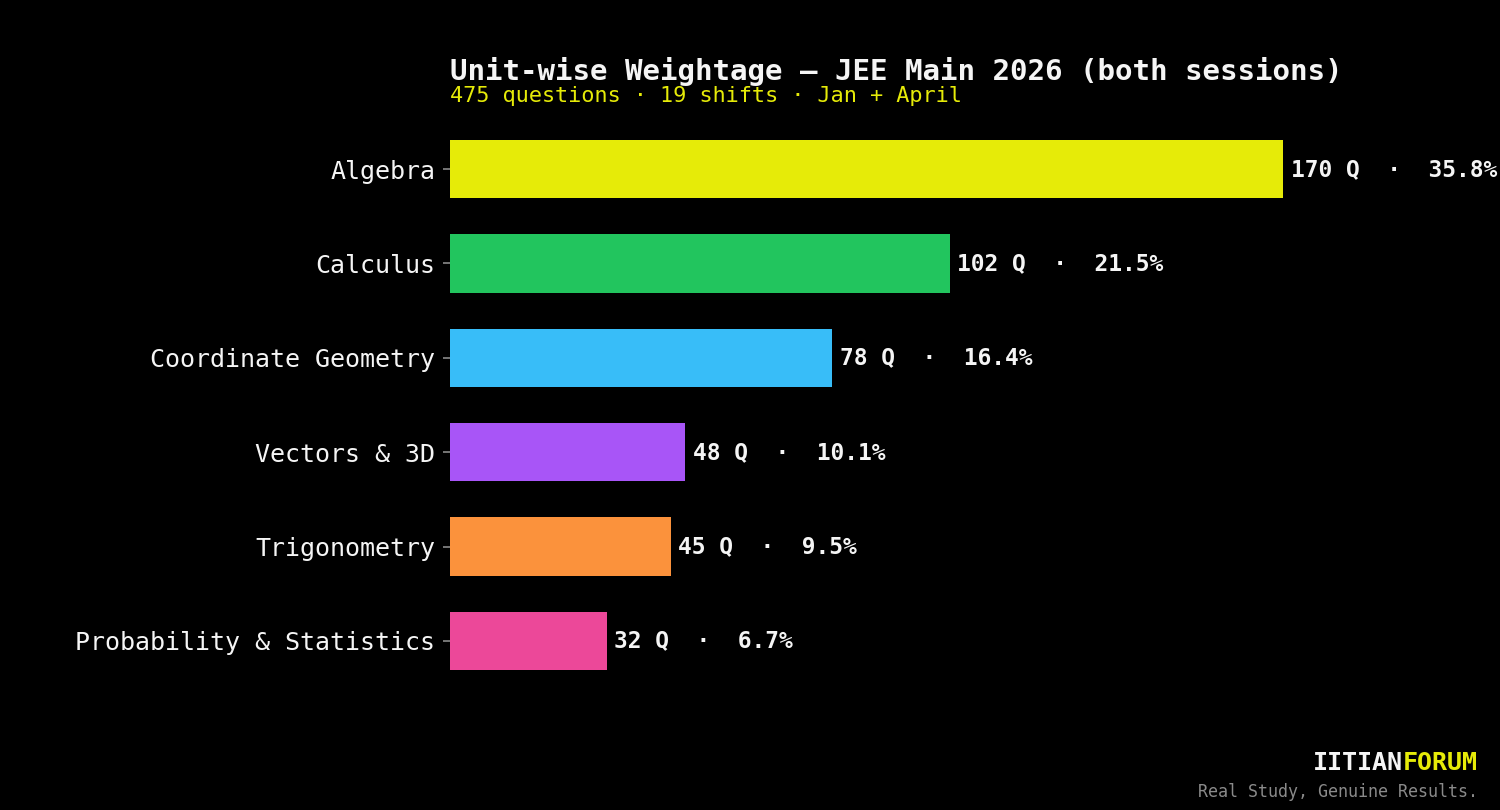
Six units, and the top two dominate everything:
- Algebra — 170 questions (36%). By far the biggest, led by Sequences & Series, Matrices & Determinants, Quadratics and Sets/Relations/Functions.
- Calculus — 102 questions (21%). Definite Integration alone is a top-two chapter; Limits/Continuity/Differentiability and Area appear every shift.
- Coordinate Geometry — 78 questions (16%). Reliably one question from each conic, plus Straight Lines.
- Vectors & 3D — 48 questions (10%).
- Trigonometry — 45 questions (9%).
- Probability & Statistics — 32 questions (7%).
Algebra + Calculus together = 57% of the entire paper. If your foundation in these two units is weak, no amount of clever last-minute work can rescue your score.
The high-yield chapters
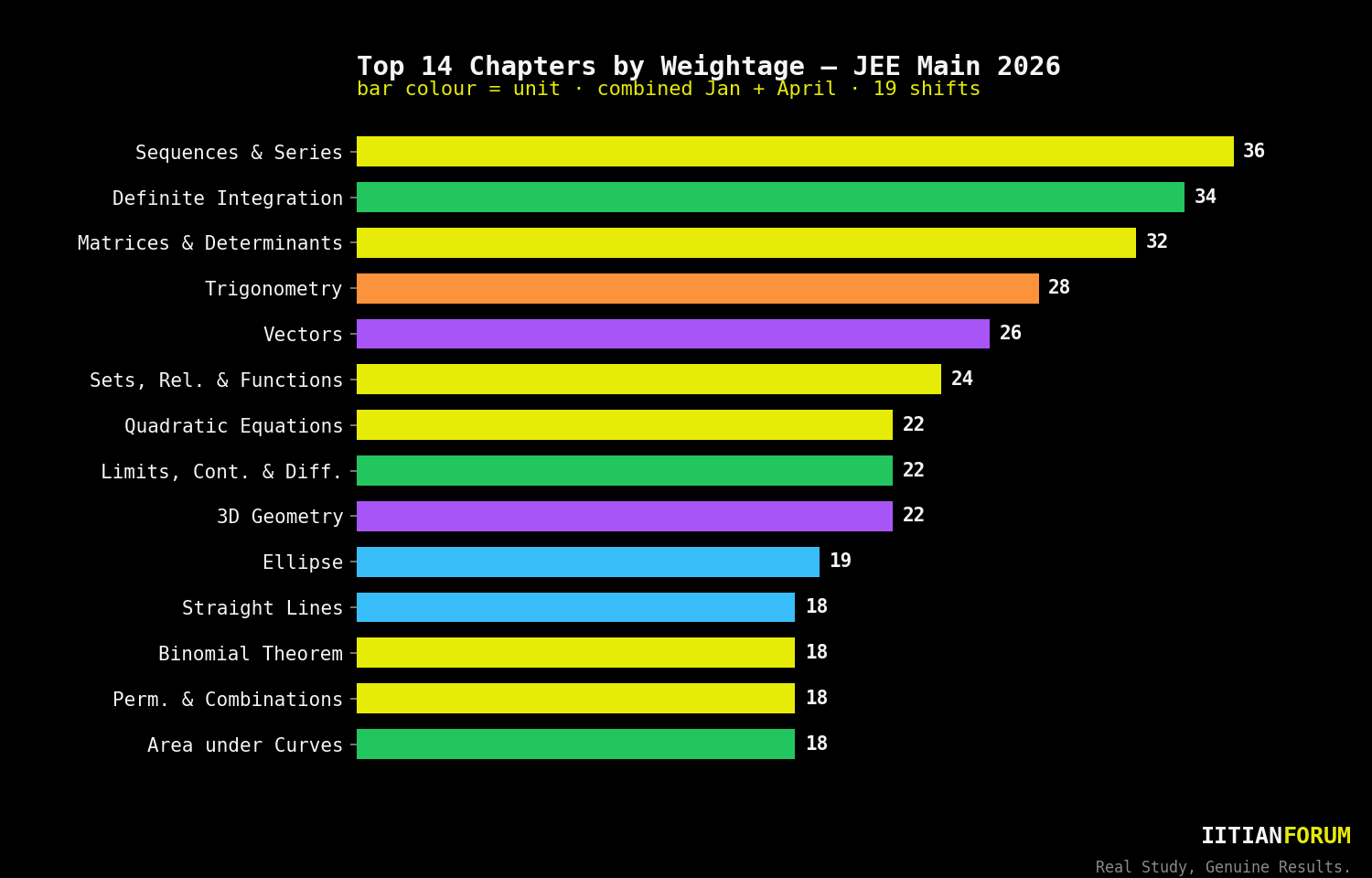
Across 475 questions, these are the chapters that showed up most often. The top handful are non-negotiable:
| Rank | Chapter | Questions | Unit |
|---|---|---|---|
| 1 | Sequences & Series | 36 | Algebra |
| 2 | Definite Integration | 34 | Calculus |
| 3 | Matrices & Determinants | 32 | Algebra |
| 4 | Trigonometry | 28 | Trigonometry |
| 5 | Vectors | 26 | Vectors & 3D |
| 6 | Sets, Relations & Functions | 24 | Algebra |
| 7 | Quadratic Equations | 22 | Algebra |
| 7 | Limits, Continuity & Differentiability | 22 | Calculus |
| 7 | 3D Geometry | 22 | Vectors & 3D |
| 10 | Ellipse | 19 | Coordinate Geometry |
| 11 | Straight Lines | 18 | Coordinate Geometry |
| 11 | Binomial Theorem | 18 | Algebra |
| 11 | Permutations & Combinations | 18 | Algebra |
| 11 | Area under Curves | 18 | Calculus |
The top eight chapters alone account for over half of all questions. Master these and you have secured the backbone of the paper.
How hard was it, really?
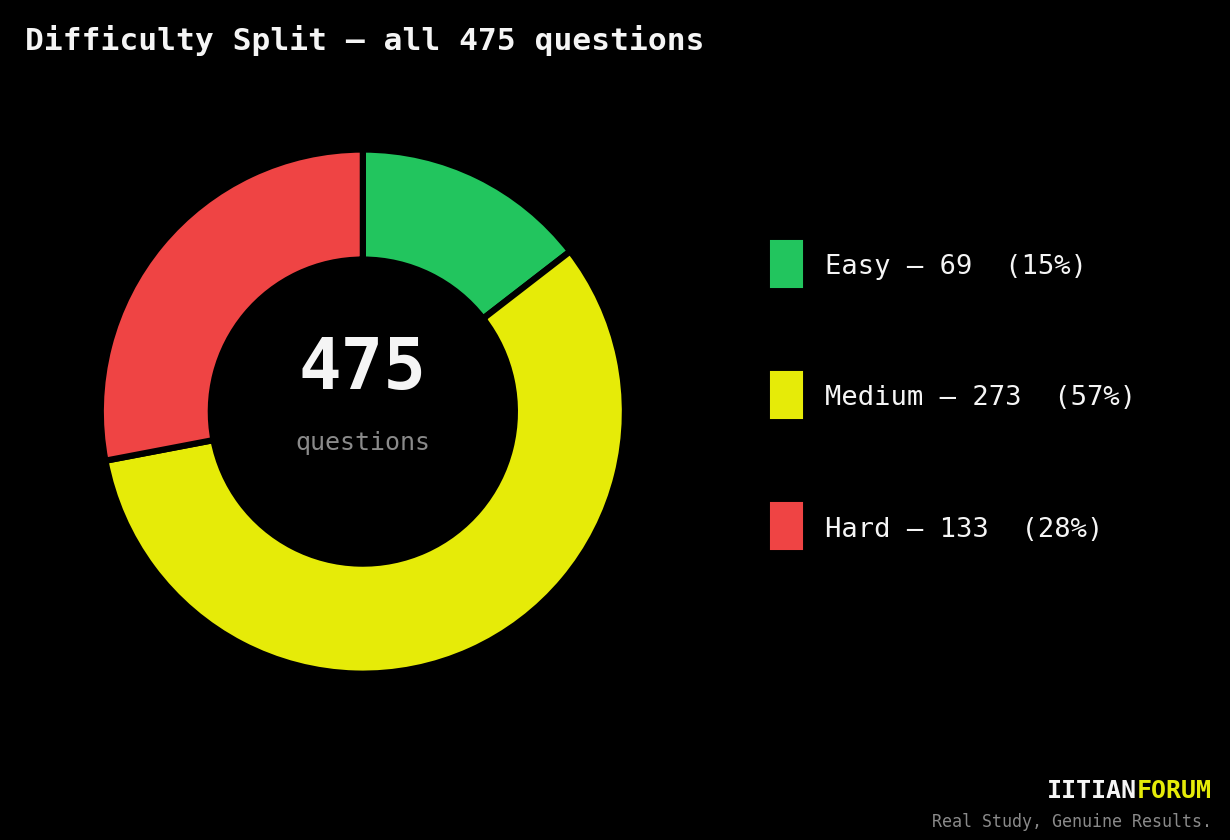
| Level | Questions | Share |
|---|---|---|
| Easy | 69 | 15% |
| Medium | 273 | 57% |
| Hard | 133 | 28% |
More than half the paper sits at medium. That is the crucial insight: JEE Main Mathematics is not primarily a test of solving the hardest problem — it is a test of converting a large block of routine, medium-difficulty questions quickly and without error. Accuracy compounds far faster than raw brilliance.
Section A vs Section B
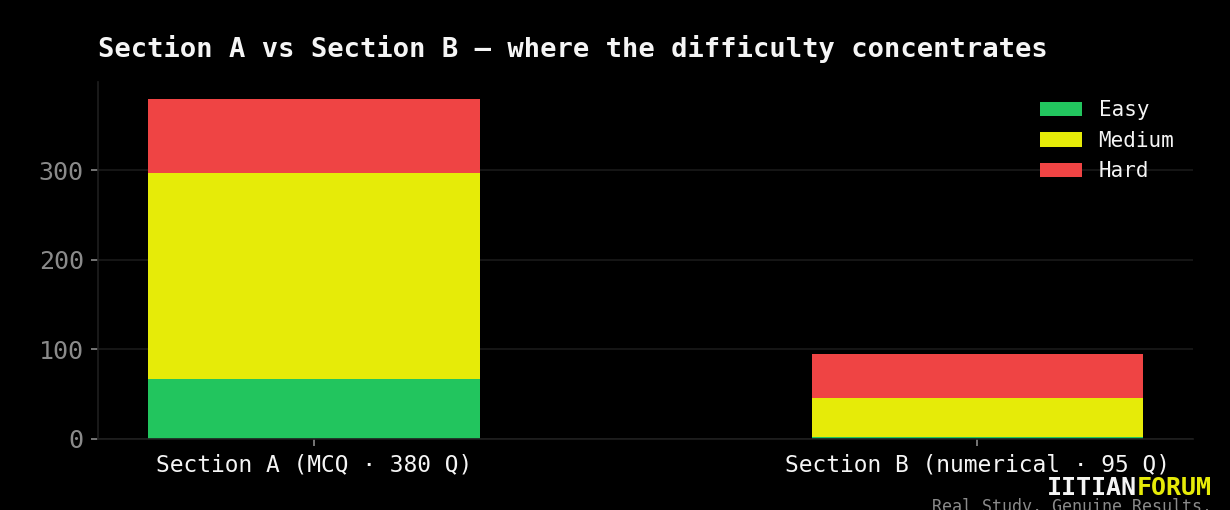
The difficulty is not spread evenly. The five numerical questions per shift (Section B) are where the paper bites:
- Section A (MCQ, 380 questions): mostly easy/medium — only about 22% hard.
- Section B (numerical, 95 questions): over half are hard, and easy ones are almost non-existent.
Practical takeaway: treat the numerical section as a separate, harder exam. Bank Section A cleanly first, then spend your remaining time on the back five.
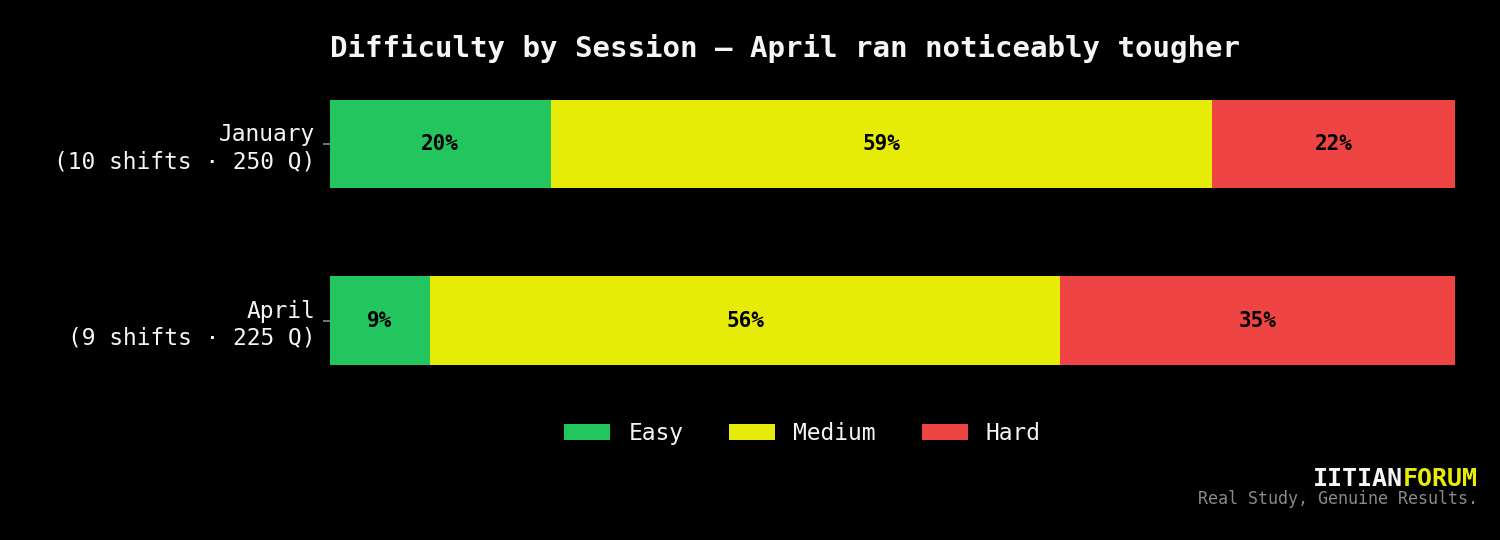
January vs April: the papers got harder
Chapter strategy: where to spend your hours
Must-master (high weightage, appears every shift): Sequences & Series, Definite Integration, Matrices & Determinants, Trigonometry, Vectors, Quadratics. These are your bread and butter — if any is weak, fix it first.
High marks-per-minute (reliable and not too hard): Sets/Relations/Functions, Parabola, Inverse Trigonometry, Application of Derivatives tend to be gettable. Strong revision here pays off fast.
Handle-with-care (lower weightage but tough when they appear): Differential Equations and Straight Lines lean hard; Definite Integration and Section-B numericals need timed practice, not just theory.
Don't over-invest: low-frequency chapters like Number Theory, Indefinite Integration and Differentiation appear rarely — cover the basics, but don't let them eat time that belongs to the top eight.
The five things to remember
- Algebra + Calculus = 57% of the paper. Everything else is secondary. Fix these two units first.
- The top 8 chapters are over half of all questions. Rank your prep against them ruthlessly.
- 57% of questions are medium. Ranks are won by accuracy and speed on routine problems, not by heroics.
- Section B is the difficulty spike. The five numericals per shift decide the top scores — practise them under a timer.
- April was harder than January. Prepare for the tougher end of the range.
FAQ
Which chapter has the highest weightage in JEE Main 2026 Maths?
Sequences & Series (36 questions across 19 shifts), followed by Definite Integration (34) and Matrices & Determinants (32).
Which unit is most important?
Algebra, at 36% of all questions, followed by Calculus at 21%. Together they are 57% of the paper.
How hard is JEE Main 2026 Maths overall?
About 15% easy, 57% medium and 28% hard. The numerical section (Section B) is significantly harder than the MCQ section.
Was the April session harder than January?
Yes — the hard-question share rose from 22% in January to 35% in April.
How was this analysis made?
Every one of the 475 Mathematics questions across both 2026 sessions (19 shifts) was independently solved and verified by IITIANFORUM, then classified by chapter, unit and difficulty. Difficulty is a solution-complexity estimate, not an official rating.
This is our master weightage report — bookmark it. For the full question-by-question breakdown of any single shift, see the individual shift analyses on IITIANFORUM, and download the complete verified report PDF below.
Enter your email to get the download.
Ritesh Raj
Founder and Lead Mentor at IITian Forum. M.Sc Mathematics, IIT Delhi. 500+ students mentored for JEE and Olympiad mathematics.