JEE Main 2026 (21 Jan, Shift 2) Maths Analysis Chapter Weightage, Difficulty & Expected Cutoff
The 21 January 2026 evening shift followed the morning paper and nudged the difficulty up a notch. The Mathematics paper was moderate-to-tough, again led by Algebra and Calculus, but with a heavier back end — 10 of the 25 questions landed in the hard bucket, most of them in the numerical section.
Here is the full breakdown: what was asked, where the marks sat, how hard it really was, and roughly what a good attempt looked like.
The paper at a glance
| Field | Detail |
|---|---|
| Exam | JEE Main 2026 · 21 Jan · Shift 2 (Evening) |
| Questions | 25 (Q1–Q20 single-correct MCQ, Q21–Q25 numerical) |
| Marks | 100 (+4 correct, –1 wrong on MCQs; no negative on numericals) |
| Overall difficulty | Moderate, leaning tough |
| Biggest units | Algebra (40 marks) · Calculus (24 marks) |
| Toughest questions | Q19, Q21, Q23, Q24 |
| Answer key | Independently verified — no errors found |
Overall verdict
Like the morning slot, the single-correct section stayed mostly medium, but the numerical section (Q21–Q25) was brutal — all five were hard, spanning a greatest-integer Riemann sum, an inverse-trig maximisation, an arccot integral and a slick binomial-reciprocal product. Algebra was even more dominant than the morning, taking 40 of 100 marks. A student who was quick and accurate on algebra could build a big score before ever touching the hard numericals.
Bank the 2 easy + 13 medium questions first (that's already 60/100), then spend what's left on the 10 hard ones. Q19, Q21, Q23 and Q24 were the biggest time sinks save them for last.
Unit-wise weightage
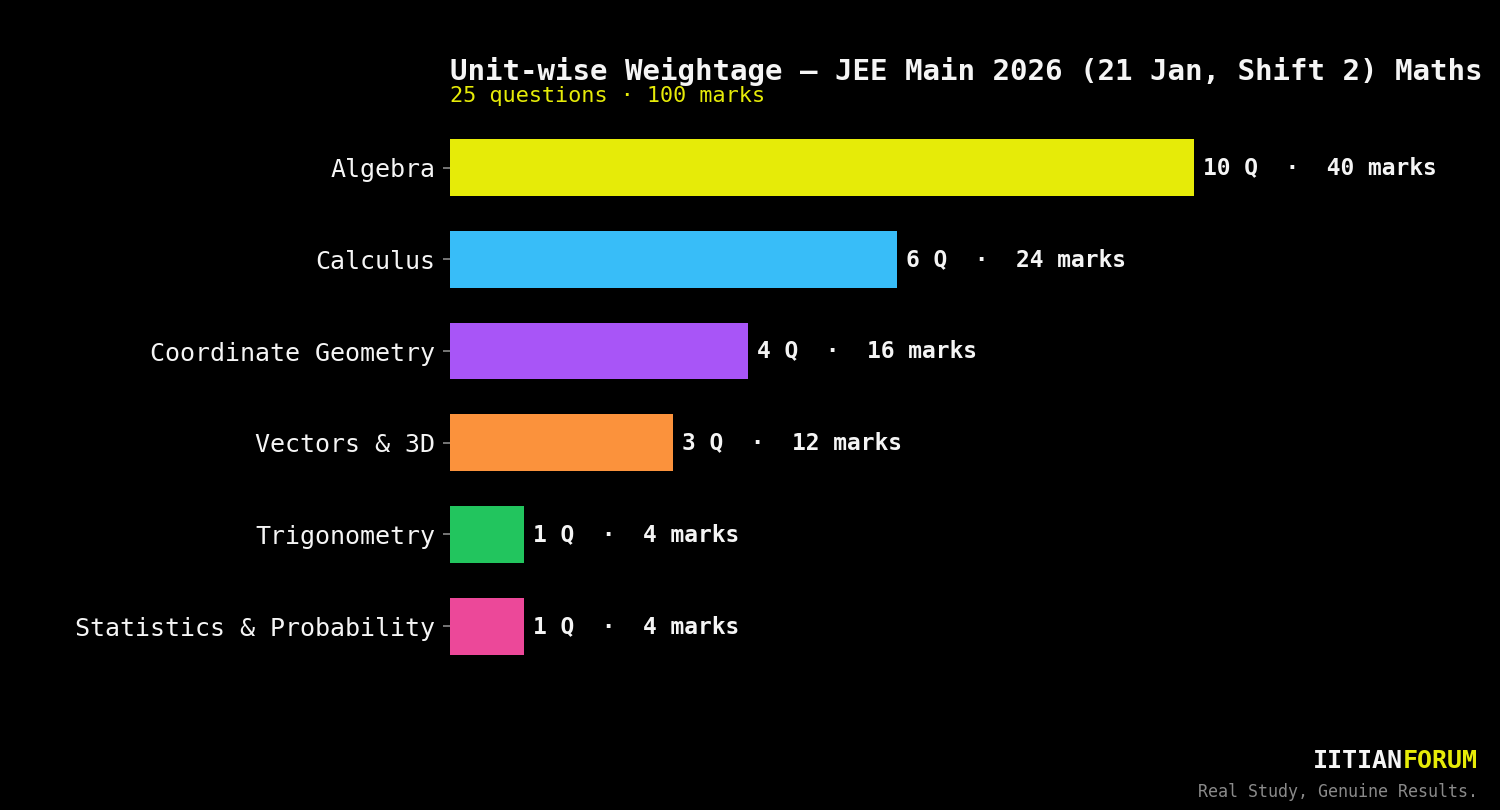
- Algebra — 10 questions · 40 marks. The clear giant: two Sequences, two Sets & Relations, two Matrices, plus Theory of Equations, Complex Numbers, Permutations & Combinations and Binomial.
- Calculus — 6 questions · 24 marks. Limits, Application of Derivatives, Methods of Differentiation, Area, a Differential Equation and a Definite Integral.
- Coordinate Geometry — 4 questions · 16 marks. Ellipse, two Parabola and a Circle.
- Vectors & 3D — 3 questions · 12 marks. One vectors (triangle cross-product) and two 3D problems.
- Trigonometry — 1 question · 4 marks (inverse-trig maximisation).
- Statistics & Probability — 1 question · 4 marks.
Algebra + Calculus = 64 of 100 marks — an even stronger concentration than the morning shift.
Chapter weightage
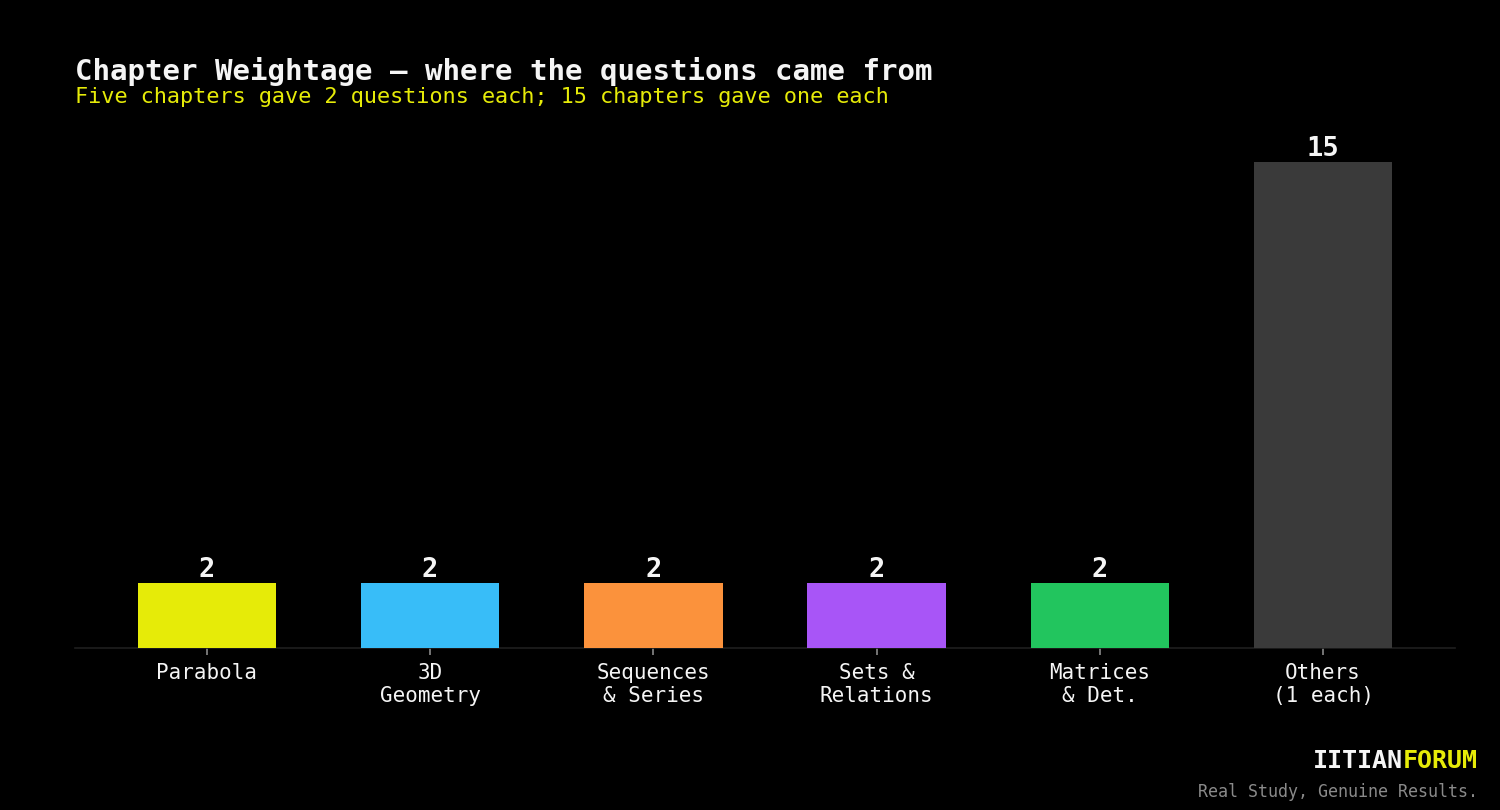
Five chapters gave two questions each — Sequences & Series, Parabola, 3D Geometry, Sets & Relations and Matrices & Determinants while 15 other chapters gave exactly one. As in the morning, the paper rewarded breadth over depth.
| Chapter | Questions | Marks |
|---|---|---|
| Sequences & Series | 2 | 8 |
| Parabola | 2 | 8 |
| 3D Geometry | 2 | 8 |
| Sets & Relations | 2 | 8 |
| Matrices & Determinants | 2 | 8 |
| 15 other chapters | 1 each | 4 each |
Difficulty split
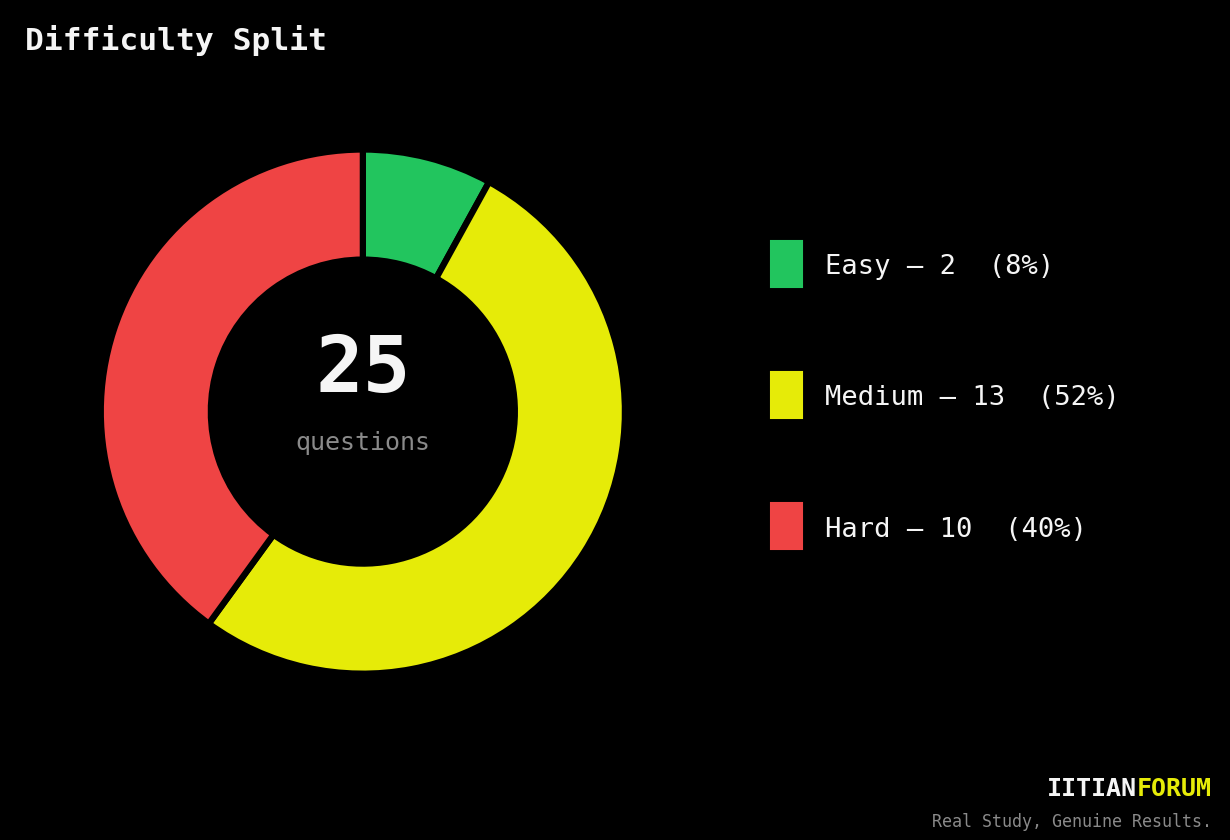
| Level | Questions | Share |
|---|---|---|
| Easy | 2 | 8% |
| Medium | 13 | 52% |
| Hard | 10 | 40% |
At 40%, the hard share edged above the morning's 36%. The two easy questions — Q13 (set operations) and Q20 (power of 7 in 101!) — were pure gifts; everything else needed real work.
The four questions that decided the paper
Q19 — Complex number with maximum argument (Hard). Geometry, not algebra, cracked it: the point of maximum argument on a disc is where the tangent from the origin touches.
▸ SHOW SOLUTION
For with maximum positive argument, is the tangent point , so . Then and , giving . Answer: (4).
Q21 — Greatest-integer Riemann sum (Hard). A limit that looks impossible until you squeeze the floor function away.
▸ SHOW SOLUTION
is squeezed to , so . Then . Answer: 2.
Q23 — Maximum of (Hard). The identity turns it into a single-variable parabola.
▸ SHOW SOLUTION
The expression . With , the max is at : , so . Answer: 65.
Q24 — Product of binomial reciprocals (Hard). One neat identity collapses a 13-factor product.
▸ SHOW SOLUTION
. The product over is , so and . Answer: 32.
Every answer on this shift was independently re-derived and verified by IITIANFORUM — no key errors found.
Expected good attempt & cutoff read
Directional only — actual percentiles depend on normalisation across shifts:
- Excellent (top percentile): 21+ correct with clean numericals.
- Strong: 17–20 correct.
- Safe: 13–16 correct — bank every easy and medium question.
With the hard share at 40%, this shift punished slow starts. Speed on the algebra MCQs was the single biggest lever.
What to take away for your prep
- Algebra was 40% of the paper. Sequences, Sets, Matrices and Binomial all showed up — none are optional.
- Parabola appeared twice. Conics remain the most reliable coordinate-geometry marks.
- The numerical section was a wall. Every Section-B question was hard — greatest-integer limits, inverse-trig maxima and binomial identities need pattern practice, not just formula recall.
FAQ
How difficult was JEE Main 2026 Maths on 21 January Shift 2?
Moderate, leaning tough — a shade harder than the morning shift, with 10 of 25 questions rated hard and every Section-B numerical hard.
Which chapters had the highest weightage?
Sequences & Series, Parabola, 3D Geometry, Sets & Relations and Matrices & Determinants — two questions each. Algebra was the biggest unit at 40 marks.
What were the toughest questions?
Q19 (complex number, max argument), Q21 (greatest-integer Riemann sum), Q23 (max of arcsin²+arccos²) and Q24 (product of binomial reciprocals).
Were there any errors in the answer key?
No — every answer was independently verified.
Want the fully worked, step-by-step solution to all 25 questions of this shift? Practise these exact chapters on IITIANFORUM and download the complete verified solutions PDF below.
Enter your email to get the download.
Ritesh Raj
Founder and Lead Mentor at IITian Forum. M.Sc Mathematics, IIT Delhi. 500+ students mentored for JEE and Olympiad mathematics.