JEE Main 2026 (22 Jan, Shift 1) Maths Analysis Chapter Weightage, Difficulty & Expected Cutoff
The 22 January 2026 morning shift eased off slightly from the 21 January papers. The Mathematics section was moderate Algebra and Calculus still led, but with only 7 hard questions out of 25, a prepared student had real room to score. The difficulty, as usual, was concentrated in the numerical back five.
Here is the full breakdown: what was asked, where the marks sat, how hard it really was, and roughly what a good attempt looked like.
The paper at a glance
| Field | Detail |
|---|---|
| Exam | JEE Main 2026 · 22 Jan · Shift 1 (Morning) |
| Questions | 25 (Q1–Q20 single-correct MCQ, Q21–Q25 numerical) |
| Marks | 100 (+4 correct, –1 wrong on MCQs; no negative on numericals) |
| Overall difficulty | Moderate |
| Biggest units | Algebra (32 marks) · Calculus (24 marks) |
| Toughest questions | Q16, Q21, Q22, Q25 |
| Answer key | Independently verified — one booklet typo noted (Q16) |
Overall verdict
This was the friendliest of the first four January shifts. The single-correct section (Q1–Q20) stayed comfortably in medium territory, with two clear easy marks (Q2 relations, Q20 AP). The numerical section again carried the weight — four of the five were hard, spanning complex numbers, matrices, integration and combinatorics. If your fundamentals were solid, this paper rewarded steady accuracy over heroics.
Bank the 2 easy + 16 medium questions first (that alone is a strong 72/100), then attack the 7 hard ones. Q16, Q21, Q22 and Q25 were the biggest time sinks — save them for last.
Unit-wise weightage
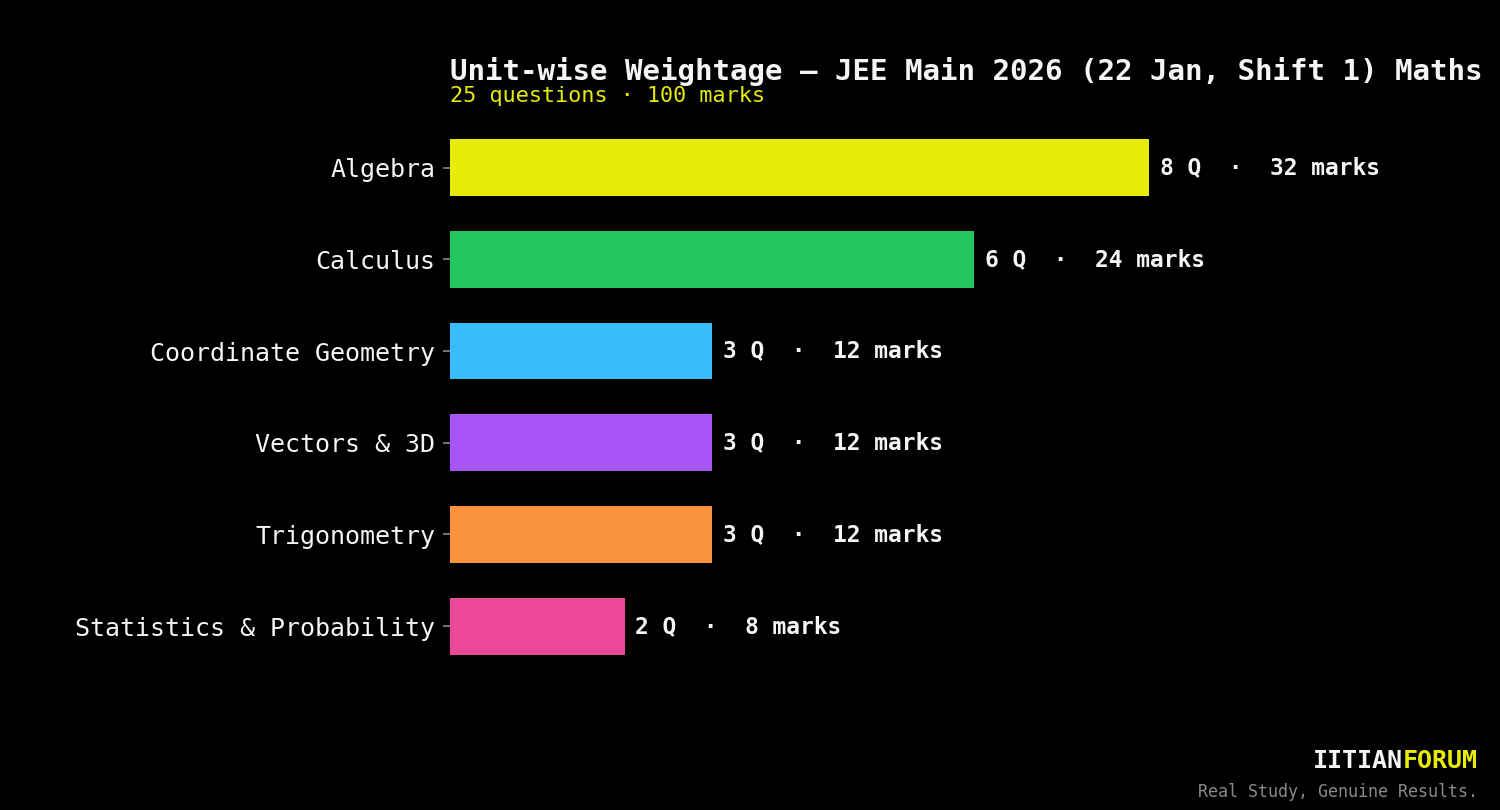
- Algebra — 8 questions · 32 marks. Sets & Relations, Quadratics, two Matrices, Binomial, Sequences, Complex Numbers and Permutations & Combinations.
- Calculus — 6 questions · 24 marks. Application of Derivatives, Area, two Differential Equations, Definite and Indefinite Integration.
- Coordinate Geometry — 3 questions · 12 marks. Hyperbola, Circle and Parabola.
- Vectors & 3D — 3 questions · 12 marks. One vectors and two 3D problems.
- Trigonometry — 3 questions · 12 marks. Two inverse-trig and one identity.
- Statistics & Probability — 2 questions · 8 marks.
Algebra + Calculus = 56 of 100 marks the usual backbone, though slightly less concentrated than 21 Jan.
Chapter weightage
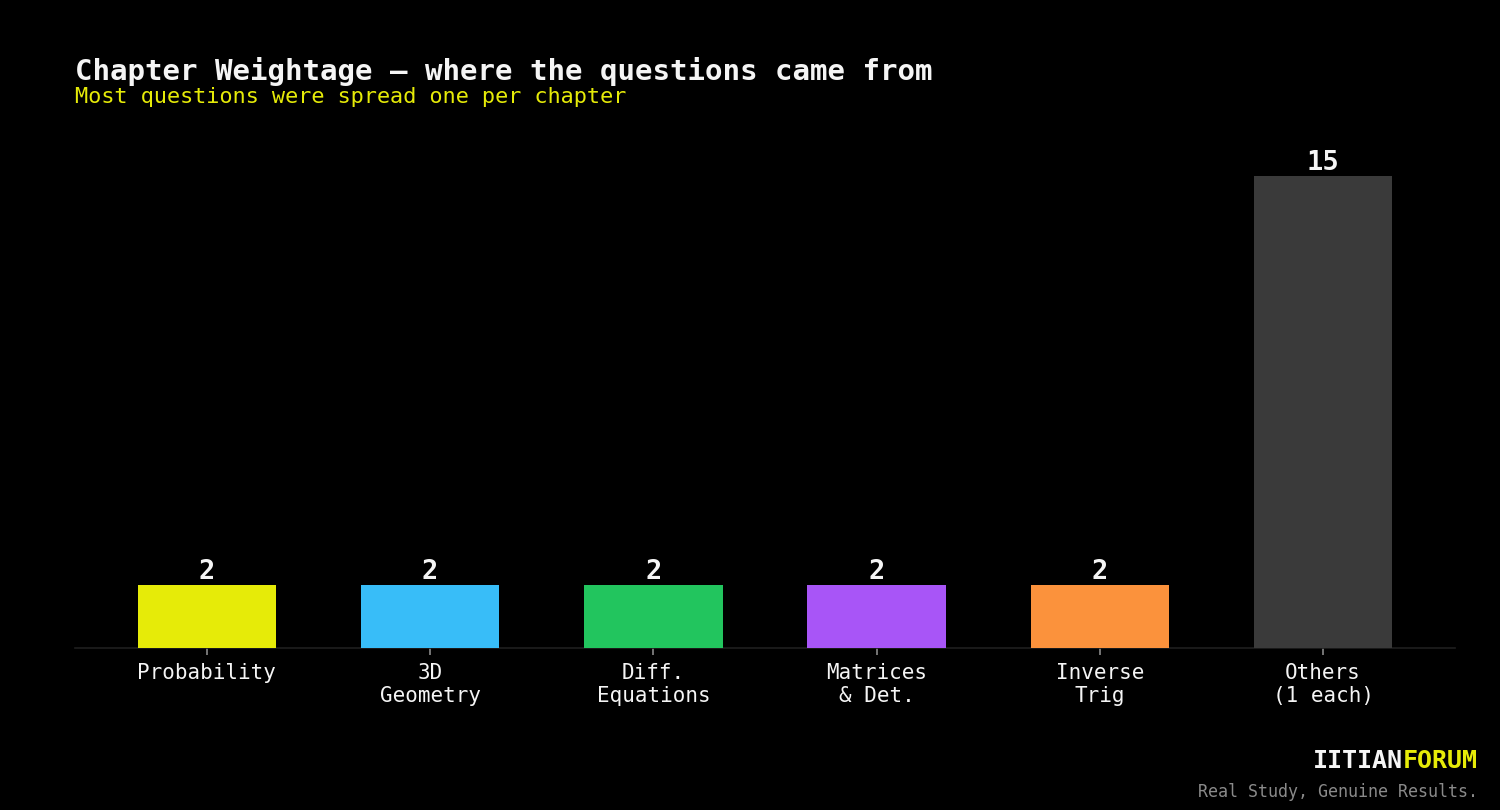
Five chapters gave two questions each Probability, 3D Geometry, Differential Equations, Matrices & Determinants and Inverse Trigonometry while 15 other chapters gave exactly one. Breadth over depth, again.
| Chapter | Questions | Marks |
|---|---|---|
| Probability | 2 | 8 |
| 3D Geometry | 2 | 8 |
| Differential Equations | 2 | 8 |
| Matrices & Determinants | 2 | 8 |
| Inverse Trigonometry | 2 | 8 |
| 15 other chapters | 1 each | 4 each |
Difficulty split
| Level | Questions | Share |
|---|---|---|
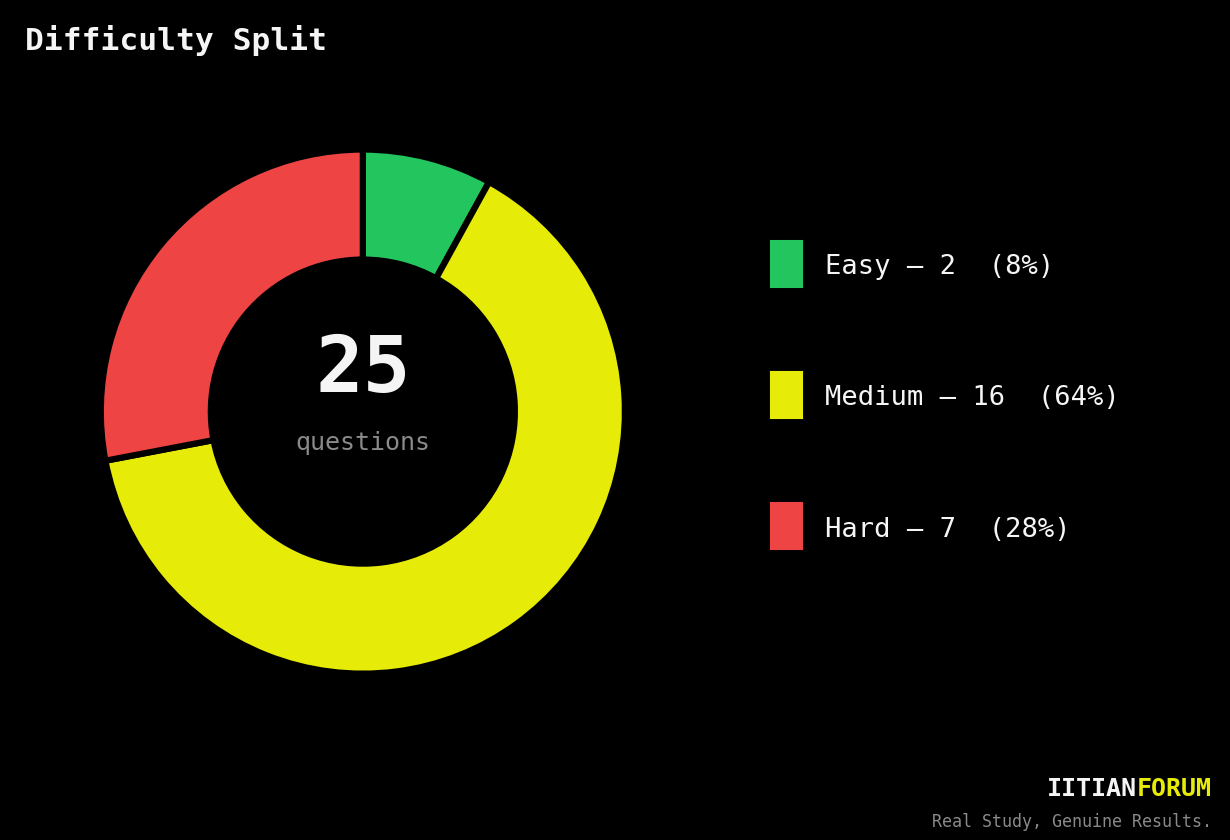
| Easy | 2 | 8% |
| Medium | 16 | 64% |
| Hard | 7 | 28% |
A 28% hard share is the lowest of the four January shifts so far. With 64% of the paper sitting at medium, this was a shift where careless mistakes not tough questions — separated scores.
The four questions that decided the paper
Q16 Coefficient of in an AGP expansion (Hard). A sum of the form has to be collapsed before you can read off a coefficient.
▸ SHOW SOLUTION
With , sums (as an AGP) to . The coefficient of comes from the term () and the term (), giving . Answer: (4).
Q21 — Cube roots of unity, power 20 (Hard). Recognising makes three of the four terms vanish.
▸ SHOW SOLUTION
Since , the fourth base is . The first three terms share a factor . So the sum , giving . Answer: 49.
Q22 — Skew-symmetric matrix + adjugate (Hard). Chained adjugate/determinant identities on a skew-symmetric matrix.
▸ SHOW SOLUTION
skew-symmetric with the given actions gives with . Then , so . Answer: 18.
Q25 — Pentagons from points on a triangle's sides (Hard). Collinearity forces at most two vertices per side.
▸ SHOW SOLUTION
A pentagon needs a split across the three sides. Summing: . Answer: 660.
Every answer on this shift was independently re-derived and verified by IITIANFORUM. In Q16 the correct expression is ; a printed would be a booklet typo.
Expected good attempt & cutoff read
Directional only actual percentiles depend on normalisation across shifts:
- Excellent (top percentile): 22+ correct with clean numericals.
- Strong: 19–21 correct.
- Safe: 15–18 correct — bank every easy and medium question.
Because this shift was so medium-heavy, accuracy was everything. On a paper like this, two silly slips cost more than a skipped hard numerical.
What to take away for your prep
- Algebra + Calculus = 56% of the paper. Even on an "easy" shift they dominate.
- Inverse Trigonometry showed up twice — a chapter students often under-practise.
- The medium band was huge (64%). On friendly shifts, ranks are decided by accuracy, not by cracking the hardest question.
FAQ
How difficult was JEE Main 2026 Maths on 22 January Shift 1?
Moderate — the friendliest of the first four January shifts, with 16 medium questions and only 7 hard.
Which chapters had the highest weightage?
Probability, 3D Geometry, Differential Equations, Matrices & Determinants and Inverse Trigonometry two questions each. Algebra was the biggest unit at 32 marks.
What were the toughest questions?
Q16 (AGP coefficient), Q21 (cube roots of unity), Q22 (skew-symmetric matrix adjugate) and Q25 (pentagons combinatorics).
Were there any errors in the answer key?
No answer-key errors.
Want the fully worked, step-by-step solution to all 25 questions of this shift? Practise these exact chapters on IITIANFORUM and download the complete verified solutions PDF below.
Enter your email to get the download.
Ritesh Raj
Founder and Lead Mentor at IITian Forum. M.Sc Mathematics, IIT Delhi. 500+ students mentored for JEE and Olympiad mathematics.