JEE Main 2026 (21 Jan, Shift 1) Maths Analysis Chapter Weightage, Difficulty & Expected Cutoff
The 21 January 2026 morning shift fired the starting gun on the JEE Main January session — and the Mathematics paper made its intentions clear early. This was a moderate-to-tough paper carried by Calculus and Algebra, with a numerical section (Q21–Q25) sharp enough to decide who walked out smiling.
Here is the full breakdown: what was asked, where the marks sat, how hard it really was, and roughly what a good attempt looked like.
The paper at a glance
| Field | Detail |
|---|---|
| Exam | JEE Main 2026 · 21 Jan · Shift 1 (Morning) |
| Questions | 25 (Q1–Q20 single-correct MCQ, Q21–Q25 numerical) |
| Marks | 100 (+4 correct, –1 wrong on MCQs; no negative on numericals) |
| Overall difficulty | Moderate, leaning tough |
| Biggest units | Algebra (36 marks) · Calculus (24 marks) |
| Toughest questions | Q7, Q20, Q21, Q25 |
| Answer key | Independently verified — no errors found |
Overall verdict
Nothing here was unfair, but nothing let you switch off either. The single-correct section (Q1–Q20) stayed mostly in medium territory — clean, single-concept problems that a prepared student clears in about two minutes each. The difficulty then spiked in the numerical section, where four of the five questions were genuinely hard and multi-step. That's the classic JEE Main structure: the paper is paced to reward students who bank the routine marks fast and save stamina for the back five.
Secure the 3 easy + 13 medium questions first (that alone is a strong 64/100), then invest the remaining time in the 9 hard ones. Q7, Q20, Q21 and Q25 were the biggest time sinks — attempt them last.
Unit-wise weightage
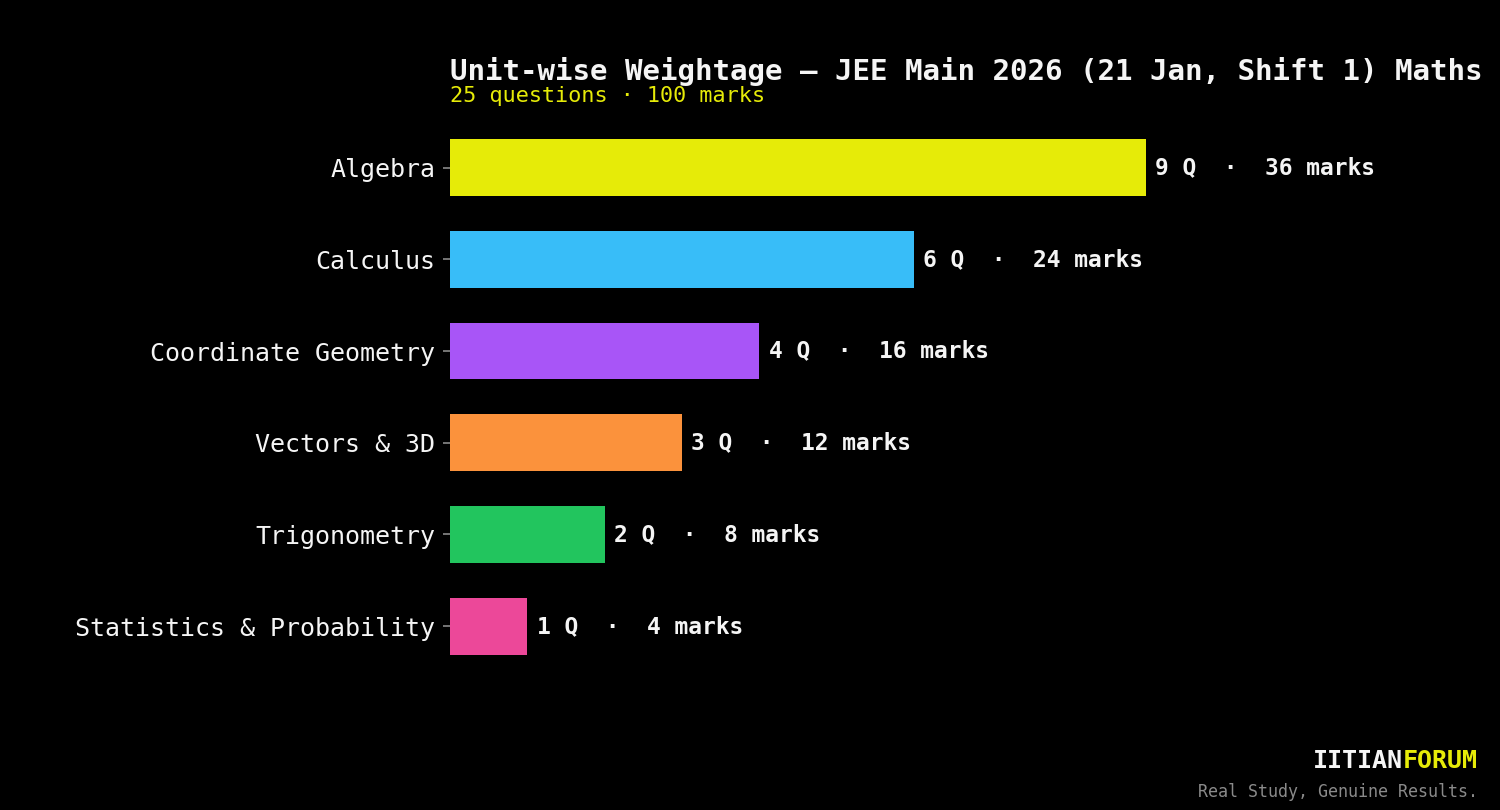
Two units did almost everything:
- Algebra — 9 questions · 36 marks. The broadest unit, spread across Sets & Relations, Complex Numbers, Quadratics, two Sequences, two Permutations & Combinations, Binomial, and Matrices.
- Calculus — 6 questions · 24 marks. Limits, Application of Derivatives, three Integration/Area problems, and one Differential Equation.
- Coordinate Geometry — 4 questions · 16 marks. Textbook distribution: one each from Straight Lines, Circle, Parabola and Hyperbola.
- Vectors & 3D — 3 questions · 12 marks. Two vectors (one fused with a circle condition) and one 3D perpendicular-foot problem.
- Trigonometry — 2 questions · 8 marks.
- Statistics & Probability — 1 question · 4 marks.
Together, Calculus + Algebra = 60 of 100 marks. That single fact is the biggest takeaway for anyone still preparing.
Chapter weightage
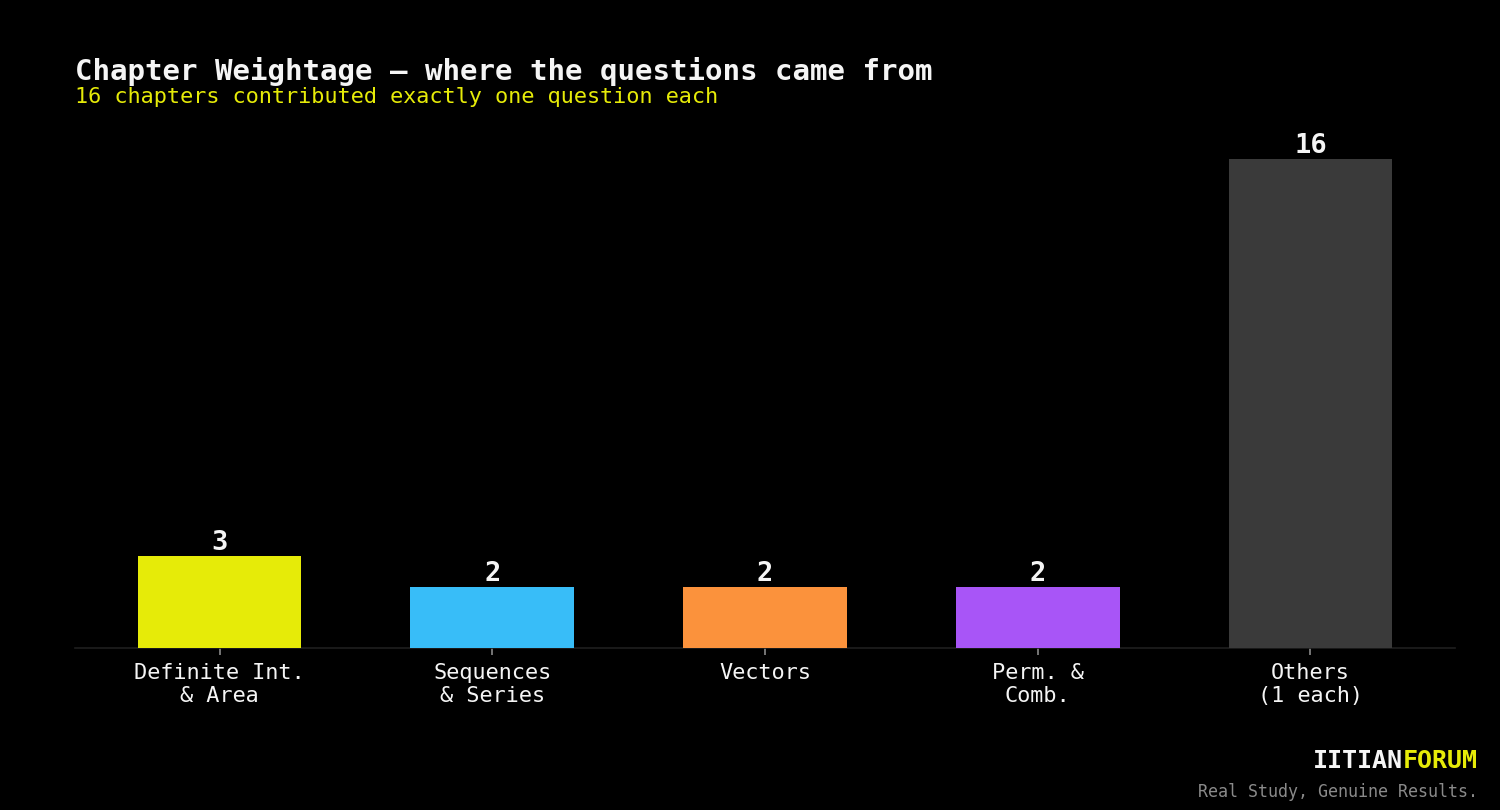
The paper spread itself wide: 16 different chapters contributed exactly one question each. Only four chapters got more than one:
| Chapter | Questions | Marks |
|---|---|---|
| Definite Integration & Area | 3 | 12 |
| Sequences & Series | 2 | 8 |
| Vectors | 2 | 8 |
| Permutations & Combinations | 2 | 8 |
| 16 other chapters | 1 each | 4 each |
The lesson: you can't "topic-select" your way through a JEE Main paper. Breadth beats depth — a student weak in even three or four chapters was leaving 12–16 marks on the table.
Difficulty split
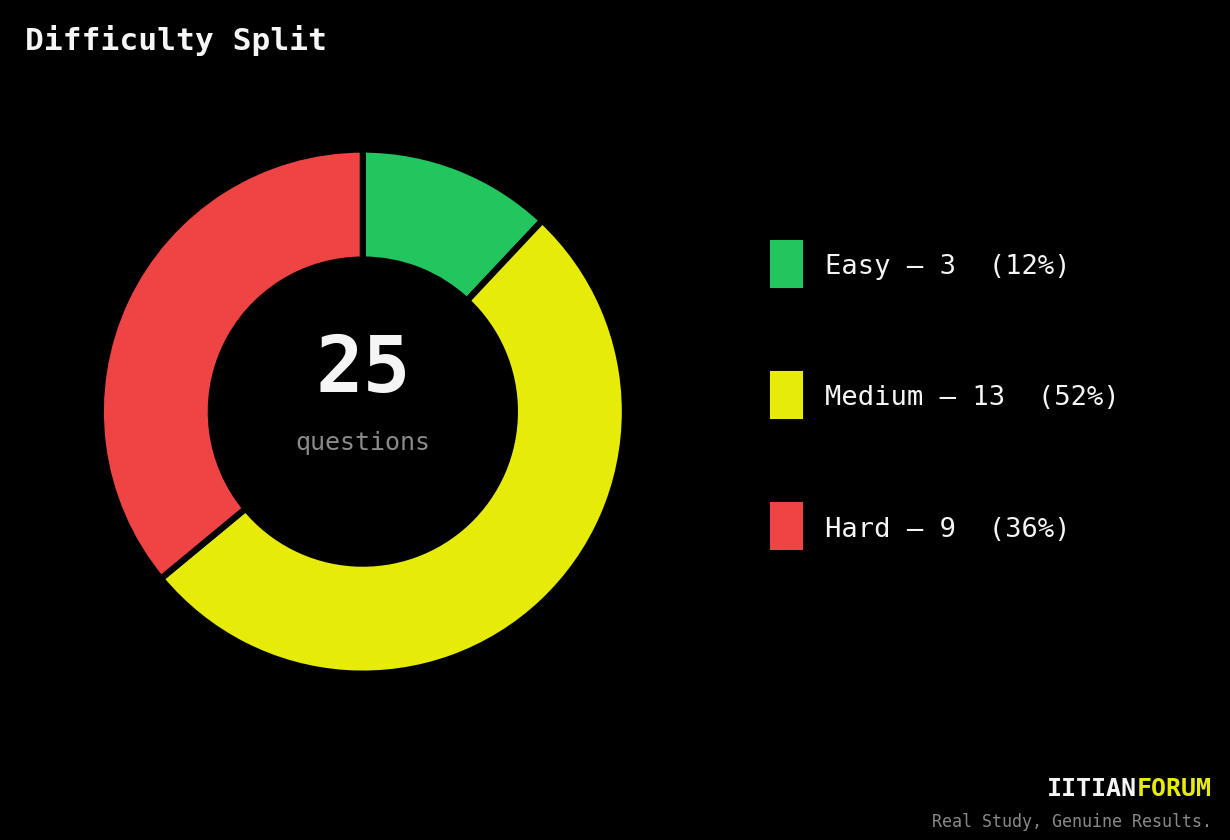
| Level | Questions | Share |
|---|---|---|
| Easy | 3 | 12% |
| Medium | 13 | 52% |
| Hard | 9 | 36% |
A 36% hard share is on the higher side for a January opening shift, and almost all of it clustered in the numerical section and the coordinate-geometry problems. The easy questions — Q2 (area), Q3 (relations) and Q19 (modulus quadratic) — were the free marks; miss those and the paper felt much harder than it was.
The four questions that decided the paper
Q7 — Vectors fused with a circle (Hard). A cross-product condition secretly fixed the direction of , which then decided when a general curve becomes a circle.
▸ SHOW SOLUTION
The condition gives , so . From , . Then , so . The conic becomes . For a circle: (so ) and (so ). Common value: . Answer: (2).
Q20 — Parabola locus + bisected chord (Hard). A dividing point traces a new parabola; then a bisected-chord condition finishes it.
▸ SHOW SOLUTION
Let on . divides in : . Eliminating gives the locus . Chord bisected at via : , i.e. . Answer: (4).
Q21 — Functional condition → monotonicity (Hard). An "equal roots for every x" clause hides a differential equation.
▸ SHOW SOLUTION
"Equal roots for all " ⟹ discriminant ⟹ ⟹ ; with , . Then , and on , so . Answer: 1.
Q25 — Modulus definite integral (Hard). A product-to-sum factorisation turns a scary integral into a clean substitution.
▸ SHOW SOLUTION
. Sub : . Split at : . Answer: 17.
Q20's printed paper duplicated an option label (re-ordered (1)–(4) here). Every answer on this shift was independently re-derived and verified by IITIANFORUM — no key errors.
Expected good attempt & cutoff read
Treat these as directional, not official — actual percentiles depend on the overall paper and normalisation across shifts:
- Excellent (top percentile): 22+ correct with clean numericals.
- Strong: 18–21 correct — all easy/medium plus a few hard.
- Safe: 14–17 correct — bank every easy and medium question.
Because the routine marks were very gettable, accuracy mattered more than raw attempts here. Two silly errors in the MCQ section cost more than one skipped hard numerical.
What to take away for your prep
- Calculus + Algebra = 60% of the paper. Weak Integration or Sequences prep is not survivable.
- Coordinate Geometry is your most bankable unit — one predictable question from each conic, every shift.
- The numerical section wins or loses papers. Practise long, multi-step problems under a timer, not just single-step drills.
FAQ
How difficult was JEE Main 2026 Maths on 21 January Shift 1?
Moderate, leaning tough. The MCQ section (Q1–Q20) was mostly medium; the numerical section (Q21–Q25) was hard, with 9 of 25 questions rated hard overall.
Which chapters had the highest weightage?
Definite Integration & Area (3 questions), followed by Sequences & Series, Vectors and Permutations & Combinations (2 each). Algebra was the biggest unit at 36 marks.
What were the toughest questions?
Q7 (vectors + circle), Q20 (parabola locus + bisected chord), Q21 (functional condition to monotonicity) and Q25 (modulus definite integral).
Were there any errors in the answer key?
No answer-key errors were found. One printed option label in Q20 was duplicated and has been re-ordered in our solutions.
Want the fully worked, step-by-step solution to all 25 questions of this shift? Practise these exact chapters on IITIANFORUM and download the complete verified solutions PDF below.
Enter your email to get the download.
Ritesh Raj
Founder and Lead Mentor at IITian Forum. M.Sc Mathematics, IIT Delhi. 500+ students mentored for JEE and Olympiad mathematics.