JEE Main 2026 (22 Jan, Shift 2) Maths Analysis Chapter Weightage, Difficulty & Expected Cutoff
The 22 January 2026 evening shift was the toughest January paper so far. The Mathematics section was moderate-to-tough and unusually top-heavy in difficulty: every one of the five Calculus questions was hard, there was barely an easy question in sight, and 9 of 25 questions landed in the hard bucket.
Here is the full breakdown: what was asked, where the marks sat, how hard it really was, and roughly what a good attempt looked like.
The paper at a glance
| Field | Detail |
|---|---|
| Exam | JEE Main 2026 · 22 Jan · Shift 2 (Evening) |
| Questions | 25 (Q1–Q20 single-correct MCQ, Q21–Q25 numerical) |
| Marks | 100 (+4 correct, –1 wrong on MCQs; no negative on numericals) |
| Overall difficulty | Moderate, leaning tough |
| Biggest units | Algebra (40 marks) · Calculus (20 marks) |
| Toughest questions | Q5, Q6, Q15, Q22 |
| Answer key | Independently verified — no errors found |
Overall verdict
This shift had no cushion. With just one genuinely easy question (Q9, a routine adjugate computation) and nine hard ones, students had to grind through a wall of medium-to-hard problems. The standout feature: all five Calculus questions were hard a Taylor-expansion limit, an ugly separable ODE, an ellipse–parabola area, a continuity problem and a fractional-part integral. Algebra, at 40 marks, was where most of the reachable marks lived.
Lock down the algebra and coordinate-geometry mediums first (that's most of a safe score), and do NOT sink time into the Calculus block early — Q5, Q6, Q15 and Q22 were designed to eat your clock.
Unit-wise weightage
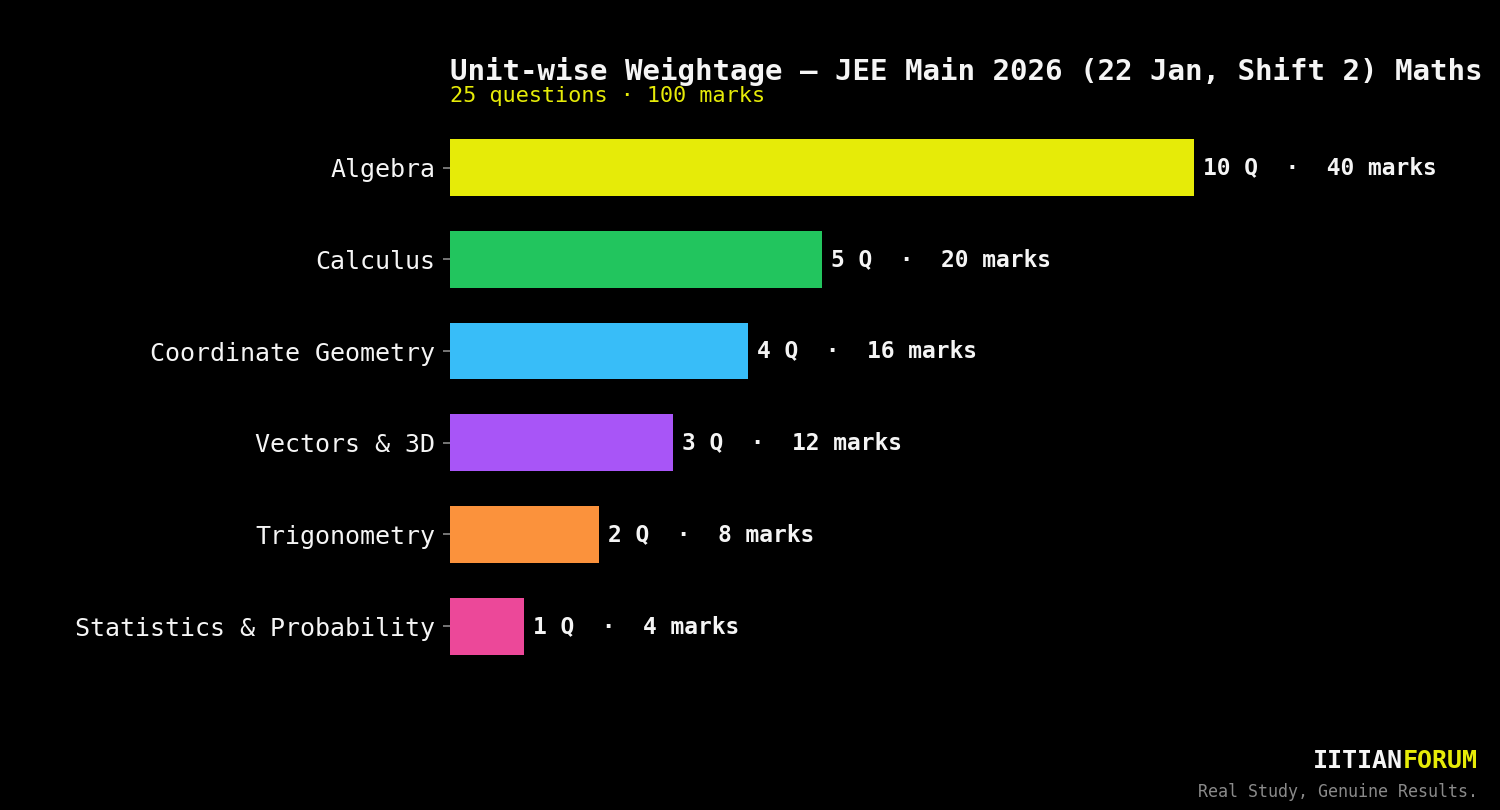
- Algebra — 10 questions · 40 marks. The dominant unit: Sets/Relations/Functions alone gave three, plus two Matrices, Complex Numbers, Theory of Equations, Binomial, Sequences and Permutations & Combinations.
- Calculus — 5 questions · 20 marks. Limits, a Differential Equation, Area, Continuity and Definite Integration all hard.
- Coordinate Geometry — 4 questions · 16 marks. Straight Lines, Hyperbola, Ellipse and Parabola — all medium.
- Vectors & 3D — 3 questions · 12 marks.
- Trigonometry — 2 questions · 8 marks (both hard).
- Statistics & Probability — 1 question · 4 marks.
Algebra + Calculus = 60 of 100 marks — but with Calculus entirely hard, Algebra was the real scoring unit.
Chapter weightage
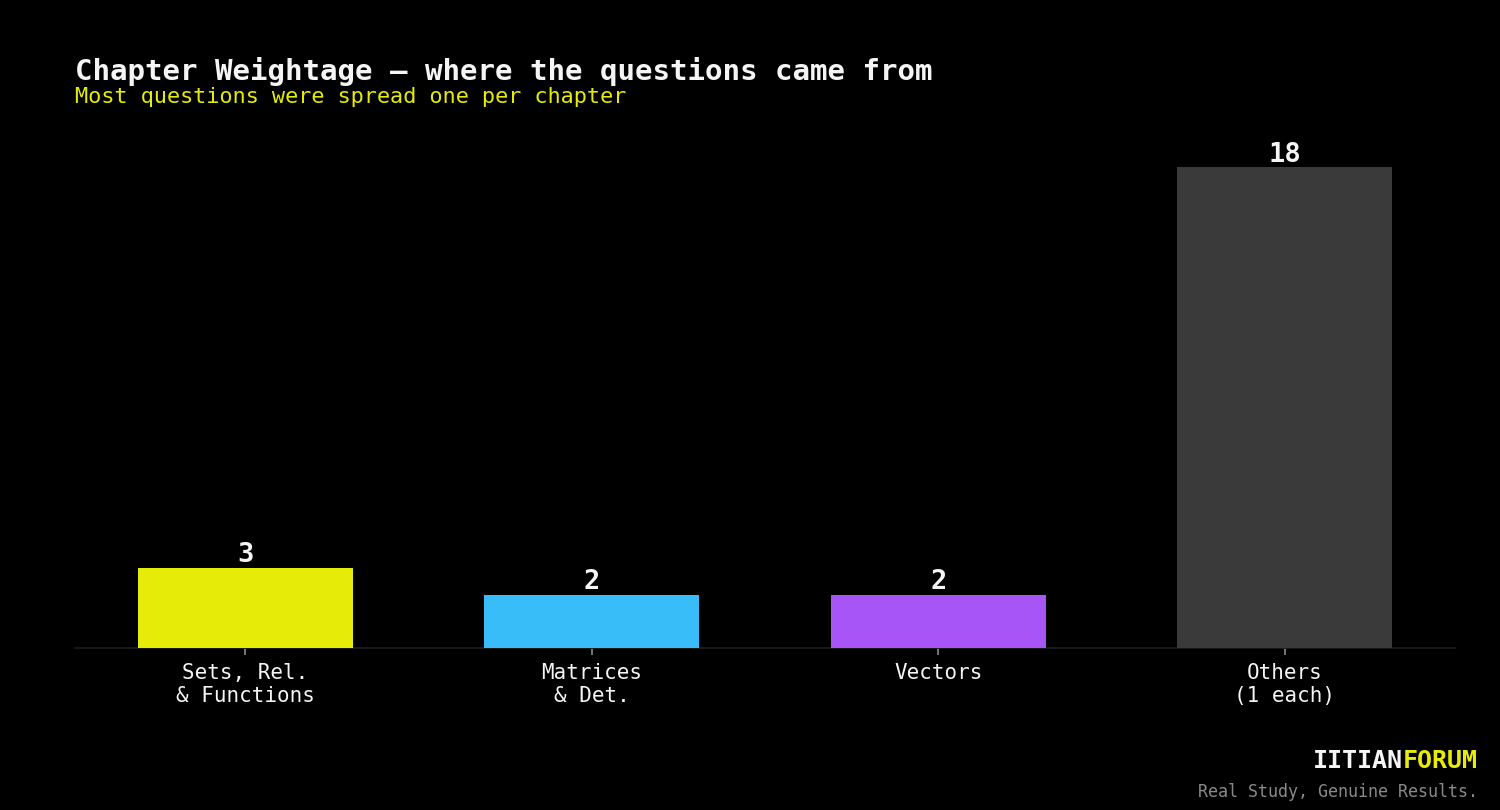
| Chapter | Questions | Marks |
|---|---|---|
| Sets, Relations & Functions | 3 | 12 |
| Matrices & Determinants | 2 | 8 |
| Vectors | 2 | 8 |
| 18 other chapters | 1 each | 4 each |
Difficulty split
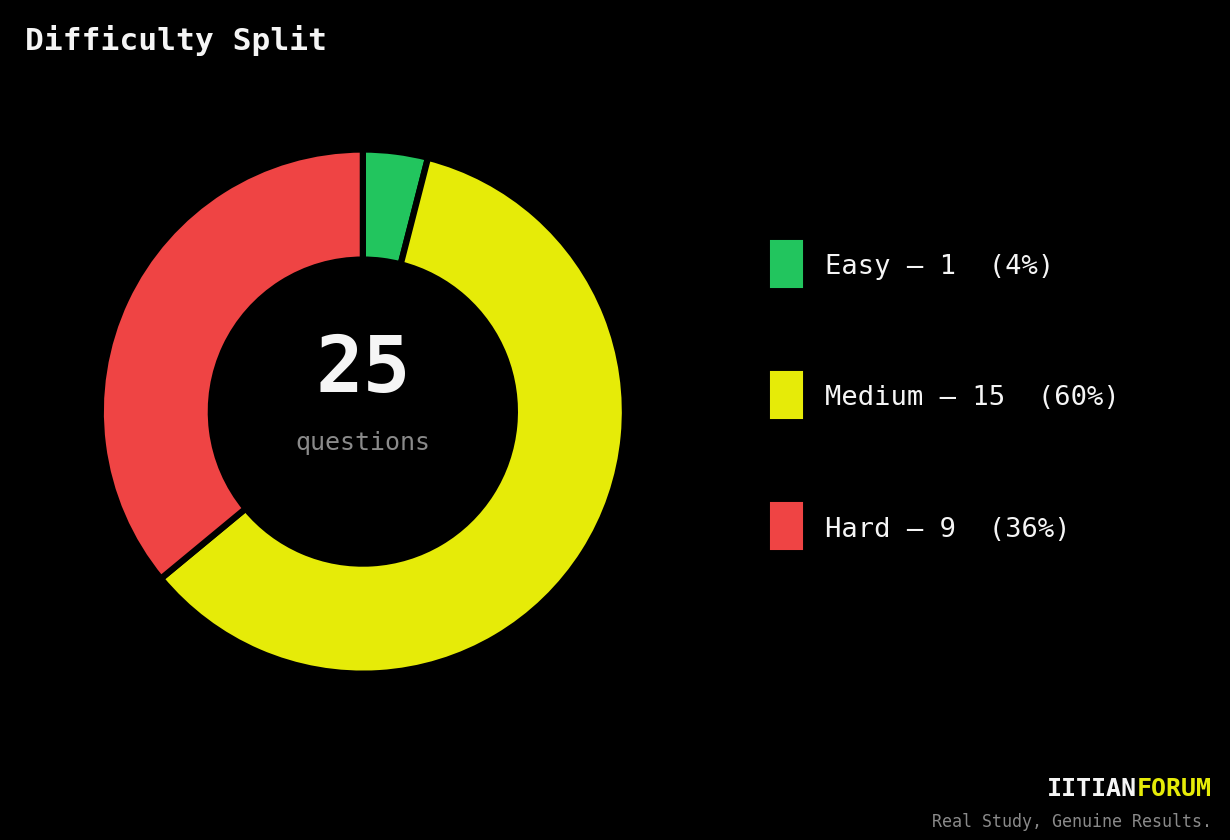
| Level | Questions | Share |
|---|---|---|
| Easy | 1 | 4% |
| Medium | 15 | 60% |
| Hard | 9 | 36% |
Only one easy question and a 36% hard share made this the steepest January shift yet (DI 2.32). The whole Calculus unit sitting in the hard band is what pushed the paper up.
The four questions that decided the paper
Q5 — Taylor-expansion limit (Hard). Three unknowns, recovered by matching successive coefficients of the series.
▸ SHOW SOLUTION
Expanding to : the constant term forces , the term forces , and matching the coefficient against the denominator's gives . So . Answer: (3).
Q6 — Separable ODE with nested radicals (Hard). The substitution is the whole battle.
▸ SHOW SOLUTION
Separating and substituting reduces the right side to ; the left is . Applying gives , and then gives , so . Answer: (1).
Q15 — Discontinuity + min function (Hard). Find where jumps, then evaluate a min at each point.
▸ SHOW SOLUTION
is discontinuous where hits an integer: . Summing over these six points gives . Answer: (3).
Q22 — Fractional-part integral × trig integral (Hard). Two integrals chained through a shared constant.
▸ SHOW SOLUTION
. The period- integrand gives . Answer: 36.
Every answer on this shift was independently re-derived and verified by IITIANFORUM — no key errors found.
Expected good attempt & cutoff read
Directional only actual percentiles depend on normalisation across shifts:
- Excellent (top percentile): 20+ correct with clean numericals.
- Strong: 16–19 correct.
- Safe: 12–15 correct — bank every medium question, don't chase the Calculus block.
With only one easy question, this shift punished poor time-management above all. Getting stuck on a hard Calculus problem early could sink an otherwise strong attempt.
What to take away for your prep
- Algebra carried 40 marks. On a hard paper it becomes your safety net Sets/Relations/Functions, Matrices and the standard algebra chapters must be automatic.
- A whole unit can go hard. Every Calculus question here was tough; you need depth, not just formula recall, in Limits, Integration and Continuity.
- Time-management wins hard shifts. When there's no easy cushion, the skill being tested is triage know when to walk away from a problem.
FAQ
How difficult was JEE Main 2026 Maths on 22 January Shift 2?
Moderate-to-tough — the hardest January shift so far, with 9 of 25 questions hard, only 1 easy, and every Calculus question rated hard (DI 2.32).
Which chapters had the highest weightage?
Sets, Relations & Functions (3 questions), followed by Matrices & Determinants and Vectors (2 each). Algebra was the biggest unit at 40 marks.
What were the toughest questions?
Q5 (Taylor-expansion limit), Q6 (separable ODE with radicals), Q15 (discontinuity + min function) and Q22 (fractional-part × trig integral).
Were there any errors in the answer key?
No every answer was independently verified.
Want the fully worked, step-by-step solution to all 25 questions of this shift? Practise these exact chapters on IITIANFORUM and download the complete verified solutions PDF below.
Enter your email to get the download.
Ritesh Raj
Founder and Lead Mentor at IITian Forum. M.Sc Mathematics, IIT Delhi. 500+ students mentored for JEE and Olympiad mathematics.