Permutations & Combinations12 questions5 PYQ
Permutations & Combinations — JEE Maths Practice Questions & Solutions
12 questions on Permutations & Combinations with full step-by-step solutions, including past-year (PYQ) problems. Free to practice.
The number of -letter words, with or without meaning, each consisting of two vowels and two consonants that can be formed from the letters of the word INCONSEQUENTIAL, without repeating any letter, is
View solution →
The number of seven-digit numbers that can be formed by using the digits and such that each digit is used at least once, is
View solution →
The number of ways of forming a queue of boys and girls such that all the girls are not together, is
View solution →
Two players and play a series of games of badminton. The player who wins games first wins the series. Assuming no game ends in a draw, the number of ways in which player wins the series is
View solution →
A box contains 5 blue, 6 yellow and 4 red balls. The number of ways of drawing 8 balls containing at least two balls of each colour is:
View solution →
If is the sum of all the possible integral values of satisfying the equation
then the number of divisors of is
View solution →
Suppose is the set of the first natural numbers. Taking , as non-empty subsets of , the number of ordered set pairs such that is ; then is equal to
View solution →
Let be the number of words which can be formed using all the letters of the word "DARJEELING" so that there are at least two consonants between any two vowels. Then match List I with List II:
View solution →
If is the number of ways in which biscuits can be distributed to five beggars seated in a row
such that no two consecutive beggars remain without biscuit, then is
View solution →
There are four colour-shifting balls of colours , , and initially. Each ball can change into any other colour or can regain its own colour at every second. The number of ways theircolours can change, if the maximum possible number of arrangements of all four balls is to be possible after second, is equal to
View solution →
points are given in a plane (as shown in the below figure): points , , lie on one
straight line and points , , , , lie on another straight line, the two lines meeting at
point . Then using these points
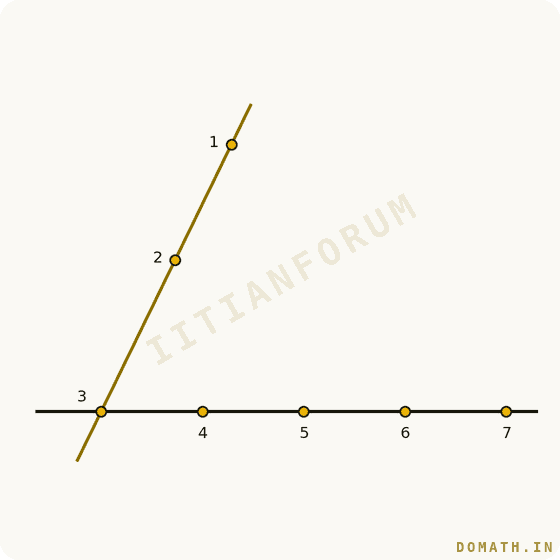
View solution →
Let be formed using the digits , each digit being used once only. If is the number of possible for which and is the number of possible for which , then is equal to (where is G.I.F.
View solution →
Practice Permutations & Combinations interactively
Sign up free to practice Permutations & Combinations with timed drills, instant solutions, bookmarks, and chapter-wise progress tracking on doMath.