Permutations & CombinationshardFree
Permutations & Combinations: Let Number Words Can Formed Using Letters Word
JEE Maths question with a full step-by-step solution.
Let be the number of words which can be formed using all the letters of the word "DARJEELING" so that there are at least two consonants between any two vowels. Then match List I with List II:
List-I
I If is divisible by , then can be
IIIf is divisible by , then must be less than
III Number of odd divisors of is greater than
IV Number of zeroes at the end of is less than
List-II
P
Q
R
S
T
AI (P, Q, R); II (Q, R, S, T); III (P, Q, R, S, T); IV (P, S, T)
BI (Q, R, T); II (P, Q, T); III (P, Q, R, S); IV (P, Q, R, S, T)
CI (P, Q, R, S, T); II (S, T); III (P, Q, R, S, T); IV (Q, R, S, T)correct
DI (P, Q, S, T); II (P, Q, R, S, T); III (P, Q, R, T); IV (P, Q, R)
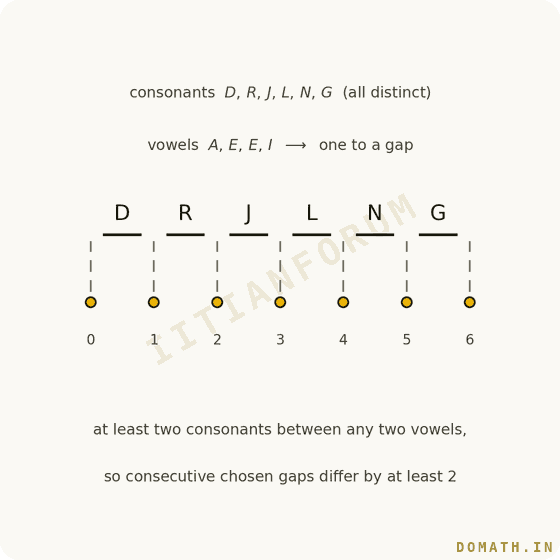 Step 1:
Step 2: Arrange the consonants in a row; they create gaps (before, between, after). Two vowels
in the same gap would be adjacent with no consonant between them, so each of the four vowels occupies a
different gap. Label the chosen gaps ; then the number of consonants
between the vowels in gaps and is exactly .
Step 3:
So , and since and , the only possibility is
i.e. the single pattern .
Step 4:
(Exhaustive enumeration of all distinct arrangements of DARJEELING confirms
.)
Step 5: Part (I), divisible by .
The exponent of is , so may be any of . Every value in List-II qualifies:
Step 6: Part (II), divisible by .
This needs (from the s) and (from the s), so . The listed values
that **must** be less than are those exceeding :
( fails because is allowed; and fail likewise.)
Step 7: Part (III), number of odd divisors. The odd part of is , with
and is greater than every value in List-II:
Step 8: Part (IV), number of trailing zeroes of .
ends in exactly one zero (equivalently of the exponents of and is
). The listed values it is **less than** are ; the bound is excluded, since
is false:
Step 9:
which is code (3).
Answer: (3)
Permutations & Combinations · medium
If is the number of ways in which biscuits can be distributed to five beggars seated in a row such that no two consecutive beggars remain without biscuit, then is
Permutations & Combinations · hard
If is the sum of all the possible integral values of satisfying the equation then the number of divisors of is
Permutations & Combinations · medium
There are four colour-shifting balls of colours , , and initially. Each ball can change into any other colour or can regain its own colour at every second. The number of ways theircolours can change, if the maximum possible number of arrangements of all four balls is to be possible after second, is equal to
Permutations & Combinations · hard
Suppose is the set of the first natural numbers. Taking , as non-empty subsets of , the number of ordered set pairs such that is ; then is equal to
Solve more, learn faster
Sign up free to solve more JEE Maths questions and explore doMath — timed drills, mastery sprints, bookmarks, and chapter-wise progress tracking.