Permutations & CombinationsmediumFree
Lines, triangles, quadrilaterals and circles from 7 points | JEE Advanced
JEE Maths question with a full step-by-step solution.
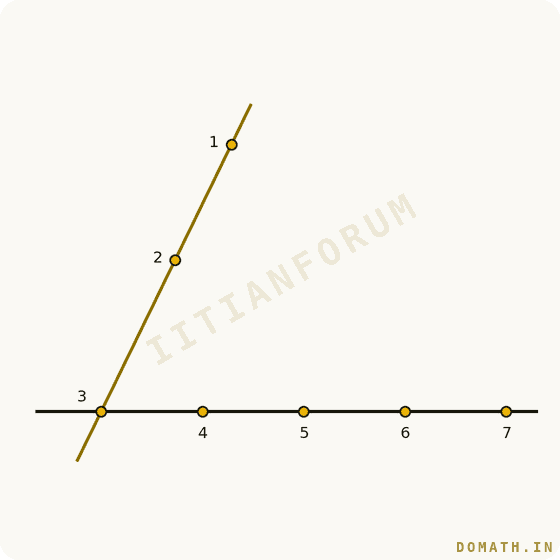
points are given in a plane (as shown in the below figure): points , , lie on one
straight line and points , , , , lie on another straight line, the two lines meeting at
point . Then using these points
ANumber of lines that can be formed is .correct
BNumber of triangles that can be formed is .correct
CNumber of quadrilateral that can be formed is .correct
DMaximum number of circles that can be formed is , where each circle contains atleast three of pointscorrect
Step 1:
overlapping in the single point . Apart from these, no three of the seven are collinear.
Step 2: (1) Each pair determines a line, but the collinear sets are over-counted:
The pairs inside all give one line, so subtract and add back ; likewise for
. (1) holds.
Step 3: (2) Choose points, discarding collinear triples:
**(B) holds.**
Step 4: (3) A quadrilateral needs four of the points with no three of them collinear. Let be the
number chosen from , the number from , and if
point is chosen. Being on means being counted by ; on , by . We need
is or , so the two cases below are all of them.
- : then and , so . Impossible, point can never be
a vertex.
: then , and , forcing :
(3) holds.
Step 5: (4) A circle is determined by three non-collinear points, and two different triples give the same
circle only when four or more of the points happen to be concyclic. The maximum possible count is
therefore the number of non-collinear triples:
(4) holds, equal to the triangle count for exactly that reason.
(Direct enumeration over the seven points, with and as
the only collinear sets, confirms lines, triangles and quadrilaterals.)
Answer: (1), (2), (3) and (4)
Permutations & Combinations · medium
If is the number of ways in which biscuits can be distributed to five beggars seated in a row such that no two consecutive beggars remain without biscuit, then is
Permutations & Combinations · hard
If is the sum of all the possible integral values of satisfying the equation then the number of divisors of is
Permutations & Combinations · medium
There are four colour-shifting balls of colours , , and initially. Each ball can change into any other colour or can regain its own colour at every second. The number of ways theircolours can change, if the maximum possible number of arrangements of all four balls is to be possible after second, is equal to
Permutations & Combinations · hard
Suppose is the set of the first natural numbers. Taking , as non-empty subsets of , the number of ordered set pairs such that is ; then is equal to
Solve more, learn faster
Sign up free to solve more JEE Maths questions and explore doMath — timed drills, mastery sprints, bookmarks, and chapter-wise progress tracking.