HOME/NOTES/CONCEPT

Vectors for JEE: Dot, Cross and Triple Products with Every 2026 PYQ

Ritesh Raj · 1 Nov 2026
Aa
24 min read18 sectionsConcept

A vector carries two pieces of information at once, a size and a direction. That is why a single vector equation can say what three ordinary equations say, and why so many JEE questions that look like heavy coordinate work collapse in two lines once they are written with vectors.

This note builds the chapter in the order the methods depend on each other: what a vector is, components and direction cosines, the dot product, vectors in the plane of two given vectors, the cross product and vector equations, the scalar triple product, the vector triple product, and geometry done with vectors. Every JEE Main 2026 vector question is here, placed where its method lives, along with a JEE Advanced 2026 question, and every answer was re-derived from scratch.

What a vector is

A scalar has magnitude only (length, mass, work). A vector is a quantity with magnitude and direction. It is drawn as a directed segment AB→\overrightarrow{AB}, from the initial point AA to the terminal point BB, and its magnitude ∣AB→∣\lvert\overrightarrow{AB}\rvert is the length ABAB.

TypeMeaning
Zero vector 0⃗\vec 0magnitude 00, no fixed direction
Unit vector a^\hat amagnitude 11, a^=a⃗∣a⃗∣\hat a=\dfrac{\vec a}{\lvert\vec a\rvert}
Equal vectorssame magnitude and same direction, wherever they are drawn
Negative of a⃗\vec asame magnitude, opposite direction
Collinear (parallel)along the same or parallel lines, b⃗=λa⃗\vec b=\lambda\vec a
Like and unlikecollinear with λ>0\lambda>0 and λ<0\lambda<0 respectively
Coplanarparallel to one plane
Orthogonalat right angles, a⃗⋅b⃗=0\vec a\cdot\vec b=0

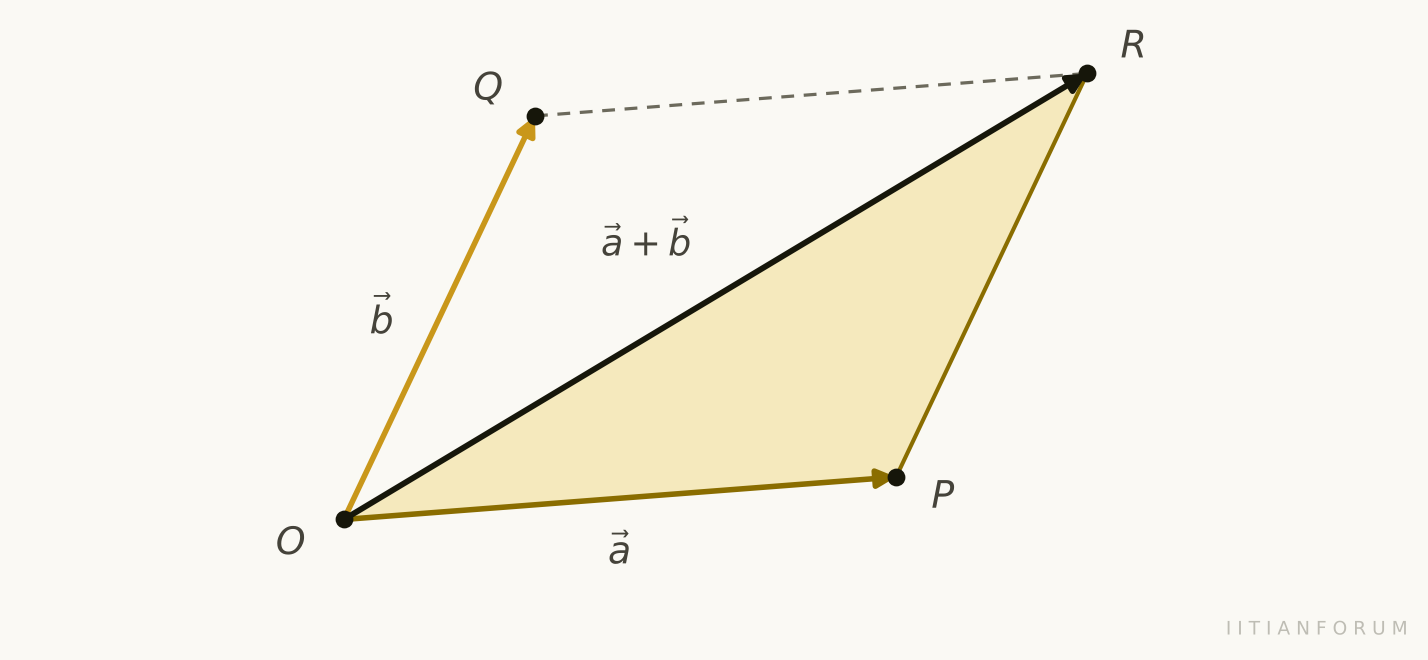
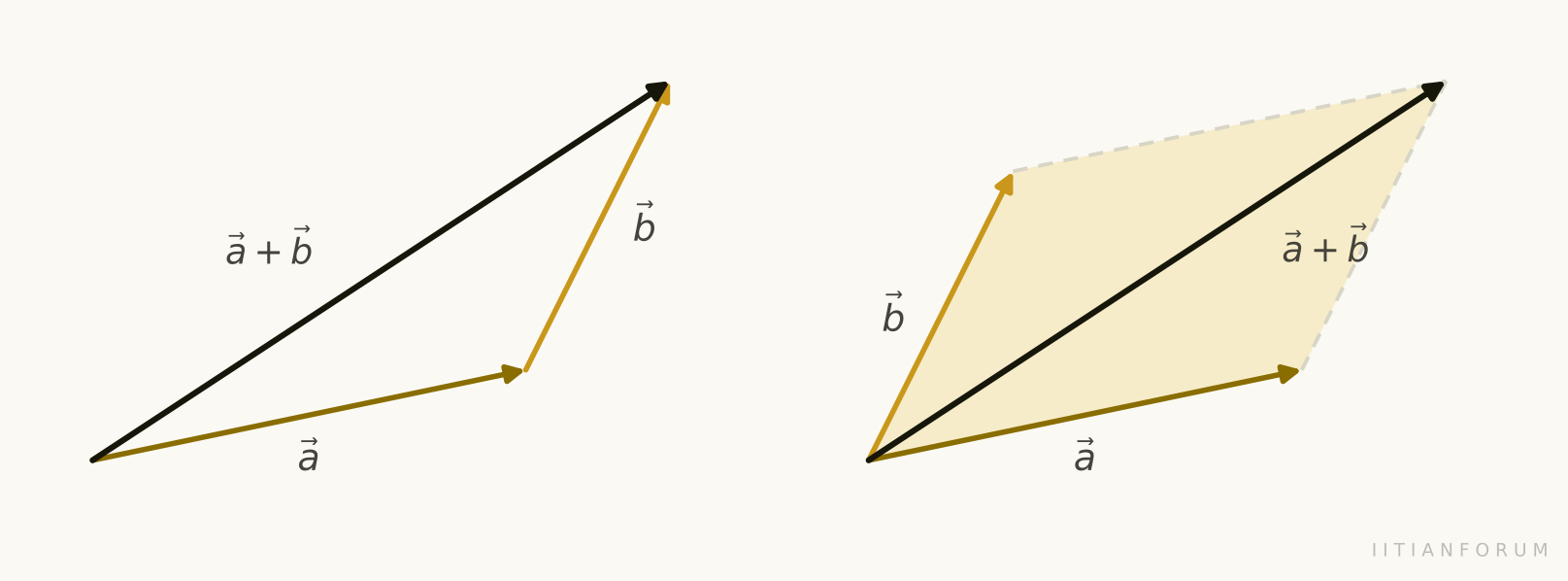
Two vectors are added by the triangle law: place the tail of b⃗\vec b at the head of a⃗\vec a, and a⃗+b⃗\vec a+\vec b runs from the tail of a⃗\vec a to the head of b⃗\vec b. The parallelogram law says the same thing: a⃗+b⃗\vec a+\vec b is the diagonal of the parallelogram on a⃗\vec a and b⃗\vec b.

Left: triangle law with an and b placed head to tail and a plus b closing the triangle. Right: parallelogram on a and b with the diagonal a plus b from the common tail

Addition is commutative and associative, and a⃗−b⃗=a⃗+(−b⃗)\vec a-\vec b=\vec a+(-\vec b). Multiplying by a scalar kk scales the length by ∣k∣\lvert k\rvert and reverses the direction when k<0k<0.

Position vectors and the section formula

Fix an origin OO. The position vector of a point AA is a⃗=OA→\vec a=\overrightarrow{OA}. Then every segment is a difference of position vectors:

AB→=b⃗−a⃗\overrightarrow{AB}=\vec b-\vec a

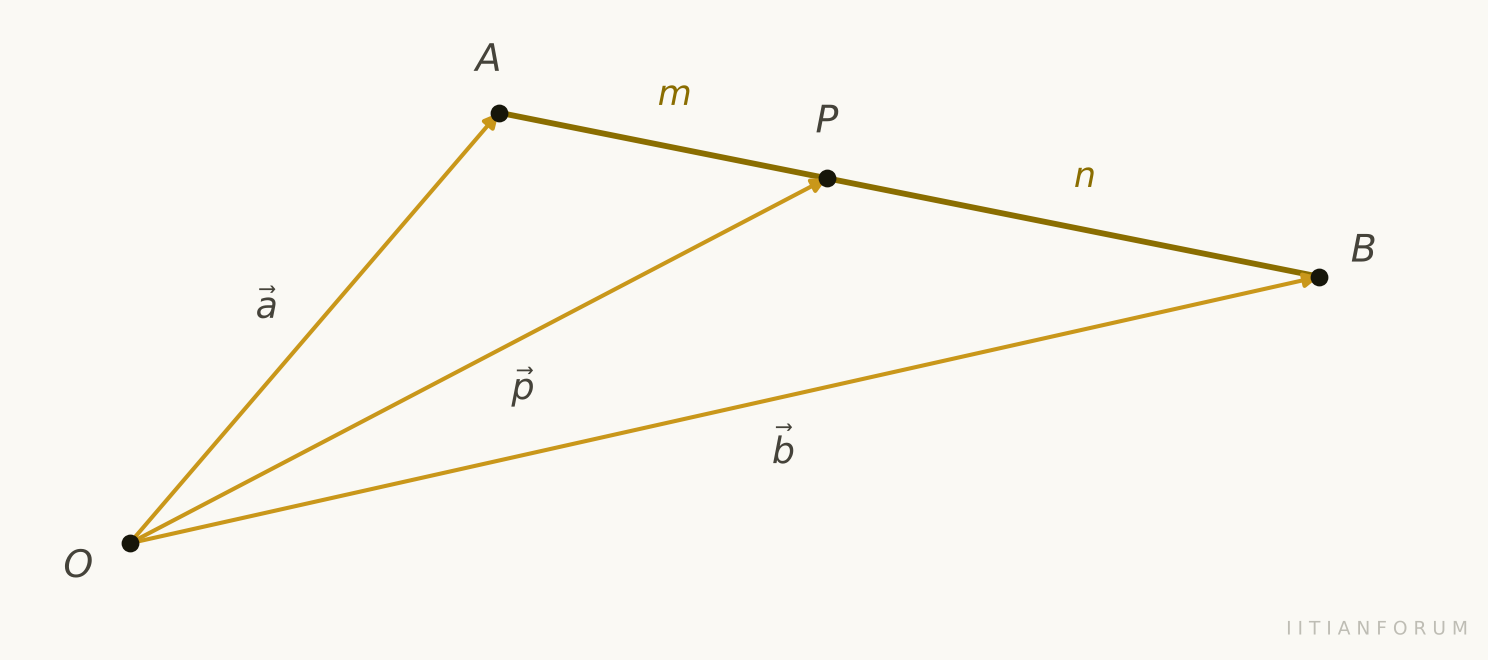
If PP divides ABAB internally in the ratio m:nm:n, then

p⃗=mb⃗+na⃗m+n\vec p=\frac{m\vec b+n\vec a}{m+n}

For external division replace nn by −n-n. The midpoint is a⃗+b⃗2\dfrac{\vec a+\vec b}{2} and the centroid of a triangle is a⃗+b⃗+c⃗3\dfrac{\vec a+\vec b+\vec c}{3}.

Segment AB with the point P dividing it in the ratio m to n, and the three position vectors a, p, b drawn from the origin O

Proof. AP→:PB→=m:n\overrightarrow{AP}:\overrightarrow{PB}=m:n and both point the same way, so n AP→=m PB→n\,\overrightarrow{AP}=m\,\overrightarrow{PB}:

n(p⃗−a⃗)=m(b⃗−p⃗)n(\vec p-\vec a)=m(\vec b-\vec p) (m+n)p⃗=mb⃗+na⃗(m+n)\vec p=m\vec b+n\vec a

Collinear points. AA, BB, CC are collinear exactly when AB→=λAC→\overrightarrow{AB}=\lambda\overrightarrow{AC} for some λ\lambda. Equivalently, there are scalars xx, yy, zz, not all zero, with

xa⃗+yb⃗+zc⃗=0⃗,x+y+z=0x\vec a+y\vec b+z\vec c=\vec 0,\qquad x+y+z=0
Write every point in terms of the origin

In a question full of points, write each one as a position vector and every segment as a difference. Most such questions then become one line of algebra.

Example 1 (JEE Main 2026, 5 April Shift 2). Let OO be the origin, OP→=a⃗\overrightarrow{OP}=\vec a and OQ→=b⃗\overrightarrow{OQ}=\vec b. If RR is the point on OPOP with OP→=5OR→\overrightarrow{OP}=5\overrightarrow{OR}, and MM is the point with OQ→=5RM→\overrightarrow{OQ}=5\overrightarrow{RM}, then PM→\overrightarrow{PM} is

(1) 15(a⃗−4b⃗)\dfrac15(\vec a-4\vec b) (2) 15(b⃗−4a⃗)\dfrac15(\vec b-4\vec a) (3) 15(−a⃗+4b⃗)\dfrac15(-\vec a+4\vec b) (4) 15(−b⃗+4a⃗)\dfrac15(-\vec b+4\vec a)

▸ SHOW SOLUTION

Step 1. Position vectors of R and M

OR→=a⃗5,RM→=b⃗5\overrightarrow{OR}=\frac{\vec a}{5},\qquad \overrightarrow{RM}=\frac{\vec b}{5}OM→=OR→+RM→=a⃗+b⃗5\overrightarrow{OM}=\overrightarrow{OR}+\overrightarrow{RM}=\frac{\vec a+\vec b}{5}

Step 2. Subtract

PM→=OM→−OP→=a⃗+b⃗5−a⃗\overrightarrow{PM}=\overrightarrow{OM}-\overrightarrow{OP}=\frac{\vec a+\vec b}{5}-\vec aPM→=15(b⃗−4a⃗)\overrightarrow{PM}=\frac15(\vec b-4\vec a)

Answer: (2)

Components, magnitude and direction cosines

In the plane every vector is xi^+yj^x\hat i+y\hat j. In space, with unit vectors i^\hat i, j^\hat j, k^\hat k along the axes, every vector is

a⃗=a1i^+a2j^+a3k^\vec a=a_1\hat i+a_2\hat j+a_3\hat k ∣a⃗∣=a12+a22+a32\lvert\vec a\rvert=\sqrt{a_1^2+a_2^2+a_3^2}

Vectors are added, subtracted and scaled component by component, and two vectors are equal exactly when their components are equal.

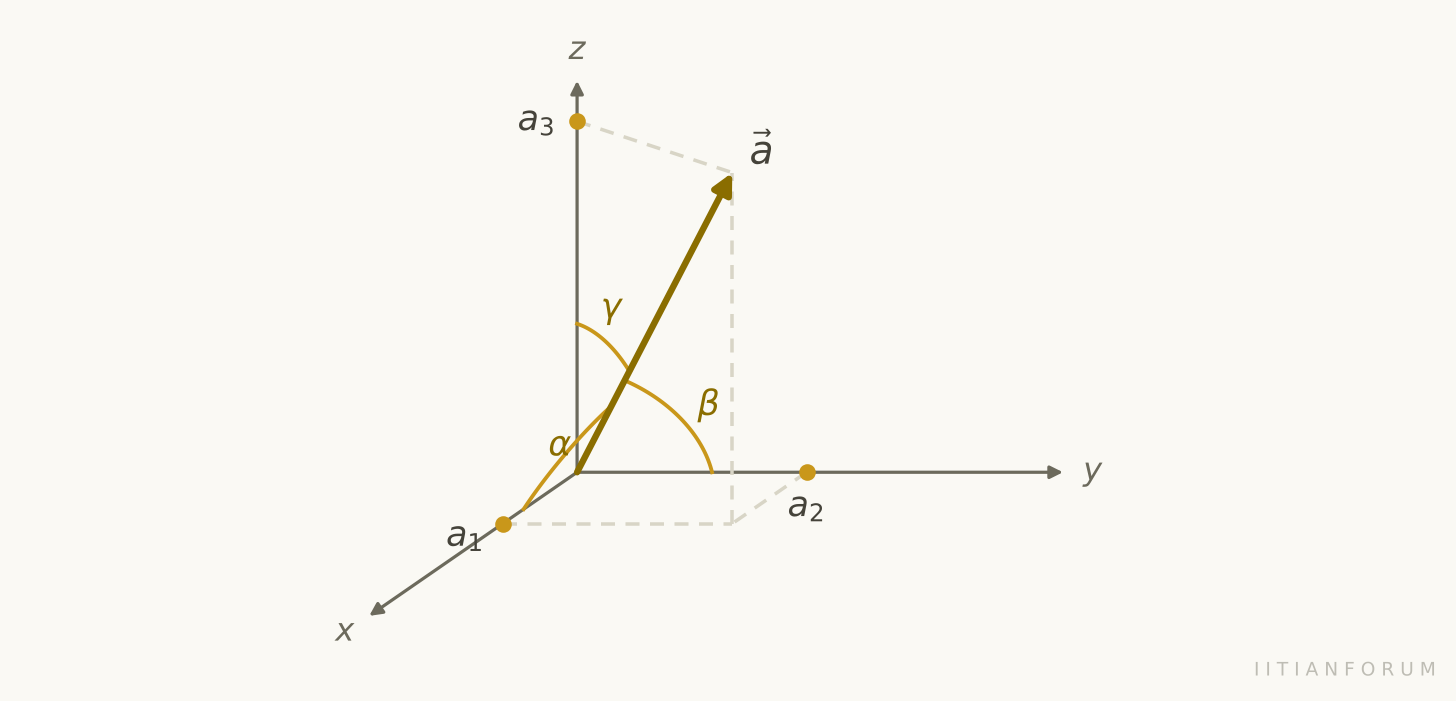
If a⃗\vec a makes angles α\alpha, β\beta, γ\gamma with the positive xx, yy, zz axes, then

cos⁡α=a1∣a⃗∣,cos⁡β=a2∣a⃗∣,cos⁡γ=a3∣a⃗∣\cos\alpha=\frac{a_1}{\lvert\vec a\rvert},\quad \cos\beta=\frac{a_2}{\lvert\vec a\rvert},\quad \cos\gamma=\frac{a_3}{\lvert\vec a\rvert}

These are the direction cosines ll, mm, nn, and the components a1a_1, a2a_2, a3a_3 (or any multiple of them) are direction ratios. Since a^=li^+mj^+nk^\hat a=l\hat i+m\hat j+n\hat k is a unit vector,

l2+m2+n2=1l^2+m^2+n^2=1 Three axes x, y, z drawn in perspective, the vector a from the origin with its three components along the axes, and the angles alpha, beta, gamma it makes with the axes

Example 2 (JEE Main 2026, 22 January Shift 2). Let a⃗=2 i^−j^+λk^\vec a=\sqrt2\,\hat i-\hat j+\lambda\hat k, λ>0\lambda>0, make an obtuse angle with b⃗=−λ2i^+42 j^+42 k^\vec b=-\lambda^2\hat i+4\sqrt2\,\hat j+4\sqrt2\,\hat k and an angle θ\theta, π6<θ<π2\dfrac\pi6<\theta<\dfrac\pi2, with the positive zz-axis. If the set of all possible λ\lambda is (α,β)−{γ}(\alpha,\beta)-\{\gamma\}, then α+β+γ\alpha+\beta+\gamma is ______.

▸ SHOW SOLUTION

Step 1. Angle with the z-axis

cos⁡θ=a⃗⋅k^∣a⃗∣=λ3+λ2\cos\theta=\frac{\vec a\cdot\hat k}{\lvert\vec a\rvert}=\frac{\lambda}{\sqrt{3+\lambda^2}}

π6<θ<π2\dfrac\pi6<\theta<\dfrac\pi2 means 0<cos⁡θ<320<\cos\theta<\dfrac{\sqrt3}{2}:

λ23+λ2<34  ⟹  λ2<9\frac{\lambda^2}{3+\lambda^2}<\frac34\implies\lambda^2<9

So 0<λ<30<\lambda<3.

Step 2. Obtuse angle with b

a⃗⋅b⃗=2(−λ2+4λ−4)<0\vec a\cdot\vec b=\sqrt2(-\lambda^2+4\lambda-4)<0(λ−2)2>0  ⟹  λ≠2(\lambda-2)^2>0\implies\lambda\ne2

Step 3. Combine

λ∈(0,3)−{2}\lambda\in(0,3)-\{2\}, so α=0\alpha=0, β=3\beta=3, γ=2\gamma=2.

α+β+γ=5\alpha+\beta+\gamma=5

Answer: 55

Example 3 (JEE Main 2026, 4 April Shift 1). Let a⃗k=(tan⁡θk)i^+j^\vec a_k=(\tan\theta_k)\hat i+\hat j and b⃗k=i^−(cot⁡θk)j^\vec b_k=\hat i-(\cot\theta_k)\hat j, where θk=2k−1π2n+1\theta_k=\dfrac{2^{k-1}\pi}{2^n+1} for some n∈Nn\in\mathbb N, n>5n>5. Find the value of

∑k=1n∣a⃗k∣2∑k=1n∣b⃗k∣2\frac{\sum_{k=1}^{n}\lvert\vec a_k\rvert^2}{\sum_{k=1}^{n}\lvert\vec b_k\rvert^2}
▸ SHOW SOLUTION

Step 1. The two magnitudes

∣a⃗k∣2=tan⁡2θk+1=sec⁡2θk\lvert\vec a_k\rvert^2=\tan^2\theta_k+1=\sec^2\theta_k∣b⃗k∣2=1+cot⁡2θk=cosec⁡2θk\lvert\vec b_k\rvert^2=1+\cot^2\theta_k=\operatorname{cosec}^2\theta_k

Step 2. One identity

cot⁡θ−tan⁡θ=2cot⁡2θ\cot\theta-\tan\theta=2\cot2\theta. Squaring and writing everything with sec⁡\sec and cosec⁡\operatorname{cosec}:

sec⁡2θ=4cosec⁡22θ−cosec⁡2θ\sec^2\theta=4\operatorname{cosec}^22\theta-\operatorname{cosec}^2\theta

Step 3. Sum over k

2θk=θk+12\theta_k=\theta_{k+1}, and θn+1=π−θ1\theta_{n+1}=\pi-\theta_1, so the doubled angles run over the same cosec⁡2\operatorname{cosec}^2 values:

∑k=1ncosec⁡22θk=∑k=1ncosec⁡2θk\sum_{k=1}^{n}\operatorname{cosec}^22\theta_k=\sum_{k=1}^{n}\operatorname{cosec}^2\theta_k

With S=∑cosec⁡2θkS=\sum\operatorname{cosec}^2\theta_k:

∑sec⁡2θk=4S−S=3S\sum\sec^2\theta_k=4S-S=3S

Answer: 33

The vector part is only Step 1. The paper as circulated printed cos⁡θk\cos\theta_k in b⃗k\vec b_k; with cos⁡\cos the ratio is not a constant, and the official solution uses cot⁡θk\cot\theta_k, as here.

Dot product

The dot product (scalar product) of a⃗\vec a and b⃗\vec b at angle θ\theta is the number

a⃗⋅b⃗=∣a⃗∣∣b⃗∣cos⁡θ\vec a\cdot\vec b=\lvert\vec a\rvert\lvert\vec b\rvert\cos\theta

In components,

a⃗⋅b⃗=a1b1+a2b2+a3b3\vec a\cdot\vec b=a_1b_1+a_2b_2+a_3b_3

It is commutative and distributes over addition. Facts used constantly:

  • a⃗⋅a⃗=∣a⃗∣2\vec a\cdot\vec a=\lvert\vec a\rvert^2.
  • a⃗⊥b⃗  ⟺  a⃗⋅b⃗=0\vec a\perp\vec b\iff\vec a\cdot\vec b=0 for non-zero vectors.
  • i^⋅i^=j^⋅j^=k^⋅k^=1\hat i\cdot\hat i=\hat j\cdot\hat j=\hat k\cdot\hat k=1, and i^⋅j^=j^⋅k^=k^⋅i^=0\hat i\cdot\hat j=\hat j\cdot\hat k=\hat k\cdot\hat i=0.
  • The angle is acute, right or obtuse as a⃗⋅b⃗\vec a\cdot\vec b is positive, zero or negative.
  • ∣a⃗⋅b⃗∣≤∣a⃗∣∣b⃗∣\lvert\vec a\cdot\vec b\rvert\le\lvert\vec a\rvert\lvert\vec b\rvert, with equality only for parallel vectors.

Example 4 (JEE Main 2026, 2 April Shift 2). Two adjacent sides of a parallelogram PQRSPQRS are PQ→=j^+k^\overrightarrow{PQ}=\hat j+\hat k and PS→=i^−j^\overrightarrow{PS}=\hat i-\hat j. If side PSPS is rotated about PP through an acute angle α\alpha in the plane of the parallelogram so that it becomes perpendicular to PQPQ, then sin⁡25α2−sin⁡2α2\sin^2\dfrac{5\alpha}{2}-\sin^2\dfrac\alpha2 is

(1) 12\dfrac12 (2) 32\dfrac{\sqrt3}{2} (3) 34\dfrac{\sqrt3}{4} (4) 235\dfrac{2\sqrt3}{5}

▸ SHOW SOLUTION

Step 1. Angle QPS

cos⁡θ=PQ→⋅PS→∣PQ→∣∣PS→∣=−12⋅2=−12\cos\theta=\frac{\overrightarrow{PQ}\cdot\overrightarrow{PS}}{\lvert\overrightarrow{PQ}\rvert\lvert\overrightarrow{PS}\rvert}=\frac{-1}{\sqrt2\cdot\sqrt2}=-\frac12

θ=2π3\theta=\dfrac{2\pi}{3}, so turning PSPS by α=2π3−π2=π6\alpha=\dfrac{2\pi}{3}-\dfrac\pi2=\dfrac\pi6 makes it perpendicular.

Step 2. The trigonometry

sin⁡2A−sin⁡2B=sin⁡(A+B)sin⁡(A−B)\sin^2A-\sin^2B=\sin(A+B)\sin(A-B)sin⁡3α sin⁡2α=sin⁡π2 sin⁡π3=32\sin3\alpha\,\sin2\alpha=\sin\frac\pi2\,\sin\frac\pi3=\frac{\sqrt3}{2}

Answer: (2)

Projection

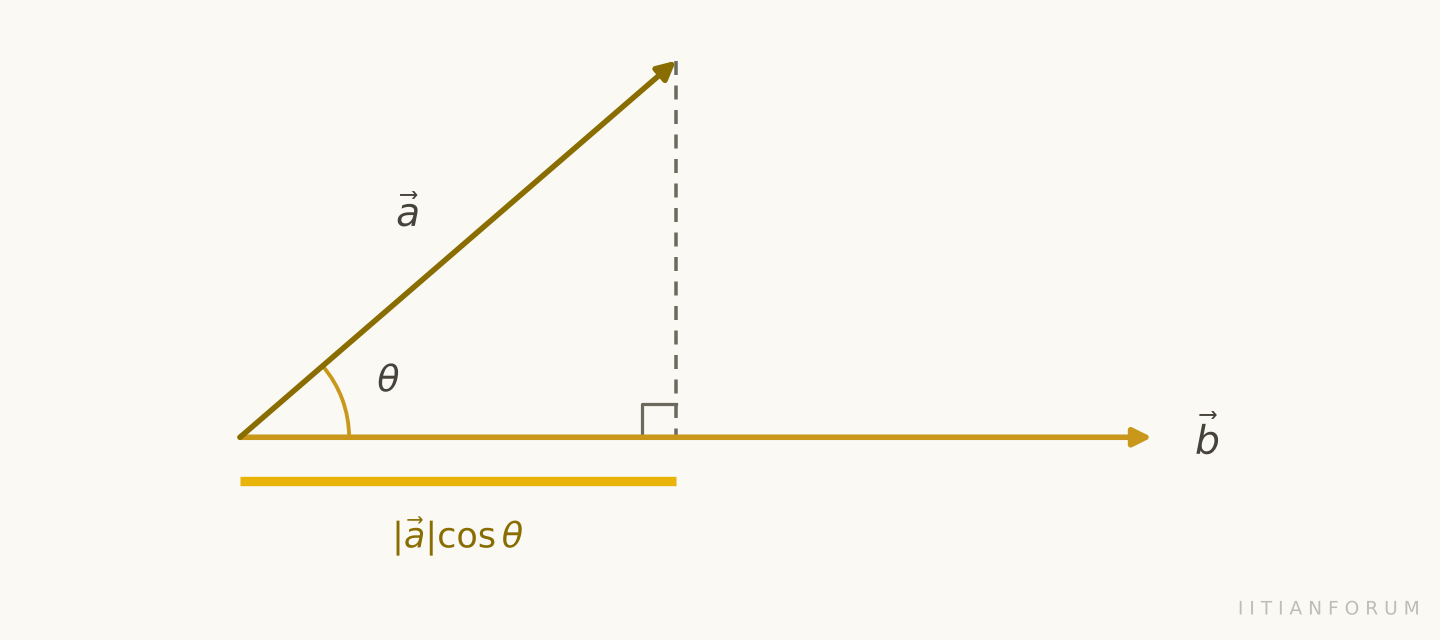
The scalar projection of a⃗\vec a on b⃗\vec b is the signed length of the shadow of a⃗\vec a on the line of b⃗\vec b:

projb⃗ a⃗=a⃗⋅b^=a⃗⋅b⃗∣b⃗∣\text{proj}_{\vec b}\,\vec a=\vec a\cdot\hat b=\frac{\vec a\cdot\vec b}{\lvert\vec b\rvert}

The vector projection is that length times b^\hat b:

a⃗⋅b⃗∣b⃗∣2 b⃗\frac{\vec a\cdot\vec b}{\lvert\vec b\rvert^2}\,\vec b

and a⃗\vec a minus its vector projection is the part of a⃗\vec a perpendicular to b⃗\vec b.

Vectors a and b from a common point at angle theta, with a dropped perpendicularly onto the line of b and the shadow of length a cos theta marked along b

Example 5 (JEE Main 2026, 22 January Shift 1). Let AB→=2i^+4j^−5k^\overrightarrow{AB}=2\hat i+4\hat j-5\hat k and AD→=i^+2j^+λk^\overrightarrow{AD}=\hat i+2\hat j+\lambda\hat k. The projection of v⃗=i^+j^+k^\vec v=\hat i+\hat j+\hat k on the diagonal AC→\overrightarrow{AC} of the parallelogram ABCDABCD has length 11. If α>β\alpha>\beta are the roots of λ2x2−6λx+5=0\lambda^2x^2-6\lambda x+5=0, then 2α−β2\alpha-\beta is

(1) 11 (2) 44 (3) 33 (4) 66

▸ SHOW SOLUTION

Step 1. The diagonal

AC→=AB→+AD→=3i^+6j^+(λ−5)k^\overrightarrow{AC}=\overrightarrow{AB}+\overrightarrow{AD}=3\hat i+6\hat j+(\lambda-5)\hat k

Step 2. Projection equal to 1

v⃗⋅AC→=λ+4\vec v\cdot\overrightarrow{AC}=\lambda+4(λ+4)2=∣AC→∣2=45+(λ−5)2(\lambda+4)^2=\lvert\overrightarrow{AC}\rvert^2=45+(\lambda-5)^218λ=54  ⟹  λ=318\lambda=54\implies\lambda=3

Step 3. The quadratic

9x2−18x+5=0  ⟹  x=53, 139x^2-18x+5=0\implies x=\frac53,\ \frac132α−β=103−13=32\alpha-\beta=\frac{10}{3}-\frac13=3

Answer: (3)

Expanding a squared magnitude

Most dot-product questions are settled by expanding a square:

∣a⃗±b⃗∣2=∣a⃗∣2+∣b⃗∣2±2 a⃗⋅b⃗\lvert\vec a\pm\vec b\rvert^2=\lvert\vec a\rvert^2+\lvert\vec b\rvert^2\pm2\,\vec a\cdot\vec b ∣a⃗+b⃗+c⃗∣2=∑∣a⃗∣2+2∑a⃗⋅b⃗\lvert\vec a+\vec b+\vec c\rvert^2=\sum\lvert\vec a\rvert^2+2\sum\vec a\cdot\vec b

where the second sum is a⃗⋅b⃗+b⃗⋅c⃗+c⃗⋅a⃗\vec a\cdot\vec b+\vec b\cdot\vec c+\vec c\cdot\vec a.

Adding the first pair gives the parallelogram identity:

∣a⃗+b⃗∣2+∣a⃗−b⃗∣2=2∣a⃗∣2+2∣b⃗∣2\lvert\vec a+\vec b\rvert^2+\lvert\vec a-\vec b\rvert^2=2\lvert\vec a\rvert^2+2\lvert\vec b\rvert^2
A square of zero means the vector is zero

If an expansion gives ∣a⃗+b⃗+c⃗∣2=0\lvert\vec a+\vec b+\vec c\rvert^2=0, then a⃗+b⃗+c⃗=0⃗\vec a+\vec b+\vec c=\vec 0 exactly, and you can substitute b⃗+c⃗=−a⃗\vec b+\vec c=-\vec a anywhere. Students compute the zero and then keep working with all three vectors.

Example 6 (JEE Main 2026, 2 April Shift 1). If ∣a⃗∣=2\lvert\vec a\rvert=2 and ∣b⃗∣=3\lvert\vec b\rvert=3, then the maximum value of 3∣3a⃗+2b⃗∣+4∣3a⃗−2b⃗∣3\lvert3\vec a+2\vec b\rvert+4\lvert3\vec a-2\vec b\rvert is

(1) 3030 (2) 3636 (3) 6060 (4) 7272

▸ SHOW SOLUTION

Step 1. Expand both squares

With a⃗⋅b⃗=6cos⁡θ\vec a\cdot\vec b=6\cos\theta:

∣3a⃗+2b⃗∣2=72+72cos⁡θ=144cos⁡2θ2\lvert3\vec a+2\vec b\rvert^2=72+72\cos\theta=144\cos^2\frac\theta2∣3a⃗−2b⃗∣2=72−72cos⁡θ=144sin⁡2θ2\lvert3\vec a-2\vec b\rvert^2=72-72\cos\theta=144\sin^2\frac\theta2

Step 2. One trigonometric expression

E=36cos⁡θ2+48sin⁡θ2E=36\cos\frac\theta2+48\sin\frac\theta2

Step 3. Maximum

Emax⁡=362+482=60E_{\max}=\sqrt{36^2+48^2}=60

Answer: (3) 6060

Example 7 (JEE Main 2026, 28 January Shift 1). For unit vectors a⃗\vec a, b⃗\vec b, c⃗\vec c with ∣a⃗−b⃗∣2+∣b⃗−c⃗∣2+∣c⃗−a⃗∣2=9\lvert\vec a-\vec b\rvert^2+\lvert\vec b-\vec c\rvert^2+\lvert\vec c-\vec a\rvert^2=9 and ∣2a⃗+kb⃗+kc⃗∣=3\lvert2\vec a+k\vec b+k\vec c\rvert=3, the positive value of kk is

(1) 33 (2) 66 (3) 44 (4) 55

▸ SHOW SOLUTION

Step 1. Expand the given sum

Let S=a⃗⋅b⃗+b⃗⋅c⃗+c⃗⋅a⃗S=\vec a\cdot\vec b+\vec b\cdot\vec c+\vec c\cdot\vec a:

6−2S=9  ⟹  S=−326-2S=9\implies S=-\frac32

Step 2. The sum of the three vectors

∣a⃗+b⃗+c⃗∣2=3+2S=0\lvert\vec a+\vec b+\vec c\rvert^2=3+2S=0

So b⃗+c⃗=−a⃗\vec b+\vec c=-\vec a.

Step 3. Substitute

∣2a⃗−ka⃗∣=∣2−k∣=3\lvert2\vec a-k\vec a\rvert=\lvert2-k\rvert=3

k=5k=5 or k=−1k=-1; the positive value is 55.

Answer: (4) 55

Example 8 (IITianForum). Unit vectors a^\hat a, b^\hat b, c^\hat c satisfy a^+b^=3 c^\hat a+\hat b=\sqrt3\,\hat c. Find ∣a^−b^+c^∣\lvert\hat a-\hat b+\hat c\rvert.

▸ SHOW SOLUTION

Step 1. Angle between a and b

∣a^+b^∣2=3  ⟹  2+2 a^⋅b^=3\lvert\hat a+\hat b\rvert^2=3\implies2+2\,\hat a\cdot\hat b=3a^⋅b^=12,∣a^−b^∣2=2−1=1\hat a\cdot\hat b=\frac12,\qquad \lvert\hat a-\hat b\rvert^2=2-1=1

Step 2. c is perpendicular to a minus b

(a^−b^)⋅(a^+b^)=1−1=0(\hat a-\hat b)\cdot(\hat a+\hat b)=1-1=0

so (a^−b^)⋅c^=0(\hat a-\hat b)\cdot\hat c=0.

Step 3. Expand

∣a^−b^+c^∣2=∣a^−b^∣2+∣c^∣2=1+1\lvert\hat a-\hat b+\hat c\rvert^2=\lvert\hat a-\hat b\rvert^2+\lvert\hat c\rvert^2=1+1

Answer: 2\sqrt2

a^+b^\hat a+\hat b and a^−b^\hat a-\hat b are the two diagonals of a rhombus, and the diagonals of a rhombus are always perpendicular.

Vectors in the plane of two given vectors

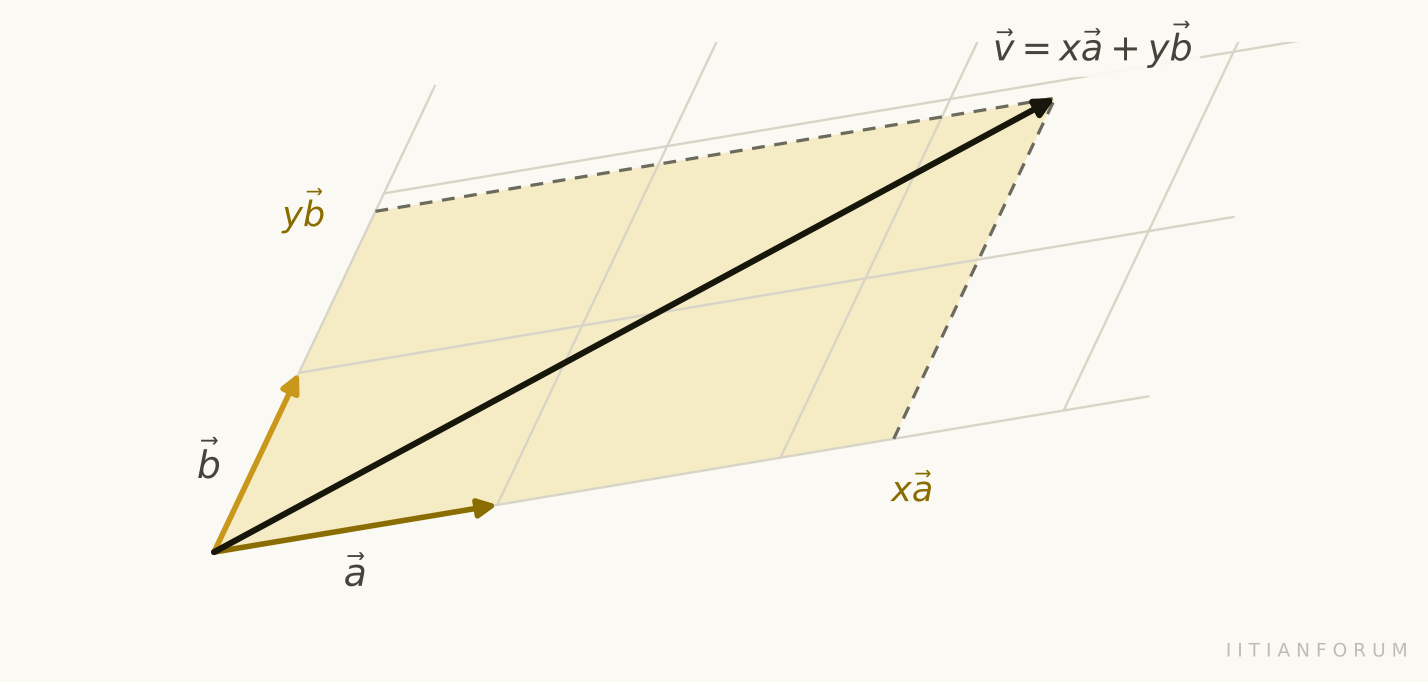
If a⃗\vec a and b⃗\vec b are not parallel, every vector in their plane can be written in exactly one way as

v⃗=xa⃗+yb⃗\vec v=x\vec a+y\vec b

So "a vector in the plane of a⃗\vec a and b⃗\vec b" means two unknowns xx, yy, and the question must supply two conditions to fix it.

Vectors a and b from the origin with a grid of their multiples, and a vector v reaching the corner of the parallelogram on x a and y b

Example 9 (JEE Main 2026, 2 April Shift 2). Let a⃗=−i^+j^+3k^\vec a=-\hat i+\hat j+3\hat k, b⃗=i^+3j^+k^\vec b=\hat i+3\hat j+\hat k and c⃗=λa⃗+μb⃗\vec c=\lambda\vec a+\mu\vec b. If c⃗⋅(3i^−6j^+2k^)=10\vec c\cdot(3\hat i-6\hat j+2\hat k)=10 and c⃗⋅(i^+j^+k^)=−2\vec c\cdot(\hat i+\hat j+\hat k)=-2, then ∣c⃗∣2\lvert\vec c\rvert^2 is

(1) 88 (2) 1212 (3) 1414 (4) 1515

▸ SHOW SOLUTION

Step 1. Components of c

c⃗=(μ−λ)i^+(λ+3μ)j^+(3λ+μ)k^\vec c=(\mu-\lambda)\hat i+(\lambda+3\mu)\hat j+(3\lambda+\mu)\hat k

Step 2. Two conditions

−3λ−13μ=10-3\lambda-13\mu=103λ+5μ=−23\lambda+5\mu=-2

Adding, μ=−1\mu=-1, then λ=1\lambda=1.

Step 3. Magnitude

c⃗=−2i^−2j^+2k^,∣c⃗∣2=12\vec c=-2\hat i-2\hat j+2\hat k,\qquad\lvert\vec c\rvert^2=12

Answer: (2) 1212

Example 10 (JEE Main 2026, 24 January Shift 2). Let a⃗=2i^−j^−k^\vec a=2\hat i-\hat j-\hat k, b⃗=i^+3j^−k^\vec b=\hat i+3\hat j-\hat k and c⃗=2i^+j^+3k^\vec c=2\hat i+\hat j+3\hat k. Let v⃗\vec v be the vector in the plane of a⃗\vec a and b⃗\vec b whose projection on c⃗\vec c has length 114\dfrac{1}{\sqrt{14}}. Then ∣v⃗∣\lvert\vec v\rvert is

(1) 212\dfrac{\sqrt{21}}{2} (2) 1313 (3) 352\dfrac{\sqrt{35}}{2} (4) 77

▸ SHOW SOLUTION

Step 1. Write v

v⃗=xa⃗+yb⃗\vec v=x\vec a+y\vec bv⃗=(2x+y)i^+(3y−x)j^−(x+y)k^\vec v=(2x+y)\hat i+(3y-x)\hat j-(x+y)\hat k

Step 2. Projection condition

v⃗⋅c⃗=2y,∣2y∣14=114\vec v\cdot\vec c=2y,\qquad \frac{\lvert2y\rvert}{\sqrt{14}}=\frac{1}{\sqrt{14}}

so y2=14y^2=\dfrac14, and xx is not fixed.

Step 3. Magnitude

∣v⃗∣2=6x2+11y2=6x2+114\lvert\vec v\rvert^2=6x^2+11y^2=6x^2+\frac{11}{4}

Answer: not unique. The official key gives (3), which is the value at x=±1x=\pm1.

This is the counting rule above in action: a vector in a plane has two unknowns and the question gives only one condition. When a question seems to leave a free parameter, check whether it really does before forcing an answer.

Cross product

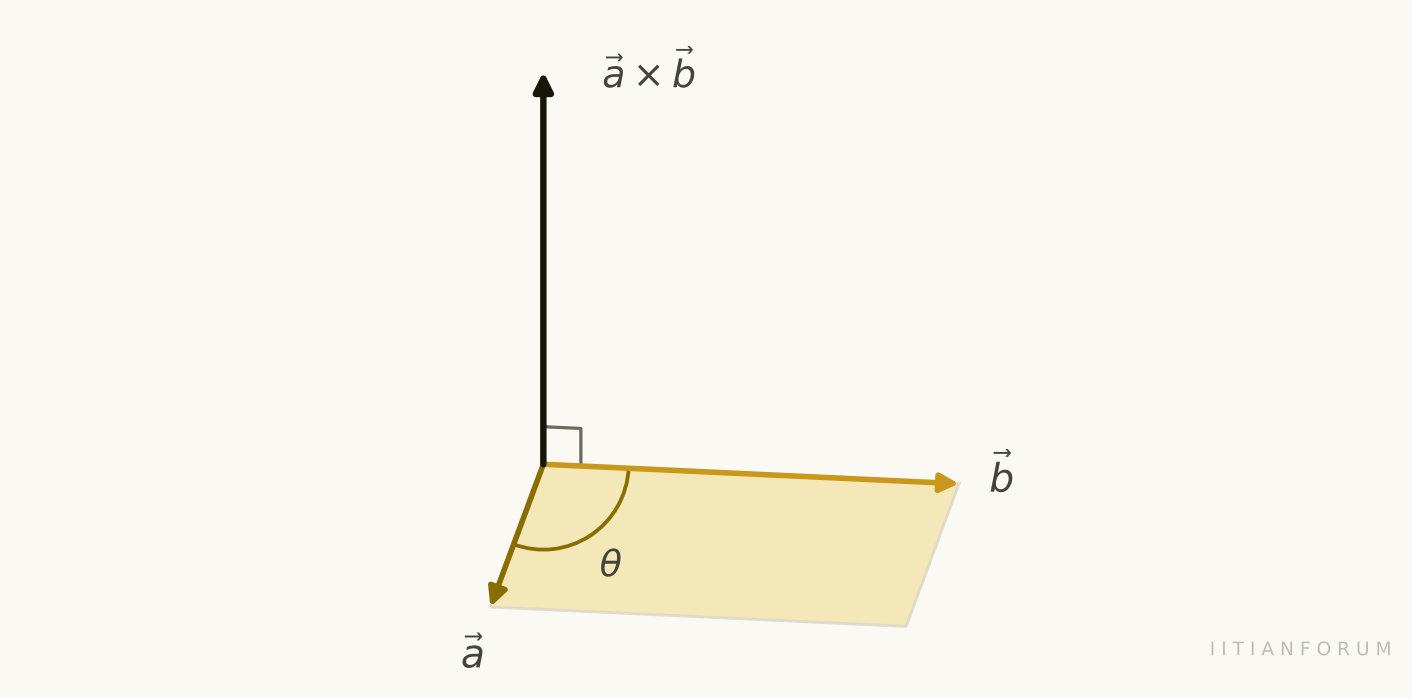
The cross product (vector product) of a⃗\vec a and b⃗\vec b at angle θ\theta is the vector

a⃗×b⃗=∣a⃗∣∣b⃗∣sin⁡θ n^\vec a\times\vec b=\lvert\vec a\rvert\lvert\vec b\rvert\sin\theta\,\hat n

where n^\hat n is the unit vector perpendicular to both, chosen so that a⃗\vec a, b⃗\vec b, n^\hat n form a right-handed system. In components,

a⃗×b⃗=∣i^j^k^a1a2a3b1b2b3∣\vec a\times\vec b=\begin{vmatrix}\hat i&\hat j&\hat k\\a_1&a_2&a_3\\b_1&b_2&b_3\end{vmatrix} A parallelogram on a and b drawn in perspective, with the vector a cross b standing perpendicular to it and the angle theta marked between a and b

Rules to know cold:

  • b⃗×a⃗=−a⃗×b⃗\vec b\times\vec a=-\vec a\times\vec b, so order matters.
  • a⃗×a⃗=0⃗\vec a\times\vec a=\vec 0, and a⃗×b⃗=0⃗  ⟺  a⃗∥b⃗\vec a\times\vec b=\vec 0\iff\vec a\parallel\vec b for non-zero vectors.
  • i^×j^=k^\hat i\times\hat j=\hat k, j^×k^=i^\hat j\times\hat k=\hat i, k^×i^=j^\hat k\times\hat i=\hat j.
  • a⃗×b⃗\vec a\times\vec b is perpendicular to both a⃗\vec a and b⃗\vec b.
  • Lagrange's identity:
∣a⃗×b⃗∣2+(a⃗⋅b⃗)2=∣a⃗∣2∣b⃗∣2\lvert\vec a\times\vec b\rvert^2+(\vec a\cdot\vec b)^2=\lvert\vec a\rvert^2\lvert\vec b\rvert^2

Area

∣a⃗×b⃗∣\lvert\vec a\times\vec b\rvert is the area of the parallelogram on a⃗\vec a and b⃗\vec b, and half of it is the area of the triangle:

Area of △ABC=12∣AB→×AC→∣\text{Area of }\triangle ABC=\frac12\lvert\overrightarrow{AB}\times\overrightarrow{AC}\rvert

For any quadrilateral with diagonals d⃗1\vec d_1 and d⃗2\vec d_2 (a parallelogram included), the area is 12∣d⃗1×d⃗2∣\dfrac12\lvert\vec d_1\times\vec d_2\rvert.

The unit vectors perpendicular to both a⃗\vec a and b⃗\vec b are

±a⃗×b⃗∣a⃗×b⃗∣\pm\frac{\vec a\times\vec b}{\lvert\vec a\times\vec b\rvert}

This is the usual opening line of a question that wants a normal direction.

Example 11 (JEE Main 2026, 6 April Shift 2). Let a⃗=2i^+3j^+3k^\vec a=2\hat i+3\hat j+3\hat k and b⃗=6i^+3j^+3k^\vec b=6\hat i+3\hat j+3\hat k. The square of the area of the triangle with adjacent sides 2a⃗+3b⃗2\vec a+3\vec b and a⃗−b⃗\vec a-\vec b is

(1) 450450 (2) 900900 (3) 18001800 (4) 24002400

▸ SHOW SOLUTION

Step 1. The two sides

2a⃗+3b⃗=22i^+15j^+15k^2\vec a+3\vec b=22\hat i+15\hat j+15\hat ka⃗−b⃗=−4i^\vec a-\vec b=-4\hat i

Step 2. Cross product

(22i^+15j^+15k^)×(−4i^)(22\hat i+15\hat j+15\hat k)\times(-4\hat i)=−60j^+60k^=-60\hat j+60\hat k

with magnitude 60260\sqrt2.

Step 3. Area

Area=302,Area2=1800\text{Area}=30\sqrt2,\qquad\text{Area}^2=1800

Answer: (3) 18001800

A shortcut worth seeing: (2a⃗+3b⃗)×(a⃗−b⃗)=−5 a⃗×b⃗(2\vec a+3\vec b)\times(\vec a-\vec b)=-5\,\vec a\times\vec b, so you only ever need a⃗×b⃗\vec a\times\vec b.

Example 12 (JEE Main 2026, 21 January Shift 2). In a triangle ABCABC, let p⃗=BC→\vec p=\overrightarrow{BC}, q⃗=CA→\vec q=\overrightarrow{CA}, r⃗=BA→\vec r=\overrightarrow{BA}. If ∣p⃗∣=23\lvert\vec p\rvert=2\sqrt3, ∣q⃗∣=2\lvert\vec q\rvert=2 and the angle θ\theta between p⃗\vec p and q⃗\vec q has cos⁡θ=13\cos\theta=\dfrac{1}{\sqrt3}, then ∣p⃗×(q⃗−3r⃗)∣2+3∣r⃗∣2\lvert\vec p\times(\vec q-3\vec r)\rvert^2+3\lvert\vec r\rvert^2 is

(1) 340340 (2) 220220 (3) 410410 (4) 200200

▸ SHOW SOLUTION

Step 1. The relation between the sides

p⃗+q⃗=r⃗\vec p+\vec q=\vec r∣r⃗∣2=12+4+2⋅23⋅2⋅13=24\lvert\vec r\rvert^2=12+4+2\cdot2\sqrt3\cdot2\cdot\frac{1}{\sqrt3}=24

Step 2. Simplify the cross product

q⃗−3r⃗=−3p⃗−2q⃗\vec q-3\vec r=-3\vec p-2\vec qp⃗×(q⃗−3r⃗)=−2 p⃗×q⃗\vec p\times(\vec q-3\vec r)=-2\,\vec p\times\vec q

Step 3. Magnitude

4∣p⃗∣2∣q⃗∣2sin⁡2θ=4⋅12⋅4⋅23=1284\lvert\vec p\rvert^2\lvert\vec q\rvert^2\sin^2\theta=4\cdot12\cdot4\cdot\frac23=128128+3⋅24=200128+3\cdot24=200

Answer: (4) 200200

Example 13 (JEE Advanced 2026, Paper 2). Let PP, QQ, RR have position vectors a⃗\vec a, b⃗\vec b, a⃗+b⃗\vec a+\vec b with respect to OO. If ∣a⃗+b⃗∣=21\lvert\vec a+\vec b\rvert=\sqrt{21}, ∣a⃗−b⃗∣=3\lvert\vec a-\vec b\rvert=3 and a⃗⊥(a⃗−b⃗)\vec a\perp(\vec a-\vec b), then the area of triangle OPROPR is

(1) 3\sqrt3 (2) 32\dfrac{\sqrt3}{2} (3) 332\dfrac{3\sqrt3}{2} (4) 32\dfrac32

▸ SHOW SOLUTION

Step 1. Three dot products

a⃗⋅(a⃗−b⃗)=0\vec a\cdot(\vec a-\vec b)=0 gives ∣a⃗∣2=a⃗⋅b⃗\lvert\vec a\rvert^2=\vec a\cdot\vec b. Expanding the two given squares:

∣a⃗∣2+∣b⃗∣2+2 a⃗⋅b⃗=21\lvert\vec a\rvert^2+\lvert\vec b\rvert^2+2\,\vec a\cdot\vec b=21∣a⃗∣2+∣b⃗∣2−2 a⃗⋅b⃗=9\lvert\vec a\rvert^2+\lvert\vec b\rvert^2-2\,\vec a\cdot\vec b=9

So a⃗⋅b⃗=3\vec a\cdot\vec b=3, ∣a⃗∣2=3\lvert\vec a\rvert^2=3, ∣b⃗∣2=12\lvert\vec b\rvert^2=12.

Step 2. The area

Area=12∣a⃗×(a⃗+b⃗)∣=12∣a⃗×b⃗∣\text{Area}=\frac12\lvert\vec a\times(\vec a+\vec b)\rvert=\frac12\lvert\vec a\times\vec b\rvert∣a⃗×b⃗∣2=3⋅12−32=27\lvert\vec a\times\vec b\rvert^2=3\cdot12-3^2=27Area=332\text{Area}=\frac{3\sqrt3}{2}

Answer: (3)

Lagrange's identity turned three dot products into the area without a single component.

Triangle OPR with OP equal to a, OQ equal to b and OR equal to a plus b, the parallelogram OPRQ completed with dashed sides

Example 14 (JEE Main 2026, 24 January Shift 1). Let a⃗=2i^+j^−2k^\vec a=2\hat i+\hat j-2\hat k, b⃗=i^+j^\vec b=\hat i+\hat j and c⃗=a⃗×b⃗\vec c=\vec a\times\vec b. Let d⃗\vec d satisfy ∣d⃗−a⃗∣=11\lvert\vec d-\vec a\rvert=\sqrt{11}, ∣c⃗×d⃗∣=3\lvert\vec c\times\vec d\rvert=3, and let the angle between c⃗\vec c and d⃗\vec d be π4\dfrac\pi4. Then a⃗⋅d⃗\vec a\cdot\vec d is

(1) 1111 (2) 33 (3) 00 (4) 11

▸ SHOW SOLUTION

Step 1. The vector c

c⃗=2i^−2j^+k^,∣c⃗∣=3\vec c=2\hat i-2\hat j+\hat k,\qquad\lvert\vec c\rvert=3

Step 2. Length of d

3=3∣d⃗∣sin⁡π4  ⟹  ∣d⃗∣=23=3\lvert\vec d\rvert\sin\frac\pi4\implies\lvert\vec d\rvert=\sqrt2

Step 3. Expand the given square

∣d⃗∣2+∣a⃗∣2−2 a⃗⋅d⃗=11\lvert\vec d\rvert^2+\lvert\vec a\rvert^2-2\,\vec a\cdot\vec d=112+9−2 a⃗⋅d⃗=11  ⟹  a⃗⋅d⃗=02+9-2\,\vec a\cdot\vec d=11\implies\vec a\cdot\vec d=0

Answer: (3) 00

Example 15 (JEE Main 2026, 22 January Shift 2). Let a⃗=2i^−j^+k^\vec a=2\hat i-\hat j+\hat k and b⃗=λj^+2k^\vec b=\lambda\hat j+2\hat k, λ∈Z\lambda\in\mathbb Z. Let c⃗=a⃗×b⃗\vec c=\vec a\times\vec b, and let d⃗\vec d be a vector of magnitude 22 in the yzyz-plane. If ∣c⃗∣=53\lvert\vec c\rvert=\sqrt{53}, then the maximum possible value of (c⃗⋅d⃗)2(\vec c\cdot\vec d)^2 is

(1) 2626 (2) 104104 (3) 208208 (4) 5252

▸ SHOW SOLUTION

Step 1. The vector c

c⃗=−(2+λ)i^−4j^+2λk^\vec c=-(2+\lambda)\hat i-4\hat j+2\lambda\hat k∣c⃗∣2=5λ2+4λ+20=53\lvert\vec c\rvert^2=5\lambda^2+4\lambda+20=53

λ=−3\lambda=-3 or 115\dfrac{11}{5}; integer gives λ=−3\lambda=-3 and c⃗=i^−4j^−6k^\vec c=\hat i-4\hat j-6\hat k.

Step 2. d in the yz-plane

d⃗=yj^+zk^\vec d=y\hat j+z\hat k with y2+z2=4y^2+z^2=4:

c⃗⋅d⃗=−4y−6z\vec c\cdot\vec d=-4y-6z

Step 3. Maximum

(4y+6z)2≤(42+62)(y2+z2)=208(4y+6z)^2\le(4^2+6^2)(y^2+z^2)=208

Answer: (3) 208208

The inequality in Step 3 is just ∣u⃗⋅v⃗∣≤∣u⃗∣∣v⃗∣\lvert\vec u\cdot\vec v\rvert\le\lvert\vec u\rvert\lvert\vec v\rvert for u⃗=4j^+6k^\vec u=4\hat j+6\hat k and v⃗=d⃗\vec v=\vec d.

Example 16 (JEE Main 2026, 23 January Shift 2). Let a⃗=i^−2j^+3k^\vec a=\hat i-2\hat j+3\hat k, b⃗=2i^+j^−k^\vec b=2\hat i+\hat j-\hat k, c⃗=λi^+j^+k^\vec c=\lambda\hat i+\hat j+\hat k and v⃗=a⃗×b⃗\vec v=\vec a\times\vec b. If v⃗⋅c⃗=11\vec v\cdot\vec c=11 and the length of the projection of b⃗\vec b on c⃗\vec c is pp, then 9p29p^2 is

(1) 99 (2) 66 (3) 44 (4) 1212

▸ SHOW SOLUTION

Step 1. The vector v

v⃗=−i^+7j^+5k^\vec v=-\hat i+7\hat j+5\hat kv⃗⋅c⃗=12−λ=11  ⟹  λ=1\vec v\cdot\vec c=12-\lambda=11\implies\lambda=1

Step 2. Projection

p=b⃗⋅c⃗∣c⃗∣=23p=\frac{\vec b\cdot\vec c}{\lvert\vec c\rvert}=\frac{2}{\sqrt3}9p2=129p^2=12

Answer: (4) 1212

Example 17 (JEE Main 2026, 4 April Shift 2). Let u^\hat u, v^\hat v be unit vectors at an acute angle with ∣u^×v^∣=32\lvert\hat u\times\hat v\rvert=\dfrac{\sqrt3}{2}. If A⃗=λu^+v^+(u^×v^)\vec A=\lambda\hat u+\hat v+(\hat u\times\hat v), then λ\lambda equals

(1) 43(A⃗⋅u^)−23(A⃗⋅v^)\dfrac43(\vec A\cdot\hat u)-\dfrac23(\vec A\cdot\hat v) (2) 23(A⃗⋅u^)−13(A⃗⋅v^)\dfrac23(\vec A\cdot\hat u)-\dfrac13(\vec A\cdot\hat v) (3) 43(A⃗⋅u^)+23(A⃗⋅v^)\dfrac43(\vec A\cdot\hat u)+\dfrac23(\vec A\cdot\hat v) (4) (A⃗⋅u^)−12(A⃗⋅v^)(\vec A\cdot\hat u)-\dfrac12(\vec A\cdot\hat v)

▸ SHOW SOLUTION

Step 1. The angle

sin⁡θ=32\sin\theta=\dfrac{\sqrt3}{2} with θ\theta acute, so u^⋅v^=12\hat u\cdot\hat v=\dfrac12.

Step 2. Dot A with u and with v

u^×v^\hat u\times\hat v is perpendicular to both, so it drops out:

A⃗⋅u^=λ+12\vec A\cdot\hat u=\lambda+\frac12A⃗⋅v^=λ2+1\vec A\cdot\hat v=\frac\lambda2+1

Step 3. Eliminate the constants

2(A⃗⋅u^)−(A⃗⋅v^)=3λ22(\vec A\cdot\hat u)-(\vec A\cdot\hat v)=\frac{3\lambda}{2}λ=43(A⃗⋅u^)−23(A⃗⋅v^)\lambda=\frac43(\vec A\cdot\hat u)-\frac23(\vec A\cdot\hat v)

Answer: (1)

Vector equations with a cross product

Three moves solve almost every equation of this kind.

  1. Collect into one cross product: x⃗×a⃗=y⃗×a⃗\vec x\times\vec a=\vec y\times\vec a means (x⃗−y⃗)×a⃗=0⃗(\vec x-\vec y)\times\vec a=\vec 0, so x⃗−y⃗=λa⃗\vec x-\vec y=\lambda\vec a.
  2. Use the extra scalar condition (a dot product or a magnitude) to find λ\lambda.
  3. If the equation is a⃗×c⃗=b⃗\vec a\times\vec c=\vec b with a⃗⋅c⃗\vec a\cdot\vec c given, either solve in components or cross with a⃗\vec a (see the vector triple product).
Cross products cannot be cancelled

a⃗×b⃗=a⃗×c⃗\vec a\times\vec b=\vec a\times\vec c does not give b⃗=c⃗\vec b=\vec c. It gives b⃗−c⃗=λa⃗\vec b-\vec c=\lambda\vec a. Dividing by a⃗\vec a is never allowed, and forgetting the λa⃗\lambda\vec a throws away the whole family of answers.

Example 18 (JEE Main 2026, 5 April Shift 1). Let a⃗=7 i^+j^−k^\vec a=\sqrt7\,\hat i+\hat j-\hat k and b⃗=j^+2k^\vec b=\hat j+2\hat k. If r⃗×a⃗+a⃗×b⃗=0⃗\vec r\times\vec a+\vec a\times\vec b=\vec 0 and r⃗⋅a⃗=0\vec r\cdot\vec a=0, then ∣3r⃗∣2\lvert3\vec r\rvert^2 is

(1) 4444 (2) 5454 (3) 8686 (4) 132132

▸ SHOW SOLUTION

Step 1. One cross product

a⃗×b⃗=−b⃗×a⃗\vec a\times\vec b=-\vec b\times\vec a:

(r⃗−b⃗)×a⃗=0⃗  ⟹  r⃗=b⃗+λa⃗(\vec r-\vec b)\times\vec a=\vec 0\implies\vec r=\vec b+\lambda\vec a

Step 2. Find λ

a⃗⋅b⃗+λ∣a⃗∣2=0  ⟹  −1+9λ=0\vec a\cdot\vec b+\lambda\lvert\vec a\rvert^2=0\implies-1+9\lambda=0λ=19\lambda=\frac19

Step 3. Magnitude

∣r⃗∣2=5+29(−1)+981=449\lvert\vec r\rvert^2=5+\frac29(-1)+\frac{9}{81}=\frac{44}{9}∣3r⃗∣2=44\lvert3\vec r\rvert^2=44

Answer: (1) 4444

Example 19 (JEE Main 2026, 8 April Shift 2). Let a⃗=4i^−j^+3k^\vec a=4\hat i-\hat j+3\hat k, b⃗=10i^+2j^−k^\vec b=10\hat i+2\hat j-\hat k and let c⃗\vec c satisfy 2(a⃗×b⃗)+3(b⃗×c⃗)=0⃗2(\vec a\times\vec b)+3(\vec b\times\vec c)=\vec 0. If a⃗⋅c⃗=15\vec a\cdot\vec c=15, then c⃗⋅(i^+j^−3k^)\vec c\cdot(\hat i+\hat j-3\hat k) is

(1) −6-6 (2) −5-5 (3) −4-4 (4) −3-3

▸ SHOW SOLUTION

Step 1. One cross product

3(b⃗×c⃗)=−3(c⃗×b⃗)3(\vec b\times\vec c)=-3(\vec c\times\vec b):

(2a⃗−3c⃗)×b⃗=0⃗  ⟹  c⃗=2a⃗−λb⃗3(2\vec a-3\vec c)\times\vec b=\vec 0\implies\vec c=\frac{2\vec a-\lambda\vec b}{3}

Step 2. Find λ

∣a⃗∣2=26\lvert\vec a\rvert^2=26, a⃗⋅b⃗=35\vec a\cdot\vec b=35:

52−35λ3=15  ⟹  λ=15\frac{52-35\lambda}{3}=15\implies\lambda=\frac15

Step 3. The required dot product

c⃗⋅(i^+j^−3k^)=2(−6)−15(15)3=−5\vec c\cdot(\hat i+\hat j-3\hat k)=\frac{2(-6)-\frac15(15)}{3}=-5

Answer: (2) −5-5

Example 20 (JEE Main 2026, 24 January Shift 2). Let a⃗=2i^−5j^+5k^\vec a=2\hat i-5\hat j+5\hat k and b⃗=i^−j^+3k^\vec b=\hat i-\hat j+3\hat k. If 2(a⃗×c⃗)+3(b⃗×c⃗)=0⃗2(\vec a\times\vec c)+3(\vec b\times\vec c)=\vec 0 and (a⃗−b⃗)⋅c⃗=−97(\vec a-\vec b)\cdot\vec c=-97, then ∣c⃗×k^∣2\lvert\vec c\times\hat k\rvert^2 is

(1) 193193 (2) 233233 (3) 218218 (4) 205205

▸ SHOW SOLUTION

Step 1. One cross product

(2a⃗+3b⃗)×c⃗=0⃗(2\vec a+3\vec b)\times\vec c=\vec 0c⃗=λ(7i^−13j^+19k^)\vec c=\lambda(7\hat i-13\hat j+19\hat k)

Step 2. Find λ

(a⃗−b⃗)⋅c⃗=97λ=−97(\vec a-\vec b)\cdot\vec c=97\lambda=-97

λ=−1\lambda=-1, so c⃗=−7i^+13j^−19k^\vec c=-7\hat i+13\hat j-19\hat k.

Step 3. Cross with k

c⃗×k^=13i^+7j^\vec c\times\hat k=13\hat i+7\hat j∣c⃗×k^∣2=169+49=218\lvert\vec c\times\hat k\rvert^2=169+49=218

Answer: (3) 218218

Example 21 (JEE Main 2026, 21 January Shift 1). Let c⃗\vec c, d⃗\vec d satisfy ∣c⃗+d⃗∣=29\lvert\vec c+\vec d\rvert=\sqrt{29} and c⃗×(2i^+3j^+4k^)=(2i^+3j^+4k^)×d⃗\vec c\times(2\hat i+3\hat j+4\hat k)=(2\hat i+3\hat j+4\hat k)\times\vec d. If λ1>λ2\lambda_1>\lambda_2 are the possible values of (c⃗+d⃗)⋅(−7i^+2j^+3k^)(\vec c+\vec d)\cdot(-7\hat i+2\hat j+3\hat k), then

K2x2+(K2−5K+λ1)xyK^2x^2+(K^2-5K+\lambda_1)xy +(3K+λ22)y2−8x+12y+λ2=0+\left(3K+\frac{\lambda_2}{2}\right)y^2-8x+12y+\lambda_2=0

is a circle for KK equal to

(1) 44 (2) 11 (3) −1-1 (4) 22

▸ SHOW SOLUTION

Step 1. One cross product

(c⃗+d⃗)×(2i^+3j^+4k^)=0⃗(\vec c+\vec d)\times(2\hat i+3\hat j+4\hat k)=\vec 0c⃗+d⃗=μ(2i^+3j^+4k^)\vec c+\vec d=\mu(2\hat i+3\hat j+4\hat k)

Step 2. Magnitude

∣μ∣29=29\lvert\mu\rvert\sqrt{29}=\sqrt{29}, so μ=±1\mu=\pm1 and the dot product is 4μ=±44\mu=\pm4. So λ1=4\lambda_1=4, λ2=−4\lambda_2=-4.

Step 3. Circle conditions

No xyxy term: K2−5K+4=0K^2-5K+4=0, so K=1K=1 or 44.

Equal x2x^2 and y2y^2 coefficients: K2=3K−2K^2=3K-2, so K=1K=1 or 22.

Answer: (2) K=1K=1

Example 22 (JEE Main 2026, 23 January Shift 2). Let a⃗×b⃗=2(a⃗×c⃗)\vec a\times\vec b=2(\vec a\times\vec c) with ∣a⃗∣=1\lvert\vec a\rvert=1, ∣b⃗∣=4\lvert\vec b\rvert=4, ∣c⃗∣=2\lvert\vec c\rvert=2, and let the angle between b⃗\vec b and c⃗\vec c be 60∘60^\circ. Then ∣a⃗⋅c⃗∣\lvert\vec a\cdot\vec c\rvert is

(1) 22 (2) 44 (3) 00 (4) 11

▸ SHOW SOLUTION

Step 1. One cross product

a⃗×(b⃗−2c⃗)=0⃗  ⟹  b⃗−2c⃗=λa⃗\vec a\times(\vec b-2\vec c)=\vec 0\implies\vec b-2\vec c=\lambda\vec a

Step 2. Find λ

b⃗⋅c⃗=4⋅2⋅12=4\vec b\cdot\vec c=4\cdot2\cdot\dfrac12=4:

∣b⃗−2c⃗∣2=16+16−16=16\lvert\vec b-2\vec c\rvert^2=16+16-16=16

So λ2=16\lambda^2=16, λ=±4\lambda=\pm4.

Step 3. Dot with c

b⃗⋅c⃗−2∣c⃗∣2=λ(a⃗⋅c⃗)\vec b\cdot\vec c-2\lvert\vec c\rvert^2=\lambda(\vec a\cdot\vec c)4−8=±4(a⃗⋅c⃗)4-8=\pm4(\vec a\cdot\vec c)

Answer: (4) 11

Example 23 (JEE Main 2026, 21 January Shift 1). Let a⃗=−i^+2j^+2k^\vec a=-\hat i+2\hat j+2\hat k, b⃗=8i^+7j^−3k^\vec b=8\hat i+7\hat j-3\hat k, and let c⃗\vec c satisfy a⃗×c⃗=b⃗\vec a\times\vec c=\vec b. If c⃗⋅(i^+j^+k^)=4\vec c\cdot(\hat i+\hat j+\hat k)=4, then ∣a⃗+c⃗∣2\lvert\vec a+\vec c\rvert^2 is

(1) 3333 (2) 3030 (3) 3535 (4) 2727

▸ SHOW SOLUTION

Step 1. Components

With c⃗=c1i^+c2j^+c3k^\vec c=c_1\hat i+c_2\hat j+c_3\hat k:

a⃗×c⃗=(2c3−2c2)i^+(c3+2c1)j^\vec a\times\vec c=(2c_3-2c_2)\hat i+(c_3+2c_1)\hat j−(c2+2c1)k^\qquad-(c_2+2c_1)\hat k

Step 2. Compare with b

2c3−2c2=82c_3-2c_2=8c3+2c1=7,c2+2c1=3c_3+2c_1=7,\quad c_2+2c_1=3

with c1+c2+c3=4c_1+c_2+c_3=4. Adding the last two, c2+c3+4c1=10c_2+c_3+4c_1=10, so 3c1=63c_1=6.

c⃗=2i^−j^+3k^\vec c=2\hat i-\hat j+3\hat k

Step 3. Magnitude

a⃗+c⃗=i^+j^+5k^,∣a⃗+c⃗∣2=27\vec a+\vec c=\hat i+\hat j+5\hat k,\qquad\lvert\vec a+\vec c\rvert^2=27

Answer: (4) 2727

Only two of the three component equations are independent, because a⃗×c⃗\vec a\times\vec c is always perpendicular to a⃗\vec a. That is why the extra condition on c⃗\vec c is needed.

Scalar triple product

The scalar triple product of a⃗\vec a, b⃗\vec b, c⃗\vec c is the number

[a⃗ b⃗ c⃗]=a⃗⋅(b⃗×c⃗)[\vec a\ \vec b\ \vec c]=\vec a\cdot(\vec b\times\vec c)

In components it is a determinant:

[a⃗ b⃗ c⃗]=∣a1a2a3b1b2b3c1c2c3∣[\vec a\ \vec b\ \vec c]=\begin{vmatrix}a_1&a_2&a_3\\b_1&b_2&b_3\\c_1&c_2&c_3\end{vmatrix}

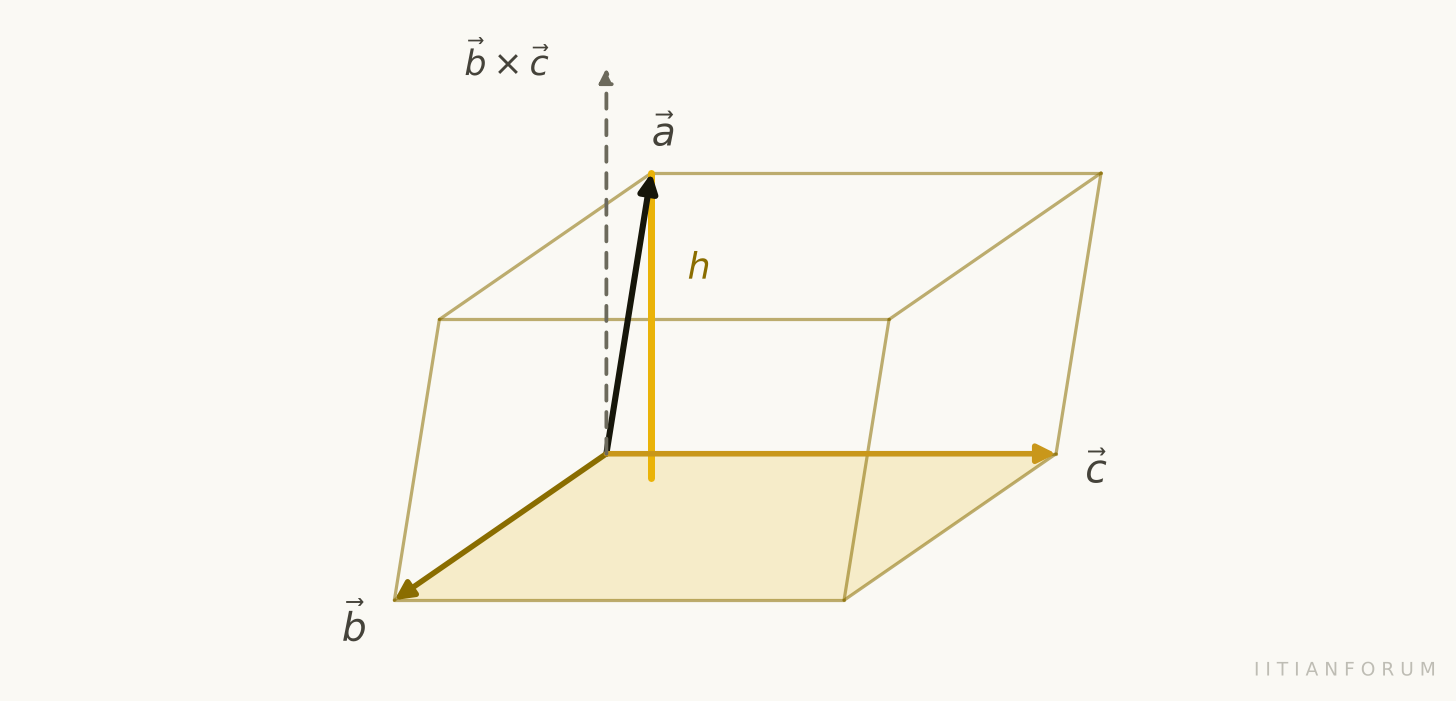
Its absolute value is the volume of the parallelepiped with coterminous edges a⃗\vec a, b⃗\vec b, c⃗\vec c: the base has area ∣b⃗×c⃗∣\lvert\vec b\times\vec c\rvert and the height is the projection of a⃗\vec a on the normal b⃗×c⃗\vec b\times\vec c.

A parallelepiped with edges a, b, c from one corner, the normal b cross c to the base, and the height of the box marked as the projection of a on that normal

Properties, all from the determinant:

  • A cyclic shift changes nothing: [a⃗ b⃗ c⃗]=[b⃗ c⃗ a⃗]=[c⃗ a⃗ b⃗][\vec a\ \vec b\ \vec c]=[\vec b\ \vec c\ \vec a]=[\vec c\ \vec a\ \vec b].
  • Swapping two vectors changes the sign: [a⃗ c⃗ b⃗]=−[a⃗ b⃗ c⃗][\vec a\ \vec c\ \vec b]=-[\vec a\ \vec b\ \vec c].
  • Dot and cross can be interchanged: a⃗⋅(b⃗×c⃗)=(a⃗×b⃗)⋅c⃗\vec a\cdot(\vec b\times\vec c)=(\vec a\times\vec b)\cdot\vec c.
  • Two equal vectors give 00.
  • a⃗\vec a, b⃗\vec b, c⃗\vec c are coplanar exactly when [a⃗ b⃗ c⃗]=0[\vec a\ \vec b\ \vec c]=0.
  • Four points AA, BB, CC, DD are coplanar exactly when [AB→ AC→ AD→]=0[\overrightarrow{AB}\ \overrightarrow{AC}\ \overrightarrow{AD}]=0.
  • The volume of a tetrahedron is 16∣[AB→ AC→ AD→]∣\dfrac16\lvert[\overrightarrow{AB}\ \overrightarrow{AC}\ \overrightarrow{AD}]\rvert.

Two results that turn long questions into one line:

If u⃗\vec u, v⃗\vec v, w⃗\vec w are combinations of a⃗\vec a, b⃗\vec b, c⃗\vec c with coefficient rows (p1,q1,r1)(p_1,q_1,r_1), (p2,q2,r2)(p_2,q_2,r_2), (p3,q3,r3)(p_3,q_3,r_3), then

[u⃗ v⃗ w⃗]=D [a⃗ b⃗ c⃗][\vec u\ \vec v\ \vec w]=D\,[\vec a\ \vec b\ \vec c] D=∣p1q1r1p2q2r2p3q3r3∣D=\begin{vmatrix}p_1&q_1&r_1\\p_2&q_2&r_2\\p_3&q_3&r_3\end{vmatrix}

and

[a⃗×b⃗  b⃗×c⃗  c⃗×a⃗]=[a⃗ b⃗ c⃗]2[\vec a\times\vec b\ \ \vec b\times\vec c\ \ \vec c\times\vec a]=[\vec a\ \vec b\ \vec c]^2
Components along a right-handed orthonormal triad

If p⃗\vec p, q⃗\vec q, r⃗\vec r are mutually perpendicular unit vectors with p⃗×q⃗=r⃗\vec p\times\vec q=\vec r, then q⃗×r⃗=p⃗\vec q\times\vec r=\vec p and r⃗×p⃗=q⃗\vec r\times\vec p=\vec q. So [a⃗ q⃗ r⃗]=a⃗⋅p⃗[\vec a\ \vec q\ \vec r]=\vec a\cdot\vec p, the component of a⃗\vec a along p⃗\vec p, and similarly for the other two.

Linearly dependent and independent vectors

Vectors a⃗1,…,a⃗n\vec a_1,\ldots,\vec a_n are linearly dependent if some combination x1a⃗1+⋯+xna⃗n=0⃗x_1\vec a_1+\cdots+x_n\vec a_n=\vec 0 holds with the scalars not all zero, and linearly independent if the only such combination has every xi=0x_i=0.

VectorsDependent exactly when
two vectorsthey are collinear
three vectorsthey are coplanar, [a⃗ b⃗ c⃗]=0[\vec a\ \vec b\ \vec c]=0
four or more vectors in spacealways

So three non-coplanar vectors a⃗\vec a, b⃗\vec b, c⃗\vec c are independent, and every vector in space can be written in exactly one way as xa⃗+yb⃗+zc⃗x\vec a+y\vec b+z\vec c. To find xx, yy, zz, take triple products: [r⃗ b⃗ c⃗]=x[a⃗ b⃗ c⃗][\vec r\ \vec b\ \vec c]=x[\vec a\ \vec b\ \vec c], and similarly for yy and zz.

Example 24 (IITianForum). Let p⃗\vec p, q⃗\vec q, r⃗\vec r be unit vectors with p⃗×q⃗=r⃗\vec p\times\vec q=\vec r and p⃗⊥q⃗\vec p\perp\vec q. If [a⃗ q⃗ r⃗]=4[\vec a\ \vec q\ \vec r]=4, [a⃗ r⃗ p⃗]=−1[\vec a\ \vec r\ \vec p]=-1 and [a⃗ p⃗ q⃗]=2[\vec a\ \vec p\ \vec q]=2, find a⃗\vec a in terms of p⃗\vec p, q⃗\vec q, r⃗\vec r.

▸ SHOW SOLUTION

Step 1. The triad is right-handed and orthonormal

q⃗×r⃗=p⃗,r⃗×p⃗=q⃗,p⃗×q⃗=r⃗\vec q\times\vec r=\vec p,\quad\vec r\times\vec p=\vec q,\quad\vec p\times\vec q=\vec r

Step 2. Read off the components

a⃗⋅p⃗=[a⃗ q⃗ r⃗]=4\vec a\cdot\vec p=[\vec a\ \vec q\ \vec r]=4a⃗⋅q⃗=[a⃗ r⃗ p⃗]=−1\vec a\cdot\vec q=[\vec a\ \vec r\ \vec p]=-1a⃗⋅r⃗=[a⃗ p⃗ q⃗]=2\vec a\cdot\vec r=[\vec a\ \vec p\ \vec q]=2

Answer: a⃗=4p⃗−q⃗+2r⃗\vec a=4\vec p-\vec q+2\vec r

Example 25 (IITianForum). Let a⃗\vec a, b⃗\vec b, c⃗\vec c be non-coplanar, and let u⃗=a⃗+2b⃗\vec u=\vec a+2\vec b, v⃗=b⃗+3c⃗\vec v=\vec b+3\vec c, w⃗=c⃗+a⃗\vec w=\vec c+\vec a. If

[u⃗×v⃗  v⃗×w⃗  w⃗×u⃗]=k[a⃗ b⃗ c⃗]2[\vec u\times\vec v\ \ \vec v\times\vec w\ \ \vec w\times\vec u]=k[\vec a\ \vec b\ \vec c]^2

find kk.

▸ SHOW SOLUTION

Step 1. Use the square rule

The left side is [u⃗ v⃗ w⃗]2[\vec u\ \vec v\ \vec w]^2.

Step 2. Triple product of the combinations

[u⃗ v⃗ w⃗]=∣120013101∣[a⃗ b⃗ c⃗][\vec u\ \vec v\ \vec w]=\begin{vmatrix}1&2&0\\0&1&3\\1&0&1\end{vmatrix}[\vec a\ \vec b\ \vec c]∣120013101∣=1(1)−2(0−3)+0=7\begin{vmatrix}1&2&0\\0&1&3\\1&0&1\end{vmatrix}=1(1)-2(0-3)+0=7

Step 3. Square

[u⃗ v⃗ w⃗]2=49[a⃗ b⃗ c⃗]2[\vec u\ \vec v\ \vec w]^2=49[\vec a\ \vec b\ \vec c]^2

Answer: k=49k=49

Example 26 (IITianForum). OABCOABC is a tetrahedron with OO at the origin, and M1M_1, M2M_2, M3M_3 are the midpoints of BCBC, CACA, ABAB. If v1v_1 is the volume of the tetrahedron and v2v_2 the volume of the parallelepiped with coterminous edges OM1OM_1, OM2OM_2, OM3OM_3, find 12v1v2\dfrac{12v_1}{v_2}.

▸ SHOW SOLUTION

Step 1. The two volumes

v1=16∣[a⃗ b⃗ c⃗]∣v_1=\frac16\lvert[\vec a\ \vec b\ \vec c]\rvertv2=∣[m⃗1 m⃗2 m⃗3]∣,m⃗1=b⃗+c⃗2, …v_2=\lvert[\vec m_1\ \vec m_2\ \vec m_3]\rvert,\qquad\vec m_1=\frac{\vec b+\vec c}{2},\ \ldots

Step 2. Triple product of the midpoints

[m⃗1 m⃗2 m⃗3]=18[b⃗+c⃗  c⃗+a⃗  a⃗+b⃗][\vec m_1\ \vec m_2\ \vec m_3]=\frac18[\vec b+\vec c\ \ \vec c+\vec a\ \ \vec a+\vec b]=18∣011101110∣[a⃗ b⃗ c⃗]=14[a⃗ b⃗ c⃗]=\frac18\begin{vmatrix}0&1&1\\1&0&1\\1&1&0\end{vmatrix}[\vec a\ \vec b\ \vec c]=\frac14[\vec a\ \vec b\ \vec c]

Step 3. Ratio

12v1v2=12⋅1614=8\frac{12v_1}{v_2}=\frac{12\cdot\frac16}{\frac14}=8

Answer: 88

Vector triple product

For any three vectors,

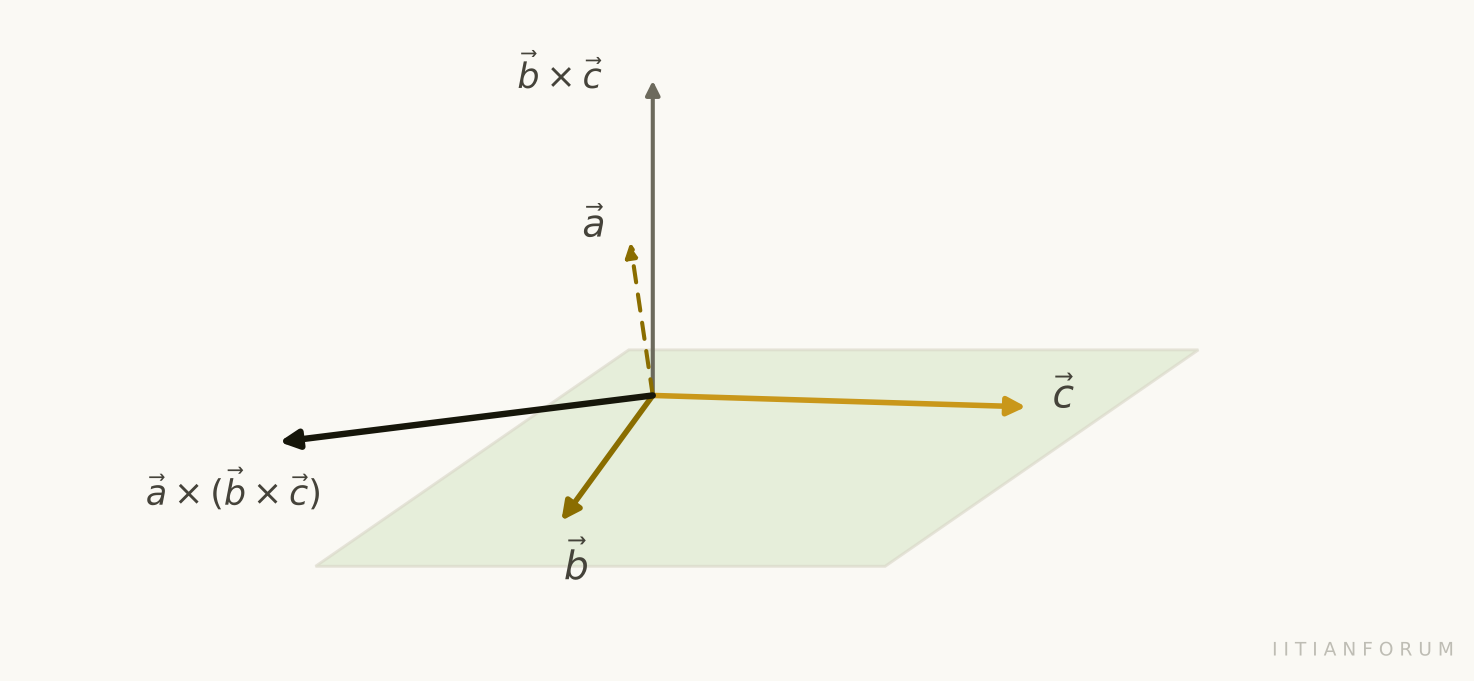
a⃗×(b⃗×c⃗)=(a⃗⋅c⃗)b⃗−(a⃗⋅b⃗)c⃗\vec a\times(\vec b\times\vec c)=(\vec a\cdot\vec c)\vec b-(\vec a\cdot\vec b)\vec c (a⃗×b⃗)×c⃗=(a⃗⋅c⃗)b⃗−(b⃗⋅c⃗)a⃗(\vec a\times\vec b)\times\vec c=(\vec a\cdot\vec c)\vec b-(\vec b\cdot\vec c)\vec a

The first lies in the plane of b⃗\vec b and c⃗\vec c; the second in the plane of a⃗\vec a and b⃗\vec b. So the cross product is not associative.

The plane of b and c with both vectors drawn in it, b cross c standing perpendicular to the plane, and a cross (b cross c) lying back in the plane of b and c

The special case to remember, with a⃗=b⃗\vec a=\vec b:

a⃗×(a⃗×c⃗)=(a⃗⋅c⃗)a⃗−∣a⃗∣2c⃗\vec a\times(\vec a\times\vec c)=(\vec a\cdot\vec c)\vec a-\lvert\vec a\rvert^2\vec c

It solves a⃗×c⃗=b⃗\vec a\times\vec c=\vec b in one stroke: cross both sides with a⃗\vec a and the unknown c⃗\vec c appears alone.

Remembering the order

In a⃗×(b⃗×c⃗)\vec a\times(\vec b\times\vec c) the answer is a combination of the two vectors inside the bracket. The coefficient of each is the dot product of the outside vector with the other one: (a⃗⋅c⃗)(\vec a\cdot\vec c) goes with b⃗\vec b, (a⃗⋅b⃗)(\vec a\cdot\vec b) goes with c⃗\vec c, and the second term carries the minus sign.

Example 27 (JEE Main 2026, 23 January Shift 1). Let a⃗=−i^+j^+2k^\vec a=-\hat i+\hat j+2\hat k, b⃗=i^−j^−3k^\vec b=\hat i-\hat j-3\hat k, c⃗=a⃗×b⃗\vec c=\vec a\times\vec b and d⃗=c⃗×a⃗\vec d=\vec c\times\vec a. Then (a⃗−b⃗)⋅d⃗(\vec a-\vec b)\cdot\vec d is

(1) 44 (2) −4-4 (3) −2-2 (4) 22

▸ SHOW SOLUTION

Step 1. Expand d

d⃗=(a⃗×b⃗)×a⃗=∣a⃗∣2b⃗−(a⃗⋅b⃗)a⃗\vec d=(\vec a\times\vec b)\times\vec a=\lvert\vec a\rvert^2\vec b-(\vec a\cdot\vec b)\vec a

∣a⃗∣2=6\lvert\vec a\rvert^2=6, a⃗⋅b⃗=−8\vec a\cdot\vec b=-8, so d⃗=6b⃗+8a⃗\vec d=6\vec b+8\vec a.

Step 2. The dot product

(a⃗−b⃗)⋅(8a⃗+6b⃗)(\vec a-\vec b)\cdot(8\vec a+6\vec b)=8∣a⃗∣2−2 a⃗⋅b⃗−6∣b⃗∣2=8\lvert\vec a\rvert^2-2\,\vec a\cdot\vec b-6\lvert\vec b\rvert^2=48+16−66=−2=48+16-66=-2

Answer: (3) −2-2

Example 28 (JEE Main 2026, 6 April Shift 1). If a⃗=i^+j^+k^\vec a=\hat i+\hat j+\hat k, b⃗=j^−k^\vec b=\hat j-\hat k and c⃗\vec c satisfy a⃗×c⃗=b⃗\vec a\times\vec c=\vec b and a⃗⋅c⃗=3\vec a\cdot\vec c=3, then c⃗⋅(a⃗−2b⃗)\vec c\cdot(\vec a-2\vec b) is ______.

▸ SHOW SOLUTION

Step 1. Cross both sides with a

a⃗×(a⃗×c⃗)=a⃗×b⃗\vec a\times(\vec a\times\vec c)=\vec a\times\vec b(a⃗⋅c⃗)a⃗−∣a⃗∣2c⃗=a⃗×b⃗(\vec a\cdot\vec c)\vec a-\lvert\vec a\rvert^2\vec c=\vec a\times\vec b

Step 2. Numbers

a⃗×b⃗=−2i^+j^+k^\vec a\times\vec b=-2\hat i+\hat j+\hat k, a⃗⋅c⃗=3\vec a\cdot\vec c=3, ∣a⃗∣2=3\lvert\vec a\rvert^2=3:

3c⃗=3a⃗−(a⃗×b⃗)=5i^+2j^+2k^3\vec c=3\vec a-(\vec a\times\vec b)=5\hat i+2\hat j+2\hat k

Step 3. The dot product

a⃗−2b⃗=i^−j^+3k^\vec a-2\vec b=\hat i-\hat j+3\hat kc⃗⋅(a⃗−2b⃗)=5−2+63=3\vec c\cdot(\vec a-2\vec b)=\frac{5-2+6}{3}=3

Answer: 33

Example 29 (IITianForum). Vectors a⃗\vec a, b⃗\vec b, c⃗\vec c have magnitudes 11, 3\sqrt3, 22 and satisfy a⃗×(a⃗×c⃗)+b⃗=0⃗\vec a\times(\vec a\times\vec c)+\vec b=\vec 0. Find the acute angle between a⃗\vec a and c⃗\vec c, and the value of b⃗⋅c⃗\vec b\cdot\vec c.

▸ SHOW SOLUTION

Step 1. Expand

a⃗×(a⃗×c⃗)=(a⃗⋅c⃗)a⃗−c⃗\vec a\times(\vec a\times\vec c)=(\vec a\cdot\vec c)\vec a-\vec c

so b⃗=c⃗−(a⃗⋅c⃗)a⃗\vec b=\vec c-(\vec a\cdot\vec c)\vec a, the part of c⃗\vec c perpendicular to a⃗\vec a.

Step 2. Magnitude of b

∣b⃗∣2=∣c⃗∣2−(a⃗⋅c⃗)2\lvert\vec b\rvert^2=\lvert\vec c\rvert^2-(\vec a\cdot\vec c)^23=4−(a⃗⋅c⃗)2  ⟹  a⃗⋅c⃗=±13=4-(\vec a\cdot\vec c)^2\implies\vec a\cdot\vec c=\pm1

cos⁡θ=±12\cos\theta=\pm\dfrac12, so the acute angle is π3\dfrac\pi3.

Step 3. b dot c

b⃗⋅c⃗=∣c⃗∣2−(a⃗⋅c⃗)2=3\vec b\cdot\vec c=\lvert\vec c\rvert^2-(\vec a\cdot\vec c)^2=3

Answer: π3\dfrac\pi3 and 33

Geometry with vectors

The angle bisector

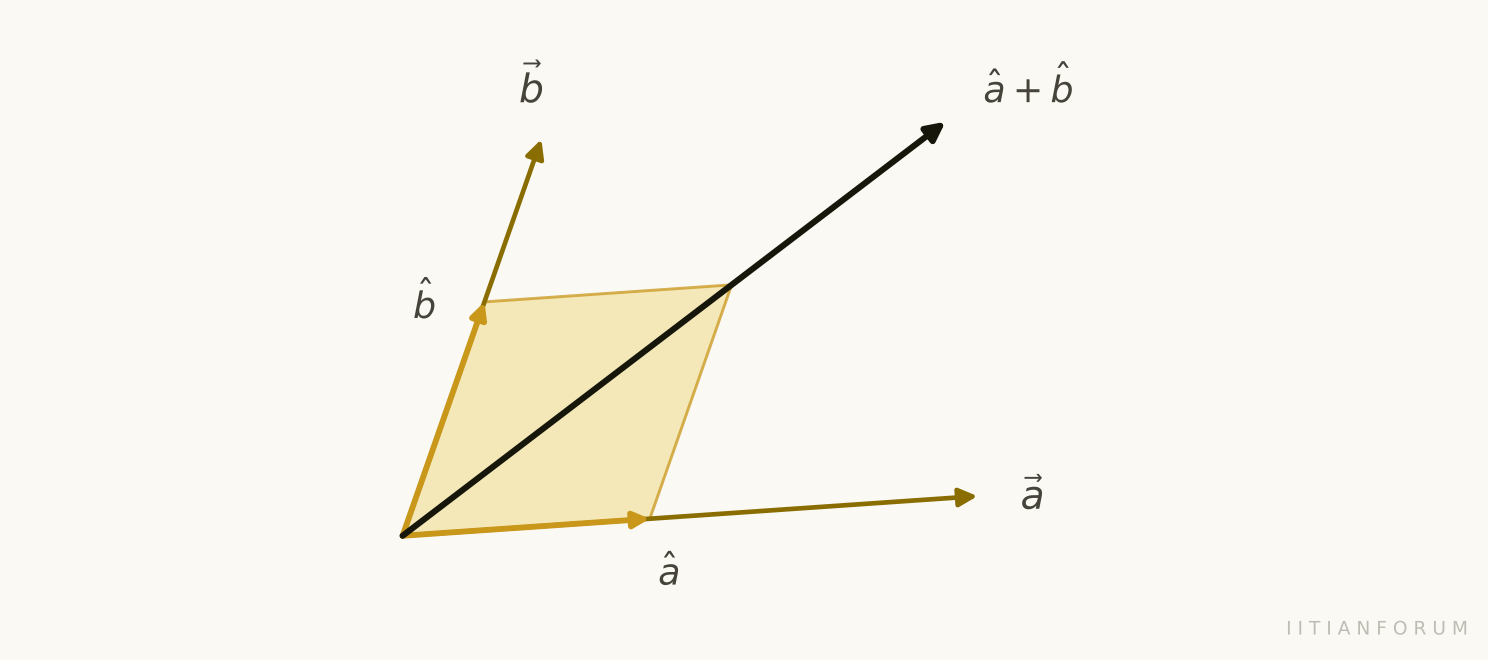
The unit vectors a^\hat a and b^\hat b have equal length, so they span a rhombus, and the diagonal of a rhombus bisects its angle. Hence the internal bisector of the angle between a⃗\vec a and b⃗\vec b has direction

a^+b^=a⃗∣a⃗∣+b⃗∣b⃗∣\hat a+\hat b=\frac{\vec a}{\lvert\vec a\rvert}+\frac{\vec b}{\lvert\vec b\rvert}

and the external bisector has direction a^−b^\hat a-\hat b. A point equidistant from two lines through AA lies on a bisector of the angle at AA.

Vectors a and b from a common point, their unit vectors forming a rhombus, and the diagonal a hat plus b hat bisecting the angle

Example 30 (JEE Main 2026, 28 January Shift 2). Let PP be a point in the plane of AB→=3i^+j^−k^\overrightarrow{AB}=3\hat i+\hat j-\hat k and AC→=i^−j^+3k^\overrightarrow{AC}=\hat i-\hat j+3\hat k, equidistant from the lines ABAB and ACAC. If ∣AP→∣=52\lvert\overrightarrow{AP}\rvert=\dfrac{\sqrt5}{2}, then the area of triangle ABPABP is

(1) 22 (2) 32\dfrac32 (3) 304\dfrac{\sqrt{30}}{4} (4) 264\dfrac{\sqrt{26}}{4}

▸ SHOW SOLUTION

Step 1. Angle at A

cos⁡2θ=AB→⋅AC→11⋅11=−111\cos2\theta=\frac{\overrightarrow{AB}\cdot\overrightarrow{AC}}{\sqrt{11}\cdot\sqrt{11}}=-\frac{1}{11}

Step 2. AP bisects the angle

∠BAP=θ\angle BAP=\theta, and cos⁡2θ=1−2sin⁡2θ\cos2\theta=1-2\sin^2\theta:

sin⁡2θ=611\sin^2\theta=\frac{6}{11}

Step 3. Area

12⋅11⋅52⋅611=304\frac12\cdot\sqrt{11}\cdot\frac{\sqrt5}{2}\cdot\sqrt{\frac{6}{11}}=\frac{\sqrt{30}}{4}

Answer: (3)

Example 31 (JEE Main 2026, 28 January Shift 1). In triangle PQRPQR, PQ→=−2i^−j^+2k^\overrightarrow{PQ}=-2\hat i-\hat j+2\hat k and PR→=ai^+bj^−4k^\overrightarrow{PR}=a\hat i+b\hat j-4\hat k with a,b∈Za,b\in\mathbb Z. Let SS on QRQR be equidistant from the lines PQPQ and PRPR. If ∣PR→∣=9\lvert\overrightarrow{PR}\rvert=9 and PS→=i^−7j^+2k^\overrightarrow{PS}=\hat i-7\hat j+2\hat k, then 3a−4b3a-4b is ______.

▸ SHOW SOLUTION

Step 1. PS bisects angle QPR

PQ→⋅PS→∣PQ→∣=PR→⋅PS→∣PR→∣\frac{\overrightarrow{PQ}\cdot\overrightarrow{PS}}{\lvert\overrightarrow{PQ}\rvert}=\frac{\overrightarrow{PR}\cdot\overrightarrow{PS}}{\lvert\overrightarrow{PR}\rvert}93=a−7b−89  ⟹  a−7b=35\frac{9}{3}=\frac{a-7b-8}{9}\implies a-7b=35

Step 2. Length of PR

a2+b2+16=81  ⟹  a2+b2=65a^2+b^2+16=81\implies a^2+b^2=65

Step 3. Solve

a=35+7ba=35+7b gives 5b2+49b+116=05b^2+49b+116=0, so b=−4b=-4 (integer) and a=7a=7.

3a−4b=21+16=373a-4b=21+16=37

Answer: 3737

Only the direction of PS→\overrightarrow{PS} was used. With these numbers the bisector actually meets QRQR at 14(i^−7j^+2k^)\dfrac14(\hat i-7\hat j+2\hat k) from PP, a quarter of the printed vector, but the direction and so the answer are unchanged.

Area ratios from a vector equation

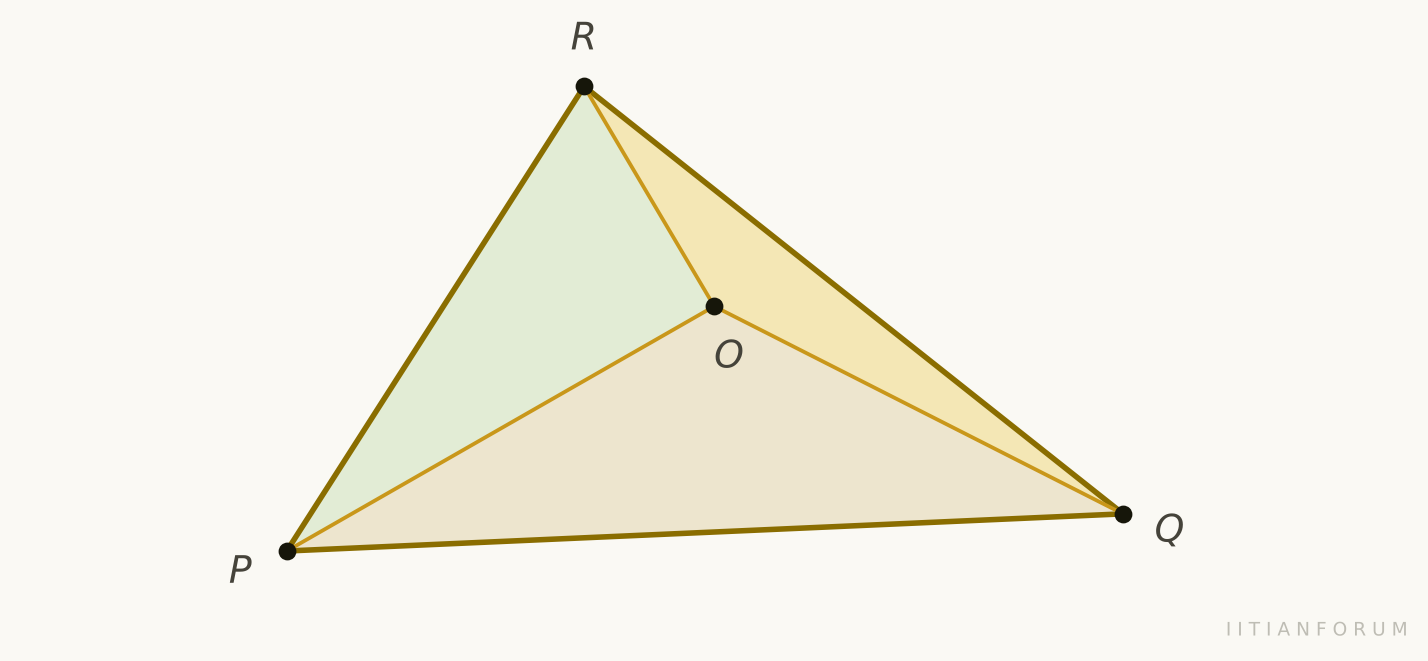
If OO is inside triangle PQRPQR and

OP→+k1OQ→+k2OR→=0⃗\overrightarrow{OP}+k_1\overrightarrow{OQ}+k_2\overrightarrow{OR}=\vec 0

with k1,k2>0k_1,k_2>0, then the areas are in the ratio of the coefficients: [OQR]:[ORP]:[OPQ]=1:k1:k2[OQR]:[ORP]:[OPQ]=1:k_1:k_2, and [PQR]=(1+k1+k2)[OQR][PQR]=(1+k_1+k_2)[OQR].

Triangle PQR with a point O inside joined to the three vertices, splitting it into the three triangles OQR, ORP and OPQ

Example 32 (IITianForum). OO is a point inside triangle PQRPQR with OP→+k1OQ→+k2OR→=0⃗\overrightarrow{OP}+k_1\overrightarrow{OQ}+k_2\overrightarrow{OR}=\vec 0. If the area of △PQR\triangle PQR is 66 times the area of △OQR\triangle OQR, find k1+k2k_1+k_2.

▸ SHOW SOLUTION

Step 1. Take O as origin

p⃗=−k1q⃗−k2r⃗\vec p=-k_1\vec q-k_2\vec r.

Step 2. Area of PQR

2[PQR]=∣(q⃗−p⃗)×(r⃗−p⃗)∣2[PQR]=\lvert(\vec q-\vec p)\times(\vec r-\vec p)\rvert=∣q⃗×r⃗+r⃗×p⃗+p⃗×q⃗∣=\lvert\vec q\times\vec r+\vec r\times\vec p+\vec p\times\vec q\rvertr⃗×p⃗=k1 q⃗×r⃗,p⃗×q⃗=k2 q⃗×r⃗\vec r\times\vec p=k_1\,\vec q\times\vec r,\qquad\vec p\times\vec q=k_2\,\vec q\times\vec r[PQR]=(1+k1+k2)⋅12∣q⃗×r⃗∣[PQR]=(1+k_1+k_2)\cdot\frac12\lvert\vec q\times\vec r\rvert[PQR]=(1+k1+k2)[OQR][PQR]=(1+k_1+k_2)[OQR]

Step 3. Solve

1+k1+k2=6  ⟹  k1+k2=51+k_1+k_2=6\implies k_1+k_2=5

Answer: 55

Which result to use

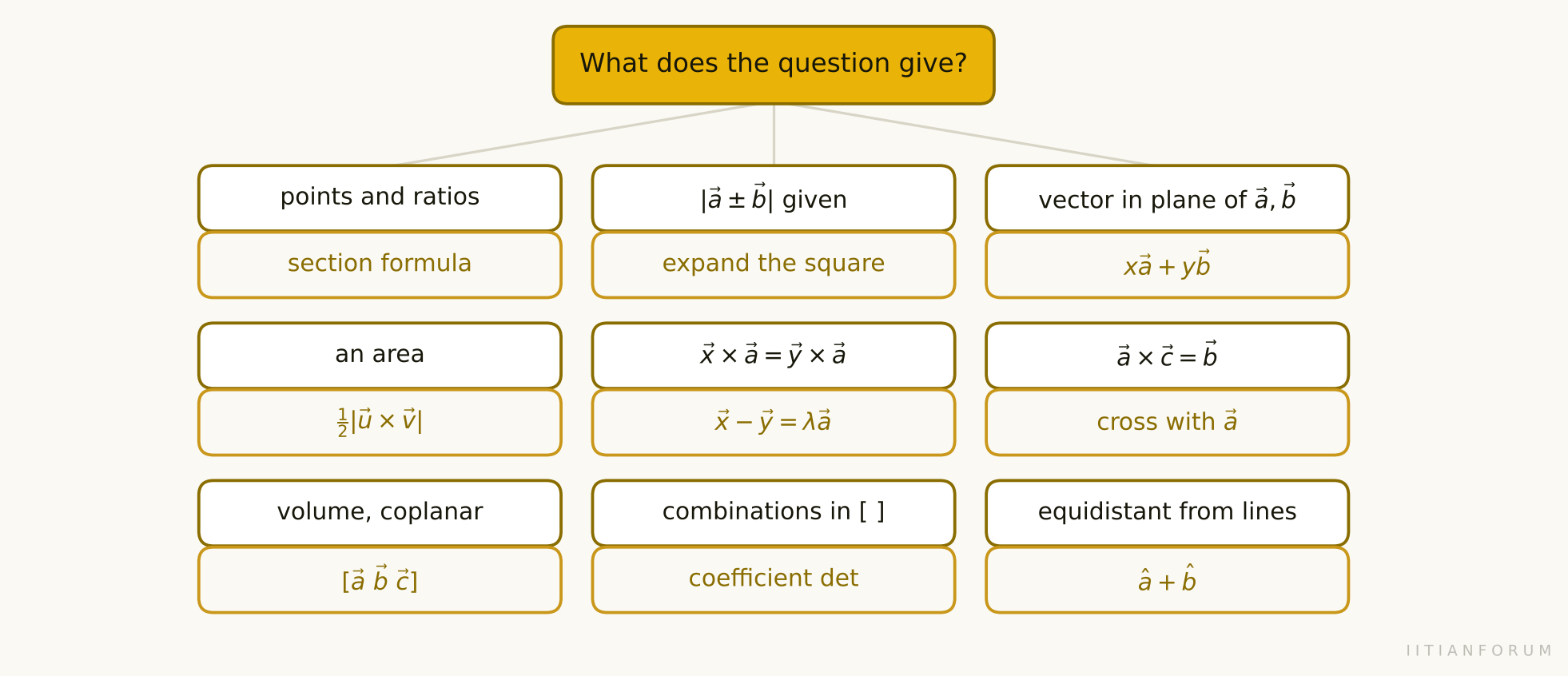
A decision chart: from what the question gives, arrows lead to the section formula, expanding a square, writing v as x a plus y b, the cross product for area, collecting into one cross product, the triple product determinant, the vector triple product, or the angle bisector direction
The question gives youReach for
points and ratiosposition vectors and the section formula
magnitudes of sums and differencesexpand ∣a⃗±b⃗∣2\lvert\vec a\pm\vec b\rvert^2
a sum of squares equal to zerothe vector itself is 0⃗\vec 0
a maximum of p∣⋯∣+q∣⋯∣p\lvert\cdots\rvert+q\lvert\cdots\rverthalf angles, then A2+B2\sqrt{A^2+B^2}
a vector in the plane of a⃗\vec a, b⃗\vec bxa⃗+yb⃗x\vec a+y\vec b, two conditions
an area12∣AB→×AC→∣\frac12\lvert\overrightarrow{AB}\times\overrightarrow{AC}\rvert
dot products only, area wantedLagrange: ∣a⃗×b⃗∣2=∣a⃗∣2∣b⃗∣2−(a⃗⋅b⃗)2\lvert\vec a\times\vec b\rvert^2=\lvert\vec a\rvert^2\lvert\vec b\rvert^2-(\vec a\cdot\vec b)^2
x⃗×a⃗=y⃗×a⃗\vec x\times\vec a=\vec y\times\vec ax⃗−y⃗=λa⃗\vec x-\vec y=\lambda\vec a, then find λ\lambda
a⃗×c⃗=b⃗\vec a\times\vec c=\vec b with a⃗⋅c⃗\vec a\cdot\vec ccross with a⃗\vec a, use the triple product formula
volume or coplanarity[a⃗ b⃗ c⃗][\vec a\ \vec b\ \vec c] as a determinant
triple product of combinationscoefficient determinant times [a⃗ b⃗ c⃗][\vec a\ \vec b\ \vec c]
equidistant from two linesbisector direction a^±b^\hat a\pm\hat b

Quick recall

ResultStatement
SegmentAB→=b⃗−a⃗\overrightarrow{AB}=\vec b-\vec a
Section formulap⃗=mb⃗+na⃗m+n\vec p=\dfrac{m\vec b+n\vec a}{m+n}
Direction cosinesl2+m2+n2=1l^2+m^2+n^2=1
Dot producta⃗⋅b⃗=∣a⃗∣∣b⃗∣cos⁡θ=∑aibi\vec a\cdot\vec b=\lvert\vec a\rvert\lvert\vec b\rvert\cos\theta=\sum a_ib_i
Projection of a⃗\vec a on b⃗\vec ba⃗⋅b⃗∣b⃗∣\dfrac{\vec a\cdot\vec b}{\lvert\vec b\rvert}
Square of a sum∣a⃗+b⃗∣2=∣a⃗∣2+∣b⃗∣2+2a⃗⋅b⃗\lvert\vec a+\vec b\rvert^2=\lvert\vec a\rvert^2+\lvert\vec b\rvert^2+2\vec a\cdot\vec b
Cross product∣a⃗×b⃗∣=∣a⃗∣∣b⃗∣sin⁡θ\lvert\vec a\times\vec b\rvert=\lvert\vec a\rvert\lvert\vec b\rvert\sin\theta, perpendicular to both
Lagrange∣a⃗×b⃗∣2+(a⃗⋅b⃗)2=∣a⃗∣2∣b⃗∣2\lvert\vec a\times\vec b\rvert^2+(\vec a\cdot\vec b)^2=\lvert\vec a\rvert^2\lvert\vec b\rvert^2
Triangle area12∣AB→×AC→∣\frac12\lvert\overrightarrow{AB}\times\overrightarrow{AC}\rvert
Parallela⃗×b⃗=0⃗\vec a\times\vec b=\vec 0
Coplanar[a⃗ b⃗ c⃗]=0[\vec a\ \vec b\ \vec c]=0
Parallelepiped, tetrahedron∣[a⃗ b⃗ c⃗]∣\lvert[\vec a\ \vec b\ \vec c]\rvert, 16∣[a⃗ b⃗ c⃗]∣\frac16\lvert[\vec a\ \vec b\ \vec c]\rvert
Square of a triple product[a⃗×b⃗  b⃗×c⃗  c⃗×a⃗]=[a⃗ b⃗ c⃗]2[\vec a\times\vec b\ \ \vec b\times\vec c\ \ \vec c\times\vec a]=[\vec a\ \vec b\ \vec c]^2
Vector triple producta⃗×(b⃗×c⃗)=(a⃗⋅c⃗)b⃗−(a⃗⋅b⃗)c⃗\vec a\times(\vec b\times\vec c)=(\vec a\cdot\vec c)\vec b-(\vec a\cdot\vec b)\vec c
Angle bisectordirection a^+b^\hat a+\hat b
Before you leave this chapter

Take a⃗=i^+j^\vec a=\hat i+\hat j and b⃗=j^+k^\vec b=\hat j+\hat k. Without looking anything up, find the angle between them, the area of the triangle they span, a unit vector perpendicular to both, and the vector a⃗×(a⃗×b⃗)\vec a\times(\vec a\times\vec b). If all four come out in under five minutes and agree with each other, the chapter is in your hands.

Practise these methods on real exam questions in the doMath Vectors chapter, and continue with the 3D Geometry note, where every line and plane is written with the vectors built here.
[ SHARE ] WhatsApp
[ practice these chapters ]
Reinforce this post with live problems on doMath.
Vectors & 3D Geometry
PreviousStraight Line in Space Complete JEE Notes with examples.Next Area Bounded by Curves: Complete Notes with Illustrations
← Back to all notes