Area Bounded by Curves: Complete Notes with Illustrations
Ritesh Raj · 3 Sept 2026
Aa
21 min read14 sectionsConcept
Every area question is the same question asked in disguise: which curve is on top, over which stretch of the axis, and where does the crossing happen. Get those three right and the integral writes itself. Get any one wrong and no amount of clean integration will save the answer.
This note builds the in order: what the definite integral actually measures, the sign convention that catches the commonest lost mark, the five configurations that cover almost every JEE question, and then the six question types with worked past papers inside each.
What the definite integral measures
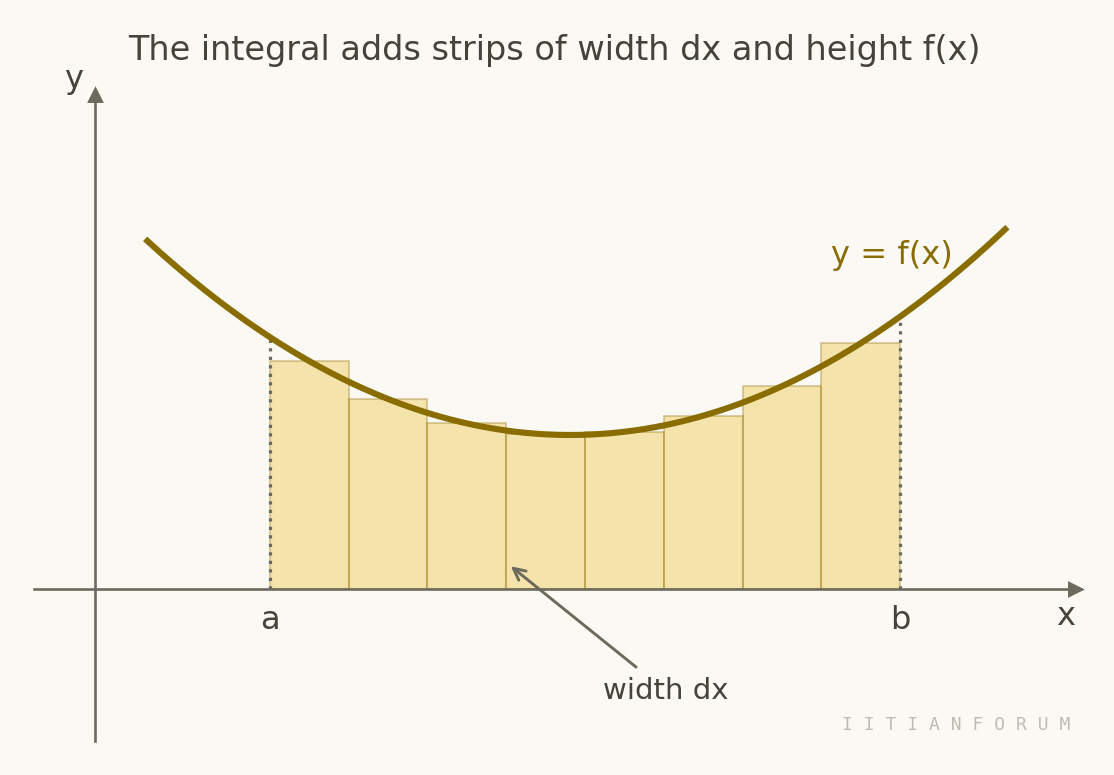
Let y=f(x) be continuous on [a,b]. The definite integral is a signed sum: strips of width dx and height f(x), added from x=a to x=b.
∫abf(x)dx=ϕ(b)−ϕ(a),where ϕ′(x)=f(x)
When f(x)≥0 on the whole of [a,b], that number is the area between the curve and the x-axis. When f dips below the axis, it is not. That single sentence is the whole of the sign convention, and it is where most marks are lost.
Strips of width dx under a curve, summing to the definite integral
The same construction turned on its side gives the y-axis version. If x=g(y) is continuous on [c,d], the area bounded by the curve, the y-axis and the lines y=c, y=d is
Area=∫cdxdy=∫cdg(y)dy
Use this whenever the region is easier to describe by horizontal strips than vertical ones. A parabola opening sideways, a region bounded left and right by two curves, a region whose top boundary changes formula but whose left and right boundaries do not: all of these are cheaper in y.
The sign convention, and the mark it costs
Three cases, and only the third is genuinely dangerous.
Case I.f(x)>0 throughout [a,b]. Then ∫abf(x)dx is already the area. Nothing to adjust.
Case II.f(x)<0 throughout [a,b]. The integral is negative. The area is its absolute value:
Area=∫abf(x)dx
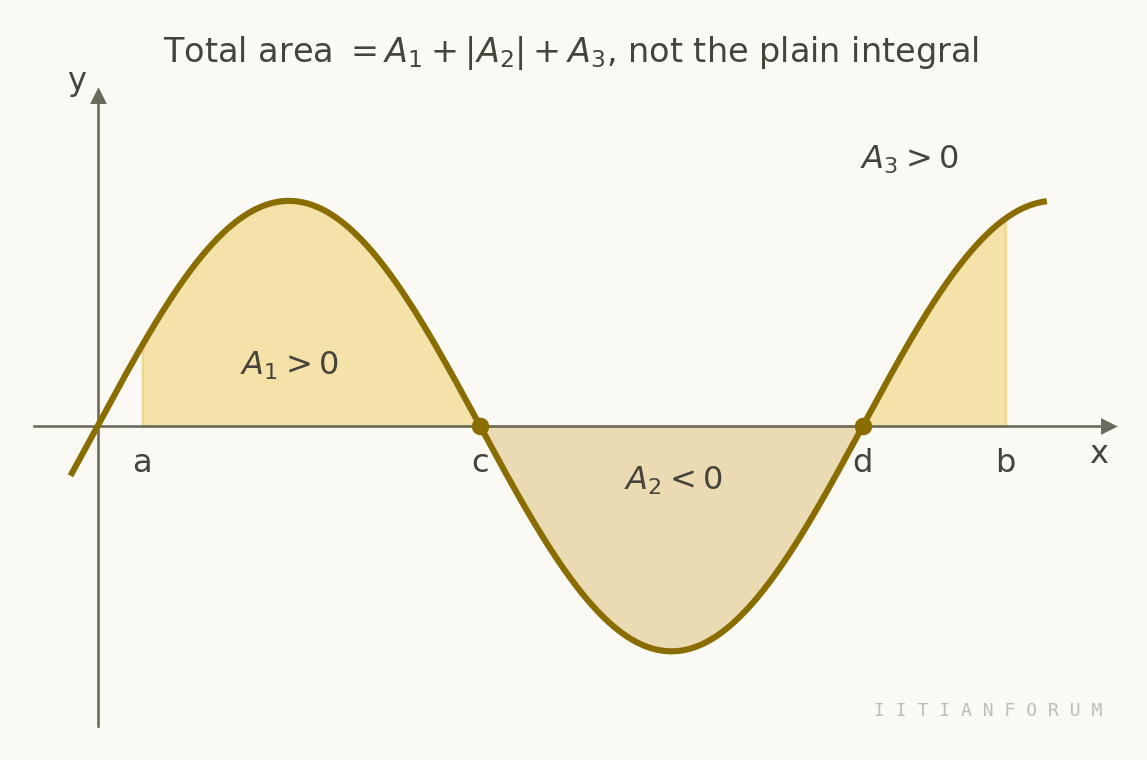
Case III.f changes sign inside [a,b]. Now the integral silently cancels: a piece of area above the axis is destroyed by a piece below it. You must split at every root and take absolute values piece by piece.
Area=∫acfdx+∫cdfdx+∫dbfdxA curve crossing the x-axis several times, with the signed pieces labelled
What a missed root costs you
If f crosses the axis at x=c and you integrate straight through from a to b, the two pieces partially cancel and your answer is too small. The examiner puts the uncancelled value in the options, so a wrong answer looks plausible. Before you integrate anything, solve f(x)=0 on the interval and mark every root.
There is a fourth situation worth naming separately because it looks different but is the same idea. If the region is bounded by two curves y=f(x) and y=g(x) which cross at x=c inside [a,b], then ∣f−g∣ changes formula at c:
Area=∫ac[f(x)−g(x)]dx+∫cb[g(x)−f(x)]dx
Always find the crossings first. Everything else is bookkeeping.
The five configurations
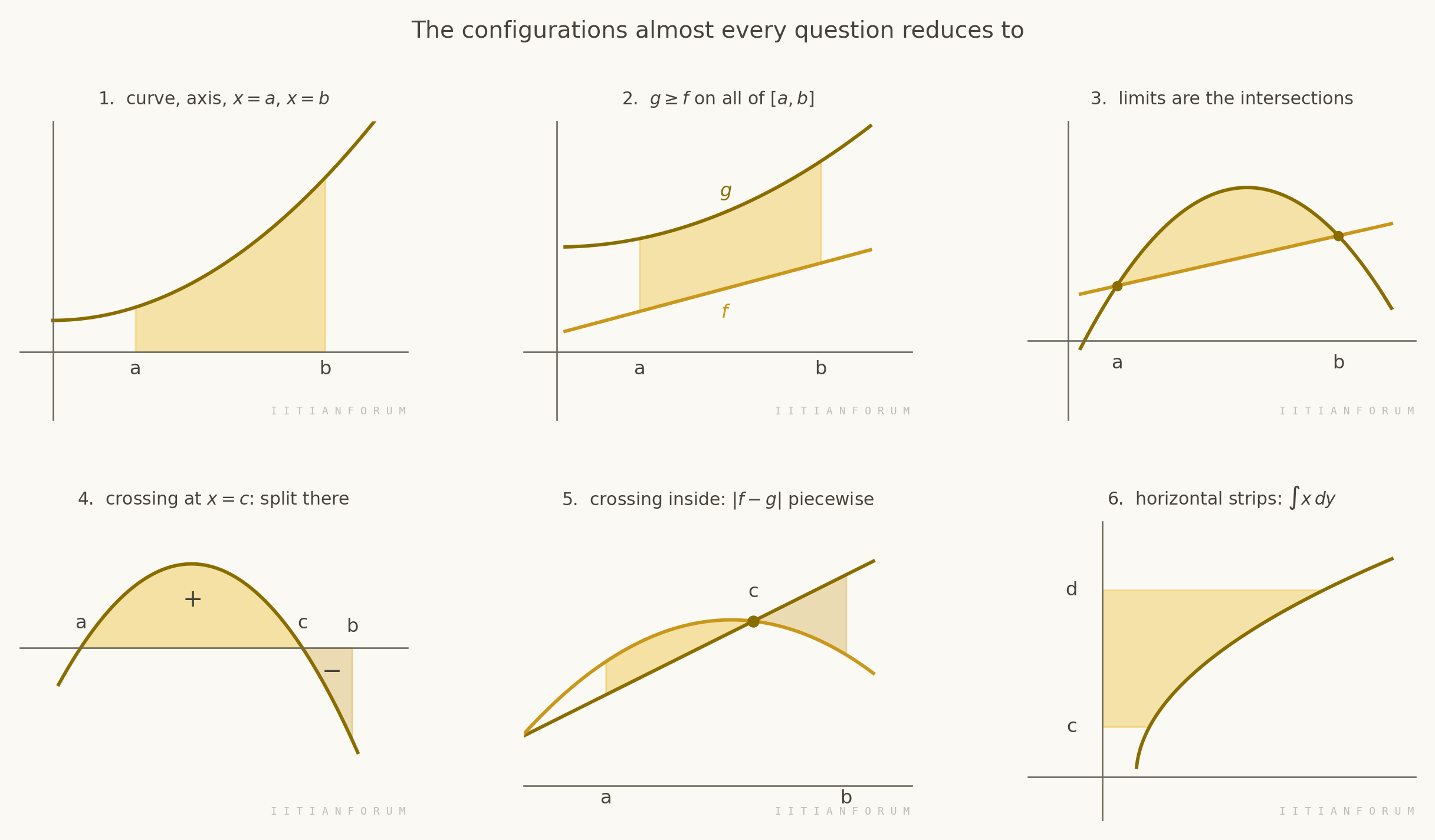
Almost every JEE area question is one of these five, or a combination of two of them.
Region
Formula
1
Curve y=f(x), the x-axis, and x=a, x=b with f≥0
∫abf(x)dx
2
Between y=f(x) and y=g(x) on [a,b], with g≥f throughout
∫ab[g(x)−f(x)]dx
3
Between two curves that meet at x=a and x=b
∫ab[g(x)−f(x)]dx, a,b the roots of f=g
4
Curve crossing the axis at x=c between a and b
∫acfdx−∫cbfdx
5
Two curves crossing at x=c inside [a,b]
split at c, take ∣f−g∣ on each piece
swipe for more →
Configuration 3 is the one to reach for first. In most questions the limits are not given to you: they are the intersection points, and finding them is half the work.
The five standard configurations side by side
Curve tracing: seven checks before you integrate
You cannot decide which curve is on top without a sketch, and you cannot sketch without a method. Seven checks, in this order, settle almost any curve that appears in this chapter.
1. Domain
Find the values of x for which the curve exists. A square root, a logarithm or a denominator will restrict it.
2. Symmetry
Four tests, each cheap:
Every power of y even, so replacing y by −y leaves the equation unchanged: symmetric about the x-axis. Example y2=4ax.
Every power of x even: symmetric about the y-axis. Example x2=4ay.
Both: symmetric about both axes, hence about the origin. Example x2+y2=1.
Swapping x and y leaves the equation unchanged: symmetric about the line y=x.
Replacing (x,y) by (−x,−y) leaves it unchanged: symmetric in opposite quadrants. Example xy=c2.
Symmetry is not decoration. It halves or quarters the integral you have to do, and on a timed paper that is the difference between finishing and not.
3. Intercepts
Where does the curve meet the axes? Set y=0, then x=0.
4. Turning points
Solve dxdy=0 to locate horizontal tangents. These tell you the shape between the intercepts.
5. Period
If the curve is periodic, find the period and sketch one cycle only.
6. Asymptotes
If x→alimf(x)=±∞ then x=a is a vertical asymptote. If x→∞limf(x)=k then y=k is a horizontal one. For an oblique asymptote y=mx+c, compute m=x→∞limxf(x) and then c=x→∞lim[f(x)−mx].
7. Sign
On each interval between the roots, is the curve above or below the axis? This is the check that feeds directly into the sign convention.
Reading a modulus off the graph
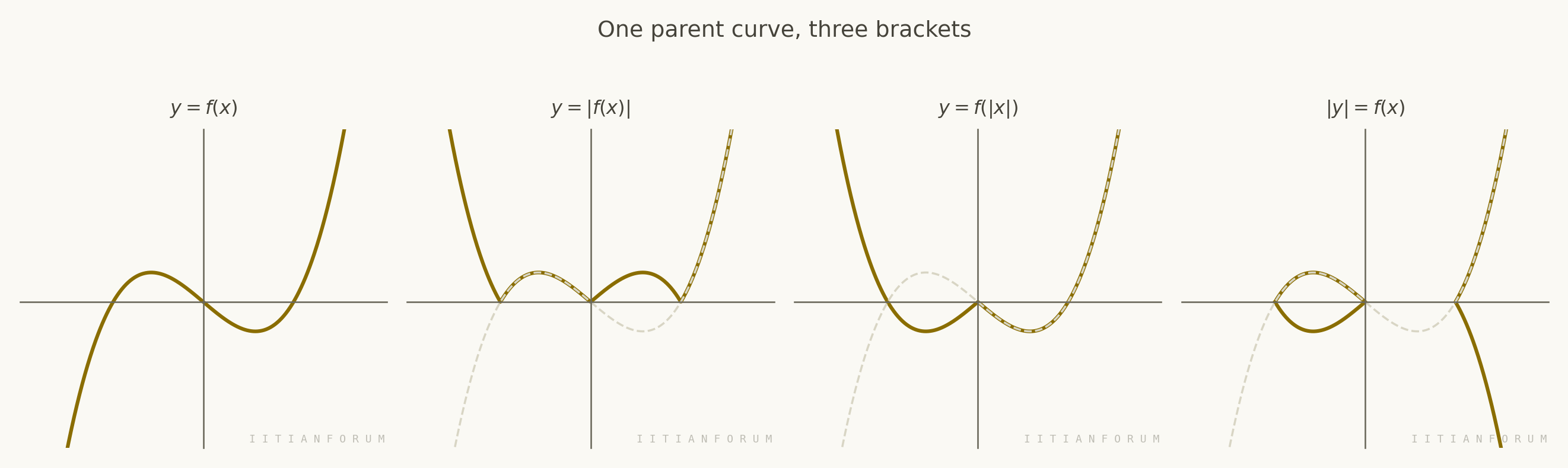
Modulus questions are the single largest source of area questions in recent papers, and they are all mechanical once you know what each bracket does to a graph.
Curve
What it does to y=f(x)
y=−f(x)
reflect in the x-axis
y=f(−x)
reflect in the y-axis
y=f(x)+k
shift up by k (down if k<0)
y=f(x+k)
shift left by k (right if k<0)
y=kf(x)
stretch vertically by k
y=f(kx)
compress horizontally by k
y=∣f(x)∣
keep the part above the axis, reflect the part below it upward
y=f(∣x∣)
discard x<0, mirror the right half into the left
∣y∣=f(x)
discard the part below the axis, mirror the rest downward
swipe for more →
The three modulus transformations on one parent curve
The order that never fails
Sketch the parent curve first, in pencil, without any brackets. Then apply one transformation at a time in the order the brackets sit, outermost last. Never try to draw y=∣f(∣x∣)∣ in one go.
Standard results worth carrying
These come up often enough that deriving them in the exam is wasted time.
Region
Area
y2=4ax and x2=4by
316ab
y2=4ax and y=mx
3m38a2
y2=4ax and its latus rectum
38a2
One arch of y=sinax with the x-axis
a2
Ellipse a2x2+b2y2=1
πab
y=logex, y=0, x=0
1
Circle segment, central angle θ
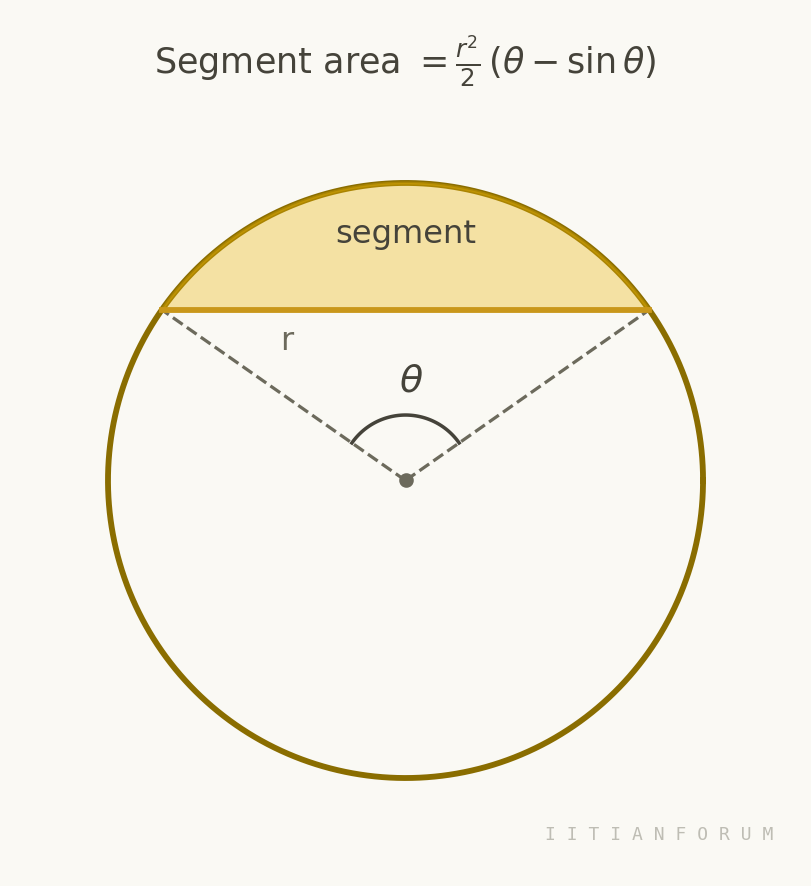
2r2(θ−sinθ)
swipe for more →
The last one is worth memorising in this exact form. Every "area of the region inside one circle and outside another" question collapses to two applications of it.
Type 1 — A curve against an axis
The plainest form. Sketch, check the sign, integrate.
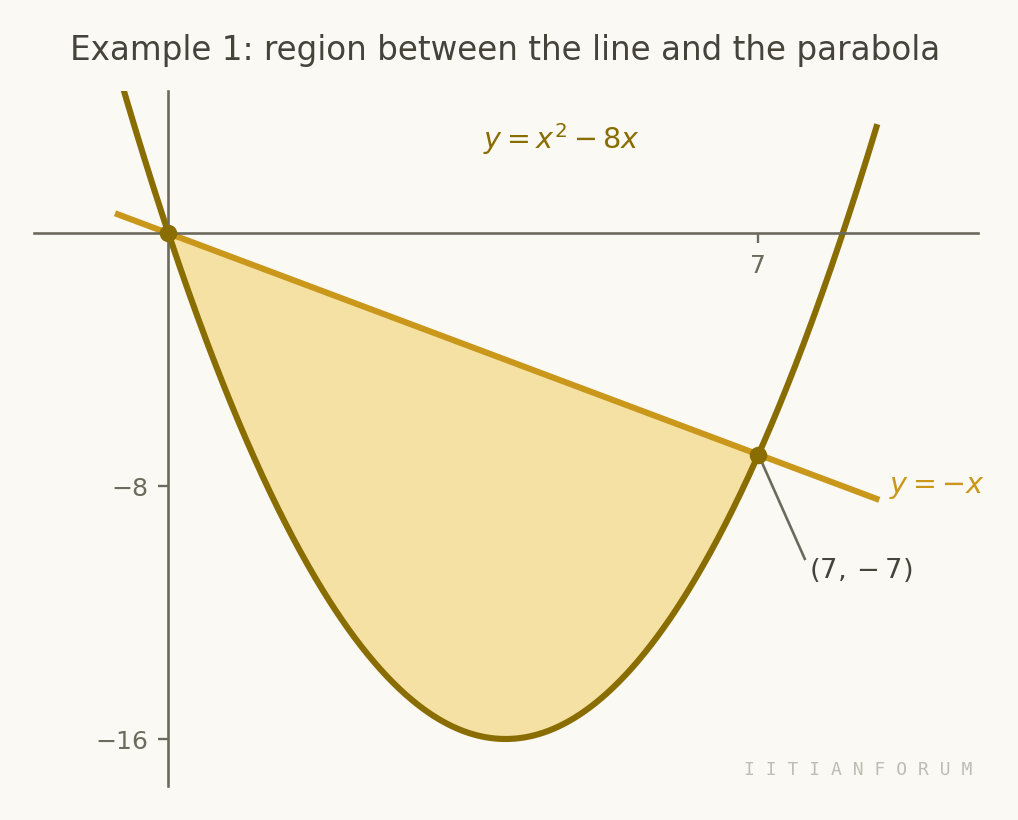
Example 1(JEE Main 2026, 6 April Shift 2). The area of the region {(x,y):x2−8x≤y≤−x} is
▸ SHOW SOLUTION
The region between the line y equals minus x and the parabola, from x=0 to x=7
Step 1. Find where the boundaries meet
The region sits between the parabola y=x2−8x below and the line y=−x above. They meet where
x2−8x=−x⟹x2−7x=0⟹x=0,7
Step 2. Confirm which is on top
At x=1 the parabola gives −7 and the line gives −1. The line is above, as the inequality already told us.
Note that the whole region lies below the x-axis, and it did not matter in the slightest. Because we integrated the difference of two boundaries rather than a single curve against the axis, the sign convention never came into play. That is the standard reason to prefer the difference form.
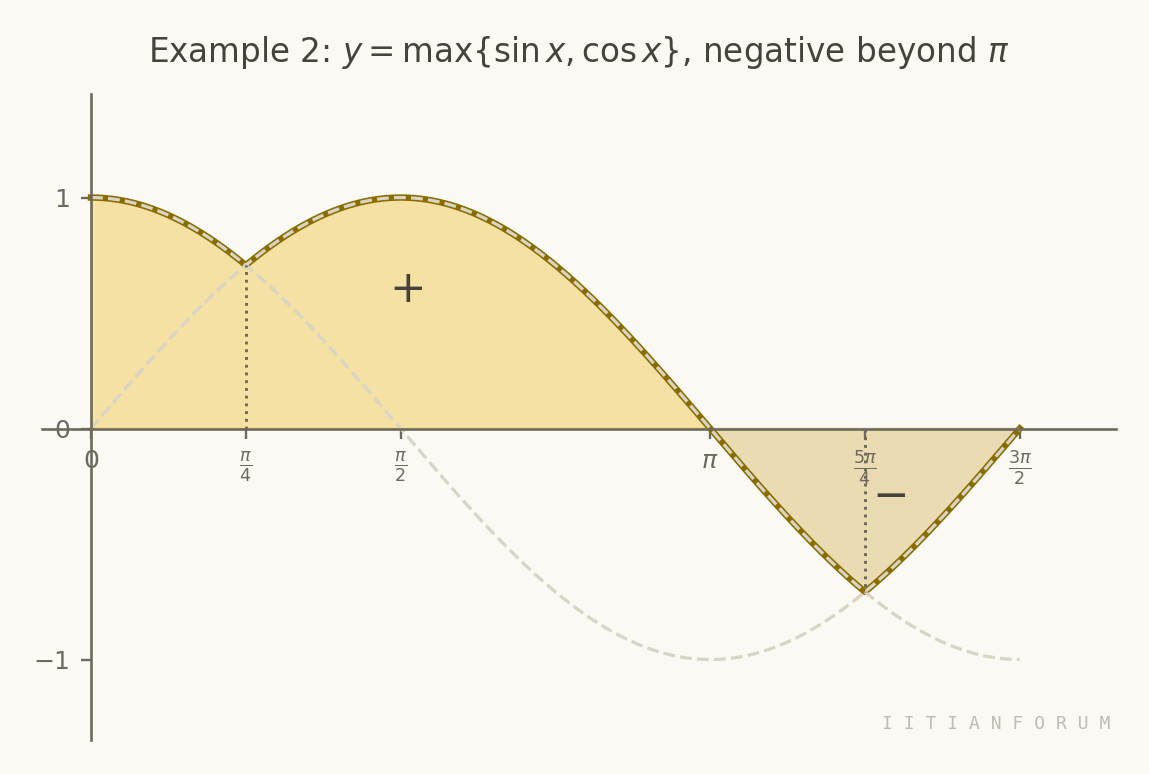
Example 2(JEE Main 2026, 23 January Shift 1). Let the area of the region bounded by y=max{sinx,cosx}, the lines x=0, x=23π and the x-axis be A. Then A+A2 is equal to ____.
▸ SHOW SOLUTION
y equals max of sin x and cos x, with the negative pieces beyond pi shaded separately
Step 1. Find where the maximum switches
sinx=cosx at x=4π and x=45π in [0,23π]. Testing a point in each piece:
on [0,4π] the maximum is cosx
on [4π,45π] the maximum is sinx
on [45π,23π] the maximum is cosx
Step 2. Check the sign on each piece
This is the step that decides the question. On [0,π] the maximum is positive. Beyond x=π both sinx and cosx are negative, so the maximum is negative there too, and those pieces must be taken in absolute value.
Every one of the four 21 terms cancels, which is the examiner's signature that you have split at the right places. If you stop at x=π and forget the two negative pieces you get A=1+2 and A+A2=4+32, which is exactly the trap.
Type 2 — Between two curves
Find the intersections, decide which is on top, integrate the difference. If the curves cross inside the interval, split there.
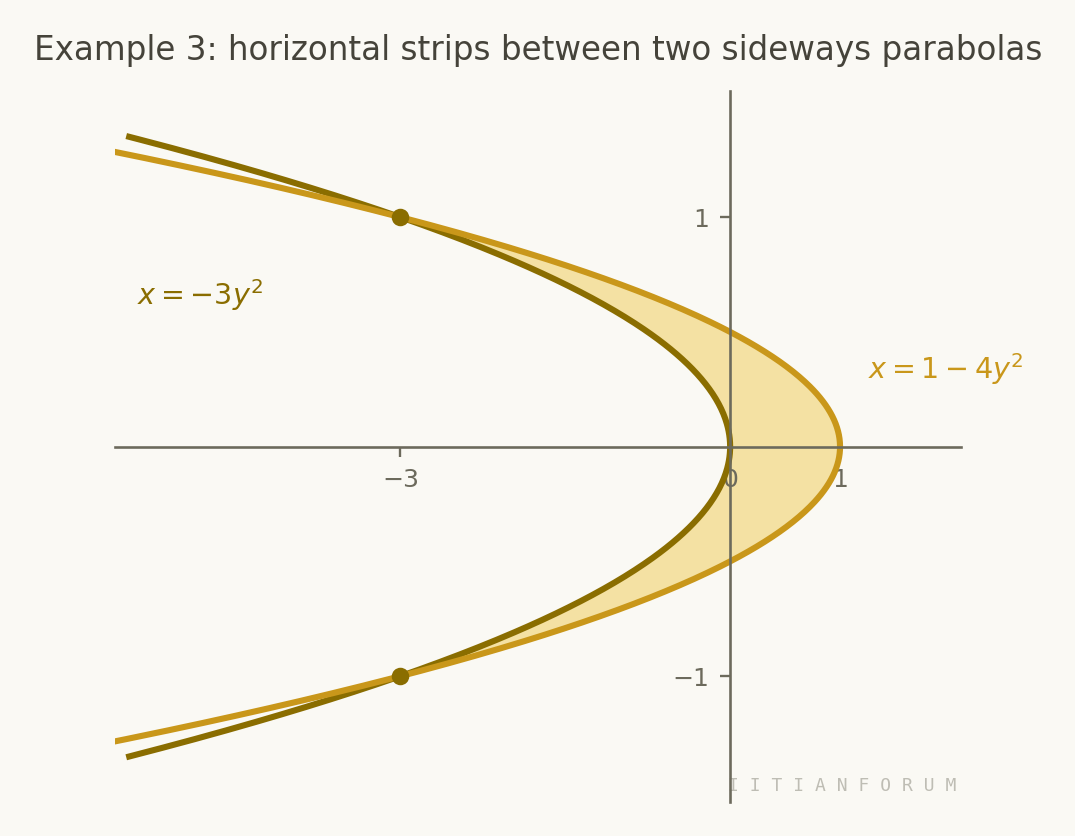
Example 3(JEE Main 2026, 4 April Shift 2). The area of the region bounded by the curves x+3y2=0 and x+4y2=1 is
▸ SHOW SOLUTION
The lens between the two sideways parabolas, measured in horizontal strips
Step 1. Write both as x in terms of y
x=−3y2andx=1−4y2
Both are parabolas opening in the −x direction, so horizontal strips are the natural choice.
Step 2. Find the intersections
−3y2=1−4y2⟹y2=1⟹y=±1
Step 3. Decide which is on the right
At y=0 the first gives x=0 and the second gives x=1, so x=1−4y2 is to the right.
Written in x this needs two integrals and a square root. Written in y it is four lines. Whenever both boundaries are naturally x=g(y), integrate in y.
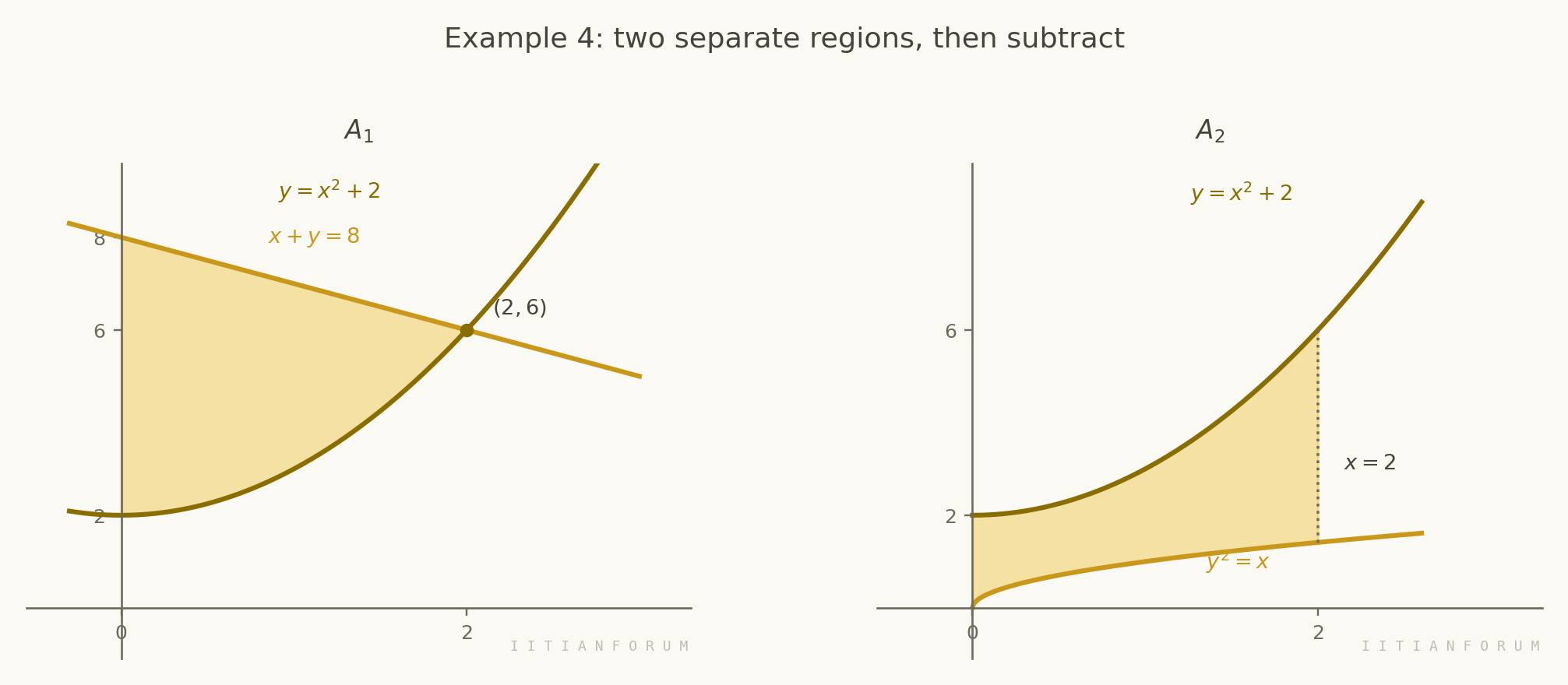
Example 4(JEE Main 2026, 24 January Shift 1). Let A1 be the bounded area enclosed by y=x2+2, x+y=8 and the y-axis in the first quadrant. Let A2 be the bounded area enclosed by y=x2+2, y2=x, x=2 and the y-axis in the first quadrant. Then A1−A2 is equal to
▸ SHOW SOLUTION
The two regions A1 and A2 side by side
Step 1. Locate A1
x2+2=8−x⟹x2+x−6=0x=2orx=−3
In the first quadrant the relevant root is x=2, and the line is above the parabola there.
Two separate regions, no shared boundary, no clever trick. The only thing to be careful about is that A2 is bounded by x=2 on the right, not by an intersection.
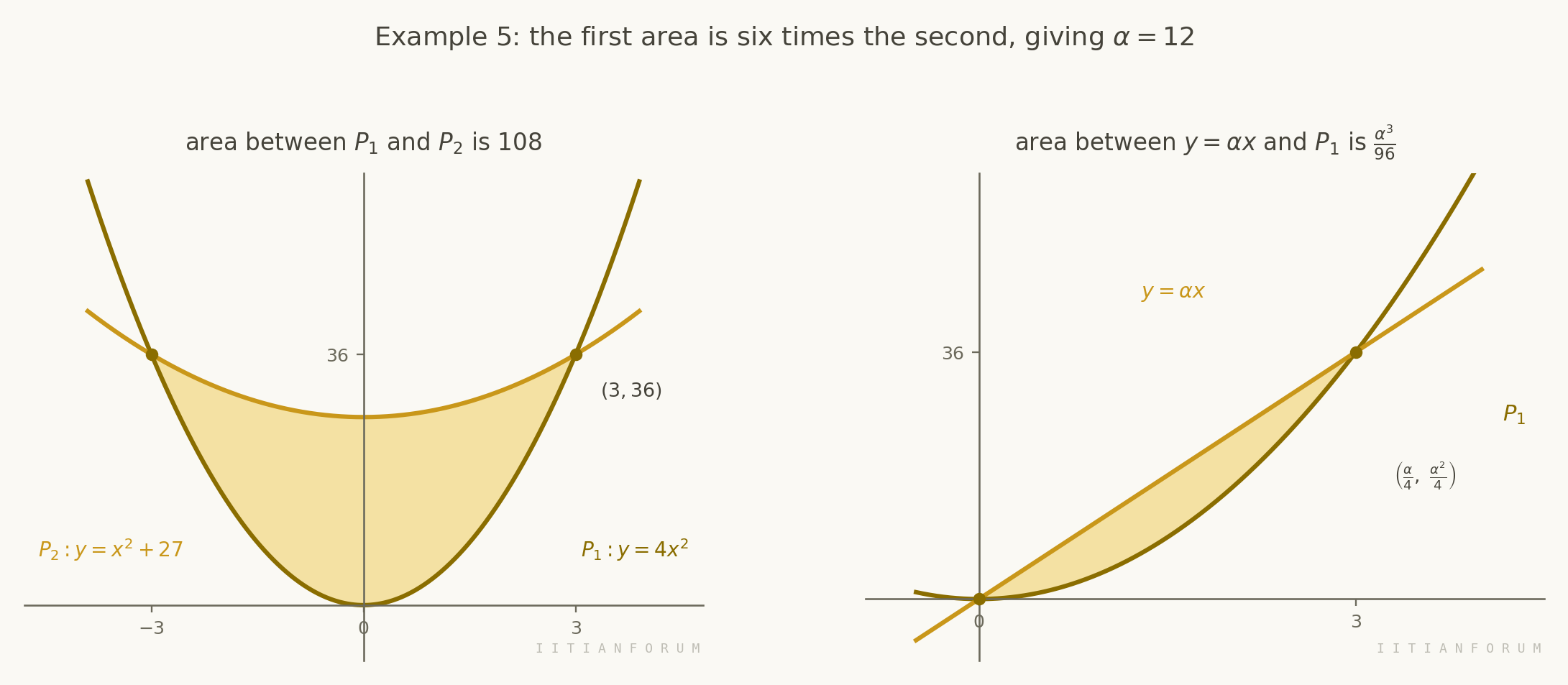
Example 5(JEE Main 2026, 28 January Shift 2). Let P1:y=4x2 and P2:y=x2+27. If the area enclosed between P1 and P2 is six times the area enclosed between the line y=αx (α>0) and P1, then α equals
▸ SHOW SOLUTION
The area between the two parabolas, and the area between the line and P1
αx=4x2⟹x=0 or x=4αA2=∫0α/4(αx−4x2)dx=[2αx2−34x3]0α/4A2=32α3−48α3=96α3
Step 3. Impose the condition
108=6⋅96α3⟹α3=1728⟹α=12
Answer: (3) 12
The standard result 3m38a2 for y2=4ax against y=mx has a twin for the vertical parabola: the area between y=kx2 and y=mx is 6k2m3. Here k=4, m=α, giving 96α3 directly.
Type 3 — Regions given by inequalities
A set such as {(x,y):…} is not harder, it is just less generous. Translate every inequality into "above", "below", "left of" or "right of", sketch, and read the limits off the picture.
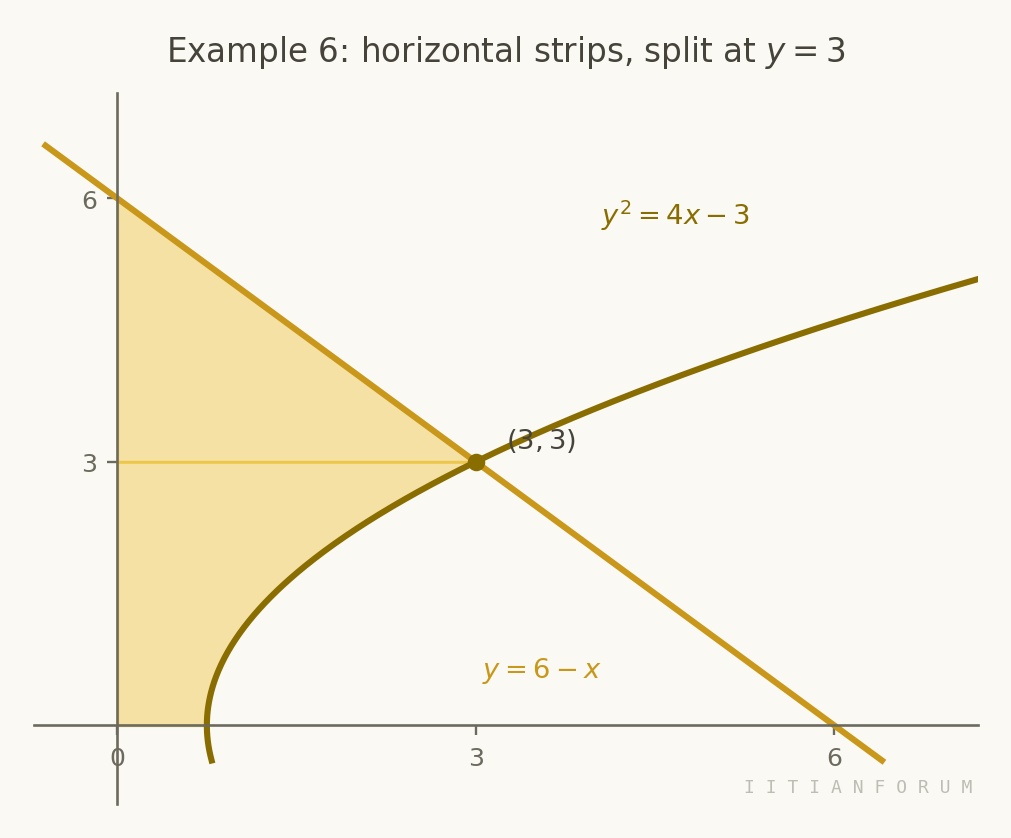
Example 6(JEE Main 2026, 6 April Shift 1). The area of the region {(x,y):0≤y≤6−x,y2≥4x−3,x≥0} is
▸ SHOW SOLUTION
The region in horizontal strips, split at y=3 where the line meets the parabola
Step 1. Translate each inequality
0≤y puts the region above the x-axis. y≤6−x puts it below the line. y2≥4x−3 rearranges to x≤4y2+3, so the region is to the left of that parabola. And x≥0.
Step 2. Find the corner
The line and the parabola meet where x=6−y and x=4y2+3:
y2+3=4(6−y)⟹y2+4y−21=0y=3ory=−7
With y≥0 the corner is at y=3, x=3.
Step 3. Integrate in horizontal strips
For 0≤y≤3 the right-hand boundary is the parabola; for 3≤y≤6 it is the line.
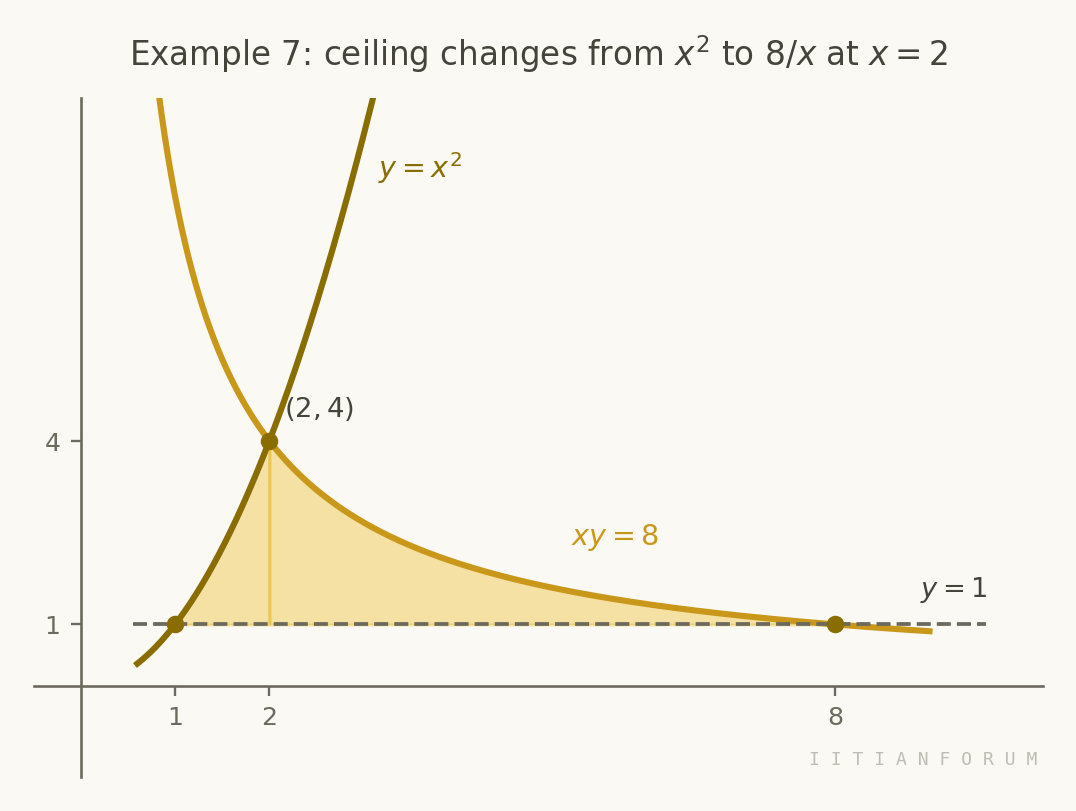
The identical region with 8 replaced by 27 and y=1 appeared again on 5 April Shift 1, where the answer is 54loge3−352. Same three boundaries, same three steps.
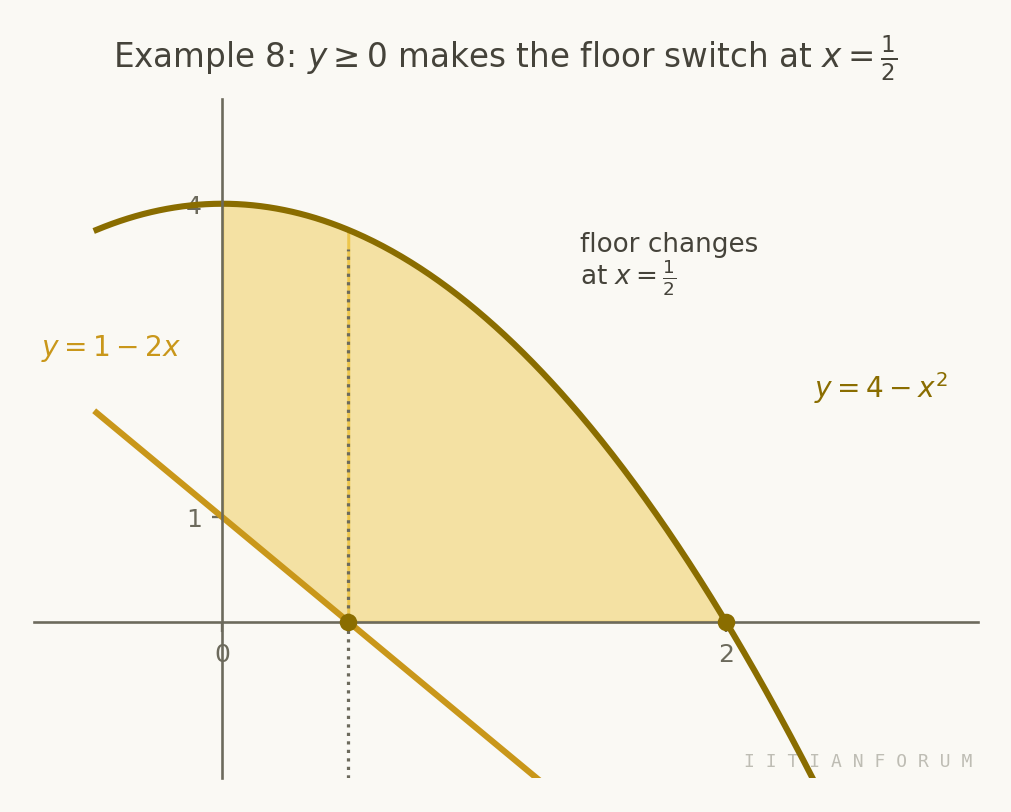
Example 8(JEE Main 2026, 21 January Shift 2). If the area of the region {(x,y):1−2x≤y≤4−x2,x≥0,y≥0} is βα with gcd(α,β)=1, then α+β is
▸ SHOW SOLUTION
The region whose floor switches from the line to the x-axis at x=one half
Step 1. Sketch the constraints
The ceiling is the downward parabola y=4−x2, which meets the x-axis at x=2. The floor is the larger of y=1−2x and y=0. The line y=1−2x is positive only for x<21.
Step 2. Split at x=21
For 0≤x≤21 the floor is the line; beyond that it is the axis.
Forgetting that the floor changes at x=21, and integrating (4−x2)−(1−2x) all the way to x=2, gives a different and wrong value. The constraint y≥0 is not decoration.
Type 4 — Modulus, max, min and the greatest integer
The graph does the work. Convert every bracket into a piecewise formula, sketch, then integrate piece by piece.
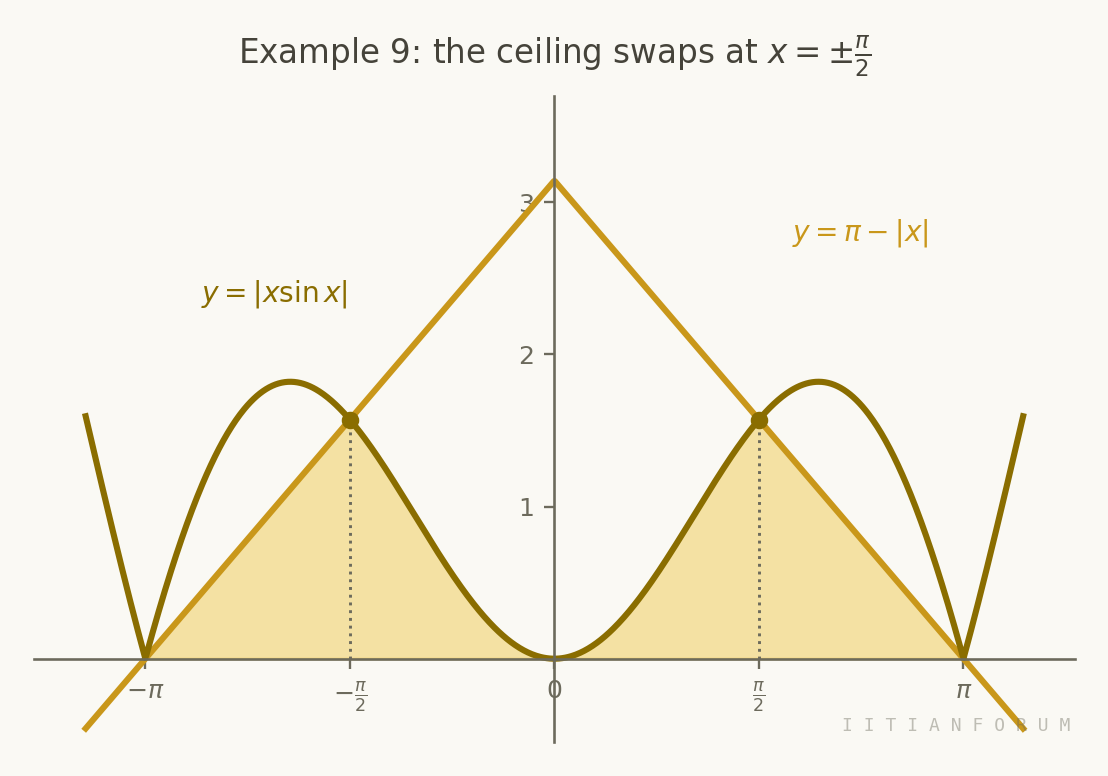
Example 9(JEE Main 2026, 4 April Shift 1). The area of the region {(x,y):y≤π−∣x∣,y≤∣xsinx∣,y≥0} is
▸ SHOW SOLUTION
The region below both ceilings, symmetric about the y-axis
Step 1. Use the symmetry
Both π−∣x∣ and ∣xsinx∣ are even, so the region is symmetric about the y-axis. Work on x≥0 and double.
Step 2. Find which ceiling is lower
On x≥0 the two ceilings are π−x and ∣xsinx∣. At x=π both are 0, and for 0<x<π we have sinx>0, so ∣xsinx∣=xsinx. Comparing at x=2π: π−2π=2π≈1.571 and 2πsin2π=2π. They are equal there. In fact xsinx≤π−x on [0,π], so the binding ceiling is y=xsinx throughout.
Step 3. Integrate
A=2∫0πxsinxdx
By parts, with u=x and dv=sinxdx:
∫0πxsinxdx=[−xcosx]0π+∫0πcosxdx=π+0=π
That gives A=2π, which is not among the options, so the ceiling must switch somewhere. Checking x=3: π−3≈0.142 while 3sin3≈0.423. So beyond some point the line is the lower ceiling.
Step 4. Locate the switch honestly
xsinx=π−x has a root at x=2π, since 2π⋅1=2π. For x<2π the product xsinx is the smaller; for 2π<x<π the line π−x is the smaller.
The moment an answer is not in the options, stop and re-test the comparison at a second point. Two curves that agree at one interior point almost always cross there.
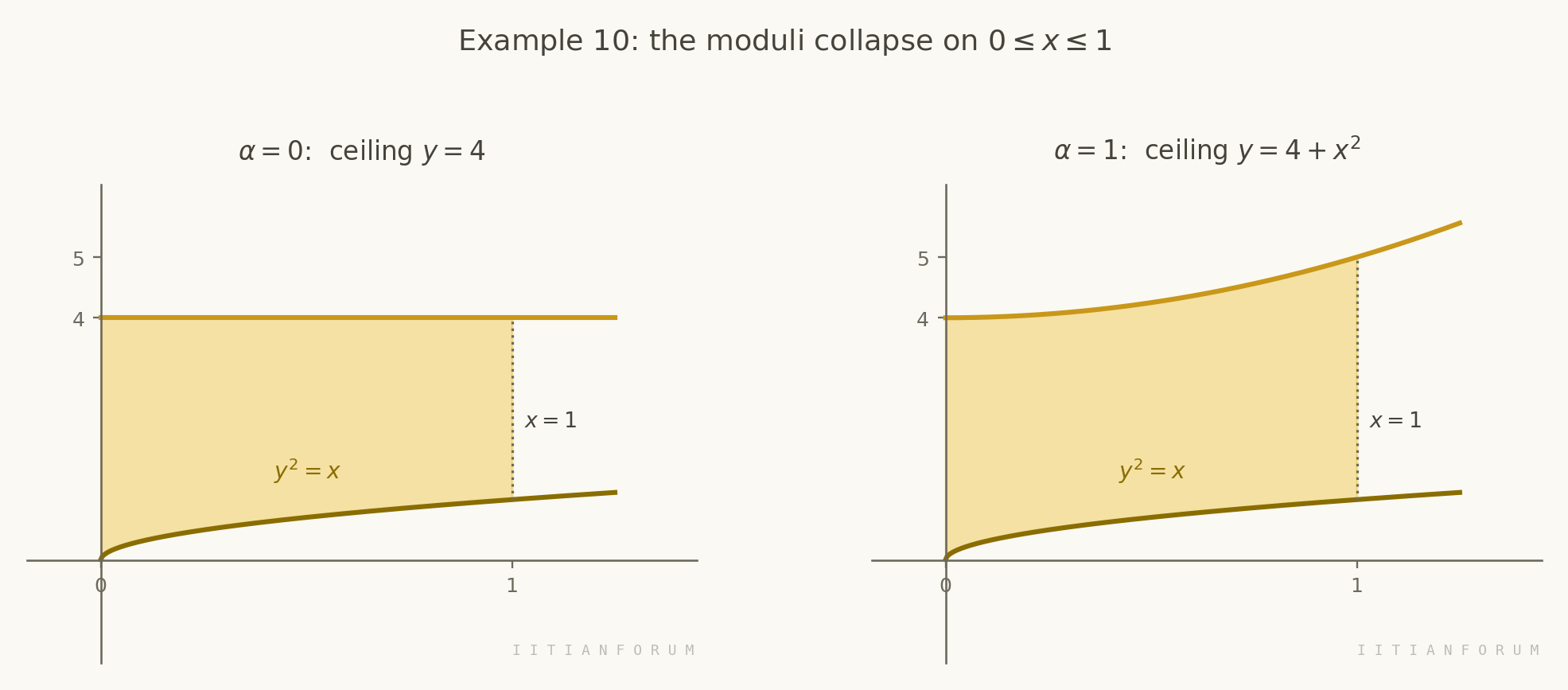
Example 10(JEE Main 2026, 24 January Shift 2). Let f(α) be the area in the first quadrant bounded by x=0, x=1, y2=x and y=∣αx−5∣−∣1−αx∣+αx2. Then f(0)+f(1) is
The two modulus terms cancel their αx parts on the whole interval, which is why the messy-looking boundary is a plain quadratic. Always resolve the moduli on the given interval before you draw anything.
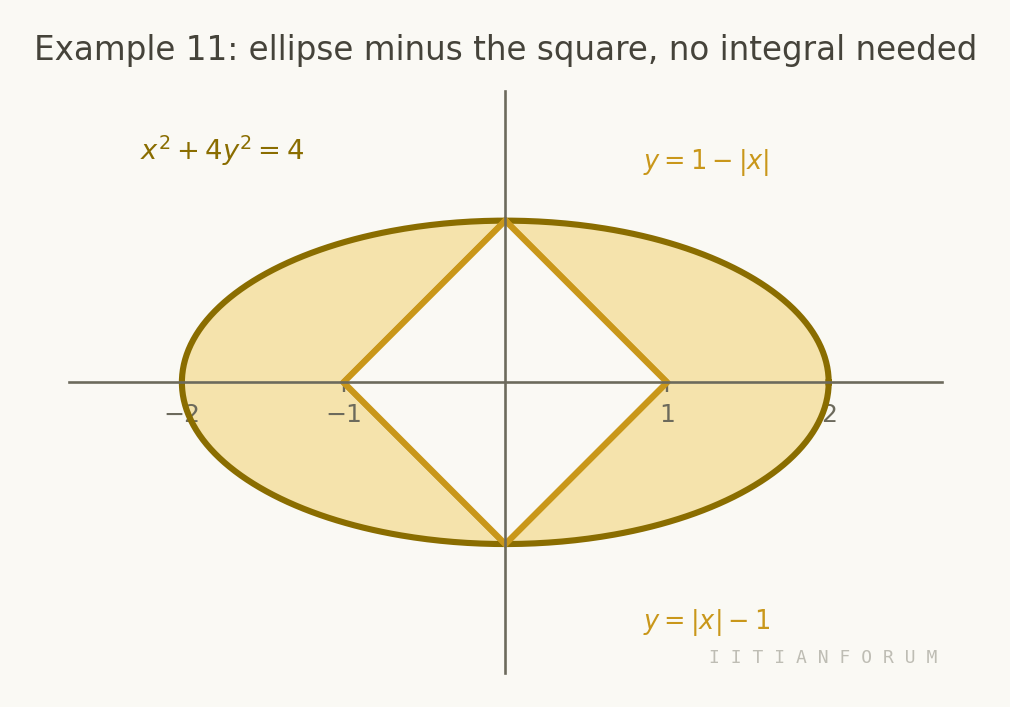
Example 11(JEE Main 2026, 21 January Shift 1). The area inside the ellipse x2+4y2=4 and outside the region bounded by y=∣x∣−1 and y=1−∣x∣ is
▸ SHOW SOLUTION
The ellipse with the square removed from its centre
Step 1. Identify both regions
The ellipse is 4x2+y2=1, with semi-axes 2 and 1, so its area is π⋅2⋅1=2π.
The curves y=∣x∣−1 and y=1−∣x∣ are two V shapes, one opening up from (0,−1) and one opening down from (0,1). Together they enclose a square standing on its corner, with vertices (0,1), (1,0), (0,−1), (−1,0).
Step 2. Confirm the square is inside the ellipse
Its vertices (±1,0) and (0,±1) all satisfy x2+4y2≤4, with equality only at (0,±1). So the square sits inside.
Step 3. Subtract
The square has diagonals of length 2 and 2, so its area is 21⋅2⋅2=2.
A=2π−2=2(π−1)
Answer: (1) 2(π−1)
No integration at all. Recognising the two V shapes as a square is the entire question.
Type 5 — A parameter to be found
The area is given and a constant is unknown. Set up the integral with the letter in it, evaluate, then solve.
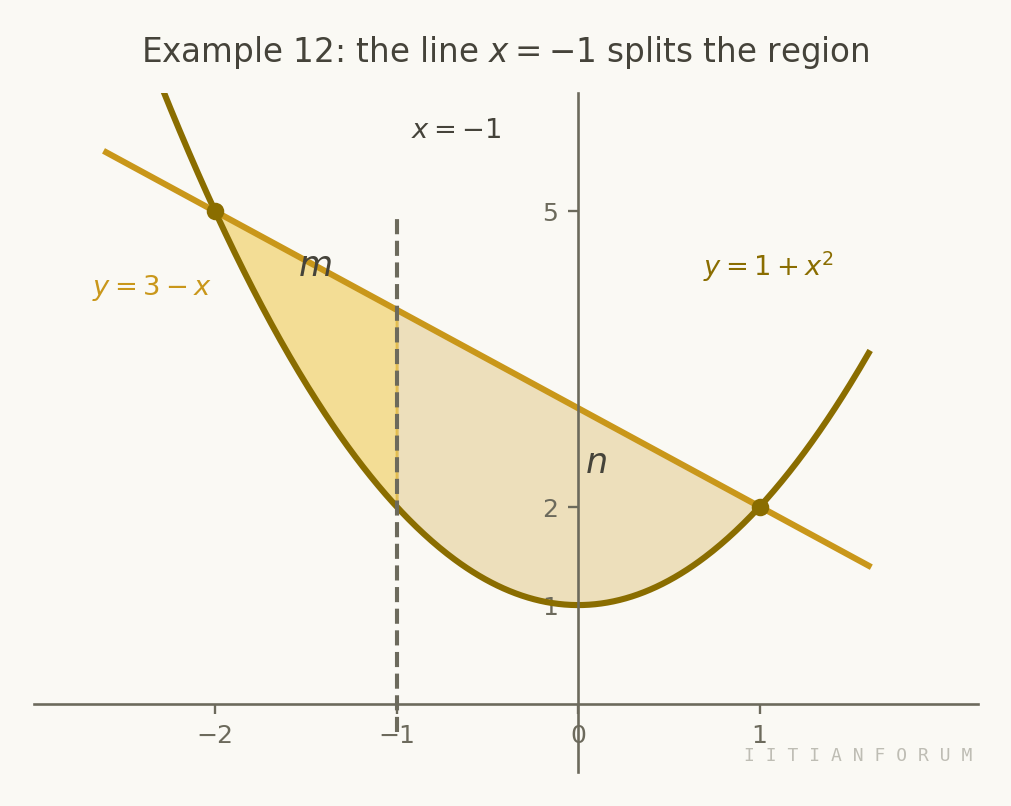
Example 12(JEE Main 2026, 22 January Shift 1). Let the line x=−1 divide the area of the region {(x,y):1+x2≤y≤3−x} in the ratio m:n with gcd(m,n)=1. Then m+n is
▸ SHOW SOLUTION
The region between parabola and line, split by x equals minus one into parts m and n
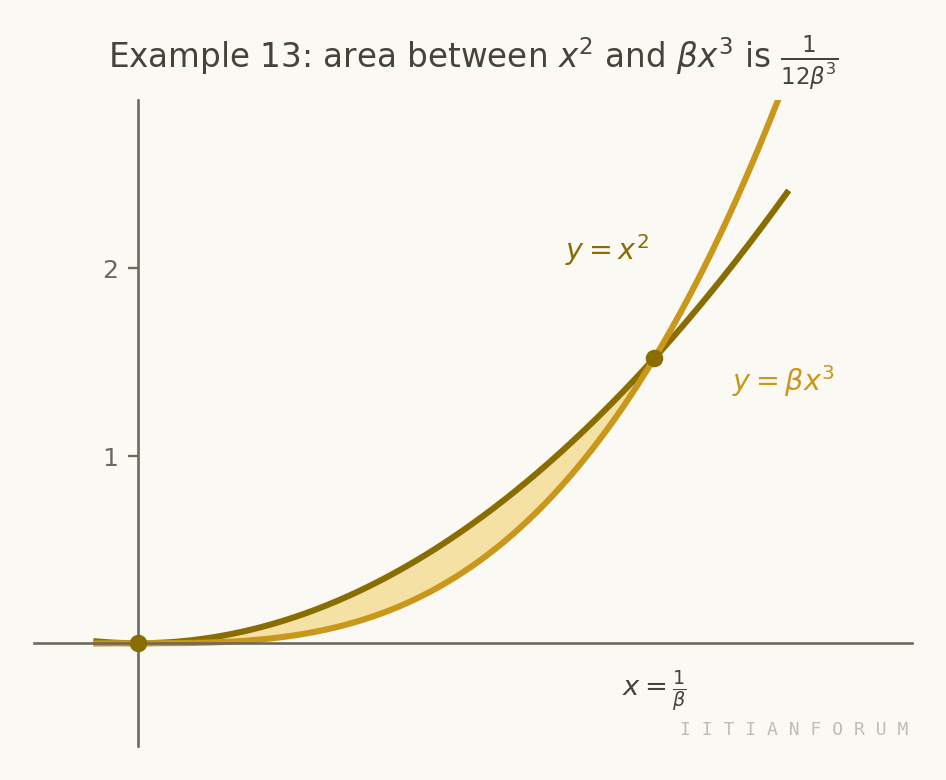
Example 13(JEE Main 2026, 5 April Shift 2). Let f:R→R satisfy f(x)+3f(2π−x)=sinx, and let α be the maximum value of f. If the area bounded by g(x)=x2 and h(x)=βx3 (β>0) is α2, then 30β3 is
▸ SHOW SOLUTION
The region between the square and the cubic
Step 1. Solve the functional equation
Replace x by 2π−x:
f(2π−x)+3f(x)=cosx
Multiply this by 3 and subtract the original:
8f(x)=3cosx−sinxf(x)=83cosx−sinx
Step 2. Take the maximum
α=832+12=810,α2=6410=325
Step 3. Find the area between the two curves
x2=βx3⟹x=0 or x=β1A=∫01/β(x2−βx3)dx=[3x3−4βx4]01/βA=3β31−4β31=12β31
Step 4. Solve
12β31=325⟹β3=6032=158⟹30β3=16
Answer:16
The area formula 12β31 is worth keeping: the region between y=x2 and y=βx3 always has that area, whatever β is.
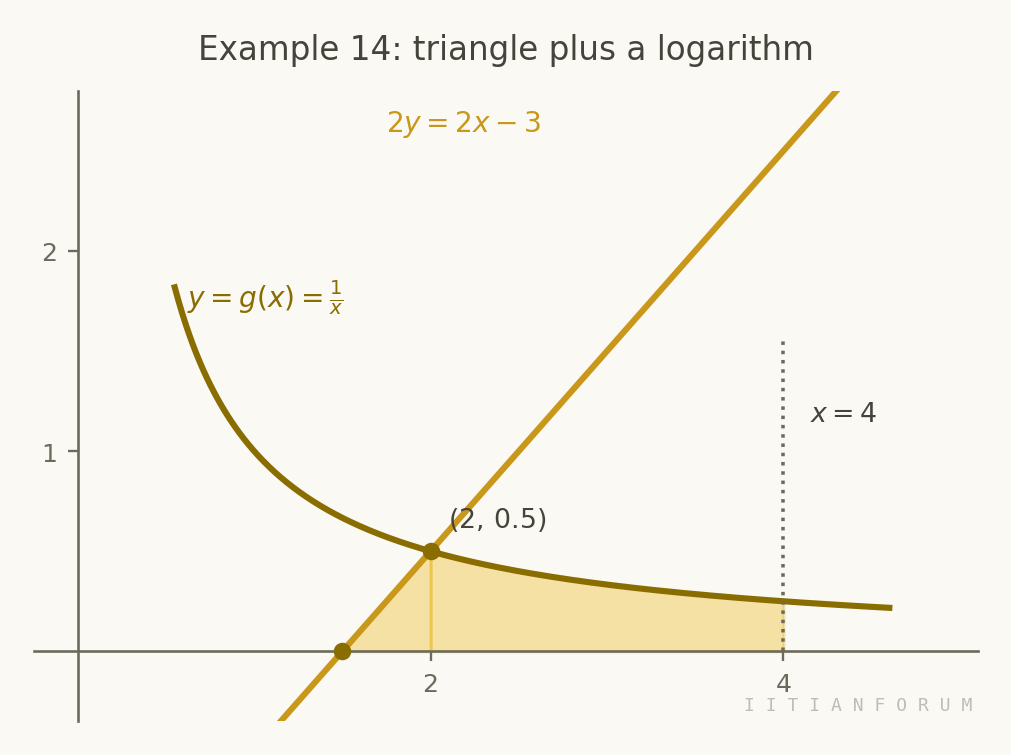
Example 14(JEE Main 2026, 8 April Shift 2). Let f:(1,∞)→R be f(x)=x+1x−1, with fi+1(x)=f(fi(x)) and f1(x)=f(x). If g(x)+f26(x)=0, the area bounded by y=g(x), 2y=2x−3, y=0 and x=4 is
▸ SHOW SOLUTION
The triangle under the line plus the region under the hyperbola up to x=4
The first integral is a triangle with legs 21 and 21, so it needs no calculus at all.
Type 6 — Conics
Circles, parabolas, ellipses and hyperbolas bring one extra tool: the segment formula. Whenever a chord cuts a circle, reach for it before you reach for an integral.
For a circle of radius r and a chord subtending a central angle θ at the centre, the smaller piece has area
segment=2r2(θ−sinθ)A circular segment with its central angle marked
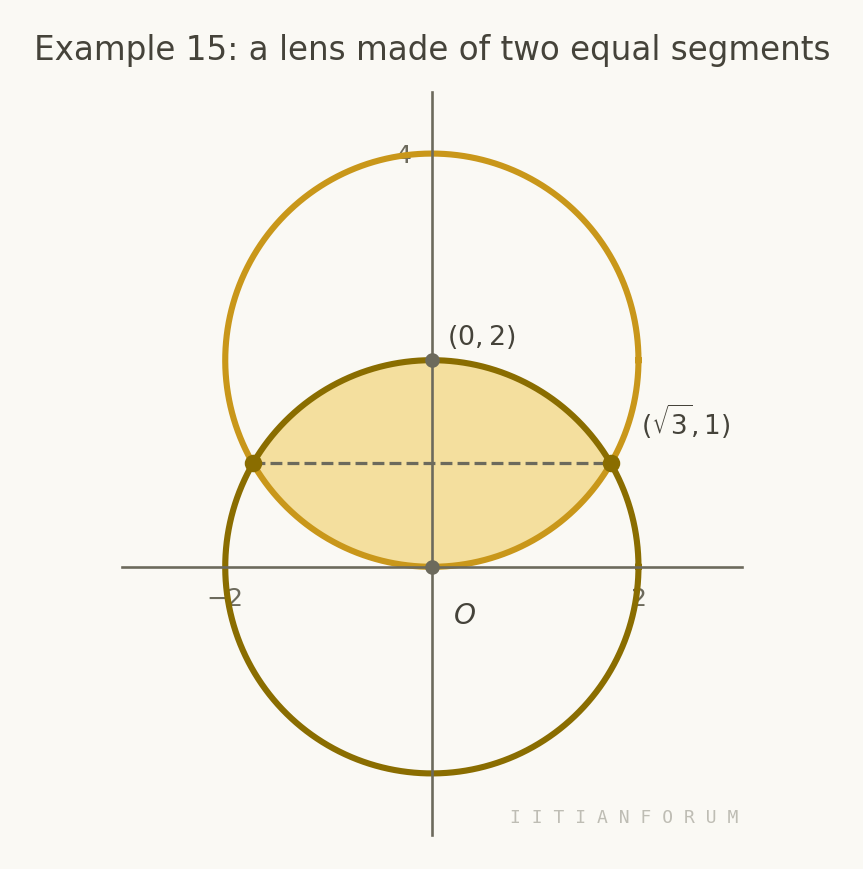
Example 15(JEE Main 2026, 23 January Shift 2). The area of the region enclosed between the circles x2+y2=4 and x2+(y−2)2=4 is
▸ SHOW SOLUTION
Step 1. Set up
Both circles have radius 2; their centres are (0,0) and (0,2), a distance d=2 apart. The overlap is a lens made of two identical segments.
The lens where the two circles of radius 2 overlap
Step 2. Find the central angle
Half the chord subtends an angle ϕ at each centre with cosϕ=rd/2=21, so ϕ=3π and the full central angle is θ=32π.
Step 3. Apply the segment formula twice
one segment=2r2(θ−sinθ)=2(32π−23)=34π−3A=2(34π−3)=38π−23=32(4π−33)
Answer: (4) 32(4π−33)
Two circles of equal radius r whose centres are r apart always give this: the lens is 32r2(2π−233), and here r=2.
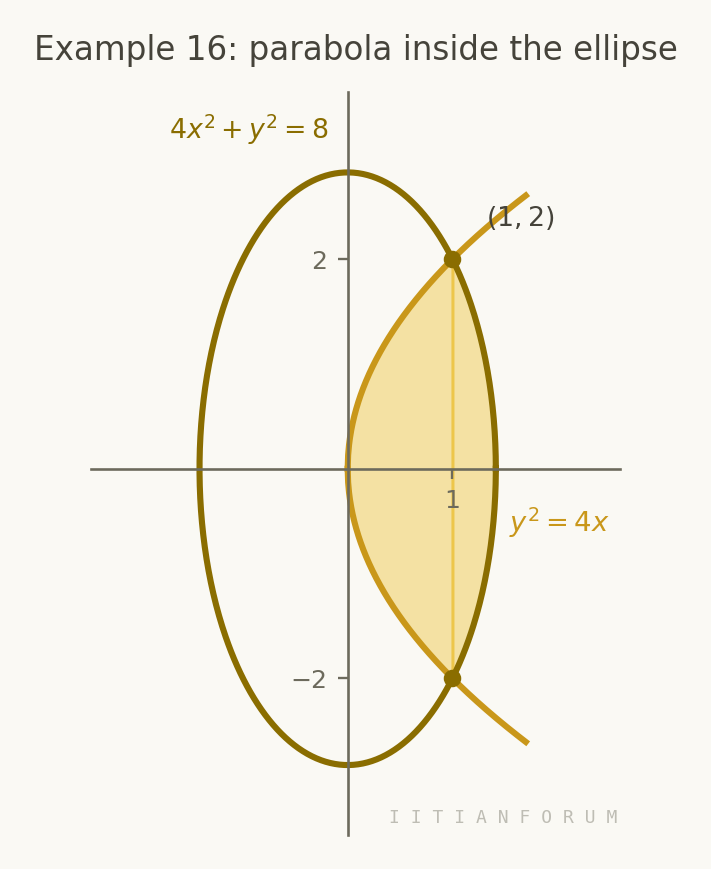
Example 16(JEE Main 2026, 22 January Shift 2). The area of the region A={(x,y):4x2+y2≤8 and y2≤4x} is
▸ SHOW SOLUTION
The region inside both the ellipse and the parabola
Step 1. Identify the curves
4x2+y2=8 is the ellipse 2x2+8y2=1, with semi-axes 2 along x and 22 along y. The parabola is y2=4x.
Step 2. Find the intersection
Substituting y2=4x into the ellipse:
4x2+4x=8⟹x2+x−2=0x=1orx=−2
Only x=1 is admissible, giving y=±2.
Step 3. Integrate, using symmetry about the x-axis
For 0≤x≤1 the ceiling is the parabola y=2x; for 1≤x≤2 it is the ellipse y=8−4x2.
The logarithm was always going to cancel: the question hands you +6loge3 precisely so that it does. When a numerical-answer question adds a transcendental term to your unknown, it is telling you what your answer contains.
The decision chart
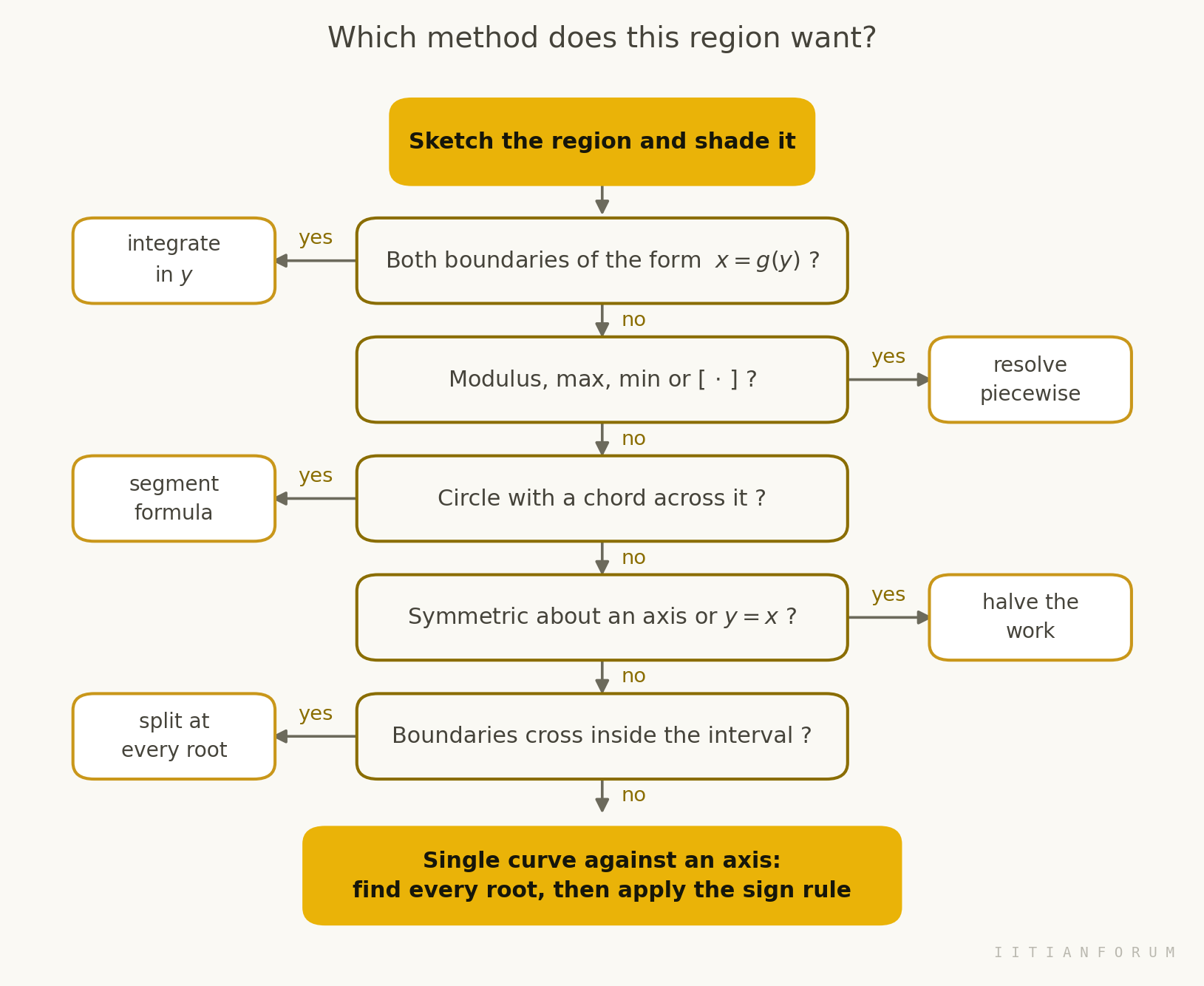
Six questions, asked in this order, settle which method to use.
Decision chart for choosing the integration variable and the split points
Are both boundaries naturally x=g(y)? If yes, integrate in y. Sideways parabolas and left-right regions belong here.
Is there a modulus, a max, a min or a greatest integer? Resolve it into a piecewise formula on the given interval first. Sketch second. Integrate third.
Does a circle appear with a chord across it? Use the segment formula 2r2(θ−sinθ), not an integral.
Is the region symmetric? Halve or quarter the work. Check for even powers of x or of y.
Do the boundaries cross inside the interval? Split at every crossing and take the difference the right way round on each piece.
Is a single curve measured against an axis? Only then does the sign convention matter. Find every root first.
Quick recall
Situation
What to write
Curve above the axis on [a,b]
∫abfdx
Curve below the axis
∫abfdx
Curve crossing at x=c
∫acfdx−∫cbfdx
Two curves, g on top
∫ab(g−f)dx
Region easier in horizontal strips
∫cdg(y)dy
Circle cut by a chord, angle θ
2r2(θ−sinθ)
y2=4ax with x2=4by
316ab
y2=4ax with y=mx
3m38a2
y=kx2 with y=mx
6k2m3
y=x2 with y=βx3
12β31
Ellipse
πab
One arch of sinax
a2
swipe for more →
The habit that earns the mark
Before writing a single integral sign, draw the region and shade it. Then write down, in words, which curve is the ceiling and which is the floor, and over what range of x or y. Nine out of ten wrong answers in this chapter come from a correct integral of the wrong region.
Every worked example above is a JEE Main 2026 question, re-derived from the statement rather than copied from a key. Practise the rest on doMath, where the same six types are graded and solved step by step.