Straight Line in Space Complete JEE Notes with examples.
A line in space is the simplest object in three-dimensional geometry and it is also the one JEE returns to every single year. In the nineteen JEE Main 2026 shifts there were twenty-six questions on it, more than one per paper. What makes them worth studying together is that they are not twenty-six different problems. They are four moves, dressed up.
This note builds the line from its definition, then names those four moves and shows each one working on real papers.
What fixes a line in space
In the plane, a point and a slope fix a line. In space there is no single number that plays the part of slope: a direction now needs three numbers, not one. So the data is a point to stand on and a direction to travel in.
A point and a direction pin down exactly one line; without the direction, infinitely many lines pass through the same point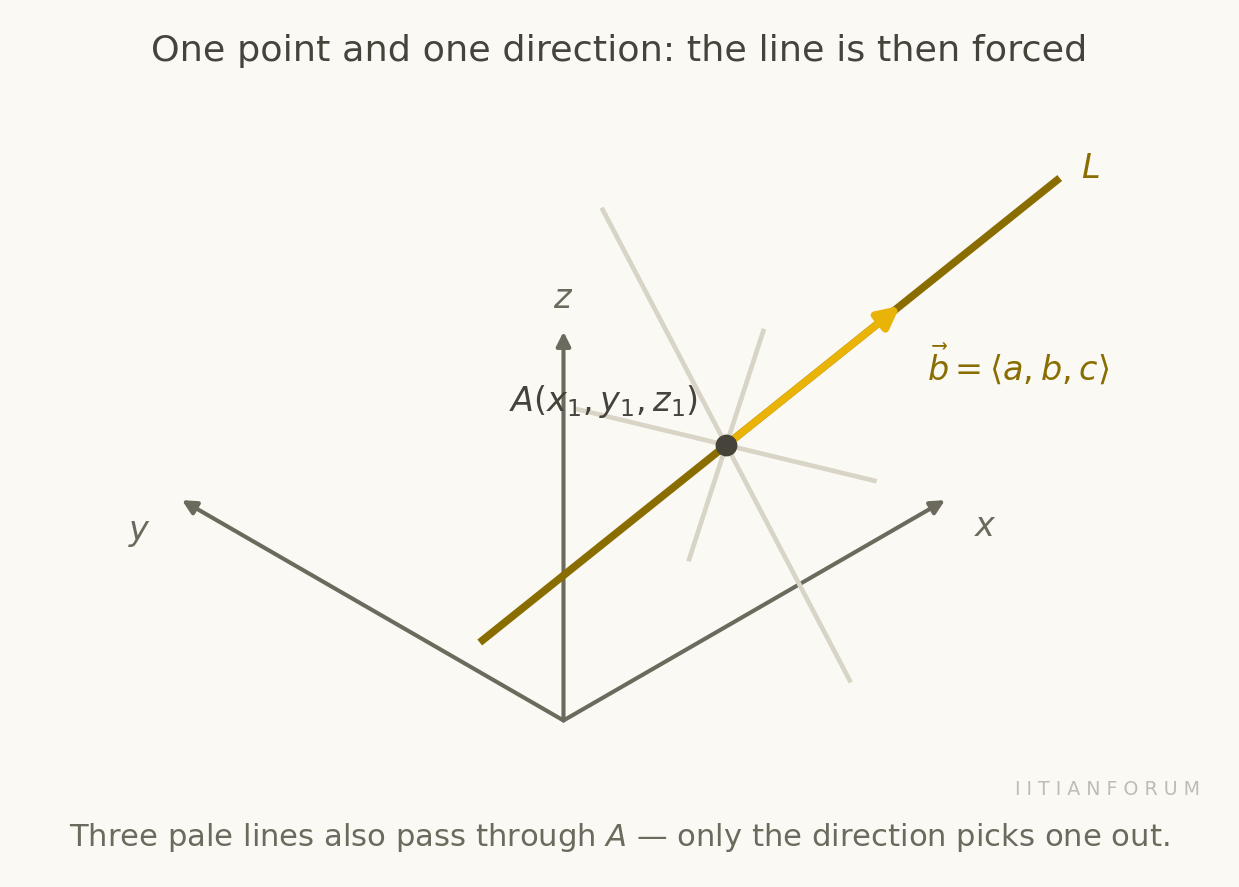
A line in space carries four independent conditions, which is worth knowing before you start any problem. Its direction eats two of them, because a direction in space has three components but only their ratios matter. The point eats the other two, because once the direction is fixed you may slide the point anywhere along the line without changing it. Four conditions, four unknowns: that is why "find the line" problems always hand you exactly four pieces of information, and why a question that seems to give you three is really giving you a family.
If a question gives you a line with one unknown in it and one more condition, expect a unique answer. If it gives you two unknowns and one condition, expect a family and a "sum of all values" ending. Counting conditions before you compute tells you what shape the answer will take.
Direction cosines and direction ratios
Point the line in one of its two directions and measure the angle it makes with each positive axis. Call those angles , , .
The three direction angles measured from the positive x, y and z axes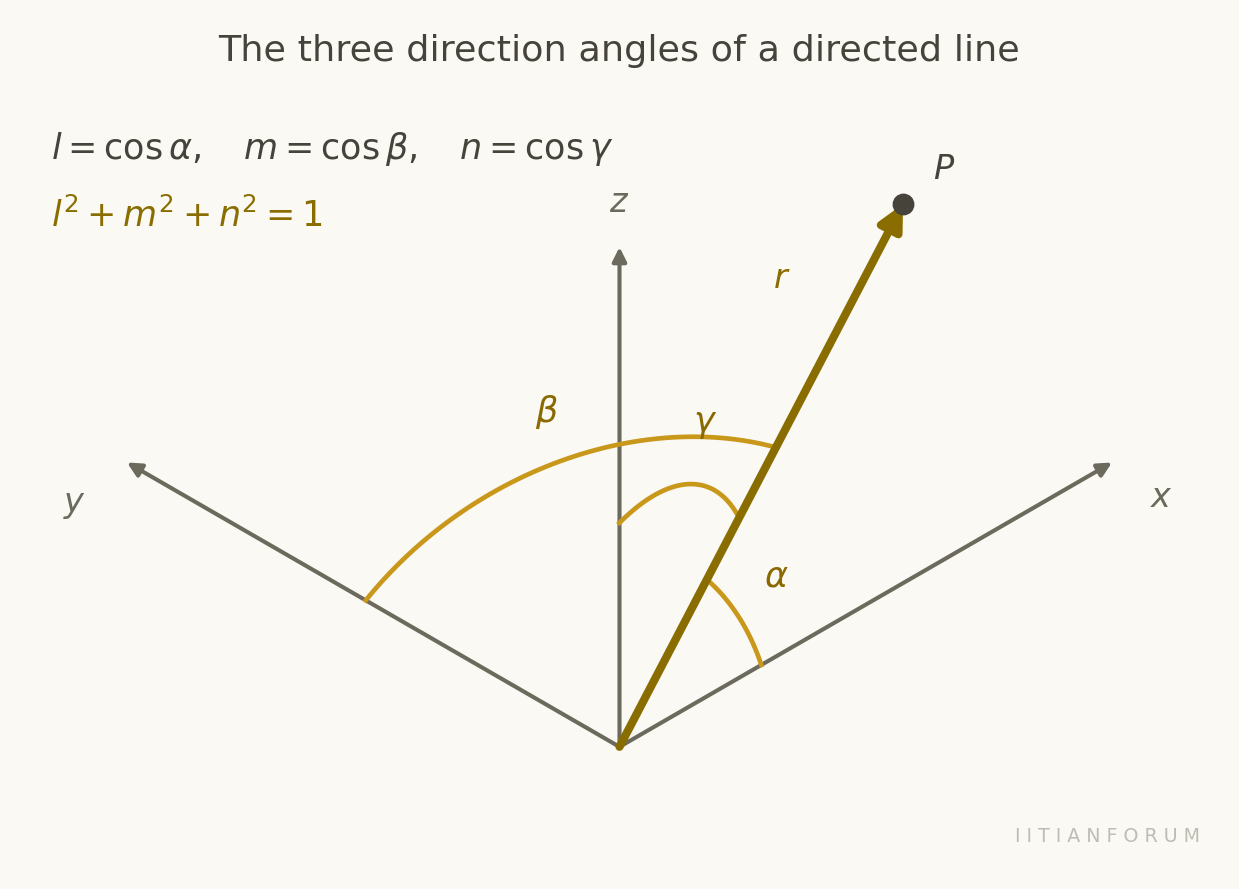
The direction cosines are , , . They are not three free numbers. Dropping perpendiculars from a point at distance along the line onto the three axes gives coordinates , and that point is at distance from the origin, so
Any three numbers proportional to are direction ratios. Here is the whole difference between the two, in one table.
| Direction cosines | Direction ratios | |
|---|---|---|
| How many sets | exactly two, one per sense of travel | infinitely many, one per non-zero multiple |
| Constraint | always | none |
| Recovered from the other | for any | |
| Read off from | a unit vector along the line | any vector along the line |
| Where they appear | angles, projections, distances measured along | equations of lines, cross products |
The practical rule is short. Write direction ratios while setting the problem up, because they are whatever falls out of the algebra. Convert to direction cosines only at the moment an angle, a projection or a distance-along is asked for, because those need a unit vector.
Reversing a line reverses all three direction cosines, so and describe the same line. Every angle formula therefore carries an absolute value. Drop it and you will produce an obtuse angle where the paper asked for the acute one, and lose the mark on an otherwise perfect page.
Example 1 (JEE Main 2026, 23 Jan Shift 1). The direction cosines of two lines satisfy and . Find the cosine of the acute angle between the lines.
▸ SHOW SOLUTION
Step 1: Use the linear relation to remove one letter.
From the first equation . Substituting into the second:
Step 2: Factorise, which splits the two lines.
Two factors, two lines. That is the whole point of the quadratic.
Step 3: Read a direction ratio off each branch.
If then and , giving ratios .
If then and , giving ratios .
Step 4: Take the angle, with the absolute value in place.
Answer: (4)
Notice that the question said "direction cosines" but the work was done entirely in direction ratios, and normalising never happened, because the formula divides by the lengths anyway. That is the table above in action.
The equation of a line, in the forms you will actually meet
Stand at with position vector and walk a multiple of . Every point of the line, and no other point, is reached exactly once.
Each value of the parameter names one point of the line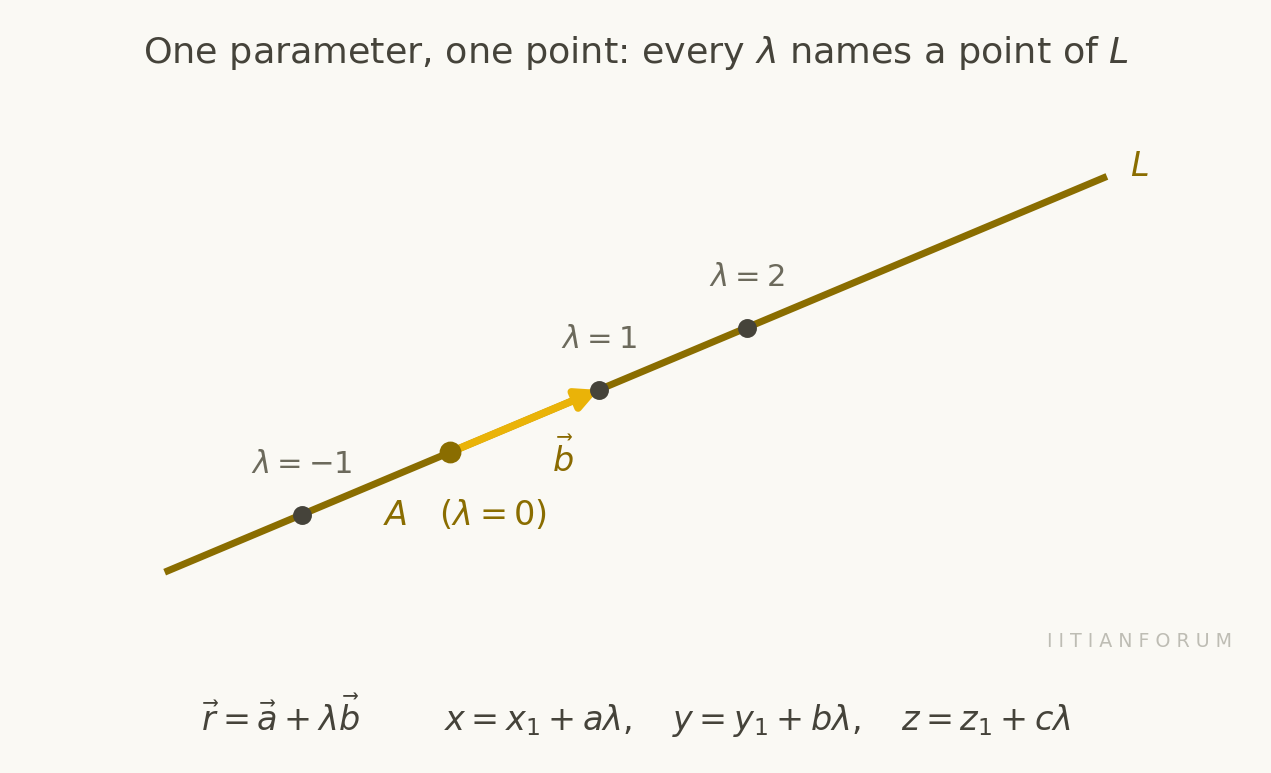
Writing and and comparing components gives the parametric form:
Eliminating gives the symmetric form, which is the one printed in almost every question:
Through two points and , the direction is , so
The first line of your working, on almost every question in this chapter, should be the general point. Write the line as equal to and read off . Once that is on the page you have turned a geometry question into one unknown, and the rest is arithmetic.
The zero denominator, which is notation and not division
A symmetric form such as
is not dividing by zero. It is shorthand for the pair of statements and . The line lies entirely in the plane , and its direction ratios are genuinely . This appears in JEE regularly, and a student who reads it as an error rather than as a plane condition loses the question at the first line.
The three axes are the cleanest examples. The -axis passes through the origin with direction , so it is , , and the same pattern gives the other two.
Angle between two lines
Position is irrelevant. Slide both direction vectors to a common point and measure between them.
Only the directions matter; where the lines sit does not enter the calculation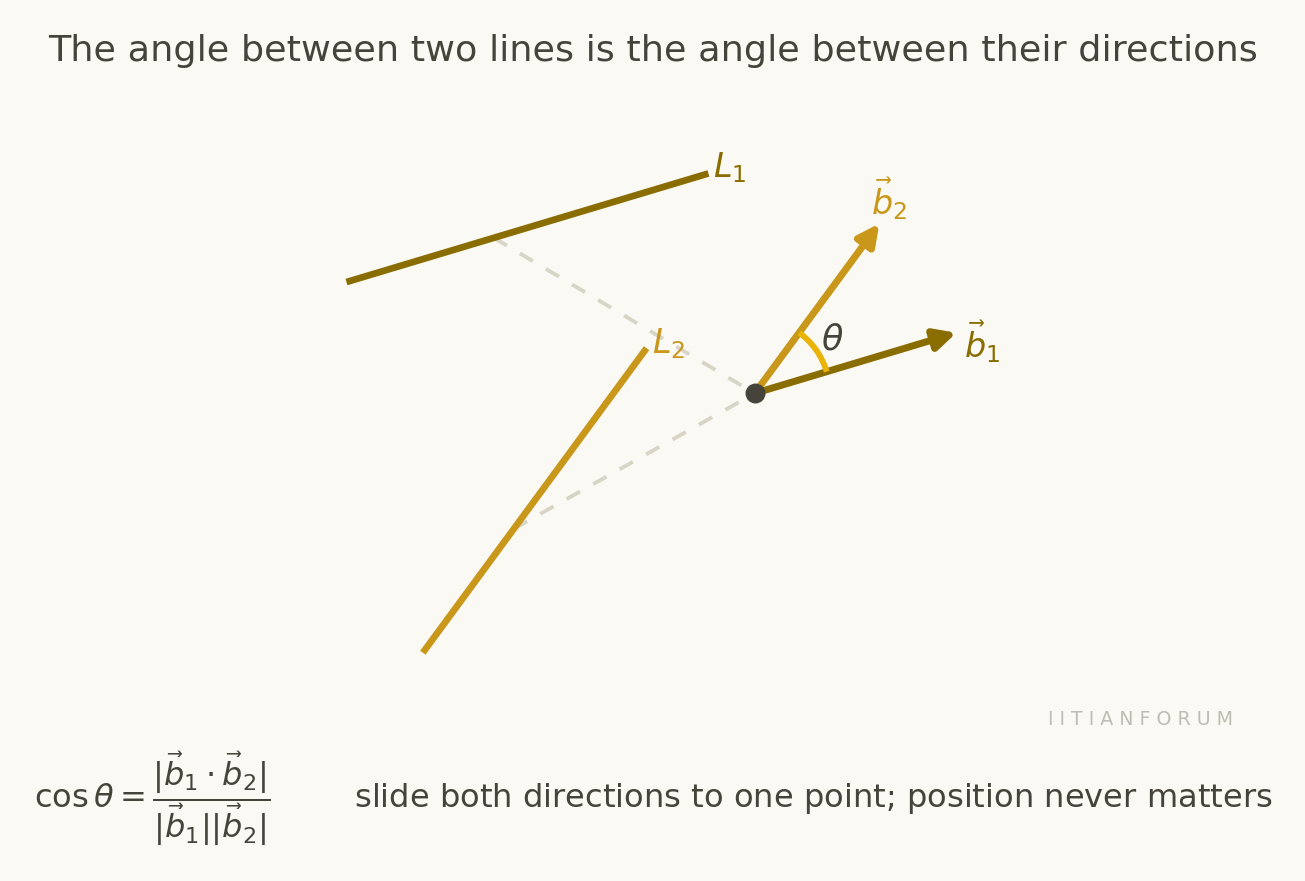
Two consequences follow immediately and are worth stating as separate facts, because questions test them separately. The lines are perpendicular exactly when , and parallel exactly when .
When a question wants a line perpendicular to two given lines, its direction is . That single observation solves a large fraction of the "let be perpendicular to both" questions, of which 2026 alone had three.
Example 2 (JEE Main 2026, 6 Apr Shift 1). Let be perpendicular to both with direction and with direction . If is the acute angle between and a line of direction , find .
▸ SHOW SOLUTION
Step 1: The cross product gives the direction of .
Divide out the common factor and use . Scaling a direction never changes an angle, so do it early.
Step 2: Take the cosine.
Step 3: Convert to a tangent.
Answer: (2)
Foot of the perpendicular: one equation does all the work
This is the single most useful computation in the chapter, and it is one line of algebra.
The foot is the one point of the line whose join to P meets the line at a right angle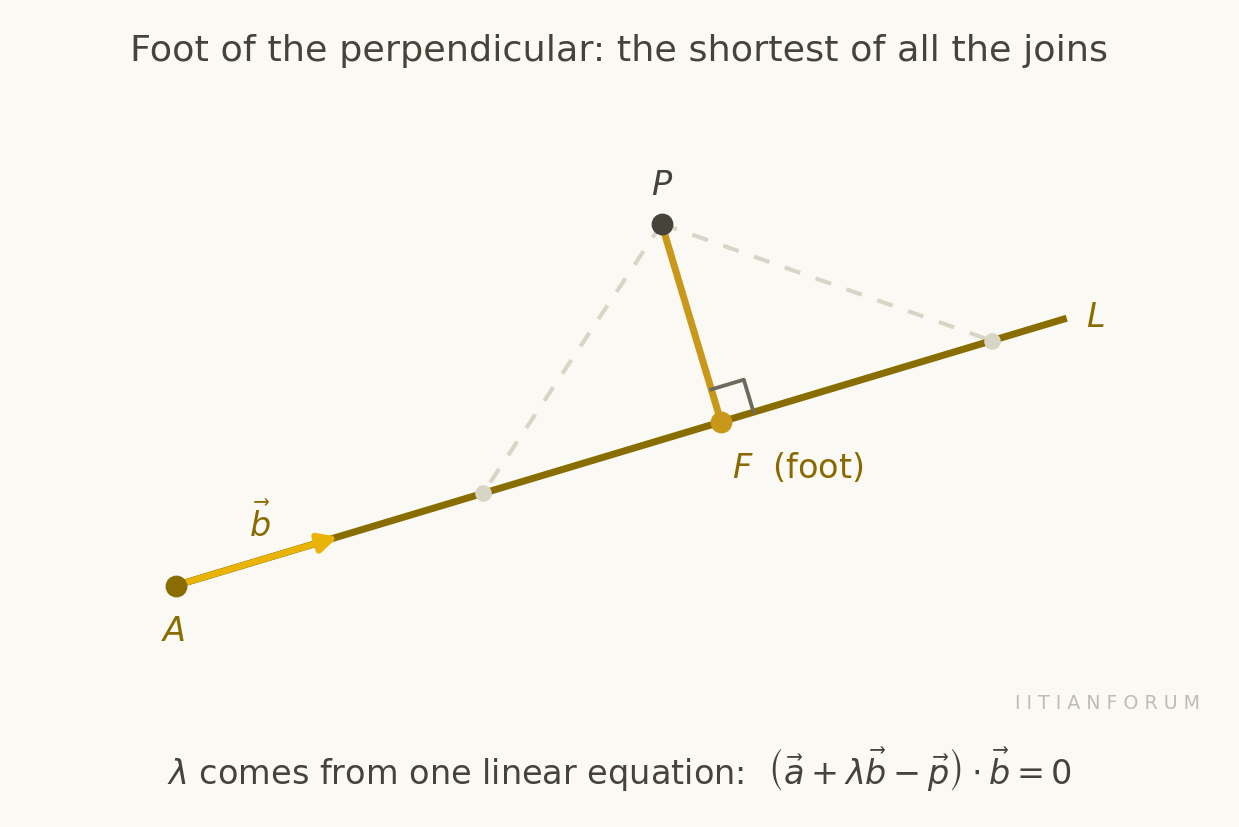
Take the general point on the line. The join must be perpendicular to the direction, so
That is a single linear equation in a single unknown. Once is known, is known, and the perpendicular distance is just .
The boxed formula for is worth understanding and not worth memorising. In an exam it is faster and safer to write the general point, dot the join with the direction, and solve. You will get the same in about the same time, with no chance of misremembering a sign.
Example 3 (JEE Main 2026, 5 Apr Shift 1). Find the square of the distance of from the line with point and direction .
▸ SHOW SOLUTION
Step 1: General point and join.
Step 2: One dot product.
So and .
Step 3: Measure.
Answer: (3)
Example 4 (JEE Main 2026, 21 Jan Shift 1). Let be the foot of the perpendicular from on . Find the length of the projection of on .
▸ SHOW SOLUTION
Step 1: Foot, by the same one equation.
With and :
So and .
Step 2: Project, which is where the direction cosines finally earn their keep.
Answer: (3)
The pattern here is worth naming, because JEE uses it constantly. The foot is rarely the answer. It is the intermediate object the real question is built on.
Example 5 (JEE Main 2025, 22 Jan Shift 2). Find the perpendicular distance of the line through with direction from the point .
▸ SHOW SOLUTION
Step 1: General point and join.
Step 2: Dot with the direction.
So and .
Step 3: Measure.
Answer: (2)
Three papers apart, three different wrappings, one identical calculation. That is the argument for learning the move rather than the question.
Image of a point in a line: find the foot, then double it
Reflecting in the line means finding the point for which the line is the perpendicular bisector of . The foot is therefore the midpoint of .
The foot is the midpoint of P and its image, so the image costs one extra line of work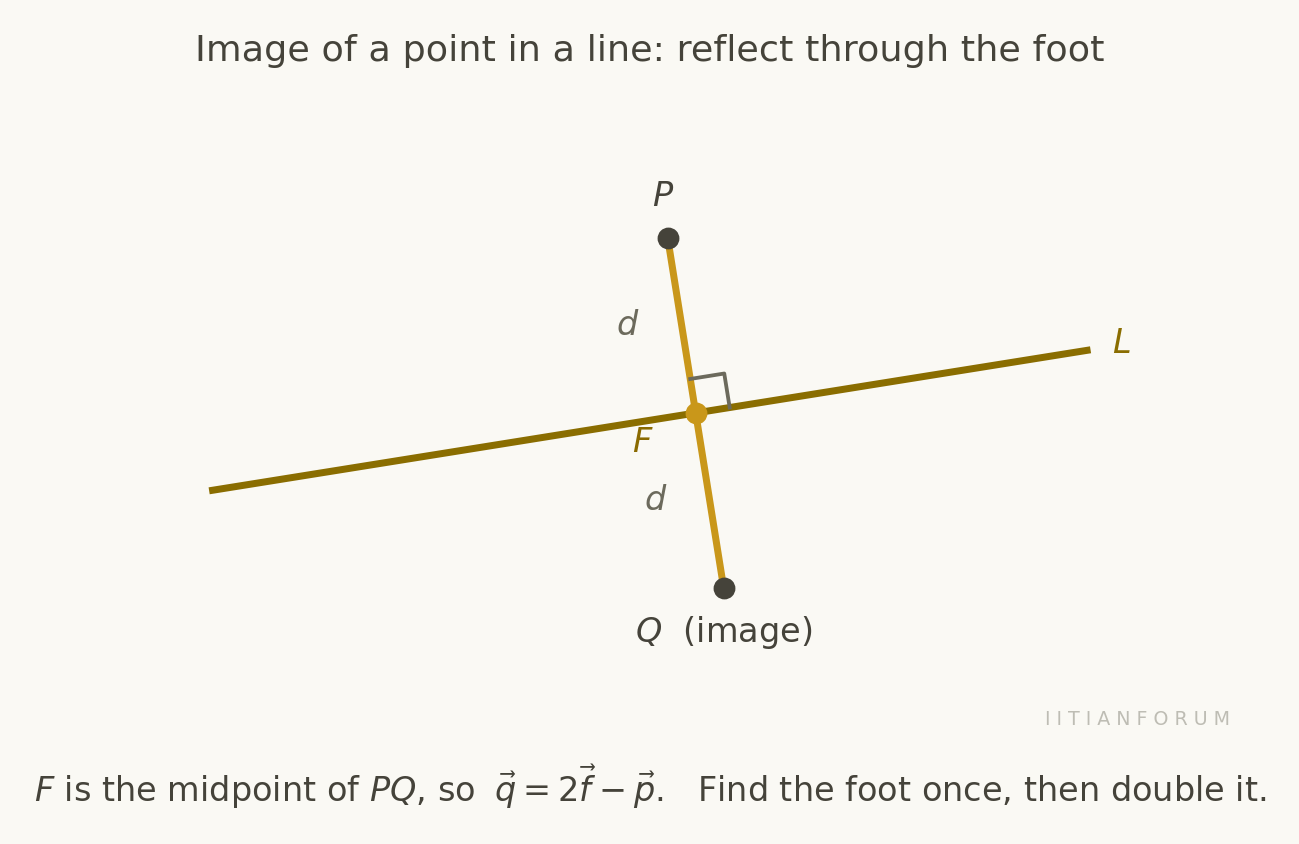
There is nothing else to it. Every image question in this chapter is a foot question with one subtraction on the end, and recognising that turns a question students find long into a short one.
First, the midpoint condition alone is not enough. A point whose midpoint with lies on the line need not be the image; you also need perpendicular to the direction. Papers exploit this by offering a value that satisfies one condition and not the other. Second, when the image is given in terms of unknowns, use both conditions as two separate equations rather than trying to force everything through the midpoint.
Example 6 (JEE Main 2026, 28 Jan Shift 2). Let be the image of in the line through with direction . Find the distance of from the line through with direction .
▸ SHOW SOLUTION
Step 1: Foot on the first line.
So and .
Step 2: Double it.
Step 3: Now a fresh perpendicular-distance calculation.
With and :
The projection of along the line has square , so by Pythagoras
Answer: (3)
Step 3 is worth a second look. Rather than solving for the foot again, it used minus the square of the along-line component. On a numeric question that is two lines shorter than finding the foot, and it is the version to reach for when the foot itself is not asked for.
Example 7 (JEE Main 2026, 22 Jan Shift 1). If the image of in the line is , find .
▸ SHOW SOLUTION
Step 1: Repair the direction before anything else.
The third fraction is written , which equals . The direction ratios are and the point is . Skip this and every later sign is wrong.
Step 2: Midpoint on the line.
The -coordinate gives at once, and then
Step 3: Perpendicularity, the second condition.
Step 4: Solve the pair.
From and : , .
Answer: (3)
Example 8 (JEE Main 2024, 31 Jan Shift 2). Let be the mirror image of in the line . Find .
▸ SHOW SOLUTION
Step 1: Foot.
So .
Step 2: Double it and combine.
Doubling gives the image, and substituting into collapses to
Answer: (4)
The word that changes everything: along
Read these two questions side by side.
Find the distance of from the line .
Find the distance of from the line measured along the line .
They are not the same question and they do not share a method. The first is a perpendicular distance. The second says: leave travelling in the direction of , and stop when you hit . Since that path is not perpendicular, it is longer.
Perpendicular distance versus distance measured along a stated direction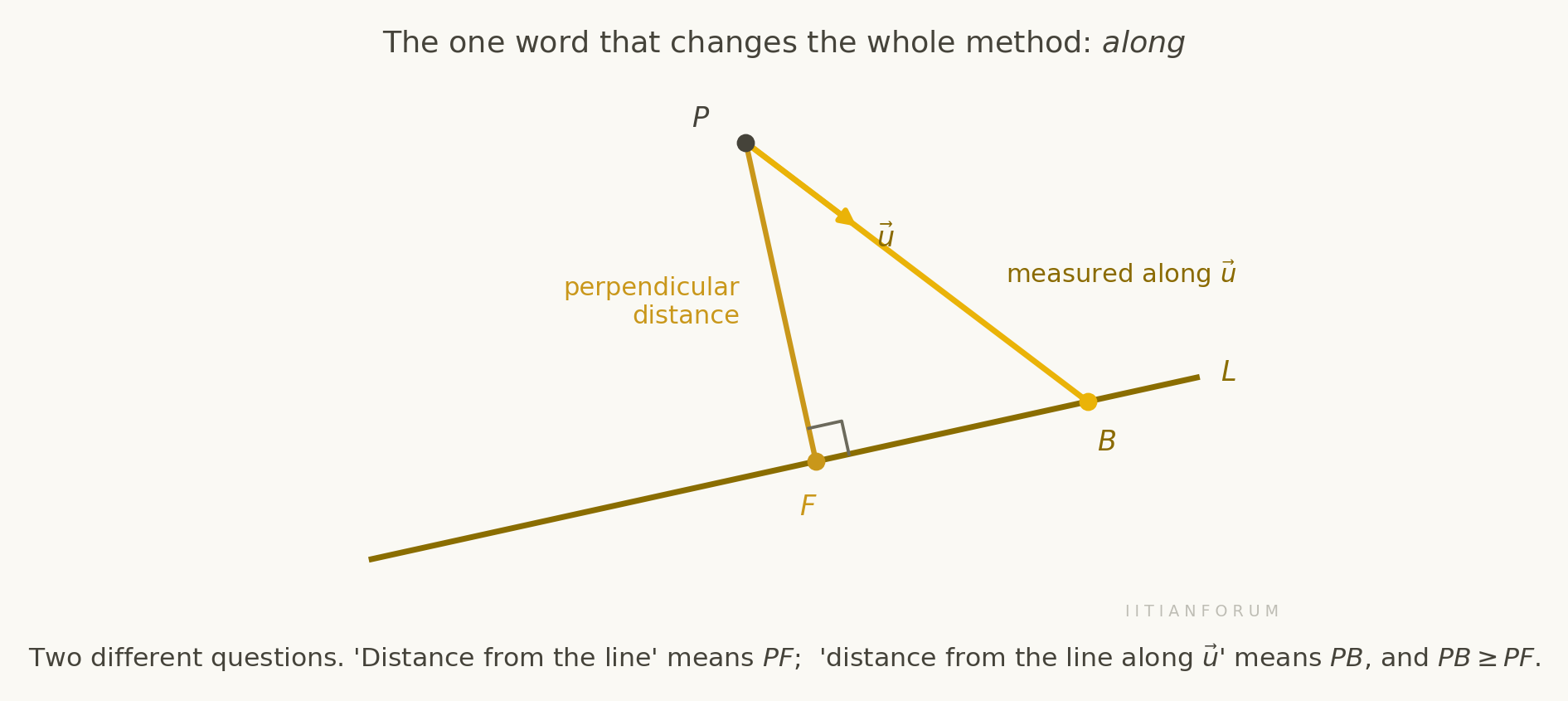
The method for the second is mechanical once you see it. Write the line through with the given direction, write the target line, and force them to meet. Two parameters, three coordinate equations, and the system is over-determined in your favour: solve two, check the third.
Every 2026 shift that used the word "along" was testing whether you noticed it. If you compute a perpendicular distance for an "along" question your answer will be too small, and it will usually still match one of the four options, because the paper puts it there on purpose.
Example 9 (JEE Main 2026, 4 Apr Shift 1). Find the square of the distance of from the line along the line .
▸ SHOW SOLUTION
Step 1: Travel from the point in the stated direction.
Only the direction of the second line is used; its position is irrelevant.
Step 2: Land on the target line.
From the first, . Substituting into the third gives , so and .
Step 3: Check the spare equation, then measure.
The second equation reads , which confirms the point. So and
Answer: (2)
Example 10 (JEE Main 2025, 3 Apr Shift 2). Find the distance of the point from the line along the line .
▸ SHOW SOLUTION
Step 1: Note the zero denominator.
The target line has direction and lies in the plane . That single fact does most of the work.
Step 2: Travel and land.
Landing on gives , so immediately, and . Checking, , so really is on the line.
Step 3: Measure.
Answer: (1)
The zero denominator turned a two-parameter system into a one-line calculation. That is what the earlier section on notation was for.
Skew lines and the shortest distance
Two lines in space fall into exactly three cases, and the first question to ask is always which one you are in.
Skew lines neither meet nor run parallel, and one join is perpendicular to both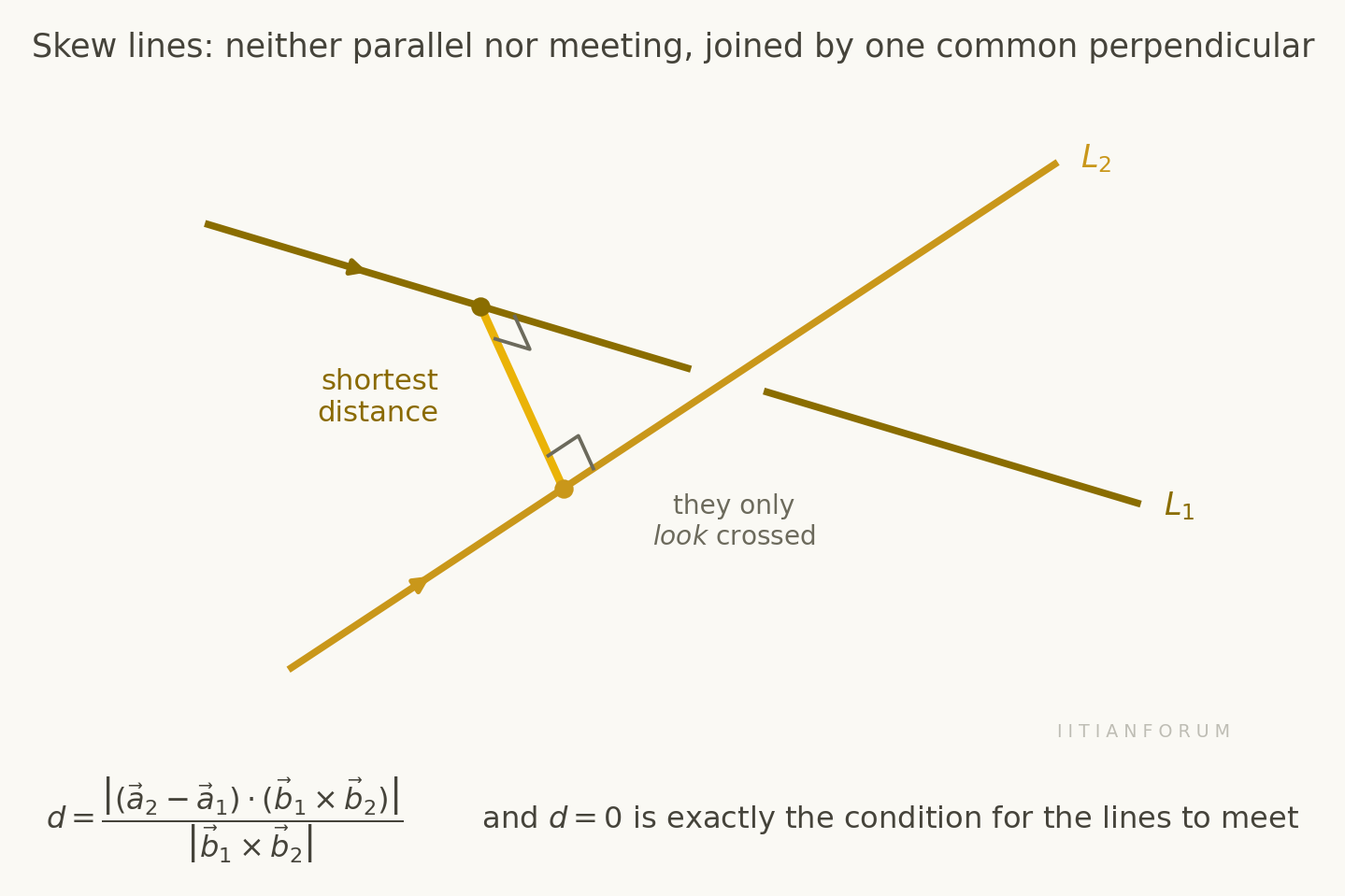
| Case | Test | Shortest distance |
|---|---|---|
| Parallel | ||
| Intersecting | and | |
| Skew | and the triple product is non-zero | the formula below |
For skew lines,
The formula reads better than it looks. The vector points along the one direction perpendicular to both lines, and the numerator projects the gap between the lines onto it. Everything else cancels.
Two lines are coplanar exactly when their shortest distance is zero, that is, when
Written as a determinant with rows , and , that is the condition every "find so that the lines are coplanar" question is really asking for. Coplanar and intersecting are the same thing here, unless the lines are parallel.
Example 11 (JEE Main 2026, 6 Apr Shift 2). Find the shortest distance between and .
▸ SHOW SOLUTION
Step 1: Check the case first.
Non-zero, so the lines are not parallel, despite and looking suspiciously close. That near-miss is deliberate.
Step 2: Apply the formula.
Answer: (3)
Example 12 (JEE Main 2026, 24 Jan Shift 2). Find the sum of all values of for which the shortest distance between and is .
▸ SHOW SOLUTION
Step 1: Cross product, keeping symbolic.
Step 2: Build the distance and watch it simplify.
With , the numerator is , so
The cancels, which is the whole reason this question is doable in two minutes.
Step 3: Set it equal and solve.
The roots are and , summing to .
Answer: (2)
Look back at the condition count from the first section. Two unknowns' worth of freedom, one condition, so a family and a "sum of all values" ending. The shape of the answer was predictable before any algebra happened.
Example 13 (JEE Main 2025, 2 Apr Shift 2). is parallel to through ; is parallel to through . Find the shortest distance.
▸ SHOW SOLUTION
Step 1: Cross product.
Step 2: Project the gap.
Answer: (1)
When two lines meet: intersection and coplanarity
If two lines do meet, the fastest route is almost never the determinant. Write both general points, set them equal, solve two of the three coordinate equations, and use the third as a check. The determinant condition is for questions that ask whether they meet, or for what value of a parameter they meet.
Example 14 (JEE Main 2026, 2 Apr Shift 1). If the point of intersection of and lies on the -plane, find .
▸ SHOW SOLUTION
Step 1: Two general points.
Step 2: Use the extra condition early.
Lying on the -plane means , and that applies to both expressions for the same point:
Two equations for free, before touching the harder ones.
Step 3: Equate the remaining coordinates.
Matching gives . Matching , and substituting, gives , so .
Step 4: Back-substitute.
Answer: (3)
Step 2 is the lesson. The condition "lies on the -plane" was not an afterthought to apply at the end; used first, it cut the work roughly in half.
Which move, when
A short decision chart covering almost every straight-line question in space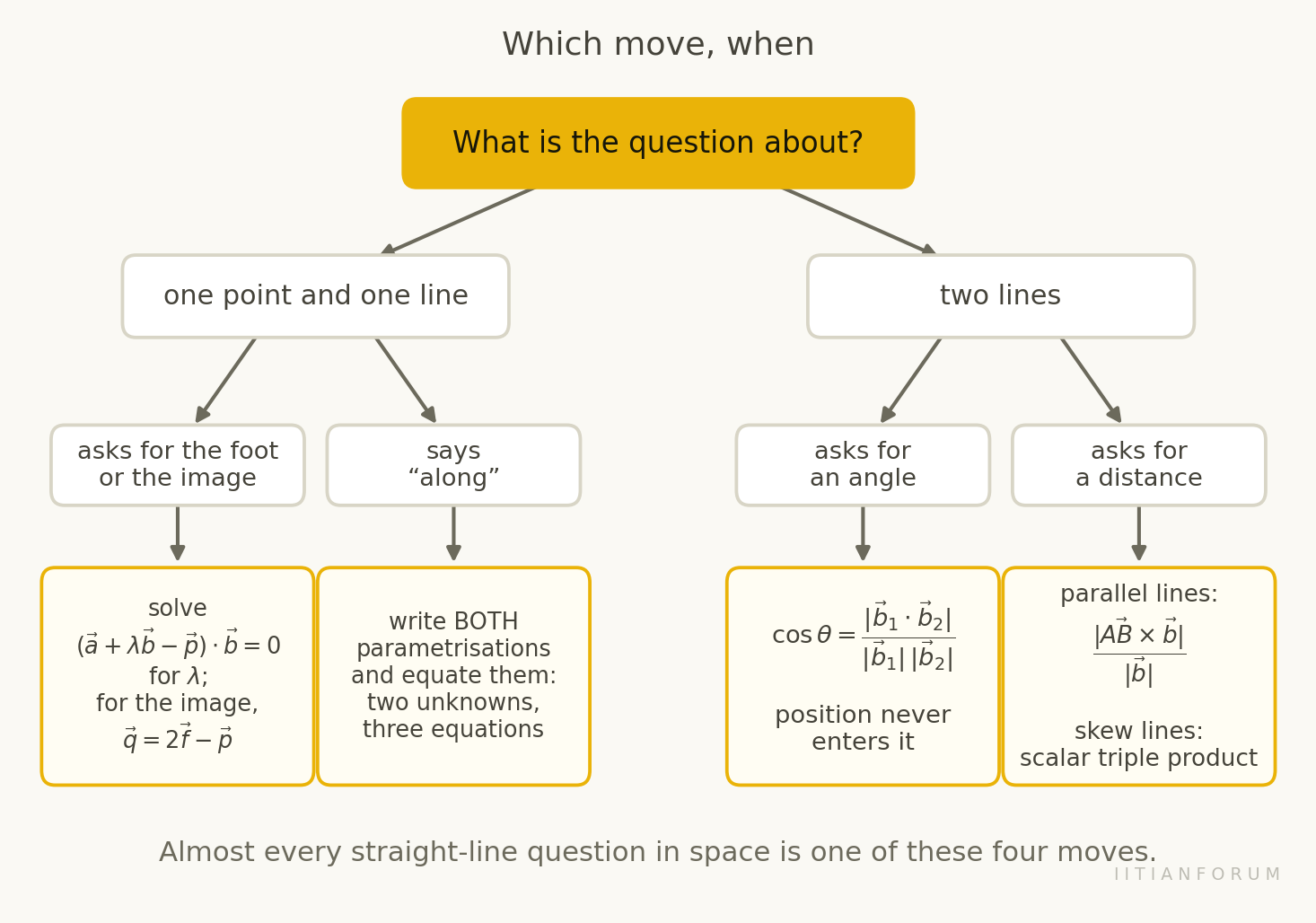
Read the question for one of four signals and the method follows.
| The question says | The move |
|---|---|
| foot, image, mirror, reflection | general point, one dot product, then double for an image |
| perpendicular distance, distance from a line | foot, then ; or minus the along-component squared |
| distance along a second line | write both parametrisations, force them to meet |
| angle, perpendicular, parallel | directions only, with an absolute value in the cosine |
| shortest distance, skew | check parallel first, then the triple product formula |
| coplanar, intersect, find such that | set the triple product to zero |
Quick recall
| Direction cosines | ; two sets per line, opposite in sign |
| Direction ratios | any non-zero multiple of ; no constraint |
| Vector form | |
| Symmetric form | |
| Zero denominator | a plane condition, never a division |
| Angle | |
| Perpendicular | |
| Line perpendicular to two lines | direction |
| Foot of perpendicular | solve |
| Image | |
| Distance, parallel lines | |
| Shortest distance, skew | |
| Coplanar | that triple product is zero |
Before computing anything, write the general point of every line the question mentions. It takes fifteen seconds, it converts the geometry into algebra, and on nearly every question in this chapter the next step then becomes obvious. Students who skip it spend their time deciding what to do; students who do it spend their time doing it.
Work these methods on the past papers until the recognition is automatic, then move on to the plane, where every one of them reappears with an extra equation attached.