Tangents, Normals, Rolle's Theorem and LMVT for JEE: Notes and PYQs
At a point where a curve is smooth, one number answers two questions: how steep the curve is, and how fast one quantity changes with another. That number is the derivative. This chapter reads it both ways. As a rate it solves related-rates problems; as a slope it gives tangents, normals, the angle between curves and the lengths attached to a tangent. The mean value theorems then turn slopes into statements about values: a curve that returns to its starting height must level off, and some tangent is always parallel to the chord.
This note covers rate of change, approximation by differentials, tangents and normals (explicit, implicit and parametric curves), tangents in special positions, tangents from an outside point, common tangents, normals and shortest distance, the angle between two curves, the lengths of tangent, normal, sub-tangent and sub-normal, Rolle's theorem, counting roots, helper functions, Lagrange's mean value theorem and Cauchy's mean value theorem. The worked examples include JEE Main 2019 to 2025 questions and JEE Advanced and IIT JEE questions; every answer was re-derived from scratch.
The derivative as a slope and as a rate
At a point where is differentiable,
- Geometrically, is the slope of the tangent to at . If the tangent makes angle with the positive -axis, then .
- Physically, is the instantaneous rate at which changes with .
The secant through and has slope equal to the difference quotient; as the secant turns into the tangent. Every idea in this chapter is one of these two readings.
Rate of change
If and both change with time and are linked by an equation, differentiate the equation with respect to . By the chain rule,
Method.
- Draw the figure and name every changing quantity.
- Write the equation that links them, true at every instant.
- Differentiate with respect to .
- Only now substitute the values at the given instant.
A quantity is increasing when its rate is positive and decreasing when its rate is negative.
| Shape | Relation to differentiate |
|---|---|
| sphere | , |
| cone, semi-vertical angle | , |
| curved surface of a cone | , |
| ladder against a wall | |
| shadow of a man from a lamp | similar triangles |
Putting into first makes a constant and . Differentiate the general relation, then substitute the instantaneous values.
Example 1 (IITianForum). The radius of a sphere increases at cm/s. Find the rates at which its volume and its surface area increase when the radius is cm.
▸ SHOW SOLUTION
Step 1. Volume
Step 2. Surface area
Answer: cm/s and cm/s
Example 2 (IITianForum). A ladder m long leans against a vertical wall. Its foot slides away from the wall at m/s. How fast is the top sliding down when the foot is m from the wall?
A right triangle formed by a wall, the floor and a ladder of length 5: the foot of the ladder is at distance x from the wall along the floor, the top is at height y up the wall, with arrows showing the foot moving away and the top moving down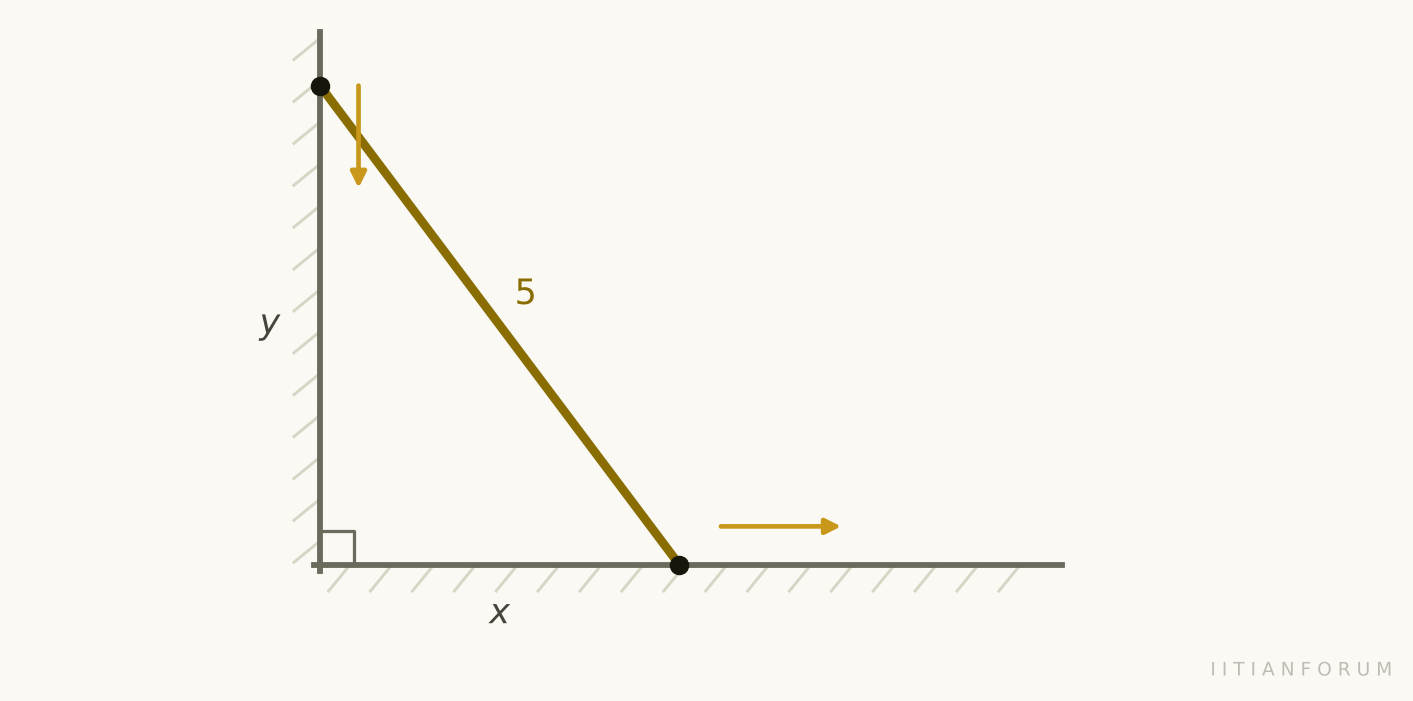
▸ SHOW SOLUTION
Step 1. The link
With the distance of the foot and the height of the top,
Step 2. Differentiate
Step 3. Substitute
At , :
Answer: the top slides down at m/s
Example 3 (JEE Main 2019, 9 April Shift 2). A water tank has the shape of an inverted right circular cone whose semi-vertical angle is . Water is poured into it at a constant rate of cubic metre per minute. Then the rate (in m/min) at which the level of water is rising at the instant when the depth of water in the tank is m is
▸ SHOW SOLUTION
Step 1. Volume in terms of h
, so
Step 2. Differentiate
Step 3. Substitute
Answer: option (4)
Example 4 (JEE Main 2022, 24 June Shift 1). The surface area of a balloon of spherical shape being inflated increases at a constant rate. If initially the radius of the balloon is units and after seconds it becomes units, then its radius after seconds is
▸ SHOW SOLUTION
Step 1. Constant rate means linear
gives . With , this says grows linearly in :
Step 2. Use t = 5
Step 3. At t = 9
Answer: option (A)
Example 5 (JEE Main 2025, 23 January Shift 2). A spherical chocolate ball has a layer of ice-cream of uniform thickness around it. When the thickness of the ice-cream layer is cm, the ice-cream melts at the rate of cm/min and the thickness of the ice-cream layer decreases at the rate of cm/min. The surface area (in cm) of the chocolate ball (without the ice-cream layer) is
▸ SHOW SOLUTION
Step 1. Only the outer radius changes
The chocolate ball is fixed, so the ice-cream volume changes exactly as the volume of the outer sphere, and the thickness changes exactly as :
Step 2. Substitute
Step 3. The chocolate ball
Its radius is , so its surface area is
Answer: option (4)
Example 6 (JEE Main 2022, 25 June Shift 2). Water is being filled at the rate of cm/s in a right circular conical vessel (vertex downwards) of height cm and diameter cm. When the height of the water level is cm, the rate (in cm/s) at which the wet conical surface area of the vessel increases is
▸ SHOW SOLUTION
Step 1. Shape of the water
Radius to height is , so and the slant height is
Step 2. Volume and wet surface
Step 3. Rates
At this is .
Answer: option (C)
Example 7 (IITianForum). is a circular arc of variable radius with centre , and . The circle through , , has radius . Find .
▸ SHOW SOLUTION
Step 1. The triangle
and , so .
Step 2. Sine rule
Step 3. Differentiate
Since , this is .
Answer:
Approximation and errors
Near a point where is differentiable, the tangent line stays close to the curve. For a small change ,
- Absolute error in : .
- Relative error: . Percentage error: .
- For : . Taking logarithms first turns any product of powers into a sum of relative errors.
Choose as the nearest point where is easy to evaluate exactly. The approximation is the tangent line itself, so it is good only for small .
Example 8 (IITianForum). (a) Find an approximate value of . (b) The radius of a sphere is measured with an error of . Find the approximate percentage errors in its surface area and volume.
▸ SHOW SOLUTION
Step 1. Part (a)
Take , , , :
Step 2. Part (b)
and , so
Answer: (a) ; (b) and
Tangent and normal
Let lie on the curve and let be the slope of the tangent at .
The normal is the line through perpendicular to the tangent, so the two slopes multiply to . If the tangent is and the normal is .
A curve with a point P on it, the tangent line touching the curve at P and the normal line through P perpendicular to it, with the right angle between them marked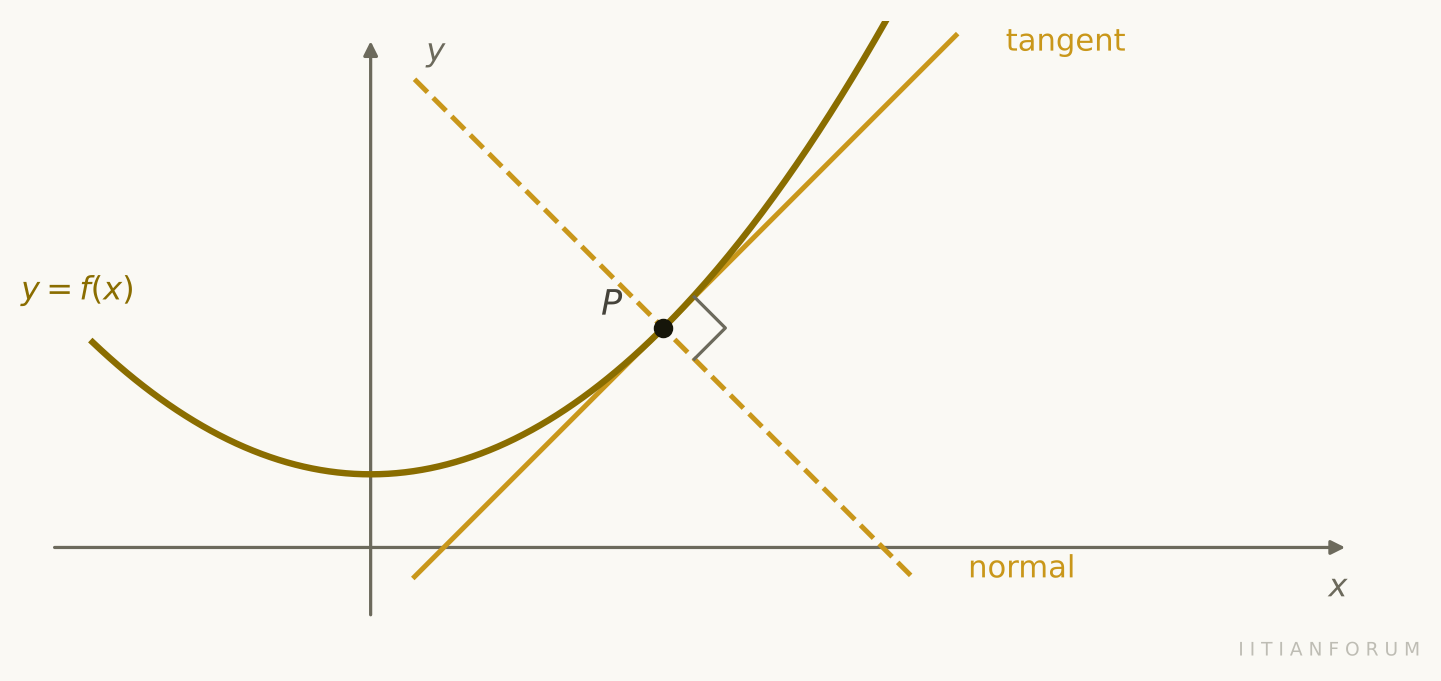
Finding m.
| Curve given as | Slope at |
|---|---|
| differentiate implicitly, put | |
| , | at |
For a parametric curve the tangent at parameter can be written straight away:
"Tangent at " needs on the curve. If the given point does not satisfy the equation, the question is about a tangent from that point; that case is treated in a later section.
Example 9 (IITianForum). Find the tangent and the normal to at .
▸ SHOW SOLUTION
Step 1. Point and slope
, and gives .
Step 2. Tangent
Step 3. Normal
Answer: tangent ; normal
Example 10 (JEE Main 2019, 10 January Shift 2). The tangent to the curve passing through the point also passes through the point
▸ SHOW SOLUTION
Step 1. Slope at x = 1
lies on the curve.
Step 2. Tangent
Step 3. Test the options
At : .
Answer: option (2)
Example 11 (JEE Advanced 2014, Paper 1). The slope of the tangent to the curve at the point is ______.
▸ SHOW SOLUTION
Step 1. Differentiate implicitly
Step 2. Put (1, 3)
Answer:
Example 12 (JEE Main 2022, 25 June Shift 2). If the angle made by the tangent at the point on the curve , , , with the positive -axis is , then is equal to
▸ SHOW SOLUTION
Step 1. The two rates
Step 2. Slope
Step 3. Slope = tan 60°
works: . The left side is increasing on , so this is the only value.
Answer: option (C)
Example 13 (JEE Main 2023, 29 January Shift 2). If the equation of the normal to the curve
at the point is , then the value of is equal to ______.
▸ SHOW SOLUTION
Step 1. Point on the curve
Step 2. Slope of the tangent
The normal has slope , so the tangent has slope . Write with ; at , and :
Step 3. Solve
Put :
Cancel : , so and .
Answer:
Example 14 (JEE Main 2022, 25 July Shift 2). Let the area enclosed by the -axis and the tangent and normal drawn to the curve
at the point be . Then is equal to ______.
▸ SHOW SOLUTION
Step 1. Slope by implicit differentiation
At : and .
Step 2. Where the lines meet the x-axis
Tangent: gives .
Normal: gives .
Step 3. Area
The base is and the height is :
Answer:
Tangents in special positions
| Condition at | Tangent |
|---|---|
| parallel to the -axis | |
| parallel to the -axis | |
| makes with the -axis | |
| parallel to | |
| normal parallel to |
Vertical tangent. If is continuous at and as , the tangent at is the vertical line . Fractional powers such as are the usual source. If instead the two one-sided derivatives are finite and different, there is a corner and no tangent at all. The corner rule for is treated in the Continuity and Differentiability note.
For a curve , horizontal tangents come from and vertical tangents from , each solved together with the curve. For a parametric curve, horizontal tangents need with , and vertical tangents need with .
Tangent at the origin. If a polynomial curve passes through the origin, the tangents there are found by equating to zero the lowest-degree terms of its equation.
Two graphs side by side: on the left the curve y equals the cube root of x, which passes through the origin with a vertical tangent along the y-axis; on the right the looped curve y squared equals x cubed plus x squared, which crosses itself at the origin with the two tangent lines y equals x and y equals minus x drawn dashed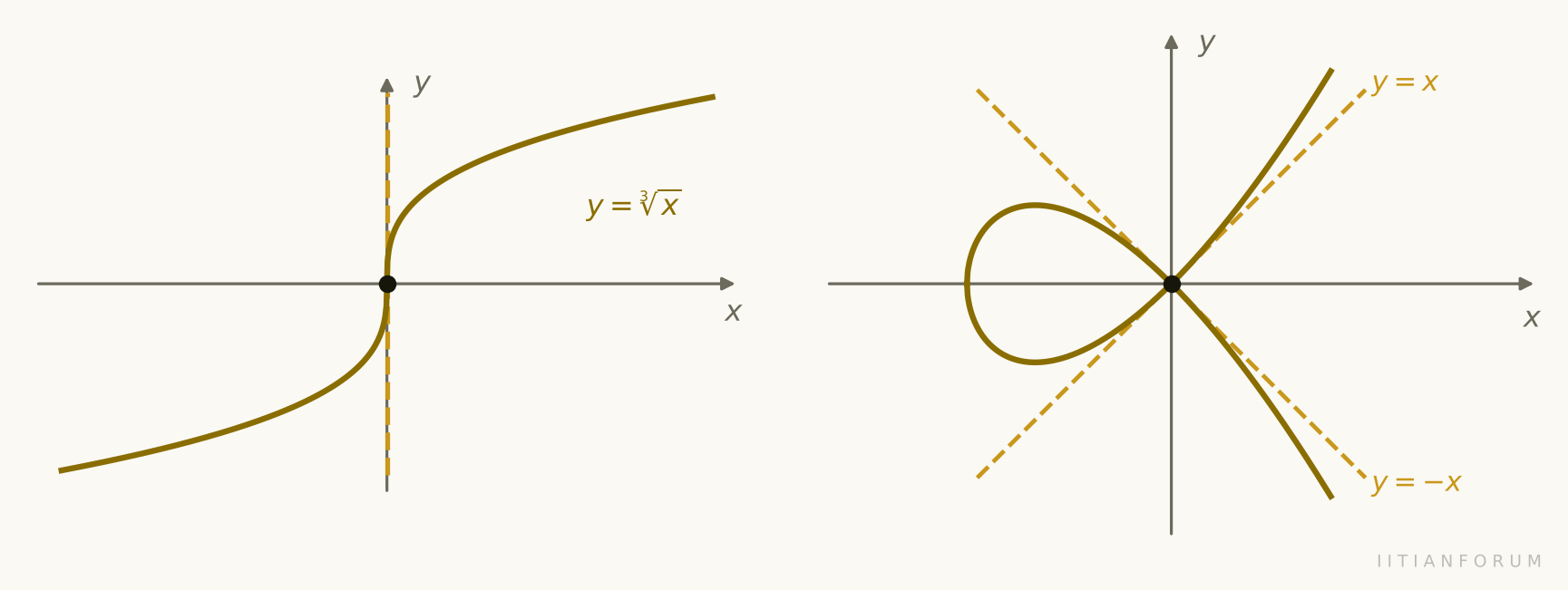
Example 15 (IITianForum). (a) Find the tangent to at the origin. (b) Find the tangents at the origin to .
▸ SHOW SOLUTION
Step 1. Part (a)
The curve is continuous at , so the tangent is the vertical line .
Step 2. Part (b)
The lowest-degree terms are :
Answer: (a) ; (b) and
Example 16 (IITianForum). For the curve , , , let be the number of points where the tangent is horizontal and the number where it is vertical. Find and .
▸ SHOW SOLUTION
Step 1. The two rates
Step 2. Horizontal
at , where . So .
Step 3. Vertical
at and , where and , both non-zero. So .
Answer: ,
Example 17 (JEE Main 2022, 27 July Shift 1). Let and be the number of points on the curve where the tangents to the curve are parallel to the -axis and the -axis respectively. Then the value of equals ______.
▸ SHOW SOLUTION
Step 1. Slope
Step 2. Horizontal tangents
. The curve gives , so , which contradicts . So .
Step 3. Vertical tangents
. Put this in the curve:
gives and gives one more point. At both the numerator . So .
Answer:
Tangent from an outside point
If the point is not on the curve , take the point of contact as , write the tangent there, and make it pass through :
Each real root of this equation gives one tangent from .
Meeting the curve again. The tangent at meets a polynomial curve at at least twice. For a cubic, subtract the tangent from the curve: the difference has the factor , and the third factor gives the second meeting point.
The parabola y equals x squared and an outside point A at 1 comma minus 3 below it, with two tangent lines drawn from A touching the parabola at x equals minus 1 and x equals 3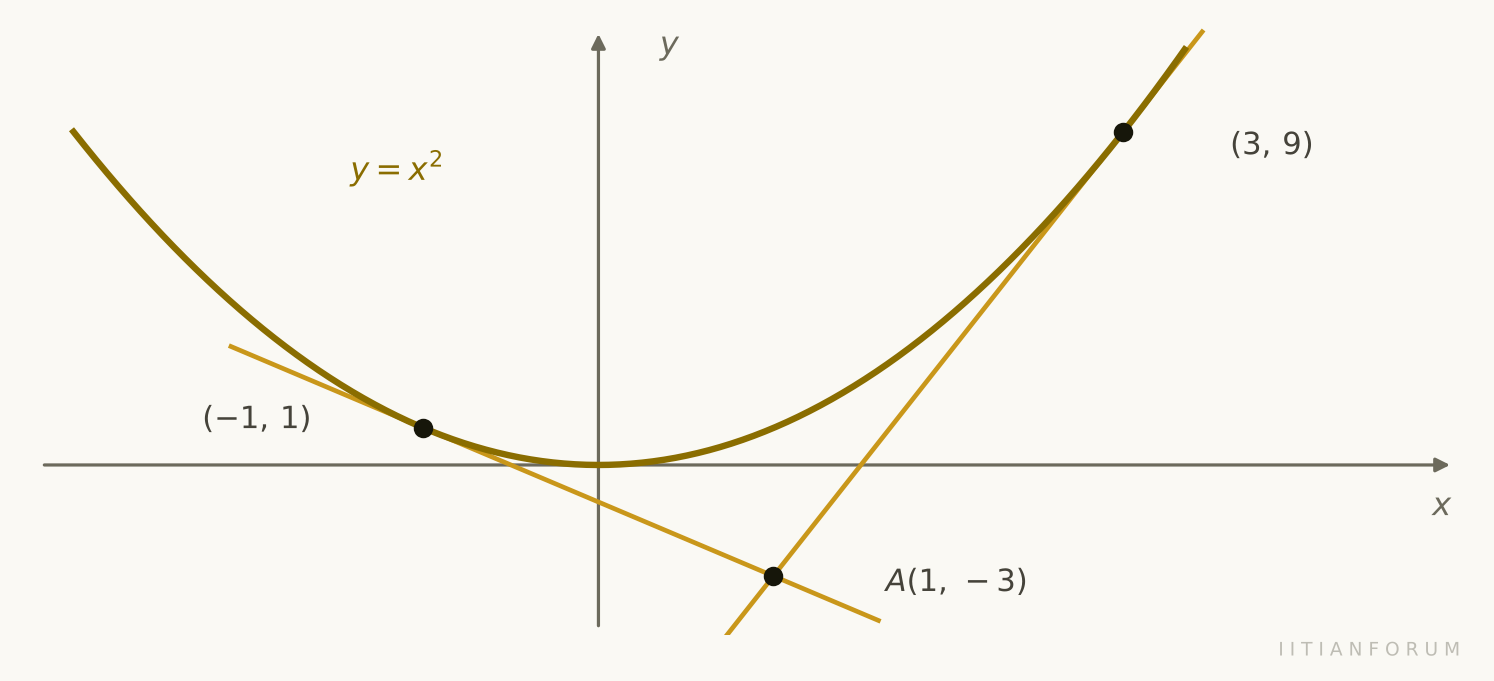
Example 18 (IITianForum). Find the tangents to drawn from the point .
▸ SHOW SOLUTION
Step 1. Tangent at (t, t²)
Step 2. Make it pass through (1, −3)
Step 3. The tangents
: . : .
Answer: and
Example 19 (JEE Main 2022, 24 June Shift 1). If the tangent at the point on the curve passes through the origin, then does NOT lie on the curve
▸ SHOW SOLUTION
Step 1. Through the origin
The tangent passes through when :
Step 2. Solve
The quadratic has , so , .
Step 3. Test
Answer: option (D)
Example 20 (JEE Main 2021, 24 February Shift 1). If the tangent to the curve at the point meets the curve again at , then the ordinate of the point which divides internally in the ratio is
▸ SHOW SOLUTION
Step 1. Tangent at P
Step 2. Meet the curve
So .
Step 3. Divide PQ in 1 : 2
Answer: option (1)
Example 21 (JEE Main 2025, 4 April Shift 2). A line passing through the point touches the parabola at the point in the first quadrant. The area of the region bounded by the line , the parabola and the -axis is
▸ SHOW SOLUTION
Step 1. Point of contact
Take , . From the tangent slope is ; the slope of is :
So and is .
Step 2. Area with horizontal strips
For the region lies between the line and the parabola :
Answer: option (3)
Example 22 (IITianForum). The tangent to at touches the curve again at . Find .
▸ SHOW SOLUTION
Step 1. A line touching twice
A line touches the quartic at two points exactly when the difference is a perfect square:
Step 2. Match
, so , works with points of contact .
Step 3. The points
Answer:
Tangent with a given slope and common tangents
Given slope. For the tangent with slope , solve for the point of contact, then write the line. A normal parallel to a given line means the tangent has the negative reciprocal slope.
Common tangent. A line is a common tangent of and when the tangent at and the tangent at are the same line. Equate their slopes and their -intercepts:
Curves touching at a point. Two curves touch at when lies on both and the slopes there are equal.
The parabola y equals x squared and the curve y equals minus 64 over x in the fourth quadrant, with the straight line y equals 16x minus 64 touching the parabola at 8 comma 64 and the other curve at 2 comma minus 32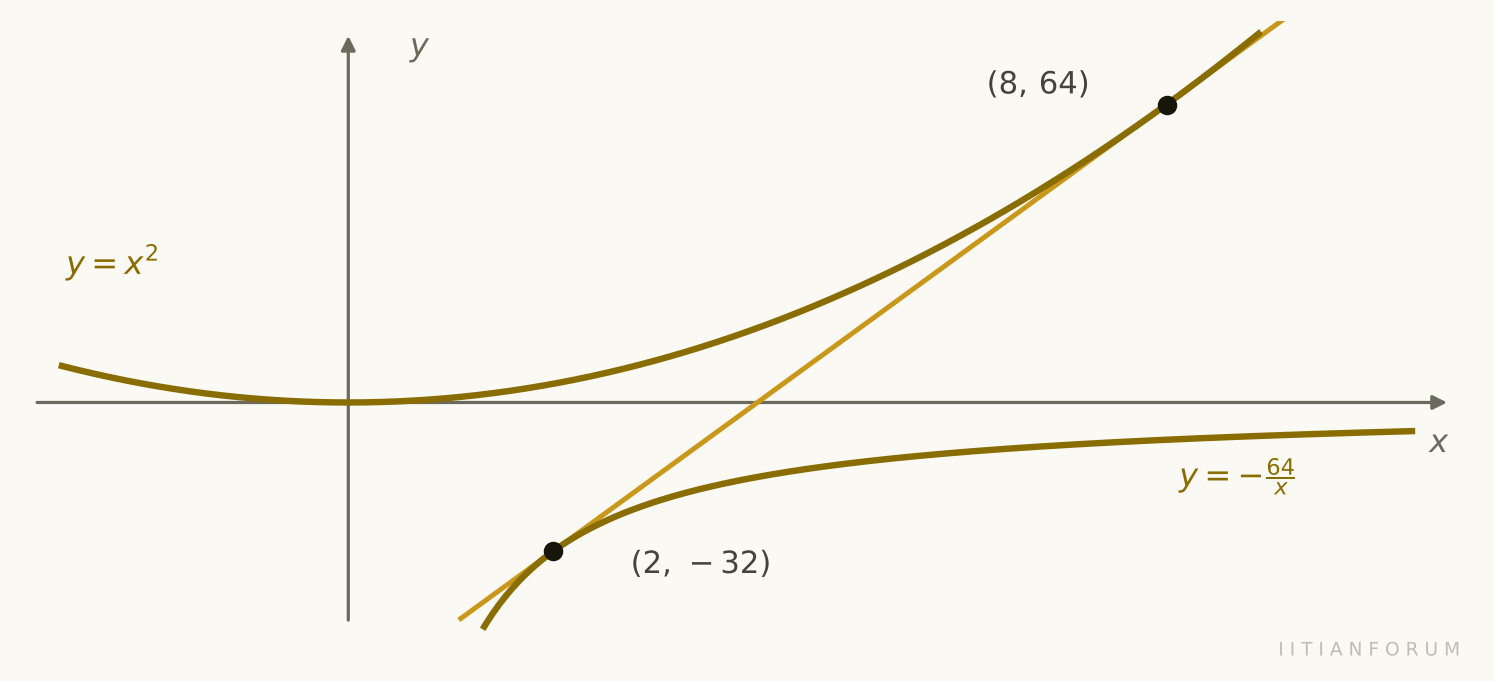
Example 23 (JEE Advanced 2026, Paper 1). Let be the point on the parabola such that the slope of the tangent to the parabola at is . Let be the point in the first quadrant on the circle such that the slope of the tangent to the circle at is . Let be the point in the first quadrant on the ellipse such that the slope of the tangent to the ellipse at is . Then the radius of the circle passing through , and is
▸ SHOW SOLUTION
Step 1. P
, so .
Step 2. Q
gives , so and : .
Step 3. R
gives , so and : .
Step 4. The circle
, and , with . The angle at is right, so is a diameter:
Answer: option (3)
Example 24 (JEE Main 2023, 30 January Shift 1). The number of points on the curve at which the normal lines are parallel to is
▸ SHOW SOLUTION
Step 1. Tangent slope needed
The normal has slope , so the tangent has slope :
Step 2. Factor
and are roots:
Step 3. Count
Four distinct real values , so four points.
Answer: option (3)
Example 25 (JEE Main 2021, 16 March Shift 1). If the normal to the curve at a point is parallel to the line , , then the value of is equal to ______.
▸ SHOW SOLUTION
Step 1. Slope of the tangent
The normal has slope , so :
With , .
Step 2. b
Answer:
Example 26 (JEE Main 2022, 29 July Shift 2). If the tangent to the curve at the point is also tangent to the curve at the point , then is equal to ______.
▸ SHOW SOLUTION
Step 1. Tangent at (2, −1)
Slope :
Step 2. Same slope on the cubic
Step 3. Same line
: and , so the point lies on the line.
: , but the line gives . Rejected.
Answer:
Example 27 (IITianForum). There is a point on and a point on , with , . The line through these two points is tangent to both curves at these points. Find .
▸ SHOW SOLUTION
Step 1. The two tangents
At : .
At , slope : .
Step 2. Equate slope and intercept
Step 3. Solve
From the first, ; then , so , , .
Answer:
Example 28 (IITianForum). The parabolas and touch each other at the point . Find .
▸ SHOW SOLUTION
Step 1. Second curve through (2, 0)
Step 2. Equal slopes at x = 2
Step 3. First curve through (2, 0)
Answer:
Normals and shortest distance
Normal through a given point. The normal at passes through when
Shortest distance. If on a curve is nearest to a point off the curve, then is along the normal at . If is nearest to a line, the tangent at is parallel to that line. For two curves, the shortest segment is along a common normal.
Example 29 (JEE Main 2019, 10 January Shift 2). A helicopter is flying along the curve given by , . A soldier positioned at the point wants to shoot down the helicopter when it is nearest to him. Then this nearest distance is
▸ SHOW SOLUTION
Step 1. Normal through the soldier
At , . The normal at passes through :
Step 2. Distance
Answer: option (3)
Example 30 (JEE Main 2025, 8 April Shift 2). Let be the radius of the circle which touches the -axis at the point , , and the parabola at the point . Then is equal to ______.
▸ SHOW SOLUTION
Step 1. The centre lies on the normal at (4, 6)
gives tangent slope , so the normal slope is . The centre is :
Step 2. Distance from the centre to (4, 6) is r
Put . Then and
Step 3. Solve
So and .
Answer:
Example 31 (IITianForum). At the point , , on , , the normal is drawn; it meets the -axis at . If , find .
▸ SHOW SOLUTION
Step 1. The normal
Slope of the tangent is :
Step 2. y-intercept
Put :
Step 3. The limit
: . : . : .
Answer:
Example 32 (JEE Main 2025, 3 April Shift 1). The radius of the smallest circle which touches the parabolas and is
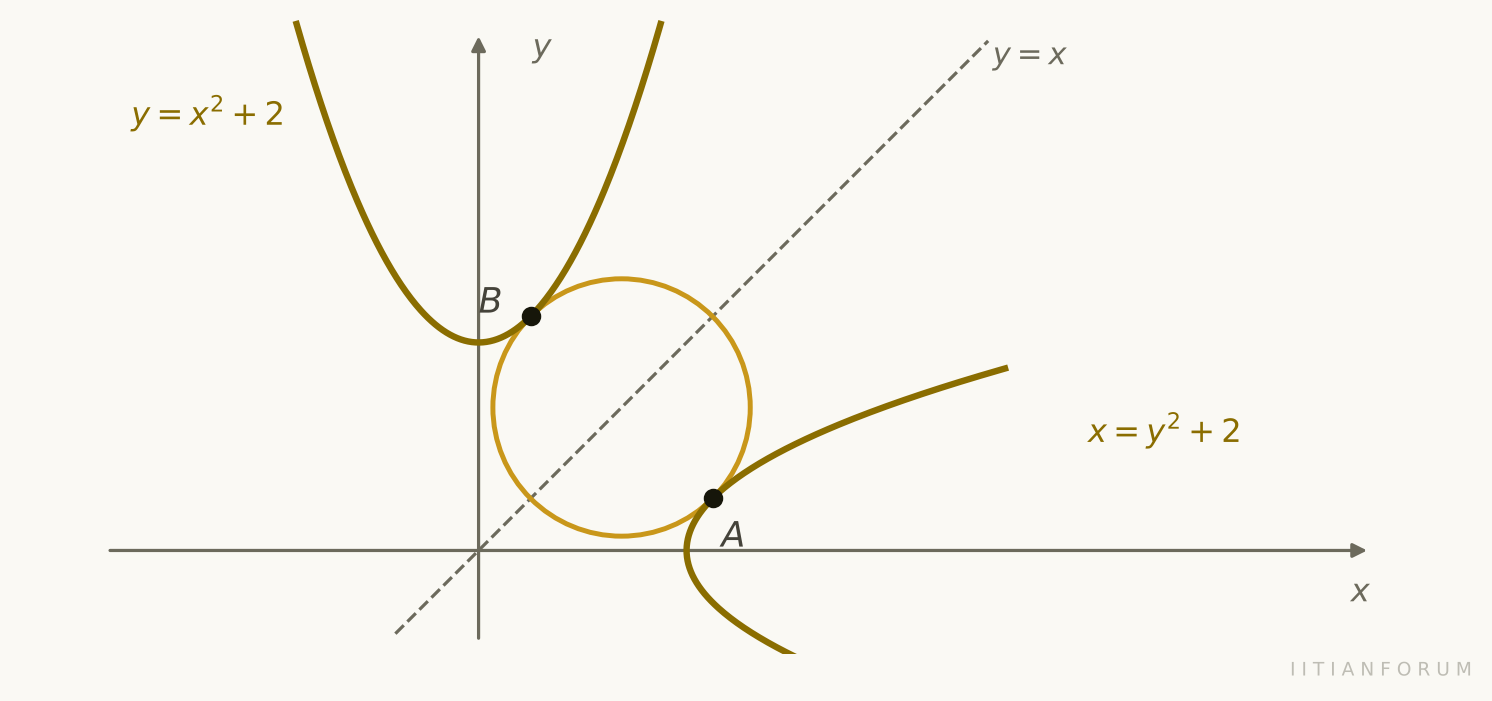
▸ SHOW SOLUTION
Step 1. Symmetry
The parabolas are mirror images in . The nearest points and are mirror images, and the smallest touching circle has as diameter.
Step 2. Nearest point to the line y = x
The tangent at is parallel to :
Step 3. Radius
Answer: radius , option (4)
Angle between two curves
The angle between two curves at a common point is the angle between their tangents there. With tangent slopes and ,
- Touch: , so .
- Cut orthogonally: , or one tangent horizontal and the other vertical.
Two curves may meet at several points and the angle can differ from point to point. Find the points of intersection first.
The curves y equals x squared and y equals x cubed meeting at the point 1 comma 1, with their tangent lines of slopes 2 and 3 drawn through that point and the small angle theta between the tangents marked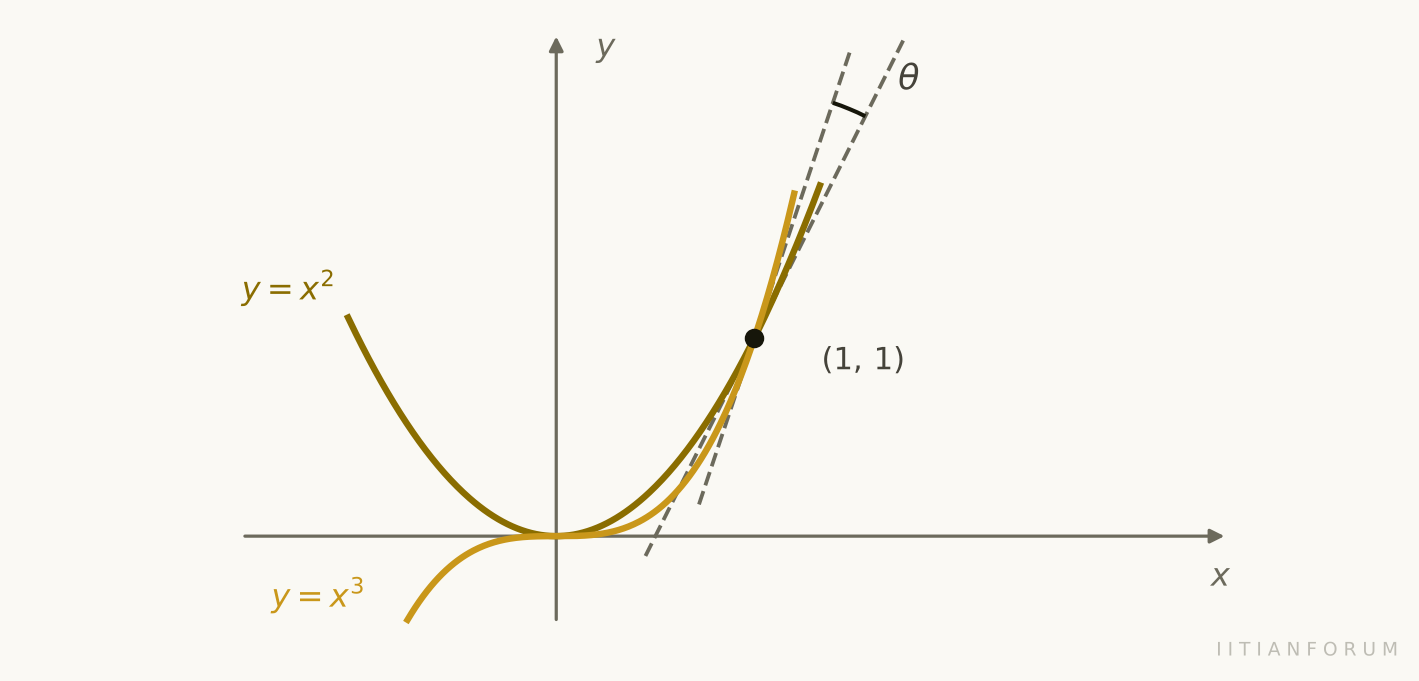
Example 33 (IITianForum). Find the angle between and at each point where they meet.
▸ SHOW SOLUTION
Step 1. Points
gives or : the points and .
Step 2. At (0, 0)
Both slopes ( and ) are . The curves touch: .
Step 3. At (1, 1)
, :
Answer: at the origin; at
Example 34 (JEE Main 2018). If the curves and intersect each other at right angles, then the value of is
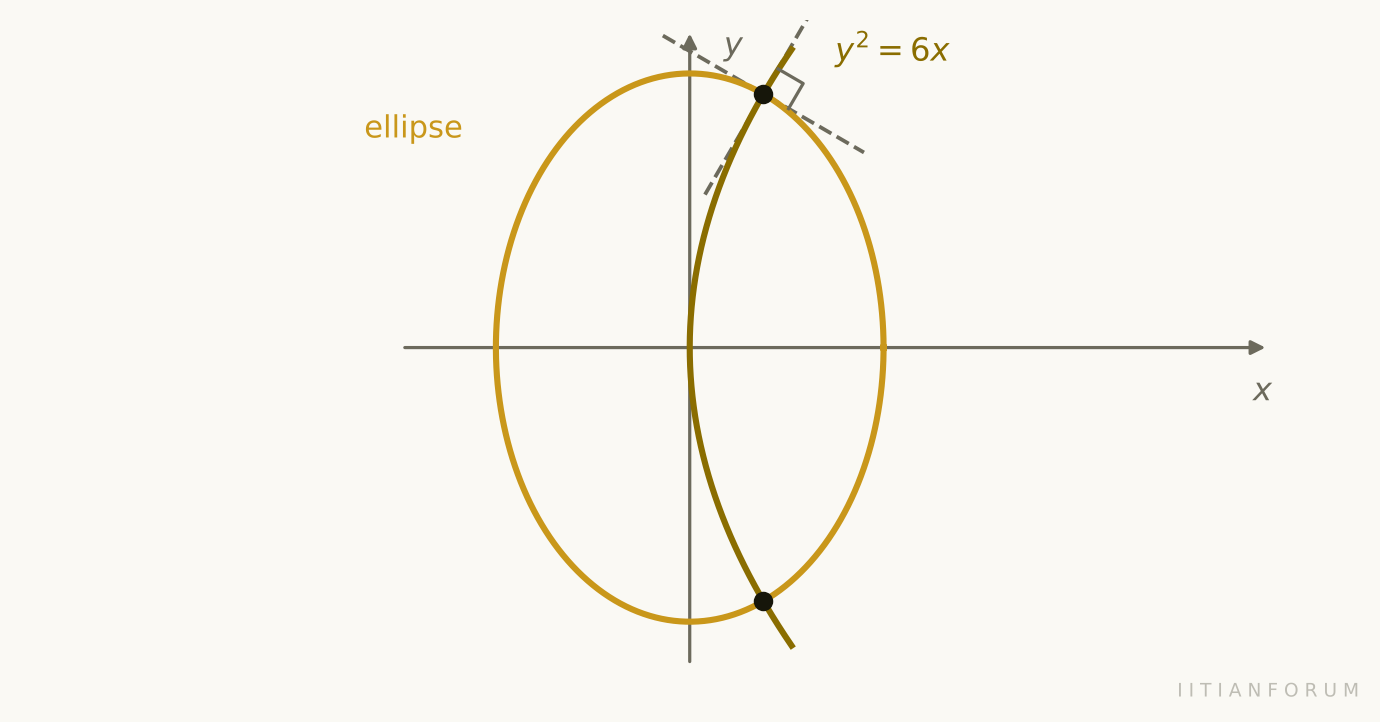
▸ SHOW SOLUTION
Step 1. Slopes at a common point (x, y)
Step 2. Right angle
At a common point (at the second curve needs , but the first gives ). So .
Answer: option (2)
Example 35 (JEE Main 2021, 25 February Shift 2). If the curves and cut at right angles, then is equal to ______.
▸ SHOW SOLUTION
Step 1. Slopes
Step 2. Right angle
With : .
Step 3. k
, so
Answer:
Lengths of tangent, normal, sub-tangent and sub-normal
Let the tangent at meet the -axis at , the normal meet it at , and let be the foot of the perpendicular from to the -axis. With the slope at :
A curve with a point P, the tangent from P meeting the x-axis at T, the normal from P meeting the x-axis at N, and the foot M of the perpendicular from P, with TM marked as the sub-tangent, MN as the sub-normal, PT as the tangent length and PN as the normal length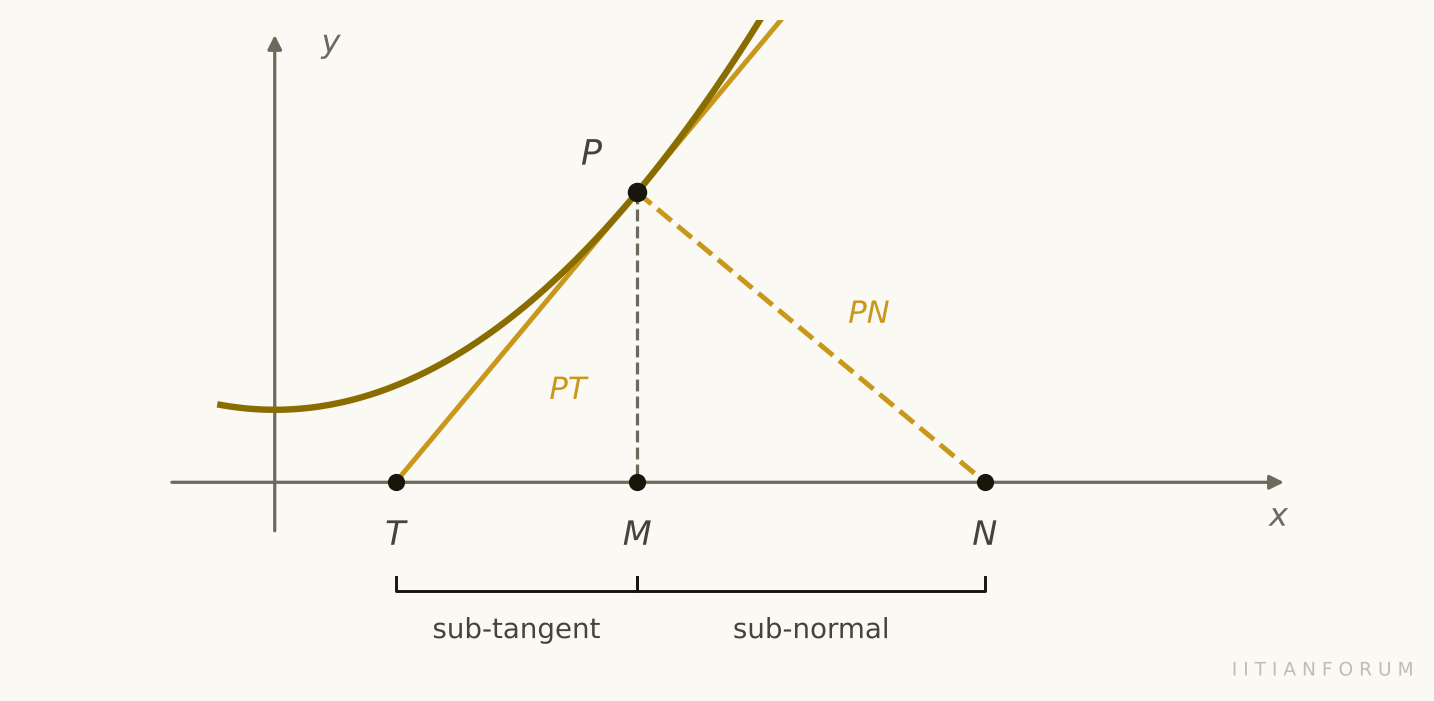
| Length | Formula |
|---|---|
| sub-tangent | |
| sub-normal | |
| tangent | |
| normal |
Each comes from the right triangles and , with and .
Two standard facts: for the sub-normal is the constant ; for the sub-tangent at any point equals .
Example 36 (IITianForum). For at , find the sub-tangent, sub-normal, length of tangent and length of normal.
▸ SHOW SOLUTION
Step 1. Slope
and .
Step 2. The four lengths
Answer: , , ,
Example 37 (IITianForum). For which of these curves is the length of the sub-normal the same at every point?
▸ SHOW SOLUTION
Step 1. Sub-normal = |y y′|
(A) : varies.
(B) , so : constant.
(C) , : varies.
(D) : varies.
Answer: option (B)
For it is the sub-tangent that is constant.
Rolle's theorem
If is
- continuous on ,
- differentiable on , and
- ,
then there is at least one with
Geometric meaning. A smooth curve that returns to its starting height has a horizontal tangent somewhere in between.
Why. A continuous on has a greatest and a least value. If both occur at the ends, is constant and everywhere. Otherwise one of them occurs at an inside point , where the curve turns, so .
A smooth curve rising from height f of a at x equals a to a peak and coming back down to the same height at x equals b, with the horizontal tangent at the peak above the point c and the equal end heights joined by a dashed line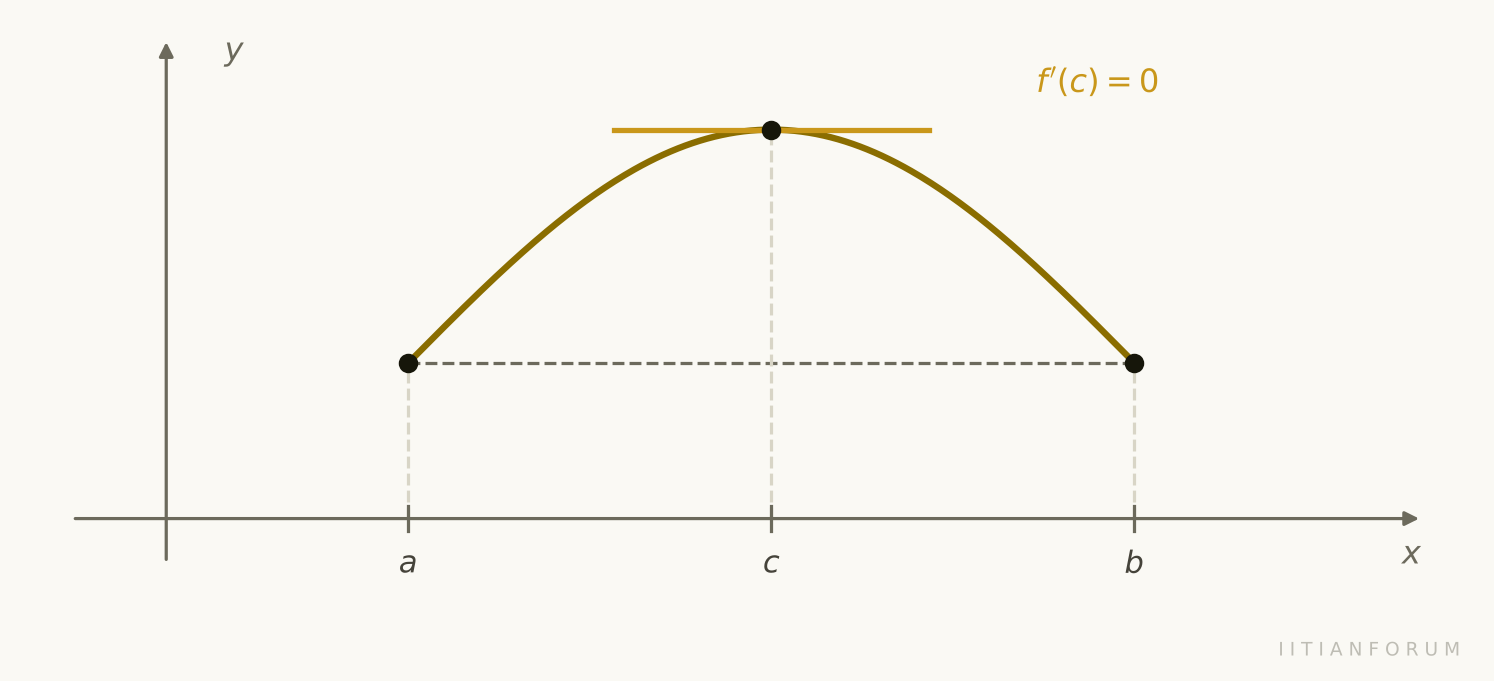
Algebraic meaning. With : between two roots of lies a root of .
All three conditions are needed, and the theorem says nothing about how many such there are or where they lie.
Three small graphs where Rolle's theorem fails: on the left a function with a jump inside the interval and equal end values but no horizontal tangent; in the middle y equals the modulus of x on minus 1 to 1 with a corner at the origin; on the right an increasing line whose end values differ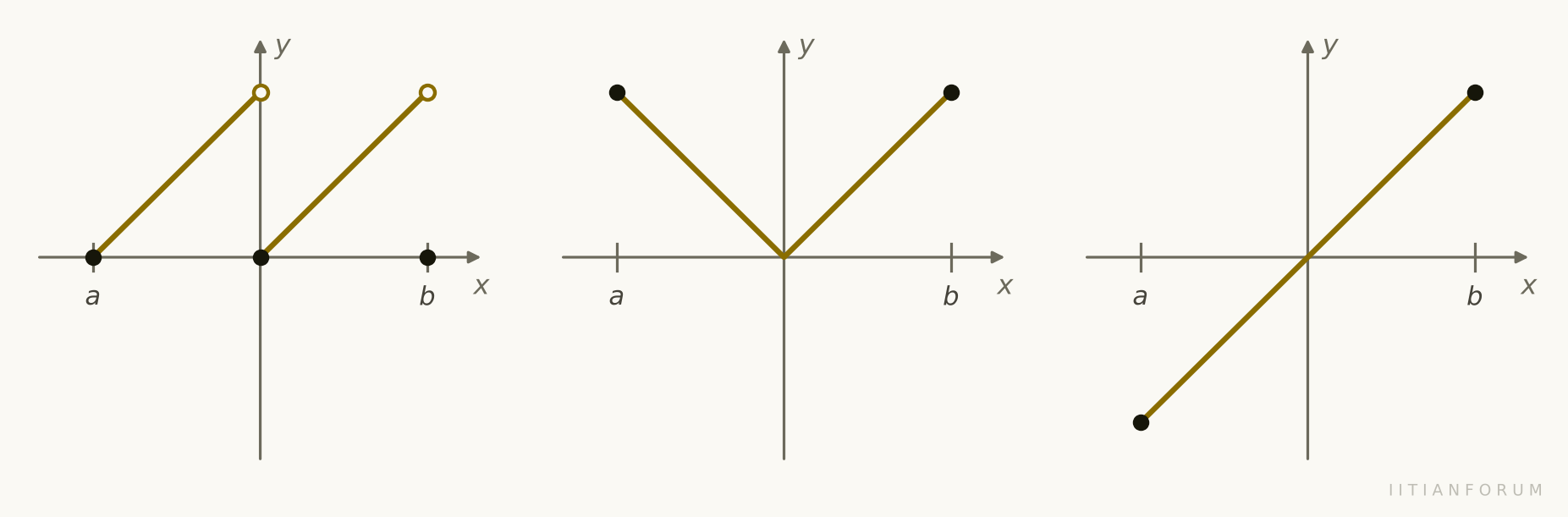
| Failing condition | Example on | No with |
|---|---|---|
| continuity | type jump | slopes are all |
| differentiability | slopes are | |
| slope is |
Example 38 (IITianForum). Verify Rolle's theorem for on and find .
▸ SHOW SOLUTION
Step 1. Conditions
is a polynomial, so continuous and differentiable. and .
Step 2. Solve f′(c) = 0
Both lie in .
Answer: and
Example 39 (IITianForum). For let
and .
Then (A) is discontinuous at , so Rolle's theorem cannot be applied; (B) , so Rolle's theorem cannot be applied; (C) Rolle's theorem applies and ; (D) Rolle's theorem applies and .
▸ SHOW SOLUTION
Step 1. Simplify
So for , and this also gives . Hence on all of .
Step 2. Conditions
A polynomial is continuous and differentiable; .
Step 3. c
, so .
Answer: option (C)
Example 40 (JEE Main 2020, 8 January Shift 1). If is a point at which Rolle's theorem holds for the function in the interval , where , then is equal to
▸ SHOW SOLUTION
Step 1. f(3) = f(4)
Step 2. f′(c) = 0
:
So .
Step 3. f″(c)
At the first part is , so .
Answer: option (A)
Example 41 (JEE Main 2014). If and are differentiable functions in satisfying , and , then for some
▸ SHOW SOLUTION
Step 1. Build equal end values
Try :
Step 2. Rolle
, so for some :
Answer: option (2)
Example 42 (JEE Main 2020, 8 January Shift 2). Let be the set of all functions which are continuous on and differentiable on . Then for every in there exists a , depending on , such that
▸ SHOW SOLUTION
Step 1. (A) and (B)
Take constant. Both sides are and the strict inequality fails.
Step 2. (C)
Take :
which is not in .
Answer: option (D)
Lagrange's theorem on gives a point with ; the point need not be .
Example 43 (JEE Advanced 2015, Paper 2). Let be continuous functions which are twice differentiable on . The values of and at , and are
In each of the intervals and the function never vanishes. Then the correct statement(s) is (are)
▸ SHOW SOLUTION
Step 1. h = f − 3g
Step 2. At least one in each interval
Rolle on and on gives a zero of in each interval.
Step 3. At most one in each
If had two zeros in one interval, Rolle applied to would give a zero of there, which is not allowed.
Answer: (B) and (C)
Example 44 (JEE Main 2022, 28 July Shift 1). Let be a twice differentiable function in such that and . If the line intersects the graph of at only two distinct points in , then the least number of points at which is ______.
▸ SHOW SOLUTION
Step 1. g = f − (2x + 3)
and . The two meeting points in are zeros of too:
Step 2. Rolle twice
Four zeros of give at least three zeros of , and these give at least two zeros of .
Step 3. Back to f
, so at least twice. Two is reached by , whose is a quadratic with two roots in .
Answer:
Counting roots with Rolle
- If has distinct real roots, has at least , one between each consecutive pair.
- So if has real roots, has at most .
- If has no real root, has at most one; a sign change of then gives exactly one.
- If never vanishes, has at most one root and at most two.
To count exactly: bound the number from above with Rolle, then find that many sign changes of .
A wavy curve crossing the x-axis at three points, with the derivative's two zeros marked as horizontal tangents lying one between each consecutive pair of roots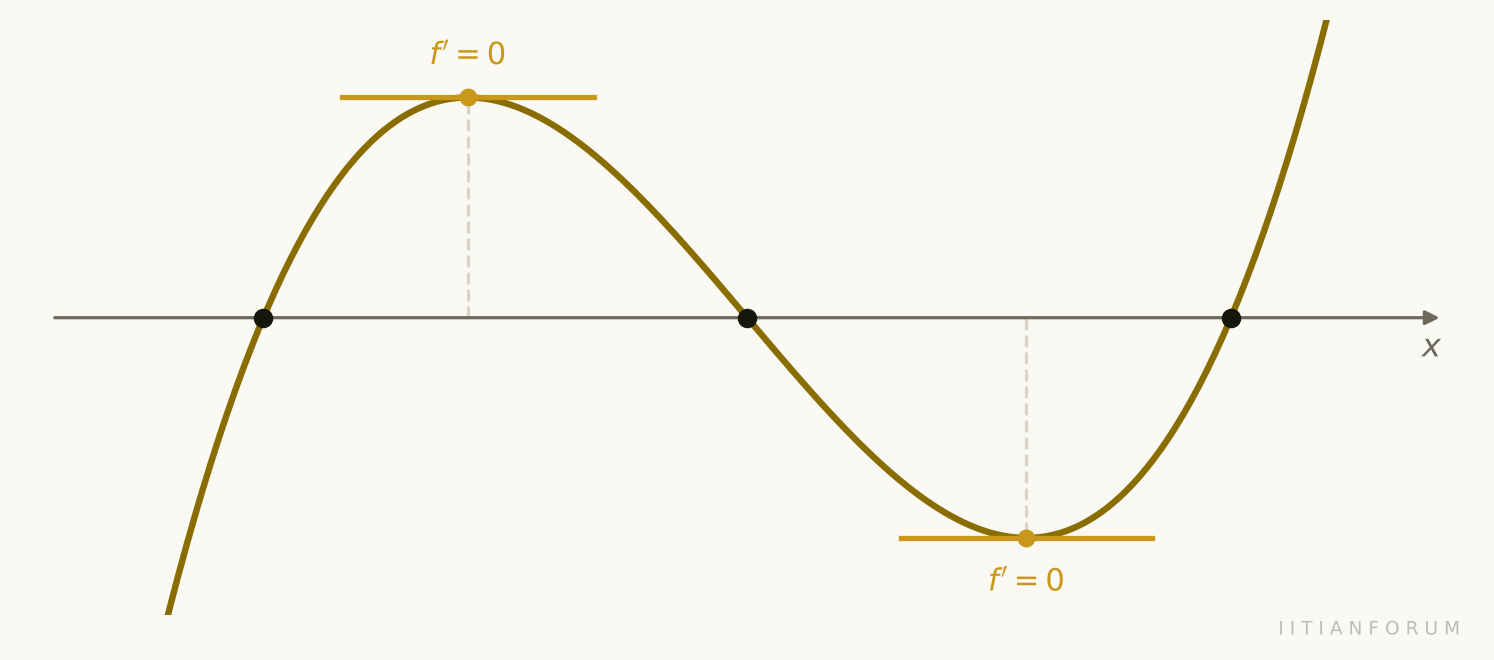
Example 45 (IIT JEE 2011, Paper 2). The number of distinct real roots of is ______.
▸ SHOW SOLUTION
Step 1. f″ never vanishes
So has at most one root and at most two.
Step 2. Two sign changes
, while as . So has a root on each side of .
Answer:
Example 46 (JEE Advanced 2013, Paper 1). The number of points in for which is
▸ SHOW SOLUTION
Step 1. Derivative
, so has the sign of : falls on and rises on .
Step 2. Values
and as .
So crosses zero exactly once on each side.
Answer: option (C)
Example 47 (JEE Advanced 2014, Paper 1). Let and let be given by . Then
▸ SHOW SOLUTION
Step 1. At most three roots
vanishes only at , so has at most three real roots.
Step 2. The values at ±1
rises on , falls on , rises on .
Step 3. Cases
: , three sign changes, three roots. : , so only the root left of . : , so only the root right of .
Answer: (B) and (D)
Helper functions
Rolle applied to a well-chosen product shows that an equation involving and has a root.
| To get a root of | Apply Rolle to |
|---|---|
The reason: and , so a zero of is a zero of . The same helper also turns an inequality such as into " is increasing".
Example 48 (IITianForum). is differentiable on and . Show that for some .
▸ SHOW SOLUTION
Step 1. Helper
is differentiable and .
Step 2. Rolle
for some :
Since , .
Answer: proved
Example 49 (JEE Advanced 2017, Paper 2). If is a differentiable function such that for all , and , then
▸ SHOW SOLUTION
Step 1. Helper
:
Step 2. Compare with h(0)
and is increasing, so for , , i.e. . This is (A).
Step 3. Monotonic
For : . So is increasing, and also , so (B) is false.
Answer: (A) and (C)
Example 50 (JEE Advanced 2013, Paper 2). Let be twice differentiable with and for .
(i) Which is true for ? (A) (B) (C) (D)
(ii) If has its minimum in at , which is true? (A) , (B) , (C) , (D) ,
▸ SHOW SOLUTION
Step 1. Helper
. Then and
So is strictly increasing on .
Step 2. Part (i)
Suppose for some . Lagrange's theorem on and gives with
Then with , against strictly increasing. So , hence , on .
Step 3. Part (ii)
The minimum is at , so ; with increasing, on . There .
Answer: (i) option (D); (ii) option (C)
Lagrange's mean value theorem
If is continuous on and differentiable on , there is a with
Geometric meaning. Some tangent is parallel to the chord joining the end points.
Why. The function satisfies ; Rolle gives , which is the statement. Rolle's theorem is the special case .
The curve y equals the square root of x between x equals 1 and x equals 4, the chord joining the end points, and the tangent at x equals 9 over 4 drawn parallel to the chord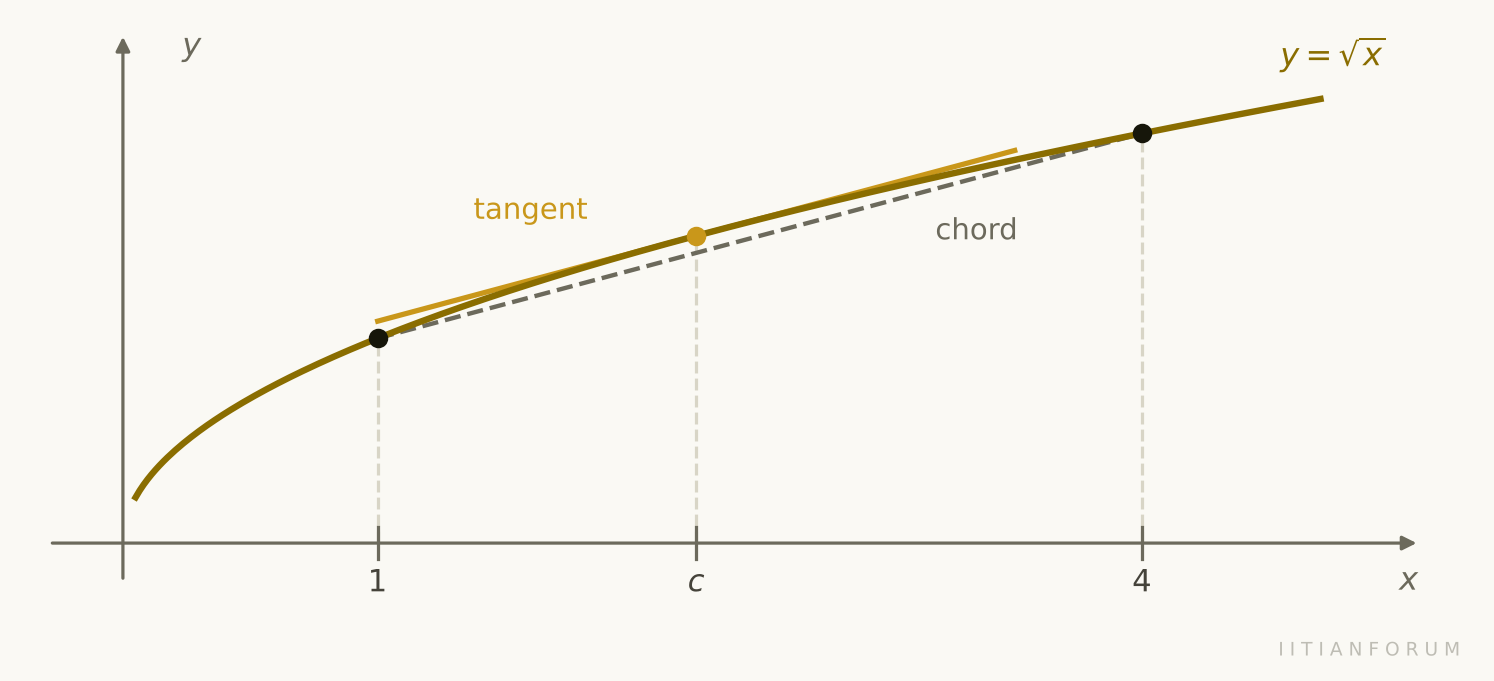
Working form.
| If on the interval | Then |
|---|---|
| is constant | |
| is constant | |
| increasing | the slope of a chord lies between at its ends |
A question that asks to bound , to compare a chord slope with derivatives, or to prove an inequality between , or values at two points is a Lagrange question.
Example 51 (IITianForum). Find of Lagrange's theorem for on .
▸ SHOW SOLUTION
Step 1. Chord slope
Step 2. Solve
Answer:
Example 52 (JEE Main 2020, 6 September Shift 2). If the tangent to the curve , , at a point is parallel to the line segment joining the points and , then is equal to
▸ SHOW SOLUTION
Step 1. Chord slope
and :
Step 2. Solve f′(c)
Answer: option (D)
Example 53 (JEE Main 2019, 9 April Shift 1). Let be the set of all values of for which the tangent to the curve at is parallel to the line segment joining the points and . Then is equal to
▸ SHOW SOLUTION
Step 1. Chord slope
and , so the slope is .
Step 2. Solve
The question asks for every on the curve, not only those inside .
Answer: , option (4)
Example 54 (IITianForum). is differentiable on with and for . Which is true? (A) (B) (C) (D) none of these
▸ SHOW SOLUTION
Step 1. Lagrange on [1, 4]
Step 2. Conclude
. The value is reached by , so (C) need not hold.
Answer: option (B)
Example 55 (IITianForum). is differentiable on with , and for all . A possible value of is
▸ SHOW SOLUTION
Step 1. On [0, 2]
Step 2. On [2, 4]
Step 3. Options
Only lies in . It is reached by , which has .
Answer: option (B)
Example 56 (IITianForum). Prove that for ,
and deduce bounds for .
▸ SHOW SOLUTION
Step 1. Lagrange for ln x on [a, b]
Step 2. Bound 1/c
, which gives the result.
Step 3. a = 5, b = 6
Answer: (actual value )
Example 57 (IIT JEE 2009, Paper 2). For the function , ,
▸ SHOW SOLUTION
Step 1. f′ and f″
For , , so and : (D) is true.
Step 2. Limit
As , , so : (B) is true.
Step 3. Lagrange on [x, x + 2]
decreases to the limit , so on :
So (C) is true and (A) is false.
Answer: (B), (C) and (D)
Example 58 (JEE Advanced 2017, Paper 2). If is a twice differentiable function such that for all , and , , then
▸ SHOW SOLUTION
Step 1. Lagrange on [½, 1]
Step 2. f′ is increasing
, so .
Answer: option (B)
Example 59 (JEE Advanced 2018, Paper 1). For every twice differentiable function with , which of the following statement(s) is (are) TRUE?
▸ SHOW SOLUTION
Step 1. (A)
, so . As is continuous, it keeps one sign on some around , where is strictly monotonic, so one-one.
Step 2. (B)
Lagrange on :
Step 3. (C)
satisfies every condition: its values lie in , and . It has no limit at infinity, so (C) is false.
Step 4. (D)
Let , so . By Step 2 there is with ; in the same way there is with . So has its greatest value on at an inside point , where
There , so and . Hence .
Answer: (A), (B) and (D)
Cauchy's mean value theorem
If and are continuous on , differentiable on , and on , then there is a with
Why. Apply Rolle to , which has . Taking gives Lagrange's theorem.
The same serves both derivatives. Applying Lagrange to and to separately gives two different points and does not prove Cauchy's theorem.
Example 60 (IITianForum). Find of Cauchy's theorem for , on .
▸ SHOW SOLUTION
Step 1. Left side
Step 2. Right side
.
Answer:
Which method to use
A decision chart: from the question asked, arrows lead to eight situations, each paired with its method: a rate, differentiate the link in t and substitute after; tangent at a point, slope from the derivative; tangent from an outside point, contact point t and pass through the point; given slope or parallel line, solve f prime equals m; nearest point or common normal, normal through the point; angle or orthogonal curves, the tan theta formula; equal values or roots of f prime, Rolle or a helper function; bound on a difference, Lagrange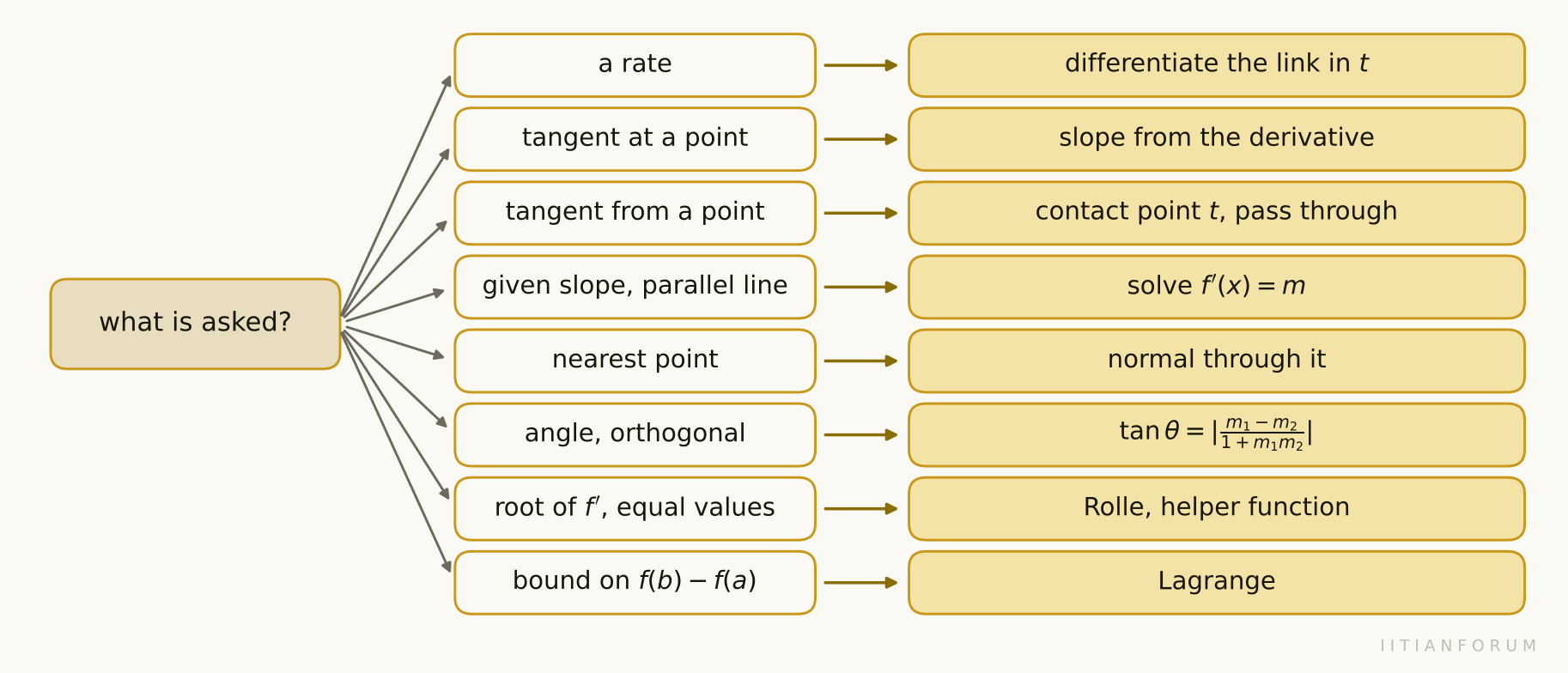
| Given | Method |
|---|---|
| two quantities changing with time | differentiate the link, then substitute |
| small change | |
| tangent at a point | slope , implicit or parametric if needed |
| point not on the curve | contact point , line through the point |
| tangent with slope | solve |
| normal parallel to a line | tangent slope is |
| horizontal or vertical tangent | or with the curve |
| nearest point to a point | normal passes through it |
| nearest point to a line | tangent parallel to it |
| common tangent | equal slopes, equal intercepts |
| angle between curves | |
| , a root of | Rolle |
| a root of or | helper or |
| number of real roots | Rolle for an upper bound, sign changes for a lower |
| bound on | Lagrange |
| ratio of two differences | Cauchy |
What JEE asks
Across the JEE Main papers from 2019 to 2025 and the JEE Advanced and IIT JEE papers, the chapter appears in these forms.
- Tangent or normal with a condition: through a point, parallel to a line, at a given angle, or meeting the curve again (Examples 9 to 28). This is the most common form in JEE Main.
- Related rates with spheres and cones (Examples 1 to 7).
- Nearest point and angle between curves (Examples 29 to 35).
- Rolle and helper functions, usually with equal values built from given data (Examples 38 to 50). This is the common form in JEE Advanced.
- Lagrange's theorem to find , to bound a difference, or inside a multi-statement question (Examples 51 to 59).
JEE Advanced 2026 asked for points of contact with given slopes on three curves (Example 23). Earlier JEE Advanced and IIT JEE papers used implicit slopes (Example 11), Rolle on (Example 43), root counting (Examples 45 to 47), helper functions (Examples 49 and 50) and Lagrange inside statement questions (Examples 57 to 59).
Quick recall
| Result | Statement |
|---|---|
| Rate | |
| Approximation | |
| Error in | |
| Tangent | |
| Normal | |
| Parametric slope | |
| Vertical tangent | , continuous |
| Tangent at origin | lowest-degree terms |
| Angle between curves | |
| Orthogonal | |
| Sub-tangent, sub-normal | , |
| Tangent, normal lengths | , |
| Rolle | |
| Roots | roots of give of |
| Helper for | |
| Lagrange | |
| Cauchy |
Without a pen, answer these four: the tangent to from ; the angle between and at ; of Lagrange's theorem for on ; and the helper function for . If , , and come quickly, the chapter is yours.
Practise these methods on real exam questions in the doMath Tangents and Normals, Rolle's and Lagrange's Mean Value Theorem and Rate of Change chapters. The sign of and the tests for extreme values are developed in the Monotonic Functions and Maxima and Minima notes, and corners and vertical tangents in the Continuity and Differentiability note.