Parabola for JEE: Notes, Focal Chords, Tangents, Normals and PYQs
A parabola is the curve of a thrown ball, the shape of a dish antenna and the graph of every quadratic. In coordinate geometry it is the simplest conic: one focus, one directrix, eccentricity exactly . Almost every JEE question on it reduces to one idea, the parametric point , which turns chords, tangents and normals into short relations between parameters.
This note covers the focus and directrix definition, the four standard forms, shifted and slanted parabolas, the position of a point, a line meeting the parabola, chords and focal chords, chords through the vertex, chords with a given middle point, tangents in all three forms, pairs of tangents and the chord of contact, common tangents, normals and co-normal points, shortest distance, the reflection property, circles on the parabola and locus problems. The worked examples include JEE Main 2025 and 2026 questions, earlier JEE Main questions, and JEE Advanced and IIT JEE questions; every answer was re-derived from scratch.
Conic sections and the parabola
Let be a fixed point and a fixed line not through . The locus of a point that moves so that
where is the perpendicular distance of from , is a conic section. is the focus, the directrix and the constant the eccentricity.
| Eccentricity | Conic |
|---|---|
| parabola | |
| ellipse | |
| hyperbola |
So a parabola is the locus of a point whose distance from the focus equals its distance from the directrix:
A parabola opening to the right with its focus S on the axis, the directrix as a vertical line on the left, a point P on the curve joined to S and to the foot M of its perpendicular on the directrix, the two equal segments PS and PM marked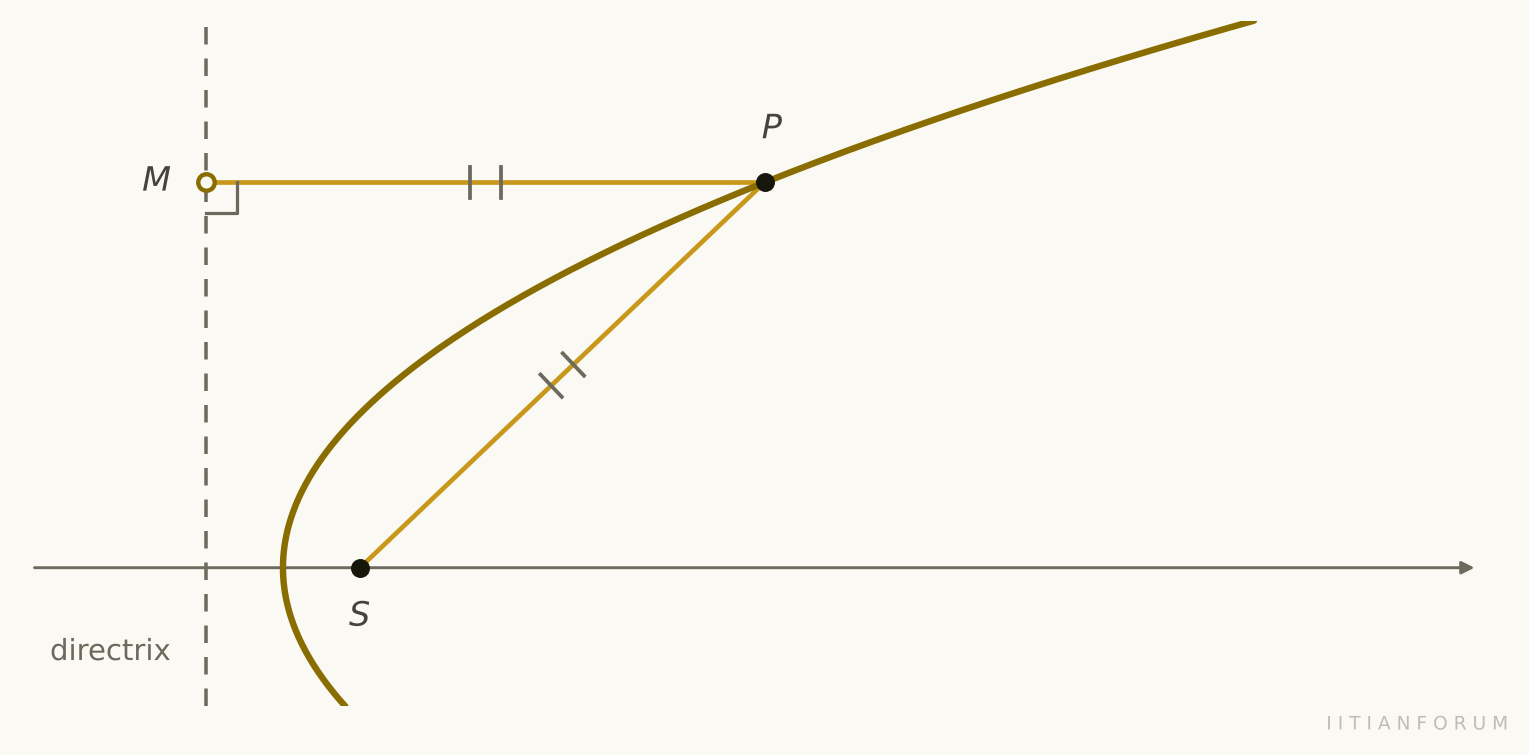
Terms used throughout.
- Axis: the line through the focus perpendicular to the directrix. The parabola is symmetric about it.
- Vertex: the point where the parabola meets its axis. It is the midpoint of the focus and the foot of the axis on the directrix.
- Focal distance of a point: its distance from the focus.
- Focal chord: a chord through the focus.
- Double ordinate: a chord perpendicular to the axis.
- Latus rectum: the focal chord perpendicular to the axis.
Recognising a parabola. The general second degree equation
is a parabola when and the equation does not split into a pair of lines, that is
The condition says the second degree terms form a perfect square, .
Example 1 (IITianForum). Find the equation of the parabola with focus and directrix . Find its vertex, axis and the length of its latus rectum.
▸ SHOW SOLUTION
Step 1. Use PS = PM
For , the distance from is :
Step 2. Read off the parts
The axis is the line through perpendicular to , that is the -axis . The vertex is the midpoint of and the foot , that is . With , , so the latus rectum is .
Answer: , vertex , axis , latus rectum
The standard parabola
Take the vertex at the origin and the axis along the -axis, with focus , , and directrix . For :
This is the standard parabola. Since , every point has ; the curve is symmetric about the -axis and opens towards the focus.
The four standard forms
The squared variable names the axis and the sign of the other term gives the direction in which the parabola opens.
Four small parabolas side by side, each with its focus marked and its directrix dashed: the first opens right, the second opens left, the third opens up and the fourth opens down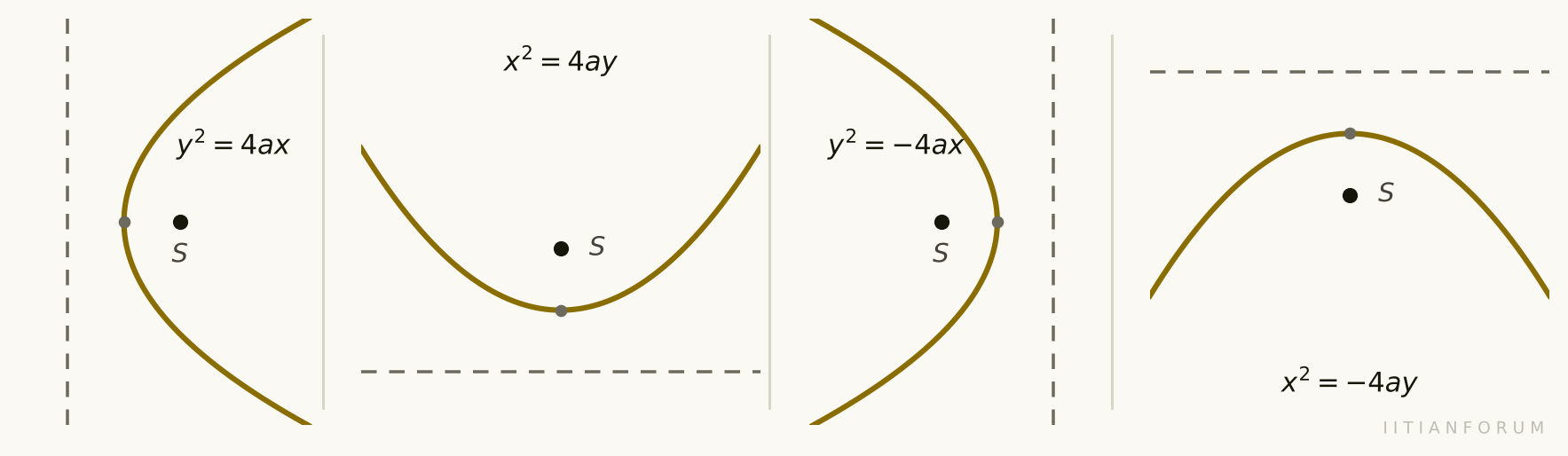
| Vertex | ||||
| Focus | ||||
| Directrix | ||||
| Axis | ||||
| Latus rectum | ||||
| Point |
In every form the length of the latus rectum is , the eccentricity is , and the focus and the directrix lie at the same distance from the vertex, on opposite sides.
Latus rectum and focal distance
Putting in gives . So the ends of the latus rectum are
and its length is . The half length is the semi-latus rectum.
The parabola y squared equals 4ax with the vertex A at the origin, the focus S, the axis, the dashed directrix, and the latus rectum LL' drawn as a vertical segment through S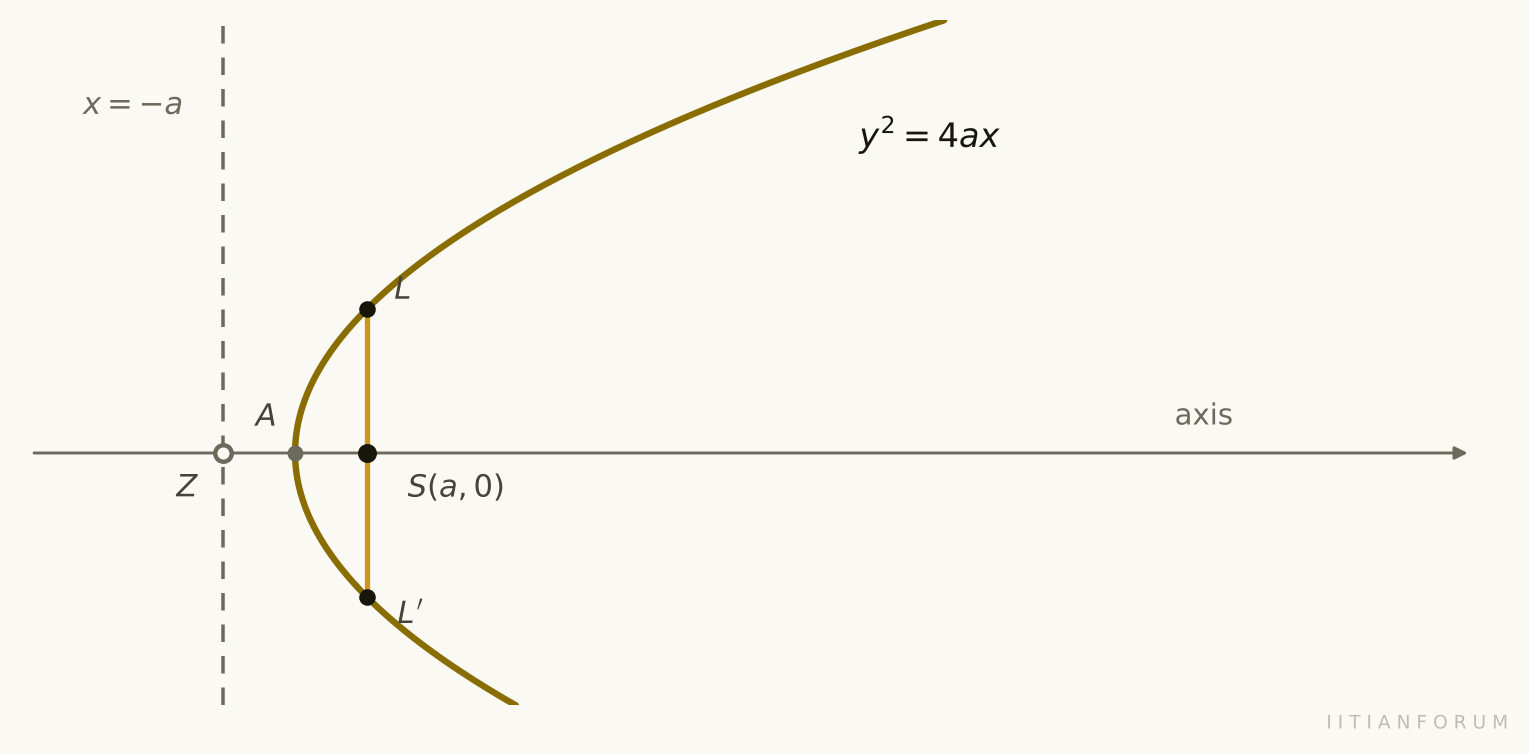
For a point on , the focal distance equals the distance from the directrix :
So focal distances on need no square root at all.
Parametric form
For every real the point
satisfies , and every point of the parabola arises from exactly one , namely . We call it the point . In this form
One parameter replaces two coordinates tied by an equation. A chord becomes a pair , its slope is , and almost every condition in this chapter becomes a short relation in and .
Example 2 (IITianForum). For the parabola , find the focus, the directrix, the ends of the latus rectum, and the points of the parabola whose focal distance is .
▸ SHOW SOLUTION
Step 1. Compare with y² = 4ax
, so . Focus , directrix , ends of the latus rectum .
Step 2. Focal distance 12
gives , and then
Answer: focus , directrix , , points
Example 3 (JEE Main 2026, 6 April Shift 1). Let chord of length of the parabola be such that the ordinates of points and are in the ratio . If the chord subtends an angle at the focus of the parabola, then is equal to
▸ SHOW SOLUTION
Step 1. Points in parameters
, so . The ordinate of is twice that of , so has parameter : .
Step 2. Use the length
So ; take : , . ( gives the mirror image and the same angle.)
Step 3. Angle at the focus
. is vertical, of length . joins to : it rises while moving across. The angle between and the vertical satisfies
so .
Answer: option (1)
General forms of the parabola
Axis parallel to a coordinate axis
Shift the vertex to , keeping the axis parallel to the -axis:
| Part | Value |
|---|---|
| Vertex | |
| Focus | |
| Directrix | |
| Axis | |
| Latus rectum |
With the axis vertical, . Expanding gives the familiar graph
Completing the square,
with . So the vertex is , the axis is , and comparing with the latus rectum is .
Every result of this chapter is stated for . For put , , use the standard result in and , and convert back at the end. Quoting "focus " for a shifted parabola is the most common slip.
Example 4 (JEE Main 2026, 2 April Shift 2). Let the parabola pass through the point such that the distance between its vertex and the -axis is minimum. Then the value of is
▸ SHOW SOLUTION
Step 1. Use the point
, so .
Step 2. Ordinate of the vertex
The vertex ordinate is :
Step 3. Least distance
The distance from the -axis is , least when . Then and .
Answer: option (B)
Example 5 (JEE Main 2026, 5 April Shift 1). Let be a moving point on the circle . Then the maximum distance of from the vertex of the parabola is
▸ SHOW SOLUTION
Step 1. Vertex of the parabola
So the vertex is ; the parabola opens downwards.
Step 2. The circle
Centre , radius .
Step 3. Farthest point
The farthest point of a circle from lies on line beyond :
Answer: option (3)
Parabola from a focus and a directrix
When the directrix is slanted, write the definition directly. For focus and directrix :
The axis is the line through the focus perpendicular to the directrix, and the vertex is the midpoint of the focus and the foot of the axis on the directrix.
A parabola whose axis is the line y equals x: the focus S at (2,2), the vertex V at (1,1), the slanted directrix x plus y equals 0 drawn dashed, and the axis drawn through S, V and the foot Z at the origin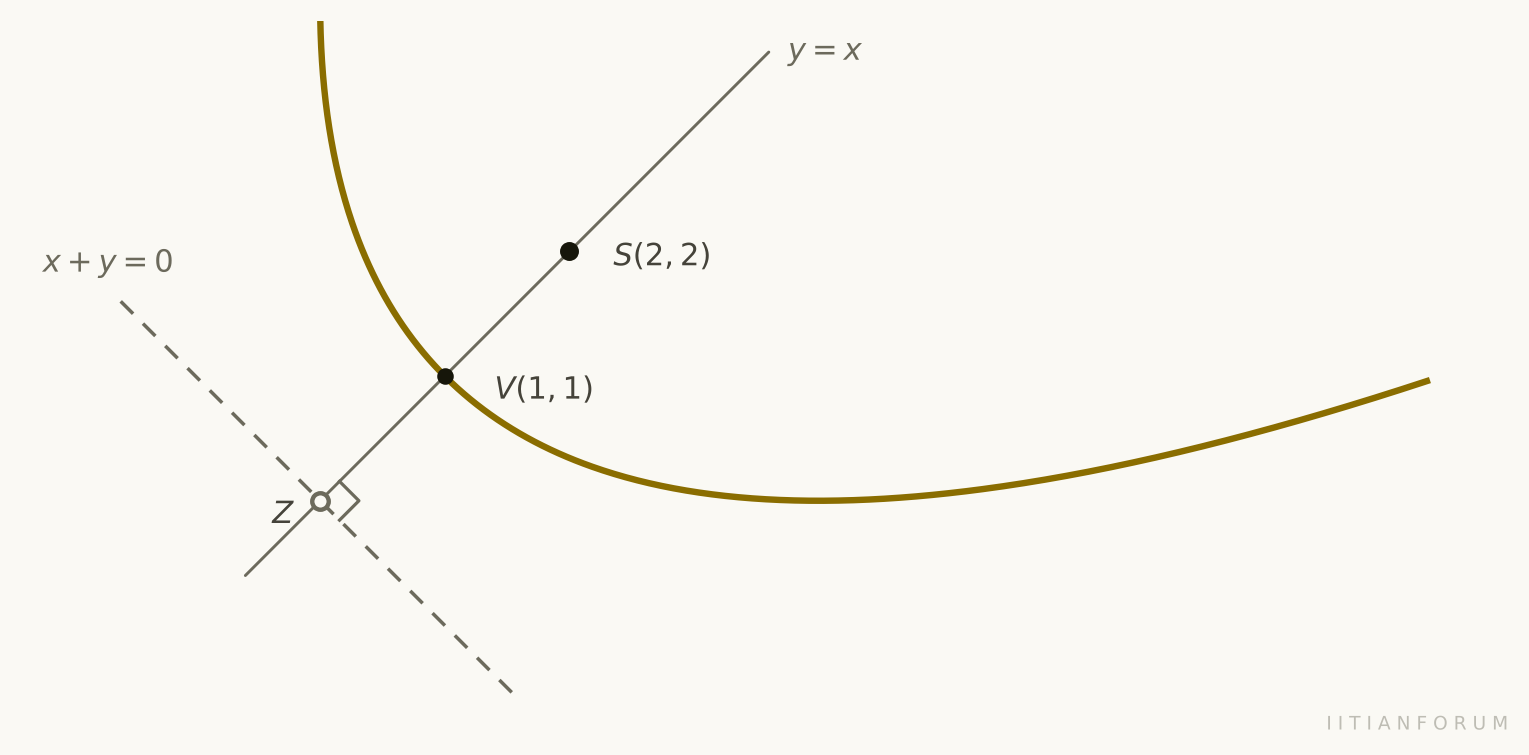
The two-line form. If and are perpendicular lines, then
(distance of from )(distance of from )
is a parabola with axis , tangent at the vertex and latus rectum . For and this reads
Example 6 (JEE Main 2025, 7 April Shift 1). Let be the parabola whose focus is and directrix is . Then the sum of the ordinates of the points on whose abscissa is , is
▸ SHOW SOLUTION
Step 1. The definition at x = −2
The distance from the focus is ; the distance from the directrix is :
Step 2. Sum of the roots
The discriminant , so both ordinates are real; their sum is .
Answer: option (1)
Example 7 (JEE Main 2025, 24 January Shift 2). If the equation of the parabola with vertex and directrix is , then is equal to
▸ SHOW SOLUTION
Step 1. Foot of the axis on the directrix
The axis through has direction . The point lies on when , . So .
Step 2. Focus
is the midpoint of and , so .
Step 3. Equation
So , , , and .
Answer: option (4)
Example 8 (JEE Main 2025, 4 April Shift 2). The axis of a parabola is the line and its vertex and focus are in the first quadrant at distances and units from the origin, respectively. If the point lies on the parabola, then a possible value of is
▸ SHOW SOLUTION
Step 1. Vertex, focus, directrix
On in the first quadrant: and . The foot is the reflection of in , , and the directrix is the line through perpendicular to the axis: .
Step 2. Equation
Step 3. Put x = 1
So or .
Answer: option (2)
Example 9 (IITianForum). Find the vertex, focus, directrix and latus rectum of the parabola
▸ SHOW SOLUTION
Step 1. Two-line form
The second degree part is , so write
The lines and are perpendicular.
Step 2. Distances
Divide both sides by :
This is (distance from )(distance from ). So the axis is , the tangent at the vertex is and the latus rectum is , that is .
Step 3. Vertex, focus, directrix
The vertex is where meets : . The parabola lies where , so the focus is a distance from along the axis on that side: . The directrix is parallel to at the same distance on the other side: .
As a check, expands to the given equation.
Answer: vertex , focus , directrix , latus rectum
Image of a parabola in a line
The image of a curve in a line is obtained point by point. For a line of slope the reflection is simple:
| Mirror | Image of |
|---|---|
So a point lies on the image exactly when its own reflection lies on the original curve.
Example 10 (JEE Main 2026, 24 January Shift 2). Let the image of the parabola in the line be , with . Then is equal to
▸ SHOW SOLUTION
Step 1. Reflection in y = x − 1
The mirror is , so the image of is .
Step 2. Condition on the image
is on the image when is on :
So , , and .
Answer: option (3)
Example 11 (JEE Advanced 2015, Paper 1). Let the curve be the mirror image of the parabola with respect to the line . If and are the points of intersection of with the line , then the distance between and is ______.
▸ SHOW SOLUTION
Step 1. Reflection in x + y = −4
The image of is .
Step 2. Equation of C
is on when is on :
Step 3. Meet y = −5
So .
Answer:
Position of a point and a line meeting the parabola
Write and, for a point , .
| Position | Tangents from the point | |
|---|---|---|
| outside | two | |
| on the curve | one | |
| inside (the focus side) | none |
A line and the parabola. Put () in :
Its discriminant, divided by , is
| The line | |
|---|---|
| cuts the parabola in two points | |
| touches it | |
| misses it |
So the condition of tangency is
A line parallel to the axis () meets the parabola in exactly one point but is never a tangent.
Length of the chord cut by :
Example 12 (IITianForum). For the parabola and the line : (a) find the values of for which the line cuts, touches or misses the parabola; (b) find the length of the chord when ; (c) state whether and lie inside or outside the parabola.
▸ SHOW SOLUTION
Step 1. Part (a)
, : . The line cuts the parabola for , touches it for and misses it for .
Step 2. Part (b)
With , :
Step 3. Part (c)
: , outside. : , inside.
Answer: (a) cuts for , touches at , misses for ; (b) ; (c) outside, inside
Example 13 (JEE Main 2019, 10 January Shift 2). The length of the chord of the parabola having equation is
▸ SHOW SOLUTION
Step 1. Meet the line
, so
So or .
Step 2. Length
The difference of abscissae is and the slope is :
Answer: option (1)
Chords of the parabola
Chord joining two points
The chord joining the points and of has slope
and equation
In coordinates, the chord joining and is .
The slope depends only on , and the chord meets the axis at , which depends only on . A condition on direction becomes a condition on the sum; a condition about a fixed point on the axis becomes a condition on the product.
Focal chords
The chord through , meets the axis at . It passes through the focus exactly when
So if one end of a focal chord is , the other end is .
The parabola y squared equals 4ax with a focal chord PQ through the focus S, P above the axis and Q below, and the angle theta that PQ makes with the axis marked at S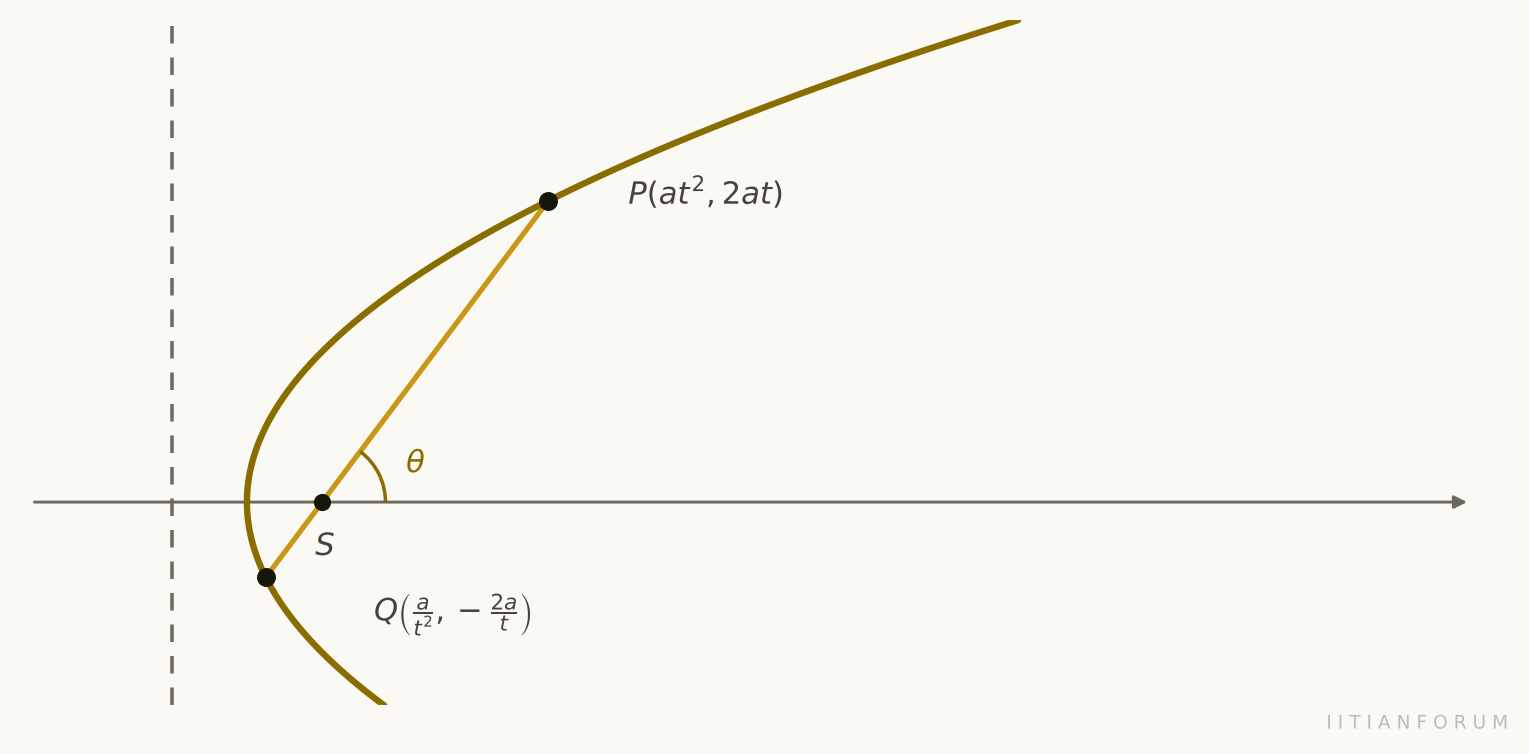
| Result | Value |
|---|---|
| Ends | and |
| Length | |
| Length, inclination | |
| Shortest focal chord | latus rectum, |
| Focal segments | , |
| Harmonic property |
Why the harmonic property holds. , so
So the semi-latus rectum is the harmonic mean of and . Also .
Why . The slope of the focal chord is , so and
which is . Since , no focal chord is shorter than the latus rectum.
Example 14 (IITianForum). One end of a focal chord of is . Find the other end , the length , and check the harmonic property.
▸ SHOW SOLUTION
Step 1. Parameters
and with . So has parameter : .
Step 2. Length
Step 3. Focal segments
and , so
Answer: , ,
Example 15 (JEE Main 2025, 2 April Shift 2). Let the point of the focal chord of the parabola be . If the focus of the parabola divides the chord in the ratio , , then is equal to
▸ SHOW SOLUTION
Step 1. Other end
; with . So has parameter : .
Step 2. Focal distances
and . So divides in the ratio , and .
Answer: option (1)
Example 16 (JEE Main 2026, 21 January Shift 2). Let one end of a focal chord of the parabola be . If divides this focal chord internally in the ratio , then the minimum value of is
▸ SHOW SOLUTION
Step 1. Other end
; has , so the other end has parameter : .
Step 2. The two orders
The ratio can be taken from either end. Measured from :
with . Measured from :
with . The minimum is .
Answer: option (2)
Example 17 (JEE Main 2026, 5 April Shift 2). Let the directrix of the parabola cut the -axis at the point . Let , , be a point on such that the slope of is . If is a focal chord of , then six times the area of is
▸ SHOW SOLUTION
Step 1. Point B
, , :
So or . forces : .
Step 2. Point C
Focal chord: has parameter , .
Step 3. Area
lies on the axis, so split by the axis. meets the axis at the focus , and :
Six times the area is .
Answer: option (2)
Example 18 (JEE Main 2025, 22 January Shift 2). Let be a point on the parabola and be a focal chord of the parabola. If and are the feet of perpendiculars drawn from and respectively on the directrix of the parabola, then the area of the quadrilateral is equal to
▸ SHOW SOLUTION
Step 1. The parabola and Q
, so . has , so has :
Step 2. A trapezium
and are both perpendicular to the directrix , so is a trapezium with
and height .
Step 3. Area
Answer: option (3)
Example 19 (JEE Advanced 2013, Paper 2). Let be a focal chord of the parabola . The tangents to the parabola at and meet at a point lying on the line , . The length of the chord is
▸ SHOW SOLUTION
Step 1. Where the tangents meet
The tangents at , meet at . For a focal chord , so the point is , on the directrix.
Step 2. Use the line
On at : . So .
Step 3. Length
The meeting point of the tangents is proved in the section on tangents.
Answer: option (B)
Example 20 (JEE Advanced 2013, Paper 2). Let be a focal chord of the parabola . The tangents to the parabola at and meet at a point lying on the line , . If the chord subtends an angle at the vertex of , then
▸ SHOW SOLUTION
Step 1. From Example 19
and , so .
Step 2. Slopes from the vertex
and have slopes and :
So .
Step 3. Acute or obtuse
, so the angle is obtuse and .
Answer: option (D)
Example 21 (JEE Advanced 2014, Paper 2). Let be nonzero real numbers. Let , , and be distinct points on the parabola . Suppose that is the focal chord and lines and are parallel, where is the point . The value of is
▸ SHOW SOLUTION
Step 1. Point Q
Focal chord: has parameter .
Step 2. Equal slopes
The slope of is ; the slope of is . So
Answer: option (D)
Chords that subtend a right angle at the vertex
For and , the slopes of and are and . So
Then the chord meets the axis at : every chord that subtends a right angle at the vertex passes through the fixed point .
The parabola y squared equals 4ax with two chords OP and OQ from the vertex at right angles, and the chord PQ passing through the fixed point (4a, 0) on the axis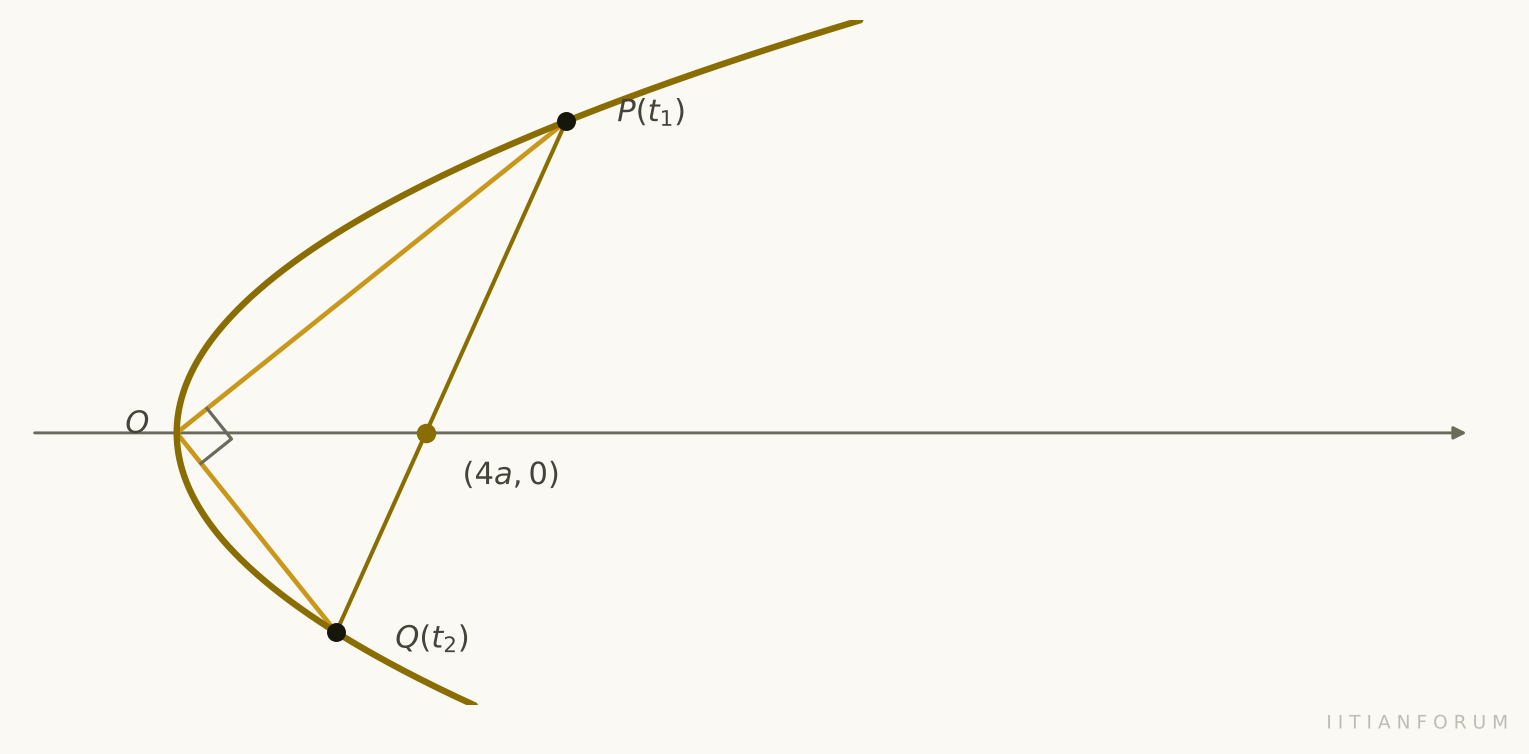
Example 22 (JEE Main 2026, 22 January Shift 1). If the chord joining and on the parabola subtends a right angle at the vertex, then is
▸ SHOW SOLUTION
Step 1. Parameters
: , with .
Step 2. Compute
Answer: option (1)
Example 23 (JEE Main 2026, 8 April Shift 2). Let be the vertex of the parabola and its chords and be perpendicular to each other. If the locus of the mid-point of the line segment is a conic , then the length of its latus rectum is
▸ SHOW SOLUTION
Step 1. Midpoint
, with . Midpoint :
Step 2. Eliminate
So is , with latus rectum .
Answer: option (2)
Example 24 (JEE Main 2025, 23 January Shift 1). If the line intersects the parabola at the points and , then at the vertex of the parabola, the line segment subtends an angle equal to
▸ SHOW SOLUTION
Step 1. Points
gives , so and .
Step 2. Angle at O
The slopes of and are and :
, so the angle is acute and equals .
Answer: option (4)
Example 25 (JEE Advanced 2015, Paper 1). Let and be distinct points on the parabola such that a circle with as diameter passes through the vertex of the parabola. If lies in the first quadrant and the area of the triangle is , then which of the following is (are) the coordinates of ?
▸ SHOW SOLUTION
Step 1. Right angle at O
The circle on passes through , so . Write , :
Step 2. Area
So .
Step 3. Solve
With and :
So or , giving or . Both lie in the first quadrant and both give area .
Answer: (A) and (D)
Example 26 (IIT JEE 2010, Paper 1). Let and be two distinct points on the parabola . If the axis of the parabola touches a circle of radius having as its diameter, then the slope of the line joining and can be
▸ SHOW SOLUTION
Step 1. Centre and radius
, . The centre is the midpoint, with ordinate . The circle touches the -axis, so
Step 2. Slope
Answer: (C) and (D)
Chord with a given middle point and diameters
Let be the middle point of a chord through , . Then , so the slope is
and the chord is
In the , notation, with :
Diameter. The middle points of all chords of slope have . So they lie on the line , parallel to the axis. This line is a diameter of the parabola. The tangent at its end on the curve has slope , parallel to the chords it bisects.
The parabola y squared equals 4ax with three parallel chords, their middle points marked, all lying on one horizontal line, the diameter, which meets the parabola where the tangent is parallel to the chords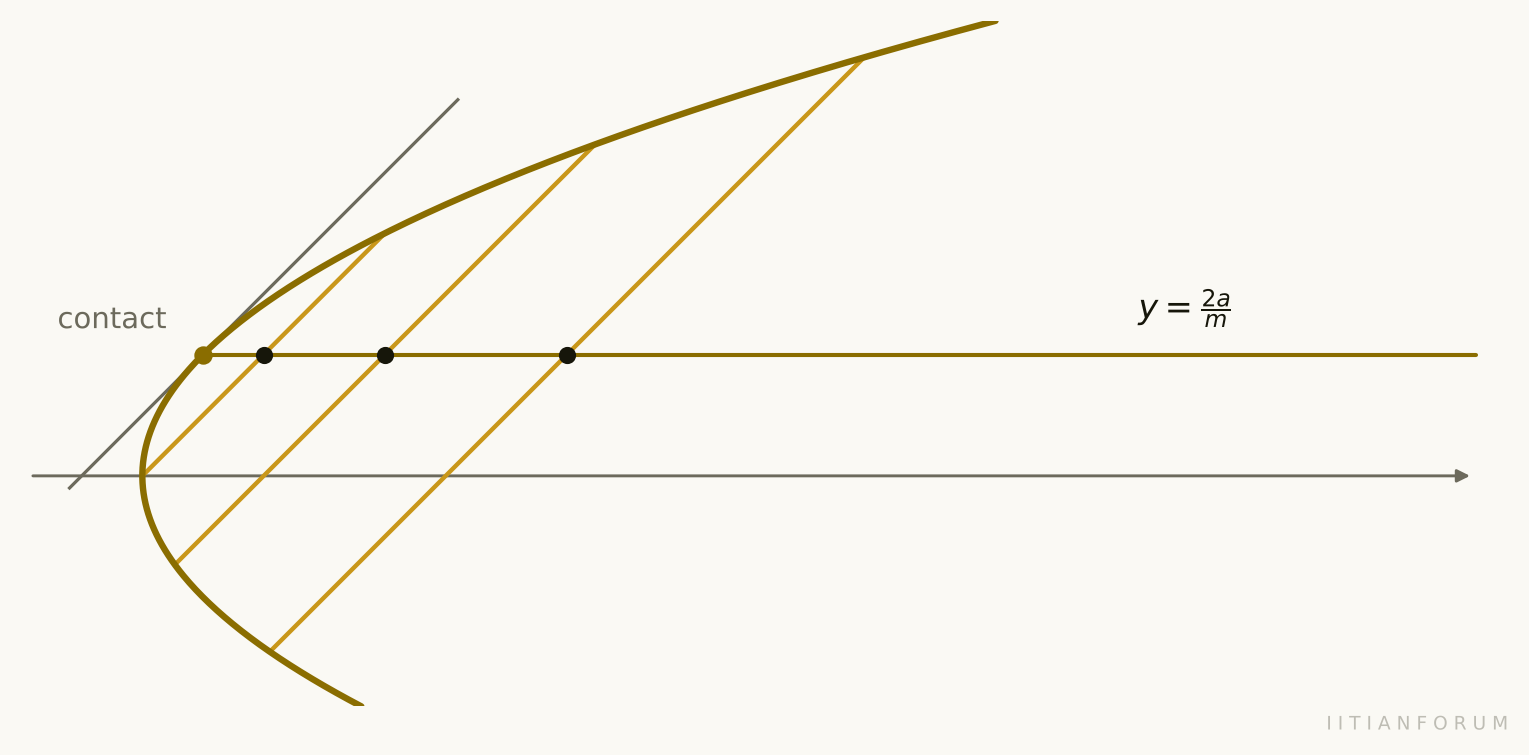
Example 27 (JEE Main 2026, 21 January Shift 1). Let be the vertex of the parabola and be any point on it. Let divide the line segment internally in the ratio , and the locus of be the conic . Then the equation of the chord of which is bisected at the point is
▸ SHOW SOLUTION
Step 1. Locus
, so . With :
Step 2. T = S₁ at (1, 2)
For : and .
Answer: option (4)
Example 28 (JEE Advanced 2017, Paper 1). If a chord, which is not a tangent, of the parabola has the equation , and midpoint , then which of the following is (are) possible value(s) of , and ?
▸ SHOW SOLUTION
Step 1. Ordinate of the midpoint
; the slope equals , so . This leaves (B) and (C).
Step 2. Midpoint on the chord
: (B) holds; (C) fails.
Step 3. A genuine chord
The midpoint must lie inside: , that is for (B).
Answer: option (B)
Triangles inscribed in the parabola
With three points , , on , the area of the triangle they form is
This comes from the determinant formula after removing the common factors. The triangle formed by the tangents at the same three points has half this area.
Example 29 (JEE Main 2026, 28 January Shift 2). Let be the focus of the parabola . Let the line intersect the parabola at two distinct points and . If the centroid of triangle is , then is equal to
▸ SHOW SOLUTION
Step 1. Sum and product of parameters
, , . From the centroid:
So , and .
Step 2. Length
, so .
Answer: option (2)
Example 30 (JEE Main 2026, 23 January Shift 2). An equilateral triangle is inscribed in the parabola with the vertex at the vertex of the parabola. Then the minimum distance of the circle having as a diameter from the origin is
▸ SHOW SOLUTION
Step 1. Symmetry
The triangle is symmetric about the axis, so and , and makes with the axis:
So , .
Step 2. The circle
Centre , radius . The origin is outside, so the least distance is
Answer: option (1)
Tangents
The three forms of the tangent
The tangency condition gives the slope form:
touching at . Every non-vertical tangent has this form, so a slope gives exactly one tangent.
Differentiating gives . At on the curve this gives the point form:
which is . At the point the slope is , giving the parametric form:
| Form | Tangent | Point of contact |
|---|---|---|
| Point | ||
| Slope | ||
| Parametric | ||
| General line | tangent when |
The tangent at the vertex is the -axis, ; it is the only vertical tangent.
Example 31 (IITianForum). For the parabola find (a) the tangent parallel to and its point of contact; (b) the tangent at ; (c) the tangents through .
▸ SHOW SOLUTION
Step 1. Part (a)
, : , touching at .
Step 2. Part (b)
: , that is .
Step 3. Part (c)
through :
Two real slopes, as expected: , so the point is outside.
Answer: (a) at ; (b) ; (c) with
Where two tangents meet
Solve and :
So the tangents at and meet at
Its abscissa is the geometric mean of the abscissae of the two points, and its ordinate is the arithmetic mean of their ordinates.
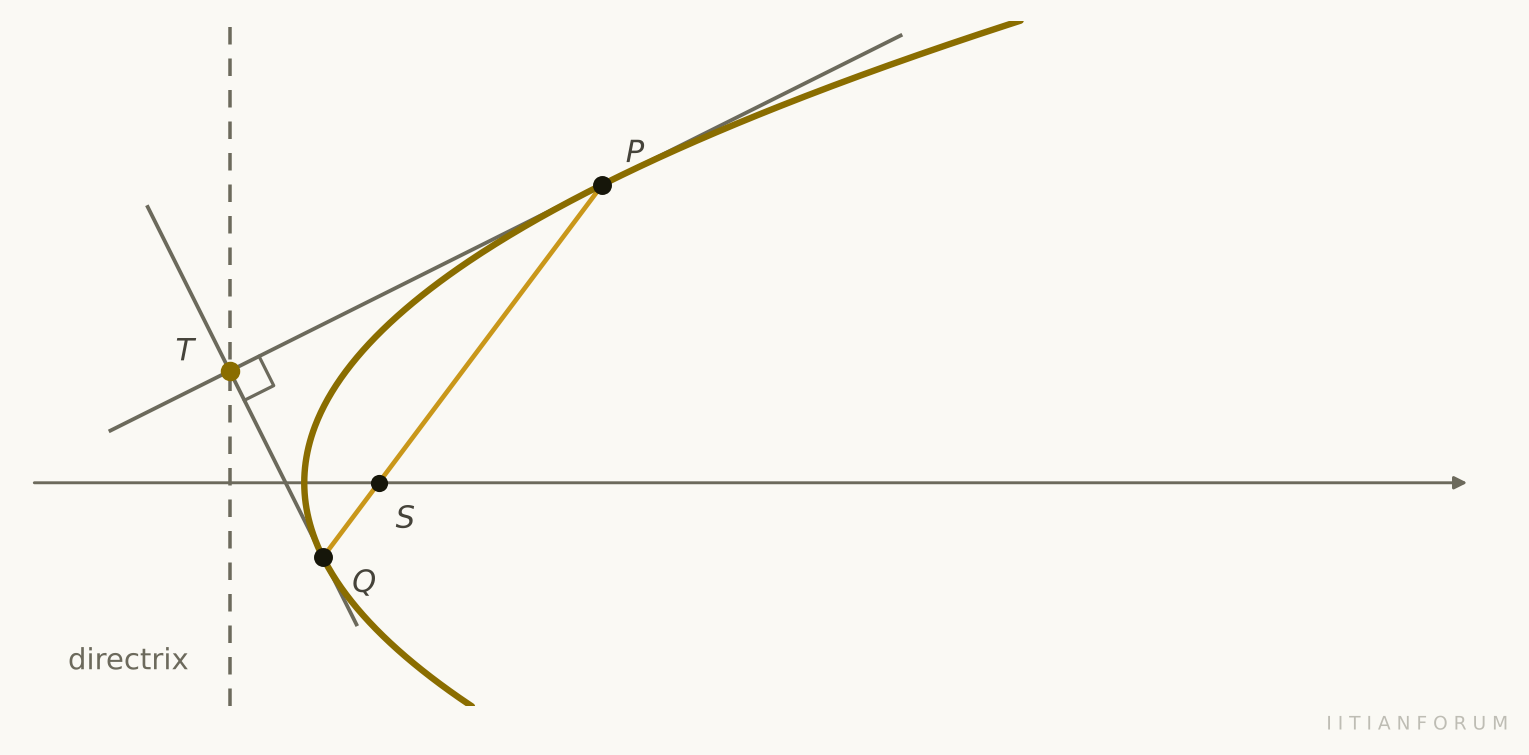
Perpendicular tangents. The slopes are and , so the tangents are perpendicular when . Then lies on the directrix, and says the chord of contact is a focal chord.
- Tangents at the ends of a focal chord are perpendicular and meet on the directrix.
- From any point of the directrix the two tangents are perpendicular.
- So the locus of the point where perpendicular tangents meet, the director circle of the parabola, is the directrix itself.
Triangle of tangents. The tangents at , , form a triangle whose area is
exactly half the area of the triangle with those three points as vertices.
Example 32 (JEE Advanced 2026, Paper 2). Let be the tangent to the parabola at the point . Let be the tangent to the same parabola at another point on the parabola. If and are perpendicular to each other, then the distance between the point and the focus of the parabola, is
▸ SHOW SOLUTION
Step 1. Parameter of (64, 32)
; with .
Step 2. Perpendicular tangent
Perpendicular tangents touch at the ends of a focal chord, so has parameter : .
Step 3. Focal distance
Answer: option (3)
Example 33 (IIT JEE 2011, Paper 1). Consider the parabola . Let be the area of the triangle formed by the end points of its latus rectum and the point on the parabola, and be the area of the triangle formed by drawing tangents at and at the end points of the latus rectum. Then is ______.
▸ SHOW SOLUTION
Step 1. Parameters
, points . has ; the ends of the latus rectum have .
Step 2. The two areas
The tangents meet at the points : , , . Their area is , half of .
So .
Answer:
Standard properties of a tangent
Let the tangent at meet the axis at and let be the foot of the ordinate of .
The parabola y squared equals 4ax with the tangent at P meeting the axis at T, the ordinate PN, the focus S joined to P, the foot Y of the perpendicular from S to the tangent lying on the y axis, and the equal lengths ST and SP marked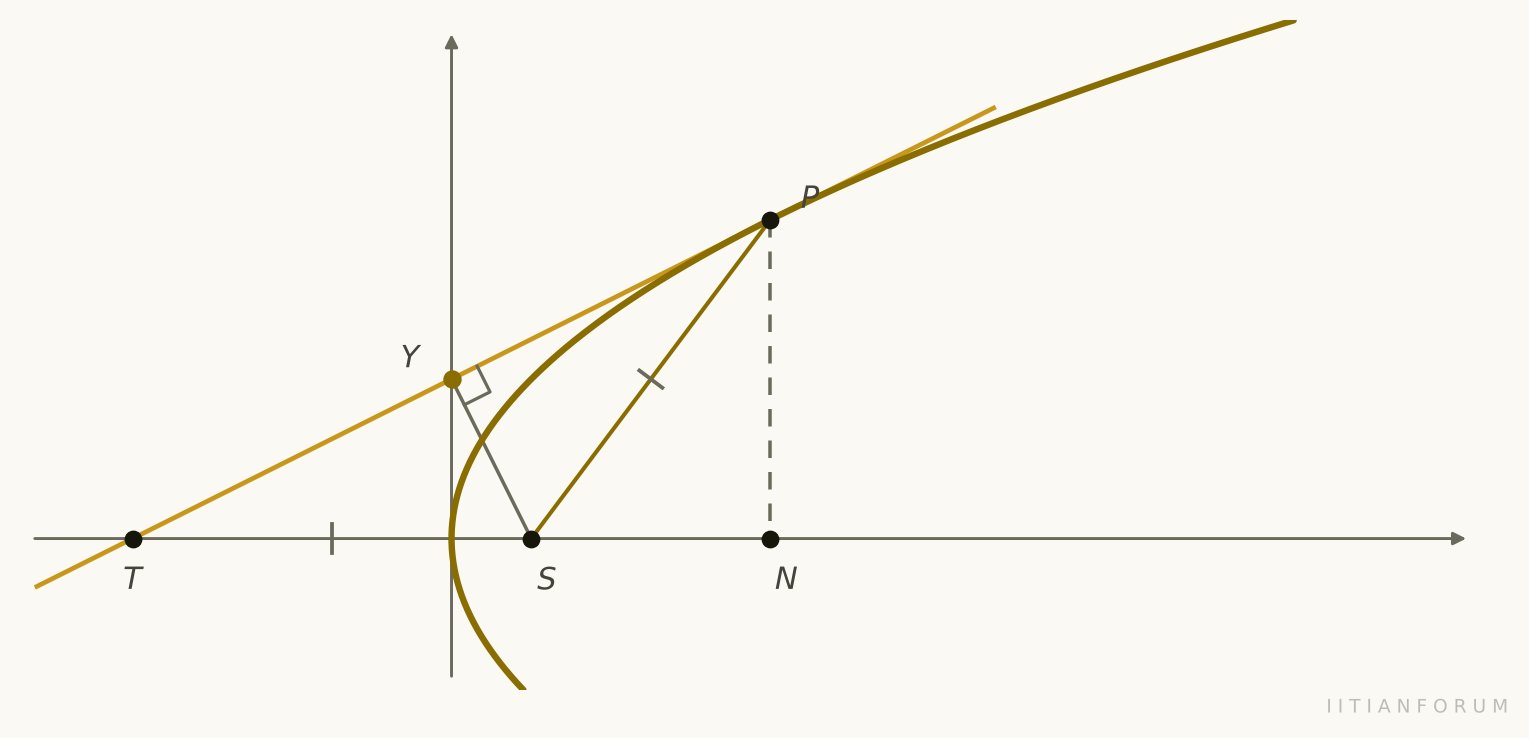
| Property | Reason |
|---|---|
| , so | put in |
| Sub-tangent | twice the abscissa |
| both equal | |
| Tangent bisects ( on the directrix) | and |
| Foot of the perpendicular from on the tangent lies on | |
| The part of the tangent between and the directrix subtends at | check slopes |
| The circle on as diameter touches | centre at height , radius |
Because and the tangent bisects , the focus is the reflection of in the tangent. Many questions that give a tangent and one more fact are solved by reflecting a point in that tangent.
Example 34 (IITianForum). The line touches a parabola at , and is the foot of the perpendicular drawn from to the directrix. If the vertex of the parabola is , find .
▸ SHOW SOLUTION
Step 1. Direction of PM
joins and , so it has direction . The tangent has normal direction . So is perpendicular to the tangent: is along the normal at .
Step 2. Normal parallel to the axis
is perpendicular to the directrix, so it is parallel to the axis. The only point where the normal is parallel to the axis is the vertex. So is the vertex.
Step 3. Check with the focus
The focus is the reflection of in : . The vertex is the midpoint of and : , as found.
So .
Answer:
Pair of tangents and chord of contact
From an outside point , the tangents touch at , with and . So
The chord of contact joins the two points of contact. Its equation is :
The pair of tangents from , as one equation, is
with , , .
The triangle formed by and the two points of contact has area
from the triangle-of-tangents formula with .
Example 35 (IITianForum). A pair of tangents is drawn from to the parabola , touching it at and . The area of the triangle , in square units, is
▸ SHOW SOLUTION
Step 1. Parameters of A and B
: , . So
Step 2. Area
is the triangle formed by the tangents at , and the chord , so its area is
The formula gives the same, with .
Answer: option (A)
Example 36 (IITianForum). Tangents are drawn from a point on the directrix of , touching it at and . The locus of the circumcentre of is
▸ SHOW SOLUTION
Step 1. A right angle at P
From a point of the directrix the tangents are perpendicular, so and the circumcentre is the midpoint of .
Step 2. AB is a focal chord
, . Midpoint :
Step 3. Eliminate u
So the locus is .
Answer: option (A)
Common tangents
A common tangent of and another curve is found by writing the parabola's tangent in slope form, , and imposing tangency to the other curve.
| Other curve | Condition on |
|---|---|
| circle, centre , radius | |
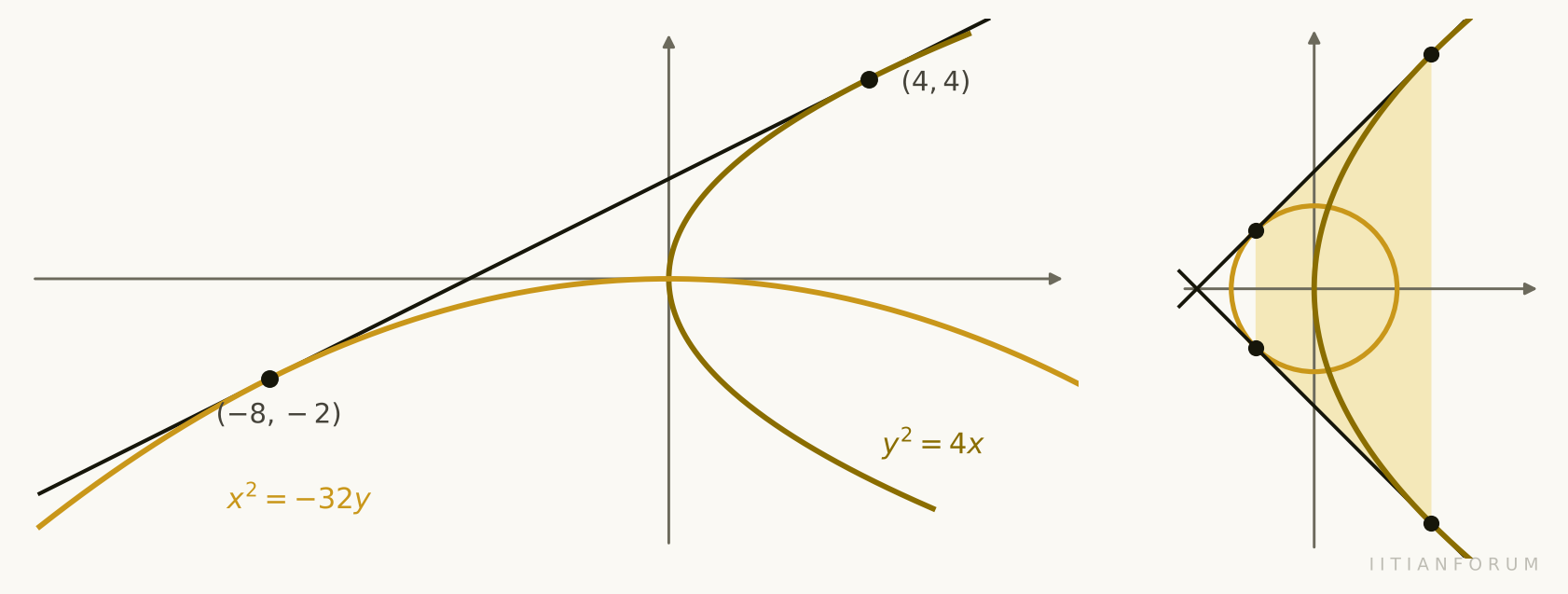
Example 37 (JEE Main 2014). The slope of the line touching both the parabolas and is
▸ SHOW SOLUTION
Step 1. Tangent to the first parabola
.
Step 2. Tangent to x² = −32y
Put : . Equal roots:
Step 3. Equate
Answer: option (3)
Example 38 (JEE Advanced 2014, Paper 2). The common tangents to the circle and the parabola touch the circle at the points , and the parabola at the points , . Then the area of the quadrilateral is
▸ SHOW SOLUTION
Step 1. Common tangents
at distance from the origin:
The tangents are and .
Step 2. Points of contact
On the circle (feet of the perpendiculars from ): and . On the parabola, : and .
Step 3. Area
The quadrilateral is a trapezium with parallel sides and at distance :
Answer: option (D)
Example 39 (JEE Advanced 2018, Paper 2). Consider two straight lines, each of which is tangent to both the circle and the parabola . Let these lines intersect at the point . Consider the ellipse whose center is at the origin and whose semi-major axis is . If the length of the minor axis of this ellipse is , then which of the following statement(s) is (are) TRUE?
▸ SHOW SOLUTION
Step 1. Common tangents
at distance from the origin:
The tangents and meet at .
Step 2. The ellipse
Semi-major axis , semi-minor axis :
, so ; latus rectum . So (A) is true and (B) is false.
Step 3. The area
Using , this equals
So (C) is true and (D) is false.
Answer: (A) and (C)
Example 40 (JEE Advanced 2015, Paper 2). Suppose that the foci of the ellipse are and where and . Let and be two parabolas with a common vertex at and with foci at and , respectively. Let be a tangent to which passes through and be a tangent to which passes through . If is the slope of and is the slope of , then the value of is ______.
▸ SHOW SOLUTION
Step 1. Foci
: , . So and .
Step 2. Tangent T₁
through :
Step 3. Tangent T₂
For the slope form is . Through :
So .
Answer:
Normals
The three forms of the normal
The normal at a point is perpendicular to the tangent there. At the tangent has slope , so the point form is
At the point the normal has slope , giving the parametric form
Writing gives the slope form
with foot . So is a normal to exactly when
| Form | Normal | Foot |
|---|---|---|
| Point | ||
| Parametric | ||
| Slope |
Tangency is ; normality is . In the slope form of the normal the foot is , with a minus sign in the ordinate, unlike the tangent's point of contact . Read the question twice to see which one is being imposed.
Sub-normal. The normal at meets the axis at . So : the sub-normal is constant, equal to the semi-latus rectum.
Normal chord
If the normal at meets the parabola again at , the slope of is both and :
The parabola y squared equals 4ax with the normal at P(t1) drawn as a chord meeting the curve again at Q(t2) on the other side of the axis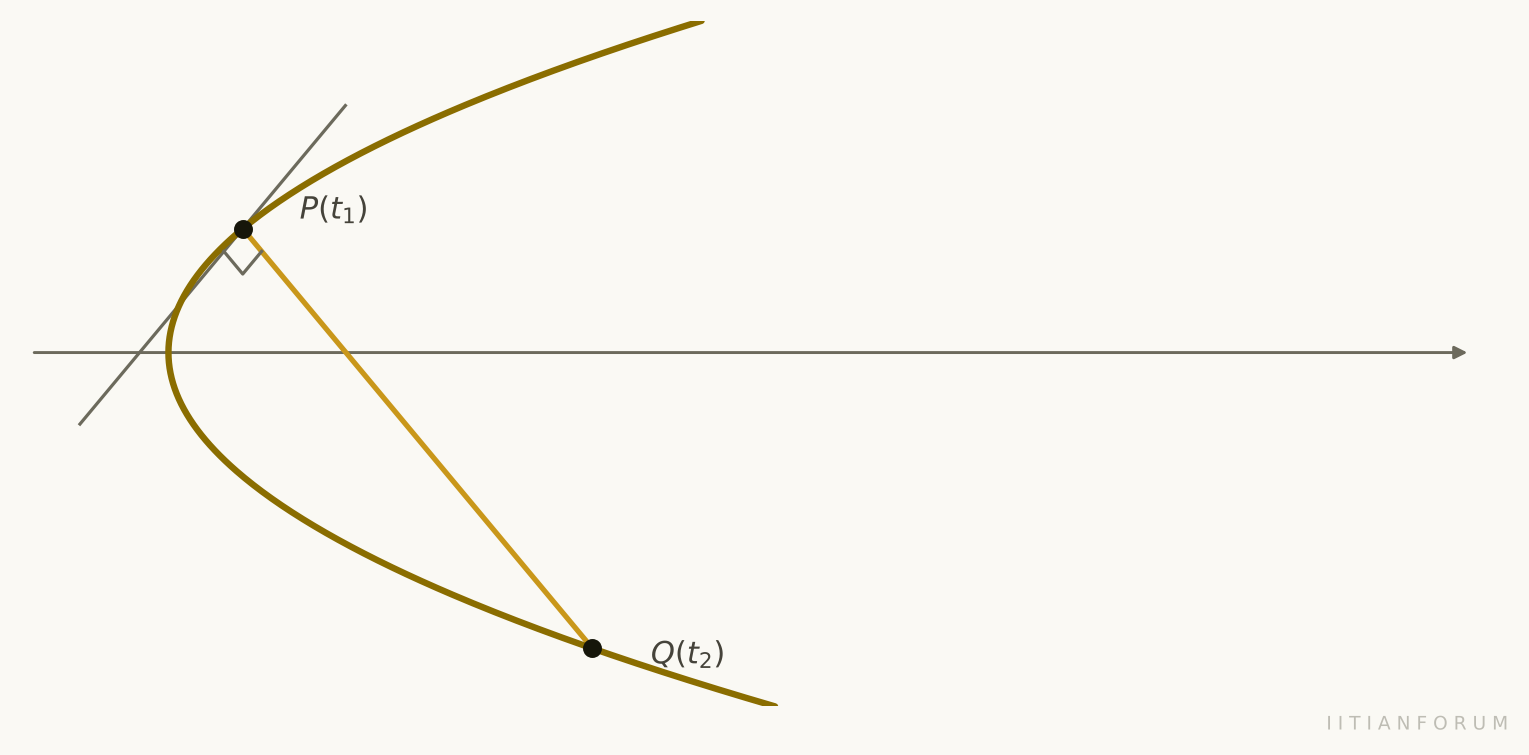
| Result | Value |
|---|---|
| Other end | |
| Normal chord subtends at the vertex | |
| Shortest normal chord | at , length |
| Normal through the focus | only at the vertex |
Example 41 (IITianForum). For , find the normal at , the point where it meets the parabola again and the length .
▸ SHOW SOLUTION
Step 1. The normal
and is the point : , that is .
Step 2. The other end
Step 3. Length
Answer: , ,
Example 42 (JEE Main 2018). Tangent and normal are drawn at on the parabola , which intersect the axis of the parabola at and , respectively. If is the centre of the circle through the points , and and , then a value of is
▸ SHOW SOLUTION
Step 1. A and B
, . Tangent meets the axis at . Normal meets it at .
Step 2. The circle
, so is a diameter and . Then , so .
Step 3. Angle at B
goes from to : up , back . With along the axis,
Answer: option (4)
Example 43 (JEE Advanced 2014, Paper 2). Let be nonzero real numbers. Let , , and be distinct points on the parabola . Suppose that is the focal chord and lines and are parallel, where is the point . If , then the tangent at and the normal at to the parabola meet at a point whose ordinate is
▸ SHOW SOLUTION
Step 1. The two lines
Tangent at : . Normal at , with :
Step 2. Eliminate x
Put in the normal and use :
Answer: option (B)
Example 44 (IIT JEE 2011, Paper 2). Let be a normal to the parabola . If passes through the point , then is given by
▸ SHOW SOLUTION
Step 1. Slope form through (9, 6)
with :
Step 2. The normals
: . : . : . These are (A), (D) and (B).
Answer: (A), (B) and (D)
Example 45 (JEE Advanced 2015, Paper 1). If the normals of the parabola drawn at the end points of its latus rectum are tangents to the circle , then the value of is ______.
▸ SHOW SOLUTION
Step 1. The two normals
The ends are . Normals: and .
Step 2. Distance from the centre
From :
Both equal , so .
Answer:
Example 46 (JEE Main 2019, 10 January Shift 1). If the parabolas and have a common normal, then which one of the following is a valid choice for the ordered triad ?
▸ SHOW SOLUTION
Step 1. Normals of slope m
For (focal length ): . For , shift by : .
Step 2. Same line
Equal intercepts, with :
Step 3. Test the triads
A real slope needs this to be positive. gives ; the others give , , .
The axis is a common normal of any two such parabolas, so the question asks for a common normal other than the axis.
Answer: option (1)
Co-normal points
Through a point the normal passes when
This cubic in has at most three roots, so at most three normals pass through a point. Their feet are called co-normal points.
The parabola y squared equals 4ax with three normals drawn from one point P(h, k), which lies to the right of x equals 2a, to three different feet on the curve, one above the axis and two below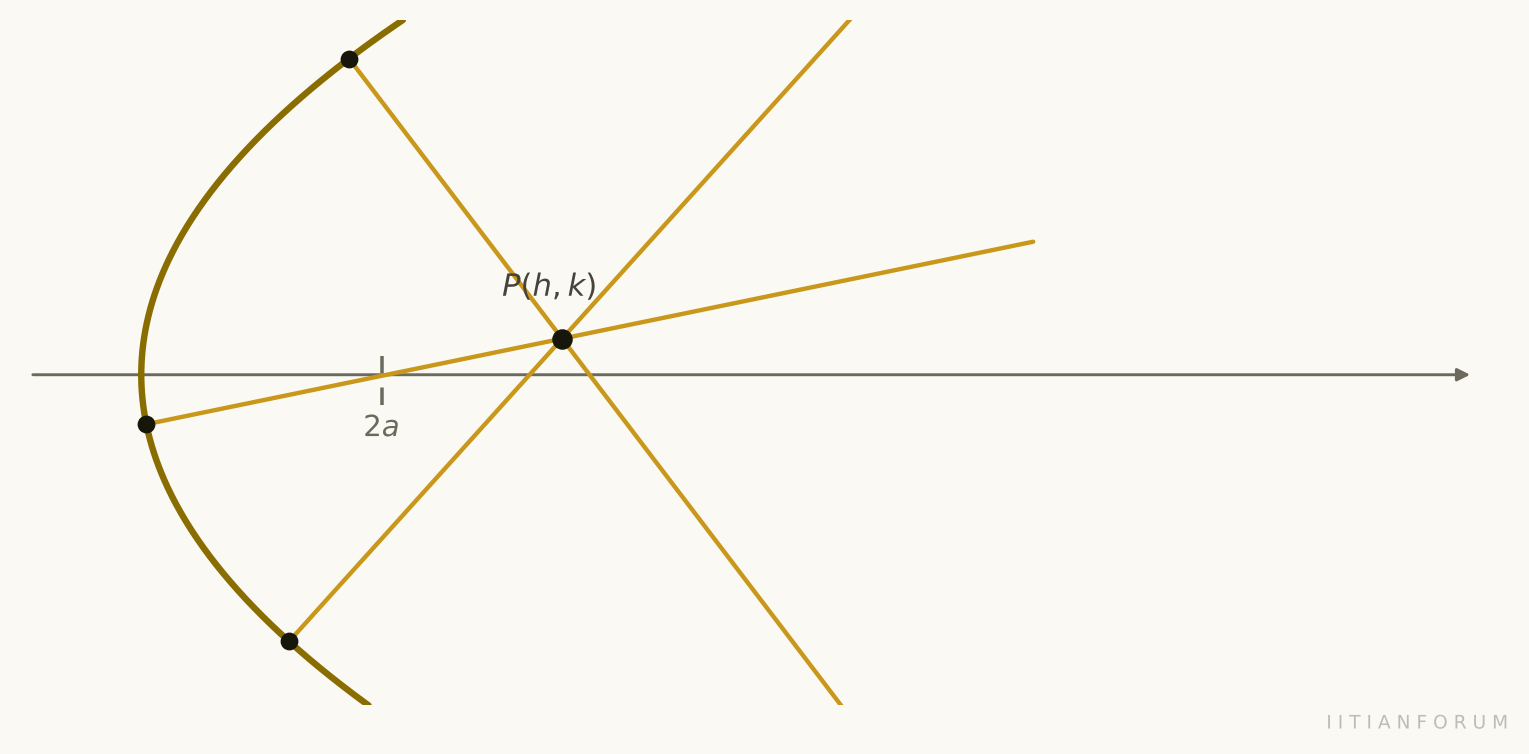
| Result | Reason |
|---|---|
| no term | |
| Sum of ordinates of the feet | |
| Centroid of the feet lies on the axis | ordinates sum to |
| Vieta | |
| Vieta | |
| Three real normals need | otherwise the cubic is increasing |
Why . If , the cubic has derivative , so it is increasing and has only one real root.
From a point of the axis , , the three normals are the axis itself and two with .
Example 47 (IITianForum). Three normals are drawn from to the parabola , with feet . Find and the centroid of the triangle formed by the feet.
▸ SHOW SOLUTION
Step 1. The cubic
, , :
Here ; the cubic changes sign three times ( give , , , ), so all three normals are real.
Step 2. Sum of reciprocals
, , :
Step 3. Centroid
The centroid is .
Answer: , centroid
Example 48 (IITianForum). Let be a point on the axis of the parabola from which three distinct real normals can be drawn to the parabola. Find the least possible value of , where is the greatest integer function.
▸ SHOW SOLUTION
Step 1. Standard form
Vertex , , axis , so .
Step 2. Shift to the vertex
With , the point is . Three real normals from a point of the axis need
Step 3. Least value of [h]
can be any number above , for example , so the least value of is .
Answer:
Example 49 (IITianForum). From a point on the parabola , two normals are drawn to the parabola at two distinct points and , both different from . Find the least integral value of .
▸ SHOW SOLUTION
Step 1. Normals through a point of the curve
, . The normal at passes through when
Step 2. Two more feet
is the normal at itself. Two more real, distinct feet need
and neither root equals , which holds since .
Step 3. Least integral h
, so the least integer is .
Answer:
Shortest distance
The shortest distance from a point, or from another curve, to the parabola is measured along a line that is normal to the parabola. For two curves, it lies along a common normal.
Example 50 (JEE Main 2025, 23 January Shift 2). Let the shortest distance from , , to the parabola be . Then the equation of the circle passing through the point and the focus of the parabola, and having its centre on the axis of the parabola, is
▸ SHOW SOLUTION
Step 1. Which normal
If the nearest point is the vertex and the distance is , not . So and the nearest points are the feet with .
Step 2. Use the distance
So and .
Step 3. The circle
It passes through and with centre on the -axis: centre , radius :
Answer: option (1)
Example 51 (JEE Advanced 2016, Paper 2). Let be the point on the parabola which is at the shortest distance from the center of the circle . Let be the point on the circle dividing the line segment internally. Then
▸ SHOW SOLUTION
Step 1. The circle
Centre , radius .
Step 2. Normal through S
through :
So and the normal is .
Step 3. Check each option
, so (A) is true. and , so , and (B) is false. The normal meets at , so (C) is true. The radius lies along , of slope , so the tangent at has slope and (D) is true.
Answer: (A), (C) and (D)
Reflection property and circles on the parabola
Reflection property
The tangent at bisects the angle between and , where is parallel to the axis. So the normal at makes equal angles with and with the line through parallel to the axis. By the law of reflection:
- A ray travelling parallel to the axis is reflected through the focus.
- A ray from the focus is reflected parallel to the axis.
This is why dish antennas, torch reflectors and solar cookers have parabolic cross-sections.
The parabola y squared equals 4ax with four horizontal rays coming in from the right, each reflected at the curve so that all four reflected rays pass through the focus S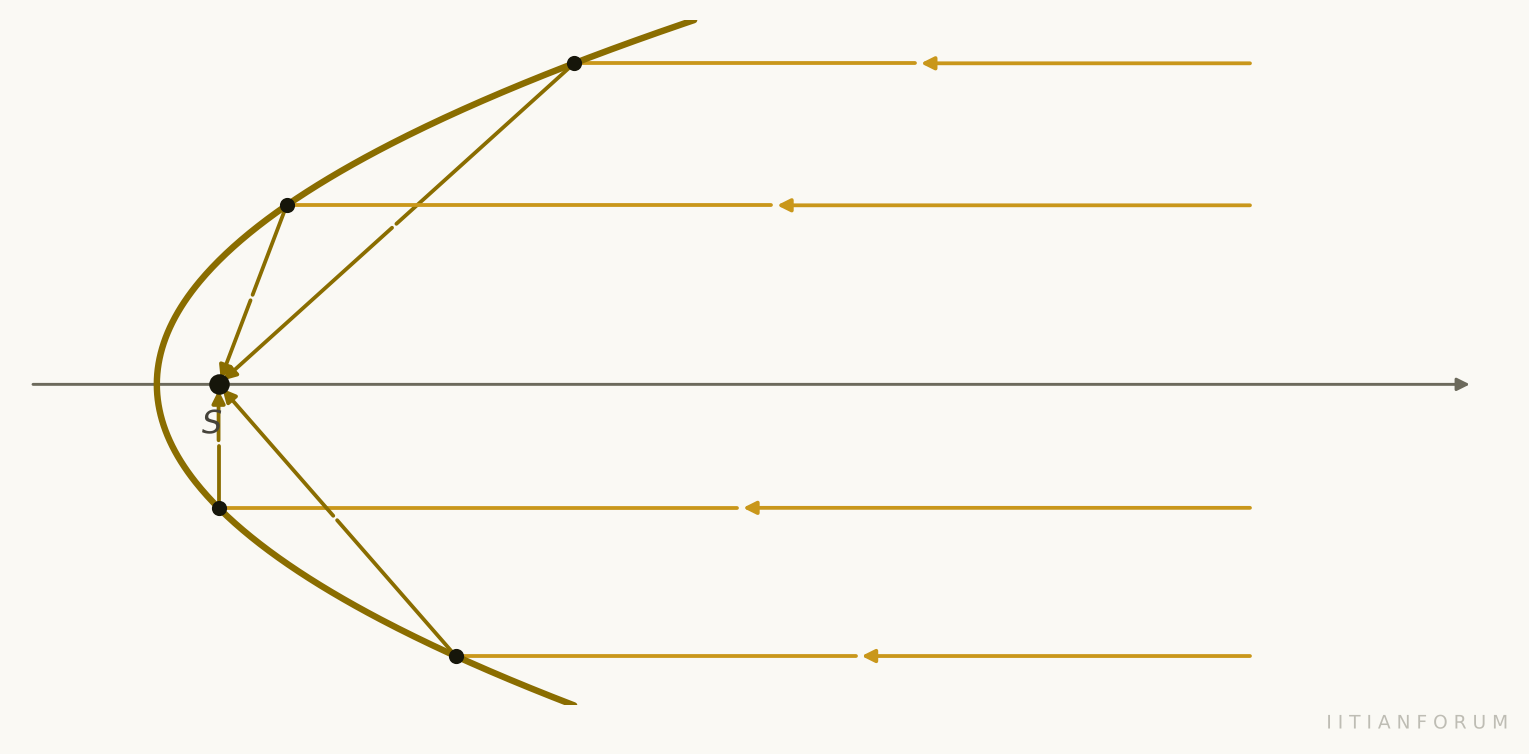
Example 52 (IITianForum). A ray along the line , travelling towards the left, strikes the parabola at . After reflection it meets the axis of the parabola at , and the normal at meets the axis at . Which of the following are correct?
▸ SHOW SOLUTION
Step 1. Point A and point B
gives , so . The ray is parallel to the axis, so after reflection it passes through the focus: .
Step 2. Point C
and is the point . The normal meets the axis at . (Also, the sub-normal is , so is to the right of the foot .)
Step 3. Triangle
is vertical and lies on the axis, so the area is . .
Answer: (A), (B) and (C)
Circles on the parabola
| Result | Reason |
|---|---|
| The circle on a focal chord as diameter touches the directrix | centre is ; radius , which is the distance of the centre from the directrix |
| The circle on a focal radius as diameter touches the tangent at the vertex | same argument with and the -axis |
| A circle meets the parabola in at most four points, | substituting in the circle gives a quartic in with no term |
| The circumcircle of the triangle formed by any three tangents passes through the focus | standard result |
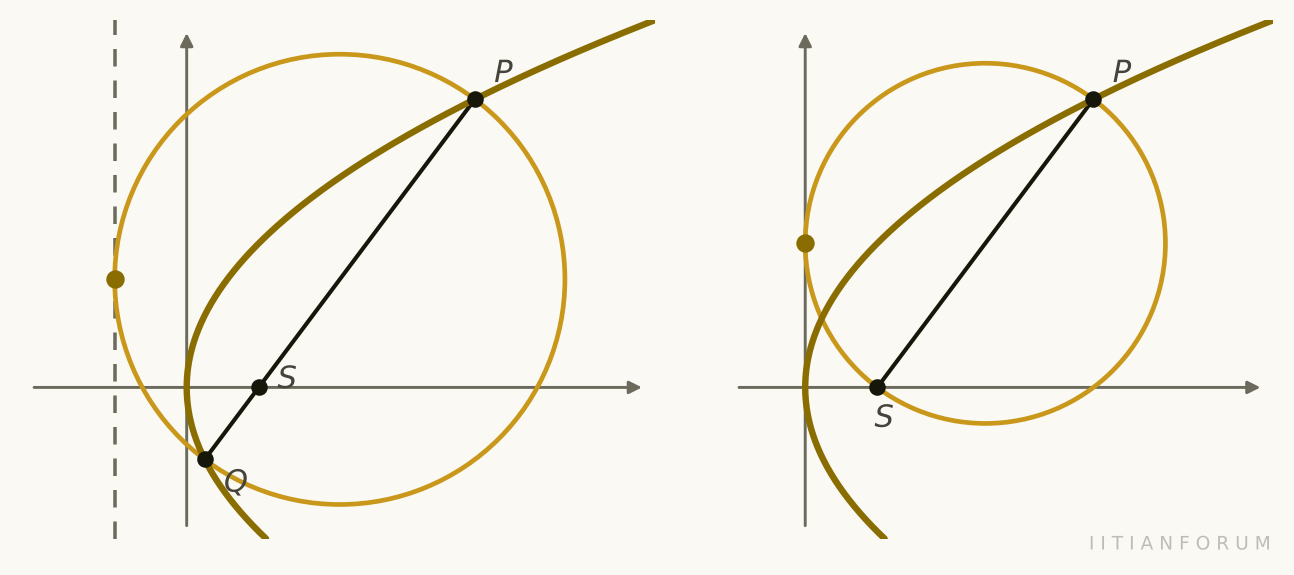
Example 53 (JEE Main 2025, 2 April Shift 1). Let the focal chord of the parabola make an angle of with the positive -axis, where lies in the first quadrant. If the circle, whose one diameter is , being the focus of the parabola, touches the -axis at the point , then is equal to
▸ SHOW SOLUTION
Step 1. Point P
. Slope with :
So .
Step 2. Circle on SP
Its centre is and it touches the tangent at the vertex, the -axis, at the level of the centre: . So .
Answer: option (1)
Example 54 (JEE Main 2025, 29 January Shift 2). Let be the parabola and be its focus. Let be a focal chord of the parabola such that . Let be the circle described taking as a diameter. If the equation of a circle is , then is equal to ______.
▸ SHOW SOLUTION
Step 1. The parameter
; and :
So and .
Step 2. Circle on PQ
, , , and . The circle is
Step 3. Match the given form
Multiplying by , the term is when :
So , and .
Answer:
Example 55 (IIT JEE 2012, Paper 1). Let be the focus of the parabola and let be the common chord of the circle and the given parabola. The area of the triangle is ______.
▸ SHOW SOLUTION
Step 1. Points of intersection
Put in the circle:
is increasing and vanishes at , so the real roots are and : , .
Step 2. Area
; is vertical of length and is away from it:
Answer:
Which method to use
A decision chart: from the question asked, arrows lead to eight situations, each paired with its method: focus and directrix given, distance equal to distance; general form, complete the square; two points on the curve, parameters t1 and t2; focal chord, t1 t2 equals minus 1; tangent condition, c equals a over m; point outside, pair of tangents and chord of contact; normal through a point, cubic in m; locus, parametrise and eliminate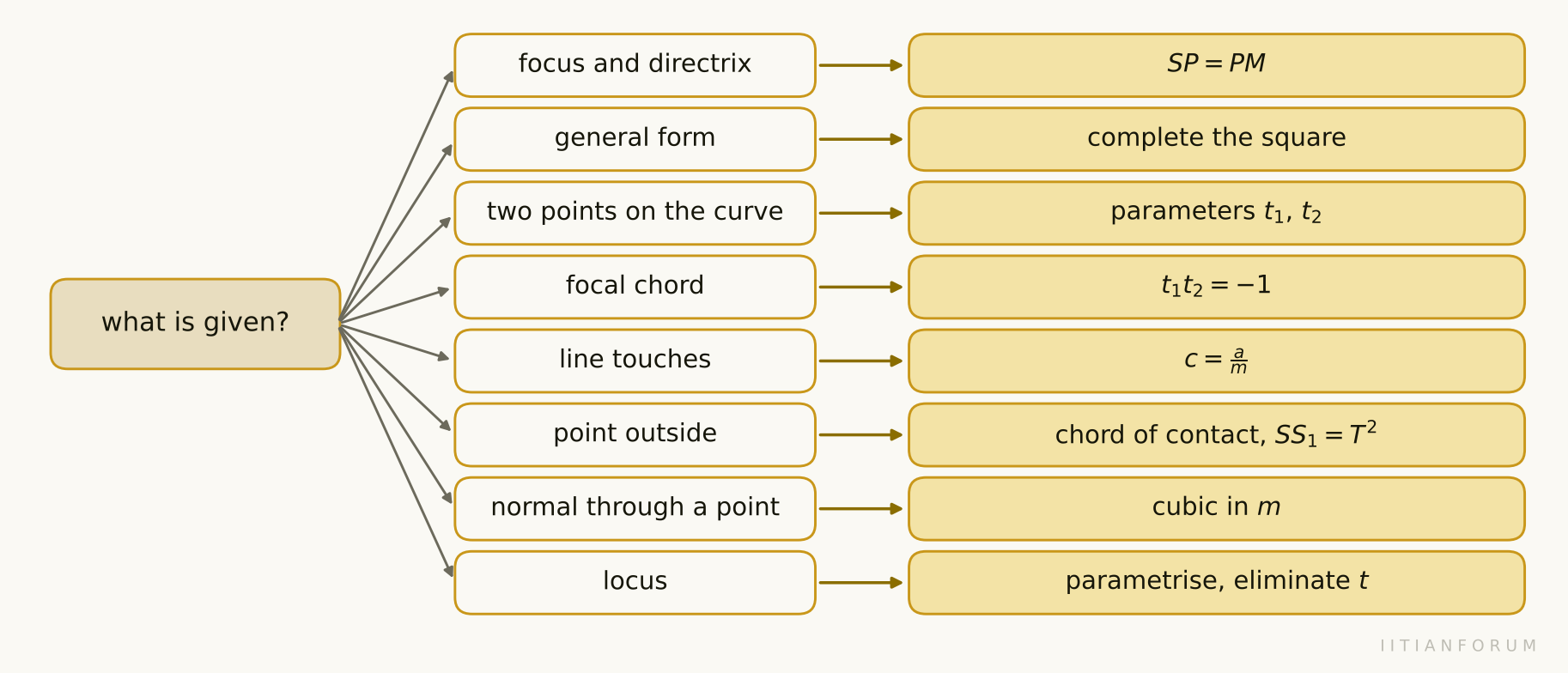
| Given | Method |
|---|---|
| focus and directrix | , then simplify |
| or | complete the square, shift the origin |
| axis along , tangent at vertex along | (distance from )(distance from ) |
| image of a parabola in a line | image of a general point, then eliminate |
| two points on the curve | parameters , ; chord slope |
| focal chord | , length |
| right angle at the vertex | , chord through |
| chord with a given mid-point | |
| line touches the parabola | , or for |
| tangents at , | meet at |
| point outside the curve | chord of contact , pair |
| common tangent with a circle or a parabola | , then the other condition |
| normals through a point | |
| shortest distance | common normal |
| locus | parametrise, eliminate |
What JEE asks
Across the JEE Main papers from 2014 to 2026 and the JEE Advanced and IIT JEE papers, the chapter appears in these forms.
- Focal chords: length, harmonic property, quadrilaterals on the directrix, points dividing the chord (Examples 14 to 21). This is the most common form in JEE Main.
- General and slanted parabolas: vertex, focus and latus rectum from a focus and directrix, or from a mirror image (Examples 4 to 11).
- Chords with a condition: right angle at the vertex, chords with a given mid-point, inscribed triangles (Examples 22 to 30).
- Tangents and common tangents, often with a circle or an ellipse (Examples 31 to 40). This is the common form in JEE Advanced.
- Normals: normal chord, co-normal points, shortest distance (Examples 41 to 51).
- Loci of mid-points and centroids (Examples 56 to 60).
JEE Advanced 2026 asked for the focal distance of the point whose tangent is perpendicular to a given tangent (Example 32). Earlier JEE Advanced and IIT JEE papers used the mirror image of a parabola (Example 11), focal chord tangents (Examples 19 and 20), the circle on a chord (Example 25), common tangents with a circle (Examples 38 and 39), normals through a point (Example 44) and a centroid locus (Example 59).
Quick recall
| Result | Statement |
|---|---|
| Parabola | focus , directrix , latus rectum |
| Parametric point | |
| Focal distance | |
| Chord | |
| Focal chord | , length |
| Harmonic property | |
| Right angle at vertex | , chord through |
| Tangent at | |
| Tangent of slope | , contact |
| Tangents at , meet | |
| Perpendicular tangents | meet on the directrix |
| Normal at | |
| Normal of slope | , foot |
| Normal chord | |
| Sub-normal | |
| Co-normal points | , three normals need |
| Mid-point chord | , slope |
| Diameter |
Without a pen, answer these four: the length of the focal chord of through ; the tangent to of slope ; the point where the normal at of meets the curve again; and the least for three normals from to . If , , and "more than " come quickly, the chapter is yours.
Practise these methods on real exam questions in the doMath Parabola chapter. Circles touching a parabola and the family of circles are developed in the Family of Circles note, tangents to a general curve in the Tangents, Normals, Rolle and LMVT note, and the discriminant conditions used for a line meeting the curve in the Quadratic Equations note.