Sequence and Series for JEE: AP, GP, HP, Special Sums and Differences
Ritesh Raj · 9 Nov 2026
Aa
47 min read46 sectionsConcept
A sequence is a list of numbers in a definite order: a first term, a second term, a third term, and so on. When a rule produces each term from its position, the whole list can be described in one line, and its sum can often be found without adding term by term. Arithmetic and geometric progressions are the two simplest rules, and almost every series asked in JEE is built from them, from the sums of n, n2 and n3, or from a term that splits into a difference.
This note covers sequences and the relation between an and Sn, the arithmetic progression with its sum, properties and the choice of terms, the geometric progression with finite and infinite sums, problems that mix an AP with a GP, the harmonic progression, the three means and the insertion of means, the arithmetico-geometric progression, the special sums ∑n, ∑n2, ∑n3, the method of differences, sequences given by a recurrence, and bounding a sum. The inequality A≥G≥H and its use for maxima and minima is developed fully in the Relation Between AM, GM and HM note; here it gets one short section. Each section ends with worked examples from JEE Main, JEE Advanced and IIT JEE papers, graded from easy to hard.
Sequences, series and the sum Sn
A sequence is a function from the natural numbers to the real numbers. Its value at n is the nth term, written an or Tn:
a1,a2,a3,…,an,…
A sequence with a last term is finite; one that never stops is infinite. The expression obtained by adding the terms is a series, and the sum of the first n terms is
Sn=a1+a2+⋯+an=k=1∑nak
From Sn back to an
Sn and Sn−1 differ only by the last term, so
an=Sn−Sn−1,n≥2a1=S1
Given
Find
Rule
an
Sn
add: Sn=∑k=1nak
Sn
an
subtract: an=Sn−Sn−1 for n≥2
Sn
a1
a1=S1
swipe for more →
Rules for Σ
For constants c and any two sequences,
k=1∑n(cak+bk)=ck=1∑nak+k=1∑nbkk=1∑nc=nc
But a sum of products is not the product of sums: ∑akbk=(∑ak)(∑bk) in general.
The formula $a_n=S_n-S_{n-1}$ starts at $n=2$
If Sn=n2+1, then Sn−Sn−1=2n−1 gives 1 at n=1, while a1=S1=2. The two agree at n=1 only when the formula for Sn gives S0=0. Always find a1 separately from S1.
Examples
Example 1(JEE Main 2026, 23 Jan Shift 2). Let k=1∑nak=αn2+βn. If a10=59 and a6=7a1, then α+β is equal to
Tap an option to check your answer
(1)12
(2)3
(3)5
(4)7
▸ SHOW SOLUTION
Step 1. Find an from Sn
an=αn2+βn−α(n−1)2−β(n−1)an=α(2n−1)+β
Here S0=0, so this also gives a1=α+β correctly.
Step 2. Use the two conditions
a10=19α+β=59. Also a6=11α+β and 7a1=7α+7β, so
11α+β=7α+7β⇒β=32α
Step 3. Solve
19α+32α=59⇒α=3,β=2
Answer:α+β=5, option (3)
Example 2(JEE Main 2026, 2 April Shift 1). If k=1∑nak=6n3, then k=1∑6(36ak+1−ak)2 is equal to ______.
▸ SHOW SOLUTION
Step 1. Find an
an=6n3−6(n−1)3=18n2−18n+6
At n=1 this gives 6=S1, so it holds for every n.
Step 2. Difference of consecutive terms
ak+1−ak=18(2k+1)−18=36k
Step 3. Sum
k=1∑6k2=66⋅7⋅13=91
Answer:91
Example 3(IITianForum). A sequence of positive numbers t1,t2,t3,… has t1=1, and the sum Sn of its first n terms satisfies Sn=21(tn+tn1) for every n. Then S25−t25 is equal to
So Sn2=n and Sn=n, since every term is positive.
Step 3. Find the required value
S25=5 and t25=S25−S24=5−24, so
S25−t25=24=26
Answer: option (A)
Arithmetic progression
A sequence is an arithmetic progression (AP) if every term minus the term before it is the same number d, the common difference:
an+1−an=d for every n
The nth term
Starting from a, each step adds d, and reaching the nth term takes n−1 steps:
an=a+(n−1)d
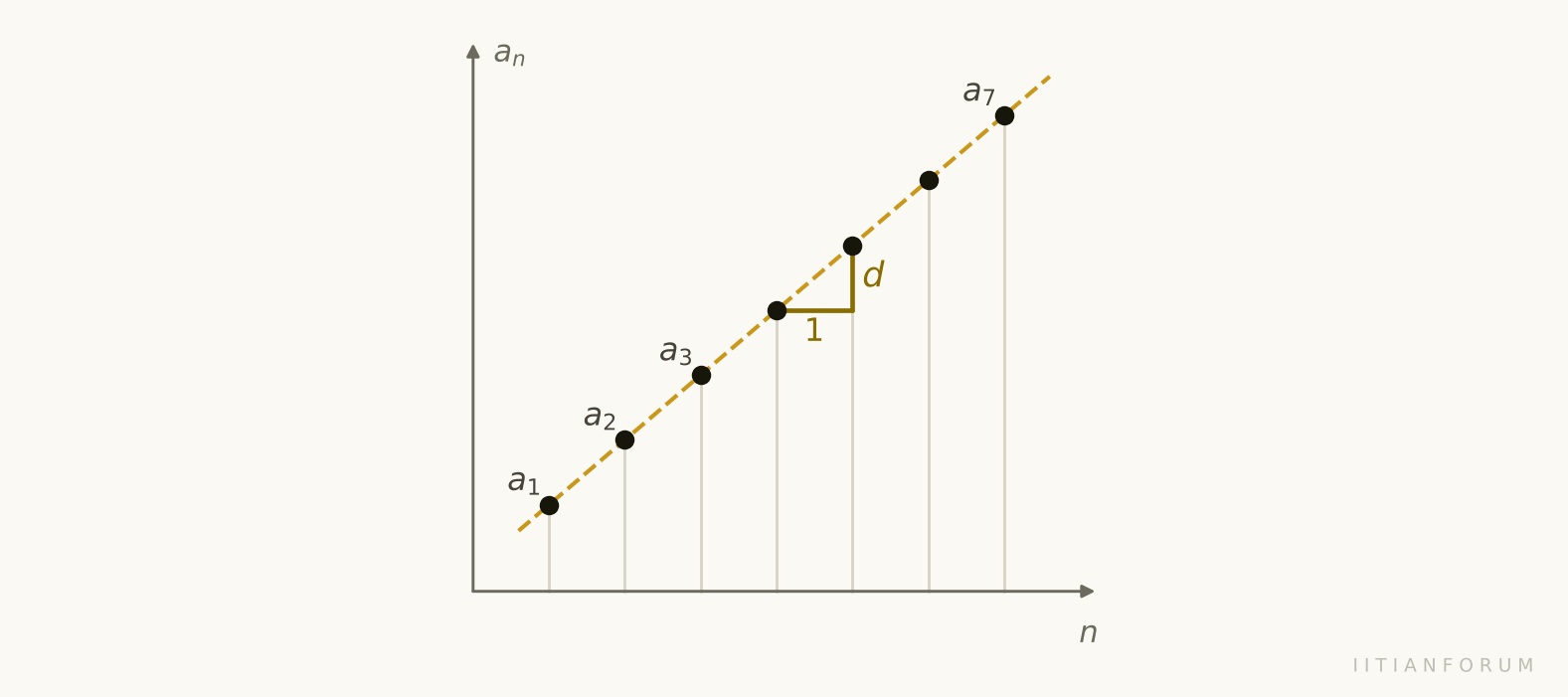
So an=dn+(a−d) is linear in n, and the points (n,an) lie on a straight line of slope d. Conversely, any sequence with an=An+B is an AP with d=A.
Terms of an AP plotted against n lie on one straight line, each step of 1 in n raising the term by d
In an AP of m terms with last term l, the nth term from the end is the (m−n+1)th from the start:
am−n+1=l−(n−1)d
Sum of n terms
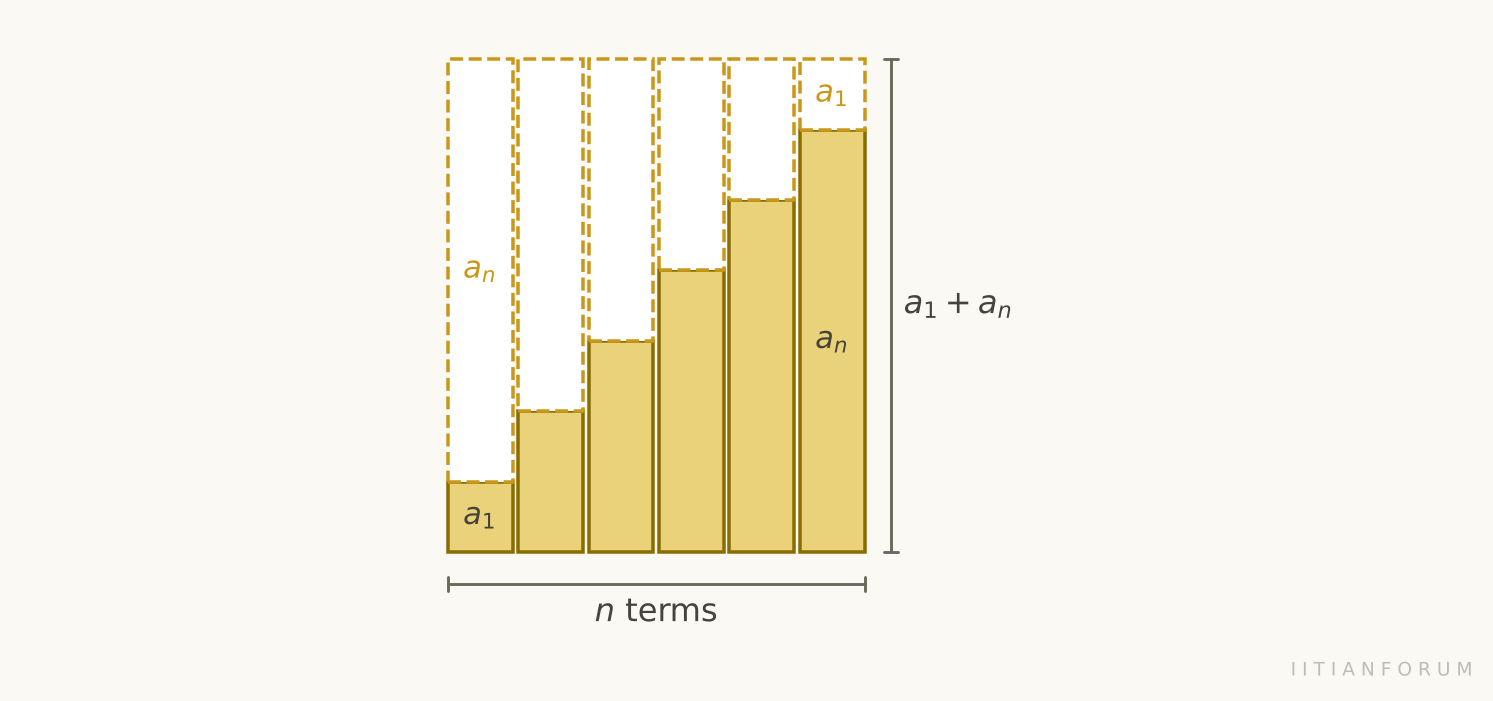
Write the sum forwards and backwards and add. Each column adds to a1+an, and there are n columns:
2Sn=n(a1+an)Sn=2n(a+l)=2n[2a+(n−1)d]Six bars of an AP with the same bars reversed on top, filling a rectangle of width n and height a1 plus an
Expanding, Sn=2dn2+(a−2d)n, a quadratic in n with no constant term. Conversely, if Sn=An2+Bn, the sequence is an AP with d=2A. If Sn=An2+Bn+C with C=0, the terms from the second onward form an AP but a1 does not fit it.
Properties of an AP
Property
Statement
Three terms
a,b,c in AP ⟺2b=a+c
Terms equidistant from the ends
ak+an−k+1=a1+an
Any term
2an=an−k+an+k
Add a constant
still an AP, same d
Multiply by k=0
still an AP, difference kd
Every pth term
still an AP, difference pd
Sum of two APs, term by term
an AP
Ratio of sums Sn′Sn known
ratio of nth terms: replace n by 2n−1
swipe for more →
The last row works because Sn=n⋅a2n+1 for odd n: the sum of an odd number of terms is the number of terms times the middle term.
Choosing the terms
When the sum of a few terms is given, choose them symmetrically so that d cancels in the sum.
Number of terms
Terms
Common difference
3
a−d,a,a+d
d
4
a−3d,a−d,a+d,a+3d
2d
5
a−2d,a−d,a,a+d,a+2d
d
swipe for more →
One arithmetic mean, n arithmetic means
A is the arithmetic mean of a and b when a,A,b are in AP, so A=2a+b. Inserting n means A1,…,An makes an AP of n+2 terms with b as the last term:
d=n+1b−a,Ak=a+kdA1+A2+⋯+An=2n(a+b)
$n$ means give $n+1$ gaps, not $n$
Between a and b with n means inserted there are n+2 terms and n+1 equal gaps, so d=n+1b−a. Dividing by n is the most common slip in this topic.
Examples
Example 4(JEE Main 2026, 28 Jan Shift 1). The common difference of the A.P. a1,a2,…,am is 13 more than the common difference of the A.P. b1,b2,…,bn. If b31=−277, b43=−385 and a78=327, then a1 is equal to
Tap an option to check your answer
(1)21
(2)24
(3)19
(4)16
▸ SHOW SOLUTION
Step 1. Difference of the second AP
b43−b31=12d2=−108⇒d2=−9
Step 2. Difference of the first AP
d1=d2+13=4
Step 3. First term
a1=a78−77d1=327−308=19
Answer: option (3)
Example 5(JEE Main 2026, 22 Jan Shift 1). If the sum of the first four terms of an A.P. is 6 and the sum of its first six terms is 4, then the sum of its first twelve terms is
Tap an option to check your answer
(1)−20
(2)−24
(3)−26
(4)−22
▸ SHOW SOLUTION
Step 1. Two equations
S4=2(2a+3d)=6⇒2a+3d=3S6=3(2a+5d)=4⇒2a+5d=34
Step 2. Solve
Subtracting, 2d=−35, so d=−65 and 2a=3−3d=211.
Step 3. Sum of twelve terms
S12=6(2a+11d)=6(211−655)=−22
Answer: option (4)
Example 6(JEE Main 2026, 24 Jan Shift 1). Consider an A.P. a1,a2,…,an with a1>0. If a2−a1=−43, an=41a1 and i=1∑nai=2525, then i=1∑17ai is equal to
Tap an option to check your answer
(1)476
(2)952
(3)238
(4)136
▸ SHOW SOLUTION
Step 1. Use the sum with first and last term
2n(a1+4a1)=2525⇒na1=420
Step 2. Use the last term
4a1=a1−43(n−1)⇒n−1=a1
Step 3. Solve for n
n(n−1)=420⇒n=21,a1=20
Step 4. Sum of seventeen terms
S17=217(40−12)=238
Answer: option (3)
Example 7(JEE Main 2026, 4 April Shift 1). The first term of an A.P. of 30 non-negative terms is 310. If the sum of this A.P. is the cube of its last term, then its common difference is
Tap an option to check your answer
(1)875
(2)8325
(3)2915
(4)295
▸ SHOW SOLUTION
Step 1. Write the sum through the last term L
S30=15(310+L)=15L+50
Step 2. Solve 15L+50=L3
L3−15L−50=0(L−5)(L2+5L+10)=0
The quadratic factor has discriminant 25−40<0, so L=5.
Step 3. Common difference
310+29d=5⇒d=875
Answer: option (1)
Example 8(JEE Main 2026, 24 Jan Shift 2). Let α1,α2,α3,α4 be an A.P. of four terms such that each term of the A.P. and its common difference l are integers. If α1+α2+α3+α4=48 and α1α2α3α4+l4=361, then the largest term of the A.P. is equal to
Tap an option to check your answer
(1)27
(2)24
(3)21
(4)23
▸ SHOW SOLUTION
Step 1. Choose the four terms symmetrically
Take a−3d,a−d,a+d,a+3d, so l=2d. The sum is 4a=48, so a=12.
Step 2. Write the product condition
(144−9d2)(144−d2)+16d4=36125d4−1440d2+1442=361
Step 3. Recognise a perfect square
(5d2−144)2=192
5d2=163 gives no integer, so 5d2=125, d=±5 and l=±10.
Step 4. Largest term
The terms are −3,7,17,27 in some order, so the largest is 27.
Answer: option (1)
Example 9(JEE Main 2025, 22 Jan Shift 2). Suppose that the number of terms in an A.P. is 2k, k∈N. If the sum of all odd terms of the A.P. is 40, the sum of all even terms is 55, and the last term of the A.P. exceeds the first term by 27, then k is equal to
Tap an option to check your answer
(1)5
(2)8
(3)6
(4)4
▸ SHOW SOLUTION
Step 1. Even terms minus odd terms
Pair a2 with a1, a4 with a3, and so on. Each pair differs by d and there are k pairs:
55−40=kd⇒kd=15
Step 2. Last term minus first term
(2k−1)d=27⇒2kd−d=27
Step 3. Solve
30−d=27, so d=3 and k=5.
Answer: option (1)
Example 10(JEE Main 2025, 29 Jan Shift 2). Let a1,a2,…,a2024 be an Arithmetic Progression such that a1+(a5+a10+a15+⋯+a2020)+a2024=2233. Then a1+a2+a3+⋯+a2024 is equal to ______.
▸ SHOW SOLUTION
Step 1. Count the bracket
a5,a10,…,a2020 has 52020=404 terms.
Step 2. Pair the terms equidistant from the ends
5+2020=10+2015=⋯=1+2024, so each of the 202 pairs in the bracket adds to s=a1+a2024:
s+202s=2233⇒s=11
Step 3. Required sum
S2024=22024s=1012⋅11=11132
Answer:11132
Example 11(JEE Main 2025, 28 Jan Shift 2). The interior angles of a polygon with n sides are in an A.P. with common difference 6°. If the largest interior angle of the polygon is 219°, then n is equal to ______.
▸ SHOW SOLUTION
Step 1. Write the angles from the largest
The angles are 219,213,… in degrees: an AP with first term 219 and difference −6.
Step 2. Equate with the angle sum of a polygon
2n[438−6(n−1)]=180(n−2)n2−14n−120=0
Step 3. Solve
(n−20)(n+6)=0, so n=20. The smallest angle is 219−19⋅6=105°, which is positive.
Answer:20
Example 12(JEE Main 2020, 7 Jan Shift 1). Five numbers are in A.P., whose sum is 25 and product is 2520. If one of these five numbers is −21, then the greatest number amongst them is
Tap an option to check your answer
(1)27
(2)7
(3)221
(4)16
▸ SHOW SOLUTION
Step 1. Choose the terms
Take a−2d,a−d,a,a+d,a+2d. The sum 5a=25 gives a=5.
Step 2. Product condition
5(25−d2)(25−4d2)=2520
Step 3. Use the term −21
5−d=−21 gives d=211, and then (25−d2)(25−4d2)=(−421)(−96)=504, which matches 52520. The choice 5−2d=−21 gives a negative product, so it fails.
Step 4. Greatest term
a+2d=5+11=16
Answer: option (4)
Example 13(JEE Main 2026, 5 April Shift 1). Let the sum of the first n terms of an A.P. be 3n2+5n. Then the sum of squares of the first 10 terms of the A.P. is
Tap an option to check your answer
(1)10220
(2)12860
(3)15220
(4)19780
▸ SHOW SOLUTION
Step 1. The nth term
Tn=Sn−Sn−1=6n+2
Step 2. Square and sum
n=1∑10(6n+2)2=36∑n2+24∑n+40
Step 3. Substitute ∑n2=385 and ∑n=55
36(385)+24(55)+40=15220
Answer: option (3)
Example 14(JEE Main 2026, 2 April Shift 1). Let A be the set of first 101 terms of an A.P. whose first term is 1 and common difference is 5, and let B be the set of first 71 terms of an A.P. whose first term is 9 and common difference is 7. Then the number of elements in A∩B which are divisible by 3 is
Tap an option to check your answer
(1)4
(2)5
(3)6
(4)7
▸ SHOW SOLUTION
Step 1. Common terms form an AP
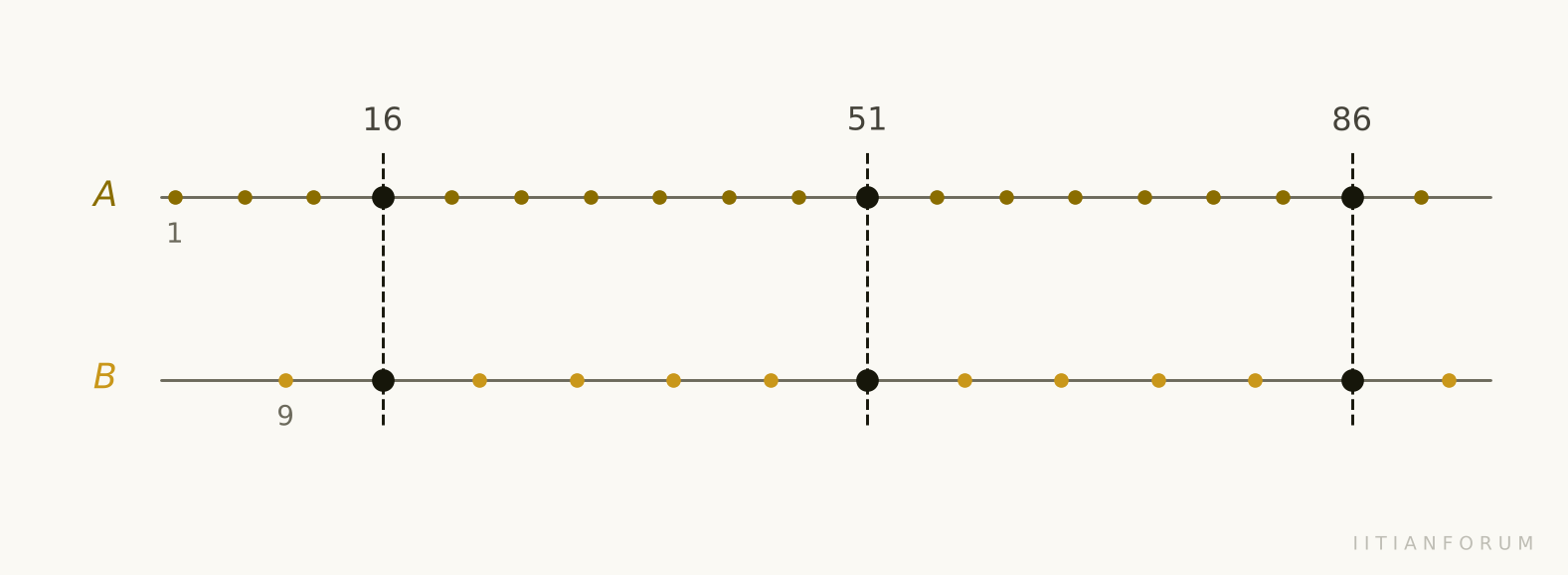
The first common term is 16, and common terms repeat every lcm(5,7)=35.
Two number lines marking the terms of A and of B, with the common terms 16, 51 and 86 joined by dashed lines
Step 2. Range
A ends at 1+100⋅5=501 and B at 9+70⋅7=499, so 16+35k≤499 gives k=0,1,…,13.
Step 3. Divisible by 3
16+35k≡1+2k(mod3), which is 0 when k≡1(mod3): k=1,4,7,10,13.
Answer:5 elements, option (2)
Example 15(JEE Advanced 2018, Paper 1). Let X be the set consisting of the first 2018 terms of the arithmetic progression 1,6,11,…, and Y be the set consisting of the first 2018 terms of the arithmetic progression 9,16,23,…. Then, the number of elements in the set X∪Y is ______.
▸ SHOW SOLUTION
Step 1. Last terms
X ends at 1+2017⋅5=10086 and Y at 9+2017⋅7=14128.
Step 2. Common terms
They are 16+35m, and must not exceed 10086:
35m≤10070⇒m≤287
So there are 288 common terms.
Step 3. Union
n(X∪Y)=2018+2018−288=3748
Answer:3748
Example 16(JEE Advanced 2015, Paper 2). Suppose that all the terms of an arithmetic progression (A.P.) are natural numbers. If the ratio of the sum of the first seven terms to the sum of the first eleven terms is 6:11 and the seventh term lies in between 130 and 140, then the common difference of this A.P. is ______.
▸ SHOW SOLUTION
Step 1. Use the middle-term form of the sums
S7=7a4 and S11=11a6, so
11(a+5d)7(a+3d)=116⇒a=9d
Step 2. Seventh term
a7=a+6d=15d
Step 3. Bounds
130<15d<140 and d is a natural number, so d=9.
Answer:9
Example 17(IIT JEE 2011, Paper 1). Let a1,a2,a3,…,a100 be an arithmetic progression with a1=3 and Sp=i=1∑pai, 1≤p≤100. For any integer n with 1≤n≤20, let m=5n. If SnSm does not depend on n, then a2 is ______.
▸ SHOW SOLUTION
Step 1. Write the ratio
SnS5n=(6−d)+nd5[(6−d)+5nd]
Step 2. Make it free of n
A ratio p+ndp+5nd is constant in n only when p=0 or d=0. Here p=6−d, so d=6 or d=0.
Step 3. Second term
d=6 gives a2=9. The constant AP (d=0) gives a2=3, where every ratio is 5.
Answer:9 (the constant AP also allows 3, so the answer is not unique)
Example 18(JEE Advanced 2013, Paper 1). A pack contains n cards numbered from 1 to n. Two consecutive numbered cards are removed from the pack and the sum of the numbers on the remaining cards is 1224. If the smaller of the numbers on the removed cards is k, then k−20= ______.
▸ SHOW SOLUTION
Step 1. Set up
2n(n+1)−(2k+1)=1224
Step 2. Bound n
Since 1≤k≤n−1, the removed sum 2k+1 lies between 3 and 2n−1, so 2n(n+1) lies between 1227 and 1223+2n. n=49 gives 1225, too small; n=50 gives 1275≤1323; n=51 gives 1326>1325, and larger n only widen the gap. So n=50.
Step 3. Find k
2k+1=1275−1224=51⇒k=25
Answer:k−20=5
Example 19(JEE Advanced 2022, Paper 1). Let l1,l2,…,l100 be consecutive terms of an arithmetic progression with common difference d1, and let w1,w2,…,w100 be consecutive terms of another arithmetic progression with common difference d2, where d1d2=10. For each i=1,2,…,100, let Ri be a rectangle with length li, width wi and area Ai. If A51−A50=1000, then the value of A100−A90 is ______.
Example 20(JEE Main 2026, 22 Jan Shift 2). Among the statements:
(S1): If A(5,−1) and B(−2,3) are two vertices of a triangle whose orthocentre is (0,0), then its third vertex is (−4,−7); and
(S2): If positive numbers 2a,b,c are three consecutive terms of an A.P., then the lines ax+by+c=0 are concurrent at (2,−2).
Tap an option to check your answer
(1)Only (S1) is correct
(2)Only (S2) is correct
(3)Both are incorrect
(4)Both are correct
▸ SHOW SOLUTION
Step 1. Check (S1)
For C(h,k), OA⊥BC and OB⊥AC:
5(h+2)−(k−3)=0−2(h−5)+3(k+1)=0
These give k=5h+13 and 2h−3k=13, so h=−4, k=−7. (S1) is correct.
Step 2. Check (S2)
2a,b,c in AP means 2b=2a+c, that is 2a−2b+c=0. This says exactly that (2,−2) satisfies ax+by+c=0, for every such triple. (S2) is correct.
Answer: option (4)
Example 21(JEE Main 2026, 4 April Shift 2). From a month of 31 days, 3 different dates are selected at random. If the probability that these dates are in an increasing A.P. is ba, where a,b∈N and gcd(a,b)=1, then a+b is equal to ______.
▸ SHOW SOLUTION
Step 1. Count the AP triples
Three numbers p<q<r are in AP when q=2p+r, which needs p and r of the same parity. Each such pair fixes exactly one triple. Among 1,…,31 there are 16 odd and 15 even numbers:
(216)+(215)=120+105=225
Step 2. Probability
(331)225=4495225=89945
Answer:a+b=944
Example 22(JEE Advanced 2026, Paper 2). Let a,b,c be positive integers in arithmetic progression such that the equation ax2+bx+c=0 has only integer solutions. Then which of the following statements is (are) TRUE?
More than one option is correct. Pick all of them, then Check
(A)c−b is an integer multiple of a
(B)Both the roots of the equation ax2+bx+c=0 are odd integers
(C)If c=15, then ab=8
(D)If b=8, then x=3 is a root of the equation ax2+bx+c=0
▸ SHOW SOLUTION
Step 1. Write b and c through the roots p,q
b=−a(p+q),c=apq
Step 2. Use 2b=a+c
−2(p+q)=1+pq(p+2)(q+2)=3
Step 3. Integer solutions
{p+2,q+2}={1,3} or {−1,−3}. The first gives p+q=0 and b=0, which is not allowed. So the roots are −3 and −5, with b=8a and c=15a.
Step 4. Test the statements
(A)c−b=7a, true.
(B)−3 and −5 are odd, true.
(C)c=15 gives a=1, b=8, true.
(D)the roots are negative, so 3 is not a root.
Answer: (A), (B) and (C)
Geometric progression
A sequence of non-zero numbers is a geometric progression (GP) if every term divided by the term before it is the same number r, the common ratio:
anan+1=r for every n
The nth term
Starting from a, each step multiplies by r:
an=arn−1
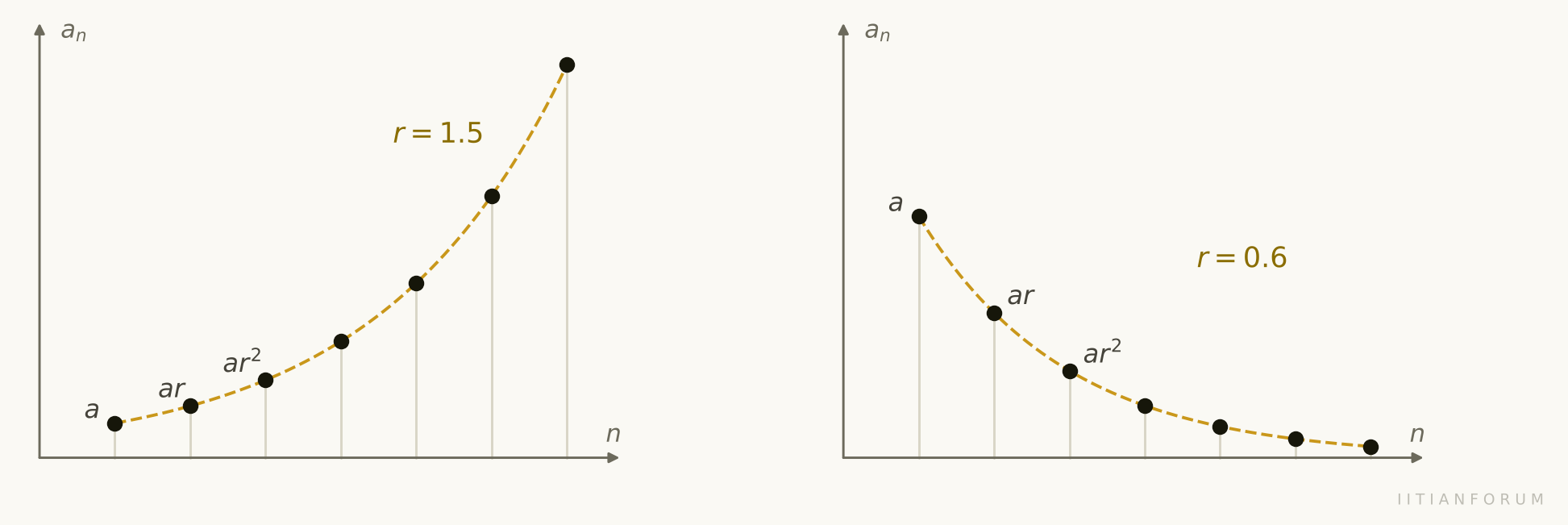
For r>1 and a>0 the terms grow faster and faster; for 0<r<1 they shrink towards 0; for r<0 the signs alternate.
Terms of a GP plotted against n: growing for r equal to 1.5 and decaying for r equal to 0.6
In a GP of m terms with last term l, the nth term from the end is l(r1)n−1.
Sum of n terms
Multiply Sn=a+ar+⋯+arn−1 by r and subtract. All terms except the first and the last cancel:
Sn−rSn=a−arnSn=r−1a(rn−1),r=1
For r=1 every term is a and Sn=na. In terms of the last term l=arn−1, Sn=r−1lr−a.
Infinite GP
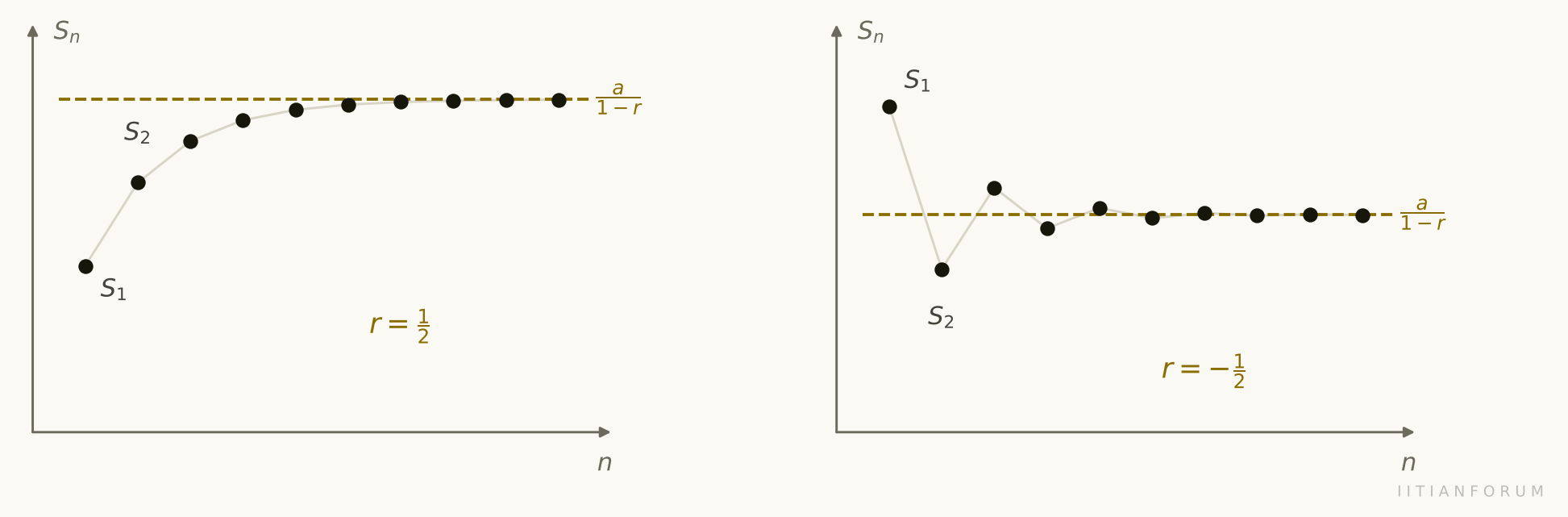
If −1<r<1, then rn→0 as n→∞, so Sn approaches a fixed number:
S∞=1−ra,∣r∣<1
For ∣r∣≥1 (and a=0) the terms do not shrink to 0 and there is no finite sum.
Partial sums of a GP with ratio one half rising to a over one minus r, and with ratio minus one half swinging above and below it
Properties of a GP
Property
Statement
Three terms
a,b,c (non-zero) in GP ⟺b2=ac
Terms equidistant from the ends
akan−k+1=a1an
Multiply every term by k=0
still a GP, same r
Reciprocals
a GP with ratio r1
Powers anp
a GP with ratio rp
Every pth term
a GP with ratio rp
Logarithms of a positive GP
an AP with difference logr
Product of first n terms
anr2n(n−1), which is (a1an)2n for positive terms
swipe for more →
The logarithm row links the two progressions: logan=loga+(n−1)logr is linear in n.
Choosing the terms
When a product is given, choose the terms so that r cancels in the product.
Number of terms
Terms
Common ratio
3
ra,a,ar
r
4
r3a,ra,ar,ar3
r2
5
r2a,ra,a,ar,ar2
r
swipe for more →
The choice $\frac{a}{r^3},\frac ar,ar,ar^3$ hides negative ratios
Its ratio is r2, which is never negative. If a question allows four terms with alternating signs, write a,ar,ar2,ar3 instead.
Examples
Example 23(JEE Main 2026, 21 Jan Shift 2). Let 2a2,22a3,…,29a10 be a G.P. of common ratio 21. If a1+a2+⋯+a10=62, then a1 is equal to
Tap an option to check your answer
(1)2(2−1)
(2)2−2
(3)2−1
(4)2(2−2)
▸ SHOW SOLUTION
Step 1. Ratio of the ak
ak/2k−1ak+1/2k=2akak+1=21⇒akak+1=2
So a1,…,a10 is a GP with ratio 2.
Step 2. Sum
2−1a1((2)10−1)=2−131a1=62a1=2(2−1)
Answer: option (1)
Example 24(JEE Main 2026, 21 Jan Shift 1). Let a1,a2,a3,… be a G.P. of increasing positive terms such that a2a3a4=64 and a1+a3+a5=7813. Then a3+a5+a7 is equal to
Tap an option to check your answer
(1)3256
(2)3252
(3)3244
(4)3248
▸ SHOW SOLUTION
Step 1. The product fixes the middle term
a2a3a4=a33=64⇒a3=4
Step 2. The second condition
With u=r2, a1+a3+a5=4(u1+1+u):
28u2−785u+28=0⇒u=28or281
The terms increase, so r2=28.
Step 3. Required sum
a3+a5+a7=4(1+28+784)=3252
Answer: option (2)
Example 25(JEE Main 2026, 28 Jan Shift 1). In a G.P., if the product of the first three terms is 27 and the set of all possible values for the sum of its first three terms is R−(a,b), then a2+b2 is equal to ______.
▸ SHOW SOLUTION
Step 1. Choose the terms
Take rA,A,Ar. The product is A3=27, so A=3 and
S=3(1+r+r1)
Step 2. Range of r+r1
For r>0, r+r1≥2; for r<0, r+r1≤−2.
Step 3. Range of S
S≥9 or S≤−3, so S∈R−(−3,9).
Answer:a2+b2=9+81=90
Example 26(JEE Main 2026, 6 April Shift 2). Consider the quadratic equation (n2−2n+2)x2−3x+(n2−2n+2)2=0, n∈R. Let α be the minimum value of the product of its roots and β be the maximum value of the sum of its roots. Then the sum of the first six terms of the G.P. whose first term is α and common ratio is βα is
Tap an option to check your answer
(1)3761
(2)81121
(3)243364
(4)7291093
▸ SHOW SOLUTION
Step 1. Find α and β
Put k=n2−2n+2=(n−1)2+1≥1. The product of roots is k, least value α=1. The sum of roots is k3, greatest value β=3.
Step 2. Sum of six terms
First term 1, ratio 31:
S6=1−311−3−6=23⋅729728=243364
Answer: option (3)
Example 27(JEE Main 2026, 6 April Shift 1). For the functions f(θ)=αtan2θ+βcot2θ and g(θ)=αsin2θ+βcos2θ, α>β>0, let 0<θ<π/2minf(θ)=0<θ<πmaxg(θ). If the first term of a G.P. is (2βα), its common ratio is (α2β), and the sum of its first 10 terms is nm with gcd(m,n)=1, then m+n is equal to ______.
▸ SHOW SOLUTION
Step 1. Minimum of f
The two terms have product αβ, so by AM and GM, f≥2αβ, with equality when tan4θ=αβ.
Step 2. Maximum of g
g=(α−β)sin2θ+β, largest value α at θ=2π.
Step 3. Equate
2αβ=α⇒α=4β
So the GP has first term 2 and ratio 21.
Step 4. Sum of ten terms
S10=1/22(1−2−10)=2561023
Answer:m+n=1279
Example 28(JEE Main 2026, 22 Jan Shift 2). Let f and g be functions satisfying f(x+y)=f(x)f(y) and g(x+y)=g(xy), with f(1)=7 and g(1)=1, for all x,y∈N. If x=1∑ng(x)f(x)=19607, then n is equal to
Tap an option to check your answer
(1)7
(2)5
(3)6
(4)4
▸ SHOW SOLUTION
Step 1. Find f and g
y=1 gives f(x+1)=7f(x), so f(x)=7x. Also g(x+1)=g(x), so g(x)=g(1)=1.
Step 2. The sum is a GP
x=1∑n7x=67(7n−1)=19607
Step 3. Solve
7n−1=16806, so 7n=16807=75.
Answer:n=5, option (2)
Example 29(JEE Main 2026, 28 Jan Shift 2). 3266+32510⋅1+32410⋅2+32310⋅22+⋯+310⋅224 is equal to
Tap an option to check your answer
(1)225
(2)226
(3)325
(4)326
▸ SHOW SOLUTION
Step 1. The tail is a GP
325−j10⋅2j=32510⋅6j,j=0,1,…,24
Step 2. Sum the tail
32510⋅5625−1=3252⋅625−2
Step 3. Add the first term
3266=3252, which cancels the −2:
S=3252⋅625=2⋅225=226
Answer: option (2)
Example 30(JEE Main 2026, 24 Jan Shift 1). Let 729,81,9,1,… be a sequence and Pn denote the product of the first n terms of this sequence. If 2n=1∑40(Pn)1/n=3β3α−1 and gcd(α,β)=1, then α+β is equal to
Tap an option to check your answer
(1)73
(2)74
(3)75
(4)76
▸ SHOW SOLUTION
Step 1. Exponents form an AP
an=38−2n, so Pn=36+4+⋯+(8−2n) and the exponent is
2n[6+(8−2n)]=n(7−n)
Step 2. The nth root
(Pn)1/n=37−n
Step 3. Sum the GP
n=1∑4037−n=36⋅2/31−3−40=2⋅333340−1
So 2∑=333340−1, α=40, β=33.
Answer:α+β=73, option (1)
Example 31(JEE Main 2026, 5 April Shift 2). Let α,β be the roots of x2−x+p=0 and γ,δ be the roots of x2−4x+q=0; p,q∈Z. If α,β,γ,δ are in G.P., then ∣p+q∣ equals
Tap an option to check your answer
(1)16
(2)32
(3)34
(4)38
▸ SHOW SOLUTION
Step 1. Write the four roots
Let them be a,ar,ar2,ar3. Then a(1+r)=1 and ar2(1+r)=4, so r2=4.
Step 2. Test r=2
a=31 and p=a2r=92, not an integer. Reject.
Step 3. Take r=−2
a(1−2)=1 gives a=−1:
p=a2r=−2,q=a2r5=−32
Answer:∣p+q∣=34, option (3)
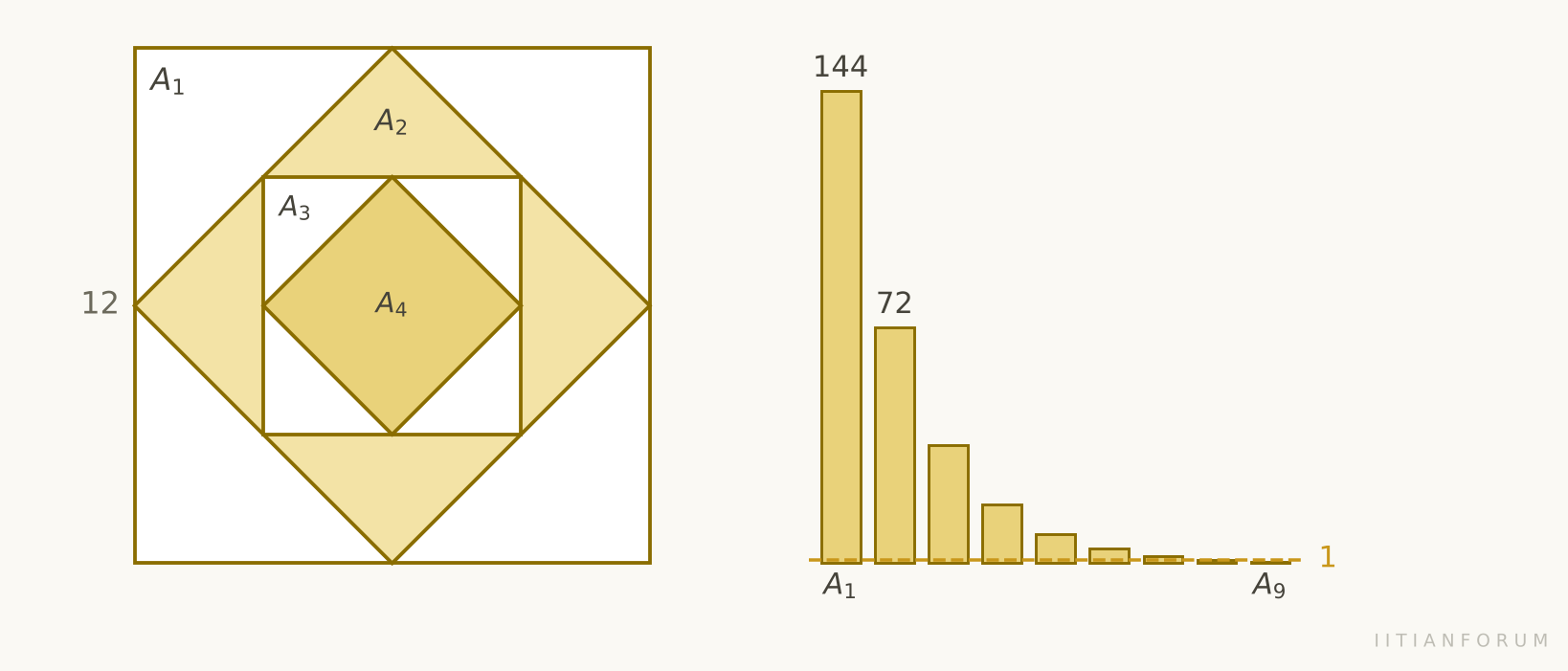
Example 32(JEE Main 2021, 25 Feb Shift 1). Let A1,A2,A3,… be squares such that for each n≥1, the length of the side of An equals the length of the diagonal of An+1. If the length of the side of A1 is 12 cm, then the smallest value of n for which the area of An is less than one, is ______.
▸ SHOW SOLUTION
Step 1. Ratio of sides
A square of side s has diagonal s2. Here side of An=2× side of An+1, so the sides form a GP with ratio 21 and the areas a GP with ratio 21.
Four nested squares, each one turned through half a right angle inside the previous one, beside bars of their areas halving from 144
Step 2. Area of An
area(An)=2n−1144
Step 3. Least n
2n−1>144 needs n−1≥8, since 27=128 and 28=256.
Answer:n=9
Example 33(JEE Advanced 2014, Paper 1). Let a,b,c be positive integers such that ab is an integer. If a,b,c are in geometric progression and the arithmetic mean of a,b,c is b+2, then the value of a+1a2+a−14 is ______.
▸ SHOW SOLUTION
Step 1. Write the terms
b=ar and c=ar2, with r a positive integer.
Step 2. Use the mean
a+ar+ar2=3ar+6⇒a(r−1)2=6
Step 3. Integer solution
(r−1)2 must be a square that divides 6, so (r−1)2=1. Then r=2 (since r=0 makes b=0) and a=6.
Step 4. Evaluate
736+6−14=4
Answer:4
Example 34(JEE Advanced 2025, Paper 1). Let R denote the set of all real numbers. Let f:R→R be a function such that f(x)>0 for all x∈R, and f(x+y)=f(x)f(y) for all x,y∈R. Let the real numbers a1,a2,…,a50 be in an arithmetic progression. If f(a31)=64f(a25), and i=1∑50f(ai)=3(225+1), then the value of i=6∑30f(ai) is ______.
▸ SHOW SOLUTION
Step 1. f turns an AP into a GP
f(ai+1)=f(ai+d)=f(ai)f(d), so f(a1),f(a2),… is a GP with ratio q=f(d)>0.
Step 2. Find the ratio
f(a31)=f(a25)q6=64f(a25)⇒q=2
Step 3. Use the total
f(a1)(250−1)=3(225+1)
250−1=(225−1)(225+1), so f(a1)=225−13.
Step 4. Required sum
i=6∑30f(ai)=f(a1)⋅25(225−1)=96
Answer:96
Example 35(JEE Advanced 2016, Paper 2). Let bi>1 for i=1,2,…,101. Suppose logeb1,logeb2,…,logeb101 are in Arithmetic Progression (A.P.) with the common difference loge2. Suppose a1,a2,…,a101 are in A.P. such that a1=b1 and a51=b51. If t=b1+b2+⋯+b51 and s=a1+a2+⋯+a51, then
Tap an option to check your answer
(A)s>t and a101>b101
(B)s>t and a101<b101
(C)s<t and a101>b101
(D)s<t and a101<b101
▸ SHOW SOLUTION
Step 1. The bi form a GP
logbi is an AP with difference log2, so bi=b12i−1.
Step 2. Compare s and t
t=b1(251−1)s=251(b1+b1250)>251b1250>t
Step 3. Compare the 101st terms
a101=2a51−a1=b1(251−1), while b101=b12100, which is far larger.
Answer: option (B)
Examples on the infinite GP
Example 36(JEE Main 2026, 4 April Shift 2). Let α=41+81+161+⋯∞ and β=31+91+271+⋯∞. Then the value of (0.2)log5(α)+(0.04)log5(β) is
Tap an option to check your answer
(1)4
(2)5
(3)8
(4)25
▸ SHOW SOLUTION
Step 1. The two sums
α=1−1/21/4=21,β=1−1/31/3=21
Step 2. First term
0.2=(5)−2, so
(0.2)log5α=(5log5α)−2=α−2=4
Step 3. Second term
0.04=5−2, so (0.04)log5β=β−2=4.
Answer:4+4=8, option (3)
Example 37(JEE Main 2019, 11 Jan Shift 1). The sum of an infinite geometric series with positive terms is 3 and the sum of the cubes of its terms is 1927. Then the common ratio of this series is
Tap an option to check your answer
(1)31
(2)32
(3)92
(4)94
▸ SHOW SOLUTION
Step 1. Two equations
The cubes form a GP with ratio r3:
1−ra=3,1−r3a3=1927
Step 2. Eliminate a
Put a=3(1−r) and cancel 1−r:
1+r+r2(1−r)2=191⇒6r2−13r+6=0
Step 3. Choose the root
r=32 or 23, and an infinite sum needs r<1.
Answer: option (2)
Example 38(JEE Main 2026, 24 Jan Shift 2). The sum
(31+74)+(321+31⋅74+7242)+⋯
where the kth bracket holds every product (31)i(74)j with i+j=k, up to infinite terms, is equal to
Tap an option to check your answer
(1)25
(2)47
(3)34
(4)56
▸ SHOW SOLUTION
Step 1. Each bracket is a finite GP
With a=74 and b=31, the kth bracket is
i+j=k∑ajbi=a−bak+1−bk+1
Step 2. Add over k≥1
S=a−b1(1−aa2−1−bb2)
Step 3. Substitute
1−aa2=2116, 1−bb2=61 and a−b=215:
S=521⋅4225=25
Answer: option (1)
AP and GP together
Many questions name two progressions and link them. The working rule is the same every time: give each progression its own unknowns (a,d for the AP; b,r for the GP), turn every condition into an equation, and use the three-term tests 2b=a+c and b2=ac.
Situation
Unknowns that work
Three numbers in AP, sum given
b−d,b,b+d
Three numbers in GP, product given
rb,b,br
AP and GP with the same first term
a,a+d,… and a,ar,…
A GP shifted by constants becomes an AP
write the GP as a,ar,ar2,…
swipe for more →
Examples
Example 39(JEE Main 2026, 2 April Shift 2). Let a1,a2,a3,… be an A.P. and g1=a1,g2,g3,… be an increasing G.P. If a1=a2+g2=1 and a3+g3=4, then a10+g5 is equal to
Tap an option to check your answer
(A)81
(B)76
(C)62
(D)55
▸ SHOW SOLUTION
Step 1. Unknowns
a1=g1=1, an=1+(n−1)d, gn=rn−1.
Step 2. Two equations
(1+d)+r=1⇒d=−r(1+2d)+r2=4⇒r2−2r−3=0
Step 3. Choose r
r=3 or r=−1; the GP increases, so r=3 and d=−3.
Step 4. Required value
a10+g5=(1−27)+81=55
Answer: option (D)
Example 40(JEE Main 2026, 6 April Shift 1). The sum of the first ten terms of an A.P. is 160 and the sum of the first two terms of a G.P. is 8. If the first term of the A.P. is equal to the common ratio of the G.P. and the first term of the G.P. is equal to the common difference of the A.P., then the sum of all possible values of the first term of the G.P. is
Tap an option to check your answer
(1)934
(2)1334
(3)932
(4)1332
▸ SHOW SOLUTION
Step 1. Name the unknowns
AP: first term a, difference d. GP: first term d, ratio a.
5(2a+9d)=160⇒2a+9d=32d+da=8
Step 2. Eliminate a
a=232−9d, so
d⋅234−9d=8⇒9d2−34d+16=0
Step 3. Sum of roots
Both roots are real (discriminant 580>0), and their sum is 934.
Answer: option (1)
Example 41(JEE Main 2026, 22 Jan Shift 2). Suppose a,b,c are in A.P. and a2,2b2,c2 are in G.P. If a<b<c and a+b+c=1, then 9(a2+b2+c2) is equal to ______.
▸ SHOW SOLUTION
Step 1. Choose the AP
a=b−d, c=b+d, d>0. The sum gives b=31.
Step 2. GP condition
4b4=a2c2⇒(b2−d2)2=814
b2−d2=92 gives d2<0, so b2−d2=−92 and d2=31.
Step 3. Sum of squares
a2+b2+c2=3b2+2d2=31+32=1
Answer:9
Example 42(JEE Main 2025, 7 April Shift 1). Let x1,x2,x3,x4 be in a geometric progression. If 2,7,9,5 are subtracted respectively from x1,x2,x3,x4, then the resulting numbers are in an arithmetic progression. Then the value of 241(x1x2x3x4) is
Tap an option to check your answer
(1)72
(2)18
(3)36
(4)216
▸ SHOW SOLUTION
Step 1. Equal differences
With xk=ark−1, the numbers a−2,ar−7,ar2−9,ar3−5 are in AP:
a(r−1)−5=ar(r−1)−2ar(r−1)−2=ar2(r−1)+4
Step 2. Subtract in pairs
a(r−1)2=−3,ar(r−1)2=−6
Dividing, r=2, and then a=−3.
Step 3. Product
The GP is −3,−6,−12,−24, with product 5184.
Answer:245184=216, option (4)
Example 43(JEE Main 2019, 10 Apr Shift 2). Let a,b and c be in G.P. with common ratio r, where a=0 and 0<r≤21. If 3a,7b and 15c are the first three terms of an A.P., then the 4th term of this A.P. is
Tap an option to check your answer
(1)a
(2)37a
(3)5a
(4)32a
▸ SHOW SOLUTION
Step 1. AP condition
14ar=3a+15ar215r2−14r+3=0
Step 2. Choose r
r=31 or 53; only 31≤21.
Step 3. The AP
3a,37a,35a with difference −32a, so the fourth term is 35a−32a=a.
Answer: option (1)
Example 44(JEE Advanced 2020, Paper 1). Let a1,a2,a3,… be a sequence of positive integers in arithmetic progression with common difference 2. Also, let b1,b2,b3,… be a sequence of positive integers in geometric progression with common ratio 2. If a1=b1=c, then the number of all possible values of c, for which the equality 2(a1+a2+⋯+an)=b1+b2+⋯+bn holds for some positive integer n, is ______.
▸ SHOW SOLUTION
Step 1. Both sums
2[nc+n(n−1)]=c(2n−1)c=2n−1−2n2n(n−1)
Step 2. Try small n
n=1 gives c=0 and n=2 gives a negative value. n=3 gives c=112=12. For n=4,5,6 the values are 724,2140,5160, not integers.
Step 3. Large n
For n≥7, 2n−1−2n>2n(n−1), so 0<c<1 and c is not a positive integer.
Answer:1
Harmonic progression
A sequence of non-zero numbers is a harmonic progression (HP) if the reciprocals of its terms form an AP:
a1,a2,…HP⟺a11,a21,…AP
For example 1,31,51,71,… is an HP because 1,3,5,7,… is an AP.
The nth term
There is no formula for the sum of an HP. Every HP question is solved by turning to the AP of reciprocals, doing the work there, and turning back. If the reciprocal AP has first term a1 and difference D,
an=a1+(n−1)D1
Three terms in HP
a,b,cin HP⟺b2=a1+c1b=a+c2ac
Two equivalent forms are often quicker:
ca=b−ca−bb−ab+a+b−cb+c=2
Inserting harmonic means
To insert H1,…,Hn between a and b, insert n arithmetic means between a1 and b1:
D=(n+1)aba−b,Hk1=a1+kD
Examples
Example 45. The fourth term of a harmonic progression is 53 and its ninth term is 103. Then its fourteenth term is
Tap an option to check your answer
(A)51
(B)203
(C)61
(D)253
▸ SHOW SOLUTION
Step 1. Pass to the reciprocal AP
The AP has fourth term 35 and ninth term 310:
5D=310−35⇒D=31
Step 2. Fourteenth term of the AP
310+5⋅31=5
Step 3. Return to the HP
The fourteenth term of the HP is 51.
Answer: option (A)
Example 46(IITianForum). Let 2,b,c be in A.P., b,c,d be in G.P. and c,d,e be in H.P. If e=18 and c>0, then b+d is equal to
Tap an option to check your answer
(A)12
(B)13
(C)15
(D)17
▸ SHOW SOLUTION
Step 1. Express d and e through a=2 and c
AP: b=2a+c. GP: d=bc2=a+c2c2.
Step 2. HP condition
d2=c1+e1⇒e=2c−dcd
Substituting d:
e=2ac/(a+c)2c3/(a+c)=ac2
So a,c,e are in GP, a result worth remembering.
Step 3. Values
c2=2⋅18=36 and c>0, so c=6, b=4, d=436=9. Check: d2=92=61+181.
Answer:b+d=13, option (B)
Arithmetic, geometric and harmonic means
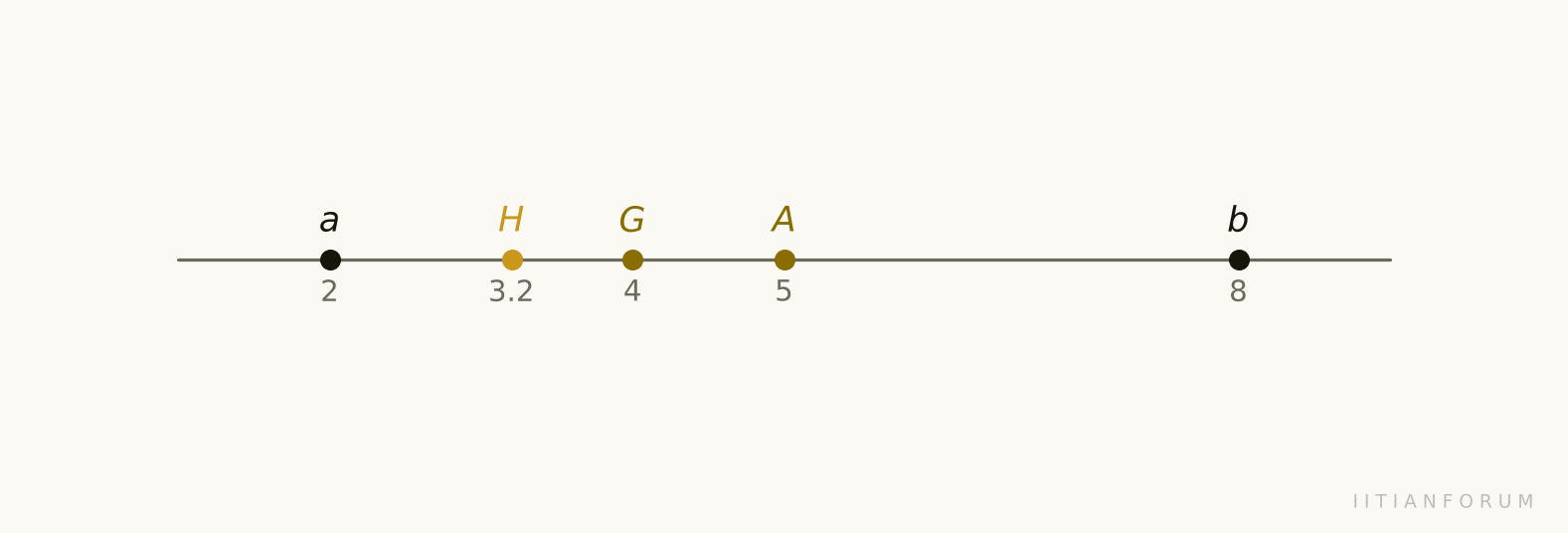
For two positive numbers a and b, the three means are
A=2a+b,G=ab,H=a+b2ab
A is the middle term of an AP a,A,b; G of a GP a,G,b; H of an HP a,H,b.
On a number line from a equal to 2 to b equal to 8, the harmonic mean 3.2, the geometric mean 4 and the arithmetic mean 5
Results on the three means
Result
Statement
Order
A≥G≥H, equality only when a=b
Link
G2=AH, so A,G,H are in GP
Numbers from A and G
roots of x2−2Ax+G2=0, that is A±A2−G2
n arithmetic means
sum =2n(a+b)
n geometric means
product =(ab)n
n harmonic means
AkHn+1−k=ab
Three numbers a,b,c
roots of x3−3Ax2+H3G3x−G3=0
swipe for more →
The order A≥G comes from one square:
A−G=2(a−b)2≥0
and G≥H follows from G2=AH with A≥G.
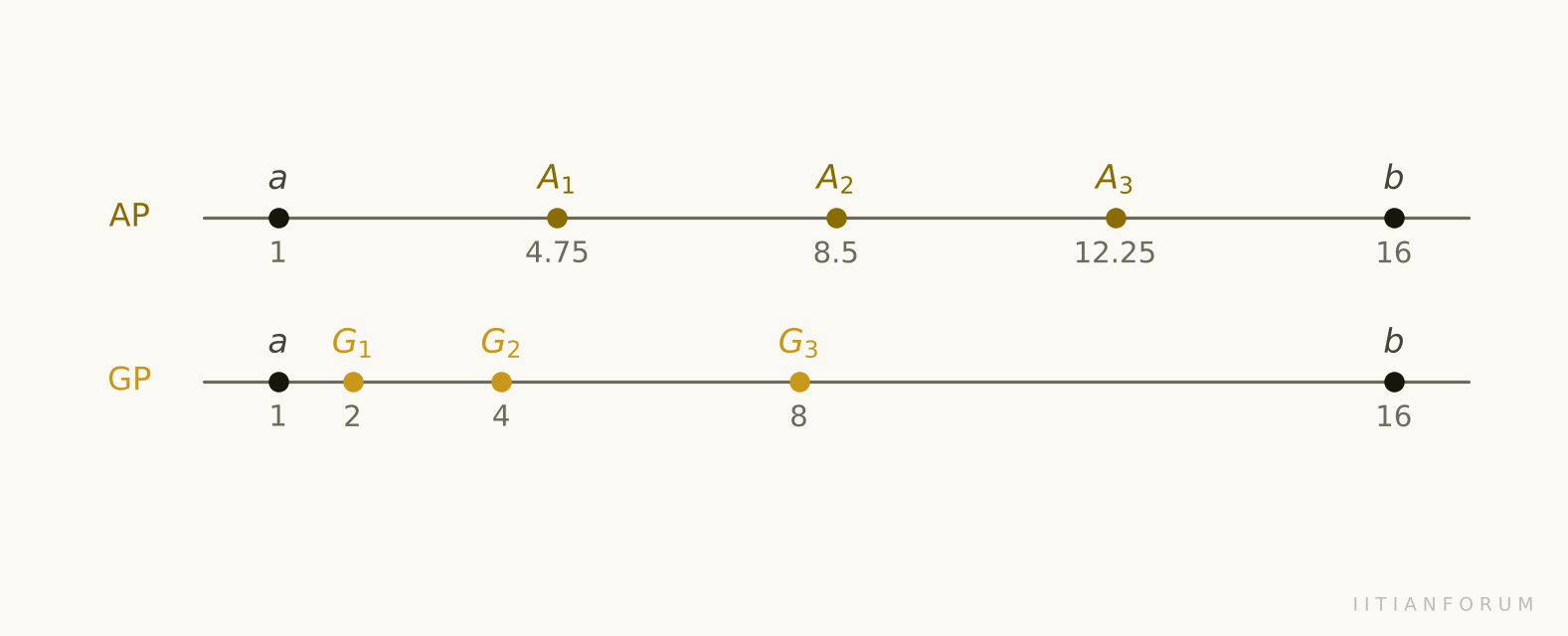
Three arithmetic means between 1 and 16 equally spaced, and three geometric means 2, 4 and 8 crowding towards the smaller end
The inserted arithmetic means divide the gap from a to b into equal parts; the geometric means divide it in equal ratios, so they crowd towards the smaller number.
Where the inequality is used
Finding the least value of a sum with a fixed product, or the greatest product with a fixed sum, is the main use of A≥G≥H. That work, with the proofs for n numbers and the standard inequalities, is in the Relation Between AM, GM and HM note.
Examples
Example 47(JEE Main 2023, 11 Apr Shift 1). Let x1,x2,…,x100 be in an arithmetic progression, with x1=2 and their mean equal to 200. If yi=i(xi−i), 1≤i≤100, then the mean of y1,y2,…,y100 is
Tap an option to check your answer
(1)10100
(2)10101.50
(3)10049.50
(4)10051.50
▸ SHOW SOLUTION
Step 1. Common difference
The mean of an AP is the mean of its first and last terms:
22+x100=200⇒x100=398,d=4
Step 2. Write yi
xi=4i−2, so
yi=i(3i−2)=3i2−2i
Step 3. Mean
1003(338350)−2(5050)=10049.5
Answer: option (3)
Example 48(IITianForum). Let Ai, Gi and Hi(i=1,2,…,5) be the five arithmetic means, five geometric means and five harmonic means inserted between 3 and 48. Then A2H4+(G1G2G3G4G5)1/5 is equal to
Tap an option to check your answer
(A)144
(B)150
(C)156
(D)168
▸ SHOW SOLUTION
Step 1. Arithmetic mean A2
d=648−3=215, so A2=3+15=18.
Step 2. Harmonic mean H4
D=61(481−31)=−965H41=31−9620=81
So H4=8 and A2H4=144=3⋅48, as the table says.
Step 3. Geometric means
The product of the five means is (144)5, so its fifth root is 12.
Answer:144+12=156, option (C)
Arithmetico-geometric progression
Multiplying an AP term by term with a GP gives an arithmetico-geometric progression (AGP):
a,(a+d)r,(a+2d)r2,…Tn=[a+(n−1)d]rn−1Bars of the terms n times 0.6 to the power n minus 1, rising for two steps and then falling towards zero
Summing an AGP: multiply by r and subtract
Write S, write rS shifted by one place, and subtract. The AP parts differ by d in every column, so what remains is a GP:
S−rS=a+(dr+dr2+⋯+drn−1)−[a+(n−1)d]rn
For an infinite AGP with ∣r∣<1, the last term goes to 0:
S∞=1−ra+(1−r)2dr
Two special cases are worth knowing by heart:
k=1∑∞kxk−1=(1−x)21,∣x∣<1k=1∑nk2k=(n−1)2n+1+2
Multiply by the ratio of the GP part
The method does not need the formula. In any sum of the form (AP term) × (GP term), multiply by the ratio, shift by one place and subtract. The same method works when the bracket is a quadratic in n; then repeat it once more.
Examples
Example 49(JEE Main 2025, 24 Jan Shift 2). If 7=5+71(5+α)+721(5+2α)+731(5+3α)+⋯∞, then the value of α is
Tap an option to check your answer
(1)1
(2)76
(3)6
(4)71
▸ SHOW SOLUTION
Step 1. Split the series
k≥1∑7k5+kα=5k≥1∑7k1+αk≥1∑7kk
Step 2. The two sums
k≥1∑7k1=61,k≥1∑7kk=(6/7)21/7=367
Step 3. Solve
7=5+65+367α⇒367α=67
Answer:α=6, option (3)
Example 50(IITianForum). The value of the infinite product 21/2⋅41/4⋅81/8⋅161/16⋯ is
Tap an option to check your answer
(A)2
(B)22
(C)4
(D)8
▸ SHOW SOLUTION
Step 1. Write every factor as a power of 2
(2k)1/2k=2k/2k
Step 2. Add the exponents
S=21+42+83+…
This is an AGP. 21S=41+82+…, and subtracting,
21S=21+41+81+⋯=1
Step 3. Product
S=2, so the product is 22=4.
Answer: option (C)
Example 51. The sum 1⋅2+2⋅22+3⋅23+⋯+10⋅210 is equal to
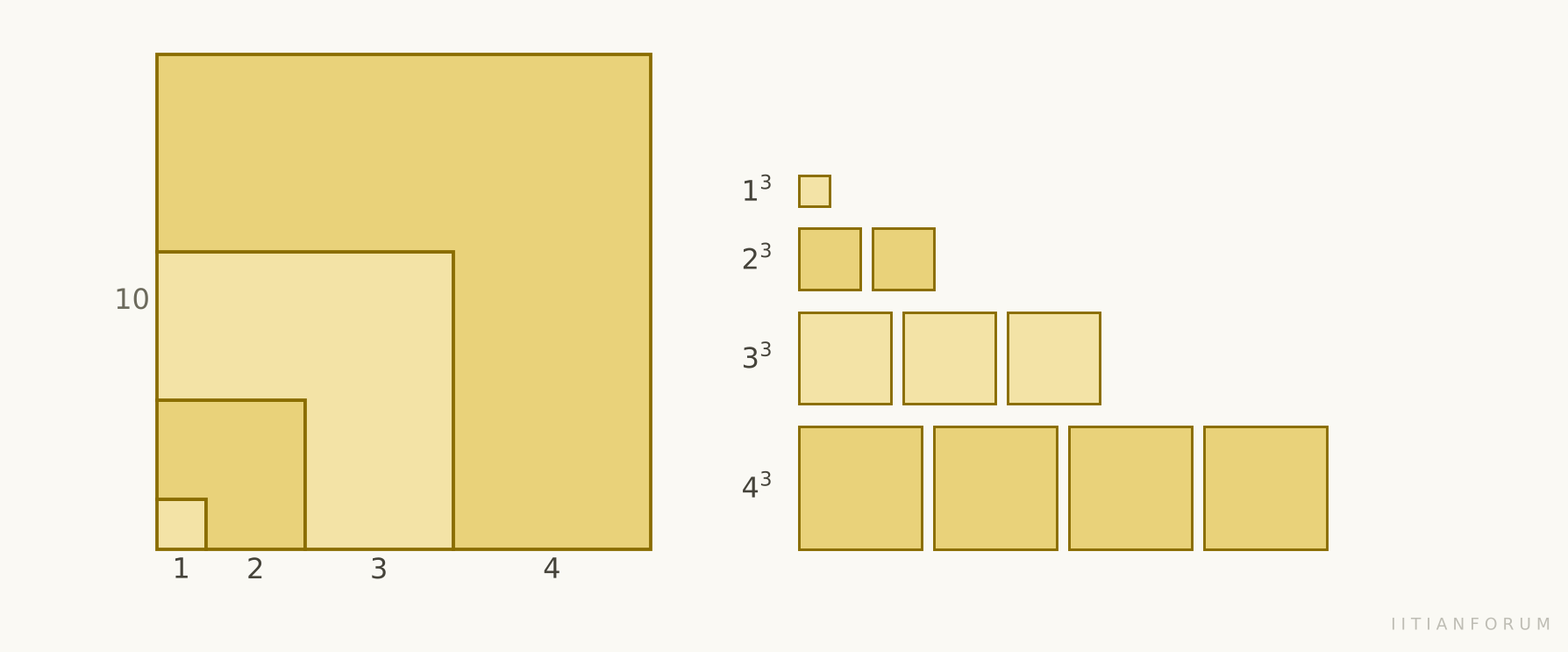
The first is the AP sum. For the second, add (k+1)3−k3=3k2+3k+1 from k=1 to n; the left side collapses to (n+1)3−1, and solving for ∑k2 gives the formula. The third has a picture: a square of side 1+2+⋯+n splits into L-shaped strips, and the strip of width k has area k3.
A square of side 1 plus 2 plus 3 plus 4 split into L-shaped strips of widths 1 to 4, beside k copies of a k by k square for each k
Summing any polynomial term
If Tk is a polynomial in k, expand it and use the three formulas term by term:
k=1∑n(ak3+bk2+ck+e)=a∑k3+b∑k2+c∑k+ne
Sum
Value
1+3+5+⋯+(2n−1)
n2
2+4+⋯+2n
n(n+1)
∑k=1nk(k+1)
3n(n+1)(n+2)
∑k=1nk(k+1)(k+2)
4n(n+1)(n+2)(n+3)
∑k=1nk4
30n(n+1)(2n+1)(3n2+3n−1)
swipe for more →
Find the general term before summing
In a series like 113+1+313+23+… the numerator and denominator of the kth term are themselves sums. Simplify Tk to a polynomial first, then sum. Summing numerators and denominators separately is wrong.
Examples
Example 52(JEE Main 2026, 2 April Shift 2). The sum 113+1+313+23+1+3+513+23+33+⋯ up to 8 terms, is
Tap an option to check your answer
(A)70
(B)71
(C)72
(D)73
▸ SHOW SOLUTION
Step 1. General term
Tk=k2[2k(k+1)]2=4(k+1)2
Step 2. Sum
k=1∑84(k+1)2=422+32+⋯+92=4285−1=71
Answer:71, option (B)
Example 53(JEE Main 2026, 6 April Shift 2). The sum 1+21(12+22)+31(12+22+32)+⋯ up to 10 terms is equal to
Tap an option to check your answer
(1)130
(2)155
(3)2315
(4)2325
▸ SHOW SOLUTION
Step 1. General term
Tk=k1⋅6k(k+1)(2k+1)Tk=62k2+3k+1
Step 2. Sum
k=1∑10Tk=62(385)+3(55)+10=6945
Answer:2315, option (3)
Example 54(JEE Main 2026, 6 April Shift 1). The value of 13−23+33−⋯+153 is
Tap an option to check your answer
(1)1706
(2)1856
(3)1982
(4)2403
▸ SHOW SOLUTION
Step 1. Take all cubes, then remove the even ones twice
k=1∑15k3−2j=1∑7(2j)3
Step 2. Evaluate
14400−16⋅784=14400−12544
Answer:1856, option (2)
Example 55(JEE Main 2019, 12 Jan Shift 2). If the sum of the first 15 terms of the series (43)3+(121)3+(241)3+33+(343)3+⋯ is equal to 225K, then K is equal to
Tap an option to check your answer
(1)9
(2)27
(3)54
(4)108
▸ SHOW SOLUTION
Step 1. General term
The bases are 43,46,49,…, so Tk=(43k)3.
Step 2. Sum
6427(215⋅16)2=6427⋅14400=6075
Answer:K=2256075=27, option (2)
Example 56(JEE Main 2026, 2 April Shift 1). Let α,α+2, α∈Z, be the roots of the quadratic equation x(x+2)+(x+1)(x+3)+(x+2)(x+4)+⋯+(x+n−1)(x+n+1)=4n for some n∈N. Then (n+α) is equal to
Tap an option to check your answer
(1)0
(2)1
(3)2
(4)3
▸ SHOW SOLUTION
Step 1. Sum the left side
(x+k−1)(x+k+1)=(x+k)2−1. Adding for k=1 to n and dividing by n:
x2+(n+1)x+6(n+1)(2n+1)=5
Step 2. Roots differ by 2
For a monic quadratic, (difference of roots)2=B2−4C:
(n+1)2−64(n+1)(2n+1)+20=4
This simplifies to n2=49, so n=7.
Step 3. Roots
x2+8x+15=0 gives x=−5,−3, so α=−5.
Answer:n+α=2, option (3)
Example 57(JEE Main 2026, 21 Jan Shift 2). The positive integer n, for which the solutions of the equation x(x+2)+(x+2)(x+4)+⋯+(x+2n−2)(x+2n)=38n are two consecutive even integers, is
Tap an option to check your answer
(1)3
(2)6
(3)12
(4)9
▸ SHOW SOLUTION
Step 1. Sum the left side
(x+2k−2)(x+2k)=x2+(4k−2)x+4k(k−1), and
k=1∑n4k(k−1)=34(n−1)n(n+1)
Step 2. The quadratic
Dividing by n:
x2+2nx+34n2−12=0
Step 3. Roots differ by 2
4n2−34(4n2−12)=4⇒n2=9
So n=3, and the roots of x2+6x+8=0 are −4 and −2.
Answer: option (1)
Example 58(JEE Main 2026, 8 April Shift 2). Let α=3+4+8+9+13+14+⋯ upto 40 terms. If (tanβ)α/1020 is a root of x2+x−2=0, β∈(0,2π), then sin2β+3cos2β is equal to
Tap an option to check your answer
(1)2
(2)47
(3)25
(4)23
▸ SHOW SOLUTION
Step 1. Group in pairs
The pairs are (3,4),(8,9),(13,14),…, with sums 7,17,27,…: an AP of 20 terms.
α=220(14+19⋅10)=2040
Step 2. The root
1020α=2, so tan2β is a root of (x−1)(x+2)=0. It is positive, so tan2β=1 and β=4π.
Step 3. Value
21+3⋅21=2
Answer: option (1)
Example 59(JEE Advanced 2013, Paper 1). Let Sn=k=1∑4n(−1)2k(k+1)k2. Then Sn can take value(s)
More than one option is correct. Pick all of them, then Check
(A)1056
(B)1088
(C)1120
(D)1332
▸ SHOW SOLUTION
Step 1. Sign pattern
2k(k+1) for k=1,2,3,4 is 1,3,6,10, so the signs run −,−,+,+ and repeat every four terms.
Step 2. One block of four
For k=4m+1 to 4m+4:
(4m+3)2−(4m+1)2=2(8m+4)(4m+4)2−(4m+2)2=2(8m+6)sum of the block=32m+20
Step 3. Add n blocks
Sn=m=0∑n−1(32m+20)=16n2+4n
Step 4. Test the options
n=8 gives 1056 and n=9 gives 1332. 1088 and 1120 fall between and are not of this form.
Answer: (A) and (D)
Example 60(IITianForum). The sum of the first 20 terms of the series 12+2⋅22+32+2⋅42+52+2⋅62+⋯ is
Tap an option to check your answer
(A)2870
(B)4410
(C)5740
(D)4200
▸ SHOW SOLUTION
Step 1. Split the weights
Every square appears once, and the even squares appear once more:
S=k=1∑20k2+j=1∑10(2j)2
Step 2. Evaluate
2870+4⋅385=2870+1540
Answer:4410, option (B)
Example 61(JEE Main 2025, 8 April Shift 2). If 141+241+341+⋯∞=90π4, 141+341+541+⋯∞=α, 241+441+641+⋯∞=β, then βα is equal to
Tap an option to check your answer
(1)23
(2)18
(3)15
(4)14
▸ SHOW SOLUTION
Step 1. The even part is a multiple of the whole
β=∑(2k)41=161⋅90π4
Step 2. The odd part
α=90π4−β=1615⋅90π4
Answer:βα=15, option (3)
Method of differences
If the kth term can be written as the difference of two consecutive values of one function,
Tk=Vk−Vk−1
then the sum collapses, every middle value cancelling with its neighbour:
k=1∑nTk=Vn−V0
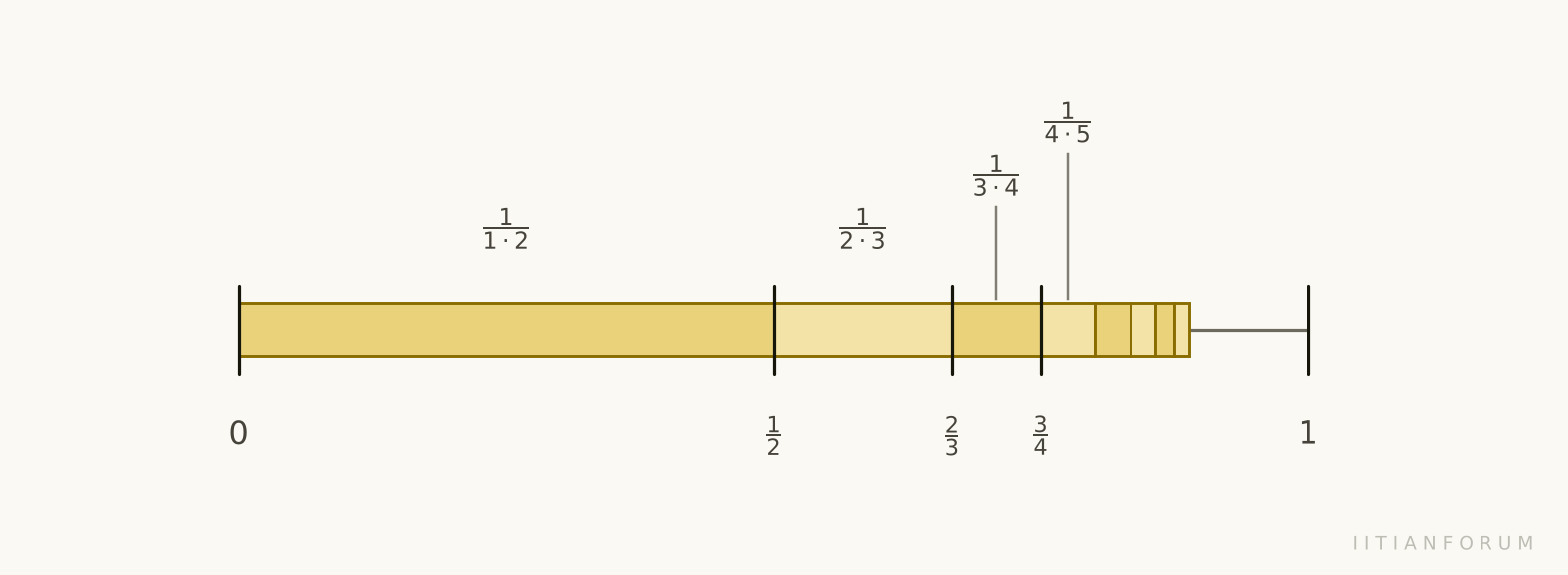
This is a telescoping sum. The cut of the unit segment below shows it for k(k+1)1=k1−k+11: the pieces fill [0,1) and the first n of them reach 1−n+11.
The unit segment cut into pieces of lengths one over 1 times 2, one over 2 times 3, and so on, with cut points one half, two thirds, three quarters
Standard splittings
Term
Splitting
k(k+1)1
k1−k+11
k(k+1)(k+2)1
21[k(k+1)1−(k+1)(k+2)1]
k(k+1)(k+2)
41[k(k+1)(k+2)(k+3)−(k−1)k(k+1)(k+2)]
k4+k2+1k
21[k2−k+11−k2+k+11]
k+k+11
k+1−k
k2(k+1)22k+1
k21−(k+1)21
swipe for more →
The fourth row rests on a factorisation used again and again:
k4+k2+1=(k2−k+1)(k2+k+1)
and (k+1)2−(k+1)+1=k2+k+1, so the second factor at k is the first factor at k+1.
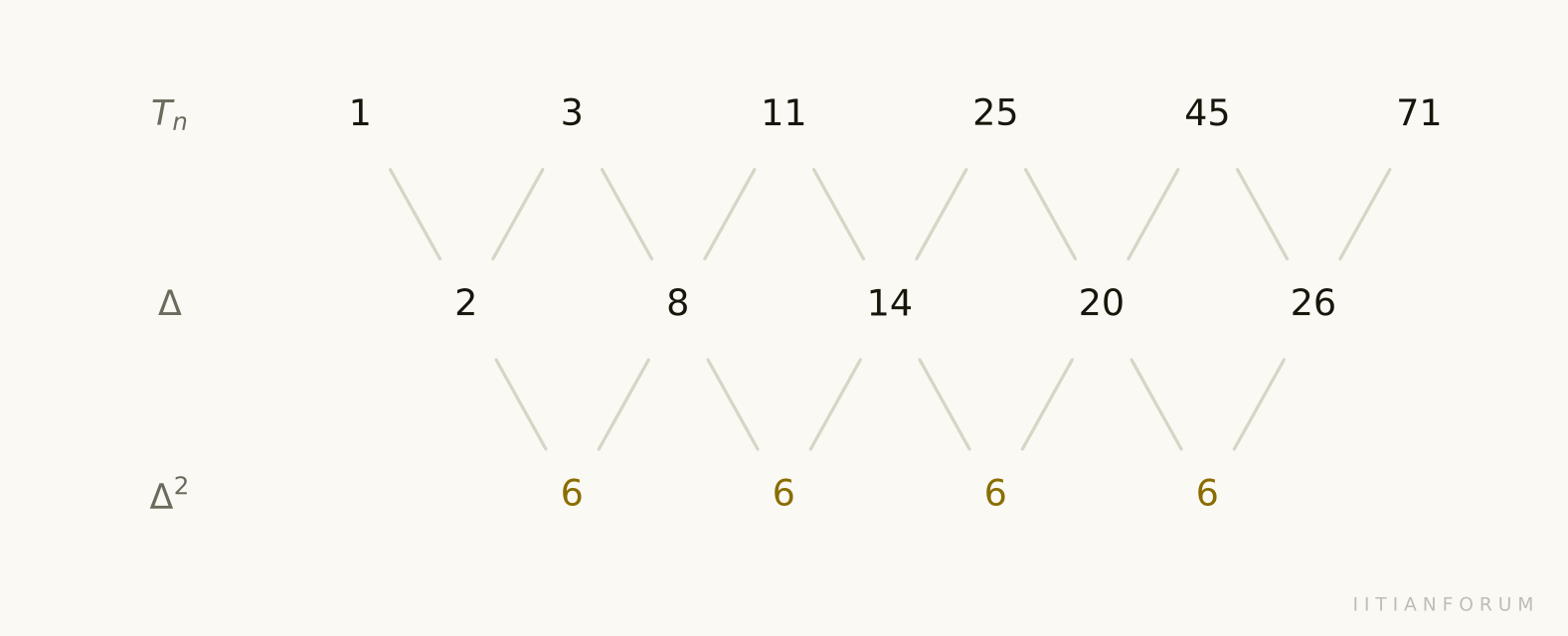
Finding Tn from differences of terms
When the terms themselves are not given by a formula, look at the differences of consecutive terms.
A difference table for 1, 3, 11, 25, 45, 71 with first differences 2, 8, 14, 20, 26 and constant second differences 6
Differences T2−T1,T3−T2,…
Form of Tn
constant
an+b
in AP
an2+bn+c
second differences in AP
an3+bn2+cn+e
in GP with ratio r
arn−1+b
second differences in GP with ratio r
arn−1+bn+c
swipe for more →
Then find the constants from the first few terms. The same idea in one line: if Tn−Tn−1=tn for n≥2, then
Tn=T1+k=2∑ntk
Examples
Example 62(JEE Main 2026, 5 April Shift 1). n=1∑10n(n+1)(n+2)528 is equal to
Tap an option to check your answer
(1)65
(2)130
(3)220
(4)440
▸ SHOW SOLUTION
Step 1. Telescope
n=1∑10n(n+1)(n+2)1=21[1⋅21−11⋅121]
Step 2. Evaluate
21⋅13265=26465
Answer:528⋅26465=130, option (2)
Example 63(JEE Main 2026, 28 Jan Shift 2). If r=1∑25r4+r2+1r=qp, where p,q are positive integers with gcd(p,q)=1, then p+q is equal to ______.
▸ SHOW SOLUTION
Step 1. Split the term
r4+r2+12r=r2−r+11−r2+r+11
Step 2. Telescope
r=1∑25=21[1−6511]=651325
325=52⋅13 and 651=3⋅7⋅31 share no factor.
Answer:p+q=976
Example 64(JEE Main 2026, 5 April Shift 2). If the sum of the first 10 terms of the series 1+14⋅41+1+24⋅42+1+34⋅43+⋯ is nm, gcd(m,n)=1, then m+n is equal to
Tap an option to check your answer
(1)256
(2)264
(3)276
(4)284
▸ SHOW SOLUTION
Step 1. Factor the denominator
1+4r4=(2r2+1)2−(2r)2=(2r2−2r+1)(2r2+2r+1)
Step 2. Split
The two factors differ by 4r, so
1+4r44r=2r2−2r+11−2r2+2r+11
and 2(r+1)2−2(r+1)+1=2r2+2r+1, so it telescopes.
Step 3. Sum
41[1−2211]=22155
Answer:m+n=276, option (3)
Example 65(IITianForum). If n=1∑20n2(n+1)22n+1=qp with gcd(p,q)=1, then p+q is equal to ______.
▸ SHOW SOLUTION
Step 1. Split
(n+1)2−n2=2n+1, so
n2(n+1)22n+1=n21−(n+1)21
Step 2. Telescope
n=1∑20=1−4411=441440
Answer:p+q=881
Example 66(IITianForum). The value of n=3∑∞ln(1−n24) is
Tap an option to check your answer
(A)−ln6
(B)−ln3
(C)−ln12
(D)ln6
▸ SHOW SOLUTION
Step 1. Turn the sum into a product
n=3∑Nln(1−n24)=lnn=3∏Nn⋅n(n−2)(n+2)
Step 2. Each half of the product telescopes
n=3∏Nnn−2=(N−1)N1⋅2n=3∏Nnn+2=3⋅4(N+1)(N+2)
Step 3. Let N→∞
The product tends to 122=61, so the sum tends to ln61.
The term at k∘ carries the sign (−1)k, and k and 180−k have the same parity. So the terms at 61∘ and 119∘ cancel, those at 62∘ and 118∘ cancel, and so on up to 89∘ and 91∘. Left are cot60∘ and cot90∘=0:
αsin1∘=31
Answer:(αcosec1∘)2=3
Example 68(JEE Main 2025, 3 April Shift 1). The sum 1+3+11+25+45+71+⋯ up to 20 terms is equal to
Tap an option to check your answer
(1)7240
(2)7130
(3)6982
(4)8124
▸ SHOW SOLUTION
Step 1. Differences
The first differences 2,8,14,20,26 form an AP, so Tn=an2+bn+c.
Step 2. Constants
From T1=1, T2=3, T3=11: a=3, b=−7, c=5.
Tn=3n2−7n+5
Step 3. Sum
3(2870)−7(210)+100=7240
Answer: option (1)
Example 69(IITianForum). A sequence a1,a2,… has a1=5 and an−an−1=n2 for every n≥2. If ak=389, then k is equal to
Tap an option to check your answer
(A)8
(B)9
(C)10
(D)12
▸ SHOW SOLUTION
Step 1. Add the differences
ak=5+n=2∑kn2=4+6k(k+1)(2k+1)
Step 2. Solve
6k(k+1)(2k+1)=385=610⋅11⋅21
Answer:k=10, option (C)
Example 70(JEE Advanced 2022, Paper 1). Let a1,a2,a3,… be an arithmetic progression with a1=7 and common difference 8. Let T1,T2,T3,… be such that T1=3 and Tn+1−Tn=an for n≥1. Then, which of the following is/are TRUE?
More than one option is correct. Pick all of them, then Check
A recurrence gives each term from the earlier ones, for example an+2=5an+1−6an. Three patterns cover most JEE questions.
Recurrence
What to do
an+1−an=f(n)
add the differences: an=a1+∑k=1n−1f(k)
an+1=kan+f(n)
find g(n) with g(n+1)=kg(n)+f(n); then an−g(n) is a GP
pan+2=qan+1+san with p=q+s
rewrite as p(an+2−an+1)=−s(an+1−an): the differences form a GP
ak=2ak−1−ak−2
the sequence is an AP
an+2=an+1+an
Fibonacci type; sum by multiplying by x and x2 and subtracting
swipe for more →
A sum like ∑anxn for a recurrence is found by the same multiply and subtract method used for the AGP: write S, xS, x2S and use the recurrence to cancel.
Examples
Example 71(JEE Main 2025, 28 Jan Shift 1). Let ⟨an⟩ be a sequence such that a0=0, a1=21 and 2an+2=5an+1−3an, n=0,1,2,3,…. Then k=1∑100ak is equal to
Tap an option to check your answer
(1)3a99−100
(2)3a100−100
(3)3a100+100
(4)3a99+100
▸ SHOW SOLUTION
Step 1. Differences form a GP
2(an+2−an+1)=3(an+1−an)
So an+1−an=21(23)n.
Step 2. Find an
an=k=0∑n−121(23)k=(23)n−1
Step 3. Sum
k=1∑100ak=3[(23)100−1]−100=3a100−100
Answer: option (2)
Example 72(IIT JEE 2010, Paper 2). Let a1,a2,a3,…,a11 be real numbers satisfying a1=15, 27−2a2>0 and ak=2ak−1−ak−2 for k=3,4,…,11. If 11a12+a22+⋯+a112=90, then the value of 11a1+a2+⋯+a11 is equal to ______.
▸ SHOW SOLUTION
Step 1. The recurrence gives an AP
ak−ak−1=ak−1−ak−2, so ak=15+(k−1)d.
Step 2. Sum of squares
i=0∑10(15+id)2=9907d2+30d+27=0
So d=−3 or d=−79.
Step 3. Use the condition
27−2a2>0 means a2<13.5, so d<−1.5 and d=−3.
Step 4. Mean
The mean of an AP of 11 terms is its middle term a6=15−15.
Answer:0
Example 73(JEE Advanced 2019, Paper 1). Let α and β be the roots of x2−x−1=0, with α>β. For all positive integers n, define an=α−βαn−βn, n≥1, b1=1 and bn=an−1+an+1, n≥2. Then which of the following options is/are correct?
More than one option is correct. Pick all of them, then Check
(A)a1+a2+a3+⋯+an=an+2−1 for all n≥1
(B)n=1∑∞10nan=8910
(C)bn=αn+βn for all n≥1
(D)n=1∑∞10nbn=898
▸ SHOW SOLUTION
Step 1. The recurrence
α2=α+1 and β2=β+1 give an+2=an+1+an, with a1=a2=1.
Step 2. Option (A)
ak=ak+2−ak+1, so the sum telescopes to an+2−a2=an+2−1. True.
Step 3. Option (B)
Let S=∑anxn with x=101. Using the recurrence,
S−xS−x2S=a1x=xS=0.890.1=8910
True.
Step 4. Option (C)
With αβ=−1, α+α1=α−β and β+β1=β−α. Then
an−1+an+1=α−βαn(α−β)+βn(α−β)=αn+βn
and b1=1=α+β. True.
Step 5. Option (D)
∑10nαn+∑10nβn=10−αα+10−ββ, which works out to 8912. False.
Answer: (A), (B) and (C)
Example 74(JEE Main 2026, 21 Jan Shift 1). Let a1=1 and for n≥1, an+1=21an+n2(n+1)2n2−2n−1. Then n=1∑∞(an−n22) is equal to ______.
▸ SHOW SOLUTION
Step 1. Split the extra term
(n+1)22−n21=n2(n+1)2n2−2n−1
Step 2. Rewrite the recurrence
With bn=an−n22:
bn+1+(n+1)22=21bn+n21+(n+1)22−n21
So bn+1=21bn, a GP.
Step 3. Sum the GP
b1=1−2=−1, so bn=−(21)n−1 and ∑bn=−2.
Answer:2
Bounding a sum
When a sum has no closed form, it can still be trapped between two sums that do. If every term lies between m and M, the sum of n terms lies between nm and nM. When both bounds tend to the same limit, so does the sum (the sandwich theorem).
Example 75. The value of n→∞limk=1∑nn2+kn is
Tap an option to check your answer
(A)0
(B)21
(C)1
(D)2
▸ SHOW SOLUTION
Step 1. Bound each term
For 1≤k≤n:
n2+nn≤n2+kn≤n2+1n
Step 2. Bound the sum
n2+nn2≤k=1∑nn2+kn≤n2+1n2
Step 3. Limit
Both bounds tend to 1.
Answer: option (C)
Which method to use
What you see
Method
Sn given as a formula
an=Sn−Sn−1, and a1=S1 separately
Sum of a few AP terms given
choose a−d,a,a+d or a−3d,…,a+3d
Product of a few GP terms given
choose ra,a,ar
Terms equidistant from the ends
pair them: equal sums (AP), equal products (GP)
Ratio of two AP sums
Sn=n× middle term; replace n by 2n−1
Common terms of two APs
an AP with difference lcm(d1,d2)
HP
work with the AP of reciprocals
(AP term) × (GP term)
multiply by r, shift, subtract
Polynomial Tk
expand, use ∑k,∑k2,∑k3
Fraction Tk
split into Vk−Vk−1
Terms like 1,3,11,25,…
difference table
Recurrence
differences, a shift to a GP, or multiply and subtract
No closed form, limit asked
bound each term and sandwich
swipe for more →
What JEE asks
JEE Main asks one or two questions from this chapter in nearly every shift. In 2026 the most frequent types were: conditions on an AP solved with a and d (Examples 4 to 8 and 13), products and sums of GP terms (Examples 23 to 31), AP and GP linked in one question (Examples 39 to 41), sums whose general term is a polynomial (Examples 52 to 54 and 56 to 58), and telescoping fractions with k4+k2+1 or 1+4k4 in the denominator (Examples 62 to 64). Two 2026 shifts asked for a quadratic built from a sum of products whose roots differ by 2 (Examples 56 and 57).
JEE Advanced asks fewer but deeper questions: an AP carried into a GP by f(x+y)=f(x)f(y) (Example 34) and a trigonometric telescoping sum (Example 67) in 2025, coefficients in AP with integer roots (Example 22) in 2026, and in earlier years common terms of two APs, the sign pattern (−1)k(k+1)/2, recurrences of Fibonacci type and sums defined by differences (Examples 15, 59, 70 and 73).
Quick recall
Result
Statement
an from Sn
an=Sn−Sn−1, a1=S1
AP term
a+(n−1)d
AP sum
2n[2a+(n−1)d]=2n(a+l)
AP test
an linear in n; Sn=An2+Bn
GP term
arn−1
GP sum
r−1a(rn−1), r=1
Infinite GP
1−ra, ∣r∣<1
HP
reciprocals in AP; b=a+c2ac
Means
A≥G≥H, G2=AH
n inserted AMs
d=n+1b−a, sum 2n(a+b)
n inserted GMs
r=(ab)n+11, product (ab)2n
Infinite AGP
1−ra+(1−r)2dr
∑k, ∑k2, ∑k3
2n(n+1), 6n(n+1)(2n+1), [2n(n+1)]2
Telescoping
∑(Vk−Vk−1)=Vn−V0
k4+k2+1
(k2−k+1)(k2+k+1)
swipe for more →
Before you leave this chapter
Without a pen, answer these four: the sum 1+3+5+⋯+99; the sum of the infinite GP 6+2+32+…; the value of ∑k=19k(k+1)1; and the HM of 3 and 6. If 2500, 9, 109 and 4 came quickly, the chapter is in place.
Practise these methods on real exam questions in the doMath Sequence and Series chapter. Maxima and minima by A≥G≥H are developed in the Relation Between AM, GM and HM note, and quadratic equations, which appear in several examples here, in the Quadratic Equations note.