Solution of Triangles for JEE: Every Formula, Proved and Solved
Ritesh Raj · 3 Sept 2026
Aa
38 min read19 sectionsConcept
A triangle has six elements: three sides and three angles. Give me any three of them, one of which is a side, and the triangle is fixed. Everything else, every remaining side, every remaining angle, the area, the radius of the circle through the vertices, the radius of the circle inside it, is then a computation and nothing more.
This chapter is that computation, done properly. The sine rule and the cosine rule are the two engines. The half angle formulae are the bridge that turns any angle condition into a statement about s, a, b and c. After that come the four centres, the four circles, and the handful of identities that JEE keeps coming back to. Everything below is proved, not asserted, and every worked example was re-derived from scratch before it was written down.
The six elements and what fixes a triangle
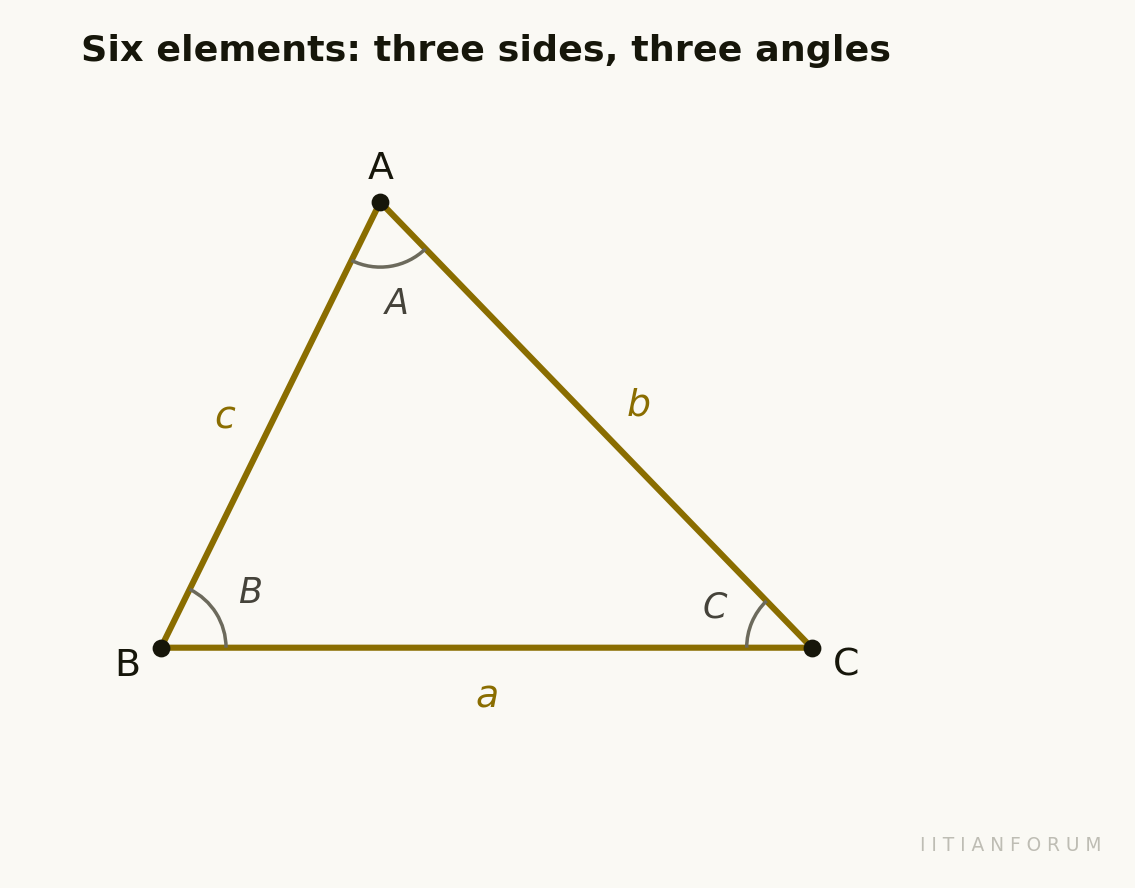
Write the standard labels once and never change them. In △ABC the angles at the vertices are A, B, C, and the side opposite each is a, b, c respectively.
Triangle ABC with sides a, b, c opposite the angles A, B, C
Three facts hold in every triangle and are used constantly without comment:
A+B+C=180∘a+b>c,b+c>a,c+a>ba>b⟺A>B
The semi-perimeter is the single most useful abbreviation in the chapter:
s=2a+b+c
so that s−a=2b+c−a, and each of s−a, s−b, s−c is strictly positive.
Which three elements are enough
Three sides (SSS), two sides and the angle between them (SAS), two angles and any side (AAS or ASA) each fix the triangle completely. Two sides and an angle not between them (SSA) may fix nothing, one triangle, or two. That is the ambiguous case, and it has its own section below.
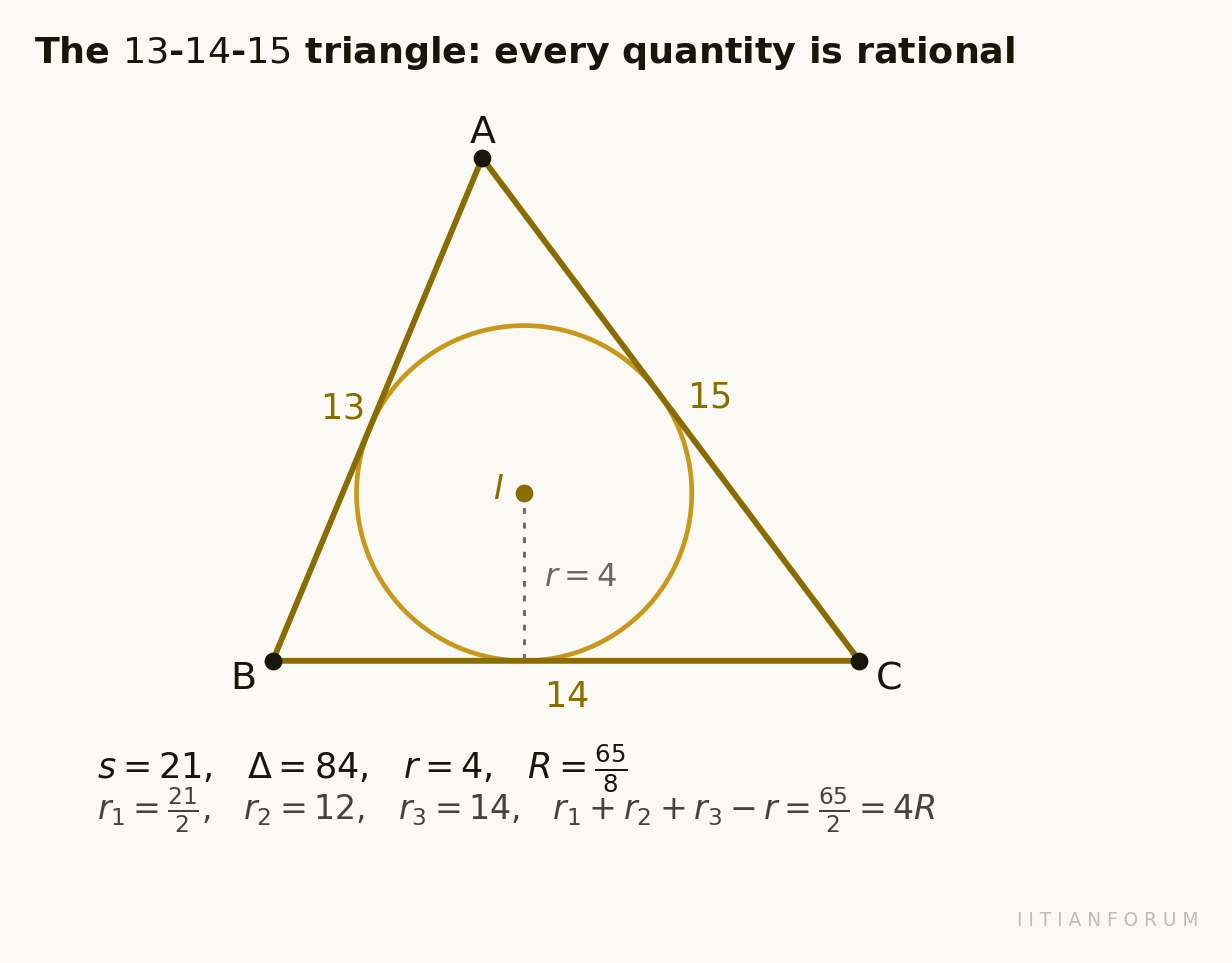
Example 1(IITianForum). In △ABC, a=13, b=14, c=15. Find cosA, the area, the inradius and the circumradius.
This triangle is worth memorising. Its area, its inradius, its circumradius and all three exradii are rational, which makes it the cleanest possible test case for any identity you are unsure of.
The 13-14-15 triangle with its incircle and the values of s, area, r and R
Sine rule and the circumcircle
The circle through the three vertices is the circumcircle; its centre is the circumcentre O and its radius is R.
sinAa=sinBb=sinCc=2R
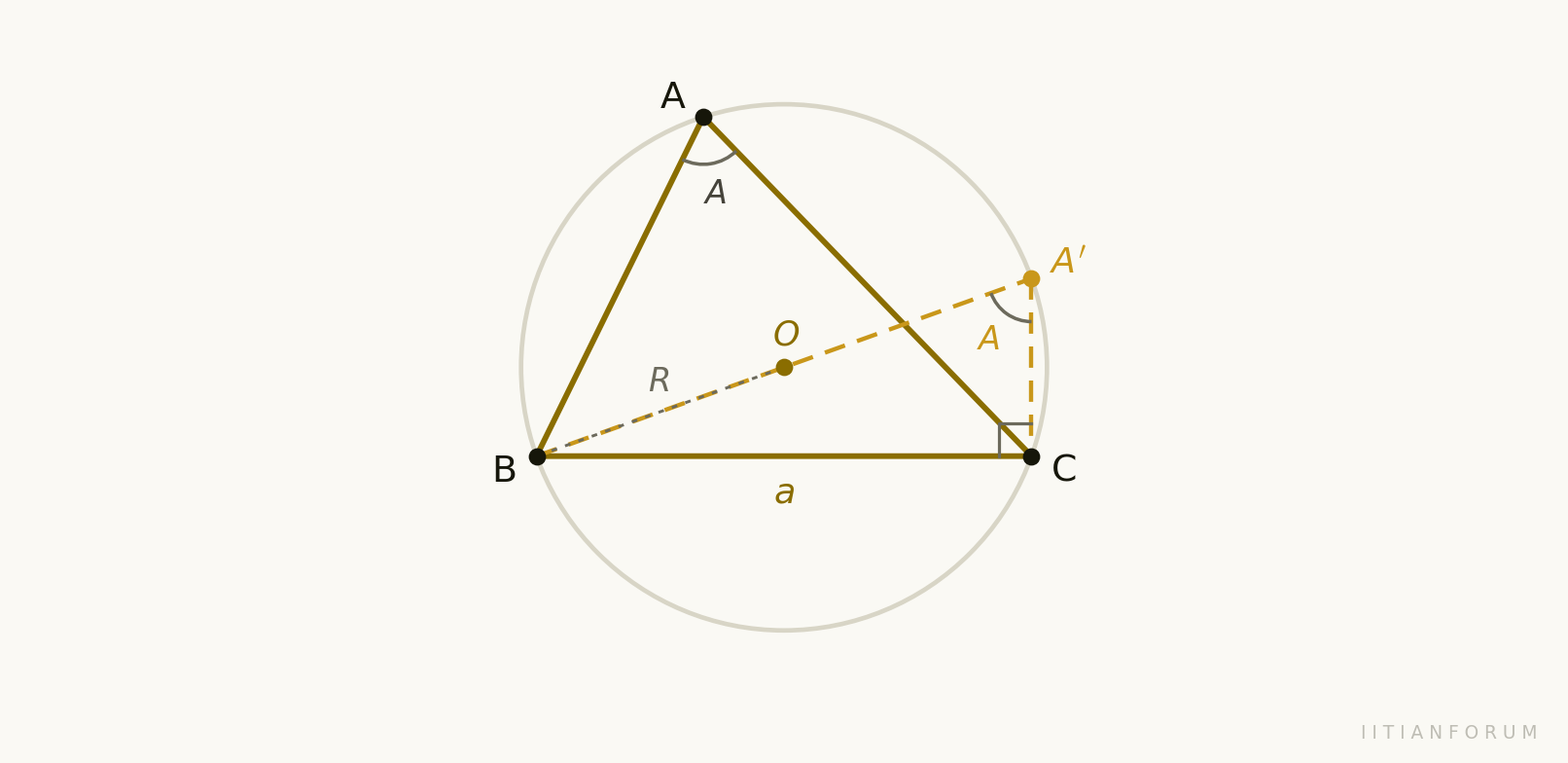
Proof. Draw the circumcircle and let BA′ be the diameter through B. The angle in a semicircle is a right angle, so ∠BCA′=90∘. Angles ∠BA′C and ∠BAC stand on the same arc BC, so ∠BA′C=A. In the right triangle BCA′,
a=BC=BA′sinA=2RsinA
The same argument at the other two vertices gives the other two ratios. If A is obtuse the point A′ lies on the other arc and ∠BA′C=180∘−A, whose sine is still sinA, so the result is unchanged.
Circumcircle with the diameter BA-prime used to prove a = 2R sin A
Three forms of the same statement are worth having in your hands at once:
a=2RsinA,b=2RsinBc=2RsinCsinA=2Ra,sinB=2RbsinC=2Rca:b:c=sinA:sinB:sinC
The third line is the one that turns a condition on the sides into a condition on the angles, and back again. Whenever a question mixes sides and sines, convert everything to one or the other before doing anything else.
The substitution that clears most identity questions
Put a=2RsinA, b=2RsinB, c=2RsinC. Every R cancels in a homogeneous expression, and what is left is pure trigonometry in A, B, C with A+B+C=180∘.
Example 2(IITianForum). In △ABC, A=30∘ and a=8. Find R, and find b if B=45∘.
▸ SHOW SOLUTION
Step 1. Get 2R from the given pair
2R=sinAa=sin30∘8=1/28=16
so R=8.
Step 2. Use the same constant for b
b=2RsinB=16sin45∘=16⋅22b=82
Answer:R=8 and b=82.
Example 3(JEE Main 2026, 4 April Shift 2). Let A and B be points on the two half-lines x−3∣y∣=α, α>0, at a distance α from their point of intersection P. The segment AB meets the angle bisector of the half-lines at Q. If PQ=29 and R is the circumradius of △PAB, find Rα2.
▸ SHOW SOLUTION
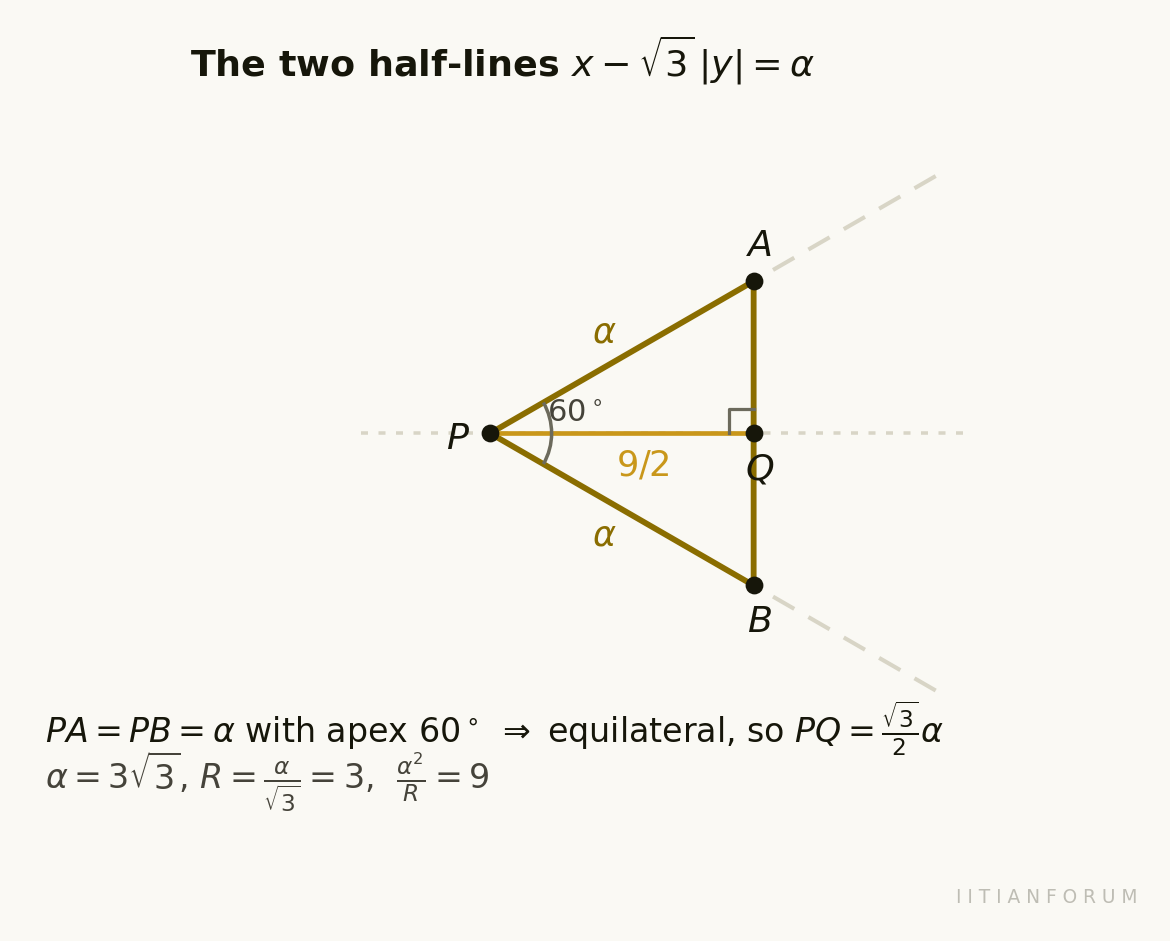
The two half-lines meeting at P with the equilateral triangle PAB and the median PQ
Step 1. Split the modulus and find the apex angle
x−3∣y∣=α is the pair of half-lines
x−3y=αandx+3y=α
meeting at P(α,0). Their slopes are 31 and −31, so each makes 30∘ with the x-axis and the angle at P is 60∘.
Step 2. Recognise the triangle
PA=PB=α with an included angle of 60∘, so △PAB is equilateral of side α.
Step 3. Use the median
The bisector of the apex angle is the x-axis, and it meets AB at its midpoint Q. In an equilateral triangle the median is 23 times the side:
23α=29⟹α=39=33
Step 4. Circumradius of an equilateral triangle
R=2sinAa=2sin60∘α=3α=3Rα2=327=9
Answer:9.
The whole question is the sine rule applied once, after one line of reading. The half-lines are a disguise for "isosceles with a 60∘ apex", and that phrase always means equilateral.
Cosine rule
The cosine rule is what you reach for whenever an angle sits between two known sides, or whenever all three sides are known.
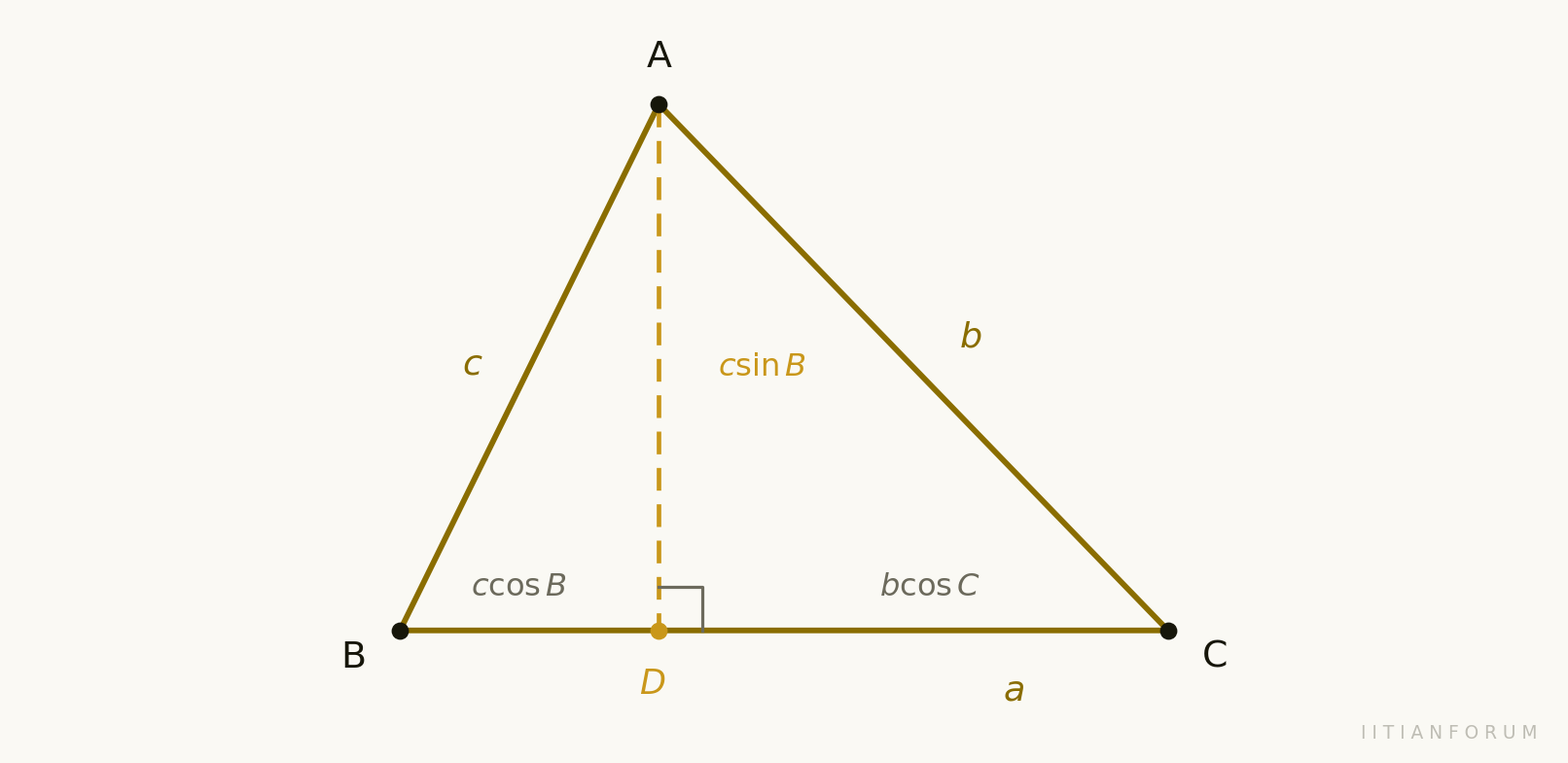
Proof. Drop the perpendicular AD from A onto BC. In the right triangle ABD, BD=ccosB and AD=csinB, so DC=a−ccosB. Pythagoras in ADC gives
b2=(csinB)2+(a−ccosB)2
and using sin2B+cos2B=1 this collapses to
b2=a2+c2−2accosB
If B is obtuse the foot D falls outside BC and BD=ccosB is negative, which is exactly what the algebra above already assumes. No separate case is needed.
Cosine rule proved by dropping one altitude and applying Pythagoras
Rearranged, the same statement reads
a2=b2+c2−2bccosA
and this is the form to use when the angle is given and the opposite side is wanted.
The sign that decides the shape
a2=b2+c2−2bccosA says the sign of b2+c2−a2 is the sign of cosA. So a2<b2+c2 means A is acute, a2=b2+c2 means A is right, and a2>b2+c2 means A is obtuse. Test the largest side only. Checking a smaller side proves nothing, because the angle opposite it was never going to be the obtuse one.
Example 4(IITianForum). In △ABC, b=5, c=8 and A=60∘. Find a and the area.
▸ SHOW SOLUTION
Step 1. Cosine rule for the third side
a2=25+64−2⋅5⋅8⋅cos60∘a2=89−80⋅21=89−40=49
so a=7.
Step 2. Area from two sides and the included angle
Δ=21bcsinA=21⋅5⋅8⋅23Δ=103
Answer:a=7 and Δ=103.
Example 5(JEE Main 2026, 21 January Shift 2). For a triangle ABC let p=BC, q=CA, r=BA. If ∣p∣=23, ∣q∣=2 and cosθ=31, where θ is the angle between p and q, find p×(q−3r)2+3∣r∣2.
▸ SHOW SOLUTION
Step 1. Find the relation between the three vectors
BC+CA=BA⟹p+q=r
Step 2. Get ∣r∣2 by the cosine rule
The angle between p and q as vectors is θ, but the interior angle of the triangle at C is 180∘−θ, because CB=−p. So
The vector notation is decoration. The only piece of real work is spotting that the interior angle at C is 180∘−θ, not θ; getting that wrong gives ∣r∣2=8 and a wrong option that is on the paper.
Projection formulae
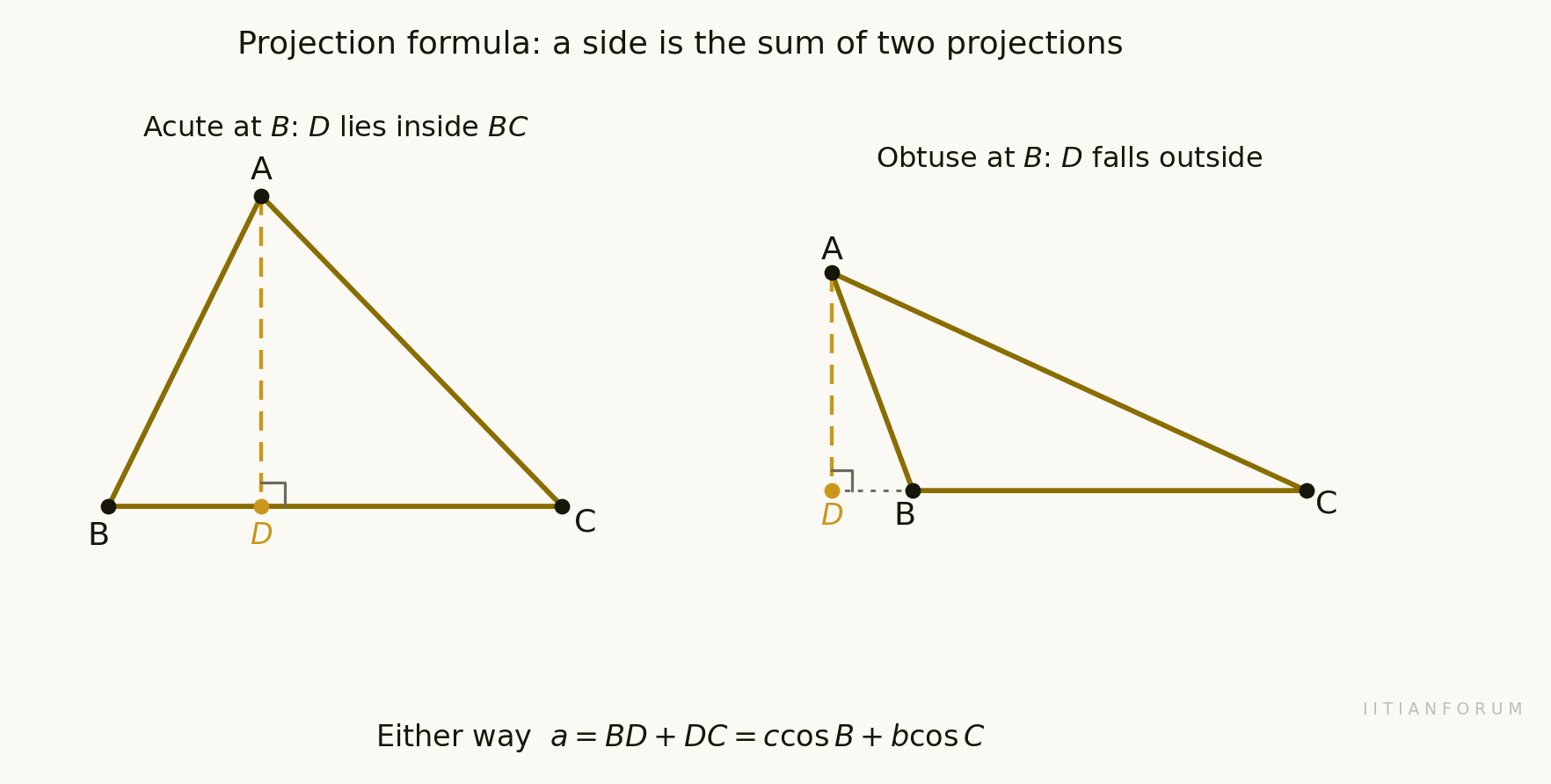
Every side is the sum of the projections of the other two onto it.
a=bcosC+ccosBb=ccosA+acosCc=acosB+bcosA
Proof. With D the foot of the perpendicular from A to BC, BD=ccosB and DC=bcosC, and a=BD+DC. If B is obtuse, D lies outside the segment on the far side of B, cosB<0, and BD=ccosB is a signed length, so the sum is still correct.
The projection formula in the acute case and the obtuse case
These three are the fastest route from a side condition to an angle condition, because substituting a=2RsinA turns the first into
sinA=sinBcosC+sinCcosBsinA=sin(B+C)
which is the statement A+B+C=180∘ in disguise. That is worth knowing: the projection formulae carry no information beyond the angle sum and the sine rule, so they never let you conclude something new on their own. What they do is convert an expression quickly.
Example 6(IITianForum). In △ABC, acosA=bcosB. What can you say about the triangle?
▸ SHOW SOLUTION
Step 1. Convert sides to sines
Put a=2RsinA and b=2RsinB:
2RsinAcosA=2RsinBcosBsin2A=sin2B
Step 2. Solve the sine equation, keeping both branches
2A=2Bor2A=180∘−2BA=BorA+B=90∘
Step 3. Read both branches as geometry
A=B means the triangle is isosceles with a=b. And A+B=90∘ means C=90∘, so the triangle is right angled at C.
Answer: the triangle is isosceles (a=b) or right angled at C, and both genuinely occur.
The mark here is lost by cancelling. Writing sin2A=sin2B⟹A=B throws away the second branch, and the option "isosceles or right angled" is always on the paper for exactly that reason.
Never cancel a sine, a cosine or a side
sin2A=sin2B gives two families, not one. cosA=cosB gives one, because cos is injective on (0∘,180∘). Before cancelling anything in this chapter, ask whether the function is one-to-one on the range an angle of a triangle can occupy.
Half angle formulae and the semi-perimeter
These are the bridge between angles and sides. Everything on the right is built from s, a, b, c alone.
Since 0<2A<90∘ the sine is positive and the square root is unambiguous. The cosine formula follows the same way from cosA=2cos22A−1, and the tangent is their quotient.
The half angle is always acute, which is the whole reason these formulae are single valued while sinA=2Ra is not. That single fact resolves the ambiguous case later on.
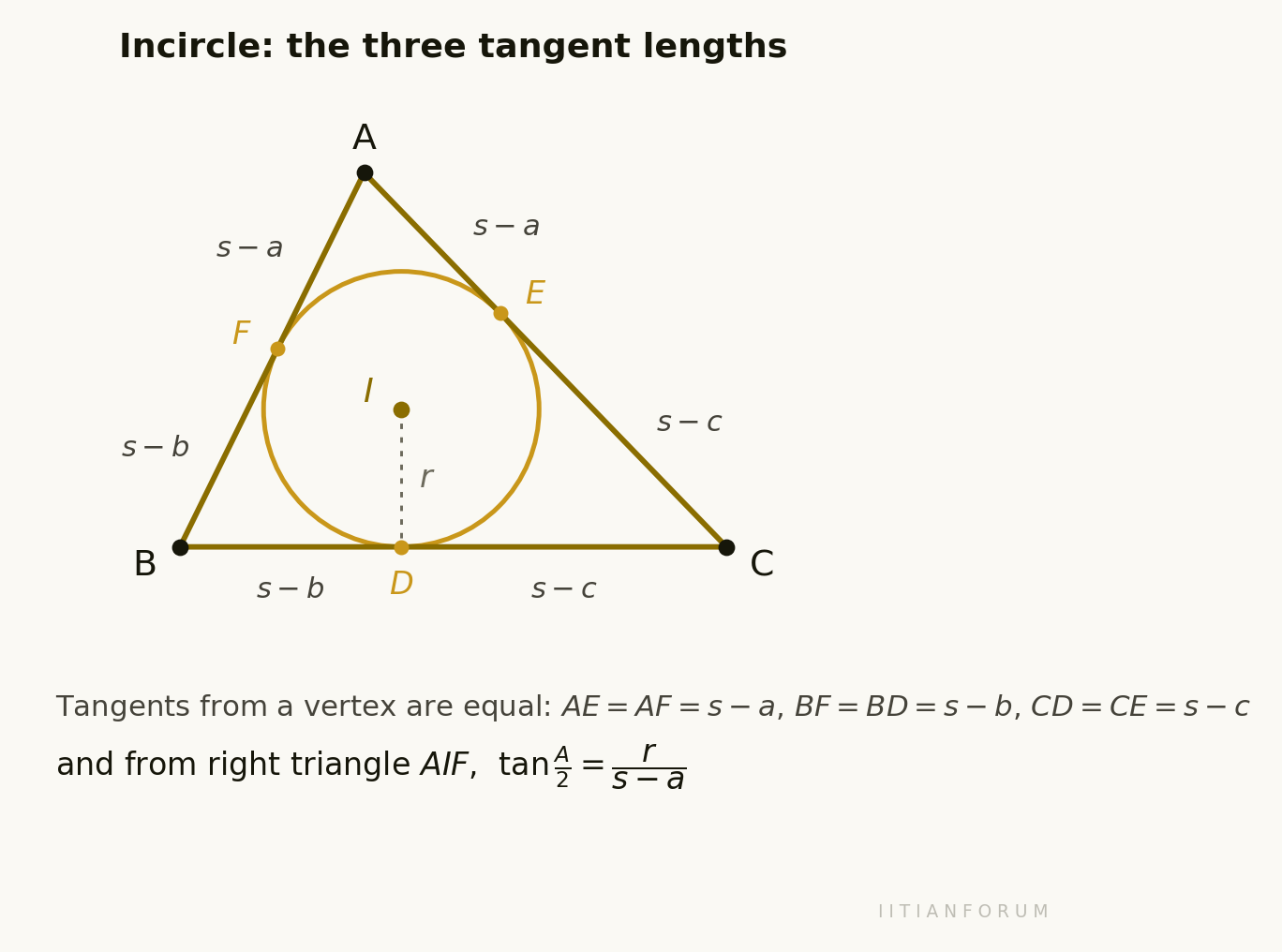
Incircle touching the three sides, with tangent lengths s-a, s-b and s-c
The picture explains where s−a comes from. The two tangents to the incircle from A are equal; call that length x, and similarly y from B and z from C. Then
y+z=a,z+x=b,x+y=cx+y+z=sx=s−a,y=s−b,z=s−c
and from the right triangle formed by A, the incentre and a point of contact,
tan2A=s−ar
Example 7(IITianForum). For the triangle with a=13, b=14, c=15, find tan2A and confirm it against r and s−a.
tan2A=21 gives cosA=1+tan2(A/2)1−tan2(A/2)=1+411−41=53, which is what Example 1 found.
Answer:tan2A=21.
When to reach for the half angle
Any condition of the form tan2Atan2B=k, or a ratio of half angle tangents, or a mixture of r, r1 and an angle, collapses the moment you substitute the s forms. Full angle formulae almost never simplify these; half angle formulae almost always do.
Napier's analogy and Mollweide's check
Napier's analogy converts a ratio of sides into a difference of angles, which is exactly what you need when two sides and the included angle are given.
and 2A+B=90∘−2C, so cot2A+B=tan2C. Rearranging gives the result.
Mollweide's formulae are the companion pair, and they are the best available check on a finished solution because every one of the six elements appears in each:
ca+b=sin2Ccos2A−Bca−b=cos2Csin2A−B
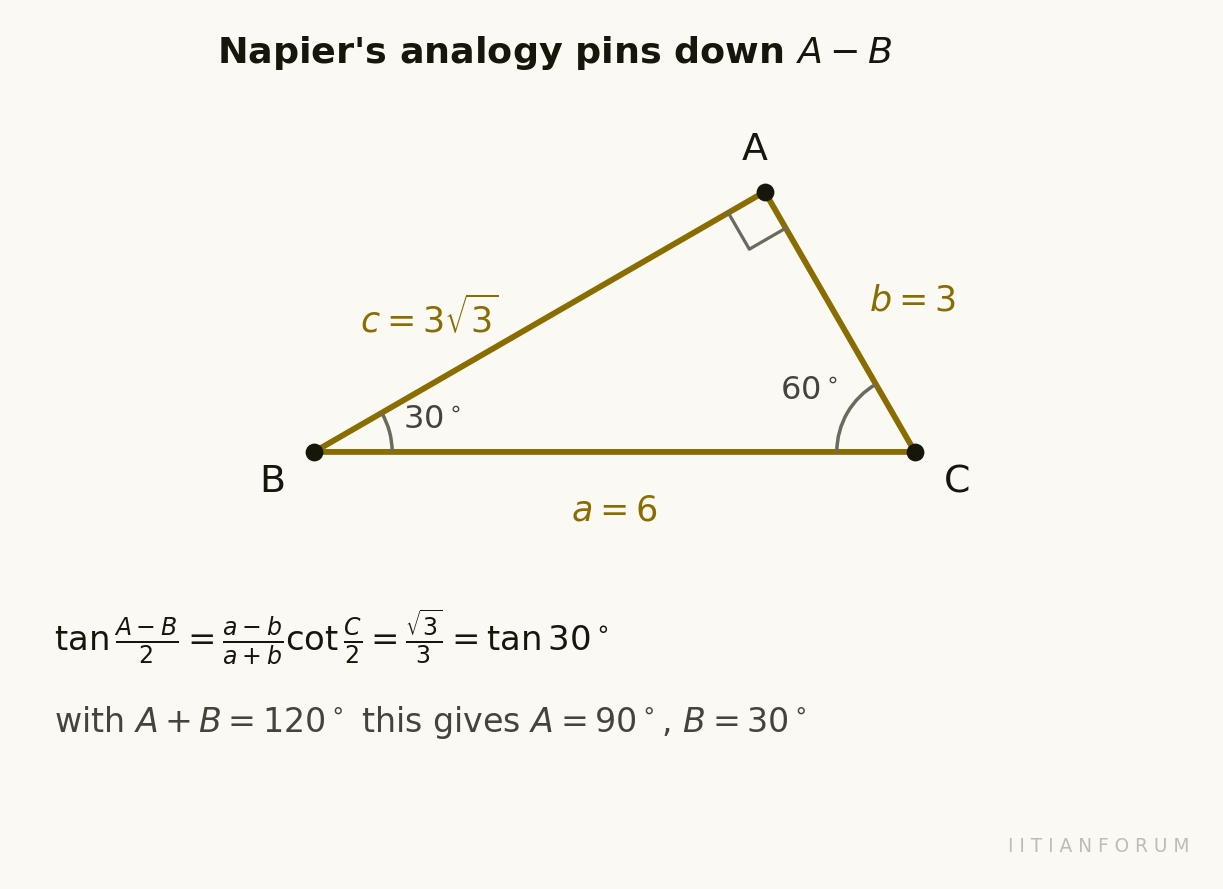
Example 8(IITianForum). In △ABC, a=6, b=3 and C=60∘. Solve the triangle.
▸ SHOW SOLUTION
The triangle a=6, b=3, C=60 degrees solved by Napier's analogy
Step 1. Napier for the difference of the other two angles
The two agree, so all six elements are consistent.
Answer:A=90∘, B=30∘, c=33.
Area of a triangle: seven ways
Each of these is the same number Δ, written in terms of whatever you happen to know.
Given
Area
two sides and the included angle
Δ=21absinC=21bcsinA=21casinB
three sides
Δ=s(s−a)(s−b)(s−c)
three sides and R
Δ=4Rabc
inradius and s
Δ=rs
an exradius
Δ=r1(s−a)=r2(s−b)=r3(s−c)
two angles and the included side
Δ=2sin(B+C)a2sinBsinC
the circumradius and the angles
Δ=2R2sinAsinBsinC
swipe for more →
Area from a base and the height b sin C
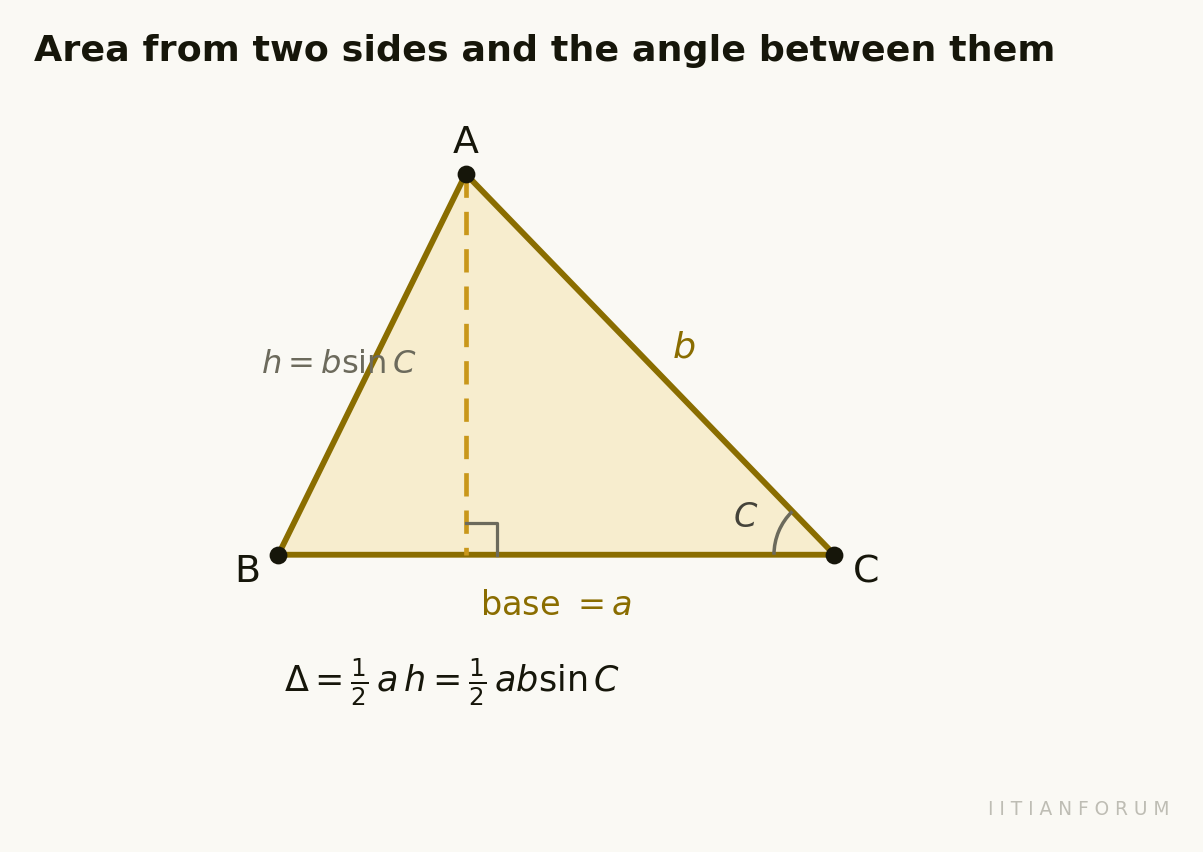
Proof of the first. The height from A onto BC is bsinC, so Δ=21a⋅bsinC. Proof of Heron's. Square the first form and use sin2C=(1−cosC)(1+cosC) with the cosine rule; the four factors that appear are exactly 2s, 2(s−a), 2(s−b), 2(s−c) divided by 4ab. Proof of the third. Substitute sinC=2Rc into the first. Proof of the fourth. Join the incentre to the three vertices, splitting the triangle into three triangles of heights r and bases a, b, c, so Δ=21r(a+b+c)=rs.
The three altitudes p1, p2, p3 from A, B, C satisfy p1=a2Δ and so on, from which
Step 2. Add the reciprocals over a common denominator
16813+121+565=16813+16814+16815=16842=41
Step 3. Compare with r1
r=4, so r1=41. They match.
Answer:13168, 12, 556, and the identity holds.
Notice why the identity is obvious once written this way: the reciprocals are 2Δa, 2Δb, 2Δc, which sum to 2Δ2s=Δs=r1.
Medians, Apollonius and the m-n theorem
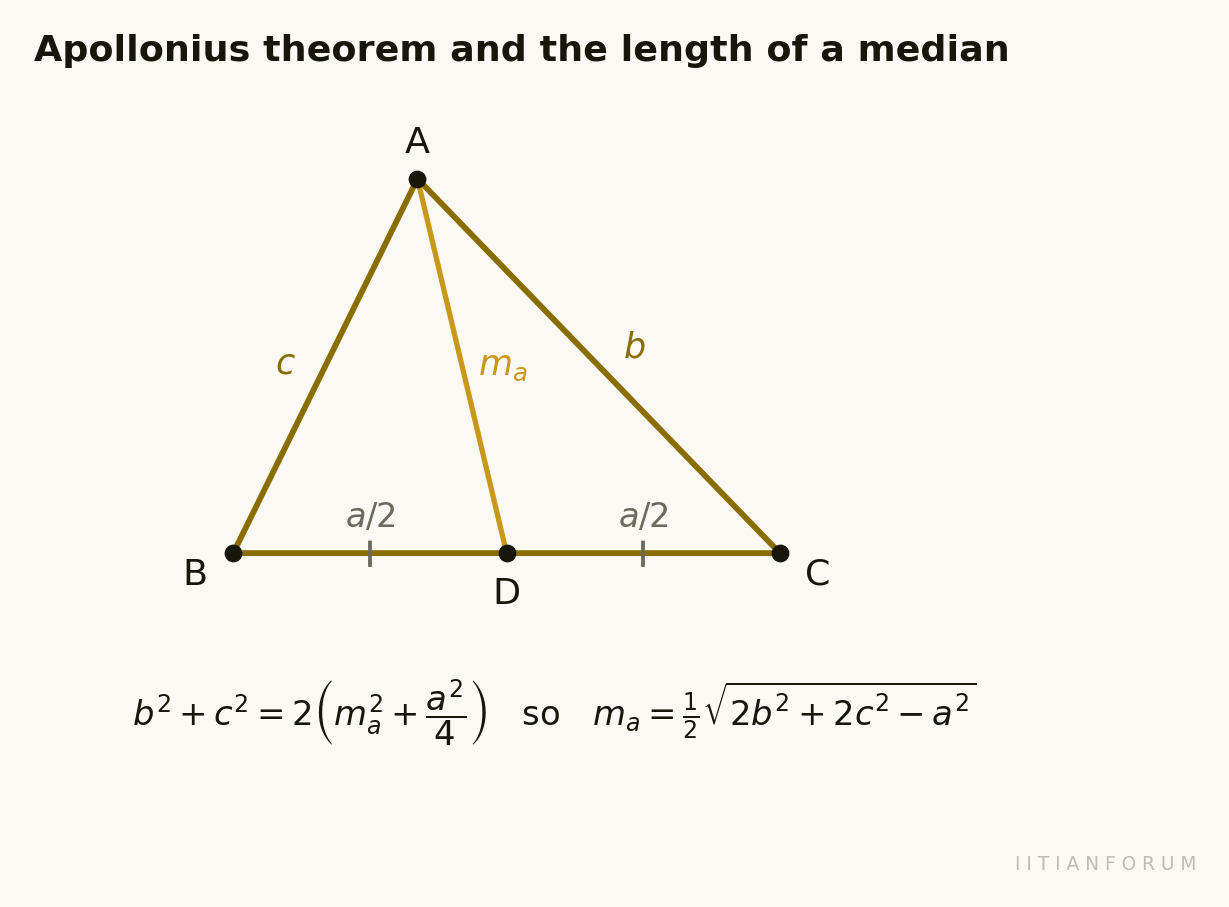
The median from A meets BC at its midpoint D. Its length is
ma=212b2+2c2−a2
Proof (Apollonius). Apply the cosine rule in △ABD and in △ACD at the two supplementary angles ∠ADB and ∠ADC. The cosine terms are equal and opposite, so adding the two equations kills them:
b2+c2=2ma2+2a2
which rearranges to the formula above. In words: the sum of the squares of two sides is twice the square of the median to the third side plus twice the square of half that side.
Median AD of a triangle, with Apollonius theorem stated
where G is the centroid. The second follows from the first because GA=32ma.
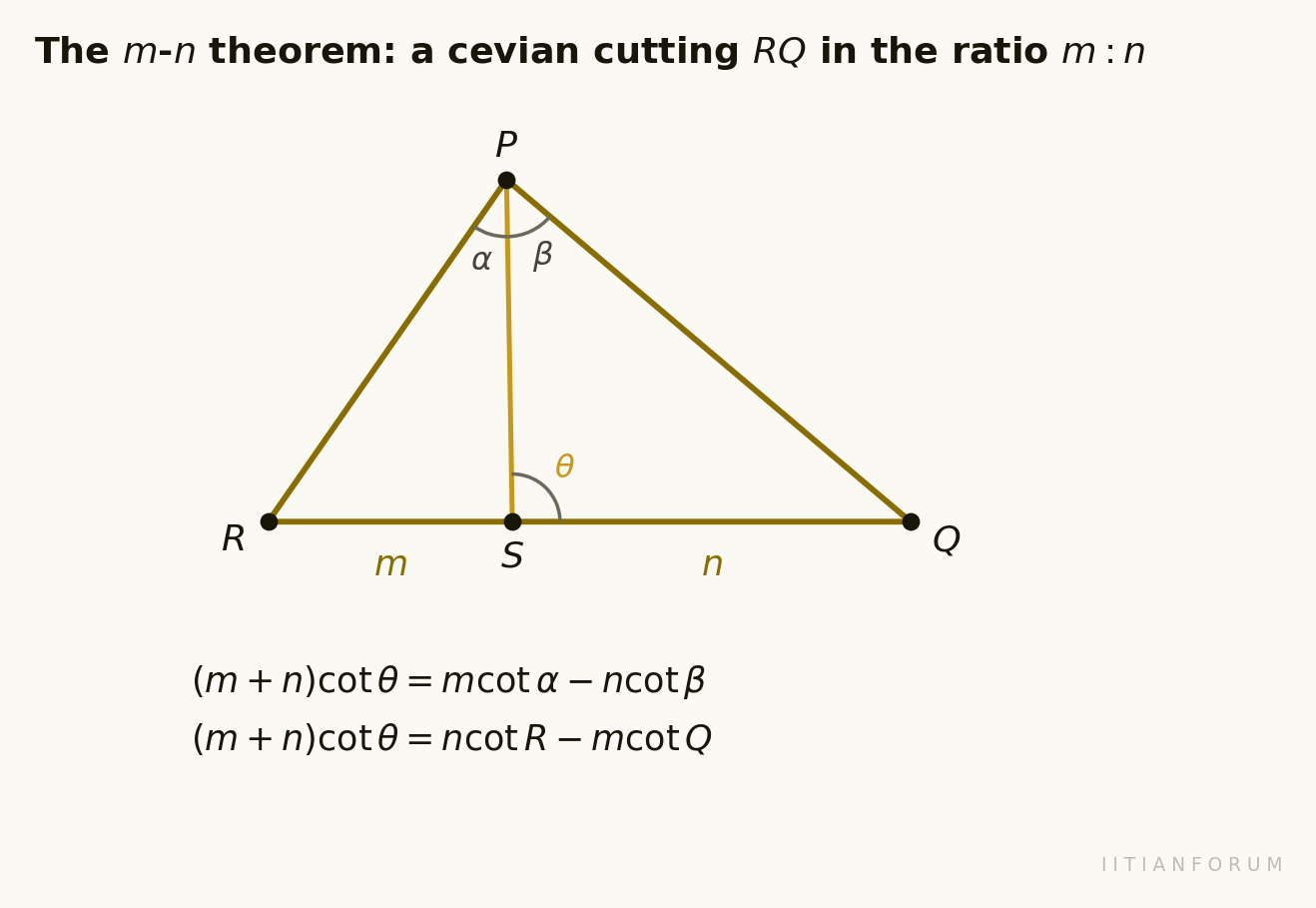
For a general cevian, not just a median, the tool is the m-n theorem. If D lies on BC with BD:DC=m:n, and θ=∠ADC, then
(m+n)cotθ=ncotB−mcotC(m+n)cotθ=mcotα−ncotβ
where α=∠BAD and β=∠DAC.
The m-n theorem for a cevian dividing BC in the ratio m to n
Proof. Write the area of △ABD two ways and the area of △ADC two ways, or apply the sine rule in each of the two sub-triangles and divide. Either route gives DCBD=sinβsinα⋅sinBsinC, and expanding θ=B+α turns that into the cotangent form.
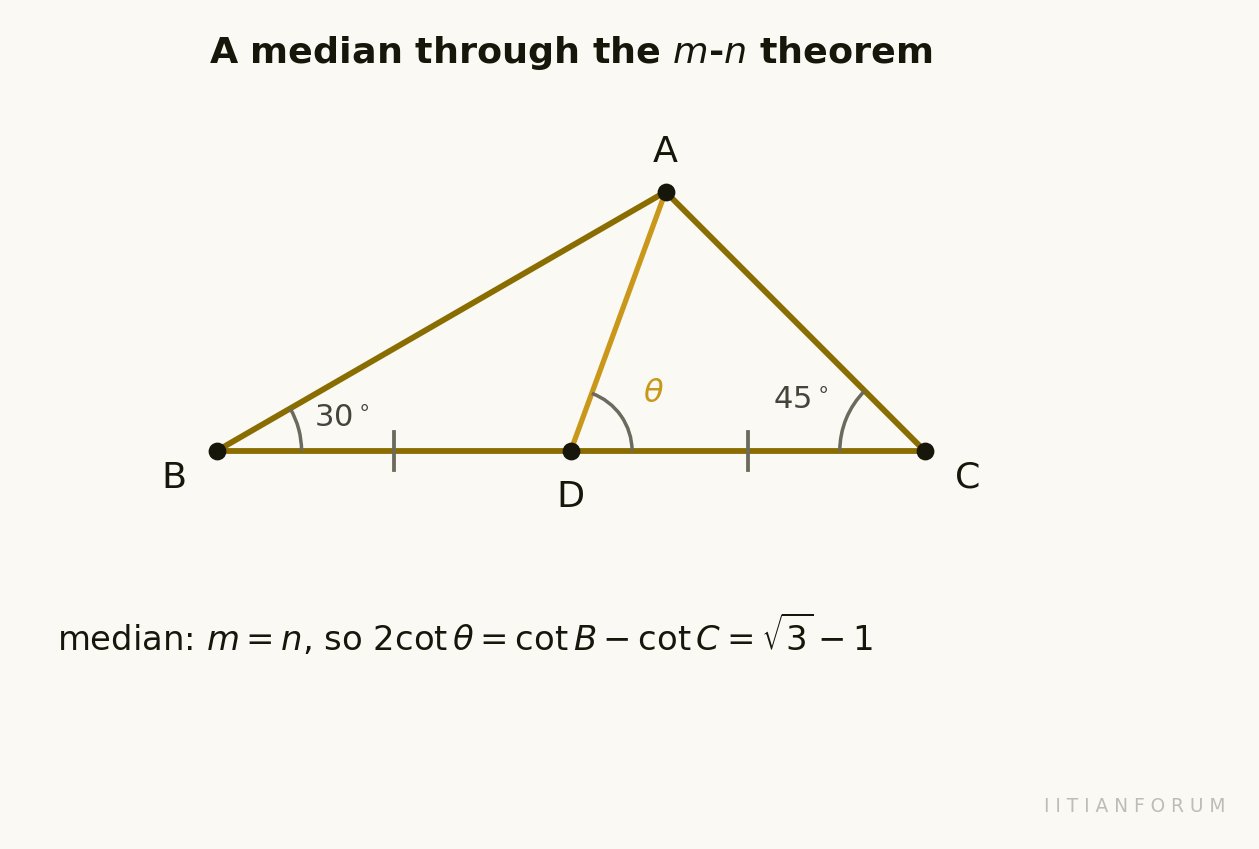
Example 10(IITianForum). In △ABC, B=30∘ and C=45∘. If AD is the median to BC, find cot(∠ADC).
▸ SHOW SOLUTION
Step 1. A median is the case m=n
(m+n)cotθ=ncotB−mcotC
with m=n becomes
2cotθ=cotB−cotC
Step 2. Substitute the two angles
2cotθ=cot30∘−cot45∘=3−1cotθ=23−1
Answer:cot(∠ADC)=23−1.
Worth noting: cotθ>0, so θ is acute, which is the expected picture when C>B. If you get a negative cotangent for ∠ADC in a problem like this, check which of the two angles at D you have actually computed.
A median with base angles 30 and 45 degrees
Example 11(JEE Main 2025, 4 April Shift 2). The three sides of a triangle ABC are given by the vectors 2i^−j^+k^, i^−3j^−5k^ and 3i^−4j^−4k^. If G is the centroid, find 6(∣AG∣2+∣BG∣2+∣CG∣2).
▸ SHOW SOLUTION
Step 1. Recognise the identity that does all the work
GA2+GB2+GC2=3a2+b2+c2
so the answer is 2(a2+b2+c2), and the three side vectors are given, so nothing needs to be located.
Step 2. Square the three side lengths
a2+b2+c2=6+35+41a2+b2+c2=82
Step 3. Multiply
6(GA2+GB2+GC2)=2⋅82=164
Answer:164.
A quick consistency check that the three vectors really do close into a triangle: (2,−1,1)+(1,−3,−5)=(3,−4,−4), so with suitable orientations they sum to zero. If they had not, the question would have no triangle at all.
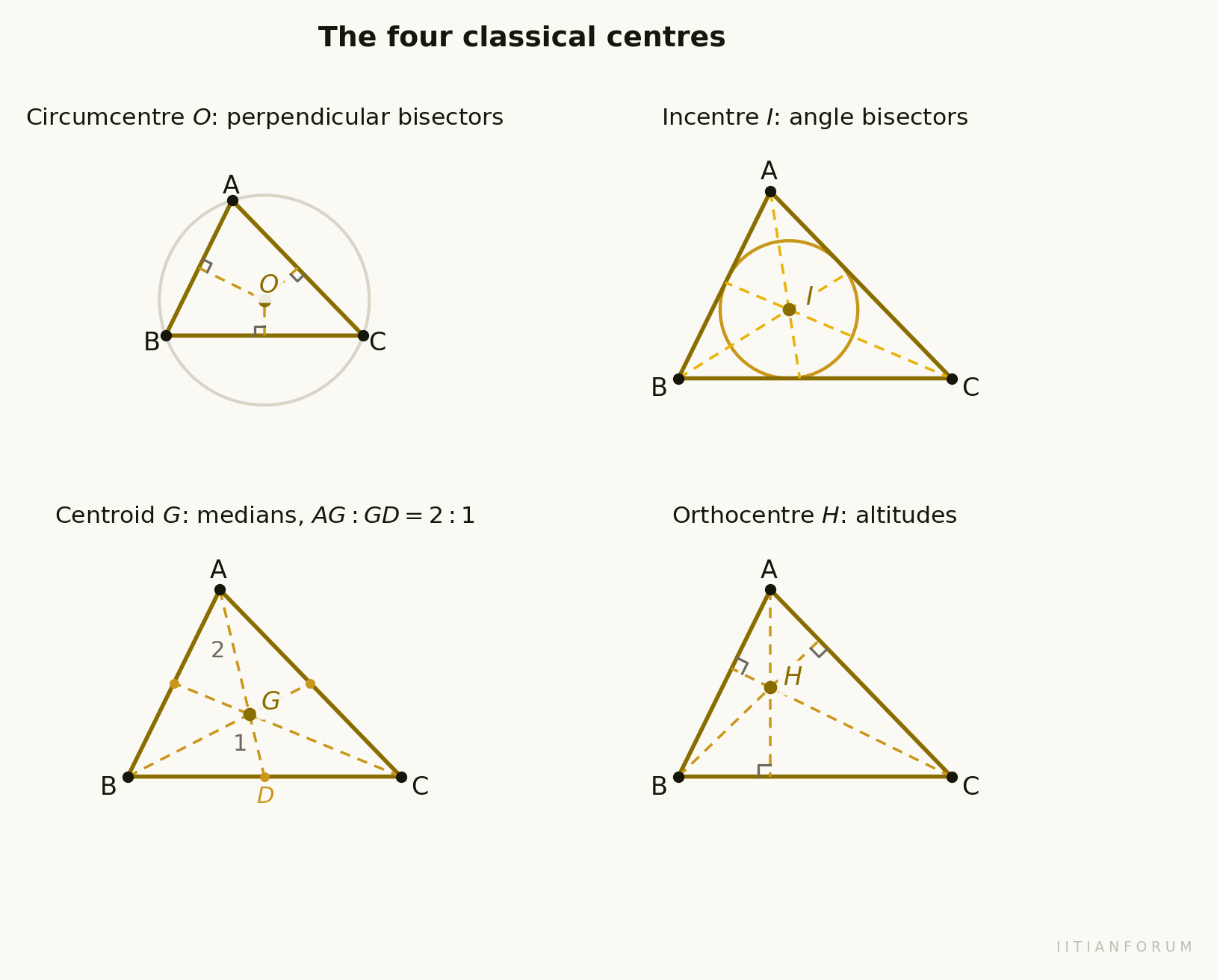
The four centres
The circumcentre, incentre, centroid and orthocentre of the same triangle
Centre
Built from
Position
circumcentre O
perpendicular bisectors of the sides
inside if acute, on the hypotenuse midpoint if right, outside if obtuse
incentre I
internal angle bisectors
always inside
centroid G
medians, dividing each 2:1 from the vertex
always inside
orthocentre H
altitudes
inside if acute, at the right-angled vertex if right, outside if obtuse
swipe for more →
The coordinate forms are worth having exactly right, because JEE asks for them directly:
G=3A+B+CI=a+b+caA+bB+cC
The incentre is the side-weighted average, with the weight a attached to the vertex A opposite it. The centroid is the plain average. Confusing the two is the commonest slip in this part of the chapter.
Distances from a vertex, all of which follow from the sine rule in the small triangles the centres create:
OA=OB=OC=RIA=rcosec2A=4Rsin2Bsin2CHA=2RcosA
and the distance from H to the side BC is 2RcosBcosC.
The relation that shortcuts half the coordinate questions
If the circumcentre is at the origin, then
OH=OA+OB+OC
so H=A+B+C and G=3H. Whenever a question puts all three vertices on a circle centred at the origin, reach for this first.
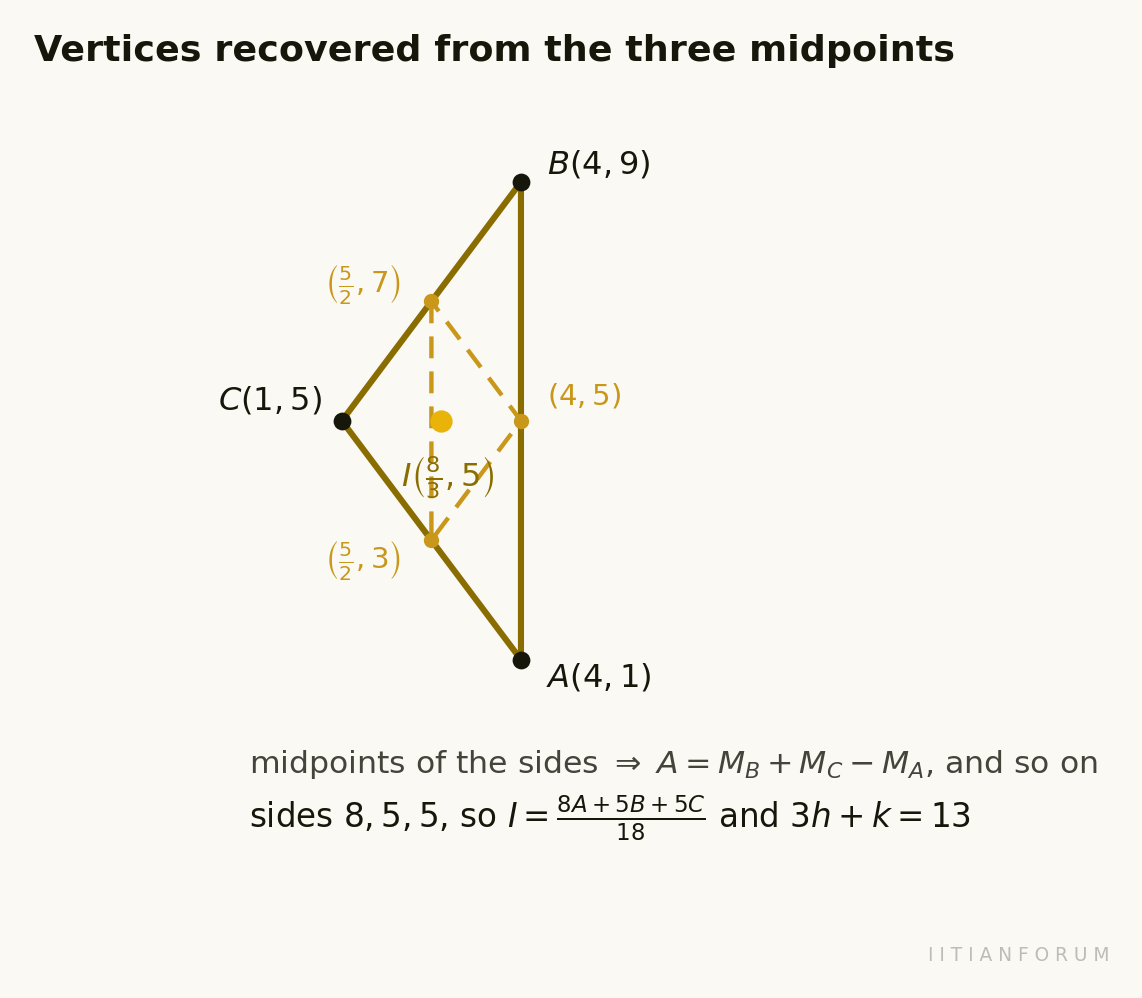
Example 12(JEE Main 2026, 2 April Shift 1). The midpoints of the sides of a triangle ABC are (25,7), (25,3) and (4,5). If its incentre is (h,k), find 3h+k.
▸ SHOW SOLUTION
The medial triangle, the recovered vertices and the incentre
Step 1. Recover the vertices
If MA, MB, MC are the midpoints of BC, CA, AB, then
A=MB+MC−MA
and cyclically. Taking MA=(25,7), MB=(25,3), MC=(4,5):
The weights are a on A, b on B, c on C. Here the side opposite A(4,1) is BC=5, not the side AB=8 that touches it. Attach each weight to the vertex it faces, never to the side it lies on.
Example 13(JEE Main 2025, 22 January Shift 2). Let A(6,8), B(10cosα,−10sinα) and C(−10sinα,10cosα) be the vertices of a triangle. If L(a,9) is its orthocentre and G(h,k) its centroid, find 5a−3h+6k+100sin2α.
▸ SHOW SOLUTION
Step 1. Notice where the vertices lie
62+82=100100cos2α+100sin2α=100
All three vertices satisfy x2+y2=100, so the circumcentre is the origin.
Example 14(JEE Main 2026, 22 January Shift 2). Statement (S1): if A(5,−1) and B(−2,3) are two vertices of a triangle whose orthocentre is (0,0), then the third vertex is (−4,−7). Is (S1) correct?
▸ SHOW SOLUTION
Step 1. Write the two perpendicularity conditions
Let C(h,k) and O(0,0) be the orthocentre. Then AO⊥BC and BO⊥AC.
Answer: (S1) is correct: the third vertex is (−4,−7).
Use the dot product form OA⋅BC=0 rather than slopes when either line risks being vertical. Here neither is, but the habit costs nothing.
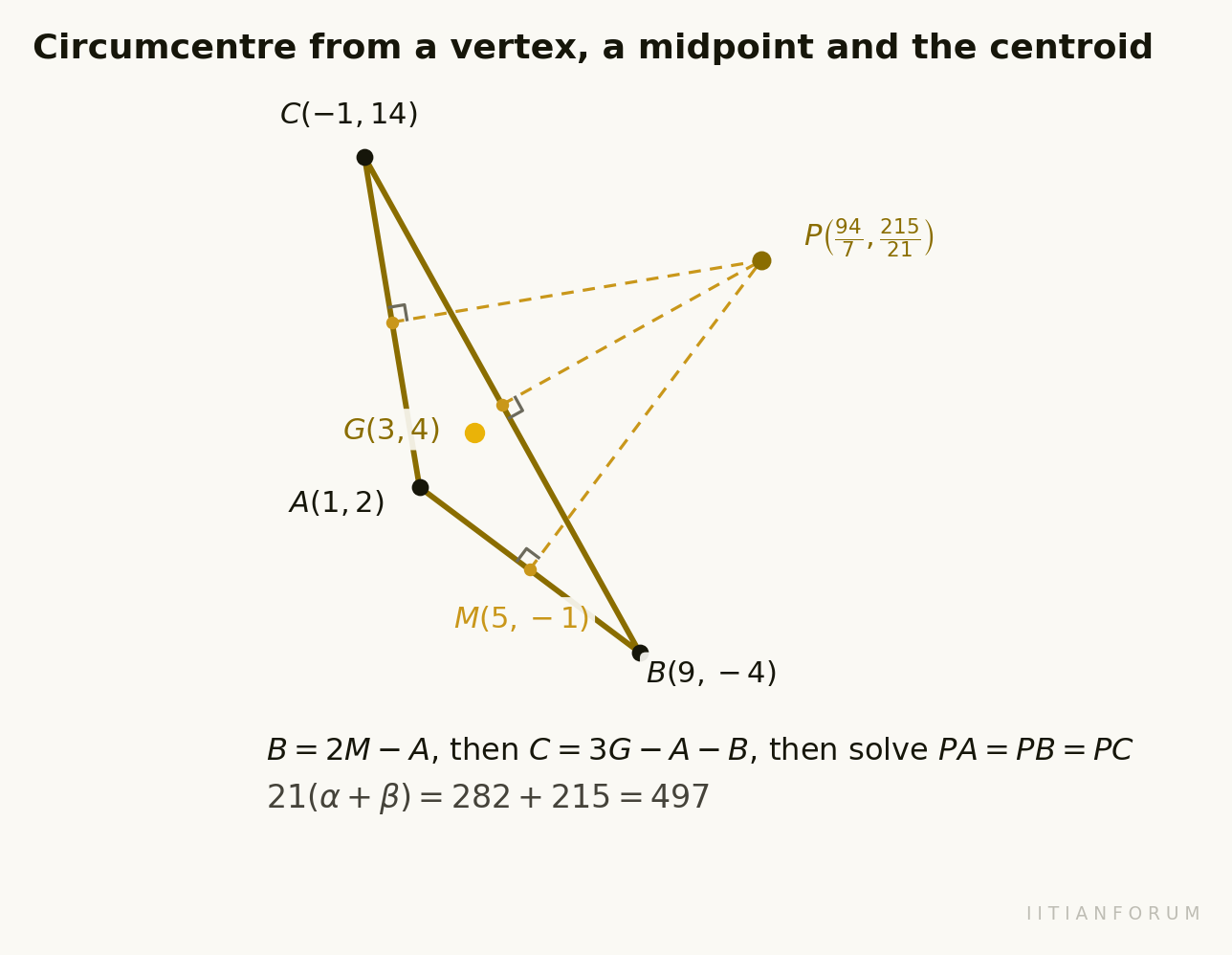
Example 15(JEE Main 2026, 4 April Shift 1). The vertex A of triangle ABC is (1,2), the midpoint of AB is (5,−1), and the centroid is (3,4). If the circumcentre is (α,β), find 21(α+β).
▸ SHOW SOLUTION
Circumcentre found from a vertex, a midpoint and the centroid
Step 1. Get B from the midpoint
B=2(5,−1)−(1,2)=(9,−4)
Step 2. Get C from the centroid
C=3(3,4)−(1,2)−(9,−4)=(−1,14)
Step 3. Impose equal distances from the circumcentre
The question hands you 21(α+β) rather than α+β precisely because the denominator is 21. When a question multiplies the answer by an odd-looking integer, that integer is usually the denominator you are about to produce, and it is a free check that you are on the right line.
Incircle, excircles and the identities they satisfy
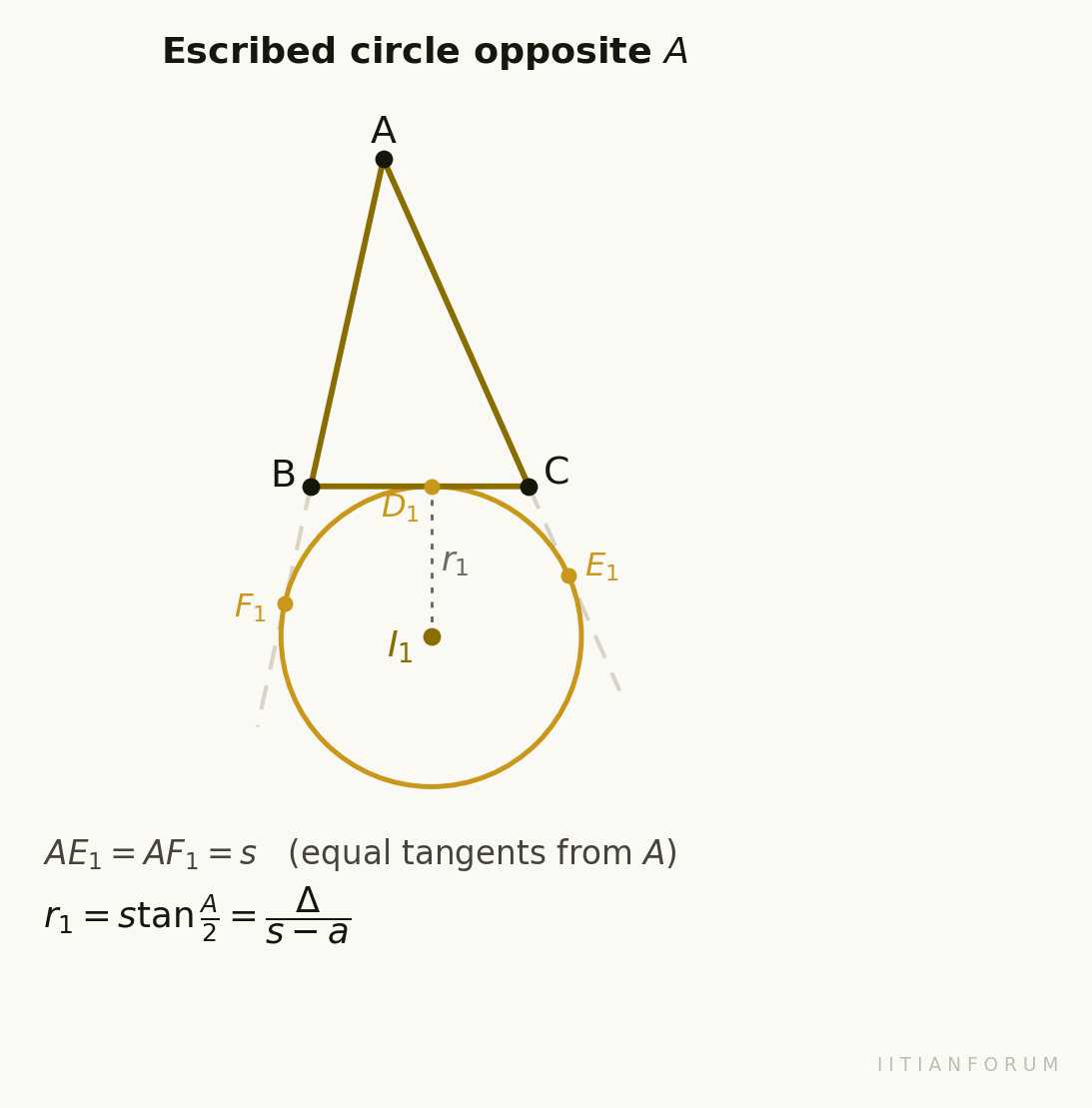
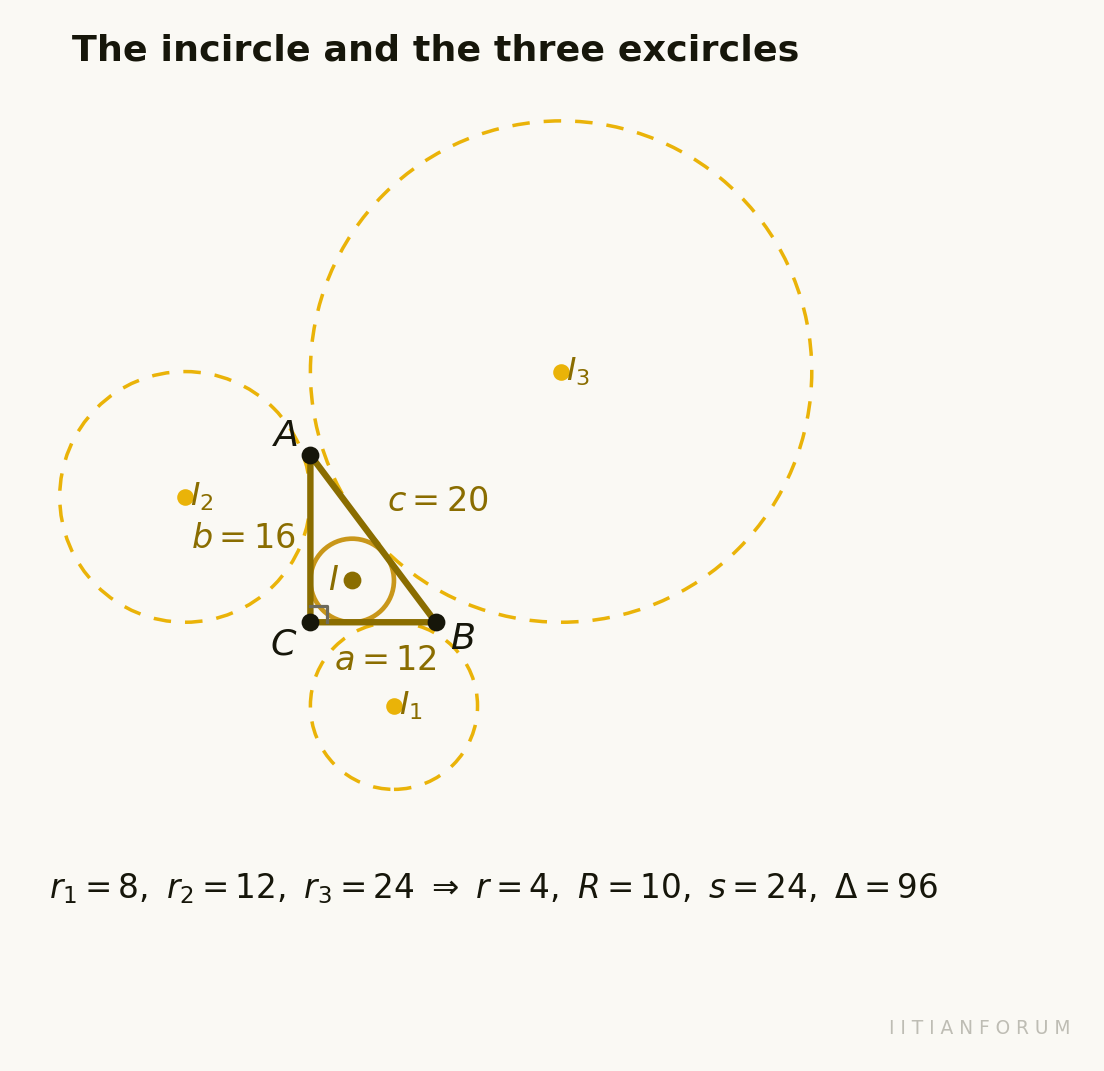
The incircle touches all three sides from the inside; its radius is r and its centre is I. There are three escribed circles, or excircles: the one opposite A touches the side BC and the other two sides produced, and its radius is r1. Similarly r2 opposite B and r3 opposite C.
Escribed circle opposite A, touching BC and the two produced sides
The last one has a clean pattern: r is 4R times three sines; each ri swaps two of those sines for cosines, keeping the sine at the vertex it is opposite. Notice also that r1=stan2A against r=(s−a)tan2A, so
rr1=s−as
Six identities that JEE returns to again and again, all of them provable in a line from the forms above:
Proof of the second.r11+r21+r31=Δ(s−a)+(s−b)+(s−c)=Δ3s−2s=Δs=r1. Every other identity in that list falls the same way: write each radius as Δ over a linear expression in s, and let the algebra collapse.
Incircle and the three excircles of the 12-16-20 triangle
Example 16(IITianForum). In a triangle the three exradii are r1=8, r2=12, r3=24. Find r, R, s, the area and the three sides.
12, 16, 20 is 4 times 3,4,5, so the triangle is right angled at C. Then Δ=21⋅12⋅16=96 and R=2c=10, both of which agree.
Answer:r=4, R=10, s=24, Δ=96, sides 12, 16, 20.
Example 17(IITianForum). Prove that in any triangle cosA+cosB+cosC=1+Rr.
▸ SHOW SOLUTION
Step 1. Convert the left side to half angles
cosA+cosB=2cos2A+Bcos2A−BcosC=1−2sin22C
and cos2A+B=sin2C, so the sum is
1+2sin2C(cos2A−B−sin2C)
Step 2. Replace the second sin2C
sin2C=cos2A+B, and
cos2A−B−cos2A+B=2sin2Asin2B
Step 3. Collect
cosA+cosB+cosC=1+4sin2Asin2Bsin2C
Step 4. Recognise the last term
r=4Rsin2Asin2Bsin2C, so the bracket is exactly Rr.
cosA+cosB+cosC=1+Rr
Since r>0 and R>0, this proves the standard bound cosA+cosB+cosC>1 at once, and with R≥2r from the next section it gives the upper bound 23.
Euler line and the distances between centres
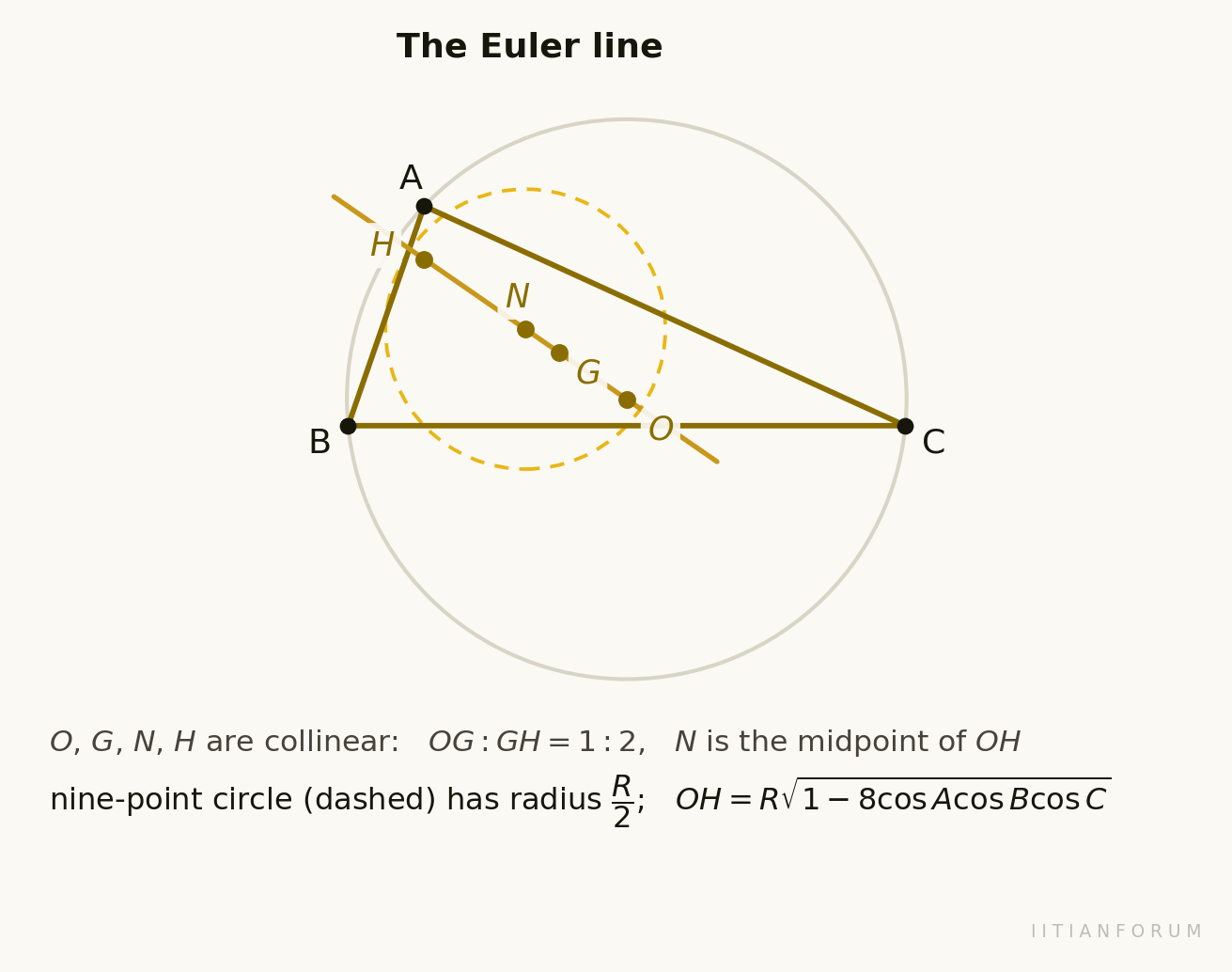
Circumcentre, centroid, nine-point centre and orthocentre on the Euler line
In every non-equilateral triangle the circumcentre O, the centroid G and the orthocentre H are collinear, and
OG:GH=1:2
Proof. With O at the origin, define P=A+B+C. Then AP=B+C, which is perpendicular to BC=C−B because (B+C)⋅(C−B)=∣C∣2−∣B∣2=R2−R2=0. So P lies on the altitude from A, and by symmetry on all three: P=H. Since G=3A+B+C=3H, the three points O, G, H are collinear with OG:GH=1:2.
The midpoint N of OH is the centre of the nine-point circle, which passes through the three side midpoints, the three feet of the altitudes and the three midpoints of AH, BH, CH. Its radius is 2R.
The three standard distances:
OI2=R2−2RrOH2=R2(1−8cosAcosBcosC)II1=4Rsin2A
Proof of the first. In △OAI, OA=R and AI=4Rsin2Bsin2C, and the angle ∠OAI equals 2∣B−C∣ because ∠OAB=90∘−C while ∠IAB=2A. The cosine rule then gives, after using r=4Rsin2Asin2Bsin2C,
OI2=R2−8R2sin2Asin2Bsin2COI2=R2−2Rr
Euler's inequality falls straight out
OI2≥0 forces R2≥2Rr, so
R≥2r
with equality exactly when O=I, that is when the triangle is equilateral. This one line settles a whole family of "prove the triangle is equilateral" questions.
Example 18(JEE Main 2025, 24 January Shift 2). The position vectors of the three vertices of a triangle are 4p+q−3r, −5p+q+2r and 2p−q+2r. If the orthocentre is 4p+q+r and the circumcentre is αp+βq+γr, find α+2β+5γ.
▸ SHOW SOLUTION
Step 1. Compute the centroid, which needs no geometry
The coefficients of p, q, r in the sum of the three position vectors are 4−5+2=1, 1+1−1=1 and −3+2+2=1, so
3G=p+q+rG=3p+q+r
Step 2. Use the Euler line ratio
G divides HO (from orthocentre to circumcentre) in the ratio 2:1, so
3G=2O+H2O=3G−H=(p+q+r)−4p+q+r2O=43(p+q+r)
Step 3. Read off the coefficients
O=83(p+q+r)
so α=β=γ=83.
Step 4. Combine
α+2β+5γ=83(1+2+5)=824=3
Answer: (1) 3.
Nothing about p, q, r was needed beyond their being a basis, which is why the centroid could be written down immediately. The Euler line ratio OG:GH=1:2 is the entire question.
Example 19(JEE Main 2025, 23 January Shift 1). The area of △PQR with P(5,4), Q(−2,4) and R(a,b) is 35. Its orthocentre is (2,514) and its centroid is (c,d). Find c+2d.
▸ SHOW SOLUTION
Step 1. Use the area to pin b
PQ lies along y=4 and has length 7, so
21⋅7⋅∣b−4∣=35⟹∣b−4∣=10
giving b=14 or b=−6.
Step 2. Impose the orthocentre conditions
With O(2,514), require OP⋅QR=0 and OQ⋅PR=0. Solving the pair gives the single point
R=(2,−6)
which is consistent with b=−6 from Step 1. The value b=14 does not satisfy both perpendicularity conditions.
Step 3. Centroid
c=35−2+2=35d=34+4−6=32
Step 4. Combine
c+2d=35+34=39=3
Answer: (2) 3.
Example 20(IITianForum). Show that a triangle with R=2r must be equilateral.
▸ SHOW SOLUTION
Step 1. Use the distance formula for OI
OI2=R2−2Rr
Step 2. Substitute the condition
R=2r gives 2Rr=R2, so
OI2=R2−R2=0
Step 3. Interpret
OI=0 means the circumcentre and the incentre coincide. If O=I then every perpendicular bisector is also an angle bisector, so each angle bisector meets the opposite side at its midpoint, which forces the two sides at that vertex to be equal. Applying this at all three vertices gives a=b=c.
Answer: the triangle is equilateral.
The converse is immediate: in an equilateral triangle R=3a and r=23a, so R=2r.
Pedal and excentral triangles
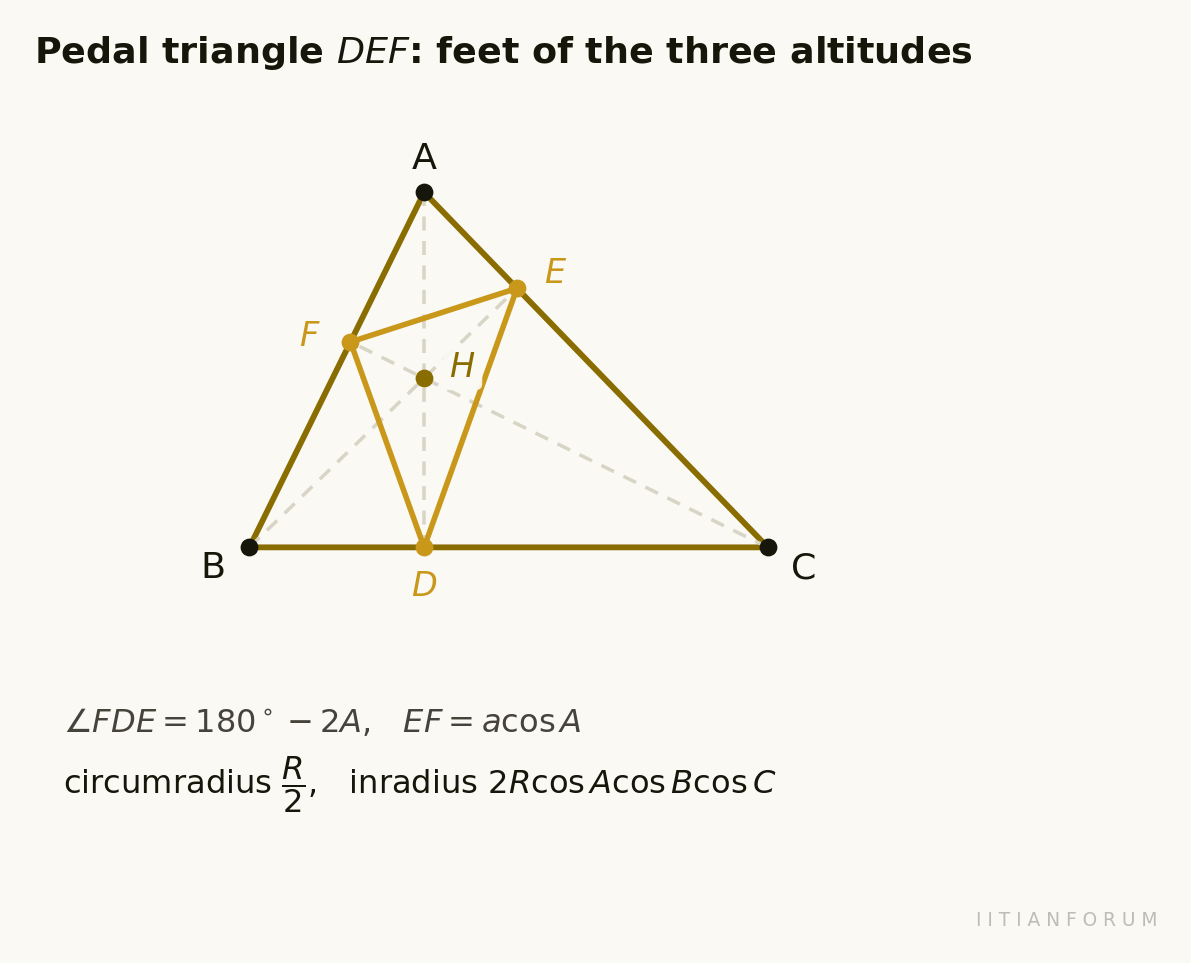
The pedal triangleDEF has as its vertices the feet of the three altitudes.
Pedal triangle DEF formed by the feet of the three altitudes
For an acute triangle:
∠FDE=180∘−2AEF=acosA,FD=bcosBDE=ccosCarea=2R2sin2Asin2Bsin2Ccircumradius=2Rinradius=2RcosAcosBcosC
The circumradius 2R is no accident: the pedal triangle is inscribed in the nine-point circle. If the original triangle is obtuse at A, the angles of the pedal triangle become 2A−180∘, 2B, 2C and the side EF becomes −acosA, which is positive because cosA<0.
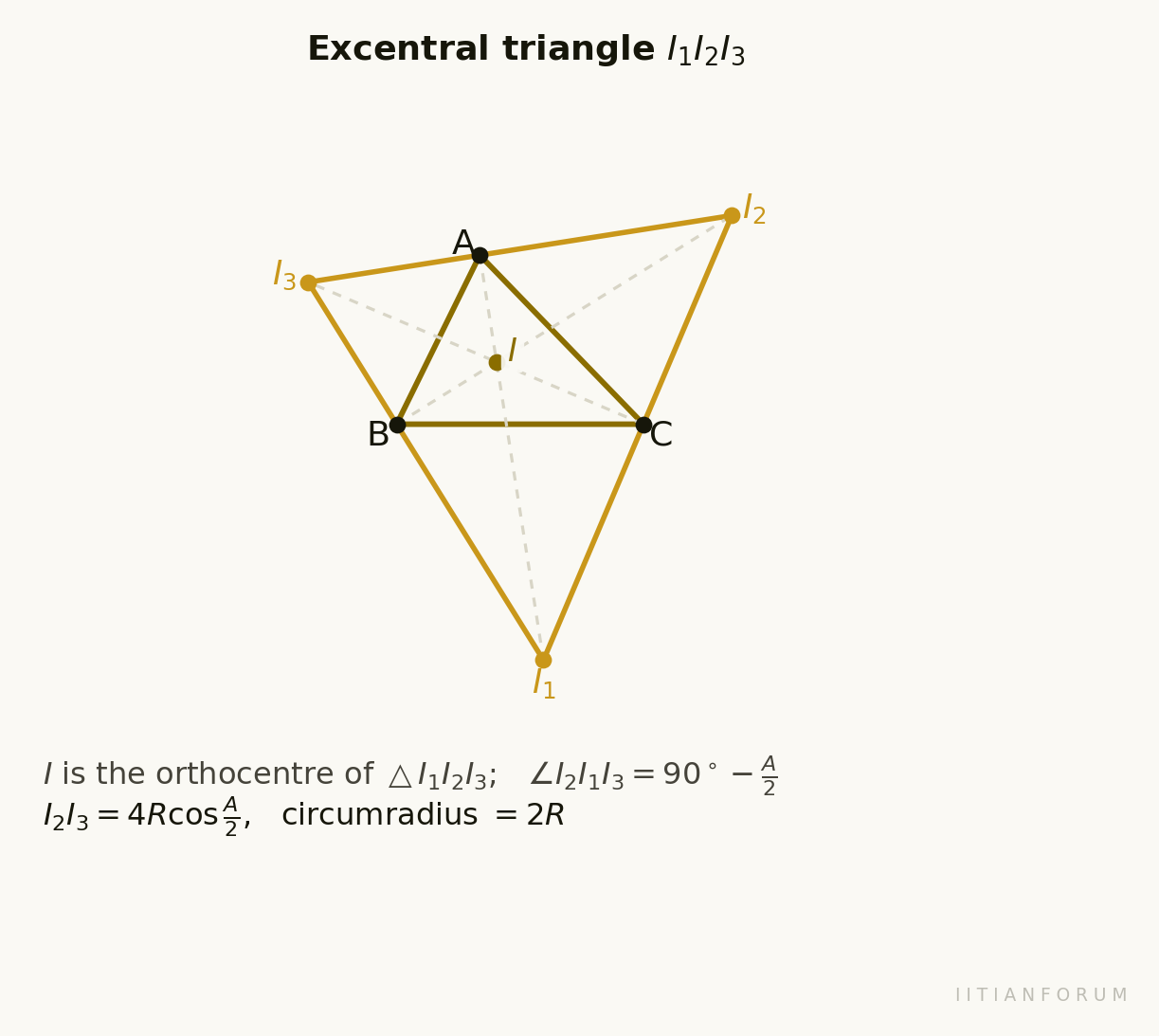
The excentral triangleI1I2I3 has the three excentres as vertices.
Excentral triangle with the incentre as its orthocentre∠I2I1I3=90∘−2AI2I3=4Rcos2Acircumradius=2Rarea=8R2cos2Acos2Bcos2C
and I is the orthocentre of I1I2I3, while the original triangle ABC is its pedal triangle. That single sentence generates every formula in the list: apply the pedal results to I1I2I3 and you recover the ones for ABC.
Example 21(IITianForum). In an acute triangle with R=5 and angles 45∘, 60∘, 75∘, find the sides of the pedal triangle and its circumradius.
The pattern acosA=2RsinAcosA=Rsin2A is the quickest form of all: the pedal sides are Rsin2A, Rsin2B, Rsin2C, which is a circle of radius 2R read through the sine rule.
Solving a triangle: four cases and the ambiguous one
Three sides given (SSS). Use cosA=2bcb2+c2−a2, or tan2A if you also want the area or the radii. One triangle, always, provided the three triangle inequalities hold.
Two sides and the included angle (SAS). Use the cosine rule for the third side, then the sine rule or Napier's analogy for the remaining angles. One triangle, always.
Two angles and one side (AAS or ASA). Get the third angle from the angle sum, then two applications of the sine rule. One triangle, always, provided the two given angles sum to less than 180∘.
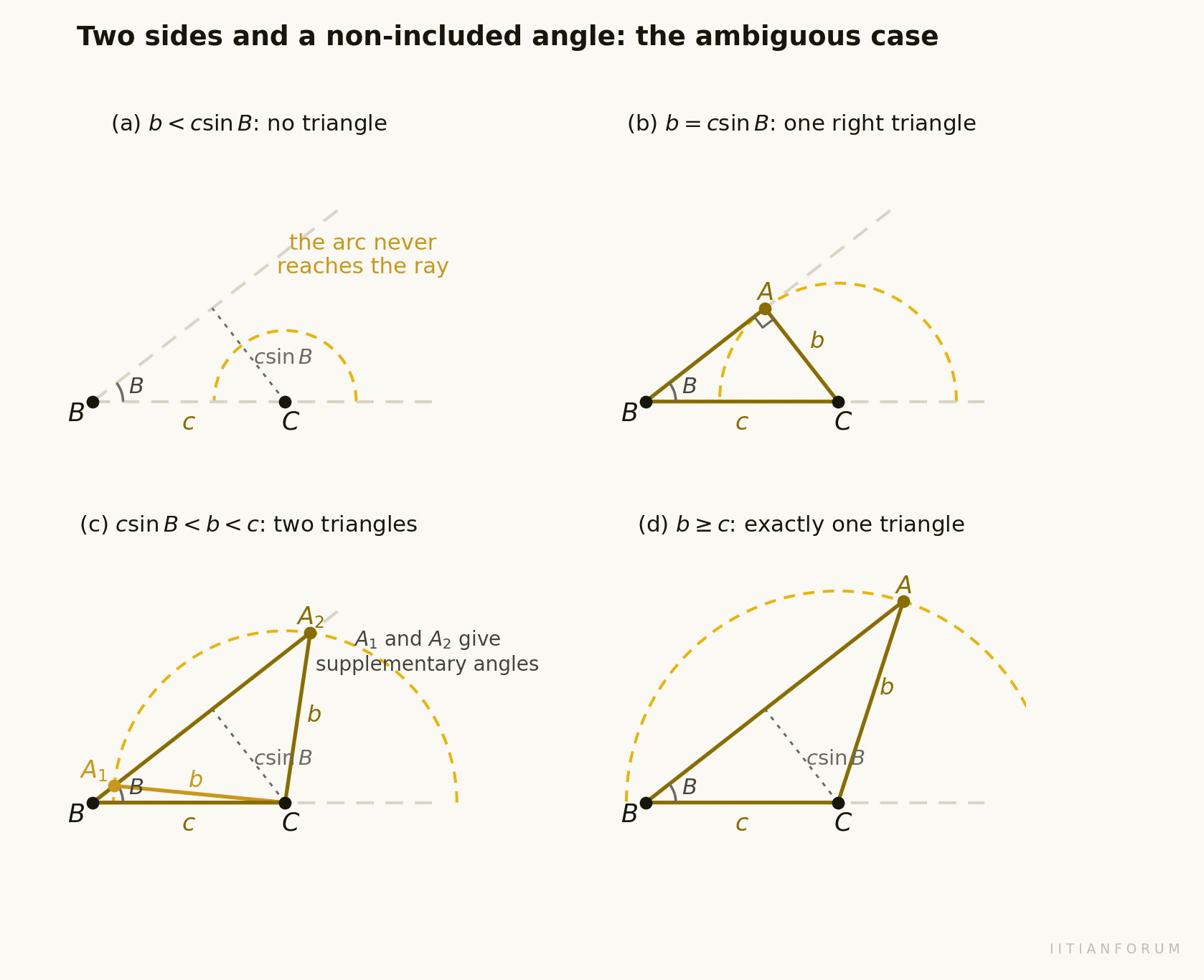
Two sides and a non-included angle (SSA). This is the ambiguous case. Given b, c and B, the sine rule gives
sinC=bcsinB
and sinC does not determine C, because C and 180∘−C have the same sine. Four things can happen.
The four sub-cases of the ambiguous SSA situation
Condition
Number of triangles
b<csinB
none: the arc of radius b never reaches the other side
b=csinB
exactly one, right angled at C
csinB<b<c
two, with C and 180∘−C both admissible
b≥c
exactly one
swipe for more →
Everything in the table is the statement sinC=bcsinB read carefully. If the right side exceeds 1 there is no C; if it equals 1 there is one, namely 90∘; if it is less than 1 there are two candidates and you must test whether each gives a positive third angle. When b≥c we have B≥C, so C cannot be the obtuse one and only the acute root survives.
Do not decide the ambiguous case with the sine rule alone
The cosine rule settles it in one step and cannot lose a solution. Given b, c and B, write
b2=a2+c2−2accosB
as a quadratic in a. Two positive roots means two triangles, one positive root means one, and no positive root means none. The discriminant does the case analysis for you.
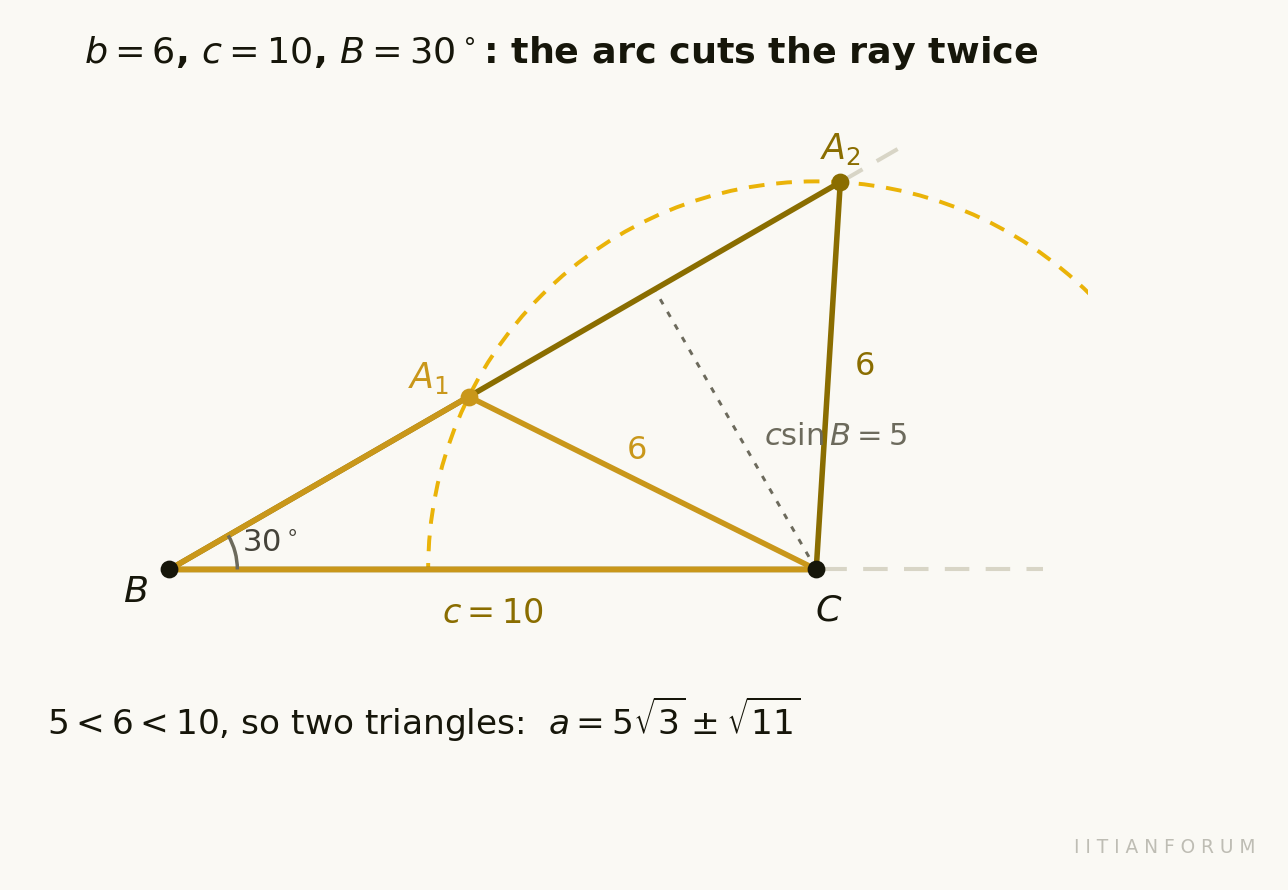
Example 22(IITianForum). In △ABC, b=6, c=10 and B=30∘. How many triangles are possible, and what are the values of a?
▸ SHOW SOLUTION
The arc of radius 6 cutting the ray from B in two points
Step 1. Test the condition
csinB=10sin30∘=5
Since 5<6<10, that is csinB<b<c, there are two triangles.
Step 2. Use the cosine rule as a quadratic in a
36=a2+100−2⋅a⋅10cos30∘a2−103a+64=0
Step 3. Solve
a=2103±300−256a=2103±44a=53±11
Both roots are positive, which confirms two triangles.
Step 4. Read the two shapes
a≈11.98anda≈5.34
The larger goes with the acute C, the smaller with the obtuse one.
Answer: two triangles, with a=53+11 and a=53−11.
Equilateral and isosceles shortcuts
For an equilateral triangle of side a, every quantity in this chapter collapses:
Δ=43a2,R=3a,r=23aR=2r,height=23a=3r
and the circumcentre, incentre, centroid and orthocentre are the same point. In terms of R:
Δ=433R2,a=R3
That last pair is what a question means when it gives you the area of an equilateral triangle inscribed in a circle.
Equilateral, in one line
Two conditions force an equilateral triangle and both appear constantly: an isosceles triangle with a 60∘ angle anywhere, and any triangle in which two of the four centres coincide.
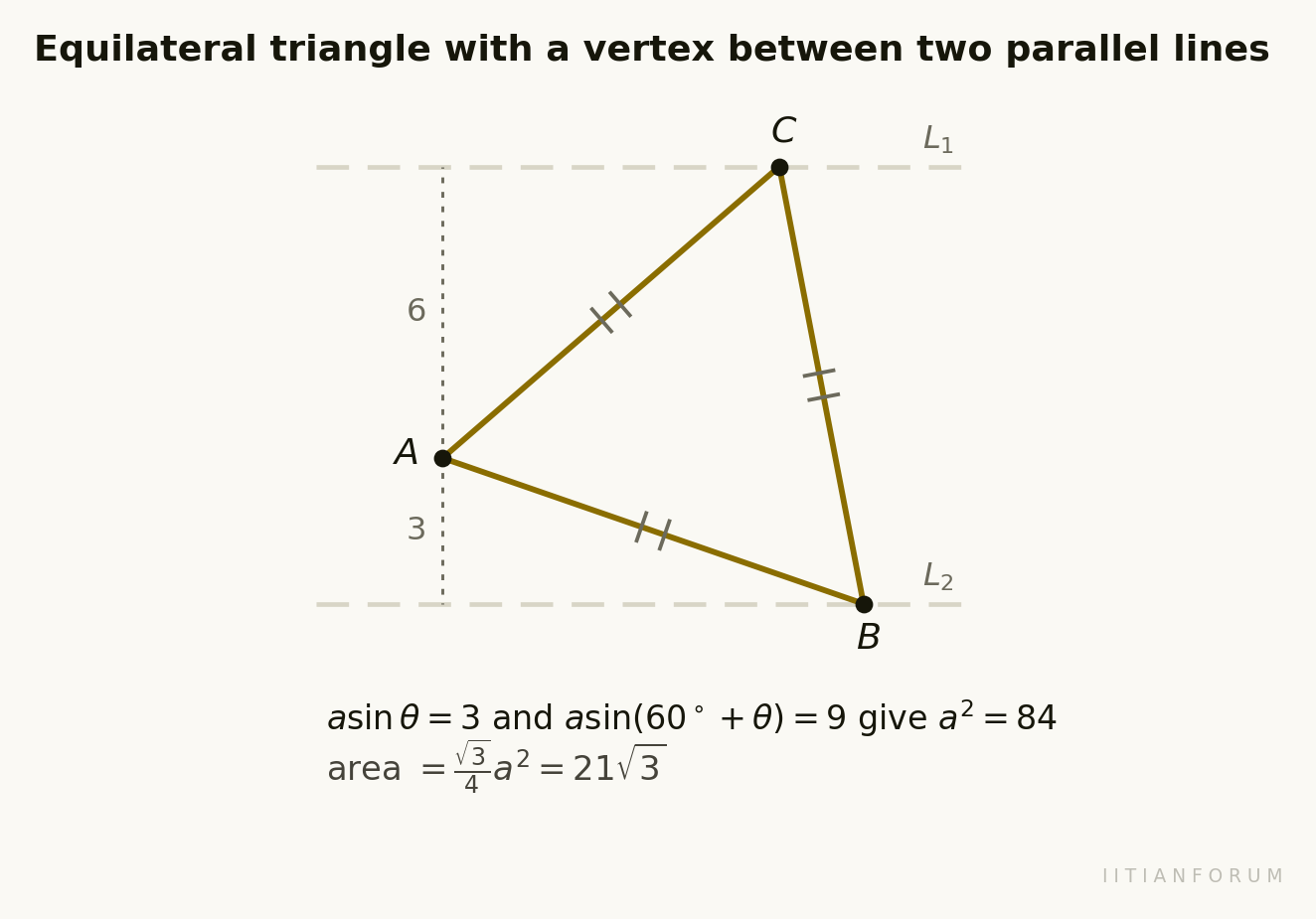
Example 23(JEE Main 2026, 21 January Shift 1). A point A lies between two parallel lines L1 and L2, at distances 6 and 3 from them. Find the area of the equilateral triangle ABC with B on L1 and C on L2.
▸ SHOW SOLUTION
Equilateral triangle with one vertex between two parallel lines
Step 1. Set up one angle and use it twice
Let the side be a and let AC make an angle θ with the parallel lines. The perpendicular from A to L2 has length 3, so
asinθ=3
The side AB makes an angle 60∘+θ with the same direction, and B lies on L1, at perpendicular distance 6 on the other side, so the total drop is 6+3=9:
asin(60∘+θ)=9
Step 2. Expand the second equation
a(23cosθ+21sinθ)=93acosθ+asinθ=18
Step 3. Substitute the first equation
3acosθ=15acosθ=53
Step 4. Square and add
a2=(asinθ)2+(acosθ)2a2=9+75=84
Step 5. Area
Δ=43a2=43⋅84=213
Answer: (3) 213.
Squaring and adding is what makes this quick. Solving for θ first produces an ugly inverse tangent and the same answer three lines later.
Example 24(JEE Main 2025, 22 January Shift 2). Two parallel lines are 5 apart and a point P lies between them at distance 1 from one. An equilateral triangle PQR has Q on one line and R on the other. Find (QR)2.
▸ SHOW SOLUTION
Step 1. Put in coordinates
Take the lines y=0 and y=5, and P=(0,1). Let Q=(q,0) and R=(t,5).
Step 2. Write the three equal squared sides
PQ2=q2+1PR2=t2+16QR2=(q−t)2+25
Step 3. Solve PQ2=PR2=QR2
From the first two, q2−t2=15. Substituting into PQ2=QR2 and simplifying gives
q=33,t=23
up to the reflection that swaps signs.
Step 4. Read off the answer
QR2=(33−23)2+25QR2=3+25=28
Answer:28.
Check: PQ2=27+1=28 and PR2=12+16=28, so all three sides do agree.
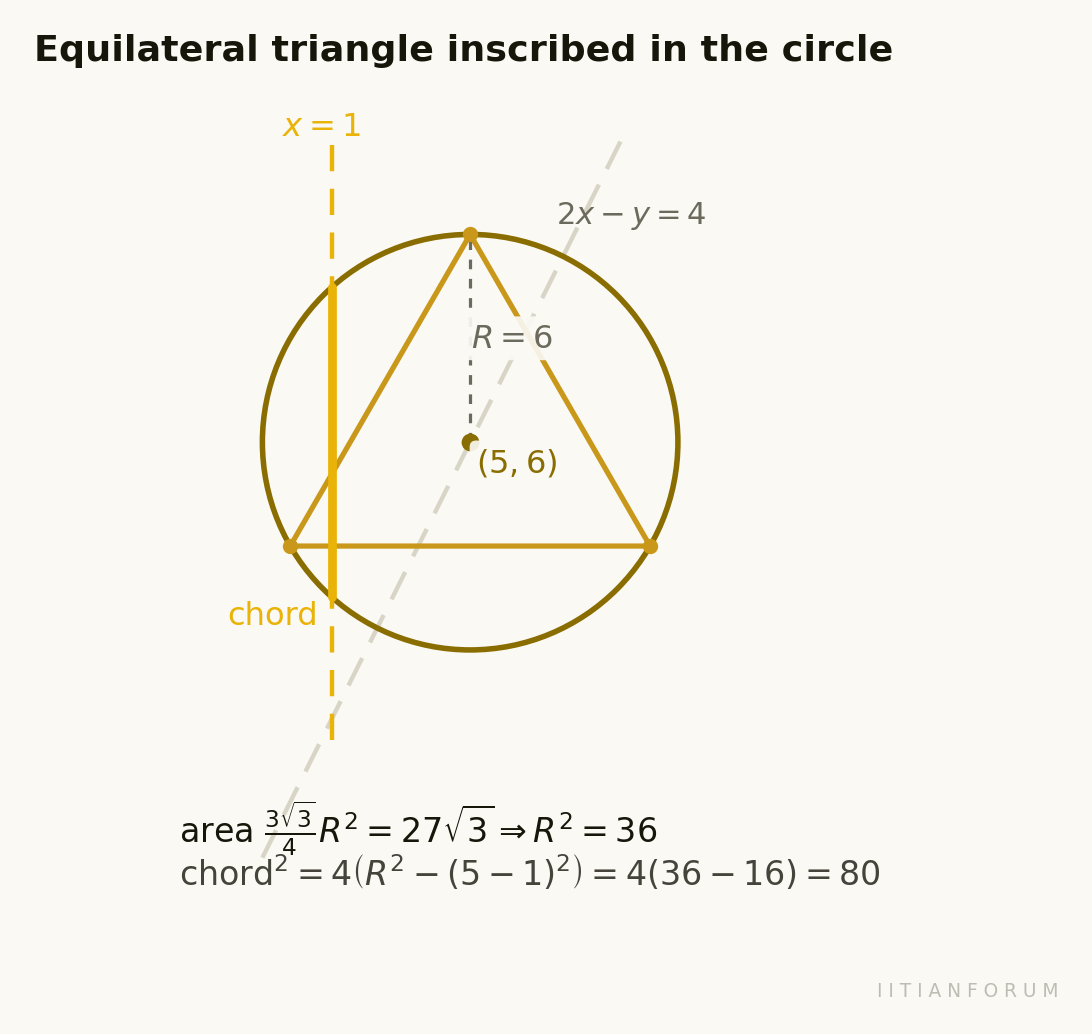
Example 25(JEE Main 2026, 6 April Shift 1). The centre of the circle x2+y2+2gx+2fy+25=0 lies in the first quadrant and on the line 2x−y=4. An equilateral triangle inscribed in the circle has area 273. Find the square of the length of the chord cut on x=1.
▸ SHOW SOLUTION
Equilateral triangle inscribed in the circle, and the chord on x = 1
Step 1. Turn the area into R
For an equilateral triangle inscribed in a circle of radius R, the side is R3, so
Δ=43(R3)2=433R2433R2=273⟹R2=36
Step 2. Use the two conditions on the centre
The centre is (−g,−f), and it lies on 2x−y=4:
−2g+f=4
The radius condition is g2+f2−25=36, so g2+f2=61. Substituting f=4+2g:
5g2+16g−45=0g=10−16±34=59or−5
Step 3. Pick the root that puts the centre in the first quadrant
g=−5 gives the centre (5,6), which qualifies. g=59 gives a centre in the third quadrant, rejected.
Step 4. Cut the circle with x=1
(1−5)2+(y−6)2=36(y−6)2=20
The chord has length 220, so its square is
4⋅20=80
Answer:80.
Example 26(JEE Main 2026, 5 April Shift 1). In an equilateral triangle PQR the vertex P is (3,5) and the side QR lies along x+y=4. If the orthocentre is (α,β), find 9(α+β).
▸ SHOW SOLUTION
Step 1. The orthocentre is the centroid
In an equilateral triangle all four centres coincide, so it is enough to find the centroid.
Step 2. Find the foot of the perpendicular from P
M=P−12+12xP+yP−4(1,1)M=(3,5)−24(1,1)=(1,3)
Step 3. Use Q+R=2M
G=3P+Q+R=3P+2MG=(33+2,35+6)=(35,311)
Step 4. Combine
9(α+β)=9⋅316=48
Answer: (4) 48.
Q and R were never located, and never needed to be. Anything symmetric in Q and R depends only on their midpoint.
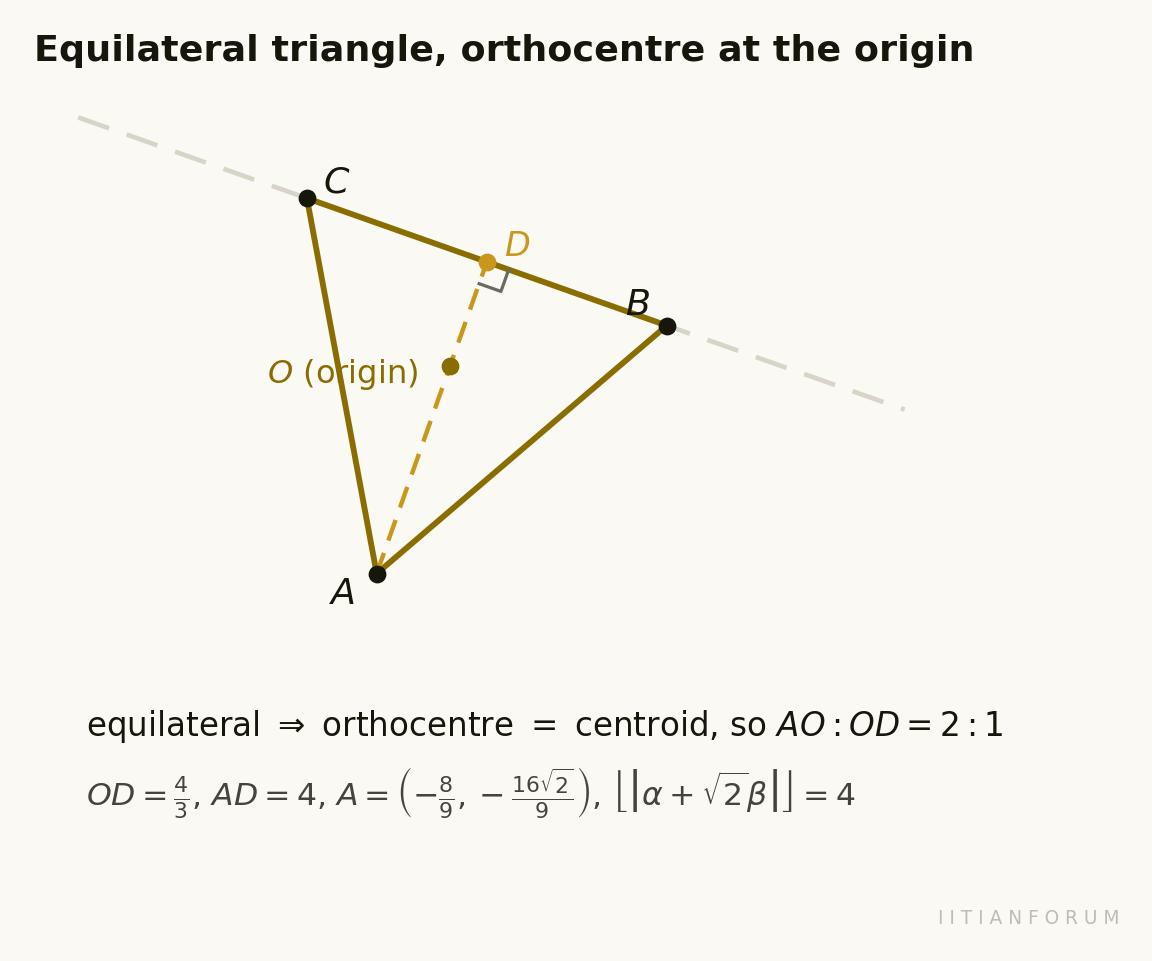
Example 27(JEE Main 2026, 28 January Shift 1). ABC is equilateral with orthocentre at the origin and side BC on the line x+22y=4. If A=(α,β), find ⌊α+2β⌋.
▸ SHOW SOLUTION
Equilateral triangle with its orthocentre at the origin
Step 1. Locate the foot of the altitude
The orthocentre is the centroid O(0,0). The distance from O to BC is
OD=1+8∣0+0−4∣=34
Step 2. Use the 2:1 split
AO=2OD=38AD=AO+OD=4
Step 3. Step from O away from the line
The unit normal towards the line is 31(1,22), so A is at −38 times it:
The sign matters. A must lie on the opposite side of BC from the direction the normal points towards the line, and taking the other sign gives α=916, which puts A on the same side as BC and produces a wrong option that is on the paper.
Angle bisectors and the isosceles trap
The internal bisector from B meets AC at D with
DCAD=BCBA=ac
and the external bisector meets AC produced at D′ with the same ratio taken externally. Its length is
BD=a+c2accos2B
Proof of the ratio. Areas of △ABD and △DBC share the same height from B, so their ratio is AD:DC. Computing them instead as 21⋅BA⋅BDsin2B and 21⋅BD⋅BCsin2B gives the ratio BA:BC.
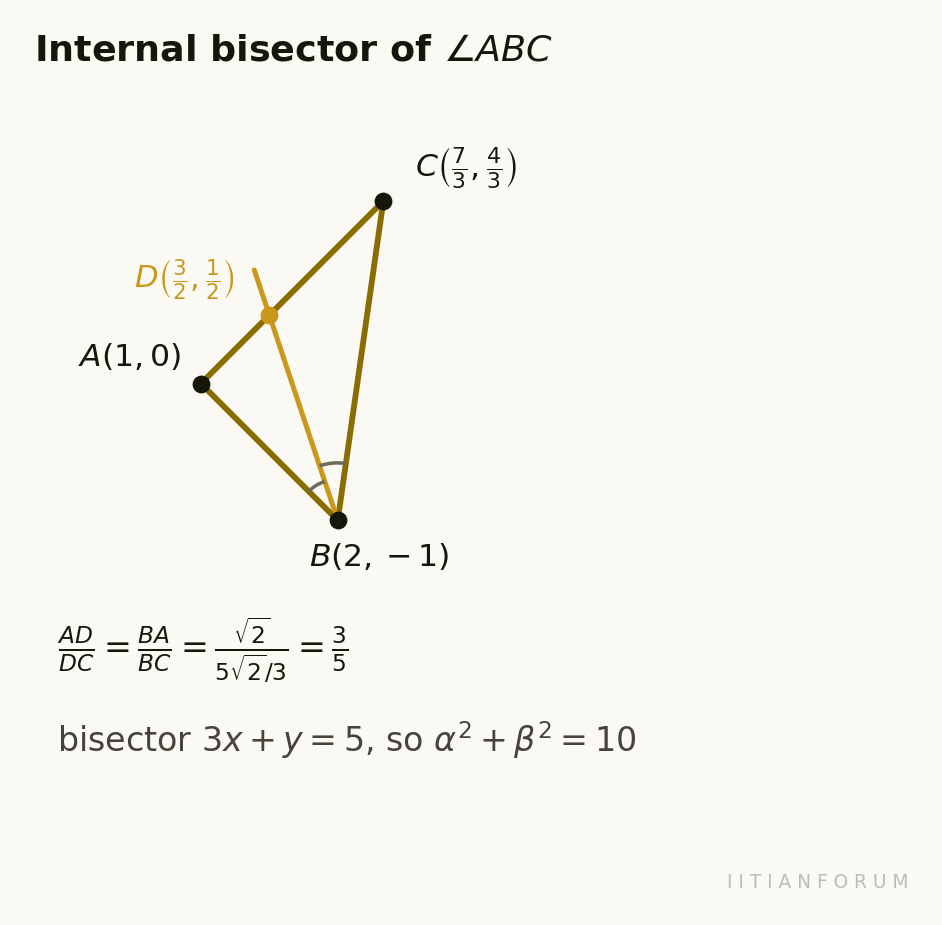
Example 28(JEE Main 2026, 24 January Shift 1). A(1,0), B(2,−1) and C(37,34) are three points. If the bisector of ∠ABC is αx+βy=5, find α2+β2.
▸ SHOW SOLUTION
Step 1. Find the two sides at B
BA=1+1=2BC=(31)2+(37)2=950=352
Step 2. Use the bisector ratio
DCAD=BCBA=52/32=53
Step 3. Section formula on AC
D divides AC in the ratio 3:5, so
Dx=83⋅37+5⋅1=812=23Dy=83⋅34+5⋅0=84=21
Step 4. Write the line BD
slope=23−221+1=−1/23/2=−3y+1=−3(x−2)⟹3x+y=5
so α=3, β=1.
α2+β2=9+1=10
Answer: (4) 10.
The form αx+βy=5 fixes the scaling: once you have 3x+y=5 there is nothing left to normalise. Had the line come out as 6x+2y=10 you would have to divide by 2 before reading off α and β.
The internal bisector from B meeting AC at D
Example 29(JEE Main 2025, 28 January Shift 2). The two equal sides of an isosceles triangle lie along −x+2y=4 and x+y=4. If m is the slope of the third side, find the sum of all possible distinct values of m.
▸ SHOW SOLUTION
Step 1. Say what "equal sides" gives you
The base makes equal angles with the two equal sides, so with m1=21 and m2=−1,
1+mm1m−m1=1+mm2m−m2
Step 2. Square to remove the moduli
(2+m2m−1)2=(1−mm+1)2
Step 3. Take both signs
The sign giving (2m−1)(1−m)=(m+1)(2+m) leads to 3m2=−3, which has no real root. The other sign gives
(2m−1)(1−m)=−(m+1)(2+m)m2−6m−1=0
Step 4. Sum the roots
m=3±10,sum=6
Answer: (3) 6.
Both roots are genuine: they are the base of the isosceles triangle and the base of its reflection, and the question asks for the sum, so Vieta's relation gives the answer without ever computing 10.
Two bisectors, not one
Two lines have two angle bisectors, perpendicular to each other. A question that says "the bisector" without saying internal or external, or one that asks for "all possible" values, is testing whether you kept both. The internal bisector of the angle containing a given point is the one on which that point and the origin sit with the same sign in a12+b12a1x+b1y+c1=±a22+b22a2x+b2y+c2.
Cyclic quadrilaterals
A quadrilateral inscribed in a circle has opposite angles supplementary, and that one fact does everything.
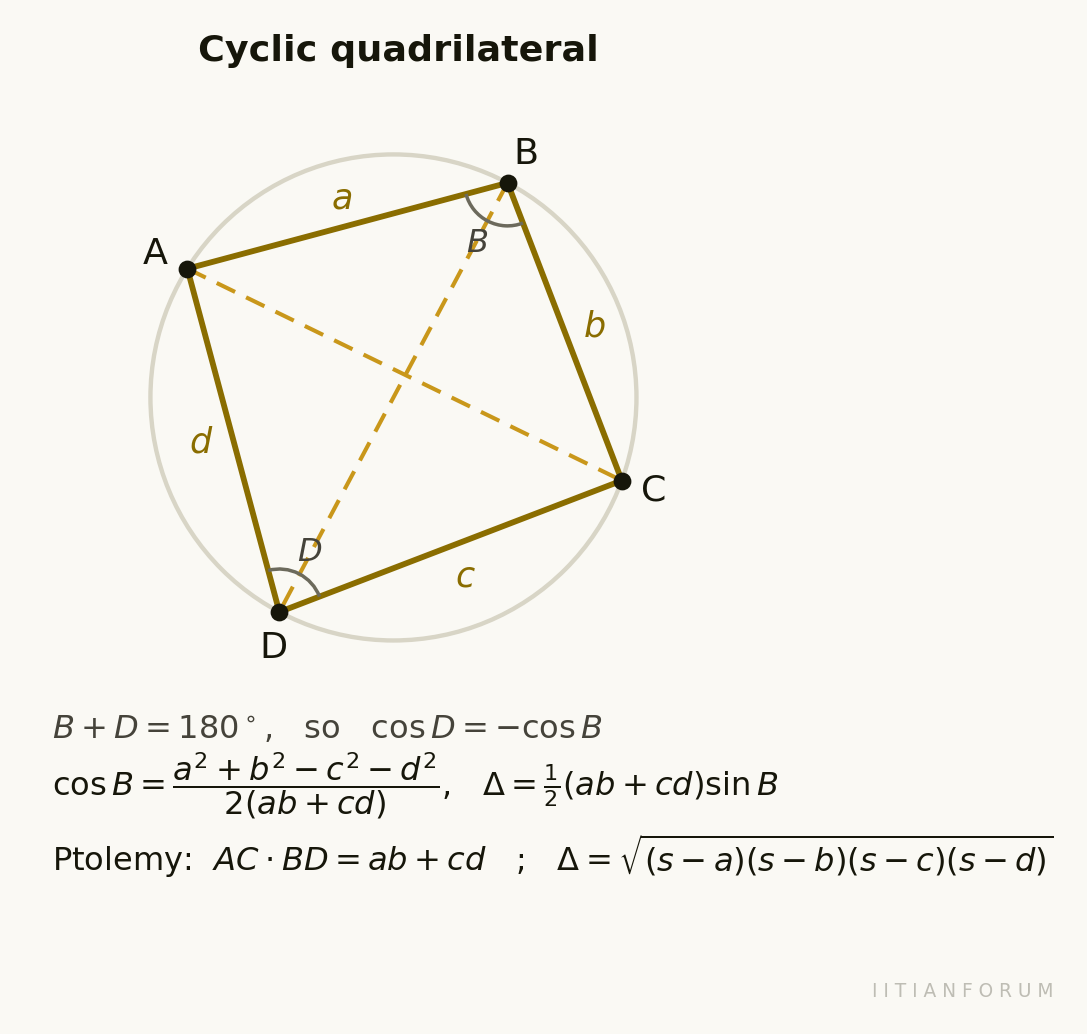
Cyclic quadrilateral with its two diagonals and Ptolemy's relation
With sides AB=a, BC=b, CD=c, DA=d and s=2a+b+c+d:
Proof of the cosine formula. Apply the cosine rule to AC in △ABC and in △ACD:
AC2=a2+b2−2abcosBAC2=c2+d2−2cdcosD
Since D=180∘−B, cosD=−cosB. Equating the two and solving for cosB gives the formula. The area formula follows by adding the two triangle areas and using sinD=sinB. The last line is Ptolemy's theorem; the fourth is Brahmagupta's formula, which is Heron's formula with a fourth factor.
For a general quadrilateral, not necessarily cyclic, the area is
Δ=P−abcdcos2α
where P=(s−a)(s−b)(s−c)(s−d) and α=2A+C. Setting A+C=180∘ recovers Brahmagupta, which shows that the cyclic quadrilateral is the one of largest area for given side lengths.
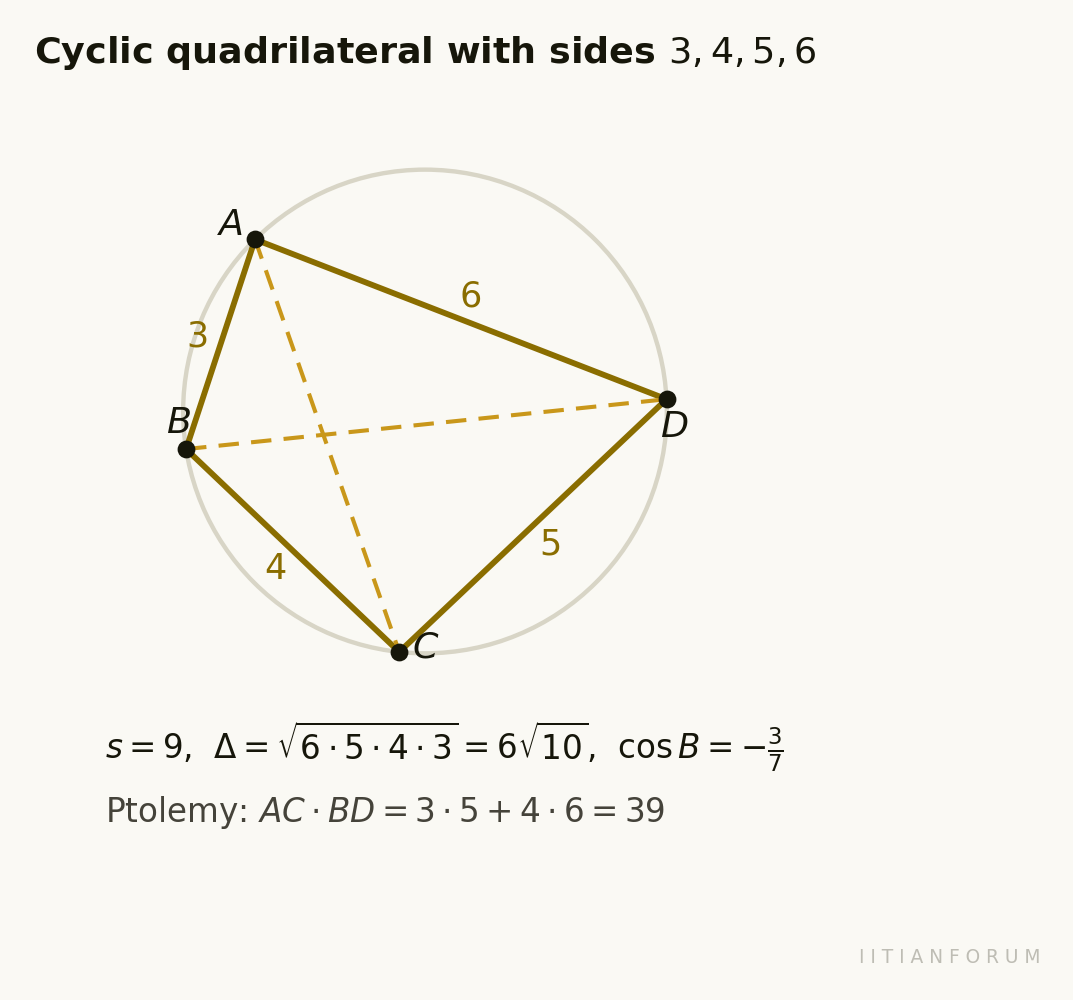
Example 30(IITianForum). A cyclic quadrilateral has sides 3, 4, 5, 6 in order. Find its area, cosB, and the product of its diagonals.
▸ SHOW SOLUTION
Cyclic quadrilateral with sides 3, 4, 5, 6
Step 1. Semi-perimeter and Brahmagupta
s=23+4+5+6=9Δ=6⋅5⋅4⋅3=360=610
Step 2. The angle between the sides 3 and 4
cosB=2(12+30)9+16−25−36=84−36=−73
so B is obtuse, as it must be when the two opposite sides are the longer pair.
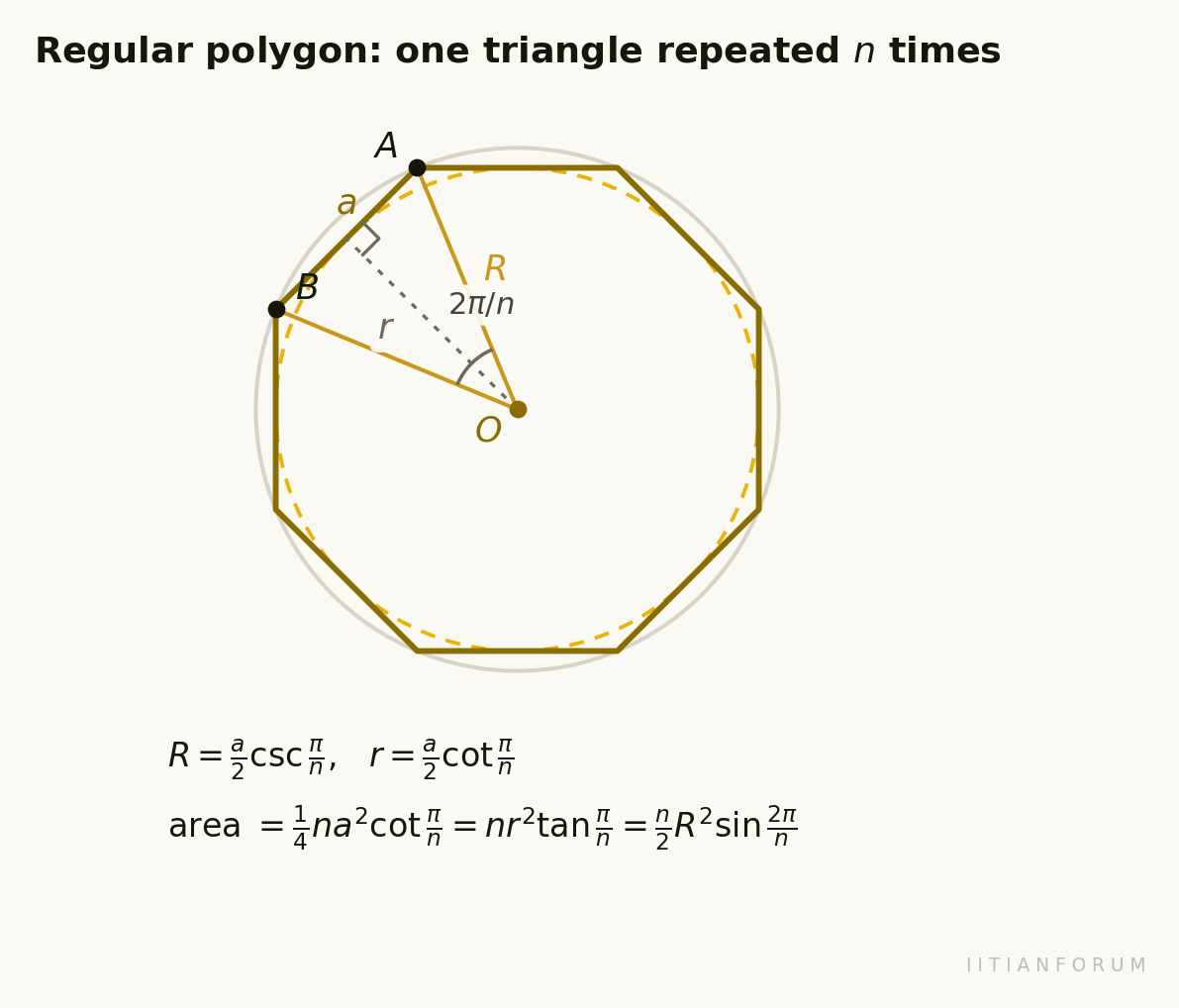
A regular polygon of n sides is n copies of one isosceles triangle joined at the centre, and every formula follows from solving that one triangle.
Regular polygon split into n congruent triangles about the centresum of interior angles=(n−2)πeach interior angle=n(n−2)πR=2acosecnπ,r=2acotnπarea=41na2cotnπarea=nr2tannπ=2nR2sinn2π
Proof. The central angle subtended by one side is n2π. Half of that isosceles triangle is right angled with hypotenuse R, opposite side 2a and adjacent side r, giving the two radius formulas at once. The area is n times 21R2sinn2π.
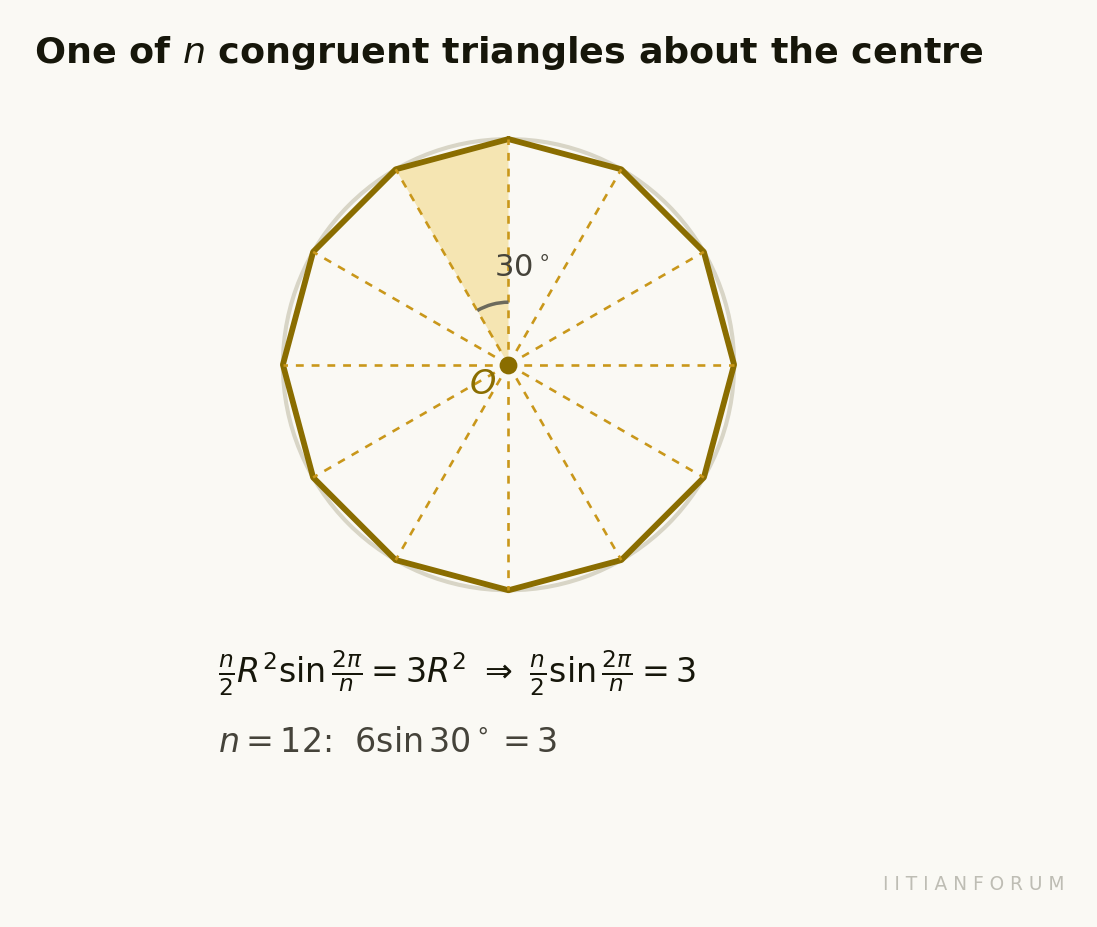
Example 31(IITianForum). A regular polygon inscribed in a circle of radius R has area 3R2. Find the number of sides.
▸ SHOW SOLUTION
A regular 12-gon with one of the twelve congruent triangles shaded
Step 1. Use the area formula in terms of R
2nR2sinn2π=3R22nsinn2π=3
Step 2. Try the value that makes the angle standard
n=12 gives n2π=30∘, so
212sin30∘=6⋅21=3
which works.
Step 3. Confirm there is no other
f(n)=2nsinn2π is strictly increasing in n, since it is the area of the inscribed n-gon in a fixed circle and adding a side strictly increases that area. So the solution is unique.
Answer:n=12.
As a check on the direction of that monotonicity, f(n)→π as n→∞, which is the area of the unit circle, and 3<π, so a finite answer had to exist.
Which rule to reach for
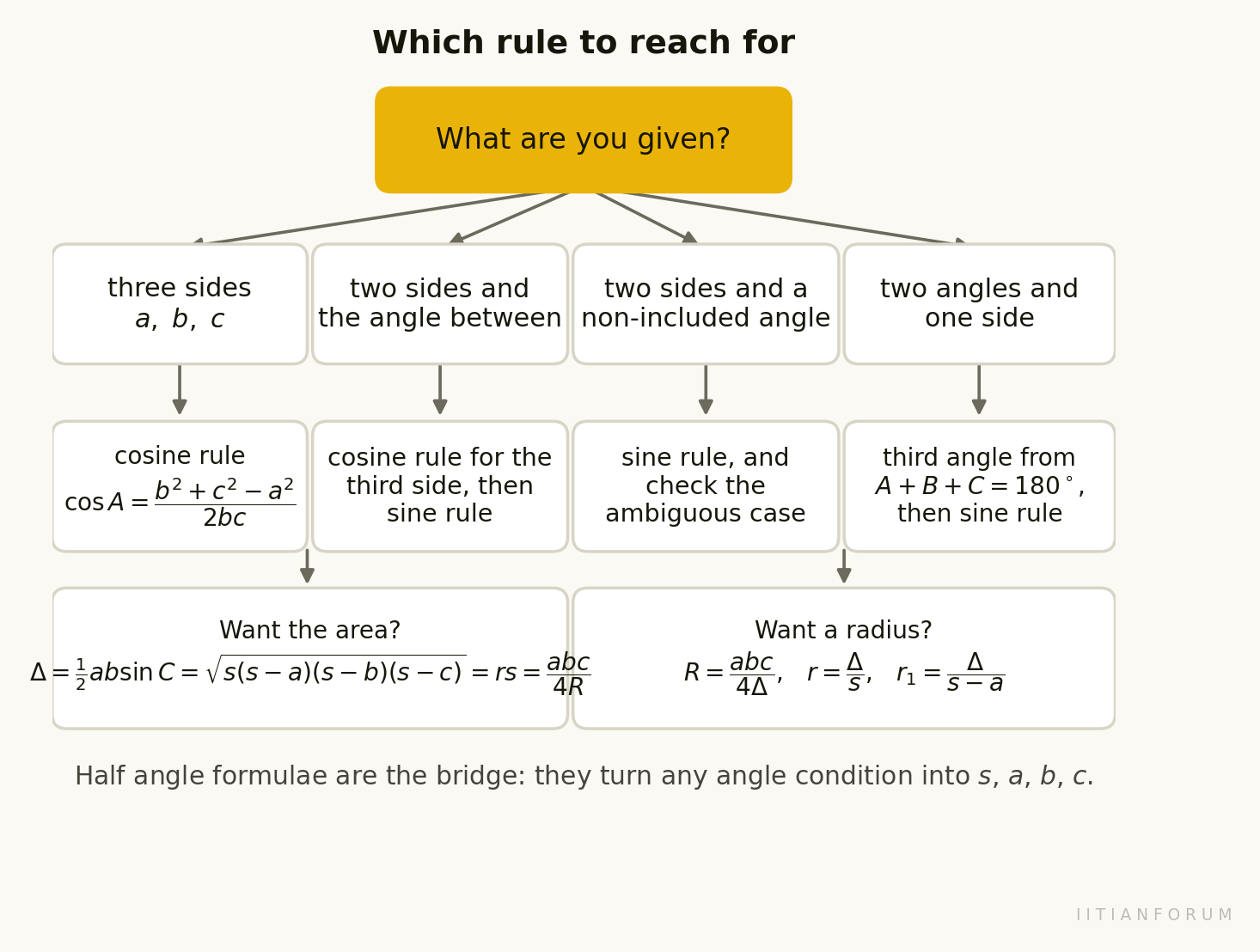
Decision chart: what you are given decides which rule to use
Read it in one line: what you are given decides the rule, and what you are asked decides which area or radius formula finishes the job. The half angle formulae sit between the two, because they are the only tool that converts an angle condition into a pure statement about s, a, b and c.
Quick recall
Result
Statement
sine rule
sinAa=sinBb=sinCc=2R
cosine rule
cosA=2bcb2+c2−a2
projection
a=bcosC+ccosB
Napier
tan2A−B=a+ba−bcot2C
Mollweide
ca+b=sin2Ccos2A−B
half angle
tan2A=s(s−a)(s−b)(s−c)=s−ar
area
Δ=21absinC=s(s−a)(s−b)(s−c)=rs=4Rabc
median
ma=212b2+2c2−a2
Apollonius
b2+c2=2ma2+2a2
m-n theorem
(m+n)cotθ=ncotB−mcotC
centroid
G=3A+B+C
incentre
I=a+b+caA+bB+cC
orthocentre
H=A+B+C when O is the origin; HA=2RcosA
Euler line
O, G, N, H collinear, OG:GH=1:2, N the midpoint of OH
nine-point circle
centre N, radius 2R
inradius
r=sΔ=4Rsin2Asin2Bsin2C
exradius
r1=s−aΔ=stan2A
radii identities
r1+r2+r3−r=4R and r11+r21+r31=r1
OI and OH
OI2=R2−2Rr, OH2=R2(1−8cosAcosBcosC)
Euler inequality
R≥2r, equality only for an equilateral triangle
pedal triangle
angles 180∘−2A, sides acosA, circumradius 2R
excentral triangle
angles 90∘−2A, sides 4Rcos2A, circumradius 2R
ambiguous case
two triangles exactly when csinB<b<c
cyclic quadrilateral
Δ=(s−a)(s−b)(s−c)(s−d) and AC⋅BD=ac+bd
regular n-gon
R=2acosecnπ, area =2nR2sinn2π
equilateral
R=2r, Δ=433R2, side =R3
swipe for more →
The habit that saves the most marks here
Finish every solution by checking one quantity a second way. The area computed from 21absinC should match rs. A solved triangle should satisfy Mollweide. An answer for a radius should be consistent with R≥2r. Each check costs one line and catches nearly every arithmetic slip this chapter can produce.
Practise these until the decision chart is automatic, then take a full chapter test in the doMath practice section to see how fast you can place a question in the right box.