Monotonic Functions Increasing, Decreasing, Concavity and Inflection
The nature of a function which is differentiable everywhere can only be one of three things:
- the output increases as the input increases,
- the output decreases as the input increases,
- the output does neither, because the function rises on some stretches and falls on others.
A function is called monotonic when it does the same thing throughout the interval you are looking at. If it rises on one stretch and falls on another, it is monotonic on each stretch separately, but not on the whole. Everything in this chapter is about deciding which stretch is which, and the derivative is the tool that decides it quickly.
Fundamental concept of monotonic functions
Let be defined on an interval , and take any with .
| Strictly increasing | Strictly decreasing | |
|---|---|---|
| 1. Definition | The output rises as the input rises: for every such pair. | The output falls as the input rises: for every such pair. |
| 2. Graphical reading | Moving right along the curve, you move up. | Moving right along the curve, you move down. |
| 3. Derivative | From first principles, . For the numerator is positive, so the quotient is positive, giving . | For the numerator is negative while , so the quotient is negative, giving . |
| 4. Geometrical meaning | The tangent has positive slope at every point, so the angle it makes with the positive -direction is acute. | The tangent has negative slope at every point, so is obtuse. |
| 5. Effect on an inequality | Applying to both sides keeps the inequality: . Example: is increasing on , so there gives . | Applying to both sides reverses it: . Example: is decreasing on , so there gives . |
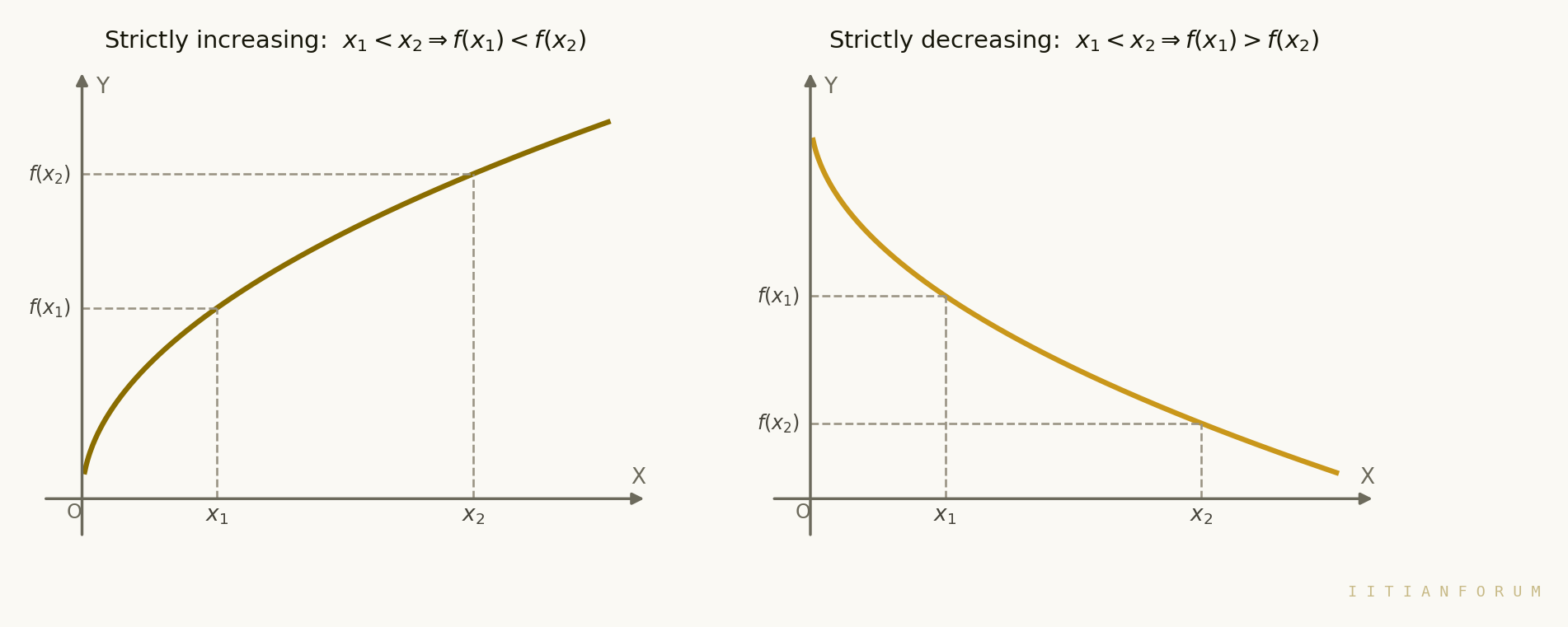
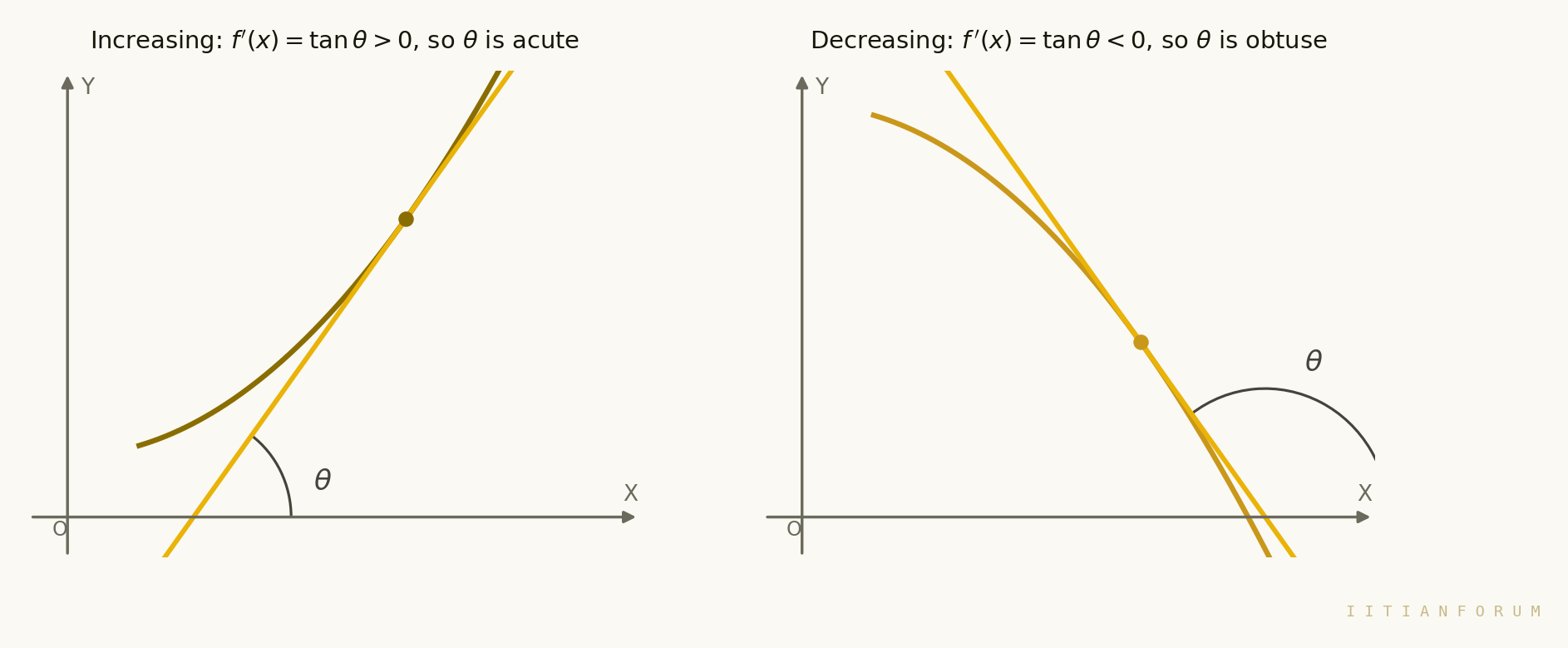
The inequality must hold for every pair in , not just the pair you happened to test. And monotonicity always belongs to a function together with an interval — never to the function alone.
is strictly decreasing on and strictly decreasing on . But on the full domain, take and : then while . The outputs went up. So never write "decreasing on " — write the two intervals separately.
Non-decreasing and non-increasing
A function is called non-decreasing (or increasing in the weak sense) if . For two different inputs the function may return the same output, but it never returns a smaller one. Similarly is non-increasing if : it may repeat a value, but never grow.
The visible difference is that a non-decreasing function is allowed to stop and sit still on a stretch, while a strictly increasing one is never allowed to.
Non-decreasing and non-increasing functions — flat stretches allowed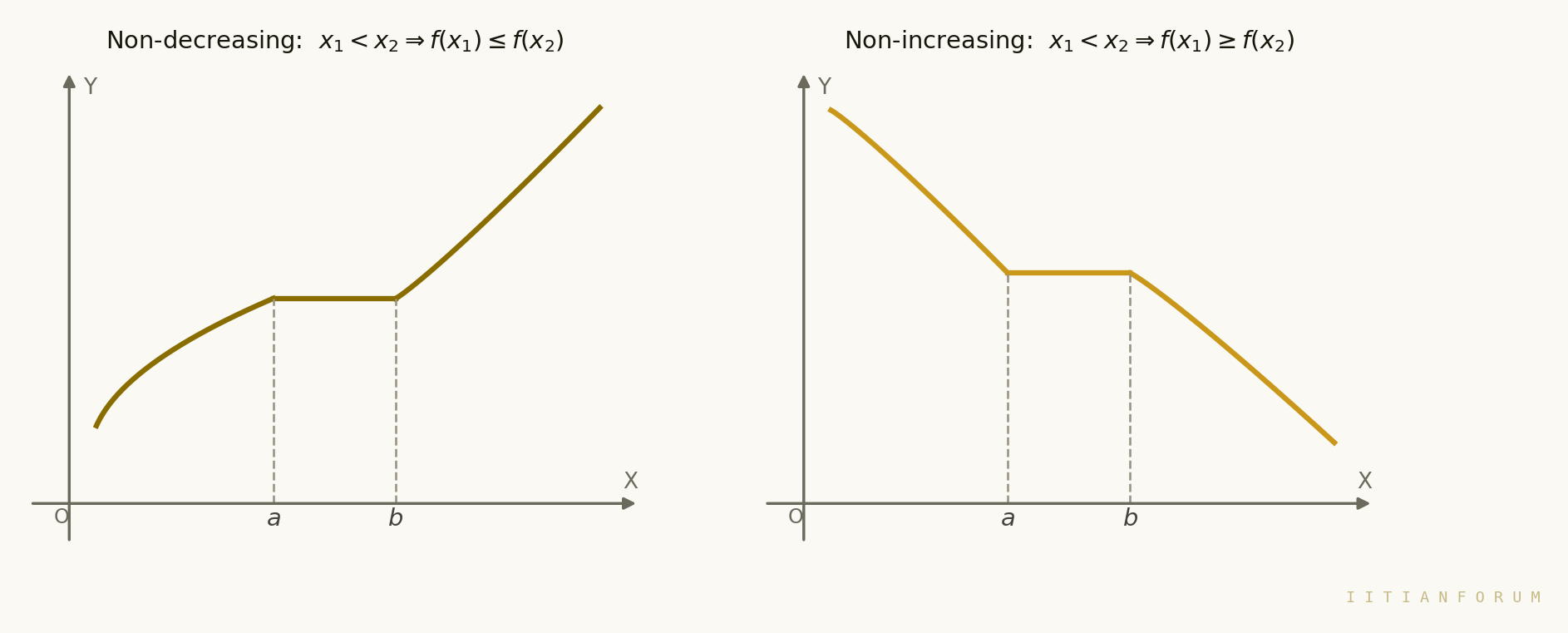
Increasing on its own almost always means strictly increasing. A question wanting the weak version says non-decreasing, or writes the explicitly. Read the full option list before deciding: when one option says increasing and another says non-decreasing, that distinction is the question.
Reading monotonicity off the derivative
The two facts above have a converse, and the converse is the one you will actually use. It comes from Lagrange's mean value theorem.
For in the interval, LMVT supplies a point between them with
The bracket is positive, so the sign of is exactly the sign of . Hence, for continuous on and differentiable on :
- on is strictly increasing on ,
- on is strictly decreasing on ,
- on is constant on .
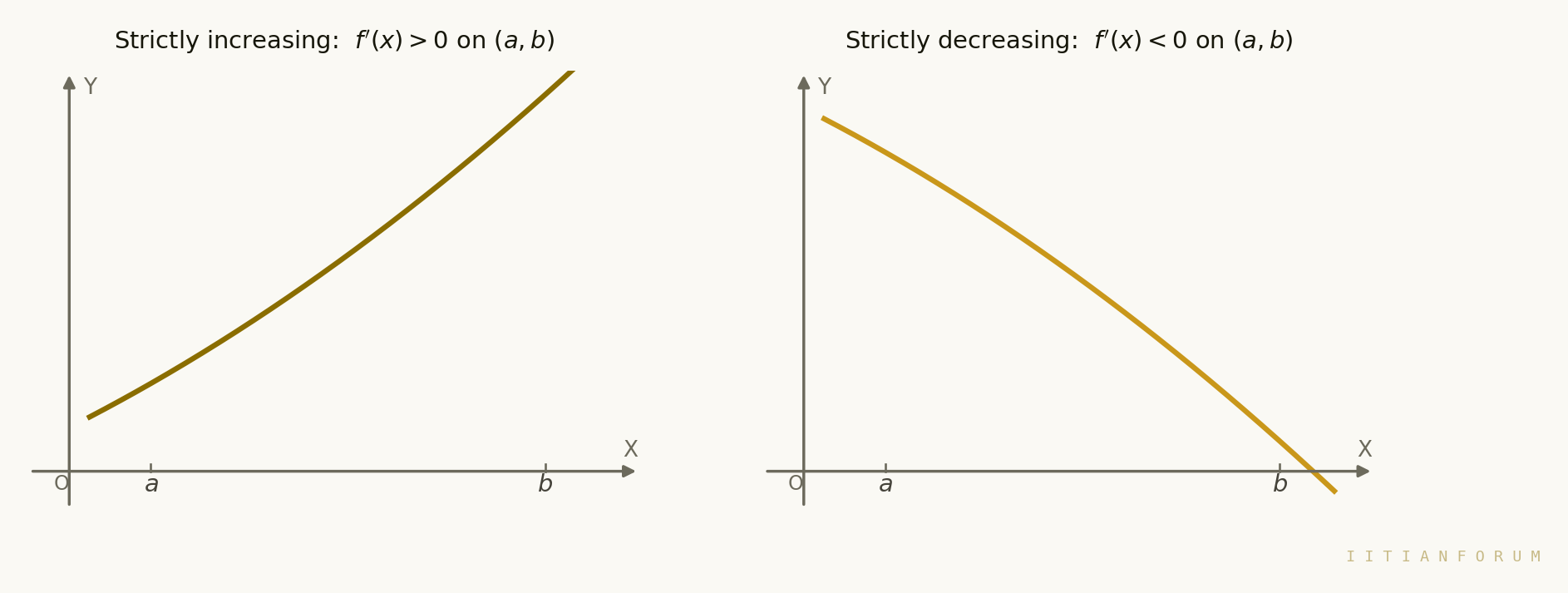
Note the hypotheses: continuity on the closed interval, differentiability only on the open one. That is why counts as strictly increasing on even though does not exist.
The one statement that is false
Row 3 of the table gave , not . So while guarantees strictly increasing, strictly increasing does not guarantee . This is the most heavily examined misconception in the chapter.
is strictly increasing on , which you can prove with no calculus at all: for ,
And yet .
y = x cubed is strictly increasing on R yet has f'(0)=0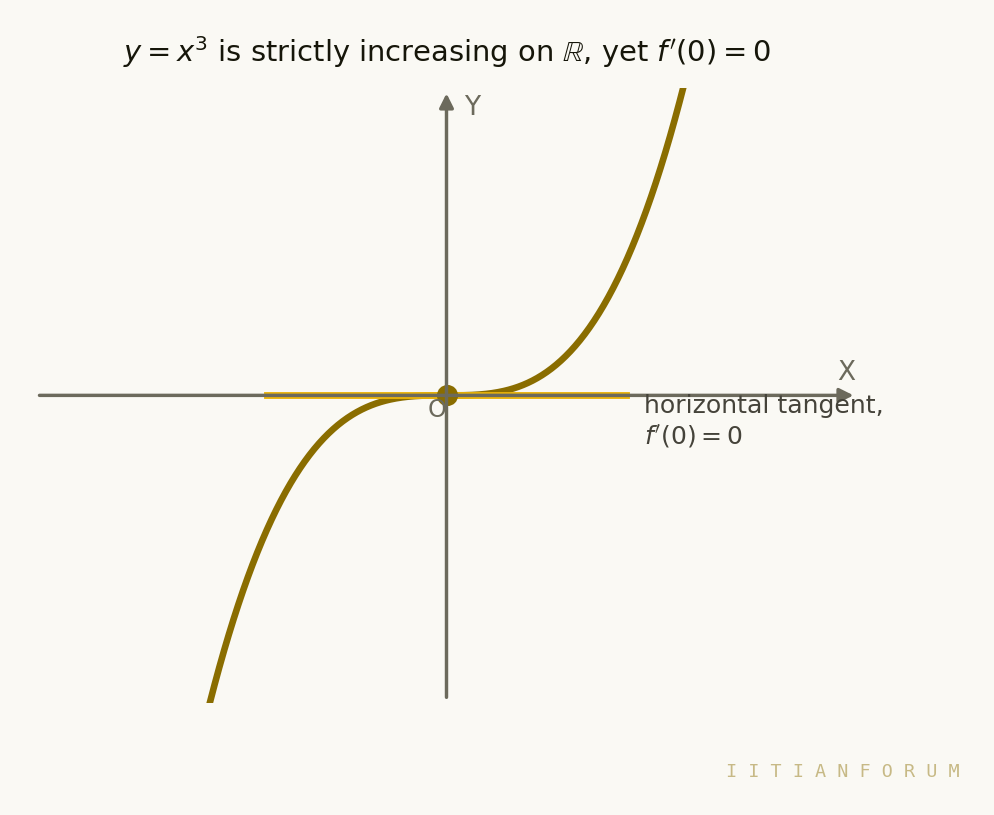
The correct statement allows the derivative to vanish, provided it does not stay vanished:
If on and does not vanish identically on any sub-interval — in particular if its zeros are isolated — then is strictly increasing on .
Why: already makes non-decreasing. If two points had equal images, would be constant between them, forcing on that whole sub-interval, which the hypothesis forbids.
- on strictly increasing. True — the workhorse.
- strictly increasing . True.
- strictly increasing . False. Counterexample at .
Consequence: the answer to a "find the values of " question is almost always a closed interval. Students who demand lose both endpoints.
Double derivative of monotonic functions
The sign of says which way the curve goes. The sign of says how it bends, and the two are independent — so an increasing function has three possible shapes, and so does a decreasing one.
is concave up where is increasing, i.e. where ; concave down where is decreasing, i.e. where . This is just the derivative test applied to instead of .
A. Increasing
An increasing curve can bend up (), bend down (), or not bend at all (, a straight line). All three are rising.
Increasing functions — the three shapes from the second derivative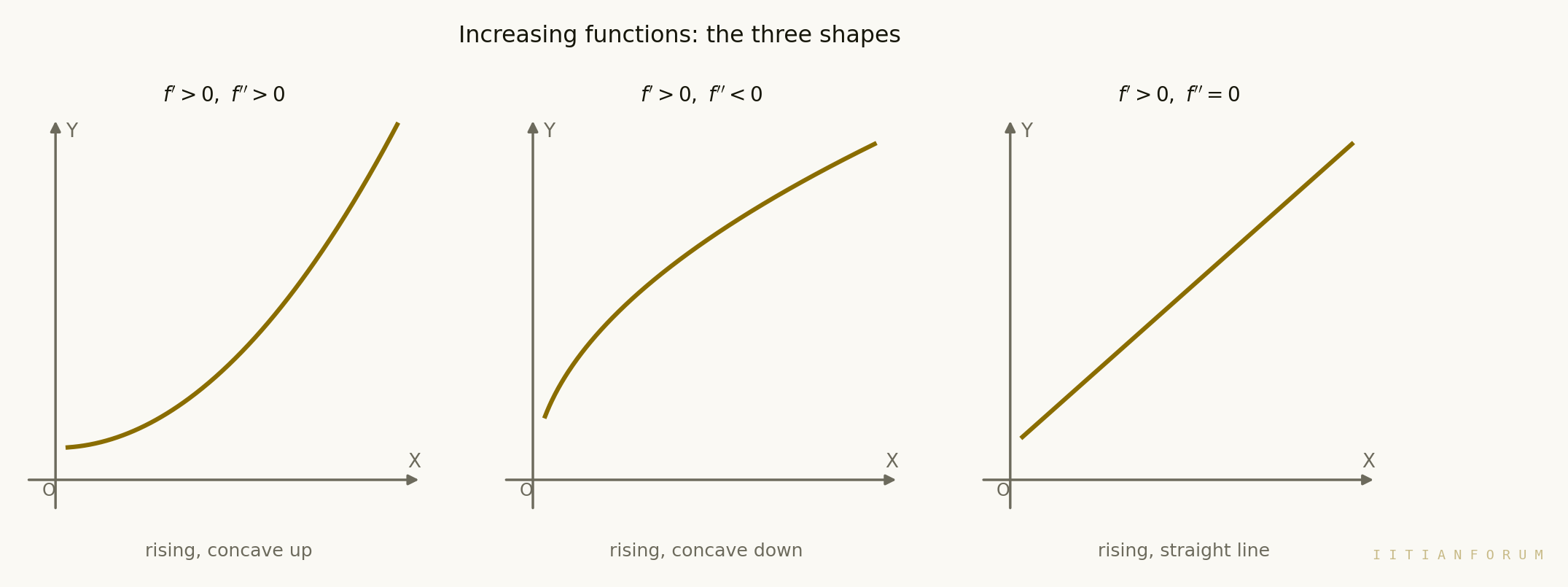
B. Decreasing
The same three shapes occur while falling: bending down (), bending up (), or a straight line ().
Decreasing functions — the three shapes from the second derivative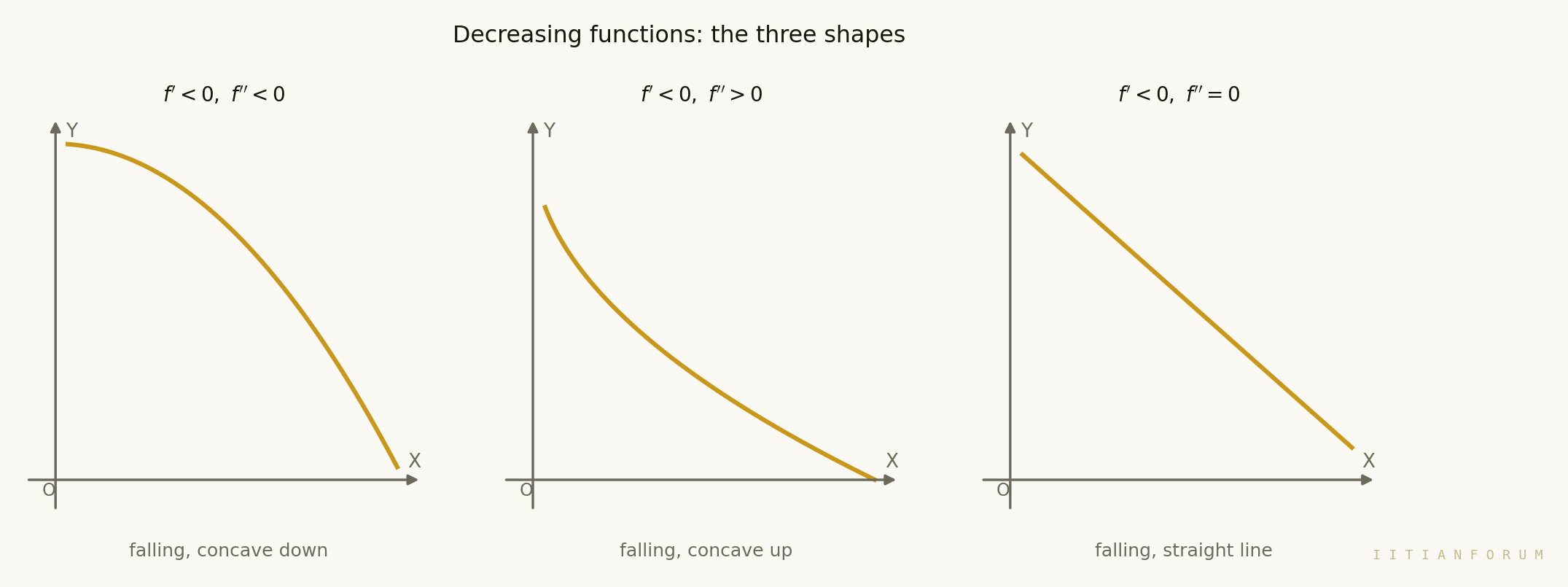
Point of inflection
For a continuous , a point is a point of inflection if the concavity changes as passes through it — concave up on one side, concave down on the other. If is continuous near , then an inflection forces ; conversely, if changes sign at , then is an inflection point.
Point of inflection — concavity changes where f''(x0)=0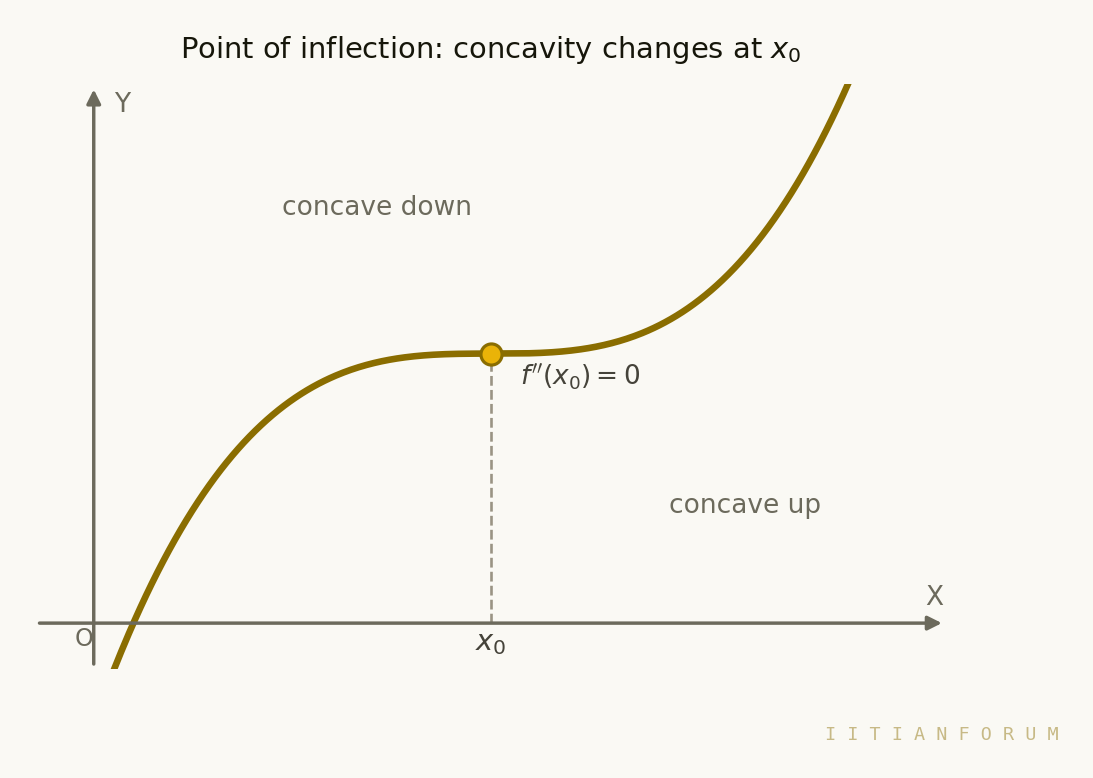
For we have , so . But on both sides, so the curve is concave up throughout and is not an inflection point.
The working rule: a zero of coming from an even power does not flip the sign, so it gives no inflection; a zero from an odd power does. For , — nothing at , one inflection at .
Now the six question types that use all of this.
Type 1 — Monotonicity at a point
Monotonicity at a single point compares only with its immediate neighbours. is increasing at if there is a small with
and decreasing at if .
Continuity and differentiability are simply not part of this definition, so a corner or a jump at does not by itself stop from being increasing at . We may speak of monotonicity of at only if lies in the domain of .
Example 1. At the graph of satisfies and for all small . Classify at .
▸ SHOW SOLUTION
Step 1: Test the increasing chain. It needs . Here , so the second inequality is not strict and the chain fails.
Step 2: Test the decreasing chain. It needs . Here , so it fails at the first step.
Step 3: Test the weak version. does hold.
Answer: is neither increasing nor decreasing at ; it is non-decreasing at .
Put your pencil at , look a hair left, then a hair right. Increasing needs both inequalities strict and pointing the same way. If one side is flat, it is non-decreasing but not increasing. If the two sides disagree, it is neither.
Type 2 — Monotonicity in an interval
This is the standard case. The method is fixed:
- Write the domain first — everything that follows is trapped inside it.
- Differentiate and factorise .
- Mark the partition points: zeros of , and domain points where fails to exist.
- Build a sign chart on the gaps between consecutive partition points.
- Report the intervals one at a time.
Example 2. Find the intervals in which increases and decreases.
▸ SHOW SOLUTION
Step 1: Domain. , since is a polynomial.
Step 2: Factorise the derivative.
Step 3: Partition points. and .
Step 4: Sign chart. The factor is positive, so the sign of is the sign of — a product of two brackets, positive when both share a sign.
Step 5: Report. Strictly increasing on and on ; strictly decreasing on . Endpoints attach because is continuous and vanishes only at those single points.
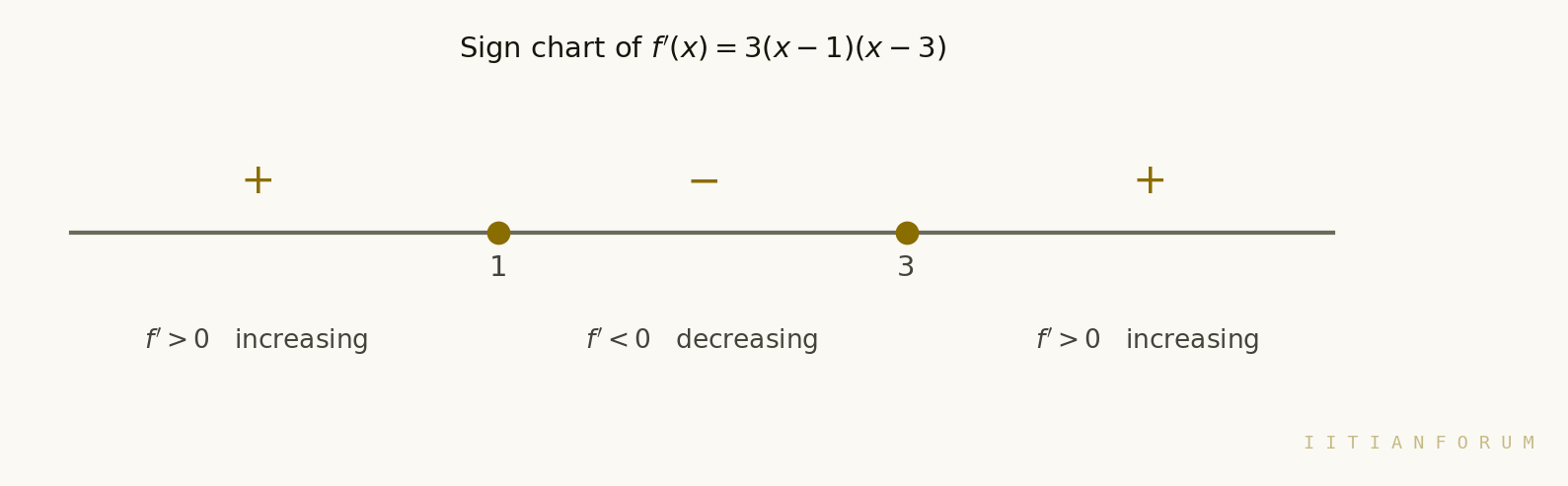
Test the union with real numbers. and . The pair lies inside , yet . Two separate intervals is not a stylistic preference — it is the only true statement.
Example 3. For which real is strictly increasing on ?
▸ SHOW SOLUTION
Step 1: Differentiate. .
Step 2: Decide what to demand. It is enough that everywhere, provided does not vanish on a whole interval. A non-zero quadratic has at most two roots, so that is automatic.
Step 3: Discriminant. The leading coefficient is positive, so for all exactly when
Step 4: Solve. .
Step 5: Check the endpoints. At , , vanishing only at — allowed. Same at .
Answer: , a closed interval.
Example 4 (JEE Main 2026, 24 Jan Shift 1). Let be the largest interval in which , , is strictly decreasing. Find the local maximum value of , .
▸ SHOW SOLUTION
Step 1: Locate the switch of the modulus. On , the expression is negative for . Since needs , we get , so work on where .
Step 2: Differentiate. With ,
Step 3: Sign chart on . The denominator there. The numerator is positive on and negative on . So on and on : the largest interval of strict decrease is .
Step 4: Match. , and then agrees.
Step 5: Write and differentiate.
Step 6: Critical points with . gives , so (the root fails ).
Step 7: Confirm it is a maximum.
whose sign for follows : positive on , negative on . The sign goes , so is a local maximum.
Step 8: Evaluate.
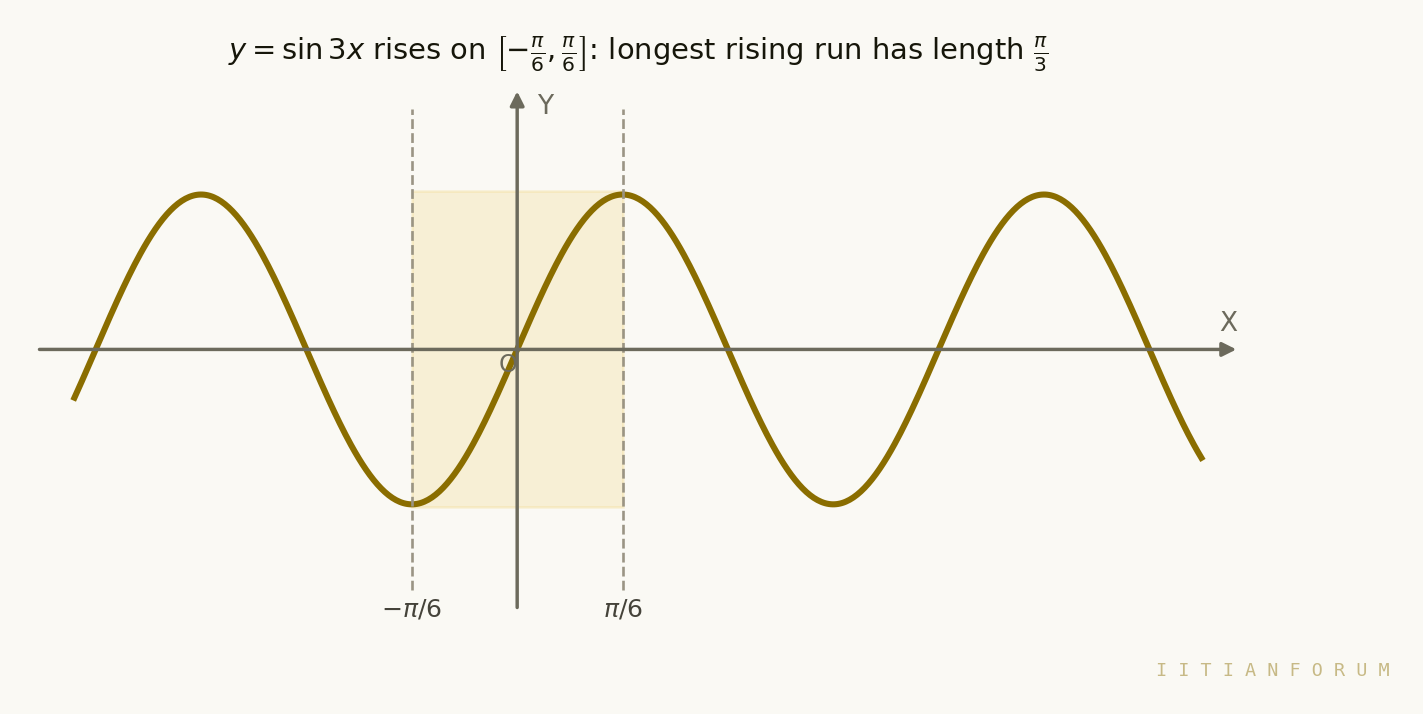
For a function like the rising and falling runs each have length , because the whole graph of is compressed horizontally by the factor . So rises on , a run of length , and that is the longest interval on which it increases.
Type 3 — Checking the one-one (injective) nature
If is strictly increasing or strictly decreasing on a set, it is one-one there: for two distinct inputs, one is smaller, so their images are strictly ordered and cannot be equal.
The converse fails. A function equal to on and to on is one-one but neither increasing nor decreasing. So use monotonicity to prove one-one, never to disprove it.
Example 5 (JEE Main 2026, 28 Jan Shift 2). Show that , , is one-one.
▸ SHOW SOLUTION
Step 1: Remove the modulus.
Step 2: Differentiate on .
Step 3: Differentiate on .
Step 4: Join the pieces. Both formulas give , so is continuous at . With positive derivative on both sides and only the single point left over, is strictly increasing on all of .
Step 5: Conclude. Strictly increasing one-one.
A positive derivative on each piece separately proves nothing on its own — that was exactly the situation earlier, where the derivative is negative on both pieces and the function still fails to be decreasing overall. What rescues this problem is that the pieces join continuously at . Always say so.
A strictly monotonic is also invertible onto its range, and keeps the same direction: if but , applying the increasing would give , a contradiction.
Type 4 — Monotonicity of a composite function
Direction composes like multiplication of signs:
| increasing | increasing | increasing |
| increasing | decreasing | decreasing |
| decreasing | increasing | decreasing |
| decreasing | decreasing | increasing |
Why the second row: for , a decreasing gives ; feeding those into an increasing preserves the order, so .
Example 6 (JEE Main 2026, 21 Jan Shift 2). Let be twice differentiable with for all and . Put on . Decide: (I) is increasing on ; (II) is decreasing on .
▸ SHOW SOLUTION
Step 1: Complete the square inside .
so with .
Step 2: Chain rule. , so
Step 3: The factor is never negative. Since everywhere, is strictly increasing. And , because a square is . Feeding the larger input into the increasing :
Step 4: Reduce the sign to one bracket. on and , so
Step 5: Evaluate on each interval. On , , so and decreases — (I) is FALSE. On , , so and increases — (II) is FALSE.
Answer: neither statement is true; the truth is the exact opposite of both.
Check with a concrete . Take and , which satisfies and . Then , which takes the values at (falling) and at (rising). Exactly as proved.
Type 5 — Peeling an unknown off an inequality
This is the disguise JEE likes most. You are told only that some unnamed is strictly monotonic, and the entire problem is to convert an inequality in into an inequality in the arguments:
- strictly increasing: .
- strictly decreasing: — the inequality flips.
Example 7 (JEE Main 2026, 08 Apr Shift 2). Let represent an ellipse with major axis along the -axis, where is a strictly decreasing positive function on . If the set of all possible is , find .
▸ SHOW SOLUTION
Step 1: Turn the geometry into an inequality. For with , the major axis lies along exactly when :
Both denominators are positive because is a positive function, so this really is an ellipse.
Step 2: Peel off . is strictly decreasing, so comparing the inputs reverses the inequality:
Step 3: Solve.
Step 4: Match the stated form. The set is , so , .
Check. At : inputs and , and , so a decreasing gives — the denominator is indeed larger. At , inside the excluded interval: inputs and , so and the major axis would be along . Correct.
Example 8 (JEE Main 2026, 05 Apr Shift 1). The system , , has infinitely many solutions for every , where is differentiable. What can be said about ?
▸ SHOW SOLUTION
Step 1: Determinant condition. A homogeneous system has non-trivial solutions exactly when
Step 2: Expand along the first row.
Step 3: Collect.
Step 4: Differentiate.
Step 5: Conclude. is strictly increasing on — in particular not constant, and with no critical point.
Type 6 — Proving an inequality, and counting roots
To prove on an interval, set , show , and evaluate at one convenient endpoint. Monotonicity then carries that single value across the whole interval.
Example 9. Prove that for every .
▸ SHOW SOLUTION
Step 1: Difference function. on .
Step 2: Differentiate.
Step 3: Sign. For both and , so ; and is continuous at . So is strictly increasing on .
Step 4: Endpoint. .
Step 5: Conclude. Strictly increasing from gives for , i.e. .
Check. At : . At : .
Running the same recipe on gives the companion bound, and together they make the two-sided estimate worth memorising:
For roots, monotonicity gives uniqueness and the intermediate value theorem gives existence: if is strictly monotonic on , then has at most one root there; add continuity and a sign change and it has exactly one.
Example 10. Show that has exactly one real root, and locate it between consecutive integers.
▸ SHOW SOLUTION
Step 1: Monotonicity. , so is strictly increasing on — at most one root.
Step 2: Existence. and . The sign changes, so a root lies in .
Step 3: Combine. Exactly one real root, and it lies in .
Check. and , so the root sits near .
Quick recall
| Situation | What to do |
|---|---|
| Asked for intervals | Domain, factorise , sign chart, report separately |
| Asked for values of a parameter | Demand , use the discriminant, keep the endpoints |
| An unnamed with a stated direction | Peel it off both sides; decreasing flips the inequality |
| Asked whether is one-one | Try strict monotonicity; if that fails, hunt for two equal outputs |
| Asked to prove an inequality | Difference function, sign of its derivative, endpoint value |
| Asked how many roots | Monotonic for uniqueness, sign change for existence |
| Modulus, or a piecewise rule inside | Split at the switch point first, differentiate each piece, then check they join |
| given, known at one point | is increasing; read its sign either side of that point |
If you keep only one line from this page, keep this: strictly increasing does not force . Every parameter question in this chapter is built to punish the student who forgets it, and the answer is almost always a closed interval.
Work the linked chapters on doMath to see these patterns in past-paper form, and read the JEE Main 2026 shift-wise analyses to see how many marks Application of Derivatives actually carried this year.