Differential Equations for JEE: All Nine Methods, Worked Examples
Differential equations is the chapter where marks come from recognition, not from technique. Every equation JEE sets is solved by one of nine standard moves, and all nine are short. What is actually being tested is whether you can look at an equation and name the move inside ten seconds.
So this note is a catalogue. Each type gets the shape that triggers it, the substitution or factor it wants, and a recent JEE question worked in full.
What a differential equation is
An equation relating an unknown function to one or more of its derivatives is a differential equation. If the unknown depends on a single independent variable the equation is ordinary; if partial derivatives appear it is partial. Only ordinary equations are in the JEE syllabus.
So and are differential equations, while is not: no derivative appears in it.
A differential equation almost never has one solution. Solving
gives , one curve for every value of , and each of them has the prescribed slope at every point. One extra condition, a point the curve must pass through, picks out one member.
A one-parameter family of solution curves, with the member through (0,2) picked out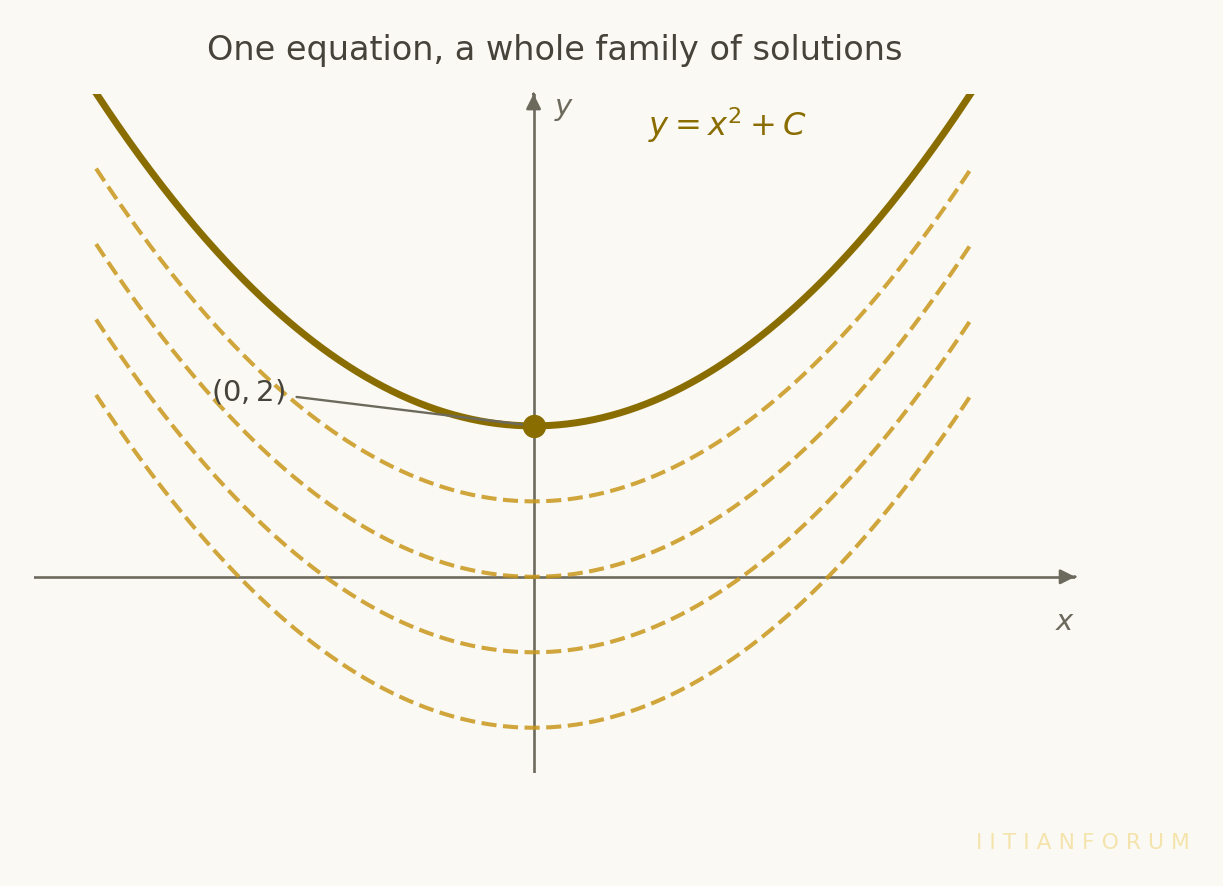
Order and degree
| # | Order | Degree | |
|---|---|---|---|
| 1 | Definition | the order of the highest derivative present | the power to which that highest derivative is raised |
| 2 | When you may read it | immediately | only after the equation is free of radicals and fractional powers in the derivatives |
| 3 | Can it fail to exist | no | yes, if no polynomial form in the derivatives exists |
| 4 | Effect of lower derivatives | none | none, degree looks only at the highest derivative |
| 5 | What it tells you | how many independent arbitrary constants the general solution carries | nothing about the solution, only about the form |
Worked example
Find the order and degree of
▸ SHOW SOLUTION
Step 1. The highest derivative present is , so the order is .
Step 2. The degree cannot be read yet, because both sides carry fractional powers. Raise both sides to the twelfth power, the LCM of and :
Step 3. Now the equation is a polynomial in the derivatives, and appears to the power .
Answer: order , degree .
Degree is a statement about a polynomial in the derivatives. Reading it off before rationalising is the single most common error in this section, and examiners set the trap deliberately. If a derivative sits inside , or an exponent, no amount of algebra will produce a polynomial form and the degree is simply undefined.
Forming the equation: eliminating the constants
The reverse problem. You are given a family of curves and asked for the differential equation it satisfies.
Working rule. For a family containing independent arbitrary constants:
- Count the constants; call the number .
- Differentiate the relation times with respect to .
- Eliminate the constants using the equations now available.
The result has order exactly .
Why exactly . Each differentiation produces one new equation, so after of them you hold equations in unknown constants. Eliminating unknowns from equations leaves one relation, and the highest derivative it can contain is the th. It cannot contain fewer, because equations are genuinely needed to remove independent constants.
Worked example
Find the differential equation of the family , where and are arbitrary.
▸ SHOW SOLUTION
Step 1. Two constants, so expect order .
Step 2. Take logarithms first, which is what removes the product rule:
Step 3. Differentiate:
so has already gone.
Step 4. Differentiate again to get , and substitute :
Answer: .
Any time an arbitrary constant appears as an exponent, or as a multiplier of the whole expression, take logarithms before differentiating. It turns a product rule into a one-line division.
The number of independent arbitrary constants in a family equals the order of the differential equation that family satisfies. In a multiple-choice question that observation alone frequently settles it: the family has two constants, so its equation is second order, and only one option can be right.
Two families worth knowing, because they recur:
| Family | Constants | Differential equation |
|---|---|---|
| , all lines through the origin | ||
| , parabolas, vertex at origin, axis along | ||
| , circles touching at the origin | ||
Type 1 — Variable separable
The shape. Every can be pushed to one side and every to the other:
Then integrate each term on its own.
Why it works. Write the equation as and integrate both sides with respect to . On the left, the substitution rule turns into , because is a function of . Moving everything to one side introduces the single constant .
The slope field of dy/dx = −x/y, with three circular solution curves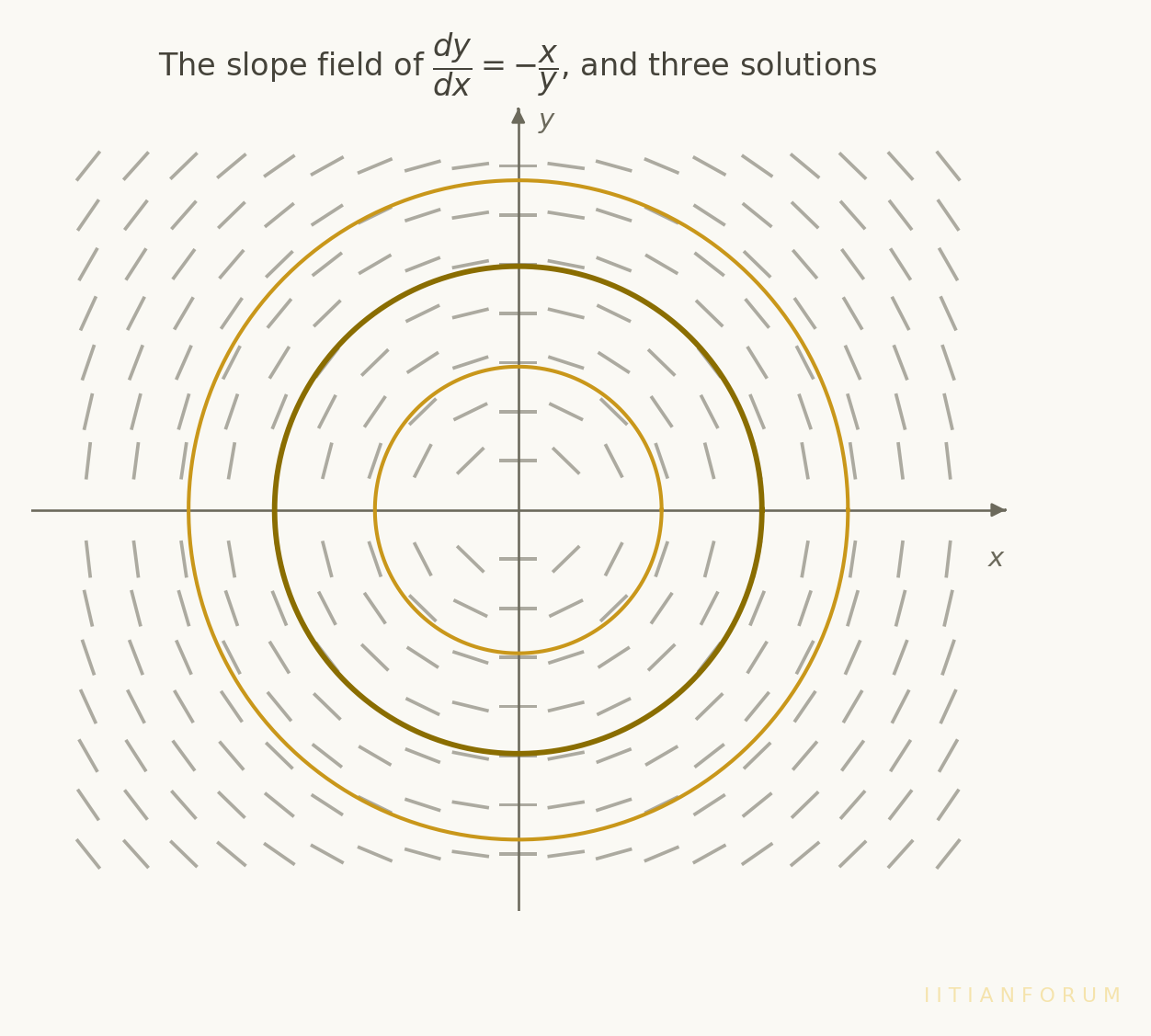
The equation
separates as only after factoring out of the numerator. Look for a common factor before deciding an equation is not separable. Most of the ones that look mixed are separable after one factorisation.
Worked example 1 · JEE Main 2026, 2 April Shift 1
The curve passes through and satisfies for . Find .
▸ SHOW SOLUTION
Step 1. The stands alone against a function of , so divide by and separate:
Step 2. On the right, by parts, so
Step 3. At : and , so and .
Step 4. Hence , and at ,
Answer: .
Worked example 2 · JEE Main 2026, 4 April Shift 1
Let solve with . Find .
▸ SHOW SOLUTION
Step 1. The right side is already a product of a function of and a function of , so separate directly:
Step 2. Complete the square in the denominator:
Step 3. With and the standard integral gives
Step 4. At , , so the left side is and .
Step 5. At the right side is , so
Step 6. Therefore
Answer: .
Both sides of a separated equation are very often of the form , and integrate to on sight. In JEE Main 2026, 2 April Shift 1 the equation separates to , and both sides are logarithmic derivatives, so in one line.
Type 2 — Reducible to separable
The shape. The same linear combination of and appears throughout:
The move. Put . Then , which separates:
Every step is reversible as long as .
Worked example · JEE Main 2026, 22 January Shift 2
Let satisfy
for , with . If , find .
▸ SHOW SOLUTION
Step 1. Separate:
Step 2. The left side integrates at once, since :
Step 3. For the right side put , the whole outer bracket. Then
so and the right side becomes .
Step 4. Therefore
Step 5. Apply . Working outwards: , then , then ; and . So , giving and
Step 6. At : , then , then . Hence .
Answer: .
Every layer of that expression was built so that the derivative of the outermost bracket reproduces the rest of the denominator. Faced with nested radicals, set equal to the largest complete block and differentiate once. If the block was the right one, the whole tail cancels in a single line, as it did in Step 3.
Two more of this type, worth recognising by sight:
| Equation | Substitution | What it becomes |
|---|---|---|
| , so | ||
Type 3 — Exact differentials
The shape. A group of terms is already the differential of something. This is the fastest method in the chapter when it applies, and the slowest to find if you have not memorised the list.
The identities worth knowing by sight
| The group you see | What it is |
|---|---|
The combination almost always means divide by , by , by or by , producing , , or . The combination means . Choosing the divisor is the whole skill, and the remaining terms tell you which: pick the one that leaves everything else expressible in the same new variable.
Worked example 1 · JEE Main 2026, 22 January Shift 1
Let the solution curve of for with be . Find .
▸ SHOW SOLUTION
Step 1. Divide by so the left side becomes an exact differential. Using for ,
Step 2. With this is , now separable.
Step 3. Integrate:
so .
Step 4. At , gives , so and .
Step 5. Rationalise: , and squaring gives , so and
Step 6. Hence .
Answer: .
That equation is also homogeneous, and substituting from the start works just as well. When both routes are open the exact-differential route is usually two lines shorter, because it produces directly instead of after a cancellation. Look for the exact route before starting a long substitution.
Worked example 2 · JEE Main 2023, 11 April Shift I
Let satisfy . The line meets the curve at and the line meets it at . Find .
▸ SHOW SOLUTION
Step 1. The right side is exactly , so with the equation is .
Step 2. Separate and integrate:
Step 3. At , , so and , giving .
Step 4. At write . Then
Step 5. So the modulus equals , and since the quantity inside is negative:
Step 6. Solving, , so
Answer: .
Type 4 — Homogeneous
The shape. The whole right side can be written in terms of alone:
Equivalently, the equation is a ratio of two expressions homogeneous of the same degree.
The move. Put , so , and the equation becomes
which is separable.
Along each ray through the origin the prescribed slope is the same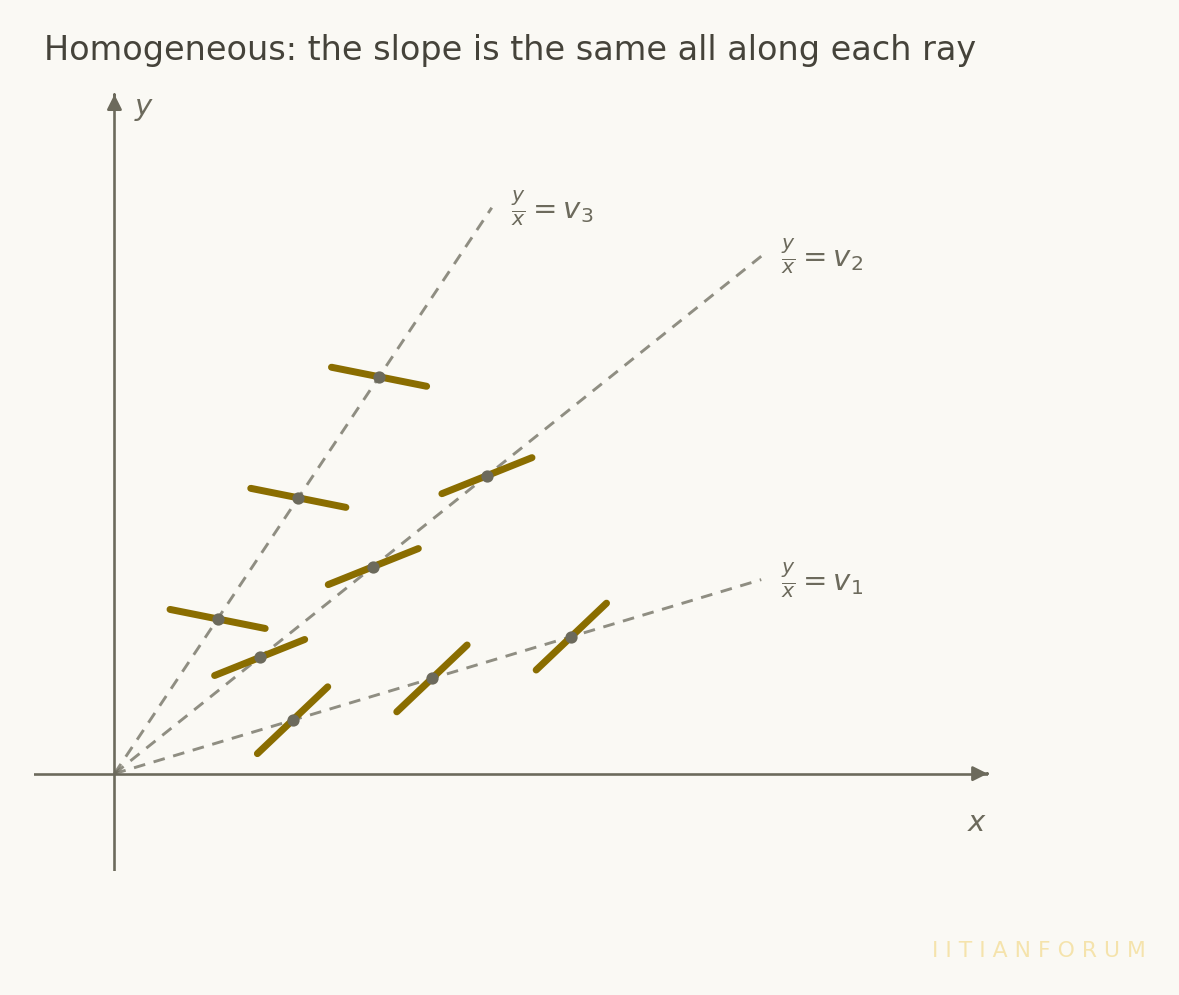
Degree zero says : the slope prescribed by the equation depends only on the direction of the point from the origin, not on its distance. So the direction field is constant along every ray through the origin, and stretching a solution curve away from the origin produces another solution. That is exactly why , which labels the rays, is the right new variable.
Use when the equation is naturally a function of , and when it is naturally a function of . The test is which makes the algebra shorter: if appears only inside , use ; if the equation is handed to you as , use .
Worked example · JEE Main 2026, 5 April Shift 1
Let solve
with , and let . Find .
▸ SHOW SOLUTION
Step 1. Every occurrence of sits inside or is multiplied by it, so put and .
Step 2. Substituting,
Step 3. The term appears on both sides and cancels, leaving .
Step 4. Separate: , so , that is
Step 5. At , : , so and .
Step 6. Putting gives .
Answer: .
The relation has real solutions only while , that is for . At there is no real , so is what the relation formally gives, not a value the solution curve actually attains. Examiners do sometimes push a solution past its interval of existence. Carry the algebra through, and note the restriction if a question asks for the domain.
Two standard homogeneous results worth carrying:
| Equation | Answer |
|---|---|
| slope through | |
Type 5 — Reducible to homogeneous
The shape. A ratio of two linear expressions, each carrying a constant term:
The constants and are what stop it being homogeneous, so remove them by moving the origin to the point where the two lines meet.
The move, when . Put and , choosing and so that
Because the shift is by constants, , and the equation becomes , homogeneous. The two linear conditions have a unique solution exactly when .
If the two linear forms are proportional the lines are parallel and never meet, so there is no point to shift to. Then appears in both, and the substitution reduces the equation to separable form instead. Trying to solve for and in that case gives an inconsistent pair and wastes two minutes.
Worked example · JEE Main 2024, 27 January Shift I
The solution of with is
Find .
▸ SHOW SOLUTION
Step 1. Here , so the coefficients are proportional and the shift method does not apply. Put instead.
Step 2. Then , and the equation gives , so
Step 3. Separate and divide out, using :
Step 4. Integrate:
Step 5. Restore and collect:
Step 6. At , : , so the logarithm vanishes and . Dividing throughout by ,
Step 7. Comparing, , , , so .
Answer: .
The decision in one line:
| Test | Method |
|---|---|
| , the lines meet | shift the origin to the intersection, then |
| , the lines are parallel | put ; the equation separates |
Type 6 — Linear
More JEE questions come from this one type than from any other in the chapter. The method never changes; the only work is putting the equation into the standard shape so that and can be read off.
The shape.
The move. Multiply by the integrating factor
which makes the left side an exact derivative, and then
Why it works. Write , so . Then , and one integration finishes it. Any antiderivative of will do: replacing by multiplies by the constant , which cancels from both sides.
Solution curves of a linear equation never cross; the initial condition picks one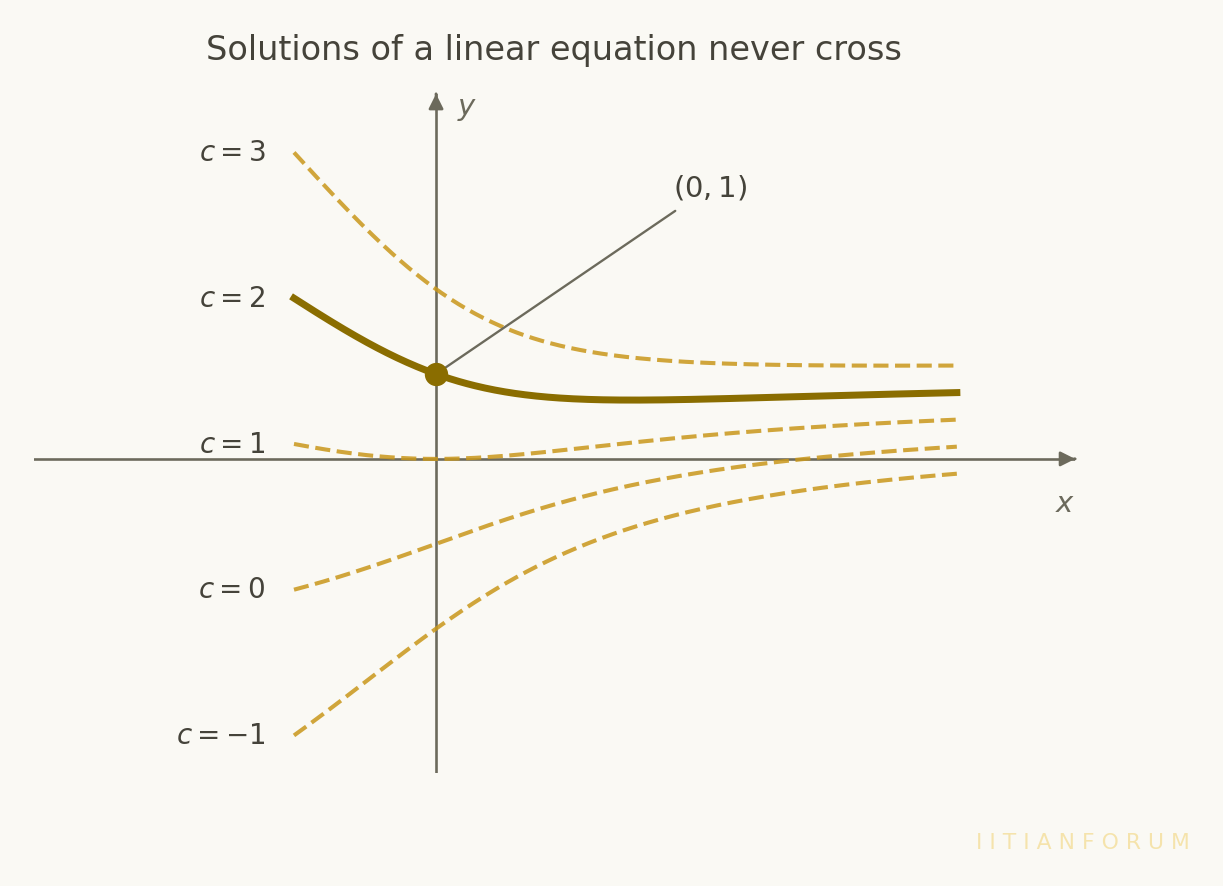
The coefficient of must be before you read off . An equation given as has , not , and its integrating factor is , not . Divide first. Misreading is the largest single source of lost marks here.
Integrating factors you should never have to compute
| I.F. | |
|---|---|
Worked example 1 · JEE Main 2026, 23 January Shift 1
Let solve for , with . Find .
▸ SHOW SOLUTION
Step 1. Group the two terms carrying :
Step 2. The left side is already exact, because .
Step 3. Integrate: .
Step 4. At , , so and .
Step 5. At : , and .
Answer: .
In standard form the equation is , so and I.F. , exactly the factor already sitting in front of . Whenever the coefficient of is and the coefficient of is , the equation has been pre-multiplied for you and you can integrate on sight.
Worked example 2 · JEE Main 2026, 21 January Shift 1
Let be the solution curve of with . Find .
▸ SHOW SOLUTION
Step 1. Divide by :
Step 2. Here , so I.F. and
Step 3. Put , so and the right side integrates by parts:
Step 4. Hence .
Step 5. At : , so .
Step 6. At , with ,
Answer: .
Worked example 3 · JEE Main 2026, 6 April Shift 1
Let solve for , with . Find .
▸ SHOW SOLUTION
Step 1. Factor the coefficient of as and divide throughout:
Step 2. Rationalise. Multiplying above and below by leaves the denominator , so
Step 3. I.F. , so .
Step 4. Integrate, using in the second piece:
Step 5. At , : , so .
Step 6. At : and , so
Answer: .
Type 7 — Linear in instead of in
The shape. The equation is not linear in , but appears only to the first power once you treat as the unknown function of :
Everything from Type 6 then applies with the roles swapped, and I.F. .
The test is quick: write the equation as and see whether appears only to the first power. Terms like , or are then harmless, because they are just coefficients. Any equation handed to you as is telling you which variable it wants to be solved for.
Worked example · Spectrum Master Strokes
Solve .
▸ SHOW SOLUTION
Step 1. The unknown appears to the first power while sits inside and , so treat as the function. Multiply by :
Step 2. Divide by to reach standard form in :
Step 3. , so I.F. and
Step 4. With the right side is , whose integral is .
Answer: .
Three more that only work this way round:
| Equation | Why is the unknown | Answer |
|---|---|---|
| with | is linear, is a coefficient | |
| is a coefficient, is linear | ||
| appears once, multiplied by |
Type 8 — Bernoulli, and other reductions to linear
The shape.
The move. Divide by and put . Since , the equation becomes
which is linear in . The excluded cases need no work at all: is already linear, is separable.
Get every that is not to the first power onto the right, read the exponent , divide by , substitute. If the right side carries two different powers of the equation is not of Bernoulli type and something else is needed.
The wider family: anything whose derivative you can see
Bernoulli is one case of a general habit. Whenever the equation contains a block together with , put equal to that block.
| Block you see | Substitution | Why |
|---|---|---|
| Bernoulli | ||
| logarithmic derivative | ||
| direct |
Worked example 1 · JEE Main 2026, 28 January Shift 1
Let solve for , with . Find .
▸ SHOW SOLUTION
Step 1. Use so that every term carries :
Step 2. Divide by :
Step 3. The combination is the derivative of , so put :
now linear in .
Step 4. gives I.F. , so .
Step 5. Integrate:
Step 6. At , so : , giving .
Step 7. At : .
Answer: .
Worked example 2 · JEE Main 2026, 2 April Shift 2
Let solve for , with . Find .
▸ SHOW SOLUTION
Step 1. The unknown here is , and appears squared, so this is Bernoulli in . Divide by :
Step 2. Divide by and put , so :
Step 3. I.F. , so and .
Step 4. Restore : .
Step 5. At , : , so and .
Step 6. At : , so .
Answer: .
Multiplying that last equation out and grouping gives ; dividing by turns it into , and one integration finishes it. Two named methods, one equation, which is normal in this chapter and a good reason to look for the exact route before starting a long substitution.
Type 9 — Curves: tangents, normals and orthogonal trajectories
Every question here is a translation exercise. A sentence about a tangent, a normal, an intercept or an area becomes a differential equation, and from there the work is one of the eight methods above.
The dictionary
Let lie on and write for the slope there. Use for the running point on the tangent.
| Quantity | Expression |
|---|---|
| Tangent at | |
| Normal at | |
| -intercept of the tangent | |
| -intercept of the tangent | |
| Length of the subtangent | |
| Length of the subnormal | |
| Area swept from to |
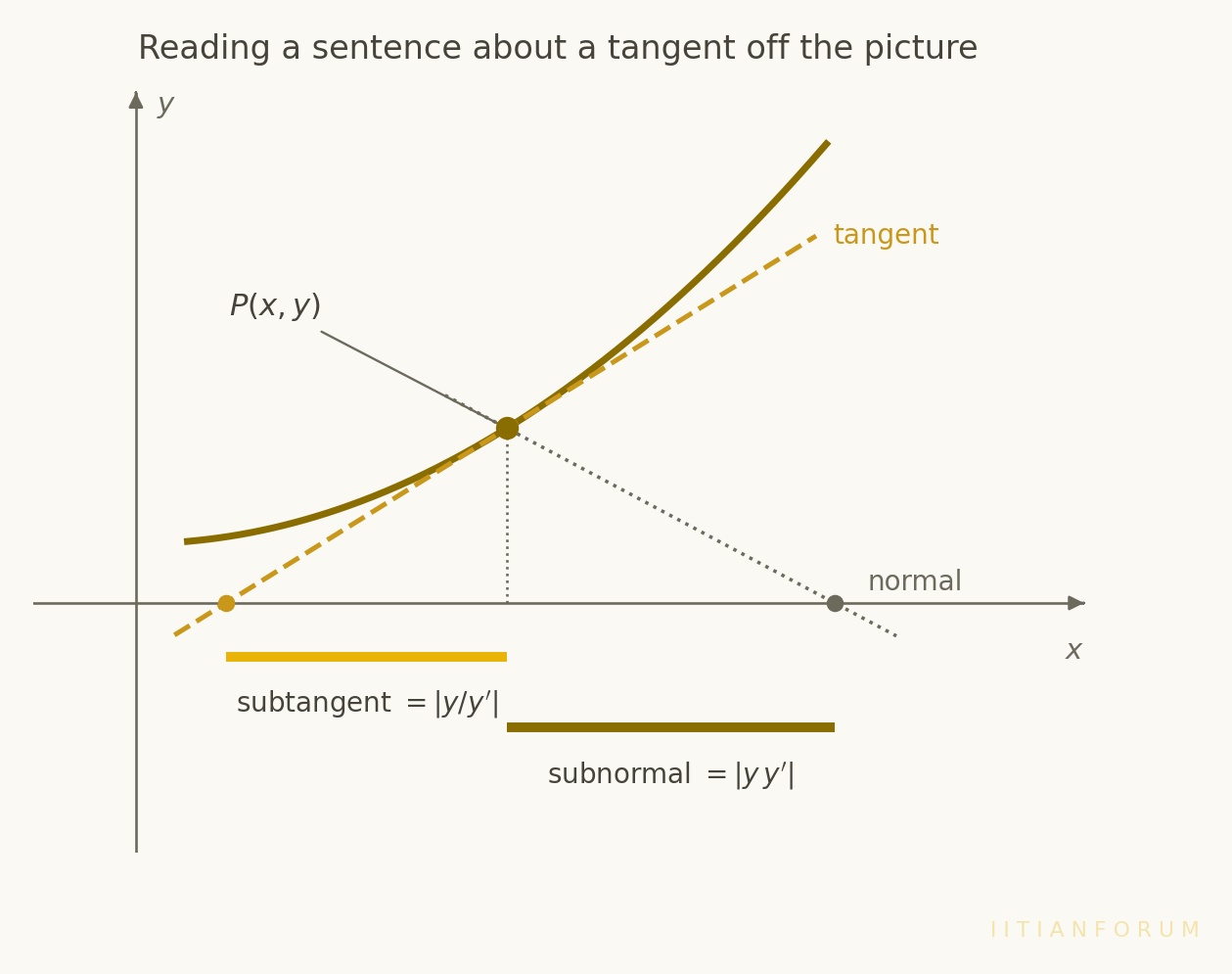
The commonest slip is writing the tangent as , which says nothing. Keep the point of contact as and the moving point as . Then setting or produces the intercepts cleanly, and every intercept is a function of , and , which is exactly a differential equation waiting to be written down.
Worked example · a tangent condition
A curve passes through , and at every point the -intercept of the tangent equals the cube of the abscissa of the point of contact. Find .
▸ SHOW SOLUTION
Step 1. From the dictionary the -intercept is , so the condition is .
Step 2. Divide by to reach standard linear form:
Step 3. , so I.F. and .
Step 4. Integrate: .
Step 5. At : , so .
Step 6. Hence .
Answer: .
Orthogonal trajectories
Given a family with one arbitrary constant:
- Form its differential equation, eliminating the constant, to get .
- Replace by , giving .
- Solve. Its solutions cut every member of the original family at right angles.
Why. At a point of intersection the two curves meet at right angles exactly when . Step 1 produces as a function of position alone, because the constant has been eliminated, so the slope of whichever member passes through is known from the point itself. Substituting for therefore describes exactly the curves perpendicular at every point they meet.
Parabolas y² = 4ax and their orthogonal family of ellipses 2x² + y² = C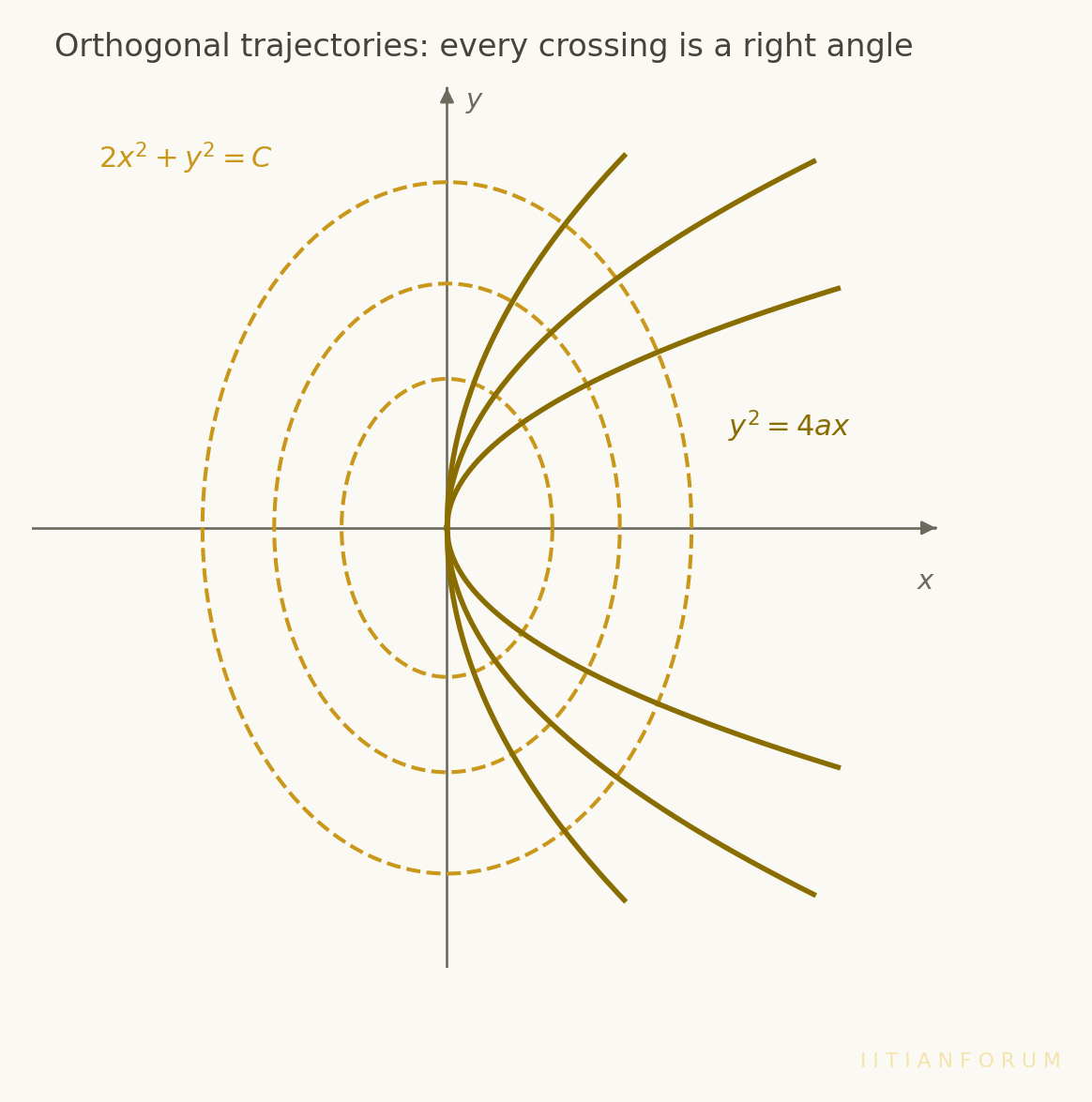
Worked example · the classical pair
Find the orthogonal trajectories of the family of parabolas .
▸ SHOW SOLUTION
Step 1. Differentiating, , so .
Step 2. Substitute back into : , and cancelling one ,
Step 3. Replace by :
Step 4. Separate: , so .
Answer: , a family of ellipses centred at the origin with major axis along and .
This is where marks are lost. If the constant is still present when you replace by , the resulting equation describes a different curve for every value of the constant and is not a family of trajectories at all. Get the slope down to a function of and only, then flip.
Three standard orthogonal pairs:
| Family | Orthogonal family |
|---|---|
Growth, decay and modelling
These questions hand you the differential equation in words. Once written down it is always separable or linear, so the marks sit entirely in the translation and in the two conditions used to fix the constants.
The two standard laws
Exponential growth and decay. If a quantity changes at a rate proportional to its own size,
with . Growth means , decay means .
Newton's law of cooling. A body at temperature in surroundings held at satisfies
The proof is one line: put , note is constant so , and apply the first law to .
Newton cooling: the excess over room temperature halves every fifteen minutes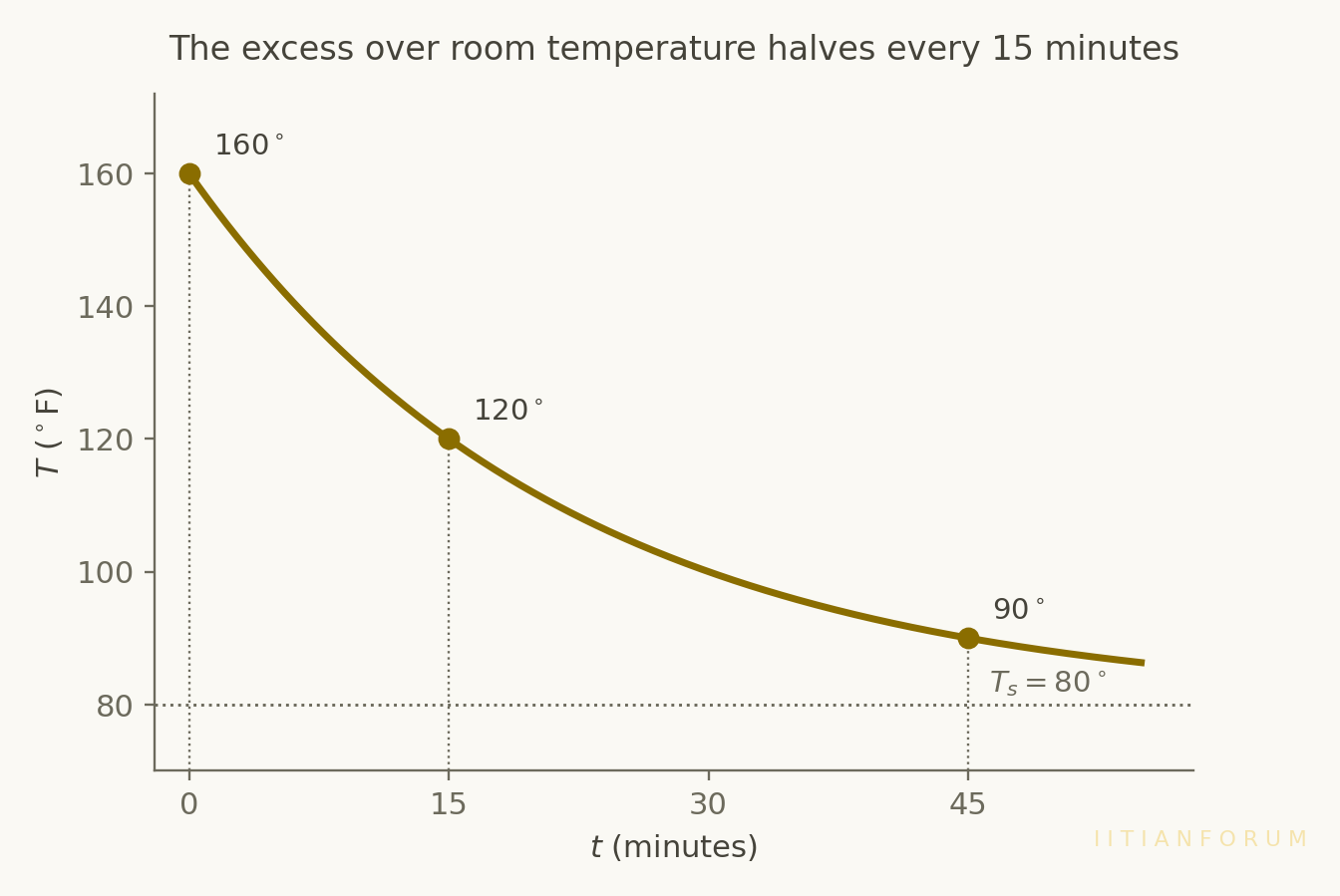
One reading gives or ; a second gives . Every later value is a power of that number, so keep as a block instead of solving for . If a quantity halves in minutes then , and after minutes the factor is . Taking logarithms and back-substituting wastes time and invites arithmetic slips.
Worked example 1 · cooling
A thermometer reading F is placed in a room kept at F. After minutes it reads F. What does it read after minutes?
▸ SHOW SOLUTION
Step 1. Here and , so .
Step 2. At , : , so .
Step 3. Do not solve for . Since ,
Step 4. Therefore .
Answer: F.
Worked example 2 · a bounded model
In a closed community of people, the number who have heard a piece of news grows at a rate proportional to the product of those who know it and those who do not:
If and , with in days, find .
▸ SHOW SOLUTION
Step 1. Separate and use partial fractions:
Step 2. Integrating,
Step 3. Write . The last line says , so is multiplied by the same factor every day: .
Step 4. Read and from the data. At , ; at , , so .
Step 5. Hence .
Step 6. Invert to get :
Answer: people.
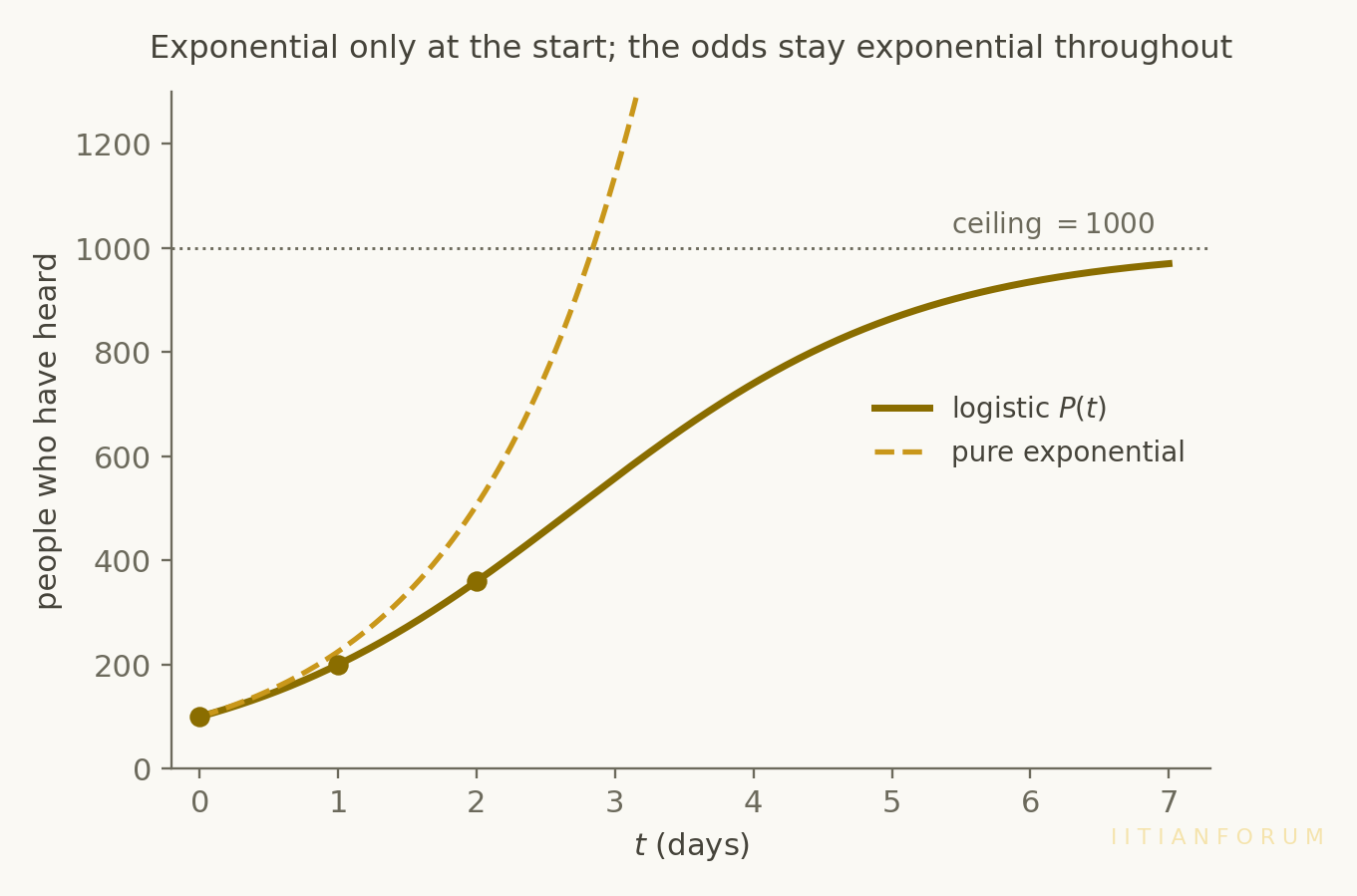
itself is nowhere near exponential; it flattens as it approaches . What is exponential is the odds , and that is why Step 3 pays: it turns two data points into a common ratio, and no logarithm is ever evaluated.
When the equation is hidden
At JEE Advanced level the differential equation is rarely handed over. It sits inside a limit, inside an integral identity, or behind a substitution you have to invent. Only after you have unearthed it do the nine methods apply.
Inside a limit
If a limit as has both numerator and denominator vanishing at , differentiate both with respect to and then set . Every produced becomes , and the condition turns into a relation between , and : a differential equation.
Worked example
Let be differentiable on with , and suppose
Find .
▸ SHOW SOLUTION
Step 1. At the numerator is and the denominator is , so the limit is and L'Hôpital applies with as the variable.
Step 2. Differentiate top and bottom with respect to , then set :
Step 3. Clear the denominator and divide by :
Step 4. I.F. , so .
Step 5. Integrate: , that is .
Step 6. Impose : , so .
Answer: .
Inside an integral
An identity of the form becomes a differential equation on differentiating, by the fundamental theorem. The constant of integration is then fixed not by guesswork but by putting in the original identity, where the integral vanishes.
Worked example
Let be differentiable with and
Find .
▸ SHOW SOLUTION
Step 1. Differentiate both sides. The left gives ; the right gives .
Step 2. So , that is .
Step 3. Divide by : , linear with I.F. .
Step 4. Then , so .
Step 5. At : , so .
Step 6. Check against the original identity at : the left side is and the right is . Consistent.
Step 7. At : .
Answer: .
Behind a substitution you invent
Nested radicals telescope. Each substitution is chosen to cancel the very factor it introduces, so start from the innermost and work outwards rather than trying to simplify the whole expression at once. The JEE Advanced equation
collapses in three moves: kills the outer , then kills the next layer, then kills the last, leaving . With the answer is , so .
A block substitution does the same job when a combination repeats. If
the isolated is the clue: put , so and the equation becomes , which is Bernoulli with .
Which method? A decision chart
Run down this list in order and stop at the first "yes". The order matters: it is arranged so that the cheapest test comes first, and so that an equation which admits two methods is caught by the shorter one.
A nine-step decision chart for choosing the method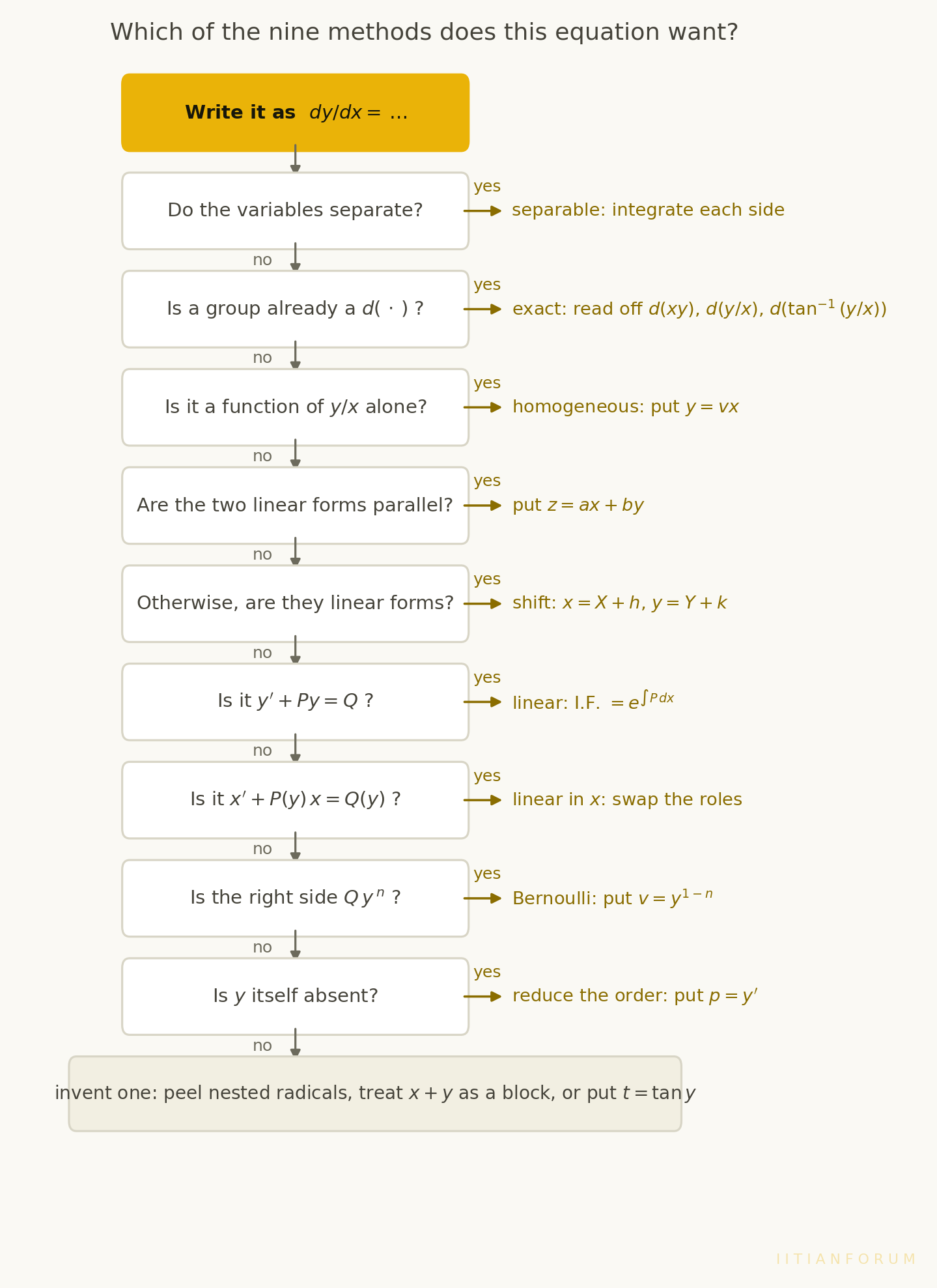
| Ask | If yes |
|---|---|
| Do the variables separate? | integrate each side |
| Is a group already a ? | exact: read off , , |
| Is the right side a function of alone? | homogeneous: put |
| Are the two linear forms proportional? | put |
| Otherwise, are they linear forms? | shift: , |
| Is it ? | linear: I.F. |
| Is it ? | linear in : swap the roles |
| Is the right side ? | Bernoulli: put |
| Is itself absent? | reduce the order: put |
| None of these | invent a substitution: peel nested radicals, treat as a block, or put |
Half the equations that look like none of the nine become one of them after a single algebraic move: factor the coefficient of , rationalise a radical, or use so that a common factor appears. Spend ten seconds rewriting before deciding the equation is exotic.
Where the marks are
Across the nineteen JEE Main 2026 shifts, differential equations produced 14 questions, roughly per shift, so essentially one question in every paper. The split by method:
| Method | 2026 questions | Typical marks |
|---|---|---|
| Linear, integrating factor | 6 | 4 each |
| Variable separable | 4 | 4 each |
| Homogeneous | 2 | 4 each |
| Exact differential | 1 | 4 each |
| Bernoulli / reducible to linear | 1 | 4 each |
Two patterns worth planning around:
- The linear type dominates. Nearly half the 2026 questions were solved by writing the equation in standard form and reading off . If you drill one thing, drill that.
- The arithmetic is deliberately heavy at the end. Several 2026 questions ask not for but for , or , or . Solve the equation, then read the question again before computing.
Quick recall
| Shape you see | Move | Result |
|---|---|---|
| integrate each term | ||
| present | divide by , , or | , , , |
| present | recognise it | |
| , | , | homogeneous in |
| , | separable | |
| I.F. | ||
| I.F. | same, roles swapped | |
| linear in | ||
| absent, only and | first order in | |
| a limit of form | L'Hôpital in , then | a differential equation |
| differentiate; fix at | a differential equation |
The five traps
- Read only after making the coefficient of equal to . has , not .
- Clear radicals before naming the degree. And if a derivative sits inside , or an exponent, the degree is undefined, not fractional.
- Eliminate the arbitrary constant before flipping the slope in an orthogonal-trajectory question.
- When the two linear forms are parallel, do not try to shift. Substitute instead.
- A relation can outrun its own domain. Check that the value the question asks for is one the solution curve actually attains, and say so if it is not.
The one habit that pays
Before touching the algebra, write the equation as and spend ten seconds naming the type. Almost every mark lost in this chapter is lost by starting the wrong method and discovering it four lines in. Naming the type is free; unwinding a wrong substitution is not.