Sets and Relations for JEE: Venn Counting, Types and Equivalence
A set is a well defined collection of objects, and a relation is a set of ordered pairs. These two ideas carry the whole language of class 11 and 12 mathematics: domains and ranges are sets, solution sets of inequalities are sets, and every function is a special relation. JEE Main asks this chapter in almost every shift, usually as a counting question: count the elements of a relation, count the pairs to add, count subsets or count equivalence relations.
This note covers sets, subsets and power sets, the operations and their laws, counting with Venn diagrams, the cartesian product, relations and their types, counting relations, the smallest number of pairs to add, and equivalence relations with their classes. Every worked example is a JEE Main 2025 or 2026 or JEE Advanced 2026 question unless it says otherwise, and every answer was re-derived from scratch.
Sets and their representation
A set is a well defined collection of distinct objects, called its elements. "Well defined" means that for any object we can say without argument whether it belongs. Write when belongs to and when it does not.
There are two ways to write a set.
| Form | Example |
|---|---|
| Roster | |
| Set-builder |
In roster form the order does not matter and repeats do not count: .
The standard number sets lie one inside the next.
| Symbol | Set |
|---|---|
| natural numbers | |
| whole numbers | |
| integers | |
| rational numbers , | |
| real numbers |
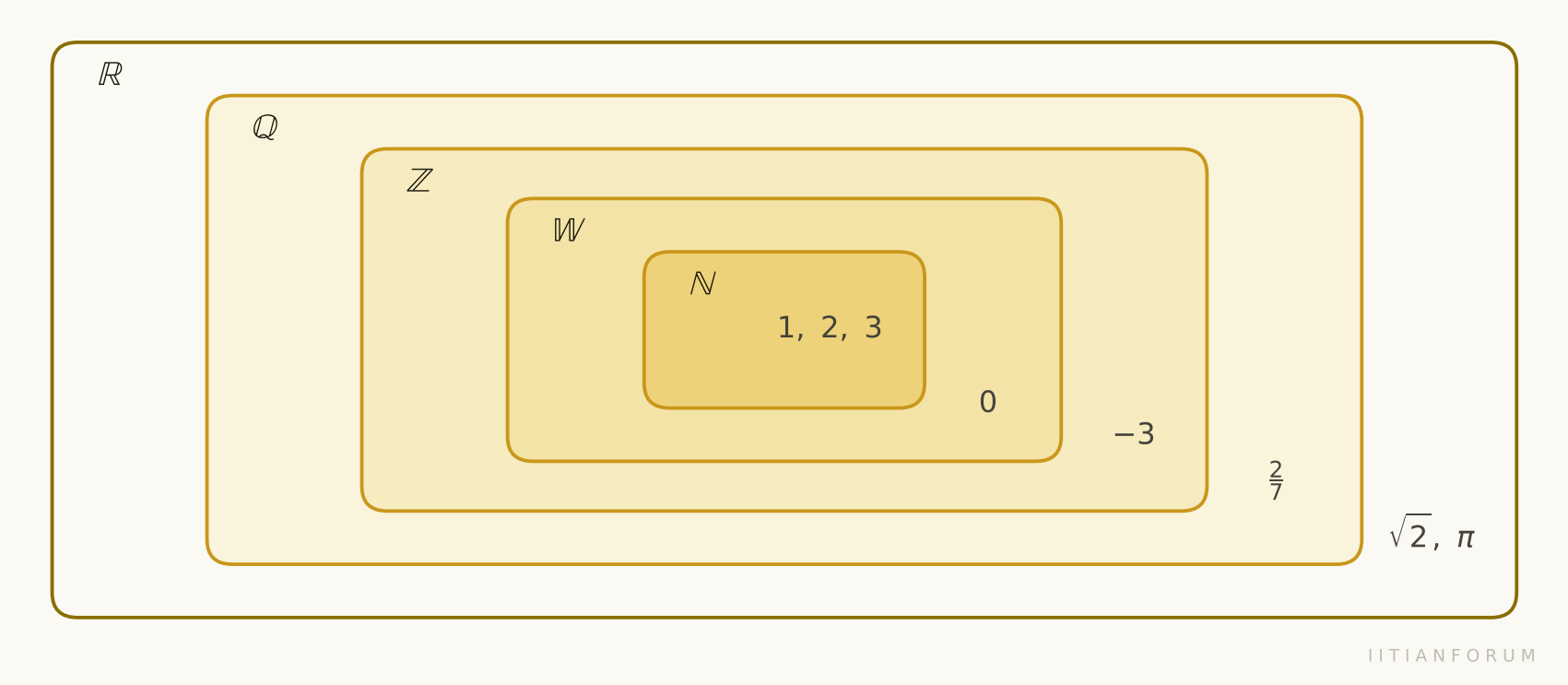
Types of sets.
| Type | Meaning |
|---|---|
| Empty set | no element |
| Singleton | exactly one element |
| Finite, infinite | the count of elements ends, or does not |
| Equal sets | the same elements |
| Equivalent sets | the same number of elements |
denotes the number of elements of a finite set . Equal sets are equivalent; equivalent sets need not be equal.
Example 1 (IITianForum). (a) Write in roster form: and . (b) Write in set-builder form.
▸ SHOW SOLUTION
Step 1. Set A
with : , since .
Step 2. Set B
Step 3. Set C
The elements are the squares of to .
Answer: , ,
Example 2 (IITianForum). Classify each set as empty, singleton, finite or infinite.
▸ SHOW SOLUTION
Step 1. P and Q
has no real root, so . No natural number lies strictly between and , so .
Step 2. S and T
, a singleton. has one element, the empty set itself, so is a singleton and is not empty.
Step 3. V
all lie in , so is infinite.
Answer: empty; singletons; infinite
has no element; has one element. Similarly is not empty. Always read which universe the builder form uses: is empty in but equals in .
Subsets and power set
is a subset of , written , when every element of is an element of . If also , then is a proper subset, .
- and for every set .
- exactly when and .
- joins an element to a set; joins a set to a set.
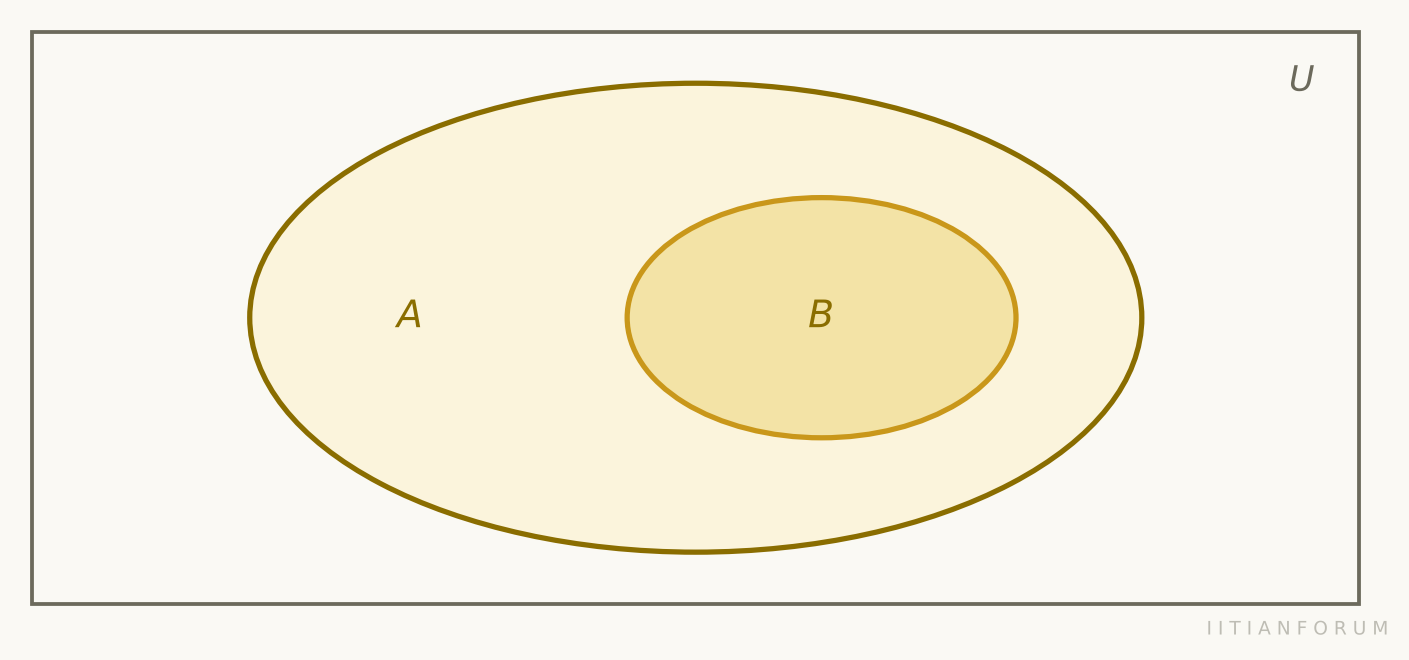
Power set
The power set is the set of all subsets of . Building a subset means deciding "in or out" once for each element, so
| Count, for | Value |
|---|---|
| all subsets | |
| proper subsets | |
| subsets with exactly elements | |
| subsets containing a fixed element | |
| pairs with | |
| pairs with |
Example 3 (IITianForum). Let . (a) Decide true or false: ; ; ; ; ; ; . (b) Find and .
▸ SHOW SOLUTION
Step 1. The elements
has three elements: , and . The number is not one of them.
Step 2. Membership
true; false; true.
Step 3. Subsets
A set is a subset of when each of its elements is an element of .
- needs : false.
- : true. : true.
- needs : false. (But is true.)
Step 4. Power sets
Answer: (a) T, F, T, F, T, T, F; (b) and
Example 4 (IITianForum). Finite sets and have and elements. The number of subsets of is more than the number of subsets of . Find .
▸ SHOW SOLUTION
Step 1. Equation
Step 2. Match the factors
is odd, so it must be and .
Check: .
Answer:
Example 5 (JEE Main 2026, 22 January Shift 2). Let be the set of the first natural numbers. Then the number of elements in is ______.
▸ SHOW SOLUTION
Step 1. Subsets with at least two elements
Step 2. Remove the odd products
The product is odd exactly when every element is odd. has odd numbers ; their subsets with at least two elements number
Step 3. Count
Answer:
Example 6 (JEE Main 2025, 7 April Shift 1). For , let denote the set of all subsets of with no two consecutive numbers. For example , but . Then is equal to ______.
▸ SHOW SOLUTION
Step 1. Count by size
A subset of with elements and no two consecutive: choose numbers so that gaps of at least one remain. The count is .
For the only subset is . No subset with elements exists.
Step 2. Add
The empty set is counted; it has no two consecutive numbers.
Answer:
Example 7 (JEE Main 2026, 24 January Shift 2). Let be a set of elements and denote the power set of . Let be the event of choosing an ordered pair from the set such that . If the probability of the event is , where , then is equal to ______.
▸ SHOW SOLUTION
Step 1. Total pairs
Step 2. Disjoint pairs
Each element of has three choices: in only, in only, or in neither. It cannot be in both. So there are disjoint pairs.
Step 3. Probability
Answer:
Example 8 (JEE Main 2025, 24 January Shift 1). Let be the set of first ten prime numbers. Let , where is the set of all possible products of distinct elements of . Then the number of all ordered pairs , , , such that divides , is ______.
▸ SHOW SOLUTION
Step 1. Elements of A as subsets
Every element of is the product of a non-empty subset of , and different subsets give different products. So matches the non-empty subsets of .
Step 2. Fix x
divides exactly when the subset of contains . Subsets of containing a fixed number .
Step 3. Count
Answer:
Operations on sets
All sets in a question are taken inside a universal set . A Venn diagram draws as a rectangle and the sets as circles. Two sets cut into regions; three sets cut it into regions.
Two Venn diagrams side by side: on the left two overlapping circles A and B in a rectangle U with regions labelled p in A only, q in both, r in B only and s outside both; on the right three overlapping circles A, B and C with regions labelled a, b, c in one set only, d, e, f in exactly two, g in all three and h outside all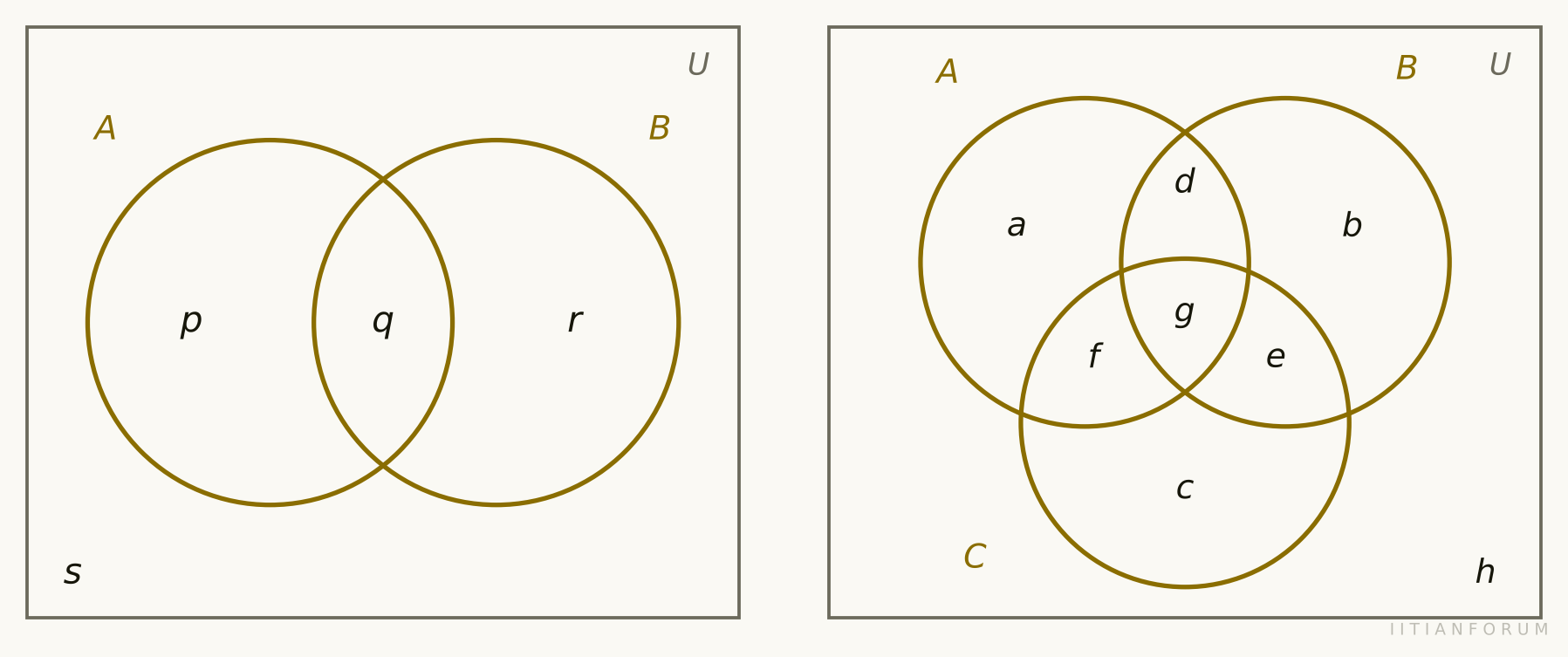
| Operation | Definition | Two-set regions |
|---|---|---|
| union | in or in | |
| intersection | in both | |
| difference | in , not in | |
| symmetric difference | in exactly one | |
| complement | in , not in |
and are disjoint when .
Three Venn diagrams of two overlapping circles A and B inside U; from left to right the shaded part is the union of A and B, then only the lens common to both, then the part of A outside B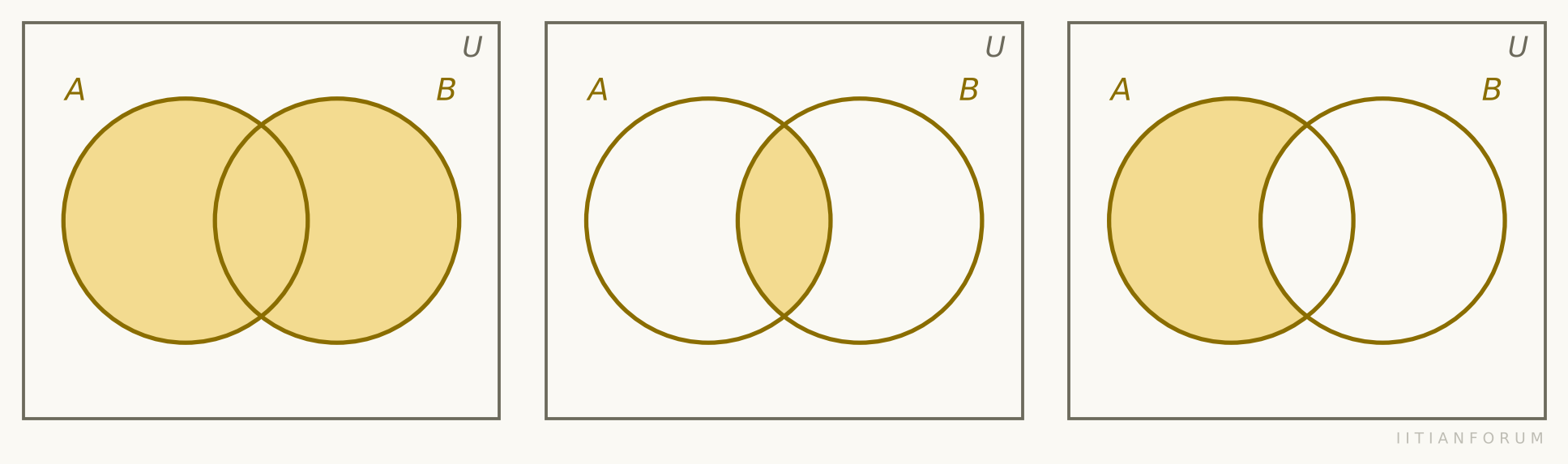
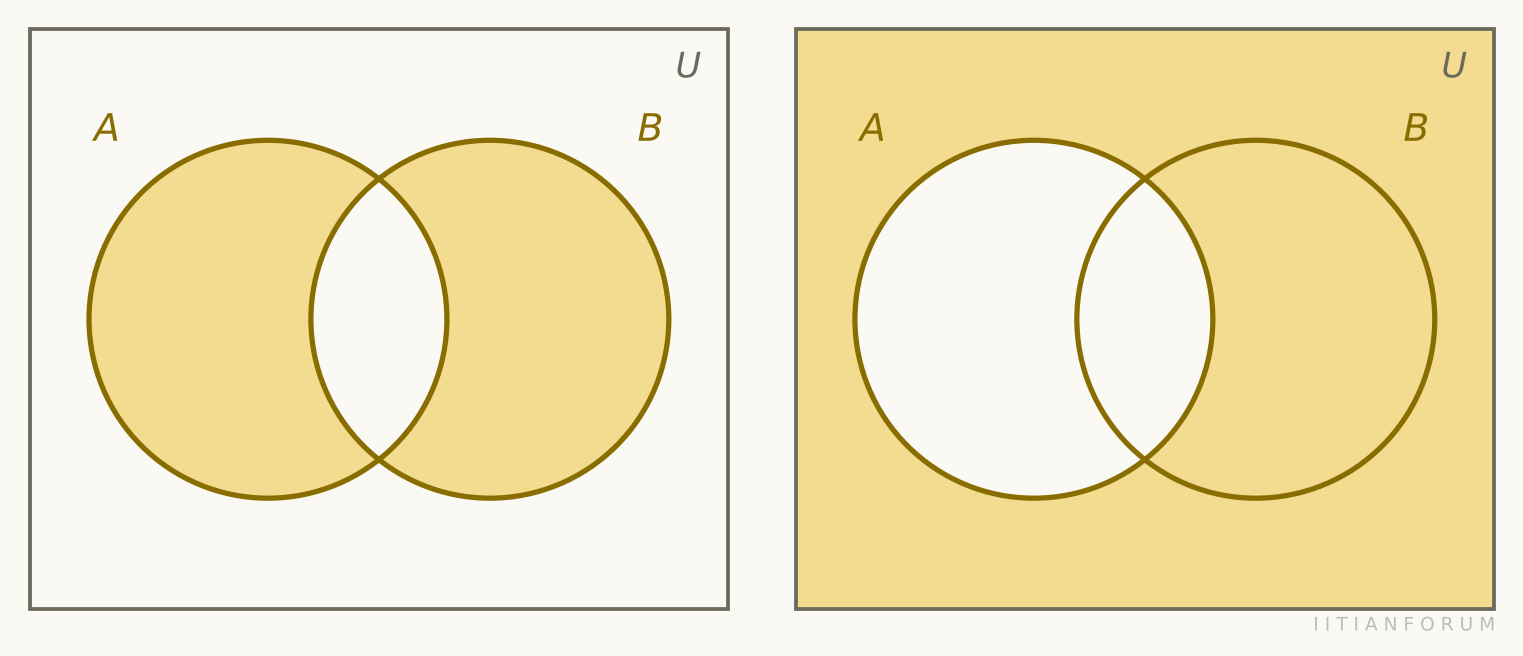
Three facts used again and again:
Example 9 (IITianForum). Let , and . Find , , , , , and .
▸ SHOW SOLUTION
Step 1. Union and intersection
Step 2. Differences
Step 3. Complements
Answer: as above; note
Example 10 (JEE Main 2026, 21 January Shift 2). Let and . Then
▸ SHOW SOLUTION
Step 1. Set A
Step 2. Set B
or :
Step 3. Test each option
- ; option (1) is wrong at and .
- ; option (2) misses .
- ; option (3) wrongly includes .
- : remove from . This leaves , and . Option (4) is correct.
Answer: option (4)
Example 11 (JEE Main 2026, 2 April Shift 1). Let be the set of first terms of an A.P. whose first term is and common difference is , and let be the set of first terms of an A.P. whose first term is and common difference is . Then the number of elements in which are divisible by is
▸ SHOW SOLUTION
Step 1. The two sets
Step 2. Common terms
The first common term is . Common terms form an A.P. with difference :
So has elements, .
Step 3. Divisible by 3
This is when : .
The numbers are .
Answer: , option (2)
Example 12 (JEE Main 2025, 4 April Shift 1). Let and be the sets consisting of the first terms of two arithmetic progressions. Then is:
▸ SHOW SOLUTION
Step 1. Last terms
Step 2. Common terms
Common terms are with difference , and they cannot pass :
So .
Step 3. Union
Answer: option (3)
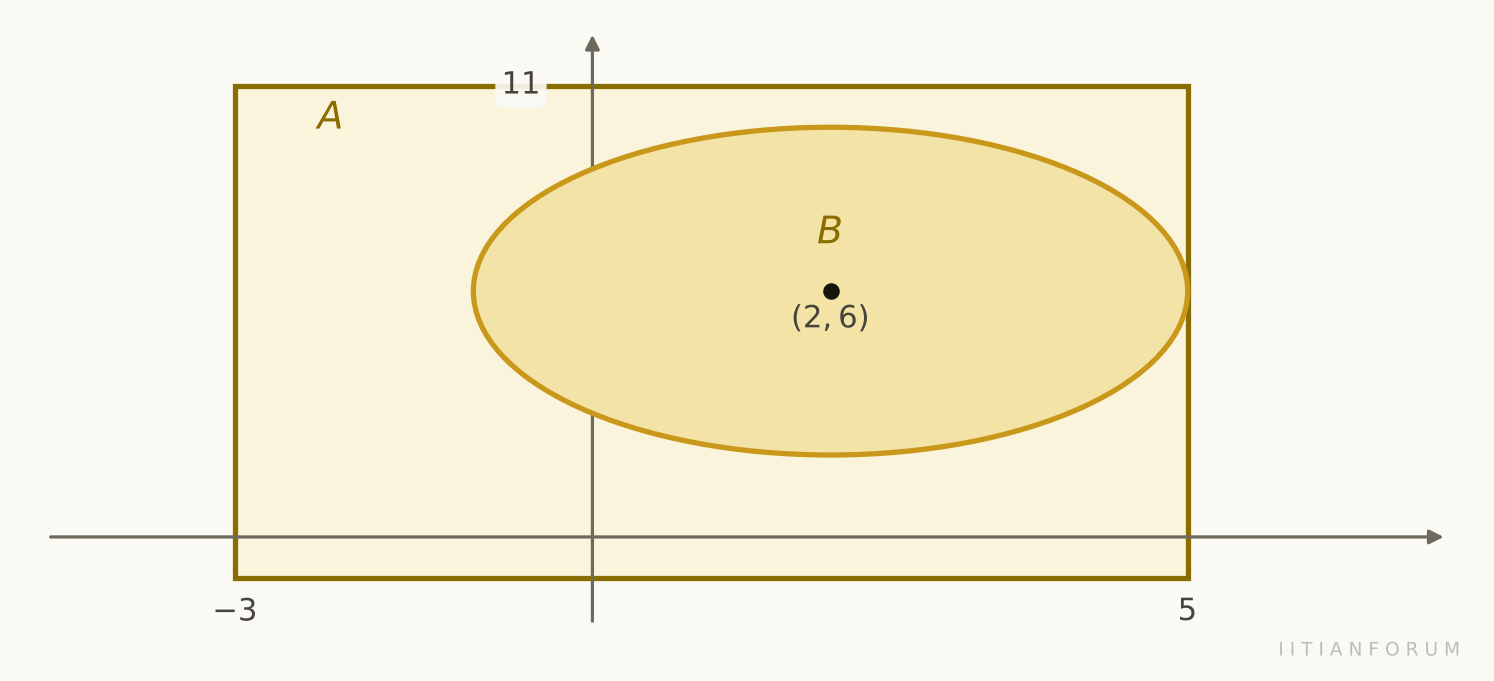
Example 13 (JEE Main 2025, 7 April Shift 2). Let and . Then:
▸ SHOW SOLUTION
Step 1. Set A is a rectangle
Step 2. Set B is an ellipse with its inside
Each fraction is at most , so for every point of ,
Step 3. Compare
Every point of satisfies the rectangle conditions, so . The corner lies in but not in , so . Also , and has , so option (2) is false.
Answer: , option (1)
Algebra of sets
These laws hold for all sets inside . Each can be checked on the Venn regions.
| Law | Statement |
|---|---|
| commutative | , |
| associative | |
| distributive | |
| distributive | |
| identity | , |
| complement | , , |
| absorption | , |
| De Morgan | |
| De Morgan |
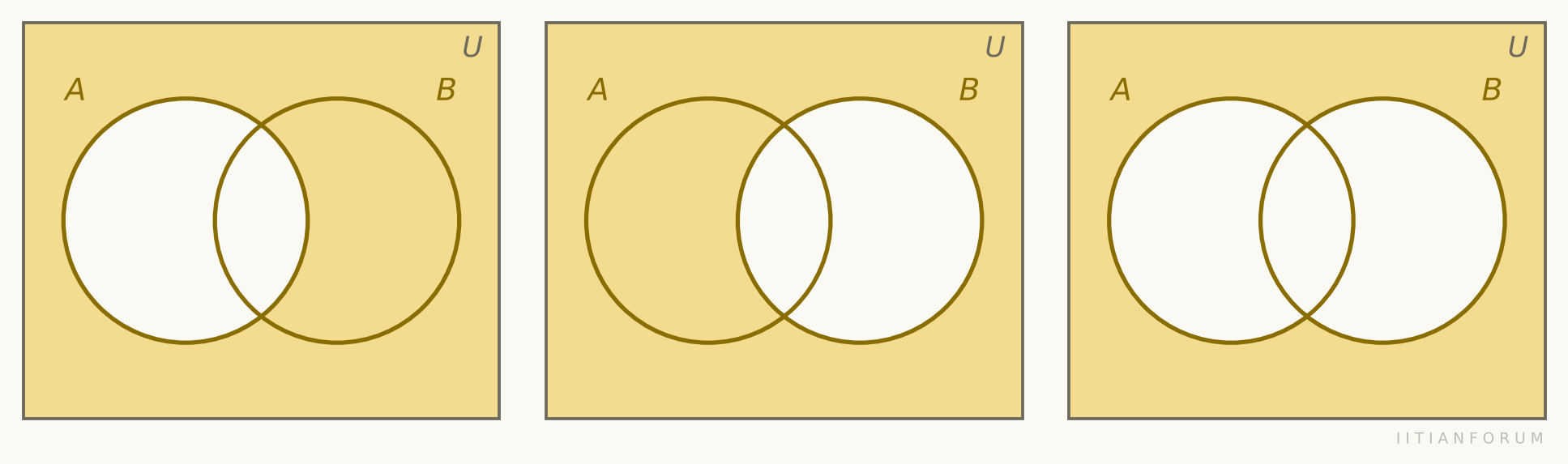
The picture shows the first law of De Morgan: the region common to and is exactly the region outside . The same laws hold with differences:
Write every difference as an intersection with a complement, . The expression then uses only , and , and the laws above apply directly.
Example 14 (IITianForum). Simplify .
▸ SHOW SOLUTION
Step 1. First two pieces
Step 2. Add the third piece
In regions: and , everything except .
Answer: , which equals
Example 15 (IITianForum). Simplify .
▸ SHOW SOLUTION
Step 1. De Morgan inside
Step 2. Take out A'
Step 3. Complement
Answer:
Example 16 (IITianForum). Let and . Find the set with . Is it unique?
▸ SHOW SOLUTION
Step 1. Take the symmetric difference with A on both sides
is associative, and . So
Step 2. Compute
Check: .
Answer: , and it is unique
Counting with sets
For finite sets,
For three sets write , and . Then
| Count | Formula |
|---|---|
| at least one | |
| exactly one | |
| exactly two | |
| at least two | |
| none | |
| neither, for two sets |
"Neither" is , while "not both" is . "Only " is . Most mistakes in survey questions come from mixing these.
Example 17 (IITianForum). If , and , find , and .
▸ SHOW SOLUTION
Step 1. Intersection
Step 2. The rest
Answer: , ,
Example 18 (IITianForum). In a class of students, study Mathematics, Physics and Chemistry; study M and P, study P and C, study M and C, and study all three. Find the number who study none, exactly one, exactly two and at least two subjects.
▸ SHOW SOLUTION
Step 1. The sums
Step 2. At least one and none
None: .
Step 3. Exactly one, exactly two, at least two
Check: .
Answer: none , exactly one , exactly two , at least two
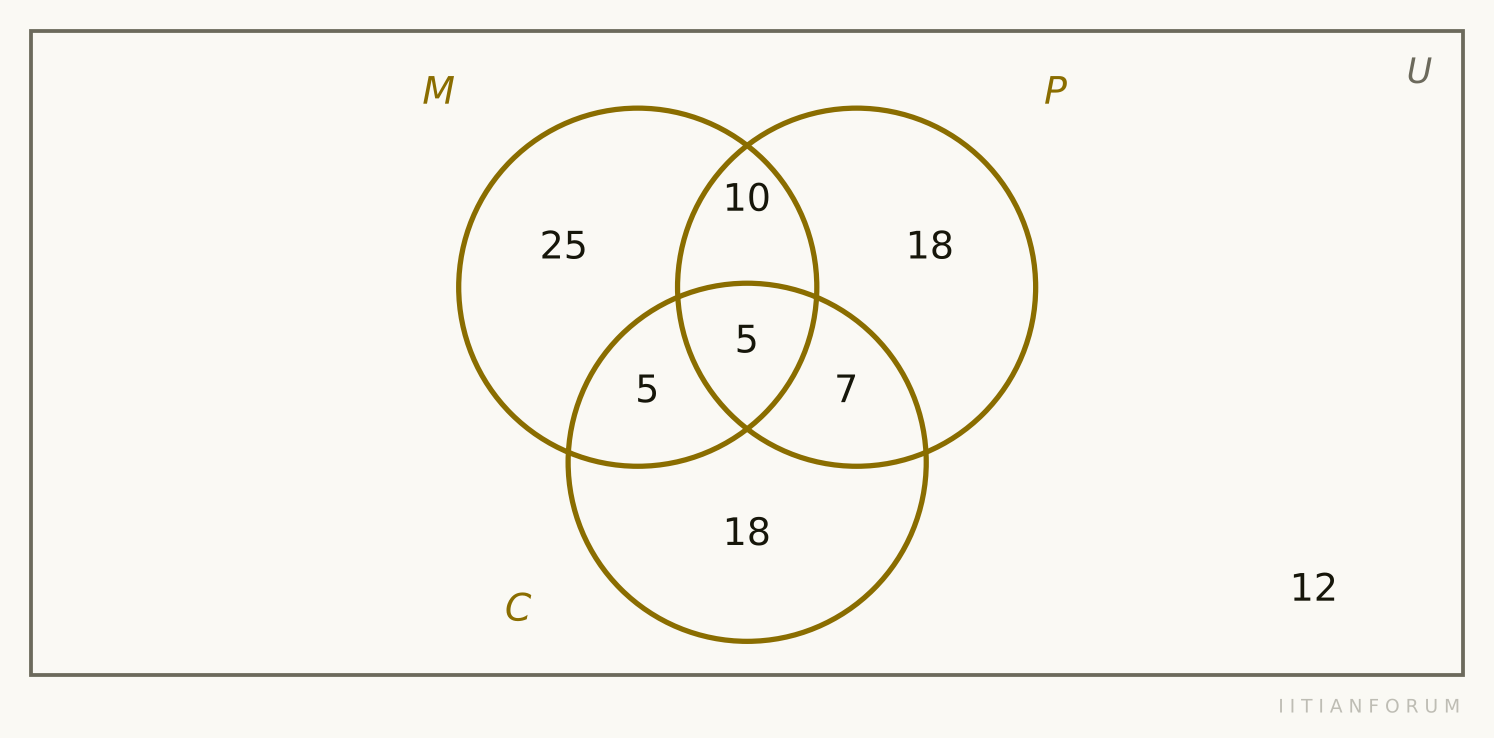
The picture fills the regions from the centre outwards: first in all three, then , , in exactly two, then and so on in one set only.
Bounds on the overlap
When only , and are known, the overlap is not fixed, but it is bounded:
The overlap is also never below . Both ends can occur.
Example 19 (IITianForum). In a group of people, read Hindi and read English. Find the least and the greatest number who read both, and the range of the number who read at least one.
▸ SHOW SOLUTION
Step 1. Least overlap
, so
Step 2. Greatest overlap
The overlap cannot exceed the smaller set: , reached when every English reader also reads Hindi.
Step 3. At least one
As the overlap runs from to , the union runs from down to .
Answer: both: from to ; at least one: from to
Example 20 (IITianForum). Of students, like tea, like coffee and like juice. Find the least possible number who like all three.
▸ SHOW SOLUTION
Step 1. Count those who miss something
do not like tea, do not like coffee and do not like juice. A student outside misses at least one drink, so
Step 2. Least value
It is reached when the three groups of "misses" have no student in common.
Answer: . In general the least triple overlap is when this is positive.
Cartesian product
An ordered pair has a first and a second entry: exactly when and . The cartesian product is
| Property | Statement |
|---|---|
| size | |
| order | only when (or one is empty) |
| empty | exactly when or is empty |
| union | |
| intersection | |
| two products |
Example 21 (IITianForum). Let and . Write , and find and . Is ?
▸ SHOW SOLUTION
Step 1. List
consists of the six pairs , , , , , .
Step 2. Sizes
Step 3. Order
but , since the first entry of a pair in is a letter.
Answer: , ;
Example 22 (IITianForum). has elements, three of which are , and . Find , and the remaining elements.
▸ SHOW SOLUTION
Step 1. What is known
First entries give ; second entries give .
Step 2. Sizes
with and forces , . So
Step 3. The rest
Answer: , ; remaining
Example 23 (IITianForum). Let and . Find .
▸ SHOW SOLUTION
Step 1. Use the two-product rule
Step 2. Compute
, so the answer is .
Answer: elements, as listed
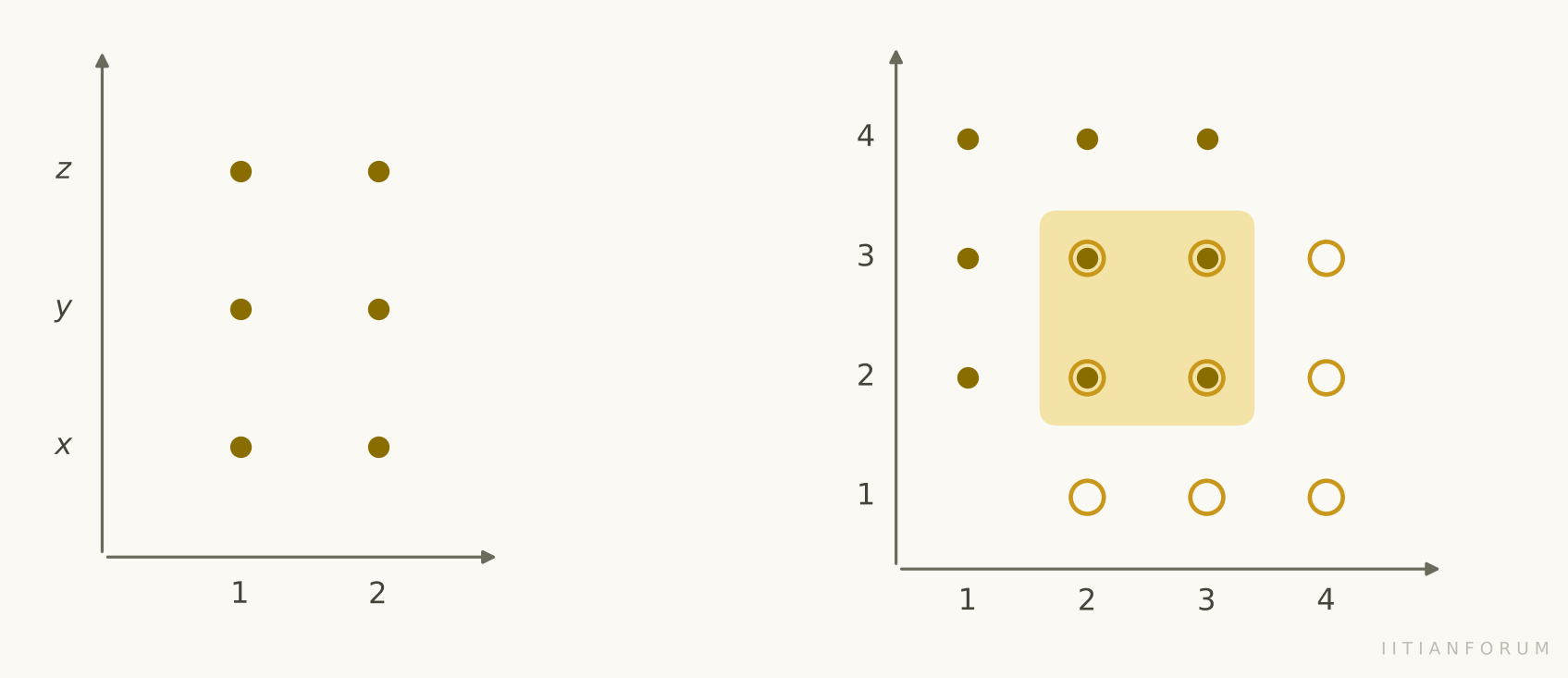
The left picture is Example 21. In the right picture, solid dots are and rings are ; the shaded square, where both appear, is of Example 23.
Relations
A relation from to is any subset of . If we write . A relation from to is a relation on .
- Domain of : the set of first entries.
- Range of : the set of second entries.
- Inverse: , a relation from to .
Every subset of is a relation, so for and ,
On a set with elements there are relations, including the void relation and the universal relation .
A relation from to is a function when every element of appears as a first entry exactly once. The Functions note treats functions in full.
Example 24 (IITianForum). On let . Write in roster form, its domain, its range and .
▸ SHOW SOLUTION
Step 1. List the pairs
give ; gives .
Step 2. Domain, range, inverse
Answer: as above; the range is a subset of the co-domain
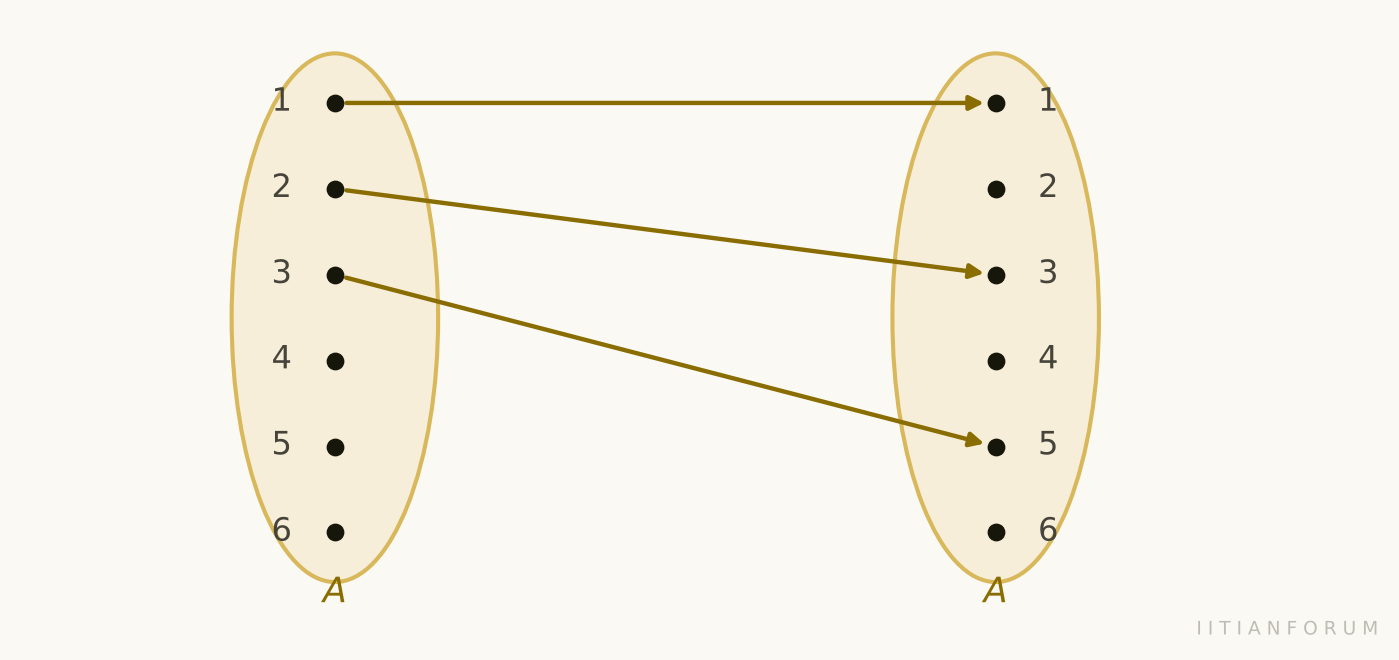
Example 25 (IITianForum). Let and . Find the number of relations (a) from to ; (b) on ; (c) from to with exactly two pairs; (d) non-empty relations on .
▸ SHOW SOLUTION
Step 1. Using the subset count
and .
Step 2. Each part
Answer: , , ,
Relations given by a rule
Most JEE questions define by a formula and ask for . Fix the first entry, count the second entries that work, and add.
Example 26 (JEE Main 2025, 29 January Shift 2). Let . Define a relation from to by . Then the sum of all the elements in the range of is equal to:
▸ SHOW SOLUTION
Step 1. Solve for y
Step 2. Range
Step 3. Sum of the G.P.
Answer: option (2)
Example 27 (JEE Main 2026, 22 January Shift 2). The number of elements in the relation is:
▸ SHOW SOLUTION
Step 1. Possible x
gives , so .
Step 2. Count y for each x
| condition | values | |
|---|---|---|
| : | ||
| : each | ||
| : each | ||
| : each |
Step 3. Add
Answer: option (1)
Example 28 (JEE Main 2026, 2 April Shift 2). Let . Let be a relation on the set given by if and only if divides and . Then the number of elements in is ______.
▸ SHOW SOLUTION
Step 1. Split the condition
The condition on and the condition on are independent, so
Step 2. Pairs with x dividing z
: ; : ; : only.
Step 3. Pairs with y at most w
Answer:
Example 29 (JEE Main 2026, 24 January Shift 1). Let be a relation defined on the set by . Then the number of elements in is:
▸ SHOW SOLUTION
Step 1. Range of values
runs from to . So only those with can match.
Step 2. Table
For each such , list the with :
The other six give values above .
Step 3. Count
Answer: option (3)
Example 30 (JEE Main 2026, 5 April Shift 2). Let and . Then the number of elements in the relation is ______.
▸ SHOW SOLUTION
Step 1. Re-pair the entries
Choosing is the same as choosing the two pairs and freely from . So count ordered pairs of sums with .
Step 2. The nine sums
The list is , with twice.
Step 3. Count divisors in the list
| sums dividing | count | |
|---|---|---|
| (twice) | ||
Answer:
Example 31 (IITianForum). One relation is chosen at random from all non-empty relations on . Find the probability that it is a function from to , and the probability that it is a one-one function.
▸ SHOW SOLUTION
Step 1. Total
Step 2. Functions
A function gives each of exactly one image: relations. One-one functions: .
Answer: and
Example 32 (JEE Main 2025, 2 April Shift 2). Let and be a relation on such that . Let be a sequence of elements of such that the second entry of an ordered pair is equal to the first entry of the next ordered pair. Then the largest integer , for which such a sequence exists, is equal to:
▸ SHOW SOLUTION
Step 1. Run the chain backwards
, so the numbers grow as we go back. To make the chain long, start the end at the smallest value :
Step 2. Stay inside A
, so the longest chain uses : six numbers.
Answer: , option (3)
Types of relations
Let be a relation on a set .
| Type | Condition |
|---|---|
| reflexive | for every |
| symmetric | |
| transitive | |
| anti-symmetric | |
| identity | |
| equivalence | reflexive, symmetric and transitive |
On a grid of points , a reflexive relation contains every point of the diagonal , and a symmetric relation is its own mirror image in that diagonal.
Two 4 by 4 grids of points with the diagonal y equals x dashed; the left grid has all four diagonal points filled together with 1 comma 3, 2 comma 4 and 4 comma 1, a reflexive relation; the right grid has filled points 1 comma 2 and 2 comma 1, 1 comma 4 and 4 comma 1, 2 comma 3 and 3 comma 2, and 3 comma 3, each off-diagonal point matched by its mirror, a symmetric relationTo prove a property, argue for all elements. To disprove it, one counterexample is enough. Symmetric and transitive hold automatically for the void relation, because there is no pair to test; it is not reflexive on a non-empty set.
Example 33 (IITianForum). On decide whether each relation is reflexive, symmetric or transitive.
▸ SHOW SOLUTION
Step 1. R1
Reflexive: all three diagonal pairs. Not symmetric: is missing. Transitive: the only chain is through with diagonal pairs, which gives nothing new.
Step 2. R2
Not reflexive. Symmetric. Not transitive: need .
Step 3. R3
Not reflexive, not symmetric. Transitive: the only chain needs , which is present.
Step 4. R4
Not reflexive; symmetric and transitive, with nothing to test.
Answer: : R, T; : S; : T; : S, T
Example 34 (IITianForum). On , decide which properties hold for defined by (a) divides ; (b) ; (c) .
▸ SHOW SOLUTION
Step 1. Divisibility by 5
; ; and give . An equivalence relation.
Step 2. Less than or equal
Reflexive and transitive. Not symmetric: but . Anti-symmetric: and give .
Step 3. Distance at most 1
Reflexive and symmetric. Not transitive: and are in , but .
Answer: (a) equivalence; (b) R, T, anti-symmetric; (c) R, S only
Example 35 (IITianForum). On , holds whenever . Then is
▸ SHOW SOLUTION
Step 1. Reflexive
for every real . Reflexive.
Step 2. Symmetric
, so ; but is false. Not symmetric.
Step 3. Transitive
since , and since . But . Not transitive.
Answer: option (A)
Example 36 (IITianForum). On , holds whenever is irrational. Which of reflexive, symmetric, transitive hold?
▸ SHOW SOLUTION
Step 1. Reflexive
is rational. Not reflexive.
Step 2. Symmetric
If is irrational, so is . Symmetric.
Step 3. Transitive
and are in , since is irrational. But , so . Not transitive.
Answer: symmetric only
Example 37 (JEE Main 2025, 29 January Shift 1). Define a relation on the interval by if and only if . Then is:
▸ SHOW SOLUTION
Step 1. Rewrite
Step 2. Use the interval
On , is non-negative and increasing, so gives . Thus is the identity relation on the interval, which is reflexive, symmetric and transitive.
Answer: option (1)
Any relation of the form is an equivalence relation, whatever is. Its classes are the sets on which takes one value.
Example 38 (JEE Main 2025, 2 April Shift 1). Let be the set of all functions and be a relation on such that . Then is:
▸ SHOW SOLUTION
Step 1. Reflexive
needs . For this fails. Not reflexive.
Step 2. Symmetric
and say the same as and . Symmetric.
Step 3. Transitive
Take and . Then and , so , and by symmetry . Transitivity would give , which is false. Not transitive.
Answer: option (2)
Example 39 (JEE Main 2026, 8 April Shift 2). Consider the relation on the set defined by if and only if . Among the statements: I. The number of elements in is . II. is an equivalence relation.
▸ SHOW SOLUTION
Step 1. Pairs that fail
means : one entry negative, one positive.
and their reverses: pairs.
So I is true.
Step 2. Equivalence?
, so is reflexive, and it is symmetric. But and are in while is not. Not transitive, so II is false.
Answer: option (1)
Example 40 (JEE Main 2025, 8 April Shift 2). Let . Let be a relation on defined by if and only if . Then among the statements : The number of elements in is , and : The relation is symmetric but neither reflexive nor transitive:
▸ SHOW SOLUTION
Step 1. Count
Pairs with maximum exactly : both entries in but not both in .
So and is false.
Step 2. Properties
, so is symmetric. : not reflexive. but : not transitive. So is true.
Answer: option (3) :::## Types of relations
Let be a relation on a set .
| Type | Condition |
|---|---|
| reflexive | for every |
| symmetric | |
| transitive | |
| anti-symmetric | |
| identity | |
| equivalence | reflexive, symmetric and transitive |
On a grid of points , a reflexive relation contains every point of the diagonal , and a symmetric relation is its own mirror image in that diagonal.
Two 4 by 4 grids of points with the diagonal y equals x dashed; the left grid has all four diagonal points filled together with 1 comma 3, 2 comma 4 and 4 comma 1, a reflexive relation; the right grid has filled points 1 comma 2 and 2 comma 1, 1 comma 4 and 4 comma 1, 2 comma 3 and 3 comma 2, and 3 comma 3, each off-diagonal point matched by its mirror, a symmetric relation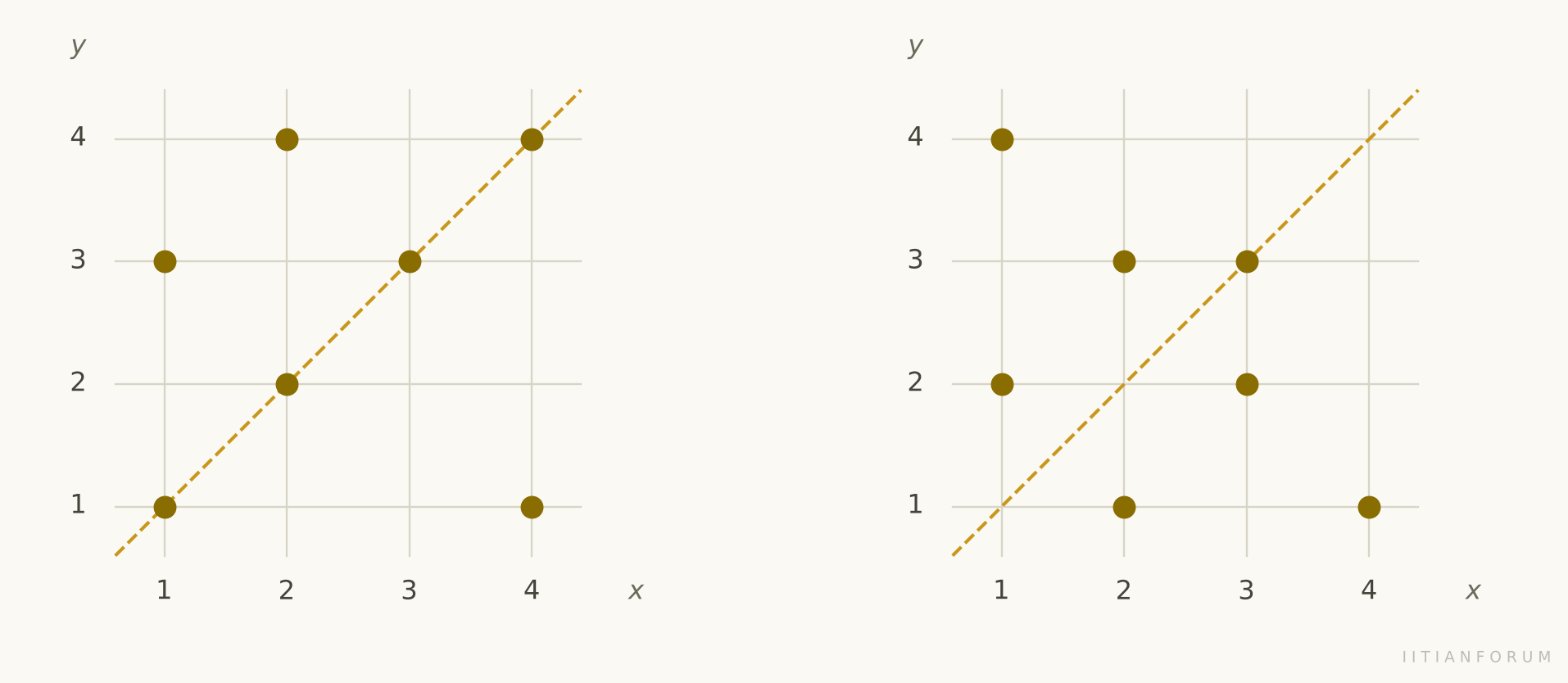
To prove a property, argue for all elements. To disprove it, one counterexample is enough. Symmetric and transitive hold automatically for the void relation, because there is no pair to test; it is not reflexive on a non-empty set.
Example 33 (IITianForum). On decide whether each relation is reflexive, symmetric or transitive.
▸ SHOW SOLUTION
Step 1. R1
Reflexive: all three diagonal pairs. Not symmetric: is missing. Transitive: the only chain is through with diagonal pairs, which gives nothing new.
Step 2. R2
Not reflexive. Symmetric. Not transitive: need .
Step 3. R3
Not reflexive, not symmetric. Transitive: the only chain needs , which is present.
Step 4. R4
Not reflexive; symmetric and transitive, with nothing to test.
Answer: : R, T; : S; : T; : S, T
Example 34 (IITianForum). On , decide which properties hold for defined by (a) divides ; (b) ; (c) .
▸ SHOW SOLUTION
Step 1. Divisibility by 5
; ; and give . An equivalence relation.
Step 2. Less than or equal
Reflexive and transitive. Not symmetric: but . Anti-symmetric: and give .
Step 3. Distance at most 1
Reflexive and symmetric. Not transitive: and are in , but .
Answer: (a) equivalence; (b) R, T, anti-symmetric; (c) R, S only
Example 35 (IITianForum). On , holds whenever . Then is
▸ SHOW SOLUTION
Step 1. Reflexive
for every real . Reflexive.
Step 2. Symmetric
, so ; but is false. Not symmetric.
Step 3. Transitive
since , and since . But . Not transitive.
Answer: option (A)
Example 36 (IITianForum). On , holds whenever is irrational. Which of reflexive, symmetric, transitive hold?
▸ SHOW SOLUTION
Step 1. Reflexive
is rational. Not reflexive.
Step 2. Symmetric
If is irrational, so is . Symmetric.
Step 3. Transitive
and are in , since is irrational. But , so . Not transitive.
Answer: symmetric only
Example 37 (JEE Main 2025, 29 January Shift 1). Define a relation on the interval by if and only if . Then is:
▸ SHOW SOLUTION
Step 1. Rewrite
Step 2. Use the interval
On , is non-negative and increasing, so gives . Thus is the identity relation on the interval, which is reflexive, symmetric and transitive.
Answer: option (1)
Any relation of the form is an equivalence relation, whatever is. Its classes are the sets on which takes one value.
Example 38 (JEE Main 2025, 2 April Shift 1). Let be the set of all functions and be a relation on such that . Then is:
▸ SHOW SOLUTION
Step 1. Reflexive
needs . For this fails. Not reflexive.
Step 2. Symmetric
and say the same as and . Symmetric.
Step 3. Transitive
Take and . Then and , so , and by symmetry . Transitivity would give , which is false. Not transitive.
Answer: option (2)
Example 39 (JEE Main 2026, 8 April Shift 2). Consider the relation on the set defined by if and only if . Among the statements: I. The number of elements in is . II. is an equivalence relation.
▸ SHOW SOLUTION
Step 1. Pairs that fail
means : one entry negative, one positive.
and their reverses: pairs.
So I is true.
Step 2. Equivalence?
, so is reflexive, and it is symmetric. But and are in while is not. Not transitive, so II is false.
Answer: option (1)
Example 40 (JEE Main 2025, 8 April Shift 2). Let . Let be a relation on defined by if and only if . Then among the statements : The number of elements in is , and : The relation is symmetric but neither reflexive nor transitive:
▸ SHOW SOLUTION
Step 1. Count
Pairs with maximum exactly : both entries in but not both in .
So and is false.
Step 2. Properties
, so is symmetric. : not reflexive. but : not transitive. So is true.
Answer: option (3)
Counting relations of each type
For a set with elements, the pairs split into diagonal pairs and off-diagonal partner sets .
| Relations on elements | Count |
|---|---|
| all | |
| reflexive | |
| symmetric | |
| reflexive and symmetric | |
| anti-symmetric | |
| smallest equivalence | identity, pairs |
| largest equivalence | , pairs |
Example 41 (IITianForum). For , find the number of relations that are (a) reflexive; (b) symmetric; (c) reflexive and symmetric; (d) anti-symmetric.
▸ SHOW SOLUTION
Step 1. The pairs
diagonal pairs and partner sets , , .
Step 2. Reflexive and symmetric counts
Reflexive: diagonal fixed, the other pairs free.
Symmetric: each diagonal pair free and each partner set wholly in or out.
Step 3. Anti-symmetric
Each diagonal pair is free. Each partner set may take neither pair, the first or the second, but not both: choices.
Answer: , , ,
Example 42 (JEE Main 2026, 21 January Shift 1). The number of relations defined on the set which are both reflexive and symmetric is
▸ SHOW SOLUTION
Step 1. Diagonal
Reflexive: all diagonal pairs are in, way.
Step 2. Partner sets
The off-diagonal pairs form partner sets; symmetric means each set is wholly in or out.
Answer: option (4)
Example 43 (JEE Main 2025, 22 January Shift 2). Let . The number of relations on , containing and , which are reflexive and transitive but not symmetric, is ______.
▸ SHOW SOLUTION
Step 1. Pairs forced in
Reflexive: . Given: . Transitive: . Call this set ; it is transitive.
Step 2. Pairs left to decide
, and .
- Adding : then need and need . That is all of , which is symmetric.
- Adding and : need , back to .
- Adding only , or only : each stays transitive, and neither is symmetric.
Step 3. Count
, and .
Answer:
Smallest number of pairs to add
To make a given have a property with the fewest new pairs:
| Target | Add |
|---|---|
| reflexive | every missing |
| symmetric | the reverse of every pair whose reverse is missing |
| transitive | for every chain , and repeat until nothing new appears |
| equivalence | join elements linked by into classes; the result is all pairs inside each class |
For an equivalence relation with classes of sizes the number of pairs is
Example 44 (JEE Main 2026, 22 January Shift 1). Let the relation on the set be given by . Then the minimum number of elements required to be added in to make it symmetric is
▸ SHOW SOLUTION
Step 1. List R
is an integer when , giving . .
Step 2. Missing reverses
is its own reverse. Add and .
Answer: , option (2)
Example 45 (JEE Main 2026, 21 January Shift 2). Let and be the relation on defined by iff . Let be the number of elements in and the minimum number of elements to add to make symmetric. Then is
▸ SHOW SOLUTION
Step 1. Count R
:
| count | ||
|---|---|---|
| all five | each | |
| each | ||
Step 2. Missing reverses
with means :
So .
Answer: , option (2)
Example 46 (JEE Main 2026, 23 January Shift 1). Let . Let be a relation on defined by if and only if . Let be the number of elements in . Let and be the minimum number of elements required to be added in to make it reflexive and symmetric relations respectively. Then is equal to:
▸ SHOW SOLUTION
Step 1. Count R
:
| count | ||
|---|---|---|
| all seven | each | |
| none |
Step 2. Reflexive
iff . Missing: , so .
Step 3. Symmetric
but :
So .
Answer: , option (3)
Example 47 (JEE Main 2026, 6 April Shift 2). Let . Then the minimum number of elements required to be added in to make it a transitive relation, is ______.
▸ SHOW SOLUTION
Step 1. R in plain terms
, so . For there are pairs, :
Step 2. What transitivity forces
Every satisfies , and for every . So must be added for all .
Step 3. The full set works
is transitive and contains , with pairs.
Answer:
Example 48 (JEE Main 2025, 23 January Shift 1). Let be a relation defined on the set . Then the minimum number of elements needed to be added in so that becomes an equivalence relation, is:
▸ SHOW SOLUTION
Step 1. Classes
and put in one class. is linked to nothing, so it is a class by itself.
Step 2. Pairs needed
Step 3. Add
already has of them.
Answer: option (4)
Equivalence relations and classes
Let be an equivalence relation on . The equivalence class of is
- Every element lies in its own class, since .
- Two classes are either equal or disjoint.
- The classes together cover .
So the classes form a partition of : disjoint non-empty blocks whose union is . Conversely every partition gives an equivalence relation, "same block". Hence
| equivalence relations |
Example 49 (JEE Main 2025, 28 January Shift 1). The relation is:
▸ SHOW SOLUTION
Step 1. Same parity
is even exactly when and are both even or both odd.
Step 2. Conclude
"Same parity" is of the form with the remainder on division by . So is an equivalence relation with two classes, the even integers and the odd integers.
Answer: option (3)
Example 50 (JEE Main 2026, 23 January Shift 2). Let . Let be a relation on defined by if and only if is a multiple of . Given two statements: Statement I: . Statement II: is an equivalence relation.
▸ SHOW SOLUTION
Step 1. Statement II
means and leave the same remainder on division by . This is of the form , so is an equivalence relation.
Step 2. Classes
Step 3. Statement I
Answer: option (2)
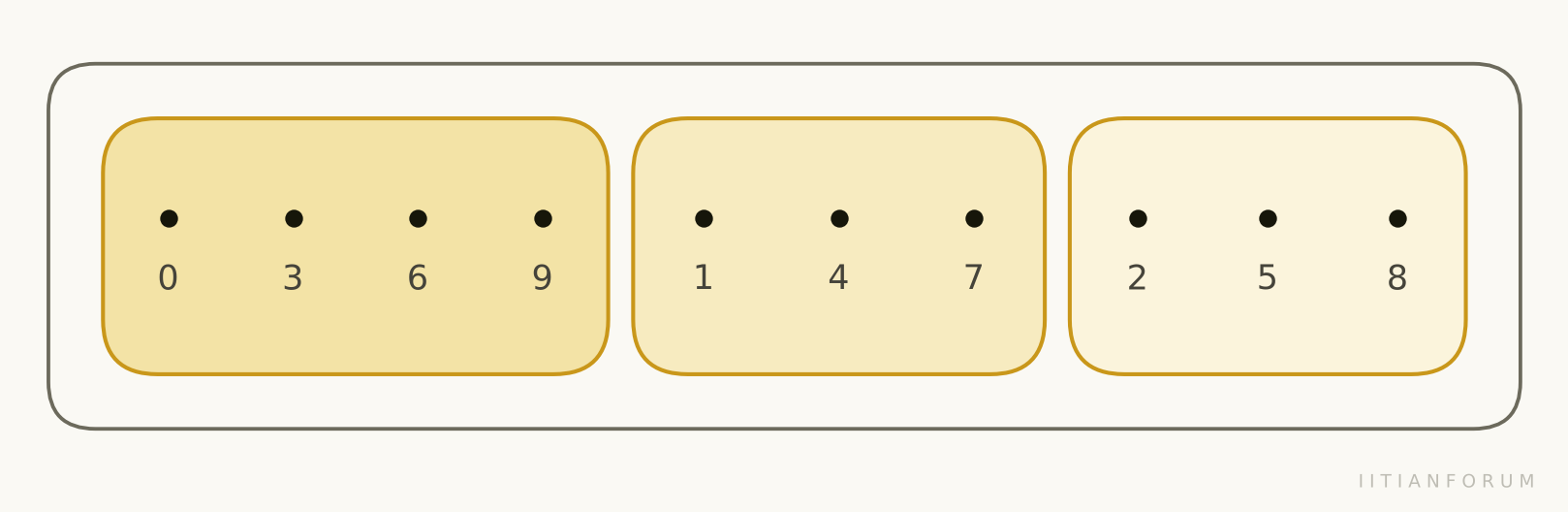
Example 51 (IITianForum). On , holds whenever . Show that is an equivalence relation, and find the classes of and of .
▸ SHOW SOLUTION
Step 1. Equivalence
With , means . So is reflexive, symmetric and transitive.
Step 2. Class of 2
Step 3. Class of minus one half
Answer: ; has one element. In general .
Example 52 (JEE Main 2025, 23 January Shift 2). Let . Define a relation on as . Statement-I: is an equivalence relation. Statement-II: For some , the set represents a line parallel to .
▸ SHOW SOLUTION
Step 1. Statement I
The relation compares the second entries: takes equal values. So is an equivalence relation.
Step 2. Statement II
, the horizontal line . It is parallel to the axis for every , never to .
Answer: option (2)
Example 53 (JEE Main 2025, 22 January Shift 1). The number of non-empty equivalence relations on the set is:
▸ SHOW SOLUTION
Step 1. Partitions of {1, 2, 3}
Step 2. Count
partitions, so equivalence relations. Each contains the diagonal, so each is non-empty.
Answer: option (3)
Example 54 (IITianForum). Find the number of equivalence relations on , and the number of them that contain .
▸ SHOW SOLUTION
Step 1. Partitions by block sizes
| Block sizes | Number of partitions |
|---|---|
Step 2. Containing (1, 2)
and must be in one block. Treat them as a single object: partitions of the three objects , , number .
Answer: and
Example 55 (JEE Advanced 2026, Paper 1). Let . Consider the set of all equivalence relations on such that has exactly elements. Then the number of elements in is ______.
▸ SHOW SOLUTION
Step 1. Size of R from the classes
If the classes have sizes , then
Step 2. Find the block sizes
A block of or more gives at least , too many. With largest block , the other blocks add to and their squares to : only . With largest block , the rest add to with squares adding to : only . With largest block or less, the squares add to at most .
So the block sizes are or .
Step 3. Count each shape
The two singletons in the first shape need no ordering; choosing the block of fixes them.
Answer:
Which method to use
A decision chart: from a box asking what is asked, eight branches lead to the method; simplify a set expression leads to writing minus as intersection with a complement; survey numbers to filling the Venn regions from the centre; count subsets to in or out for each element; count a relation to fixing the first entry and counting the second; is it reflexive, symmetric, transitive to checking each and finding one counterexample; count reflexive or symmetric relations to the diagonal then partner pairs; pairs to add to mirrors, diagonal, then closure; equivalence relations to counting partitions into classes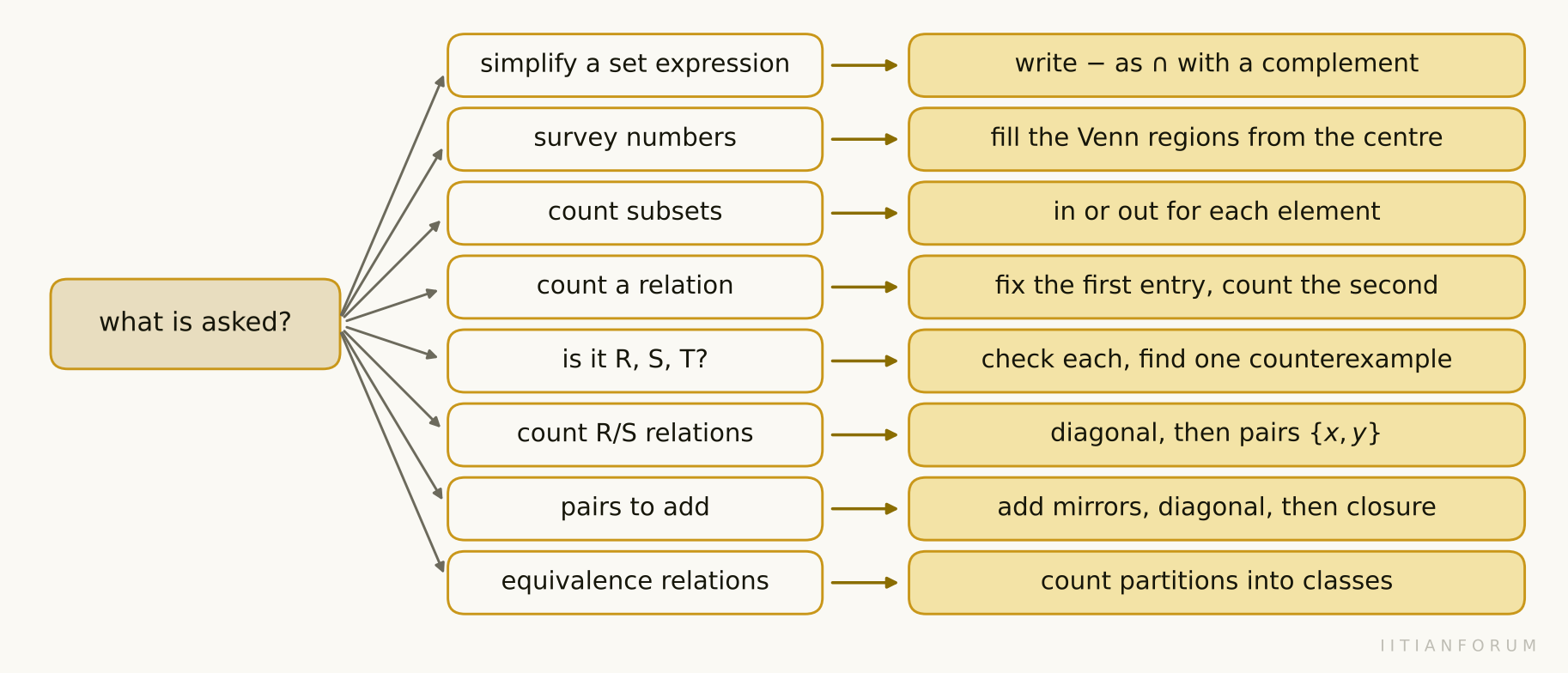
| Situation | Method |
|---|---|
| expression with and | , then the laws |
| survey with three sets | fill the regions from the centre |
| least overlap | |
| subsets with a condition | "in or out", remove the bad ones |
| disjoint or nested pairs of subsets | |
| two A.P.s as sets | common terms form an A.P. with LCM difference |
| relation with a formula | fix , count in a table |
| relation on with split conditions | product of two counts |
| reflexive, symmetric counts | diagonal pairs, then partner sets |
| pairs to add for symmetry | missing reverses |
| pairs to add for equivalence | classes, then |
| equivalence at once | |
| number of equivalence relations | number of partitions |
Quick recall
| Result | Statement |
|---|---|
| proper subsets | |
| subsets containing a fixed element | |
| , or | pairs |
| De Morgan | |
| two sets | |
| three sets | |
| exactly one, exactly two | , |
| least overlap | |
| relations from to | |
| reflexive | |
| symmetric | |
| reflexive and symmetric | |
| anti-symmetric | |
| void relation | symmetric and transitive |
| equivalence with classes | pairs |
| equivalence relations on , elements | , |
Without a pen, answer these four: the number of subsets of a element set that contain but not ; if and ; the number of symmetric relations on a element set; and the number of pairs in the equivalence relation on with classes , , . If , , and come quickly, the chapter is yours.
Practise these methods on real exam questions in the doMath Sets and Relations chapters. A function is a relation with one output for each input: the Functions note continues from here.