Quadratic Equations for JEE: Roots, Graphs, Location and Newton Sums
Ritesh Raj · 5 Nov 2026
Aa
40 min read18 sectionsConcept
A quadratic equation is the first equation where the answer is not a single number but a pair, and the pair carries more information than either root alone. Their sum and product come straight from the coefficients, their nature comes from one number D, and their position on the number line comes from one picture, the parabola. JEE uses all three in almost every paper, and the same ideas return in calculus, coordinate geometry and complex numbers.
This note covers the equation and its roots, the discriminant, the relations between roots and coefficients, forming and transforming equations, power sums by Newton's formula, the graph and sign of the quadratic expression, maximum, minimum and range, location of roots, common roots, equations reducible to a quadratic, the quadratic expression in two variables, and equations of higher degree. The worked examples include JEE Main 2025 and 2026 questions and JEE Advanced questions; every answer was re-derived from scratch.
The quadratic equation and its roots
An equation of the form
ax2+bx+c=0,a=0
with a,b,c real is a quadratic equation in x. A number α is a root (or zero) when aα2+bα+c=0. A quadratic equation has exactly two roots, counted with repetition; they may be real or non-real.
Degenerate cases. If a=0, b=0, the equation is linear with the single root −bc. If a=b=0, c=0, there is no root. If a=b=c=0, every x satisfies it.
Three roots means an identity
A genuine quadratic has at most two roots. So if ax2+bx+c=0 holds for three distinct values of x, then a=b=c=0 and the expression is zero for every x. This is the standard way to prove an identity: show that a polynomial of degree at most 2 vanishes at three points.
has degree at most 2 and is 0 at x=a, x=b and x=c (check each). So it is 0 for every x.
Methods of solving
Factorisation. Split the middle term so that ax2+bx+c=a(x−α)(x−β), then put each factor equal to zero.
Completing the square. Divide by a and add (2ab)2 to both sides:
x2+abx=−ac(x+2ab)2=4a2b2−4ac
Taking square roots gives the quadratic formula:
x=2a−b±b2−4ac
The number D=b2−4ac is the discriminant. The two roots are
α=2a−b+D,β=2a−b−D
Example 1(IITianForum). Solve (a) 6x2−7x−3=0 by factorisation; (b) 2x2+4x−1=0 by the formula.
▸ SHOW SOLUTION
Step 1. Part (a)
Two numbers with product 6⋅(−3)=−18 and sum −7 are −9 and 2:
6x2−9x+2x−3=(2x−3)(3x+1)
So x=23 or x=−31.
Step 2. Part (b)
D=16+8=24:
x=4−4±24=2−2±6
Answer: (a) 23,−31; (b) 2−2±6
Example 2(JEE Main 2026, 23 January Shift 1). A building construction work can be completed by two masons A and B together in 22.5 days. Mason A alone can complete the work in 24 days less than mason B alone. Then mason A alone will complete the work in
Tap an option to check your answer
(1)24 days
(2)42 days
(3)30 days
(4)36 days
▸ SHOW SOLUTION
Step 1. Form the equation
Let A take x days; then B takes x+24 days. One day's work together:
x1+x+241=452
Step 2. Solve
45(2x+24)=2x(x+24)x2−21x−540=0(x−36)(x+15)=0
A number of days is positive, so x=36.
Answer: option (4)
Example 3(JEE Main 2026, 21 January Shift 2). The positive integer n, for which the solutions of the equation
x(x+2)+(x+2)(x+4)+⋯⋯+(x+2n−2)(x+2n)=38n
are two consecutive even integers, is
Tap an option to check your answer
(1)3
(2)6
(3)12
(4)9
▸ SHOW SOLUTION
Step 1. Add the terms
The rth term is x2+(4r−2)x+4r2−4r. Summing for r=1 to n and dividing by n:
x2+2nx+34(n2−1)−38=0
Step 2. Roots differ by 2
For a monic quadratic, (α−β)2=D, so D=4:
4n2−316(n2−1)+332=4n2=9,n=3
Step 3. Check
n=3 gives x2+6x+8=0, roots −2,−4: consecutive even integers.
Answer: option (1)
Example 4(JEE Main 2026, 2 April Shift 1). Let α and α+2, α∈Z, be the roots of
x(x+2)+(x+1)(x+3)+⋯⋯+(x+n−1)(x+n+1)=4n
for some n∈N. Then n+α is equal to
Tap an option to check your answer
(1)0
(2)1
(3)2
(4)3
▸ SHOW SOLUTION
Step 1. Add the terms
The kth term is (x+k)2−1=x2+2kx+k2−1. Summing and dividing by n:
x2+(n+1)x+C=0C=6(n+1)(2n+1)−5
Step 2. Roots differ by 2
D=(n+1)2−4C=4:
(n+1)2−32(n+1)(2n+1)+20=4−n2+61=12,n=7
Step 3. The roots
n=7 gives x2+8x+15=0, roots −5,−3. So α=−5.
Answer:n+α=2, option (3)
Nature of the roots
With a,b,c real, D in the formula decides everything.
Discriminant
Roots
D>0
real and distinct
D=0
real and equal, each −2ab
D<0
non-real, a conjugate pair p±iq
D≥0
real (equal or distinct)
swipe for more →
With a,b,crational:
Discriminant
Roots
D>0, a perfect square
rational, distinct
D>0, not a perfect square
irrational, a pair p±q
swipe for more →
Why irrational roots come in pairs. Let p+q be a root (q irrational). The other root is −ab−(p+q), which is p′−q with p′ rational. The product (p+q)(p′−q)=ac is rational, so (p′−p)q is rational, which forces p′=p.
Integer roots. If a=1 and b,c are integers, the roots are integers exactly when D is a perfect square. (Here D=b2−4c has the same parity as b2, so −b±D is even.)
Conjugate pairs need the right coefficients
"Irrational roots come in pairs" needs rational coefficients, and "non-real roots come in pairs" needs real coefficients. The equation x2−(1+2)x+2=0 has roots 1 and 2: one rational, one irrational, because its coefficients are not rational. Check the coefficients before using the pairing.
Example 5(IITianForum). Find all real k for which x2−2(k+1)x+k2+3=0 has real roots. When are they equal?
▸ SHOW SOLUTION
Step 1. Discriminant
4D=(k+1)2−(k2+3)=2k−2
Step 2. Conditions
Real roots: 2k−2≥0, so k≥1. Equal roots: k=1, and then the root is k+1=2.
Answer:k≥1; equal roots at k=1
Example 6(JEE Main 2025, 29 January Shift 2). If the set of all a∈R for which the equation 2x2+(a−5)x+15=3a has no real root is the interval (α,β), and X={x∈Z:α<x<β}, then ∑x∈Xx2 is equal to
Tap an option to check your answer
(1)2109
(2)2129
(3)2139
(4)2119
▸ SHOW SOLUTION
Step 1. No real root
(a−5)2−8(15−3a)<0a2+14a−95<0(a+19)(a−5)<0
So (α,β)=(−19,5).
Step 2. The sum
X={−18,…,4}:
∑x2=618⋅19⋅37+30=2139
Answer: option (3)
Example 7(JEE Main 2025, 23 January Shift 1). If the equation a(b−c)x2+b(c−a)x+c(a−b)=0 has equal roots, where a+c=15 and b=536, then a2+c2 is equal to ______.
▸ SHOW SOLUTION
Step 1. One root is 1
The coefficients add to 0:
a(b−c)+b(c−a)+c(a−b)=0
So x=1 is a root, and equal roots means both roots are 1.
Step 2. Product of roots is 1
c(a−b)=a(b−c)⇒2ac=b(a+c)2ac=536⋅15=108,ac=54
Step 3. Value
a2+c2=225−108=117
Answer:117
Sum of coefficients
If a+b+c=0, then 1 is a root and the other root is ac. If a−b+c=0, then −1 is a root. Spotting this saves the formula entirely.
Example 8(JEE Main 2025, 4 April Shift 1). Consider x2+4x−n=0, where n∈[20,100] is a natural number. The number of values of n for which the equation has integral roots is
Tap an option to check your answer
(1)7
(2)8
(3)6
(4)5
▸ SHOW SOLUTION
Step 1. Complete the square
(x+2)2=n+4,x=−2±n+4
Integral roots need n+4 to be a perfect square.
Step 2. Count
24≤n+4≤104 allows 25,36,49,64,81,100: six values.
Answer: option (3)
Example 9(JEE Advanced 2026, Paper 2). Let a,b,c be positive integers in arithmetic progression such that ax2+bx+c=0 has only integer solutions. Which of the following statements is (are) TRUE?
More than one option is correct. Pick all of them, then Check
(1)c−b is an integer multiple of a
(2)Both roots are odd integers
(3)If c=15, then ab=8
(4)If b=8, then x=3 is a root
▸ SHOW SOLUTION
Step 1. Reduce to a monic equation
Integer roots give integer sum −ab and product ac. Put b=ma, c=na. The A.P. gives 2b=a+c, so n=2m−1:
x2+mx+(2m−1)=0
Step 2. Perfect square discriminant
D=m2−8m+4=(m−4)2−12
D=d2 gives (m−4−d)(m−4+d)=12. Both factors have the same parity, so they are 2,6 or −6,−2. With m≥1: m=8, d=2.
Step 3. The equation
b=8a, c=15a, and x2+8x+15=0 has roots −3,−5.
Step 4. Statements
(1)c−b=7a: true.
(2)−3,−5 are odd: true.
(3)c=15 gives a=1, b=8, ab=8: true.
(4)3 is not a root: false.
Answer: (1), (2), (3)
Roots and coefficients
If α,β are the roots of ax2+bx+c=0, then ax2+bx+c=a(x−α)(x−β). Comparing coefficients:
α+β=−ab,αβ=ac
From the formula, the difference is
(α−β)2=a2D,∣α−β∣=∣a∣D
Write S=α+β and P=αβ. Every symmetric expression in the roots (unchanged when α,β swap) is a formula in S and P:
Expression
In S and P
α2+β2
S2−2P
(α−β)2
S2−4P
α3+β3
S3−3PS
α3−β3
(α−β)(S2−P)
α4+β4
(S2−2P)2−2P2
α1+β1
PS
βα+αβ
PS2−2P
α21+β21
P2S2−2P
swipe for more →
Signs of the roots (real coefficients):
Roots
Condition
opposite signs
ac<0
both positive
D≥0, ab<0, ac>0
both negative
D≥0, ab>0, ac>0
equal size, opposite sign
b=0, ac<0
reciprocals of each other
a=c
one root zero
c=0
swipe for more →
D comes first
α+β>0 and αβ>0 do not make the roots positive unless the roots are real. x2−x+1=0 has sum 1 and product 1 but no real roots. Always add D≥0.
Example 10(IITianForum). If α,β are the roots of 2x2−5x+1=0, find α2+β2, α3+β3, α21+β21 and (α−β)2.
Example 11(JEE Main 2026, 28 January Shift 1). If α,β(α<β) are the roots of λx2−(λ+3)x+3=0 such that α1−β1=31, then the sum of all possible values of λ is
Tap an option to check your answer
(1)6
(2)2
(3)4
(4)8
▸ SHOW SOLUTION
Step 1. Use the product
α1−β1=αββ−α=31
αβ=λ3, so β−α=λ1.
Step 2. Square and use S, P
λ21=λ2(λ+3)2−λ12λ2−6λ+8=0,λ=2,4
Both work: λ=2 gives roots 1,23; λ=4 gives 43,1.
Answer:2+4=6, option (1)
Example 12(JEE Main 2026, 22 January Shift 2). Let α,β be the roots of 12x2−20x+3λ=0, λ∈Z. If 21≤∣β−α∣≤23, then the sum of all possible values of λ is
Tap an option to check your answer
(1)6
(2)1
(3)3
(4)4
▸ SHOW SOLUTION
Step 1. The difference
S=35, P=4λ:
(β−α)2=925−λ
Step 2. The bound
41≤925−λ≤493619≤λ≤3691
So λ=1,2.
Answer:3, option (3)
Example 13(JEE Advanced 2015). Let S be the set of all non-zero real numbers α such that αx2−x+α=0 has two distinct real roots x1,x2 with ∣x1−x2∣<1. Which of these intervals is (are) a subset of S?
More than one option is correct. Pick all of them, then Check
(A)(−21,−51)
(B)(−51,0)
(C)(0,51)
(D)(51,21)
▸ SHOW SOLUTION
Step 1. Distinct real roots
D=1−4α2>0, so α2<41.
Step 2. Difference of roots
∣x1−x2∣2=α21−4α2<11<5α2,α2>51
Step 3. Combine
S=(−21,−51)∪(51,21)
Answer: (A) and (D)
Example 14(JEE Main 2026, 2 April Shift 2). Let α,β be the roots of x2−3x+r=0, and 2α,2β be the roots of x2+3x+r=0. If the roots of x2+6x=m are 2α+β+2r and α−2β−2r, then m is
Tap an option to check your answer
(A)−135
(B)−567
(C)135
(D)567
▸ SHOW SOLUTION
Step 1. Two sums
α+β=3,2α+2β=−3
So β=−3, α=6, and r=αβ=−18.
Step 2. The new roots
2α+β+2r=12−3−36=−27α−2β−2r=6+6+9=21
Step 3. Product of roots of x² + 6x − m = 0
−m=(−27)(21)=−567
Answer:m=567, option (D)
Example 15(JEE Main 2026, 5 April Shift 2). Let α,β be the roots of x2−x+p=0 and γ,δ the roots of x2−4x+q=0, p,q∈Z. If α,β,γ,δ are in G.P., then ∣p+q∣ equals
Tap an option to check your answer
(1)16
(2)32
(3)34
(4)38
▸ SHOW SOLUTION
Step 1. Write the G.P.
Take α=a, β=ar, γ=ar2, δ=ar3:
a(1+r)=1,ar2(1+r)=4
Dividing, r2=4.
Step 2. Integer p, q
r=2 gives a=31 and p=a2r=92: not an integer. r=−2 gives a=−1:
p=a2r=−2,q=a2r5=−32
Answer:∣p+q∣=34, option (3)
Example 16(JEE Main 2025, 22 January Shift 2). Let αθ,βθ be the distinct roots of 2x2+(cosθ)x−1=0, θ∈(0,2π). If m and M are the minimum and maximum values of αθ4+βθ4, then 16(M+m) equals
Tap an option to check your answer
(1)24
(2)25
(3)27
(4)17
▸ SHOW SOLUTION
Step 1. In S and P
S=−2cosθ, P=−21. With c=cos2θ:
α2+β2=4c+1α4+β4=(4c+1)2−21
Step 2. Extremes
c∈[0,1], and the expression increases with c:
m=21,M=1625−21=1617
Answer:16(M+m)=25, option (2)
Example 17(JEE Main 2026, 6 April Shift 2). For (n2−2n+2)x2−3x+(n2−2n+2)2=0, n∈R, let α be the minimum value of the product of the roots and β the maximum value of the sum of the roots. The sum of the first six terms of the G.P. with first term α and common ratio βα is
Tap an option to check your answer
(1)3761
(2)81121
(3)243364
(4)7291093
▸ SHOW SOLUTION
Step 1. Sum and product
Let k=n2−2n+2=(n−1)2+1≥1. Product =kk2=k, least value α=1. Sum =k3, greatest value β=3.
Step 2. The G.P.
S6=1−1/31−(1/3)6=243364
Answer: option (3)
Example 18(JEE Advanced 2016). Let −6π<θ<−12π. Suppose α1,β1 are the roots of x2−2xsecθ+1=0 and α2,β2 are the roots of x2+2xtanθ−1=0. If α1>β1 and α2>β2, then α1+β2 equals
Tap an option to check your answer
(A)2(secθ−tanθ)
(B)2secθ
(C)−2tanθ
(D)0
▸ SHOW SOLUTION
Step 1. First equation
x=secθ±sec2θ−1=secθ±tanθ
Here tanθ<0, so the larger root is α1=secθ−tanθ.
Step 2. Second equation
x=−tanθ±secθ
secθ>0, so the smaller root is β2=−tanθ−secθ.
Step 3. Add
α1+β2=−2tanθ
Answer: option (C)
Example 19(IITianForum). Let α,β be the roots of x2+ax−a21=0, a a non-zero real. Find the least value of [α4+β4], where [⋅] is the greatest integer function.
▸ SHOW SOLUTION
Step 1. In S and P
S=−a, P=−a21:
α2+β2=a2+a22α4+β4=(a2+a22)2−a42=a4+4+a42
Step 2. AM ≥ GM
a4+a42≥22
with equality at a4=2. So the least value of α4+β4 is 4+22=6.82…
Answer:[4+22]=6
Forming and transforming equations
The quadratic with roots α and β is
x2−(α+β)x+αβ=0
that is, x2−(sum)x+(product)=0. Any non-zero multiple has the same roots.
Transforming the roots. Let α,β be the roots of ax2+bx+c=0. To get the equation whose roots are f(α),f(β), put y=f(x), solve for x, substitute in the given equation and rename y as x.
New roots
Substitute
New equation
−α,−β
x→−x
ax2−bx+c=0
α1,β1
x→x1
cx2+bx+a=0
kα,kβ
x→kx
ax2+kbx+k2c=0
α+k,β+k
x→x−k
a(x−k)2+b(x−k)+c=0
α2,β2
x→x
a2x2−(b2−2ac)x+c2=0
swipe for more →
Example 20(IITianForum). If α,β are the roots of 2x2+3x−4=0, form the equations whose roots are (a) α1,β1; (b) α+2,β+2; (c) α2,β2.
▸ SHOW SOLUTION
Step 1. Reciprocals
Reverse the coefficients: −4x2+3x+2=0, that is 4x2−3x−2=0.
Step 2. Shift by 2
2(x−2)2+3(x−2)−4=02x2−5x−2=0
Step 3. Squares
α2+β2=49+4=425,α2β2=44x2−25x+16=0
Answer:4x2−3x−2=0; 2x2−5x−2=0; 4x2−25x+16=0
Example 21(IIT JEE 2010). Let p,q be real with p=0, p3=q, p3=−q. If α,β are non-zero complex numbers with α+β=−p and α3+β3=q, find a quadratic equation whose roots are βα and αβ.
▸ SHOW SOLUTION
Step 1. Product αβ
α3+β3=(α+β)3−3αβ(α+β)q=−p3+3pαβ,αβ=3pp3+q
Step 2. Sum and product of the new roots
The product is 1. The sum is
αβα2+β2=αβp2−2=p3+qp3−2q
Step 3. The equation
(p3+q)x2−(p3−2q)x+(p3+q)=0
Answer: as above
Example 22(IITianForum). Let α,β be the roots of x2−2x−1=0. Find the quadratic equation whose roots are α3−α31 and β2+β21.
Example 23(IITianForum). The equation (x−a)(x−b)+2(x−c)(x−d)=0 has roots p and q. Find the roots of 3(x−p)(x−q)−(x−a)(x−b)=0.
▸ SHOW SOLUTION
Step 1. Same roots, same leading coefficient
(x−a)(x−b)+2(x−c)(x−d) has leading coefficient 3 and roots p,q. So for every x,
(x−a)(x−b)+2(x−c)(x−d)=3(x−p)(x−q)
Step 2. Rearrange
3(x−p)(x−q)−(x−a)(x−b)=2(x−c)(x−d)
Answer:c and d
Example 24(JEE Advanced 2026, Paper 1). Match List I with List II.
(P) If α,β are distinct roots of x2+x+1=0, the quadratic with roots (α+1)20261,(β+1)20261 is
(Q) If α,β are distinct roots of x2+x+1=0, the quadratic with roots (α+1)20271,(β+1)20271 is
(R) If γ,δ are distinct roots of x2−x+1=0, then (γ−1)20261+(δ−1)20261 is
(S) If p,r are distinct roots of x2+x−1=0, then (p+1)31+(r+1)31 is
Let α,β be the roots of ax2+bx+c=0 and Sk=αk+βk. Multiply aα2+bα+c=0 by αk−2, do the same for β, and add:
aSk+bSk−1+cSk−2=0,k≥2
This is Newton's formula. Start from S0=2 and S1=−ab and step up one power at a time. The same proof shows that Tk=αk−βk, and any pαk+qβk, satisfy the same recurrence.
Read the recurrence backwards
A question that asks for something like 2a9a10−2a8 is written so that the recurrence finishes it in one line. Write the recurrence from the equation first, then look at the expression.
Example 25(IITianForum). If α,β are the roots of x2−3x+1=0, find α5+β5.
▸ SHOW SOLUTION
Step 1. Recurrence
Sk=3Sk−1−Sk−2, with S0=2, S1=3.
Step 2. Step up
S2=7,S3=18,S4=47,S5=123
Answer:123
Example 26(IIT JEE 2011). Let α,β be the roots of x2−6x−2=0, with α>β. If an=αn−βn for n≥1, then the value of
2a9a10−2a8
is (A) 1 (B) 2 (C) 3 (D) 4
▸ SHOW SOLUTION
Step 1. Recurrence
α2=6α+2 and β2=6β+2. Multiply by α8, β8 and subtract:
a10=6a9+2a8
Step 2. Value
2a9a10−2a8=2a96a9=3
Answer: option (C)
Example 27(JEE Main 2025, 3 April Shift 1). Let α,β be the roots of x2+3x−16=0, and γ,δ the roots of x2+3x−1=0. If Pn=αn+βn and Qn=γn+δn, then
2P23P25+3P24+Q24Q25−Q23
is equal to (1) 3 (2) 4 (3) 5 (4) 7
▸ SHOW SOLUTION
Step 1. First part
P25+3P24−16P23=0, so the first fraction is 216=8.
Step 2. Second part
Q25+3Q24−Q23=0, so Q25−Q23=−3Q24 and the second fraction is −3.
Answer:8−3=5, option (3)
Example 28(JEE Main 2025, 2 April Shift 1). Let Pn=αn+βn. If P10=123, P9=76, P8=47 and P1=1, then the quadratic equation with roots α1 and β1 is
Tap an option to check your answer
(1)x2−x+1=0
(2)x2+x−1=0
(3)x2−x−1=0
(4)x2+x+1=0
▸ SHOW SOLUTION
Step 1. Find the equation of α, β
Let α,β be roots of x2−sx+p=0, so P10=sP9−pP8. Here s=P1=1:
123=76−47p,p=−1
So α,β are the roots of x2−x−1=0.
Step 2. Reciprocals
Reverse the coefficients: −x2−x+1=0.
Answer:x2+x−1=0, option (2)
Example 29(JEE Main 2026, 6 April Shift 2). Let S={z∈C:z2+6iz−3=0}. Then ∑z∈Sz8 is equal to
Tap an option to check your answer
(1)162
(2)184
(3)262
(4)324
▸ SHOW SOLUTION
Step 1. Sum and product
For the roots α,β: α+β=−6i, αβ=−3.
α2+β2=(−6i)2+6=−6+6=0
Step 2. Square twice
α4+β4=0−2(αβ)2=−18α8+β8=(−18)2−2(αβ)4=324−162=162
Answer:162, option (1)
Complex coefficients
Sum, product and Newton's formula only use aα2+bα+c=0, so they hold for complex coefficients too. What fails with complex coefficients is the discriminant test and the conjugate pairing.
Example 30(JEE Advanced 2017). Let p,q be integers and α,β the roots of x2−x−1=0, α=β. For n=0,1,2,… let an=pαn+qβn. (Fact: if a,b are rational and a+b5=0, then a=b=0.) (i) Express a12 in terms of a11 and a10. (ii) If a4=28, find p+2q.
▸ SHOW SOLUTION
Step 1. Recurrence
α2=α+1, β2=β+1, so an+2=an+1+an. In particular a12=a11+a10.
Step 2. a₄ in p and q
a2=a1+a0, a3=2a1+a0, a4=3a1+2a0. With a0=p+q and α,β=21±5:
a4=27(p+q)+235(p−q)=28
Step 3. Use the fact
p−q=0 and 27(p+q)=28, so p=q=4.
Answer: (i) a12=a11+a10; (ii) p+2q=12
Example 31(IITianForum, JEE Advanced level). Let α>β be the roots of x2−x−1=0. For n≥1 let
an=α−βαn−βn,bn=αn+βn
Which are true? (A) a1+a2+⋯+an=an+2−1 (B) ∑n=1∞10nan=8910 (C) ∑n=1∞10nbn=898 (D) bn=an−1+an+1 for n≥2
▸ SHOW SOLUTION
Step 1. Recurrences
Both sequences satisfy un+2=un+1+un, with a1=a2=1 and b1=1, b2=3.
Step 2. (A)
ak=ak+2−ak+1. Adding for k=1 to n, the sum telescopes to an+2−a2=an+2−1. True.
Step 3. (B) and (C)
Let A=∑10nan. The recurrence gives
A−10A−100A=10a1+100a2−a1=101
so A=8910. True. The same steps with b1=1, b2=3 give
B⋅10089=101+1002,B=8912
So (C) is false.
Step 4. (D)
an−1+an+1=α−βαn−1(1+α2)−βn−1(1+β2). From αβ=−1, 1+α2=α(α−β), and 1+β2=−β(α−β). So the sum is αn+βn=bn. True.
Answer: (A), (B), (D)
Graph of the quadratic expression
Completing the square,
y=a(x+2ab)2−4aD
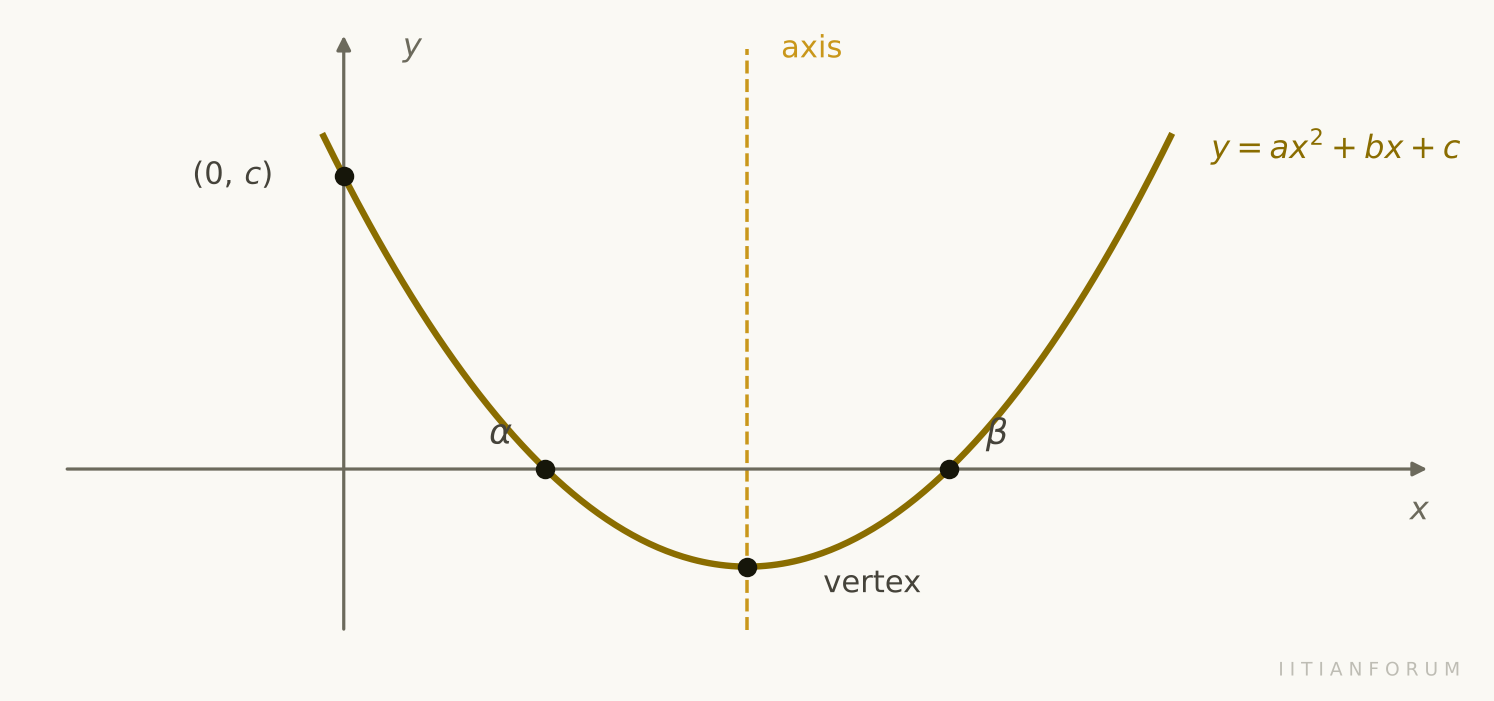
So the graph of y=ax2+bx+c is a parabola with
vertex(−2ab,−4aD)axisx=−2ab
It opens upwards for a>0 and downwards for a<0.
It meets the y-axis at (0,c).
It meets the x-axis at the real roots: two points if D>0, touches at one point if D=0, misses if D<0.
A parabola opening upwards with its vertex below the x axis marked, a dashed vertical axis of symmetry through the vertex, the two points where it cuts the x axis marked alpha and beta, and the point where it cuts the y axis marked 0 comma c
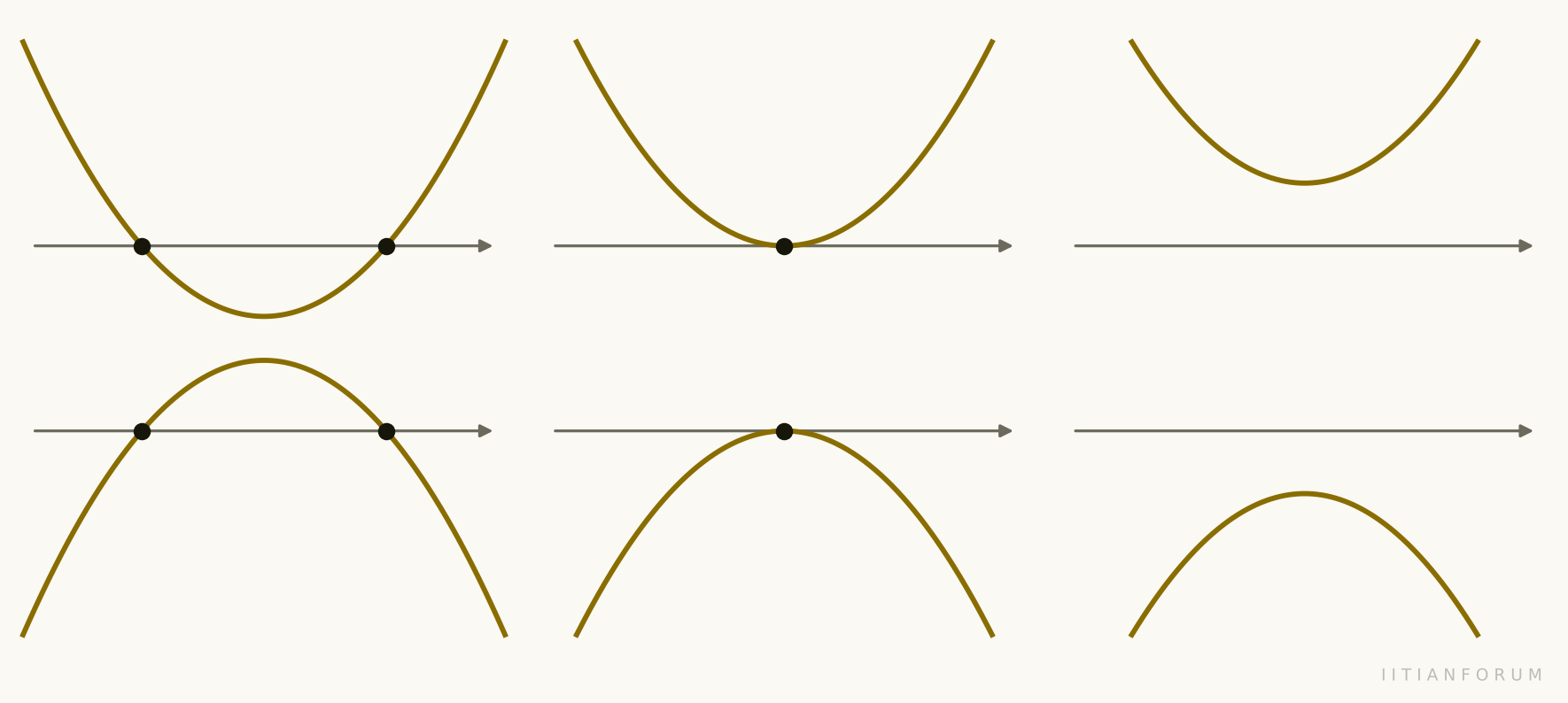
The sign of a and the sign of D give the six pictures. Nearly every question on sign, range or location of roots is one of these.
Six small graphs in two rows; top row parabolas opening upwards, bottom row opening downwards; in each row the left one cuts the x axis at two marked points, the middle one touches it at one marked point, and the right one does not meet it
Top row a>0, bottom row a<0; left to right D>0, D=0, D<0.
Reading signs from a graph.a from the opening, c from the y-intercept, and b from the vertex: −2ab>0 (vertex right of the y-axis) means a,b have opposite signs.
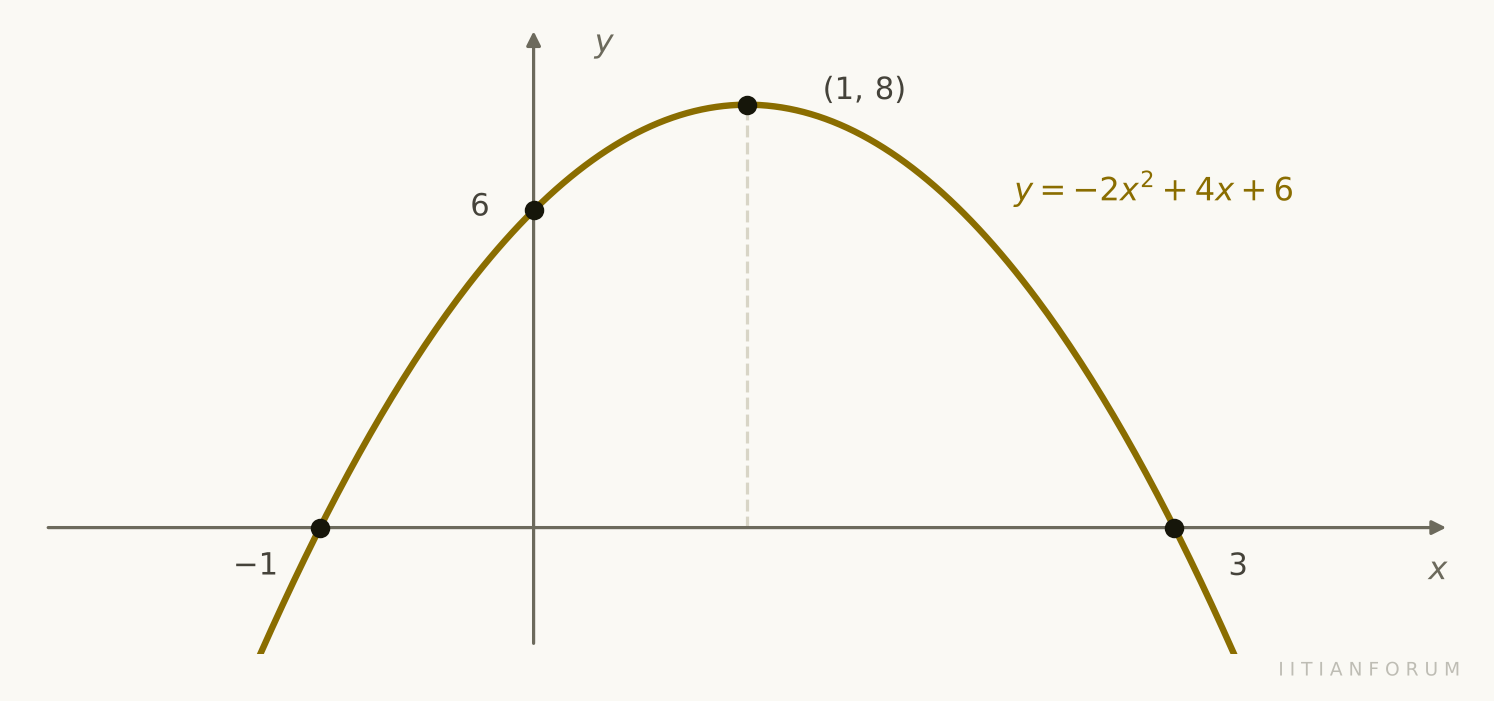
Example 32(IITianForum). (a) Sketch y=−2x2+4x+6, marking the vertex, the roots and the y-intercept. (b) A parabola y=ax2+bx+c opens downwards, has its vertex to the right of the y-axis and meets the y-axis below the origin. Find the signs of a, b, c and D, given that it meets the x-axis at two points.
▸ SHOW SOLUTION
Step 1. Vertex form
y=−2(x−1)2+8
Vertex (1,8), opening downwards.
Step 2. Roots and intercept
−2x2+4x+6=0 gives x2−2x−3=0, roots −1 and 3. The y-intercept is 6.
Step 3. Part (b)
Downwards: a<0. Vertex right: −2ab>0, so b>0. Below the origin: c<0. Two meeting points: D>0.
Answer: (b) a<0, b>0, c<0, D>0
A downward parabola with its vertex marked at 1 comma 8, a dashed line from the vertex down to the x axis, the points minus 1 and 3 marked where it cuts the x axis, and the point 6 marked on the y axis
Sign of the quadratic expression
Let f(x)=ax2+bx+c, a,b,c real, a=0.
Case
Sign of f(x)
D<0
sign of a for every x
D=0
sign of a, except 0 at x=−2ab
D>0, roots α<β
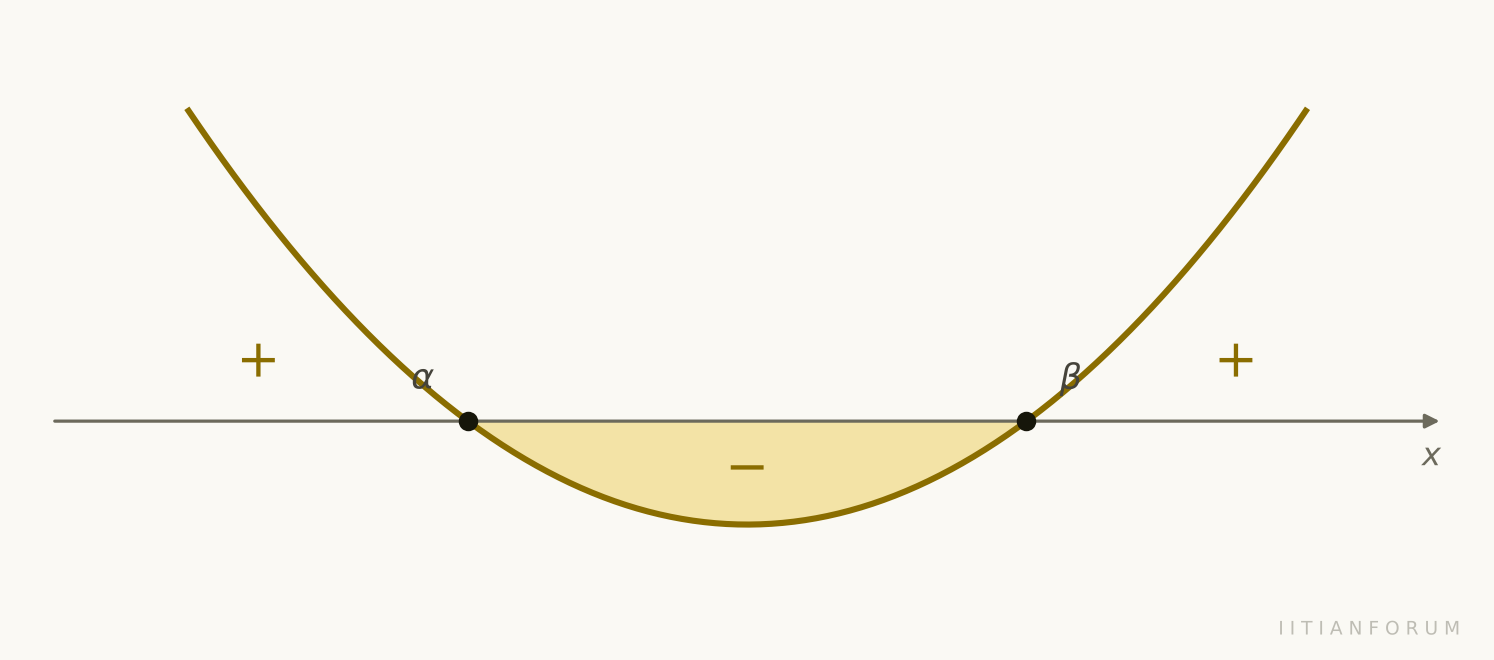
sign of a outside [α,β], opposite sign strictly between
swipe for more →
Reason. For D>0, f(x)=a(x−α)(x−β). For x between the roots the two brackets have opposite signs; outside, the same sign. For D<0, the vertex form is a times a positive number.
An upward parabola cutting the x axis at alpha and beta, with the part between them shaded below the axis and a minus sign there, and plus signs above the axis to the left of alpha and to the right of betaax2+bx+c>0∀x⟺a>0,D<0ax2+bx+c<0∀x⟺a<0,D<0ax2+bx+c≥0∀x⟺a>0,D≤0
When the leading coefficient has a parameter
For (k−1)x2+⋯, check k=1 separately. There the expression is linear, and a non-constant linear expression is never of one sign for all x.
Quadratic inequalities. Find the roots, then read the sign: for a>0, f(x)<0 exactly between the roots and f(x)>0 outside them. For products and quotients of several factors, use the wavy curve method of the Basic Algebra and Logarithms note; a quadratic factor with D<0 and positive leading coefficient can simply be dropped, since it is always positive.
Example 33(IITianForum). Find all real k for which kx2+4x+k>0 for every real x.
▸ SHOW SOLUTION
Step 1. k = 0
The expression is 4x, not always positive.
Step 2. k ≠ 0
Need k>0 and D=16−4k2<0, that is k2>4.
Answer:k>2
Example 34(IITianForum). Let f(x)=ax2+bx+c with a<b and f(x)≥0 for every real x. Find the least value of
b−a4a+2b+c▸ SHOW SOLUTION
Step 1. Conditions
f≥0 for all x forces a>0 and b2≤4ac, so c≥4ab2. The expression is unchanged when a,b,c are scaled, so take a=1 and b>1:
b−14+2b+c≥b−14+2b+4b2=4(b−1)(b+4)2
Step 2. Substitute and use AM ≥ GM
Put u=b−1>0:
4u(u+5)2≥4u(25u)2=5
Equality at u=5: b=6, c=9, f(x)=(x+3)2.
Answer:5
Maximum, minimum and range
From the vertex form, f(x)=ax2+bx+c has its extreme value at x=−2ab:
f(−2ab)=−4aD=4a4ac−b2
a
Extreme value
Range on R
a>0
minimum −4aD
[−4aD,∞)
a<0
maximum −4aD
(−∞,−4aD]
swipe for more →
On a closed interval [p,q]. Compare f(p), f(q) and, if the vertex lies in [p,q], f(−2ab). For a>0: the minimum is at the vertex when it lies inside, otherwise at the end nearer the vertex; the maximum is always at the end farther from the vertex.
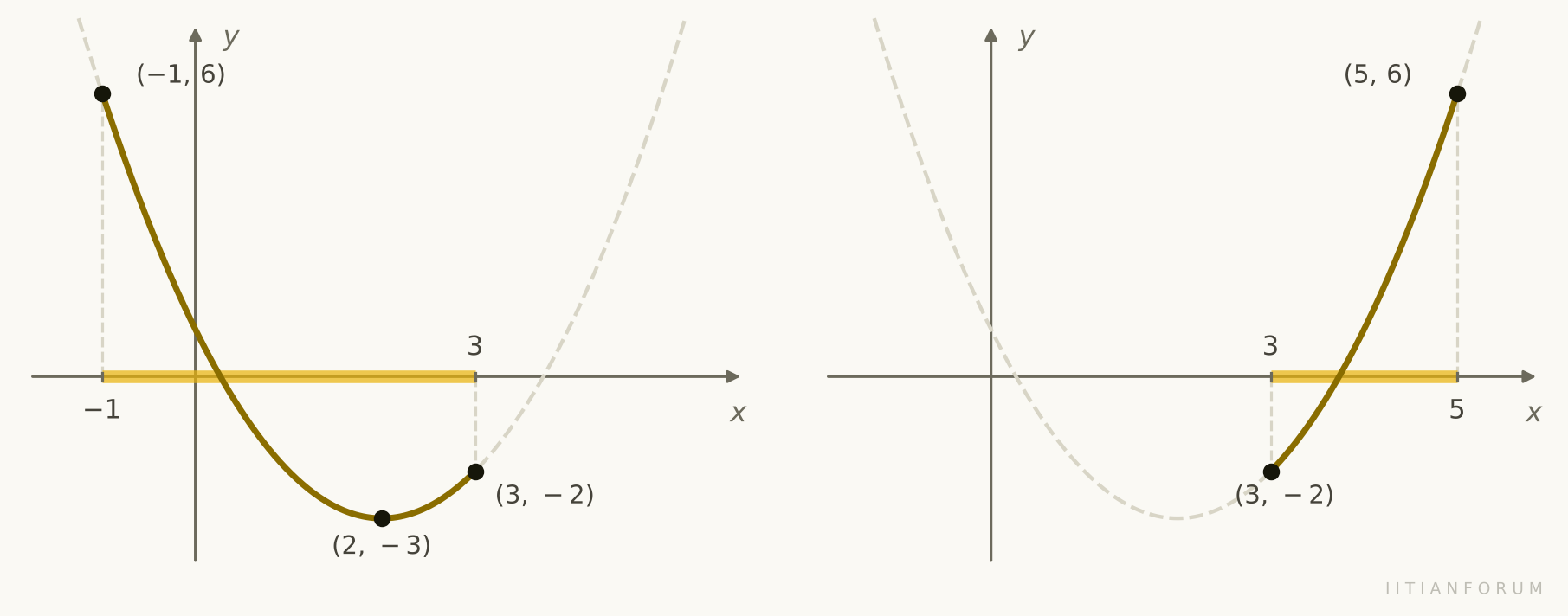
Example 35(IITianForum). Find the maximum and minimum values of f(x)=x2−4x+1 on (a) [−1,3]; (b) [3,5].
▸ SHOW SOLUTION
Step 1. Vertex
f(x)=(x−2)2−3: vertex at x=2, value −3.
Step 2. Interval [−1, 3]
The vertex lies inside: minimum −3. Ends: f(−1)=6, f(3)=−2; maximum 6.
Step 3. Interval [3, 5]
The vertex lies to the left, so f increases here: minimum f(3)=−2, maximum f(5)=6.
Answer: (a) max 6, min −3; (b) max 6, min −2
Two copies of the parabola y equals x squared minus 4x plus 1 drawn dashed; on the left the part over the interval from minus 1 to 3 is drawn solid with the end points minus 1 comma 6 and 3 comma minus 2 and the vertex 2 comma minus 3 marked; on the right the part over the interval from 3 to 5 is drawn solid with the end points 3 comma minus 2 and 5 comma 6 marked
Range of a rational expression
To find the values of
y=a2x2+b2x+c2a1x2+b1x+c1
clear the denominator and read the result as a quadratic in x:
(a1−ya2)x2+(b1−yb2)x+(c1−yc2)=0
A value y is taken exactly when this has a real root x that does not make the denominator zero. So the range is given by
(b1−yb2)2−4(a1−ya2)(c1−yc2)≥0
together with two checks.
The linear case. For the y with a1−ya2=0 the equation is linear; solve it directly.
Common factor. If the numerator and denominator share a factor (x−r), cancel it first. The value of the cancelled form at x=r is not taken, although the discriminant test lets it through.
If the two quadratics have no common factor, the test is correct even when the denominator has real roots.
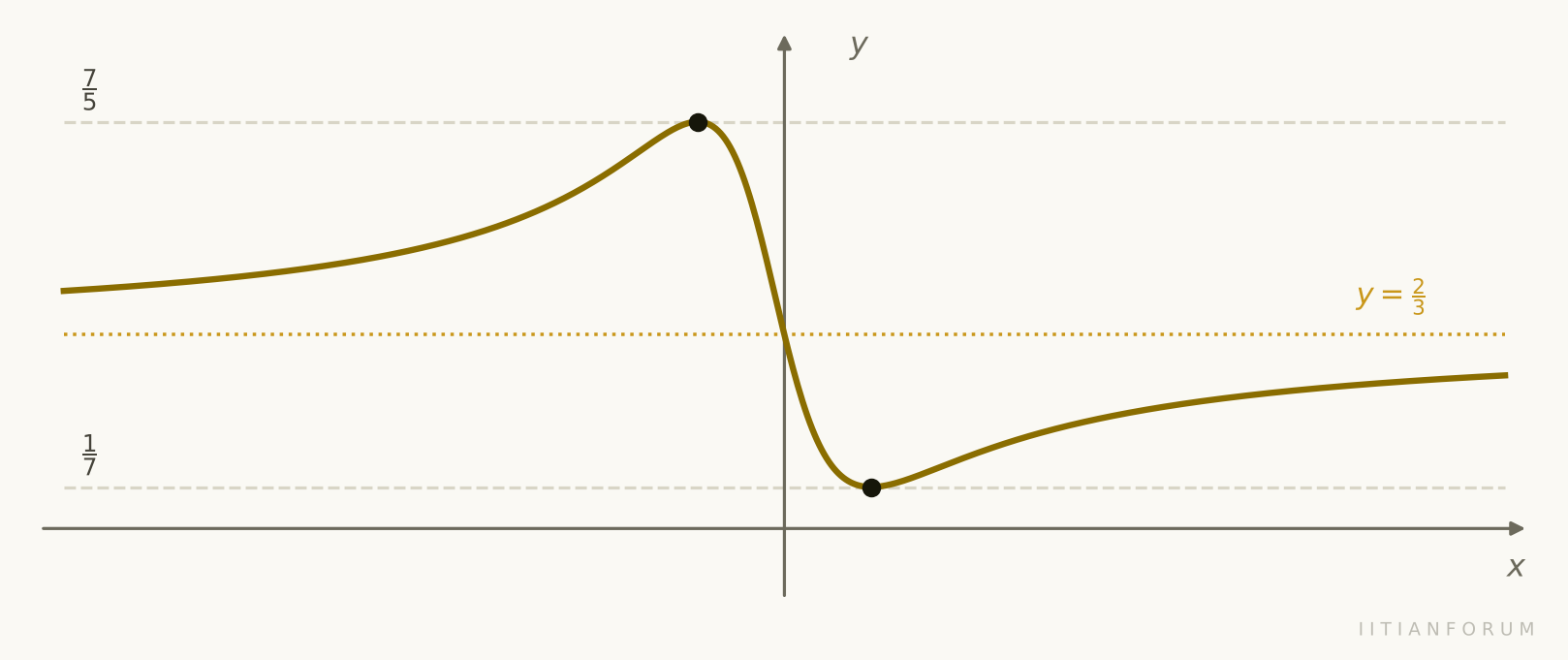
Example 36(JEE Main 2026, 6 April Shift 2). Let f:R→R, f(x)=3x2+x+32x2−3x+2. Then f is
Tap an option to check your answer
(1)both one-one and onto
(2)one-one but not onto
(3)onto but not one-one
(4)neither one-one nor onto
▸ SHOW SOLUTION
Step 1. Quadratic in x
(3y−2)x2+(y+3)x+(3y−2)=0
The denominator has D=1−36<0, so it never vanishes.
Step 2. Range
(y+3)2−4(3y−2)2≥0(7y−1)(5y−7)≤0,71≤y≤57
The range is [71,57]=R: not onto.
Step 3. Not one-one
The equation in x has its coefficients of x2 and of 1 equal, so its two roots have product 1: if x gives the value y, so does x1. For example f(2)=f(21)=174.
Answer: option (4)
The curve y equals 2x squared minus 3x plus 2 over 3x squared plus x plus 3, rising to a highest point at x equals minus 1 on the dashed line y equals 7 over 5, falling to a lowest point at x equals 1 on the dashed line y equals 1 over 7, and levelling off towards the dotted line y equals 2 over 3 at both ends
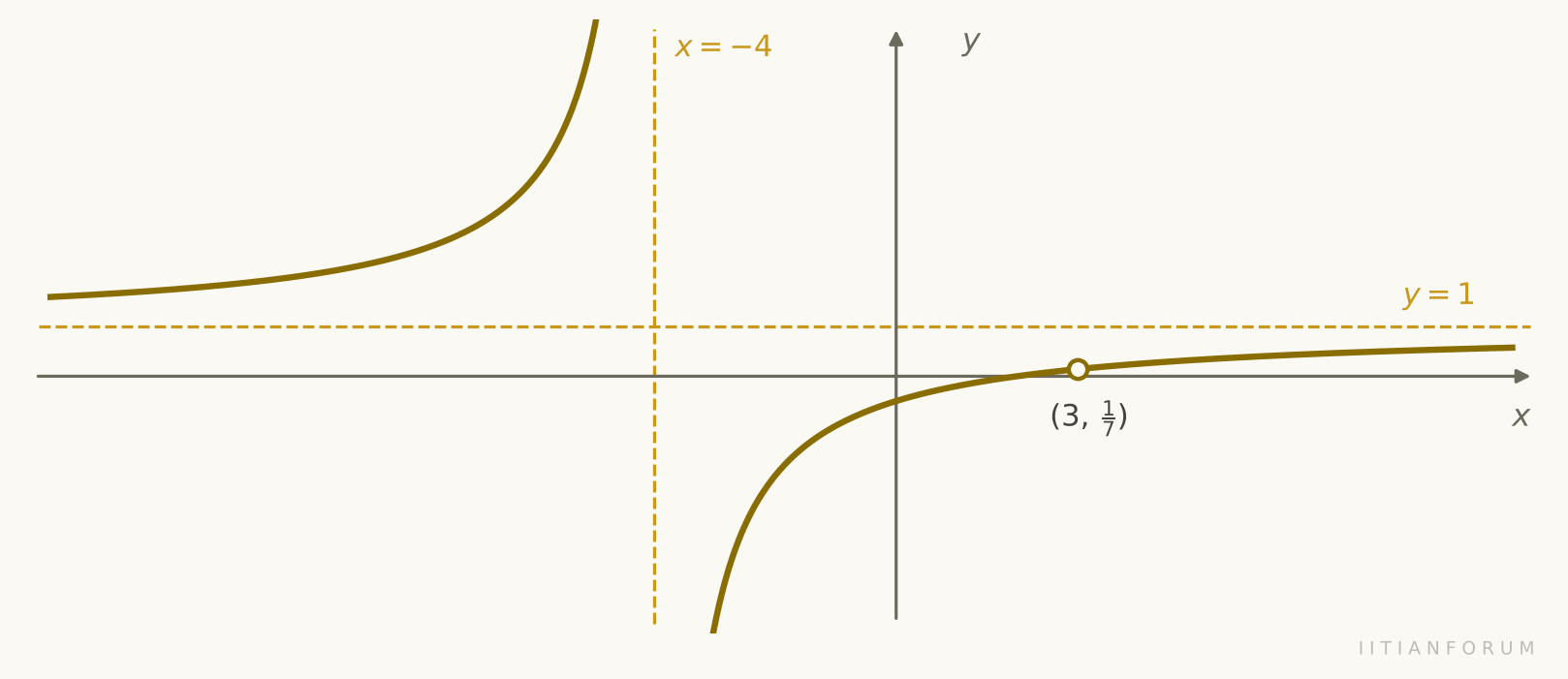
Example 37(IITianForum). Exactly one integer is not in the range of f(x)=x2+x−12x2−5x+6. Find it, and find the full range.
▸ SHOW SOLUTION
Step 1. Cancel the common factor
f(x)=(x+4)(x−3)(x−2)(x−3)=x+4x−2
for x=3,−4.
Step 2. Values of the cancelled form
x+4x−2=1−x+46 takes every real value except 1.
Step 3. Remove x = 3
At x=3 the cancelled form equals 71, and no other x gives 71. So 71 is not taken either.
Range=R−{1,71}
Answer: the integer is 1
The discriminant test alone would miss 71 here: it gives (7y−1)2≥0, true for every y, and at y=71 it produces the double root x=3, which is not in the domain.
The curve y equals x minus 2 over x plus 4 in two branches with dashed asymptotes x equals minus 4 and y equals 1, and a hollow circle on the right branch at the point 3 comma 1 over 7 showing a missing value
Example 38(IITianForum). P(x) is a quadratic polynomial with real coefficients such that 2(1+P(x))=P(x−1)+P(x+1) for every real x, with P(0)=5 and P(3)=29. Find (a) the sum of the coefficients of P; (b) the range of P; (c) P(10).
▸ SHOW SOLUTION
Step 1. Leading coefficient
For P(x)=Ax2+Bx+C:
P(x−1)+P(x+1)=2P(x)+2A
So 2+2P(x)=2P(x)+2A, giving A=1.
Step 2. The polynomial
C=P(0)=5 and 9+3B+5=29, so B=5:
P(x)=x2+5x+5=(x+25)2−45
Step 3. The three answers
Sum of coefficients P(1)=11. Range [−45,∞). P(10)=155.
Answer: (a) 11; (b) [−45,∞); (c) 155
Location of roots
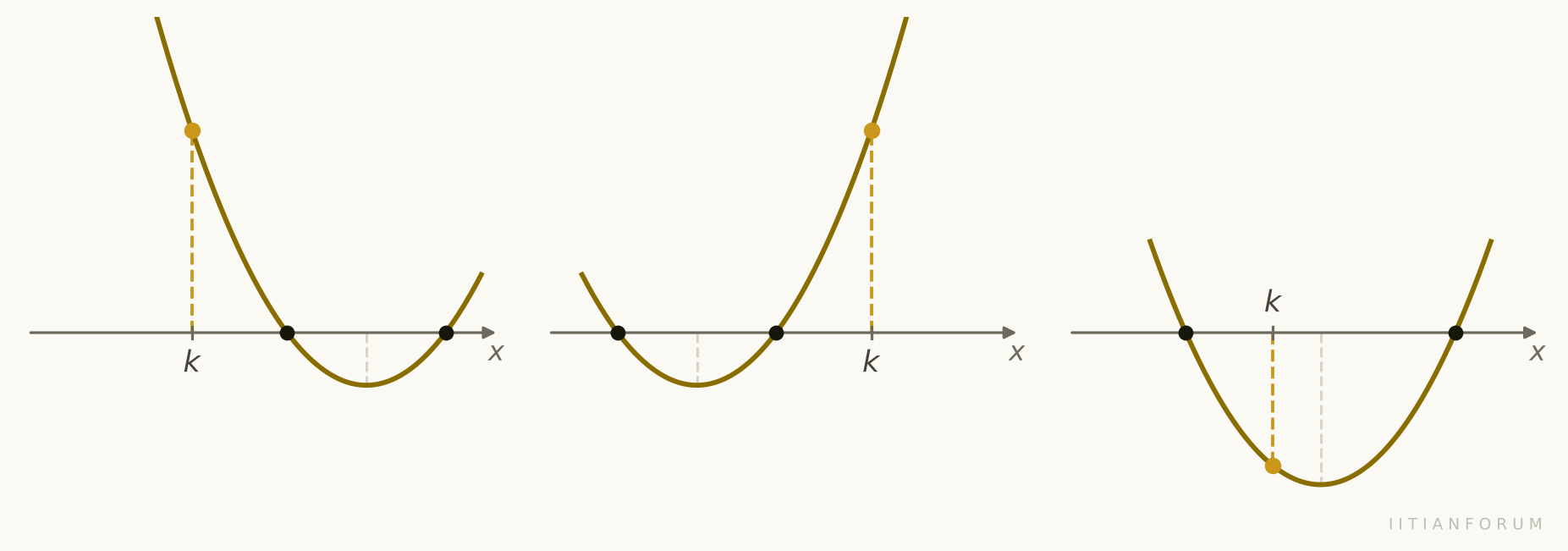
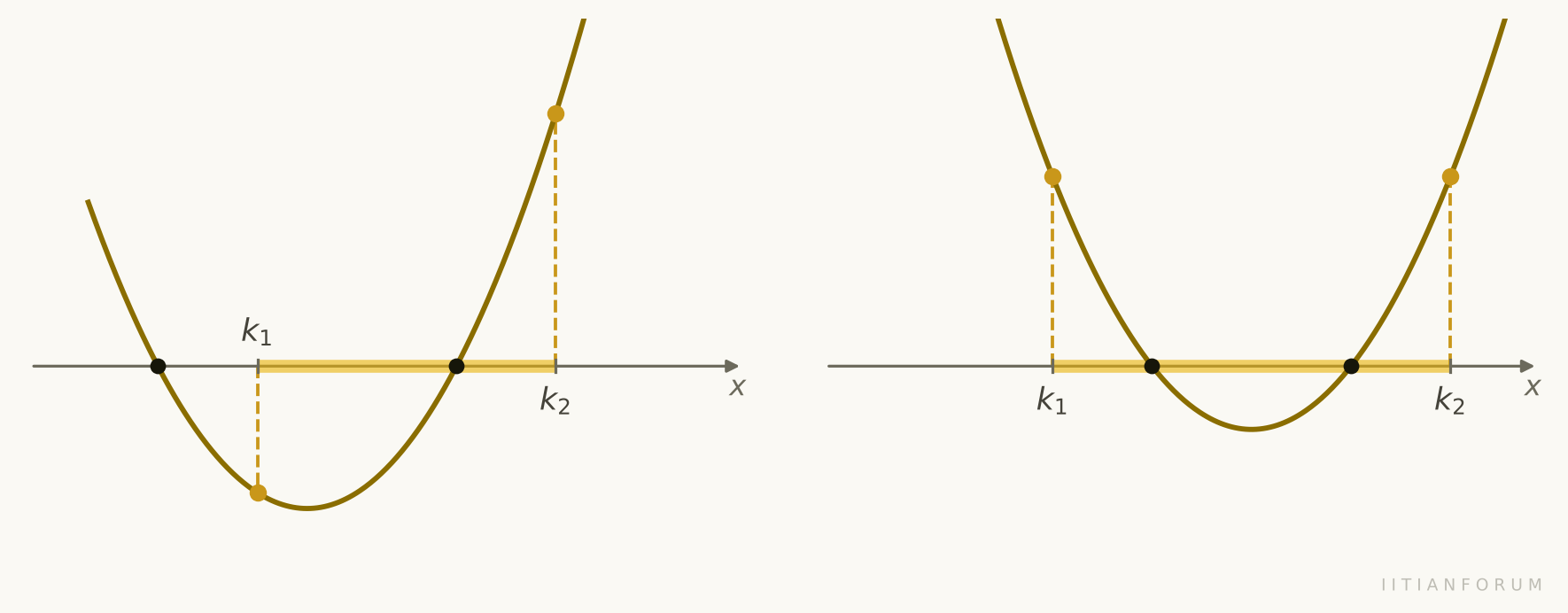
Let f(x)=ax2+bx+c with a>0 (if a<0, multiply the equation by −1), real roots α≤β, and real numbers k, k1<k2. Each condition is the parabola picture written down: the sign of f at a test point tells which side of the roots that point is on, the vertex −2ab tells where the turning point is, and D decides whether real roots exist.
Requirement
Conditions (a>0)
both roots >k
D≥0, f(k)>0, −2ab>k
both roots <k
D≥0, f(k)>0, −2ab<k
k between the roots
f(k)<0
both roots in (k1,k2)
D≥0, f(k1)>0, f(k2)>0, k1<−2ab<k2
exactly one root in (k1,k2)
f(k1)f(k2)<0
k1,k2 both between the roots
f(k1)<0, f(k2)<0
swipe for more →
For any sign of a, "k between the roots" is af(k)<0, and "f(k)>0" in the other rows becomes af(k)>0.
Three upward parabolas; in the first a point k on the x axis lies to the left of both roots with f of k positive; in the second k lies to the right of both roots with f of k positive; in the third k lies between the roots with f of k negative; a dashed line marks the vertex in eachTwo upward parabolas with an interval from k1 to k2 highlighted on the x axis; on the left f of k1 is negative and f of k2 positive, so exactly one root lies in the interval; on the right f of k1 and f of k2 are both positive and both roots lie inside the interval
f(k) > 0 alone is not enough
f(k)>0 says only that k is not between the roots. It does not say on which side the roots are, or that they are real. Both extra conditions, D≥0 and the vertex, are needed.
Example 39(IITianForum). Find all real k for which both roots of x2−2kx+k2+k−5=0 are less than 5.
▸ SHOW SOLUTION
Step 1. Real roots
4D=k2−(k2+k−5)=5−k
D≥0 gives k≤5.
Step 2. f(5) > 0
f(5)=k2−9k+20=(k−4)(k−5)>0
So k<4 or k>5.
Step 3. Vertex
−2ab=k<5.
Answer:k<4
Example 40(JEE Main 2026, 21 January Shift 2). Let α,β be the roots of x2+2ax+(3a+10)=0 such that α<1<β. Then the set of all possible values of a is
Tap an option to check your answer
(1)(−∞,−511)∪(5,∞)
(2)(−∞,−2)∪(5,∞)
(3)(−∞,−3)
(4)(−∞,−511)
▸ SHOW SOLUTION
Step 1. One condition
The parabola opens upwards and 1 lies between the roots, so f(1)<0.
Step 2. Solve
1+2a+3a+10<0,a<−511
Answer: option (4)
Example 41(JEE Main 2026, 4 April Shift 2). If (λ+2)x2−3λx+4λ=0, λ=−2, has two positive roots, then the number of possible integral values of λ is
Tap an option to check your answer
(1)1
(2)2
(3)3
(4)4
▸ SHOW SOLUTION
Step 1. Product and sum positive
λ+24λ>0,λ+23λ>0
Both give λ<−2 or λ>0.
Step 2. Real roots
D=9λ2−16λ(λ+2)=−λ(7λ+32)≥0
So −732≤λ≤0.
Step 3. Combine
λ∈[−732,−2): integers −4,−3.
Answer:2, option (2)
Example 42(JEE Main 2025, 7 April Shift 1). Let the set of all p∈R for which both roots of x2−(p+2)x+(2p+9)=0 are negative real numbers be (α,β]. Then β−2α is
Tap an option to check your answer
(1)0
(2)9
(3)5
(4)20
▸ SHOW SOLUTION
Step 1. Real roots
(p+2)2−4(2p+9)≥0(p+4)(p−8)≥0
So p≤−4 or p≥8.
Step 2. Both negative
Sum p+2<0 and product 2p+9>0: −29<p<−2.
Step 3. Combine
p∈(−29,−4].
Answer:β−2α=−4+9=5, option (3)
Example 43(JEE Main 2026, 28 January Shift 2). Let the arithmetic mean of a1 and b1 be 165, a>2. If a,4,α,b are in A.P., then the equation αx2−ax+2(α−2b)=0 has
Tap an option to check your answer
(1)one root in (1,4) and another in (−2,0)
(2)one root in (0,2) and another in (−4,−2)
(3)complex roots of magnitude less than 2
(4)both roots in (−2,0)
▸ SHOW SOLUTION
Step 1. The A.P.
With common difference d: a=4−d, α=4+d, b=4+2d.
4−d1+4+2d1=855d2−6d−8=0,d=2or−54
Both give a>2.
Step 2. The equation
d=2: a=2, α=6, b=8, and the equation is 3x2−x−10=0, roots 2 and −35. d=−54 gives 2x2−3x−2=0, roots 2 and −21.
Step 3. Location
In both cases one root is 2∈(1,4) and the other lies in (−2,0).
Answer: option (1)
Example 44(IITianForum). The equation (c−3)x2−2cx+(c−2)=0 has both roots positive, one root less than 2 and the other between 2 and 3. Find the number of integer values of c.
▸ SHOW SOLUTION
Step 1. Test points
With A=c−3 the leading coefficient: 2 lies between the roots, 0 and 3 lie outside them. So
Af(2)<0,Af(0)>0,Af(3)>0
Step 2. Values
f(2)=c−14,f(0)=c−2f(3)=4c−29
Step 3. Solve
(c−3)(c−14)<0: 3<c<14. Then c−3>0, so f(0)>0 holds and f(3)>0 needs c>429.
c∈(429,14): integers 8 to 13.
Answer:6
Common roots
Take a1x2+b1x+c1=0 and a2x2+b2x+c2=0.
One common root. Let α be common. Treat α2 and α as unknowns and solve the two linear equations (cross-multiplication):
b1c2−b2c1α2=c1a2−c2a1α=a1b2−a2b11
So
α=a1b2−a2b1c1a2−c2a1
and the condition for a common root is
(c1a2−c2a1)2=(b1c2−b2c1)(a1b2−a2b1)
In practice it is often quicker to subtract a suitable multiple of one equation from the other to remove x2, find α, and substitute back.
Both roots common. The equations must be multiples of each other:
a2a1=b2b1=c2c1
One shared irrational root means both
If two equations with rational coefficients share an irrational root p+q, they share p−q too, so both roots are common. Two equations with real coefficients that share a non-real root also share its conjugate.
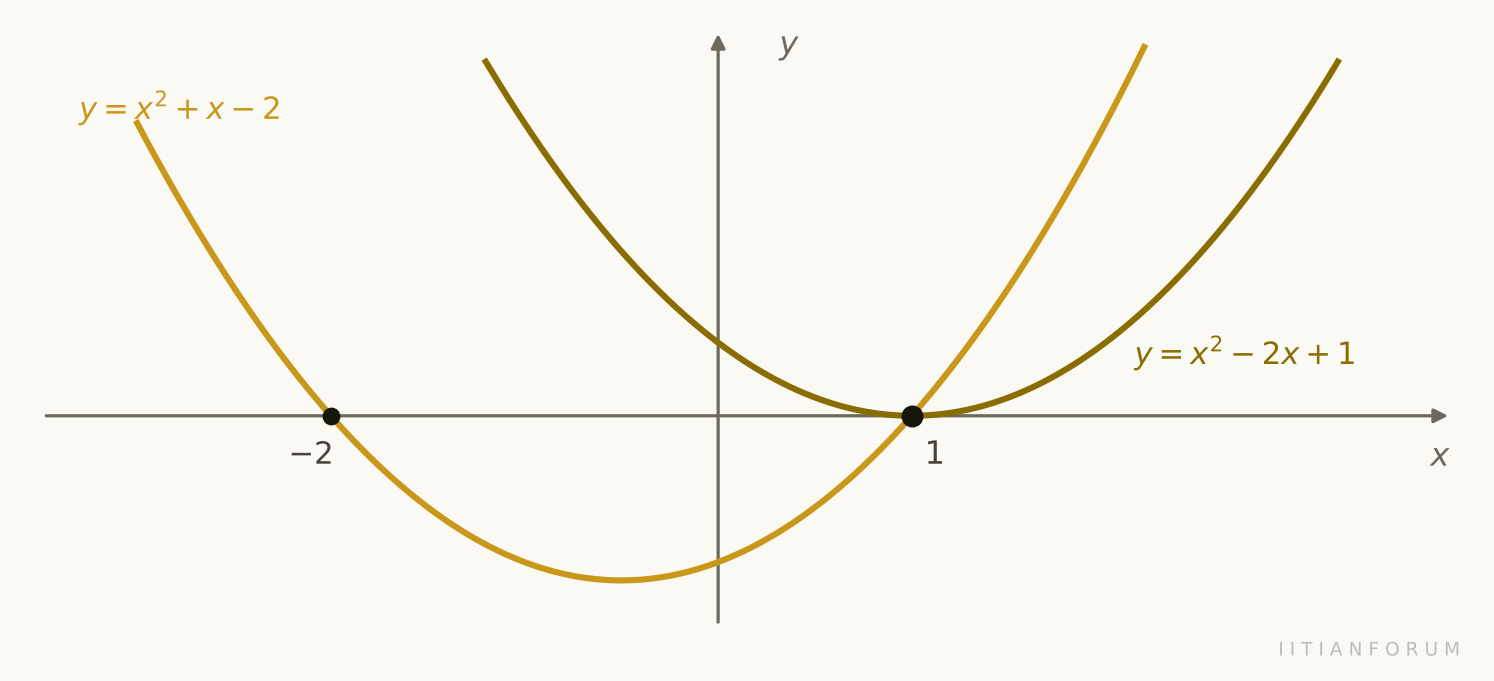
The parabolas y equals x squared minus 2x plus 1, touching the x axis at 1, and y equals x squared plus x minus 2, cutting the x axis at minus 2 and 1, meeting each other at the common root 1 on the x axis
Example 45(IITianForum). Find k if x2+kx+1=0 and x2+x+k=0 have a common root.
▸ SHOW SOLUTION
Step 1. Subtract
(k−1)x+(1−k)=0
Step 2. Two cases
k=1: the common root is x=1, and 1+k+1=0 gives k=−2. Then the equations are (x−1)2=0 and (x−1)(x+2)=0.
k=1: both equations are x2+x+1=0, with both (non-real) roots common.
Answer:k=−2 for one common real root; k=1 makes the equations identical
Example 46(IITianForum). Consider x2−2prx+cr=0 for r=1,2,3 with c1=2, c2=3, c3=6. Every pair of these equations has exactly one root in common, and no number is a root of all three. (a) Find the root common to the first and the third equation. (b) How many triplets (p1,p2,p3) are possible?
▸ SHOW SOLUTION
Step 1. Name the roots
The equations share roots in a cycle: first {u,v}, second {u,w}, third {v,w}. Products:
uv=2,uw=3,vw=6
Step 2. Solve
(uvw)2=36, so uvw=±6. Then w=±3, v=±2, u=±1, all with the same sign.
Step 3. Answers
The first and third share v=±2. The sign is the only freedom, and each sign fixes 2p1=u+v, 2p2=u+w, 2p3=v+w.
Answer: (a) 2 or −2; (b) 2
Equations reducible to a quadratic
Form
Substitution
Keep
ax4+bx2+c=0
t=x2
t≥0
a[f(x)]2+bf(x)+c=0
t=f(x)
t in the range of f
ax2+b∣x∣+c=0
t=∣x∣
t≥0
am2x+bmx+c=0
t=mx
t>0
quadratic in logx
t=logx
then x>0
reciprocal ax4+bx3+cx2+bx+a=0
divide by x2, t=x+x1
∣t∣≥2 for real x
swipe for more →
For the reciprocal form use x2+x21=t2−2.
Check every value
After a substitution, a root t outside the allowed set gives no x. After squaring, or with logs and roots, test each x in the original equation. Most lost marks here are extra roots that were never checked.
Example 48(JEE Main 2026, 24 January Shift 2). The smallest positive integral value of a for which all the roots of x4−ax2+9=0 are real and distinct is
Tap an option to check your answer
(1)9
(2)3
(3)4
(4)7
▸ SHOW SOLUTION
Step 1. Quadratic in t = x²
t2−at+9=0 needs two distinct positive roots; each gives two values ±t.
Step 2. Conditions
D=a2−36>0, sum a>0, product 9>0. So a>6.
Answer:a=7, option (4)
Example 49(JEE Main 2026, 23 January Shift 1). If α<β are the roots of
(3−2)∣x−3∣+(x−6x)+(9−23)=0,x≥0
then αβ+αβ is
Tap an option to check your answer
(1)8
(2)9
(3)10
(4)11
▸ SHOW SOLUTION
Step 1. Substitute u = |√x − 3|
x−6x=u2−9:
u2+(3−2)u−23=0(u+3)(u−2)=0
u≥0, so u=2.
Step 2. Back to x
x=5 or 1: x=25 or 1.
Answer:25+25=10, option (3)
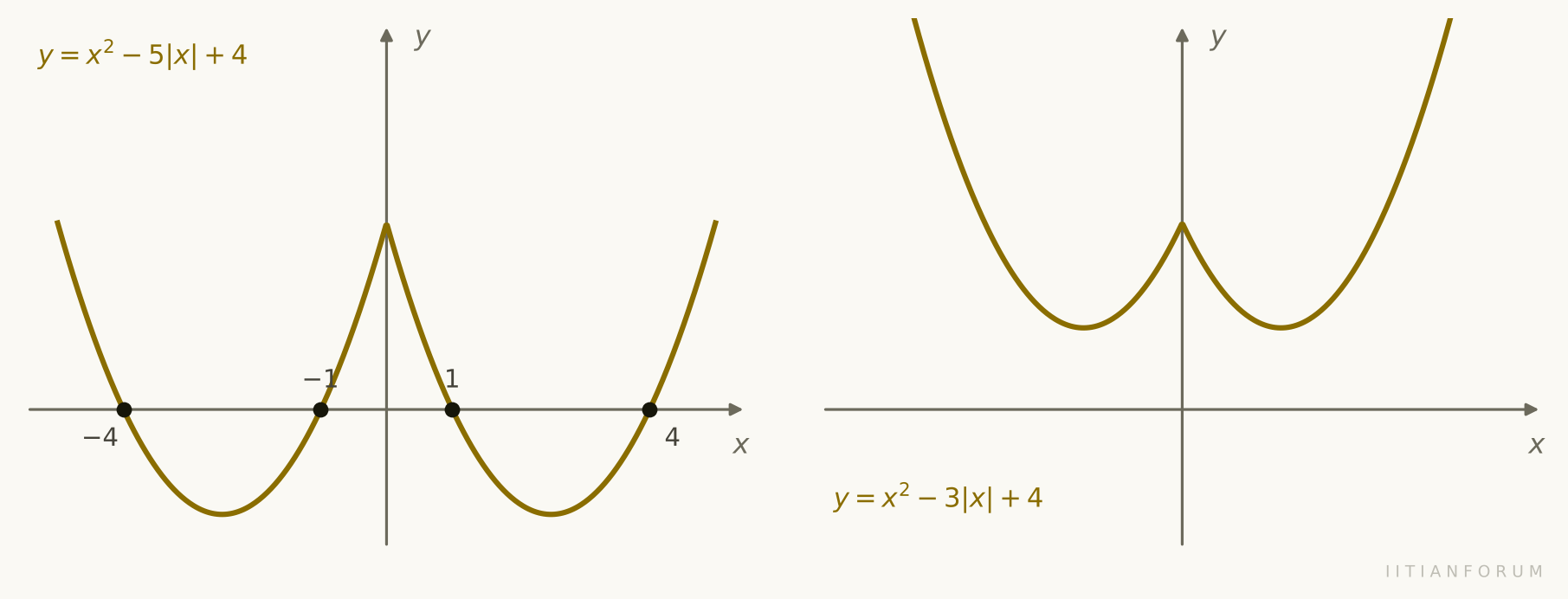
Example 50(IITianForum). Let b>0, b=4. Show that x2−b∣x∣+4=0 has either four real roots or no real root.
▸ SHOW SOLUTION
Step 1. t = |x|
t2−bt+4=0
Product 4>0 and sum b>0: when real, both roots in t are positive.
Step 2. Two cases
b>4: D=b2−16>0, two distinct positive t, each giving x=±t: four roots. 0<b<4: D<0, no real t, no real x.
Answer: four roots for b>4, none for 0<b<4; two roots (±2) only for the excluded b=4
Two graphs; on the left y equals x squared minus 5 mod x plus 4, a W shaped curve symmetric about the y axis cutting the x axis at minus 4, minus 1, 1 and 4; on the right y equals x squared minus 3 mod x plus 4, the same shape lying wholly above the x axis
Example 51(IITianForum). Let α,β be the real roots of (log2x)2−8log2x+k=0, k∈R. Find the least possible value of α+β.
▸ SHOW SOLUTION
Step 1. t = log₂x
t2−8t+k=0 with t1+t2=8, so
αβ=2t1+t2=28=256
Step 2. AM ≥ GM
α+β≥2256=32
Equality needs α=β=16, that is t1=t2=4, which happens for k=16.
Answer:32
Quadratic expression in two variables
The general second degree expression in x and y is
ax2+2hxy+by2+2gx+2fy+c
It splits into two linear factors exactly when
Δ=abc+2fgh−af2−bg2−ch2=0
Reason (a=0). Read it as a quadratic in x:
ax2+2(hy+g)x+(by2+2fy+c)
It factors into linear factors in x and y exactly when its discriminant is a perfect square in y. A quarter of that discriminant is
(h2−ab)y2+2(gh−af)y+(g2−ac)
and a quadratic in y is a perfect square when its own discriminant is zero:
(gh−af)2=(h2−ab)(g2−ac)
Expanding and dividing by a gives Δ=0.
Range of one variable. If real x,y satisfy a quadratic relation, read it as a quadratic in y (or x) and demand D≥0. For example x2−xy+y2=3 read in y gives x2−4(x2−3)≥0, so −2≤x≤2.
Example 52(IITianForum). Find k so that x2−5xy+6y2+x−4y+k is a product of two linear factors, and find the factors.
A polynomial equation of degree n has exactly n roots, counted with repetition.
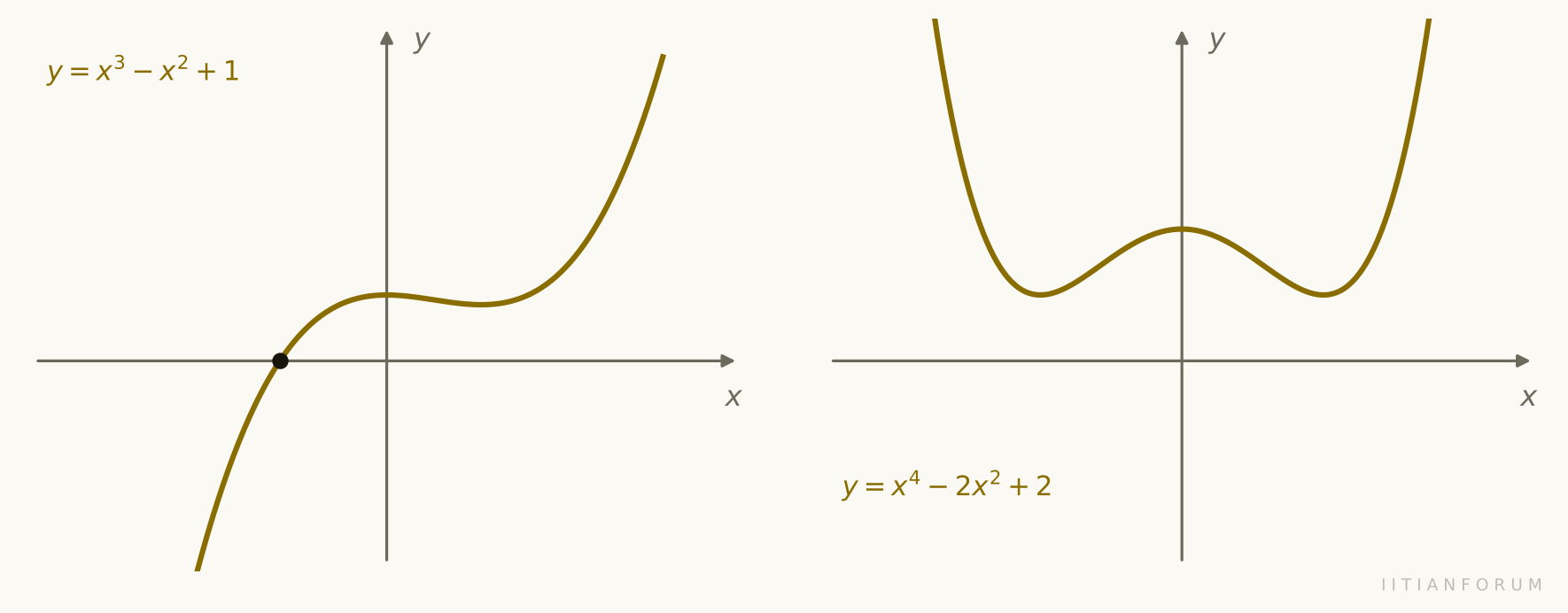
With real coefficients, non-real roots come in conjugate pairs; so an equation of odd degree with real coefficients has at least one real root.
With rational coefficients, irrational roots p+q come with p−q.
Remainder theorem:f(x) divided by x−a leaves f(a). Factor theorem:x−a is a factor exactly when f(a)=0.
If f(p) and f(q) have opposite signs (f a polynomial), a real root lies between p and q.
Descartes' rule of signs: the number of positive roots is at most the number of sign changes in the coefficients of f(x), and the number of negative roots at most the number of sign changes in f(−x); in each case the shortfall is even.
Two graphs; on the left the cubic y equals x cubed minus x squared plus 1 coming up from below the x axis and crossing it once at a marked point; on the right the quartic y equals x to the fourth minus 2x squared plus 2, a W shaped curve that stays above the x axis
Newton's formula for a cubic. For ax3+bx2+cx+d=0 with Sk=∑αk:
and h(x)=f(x+1)−g(x+2). If f(x)=g(x) for every x∈R, then the coefficient of x3 in h(x) is
Tap an option to check your answer
(A)8
(B)2
(C)−4
(D)−6
▸ SHOW SOLUTION
Step 1. f − g has no real root
f(x)−g(x)=(a3−b3)x3+(a2−b2)x2+7x+(a1−b1)
If a3=b3 this has odd degree 3 and so a real root, against f(x)=g(x). Hence a3=b3.
Step 2. Coefficient of x³ in h
From f(x+1): a3+4. From g(x+2): b3+4⋅2=b3+8.
a3+4−b3−8=−4
Answer: option (C)
The same reasoning shows why the remaining quadratic (a2−b2)x2+7x+(a1−b1) must have D<0: it may never vanish, so it keeps one sign.
Which method to use
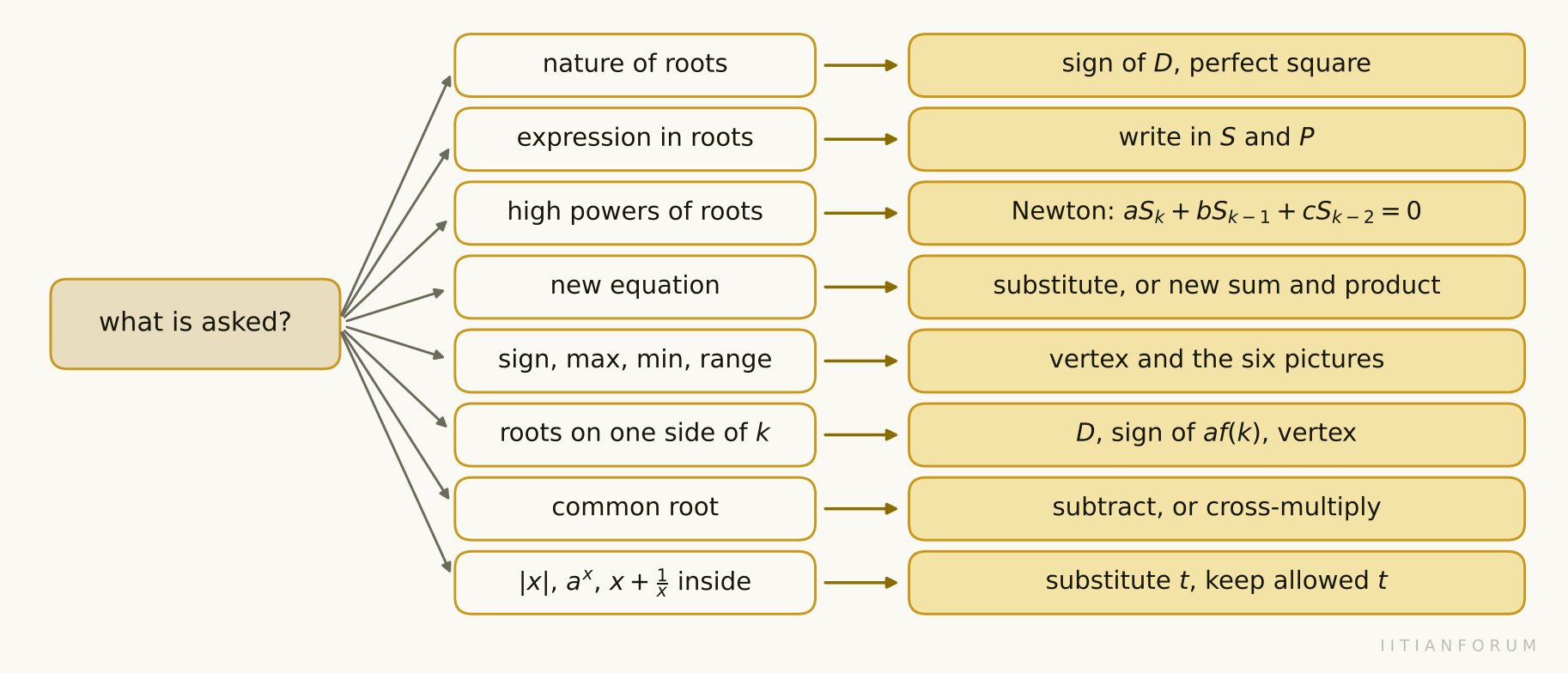
A decision chart: from the question asked, arrows lead to eight situations, each paired with its method: nature of roots, the sign of D or a perfect square; expression in the roots, write it in S and P; high powers of roots, Newton's formula; new equation, substitute or use the new sum and product; sign, maximum, minimum or range, the vertex and the six pictures; roots on one side of k, D, the sign of a f of k and the vertex; common root, subtract or cross-multiply; modulus, exponential or reciprocal equations, substitute t and keep the allowed values of t
Given
Method
real, equal, rational roots
sign of D, perfect square D
integer roots, monic
D a perfect square
a+b+c=0
1 is a root, other root ac
symmetric expression in roots
S and P table
∣α−β∣
∣a∣D
αn±βn for large n
Newton's recurrence
equation with roots f(α)
y=f(x), solve for x, substitute
always positive
a>0, D<0
range of quadraticquadratic
D≥0 in x, then the two checks
extreme on [p,q]
vertex and both ends
roots relative to k
D, af(k), vertex
common root
subtract, or the cross-multiplication rule
∣x∣, ax, logx, x+x1
substitute, keep allowed t
factor in x and y
Δ=0
sums of powers, cubic
Newton for cubics
swipe for more →
What JEE asks
Across the 2025 and 2026 JEE Main papers and recent JEE Advanced papers the chapter appears in these forms.
Relations between roots and coefficients, usually with a symmetric expression or a difference of roots (Examples 10 to 19). This is the most common form in JEE Main.
Location and sign of roots with a parameter (Examples 39 to 44).
Power sums by Newton's recurrence, often with large powers or complex roots (Examples 26 to 31).
Equations reducible to a quadratic: biquadratic, modulus, roots, logs (Examples 47 to 51).
Nature and integer roots (Examples 5 to 9).
JEE Advanced 2026 asked about integer roots with coefficients in A.P. (Example 9) and transformed roots of x2±x+1=0 (Example 24); JEE Advanced 2025 used the odd degree fact (Example 55).
Quick recall
Result
Statement
Roots
2a−b±D, D=b2−4ac
Sum, product
−ab, ac
(α−β)2
a2D
Three roots of a quadratic
identity: a=b=c=0
D>0, =0, <0
distinct real, equal, conjugate non-real
Rational coefficients
irrational roots in pairs p±q
Equation from roots
x2−Sx+P=0
Reciprocal roots
cx2+bx+a=0
Newton
aSk+bSk−1+cSk−2=0
Vertex
(−2ab,−4aD)
Always positive
a>0, D<0
Extreme value
−4aD at x=−2ab
k between roots
af(k)<0
Both roots >k
D≥0, af(k)>0, −2ab>k
Exactly one root in (k1,k2)
f(k1)f(k2)<0
Common root
α=a1b2−a2b1c1a2−c2a1
Both roots common
a2a1=b2b1=c2c1
Two-variable factors
abc+2fgh−af2−bg2−ch2=0
Cubic
∑α=−ab, ∑αβ=ac, αβγ=−ad
Odd degree, real coefficients
at least one real root
swipe for more →
Before you leave this chapter
Without a pen, answer these four: the condition for x2+px+q>0 for every x; the equation whose roots are the squares of the roots of x2−3x+1=0; α4+β4 for that same equation; and the values of k for which 1 lies between the roots of x2−kx+k−3=0. If p2<4q, x2−7x+1=0, 47 and "every k" come quickly, the chapter is yours.
Practise these methods on real exam questions in the doMath Quadratic Equations chapter. Inequalities, the modulus and logarithms used above are developed in the Basic Algebra and Logarithms note, and the range of a rational function is used again in the Functions note.