Basic Algebra and Logarithms for JEE: Modulus, Inequalities and Logs
Ritesh Raj · 3 Nov 2026
Aa
30 min read27 sectionsConcept
Basic algebra is the part of mathematics that every other chapter uses without saying so. An inequality decides a domain, a modulus decides a number of roots, a logarithm turns a power into a product, and one identity can replace a page of expansion. JEE rarely asks this chapter on its own, but these methods sit inside questions from almost every unit, so speed here keeps the rest short.
This note covers numbers and intervals, indices and surds, identities, polynomials, inequalities by the wavy curve method, the modulus, the greatest integer, logarithms and exponential equations. Every worked example is a JEE Main 2025 or 2026 question unless it says otherwise, and every answer was re-derived from scratch.
Numbers and intervals
N⊂W⊂Z⊂Q⊂R
A rational number is qp with p,q integers and q=0; its decimal ends or recurs. An irrational number has a decimal that neither ends nor recurs: 2, 3, π, e.
Combination
Result
rational ± irrational
always irrational
non-zero rational × irrational
always irrational
irrational ± irrational
can be anything: 2+(−2)=0
irrational × irrational
can be anything: 2⋅8=4
swipe for more →
Intervals
Interval
Meaning
(a,b)
a<x<b
[a,b]
a≤x≤b
[a,b)
a≤x<b
(a,b]
a<x≤b
(a,∞)
x>a
(−∞,b]
x≤b
swipe for more →
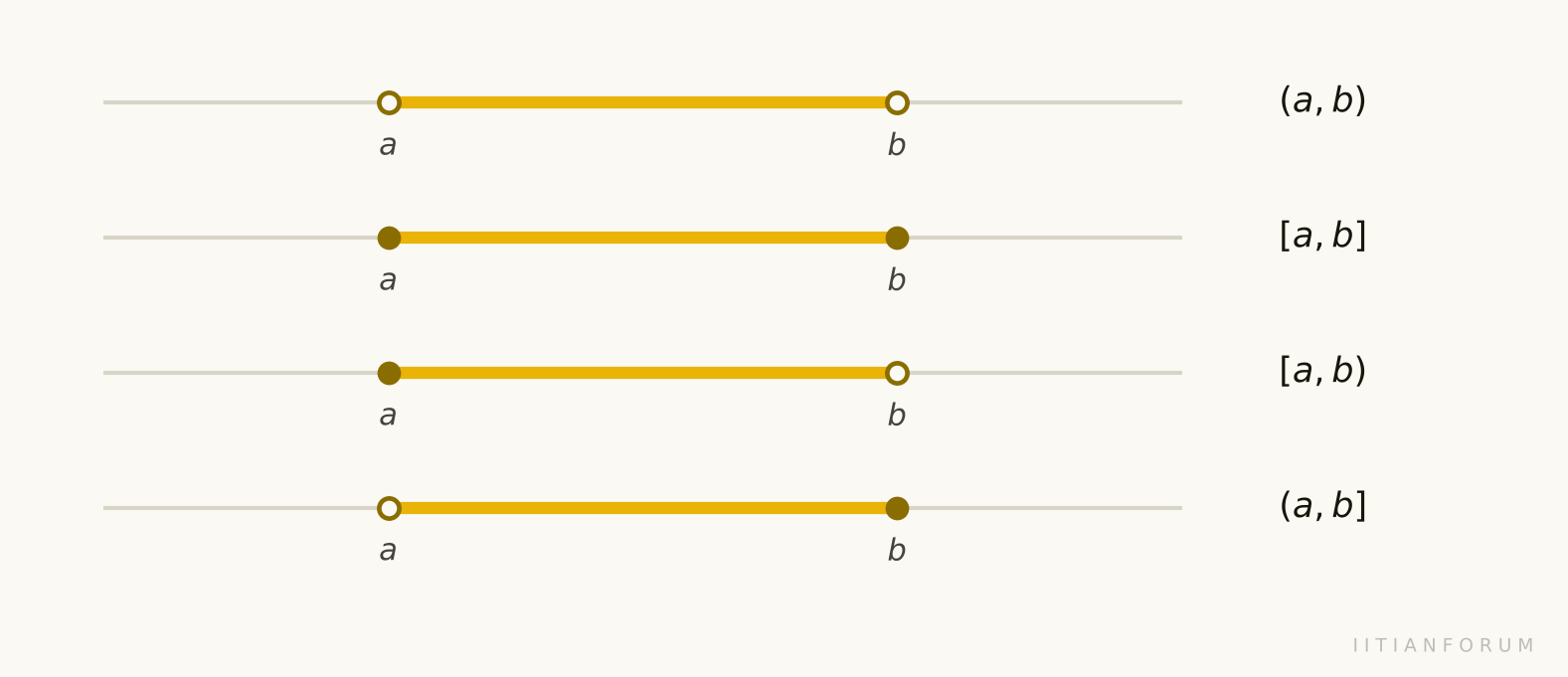
Four number lines one below the other, each with a highlighted segment from a to b: the first with both end points hollow, the second with both end points filled, the third with a filled left end and a hollow right end, the fourth with a hollow left end and a filled right end
A filled dot means the end point belongs to the set; a hollow dot means it does not. The intersection of two intervals runs from the larger left end to the smaller right end. A set of solutions is always reported as a union of intervals in increasing order.
Infinity takes a round bracket
∞ is not a number and is never reached, so [2,∞] is wrong. Write [2,∞).
Example 1(IITianForum). (a) Which of these are rational?
(3+2)−2,2⋅18(1+2)2,123
(b) For A=[−2,5) and B=(1,8], write A∩B, A∪B and A−B.
Ratio and proportion.** If ba=dc, then by **componendo and dividendo
a−ba+b=c−dc+d
It also works backwards: from a−ba+b=k we get ba=k−1k+1.
Means. For positive a,b, 2a+b≥ab, with equality only when a=b. In particular t+t1≥2 for t>0. The full theory is in the Relation Between AM, GM and HM note.
Example 6(IITianForum). If x+x1=3, find x2+x21, x3+x31 and x5+x51.
So the sum of cubes equals three times the product.
Step 2. Solve
3(x−2)(x−3)(5−2x)=0
Answer:x=2,3,25
Example 8(IITianForum). Find
n=1∑10n4+n2+1n▸ SHOW SOLUTION
Step 1. Factorise
n4+n2+1=(n2+n+1)(n2−n+1)
The difference of the two factors is 2n.
Step 2. Split
Let un=n2−n+1. Then un+1=n2+n+1, and
n4+n2+1n=21[un1−un+11]
Step 3. Telescope
Adding from n=1 to 10, the middle terms cancel, leaving u1=1 and u11=111:
21[11−1111]=11155
Answer:11155
Example 9(IITianForum). Solve
x+5−x−5x+5+x−5=3▸ SHOW SOLUTION
Step 1. Componendo and dividendo
x−5x+5=3−13+1=2
Step 2. Square
x+5=4(x−5)⇒x=325
x>5, so both roots are defined.
Answer:x=325
Example 10(IITianForum). Find the number of real solutions of
9x+25x+1=3x+5x+15x▸ SHOW SOLUTION
Step 1. Substitute
Put a=3x, b=5x. Then 9x=a2, 25x=b2, 15x=ab:
a2+b2+1−a−b−ab=0
Step 2. Sum of squares
The left side is Q for the three numbers a, b, 1:
21[(a−b)2+(a−1)2+(b−1)2]=0
So a=b=1, that is 3x=5x=1, giving x=0.
Answer: one solution, x=0
Example 11(IITianForum). Find the number of real solutions of
(x10+1)(1+x2+x4+x6+x8)=10x9▸ SHOW SOLUTION
Step 1. Negative x and zero
For x≤0 the left side is positive and the right side is ≤0. No solution.
Step 2. Positive x
By AM ≥ GM, x10+1≥2x5. For the five terms 1,x2,x4,x6,x8:
1+x2+x4+x6+x8≥55x20=5x4
Multiplying, the left side is ≥10x9.
Step 3. Equality
Equality needs equal terms in both: x10=1 and 1=x2=⋯=x8, so x=1.
Answer:1
Polynomials
Dividing P(x) by D(x) gives a quotient Q(x) and a remainder R(x) with degR<degD:
P(x)=D(x)Q(x)+R(x)
Result
Statement
remainder theorem
remainder of P(x) by x−a is P(a)
factor theorem
x−a divides P(x) exactly when P(a)=0
divisor a quadratic
remainder is αx+β
an−bn
divisible by a−b for every n
an+bn
divisible by a+b for odd n
identity theorem
degree ≤n and zero at n+1 points means zero everywhere
swipe for more →
The last two divisibility facts are the factor theorem: put a=b in an−bn, and a=−b in an+bn with n odd.
Example 12(IITianForum). x−2 is a factor of P(x)=x3+ax2+bx+6, and P(x) leaves remainder 3 when divided by x−3. Find a and b.
▸ SHOW SOLUTION
Step 1. Two conditions
P(2)=0:4a+2b=−14P(3)=3:9a+3b=−30
Step 2. Solve
2a+b=−7 and 3a+b=−10 give a=−3, b=−1.
Answer:a=−3, b=−1
Example 13(IITianForum). Find the remainder when x100 is divided by x2−3x+2.
▸ SHOW SOLUTION
Step 1. Form of the remainder
x2−3x+2=(x−1)(x−2), so
x100=(x−1)(x−2)Q(x)+αx+β
Step 2. Put x = 1 and x = 2
α+β=1,2α+β=2100α=2100−1,β=2−2100
Answer:(2100−1)x+2−2100
Example 14(JEE Main 2026, 28 January Shift 1). Let
S={x3+ax2+bx+c}
with a,b,c∈N and a,b,c≤20
be a set of polynomials. Then the number of polynomials in S which are divisible by x2+2 is
Tap an option to check your answer
(1)20
(2)6
(3)120
(4)10
▸ SHOW SOLUTION
Step 1. The quotient is linear
x3+ax2+bx+c=(x2+2)(x+k)=x3+kx2+2x+2k
Step 2. Compare coefficients
a=k, b=2, c=2k. So c is even and a=2c.
Step 3. Count
c∈{2,4,…,20} gives a∈{1,…,10}, all allowed. Ten polynomials.
Answer: option (4)
Example 15(JEE Main 2026, 28 January Shift 2). Given below two statements:
Statement I: 2513+2013+813+313 is divisible by 7.
Statement II: The integral part of (7+43)25 is an odd number.
Tap an option to check your answer
(1)Both Statement I and Statement II are false.
(2)Both Statement I and Statement II are true.
(3)Statement I is false but Statement II is true.
(4)Statement I is true but Statement II is false.
▸ SHOW SOLUTION
Step 1. Statement I
13 is odd, so a+b divides a13+b13. Pair the terms:
28∣2513+313,28∣2013+813
So 28, and hence 7, divides the sum. True.
Step 2. Statement II: the conjugate
Let R=(7+43)25=I+f with 0≤f<1, and R′=(7−43)25. Since 0<7−43<1, 0<R′<1.
Step 3. R + R′ is an even integer
In the expansions of (7+43)25 and (7−43)25, the terms with odd powers of 43 cancel and the rest double. Each even power of 43 is an integer, so R+R′ is even.
Step 4. Conclude
I+f+R′ is an integer and 0<f+R′<2, so f+R′=1. Then I=(R+R′)−1 is odd. True.
Answer: option (2)
Example 16(JEE Main 2025, 24 January Shift 1). The product of all the rational roots of the equation
(x2−9x+11)2−(x−4)(x−5)=3
is equal to
Tap an option to check your answer
(1)14
(2)7
(3)28
(4)21
▸ SHOW SOLUTION
Step 1. One substitution
(x−4)(x−5)=x2−9x+20. Put t=x2−9x:
(t+11)2−(t+20)=3t2+21t+98=0⇒t=−7,−14
Step 2. Back to x
t=−14: x2−9x+14=0, so x=2,7.
t=−7: x2−9x+7=0, discriminant 53, not a square, so irrational roots.
Step 3. Product
2×7=14.
Answer: option (1)
Example 17(IITianForum). P(x) is a polynomial of degree 5 with
P(k)=k+1k,k=0,1,2,3,4,5
Find P(6).
▸ SHOW SOLUTION
Step 1. Build a polynomial with known roots
Let Q(x)=(x+1)P(x)−x. It has degree 6 and is zero at x=0,1,…,5:
Q(x)=cx(x−1)(x−2)⋯(x−5)
Step 2. Find c
Put x=−1. The left side is 0⋅P(−1)+1=1:
1=c(−1)(−2)⋯(−6)=720c
So c=7201.
Step 3. Put x = 6
7P(6)−6=7206!=1
Answer:P(6)=1
Inequalities
Step
Rule
add or subtract k
direction stays
multiply by k>0
direction stays
multiply by k<0
direction reverses
squaring
allowed only when both sides are ≥0
reciprocals, same sign
direction reverses
swipe for more →
Never cross-multiply by an unknown sign
In Q(x)P(x)>k, multiplying by Q(x) is wrong unless the sign of Q(x) is known. Bring everything to one side instead.
The wavy curve method
Bring everything to one side: f(x)>0, <0, ≥0 or ≤0.
Factorise completely. Write every linear factor as x−a; take the minus signs out to the front.
Mark the roots in increasing order on a number line.
With a positive leading coefficient, start above the line on the far right and alternate through each root.
Read off the intervals with the required sign.
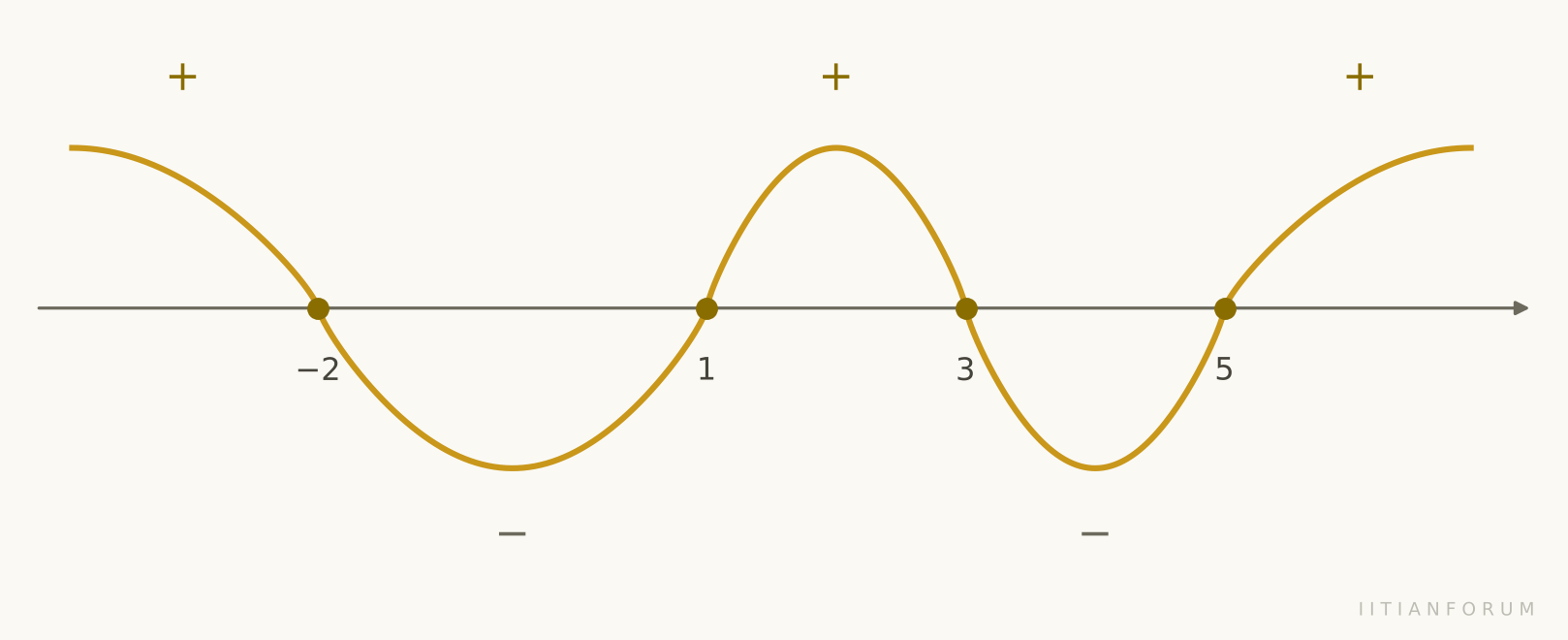
A number line with the points minus 2, 1, 3 and 5 marked; a wave starts above the line on the far right and crosses the line at each point, with plus and minus signs written alternately in the five gaps, plus on the far right
Example 18(IITianForum). Solve
(x+2)(x−1)(3−x)(x−5)≤0▸ SHOW SOLUTION
Step 1. Make every factor x − a
3−x=−(x−3). Multiply by −1 and reverse the sign:
(x+2)(x−1)(x−3)(x−5)≥0
Step 2. Wave
Roots −2,1,3,5; signs from the right: +,−,+,−,+. Take the + parts with the roots included.
Answer:(−∞,−2]∪[1,3]∪[5,∞)
Repeated factors and rational inequalities
An odd power of x−a changes the sign at a: the wave crosses.
An even power does not: the wave touches the line and turns back. The root still goes on the line.
A quadratic factor with positive leading coefficient and negative discriminant, like x2+x+1, is always positive and can be dropped.
For QP, use the same signs as PQ. Roots of Q are always hollow; roots of P are filled only for ≥ or ≤.
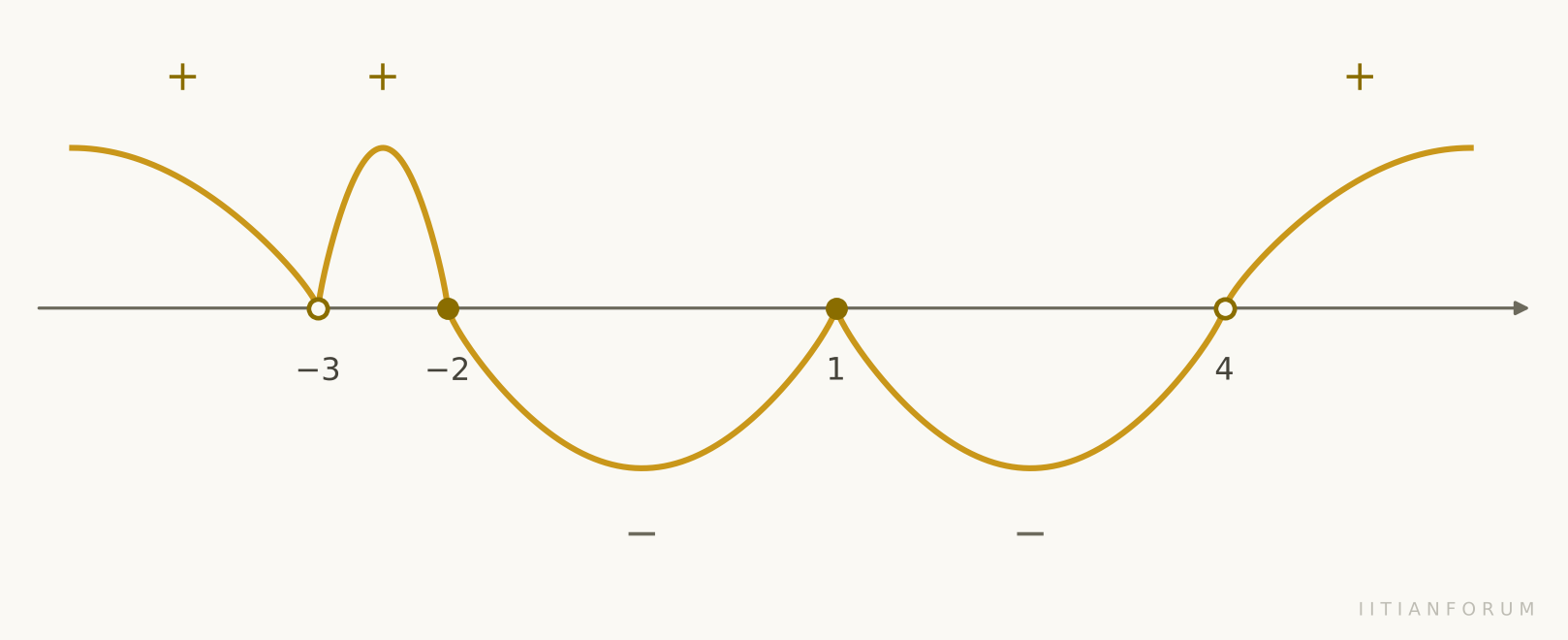
From the right: + on (4,∞); crossing at 4, − on (1,4); touching at 1, still − on (−2,1); crossing at −2, + on (−3,−2); touching at −3, still + on (−∞,−3).
Step 3. Collect
The + intervals, the filled root −2, and the point 1 where the expression is zero.
Answer:(−∞,−3)∪(−3,−2]∪{1}∪(4,∞)
A number line with the points minus 3, minus 2, 1 and 4; hollow dots at minus 3 and 4, filled dots at minus 2 and 1; a wave that starts above the line on the far right, crosses at 4, touches the line at 1 and turns back, crosses at minus 2, and touches at minus 3 staying above
Example 20(IITianForum). Solve x+12x−3≥1.
▸ SHOW SOLUTION
Step 1. One side
x+12x−3−1≥0⇒x+1x−4≥0
Step 2. Wave
Roots −1 (hollow) and 4 (filled); + outside them.
Answer:(−∞,−1)∪[4,∞)
Cross-multiplying would give 2x−3≥x+1, that is x≥4 only, and loses (−∞,−1), where x+1<0.
Inequalities with a square root
A square root is defined only for a non-negative argument, and it is never negative.
Inequality
Equivalent system
f<g
f≥0, g>0, f<g2
f>g
f≥0 with g<0; or g≥0 with f>g2
f<g
f≥0, f<g
swipe for more →
Example 21(IITianForum). Solve x+3>x+1.
▸ SHOW SOLUTION
Step 1. Case x + 1 < 0
The left side is ≥0, so the inequality holds wherever the root is defined: −3≤x<−1.
Step 2. Case x + 1 ≥ 0
Square:
x+3>(x+1)2⇒x2+x−2<0
−2<x<1; with x≥−1 this gives −1≤x<1.
Step 3. Union
Answer:[−3,1)
Example 22(IITianForum). Solve x2−3x−10<8−x.
▸ SHOW SOLUTION
Step 1. Conditions
x2−3x−10=(x−5)(x+2)≥0: x≤−2 or x≥5. Also 8−x>0: x<8.
Step 2. Square
x2−3x−10<64−16x+x213x<74⇒x<1374
Step 3. Intersect
Answer:(−∞,−2]∪[5,1374)
Modulus
∣x∣=x(x≥0),∣x∣=−x(x<0)
∣x∣ is the distance of x from 0, and ∣x−a∣ is the distance between x and a on the number line.
Property
Statement
sign
∣x∣≥0; zero only at x=0
square
∣x∣2=x2, x2=∣x∣
product
∣xy∣=∣x∣∣y∣
quotient
∣x/y∣=∣x∣/∣y∣, y=0
swipe for more →
The square root of a square
x2=∣x∣, not x. For example, for −2≤x≤3, (x−3)2+(x+2)2=(3−x)+(x+2)=5.
Modulus equations
Equation
Method
∣f∣=a, a>0
f=a or f=−a
∣f∣=g
f=±g, keep roots with g≥0
∣f∣=∣g∣
f=g or f=−g
(x−a)2 and ∣x−a∣ together
put t=∣x−a∣≥0
several moduli
split at the zeros, one case per interval
swipe for more →
Example 23(JEE Main 2026, 21 January Shift 1). The sum of all the roots of the equation (x−1)2−5∣x−1∣+6=0 is
Tap an option to check your answer
(1)4
(2)3
(3)1
(4)5
▸ SHOW SOLUTION
Step 1. Substitute
(x−1)2=∣x−1∣2. Put t=∣x−1∣≥0:
t2−5t+6=0⇒t=2,3
Step 2. Roots
∣x−1∣=2: x=3,−1. ∣x−1∣=3: x=4,−2.
3−1+4−2=4
Answer: option (1)
Example 24(JEE Main 2026, 24 January Shift 1). The number of real solutions of the equation x∣x+3∣+∣x−1∣−2=0 is
Tap an option to check your answer
(1)3
(2)2
(3)5
(4)4
▸ SHOW SOLUTION
Step 1. Case x ≥ 1
x2+4x−3=0⇒x=−2±7
−2+7≈0.65 and −2−7 are both below 1. No root.
Step 2. Case −3 ≤ x < 1
x2+2x−1=0⇒x=−1±2
0.41 and −2.41 both lie in [−3,1). Two roots.
Step 3. Case x < −3
x2+4x+1=0⇒x=−2±3
Only −2−3≈−3.73 is below −3. One root.
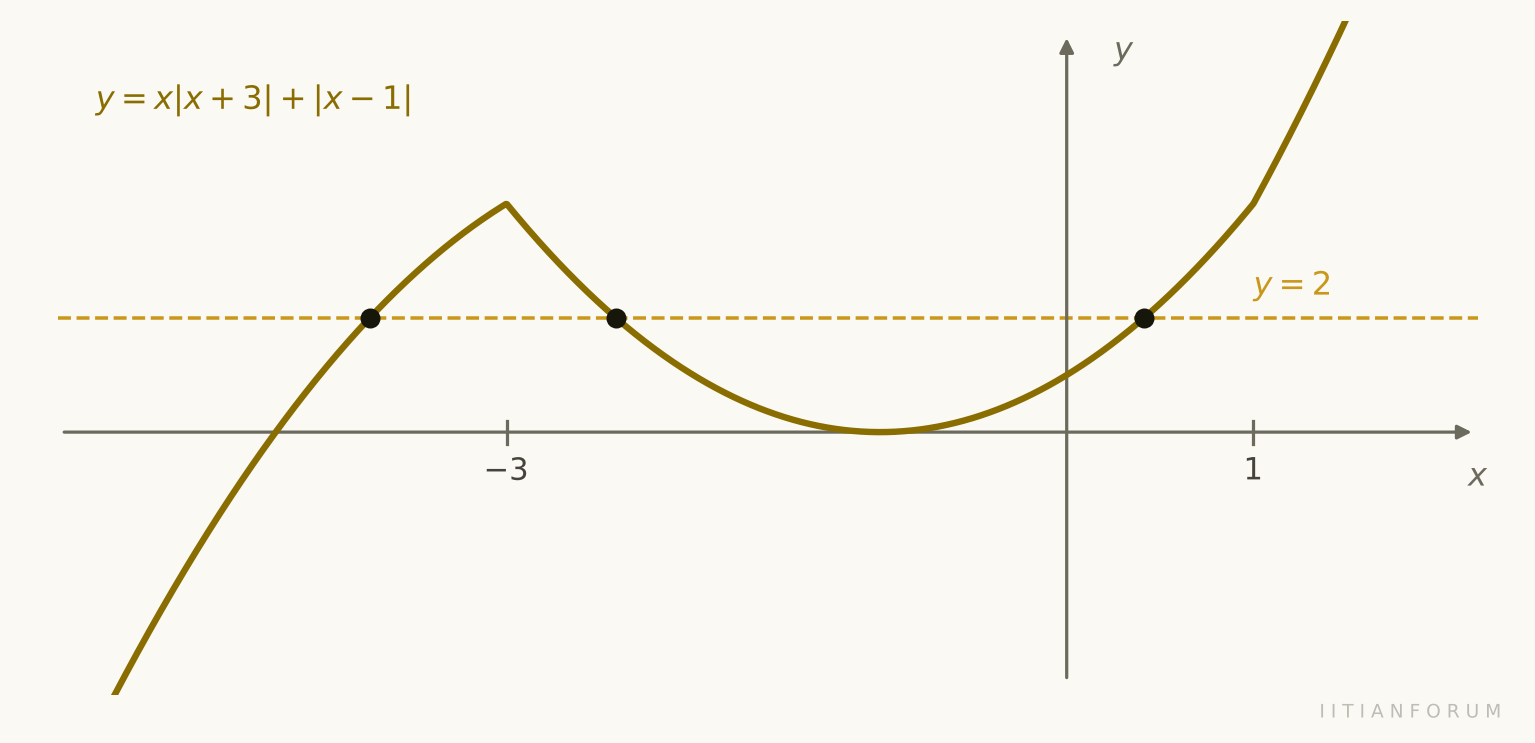
Answer:3 roots, option (1)
The graph of y equals x times the modulus of x plus 3, plus the modulus of x minus 1, drawn as a smooth curve made of three pieces, cut by the horizontal line y equals 2 at three marked points near x equals minus 3.7, minus 2.4 and 0.4
Example 25(JEE Main 2025, 24 January Shift 2). Let
π28≈0.81. As x runs over (0,π), 2x runs over (0,2π), where sin2x=±0.81 has 4 solutions.
Step 3. Union
Of the points of B, only 1 lies in (0,π), and ∣sin2∣≈0.91=0.81. So 1∈/A and the sets do not overlap.
n(A∪B)=4+4=8
Answer: option (3)
Modulus inequalities
For a>0:
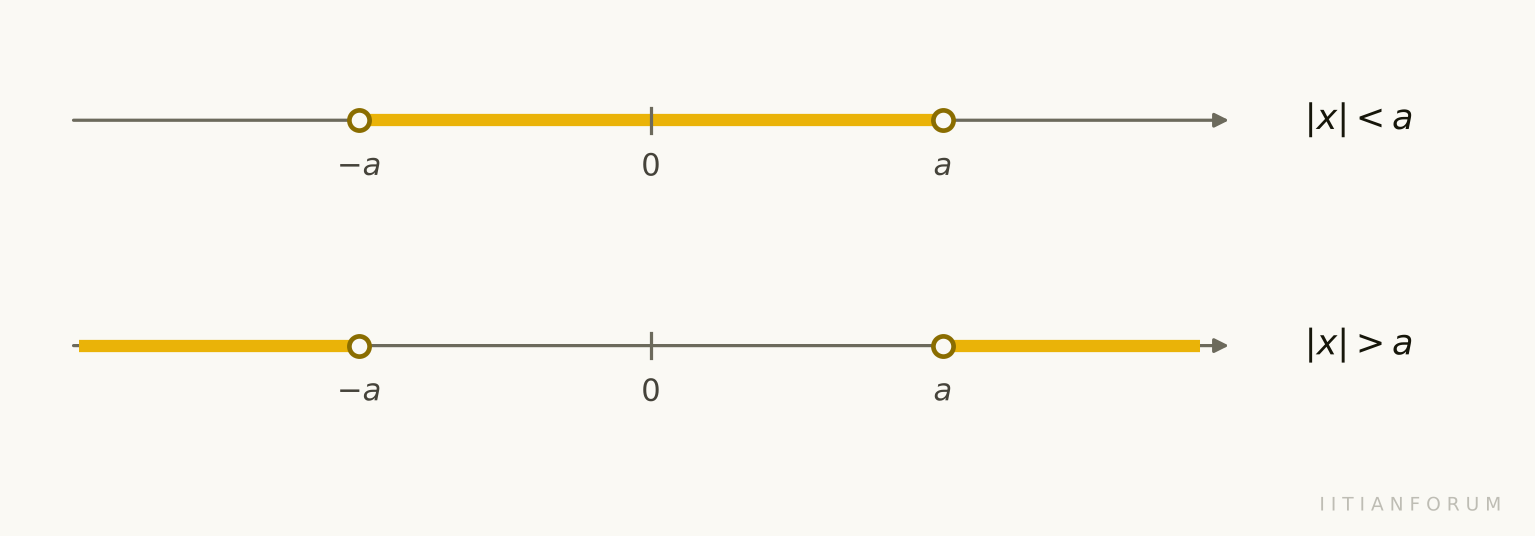
∣x∣<a⟺−a<x<a∣x∣>a⟺x<−aorx>aTwo number lines: on the upper one the segment between minus a and a is highlighted with hollow end points; on the lower one the two rays to the left of minus a and to the right of a are highlighted, with hollow end points
In the same way, ∣f∣<g means −g<f<g, and ∣f∣>g means f>g or f<−g.
Example 26(JEE Main 2026, 21 January Shift 2). Let A={x:∣x2−10∣≤6} and B={x:∣x−2∣>1}. Then
Tap an option to check your answer
(1)A∪B=(−∞,1]∪(2,∞)
(2)A−B=[2,3)
(3)A∩B=[−4,−2]∪[3,4]
(4)B−A=(−∞,−4)∪(−2,1)∪(4,∞)
▸ SHOW SOLUTION
Step 1. Set A
−6≤x2−10≤6⇒4≤x2≤16
A=[−4,−2]∪[2,4].
Step 2. Set B
x−2>1 or x−2<−1: B=(−∞,1)∪(3,∞).
Step 3. B − A
From (−∞,1) remove [−4,−2]; from (3,∞) remove (3,4]:
B−A=(−∞,−4)∪(−2,1)∪(4,∞)
The others fail: A∩B=[−4,−2]∪(3,4], A−B=[2,3], A∪B=(−∞,1)∪[2,∞).
Answer: option (4)
Several moduli
Find the critical points, where each expression inside a modulus is zero.
On each interval between them, open every modulus with a fixed sign.
Solve, and keep only the part of the answer inside that interval.
Take the union.
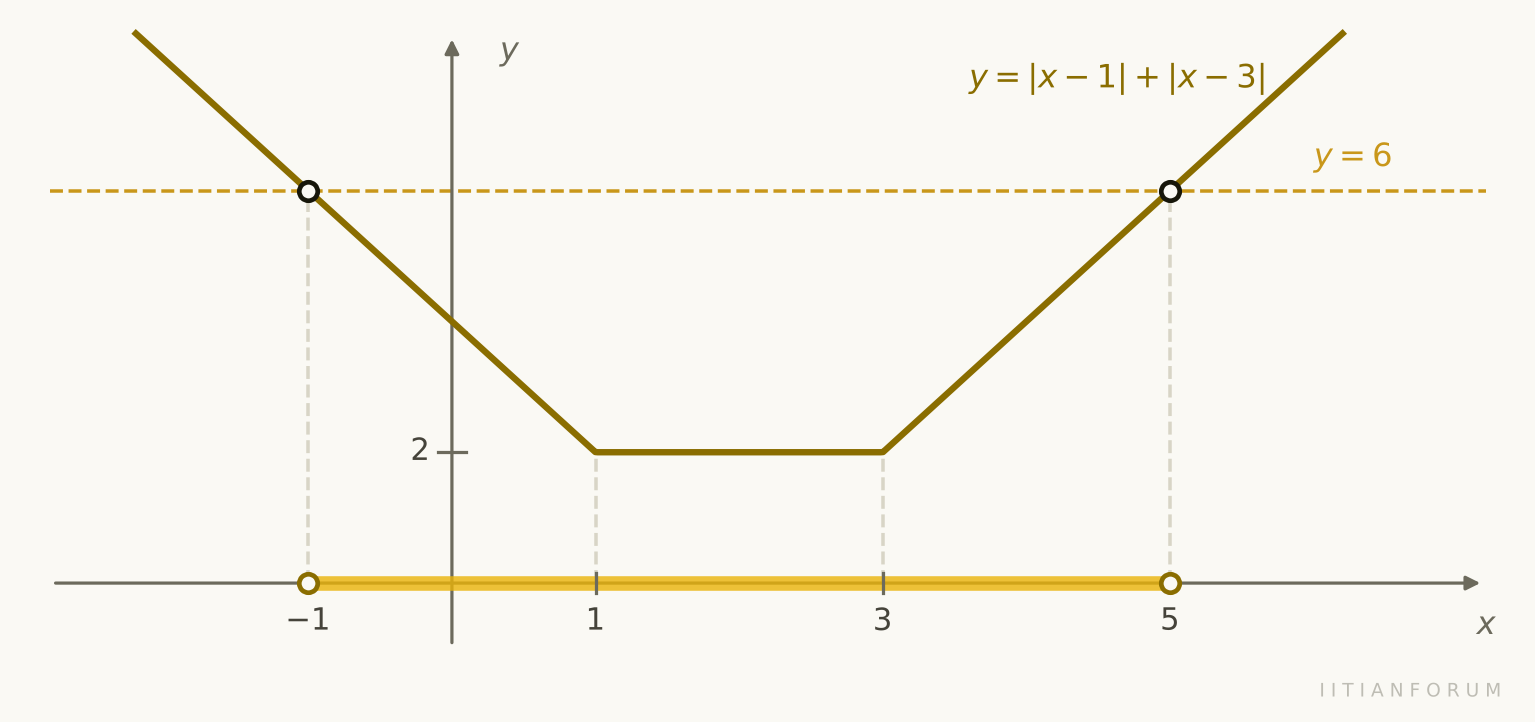
Example 27(IITianForum). Solve ∣x−1∣+∣x−3∣<6.
▸ SHOW SOLUTION
Step 1. Case x < 1
(1−x)+(3−x)<6⇒x>−1
So −1<x<1.
Step 2. Case 1 ≤ x < 3
(x−1)+(3−x)=2<6, true for the whole interval.
Step 3. Case x ≥ 3
(x−1)+(x−3)<6⇒x<5
So 3≤x<5.
Answer:(−1,5)
As distances: the sum of the distances from 1 and from 3 is 2 between them and grows by 2 for each unit outside, reaching 6 at −1 and 5.
The graph of y equals the modulus of x minus 1 plus the modulus of x minus 3: a flat bottom at height 2 between x equals 1 and x equals 3, rising lines on both sides, cut by the dashed line y equals 6 at x equals minus 1 and x equals 5, with the part of the x axis between them highlighted
The triangle inequality
∣x∣−∣y∣≤∣x±y∣≤∣x∣+∣y∣
∣x+y∣=∣x∣+∣y∣ exactly when xy≥0, and ∣x−y∣=∣x∣+∣y∣ exactly when xy≤0.
Example 28(IITianForum). Solve ∣2x−1∣+∣x+3∣=∣3x+2∣.
▸ SHOW SOLUTION
Step 1. Spot the sum
(2x−1)+(x+3)=3x+2, so the equation is ∣a∣+∣b∣=∣a+b∣ with a=2x−1, b=x+3.
Step 2. Equality case
(2x−1)(x+3)≥0
Answer:(−∞,−3]∪[21,∞)
Nested modulus and counting by graph
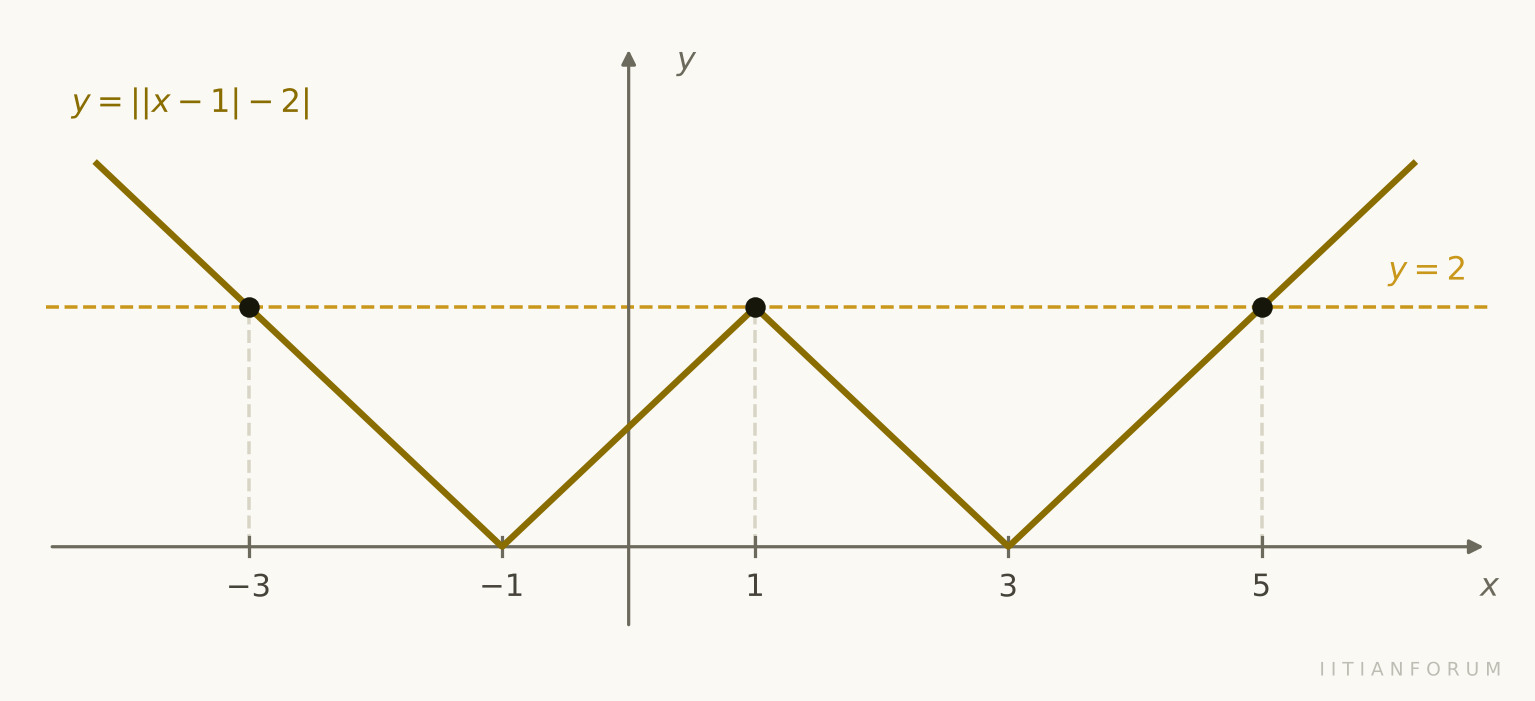
For ∣f(x)∣, reflect the parts of y=f(x) below the x axis. The number of solutions of f(x)=k is the number of meets of y=f(x) with the line y=k.
Example 29(IITianForum). The equation ∣x−1∣−a=2 has exactly three distinct real solutions. Find a and the solutions.
▸ SHOW SOLUTION
Step 1. Open the outer modulus
∣x−1∣=a+2or∣x−1∣=a−2
Step 2. Count
∣x−1∣=c has two solutions for c>0, one for c=0, none for c<0. Three solutions in all needs a+2>0 and a−2=0.
Step 3. Solve with a = 2
∣x−1∣=4: x=5,−3. ∣x−1∣=0: x=1.
Answer:a=2; x=−3,1,5
The graph of y equals the modulus of the modulus of x minus 1, minus 2: a W shape with zeros at x equals minus 1 and x equals 3 and a peak of height 2 at x equals 1, cut by the dashed line y equals 2 at three marked points x equals minus 3, 1 and 5
Example 30(JEE Main 2026, 23 January Shift 2). Consider two sets A={x∈Z:∣x−3∣−3≤1} and
B={x∈R−{1,2}:g(x)=0}g(x)=x−1(x−2)(x−4)loge∣x−2∣
Then the number of onto functions f:A→B is equal to
Tap an option to check your answer
(1)62
(2)79
(3)32
(4)81
▸ SHOW SOLUTION
Step 1. Set A
−1≤∣x−3∣−3≤12≤∣x−3∣≤4
x−3∈[2,4] or x−3∈[−4,−2]: x∈[5,7]∪[−1,1]. Integers: A={−1,0,1,5,6,7}.
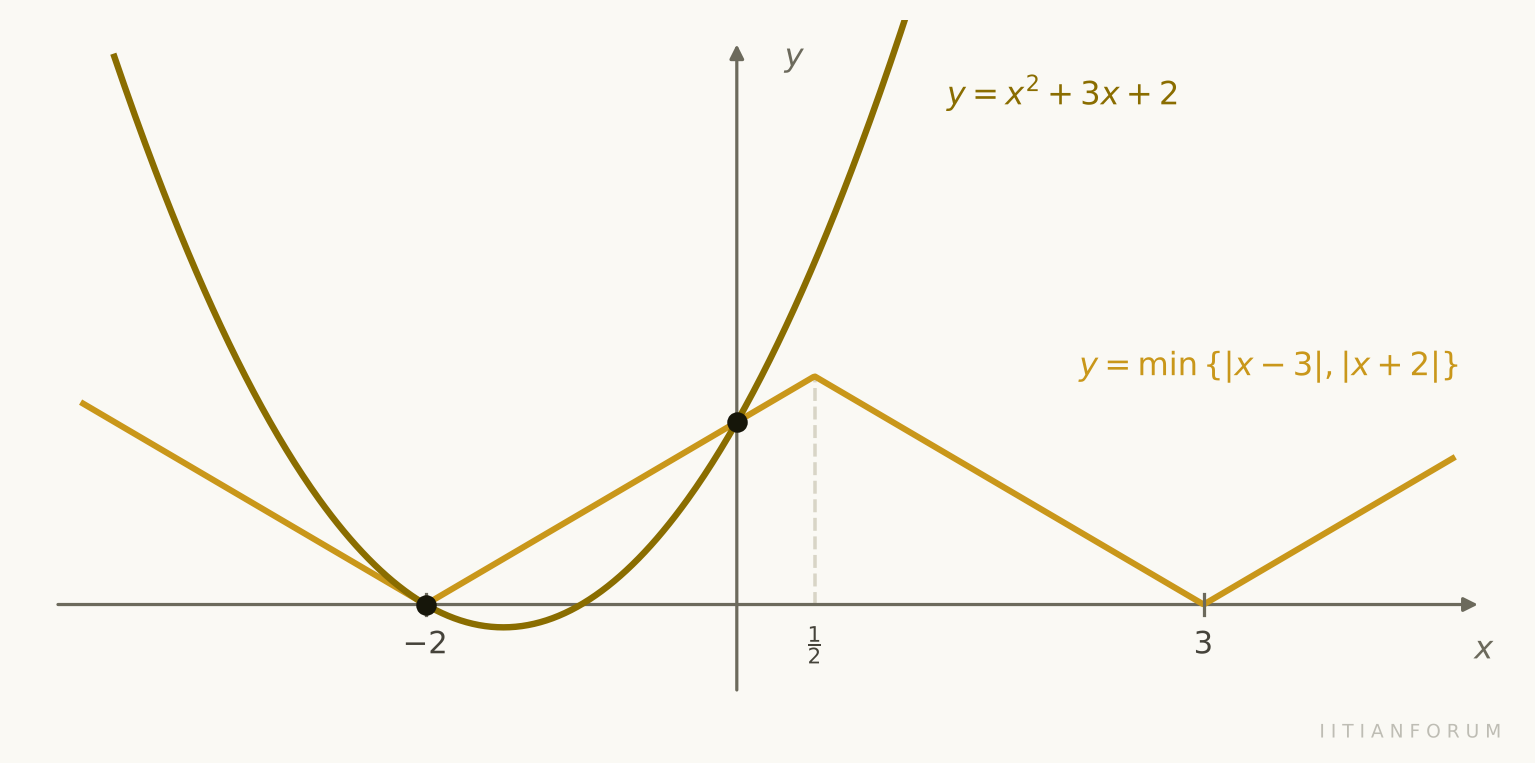
Example 31(JEE Main 2025, 24 January Shift 2). The number of real solution(s) of the equation
x2+3x+2=min{∣x−3∣,∣x+2∣}
is
Tap an option to check your answer
(1)2
(2)0
(3)3
(4)1
▸ SHOW SOLUTION
Step 1. The right side
∣x−3∣ and ∣x+2∣ are equal at x=21. So
min=∣x+2∣for x≤21min=∣x−3∣for x≥21
Step 2. x ≤ 1/2
(x+1)(x+2)=∣x+2∣. Clearly x=−2 is a root. For −2<x≤21, divide by x+2>0: x+1=1, so x=0. For x<−2, divide by −(x+2)>0: x+1=−1, so x=−2, which is not below −2.
Step 3. x ≥ 1/2
For 21≤x≤3: x2+3x+2=3−x gives x2+4x−1=0, x=−2±5; the larger root 0.236 is below 21. For x>3: x2+2x+5=0 has no real root.
Answer:x=−2,0; option (1)
An upward parabola y equals x squared plus 3x plus 2 and the graph of the minimum of the moduli of x minus 3 and x plus 2, made of straight pieces that touch the x axis at x equals minus 2 and x equals 3 with a peak at x equals one half; the two graphs meet at two marked points, x equals minus 2 and x equals 0
Greatest integer and fractional part
[x] is the greatest integer ≤x, and {x}=x−[x]∈[0,1). So [2.7]=2 and [−2.7]=−3.
[x]≤x<[x]+1
An equation in [x] is solved for the integer n=[x] first; then x∈[n,n+1). The graphs of [x] and {x} are in the Functions note.
Example 32(IITianForum). Solve (a) [x]2−5[x]+6=0; (b) 4{x}=x+[x].
▸ SHOW SOLUTION
Step 1. Part (a)
([x]−2)([x]−3)=0, so [x]=2 or 3. Then x∈[2,3)∪[3,4)=[2,4).
Step 2. Part (b)
Write x=n+f with n=[x], f={x}:
4f=2n+f⇒f=32n
0≤f<1 allows n=0,1, giving f=0,32.
Answer: (a) [2,4); (b) x=0,35
Logarithms
logaN=x⟺ax=N
The logarithm exists only when
N>0,a>0,a=1
logN means log10N and lnN means logeN. Always loga1=0, logaa=1 and alogaN=N.
Example 33(IITianForum). (a) Find log2log381, 3log925 and log28. (b) For which x is logx−1(5−x) defined?
logax2 is defined for all x=0, but 2logax only for x>0. The correct form is logax2=2loga∣x∣.
Example 34(IITianForum). Solve (a) log3(x−1)2=2; (b) 2log3(x−1)=2.
▸ SHOW SOLUTION
Step 1. Part (a)
(x−1)2=9, so x−1=±3: x=4 or x=−2. Both make (x−1)2>0.
Step 2. Part (b)
Here x−1>0 is needed: log3(x−1)=1, x=4.
Answer: (a) x=4,−2; (b) x=4
Example 35(IITianForum). Let log1/9β=−1, logβα=−1 and logα27=γ. Find
(α1+1)log10(81β2+4γ2)▸ SHOW SOLUTION
Step 1. The three values
β=(91)−1=9,α=9−1=91γ=log3−233=−23
Step 2. The exponent
81β2+4γ2=1+9=10log1010=2
Step 3. Value
(9+1)2=100
Answer:100
Example 36(IITianForum). If a,b>0 and
ln4a+b=2lna+lnb,
find ba+ab.
▸ SHOW SOLUTION
Step 1. Remove the logs
The right side is lnab, so
4a+b=ab⇒(a+b)2=16ab
Step 2. Divide by ab
a2+b2=14ab⇒ba+ab=14
Answer:14
Change of base
logaN=logbalogbN
Consequence
Statement
reciprocal
logab⋅logba=1
chain
logab⋅logbc⋅logcd=logad
swap
alogbc=clogba
swipe for more →
Example 37(IITianForum). Let 2a1=3, 3a2=4, 4a3=5, and so on up to 15a14=16. Find a1a2⋯a14.
▸ SHOW SOLUTION
Step 1. Each term is a log
a1=log23, a2=log34, …, a14=log1516.
Step 2. The chain
a1a2⋯a14=log216=4
Answer:4
Example 38(IITianForum). Find the smallest integer greater than
log2π1+log5π1▸ SHOW SOLUTION
Step 1. Flip the bases
log2π1+log5π1=logπ2+logπ5=logπ10
Step 2. Place 10 between powers of π
π2≈9.87<10<π3≈31, so 2<logπ10<3.
Answer:3
Example 39(JEE Main 2026, 4 April Shift 2). Let α=41+81+161+⋯∞ and β=31+91+271+⋯∞. Then the value of
(0.2)log5α+(0.04)log5β
is
Tap an option to check your answer
(1)4
(2)5
(3)8
(4)25
▸ SHOW SOLUTION
Step 1. The two sums
α=1−1/21/4=21,β=1−1/31/3=21
Step 2. First term by the swap rule
log50.2=log51/25−1=−2:
(0.2)log5α=αlog50.2=α−2=4
Step 3. Second term
(0.04)log5β=5−2log5β=β−2=4
Answer:4+4=8, option (3)
Graph of the logarithm
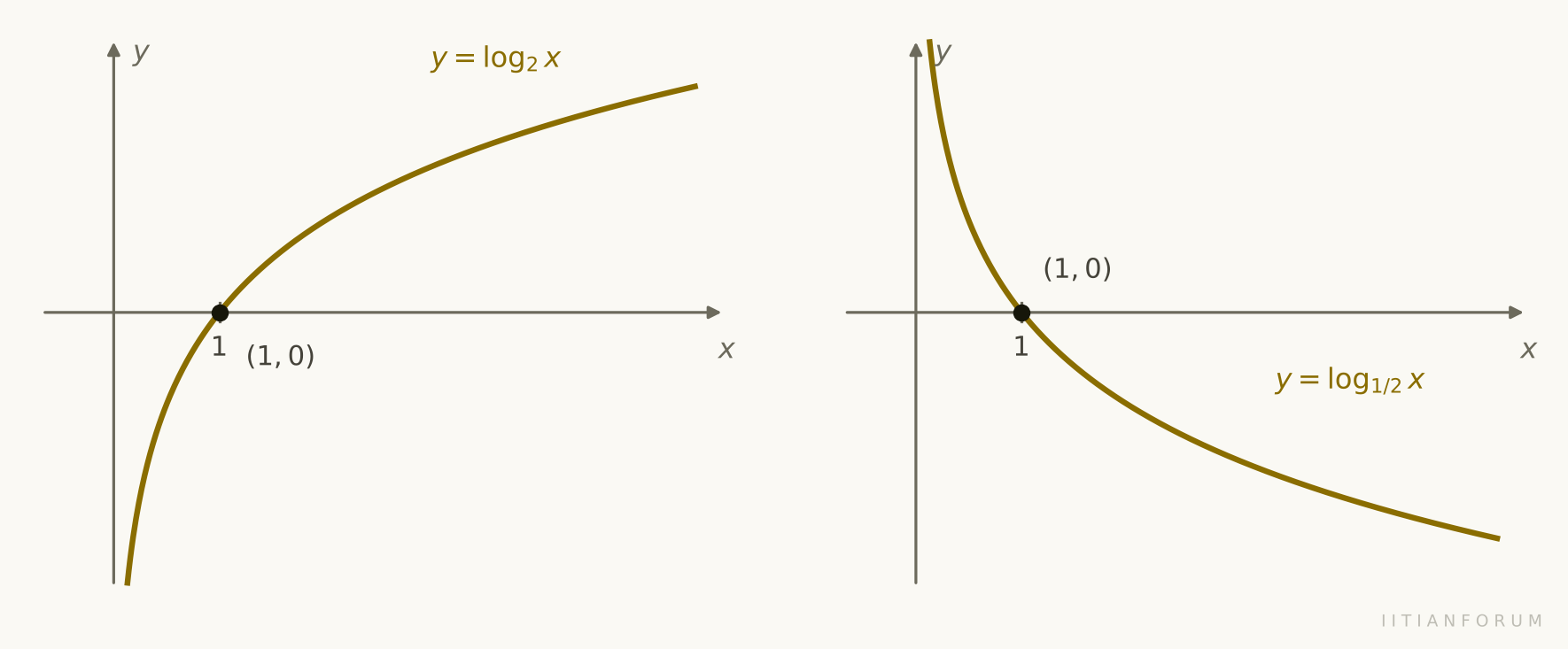
Two graphs side by side: on the left the increasing curve y equals log to base a of x for a greater than 1, and on the right the decreasing curve y equals log to base a of x for a between 0 and 1; both pass through the marked point 1 comma 0 and approach the y axis without touching it
Base
Behaviour
a>1
increasing; logax<0 on (0,1), >0 on (1,∞)
0<a<1
decreasing; logax>0 on (0,1), <0 on (1,∞)
swipe for more →
So logax>0 exactly when x and a lie on the same side of 1. This gives the sign of a log at a glance.
Logarithmic equations
Write the domain: every argument positive, every base positive and not 1.
Bring the logs to one base and combine them.
Remove the log: logaM=logaN gives M=N.
Reject roots outside the domain.
Why roots must be checked
logM+logN needs M>0 and N>0, but log(MN) needs only MN>0. Combining the logs enlarges the domain, and the extra root that appears is the one the domain rejects.
Example 40(IITianForum). Solve log3(x−2)+log3(x+4)=3.
▸ SHOW SOLUTION
Step 1. Domain
x−2>0 and x+4>0: x>2.
Step 2. Combine
(x−2)(x+4)=27x2+2x−35=0
x=5 or x=−7.
Step 3. Check
−7 is outside the domain.
Answer:x=5
Example 41(JEE Main 2025, 22 January Shift 1). The product of all solutions of the equation e5(logex)2+3=x8, x>0, is
Tap an option to check your answer
(1)e8/5
(2)e6/5
(3)e2
(4)e
▸ SHOW SOLUTION
Step 1. Take ln
Put t=lnx:
5t2+3=8t⇒5t2−8t+3=0
Step 2. Product of the x values
x1x2=et1+t2 and t1+t2=58. (The roots t=1,53 are real and distinct.)
Answer:e8/5, option (1)
Example 42(JEE Main 2026, 8 April Shift 2). The sum of squares of all real solutions of
log(x+1)(2x2+5x+3)=4−log(2x+3)(x2+2x+1)
is ______.
▸ SHOW SOLUTION
Step 1. Factorise the arguments
2x2+5x+3=(2x+3)(x+1) and x2+2x+1=(x+1)2. Bases need x+1>0, x+1=1, 2x+3>0, 2x+3=1; so x>−1, x=0.
Step 2. One variable
Let t=logx+1(2x+3). Then log2x+3(x+1)=t1:
1+t+t2=4⇒t2−3t+2=0
t=1 or t=2.
Step 3. Back to x
t=1: 2x+3=x+1, x=−2, rejected.
t=2: 2x+3=(x+1)2, x2=2; only x=2 is in the domain.
Answer:(2)2=2
Example 43(JEE Main 2026, 23 January Shift 2). The sum of all the real solutions of the equation
log(x+3)(6x2+28x+30)=5−2log(6x+10)(x2+6x+9)
is equal to
Tap an option to check your answer
(1)2
(2)1
(3)0
(4)4
▸ SHOW SOLUTION
Step 1. Factorise
6x2+28x+30=(x+3)(6x+10) and x2+6x+9=(x+3)2.
Step 2. One variable
Let A=logx+3(6x+10):
1+A=5−A4⇒(A−2)2=0
Step 3. Back to x
6x+10=(x+3)2 gives x2=1, x=±1. Bases 4,2 and 16,4: all valid.
Answer:1+(−1)=0, option (3)
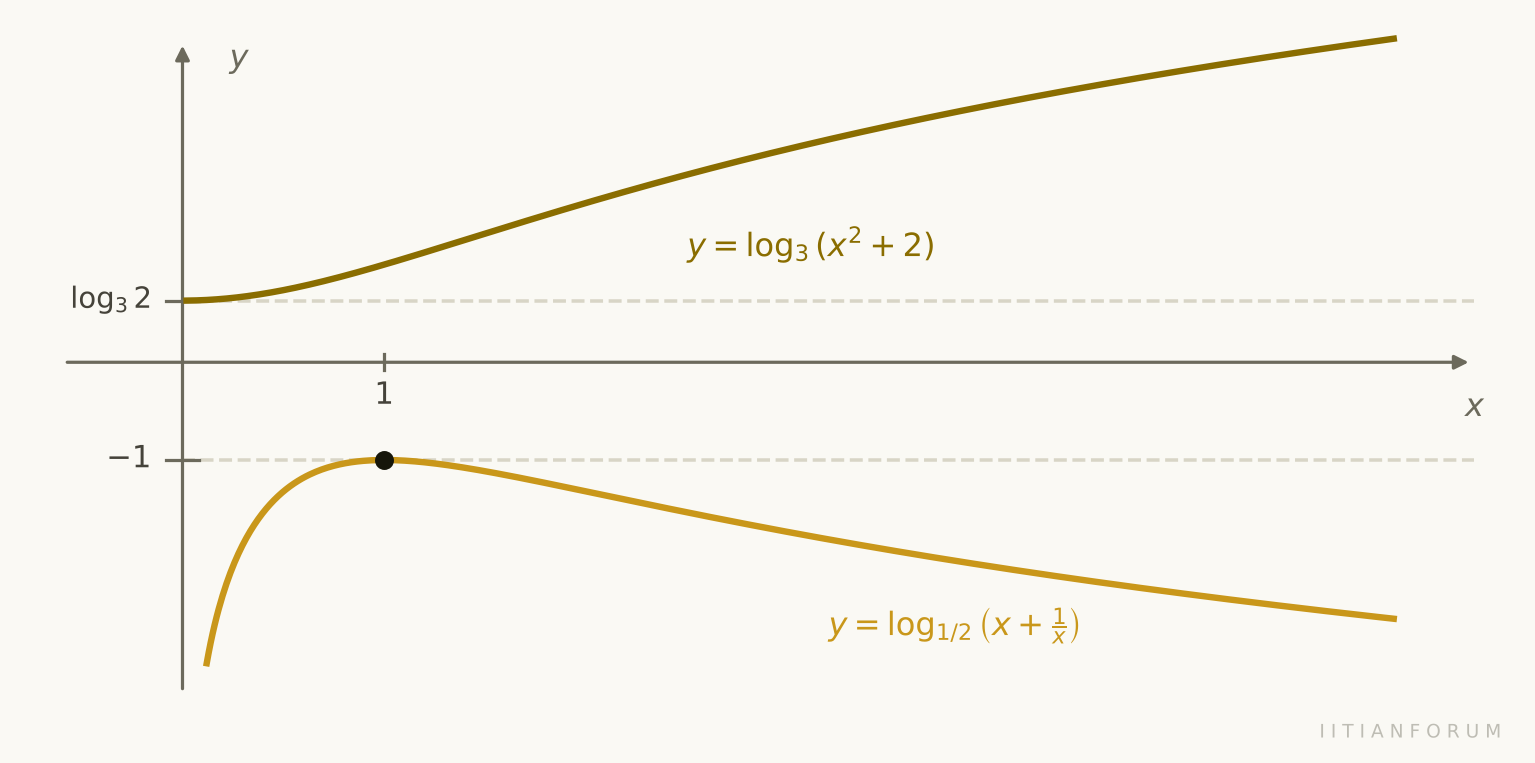
Example 44(IITianForum). Find the number of solutions of
log3(x2+2)=log1/2(x+x1)
for x>0.
▸ SHOW SOLUTION
Step 1. Left side
x2+2≥2, so the left side is ≥log32>0.
Step 2. Right side
x+x1≥2 and the base 21 is below 1, so the right side is ≤log1/22=−1.
Step 3. Compare
A positive number never equals a number ≤−1.
Answer: no solution
For x greater than 0, the curve y equals log to base 3 of x squared plus 2, which stays above the dashed level log to base 3 of 2, and the curve y equals log to base one half of x plus 1 over x, which stays below the dashed level minus 1, with its highest point at x equals 1; the two curves never meet
Logarithmic inequalities
For a>1:
logaM>logaN⟺M>N>0
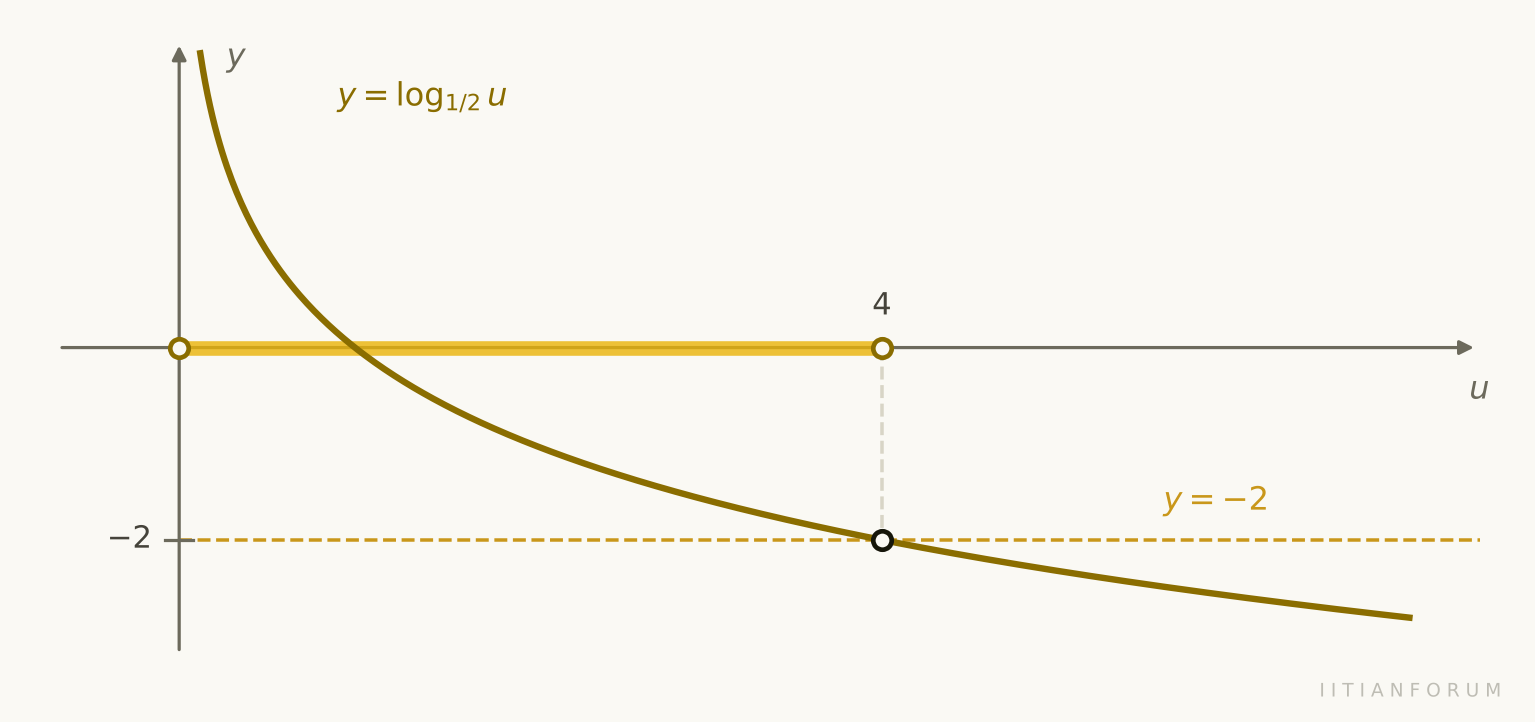
For 0<a<1:
logaM>logaN⟺0<M<NThe decreasing curve y equals log to base one half of u for u greater than 0, cut by the dashed line y equals minus 2 at u equals 4; the part of the curve above the line lies over the interval from 0 to 4, which is highlighted on the u axis
If the base contains the variable, solve the two cases a>1 and 0<a<1 separately and take the union.
Example 45(IITianForum). Solve log1/2(x−1)>−2.
▸ SHOW SOLUTION
Step 1. Write −2 as a log
−2=log1/24. The base is below 1, so the direction reverses:
0<x−1<4
Answer:(1,5)
Example 46(IITianForum). Solve logx(x+2)>2.
▸ SHOW SOLUTION
Step 1. Case x > 1
x+2>x2⇒(x−2)(x+1)<0
−1<x<2; with x>1: 1<x<2.
Step 2. Case 0 < x < 1
0<x+2<x2⇒(x−2)(x+1)>0
x>2 or x<−1: nothing in (0,1).
Answer:(1,2)
Example 47(JEE Main 2025, 29 January Shift 2). If the domain of the function log5(18x−x2−77) is (α,β) and the domain of the function
log(x−1)(x2−3x−42x2+3x−2)
is (γ,δ), then α2+β2+γ2 is equal to
Tap an option to check your answer
(1)195
(2)174
(3)186
(4)179
▸ SHOW SOLUTION
Step 1. First domain
x2−18x+77<0(x−7)(x−11)<0
(α,β)=(7,11).
Step 2. Second domain: the argument
(x−4)(x+1)(2x−1)(x+2)>0
Wave with roots −2,−1,21,4: x<−2, −1<x<21 or x>4.
Step 3. The base
x>1, x=2. With Step 2: x>4, so γ=4.
Answer:49+121+16=186, option (3)
Example 48(JEE Main 2026, 2 April Shift 1). If the domain of the function
f(x)=log(0.6)x2−42x−5
is (−∞,a]∪{b}∪[c,d)∪(e,∞), then the value of a+b+c+d+e is ______.
▸ SHOW SOLUTION
Step 1. Remove the log
The root needs the log ≥0. The base 0.6 is below 1, so
0<x2−42x−5≤1
That is x=±2, x=25, and −1≤x2−42x−5≤1.
Step 2. Lower half
x2−4x2+2x−9≥0
Roots −1±10 and ±2: x≤−1−10, −2<x<2 or x≥−1+10.
Step 3. Upper half
(x−2)(x+2)(x−1)2≥0
The square touches at 1: x<−2, x=1 or x>2.
Step 4. Intersect
(−∞,−1−10]∪{1}∪[−1+10,25)∪(25,∞)
a+c=−2, b=1, d=e=25.
Answer:−2+1+5=4
Example 49(IITianForum). Solve
log3x−1−log3x+3>0▸ SHOW SOLUTION
Step 1. Substitute
Put t=log3x. The root needs t≥1:
t−1>t−3
Step 2. Case t < 3
The right side is negative: true for 1≤t<3.
Step 3. Case t ≥ 3
t−1>(t−3)2⇒(t−2)(t−5)<0
With t≥3: 3≤t<5.
Step 4. Back to x
1≤log3x<5.
Answer:[3,243)
Characteristic, mantissa and digits
Write log10N= characteristic + mantissa, with the characteristic an integer and the mantissa in [0,1).
Result
Statement
digits in N≥1
characteristic +1
zeros after the point, 0<N<1
∣characteristic∣−1
useful values
log2≈0.3010, log3≈0.4771, log7≈0.8451
swipe for more →
Example 50(IITianForum). (a) How many digits does 2100 have, and what is its first digit? (b) How many zeros come right after the decimal point in 3−20?
▸ SHOW SOLUTION
Step 1. Part (a)
log2100=30.10
Characteristic 30: there are 31 digits. The mantissa 0.10 lies between log1=0 and log2=0.301, so the first digit is 1.
Step 2. Part (b)
log3−20=−9.542=−10+0.458
Characteristic −10: there are 9 zeros after the point.
Answer: (a) 31 digits, first digit 1; (b) 9
Exponential equations
af(x)=ag(x) with a>0, a=1 gives f(x)=g(x).
a2x+kax+m=0 is a quadratic in t=ax, and t>0 is compulsory.
ax>ay means x>y for a>1, and x<y for 0<a<1.
Example 51(IITianForum). Solve 4x+2x+2=32.
▸ SHOW SOLUTION
Step 1. Substitute
Put t=2x>0:
t2+4t−32=0⇒t=4ort=−8
Step 2. Reject
t=−8 is not allowed. 2x=4.
Answer:x=2
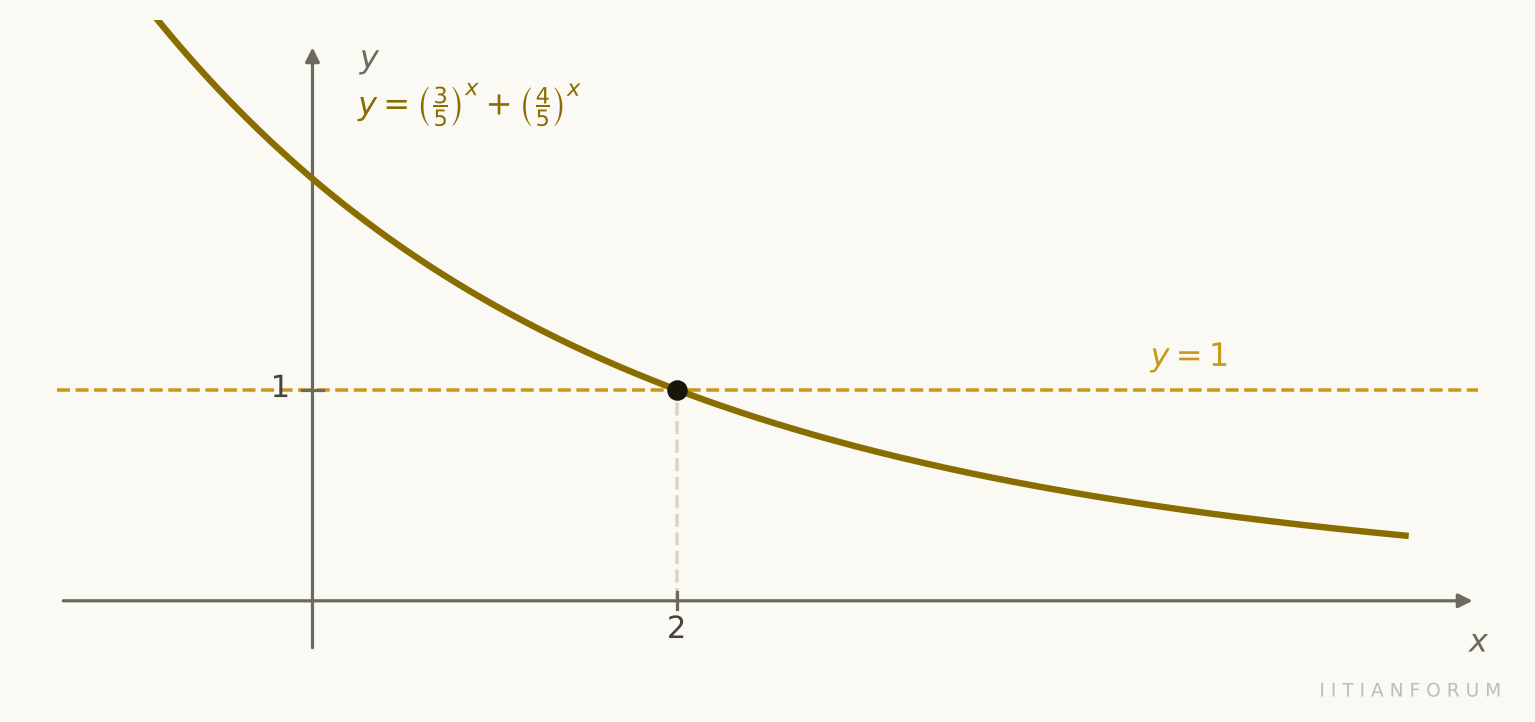
Example 52(IITianForum). Solve 3x+4x=5x.
▸ SHOW SOLUTION
Step 1. Divide by 5^x
(53)x+(54)x=1
Step 2. One root
Both bases are below 1, so the left side decreases as x increases. It meets 1 at most once, and x=2 works: 259+2516=1.
Answer:x=2
The decreasing curve y equals three fifths to the power x plus four fifths to the power x, which crosses the dashed line y equals 1 exactly once, at the marked point x equals 2
Example 53(IITianForum). Find the number of real solutions of
41⋅51+cosπx+2x2−3+4−∣x∣=43▸ SHOW SOLUTION
Step 1. First term
1+cosπx≥0, so 41⋅51+cosπx≥41, with equality when cosπx=−1, that is x an odd integer.
Step 2. Last two terms by AM ≥ GM
2x2−3+2−2∣x∣≥22x2−2∣x∣−3
x2−2∣x∣−3=(∣x∣−1)2−4≥−4, so the sum is ≥2⋅2−2=21, with equality only at ∣x∣=1.
Step 3. Combine
The left side is ≥41+21=43. Equality needs ∣x∣=1 and x odd: x=±1.
Answer:2
Which method to use
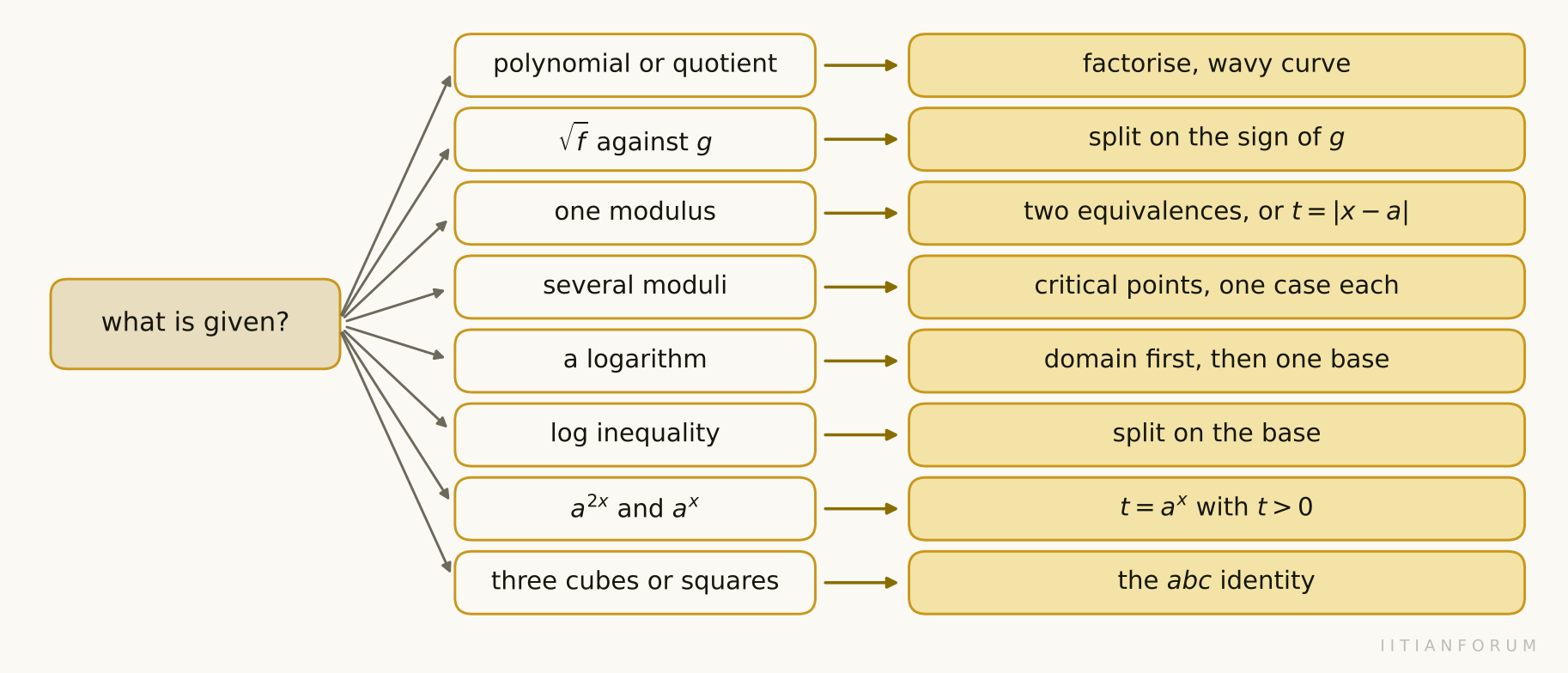
A decision chart: from the question asked, arrows lead to eight situations, each paired with its method: a polynomial or quotient against zero, factorise and use the wavy curve; a square root against an expression, split on the sign of the other side; one modulus, the two standard equivalences or a substitution; several moduli, critical points and cases; a logarithm, write the domain then one base; a log inequality, split on the base; a power appearing twice, put t equal to a to the x with t positive; sum of three cubes or three squares, use the abc identity
Given
Method
polynomial against 0
factorise, wavy curve
quotient against a number
one side, then wave on P⋅Q
repeated root
even power touches, odd power crosses
f against g
split on the sign of g
∣x−a∣2 and ∣x−a∣
t=∣x−a∣≥0
several moduli
critical points, one case per interval
∣a∣+∣b∣=∣a+b∣
ab≥0
number of roots
graph, count the meets
[x] in an equation
solve for n=[x] first
logs with different bases
change to one base
alogbc
swap to clogba
variable base
t=loguv, then logvu=t1
log inequality
domain, then split on the base
a2x and ax
t=ax>0
sum of powers equal to a constant
AM ≥ GM or a sum of squares
remainder by a quadratic
αx+β, put the two roots
swipe for more →
What JEE asks
Across the 2025 and 2026 papers the chapter appears in five forms.
Modulus equations counted by cases or by a graph (Examples 23 to 31). This is the most frequent form in JEE Main 2026.
Logarithmic equations with a variable base, solved by t+tk (Examples 42 and 43).
Domains that reduce to log and rational inequalities (Examples 47 and 48).
Log laws and the swap rule inside a numerical value question (Example 39).
Polynomial division and the factor theorem (Examples 14 and 15).
The same methods appear inside domain questions in the Functions note and inside sign questions in calculus.
Quick recall
Result
Statement
a+2b
x+y, x+y=a, xy=b
a+b+c=0
a3+b3+c3=3abc
a2+b2+c2−ab−bc−ca
21∑(a−b)2≥0
componendo and dividendo
ba=dc⇒a−ba+b=c−dc+d
remainder by x−a
P(a)
an+bn, n odd
divisible by a+b
wavy curve
start + on the right
even power
touches, no sign change
denominator roots
always hollow
x2
∣x∣
∣x∣<a
−a<x<a
∣x∣>a
x<−a or x>a
∣x+y∣=∣x∣+∣y∣
xy≥0
logaN exists
N>0, a>0, a=1
logax2
2loga∣x∣
change of base
logaN=logbalogbN
swap
alogbc=clogba
logax>0
x and a on the same side of 1
log inequality, 0<a<1
direction reverses
digits of N
characteristic +1
t=ax
t>0
swipe for more →
Before you leave this chapter
Without a pen, answer these four: the solution of x+3x−2≤0, the number of roots of ∣x∣2−3∣x∣+2=0, the value of 5log2549, and the solution of log1/3x>2. If (−3,2], 4, 7 and (0,91) come quickly, the chapter is yours.
Practise these methods on real exam questions in the doMath Basic Algebra and Logarithms chapter. Domains and ranges built on them are in the Functions note, and the full theory of means is in the Relation Between AM, GM and HM note.