Complex Numbers in Coordinate Geometry Complete JEE Notes
Coordinate geometry gives every point two numbers. Complex numbers give it one, and that single change is what makes this topic worth a chapter of its own. A rotation, which costs you a page of trigonometry in Cartesian coordinates, becomes one multiplication. A circle, a line, an ellipse each collapses to a short statement about distances or angles.
JEE has noticed. Across the ten JEE Main 2026 shifts we hold verified solutions for, thirteen questions were built on complex numbers, and nine of those thirteen were pure geometry circles, perpendicular bisectors, an annulus, an ellipse, a maximum-argument problem. Not one of them needed a hard algebraic identity. All of them needed a picture.
| Coordinate geometry | The complex-number way | |
|---|---|---|
| 1. A point | an ordered pair | one number |
| 2. Distance | ||
| 3. A circle | ||
| 4. Rotating a point | a matrix, or expanding | multiply by |
| 5. "Angle is constant" | messy — needs of a difference |
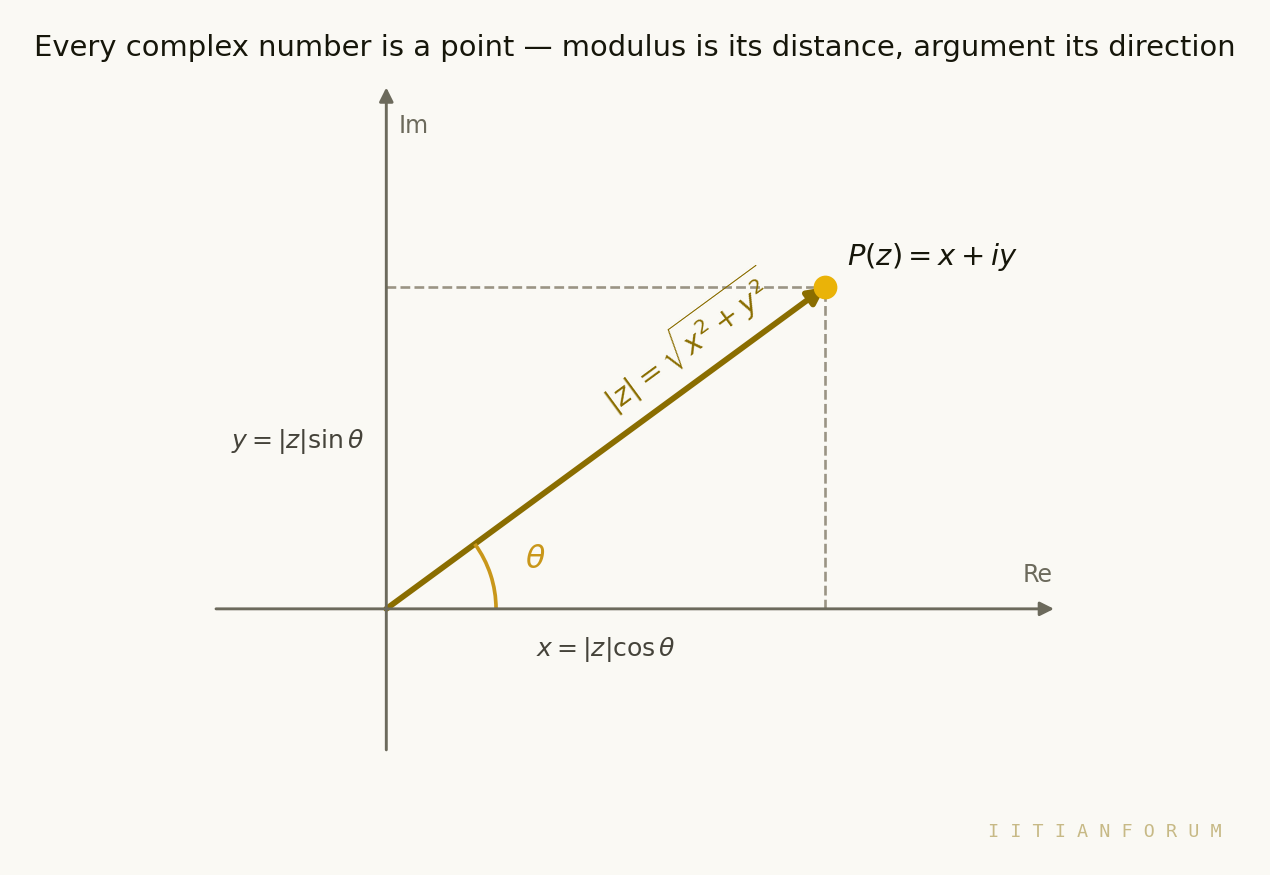
The two numbers that describe . The modulus is the distance . The argument is the angle makes with the positive real axis, measured anticlockwise as positive. Because a full turn returns you to the same point, the argument is only defined up to ; the value in is the principal argument, written .
Read every condition as a sentence about distance or about angle, and draw it before you write algebra.
is not an equation to expand. It says "the distance from to the point is " a circle, centre , radius . You now know its centre, radius, nearest point to the origin and farthest point, without touching and . Candidates who substitute on line one lose four minutes and usually the mark.
The four operations, seen as pictures
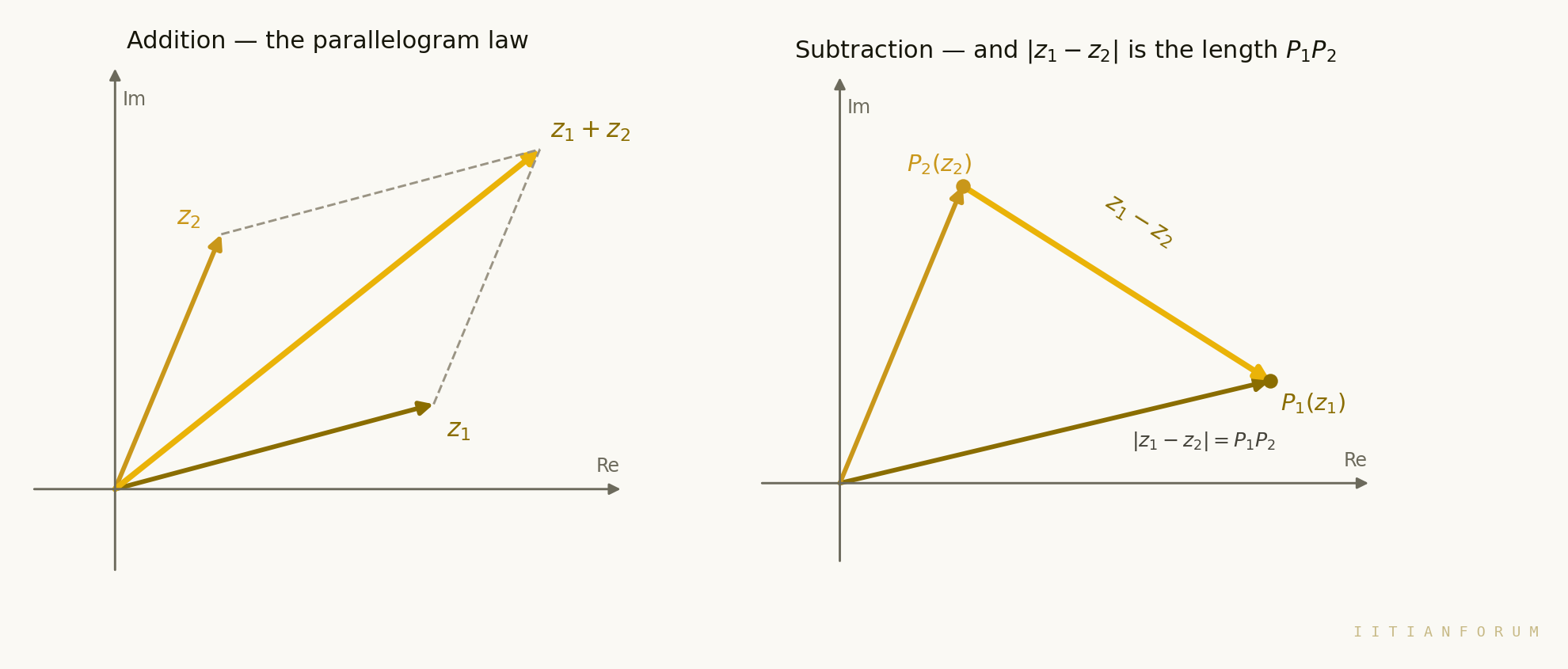
Addition places the two vectors nose to tail: is the fourth vertex of the parallelogram with , , . Subtraction is the vector from to , which is why
That one line is the most used fact in the chapter.
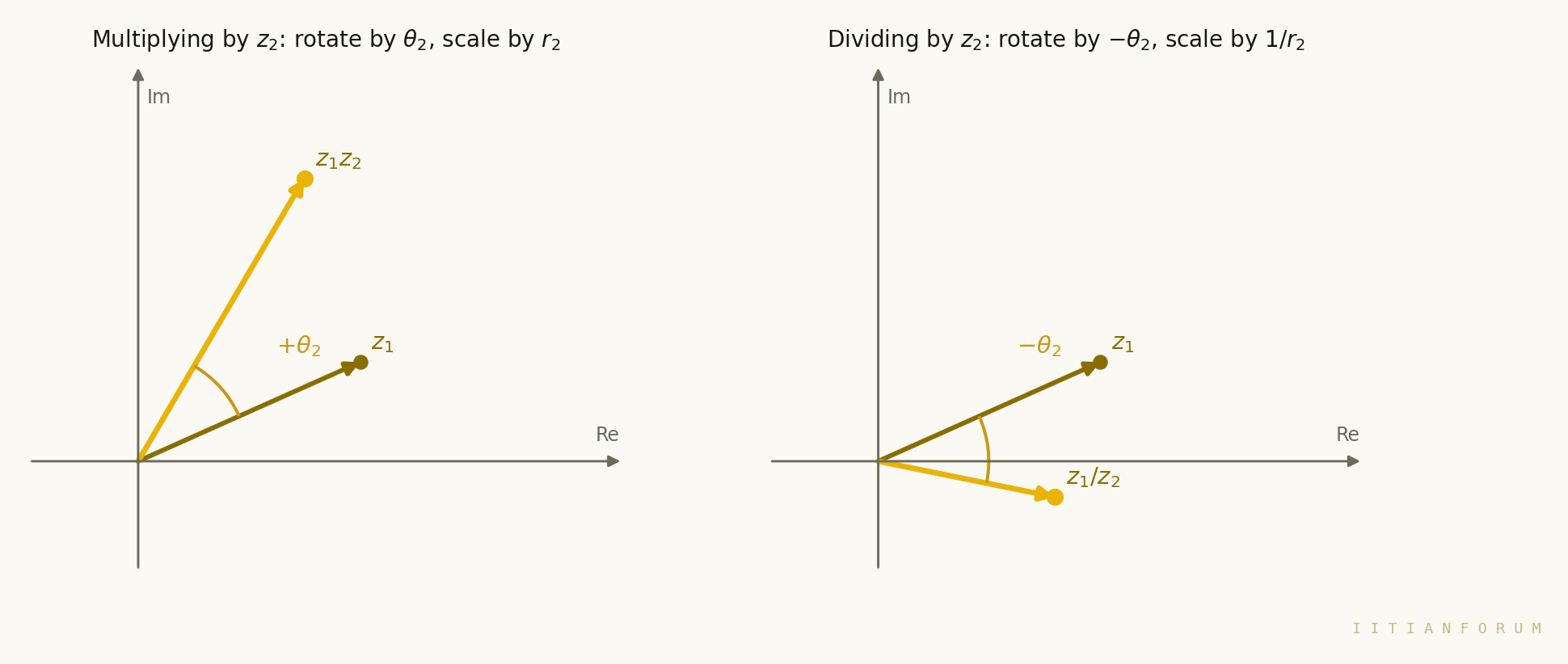
Moduli multiply, arguments add. Dividing subtracts the argument instead. In particular multiplying by is exactly a quarter-turn anticlockwise, and multiplying by is a half-turn.
▸ SHOW SOLUTION
- the point turned a quarter-turn anticlockwise about the origin.
- — turned a half-turn, i.e. reflected in the origin.
- — reflected in the real axis.
Each has the same modulus , because rotation and reflection preserve distance from the origin.
Rotation — the master tool
Everything geometric in this chapter is downstream of one formula.
The rotation formula. If , , are three points and is the angle from to measured anticlockwise, then
Why ? is the vector and is the vector . Dividing two complex numbers divides their moduli and subtracts their arguments, so the quotient has modulus and argument exactly the angle between them. There is nothing more to it.
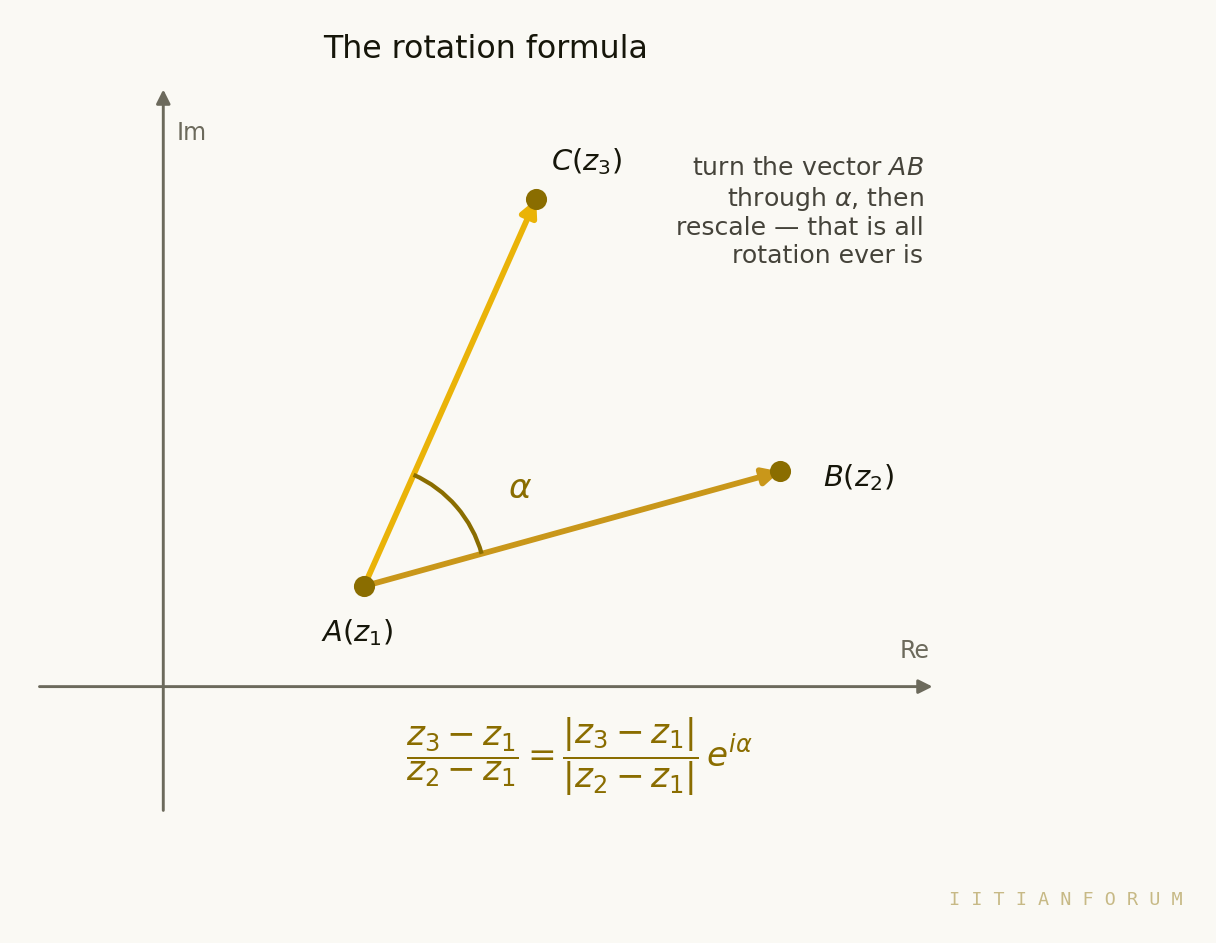
Forwards — given a picture, write down a ratio. " and " becomes immediately.
Backwards — given a ratio, read off a picture. If turns out to be purely real, the argument is or , so are collinear. If it is purely imaginary, the angle is , so .
Example 2 (IIT-JEE 2008). A particle starts at . It first moves units horizontally away from the origin, then units vertically away from the origin, reaching . From it moves units in the direction of and then turns through anticlockwise on a circle centred at the origin, reaching . Find .
▸ SHOW SOLUTION
Step 1: The two axis moves. has positive real and imaginary parts, so "away from the origin" means the and directions:
Step 2: The diagonal move. The unit vector along is , so moving units adds :
Step 3: The rotation. Turning through anticlockwise about the origin means multiplying by :
Notice that the whole question is four one-line moves. Setting up coordinates and rotation matrices would take five times as long.
Example 3. and are two adjacent vertices of a square, taken anticlockwise, with the centre at the origin. Express the other two vertices in terms of .
▸ SHOW SOLUTION
The four vertices of a square centred at the origin are equally spaced round a circle, at apart. Successive anticlockwise vertices are therefore obtained by multiplying by :
Check. , so the diagonals bisect each other at the origin; and , so the diagonals are equal. Both are properties a square must have.
Distance, section formula and collinearity
Because is the distance , every result of coordinate geometry transfers unchanged.
Section formula. If divides the join of and in the ratio , then In particular the midpoint is and the centroid of with vertices is .
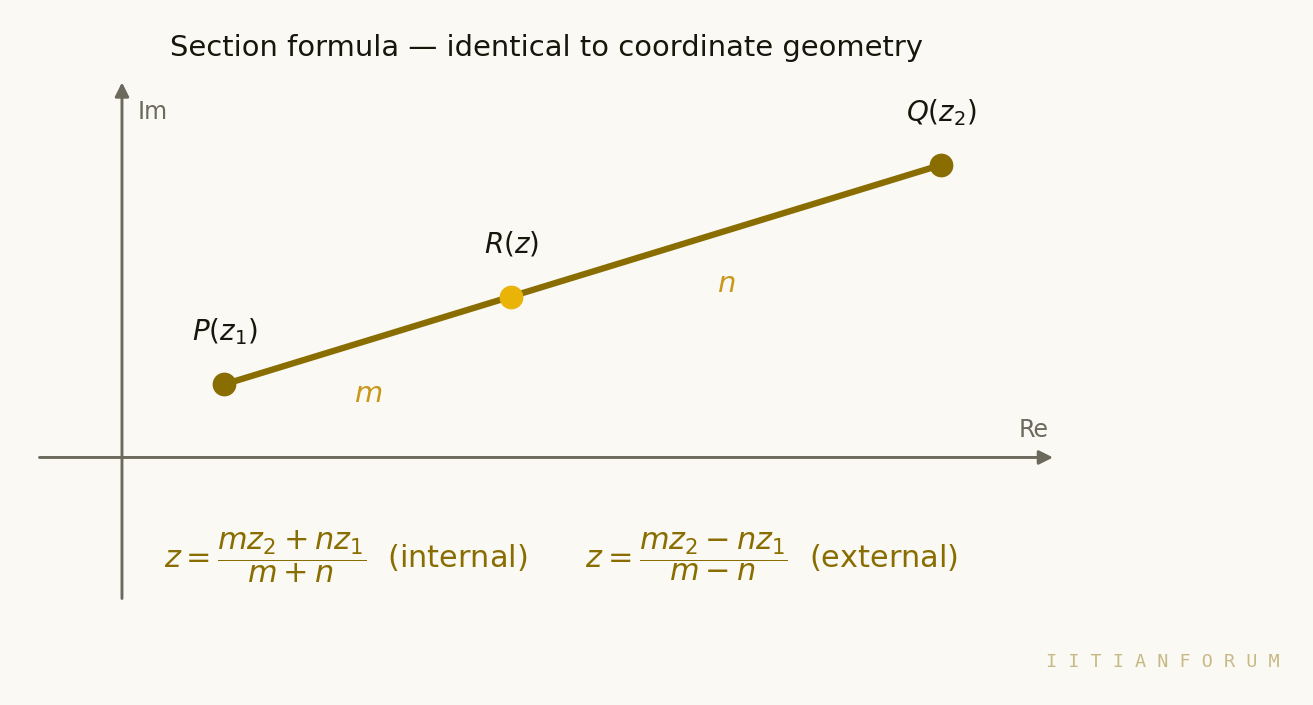
Collinearity. , , are collinear if and only if any of the following holds — they are the same statement three ways:
- is purely real;
- (with between and );
- .
Area of a triangle. , which is why the determinant vanishing means collinear.
Example 4 (IIT-JEE 2010). Let be distinct complex numbers and let for some real with . If denotes the principal argument of a non-zero complex number , which of the following is/are true?
(a) (b) (c) (d)
▸ SHOW SOLUTION
Step 1: Recognise the parametrisation. is exactly the section formula with dividing in the ratio . Since , the point lies strictly between and on the segment.
Step 2: Test each statement.
- (a) lies on the segment, so the two part-lengths add to the whole. True.
- (b), (d) with , so the two vectors point the same way and have the same principal argument. True.
- (c) The determinant is . Substituting gives . True — it is the collinearity determinant.
Answer: all of them.
Triangles
Two results carry almost all the marks.
Equilateral triangle. form an equilateral triangle iff equivalently . If in addition the circumcentre is at the origin, then .
Why the first form is true. Rotating about through lands on , so . The same is true starting from each vertex. Writing , eliminating between the three relations produces exactly the symmetric identity above.
Example 5. An equilateral triangle has its circumcentre at the origin and circumradius . Find , and for any point on its incircle.
▸ SHOW SOLUTION
Step 1: Place the vertices. With circumcentre at the origin, take , , where . Then .
Step 2: The side. , so each side is and
Step 3: The incircle. For an equilateral triangle the inradius is half the circumradius, so and satisfies .
Step 4: Use the centroid identity. For any point ,
and here the centroid is the origin. So the sum is , independent of where sits on the incircle.
Check. Direct expansion with gives for every — the -terms cancel because .
Triangle centres. With vertices and opposite side lengths :
Centre Formula Centroid Incentre Circumcentre , orthocentre collinear with , and
Quadrilaterals
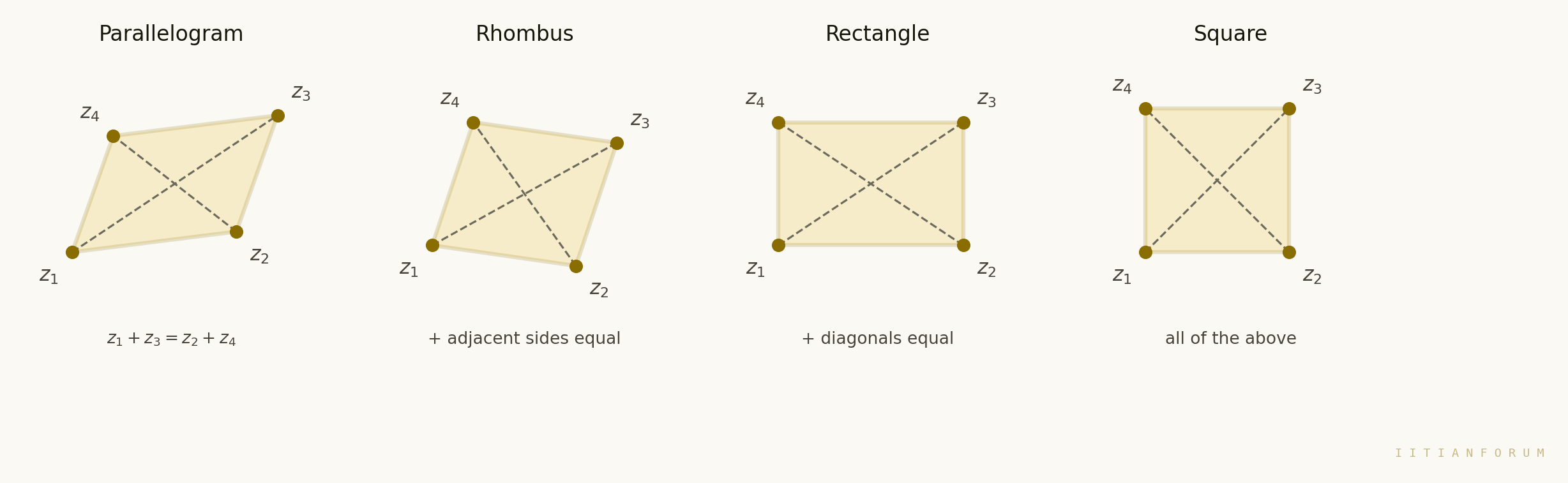
Four points taken in order form:
| Shape | Conditions |
|---|---|
| Parallelogram | (diagonals bisect each other) |
| Rhombus | parallelogram and (adjacent sides equal) |
| Rectangle | parallelogram and (diagonals equal) |
| Square | parallelogram, adjacent sides equal and diagonals equal |
Example 6. are represented by , , , respectively. What is ?
▸ SHOW SOLUTION
Step 1: Test the parallelogram condition.
Equal, so the diagonals bisect each other — it is at least a parallelogram.
Step 2: Adjacent sides.
Equal, so it is a rhombus.
Step 3: Diagonals.
Equal, so it is also a rectangle.
Answer: rhombus and rectangle, i.e. a .
The conditions above assume the vertices are listed in cyclic order around the shape. The same four points listed as describe a crossed figure and every test fails. If a question does not state the order, check that for some pairing before concluding anything.
Straight lines
The perpendicular bisector. says is equidistant from two fixed points, so the locus is the perpendicular bisector of the segment joining them.
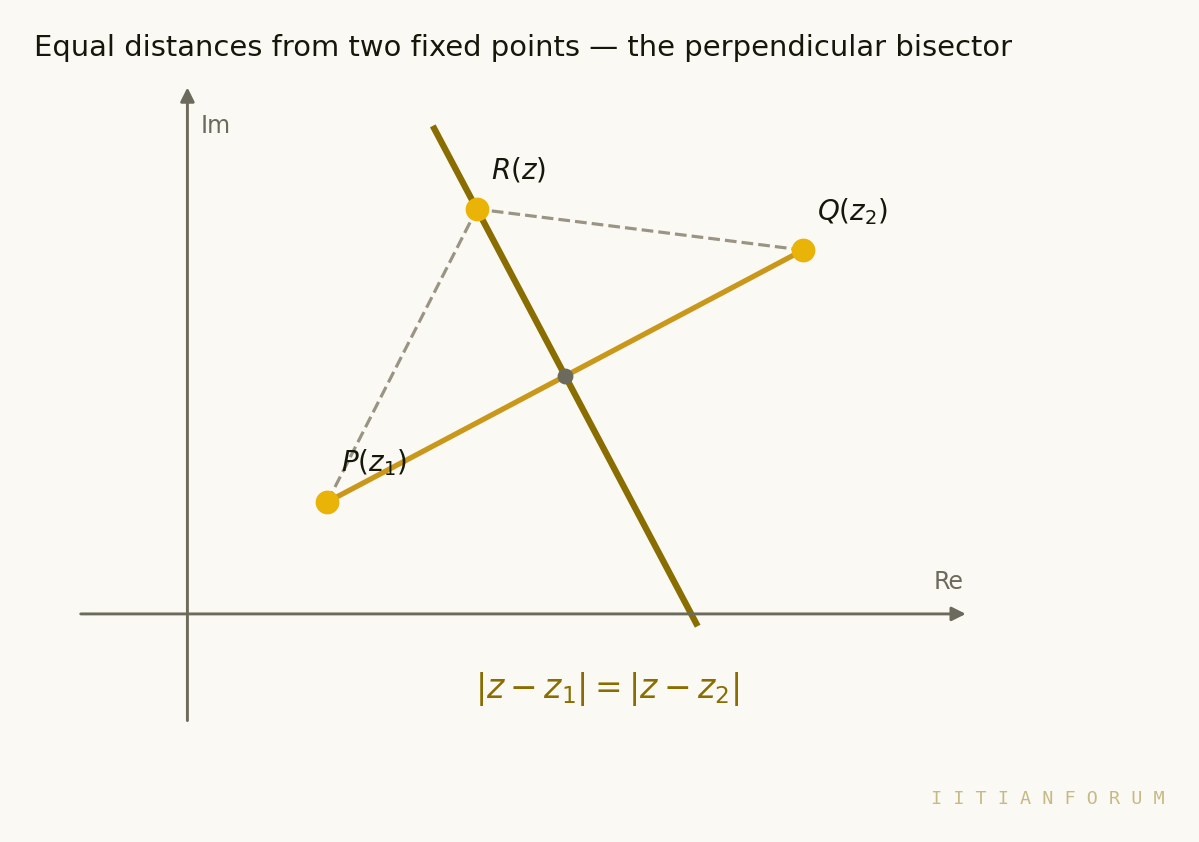
Example 7. Find the locus of satisfying .
▸ SHOW SOLUTION
Step 1: Recognise it. Equal distances from and — the perpendicular bisector of the segment joining and .
Step 2: Square both sides and expand:
Step 3: Cancel and .
Answer: the line .
Check. The midpoint is , and . The direction of is , and the line's normal is . Both as they must be.
General equation of a line. with , . Its slope is (as a complex direction). Two lines with are parallel when and perpendicular when .
Parametric form. , , is the whole line through and ; restricting to gives the segment.
Determinant form. .
Circles
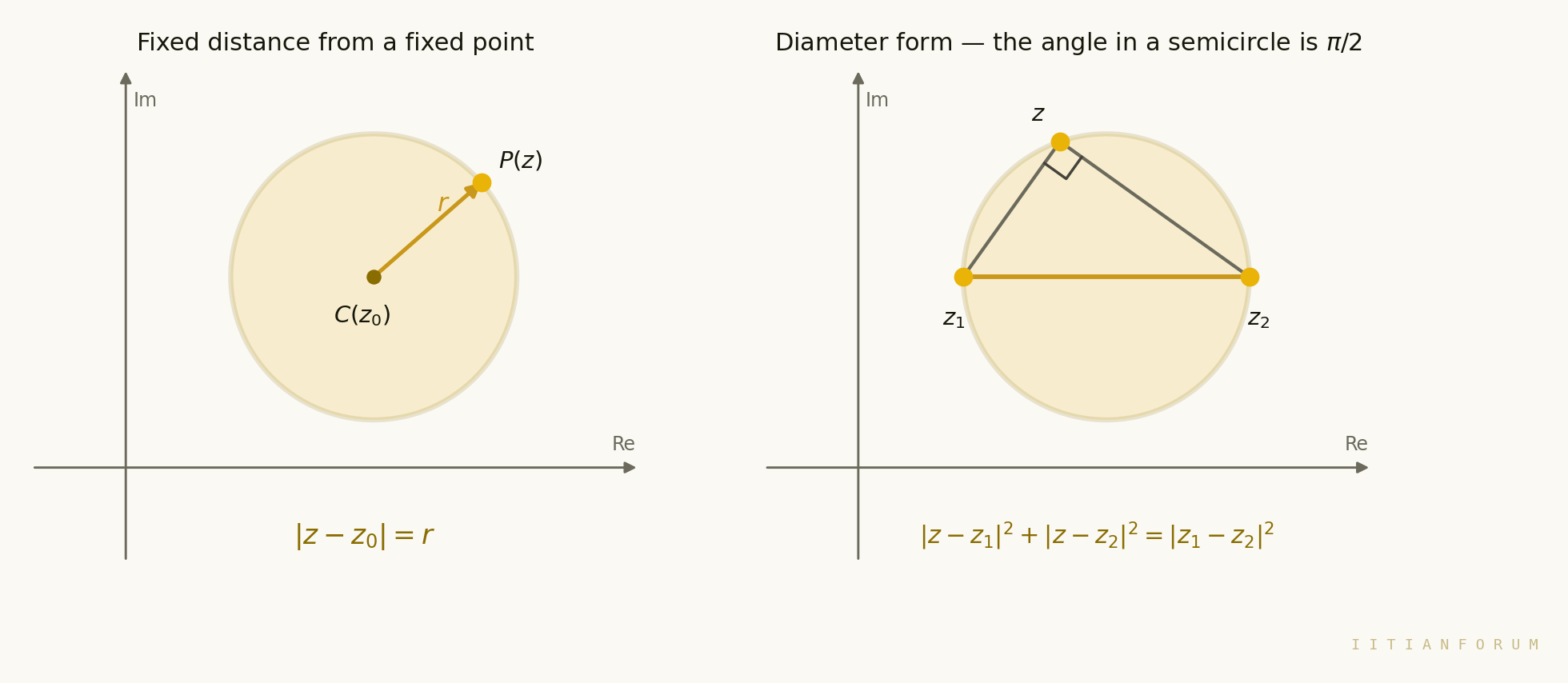
The four forms.
- Centre–radius: .
- General: with , — centre , radius .
- Diameter form: if are ends of a diameter, .
- Right-angle form: — again the circle on as diameter, by Pythagoras.
Nature of the general equation. For , look at :
Sign What you get a real circle of radius a point circle — the single point an imaginary circle — no points at all
Example 8 (JEE Main 2026, 28 Jan Shift 1). Let satisfy and . Find .
▸ SHOW SOLUTION
Step 1: Two circles. Centres and , both of radius .
Step 2: Distance between centres.
The centres are exactly apart, so the circles touch externally — there is precisely one common point.
Step 3: The point of contact divides in the ratio , i.e. it is the midpoint:
Recognising the touching case turns a pair of simultaneous quadratics into one midpoint.
Example 9 (JEE Main 2026, 23 Jan Shift 1). Let . Find .
▸ SHOW SOLUTION
Step 1: Normalise the coefficient of . Pull the out of the modulus:
so the condition becomes .
Step 2: Name the region. is an annulus — the ring between two concentric circles — centred at with inner radius and outer radius .
Step 3: Name the target. is the distance from to the fixed point .
Step 4: Locate relative to the ring.
Since , the point lies outside the annulus altogether.
Step 5: Minimise. For a point outside, the nearest point of the ring lies on the segment , on the outer circle:
Had fallen inside the hole, the answer would instead have been ; had it fallen within the ring, the minimum would be . Deciding which of the three cases you are in is the entire question.
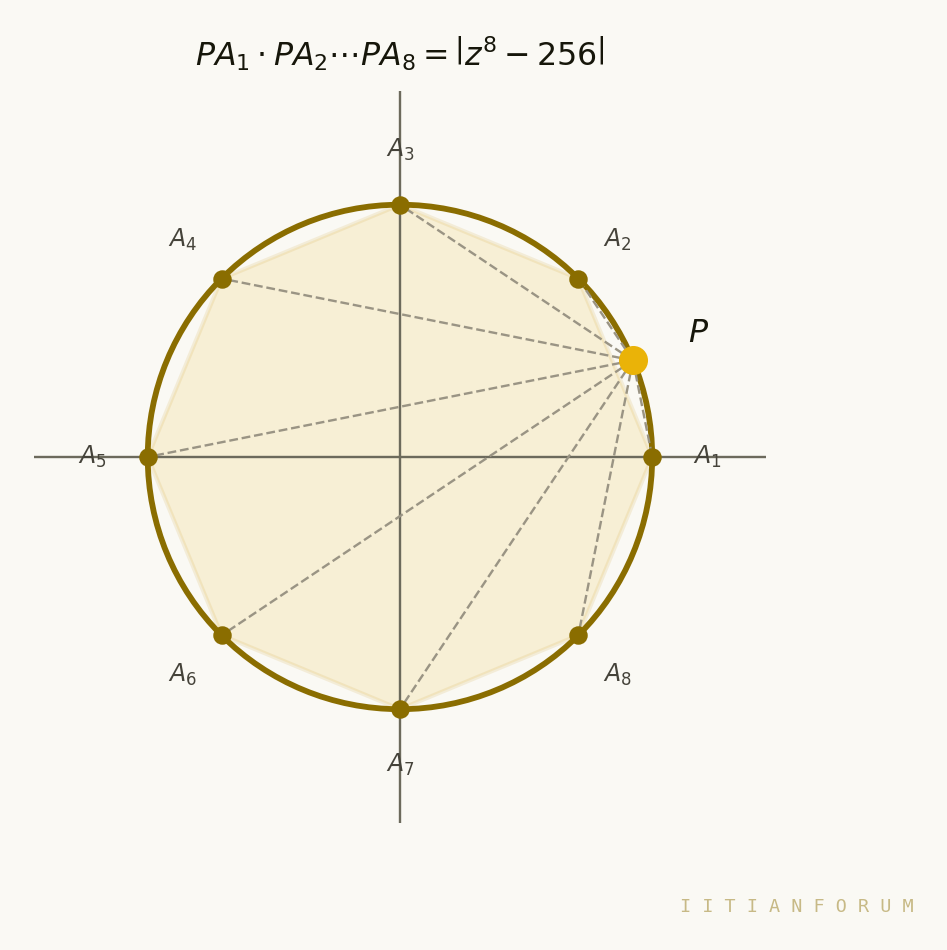
Products of distances to points on a circle. If are the vertices of a regular -gon inscribed in , they are exactly the roots of . Hence for any , so a product of distances collapses to a single modulus. This is the only sensible way to handle "find ".
Example 10 (JEE Advanced 2023). are the vertices of a regular octagon inscribed in a circle of radius , and is a point on that circle. Find the maximum value of .
▸ SHOW SOLUTION
Step 1: Put the octagon at the roots of an equation. Place the centre at the origin. The eight vertices are equally spaced on , so they are precisely the eight solutions of
Step 2: Turn the product of distances into one modulus. If is the point , then , and since the are all the roots of ,
Step 3: Use . Then , so itself runs over the circle of radius centred at the origin.
Step 4: Maximise. is the distance from the point to the fixed point , and both lie on (or the latter on) the circle of radius . The greatest such distance is the diameter:
attained when , i.e. when is a midpoint of an arc between two adjacent vertices.
Answer:
Numerical check. Sweeping round the circle in steps, the product peaks at — exactly at the eight arc midpoints.
is not a circle of radius . Pull the out — — and the radius is , the centre . Forgetting this halves or doubles every subsequent number and is the single commonest slip in circle questions.
Loci by ratio — the Apollonius circle
Apollonius. For fixed and constant , is the perpendicular bisector of when , and a circle for every .
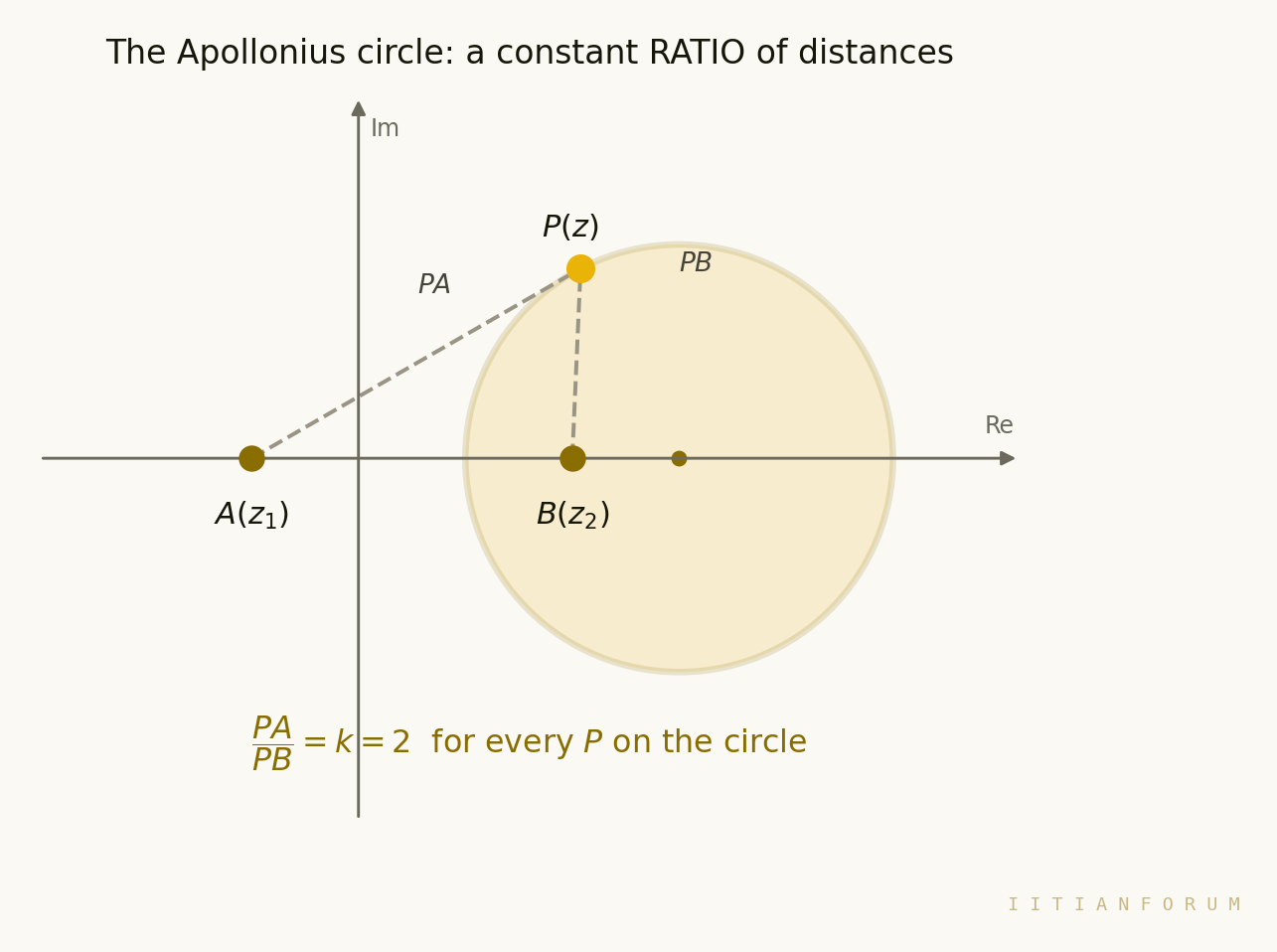
Why it is a circle. Put and expand. The terms carry coefficients and , so provided they do not cancel and you are left with — the general circle. When they cancel exactly, the term vanishes, and a line is what remains.
Example 11 (JEE Main 2026, 24 Jan Shift 1). Let . Describe .
▸ SHOW SOLUTION
Step 1: Both ratios equal , so both conditions are perpendicular bisectors — no circles here at all.
Step 2: First condition. : equidistant from and , so lies on the horizontal line .
Step 3: Second condition. : equidistant from and . Squaring,
Step 4: Intersect. Substituting gives , so .
Answer: is the single point — two lines meet once.
Loci by angle
The constant-angle locus. For fixed , is the set of points from which the segment subtends the fixed angle .
Locus , an arc of a circle through and the circle with as diameter the line segment between and the line through outside the segment
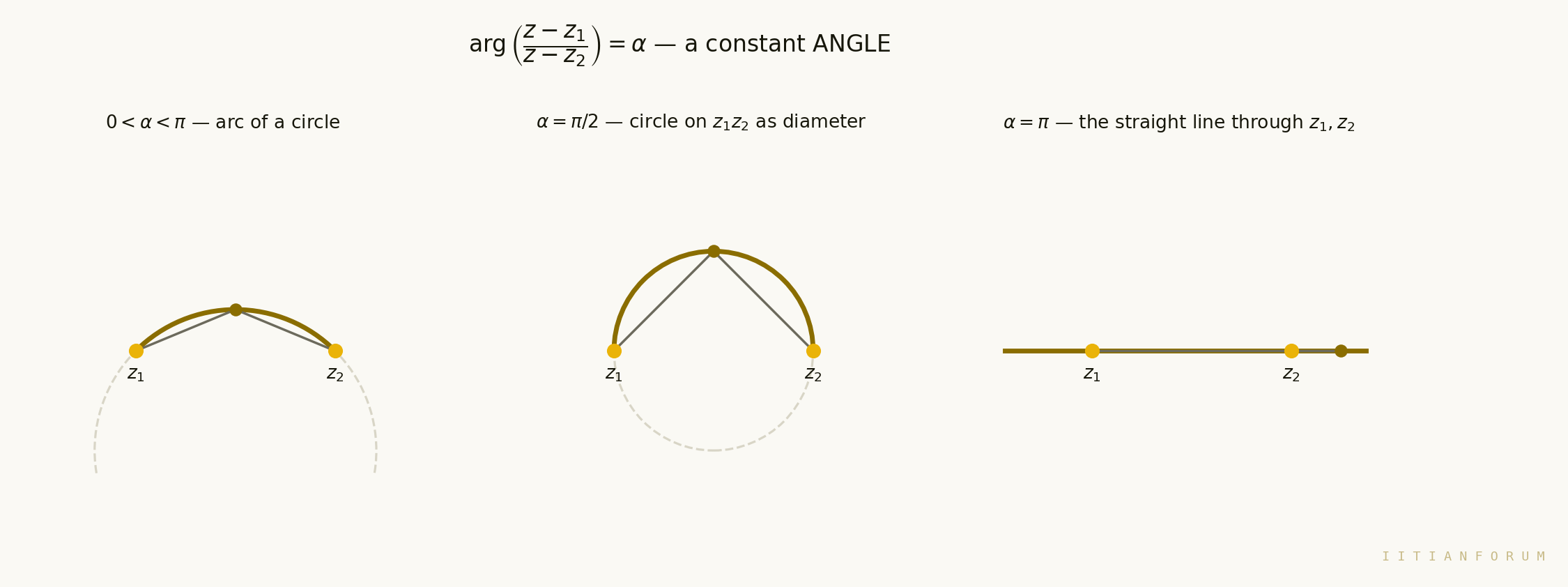
The radius of the arc follows from the sine rule: if the chord has length and subtends , then .
Example 12. Let and . If satisfies , show the locus is an arc and find its radius.
▸ SHOW SOLUTION
Step 1: The chord. .
Step 2: Apply the sine rule. The chord subtends at every point of the arc, so
Step 3: Sanity check. , comfortably more than half the chord () — as any circle through both endpoints must be.
Example 13 (JEE Main 2026, 4 Apr Shift 1). Let satisfy and . Find .
▸ SHOW SOLUTION
Step 1: Use the first condition. Equal distances from and is the perpendicular bisector of that segment — the imaginary axis. So write with real.
Step 2: Simplify the quotient.
Multiply numerator and denominator by to clear the imaginary unit below:
Step 3: Impose the argument. An argument of means the real and imaginary parts are equal:
Step 4: Check the quadrant. At both parts equal , so the point is in the first quadrant and the argument really is , not .
Step 5: , so
The quadrant check in Step 4 is not optional: is satisfied by both and .
When a quotient is real or purely imaginary. For any : is real , and is purely imaginary . Applied to a quotient this is nearly always faster than separating real and imaginary parts by brute force: cross-multiply into , i.e. .
Example 14 (JEE Advanced 2022). Let be a non-real complex number for which
is real. Find .
▸ SHOW SOLUTION
Step 1: Give the common part a name. Write , so the quotient is .
Step 2: Impose reality by cross-multiplying. A number equals its own conjugate exactly when it is real, so
Step 3: Expand and cancel. The and terms appear on both sides and cancel, leaving
Step 4: Substitute .
using .
Step 5: Take the imaginary part. With and ,
Step 6: Use "non-real". Non-real means , so the bracket must vanish:
Check. At we have , and the quotient evaluates to — real, as required. At it evaluates to .
Ellipse, hyperbola and their degenerate cases
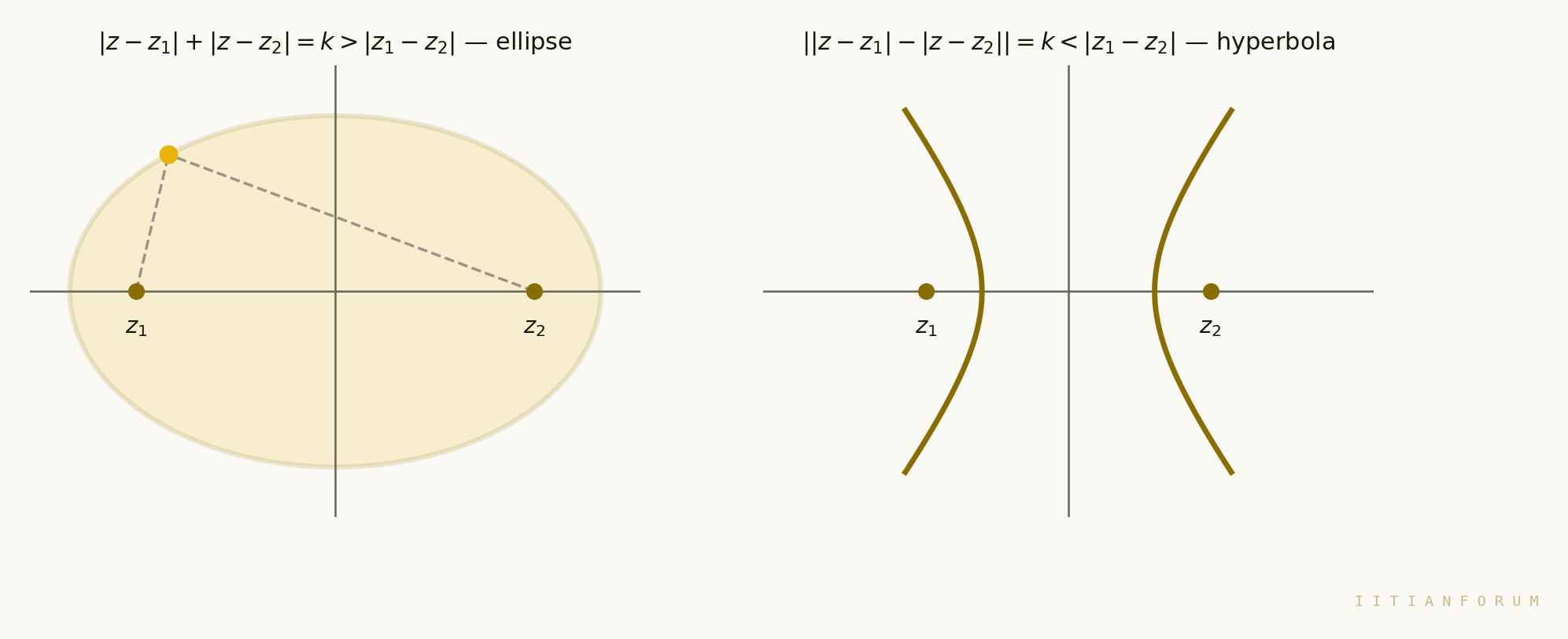
Let be the distance between two fixed points.
Condition Locus ellipse, foci the segment (degenerate) empty hyperbola the two rays outside the segment
Example 15. If always represents an ellipse, find the range of for .
▸ SHOW SOLUTION
Step 1: The condition for a genuine ellipse is that the constant exceeds the focal distance:
Step 2: Split the modulus. .
- Right: .
- Left: , whose discriminant is , so it holds for every real .
Step 3: Impose .
Example 16. Find the greatest and least values of given .
▸ SHOW SOLUTION
Step 1: Identify the region. Foci and , focal distance , and , so the region is the closed interior of an ellipse with .
Step 2: Extract the ellipse's data. Centre is the midpoint ; ; ; so . In coordinates,
Step 3: Maximise and minimise the distance to . The point lies on the major axis, outside the ellipse. On the major axis the ellipse runs from to , so
Step 4: Confirm no interior critical point competes. Writing and differentiating gives a stationary point at , far outside , so the extremes really are at the vertices.
Answer:
Example 17. Identify the locus of satisfying .
▸ SHOW SOLUTION
The two fixed points are and , a distance apart. The difference of the distances is constant and equals , which is strictly less than . That is precisely the definition of a with those two points as foci.
Had the constant been it would degenerate into two rays; had it exceeded the locus would be empty, since the triangle inequality forbids it.
Maximum and minimum modulus
Triangle inequality. For any : Equality on the right needs to point the same way; on the left, opposite ways.
Extremes on a circle. If then and both are attained on the line joining to .
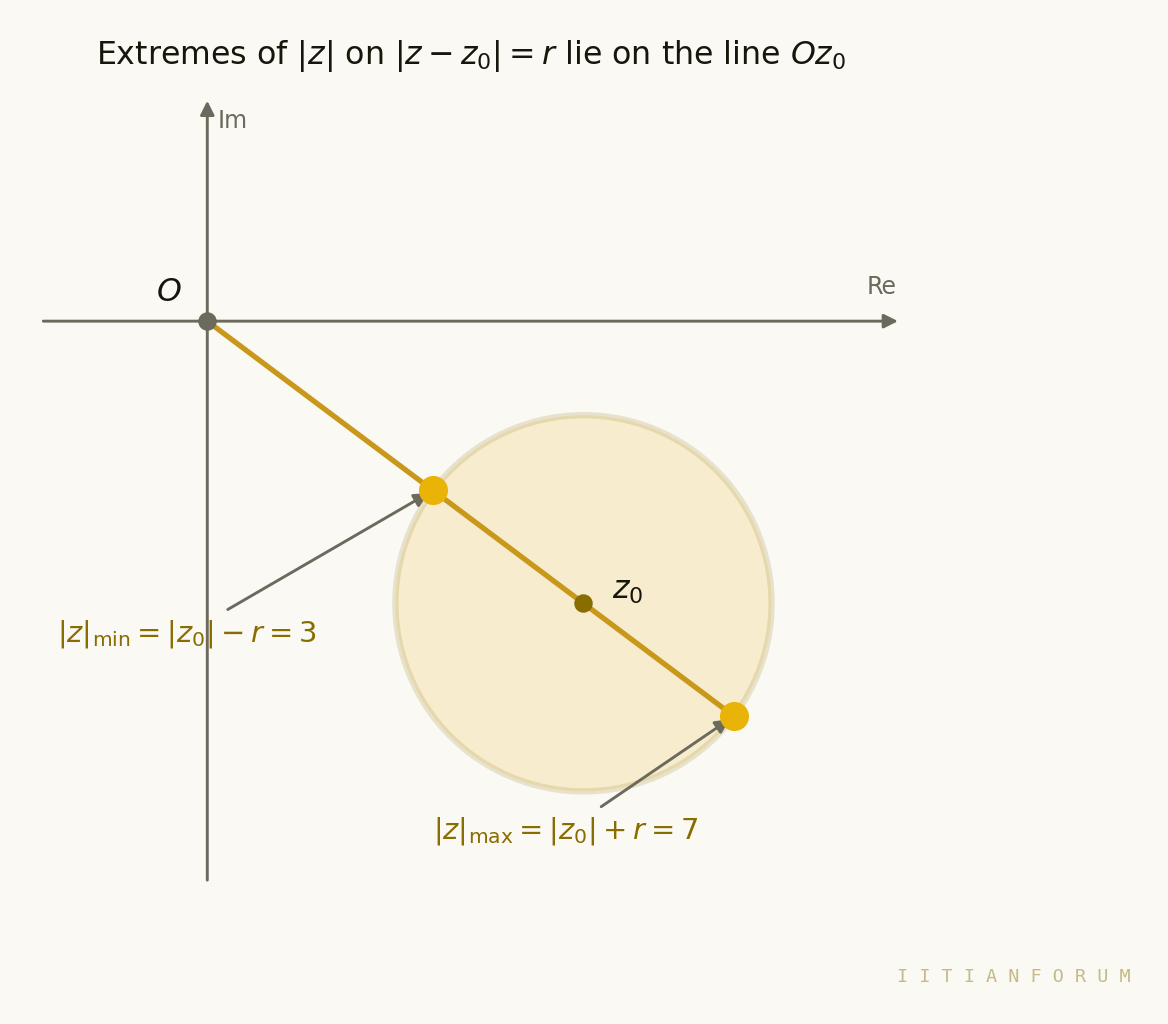
Example 18. If , find the least and greatest values of .
▸ SHOW SOLUTION
Step 1: Read the region. A closed disc, centre , radius .
Step 2: Distance from the origin to the centre. .
Step 3: The origin is outside (since ), so
Answer:
Example 19. If and , find the greatest and least values of .
▸ SHOW SOLUTION
. By the triangle inequality,
so . Geometrically traces the circle of radius centred at , and the extremes are its nearest and farthest points from the origin.
Example 20. Find the maximum value of when .
▸ SHOW SOLUTION
Step 1: Bound below using the triangle inequality. Writing ,
Step 2: Remove the modulus. , and since we want the largest we take the right-hand half:
Step 3: Solve. The roots are , and , so .
Answer:
Example 21 (JEE Main 2026, 2 Apr Shift 2 — the same idea). Let satisfy and satisfy . Find .
▸ SHOW SOLUTION
Step 1: Two circles. runs on the circle centre , radius . runs on the circle centre , radius .
Step 2: Note the second circle passes through the origin, because equals its radius. So ranges over .
Step 3: Minimise the gap. , attained when and are both on the ray through .
Answer:
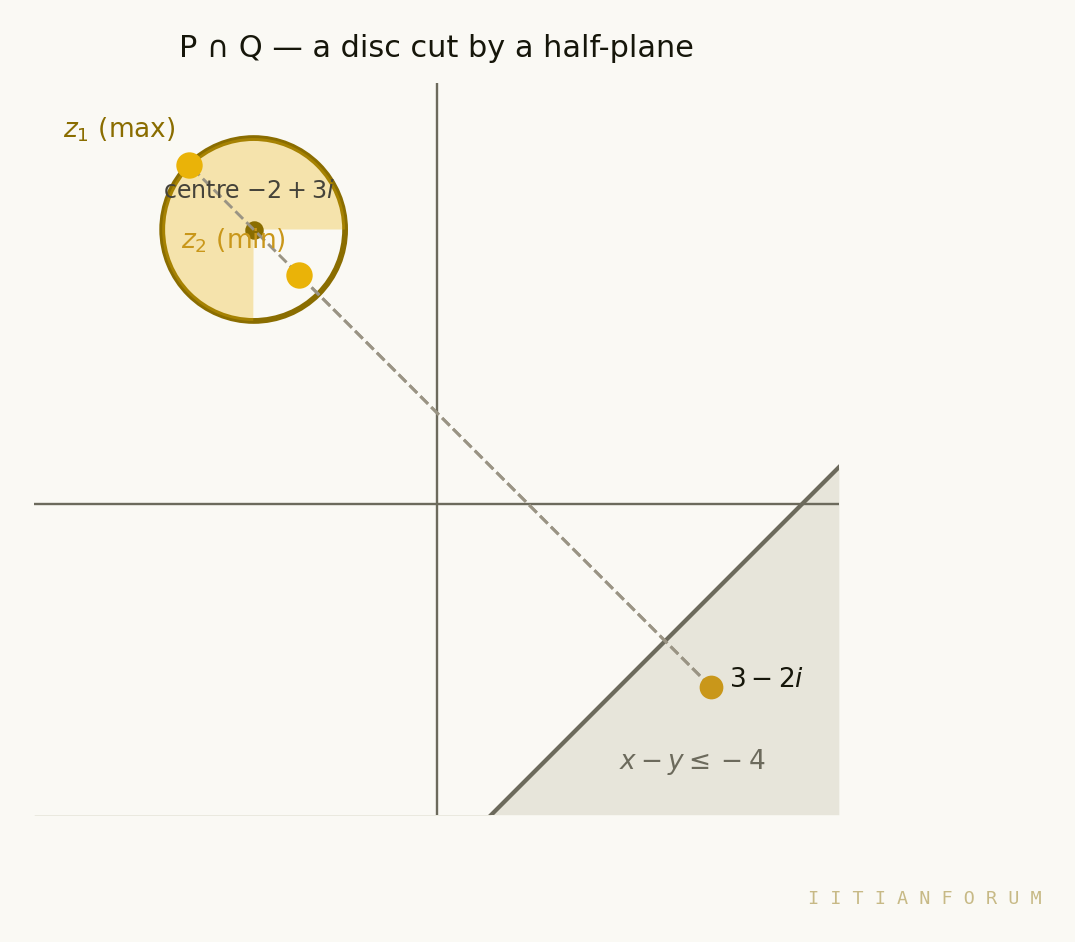
A region cut by a half-plane. A condition of the form (with complex, real) is always a half-plane, because is a real linear function of and . Intersecting it with a disc leaves a circular segment, and the extremes of a distance over that segment sit either on the arc or on the straight edge — you must test both.
Example 22 (JEE Main 2024, 1 Feb Shift 1). Let and . In , let be greatest at and least at . If with integers, find .
▸ SHOW SOLUTION
Step 1: Read . A closed disc, centre , radius .
Step 2: Read . With , , so is the half-plane
Step 3: Do they overlap? At the centre we get , so the centre is inside . The distance from the centre to the boundary line is , so the line genuinely cuts the disc: is a circular segment.
Step 4: The target point. is the distance to , and
Step 5: The maximum. The farthest point of the whole disc from is the centre pushed one unit away from :
Check it lies in : . It does, so the maximum is unaffected by the cut.
Step 6: The minimum — this is where the cut bites. The nearest point of the disc alone would be the centre pushed one unit towards , at , where — outside . So the minimum must lie on the straight edge. Dropping a perpendicular from to gives the foot
which is from the centre, so it really is on the segment.
Step 7: Compute.
Step 8: , , so
The lesson. The maximum was decided by the circle and the minimum by the line. Testing only the circle gives the minimum wrong; testing only the line gives the maximum wrong. Always check whether the unconstrained extreme survives the cut.
The shape JEE Main 2026 kept setting
Three of the 2026 questions were built the same way: one circle, one sum-of-distances condition, count the common points. The trick is always to check whether the sum-of-distances condition is a genuine ellipse or has degenerated.
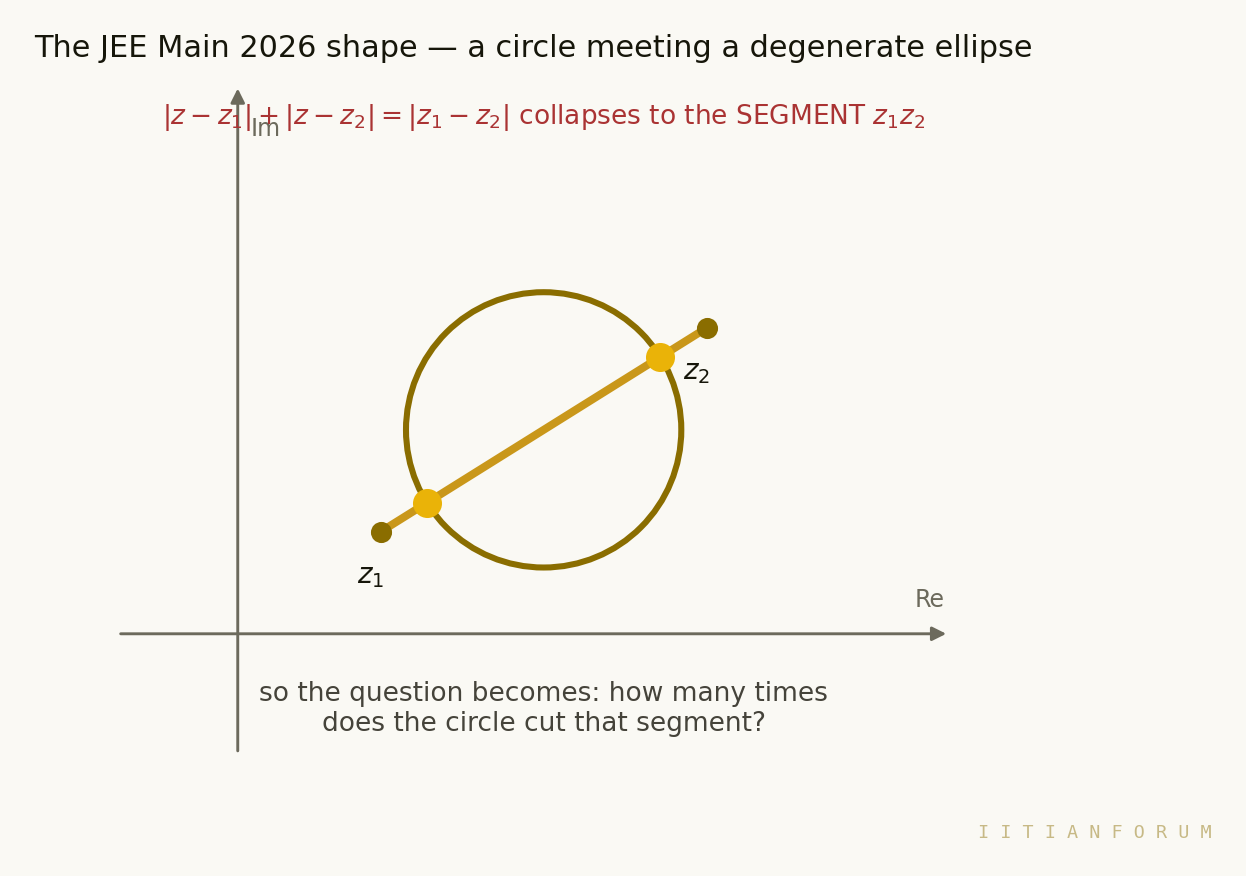
Example 23 (JEE Main 2026, 8 Apr Shift 2). Find the number of satisfying
▸ SHOW SOLUTION
Step 1: Identify the ellipse. The foci are and . Their separation is
so , giving . The constant is , so . Since exceeds , this is a genuine ellipse.
Step 2: Find the semi-minor axis.
Step 3: Locate the circle. Its centre is the midpoint of the foci, which is exactly the centre of the ellipse. So the two curves are concentric. Its radius is .
Step 4: Compare radius with semi-axes. The circle's radius is , and the semi-minor axis is also , while the semi-major axis is . So the circle is inscribed in the ellipse touching it exactly where the ellipse is nearest its centre — the two ends of the minor axis.
Answer: common points.
Why the numbers were chosen. Set against : if the circle is strictly inside and there are solutions; if it touches at points; if it cuts at ; if it touches at again (the major-axis ends); if there are . The examiner picked the one value of that gives exactly by tangency rather than by crossing.
Example 24 (JEE Main 2026, 28 Jan Shift 2). Let and . Describe .
▸ SHOW SOLUTION
Step 1: is the closed disc of centre , radius .
Step 2: . Foci and are apart, and , so is a genuine ellipse: centre , so , , .
Step 3: Picture them together. The ellipse runs from to ; the disc is centred at with radius , so it spans . The two overlap over the right-hand portion of the ellipse.
Step 4: The intersection is therefore an arc of the ellipse, not a finite set of points — the part of lying within distance of the point .
The toolkit card
| You see | You write |
|---|---|
| circle, centre , radius | |
| divide by first — radius is | |
| perpendicular bisector | |
| Apollonius circle | |
| arc; gives the circle on as diameter | |
| ellipse if ; segment if equal; empty if less | |
| hyperbola if | |
| purely real | collinear |
| purely imaginary | |
| "rotate through " | multiply by |
| diagonals bisect — parallelogram | |
| max/min of on a circle | , on the line |
- Substituting immediately. Nine of the thirteen 2026 questions are solved faster by reading the geometry. Expand only when you must.
- Forgetting to divide out the coefficient of . has radius , not .
- Not testing an ellipse condition for degeneracy. If the "ellipse" is a segment; if it is empty.
- Ignoring the quadrant in an condition. holds for both and ; check the signs.
- Applying quadrilateral tests to vertices not in cyclic order. Every test then fails on a perfectly good square.
- Treating as single-valued. It is defined modulo ; the principal value lives in .
Name each locus without writing anything:
· · · ·
Answers: perpendicular bisector of and ; an Apollonius circle; the circle on the segment from to as diameter; the segment from to (degenerate, since ); the circle centre radius .