Properties of Definite Integrals: The Complete JEE Method
Ritesh Raj · 23 Aug 2026
Aa
23 min read18 sectionsConcept
A definite integral is a number. That single sentence decides most of what follows: a number can be estimated, compared, bounded, split, reflected and paired, and none of those moves need the antiderivative that a beginner reaches for first.
Most JEE questions on this chapter are built on that gap. They hand you an integrand whose antiderivative does not exist in closed form, then reward you for noticing a symmetry. ∫π/245π/241+3tan2xdx has no elementary antiderivative. It still takes about forty seconds.
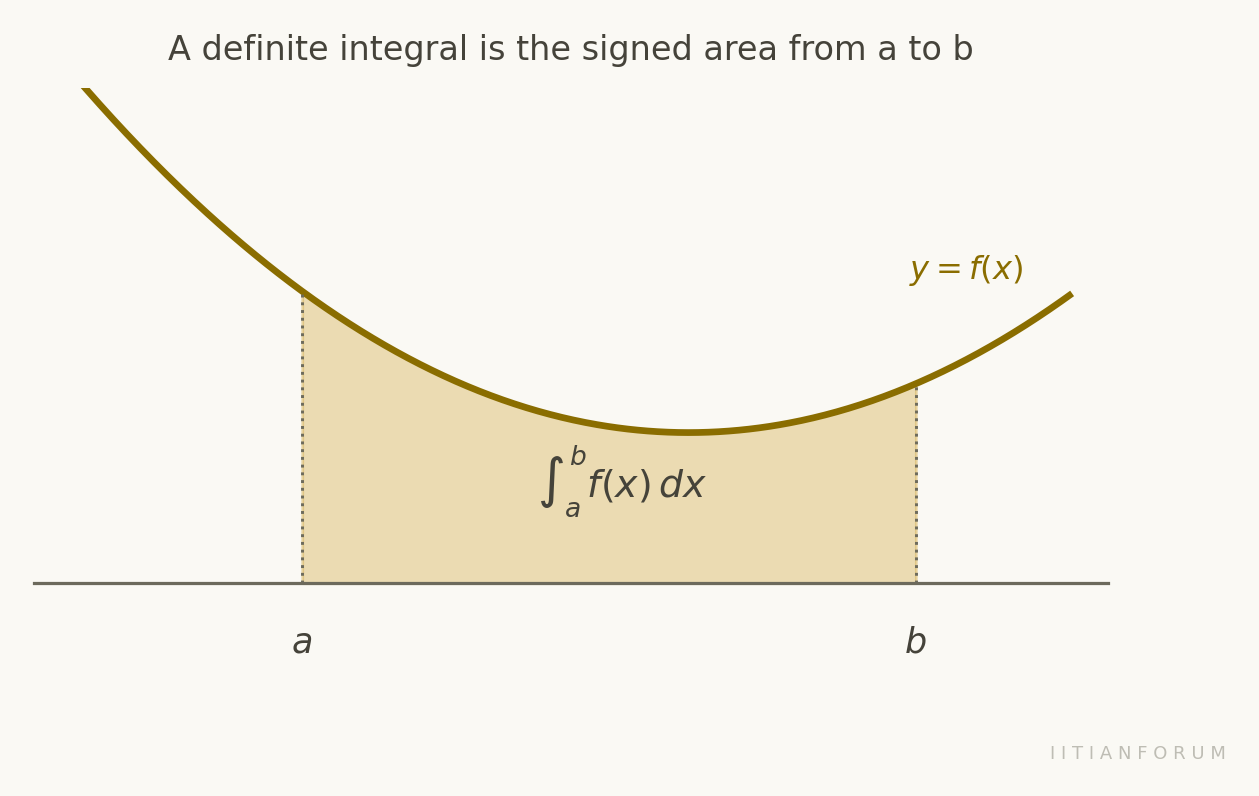
Definite integral as signed area under a curve, with the area above the axis counted positive and below negative
Fundamental concept of the definite integral
Everything in this chapter follows from one distinction. Read this table across, not down.
Indefinite integral ∫f(x)dx
Definite integral ∫abf(x)dx
1. Definition
The family of all antiderivatives, ϕ(x)+C where ϕ′=f
The single number ϕ(b)−ϕ(a)
2. What it produces
A function of x
A real number, no x left in it
3. Role of the variable
x survives into the answer
x is a dummy: ∫abf(x)dx=∫abf(t)dt
4. Constant of integration
Essential, the answer is wrong without it
Cancels in the subtraction, never write it
5. Geometrical meaning
None on its own
Signed area between the curve and the x-axis from a to b
6. Effect of swapping limits
Not applicable
Sign flips: ∫ab=−∫ba
swipe for more →
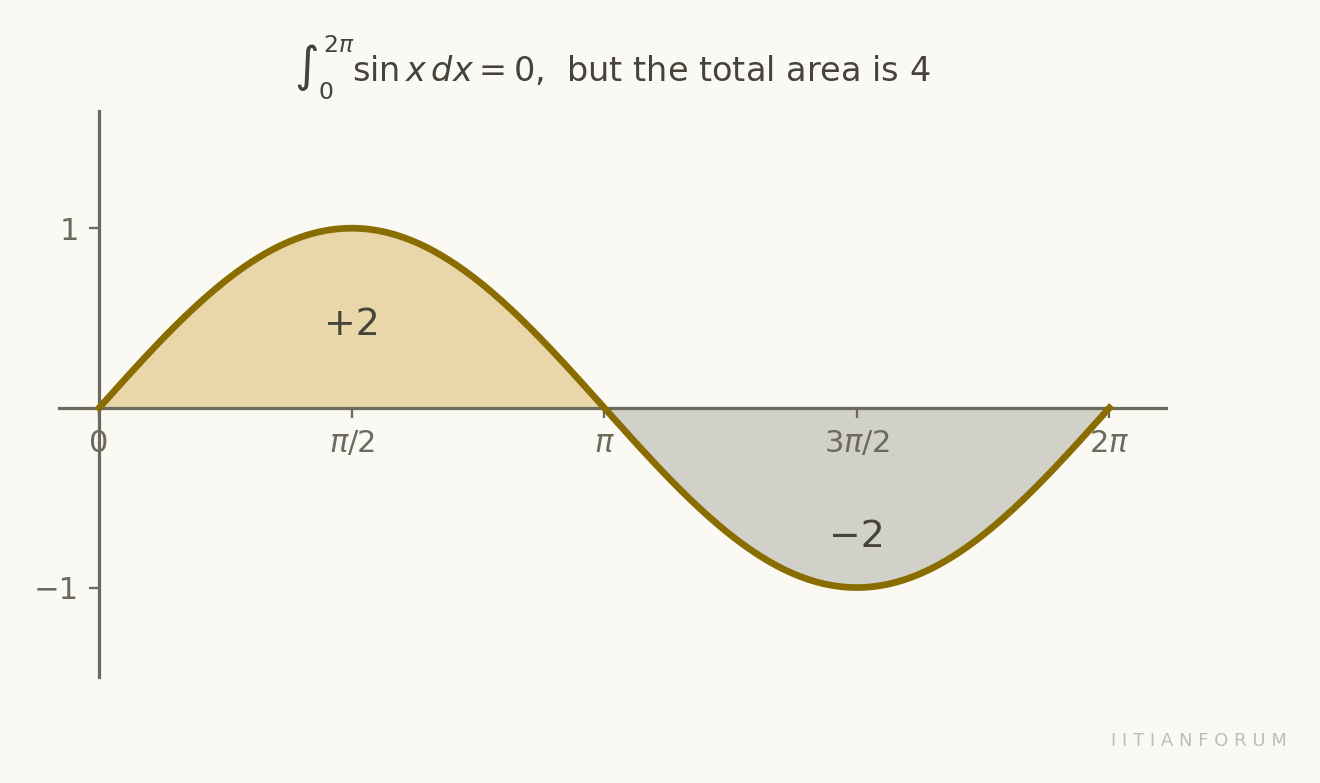
The word signed in row 5 is where marks are lost. Area is never negative; a definite integral often is. Where the curve dips below the axis the strip contributes a negative amount, so ∫02πsinxdx=0 even though the curve encloses a total area of 4.
Signed area: the region above the axis counted positive, the region below counted negative, and the two cancelling for sin x over one full period
The first trap of the chapter
"Area under the curve" and "the definite integral" are not synonyms. If a question asks for area, you integrate ∣f(x)∣, which means splitting at every root of f. If it asks for the integral, you do not split. Reading the wrong one costs the whole question.
The six properties, in one table
Property
Statement
What it is really for
I
Dummy variable
∫abf(x)dx=∫abf(t)dt
Lets you rename before pairing two integrals
II
Interchanging limits
∫abf(x)dx=−∫baf(x)dx
Fixes orientation after a substitution
III
Splitting
∫abf=∫acf+∫cbf
Handles modulus, greatest integer, piecewise
IV
King
∫abf(x)dx=∫abf(a+b−x)dx
The workhorse of the chapter
V
Doubling on [0,2a]
∫02af=∫0af(x)dx+∫0af(2a−x)dx
Collapses to 0 or 2∫0af
VI
Odd and even
∫−aaf=0 if f odd, =2∫0af if f even
Kills half the integrand on sight
swipe for more →
Property III does not require c to lie between a and b. That is worth remembering, because it lets you write ∫−42=∫−4−1+∫−12 and also ∫12=∫15+∫52 when the second form is the one you can compute.
Property IV, the king property
∫abf(x)dx=∫abf(a+b−x)dx
Why it is true
Put t=a+b−x, so dt=−dx. When x=a, t=b; when x=b, t=a.
∫abf(a+b−x)dx=∫baf(t)(−dt)=∫abf(t)dt
and by Property I that last integral is ∫abf(x)dx.
What it means geometrically
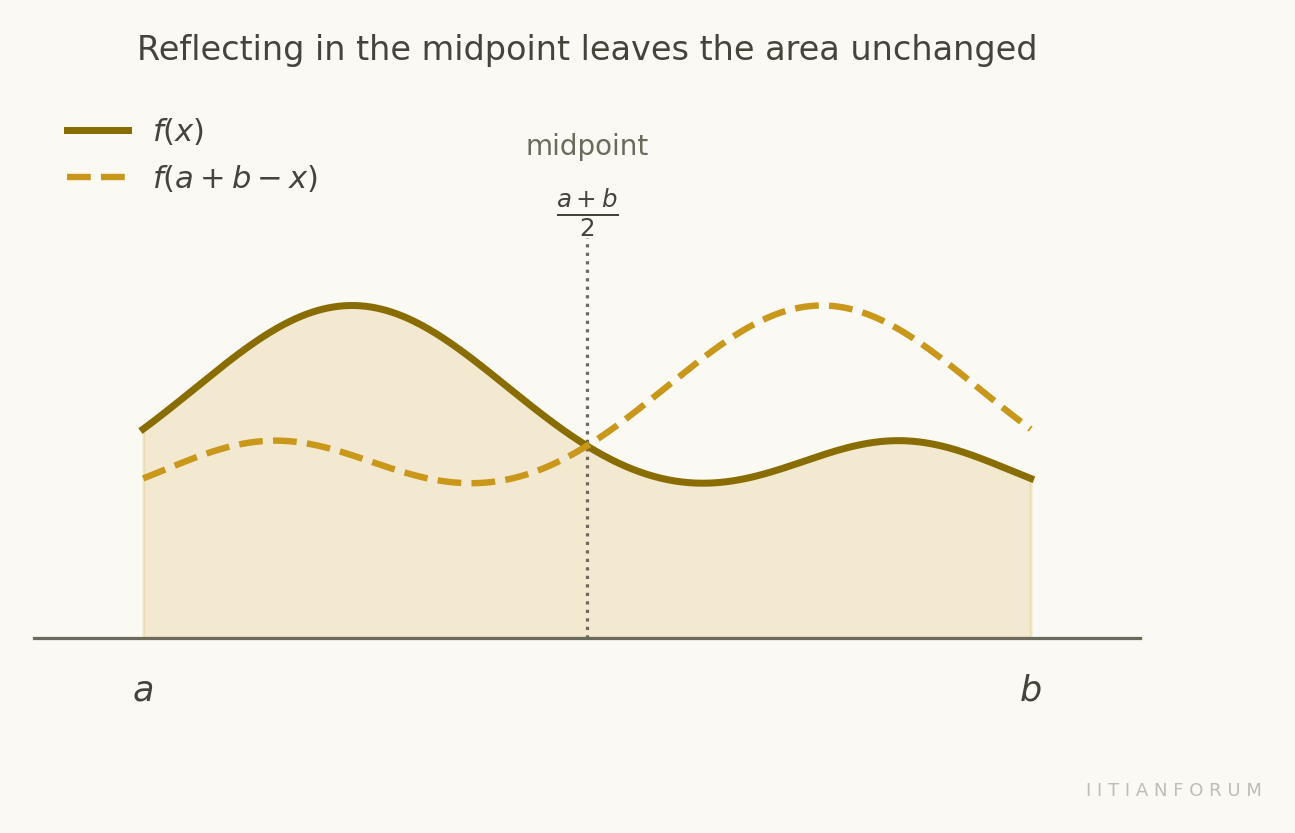
x↦a+b−x is the reflection of the interval [a,b] in its own midpoint 2a+b. So the property says: flip the graph left-to-right about the midpoint of the interval and the area does not change. That is obvious once you see it, and it is the whole content of the property.
Reflection of a curve about the midpoint of the interval of integration, showing the two shaded regions have equal area
The pattern that makes it pay
King is worth using when f(x)+f(a+b−x) is simpler than either piece. Two shapes account for almost every JEE question:
If f(x)+f(a+b−x)=k, then ∫abf(x)dx=2k(b−a)If f(x)=g(x)+g(a+b−x)g(x), then ∫abf(x)dx=2b−a
The second is the first in disguise, with k=1.
How to spot it in three seconds
Add the two limits. If a+b is a round number like 2π, π, 1, 5 or 2π, and the integrand contains tan, cot, sin, cos or a ratio of the form g+hg, try king before anything else.
The one statement that is false
This is the classic two-statement question, and it has been asked in almost exactly this form more than once.
Example 1.(IIT JEE 2013) Statement I: ∫π/6π/31+tanxdx=6π. Statement II: ∫abf(x)dx=∫abf(a+b−x)dx. Which is correct?
▸ SHOW SOLUTION
Step 1: Statement II is Property IV, so it is true
The trap is not the mathematics. It is stopping at 2I and copying that number down. Every king-property question ends with a division by two, and the wrong option is always waiting there.
Three ways king goes wrong
Forgetting the halving.2I=k(b−a) is not the answer.
Using the wrong reflection. The map is x↦a+b−x, built from the actual limits. On ∫π/6π/3 it is x↦2π−x, not x↦π−x.
Applying it across a discontinuity. King is a substitution, and a substitution needs the integrand to be integrable on the whole interval. ∫−11x2dx is not 2∫01x2dx; both sides are meaningless, because the integrand blows up at 0.
Odd, even and the two symmetries
Property VI is the special case of Property IV in which the midpoint is the origin. It is worth separating the two symmetries a question can hand you, because students routinely apply the first when only the second is available.
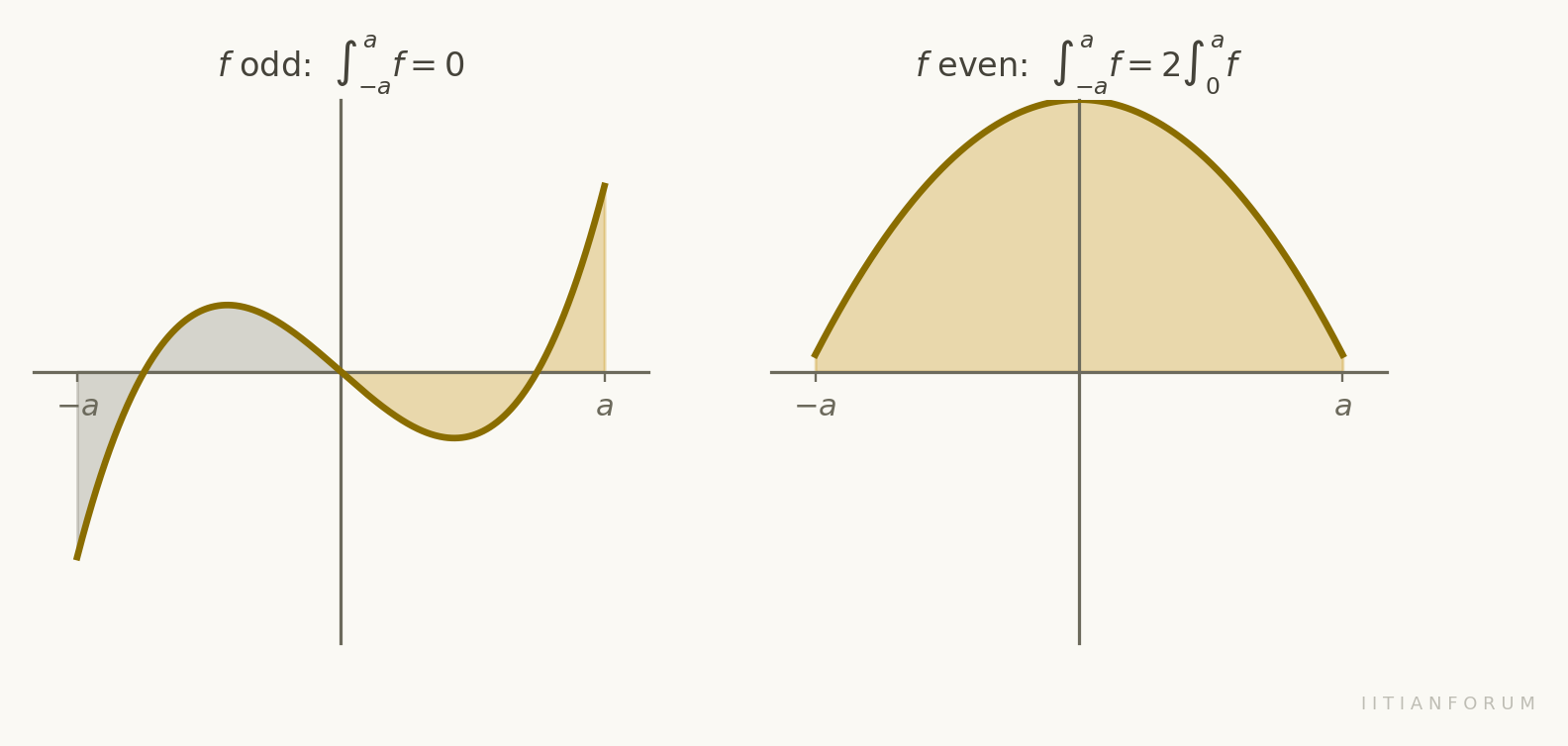
The value of this is not that it saves arithmetic. It is that it lets you delete terms before you integrate anything. In a sum f=fodd+feven over a symmetric interval, the odd part contributes nothing at all, so you never compute it.
An odd function on a symmetric interval, with the two shaded regions equal in size and opposite in sign
Example 2.(JEE Main 2026, 21 Jan Shift 1) Find ∫−π/6π/61−sin(∣x∣+6π)π+4x11dx.
▸ SHOW SOLUTION
Step 1: Split the numerator
The denominator 1−sin(∣x∣+6π) contains ∣x∣, so it is an even function of x.
Step 2: Classify each piece
1−sin(∣x∣+6π)π is even. 1−sin(∣x∣+6π)4x11 is odd over even, so it is odd.
Read f(2a−x)=f(x) as "the graph is symmetric about the vertical line x=a", and f(2a−x)=−f(x) as "the graph has a half-turn centre at (a,0)".
Why these are the same theorem
Shift by a. Setting g(u)=f(u+a) turns [0,2a] into [−a,a], and f(2a−x)=f(x) becomes g(−u)=g(u). Odd and even about the origin, and the two symmetries about x=a, are one statement seen from two positions.
The boundary case: when the integrand breaks
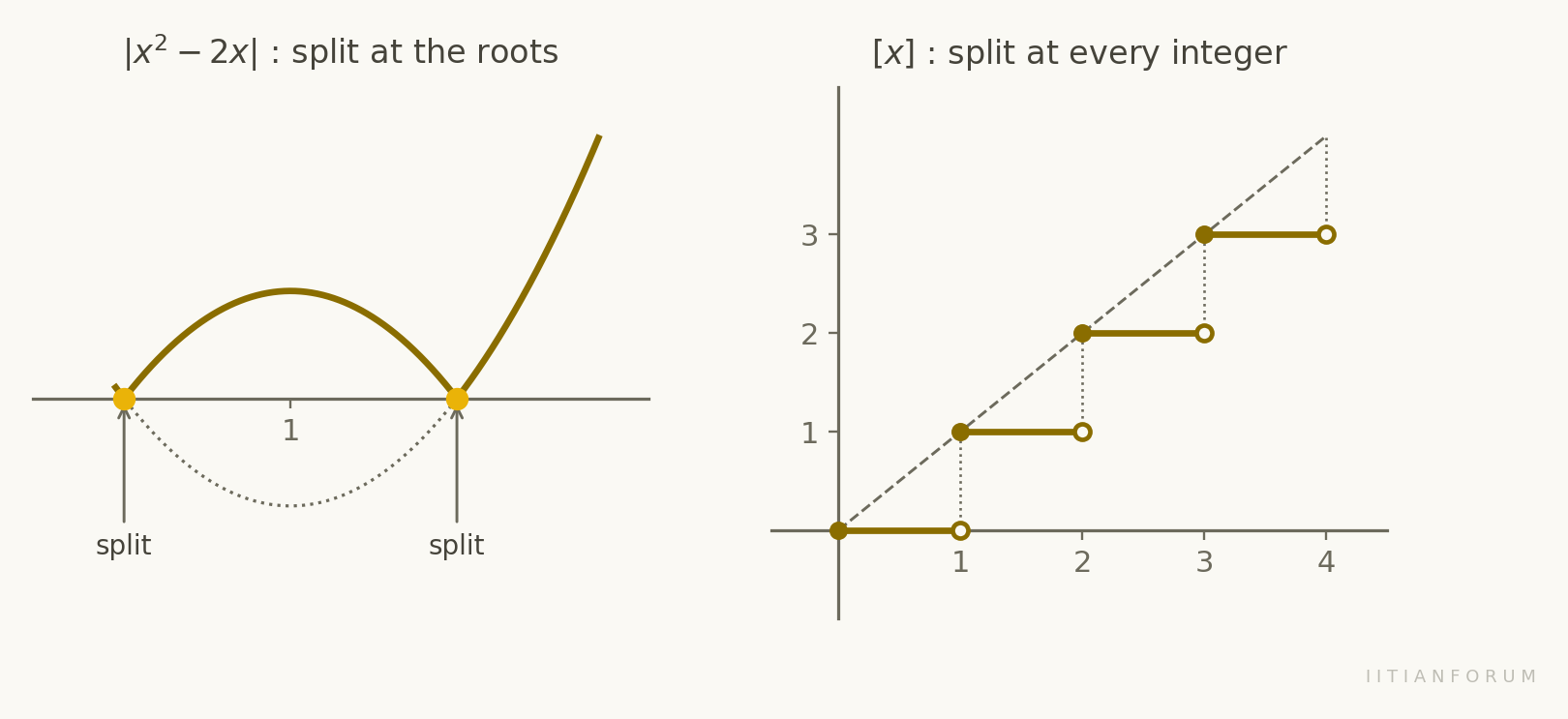
Everything above assumed the integrand is continuous. The interesting questions are the ones where it is not, and the fix is always Property III: split the interval at every point where the formula changes, then integrate each piece with its own formula.
Three kinds of break come up:
Break
Where to split
Typical integrand
Modulus
At every root of the inside expression
∣sinx∣, ∣x2+2x−3∣
Greatest integer
At every integer value of the inside expression
[x], [2sinx], [xsinx]
Piecewise definition
At every changeover point given in the definition
f(x)={⋯
swipe for more →
A step function and a modulus function on the same axes, with the split points marked on the x-axis
The split points are not always the obvious ones
For ∫−22[xsinx]dx the split is not at the integers −1,0,1. It is where xsinx crosses an integer, and on [0,2] that happens once, at the root of xsinx=1. Find where the inside changes value, not where x does.
Type 1, king property
Example 3.(JEE Main 2026, 23 Jan Shift 1) Evaluate ∫π/245π/241+3tan2xdx.
▸ SHOW SOLUTION
Step 1: Check the limit sum
a+b=24π+245π=246π=4π, so the reflection is x↦4π−x.
Whenever the denominator is 1+ag(x) with g odd about the midpoint, king turns the integrand into its own complement and the exponential vanishes completely. It works for 1+esinx, 1+πx, 1+2tanx, 1+ax alike, and the base never appears in the answer. Seeing that the base is irrelevant is the fastest way to confirm you are on the right track.
Example 5.(JEE Main 2026, 4 Apr Shift 2) Evaluate ∫01cot−1(1+x+x2)dx.
▸ SHOW SOLUTION
Step 1: Turn the cot−1 into a difference
1+x+x2=1+x(1+x), and the identity cot−1(1+uv)=tan−1u−tan−1v holds when uv>−1. With u=1+x, v=x:
cot−1(1+x+x2)=tan−1(1+x)−tan−1x
Step 2: Split
I=∫01tan−1(1+x)dx−∫01tan−1xdx
Step 3: Shift the first integral
Put u=1+x in the first: it becomes ∫12tan−1udu. So
Using cos2x=1+t21−t2, the integrand becomes 3−t22(1+t2) and dx=1+t2dt:
I=∫1/313−t22dt=232[loge3−t3+t]1/31
Step 4: Put in the limits
At t=1: 3−13+1. At t=31: 3−313+31=2/34/3=2.
I=31[loge3−13+1−loge2]
Step 5: Simplify the bracket
3−13+1=2(3+1)2=2+3, so the bracket is loge(22+3).
Now rationalise the other way: (3−1)21=4−231=44+23=22+3. So the bracket is loge(3−1)−2=−2loge(3−1).
Step 6: Read off α
I=−32loge(3−1)⇒α=−32,9α2=9⋅34=12
Type 2, odd and even
Example 9.(JEE Main 2026, 6 Apr Shift 2) Find ∫−11x2+2∣x∣+1x3+∣x∣+1dx.
▸ SHOW SOLUTION
Step 1: Note the denominator is even
x2+2∣x∣+1=(∣x∣+1)2 depends only on ∣x∣, so it is even.
Step 2: Split the numerator into odd and even parts
(∣x∣+1)2x3 is odd. (∣x∣+1)2∣x∣+1=∣x∣+11 is even.
Step 3: Delete the odd part and double the even part
I=2∫01x+1dx=2[loge(x+1)]01=2loge2
Example 10.(IIT JEE 2012) Evaluate ∫−π/2π/2[x2+loge(π+xπ−x)]cosxdx.
▸ SHOW SOLUTION
Step 1: Classify the two terms
x2cosx is even. For the second, logeπ−xπ+x=−logeπ+xπ−x, so logeπ+xπ−x is odd and, multiplied by the even cosx, stays odd.
Step 2: Delete the odd term
I=2∫0π/2x2cosxdx
Step 3: Integrate by parts twice
∫x2cosxdx=x2sinx+2xcosx−2sinx
Step 4: Substitute the limits
At x=2π this is 4π2+0−2; at x=0 it is 0.
I=2(4π2−2)=2π2−4
Example 11.(IIT JEE 2009) If In=∫−ππ(1+πx)sinxsinnxdx for n=0,1,2,…, which of the following hold?
(a) In=In+2 (b) ∑m=110I2m+1=10π (c) ∑m=110I2m=0 (d) In=In+1
▸ SHOW SOLUTION
Step 1: Kill the 1+πx with king
The interval is symmetric, so the reflection is x↦−x, and sin(−x)sin(−nx)=sinxsinnx is unchanged.
In=∫−ππ(1+πx)sinxπxsinnxdx
Step 2: Add the two forms
2In=∫−ππsinxsinnxdx=2∫0πsinxsinnxdx
because sinxsinnx is even. So In=∫0πsinxsinnxdx.
Odd index gives π every time, so ∑m=110I2m+1=10π, which is (b). Even index gives 0 every time, so ∑m=110I2m=0, which is (c). And I1=I2, so (d) fails.
Correct: (a), (b), (c).
Type 3, greatest integer and fractional part
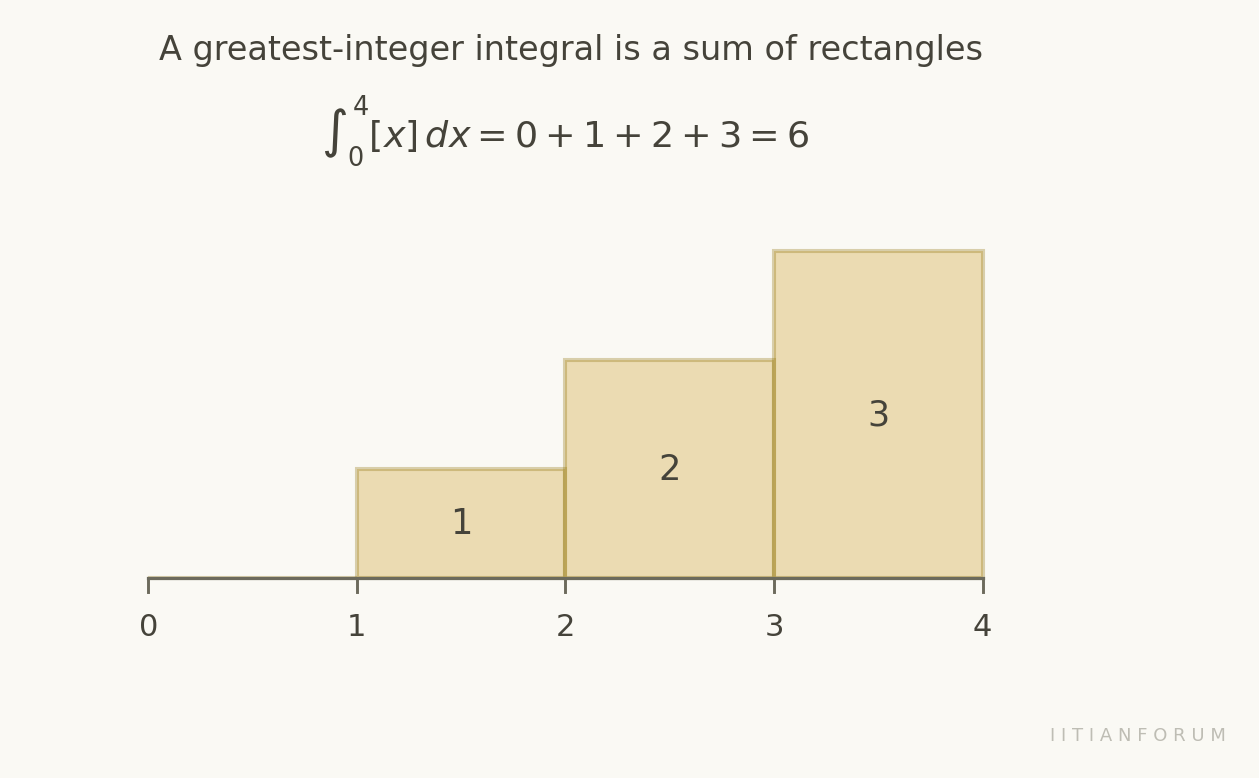
The rule never changes: find where the inside crosses an integer, split there, and replace [⋅] by the constant it equals on each piece.
The greatest integer function drawn as a staircase, with the area under it read as a sum of rectangles
Example 12.(IIT JEE 2001) Evaluate ∫π/23π/2[2sinx]dx, where [⋅] is the greatest integer function.
▸ SHOW SOLUTION
Step 1: Track 2sinx across the interval
On [2π,23π], 2sinx decreases from 2 down to −2.
Step 2: Find the crossing points
2sinx=1 at x=65π; 2sinx=0 at x=π; 2sinx=−1 at x=67π.
Example 18.(IIT JEE 2014) Evaluate ∫0π1+4sin22x−4sin2xdx.
▸ SHOW SOLUTION
Step 1: Recognise the perfect square
1−4sin2x+4sin22x=(1−2sin2x)2, so the integrand is 1−2sin2x.
Step 2: Find where the inside changes sign
1−2sin2x=0 gives sin2x=21, that is 2x=6π, so x=3π.
Step 3: Determine the sign
On (0,3π), sin2x<21, so the inside is positive. On (3π,π) it is negative.
Step 4: Split
I=∫0π/3(1−2sin2x)dx+∫π/3π(2sin2x−1)dx
Step 5: Use the antiderivative x+4cos2x
I=[x+4cos2x]0π/3−[x+4cos2x]π/3π
Step 6: Evaluate
I=(3π+23−4)−(0+4−3π−23)=43−4−3π
Example 19.(JEE Main 2026, 8 Apr Shift 2) Let f(x)=31 for x≤2π and f(x)=(π−2x)2b(1−sinx) for x>2π. If f is continuous at x=2π, find ∫03b−6x2+2x−3dx.
▸ SHOW SOLUTION
Step 1: Take the right-hand limit
Put x=2π+h. Then 1−sinx=1−cosh and π−2x=−2h.
h→0lim4h2b(1−cosh)=4b⋅21=8b
Step 2: Match it to 31
8b=31 gives b=38, so the upper limit is 3b−6=8−6=2.
Step 3: Factorise the modulus
x2+2x−3=(x+3)(x−1), negative on (−3,1) and positive outside.
Step 4: Split at x=1
I=∫01(3−2x−x2)dx+∫12(x2+2x−3)dx
Step 5: Evaluate
First piece: [3x−x2−3x3]01=3−1−31=35.
Second piece: [3x3+x2−3x]12=(38+4−6)−(31+1−3)=32+35=37.
Step 6: Add
I=35+37=4
Type 5, periodic integrands
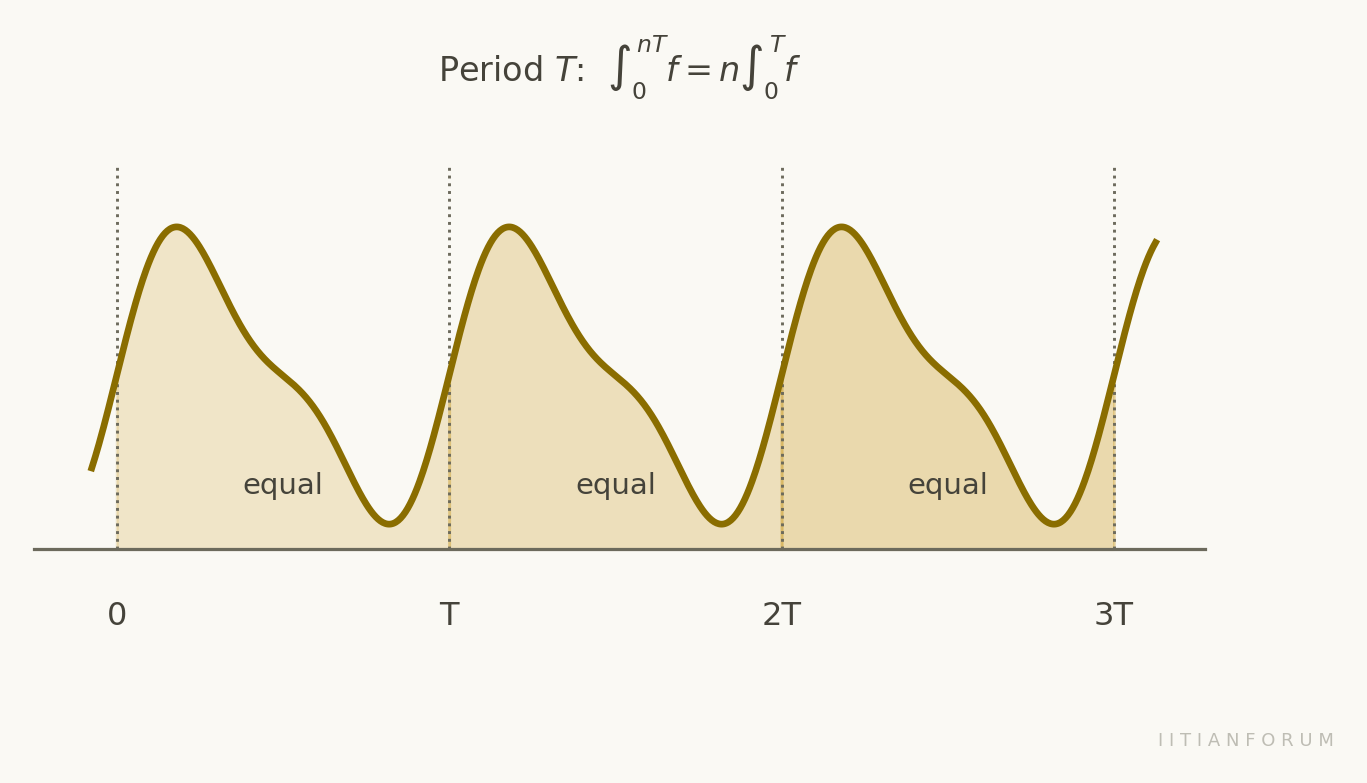
If f has period T, an integral over any whole number of periods does not care where it starts.
∫aa+Tf(x)dx=∫0Tf(x)dxand∫0nTf(x)dx=n∫0Tf(x)dxA periodic curve with three consecutive period-blocks shaded to show they carry equal area
When a definite integral has constant limits, it is a number, so it can be given a name and solved for. This turns a functional equation into ordinary algebra.
Example 23.(JEE Main 2026, 24 Jan Shift 2) If f(x)=ex+∫01(y+xex)f(y)dy, find e+f(0).
Note that B was never needed. Whenever one of the named constants cancels, stop chasing it.
Example 24.(JEE Main 2026, 24 Jan Shift 1) A differentiable f satisfies ∫036f(36tx)dt=4αf(x). If y=f(x) is a standard parabola through (2,1) and (−4,β), find βα.
▸ SHOW SOLUTION
Step 1: Identify the parabola
A standard parabola of the form y=4ax2 through (2,1) gives 1=4a4, so a=1 and f(x)=4x2.
Type 7, Newton–Leibnitz inside a definite integral
When the unknown function sits inside an integral whose upper limit is x, differentiate instead of integrating. That is the Newton–Leibnitz rule:
dxd∫u(x)v(x)f(t)dt=f(v(x))v′(x)−f(u(x))u′(x)
Constant limits versus variable limits
Constant limits mean the integral is a number: name it and solve algebraically, as in Type 6. A variable upper limit means the integral is a function: differentiate it, as here. Deciding which of the two you are looking at is the entire opening move.
Example 25.(JEE Main 2026, 22 Jan Shift 1) Let f:[1,∞)→R be differentiable with 6∫1xf(t)dt=3xf(x)+x3−4 for all x≥1. Find f(2)−f(3).
▸ SHOW SOLUTION
Step 1: Differentiate both sides
6f(x)=3f(x)+3xf′(x)+3x2
Step 2: Rearrange into a linear equation
3f(x)−3xf′(x)=3x2⇒f′(x)−xf(x)=−x
Step 3: Recognise the derivative of a quotient
(xf)′=xf′−x2f=x1(f′−xf)=−1
Step 4: Integrate
xf(x)=−x+C⇒f(x)=−x2+Cx
Step 5: Fix C from the original relation at x=1
The left side is 0, so 0=3f(1)+1−4, giving f(1)=1, hence −1+C=1 and C=2.
Step 6: Evaluate
f(x)=−x2+2x, so f(2)=0 and f(3)=−3.
f(2)−f(3)=3
Example 26.(JEE Main 2026, 23 Jan Shift 2) Find the number of elements of S={x∈[0,100]:∫0xt2sin(x−t)dt=x2}.
▸ SHOW SOLUTION
Step 1: Turn the convolution into a plain integral
Example 27.(JEE Main 2026, 28 Jan Shift 2) Let f(x)=1−2x+∫0xex−tf(t)dt and g(x)=∫0x(f(t)+2)15(t−4)6(t+12)17dt. If p and q are the points of local minimum and maximum of g, find ∣p+q∣.
2.6≤∫1/21f≤3.9, so any valid pair must satisfy m≤2.6 and M≥3.9. Of the offered pairs only m=1,M=12 works.
Example 29.(IIT JEE 2000) Let g(x)=∫0xf(t)dt where 21≤f(t)≤1 for t∈[0,1] and 0≤f(t)≤21 for t∈[1,2]. Bound g(2).
▸ SHOW SOLUTION
Step 1: Split at the changeover
g(2)=∫01f(t)dt+∫12f(t)dt
Step 2: Bound each piece with its own constants
21≤∫01f≤1,0≤∫12f≤21
Step 3: Add the inequalities
21≤g(2)≤23
Decision chart
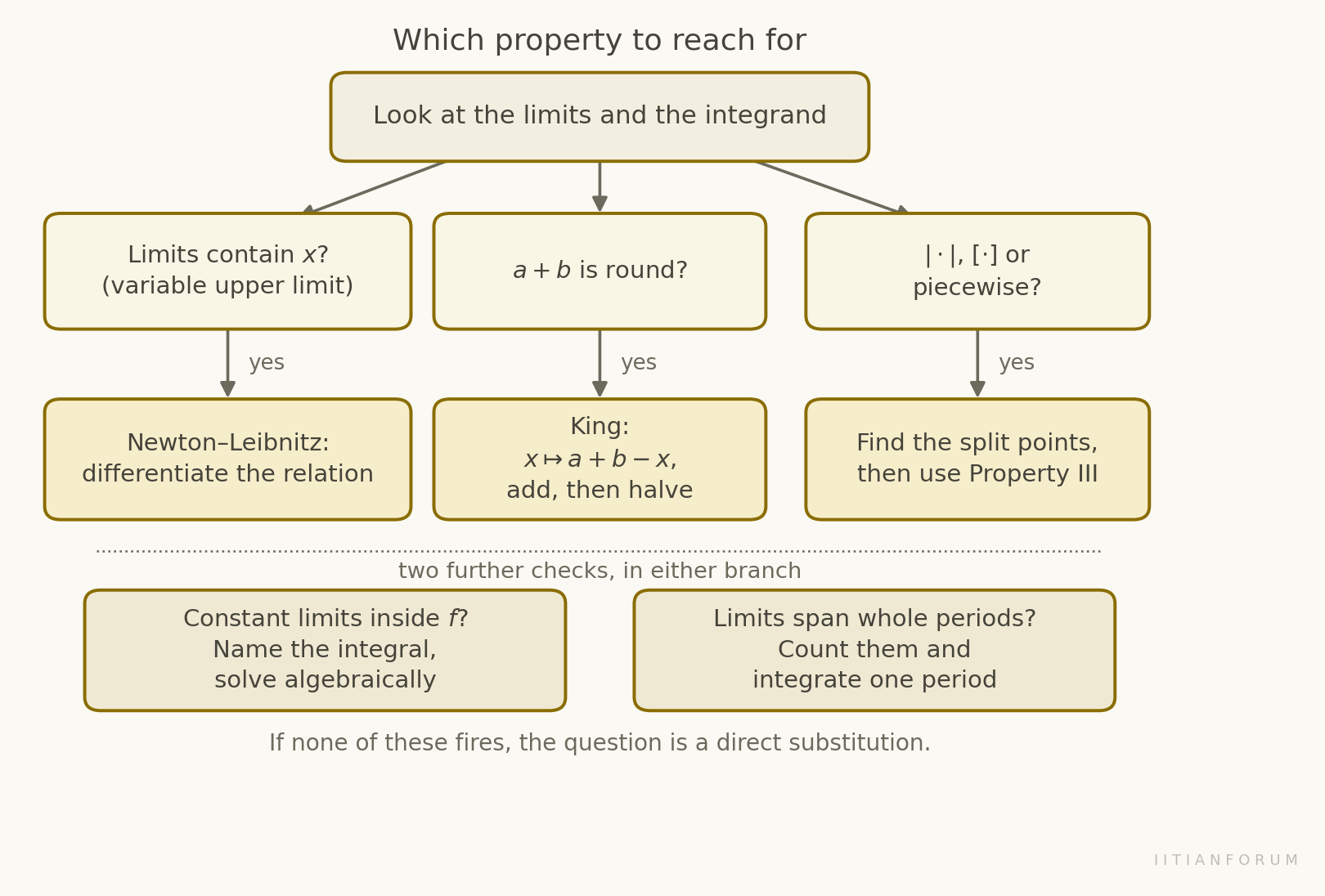
Decision chart for choosing the right definite-integral property from the shape of the integrand
What you see
First move
a+b is round, integrand has tan, cot or g+hg
King, then add and halve
Denominator 1+ag(x) with g odd about the midpoint
King, the base cancels
Limits −a to a
Split into odd and even parts, delete the odd one
Limits 0 to 2a
Test f(2a−x) against f(x)
[⋅] or {⋅} anywhere
Find where the inside crosses an integer, then split
∣⋅∣ anywhere
Find the roots of the inside, then split
Limits are a large multiple of a period
Count periods, integrate one
Integral with constant limits inside the definition of f
Name it, solve algebraically
Integral with variable upper limit
Differentiate, Newton–Leibnitz
Question asks for a range, not a value
Bound the integrand, then integrate the bounds
swipe for more →
Quick recall
Situation
Result
Swap the limits
∫abf=−∫baf
King
∫abf(x)dx=∫abf(a+b−x)dx
f(x)+f(a+b−x)=k
∫abf=2k(b−a)
f(x)=g(x)+g(a+b−x)g(x)
∫abf=2b−a
f odd on [−a,a]
∫−aaf=0
f even on [−a,a]
∫−aaf=2∫0af
f(2a−x)=−f(x)
∫02af=0
f(2a−x)=f(x)
∫02af=2∫0af
f has period T
∫aa+nTf=n∫0Tf
∫0nπ+v∣sinx∣dx
2n+1−cosv
∫0rx∣sinπx∣dx
πr2
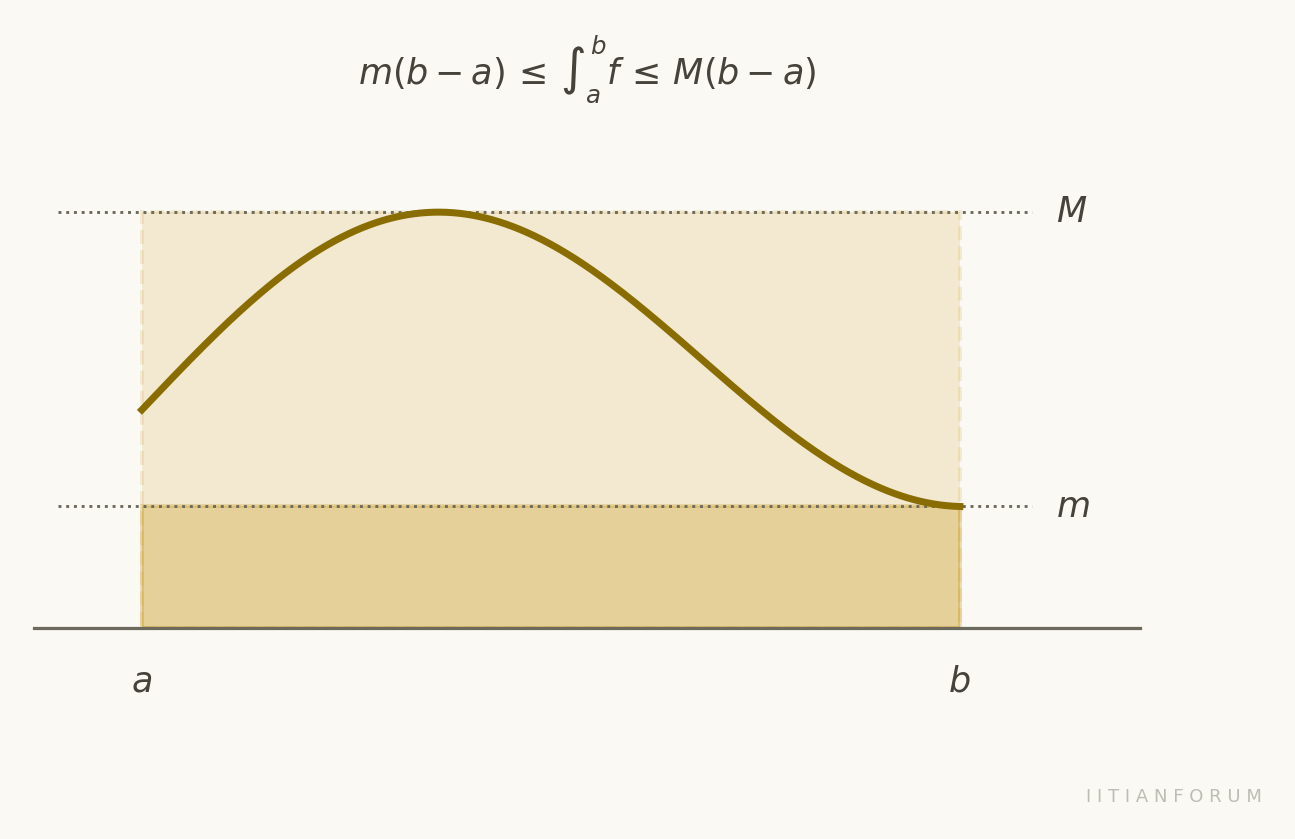
m≤f≤M on [a,b]
m(b−a)≤∫abf≤M(b−a)
Newton–Leibnitz
dxd∫uvf(t)dt=f(v)v′−f(u)u′
swipe for more →
The habit that makes this chapter fast
Before writing a single line, do three checks in this order. One: add the limits and see whether a+b is round. Two: look for ∣⋅∣, [⋅] or a piecewise definition, and if one is there, find the split points first. Three: ask whether the limits are constants or contain x. Those three checks classify nearly every question in this chapter, and each takes about five seconds.
What a wrong start costs you
Reaching for the antiderivative on a king-property question is not a slower route to the same answer. On ∫π/245π/241+3tan2xdx there is no antiderivative to find, so the attempt goes nowhere and takes four minutes to establish that. In an exam where a question is worth about ninety seconds, the cost of the wrong opening move is the question plus two more.
Work through the full chapter with proofs, the complete problem bank and worked solutions in the IITianForum lecture notes PDF, then come back and try the ten shifts you have not seen yet.