Conditional Probability, Total Probability and Bayes' Theorem
Every probability question hands you a sample space. Some questions then hand you something extra: a piece of information that has already come true. "Given that the ball drawn is white." "It is known that the candidate reached late." "Three balls are drawn and all are found to be black." The moment those words appear, the sample space you started with is no longer the sample space you must count in.
Conditional probability is the machinery for that shrinking. Total probability and Bayes' theorem are the two directions you can run it in. Between them they carried six of the nineteen JEE Main 2026 shifts, and they are the single most reliable place in the syllabus to pick up four marks in ninety seconds.
Fundamental concept of conditioning
| Unconditional | Conditional | |
|---|---|---|
| 1. Definition | fraction of occupied by | fraction of occupied by |
| 2. Venn reading | compare with the whole rectangle | compare with the circle |
| 3. Formula | , | |
| 4. What plays the role of "everything" | the sample space | the given event |
| 5. What plays the role of "favourable" | , never |
Row 5 is where marks are lost. Students write . The numerator is the overlap, not the whole of . If you can only remember one line from this post, remember that the numerator and the denominator must both live inside .
Venn diagram of two overlapping circles A and B inside a rectangle S, with the lens-shaped intersection shaded gold and labelled as the favourable part, and B labelled as the new sample space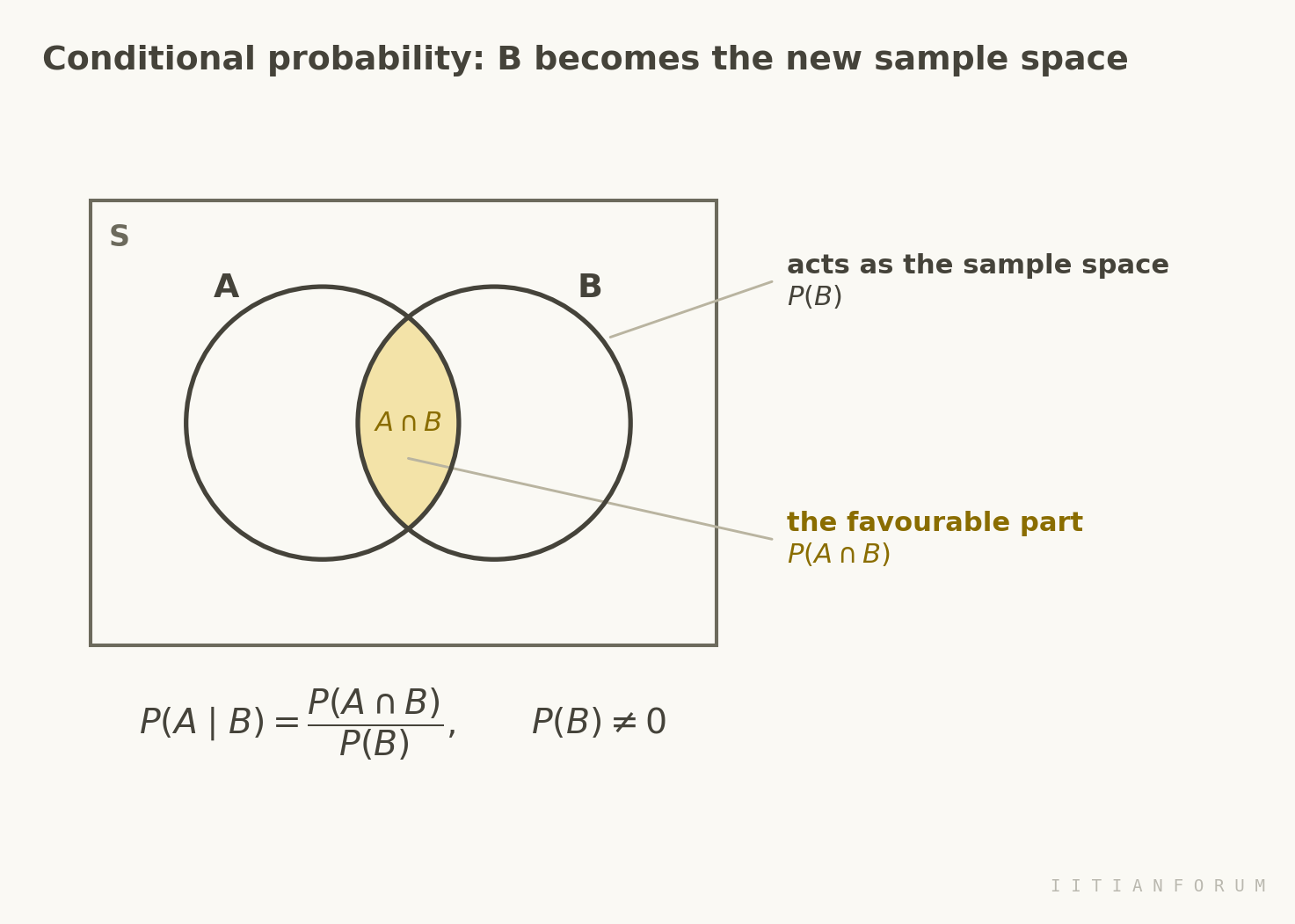
The sample space really does shrink
Here is the same pair of events drawn twice. On the left nothing is known, so the rectangle is the universe and is the share of the rectangle that covers. On the right you have been told happened, so everything outside is dead. The circle is now the universe, and the only part of that survives is .
Two panels side by side. Left panel shows sample space S with circles A and B overlapping. Right panel greys out everything except B, which is outlined in gold, with A shown dashed and only the overlap shaded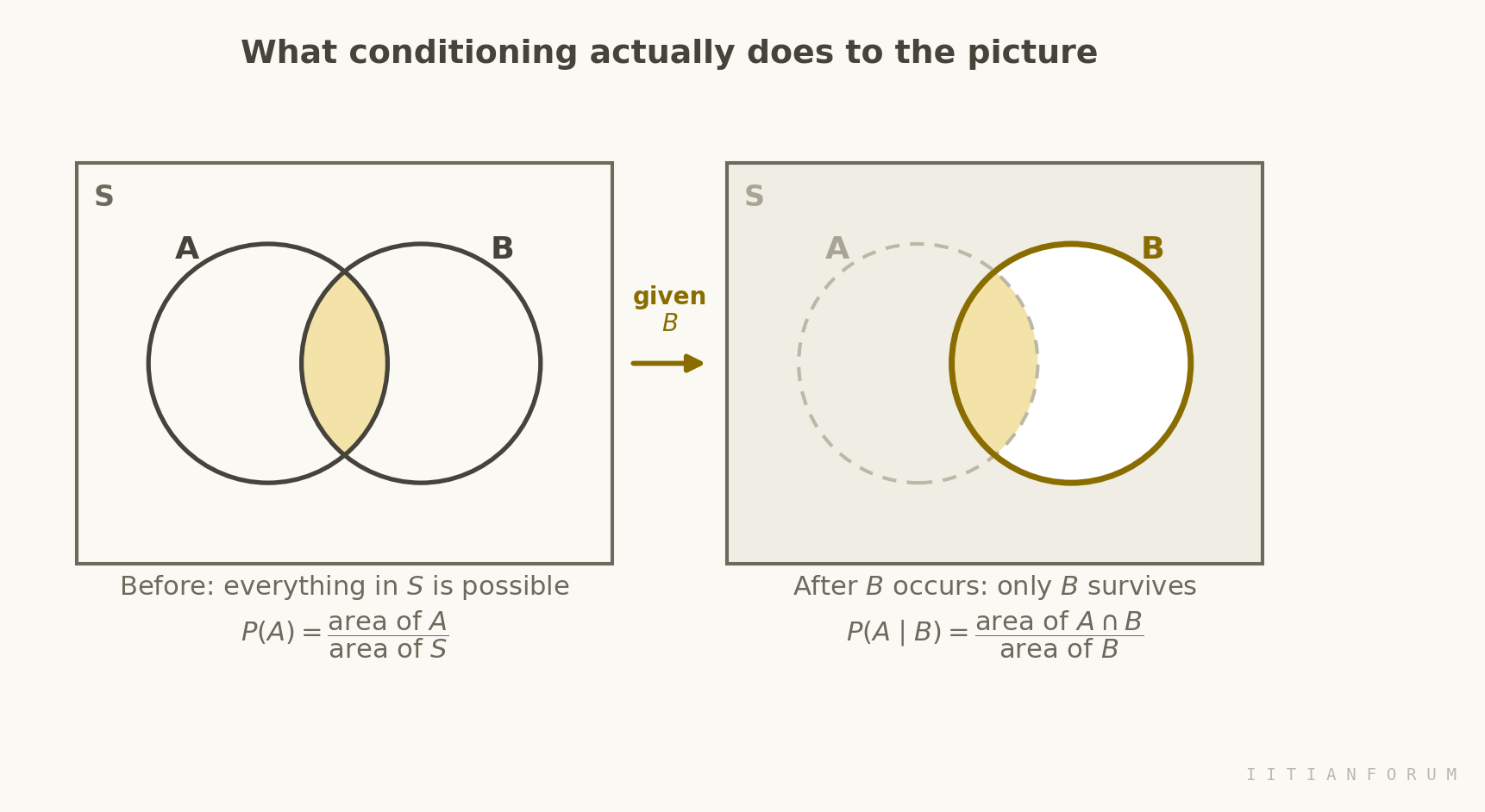
Two consequences follow immediately, and both get asked.
Conditional probability is itself a probability. Fix and let vary. Then satisfies every axiom that does. In particular
Proof in one line: and are disjoint and their union is , so . Divide by .
The addition rule survives conditioning. For any events , and any with ,
Proof: , apply the ordinary addition rule to those two sets, note that , then divide throughout by .
Two panels. Left shows B outlined in gold split into the parts A cap B and A-complement cap B. Right shows a large gold circle E containing two smaller overlapping circles A and B, illustrating the conditional addition rule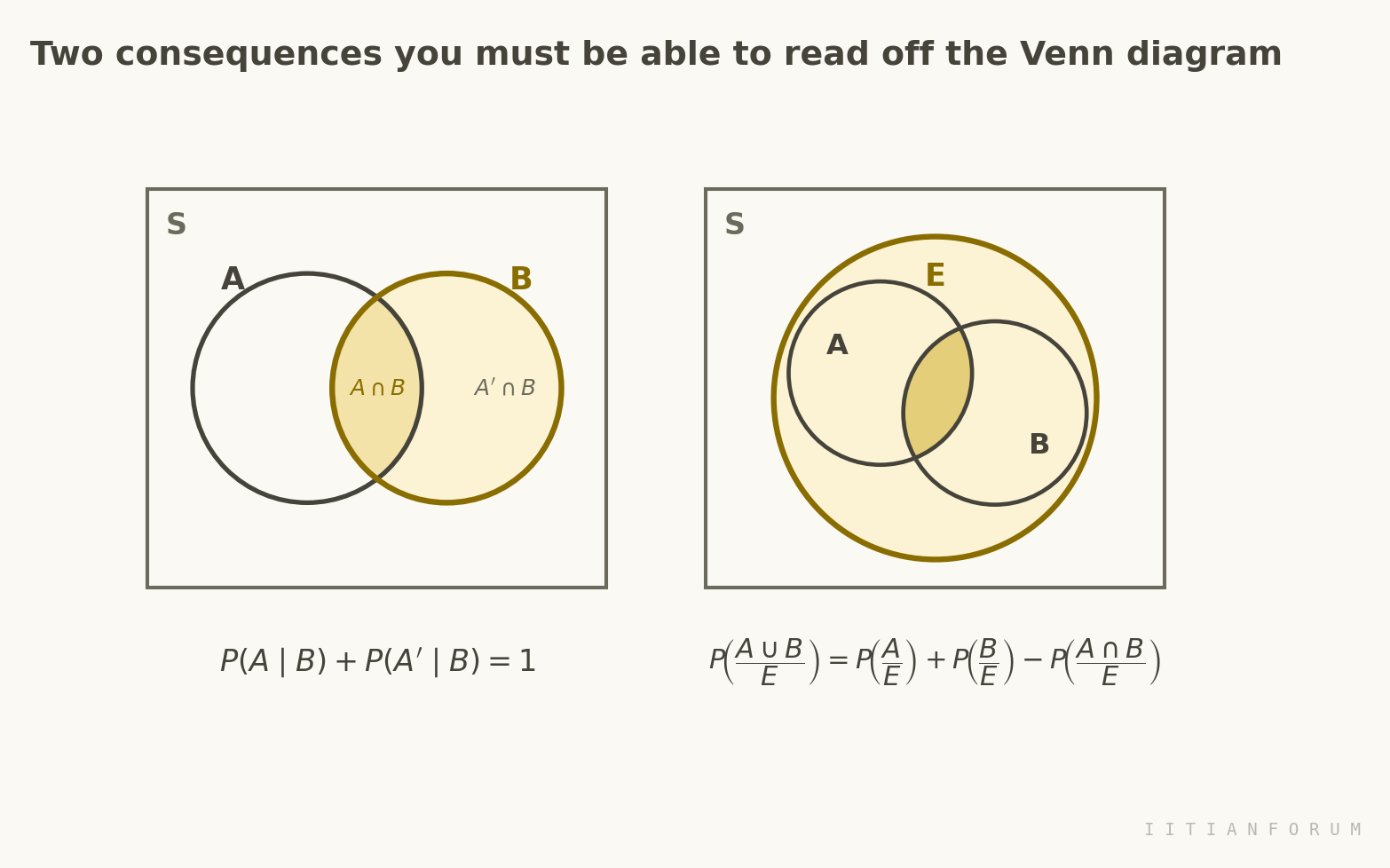
and , because and .
.
always, because forces . If your answer exceeds you divided by the wrong thing.
The multiplication theorem: reading the formula backwards
The definition is usually taught as a way to compute a conditional probability. In JEE it is used far more often in the other direction, cleared of its denominator:
That is the multiplication theorem. It says: to make two things happen, make the first happen, then make the second happen given the first. Drawn as a tree, it says multiply along a path.
Two-stage probability tree from a start node splitting into A and A-complement, with A splitting further into B and B-complement, and the product of the two edge probabilities labelled as P of A intersect B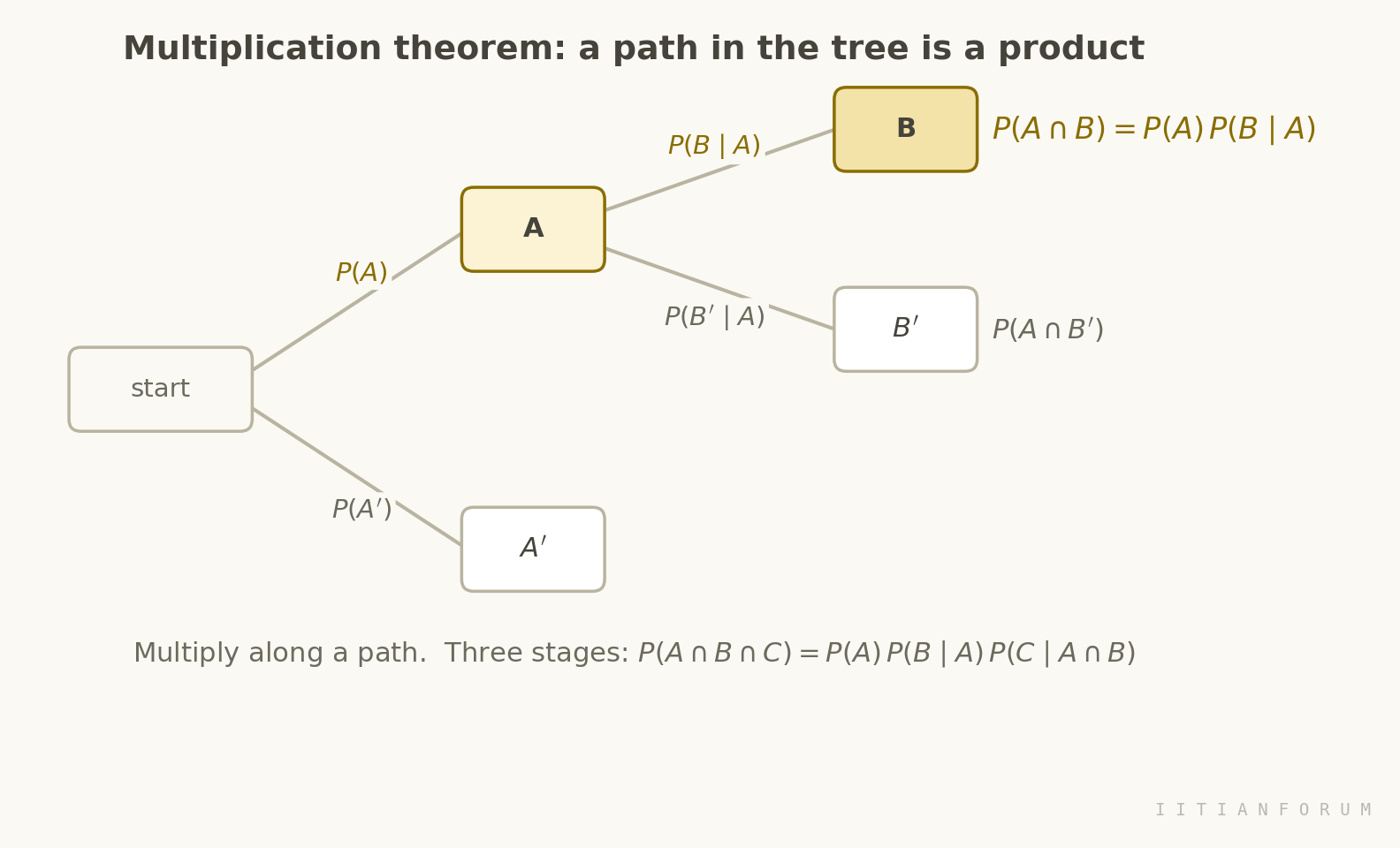
For three events, condition on more and more history:
and in general
This is the whole theory of "drawing without replacement". Second draw depends on the first, third depends on the first two, and the chain rule is exactly the bookkeeping for that dependence.
Example 1. (JEE Main 2026, 6 Apr Shift 2) A bag contains blue and green balls. Pairs of balls are drawn without replacement until the bag is empty. Find the probability that every drawn pair has one blue and one green ball.
▸ SHOW SOLUTION
Think of the twelve balls being pulled out in order, positions to , all orders equally likely. The pairs are positions , , ..., .
Do it as a chain, pair by pair. Before the first pair there are blue and green. Pick any ball; whatever colour it is, of the remaining balls have the other colour, so
Now blue and green remain. By the same argument , then , then , then , and the last pair is forced, probability .
Multiply along the path:
Answer: , option (3).
Notice what the chain rule bought you. The counting solution needs and a careful argument about unordered pairs. The conditional chain needs no counting at all.
Example 2. (JEE Main 2026, 24 Jan Shift 1) From a lot of defective and non-defective bulbs, bulbs are selected one by one with replacement. Find the probability of getting at least defective bulbs.
▸ SHOW SOLUTION
With replacement means the eight draws are independent, so every conditional probability in the chain collapses to the unconditional one: each time.
Answer: , option (4).
The words "with replacement" are the whole question. Change them to "without replacement" and every factor becomes a genuine conditional probability and the binomial formula dies.
Independence, and the one statement that is false
and are independent when knowing one changes nothing about the other:
The product form is the definition worth carrying, because it is symmetric in and and it stays legal when .
Three facts that follow, each worth proving once:
(i) If and are independent, so are and .
Apply it twice and and are independent too.
(ii) For independent , : .
(iii) and are independent, and and are independent, for every .
Now the trap.
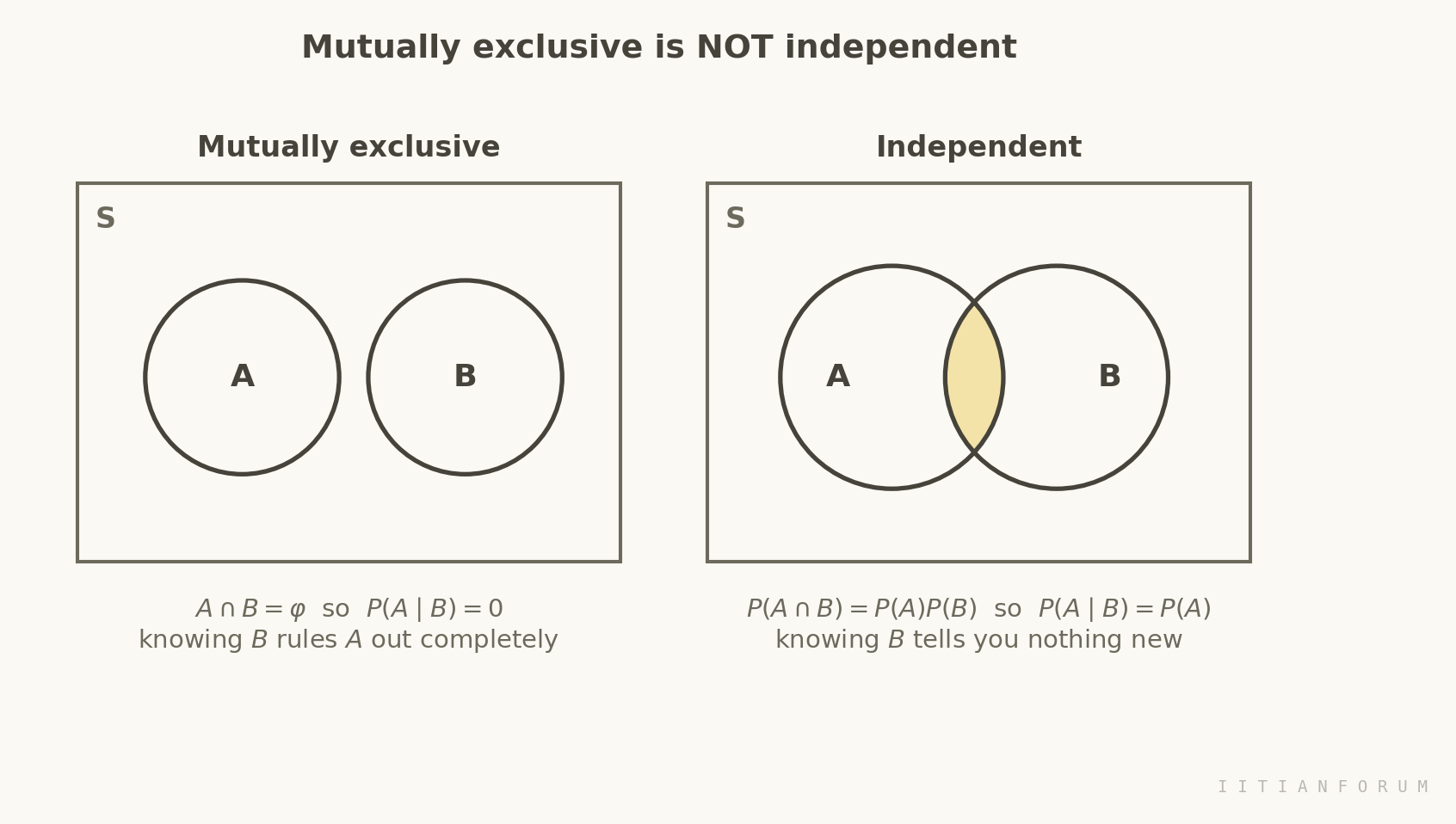
Mutually exclusive is a statement about sets: , the circles do not touch.
Independent is a statement about probabilities: , the overlap has exactly the size chance would predict.
If and are mutually exclusive and both have positive probability, then but , so they are not independent. In fact they are as dependent as two events can be: . Knowing happened rules out completely.
The only way to be both is for one of them to have probability zero.
Example 3. (JEE Main 2026, 24 Jan Shift 2) is a set of elements and is its power set. An ordered pair is chosen at random from . If , find .
▸ SHOW SOLUTION
Handle the five elements independently. That is the whole idea: the pair is built by making five separate, unrelated decisions.
For one element there are four equally likely states: in only, in only, in both, in neither. So ordered pairs in total, which matches .
fails exactly when some element sits in both. So for each element only of the states are allowed, and the elements are independent:
So , and .
Answer: .
Example 4. (JEE Main 2026, 4 Apr Shift 1) A coin is tossed times. If is the probability that exactly heads appear in the first six tosses and exactly heads appear in the last five tosses, find .
▸ SHOW SOLUTION
The two events are not independent, because tosses , , belong to both windows. Split on the overlap, which is the standard move.
Let be the number of heads among tosses . Then tosses must supply heads and tosses must supply heads. Feasibility needs and , so .
Count the favourable strings of length :
Total favourable , and all strings are equally likely, so and
Answer: .
Partition of a sample space
Everything that follows rests on one picture: the sample space chopped into non-overlapping pieces that between them use up all of .
form a partition of when all three hold:
In words: mutually exclusive, exhaustive, and none of them impossible. In a question the partition is almost never called a partition. It is "the three bags", "bus or scooter or car", "the coin is fair or two-headed", "the letter came from KANPUR or from ANANTPUR". Spotting it is the entire skill.
The smallest partition is for any event with . That is why so many two-case questions can be done without ever naming a partition.
A rectangle S divided into five vertical bands labelled E1 to E5, with a gold ellipse A lying across all five bands and the band boundaries dashed inside A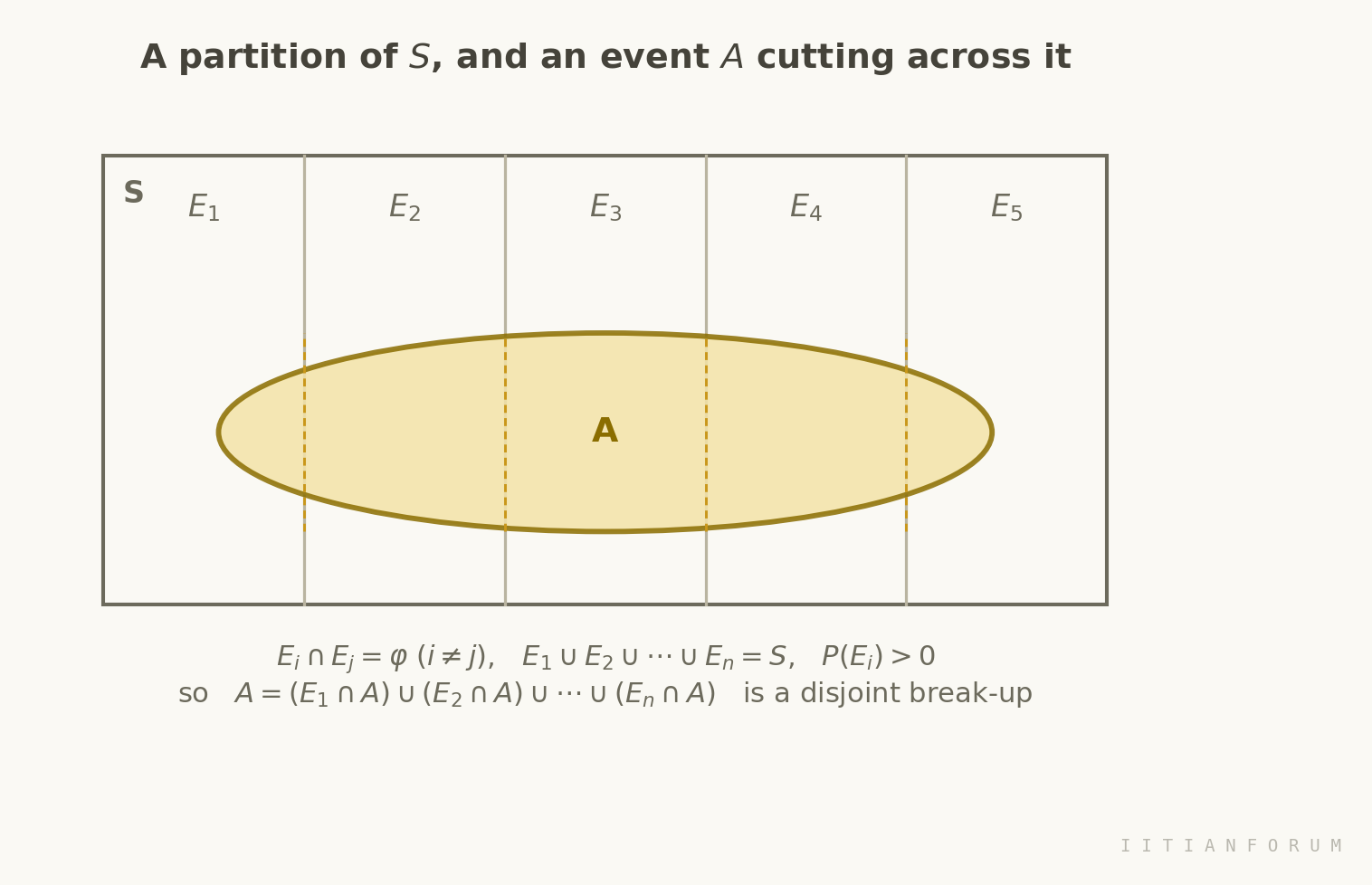
Now look at the ellipse in that picture. The five dashed cuts break into five disjoint pieces:
and the pieces are pairwise disjoint because the already are. So probabilities simply add:
Law of total probability
Apply the multiplication theorem to each term above, , and you have it.
Theorem. If partition and is any event, then
Proof. . The sets are pairwise disjoint, since . By the addition rule for disjoint events, . Each , so the multiplication theorem gives . Substitute.
Probability tree with a start node branching to E1, E2, E3 with probabilities P of Ei, each branching to A with probability P of A given Ei, and the three path products braced together into the total probability formula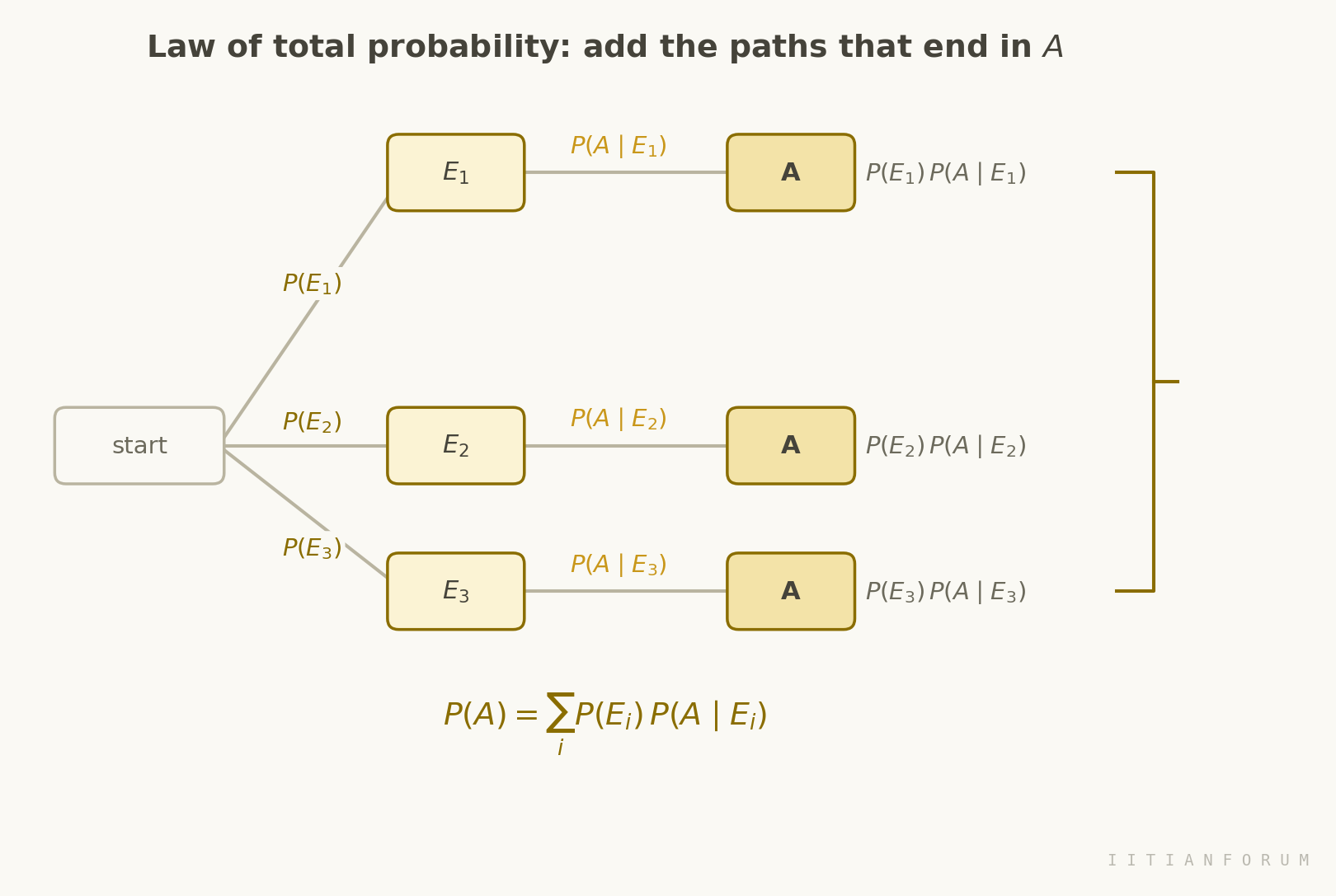
Draw the tree. First level = the causes, and those probabilities must add to . Second level = the event hanging off each cause. Multiply along each path, then add the paths that end at . That is the whole method, and it takes about fifteen seconds once the partition is named.
Bayes' theorem
Total probability runs forward: causes are known, and you want the chance of the effect. Bayes runs backward: the effect has happened, and you want the chance that a particular cause was responsible.
Two panels separated by a dashed line. Left panel has an arrow from cause Ei to effect A labelled P of A given Ei, marked FORWARD. Right panel has the arrow reversed, from effect A back to cause Ei, labelled P of Ei given A, marked REVERSE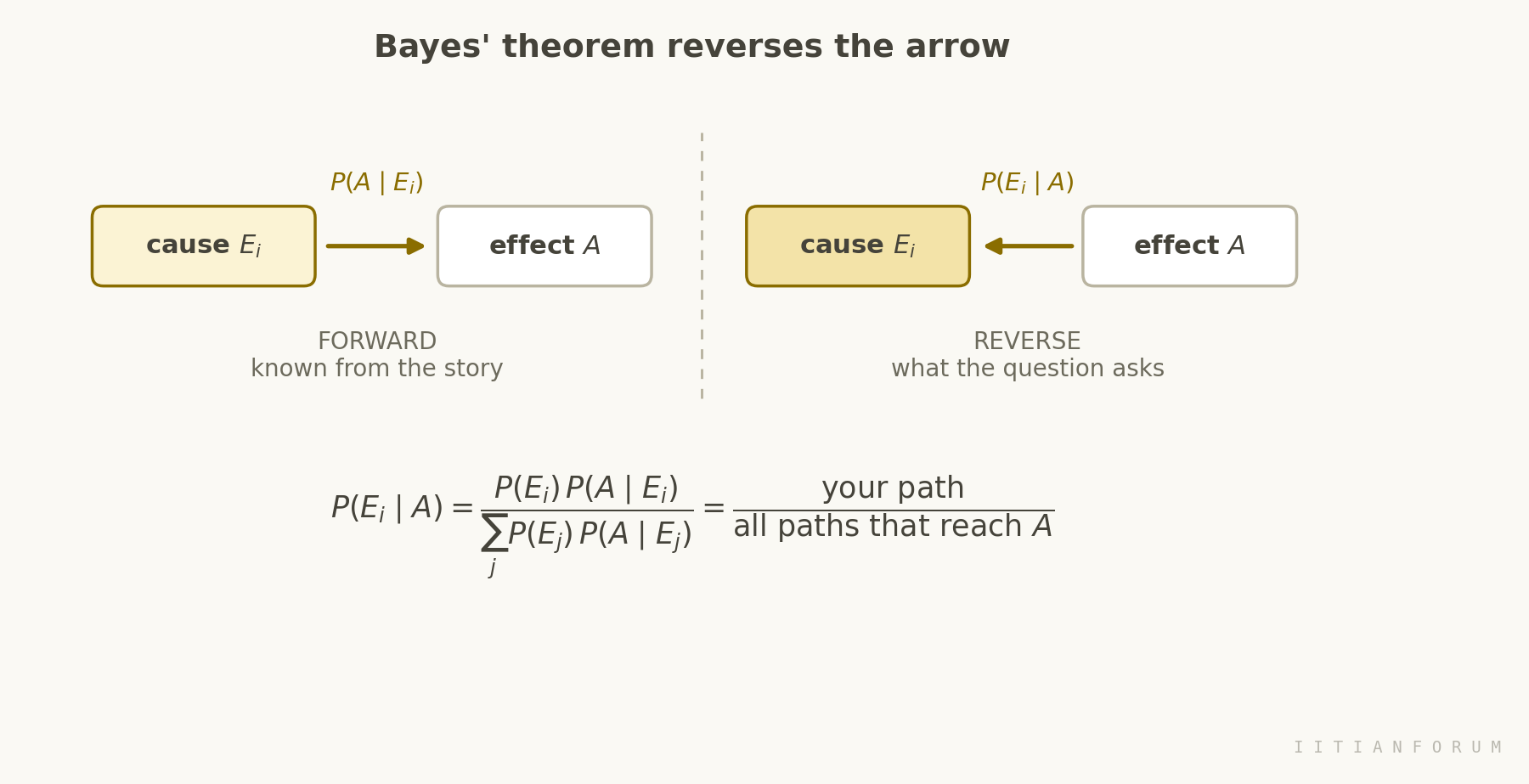
Theorem. Let partition and let be an event with . Then for each ,
Proof. Start from the definition and use the multiplication theorem on the numerator, in the form that conditions on :
Now replace in the denominator by the law of total probability.
That is all Bayes is: the definition of conditional probability, with the denominator expanded. Nothing new is being assumed.
The one-sentence version. is your path divided by all the paths that reach .
A horizontal stacked bar split into three segments labelled E1, E2, E3, each segment labelled P of Ei times P of A given Ei, with the whole bar labelled P of A and the first segment marked your slice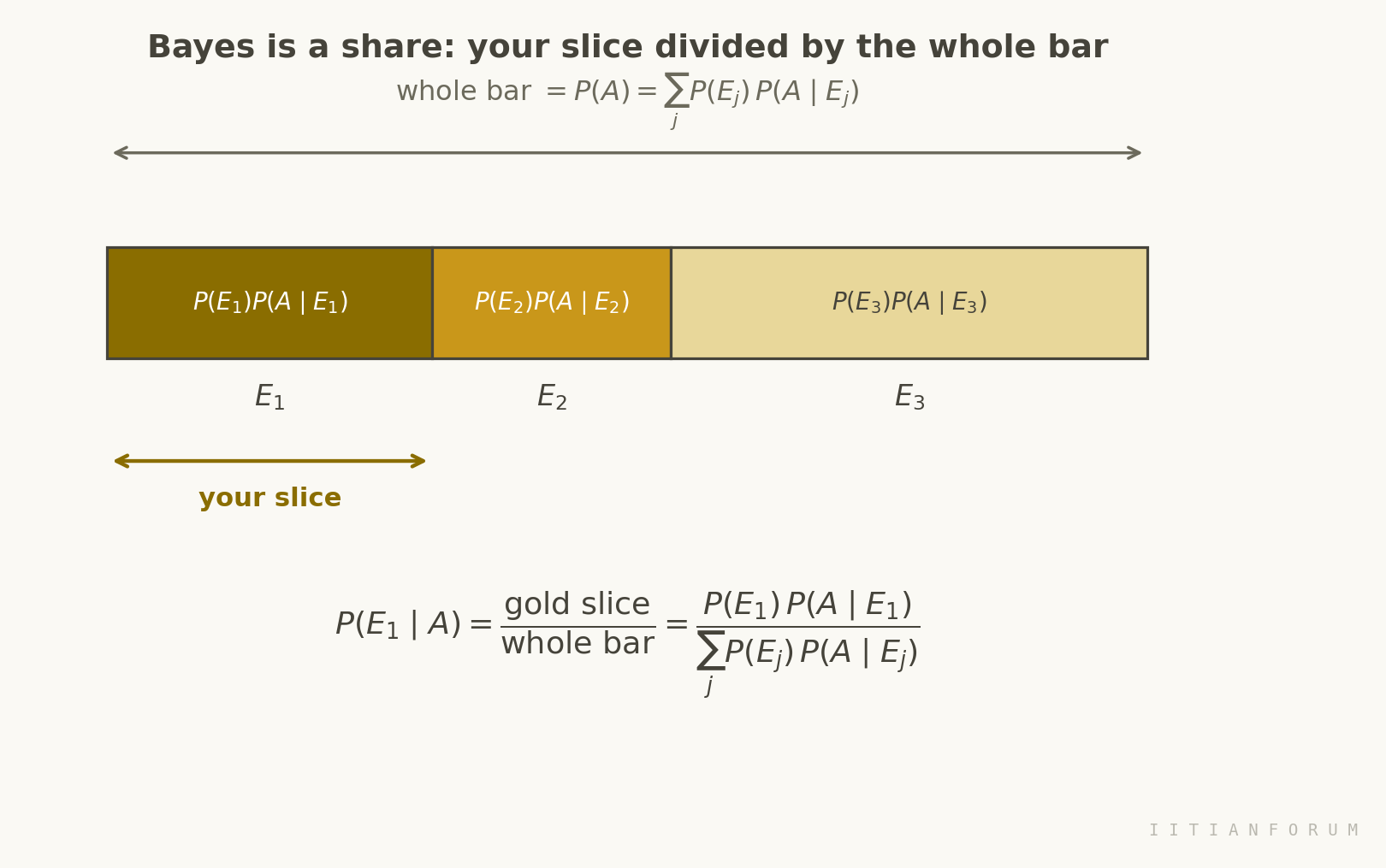
Vocabulary the paper uses.
| Term | Symbol | Meaning |
|---|---|---|
| Hypotheses | the partition, the possible causes | |
| Prior (a priori) probability | what you believed before the evidence | |
| Likelihood | how well cause explains the evidence | |
| Posterior (a posteriori) probability | what you believe after the evidence |
Two shortcuts that save real time in the exam.
(a) Equal priors. If , that common value cancels from numerator and denominator, and
(b) Never simplify the fractions. Put every path product over one common denominator and then throw the denominator away. In a Bayes ratio it cancels, so with no arithmetic at all.
Forgetting a hypothesis. The denominator must contain every path that could have produced . Miss one branch and the answer is silently too large. Before you divide, check that the priors you wrote down add to exactly .
Confusing with . "Given the candidate was late, the probability the candidate took the bus" is not "given the bus, the probability of being late". The first is the answer, the second is the data. Read which one is given and which one is asked, every single time.
Type 1 — the counting layer underneath
Before a conditional probability can be computed, the plain probabilities in it have to be computed. Every 2026 shift tested that layer, so it is worth clearing first. The three tools are: favourable over total, the complement rule , and the addition rule.
Example 5. (JEE Main 2026, 22 Jan Shift 1) Two distinct numbers and are chosen at random from . Find the probability that is divisible by .
▸ SHOW SOLUTION
Direct counting would need three cases. The complement needs one.
is not divisible by exactly when neither nor is a multiple of .
Multiples of in the list: . Non-multiples: .
Answer: , option (2).
Example 6. (JEE Main 2026, 21 Jan Shift 1) The mean and variance of the seven observations (with ) are and . Two numbers are then chosen one after another without replacement from . Find the probability that the smaller of the two is less than .
▸ SHOW SOLUTION
First pin down and . Sum of the five known values is , so
Sum of their squares is , and variance gives
Then , so . Hence are roots of , that is or . Since , and .
So the set is , six distinct numbers. Two are drawn without replacement, giving equally likely ordered outcomes.
Complement again: "smaller " means both chosen numbers are , that is both come from , which happens in ways.
Answer: , option (2).
Example 7. (JEE Main 2026, 23 Jan Shift 1) From the first natural numbers, is chosen and then is chosen, without replacement. If in lowest terms, find .
▸ SHOW SOLUTION
Order matters here, so the sample space has ordered pairs.
Fix . Then must satisfy , so ranges over , which is values. This is positive only for .
Since and share no factor, , and .
Answer: .
Type 2 — probability wearing another chapter's clothes
A large share of 2026 probability questions were really determinant, quadratic or sequence questions with a probability wrapper. The wrapper is always the same: work out which cases succeed, count them, divide by the total.
Example 8. (JEE Main 2026, 22 Jan Shift 2) is the number obtained on rolling a fair die. If the probability that the system
has a unique solution is , find the sum of and all possible values of .
▸ SHOW SOLUTION
A linear system has a unique solution exactly when .
Expand along the first column:
So .
A die gives , so of the outcomes work and gives .
Answer: , option (4).
Example 9. (JEE Main 2026, 2 Apr Shift 1) Let . If in lowest terms, find .
▸ SHOW SOLUTION
Since always, the quadratic is positive for every real exactly when its discriminant is negative:
Count by .
, need : gives ; gives ; and give all four values of . Count .
, need : gives ; gives . Count .
needs and needs , but . Count .
Favourable out of , and .
Answer: .
Example 10. (JEE Main 2026, 4 Apr Shift 2) From a month of days, different dates are chosen at random. If the probability that they are in increasing A.P. is in lowest terms, find .
▸ SHOW SOLUTION
For in A.P., , so is determined by and , and the only requirement is that and have the same parity.
Among there are odd and even numbers, so
and , so the fraction is in lowest terms and .
Answer: .
Example 11. (JEE Main 2026, 2 Apr Shift 2) A man throws a fair coin repeatedly, scoring for each head and for each tail. If in lowest terms, find .
▸ SHOW SOLUTION
"Exactly points" means the game is described by the pair with , that is , with integers:
Each such outcome is a specific string of tosses, and the number of arrangements is , each of probability .
, so .
Answer: , option (C).
Type 3 — total probability
Recognition test: the question asks for the plain probability of an event, but that event can arrive by more than one route, and the routes have different chances. No "given that" appears in the question. Draw the tree, multiply along paths, add.
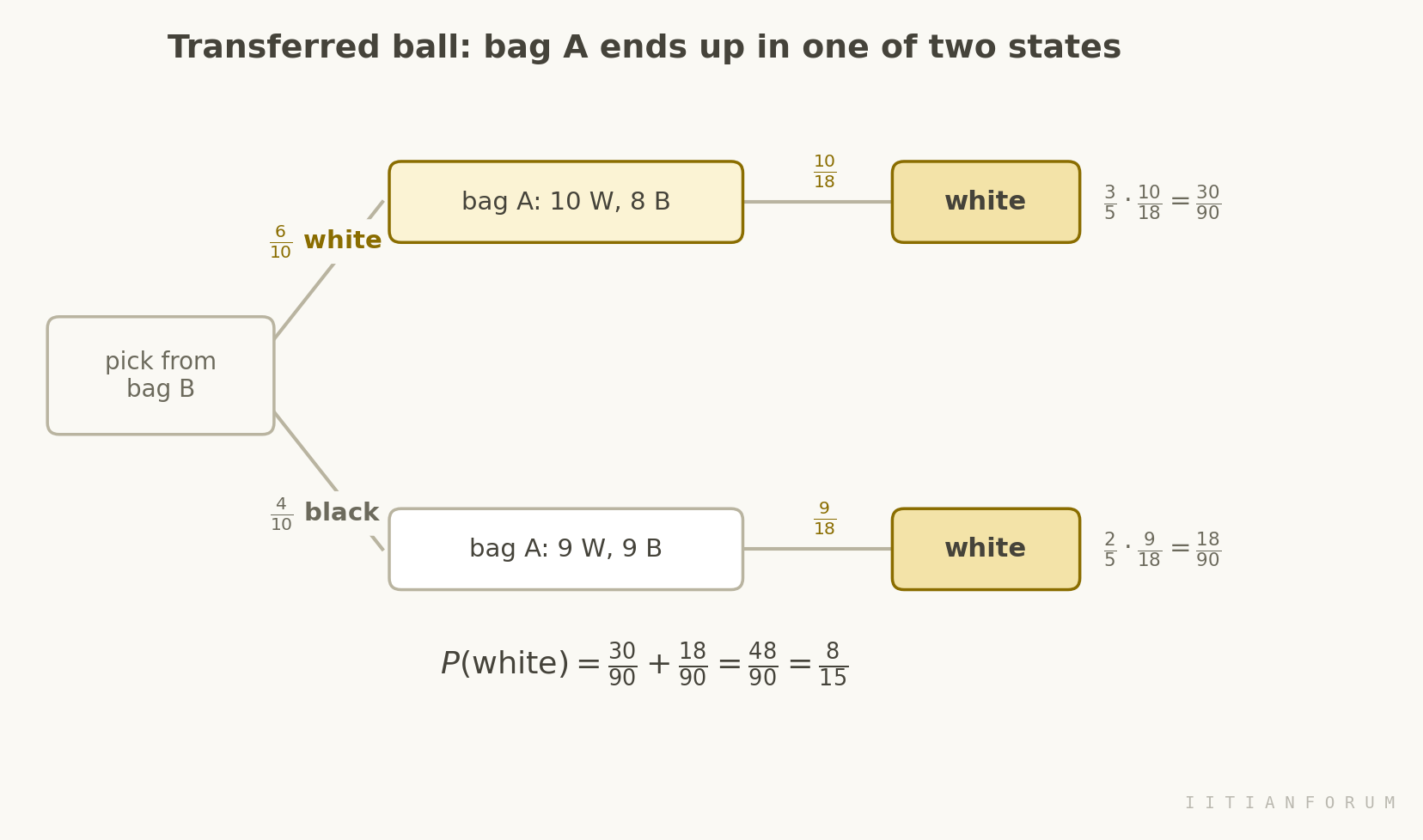
Example 12. (JEE Main 2026, 23 Jan Shift 2) Bag A contains white and black balls; bag B contains white and black balls. One ball is picked at random from bag B and dropped into bag A. A ball is then drawn at random from bag A. If in lowest terms, find .
▸ SHOW SOLUTION
The transferred ball is the partition. Two cases, and they are mutually exclusive and exhaustive.
After the transfer bag A holds balls in both cases, but the composition differs:
white transferred white out of ; black transferred white out of .
So , and .
Answer: , option (2).
Example 13. (JEE Main 2026, 5 Apr Shift 2) The probabilities that players and are selected for the captaincy are and . If is selected the team wins with probability ; if is selected it wins with probability . Find the probability that the team wins.
▸ SHOW SOLUTION
is a partition: .
Answer: , option (2).
Sanity check worth doing in three seconds: the answer must lie between the two conditional values and , because it is a weighted average of them. It does, and it is closer to because is the more likely captain.
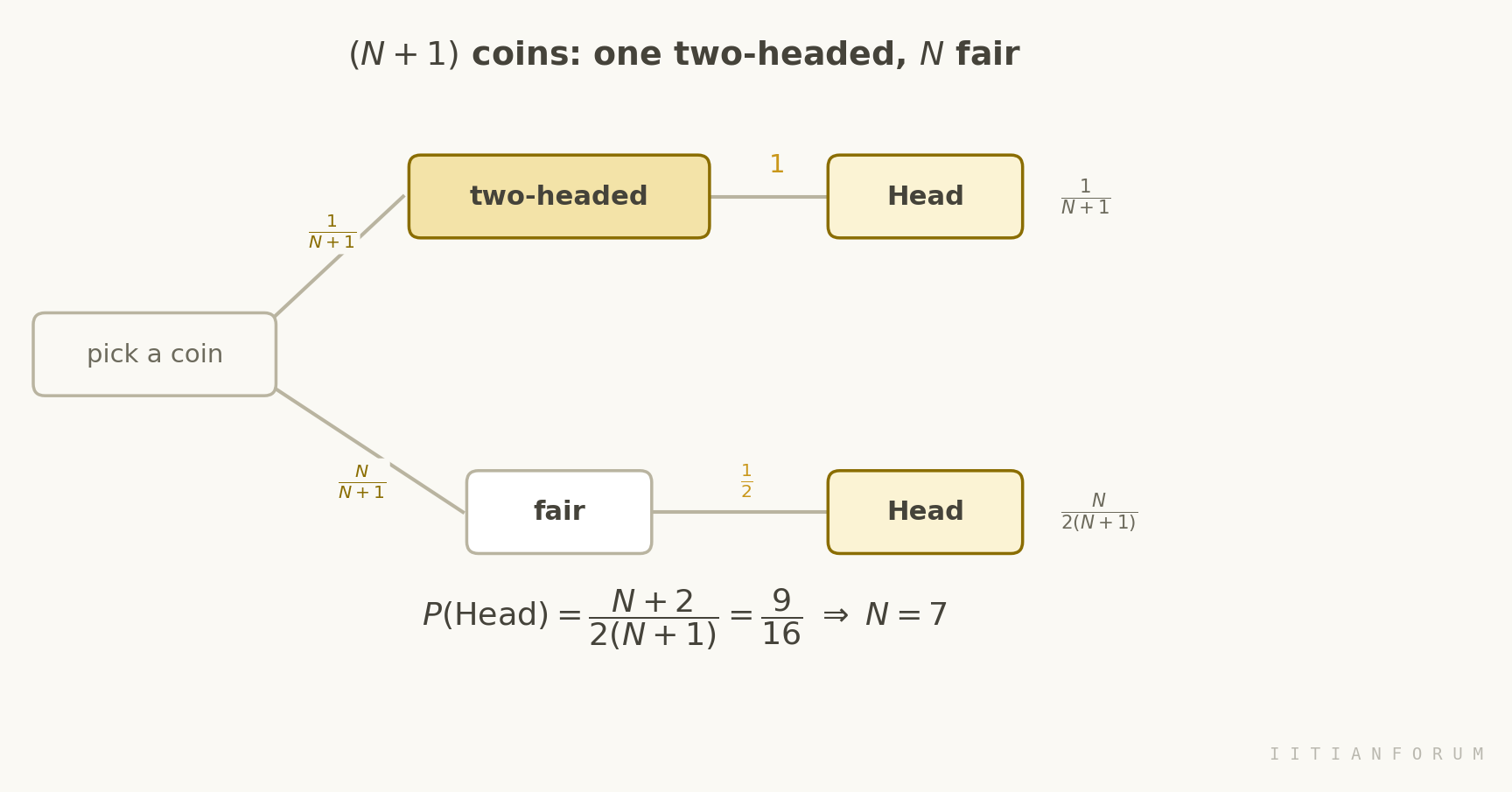
Example 14. (JEE Main 2026, 6 Apr Shift 1) A bag contains coins: fair coins and one coin with heads on both sides. A coin is chosen at random and tossed. If , find .
▸ SHOW SOLUTION
The partition is which coin got picked.
Set this equal to :
Answer: , option (2).
Check: with , , a little above , which is right because one coin is biased towards heads.
Type 4 — Bayes' theorem
Recognition test: the question tells you the effect already happened, and asks which cause was behind it. The give-away phrases are "given that", "it is known that", "is found to be", "was observed to be". The tree is exactly the total-probability tree; only the final step changes, from adding all paths to dividing one path by all of them.
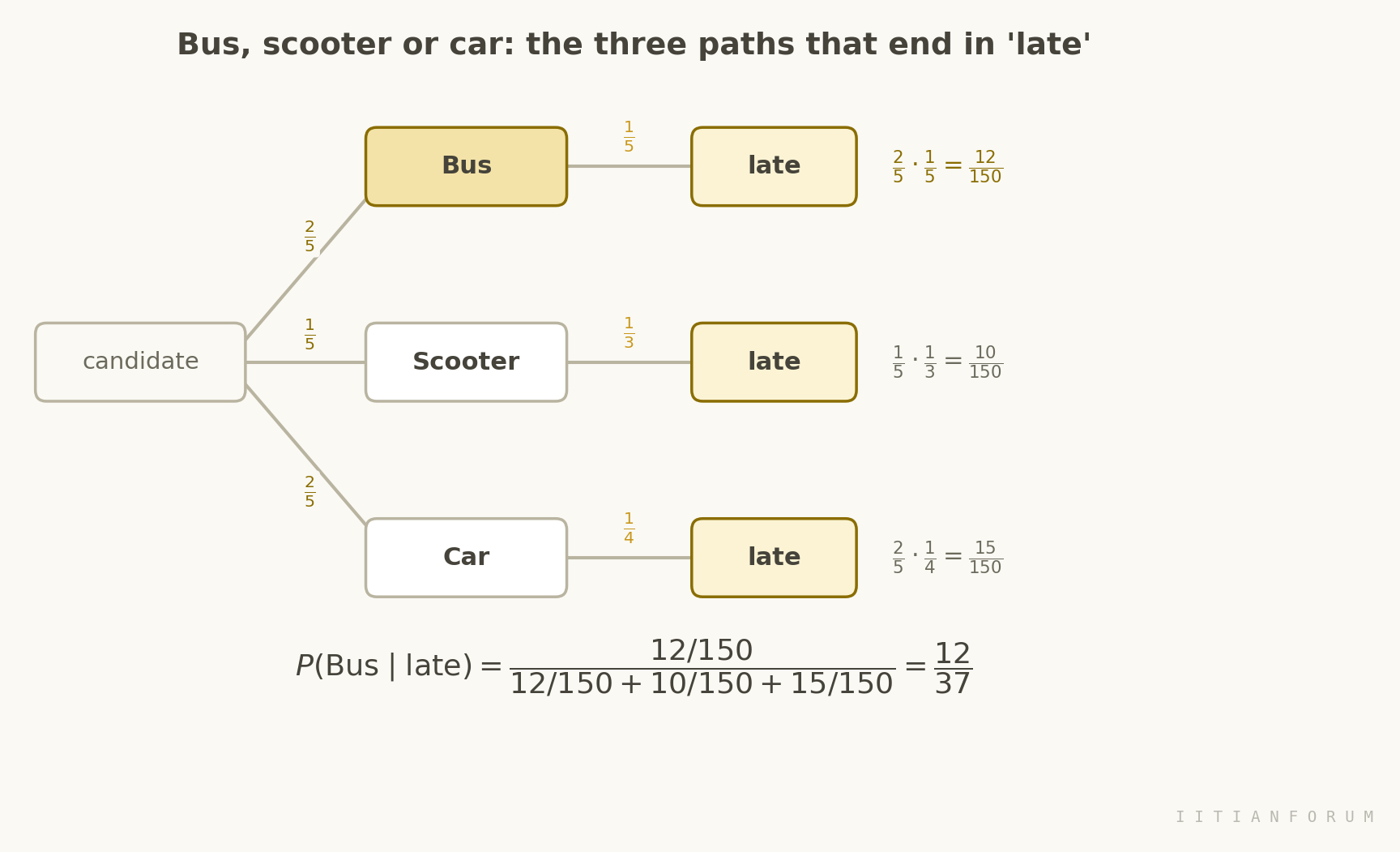
Example 15. (JEE Main 2026, 8 Apr Shift 2) A candidate travels to the exam centre by exactly one of bus, scooter or car, with probabilities . The probabilities of reaching late are respectively. Given that the candidate reached late, find the probability that the candidate travelled by bus.
▸ SHOW SOLUTION
Priors first, and check they add to : . Good.
Path products, all over the common denominator :
Answer: , option (2).
Once every product sits over , the division is just against . That is why you never simplify the individual fractions.
Example 16. (JEE Main 2026, 5 Apr Shift 1) A letter is known to have arrived either from KANPUR or from ANANTPUR. On the envelope just two consecutive letters "AN" are visible. Find the probability that the letter came from ANANTPUR.
▸ SHOW SOLUTION
A word of length contains consecutive letter pairs, and the visible pair is one of them chosen at random.
KANPUR has letters, so pairs: KA, AN, NP, PU, UR. "AN" occurs once.
ANANTPUR has letters, so pairs: AN, NA, AN, NT, TP, PU, UR. "AN" occurs twice.
The two cities are equally likely, so the priors are each and they cancel:
Answer: , option (2).
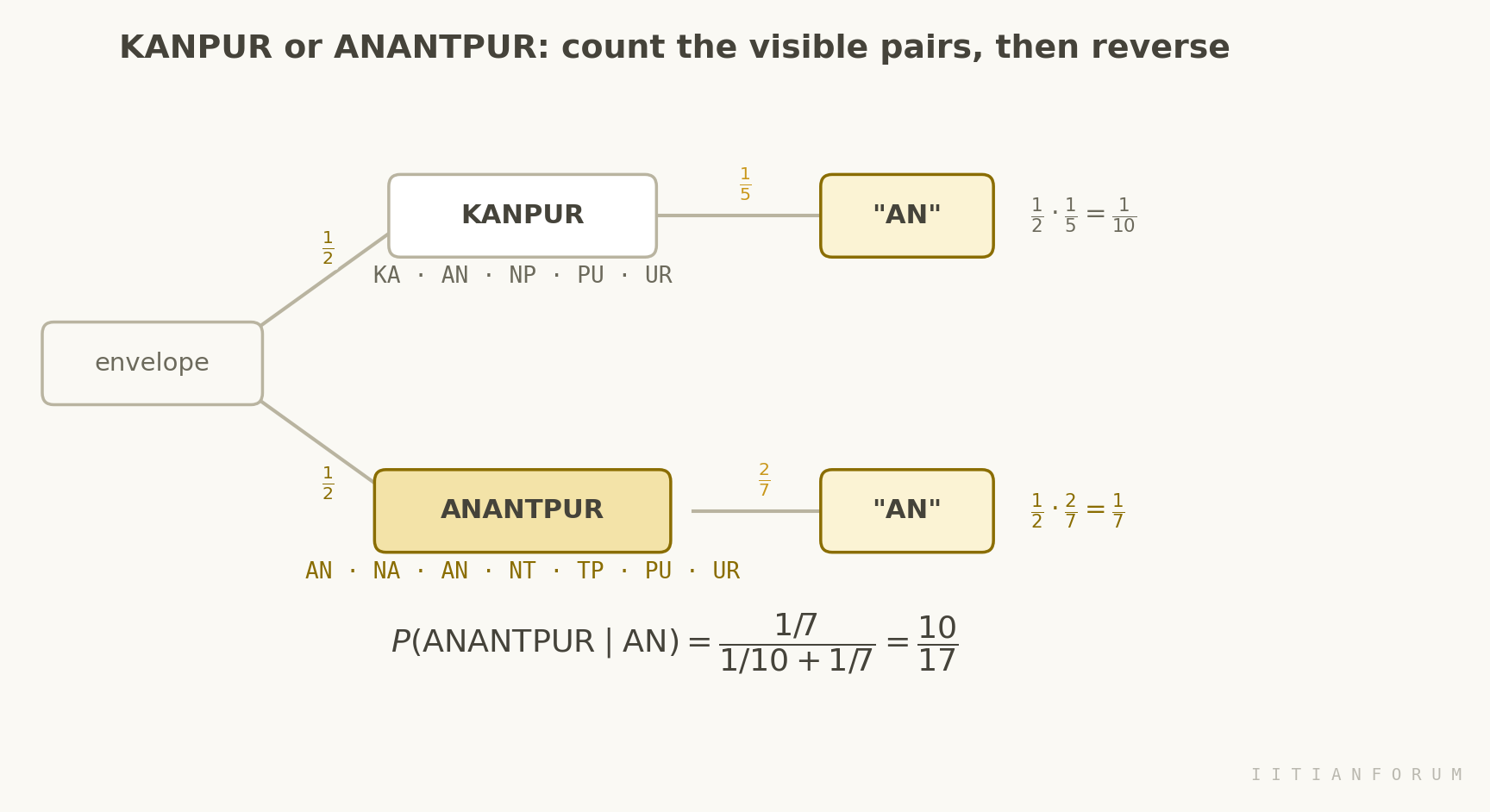
Both cities were equally likely before the evidence. After seeing "AN" the posterior moved to in favour of ANANTPUR. That is Bayes doing its job: ANANTPUR explains the evidence better, so the evidence pushes belief towards it. If your posterior moves the wrong way, you have swapped a numerator.
Type 5 — Bayes with many hypotheses
Sometimes the partition has more than three pieces, and occasionally it has infinitely many in principle. The formula does not change. What changes is that you must sum a series in the denominator, which is where the identity earns its place.
Example 17. (JEE Main 2026, 28 Jan Shift 1) A bag contains balls, of which are red and are black, where . Three balls are drawn at random without replacement and all are found to be black. Find the probability that the bag contains red and black balls.
▸ SHOW SOLUTION
The hypotheses are the eleven possible compositions. Since nothing is said to favour any of them, they are equally likely:
The evidence is : all three drawn balls are black. Under the bag has black balls, so
Apply Bayes. Both and appear in every term, so both cancel:
The denominator is the hockey-stick sum:
and the numerator is . Hence
Answer: , option (4).
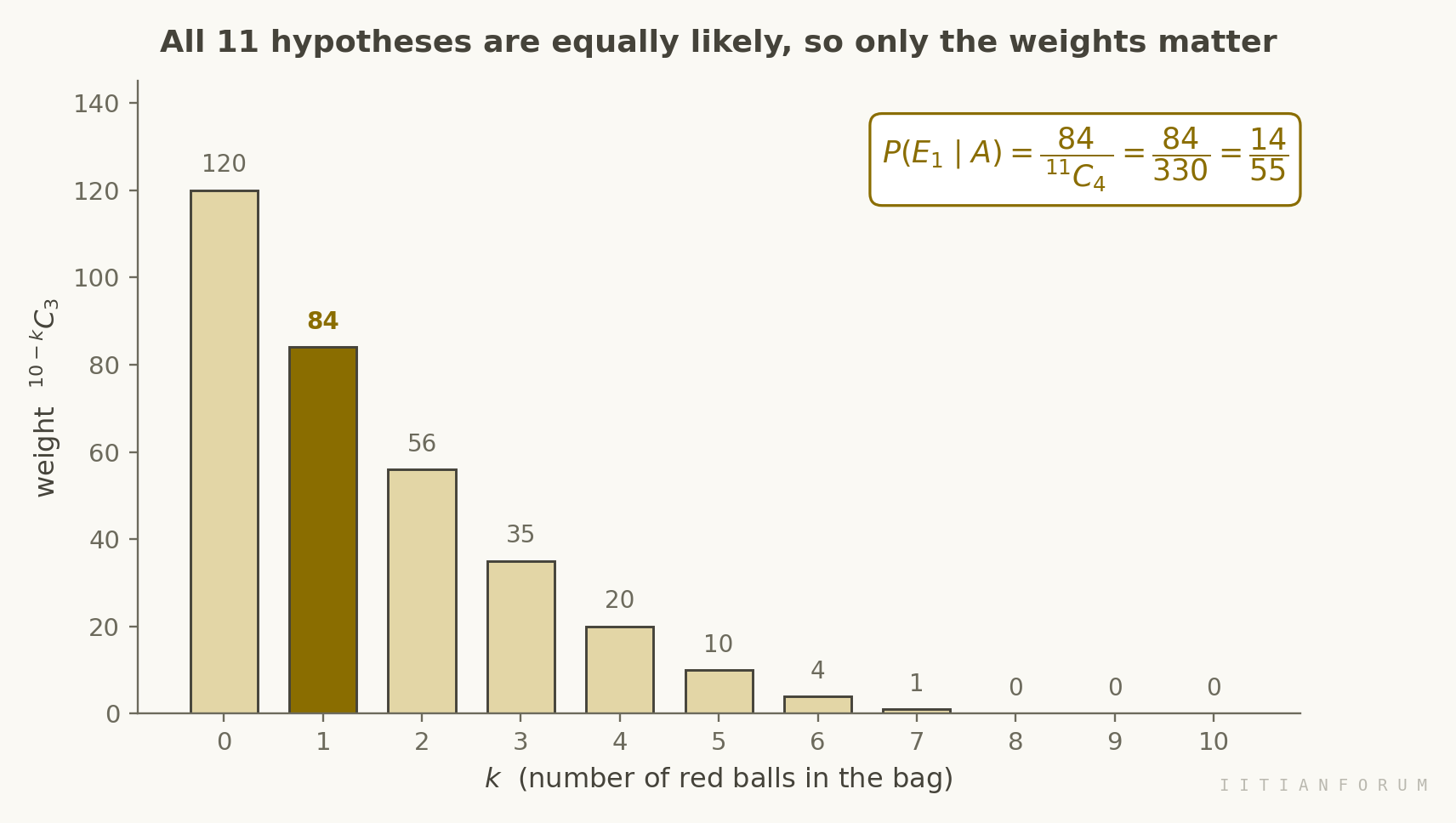
Two things are worth noticing in that solution, because they generalise.
Equal priors let you throw the priors away. All eleven were , so the answer became a ratio of pure likelihoods. Whenever a question says "chosen at random" about the hypotheses and gives you no other information, expect this.
The impossible hypotheses drop out on their own. For the bag has fewer than three black balls, so and those branches contribute nothing. You do not need a separate argument to exclude them; the likelihood does it for you. Notice also that the posterior for is the largest of all, , which matches intuition: three black balls in a row is most easily explained by a bag with no red balls at all.
Proof by induction, or in one line from applied repeatedly. It turns up in almost every Bayes question whose hypotheses are indexed by a count, which in JEE means bags with red balls, urns with white balls, and coins numbered to .
Type 6 — straight from the definition
Not every conditional question needs a tree. When the sample space is small enough to list, or when you are handed , and , the definition alone does the job. These five are IITianForum originals, built to drill the four situations that keep recurring.
Example 18. A fair die is rolled twice. Given that the sum of the two numbers is , find the probability that at least one roll showed a .
▸ SHOW SOLUTION
Condition first, count second. The given event is : sum . List it:
Those five ordered pairs are now the entire sample space. Among them, the ones containing a are and .
Answer: .
The unconditional answer would have been . The condition changed it, which is exactly what a condition is supposed to do.
Example 19. For two events, , and . Find and , and decide whether and are independent.
▸ SHOW SOLUTION
From the addition rule,
For the second one, use and :
Independence check: , so yes, independent. Consistently, and .
Answer: , , and , are independent.
Example 20. A box holds red and green pens. Three pens are drawn one by one without replacement. Find (i) and (ii) .
▸ SHOW SOLUTION
(i) Chain rule along the path:
(ii) Do not compute anything. Once two greens are gone the box literally holds red and green, so
Answer: (i) , (ii) .
Part (ii) is the point of conditional probability in one line: after the condition, you are looking at a genuinely different box.
Example 21. Urn I has white and black balls; Urn II has white and black balls. A fair die is thrown. If it shows or , a ball is drawn from Urn I; otherwise from Urn II. The ball drawn turns out to be white. Find the probability that it came from Urn I.
▸ SHOW SOLUTION
Priors from the die:
Likelihoods from the urns:
Path products, over a common denominator :
Answer: .
The prior favoured Urn II two to one, but the evidence favours Urn I, and the posterior lands just under a half. Bayes weighs the two effects against each other rather than letting either win outright.
Example 22. speaks the truth of the time and speaks the truth of the time. They independently describe the same incident. Find the probability that they contradict each other.
▸ SHOW SOLUTION
They contradict exactly when one tells the truth and the other does not. The two ways are mutually exclusive, and within each way the two speakers are independent:
Answer: .
Watch the wording. "Contradict" is this. "Agree" is , and the two add to as they must. "Both are believed" and "the statement is true" are different questions again, and each needs its own sentence read carefully.
Which tool? A thirty-second decision
Almost every mistake in this chapter is a tool-selection mistake made in the first ten seconds. Run the question through this chart before you write anything.
Flow chart. Read the question, then ask whether a condition is given. If NO, break the event over the causes and add, which is total probability. If YES, ask whether the given event is the cause or the effect. Cause given leads to the multiplication theorem, effect given leads to Bayes theorem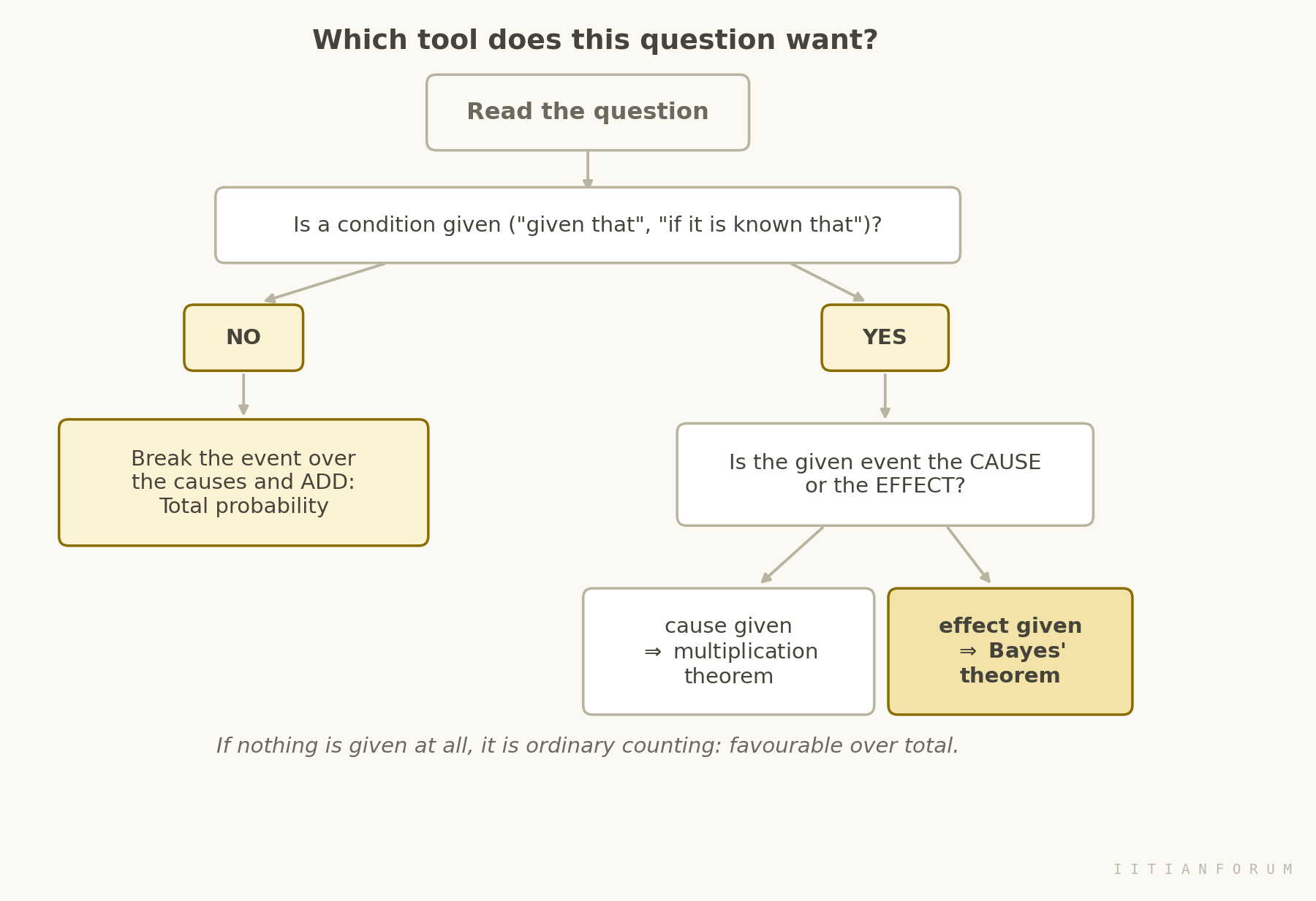
In words, and this is worth writing on the inside cover of your notebook.
| What the question says | What it wants | Formula |
|---|---|---|
| No condition, but several routes to the event | Total probability | |
| "Given the cause, find the chance of the effect" | Multiplication theorem | |
| "Given the effect, find the chance of the cause" | Bayes' theorem | |
| "Find the chance both happen", with no dependence stated | Check independence first | only if independent |
| No condition and one route | Ordinary counting |
Choosing Bayes when the question wanted total probability produces an answer that is a fraction of the right one, and it will usually match a distractor option. Choosing total probability when the question wanted Bayes produces a number that is too small, and that will match a distractor too. The paper is set so that both errors land on printed options.
The only defence is the chart above. Find the word "given", decide whether what follows it is a cause or an effect, and only then pick up your pen.
Quick recall
| # | Result | Statement |
|---|---|---|
| 1 | Conditional probability | , |
| 2 | Complement, conditioned | |
| 3 | Addition, conditioned | |
| 4 | Multiplication theorem | |
| 5 | Chain rule | |
| 6 | Independence | |
| 7 | Independence spreads | independent and and independent |
| 8 | At least one, independent | |
| 9 | Partition | , , |
| 10 | Total probability | |
| 11 | Bayes' theorem | |
| 12 | Equal priors | priors equal |
| 13 | Posteriors add to one | , always. Use it to check your answer |
| 14 | Hockey stick |
1. Name the partition. Write the causes down the left of a tree, and check their probabilities add to exactly . If they do not, you have missed a case.
2. Hang the evidence off each cause. One branch per cause, labelled . Every branch, including the ones you expect to be zero.
3. Multiply along paths, over one common denominator. Never simplify a path product; it is about to cancel.
4. Add the paths, or divide one by the sum. Adding gives total probability. Dividing gives Bayes. Which one you need was decided in step , when you looked for the word "given".
. The numerator is the overlap.
when the question never said the events were independent. Without replacement it is essentially never true.
A posterior larger than , or a set of posteriors that do not add to . Both mean a branch was dropped from the denominator.
Conditional probability rewards a habit rather than a memory. Draw the tree, even when the numbers look easy enough to do in your head, because the tree is what stops you from losing a branch. Six questions across JEE Main 2026 came down to exactly that discipline.
Want the full lecture-notes PDF for this chapter, with every theorem proved, all the Venn and tree diagrams drawn out, and a graded problem bank with complete solutions? It is linked with these notes on IITIANFORUM. Real Study, Genuine Results.