Ellipse for JEE: Notes, Eccentric Angle, Tangents, Normals and PYQs
Ritesh Raj · 9 Nov 2026
Aa
48 min read44 sectionsConcept
An ellipse is the path of a planet round the sun, the outline of a circle seen at an angle and the shape of a whispering gallery. In coordinate geometry it is the closed conic: two foci, two directrices, eccentricity between 0 and 1. Most JEE questions on it reduce to one idea, the eccentric angle point (acosθ,bsinθ), which turns chords, tangents and normals into short relations between angles.
This note covers the two definitions of the ellipse, the standard ellipse and its parts, both orientations, the auxiliary circle and the eccentric angle, shifted and slanted ellipses, the position of a point, a line meeting the ellipse, chords, focal chords, chords with a given middle point, diameters and conjugate diameters, tangents in all three forms, pairs of tangents, the chord of contact, the director circle, pole and polar, common tangents, normals and co-normal points, the reflection property, the area of an ellipse and locus problems. The worked examples include JEE Main 2025 and 2026 questions, earlier JEE Main questions, and JEE Advanced and IIT JEE questions; every answer was re-derived from scratch.
Conic sections and the ellipse
Let S be a fixed point and ℓ a fixed line not through S. The locus of a point P that moves so that
PMPS=e
where PM is the perpendicular distance of P from ℓ, is a conic section with focus S, directrix ℓ and eccentricity e.
Eccentricity
Conic
e=1
parabola
0<e<1
ellipse
e>1
hyperbola
swipe for more →
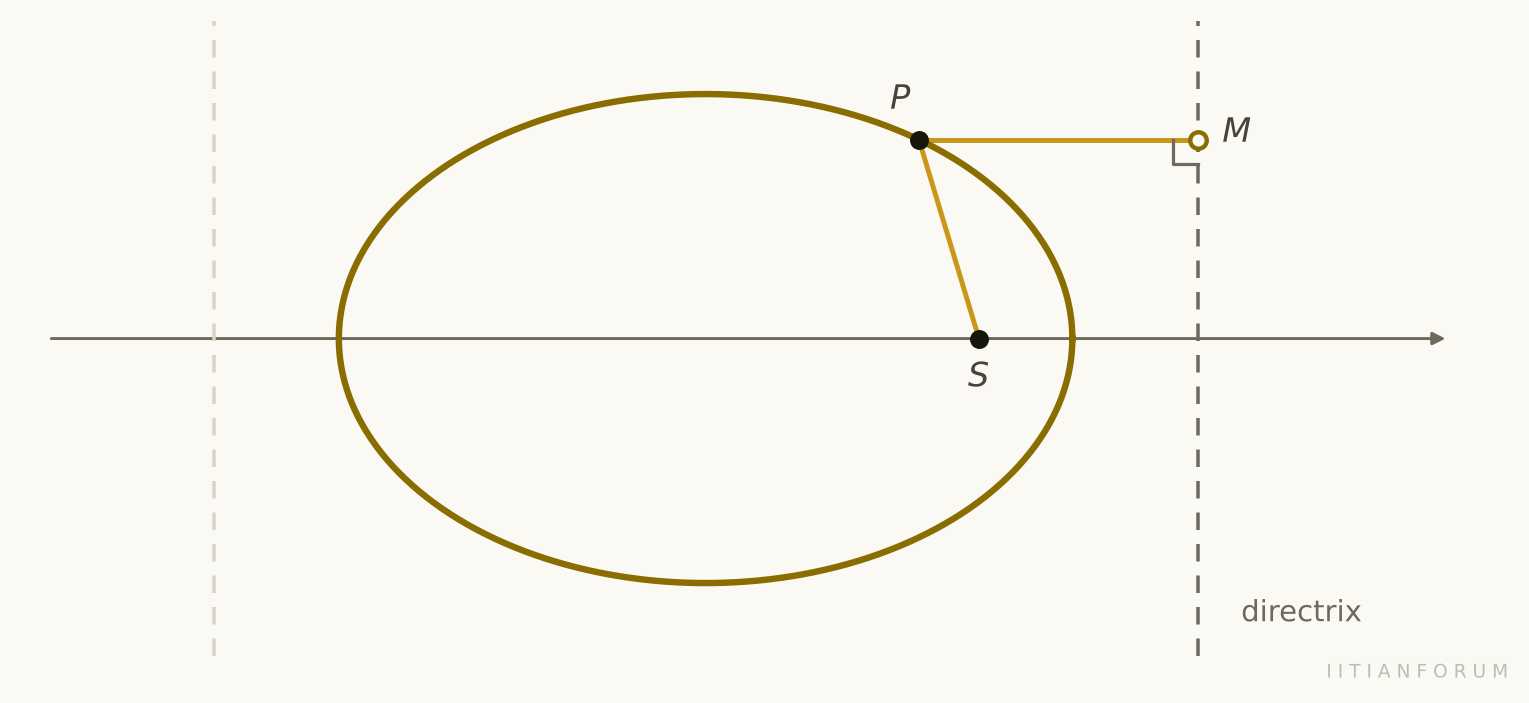
So an ellipse is the locus of a point whose distance from a fixed point is a fixed fraction e<1 of its distance from a fixed line:
PS=e⋅PM,0<e<1An ellipse with its focus S on the major axis, the directrix as a vertical line on the right, a point P on the curve joined to S and to the foot M of its perpendicular on the directrix
The second definition: sum of focal distances
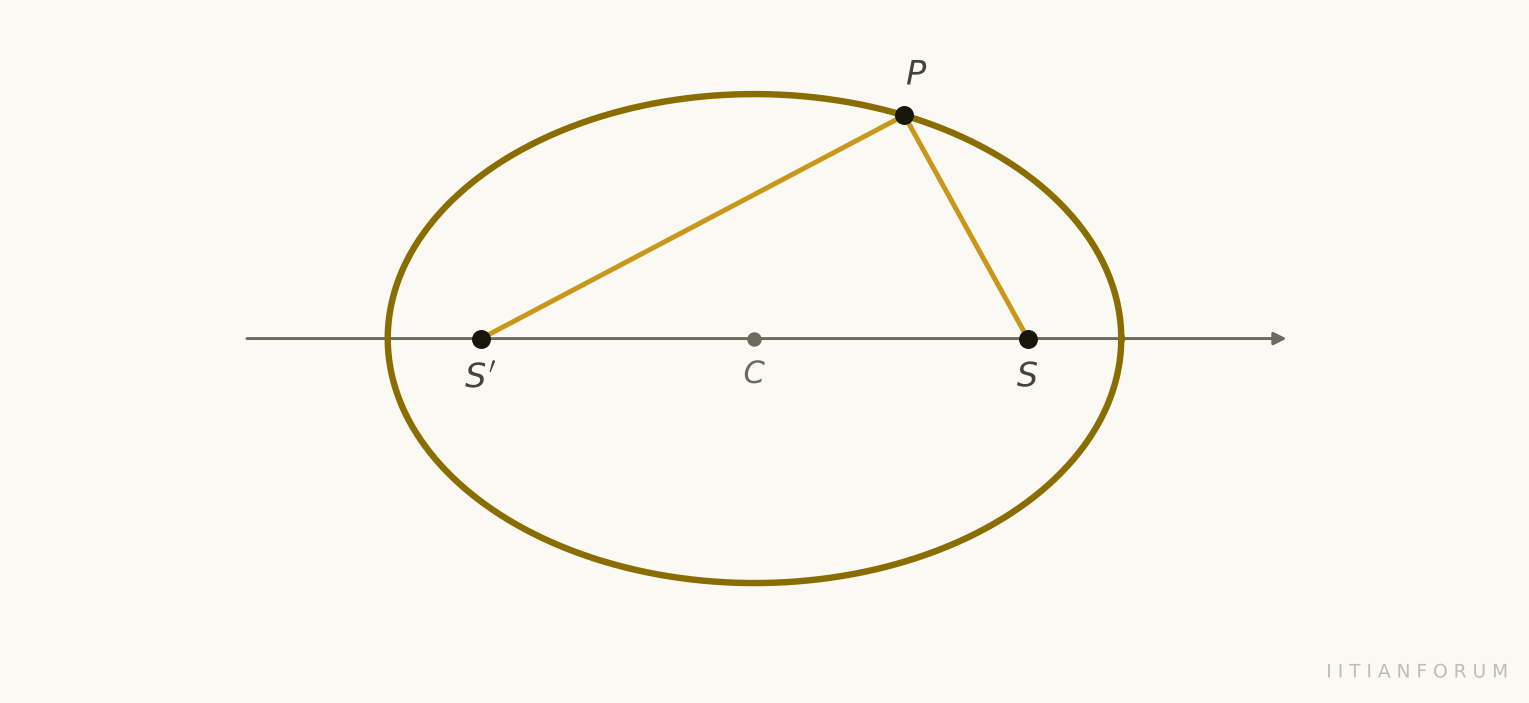
An ellipse has two foci S and S′. For every point P on it,
PS+PS′=2a
where 2a is the length of the major axis. Conversely, the locus of a point whose distances from two fixed points S, S′ add up to a constant 2a>SS′ is an ellipse with foci S and S′.
An ellipse with both foci S and S' marked on the major axis and a point P on the curve joined to both foci, the two focal distances drawn as segments
Condition on PS+PS′=k
Locus
k>SS′
ellipse with foci S, S′
k=SS′
the segment SS′
k<SS′
no point
swipe for more →
This second form is the fastest way to spot an ellipse in a locus question or in a complex number condition ∣z−z1∣+∣z−z2∣=k.
Example 1(IITianForum). Find the equation of the ellipse whose foci are (±4,0) and for which the sum of the focal distances of every point is 10.
▸ SHOW SOLUTION
Step 1. Write the condition
For P(x,y):
(x−4)2+y2=10−(x+4)2+y2
Step 2. Square once
The x2 and y2 terms cancel:
−16x=100−20(x+4)2+y25(x+4)2+y2=25+4x
Step 3. Square again
25(x2+8x+16+y2)=625+200x+16x29x2+25y2=225
Answer:25x2+9y2=1
Example 2(JEE Main 2026, 2 April Shift 2). Let A be the point (3,0) and circles with variable diameter AB touch the circle x2+y2=36 internally. Let the curve C be the locus of the point B. If the eccentricity of C is e, then 72e2 is equal to ______.
▸ SHOW SOLUTION
Step 1. Circle on AB
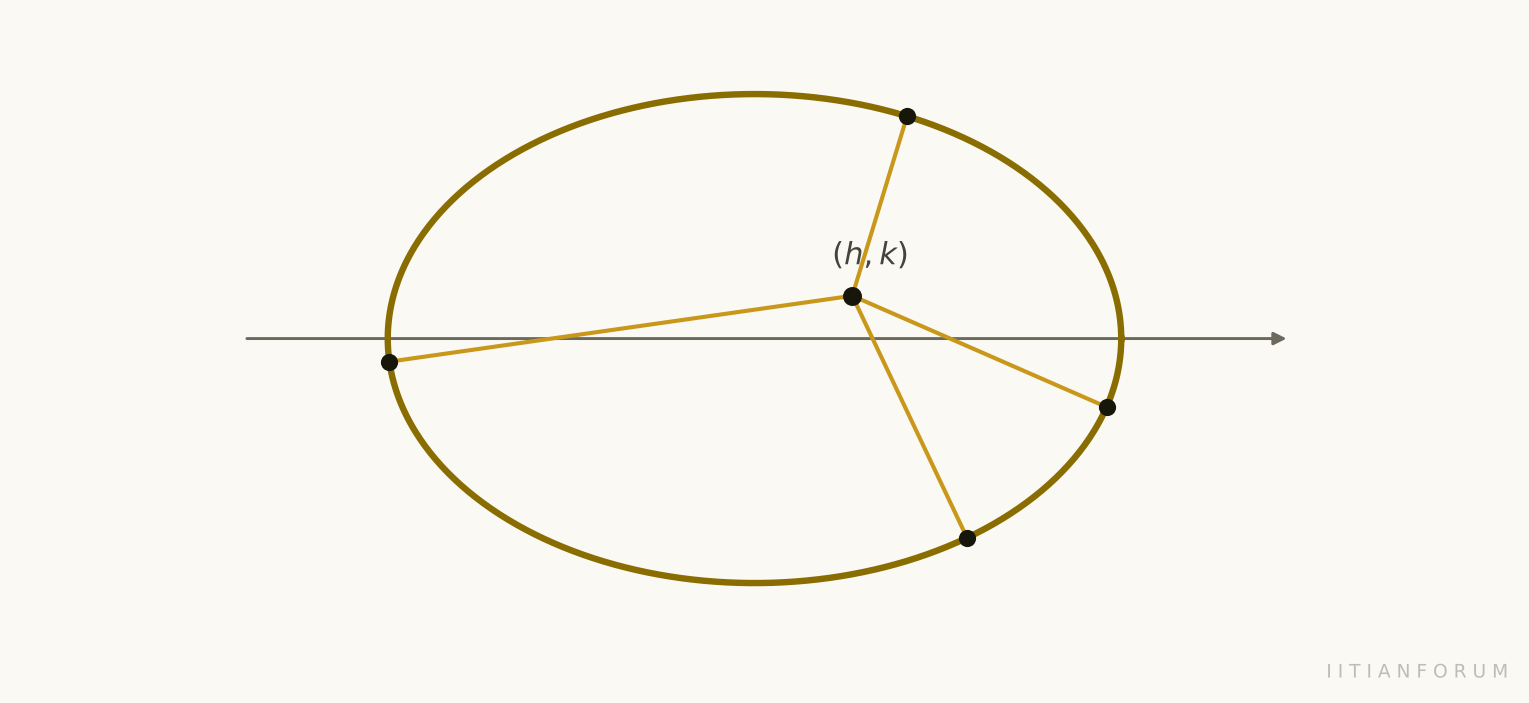
Let B=(h,k). Centre M=(2h+3,2k), radius r=2AB.
Step 2. Internal contact
OM=6−r. Multiply by 2; 2OM is the distance of B from A′(−3,0):
BA′=12−BABA+BA′=12
Step 3. Read the ellipse
Foci (±3,0) and 2a=12, so a=6, ae=3, e=21.
72e2=72⋅41=18
Answer:18
Example 3(JEE Main 2026, 8 April Shift 2). The number of values of z∈C satisfying ∣z−(4+8i)∣=10 and ∣z−(3+5i)∣+∣z−(5+11i)∣=45 is
Tap an option to check your answer
(1)0
(2)2
(3)1
(4)4
▸ SHOW SOLUTION
Step 1. The ellipse
Foci (3,5) and (5,11), 2a=45, so a2=20. Centre (4,8), half focal distance
ae=214+36=10b2=a2−a2e2=20−10=10
Step 2. The circle
Centre (4,8), the centre of the ellipse, radius 10=b.
Step 3. Count
Every point of the ellipse is at distance at least b from the centre, with equality only at the two ends of the minor axis. So the circle meets the ellipse at exactly these 2 points.
Answer: option (2)
Example 4(IIT JEE 2009, Paper 1). In a triangle ABC with fixed base BC, the vertex A moves such that cosB+cosC=4sin22A. If a,b and c denote the lengths of the sides of the triangle opposite to the angles A,B and C respectively, then
More than one option is correct. Pick all of them, then Check
(A)b+c=4a
(B)b+c=2a
(C)locus of point A is an ellipse
(D)locus of point A is a pair of straight lines
▸ SHOW SOLUTION
Step 1. Simplify the condition
2cos2B+Ccos2B−C=4sin22A
Since cos2B+C=sin2A=0:
cos2B−C=2sin2A
Step 2. Use the sine rule
ab+c=sinAsinB+sinC=sin2Acos2B−C=2
So b+c=2a.
Step 3. Locus
AC+AB=2BC, a constant larger than BC. So A moves on an ellipse with foci B and C (the two points on line BC excluded).
Answer: (B) and (C)
Example 5(IITianForum). The values of a for which (5x−1)2+(5y−2)2=(a2−3)(3x+4y−1)2 represents an ellipse are
More than one option is correct. Pick all of them, then Check
(A)(3,2)
(B)(−2,−3)
(C)(1,2)
(D)(2,3)
▸ SHOW SOLUTION
Step 1. Put it in PS = e PM form
Divide by 25:
PS2=(x−51)2+(y−52)2PS2=(a2−3)(53x+4y−1)2
Here S=(51,52), and the bracket is PM, the distance of P from 3x+4y−1=0.
Step 2. Check the focus is off the line
3⋅51+4⋅52−1=56=0. So e2=a2−3.
Step 3. Ellipse condition
0<a2−3<1⟺3<a2<4
So a∈(−2,−3)∪(3,2).
Answer: (A) and (B)
Example 6(JEE Main 2026, 6 April Shift 1). Let e1 and e2 be two distinct roots of the equation x2−ax+2=0. Let the set {a∈R:e1,e2 are eccentricities of hyperbolas}=(α,β) and {a∈R:e1,e2 are the eccentricities of an ellipse and a hyperbola respectively}=(γ,∞). Then α2+β2+γ2 is equal to
Tap an option to check your answer
(1)18
(2)22
(3)26
(4)34
▸ SHOW SOLUTION
Step 1. Both roots greater than 1
Let f(x)=x2−ax+2. Distinct real roots: a2>8. Both roots exceed 1: f(1)=3−a>0 and 2a>1. So
22<a<3
Step 2. One root in (0, 1), the other above 1
f(0)=2>0 and f(1)=3−a<0, so a>3. Hence γ=3.
Step 3. Add
α2+β2+γ2=8+9+9=26
Answer: option (3)
The standard ellipse
Take the centre at the origin, the focus S(ae,0) and the directrix x=ea, where a>0 and 0<e<1. For P(x,y), PS=e⋅PM gives
(x−ae)2+y2=e2(ea−x)2x2(1−e2)+y2=a2(1−e2)
Put b2=a2(1−e2):
a2x2+b2y2=1,a>b>0
This is the standard ellipse. Since the equation is unchanged when x→−x and when y→−y, the curve is symmetric about both axes, so there is a second focus S′(−ae,0) with a second directrix x=−ea.
e2=1−a2b2
Parts of the ellipse
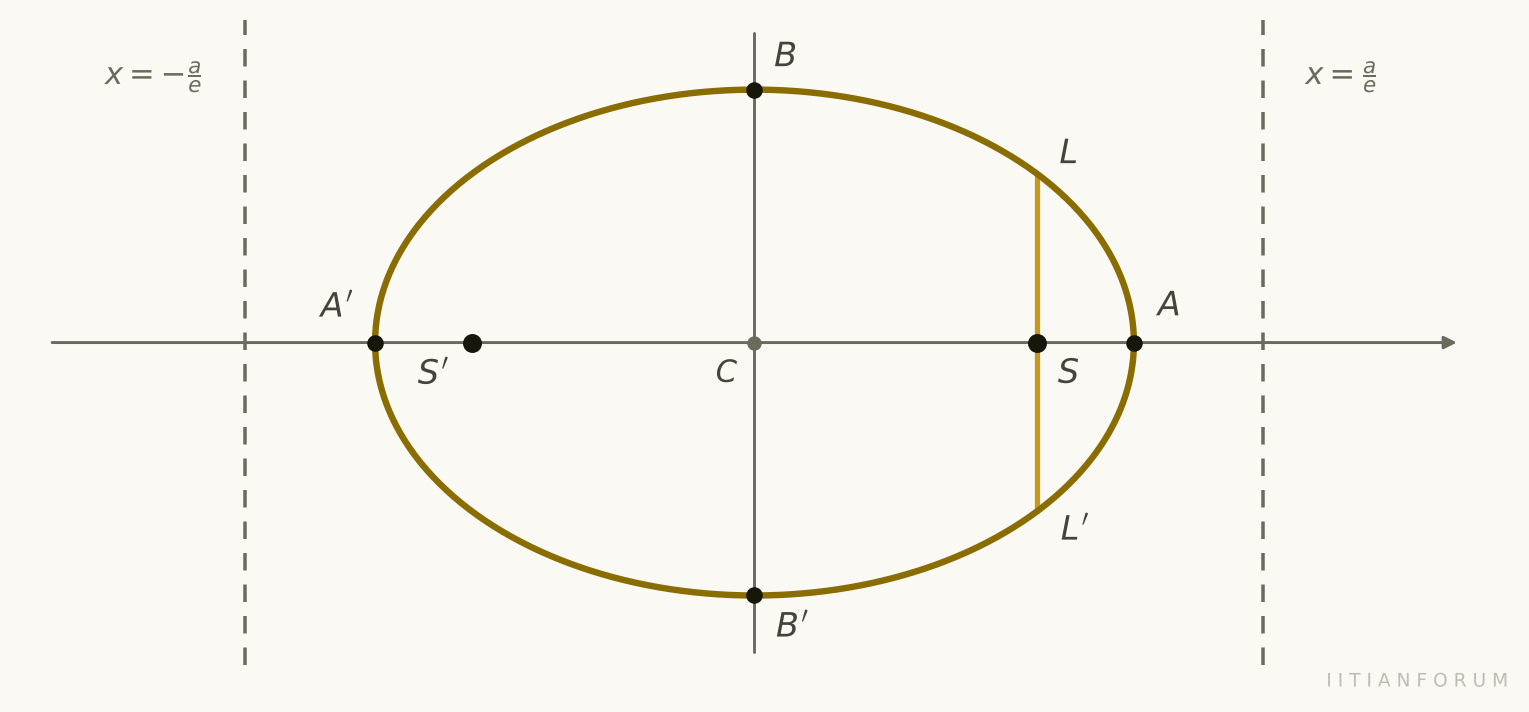
The standard ellipse with centre C, vertices A and A', ends of the minor axis B and B', foci S and S', both directrices dashed, and the latus rectum LL' through S
CentreC(0,0): every chord through it is bisected there.
Major axisAA′: from A′(−a,0) to A(a,0), length 2a.
Minor axisBB′: from B′(0,−b) to B(0,b), length 2b.
Vertices: A and A′, the ends of the major axis.
Foci: S(ae,0) and S′(−ae,0); distance between foci 2ae.
Directrices: x=±ea, at distance e2a apart.
Latus rectum: the focal chord perpendicular to the major axis.
Since b2=a2−a2e2, the three lengths a, b, ae form a right triangle: the distance from an end of the minor axis to a focus is a.
BS=b2+a2e2=a
Latus rectum and focal distances
Put x=ae in the equation: y2=b2(1−e2)=a2b4. The ends of the latus rectum are
L(ae,ab2),L′(ae,−ab2)
and its length is a2b2. The half length ab2=a(1−e2) is the semi-latus rectum.
For P(x1,y1) on the ellipse, PS=e⋅PM with PM=ea−x1, and similarly for S′:
SP=a−ex1,S′P=a+ex1
Adding gives SP+S′P=2a, the second definition. Multiplying gives a result used often:
SP⋅S′P=a2−e2x12
Which focus gets the minus sign
SP=a−ex1 is the distance from the focus on the same side as P (the right focus when x1>0). Both focal distances lie between a−ae and a+ae: the nearest point to a focus is the nearer vertex, the farthest is the other vertex.
Two orientations
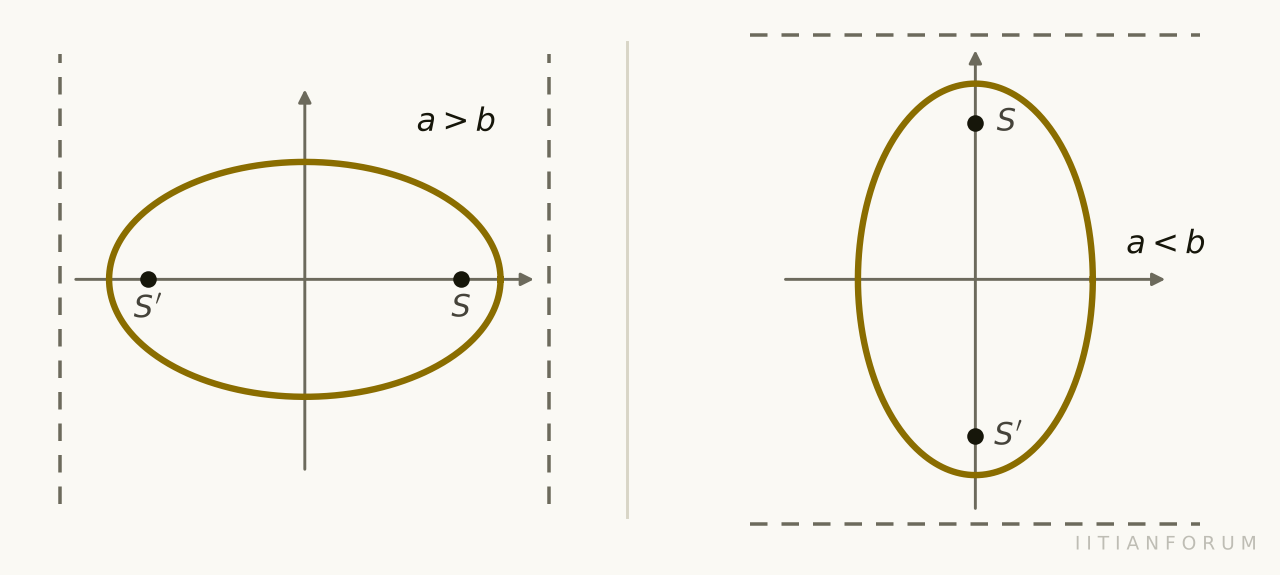
If b>a in a2x2+b2y2=1, the major axis is along the y-axis. Every result is obtained by interchanging the roles of x and y, and of a and b.
Two ellipses side by side: the first wider than tall with foci on the x-axis, the second taller than wide with foci on the y-axis, each with its directrices dashed
a>b
a<b
Major axis
x-axis, length 2a
y-axis, length 2b
Eccentricity
e2=1−a2b2
e2=1−b2a2
Foci
(±ae,0)
(0,±be)
Directrices
x=±ea
y=±eb
Latus rectum
a2b2
b2a2
Ends of latus rectum
(±ae,±ab2)
(±ba2,±be)
Focal distances
a∓ex1
b∓ey1
swipe for more →
Always ask which denominator is larger
The eccentricity formula uses (smaller denominator) over (larger denominator): e2=1−major2minor2. For 9x2+25y2=1 the foci are (0,±4), not (±4,0), and the latus rectum is 52⋅9.
Example 7(IITianForum). For the ellipse 9x2+25y2=225 find the eccentricity, the foci, the directrices, the length of the latus rectum and the focal distances of the point (4,59).
Example 8(JEE Main 2026, 5 April Shift 1). Let a focus of the ellipse E:a2x2+b2y2=1 be S(4,0) and its eccentricity be 54. If the point P(3,α) lies on E and O is the origin, then the area of △POS is
Tap an option to check your answer
(1)512
(2)514
(3)524
(4)548
▸ SHOW SOLUTION
Step 1. The ellipse
ae=4, e=54, so a=5 and b2=25−16=9.
Step 2. The point P
259+9α2=1,∣α∣=512
Step 3. Area
Base OS=4, height ∣α∣:
21⋅4⋅512=524
Answer: option (3)
Example 9(JEE Main 2026, 24 January Shift 2). Let the length of the latus rectum of the ellipse a2x2+b2y2=1, (a>b), be 30. If its eccentricity equals the maximum value of the function f(t)=−43+2t−t2, then (a2+b2) is equal to
Tap an option to check your answer
(1)516
(2)256
(3)496
(4)276
▸ SHOW SOLUTION
Step 1. Eccentricity
f(t)=41−(t−1)2≤41
So e=41 and b2=a2(1−161)=1615a2.
Step 2. Latus rectum
a2b2=815a=30,a=16
b2=240.
Step 3. Add
a2+b2=256+240=496
Answer: option (3)
Example 10(JEE Main 2026, 22 January Shift 2). Let S and S′ be the foci of the ellipse 25x2+9y2=1 and P(α,β) be a point on the ellipse in the first quadrant. If (SP)2+(S′P)2−SP⋅S′P=37, then α2+β2 is equal to
Tap an option to check your answer
(1)15
(2)11
(3)17
(4)13
▸ SHOW SOLUTION
Step 1. Focal distances
e=54, so SP=5−54α and S′P=5+54α.
Step 2. Use sum and product
SP+S′P=10 and SP⋅S′P=25−2516α2:
(SP+S′P)2−3SP⋅S′P=37100−75+2548α2=37,α2=425
Step 3. The ordinate
β2=9(1−41)=427α2+β2=452=13
Answer: option (4)
Example 11(JEE Main 2025, 2 April Shift 1). If S and S′ are the foci of the ellipse 18x2+9y2=1 and P is a point on the ellipse, then min(SP⋅S′P)+max(SP⋅S′P) is equal to
Tap an option to check your answer
(1)3(1+2)
(2)3(6+2)
(3)9
(4)27
▸ SHOW SOLUTION
Step 1. The product
e2=1−189=21. For P(x,y):
SP⋅S′P=a2−e2x2=18−2x2
Step 2. Range
0≤x2≤18, so the product runs from 9 (at the vertices) to 18 (at the ends of the minor axis).
9+18=27
Answer: option (4)
Example 12(IITianForum). The length of the major axis of an ellipse is 40 and its eccentricity is 21. The four end points of its two latera recta are joined to make a rectangle. The area of this rectangle is
Tap an option to check your answer
(1)300
(2)450
(3)600
(4)900
▸ SHOW SOLUTION
Step 1. The lengths
a=20, ae=10, b2=400(1−41)=300.
Step 2. Sides of the rectangle
One side is the distance between the foci, 2ae=20. The other is the latus rectum:
a2b2=20600=30
Step 3. Area
20×30=600
Answer: option (3)
Example 13(JEE Main 2026, 28 January Shift 2). Let A={z∈C:∣z−2∣≤4} and B={z∈C:∣z−2∣+∣z+2∣=5}. Then the maximum of {∣z1−z2∣:z1∈A,z2∈B} is
Tap an option to check your answer
(1)215
(2)8
(3)217
(4)9
▸ SHOW SOLUTION
Step 1. Read the sets
A is the disc of radius 4 about 2. B is the ellipse with foci ±2 and 2a=5, so a=25.
Step 2. Largest distance from a point of the disc
For a fixed z2, the farthest point of A is at distance ∣z2−2∣+4.
Step 3. Largest focal distance
∣z2−2∣ is the distance of z2 from the focus 2. Its largest value is a+ae=25+2=29, at the far vertex −25.
29+4=217
Answer: option (3)
Example 14(JEE Main 2026, 2 April Shift 1). Let an ellipse a2x2+b2y2=1, a<b, pass through the point (4,3) and have eccentricity 35. Then the length of its latus rectum is
Tap an option to check your answer
(1)345
(2)25
(3)375
(4)385
▸ SHOW SOLUTION
Step 1. Use the a < b formula
95=1−b2a2,a2=94b2
Step 2. Through (4, 3)
b236+b29=1,b2=45,a2=20
Step 3. Latus rectum
The major axis is vertical, so the latus rectum is b2a2:
3540=385
Answer: option (4)
Example 15(JEE Main 2026, 24 January Shift 1). Let each of the two ellipses E1:a2x2+b2y2=1(a>b) and E2:A2x2+B2y2=1(A<B) have eccentricity 54. Let the lengths of the latera recta of E1 and E2 be ℓ1 and ℓ2 respectively, such that 2ℓ12=9ℓ2. If the distance between the foci of E1 is 8, then the distance between the foci of E2 is ______.
▸ SHOW SOLUTION
Step 1. The first ellipse
2ae=8, e=54: a=5, b2=9, so ℓ1=518.
Step 2. The second ellipse
A2=B2(1−2516)=259B2, and ℓ2=B2A2=2518B.
Step 3. Use the relation
2⋅25324=9⋅2518B,B=4
Distance between the foci of E2:
2Be=2⋅4⋅54=532
Answer:532
Example 16(JEE Main 2026, 8 April Shift 2). Let f(a2+7a+3)x2+f(3a+15)y2=1 represent an ellipse with major axis along the y-axis, where f is a strictly decreasing positive function on R. If the set of all possible values of a is R−[α,β], then α2+β2 equals
Tap an option to check your answer
(1)28
(2)40
(3)61
(4)24
▸ SHOW SOLUTION
Step 1. Major axis along the y-axis
The y2 denominator must be larger:
f(3a+15)>f(a2+7a+3)
Step 2. Remove f
f is strictly decreasing, so the inequality reverses:
a2+7a+3>3a+15(a+6)(a−2)>0
Step 3. Read the set
a∈R−[−6,2], so α2+β2=36+4=40.
Answer: option (2)
Example 17(JEE Main 2026, 4 April Shift 1). Consider the parabola P:y2=4kx and the ellipse E:a2x2+b2y2=1. Let the line segment joining the points of intersection of P and E be their latus rectums. If the eccentricity of E is e, then e2+22 is equal to ______.
▸ SHOW SOLUTION
Step 1. Same focus
The common latus rectum passes through both foci: k=ae.
Step 2. Same length
4k=a2b2⇒4a2e=2a2(1−e2)e2+2e−1=0,e=2−1
Step 3. Evaluate
e2+22=3−22+22=3
Answer:3
Example 18(IIT JEE 2012, Paper 1). The ellipse E1:9x2+4y2=1 is inscribed in a rectangle R whose sides are parallel to the coordinate axes. Another ellipse E2 passing through the point (0,4) circumscribes the rectangle R. The eccentricity of the ellipse E2 is
Tap an option to check your answer
(A)22
(B)23
(C)21
(D)43
▸ SHOW SOLUTION
Step 1. The rectangle
Its sides are the tangents x=±3, y=±2; its vertices are (±3,±2).
Step 2. The second ellipse
Take E2:p2x2+16y2=1 (through (0,4)). Through (3,2):
p29+41=1,p2=12
Step 3. Eccentricity
16>12, so the major axis is vertical:
e2=1−1612=41,e=21
Answer: option (C)
Auxiliary circle and eccentric angle
The circle on the major axis as diameter,
x2+y2=a2
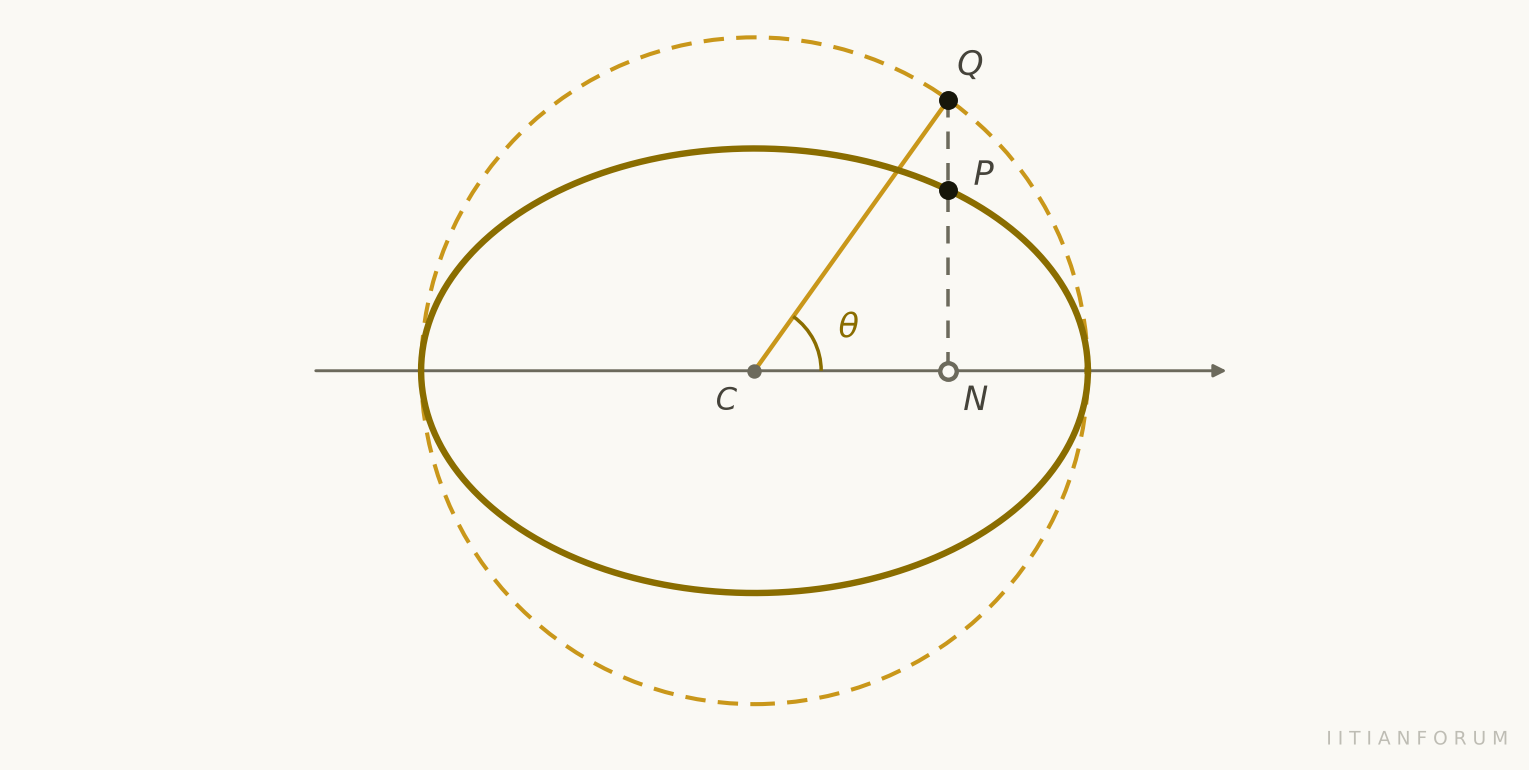
is the auxiliary circle. Take Q(acosθ,asinθ) on it and drop the perpendicular QN to the major axis. It meets the ellipse at
P(acosθ,bsinθ)
The angle θ is the eccentric angle of P, and P is called the point θ.
An ellipse inside its auxiliary circle, a point Q on the circle joined to the centre at angle theta, the perpendicular from Q to the major axis cutting the ellipse at P
Since QNPN=ab, the ellipse is the auxiliary circle compressed towards the major axis in the ratio b:a. Every vertical chord of the circle is cut by the ellipse in this ratio.
Parametric form
For every θ∈[0,2π) the point
x=acosθ,y=bsinθ
lies on the ellipse, and every point arises from exactly one θ. In this form
SP=a(1−ecosθ)S′P=a(1+ecosθ)
Eccentric angle is not the polar angle
The line CP makes the angle ϕ with tanϕ=abtanθ, not θ. The eccentric angle is the angle of Q on the auxiliary circle. Only at the four vertices do the two angles agree.
Why the eccentric angle helps
One angle replaces two coordinates tied by an equation. A chord becomes a pair θ,ϕ; a maximum or minimum on the ellipse becomes a maximum or minimum of a trigonometric expression.
Example 19(IIT JEE 2009, Paper 1). The line passing through the extremity A of the major axis and extremity B of the minor axis of the ellipse x2+9y2=9 meets its auxiliary circle at the point M. Then the area of the triangle with vertices at A, M and the origin O is
Tap an option to check your answer
(A)1031
(B)1029
(C)1021
(D)1027
▸ SHOW SOLUTION
Step 1. The points
9x2+y2=1: A(3,0), B(0,1), auxiliary circle x2+y2=9. Line AB: x=3−3y.
Step 2. Second meeting with the circle
(3−3y)2+y2=9⇒10y2−18y=0
y=59, so M(−512,59).
Step 3. Area
Base OA=3, height 59:
21⋅3⋅59=1027
Answer: option (D)
Example 20(JEE Advanced 2025, Paper 2). Let P(x1,y1) and Q(x2,y2) be two distinct points on the ellipse 9x2+4y2=1 such that y1>0, and y2>0. Let C denote the circle x2+y2=9, and M be the point (3,0). Suppose the line x=x1 intersects C at R, and the line x=x2 intersects C at S, such that the y-coordinates of R and S are positive. Let ∠ROM=6π and ∠SOM=3π, where O denotes the origin (0,0). Let ∣XY∣ denote the length of the line segment XY. Then which of the following statements is (are) TRUE?
More than one option is correct. Pick all of them, then Check
(A)The equation of the line joining P and Q is 2x+3y=3(1+3)
(B)The equation of the line joining P and Q is 2x+y=3(1+3)
(C)If N2=(x2,0), then 3∣N2Q∣=2∣N2S∣
(D)If N1=(x1,0), then 9∣N1P∣=4∣N1R∣
▸ SHOW SOLUTION
Step 1. Recognise the eccentric angles
C is the auxiliary circle, so R, S give the eccentric angles of P, Q:
P(233,1),Q(23,3)
Step 2. Line PQ
At P: 2⋅233+3⋅1=33+3. At Q: 3+33. So (A) holds and (B) fails (2x+y at P is 33+1).
Step 3. Ratios on the ordinates
Every ordinate of the ellipse is ab=32 of the circle's ordinate:
∣N2Q∣=32∣N2S∣,∣N1P∣=32∣N1R∣
So (C) holds; (D) would need the ratio 94, so it fails.
Answer: (A) and (C)
Example 21(JEE Main 2026, 24 January Shift 2). Let (h,k) lie on the circle C:x2+y2=4 and the point (2h+1,3k+2) lie on an ellipse with eccentricity e. Then the value of e25 is equal to ______.
▸ SHOW SOLUTION
Step 1. Parametrise the circle
h=2cosθ, k=2sinθ. The point is
x=1+4cosθ,y=2+6sinθ
Step 2. The ellipse
16(x−1)2+36(y−2)2=1
Step 3. Eccentricity
The major axis is vertical:
e2=1−3616=95,e25=9
Answer:9
Example 22(JEE Main 2026, 4 April Shift 2). Let P(3cosα,2sinα), α=0, be a point on the ellipse 9x2+4y2=1, Q a point on the circle x2+y2−14x−14y+82=0, and R a point on the line x+y=5, such that the centroid of △PQR is (2+cosα,3+32sinα). Then the sum of the ordinates of all possible points R is
Tap an option to check your answer
(1)6
(2)2
(3)4
(4)8
▸ SHOW SOLUTION
Step 1. Points
The circle has centre (7,7), radius 4: Q(7+4cosθ,7+4sinθ). Take R(5−y,y).
Step 2. Centroid
The terms in α cancel:
4cosθ=y−6,4sinθ=2−y
Step 3. Eliminate
(y−6)2+(y−2)2=16y2−8y+12=0
y=2 or 6; the sum is 8.
Answer: option (4)
Example 23(JEE Main 2020, 5 September Shift 1). If the point P on the curve 4x2+5y2=20 is farthest from the point Q(0,−4), then PQ2 is equal to
Tap an option to check your answer
(1)29
(2)48
(3)21
(4)36
▸ SHOW SOLUTION
Step 1. Parametrise
5x2+4y2=1: P(5cosθ,2sinθ).
Step 2. Distance squared
PQ2=5cos2θ+(2sinθ+4)2=21+16sinθ−sin2θ
Step 3. Maximise
With s=sinθ∈[−1,1], 21+16s−s2 increases on [−1,1], so the maximum is at s=1:
21+16−1=36
Answer: option (4)
General forms of the ellipse
Axes parallel to the coordinate axes
Shift the centre to (h,k):
a2(x−h)2+b2(y−k)2=1
Put X=x−h, Y=y−k; then every result of the standard ellipse holds in X, Y. For a>b:
Part
Value
Centre
(h,k)
Vertices
(h±a,k)
Foci
(h±ae,k)
Directrices
x=h±ea
Latus rectum
a2b2
swipe for more →
An equation Ax2+By2+2Gx+2Fy+C=0 with A, B of the same sign is turned into this form by completing the square in x and in y.
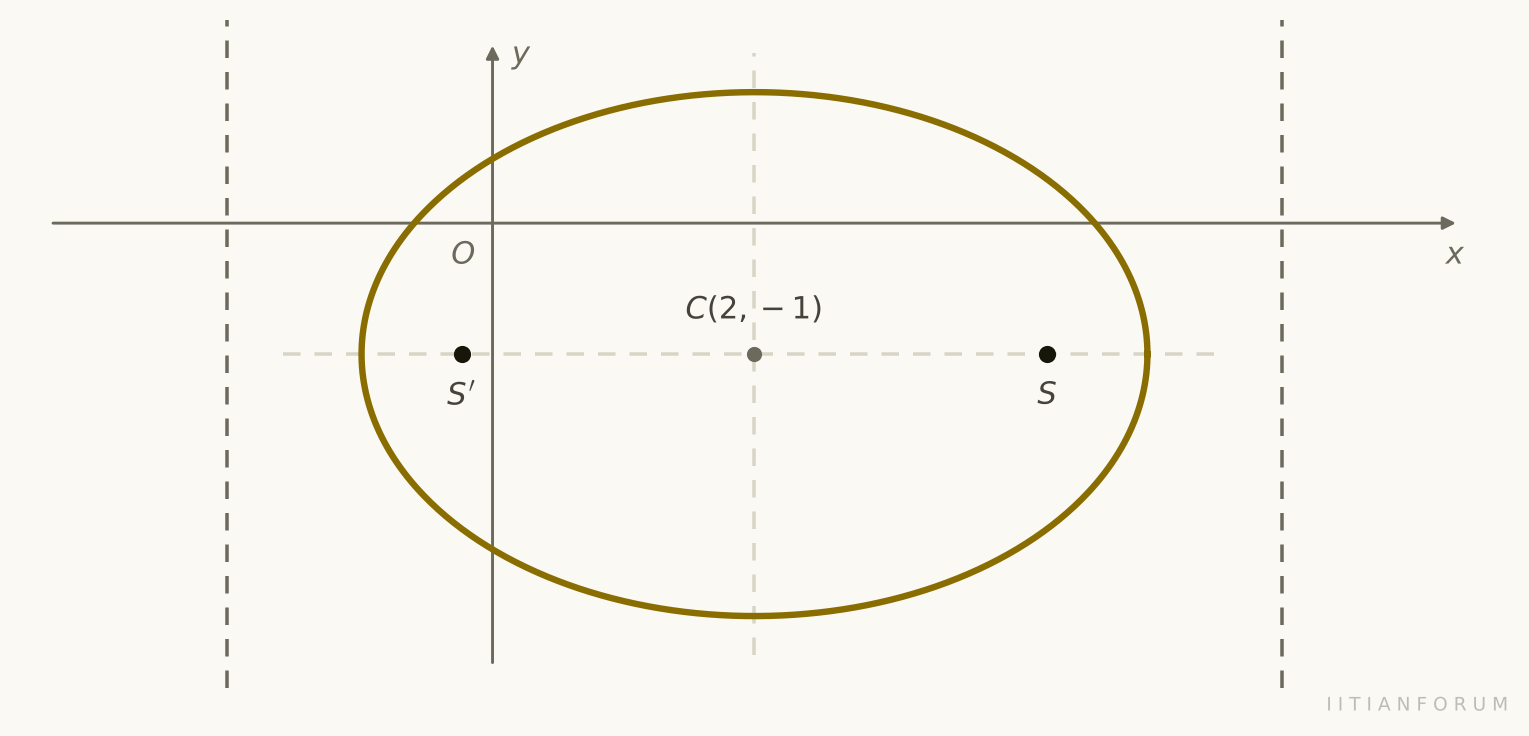
A shifted ellipse with centre C(2, -1), the shifted axes dashed through C, both foci and both directrices marked
Shift first, then quote formulas
The foci of 9(x−2)2+4(y+1)2=1 are (2±5,−1), not (±5,0). Lengths (axes, latus rectum, e) do not change under a shift; points and lines do.
Ellipse from a focus and a directrix
Given a focus S(α,β), a directrix lx+my+n=0 and e, the ellipse is
(x−α)2+(y−β)2=e2l2+m2(lx+my+n)2
Ellipse with slanted axes
If the major axis lies along L1=0 and the minor axis along L2=0 (two perpendicular lines, each written with its normal of unit length), then
a2L22+b2L12=1
because the distance from the minor axis plays the part of x and the distance from the major axis plays the part of y.
Recognising an ellipse
The general second degree equation
ax2+2hxy+by2+2gx+2fy+c=0
is an ellipse when h2<ab and the equation does not split into a pair of lines:
abc+2fgh−af2−bg2−ch2=0
(A real ellipse also needs at least one real point; for example x2+y2+1=0 passes both tests and has none.)
Example 24(JEE Main 2026, 28 January Shift 2). An ellipse has its centre at (1,−2), one focus at (3,−2) and one vertex at (5,−2). Then the length of its latus rectum is
Tap an option to check your answer
(1)316
(2)6
(3)43
(4)63
▸ SHOW SOLUTION
Step 1. Read a and ae
The major axis is the line y=−2. Centre to focus: ae=2. Centre to vertex: a=4.
Step 2. b squared
b2=a2−a2e2=16−4=12
Step 3. Latus rectum
a2b2=424=6
Answer: option (2)
Example 25(JEE Main 2025, 4 April Shift 1). The length of the latus rectum of the ellipse, whose foci are (2,5) and (2,−3) and eccentricity is 54, is
Tap an option to check your answer
(1)56
(2)350
(3)310
(4)518
▸ SHOW SOLUTION
Step 1. Orientation
The foci lie on x=2, so the major axis is vertical. Centre (2,1), half focal distance 4.
Step 2. Semi-axes
Major semi-axis p: pe=4, so p=5. Minor semi-axis q: q2=25−16=9.
Step 3. Latus rectum
p2q2=518
Answer: option (4)
Example 26(IITianForum). For the ellipse 4x2+9y2−16x+18y−11=0, find the centre, the eccentricity, the foci, the directrices and the length of the latus rectum.
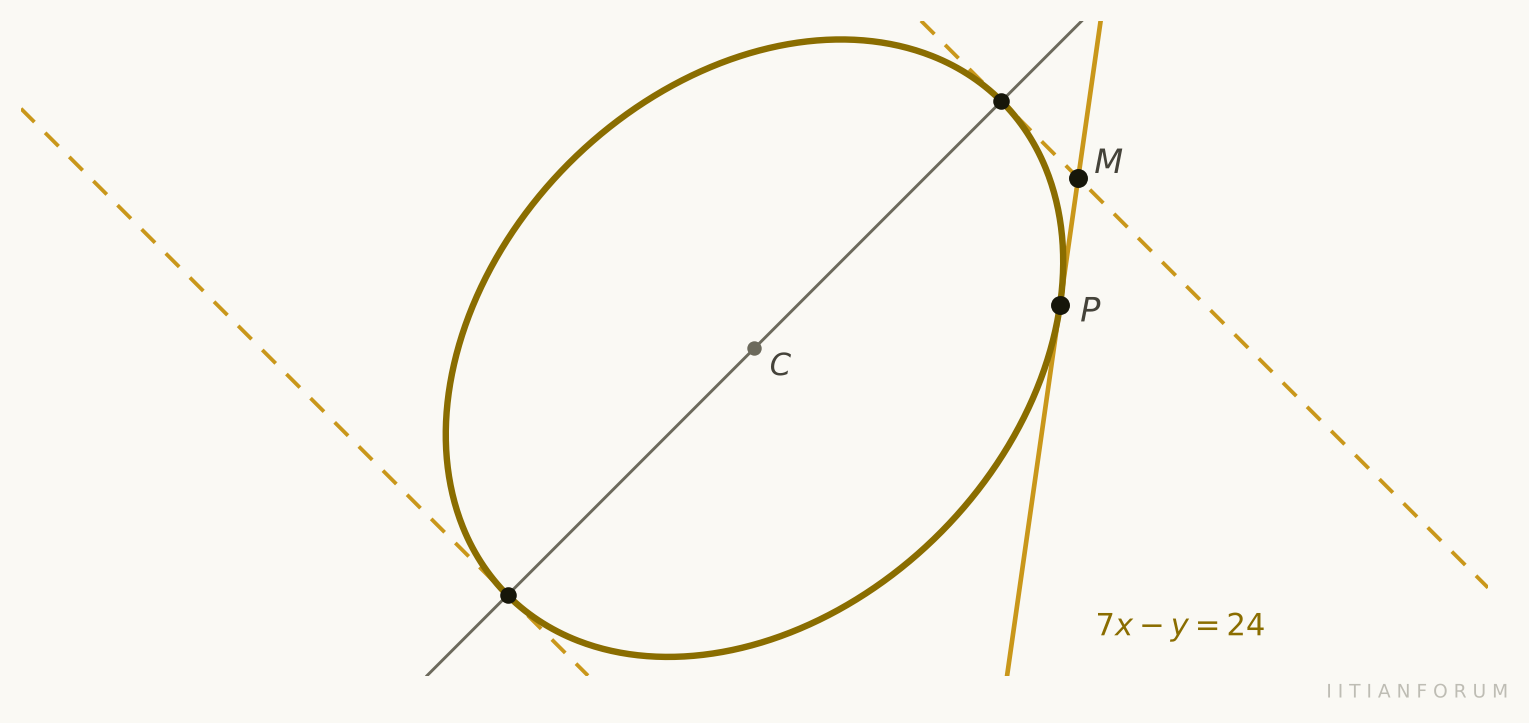
A slanted ellipse with its major axis along the line y equals x, the two vertex tangents perpendicular to that axis, a circle whose diameter MN lies on a line touching the ellipse
Example 27(IITianForum). Let M and N be the end points of that diameter of the circle x2+y2−6x+6y−7=0 which lies along the line 7x−y=24. The tangents to an ellipse at the two end points of its major axis pass through M and through N respectively, and the line MN itself touches the same ellipse. The major axis of the ellipse lies along the line y=x. Then
More than one option is correct. Pick all of them, then Check
(A)the eccentricity of the ellipse is 47
(B)the length of the latus rectum is 29
(C)the centre of the ellipse is (1,1)
(D)the equation of one of the directrices is x+y=71614
▸ SHOW SOLUTION
Step 1. M and N
The circle has centre (3,−3) (on 7x−y=24) and radius 5. Unit vector along the line: 52(1,7).
M,N=(3±21,−3±27)
So x+y=±42 at M and N.
Step 2. Centre and a
The vertex tangents are perpendicular to y=x, so they are x+y=±42. The centre lies midway on y=x: the origin. The distance between them is 8, so a=4.
Step 3. Rotated coordinates
Take X=2x+y (along the major axis), Y=2y−x. The ellipse is 16X2+b2Y2=1 and the line 7x−y=24 becomes
3X−4Y=122
Step 4. Tangency
For lX+mY=n to touch, n2=a2l2+b2m2:
288=144+16b2,b2=9
Step 5. Check the options
e2=1−169, so e=47. Latus rectum 42⋅9=29. The centre is (0,0), so (C) fails. Directrix X=ea=716:
x+y=7162=71614
Answer: (A), (B) and (D)
Example 28(JEE Main 2026, 23 January Shift 2). If the points of intersection of the ellipses x2+2y2−6x−12y+23=0 and 4x2+2y2−20x−12y+35=0 lie on a circle of radius r and centre (a,b), then the value of ab+18r2 is
Tap an option to check your answer
(1)53
(2)51
(3)52
(4)55
▸ SHOW SOLUTION
Step 1. Curve through the common points
S1+λS2=0 passes through every common point. It is a circle when the x2 and y2 coefficients are equal:
1+4λ=2+2λ,λ=21
Step 2. The circle
3x2+3y2−16x−18y+281=0x2+y2−316x−6y+227=0
Step 3. Centre and radius
Centre (38,3):
r2=964+9−227=1847ab+18r2=8+47=55
Answer: option (4)
Position of a point and a line meeting the ellipse
Position of a point
For the ellipse S≡a2x2+b2y2−1=0 write
S1=a2x12+b2y12−1
S1
P(x1,y1) lies
<0
inside
=0
on the ellipse
>0
outside
swipe for more →
A line meeting the ellipse
Put y=mx+c into the ellipse:
(b2+a2m2)x2+2a2mcx+a2(c2−b2)=0
Its discriminant is 4a2b2(a2m2+b2−c2), so
Condition
The line
c2<a2m2+b2
cuts the ellipse at two points
c2=a2m2+b2
touches the ellipse
c2>a2m2+b2
misses the ellipse
swipe for more →
Chord through a point in a given direction
The line through P(x1,y1) at angle α is x=x1+rcosα, y=y1+rsinα. Putting it in the ellipse gives a quadratic in r whose roots are PA and PB (with sign):
PA⋅PB=a2cos2α+b2sin2α∣S1∣
Example 29(IITianForum). For the ellipse 16x2+9y2=1: (a) state whether (2,2) and (3,3) are inside or outside; (b) find the values of c for which y=x+c cuts the ellipse at two points, and the point of contact when it touches with c>0.
Example 30(JEE Main 2026, 23 January Shift 1). Let the line y−x=1 intersect the ellipse 2x2+1y2=1 at the points A and B. Then the angle made by the line segment AB at the centre of the ellipse is
Tap an option to check your answer
(1)π−tan−1(41)
(2)2π+tan−1(41)
(3)2π+2tan−1(41)
(4)2π−tan−1(41)
▸ SHOW SOLUTION
Step 1. The points
x2+2(x+1)2=2⇒3x2+4x=0
A(0,1) and B(−34,−31).
Step 2. Angle at O
OA=(0,1) and ∣OB∣=317:
cos∠AOB=317−31=−171
Step 3. Write it with tan
cos(2π+t)=−sint with sint=171, tant=41.
Answer: option (2)
Example 31(JEE Main 2025, 3 April Shift 1). A line passing through the point P(5,5) intersects the ellipse 36x2+25y2=1 at A and B such that (PA)⋅(PB) is maximum. Then 5(PA2+PB2) is equal to
Tap an option to check your answer
(1)218
(2)377
(3)290
(4)338
▸ SHOW SOLUTION
Step 1. P is inside
S1=365+255−1=−900595<0
Step 2. The product
PA⋅PB=25cos2α+36sin2α595
The denominator is least at α=0, so the chord is horizontal: y=5.
Step 3. The ends
36x2=1−51,x=±512
Step 4. Evaluate
PA2+PB2=2(5+5144)=5338
5(PA2+PB2)=338.
Answer: option (4)
Chords of the ellipse
Chord joining two points
The chord joining the points θ and ϕ is
axcos2θ+ϕ+bysin2θ+ϕ=cos2θ−ϕ
To see it, check that (acosθ,bsinθ) satisfies it: the left side is cosθcos2θ+ϕ+sinθsin2θ+ϕ=cos2θ−ϕ. The same holds for ϕ.
Focal chords
The chord θϕ passes through S(ae,0) when ecos2θ+ϕ=cos2θ−ϕ, which simplifies to
tan2θtan2ϕ=e+1e−1
For the other focus S′(−ae,0) the right side is e−1e+1.
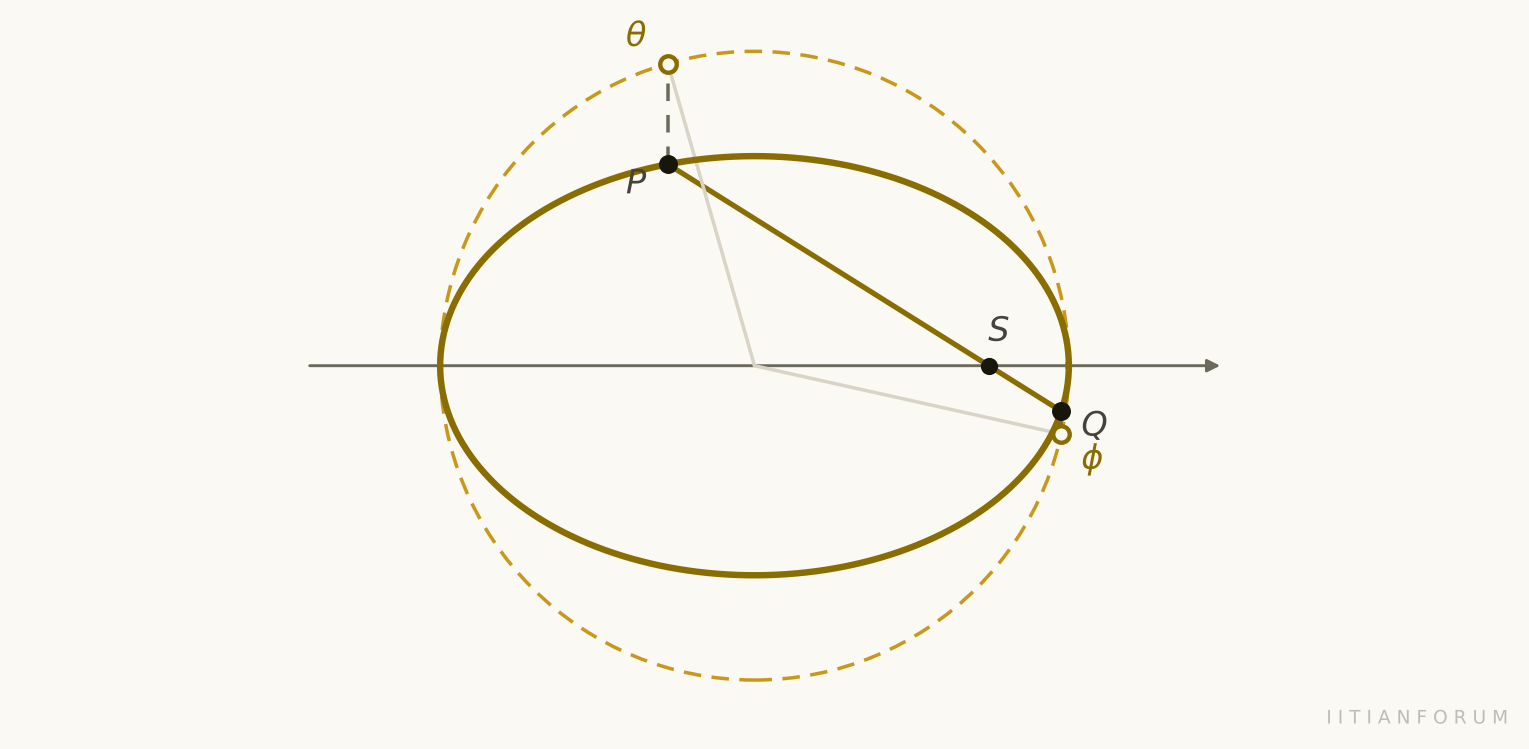
An ellipse with a focal chord PQ through the focus S, the eccentric angles of P and Q marked by their points on the auxiliary circle
If PQ is a focal chord through S, the semi-latus rectum is the harmonic mean of SP and SQ:
SP1+SQ1=b22a
Chord with a given middle point
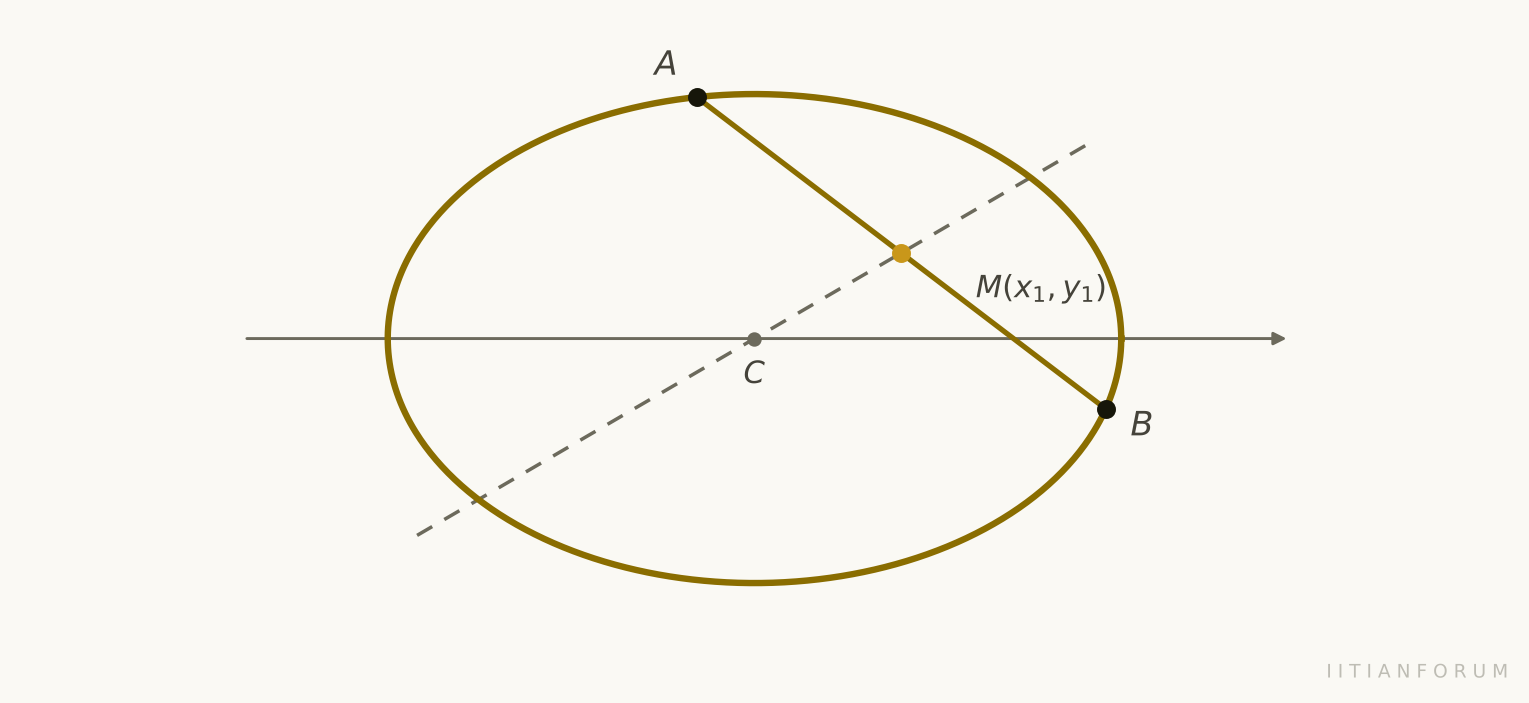
The chord of the ellipse whose middle point is (x1,y1) is
T=S1
where T=a2xx1+b2yy1−1. Its slope is −a2y1b2x1.
An ellipse with a chord AB and its middle point M marked, the line CM joining the centre to M drawn dashed
Diameters and conjugate diameters
The middle points of all chords of slope m lie on the line through the centre
y=−a2mb2x
called a diameter. Two diameters y=m1x and y=m2x are conjugate (each bisects the chords parallel to the other) when
m1m2=−a2b2
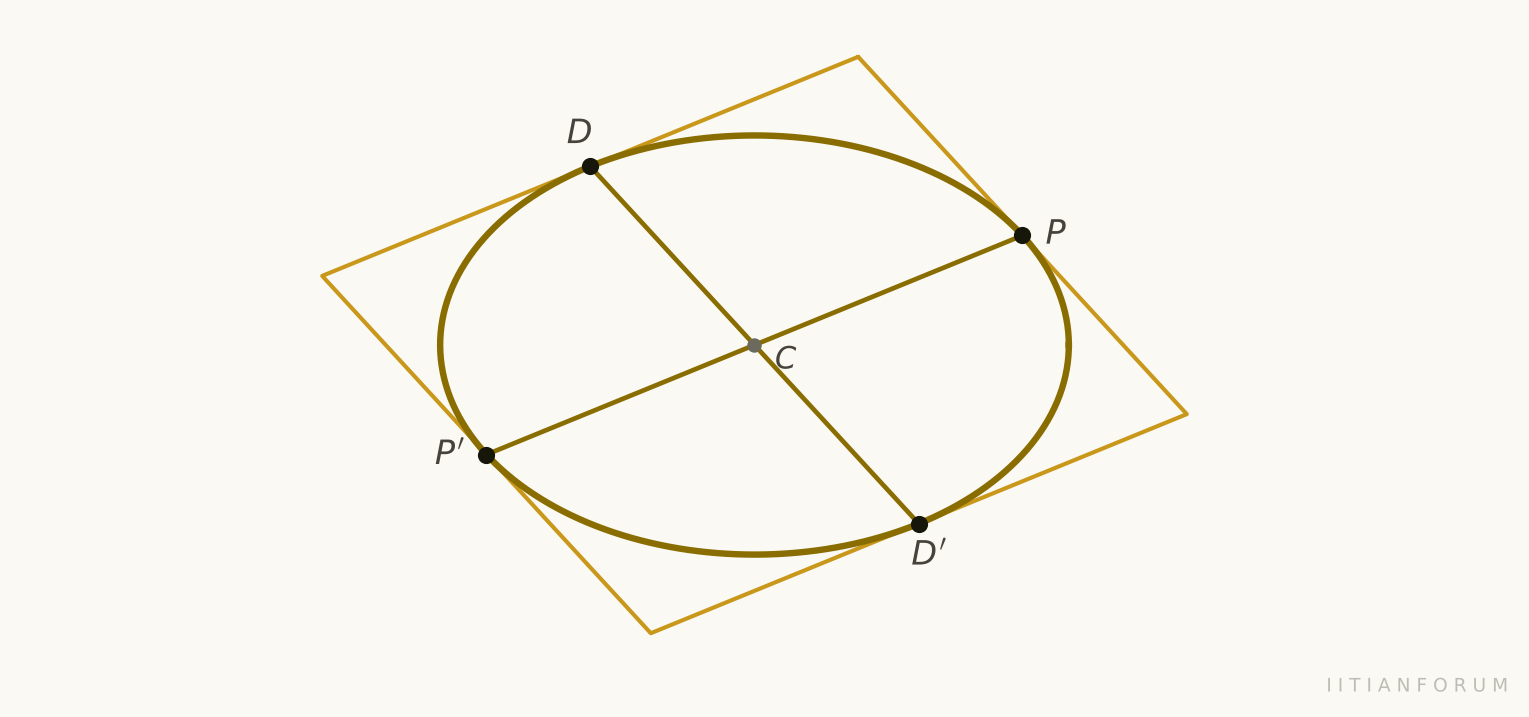
If CP and CD are conjugate semi-diameters with P the point θ, then D is the point θ+2π, and
Result
Value
CP2+CD2
a2+b2
SP⋅S′P
CD2
Area of parallelogram of tangents at P, D and their opposite ends
4ab
swipe for more →
An ellipse with two conjugate semi-diameters CP and CD, and the parallelogram formed by the tangents at the four ends
Example 32(IITianForum). For the ellipse 25x2+16y2=1, the focal chord through B(0,4) and the focus S(3,0) meets the ellipse again at Q. Find Q, check tan2θtan2ϕ=e+1e−1 and find the length of the chord.
▸ SHOW SOLUTION
Step 1. The chord
e=53. Line BS: y=4−34x. Put in the ellipse:
25x2+(1−3x)2=1⇒22534x2=32x
x=1775, y=−1732.
Step 2. Eccentric angles
B is θ=2π, so tan2θ=1. For Q: cosϕ=1715, sinϕ=−178:
tan2ϕ=1+cosϕsinϕ=−41
And e+1e−1=8/5−2/5=−41. The product agrees.
Step 3. Length
SB=5 and SQ=5−53⋅1775=1740:
SB+SQ=5+1740=17125
(Check: 51+4017=85=b22a.)
Answer:Q(1775,−1732), length 17125
Example 33(JEE Main 2026, 6 April Shift 2). Let x=9 be a directrix of an ellipse E, whose centre is at the origin and eccentricity is 31. Let P(α,0), α>0, be a focus of E and AB be a chord passing through P. Then the locus of the mid-point of AB is
Tap an option to check your answer
(1)9y2=8x(1−x)
(2)3y2=4x(1−x)
(3)9y2=8x(x−1)
(4)3y2=4x(x−1)
▸ SHOW SOLUTION
Step 1. The ellipse
ea=9, e=31: a=3, ae=1, b2=8. So P=(1,0).
Step 2. Chord with middle point (h, k)
9hx+8ky=9h2+8k2
Step 3. Through (1, 0)
9h=9h2+8k2⇒8h=8h2+9k2
The locus is 9y2=8x(1−x).
Answer: option (1)
Example 34(JEE Main 2025, 23 January Shift 2). The length of the chord of the ellipse 4x2+2y2=1, whose mid-point is (1,21), is
The point form is T=0. It comes from the slope −a2y1b2x1 found by differentiating a2x2+b2y2=1. The slope form is the condition c2=a2m2+b2 found earlier; matching it with the point form gives the point of contact.
Signs in the slope form
In y=mx+a2m2+b2 the point of contact is (−a2m2+b2a2m,a2m2+b2b2): the upper sign of c goes with a negativex when m>0. Check with m=0: y=b touches at (0,b). A line lx+my+n=0 touches the ellipse when a2l2+b2m2=n2.
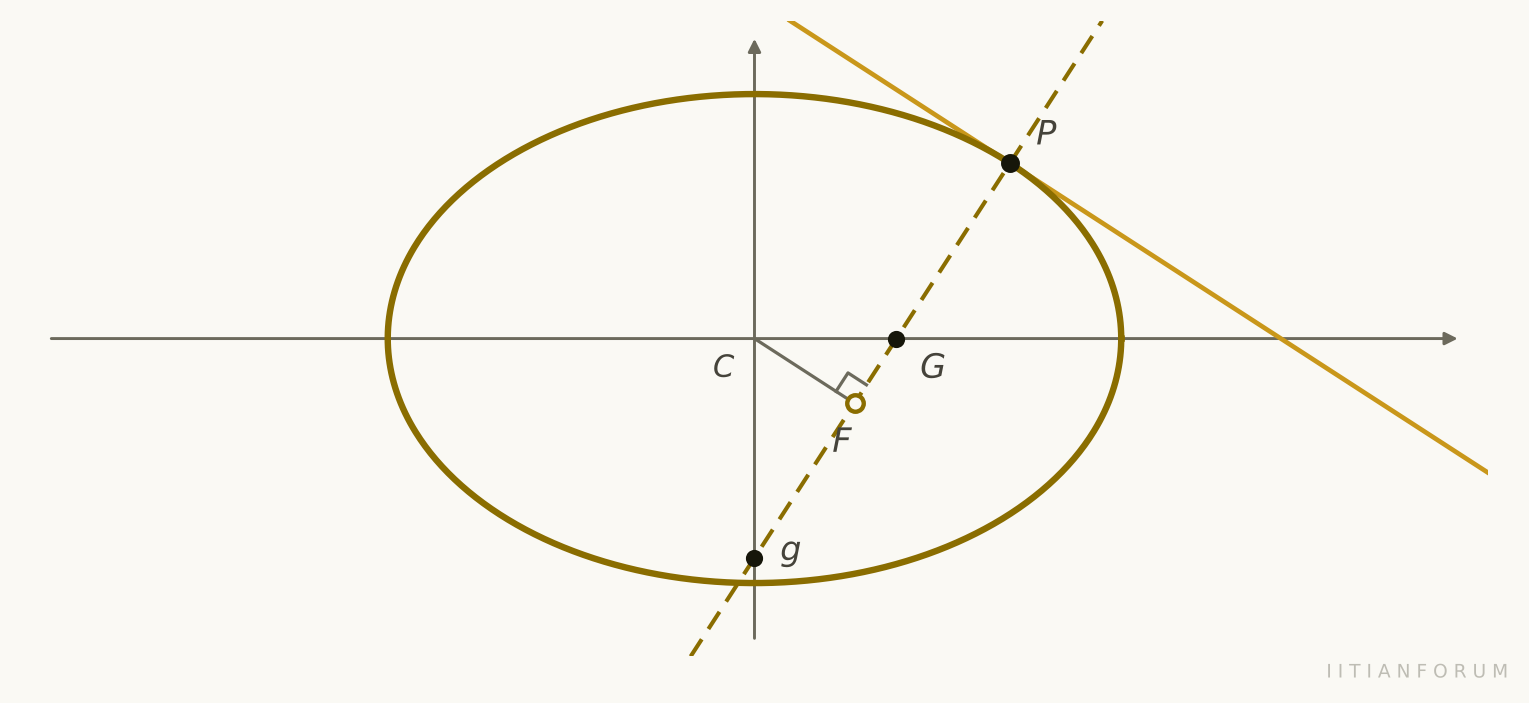
An ellipse with a tangent and the normal at a point P, the normal meeting the major axis at G and the minor axis at g, and the foot F of the perpendicular from the centre to the normal
Example 35(IITianForum). For the ellipse 9x2+4y2=1, find (a) the tangent at (59,58); (b) the tangents parallel to y=x and their points of contact.
▸ SHOW SOLUTION
Step 1. Point form
22581+10064=259+2516=1, so the point is on the ellipse. Tangent:
459x+208y=1,x+2y=5
Step 2. Slope form
m=1: c=±9+4=±13.
Step 3. Points of contact
For y=x+13: (−139,134). For y=x−13: (139,−134).
Answer:x+2y=5; y=x±13 at (∓139,±134)
Example 36(JEE Main 2026, 21 January Shift 2). The line αx+4y=7, α∈R, touches the ellipse 3x2+4y2=1 at the point P in the first quadrant. Then one of the focal distances of P is
Tap an option to check your answer
(1)31−2111
(2)31+251
(3)31−251
(4)31+271
▸ SHOW SOLUTION
Step 1. Compare with the point form
The tangent at (x1,y1) is 3x1x+4y1y=1. Matching with αx+4y=7:
y1=71,3x1=7α
Step 2. Find P
3x12+74=1 gives x12=71; first quadrant, so x1=71.
Step 3. Focal distances
a2=31, b2=41, e2=1−43=41:
a±ex1=31±271
Answer: option (4)
Example 37(JEE Main 2025, 4 April Shift 2). Let for two distinct values of p the lines y=x+p touch the ellipse E:42x2+32y2=1 at the points A and B. Let the line y=x intersect E at the points C and D. Then the area of the quadrilateral ABCD is equal to
Tap an option to check your answer
(1)36
(2)24
(3)48
(4)20
▸ SHOW SOLUTION
Step 1. A and B
p2=16+9, p=±5. Contacts (∓516,±59).
Step 2. C and D
x2(161+91)=1 gives x=±512: ±(512,512).
Step 3. Area
Both pairs are symmetric about the origin, so ACBD is a parallelogram with diagonals AB=(532,−518) and CD=(524,524):
212532⋅24+18⋅24=24
Answer: option (2)
Where two tangents meet
The tangents at the points θ and ϕ meet at
(cos2θ−ϕacos2θ+ϕ,cos2θ−ϕbsin2θ+ϕ)
Pair of tangents and chord of contact
From P(x1,y1) outside the ellipse two tangents can be drawn.
Object
Equation
Chord of contact
T=0
Pair of tangents
SS1=T2
swipe for more →
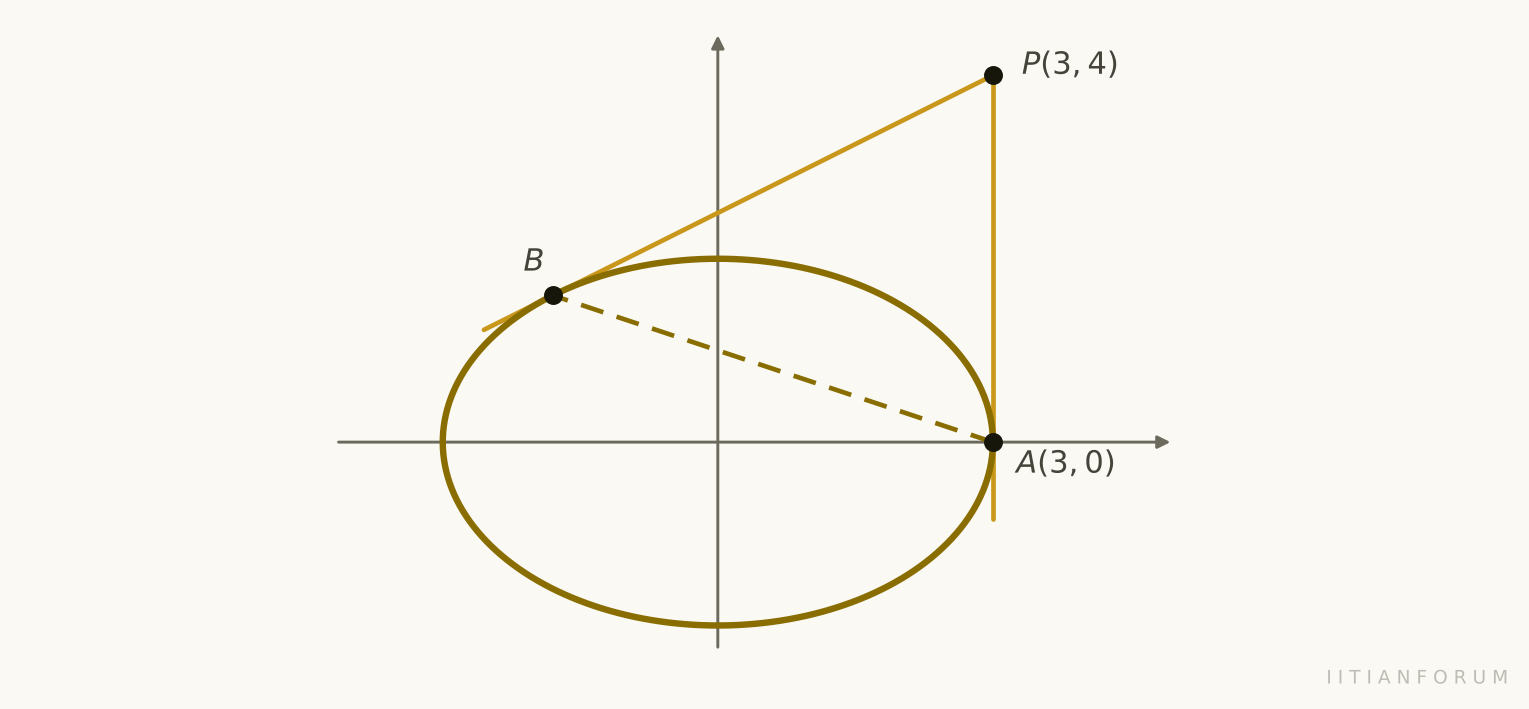
An ellipse and an outside point P(3, 4) with the two tangents from P touching at A(3, 0) and B, and the chord of contact AB
Director circle
The locus of the point from which the two tangents are perpendicular is the director circle
x2+y2=a2+b2
Reason: y=mx+c through (h,k) with c2=a2m2+b2 gives (h2−a2)m2−2hkm+k2−b2=0. Perpendicular tangents need the product of the roots −1:
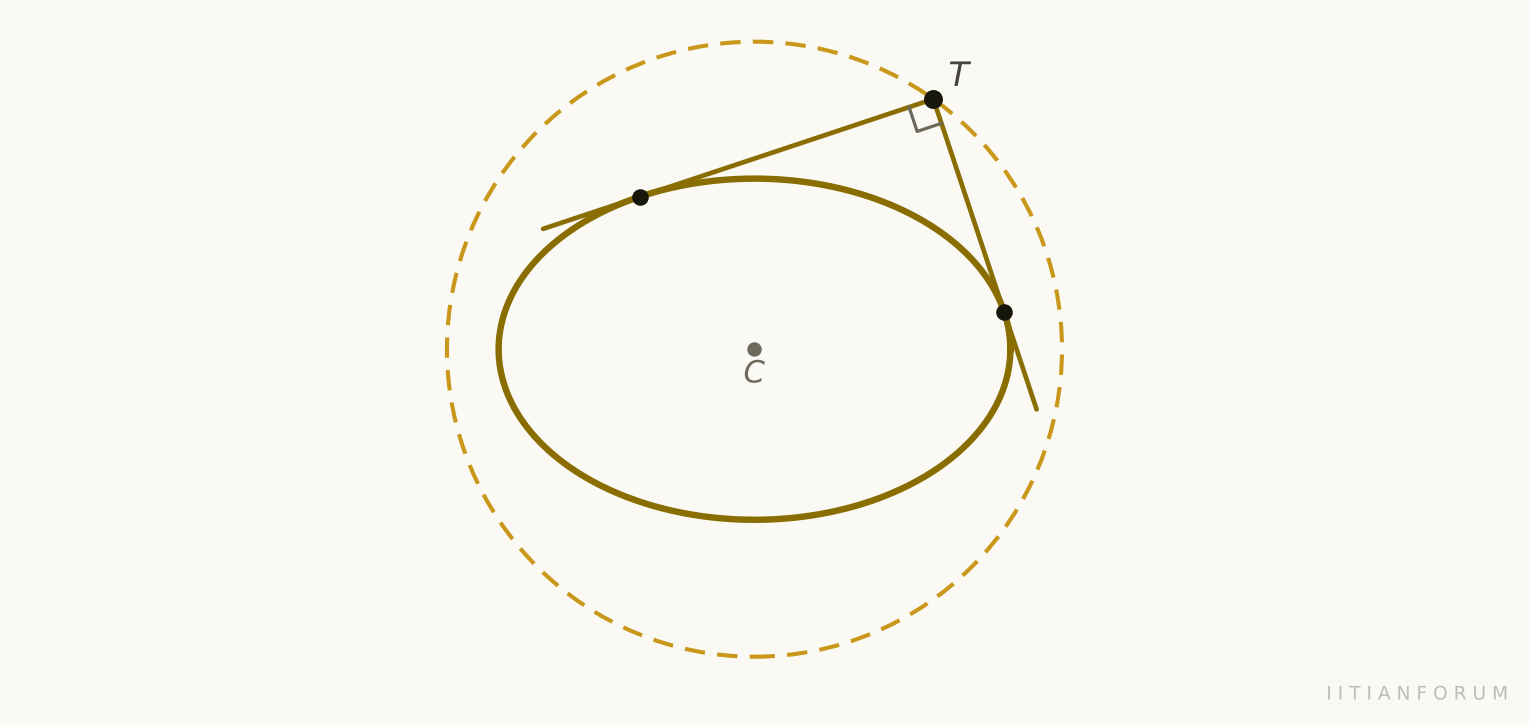
k2−b2=−(h2−a2)An ellipse with its larger concentric director circle, a point T on the circle and the two perpendicular tangents from T to the ellipse
Pole and polar
The polar of P(x1,y1) with respect to the ellipse is T=0 (for P outside, it is the chord of contact). The pole of the line lx+my+n=0 is
(−na2l,−nb2m)
If the polar of P passes through Q, then the polar of Q passes through P (conjugate points). The polar of a focus is the corresponding directrix, so tangents at the ends of a focal chord meet on the directrix.
Standard properties of a tangent
Property
Statement
Distance from the centre
lies between b and a
Perpendiculars from the foci
product p1p2=b2
Feet of those perpendiculars
lie on the auxiliary circle
Tangent meets the vertex tangents at B, C
circle on BC passes through both foci
Tangent meets a directrix at K
∠PSK=90∘ at the corresponding focus
Triangle cut from the axes
least area ab, at θ=4π
swipe for more →
The first line comes from 1+m2∣c∣=1+m2a2m2+b2, a weighted mean of a2 and b2.
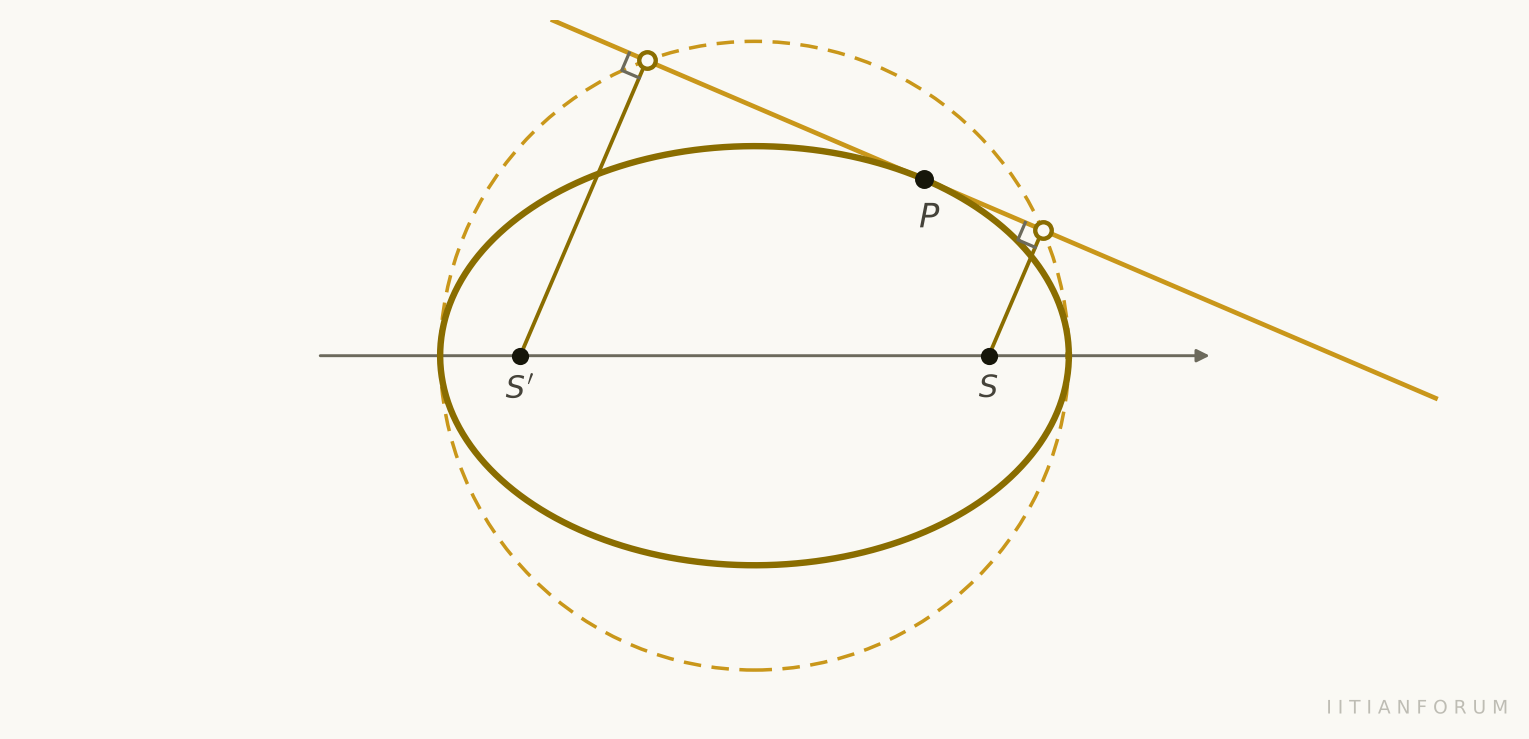
An ellipse with a tangent, the perpendiculars from both foci to the tangent, and their feet lying on the auxiliary circle
Example 38(IIT JEE 2010, Paper 2). Tangents are drawn from the point P(3,4) to the ellipse 9x2+4y2=1 touching the ellipse at points A and B. The coordinates of A and B are
Tap an option to check your answer
(A)(3,0) and (0,2)
(B)(−58,152161) and (−59,58)
(C)(−58,152161) and (0,2)
(D)(3,0) and (−59,58)
▸ SHOW SOLUTION
Step 1. Chord of contact
93x+44y=1,x=3−3y
Step 2. Meet the ellipse
(1−y)2+4y2=1⇒45y2−2y=0
y=0 or y=58.
Step 3. The points
(3,0) and (3−524,58)=(−59,58).
Answer: option (D)
Example 39(IIT JEE 2010, Paper 2). For P, A, B of Example 38, the orthocentre of the triangle PAB is
Tap an option to check your answer
(A)(5,78)
(B)(57,825)
(C)(511,58)
(D)(258,57)
▸ SHOW SOLUTION
Step 1. One altitude
PA is the vertical line x=3, so the altitude from B is horizontal: y=58.
Step 2. Second altitude
Slope of PB=3+594−58=21. The altitude from A(3,0) has slope −2:
y=−2x+6
Step 3. Meet
y=58 gives x=511.
Answer: option (C)
Example 40(JEE Main 2023, 1 February Shift 2). The line x=8 is the directrix of the ellipse E:a2x2+b2y2=1 with the corresponding focus (2,0). If the tangent to E at the point P in the first quadrant passes through the point (0,43) and intersects the x-axis at Q, then (3PQ)2 is equal to ______.
▸ SHOW SOLUTION
Step 1. The ellipse
ea=8, ae=2: a2=16, e=21, b2=12.
Step 2. The point P
The tangent 16xx1+12yy1=1 passes through (0,43): y1=3. Then x1=23.
Step 3. Q and PQ
y=0 gives x=x116=38.
PQ2=(38−23)2+3=34+3=313
(3PQ)2=9⋅313=39.
Answer:39
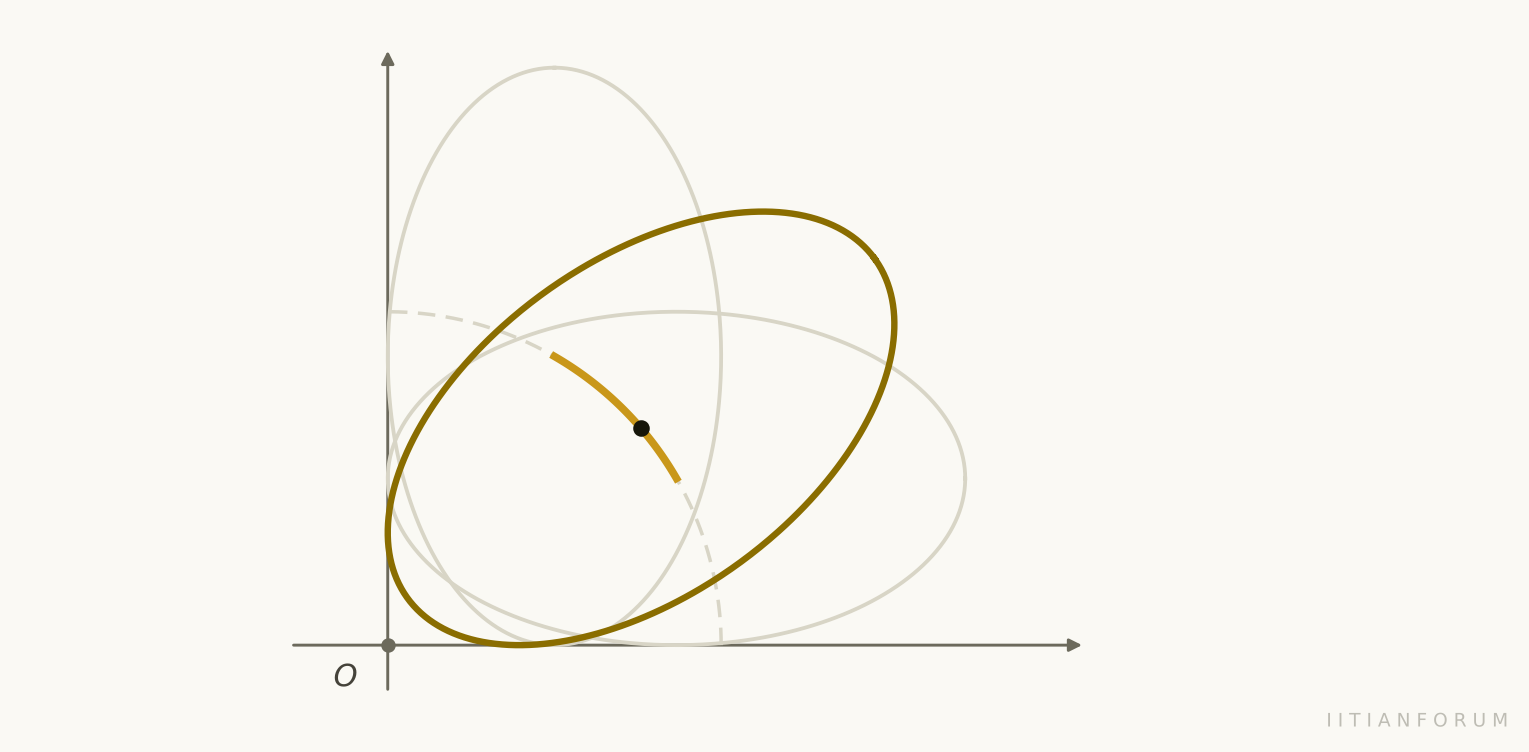
An ellipse tilted in the first quadrant touching both coordinate axes, its centre on an arc of the circle of radius 2 about the origin
Example 41(IITianForum). An ellipse whose major axis has length 23 and whose minor axis has length 2 slides along the coordinate axes, touching both of them, and stays inside the first quadrant throughout. The locus of its centre is an arc of a circle. The length of this arc is
Tap an option to check your answer
(A)6π
(B)3π
(C)2π
(D)32π
▸ SHOW SOLUTION
Step 1. The circle
The two axes are perpendicular tangents, so the origin lies on the director circle. Hence the centre is at distance a2+b2=3+1=2 from O.
Step 2. Range of the centre
The ordinate k of the centre is its distance from the tangent y=0, which lies between b=1 and a=3. With the centre at angle ψ on the circle, k=2sinψ:
21≤sinψ≤23,6π≤ψ≤3π
Step 3. Arc length
2(3π−6π)=3π
Answer: option (B)
Example 42(IITianForum). From a point T on the line 12x+5y=169, two mutually perpendicular tangents are drawn to the ellipse 144x2+25y2=1, touching it at A and B. The normals at A and B meet at P. The area of the quadrilateral TAPB is ______.
▸ SHOW SOLUTION
Step 1. T lies on the director circle
Perpendicular tangents meet on x2+y2=169. The distance of the line from O is 13169=13, so the line touches this circle, at T(12,5) only.
Step 2. The tangents
From (12,5): x=12 touches at A(12,0) and y=5 touches at B(0,5). They are perpendicular.
Step 3. The normals
The normals at the vertices A and B are the axes y=0 and x=0, so P=(0,0).
Step 4. Area
TAPB is a rectangle with sides 12 and 5: area 60.
Answer:60
Common tangents
A common tangent y=mx+c to two curves satisfies both tangency conditions. For two ellipses this gives two equations in m2 and c2.
Example 43(JEE Advanced 2015, Paper 2). Let E1 and E2 be two ellipses whose centres are at the origin. The major axes of E1 and E2 lie along the x-axis and the y-axis, respectively. Let S be the circle x2+(y−1)2=2. The straight line x+y=3 touches the curves S, E1 and E2 at P, Q and R, respectively. Suppose that PQ=PR=322. If e1 and e2 are the eccentricities of E1 and E2, respectively, then the correct expression(s) is (are)
More than one option is correct. Pick all of them, then Check
(A)e12+e22=4043
(B)e1e2=2107
(C)e12−e22=85
(D)e1e2=43
▸ SHOW SOLUTION
Step 1. P
The foot of the perpendicular from (0,1) to x+y=3 is P(1,2).
Step 2. Q and R
Moving 322 along the line (direction 2(1,−1)) from P: (35,34) and (31,38).
Step 3. Match with the point form
The tangent at (x1,y1) is p2xx1+q2yy1=1; it is x+y=3 when p2=3x1, q2=3y1. E1 needs p>q, so Q=(35,34):
by AM-GM, with equality at a2=29, inside the range. So the largest ab is 49.
Answer: (A) and (B)
Example 46(JEE Main 2020, 6 September Shift 1). Which of the following points lies on the locus of the foot of perpendicular drawn upon any tangent to the ellipse 4x2+2y2=1 from any of its foci?
Tap an option to check your answer
(1)(1,2)
(2)(−2,3)
(3)(−1,3)
(4)(−1,2)
▸ SHOW SOLUTION
Step 1. The locus
The feet lie on the auxiliary circle x2+y2=4.
Step 2. Test the points
1+4=5, 4+3=7, 1+3=4, 1+2=3. Only (−1,3) lies on it.
Answer: option (3)
Example 47(JEE Main 2021, 25 July Shift 2). If a tangent to the ellipse x2+4y2=4 meets the tangents at the extremities of its major axis at B and C, then the circle with BC as diameter passes through the point
Tap an option to check your answer
(1)(3,0)
(2)(2,0)
(3)(1,1)
(4)(−1,1)
▸ SHOW SOLUTION
Step 1. B and C
Tangent at θ: 2xcosθ+ysinθ=1. At x=±2:
yB=sinθ1−cosθ,yC=sinθ1+cosθ
Step 2. Circle on BC
(x−2)(x+2)+(y−yB)(y−yC)=0
Step 3. Put y = 0
yByC=1, so x2−4+1=0, x=±3. These are the foci, for every θ.
Answer: option (1)
Example 48(JEE Main 2021, 26 August Shift 1). On the ellipse 8x2+4y2=1 let P be a point in the second quadrant such that the tangent at P to the ellipse is perpendicular to the line x+2y=0. Let S and S′ be the foci of the ellipse and e be its eccentricity. If A is the area of the triangle SPS′, then the value of (5−e2)⋅A is
Tap an option to check your answer
(1)6
(2)12
(3)14
(4)24
▸ SHOW SOLUTION
Step 1. Slope form
Slope 2: c=±8⋅4+4=±6. Contact for c=6:
(−68⋅2,64)=(−38,32)
This is in the second quadrant.
Step 2. Area
e2=21, foci (±2,0), SS′=4:
A=21⋅4⋅32=34
Step 3. Evaluate
(5−21)⋅34=6
Answer: option (1)
Normals
The three forms of the normal
Form
Normal
Point (x1,y1)
x1a2x−y1b2y=a2−b2
Point θ
axsecθ−bycosecθ=a2−b2
Slope m
y=mx∓a2+b2m2m(a2−b2)
swipe for more →
In the slope form the foot is (±a2+b2m2a2,±a2+b2m2b2m) (same order of signs). So y=mx+c is a normal when
c2=a2+b2m2m2(a2−b2)2
Tangent condition or normal condition
c2=a2m2+b2 is for a tangent. For a normal the a2−b2 appears squared on top. Mixing them is the most common slip in this chapter.
The normal and the axes
The normal at P(x1,y1) meets the major axis at G and the minor axis at g:
G(e2x1,0),g(0,−b2a2e2y1)
If F is the foot of the perpendicular from the centre to the normal at P, then
PF⋅PG=b2,PF⋅Pg=a2
So PG:Pg=b2:a2, and CG=e2x1 is always less than ae: the normal meets the major axis between the foci.
Co-normal points
The normals at (acosθ,bsinθ) through (h,k) satisfy
cosθah−sinθbk=a2−b2
which is a fourth degree equation in tan2θ. So at most four normals pass through a point; their feet are co-normal points.
Result
Statement
Eccentric angles
α+β+γ+δ is an odd multiple of π
Abscissae
(∑xi)(∑xi1)=4
Normals at α, β, γ concurrent
sin(α+β)+sin(β+γ)+sin(γ+α)=0
swipe for more →
The last condition comes from the determinant with rows (secα,cosecα,1) being 0.
An ellipse with a point inside it and the four normals from that point meeting the ellipse at four co-normal points
Example 49(IITianForum). For the ellipse 25x2+9y2=1, find the normal at the point θ=4π, the points G and g where it meets the axes, and check that PG:Pg=9:25.
▸ SHOW SOLUTION
Step 1. The normal
P(25,23):
52x−32y=16
Step 2. G and g
G(582,0),g(0,−382)
(CG=e2x1=2516⋅25, as expected.)
Step 3. The ratio
PG2=5081+29=50306Pg2=225+18625=18850
Pg2PG2=62581, so PG:Pg=9:25.
Answer:52x−32y=16, G(582,0), g(0,−382)
Example 50(JEE Main 2020, 6 September Shift 2). If the normal at an end of a latus rectum of an ellipse passes through an extremity of the minor axis, then the eccentricity e of the ellipse satisfies
Tap an option to check your answer
(1)e2+2e−1=0
(2)e2+e−1=0
(3)e4+2e2−1=0
(4)e4+e2−1=0
▸ SHOW SOLUTION
Step 1. The normal at L
L(ae,ab2):
aea2x−b2/ab2y=a2e2ex−y=ae2
Step 2. Through (0, -b)
b=ae2, so b2=a2e4.
Step 3. Use b squared
a2(1−e2)=a2e4,e4+e2−1=0
Answer: option (4)
Example 51(IIT JEE 2009, Paper 2). The normal at a point P on the ellipse x2+4y2=16 meets the x-axis at Q. If M is the mid point of the line segment PQ, then the locus of M intersects the latus rectums of the given ellipse at the points
Tap an option to check your answer
(A)(±235,±72)
(B)(±235,±419)
(C)(±23,±71)
(D)(±23,±743)
▸ SHOW SOLUTION
Step 1. P and Q
16x2+4y2=1, e2=43. P(4cosθ,2sinθ) and Q(e2⋅4cosθ,0)=(3cosθ,0).
Step 2. M
M=(27cosθ,sinθ)
Locus: 494x2+y2=1.
Step 3. Meet the latus rectum
x=±ae=±23:
y2=1−4948=491
Answer: option (C)
Example 52(JEE Main 2023, 31 January Shift 1). If the maximum distance of normal to the ellipse 4x2+b2y2=1, b<2, from the origin is 1, then the eccentricity of the ellipse is
Tap an option to check your answer
(1)21
(2)23
(3)21
(4)43
▸ SHOW SOLUTION
Step 1. Distance of the normal at θ
d=a2sec2θ+b2cosec2θa2−b2
Step 2. Least denominator
a2sec2θ+b2cosec2θ=a2+b2+a2tan2θ+b2cot2θ
By AM-GM, a2tan2θ+b2cot2θ≥2ab, so the sum is at least (a+b)2.
So the largest d is a+ba2−b2=a−b.
Step 3. Use d = 1
2−b=1, b=1:
e2=1−41,e=23
Answer: option (2)
Example 53(IIT JEE 2009, Paper 2). An ellipse intersects the hyperbola 2x2−2y2=1 orthogonally. The eccentricity of the ellipse is reciprocal of that of the hyperbola. If the axes of the ellipse are along the coordinate axes, then
More than one option is correct. Pick all of them, then Check
(A)Equation of ellipse is x2+2y2=2
(B)The foci of ellipse are (±1,0)
(C)Equation of ellipse is x2+2y2=4
(D)The foci of ellipse are (±2,0)
▸ SHOW SOLUTION
Step 1. Eccentricities
The hyperbola x2−y2=21 has e=2, so the ellipse has e2=21: b2=2a2, that is x2+2y2=a2.
Step 2. Orthogonal at a common point
Slopes: ellipse −2yx, hyperbola yx. Product −1:
x2=2y2
Step 3. The point and a
On the hyperbola: 2y2−y2=21, so y2=21, x2=1. Then a2=1+1=2.
Step 4. Foci
x2+2y2=2: a2=2, b2=1, ae=1, foci (±1,0).
Answer: (A) and (B)
Reflection property, area and standard results
Reflection property
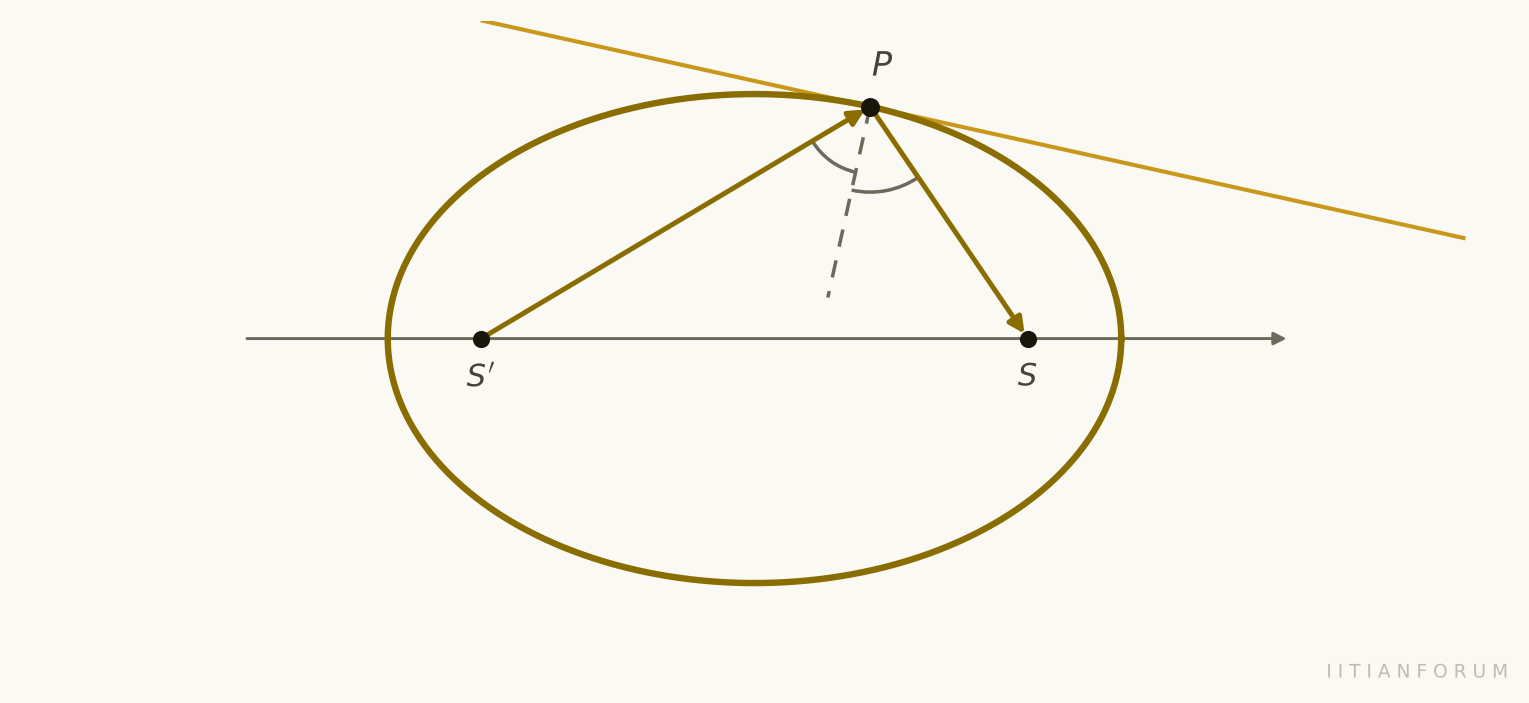
The tangent at P makes equal angles with SP and S′P; the normal at P bisects the angle SPS′. So a ray from one focus, reflected at the ellipse, passes through the other focus.
An ellipse with a ray from the focus S' striking the curve at P and reflecting through the other focus S, the normal at P bisecting the angle SPS'
Area of an ellipse
The ellipse is the auxiliary circle compressed in the ratio b:a, so every area shrinks in that ratio:
Area=πa2⋅ab=πab
More standard results
Result
Statement
Circle on a focal distance SP as diameter
touches the auxiliary circle
Circle with centre C through both foci
meets the ellipse where ∠SPS′=90∘ (needs b<ae)
Largest ∠SPS′
at an end of the minor axis
Area of △SPS′ with ∠SPS′=90∘
b2
swipe for more →
Example 54(IITianForum). A circle of radius r passes through both foci of the ellipse x2+9y2=9 and through exactly four points of the ellipse. The set of all possible values of r is an interval [a,b). Then a+b is equal to
Tap an option to check your answer
(A)22+29
(B)22+27
(C)32+4
(D)17+29
▸ SHOW SOLUTION
Step 1. The circles
Foci (±22,0). The centre lies on the y-axis, (0,k):
x2+y2−2ky−8=0,r2=8+k2
Step 2. Meet the ellipse
Put x2=9−9y2:
8y2+2ky−1=0
Each root with ∣y∣<1 gives two points.
Step 3. Both roots in (-1, 1)
The product of roots is −81<0, so they have opposite signs. Need f(1)=7+2k>0 and f(−1)=7−2k>0: ∣k∣<27.
Step 4. Range of r
r∈[22,8+449)=[22,29)
Answer: option (A)
Example 55(JEE Main 2025, 4 April Shift 2). The centre of a circle C is at the centre of the ellipse E:a2x2+b2y2=1, a>b. Let C pass through the foci F1 and F2 of E such that the circle C and the ellipse E intersect at four points. Let P be one of these four points. If the area of the triangle PF1F2 is 30 and the length of the major axis of E is 17, then the distance between the foci of E is
Tap an option to check your answer
(1)26
(2)13
(3)12
(4)213
▸ SHOW SOLUTION
Step 1. Right angle at P
F1F2 is a diameter of C, so ∠F1PF2=90∘. Let PF1=p, PF2=q.
Step 2. Two equations
p+q=17,21pq=30
Step 3. Pythagoras
F1F22=p2+q2=289−120=169
Answer: option (2)
Example 56(IITianForum). A ray of light from (−4,0) strikes the mirror 25x2+9y2=1 at P(0,3). Find the equation of the reflected ray.
▸ SHOW SOLUTION
Step 1. The foci
a=5, b=3, ae=4: (−4,0) is the focus S′.
Step 2. Reflection property
The reflected ray passes through the other focus S(4,0).
Step 3. The line PS
4x+3y=1,3x+4y=12
Answer:3x+4y=12
Example 57(JEE Main 2026, 21 January Shift 1). The area of the region inside the ellipse x2+4y2=4 and outside the region bounded by the curves y=∣x∣−1 and y=1−∣x∣ is
Tap an option to check your answer
(1)2(π−1)
(2)2π−21
(3)3(π−1)
(4)2π−1
▸ SHOW SOLUTION
Step 1. The ellipse
4x2+y2=1: area π⋅2⋅1=2π.
Step 2. The square
The two curves bound the square ∣x∣+∣y∣≤1, with diagonals 2 and 2, area 2. Its vertices (±1,0), (0,±1) are inside or on the ellipse.
Step 3. Subtract
2π−2=2(π−1)
Answer: option (1)
Example 58(JEE Main 2025, 28 January Shift 1). Let E1:9x2+4y2=1 be an ellipse. Ellipses Ei's are constructed such that their centres and eccentricities are same as that of E1, and the length of minor axis of Ei is the length of major axis of Ei+1(i≥1). If Ai is the area of the ellipse Ei, then π5(∑i=1∞Ai) is equal to ______.
▸ SHOW SOLUTION
Step 1. Ratio of sizes
Same eccentricity means the same ratio majorminor=32. Each ellipse is the previous one scaled by 32.
Step 2. Areas
A1=6π and Ai+1=94Ai:
∑Ai=1−946π=554π
Step 3. Evaluate
π5⋅554π=54
Answer:54
Loci connected with the ellipse
Method
Take the moving point as (h,k), write the given condition using the eccentric angle (or T=S1, or the chord of contact), eliminate the parameter, and replace (h,k) by (x,y).
Standard loci
Moving point
Locus
Foot of perpendicular from a focus to a tangent
auxiliary circle x2+y2=a2
Meeting point of perpendicular tangents
director circle x2+y2=a2+b2
Middle points of chords of slope m
diameter y=−a2mb2x
Meeting point of tangents at the ends of a focal chord
the corresponding directrix
Middle points of focal chords through (ae,0)
a2x2+b2y2=aex
swipe for more →
A locus of middle points is a new curve
The middle points of segments joining a fixed point to the points of an ellipse lie on a smaller ellipse of half the size, centred at the middle of the fixed point and the centre. Do not reuse the old a and b.
Example 59(IITianForum). A pair of variable straight lines x2+αxy+9y2=0, where α is a real parameter, cuts the ellipse x2+9y2=9; let A and B be points of intersection, one on each line. The locus of the point of intersection of the tangents to the ellipse at A and at B is
Tap an option to check your answer
(A)x2−9y2=0
(B)9x2−y2=0
(C)x2−9y2+6xy=0
(D)x2+9y2=9
▸ SHOW SOLUTION
Step 1. Chord of contact
If the tangents at A, B meet at (h,k), then AB is 9hx+ky=1.
Step 2. Lines OA and OB
Make the ellipse homogeneous with this chord:
9x2+y2=(9hx+ky)2(9−h2)x2−18hkxy+81(1−k2)y2=0
Step 3. Compare with the given pair
The ratio of the y2 and x2 coefficients must be 9:
81−81k2=81−9h2,h2=9k2
Answer: option (A)
Example 60(JEE Main 2021, 31 August Shift 2). The locus of mid-points of the line segments joining (−3,−5) and the points on the ellipse 4x2+9y2=1 is
Tap an option to check your answer
(1)9x2+4y2+18x+8y+145=0
(2)36x2+16y2+90x+56y+145=0
(3)36x2+16y2+108x+80y+145=0
(4)36x2+16y2+72x+32y+145=0
▸ SHOW SOLUTION
Step 1. Middle point
h=22cosθ−3,k=23sinθ−5
Step 2. Eliminate
cosθ=22h+3, sinθ=32k+5:
4(2h+3)2+9(2k+5)2=1
Step 3. Expand
Multiply by 36:
36h2+16k2+108h+80k+145=0
Answer: option (3)
Which method to use
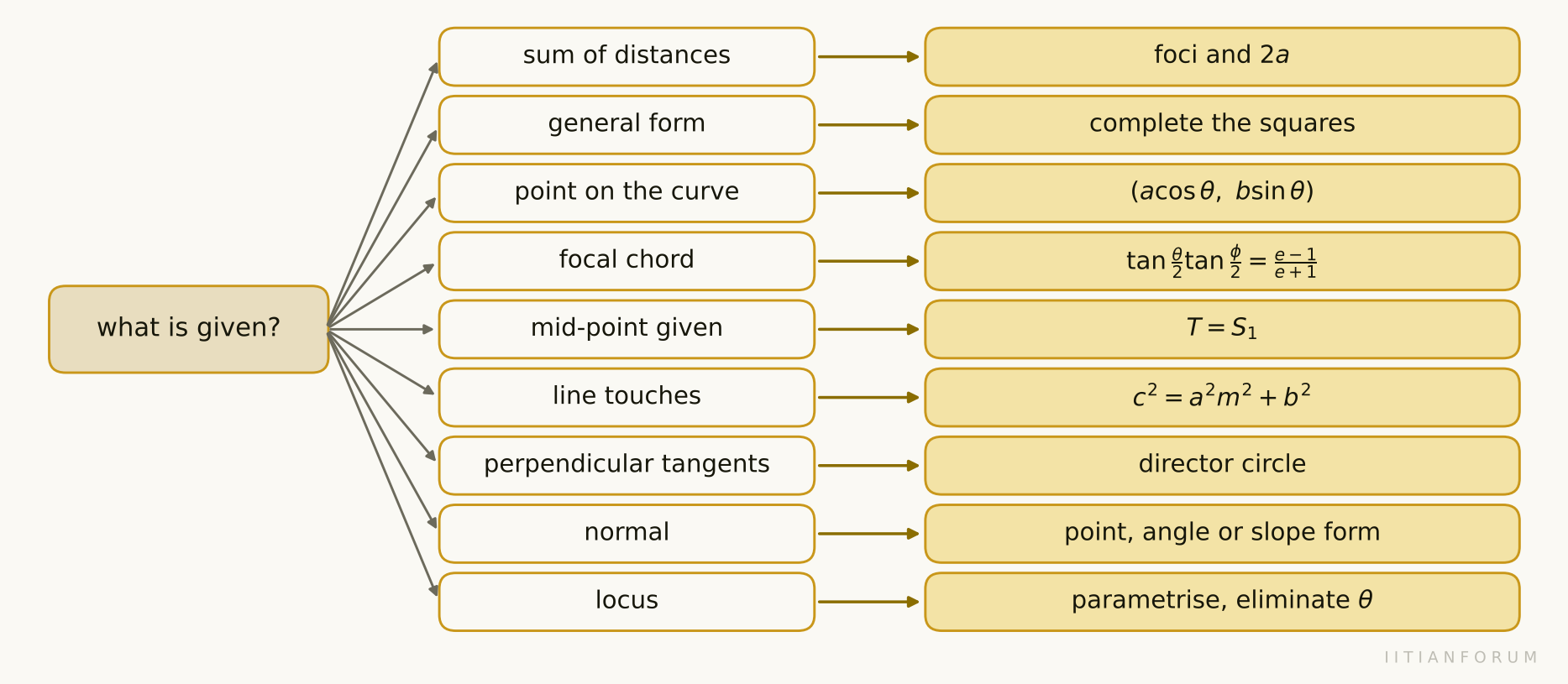
A decision chart: from the question asked, arrows lead to situations paired with methods: sum of distances, foci and 2a; general form, complete the square; point on the curve, eccentric angle; focal chord, tan half angles; mid-point given, T equals S1; tangent, c squared equals a squared m squared plus b squared; perpendicular tangents, director circle; normal, the normal forms; locus, parametrise and eliminate
Given
Method
sum of distances from two points
ellipse with those foci, 2a = the sum
∣z−z1∣+∣z−z2∣=k
ellipse with foci z1, z2 when k>∣z1−z2∣
focus and directrix
PS=e⋅PM, then simplify
Ax2+By2+2Gx+2Fy+C=0
complete the squares, shift the centre
b>a
major axis vertical, e2=1−b2a2, latus rectum b2a2
a point moving on the ellipse
(acosθ,bsinθ)
focal distances
a∓ex1, sum 2a, product a2−e2x12
focal chord
tan2θtan2ϕ=e+1e−1
chord with a given mid-point
T=S1
line touches the ellipse
c2=a2m2+b2, or a2l2+b2m2=n2
tangent through a given point
point form, then match
perpendicular tangents
director circle x2+y2=a2+b2
point outside the curve
chord of contact T=0, pair SS1=T2
normal
x1a2x−y1b2y=a2−b2
area
πab
locus
parametrise, eliminate θ
swipe for more →
What JEE asks
Across the JEE Main papers from 2014 to 2026 and the JEE Advanced and IIT JEE papers, the chapter appears in these forms.
Parts of the ellipse: eccentricity, latus rectum, foci from given data, often with a<b or a shifted centre (Examples 7 to 18 and 24 to 26). This is the most common form in JEE Main.
Focal distances and the sum definition, including complex number sets (Examples 2, 3, 10, 11, 13 and 55).
Eccentric angle and the auxiliary circle (Examples 19 to 23).
Chords: mid-point chords, focal chords, chords through a point (Examples 30 to 34).
Tangents: point and slope forms, chord of contact, director circle and common tangents (Examples 35 to 48). This is the common form in JEE Advanced.
Normals (Examples 49 to 53) and loci (Examples 59 and 60).
JEE Advanced 2025 used the auxiliary circle to read eccentric angles (Example 20). Earlier JEE Advanced and IIT JEE papers asked for the auxiliary circle and a chord (Example 19), the sum definition inside a triangle (Example 4), the rectangle round an ellipse (Example 18), tangents from a point (Examples 38 and 39), a common tangent of a circle and two ellipses (Example 43), the normal and a locus of mid-points (Example 51) and orthogonal curves (Example 53).
Quick recall
Result
Statement
Ellipse a2x2+b2y2=1, a>b
b2=a2(1−e2)
Foci, directrices
(±ae,0), x=±ea
Latus rectum
a2b2
Focal distances
a∓ex1, sum 2a
Point θ
(acosθ,bsinθ)
Chord θϕ
axcos2θ+ϕ+bysin2θ+ϕ=cos2θ−ϕ
Focal chord
tan2θtan2ϕ=e+1e−1
Harmonic property
SP1+SQ1=b22a
Mid-point chord
T=S1
Conjugate diameters
m1m2=−a2b2, CP2+CD2=a2+b2
Tangent at θ
axcosθ+bysinθ=1
Tangent of slope m
y=mx±a2m2+b2
Director circle
x2+y2=a2+b2
Perpendiculars from foci to a tangent
product b2, feet on x2+y2=a2
Normal at θ
axsecθ−bycosecθ=a2−b2
Normal meets major axis
G(e2x1,0)
Co-normal points
at most four, angle sum an odd multiple of π
Area
πab
swipe for more →
Before you leave this chapter
Without a pen, answer these four: the eccentricity of 16x2+25y2=1; the latus rectum of 4x2+9y2=36; the director circle of 9x2+7y2=1; and the product of the perpendiculars from the foci of 25x2+16y2=1 to any tangent. If 53, 38, x2+y2=16 and 16 come quickly, the chapter is yours.
Practise these methods on real exam questions in the doMath Ellipse chapter. The parabola, the conic with e=1, is developed in the Parabola note, circles through the meeting points of two curves in the Family of Circles note, and tangents to a general curve in the Tangents, Normals, Rolle and LMVT note.