Almost every chapter of JEE calculus has one formula that quietly does the heavy lifting, and in the 2026 papers that formula was Newton–Leibnitz. It appeared in ten separate questions across the January and April sessions — inside a quadratic-equation dressing, inside a matrix dressing, inside maxima and minima, inside differential equations. The dressing changed every time. The formula did not.
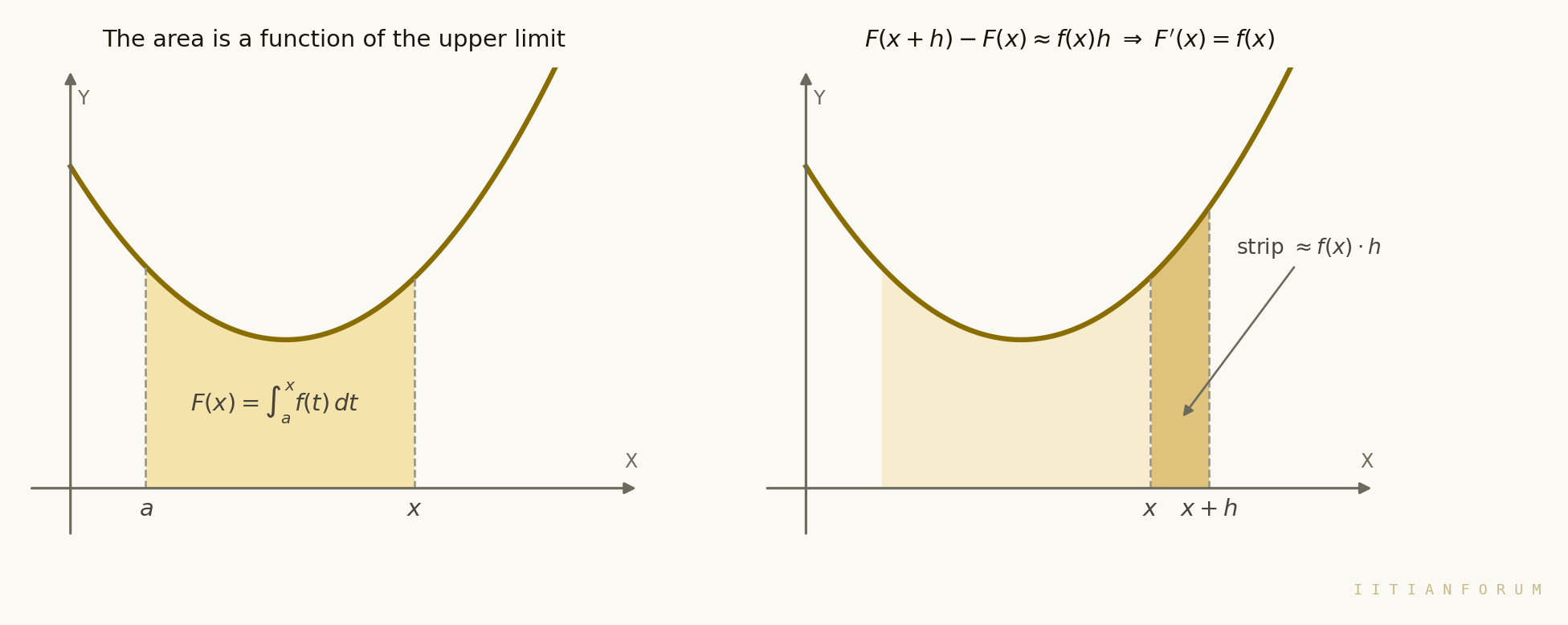
The idea is one sentence long. A definite integral whose upper limit is a variable is a function of that variable, and differentiating it costs you nothing. You never evaluate the integral. You replace t by x and carry on.
Here is what that single move replaces.
The long way
The Newton–Leibnitz way
1. What you do first
Try to find an antiderivative of the integrand
Differentiate both sides
2. Integrand like sin(t2)
Impossible — no elementary antiderivative
Irrelevant, you never integrate it
3. Integrand like (t−1)3(t−2)5
Expand into a degree-8 polynomial
Read the zeros straight off
4. Time cost
Five to ten minutes, if it works at all
Thirty seconds
5. What the examiner is testing
Nothing useful
Whether you know where x lives
swipe for more →
Read this line twice
An examiner who wants a hard question does not make the integral hard to evaluate. He makes it impossible to evaluate. That is the signal. The moment the integrand has no elementary antiderivative — sin(t2), e−t2, tsint — you know for certain that the intended solution differentiates rather than integrates.
The formula, and why it is true
Newton–Leibnitz formula. Let f be continuous on an interval I, and let g,h be differentiable functions whose values lie in I. Then
dxd∫g(x)h(x)f(t)dt=f(h(x))h′(x)−f(g(x))g′(x).
Proof. Because f is continuous it has an antiderivative F, with F′=f. The fundamental theorem of calculus turns the definite integral into a difference:
Φ(x)=∫g(x)h(x)f(t)dt=F(h(x))−F(g(x)).
Now differentiate the right-hand side by the chain rule:
Notice what the proof used and what it did not. It used the existence of F; it never used a formula for F. That is exactly why the formula survives integrands you cannot integrate.
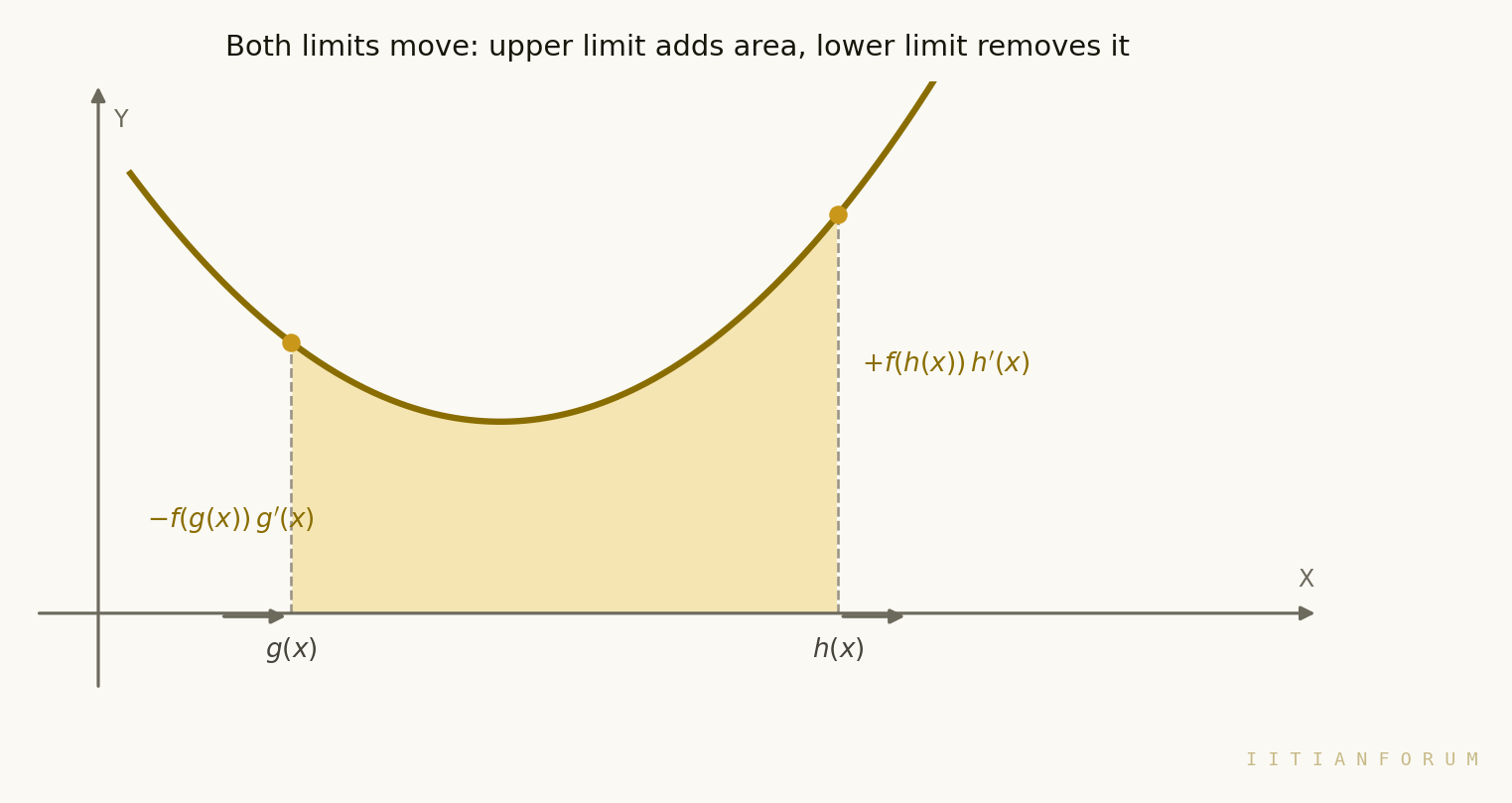
The geometric reading. Think of Φ(x) as signed area between two moving walls. Push the right wall out by h′(x)dx and you gain a strip of height f(h(x)) — that is the + term. Push the left wall right by g′(x)dx and you lose a strip of height f(g(x)) — that is the − term.
The three forms you actually meet.
Form
Derivative
Frequency in JEE
∫axf(t)dt
f(x)
About 80% of questions
∫ah(x)f(t)dt
f(h(x))h′(x)
About 15%
∫g(x)h(x)f(t)dt
f(h)h′−f(g)g′
About 5%
swipe for more →
Example 1. Differentiate Φ(x)=∫x2x3logetdt for x>1.
▸ SHOW SOLUTION
Here f(t)=loget, g(x)=x2, h(x)=x3, so g′=2x and h′=3x2.
Check. Integrating first gives Φ(x)=[tloget−t]x2x3=3x3logex−x3−2x2logex+x2, and differentiating that returns 9x2logex+3x2−3x2−4xlogex−2x+2x=xlogex(9x−4). The two agree, as they must.
Example 2. If f(x)=∫0sinx1+t4dt, find f′(3π).
▸ SHOW SOLUTION
The integrand has no elementary antiderivative, so evaluating is not an option. Apply the formula with h(x)=sinx:
f′(x)=1+sin4x⋅cosx.
At x=3π: sinx=23, so sin4x=169, and cosx=21. Hence
f′(3π)=1+169⋅21=45⋅21=85.
Example 3(JEE Main 2024, 1 Feb Shift 2). Let f:(0,∞)→R and F(x)=∫0xtf(t)dt. If F(x2)=x4+x5, find r=1∑12f(r2).
▸ SHOW SOLUTION
Step 1: Differentiate the given identity in x. The left side needs the chain rule:
dxdF(x2)=F′(x2)⋅2x.
Step 2: Get F′ from Newton–Leibnitz.F′(u)=uf(u), so F′(x2)=x2f(x2) and the left side is 2x3f(x2).
Step 3: Match.
2x3f(x2)=4x3+5x4⟹f(x2)=2+25x.
Step 4: Read the sum directly. Putting x=r gives f(r2)=2+25r, so
Note that f itself is never written down as a function of its own argument — you only ever need f at squares, and the substitution x=r delivers exactly that.
The one decision that settles every question
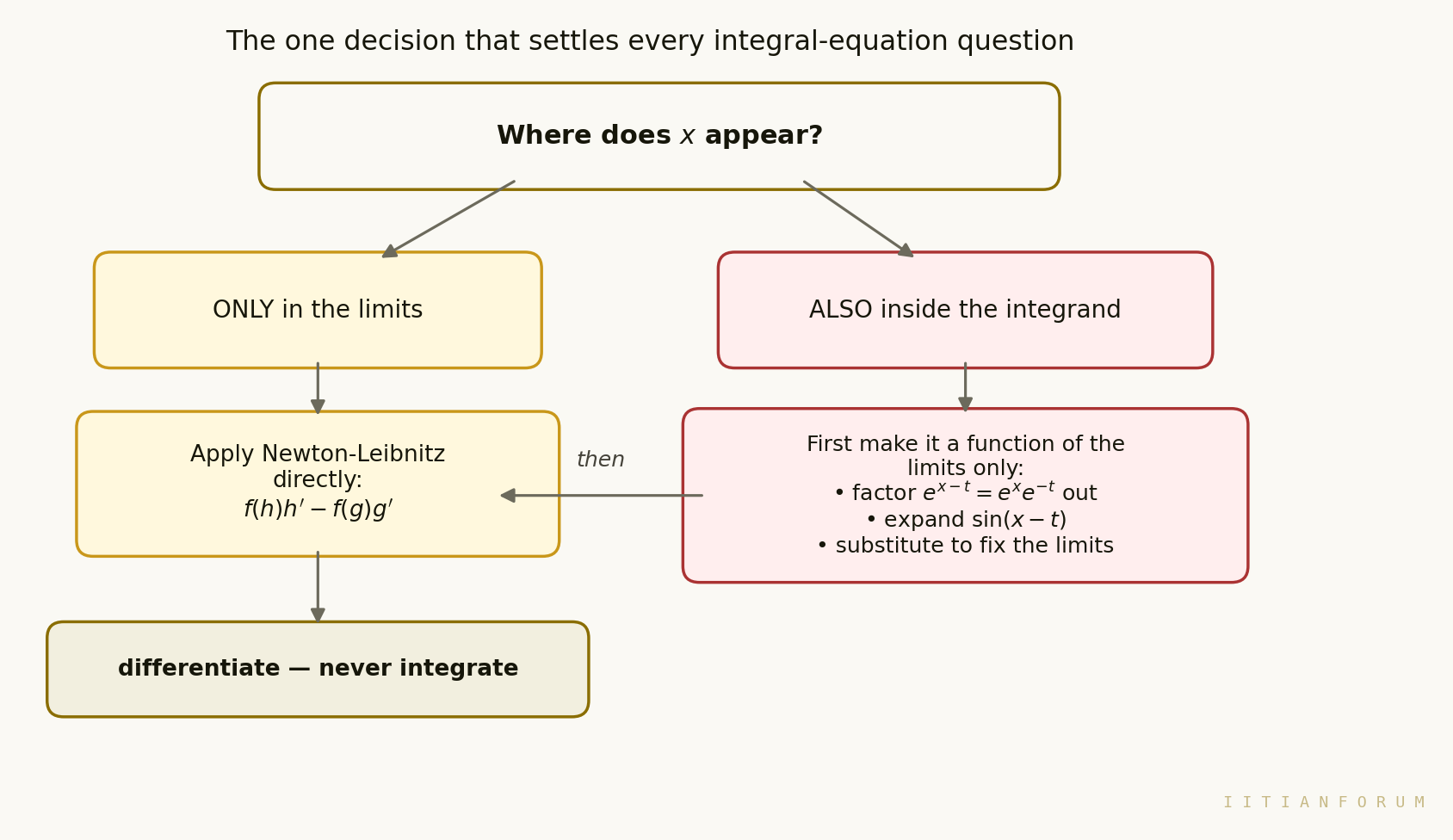
Before you write a single line, ask: where does x appear?
If x sits only in the limits, differentiate immediately. If x also sits inside the integrand, you may not — the formula does not apply, and applying it anyway is the single most common way candidates lose these marks. You must first rewrite the expression so that x has been evicted from the integrand. There are exactly three tricks for doing that, and JEE 2026 used all three.
Type 1 — Factor the x out
Example 4(JEE Main 2026, 28 Jan Shift 2 — part). Given f(x)=1−2x+∫0xe(x−t)f(t)dt, find f.
▸ SHOW SOLUTION
Step 1: Spot the problem. The integrand contains ex−t, which involves x. Newton–Leibnitz is illegal here.
Step 2: Split the exponential.ex−t=ex⋅e−t, and ex is constant with respect to t, so it comes out:
f(x)=1−2x+ex∫0xe−tf(t)dt.
Step 3: Isolate the integral. Multiply through by e−x:
e−xf(x)=(1−2x)e−x+∫0xe−tf(t)dt.
Now the integral is a clean function of the upper limit only.
Step 4: Differentiate. The left side needs the product rule; the integral gives e−xf(x):
e−xf′(x)−e−xf(x)=−2e−x−(1−2x)e−x+e−xf(x).
Step 5: Divide by e−x and tidy.
f′(x)−f(x)=−2−1+2x+f(x)⟹f′(x)−2f(x)=2x−3.
Step 6: Solve the linear ODE. Integrating factor e−2x:
dxd(e−2xf)=(2x−3)e−2x.
By parts, ∫(2x−3)e−2xdx=−2(2x−3)e−2x−2e−2x=(1−x)e−2x, so e−2xf=(1−x)e−2x+C, i.e. f(x)=1−x+Ce2x.
Step 7: Fix C. Put x=0 in the original relation: the integral vanishes, so f(0)=1. The formula gives 1+C. Hence C=0 and
f(x)=1−x.
Type 2 — Expand the integrand
Example 5(JEE Main 2026, 23 Jan Shift 2). Find the number of elements in S={x∈[0,100]:∫0xt2sin(x−t)dt=x2}.
▸ SHOW SOLUTION
Step 1: Recognise the trap.sin(x−t) contains x. Differentiating blindly is wrong.
Step 2: Expand and pull the x-parts out. Treating x as a constant for the t-integration,
Step 5: Impose the condition.x2−2+2cosx=x2⇒cosx=1⇒x=2kπ.
Step 6: Count in [0,100].2kπ≤100⇒k≤2π100≈15.9, so k=0,1,…,15.
Answer:16
What a wrong start costs you here
If you differentiate ∫0xt2sin(x−t)dt as though the formula applied, you get x2sin(x−x)=0, so you would conclude 0=2x and answer "one element". The real answer is 16. The whole question is a test of one thing: did you notice the x inside?
Type 3 — Substitute to fix the limits
Example 6(JEE Main 2026, 24 Jan Shift 1). A differentiable f satisfies ∫036f(36tx)dt=4αf(x). If y=f(x) is a standard parabola through (2,1) and (−4,β), find βα.
▸ SHOW SOLUTION
Step 1: The limits are constants, the x is inside. Nothing to differentiate yet. Substitute.
Step 2: Let u=36tx, so dt=x36du; when t=0, u=0; when t=36, u=x. The x has moved from the integrand into the upper limit:
∫036f(36tx)dt=x36∫0xf(u)du=4αf(x).
Step 3: Rearrange, then differentiate.
∫0xf(u)du=9αxf(x)dxdf(x)=9α(f(x)+xf′(x)).
Step 4: Separate.(9−α)f(x)=αxf′(x), so ff′=(α9−1)x1 and f(x)=cx9/α−1.
Step 5: Use "standard parabola".y=cx2 forces α9−1=2, so α=3.
Step 6: Fit the point.(2,1) gives 1=4c, so f(x)=4x2 and β=f(−4)=4.
Answer:βα=43=64
Application 1 — Limits
Every limit of the form 00 whose numerator is ∫ax(⋯)dt is a Newton–Leibnitz question in disguise. L'Hôpital's rule differentiates the numerator, and Newton–Leibnitz is how you differentiate it.
Example 7. Evaluate x→0limx31∫0xt4+1t2dt.
▸ SHOW SOLUTION
Step 1: Confirm the form. As x→0 the integral →0 and x3→0: it is 00.
Step 2: L'Hôpital once. The derivative of the numerator is the integrand with t replaced by x:
x→0lim3x2x4+1x2=x→0lim3(x4+1)1=31.
One application, no integration, no expansion.
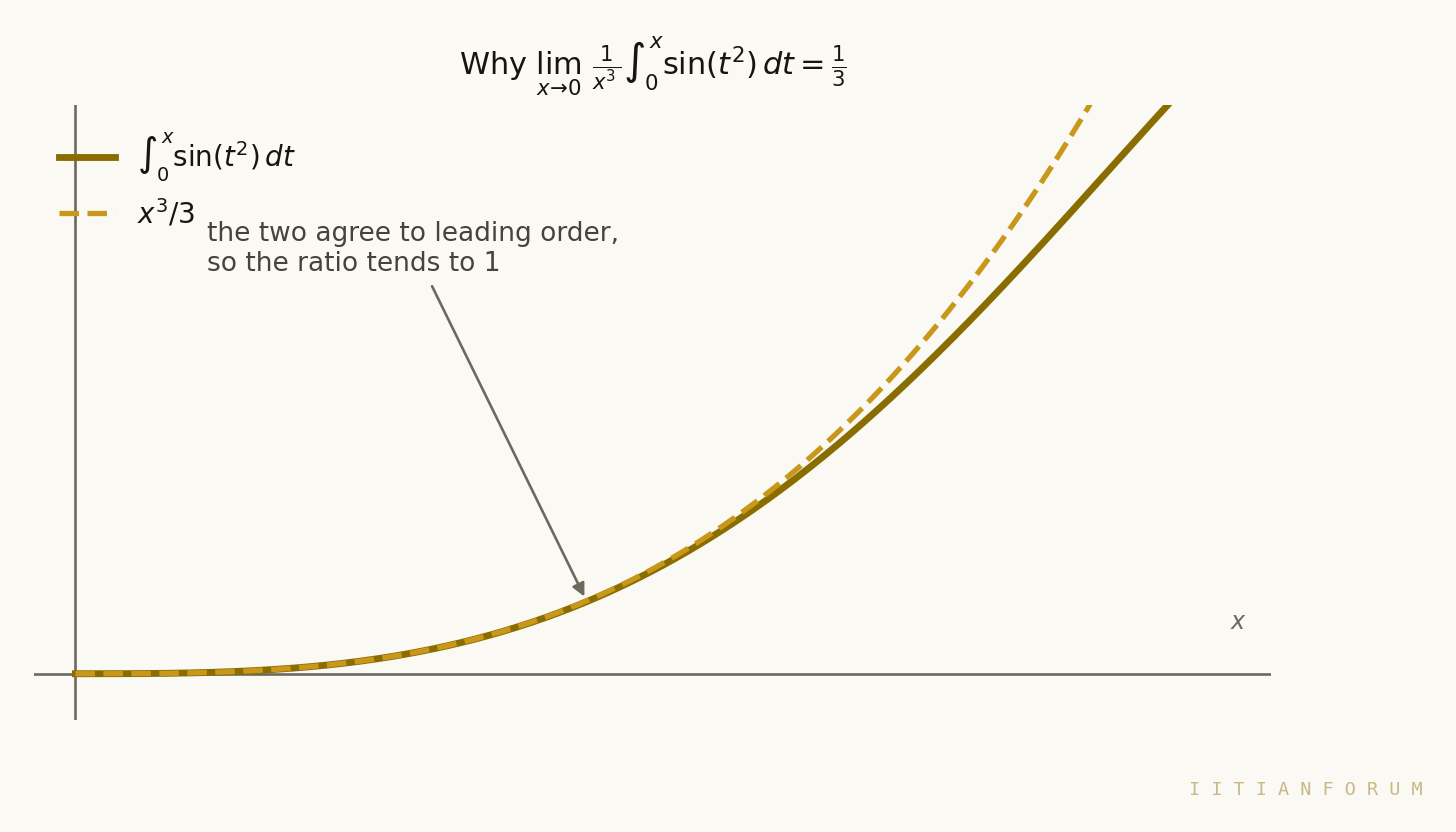
Example 8. Evaluate x→0limx31∫0xsin(t2)dt.
▸ SHOW SOLUTION
∫sin(t2)dt is a Fresnel integral — it has no elementary form, so this limit must be done by differentiation.
Step 1: L'Hôpital.
x→0lim3x2sin(x2).
Step 2: Standard limit.x2sin(x2)→1 as x→0, so the value is 31.
Example 9. Evaluate x→0limxsinx∫0x2sec2tdt.
▸ SHOW SOLUTION
Step 1: Numerator by Newton–Leibnitz with h(x)=x2.
dxd∫0x2sec2tdt=sec2(x2)⋅2x.
Step 2: Denominator.dxd(xsinx)=sinx+xcosx.
Step 3: Apply L'Hôpital.
x→0limsinx+xcosx2xsec2(x2).
Still 00, but divide numerator and denominator by x instead of differentiating again:
x→0limxsinx+cosx2sec2(x2)=1+12⋅1=1.
Example 10. Evaluate x→1limx−11∫1xet2dt.
▸ SHOW SOLUTION
This is precisely the definition of the derivative of Φ(x)=∫1xet2dt at x=1, since Φ(1)=0:
x→1limx−1Φ(x)−Φ(1)=Φ′(1)=e12=e.
Recognising the difference quotient saves you even L'Hôpital.
Example 11(JEE Main 2024, 9 Apr Shift 2). Evaluate
x→2πlim(x−2π)2∫x3(π/2)3(sin(2t1/3)+cos(t1/3))dt.▸ SHOW SOLUTION
Step 1: Confirm 00. At x=2π the limits of integration coincide, so the numerator vanishes; the denominator obviously does too.
Step 2: L'Hôpital, differentiating the numerator by Newton–Leibnitz. The upper limit is a constant, so it contributes nothing; the lower limit is x3, and a moving lower limit carries a minus sign:
dxd∫x3(π/2)3(⋯)dt=−(sin(2x)+cosx)⋅3x2,
using (x3)1/3=x. The denominator differentiates to 2(x−2π).
Step 3: Still 00. At x=2π we get sinπ+cos2π=0+0=0. Differentiate again:
Step 4: Substitute x=2π. The first term dies because sinπ+cos2π=0. For the second,
2cosπ−sin2π=−2−1=−3,
so the numerator is −3⋅4π2⋅(−3)=49π2.
Step 5: Divide.
29π2/4=89π2
Numerical check. Evaluating the original quotient at x=2π±0.001 gives 11.1127 and 11.0939, straddling 89π2=11.1033.
Example 12(JEE Advanced 2025). Let α,β∈R satisfy
x→0limx31(2α∫0x1−t2dt+βxcosx)=2.
Find α+β.
▸ SHOW SOLUTION
Step 1: Why two conditions, not one. For a finite limit after dividing by x3, the bracket must vanish to order x3. So the coefficient of x must be zero and the coefficient of x3 must equal 2. That is the whole question.
Step 2: Expand the integral. By Newton–Leibnitz the integral I(x)=∫0x1−t2dt has I′(x)=1−x21=1+x2+x4+⋯, and I(0)=0, so integrating term by term,
I(x)=x+3x3+5x5+⋯
Step 3: Expand the other term.βxcosx=βx(1−2x2+⋯)=βx−2βx3+⋯
Step 4: Collect.
2αI(x)+βxcosx=(2α+β)x+(6α−2β)x3+O(x5).
Step 5: Impose both conditions.
2α+β=0⟹α=−2β;6α−2β=2.
Substituting, −3β−2β=−65β=2, so β=−512 and α=524.
Step 6:
α+β=524−512=512=2.40
The trap in Example 12
Reaching for L'Hôpital three times will work, but it is slow and each pass invites an error. The moment a limit is divided by xn with n≥2, expand instead — and use Newton–Leibnitz to get the series of the integral by integrating the series of the integrand. One line replaces three differentiations.
Example 13(JEE Main 2024, 29 Jan Shift 2). Let the slope of the line 45x+5y+3=0 be 27r1+29r2 for some r1,r2∈R. Evaluate
x→3lim23r2x−r2x2−r1x3−3x∫3x8t2dt.▸ SHOW SOLUTION
Step 1: Extract the constraint. The line 45x+5y+3=0 is y=−9x−53, so its slope is −9 and
27r1+29r2=−9.
Step 2: Check the form. The numerator vanishes at x=3 because the limits coincide. For the denominator D(x)=23r2x−r2x2−r1x3−3x,
D(3)=29r2−9r2−27r1−9=−(27r1+29r2)−9=9−9=0.
So the form is genuinely 00 — the constraint was placed there precisely to arrange it.
Step 3: L'Hôpital. The numerator differentiates by Newton–Leibnitz to 8x2, which at x=3 is 72. For the denominator,
Step 4: Use the constraint again.23r2−6r2=−29r2, so
D′(3)=−(27r1+29r2)−3=9−3=6.
Step 5:
x→3lim(∫3x8t2dt)/D(x)=672=12
Neither r1 nor r2 is ever determined individually — only the combination 27r1+29r2 is needed, and it appears twice.
Order-counting shortcut
If f(t)∼ctn near 0, then ∫0xf(t)dt∼n+1cxn+1. So ∫0xt2ln(1+t)dt∼∫0xt3dt=4x4 and you can read off a limit like x→0limx41∫0xt2ln(1+t)dt=41 in one line. Use this to check an L'Hôpital answer, not to replace the working.
Application 2 — Continuity and differentiability
Integration is a smoothing operation. Every time you integrate, the graph gains one degree of smoothness. This gives a clean and very examinable hierarchy.
f on [a,b]
F(x)=∫axf(t)dt
Piecewise continuous with jumps
Continuous everywhere; corners at the jumps
Continuous
Differentiable everywhere, F′=f
Continuous with a corner
Differentiable, but F′′ fails at the corner
Differentiable
Twice differentiable
swipe for more →
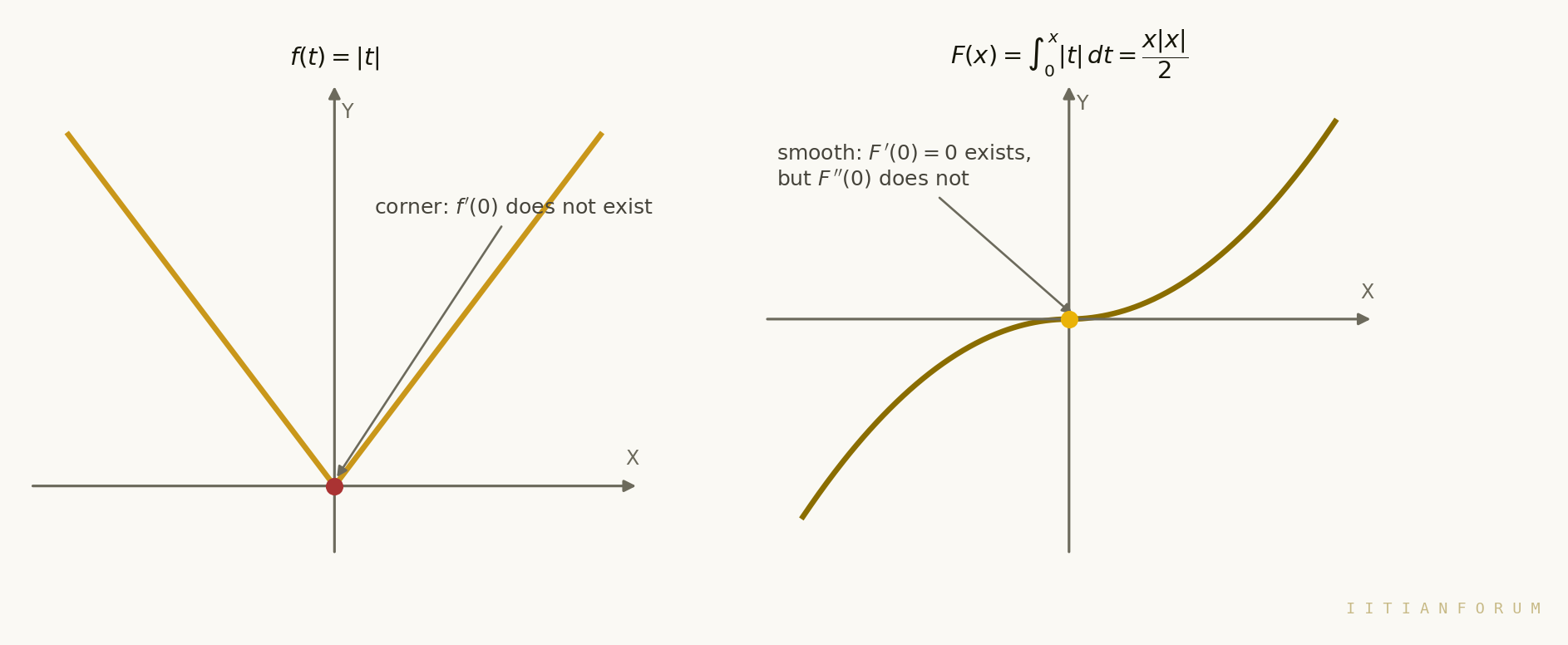
Example 14. Discuss the differentiability of F(x)=∫0x∣t∣dt.
▸ SHOW SOLUTION
Step 1: Evaluate directly (here you can, and it is instructive). For x≥0, F(x)=2x2; for x<0, F(x)=−2x2. So F(x)=2x∣x∣.
Step 2: First derivative. By Newton–Leibnitz F′(x)=∣x∣, which exists for everyx including 0 — the integrand ∣t∣ is continuous, and continuity of the integrand is all the formula needs.
Step 3: Second derivative.F′′(x)=dxd∣x∣, which does not exist at x=0.
Conclusion:F is differentiable on R but not twice differentiable at the origin. The corner of ∣t∣ was not destroyed — it was pushed up one level.
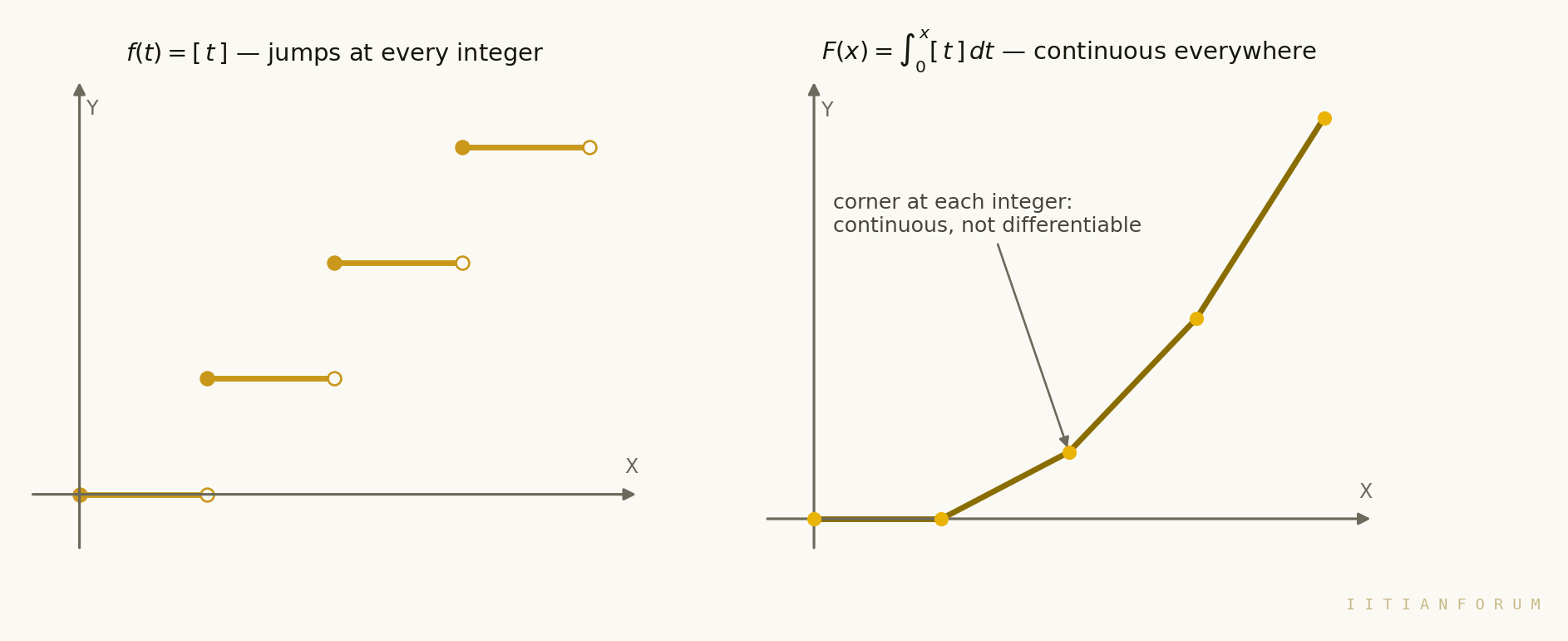
Example 15. Let F(x)=∫0x[t]dt, where [⋅] is the greatest integer function. Show that F is continuous on R and find every point where it fails to be differentiable. Also compute F(2.5).
▸ SHOW SOLUTION
Step 1: Continuity.[t] is bounded on every bounded interval, so ∣F(x+h)−F(x)∣≤M∣h∣→0. Hence F is continuous everywhere — in fact Lipschitz.
Step 2: Differentiability. Newton–Leibnitz gives F′(x)=[x]wherever the integrand is continuous, i.e. for x∈/Z. At an integer n the one-sided derivatives are
F′(n−)=n−1,F′(n+)=n,
which differ by 1. So F is not differentiable at any integer.
Step 3: The value.
F(2.5)=∫010dt+∫121dt+∫22.52dt=0+1+1=2.
Example 16. Let f be continuous on R with f(2)=5. Find h→0limh1∫22+3hf(t)dt.
▸ SHOW SOLUTION
Set Φ(u)=∫2uf(t)dt, so Φ(2)=0 and Φ′(u)=f(u). The limit is
Once you know F′(x) is just the integrand, monotonicity of F is decided by the sign of the integrand — a question about a function you can see, not one you have to construct.
Example 17. Prove that F(x)=∫0x1+t2tetdt is strictly increasing on (0,∞) and strictly decreasing on (−∞,0).
▸ SHOW SOLUTION
Step 1: Differentiate.F′(x)=1+x2xex.
Step 2: Read the sign.ex>0 always and 1+x2>0 always, so the sign of F′ is exactly the sign of x.
Step 3: Conclude.F′>0 on (0,∞) and F′<0 on (−∞,0), with F′(0)=0. Hence F decreases up to the origin and increases after it, so x=0 is the global minimum. ■
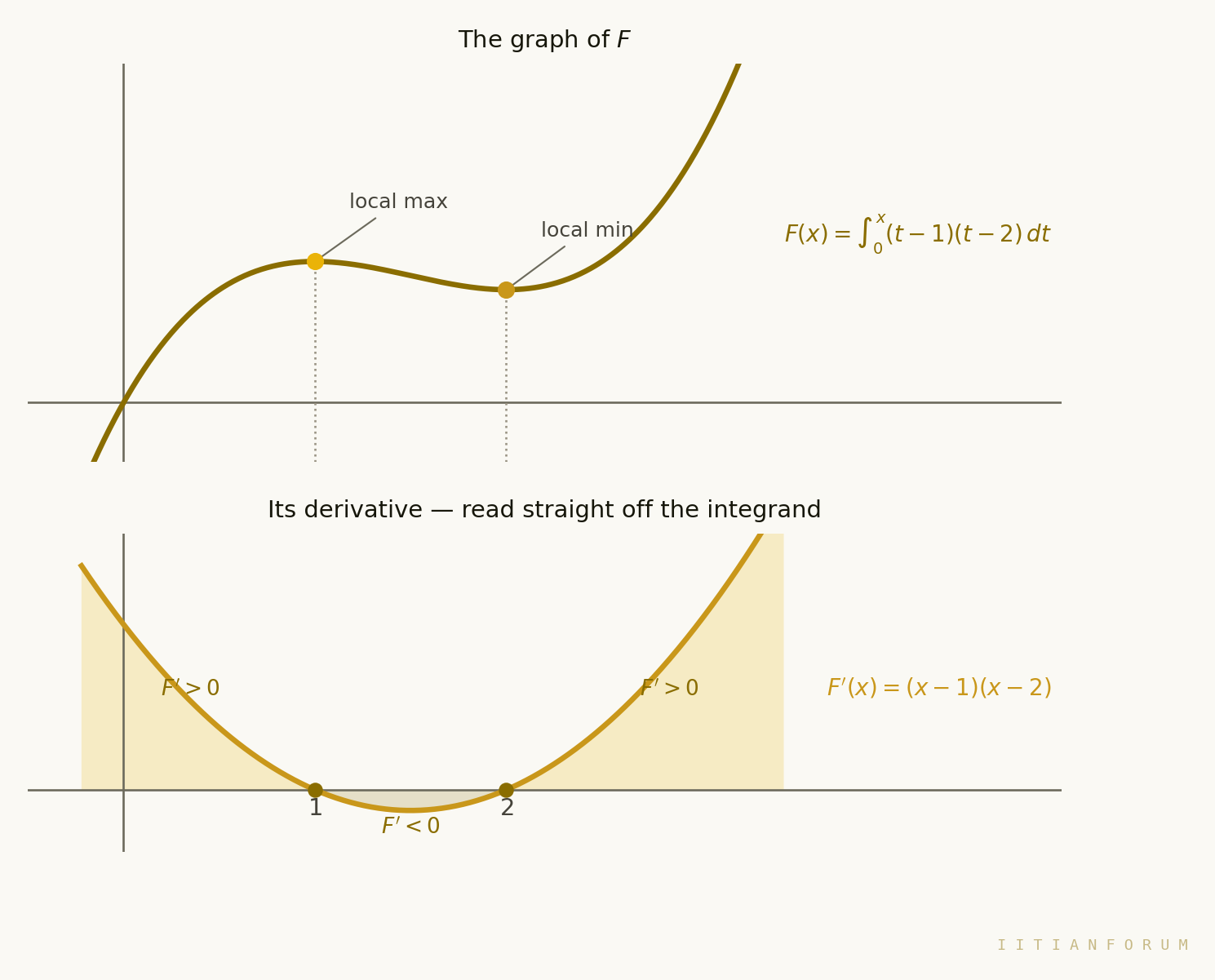
Example 18. For F(x)=∫0x(t−1)(t−2)dt, find the intervals of increase and decrease and the local extrema.
▸ SHOW SOLUTION
Step 1:F′(x)=(x−1)(x−2).
Step 2: Sign chart. Both zeros are simple, so the sign alternates:
Interval
(x−1)
(x−2)
F′
Behaviour
x<1
−
−
+
increasing
1<x<2
+
−
−
decreasing
x>2
+
+
+
increasing
swipe for more →
Step 3: Extrema.+→− at x=1 gives a local maximum; −→+ at x=2 gives a local minimum.
Step 4: The values (this is the only place integration is needed). F(x)=3x3−23x2+2x, so
F(1)=31−23+2=65,F(2)=38−6+4=32.
Example 19. Show that ∫0x1+t4dt<x for every x>0.
▸ SHOW SOLUTION
Step 1: Build the gap function. Let G(x)=x−∫0x1+t4dt, with G(0)=0.
Step 2: Differentiate.G′(x)=1−1+x41.
Step 3: Sign. For x>0 we have 1+x4>1, so 1+x4>1, so 1+x41<1 and G′(x)>0.
Step 4: Conclude.G is strictly increasing on [0,∞) and G(0)=0, so G(x)>0 for x>0, which is the claim. ■
This "define the gap, differentiate, use monotonicity" pattern proves almost every integral inequality asked at JEE level.
Application 4 — Maxima and minima
This is where Newton–Leibnitz earns its reputation. The examiner writes an integrand that is a product of many factors with large exponents, so that expanding is hopeless, and asks how many local maxima the integral has. The entire question is a sign chart.
The multiplicity rule. If F′(x)=(x−a1)m1(x−a2)m2⋯, then F′ changes sign at aiif and only if mi is odd. An even exponent touches the axis and bounces back — no sign change, no extremum.
Example 20. Let f(x)=∫0x(sint−cost)(et−2)(t−1)3(t−2)5dt on 0<x≤4. How many local maxima does f have?
Step 3: Check multiplicities. All five are odd, so f′ flips sign at every one of them.
Step 4: Anchor the sign. At x=0.5, left of all five: sin0.5−cos0.5<0, e0.5−2<0, (0.5−1)3<0, (0.5−2)5<0. Four negatives multiply to a positive, so f′(0.5)>0.
Step 5: Alternate. In order the zeros are 0.693,0.785,1,2,3.927, so the signs run
+−+−+−
Step 6: Count +→−. At x=loge2, at x=1, and at x=45π.
Answer:3 local maxima.
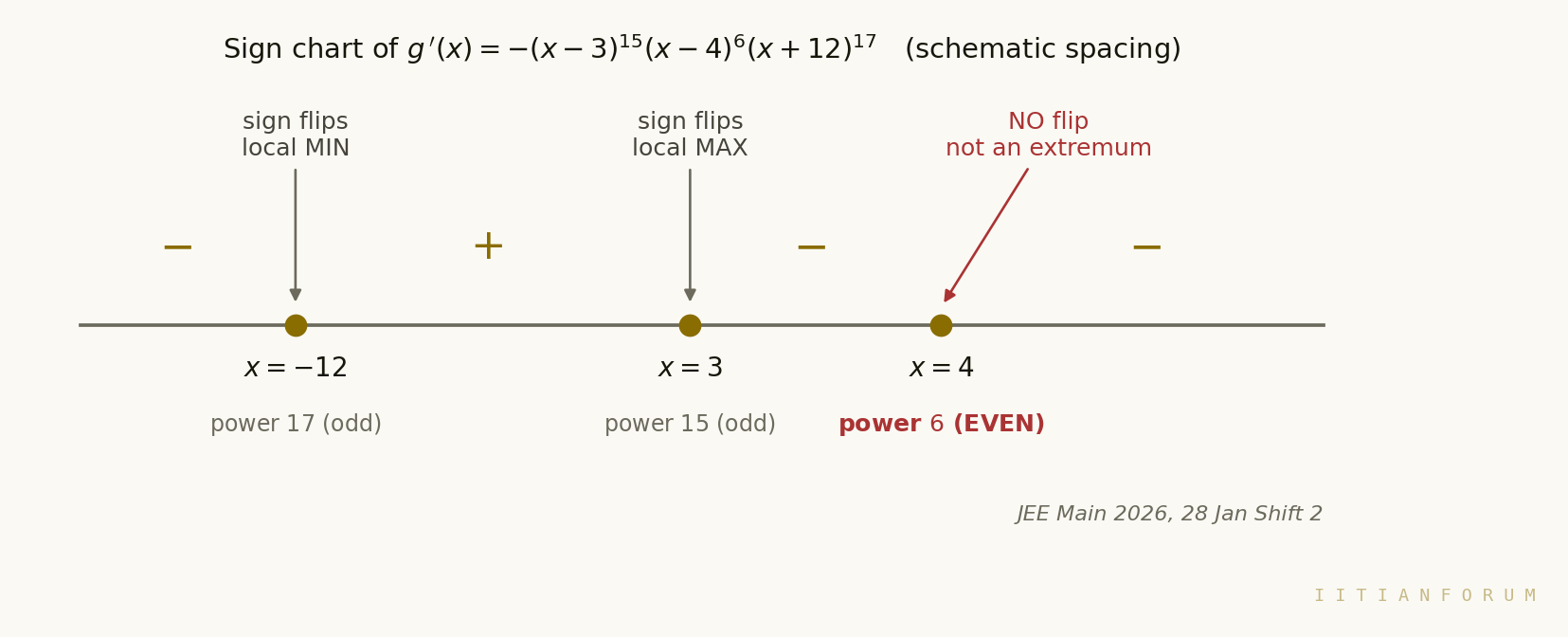
Example 21(JEE Main 2026, 28 Jan Shift 2). With f as in Example 4, let g(x)=∫0x(f(t)+2)15(t−4)6(t+12)17dt. If p and q are the points of local minimum and local maximum of g, find ∣p+q∣.
▸ SHOW SOLUTION
Step 1: Use f(t)=1−t from Example 4, so f(t)+2=3−t.
Step 5: Read off.−→+ at x=−12: local minimum, p=−12. +→− at x=3: local maximum, q=3. At x=4 the sign does not change — the even power protected it.
Answer:∣p+q∣=∣−12+3∣=9
Example 22. For f(x)=∫0xtsintdt with x>0, classify the critical point x=nπ.
▸ SHOW SOLUTION
Step 1:f′(x)=xsinx, which vanishes exactly when sinx=0, i.e. x=nπ.
Step 2: Second derivative by the quotient rule: f′′(x)=x2xcosx−sinx.
Step 3: Evaluate. At x=nπ, sinnπ=0 and cosnπ=(−1)n, so
f′′(nπ)=n2π2nπ(−1)n=nπ(−1)n.
Answer: local maximum when n is odd, local minimum when n is even.
Example 23(JEE Main 2026, 6 Apr Shift 2). Let A=120311−1α−1 be singular, and f(x)=∫0x(t2+2t+3)dt on [1,α]. If M,m are the maximum and minimum of f there, find 3(M−m).
▸ SHOW SOLUTION
Step 1: Find α. Singular means the determinant is zero:
1(−1−α)−3(−2−0)+(−1)(2−0)=−1−α+6−2=3−α=0⇒α=3.
Step 2: Monotonicity by Newton–Leibnitz.f′(x)=x2+2x+3. Its discriminant is 4−12=−8<0 and the leading coefficient is positive, so f′>0 everywhere. Thus f is strictly increasing on [1,3] and the extrema are at the endpoints.
Step 3: Evaluate.f(x)=3x3+x2+3x, so M=f(3)=9+9+9=27 and m=f(1)=31+1+3=313.
Step 4:3(M−m)=81−13=68
Example 24(JEE Main 2024, 31 Jan Shift 1). Let S=(−1,∞) and f:S→R be
f(x)=∫1x(et−1)11(2t−1)5(t−2)7(t−3)12(2t−10)61dt.
Let p be the sum of the squares of the values of x at which f attains a local maximum on S, and q the sum of the values of x at which f attains a local minimum on S. Find p2+2q.
▸ SHOW SOLUTION
Step 1: Differentiate. By Newton–Leibnitz, just replace t by x:
f′(x)=(ex−1)11(2x−1)5(x−2)7(x−3)12(2x−10)61.
Step 2: Zeros and multiplicities on (−1,∞).
Factor
Zero
Power
Sign change?
(ex−1)11
x=0
11 odd
yes
(2x−1)5
x=21
5 odd
yes
(x−2)7
x=2
7 odd
yes
(x−3)12
x=3
12even
no
(2x−10)61
x=5
61 odd
yes
swipe for more →
Step 3: Anchor the sign at x=−0.5, which is inside S and left of every zero:
Note that x=3 passes with no change, exactly as the even power predicts.
Step 5: Classify.+→− at x=0 and x=2 — two local maxima. −→+ at x=21 and x=5 — two local minima.
Step 6: Assemble.
p=02+22=4,q=21+5=211.p2+2q=16+11=27
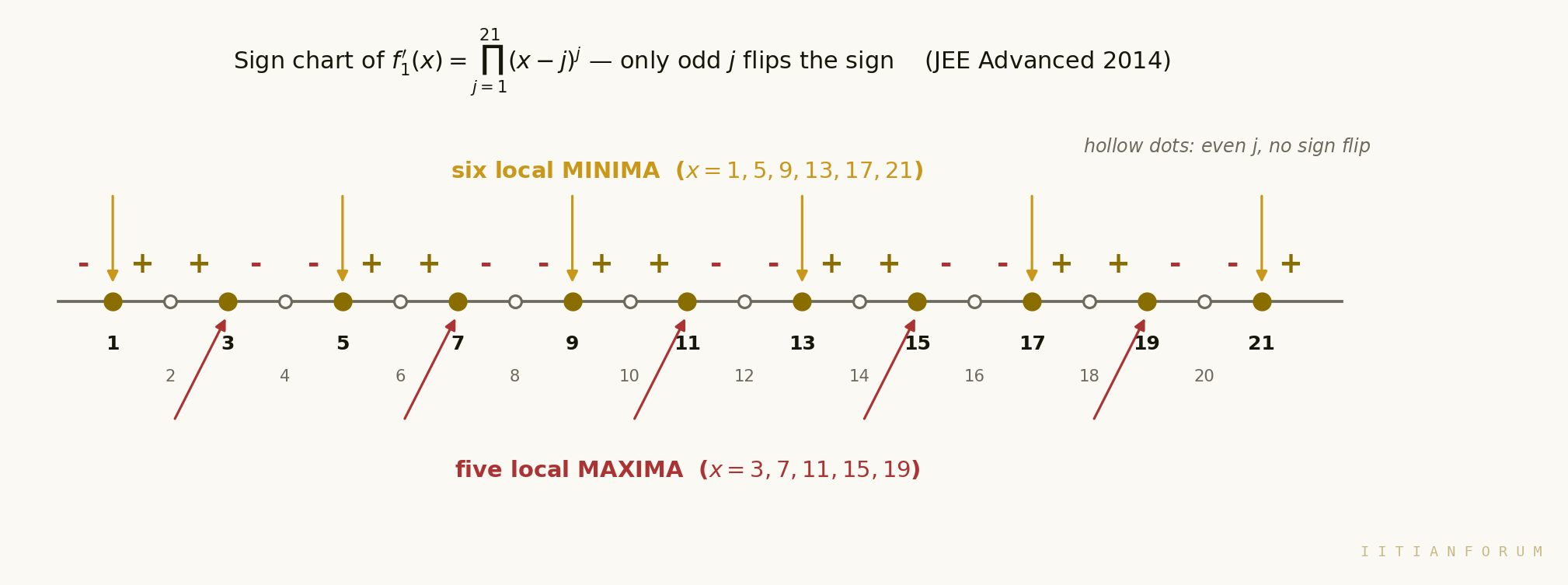
Example 25(JEE Advanced 2014, comprehension). Let f1:(0,∞)→R be
f1(x)=∫0xj=1∏21(t−j)jdt.
If m1 and n1 are the numbers of points of local minimum and local maximum of f1 on (0,∞), find 2m1+3n1+m1n1.
▸ SHOW SOLUTION
Step 1: Differentiate.f1′(x)=j=1∏21(x−j)j, with a zero at each of x=1,2,…,21, the zero at x=j carrying multiplicity j.
Step 2: Which zeros matter? Only those with oddj, namely
j=1,3,5,7,9,11,13,15,17,19,21— eleven of them.
The ten even ones (j=2,4,…,20) are critical points but not extrema.
Step 3: Anchor the sign at x=0.5, left of every zero. There x−j<0 for all j, so each factor contributes (−1)j and
signf1′(0.5)=(−1)1+2+⋯+21=(−1)231=−1.
So f1′<0 on (0,1).
Step 4: Alternate across the eleven odd zeros. Starting from − and flipping at 1,3,5,…,21:
After
1
3
5
7
9
11
13
15
17
19
21
sign of f1′
+
−
+
−
+
−
+
−
+
−
+
swipe for more →
Step 5: Read off.−→+ at x=1,5,9,13,17,21 — six minima, so m1=6. +→− at x=3,7,11,15,19 — five maxima, so n1=5.
Step 6:2m1+3n1+m1n1=12+15+30=57
Why this is the cleanest test of the multiplicity rule ever set
A product of twenty-one factors with exponents 1 through 21 is completely inaccessible by expansion — the polynomial has degree 231. The only thing you need is the parity of each exponent and one anchor sign. That is the entire question, and it is why JEE Advanced set it.
Example 26(JEE Advanced 2014, same comprehension). With f2(x)=98(x−1)50−600(x−1)49+2450 on (0,∞), and m2,n2 the numbers of local minima and maxima, find 6m2+4n2+8m2n2.
Step 2: Multiplicities. The zero at x=1 has power 48, which is even — no sign change. The zero at x=7 is simple.
Step 3: Sign.(x−1)48≥0 always, so the sign of f2′ is the sign of (x−7): negative on (0,7) and positive on (7,∞).
Step 4: Classify. One −→+ transition, at x=7: a single local minimum, and no maximum. So m2=1 and n2=0.
Step 5:6(1)+4(0)+8(1)(0)=6
The constant 2450 and the coefficient 98 are pure decoration — they vanish on differentiation or factor out.
Application 5 — Tangents and normals
To write the tangent to y=∫axf(t)dt at a point you need two numbers: the ordinate and the slope. The slope is free — it is f evaluated at that point.
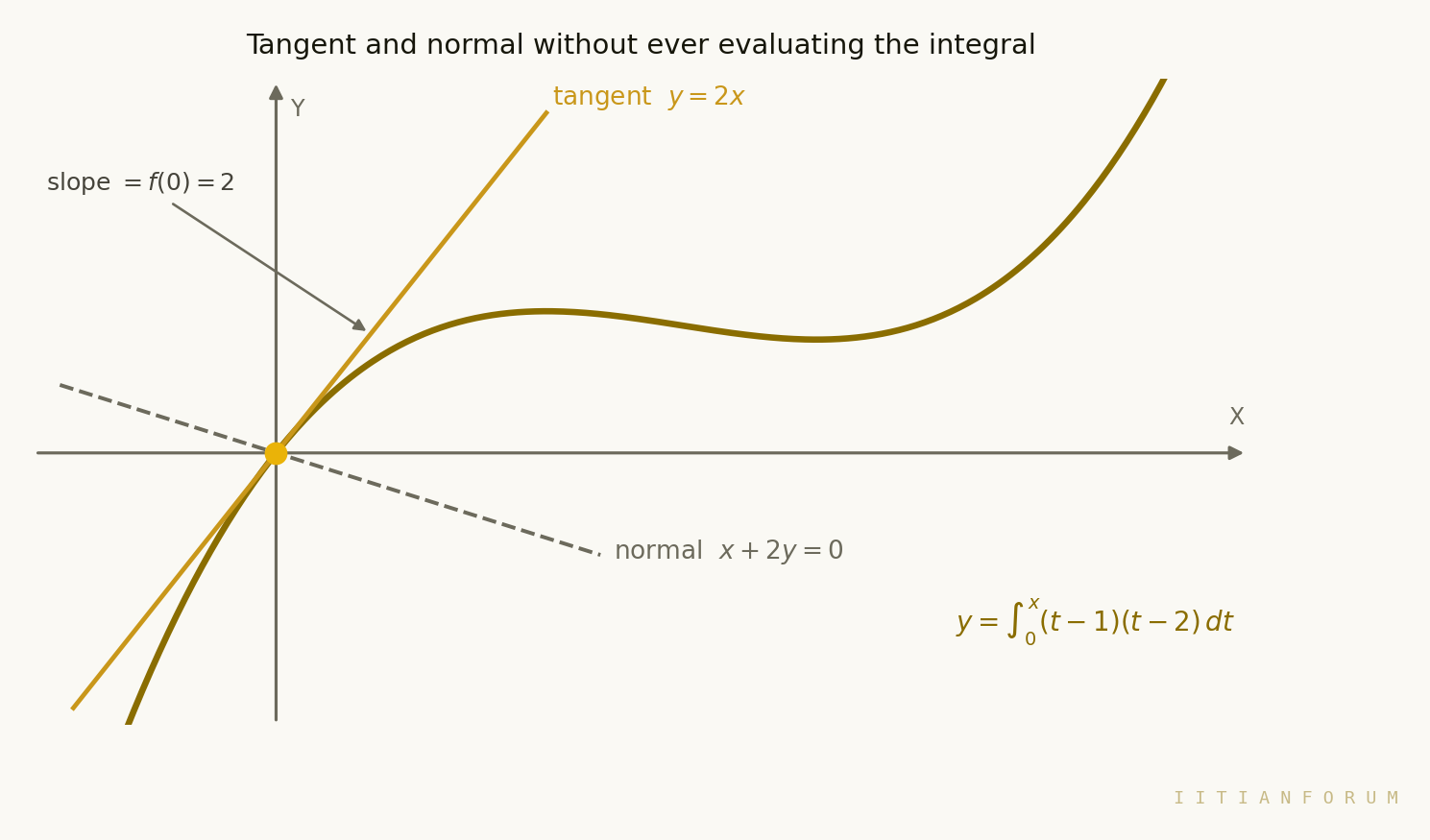
Example 27. Find the tangent and the normal to y=∫0x(t−1)(t−2)dt at x=0.
▸ SHOW SOLUTION
Step 1: Ordinate. Upper limit equals lower limit, so y(0)=0. The curve passes through the origin.
Step 2: Slope.dxdy=(x−1)(x−2), so at x=0 the slope is (−1)(−2)=2.
Step 3: Tangent.y−0=2(x−0), i.e. y=2x.
Step 4: Normal. Slope −21, so y=−2x, i.e. x+2y=0.
Example 28. At which points does the curve y=∫0xt2+4t2−4dt have a horizontal tangent, and what is the equation of the tangent at x=0?
▸ SHOW SOLUTION
Step 1:dxdy=x2+4x2−4. The denominator never vanishes, so horizontal tangents need x2=4, i.e. x=±2.
Step 2: At x=0,y(0)=0 and the slope is 4−4=−1, so the tangent is y=−x, i.e. x+y=0.
Example 29. The curve y=∫1xtlogetdt, x>0, meets the x-axis at x=1. Show that the tangent there is horizontal, and find how many points of the curve have a tangent of slope e22, naming one of them.
▸ SHOW SOLUTION
Step 1: The tangent at x=1. The upper and lower limits coincide, so y(1)=0; and by Newton–Leibnitz dxdy=xlogex, which at x=1 equals 10=0. So the tangent is y=0 — the x-axis itself, which is why the curve touches rather than crosses there.
Step 2: Set up the slope condition. We need xlogex=e22.
Step 3: One solution by inspection. Put x=e2: the left side is e2logee2=e22. So x=e2 works.
Step 4: How many solutions in total? Let ϕ(x)=xlogex. Then
ϕ′(x)=x21−logex,
which is positive on (0,e) and negative on (e,∞). So ϕ rises to a single maximum ϕ(e)=e1 and then falls back towards 0. Also ϕ→−∞ as x→0+ and ϕ(1)=0.
Step 5: Compare the target with the maximum.e22≈0.2707 and e1≈0.3679, so the target lies strictly between 0 and the maximum. A horizontal line at that height therefore cuts the graph of ϕtwice — once on the rising branch in (1,e) and once on the falling branch in (e,∞).
Answer: exactly 2 such points; one of them is x=e2 (the other lies between 1 and e).
Application 6 — Quadratic and polynomial equations
This is the connection candidates least expect. To prove a polynomial equation has a root in an interval, integrate it to build an auxiliary function, then let Rolle's theorem do the work. Newton–Leibnitz is what guarantees the auxiliary function has the derivative you want.
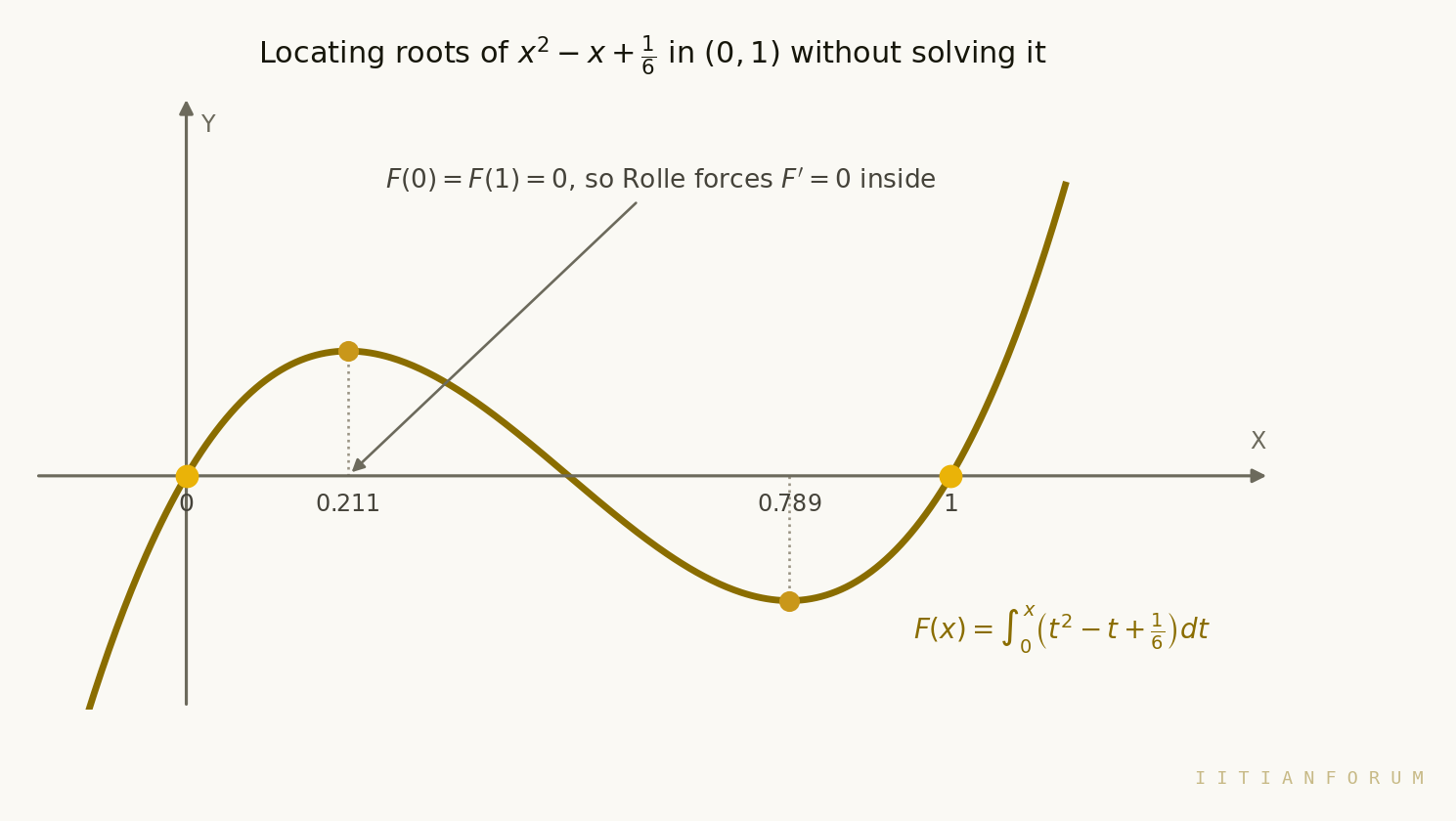
The bridge. If F(x)=∫0xϕ(t)dt and F(a)=F(b), then Rolle's theorem gives a c∈(a,b) with F′(c)=ϕ(c)=0. A root of ϕ has been located without solving ϕ=0.
Example 30. If 3a+2b+c=0, prove that ax2+bx+c=0 has at least one root in (0,1).
▸ SHOW SOLUTION
Step 1: Build the antiderivative. Let
F(x)=∫0x(at2+bt+c)dt=3ax3+2bx2+cx.
Step 2: Check the two endpoint values.F(0)=0, and
F(1)=3a+2b+c=0
by hypothesis. So F(0)=F(1).
Step 3: Apply Rolle.F is a polynomial, hence continuous on [0,1] and differentiable on (0,1). Rolle's theorem gives c0∈(0,1) with F′(c0)=0.
Step 4: Identify F′. By Newton–Leibnitz, F′(x)=ax2+bx+c. Therefore ac02+bc0+c=0 and c0∈(0,1) is the required root. ■
A concrete instance. Take a=1, b=−1, c=61; then 31−21+61=0. The roots of x2−x+61 are 21±63, i.e. 0.2113 and 0.7887 — both in (0,1), as promised.
Example 31. Find the number of real roots of ∫0x(t2−1)dt=0.
▸ SHOW SOLUTION
Step 1: Evaluate (a rare case where you should). F(x)=3x3−x.
Step 2: Factor.3x(x2−3)=0 gives x=0,±3.
Answer:3 real roots.
Step 3: Sanity check with the derivative.F′(x)=x2−1 vanishes at ±1, so F has a local maximum at x=−1 with value 32>0 and a local minimum at x=1 with value −32<0. A cubic whose local maximum is positive and local minimum negative cuts the axis three times. Consistent.
Example 32(JEE Main 2026, 22 Jan Shift 1). Let f:[1,∞)→R be differentiable with 6∫1xf(t)dt=3xf(x)+x3−4 for all x≥1. Find f(2)−f(3).
▸ SHOW SOLUTION
Step 1: Differentiate both sides. The left side gives 6f(x); the right side needs the product rule:
6f(x)=3f(x)+3xf′(x)+3x2.
Step 2: Tidy into an ODE.3f(x)−3xf′(x)=3x2, i.e. xf′(x)−f(x)=−x2.
Step 3: Spot the exact derivative. Divide by x2:
x2xf′−f=−1⟹dxd(xf)=−1.
Step 4: Integrate.xf=−x+C, so f(x)=−x2+Cx — a downward parabola, which is why this question is really a quadratic-equation question in disguise.
Step 5: Initial condition. Put x=1 in the original equation: the integral is zero, so 0=3f(1)+1−4, giving f(1)=1. Then −1+C=1, so C=2 and f(x)=−x2+2x.
Step 6: Compute.f(2)=−4+4=0 and f(3)=−9+6=−3, so
f(2)−f(3)=0−(−3)=3.
Example 33(JEE Main 2024, 31 Jan Shift 1). Let a be the sum of all coefficients in the expansion of (1−2x+2x2)2023(3−4x2+2x3)2024, and let
b=x→0limx21∫0xt2024+1loge(1+t)dt.
If cx2+dx+e=0 and 2bx2+ax+4=0 have a common root with c,d,e∈R, find d:c:e.
▸ SHOW SOLUTION
Step 1: Find a
The sum of all coefficients of a polynomial is its value at x=1:
a=(1−2+2)2023(3−4+2)2024a=12023⋅12024=1
Step 2: Find b by Newton–Leibnitz
The form is 00, so apply L'Hôpital once. Differentiating the integral by Newton–Leibnitz and the denominator normally:
using xloge(1+x)→1. The exponent 2024 is pure intimidation: near 0, x2024+1→1.
Step 3: Write the second quadratic
2bx2+ax+4=x2+x+4=0
Step 4: Look at its discriminant
1−16=−15<0
so both roots are non-real, and they are complex conjugates.
Step 5: Use the reality of c,d,e
A quadratic with real coefficients cannot share exactly one non-real root with another real quadratic, because non-real roots come in conjugate pairs. So cx2+dx+e=0 must share both roots, which forces the two quadratics to be proportional:
c:d:e=1:1:4
Step 6: Reorder as asked
The question wants d:c:e. Here c=d, so swapping the first two changes nothing.
Answer:d:c:e=1:1:4, option (2).
Application 7 — Differential equations
An integral equation is a differential equation that has not been differentiated yet. The recipe never changes:
Make sure x appears only in the limits (use the three tricks of Block 3).
Differentiate — you now have an ODE.
Read the initial condition off the original equation by substituting the value of x that collapses the integral to zero.
Solve, usually by integrating factor or separation.
Step 3 is the one people forget. The integral equation contains information the ODE does not.
Example 34(JEE Main 2026, 5 Apr Shift 2). Let f:[1,∞)→R be differentiable with f(x)=∫1xf(t)dt+(1−x)(logex−1)+e. Find f(f(1)).
▸ SHOW SOLUTION
Step 1: Initial condition first. Put x=1: the integral is 0 and the middle term is 0, so f(1)=e.
Step 2: Differentiate. The integral gives f(x). For the product,
Step 4: Recognise the right side.dxd(e−xlogex)=−e−xlogex+xe−x=e−x(x1−logex) — exactly it. So fe−x=e−xlogex+C and
f(x)=logex+Cex.
Step 5: Use f(1)=e.0+Ce=e⇒C=1, so f(x)=ex+logex.
Step 6: Compose.f(f(1))=f(e)=ee+logee=1+ee
Example 35(JEE Main 2026, 4 Apr Shift 2). Let f be twice differentiable with
f(x)=∫0xtan(t−x)dt−∫0xf(t)tantdt,x∈(−2π,2π).
Find f′′(6π)+12f′(−6π)+f(6π).
▸ SHOW SOLUTION
Step 1: Differentiate carefully. The first integral has x inside, but here the boundary term rescues us: differentiating ∫0xtan(t−x)dt contributes the boundary value tan(x−x)=tan0=0 plus the derivative of the integrand with respect to x. Writing u=t−x the substitution gives ∫0xtan(t−x)dt=∫−x0tanudu, whose derivative is −tan(−x)⋅(−1)=−tanx.
The second integral is standard: its derivative is f(x)tanx.
f′(x)=−tanx−f(x)tanx=−(1+f(x))tanx.
Step 2: Initial condition. Put x=0 in the original: both integrals vanish, so f(0)=0.
This is the moment the question turns from analysis into algebra — and it is why the examiner put (f′)2 there at all.
Step 3: Solve.f(x)=cex.
Step 4: Initial condition. Put x=0: (f(0))2=25 and f≥0, so f(0)=5 and c=5. Thus f(x)=5ex.
Step 5: Evaluate the list.f(logek)=5elogek=5k.
Step 6: Mean.
6251k=1∑6255k=6255⋅2625⋅626=25⋅626=1565
Example 38(JEE Main 2024, 9 Apr Shift 2). Let
∫0x1−(y′(t))2dt=∫0xy(t)dt,0≤x≤3,y≥0,y(0)=0.
Find the value of y′′+y+1 at x=2.
▸ SHOW SOLUTION
Step 1: Differentiate both sides. Both integrals have x only in the upper limit, so Newton–Leibnitz applies directly to each:
1−(y′(x))2=y(x).
An integral equation has become an ordinary differential equation in one step.
Step 2: Square. Since y≥0 the squaring is reversible:
1−(y′)2=y2⟹(y′)2=1−y2.
Step 3: Separate. Taking the branch with y′≥0 near the origin (forced by y(0)=0 and y≥0),
1−y2dy=dx⟹sin−1y=x+C.
Step 4: Fix C.y(0)=0 gives C=0, so y=sinx.
Step 5: Assemble.y′′=−sinx, so for every x,
y′′+y+1=−sinx+sinx+1=1.
The answer does not depend on x=2 at all — the expression y′′+y is exactly the left side of the harmonic equation y′′+y=0 that sinx satisfies. Naming the point x=2 is a decoy.
1
The toolkit card
Situation
Move
x only in the limits
Differentiate at once: f(h)h′−f(g)g′
x inside as ex−t or x⋅t
Factor the x-part out of the integral
x inside as sin(x−t), cos(x−t)
Expand the compound angle, then pull out
x inside as f(tx/k) with constant limits
Substitute u=tx/k to move x into the limit
Integrand has no elementary antiderivative
Certain sign that differentiation is intended
00 limit with an integral on top
L'Hôpital, differentiating by Newton–Leibnitz
"How many local maxima"
Sign chart, count +→− only
Even exponent in F′
No sign change, no extremum
Integral equation
Differentiate, then read the initial condition off the original
"Prove there is a root in (a,b)"
Integrate to build F, then Rolle
swipe for more →
The five mistakes that cost marks
Applying the formula when x is inside the integrand. Check every time. This is the single biggest source of wrong answers in this topic.
Forgetting the −f(g(x))g′(x) term when the lower limit is also a function.
Losing the chain-rule factor h′(x) — writing f(x2) instead of f(x2)⋅2x.
Treating an even exponent as a sign change.(x−4)6 gives a critical point, not an extremum.
Solving the ODE but never using the original integral equation. The constant of integration comes from substituting the limit value, and without it the answer is a family, not a function.
Thirty-second self-test
Without writing anything, say what dxd gives for each:
∫0x2e−t2dt · ∫sinxcosx1+t2dt · ∫0x(x−t)f(t)dt
Answers: 2xe−x4; 1+cos2x−sinx−1+sin2xcosx; and the third is a trap — expand it as x∫0xf−∫0xtf(t)dt first, which differentiates to ∫0xf(t)dt.
Where this appears in JEE
Across the ten 2026 shifts we analysed, Newton–Leibnitz carried questions labelled under six different chapter headings. If you have been treating it as a small corollary at the end of definite integration, that is the misjudgement this chapter exists to correct.
Shift
Chapter it was filed under
Answer
22 Jan Shift 1
Differential equations
3
23 Jan Shift 1
Application of derivatives
1565
23 Jan Shift 2
Definite integration
16
24 Jan Shift 1
Parabola
64
28 Jan Shift 2
Maxima and minima
9
4 Apr Shift 2
Differential equations
5
5 Apr Shift 2
Functions
1+ee
6 Apr Shift 2
Matrices and determinants
68
6 Apr Shift 2
Functional equations
15/32
swipe for more →
And in earlier papers, the same formula under yet more headings: