Maxima and Minima Complete JEE Notes
Maxima and minima is where every other calculus idea gets used at once — monotonicity, the second derivative, continuity, and for the harder JEE questions, the Newton–Leibnitz formula for differentiating an integral. These notes build the tests from the definition, prove why each works, and then run the eight shapes the question takes in a paper.
What an extremum actually is
The words extremum, extremal and turning value all mean the same thing: a maximum or a minimum value.
| Local maximum at | Local minimum at | |
|---|---|---|
| 1. Definition | is greater than every value takes in the immediate neighbourhood of | is less than every value takes in the immediate neighbourhood of |
| 2. Symbolically | and | and |
| 3. Holds for | some sufficiently small | some sufficiently small |
| 4. Reading the graph | the curve rises up to , then falls | the curve falls down to , then rises |
| 5. Necessary condition | if is differentiable at | if is differentiable at |
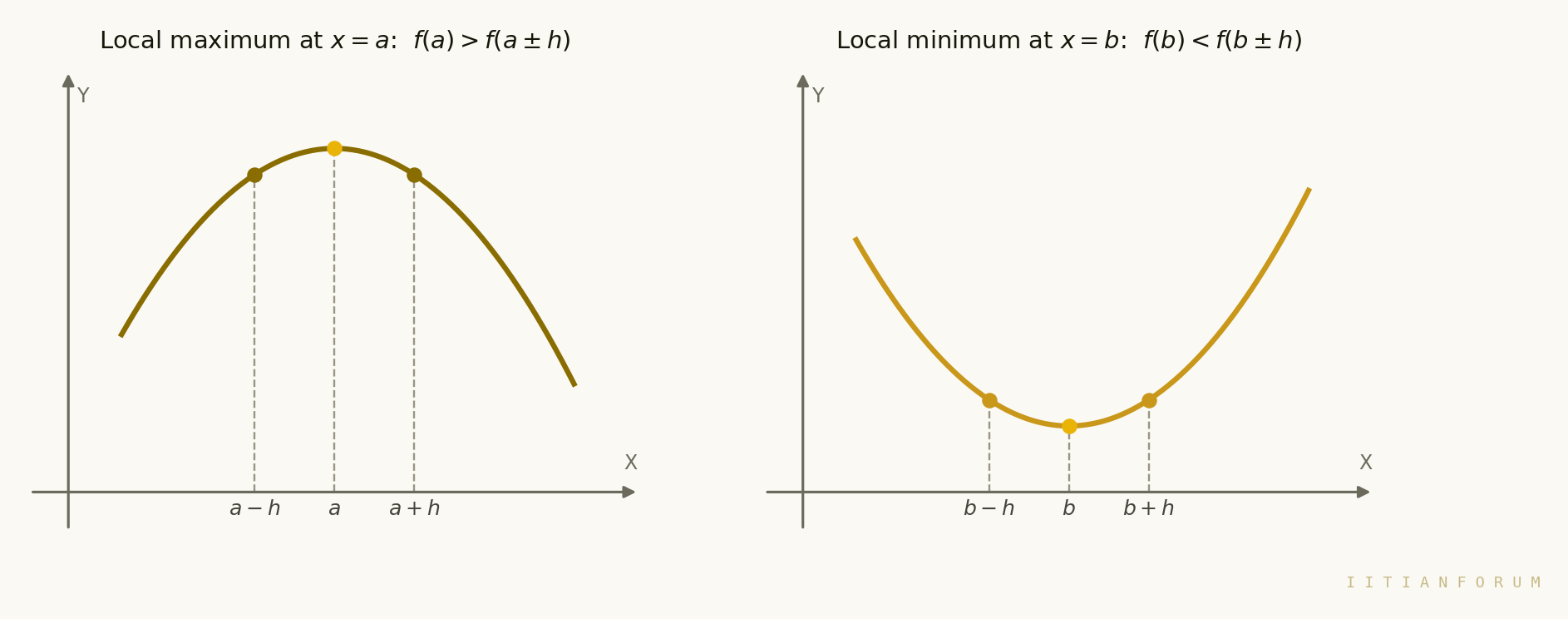
- Maximum and minimum values here are local (relative) — they compare only with its immediate neighbours, not with the whole domain.
- A local maximum value need not be the greatest value on the interval, and a local minimum need not be the least.
- A function can have several of each, and a minimum value may be larger than some maximum value elsewhere on the curve.
- For a continuous function, maxima and minima alternate: between two consecutive maxima there is a minimum, and vice versa.
Stationary points, and why is not enough
If is differentiable at and has a local extremum there, then . Points where the derivative vanishes are called stationary points — the instantaneous rate of change momentarily ceases.
But the converse fails. is necessary, not sufficient. If keeps the same sign on both sides of , the function is simply increasing (or decreasing) through a flat spot, and is not an extreme value at all. Such a point is a point of inflection.
The first order derivative test
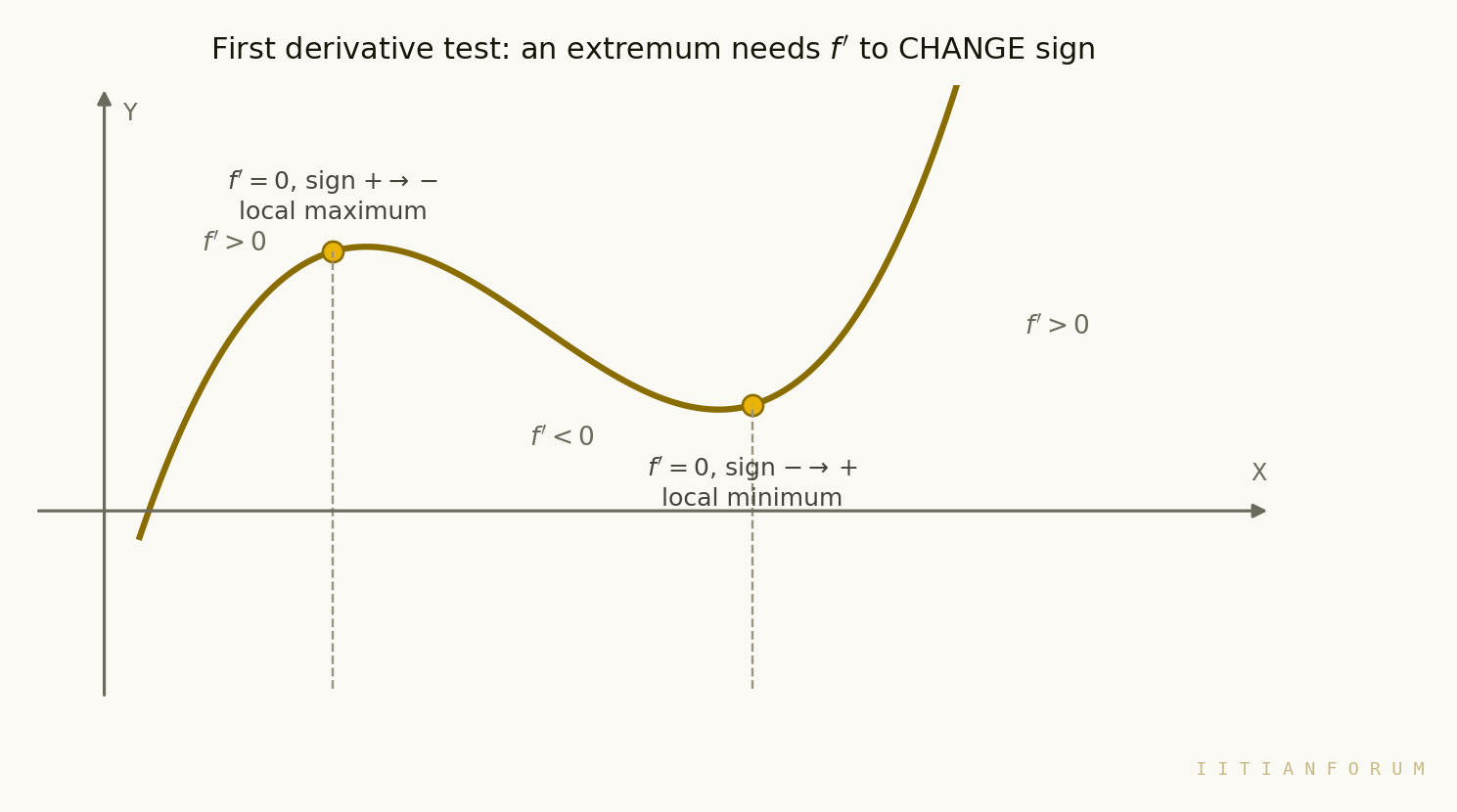
The test is a sign change, not a vanishing.
- If and , then is a local maximum: goes .
- If and , then is a local minimum: goes .
- If has the same sign on both sides, is neither — it is a point of inflection.
Example 1. For , decide each statement: (I) maximum at ; (II) minimum at ; (III) point of inflection at .
▸ SHOW SOLUTION
Step 1: Differentiate by the product rule.
Step 2: Take out the common factor. Both terms share :
Step 3: Critical points. at , and .
Step 4: Sign chart. Note has an even power, so it never flips the sign; only and do.
| Interval | ||||
|---|---|---|---|---|
Step 5: Read it off.
- At : , so a local maximum. (I) TRUE.
- At : , so a local minimum. (II) TRUE.
- At : no sign change, so a point of inflection. (III) TRUE.
Answer: all three are correct.
Example 2 (IIT-JEE 1993). If has extremum values at and , find and .
▸ SHOW SOLUTION
Step 1: Differentiate.
Step 2: Impose both conditions. An extremum needs there:
Step 3: Subtract.
Step 4: Back-substitute. gives .
Answer:
The second and th order derivative tests
Once , the quickest classification uses higher derivatives.
- local maximum at ;
- local minimum at ;
- inconclusive — go further.
The general statement covers every case at once.
Odd order gives no extremum, even order doesth order derivative test. Suppose but . Then:
- even and local maximum;
- even and local minimum;
- odd neither — it is a point of inflection.
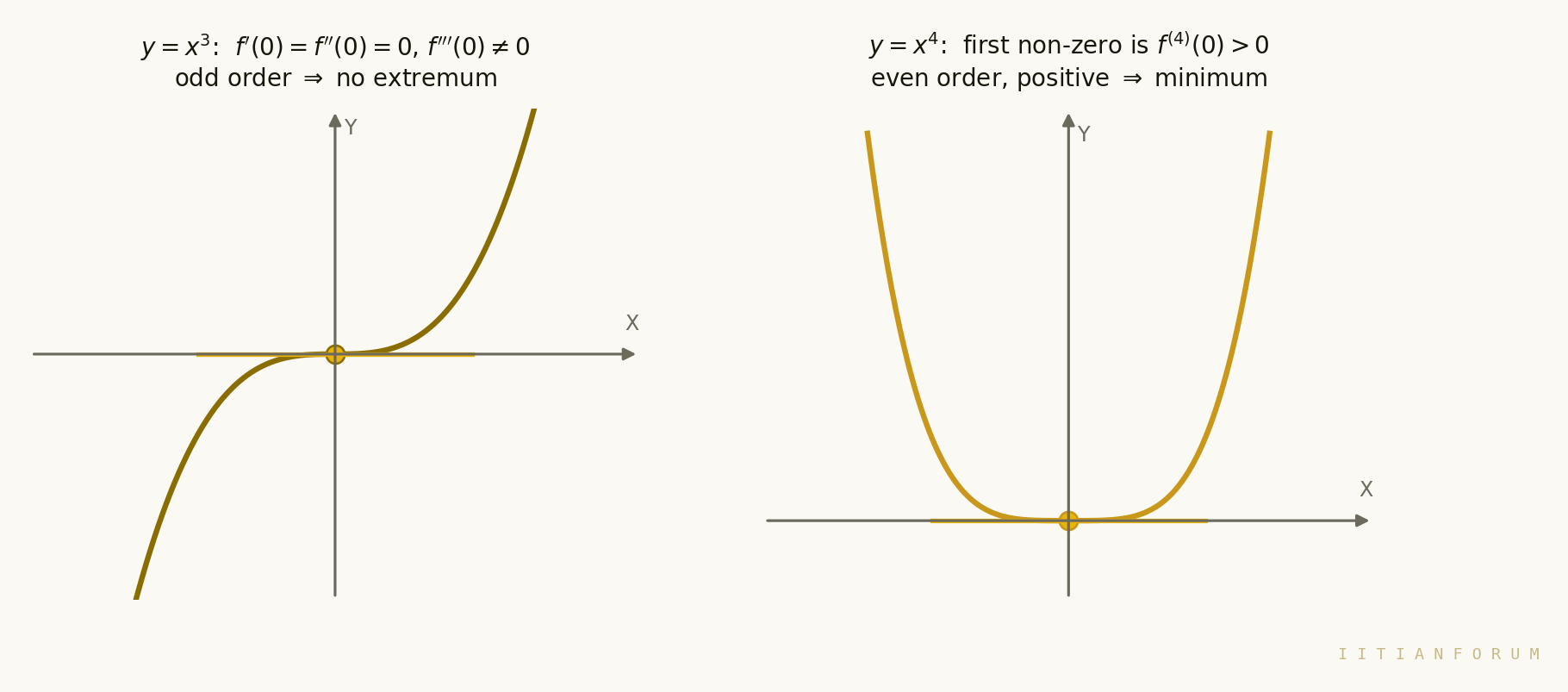
Near the function behaves like . An even power keeps the same sign on both sides, so the function sits entirely above or entirely below — an extremum. An odd power changes sign, so the function is above on one side and below on the other. That is exactly the "even power does not flip the sign" rule from the sign chart, seen from the other direction.
Example 3 (IIT-JEE 1995). On , at which point does take its maximum value?
▸ SHOW SOLUTION
Step 1: Differentiate by the product rule.
Step 2: Factor out the common part :
Step 3: Critical points on . , , .
Step 4: Sign chart. On both and are positive (even powers), so the sign of is the sign of : positive for , negative for .
Step 5: Conclude. changes at , so that is the maximum. The endpoints give , so it is the absolute maximum too.
Answer:
Example 4. Find the maximum ordinate of a point on the graph of .
▸ SHOW SOLUTION
Step 1: Rewrite using the double angle.
Step 2: Differentiate twice.
Step 3: Solve . Using ,
so or , giving in one period.
Step 4: Classify with .
f''\!\left(\frac{5\pi}{3}\right)=-\sin\frac{5\pi}{3}-2\sin\frac{10\pi}{3}>0\ \Rightarrow\ \text{minimum}.$$ ### Step 5: Evaluate at the maximum.f!\left(\frac\pi3\right)=\sin\frac\pi3\left(1+\cos\frac\pi3\right)=\frac{\sqrt3}{2}\cdot\frac32=\boxed{\frac{3\sqrt3}{4}}
Newton–Leibnitz formula
Many JEE questions define a function by an integral and then ask for its extrema. You never evaluate that integral — you differentiate it.
Newton–Leibnitz formula. If is continuous and are differentiable, then
Why it is true. Let be an antiderivative of , so by the fundamental theorem. Differentiating by the chain rule and using gives .
The case you will use ninety per cent of the time has a constant lower limit and :
Given :
- — just replace by . No integration.
- Find the zeros of and build a sign chart, exactly as for any other function.
- Odd multiplicity flips the sign, even multiplicity does not. Count only the sign changes.
The integral itself is never computed. This is why examiners can build monstrous-looking integrands: the difficulty is entirely in the sign chart.
Example 5. For with , classify the point .
▸ SHOW SOLUTION
Step 1: Differentiate by Newton–Leibnitz.
Step 2: Critical points. For the denominator never vanishes, so needs , i.e. for .
Step 3: Second derivative by the quotient rule.
Step 4: Evaluate at . There and , so
Step 5: Read the sign. For odd, — a local maximum. For even, — a local minimum.
Answer: maximum or minimum according as is odd or even respectively.
Example 6. Let for . How many points of local maximum does have?
▸ SHOW SOLUTION
Step 1: Differentiate. By Newton–Leibnitz, replace by :
Step 2: Find every zero in .
- and ;
- ;
- ;
- .
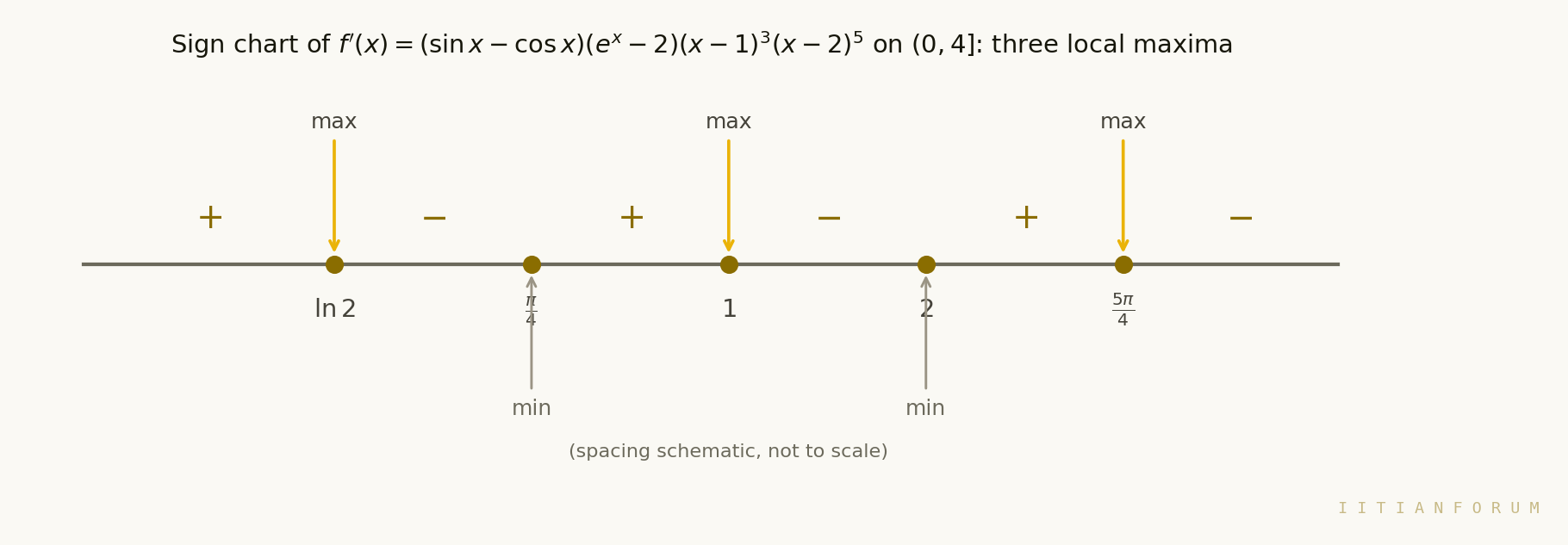
Step 3: Check the multiplicities. Every factor here has odd multiplicity — the two trigonometric and exponential zeros are simple, and the powers and are odd. So changes sign at all five points.
Step 4: Fix the sign on one interval, then alternate. Take , which is left of every zero:
four negatives, so . With five sign changes the pattern across the five points is
Step 5: Count the transitions. They occur at , and — three of them. (The transitions at and are minima.)
Answer: points of local maximum.
Example 7 (JEE Main 2026, 28 Jan Shift 2). Let be differentiable with , and let . If and are the points of local minimum and local maximum of , find .
▸ SHOW SOLUTION
Step 1: Pull the out of the integral. The factor , so
\ \Longrightarrow\ e^{-x}f(x)=(1-2x)e^{-x}+\int_0^x e^{-t}f(t)\,dt.$$ Now the integral has no $x$ inside it, only in the limit. ### Step 2: Differentiate both sides by Newton–Leibnitz.e^{-x}f'(x)-e^{-x}f(x)=-2e^{-x}-(1-2x)e^{-x}+e^{-x}f(x).
Dividing by $e^{-x}$ and tidying,f'(x)-2f(x)=2x-3.
**Step 3: Solve the linear differential equation.** The integrating factor is $e^{-2x}$, so\frac{d}{dx}\left(e^{-2x}f\right)=(2x-3)e^{-2x}.
Integrating by parts, $\displaystyle\int(2x-3)e^{-2x}dx=(1-x)e^{-2x}$, hence $f(x)=(1-x)+Ce^{2x}$. **Step 4: Fix the constant.** Putting $x=0$ in the original relation gives $f(0)=1$, and the formula gives $1+C$, so $C=0$ andf(x)=1-x.
**Step 5: Differentiate $g$ by Newton–Leibnitz.** Since $f(t)+2=3-t$,g'(x)=(3-x)^{15}(x-4)^6(x+12)^{17}=-(x-3)^{15}(x-4)^6(x+12)^{17}.
**Step 6: Sign chart.** Zeros at $x=-12,3,4$. The power $6$ on $(x-4)$ is **even**, so no sign change there; the powers $15$ and $17$ are odd. | Interval | $-(x-3)^{15}$ | $(x-4)^6$ | $(x+12)^{17}$ | $g'$ | |---|---|---|---|---| | $x<-12$ | $+$ | $+$ | $-$ | $-$ | | $-12<x<3$ | $+$ | $+$ | $+$ | $+$ | | $3<x<4$ | $-$ | $+$ | $+$ | $-$ | | $x>4$ | $-$ | $+$ | $+$ | $-$ | **Step 7: Read the extrema.** At $x=-12$: $-\to+$, local **minimum**, so $p=-12$. At $x=3$: $+\to-$, local **maximum**, so $q=3$. At $x=4$ nothing happens. ### Step 8: Compute.|p+q|=|-12+3|=\boxed{9}
Extrema where the function is not differentiable
Nothing in the definition of a local extremum mentions continuity or differentiability — it only compares with its neighbours. So a corner, a jump, or an isolated point can perfectly well be an extremum.
Six discontinuous cases: minimum, maximum and neither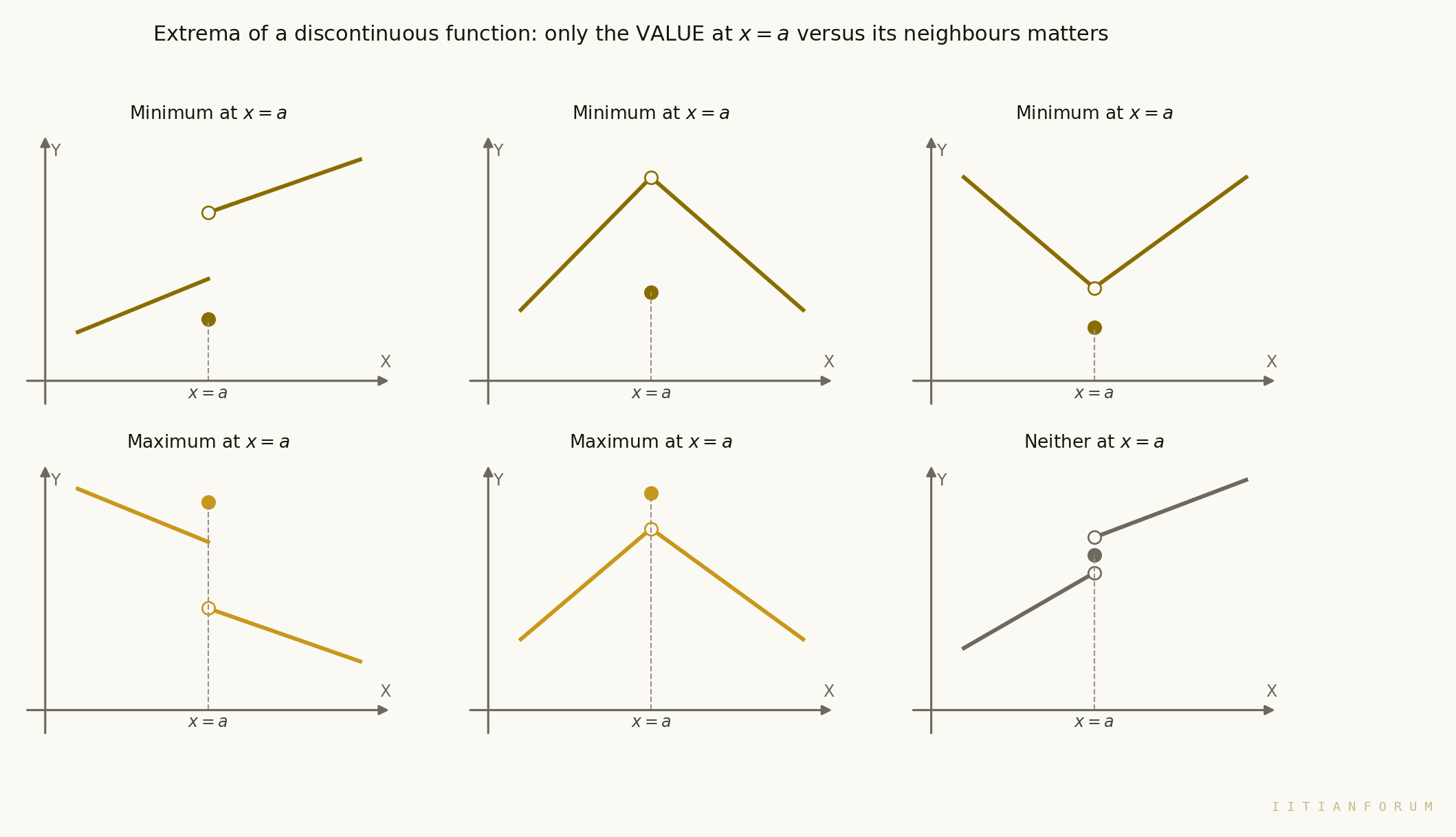
The rule is simply: look at the value , and compare it with the values on either side. If sits below both, it is a minimum; above both, a maximum; between them, neither.
Example 8. Let . Classify .
▸ SHOW SOLUTION
Step 1: Check continuity. Both pieces give at : the left limit is , the right limit is , and . So is continuous there.
Step 2: Left-hand derivative.
Step 3: Right-hand derivative.
Step 4: Classify. The two are unequal, so is not differentiable at — but that does not matter. What matters is the sign: means is rising into , and means it falls away after. The value at beats both sides.
Answer: is a point of local maximum, even though does not exist.
Global (absolute) maximum and minimum
Local extrema compare with neighbours; global extrema compare with the whole interval. On a closed interval a continuous function always attains both, and they can only occur at a critical point inside or at an end point.
Global extrema at end points versus at critical points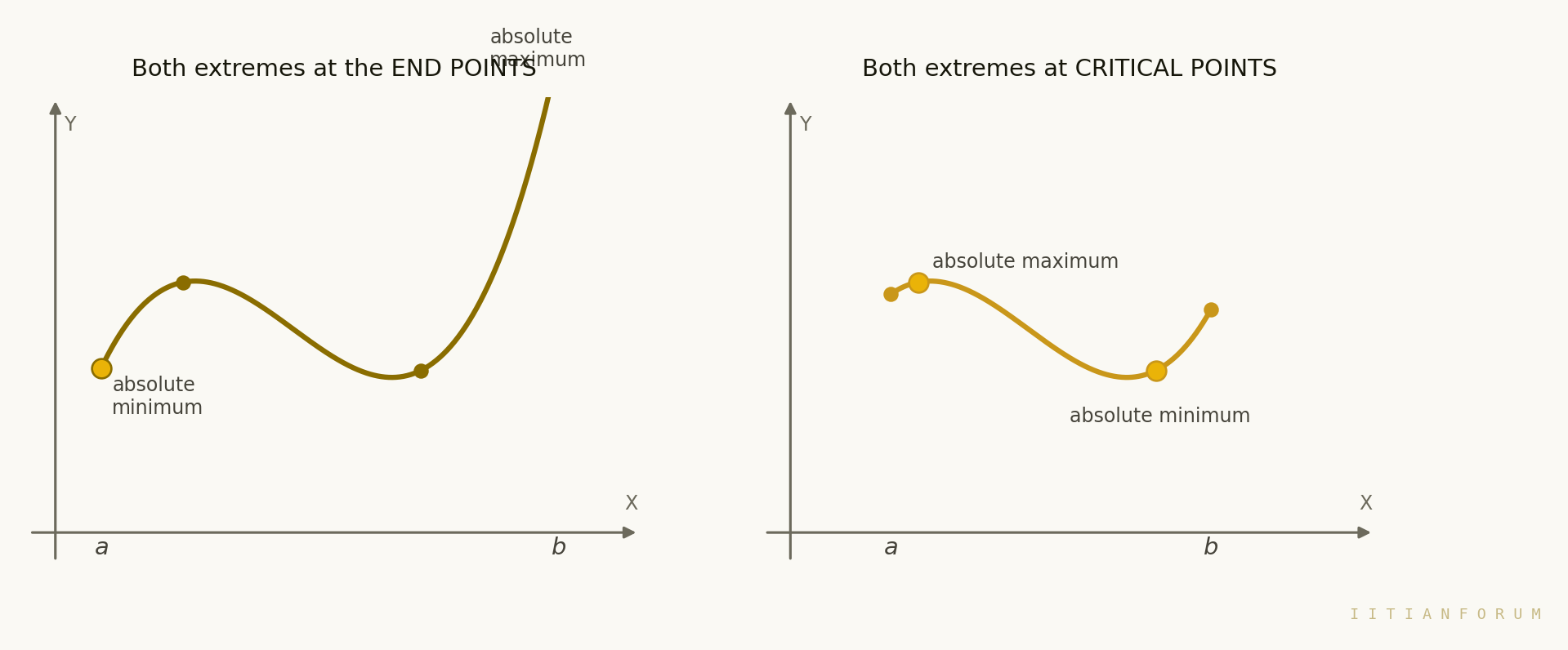
The algorithm.
- Check is continuous on .
- List the end points and every critical value inside.
- Evaluate at all of them.
- The largest value found is the absolute maximum; the smallest is the absolute minimum.
Note step 3: you evaluate and compare, you do not classify. There is no need for the second derivative test in a global problem.
Example 9. Find the global maximum of on .
▸ SHOW SOLUTION
Step 1: Work with the inside. is strictly increasing, so is largest exactly where is largest.
Step 2: Factorise . Since , divides it:
Step 3: Check for critical points inside . , whose discriminant is , with roots — both outside . So has no critical point in the interval and is monotonic there.
Step 4: Evaluate at the end points.
Step 5: Conclude. The maximum of on is , at , so
Example 10 (JEE Main 2026, 04 Apr Shift 2). Find .
▸ SHOW SOLUTION
Step 1: Simplify with double angles.
Step 2: Expand and differentiate. Writing ,
Step 3: Critical points on . gives ; gives .
Step 4: Evaluate at critical points and end points.
Step 5: Pick the largest.
Using extrema to count the roots of a cubic
For we have , with discriminant .
- : everywhere, so is strictly increasing and crosses the -axis exactly once. In particular the cubic has no extremum precisely when .
- : has two roots , giving a local maximum at and a local minimum at . The number of real roots is then decided by the two turning values:
- three distinct real roots,
- three real roots, two of them equal,
- one real root and two complex.
- : , so . If there is a triple root; otherwise exactly one real root.
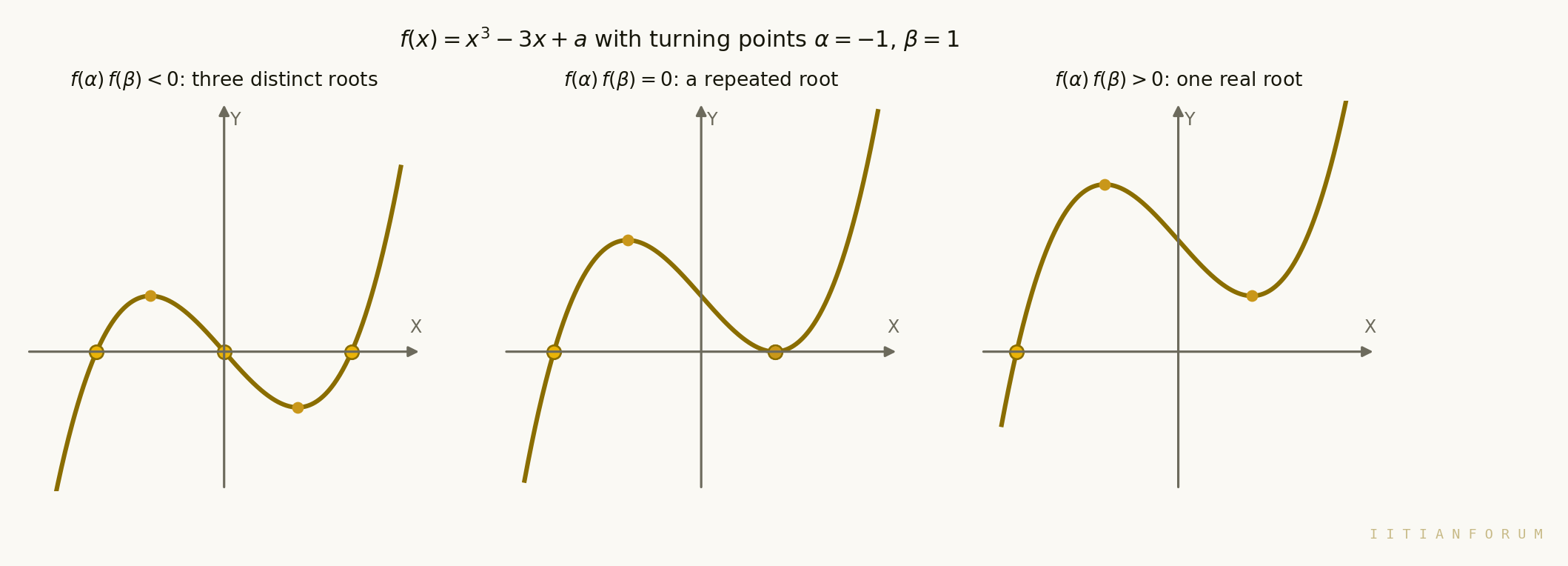
Example 11. For which values of does have three distinct real roots?
▸ SHOW SOLUTION
Step 1: Find the turning points. With ,
so (local maximum) and (local minimum).
Step 2: Evaluate the turning values.
Step 3: Apply the condition. Three distinct real roots need :
Step 4: Solve. A product of two brackets is negative when they have opposite signs, giving
Check. At the equation has roots — three distinct. At it becomes , only two distinct. At there is one real root. The boundary is exactly right.
Standard results worth memorising
These come up so often that deriving them each time is wasted minutes.
| Situation | Result |
|---|---|
| maximum at | |
| Rectangle of given perimeter | the square has the largest area |
| Rectangle of given area | the square has the least perimeter |
| Cone of maximum volume inscribed in a sphere of radius | height |
| Cylinder of maximum volume inscribed in a sphere of radius | height |
| Cylinder of maximum volume in a cone of height , semi-vertical angle | height , volume |
| for | minimum at |
Example 12. Find the volume of the greatest cylinder that can be inscribed in a cone of height cm and semi-vertical angle .
▸ SHOW SOLUTION
Step 1: Set up the geometry. The cone has base radius .
Step 2: Relate the cylinder's height to its radius. By similar triangles, a cylinder of radius has height
Step 3: Write the volume as one variable.
Step 4: Differentiate and solve.
(This is less than , so it is admissible.)
Step 5: Confirm it is a maximum and evaluate. , which at is . The height is , so
Check. A numerical sweep over peaks at , and . Agrees.
Quick recall
| Situation | What to do |
|---|---|
| Asked for local extrema | , then sign chart — the sign must change |
| and | Keep differentiating: first non-zero order, even extremum, odd inflection |
| An even power in the factorised | It does not flip the sign; that root is not an extremum |
| defined by | Newton–Leibnitz: , then sign chart. Never integrate |
| Variable limits on both ends | |
| Asked for the greatest/least value on | Evaluate at critical points and both end points, then compare |
| has a corner or jump | Compare with its neighbours directly; differentiability is irrelevant |
| Cubic, asked how many real roots | Turning values , : product three roots, repeated, one |
| Cubic, asked for no extremum | for |
| Solid inscribed in a solid | Reduce to one variable by similar triangles, then differentiate |
Two habits decide this chapter. First, a vanishing derivative is not an extremum — the sign has to change, which is why every even power in the factorised is a trap deliberately placed. Second, when a function is defined by an integral, do not integrate: Newton–Leibnitz hands you directly, and the entire question is then an ordinary sign chart.
Practise these on doMath, and read the JEE Main 2026 shift-wise analyses to see how many marks Application of Derivatives carried this year.