Relation Between AM, GM and HM Complete JEE Notes with Proofs
Ritesh Raj · 1 Aug 2026
Aa
14 min read16 sectionsConcept
Almost every "find the minimum value" question in JEE Main and Advanced is really one inequality wearing a disguise: AM ≥ GM. These notes build the three means from scratch, prove the chain A≥G≥H, and then work through the six shapes the question actually takes in a paper — with past questions from IIT-JEE and JEE Main 2026.
The three means, side by side
Let a and b be two positive numbers. Each mean is the middle term of a different progression.
Arithmetic mean A
Geometric mean G
Harmonic mean H
1. Middle term of
an AP
a GP
an HP
2. Defining relation
b−a=c−b
ab=bc
b1−a1=c1−b1
3. Formula for two numbers
A=2a+b
G=ab
H=a+b2ab
4. For n numbers
An=na1+a2+⋯+an
Gn=(a1a2⋯an)1/n
Hn=a11+a21+⋯+an1n
5. Built from
the numbers themselves
their product
their reciprocals
swipe for more →
Row 5 is the one worth internalising. The harmonic mean is nothing more than "take reciprocals, average them, take the reciprocal back" — so every HM question is an AM question in disguise, and you should reach for a1 the moment you see the word harmonic.
One formula covers all three
For two positive numbers a=b, the expression
an+bnan+1+bn+1
equals A when n=0, equals G when n=−21, and equals H when n=−1.
Why: setting it equal to 2a+b and clearing denominators gives (a−b)(an−bn)=0. Since a=b we need an=bn, i.e. n=0. The other two drop out the same way. JEE has asked all three versions of this over the years.
Inserting n means between two numbers
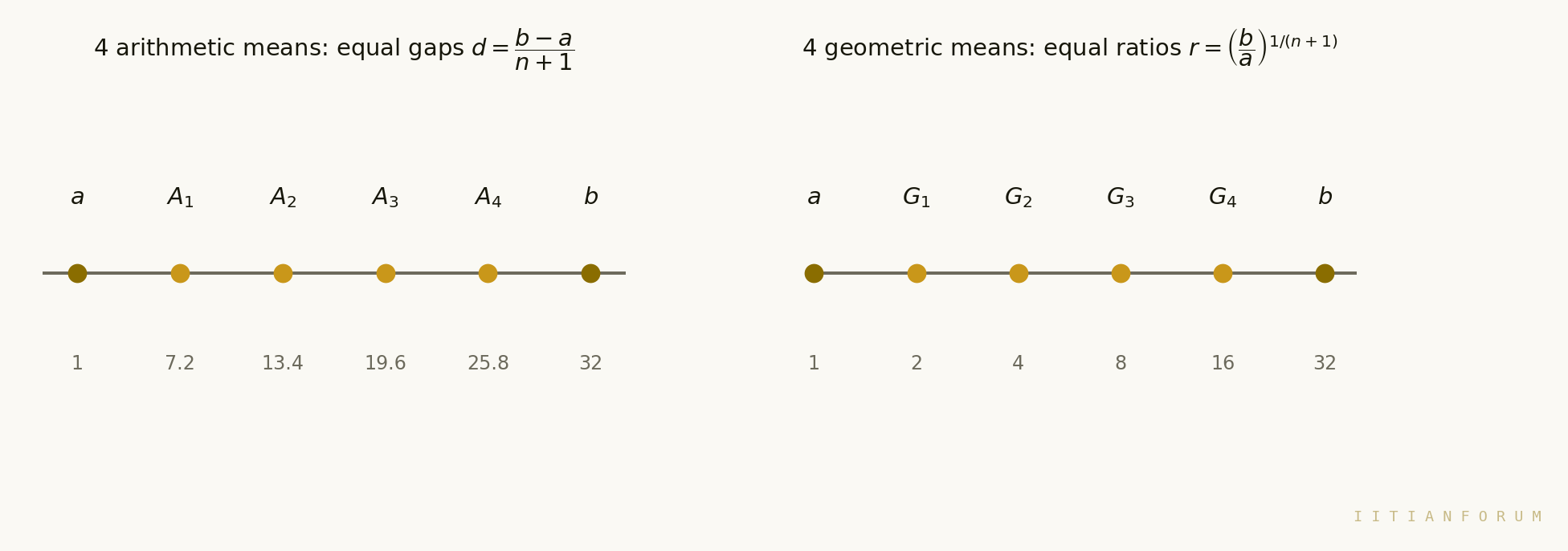
n arithmetic means
If a,A1,A2,…,An,b are in AP, the list has n+2 terms and therefore n+1 equal gaps:
d=n+1b−a,Ar=a+r(n+1b−a).
The sum is the result JEE actually uses:
A1+A2+⋯+An=n(2a+b),
i.e. the sum of n arithmetic means equals n times the single arithmetic mean of a and b.
n geometric means
If a,G1,G2,…,Gn,b are in GP, the n+1 equal ratios give
r=(ab)1/(n+1),Gk=a(ab)k/(n+1).
And the product is the mirror of the sum result:
G1⋅G2⋯Gn=(ab)n.
n harmonic means
Reciprocals turn HP into AP, so if a,H1,…,Hn,b are in HP then a1,H11,…,b1 are in AP with common difference ab(n+1)a−b, giving
Hk1=a1+k(ab(n+1)a−b),
and, matching the pattern,
H11+H21+⋯+Hn1=n(2aba+b)=HM of a and bn.Four arithmetic means and four geometric means inserted between 1 and 32
The pattern across all three
Sum of n AMs =n× (single AM). Product of n GMs =(single GM)n. Sum of the reciprocals of n HMs =n× (reciprocal of the single HM). Each mean answers to its own operation — addition, multiplication, addition-of-reciprocals.
The relation A≥G≥H
This is the engine of the whole chapter. Both halves come from the same square.
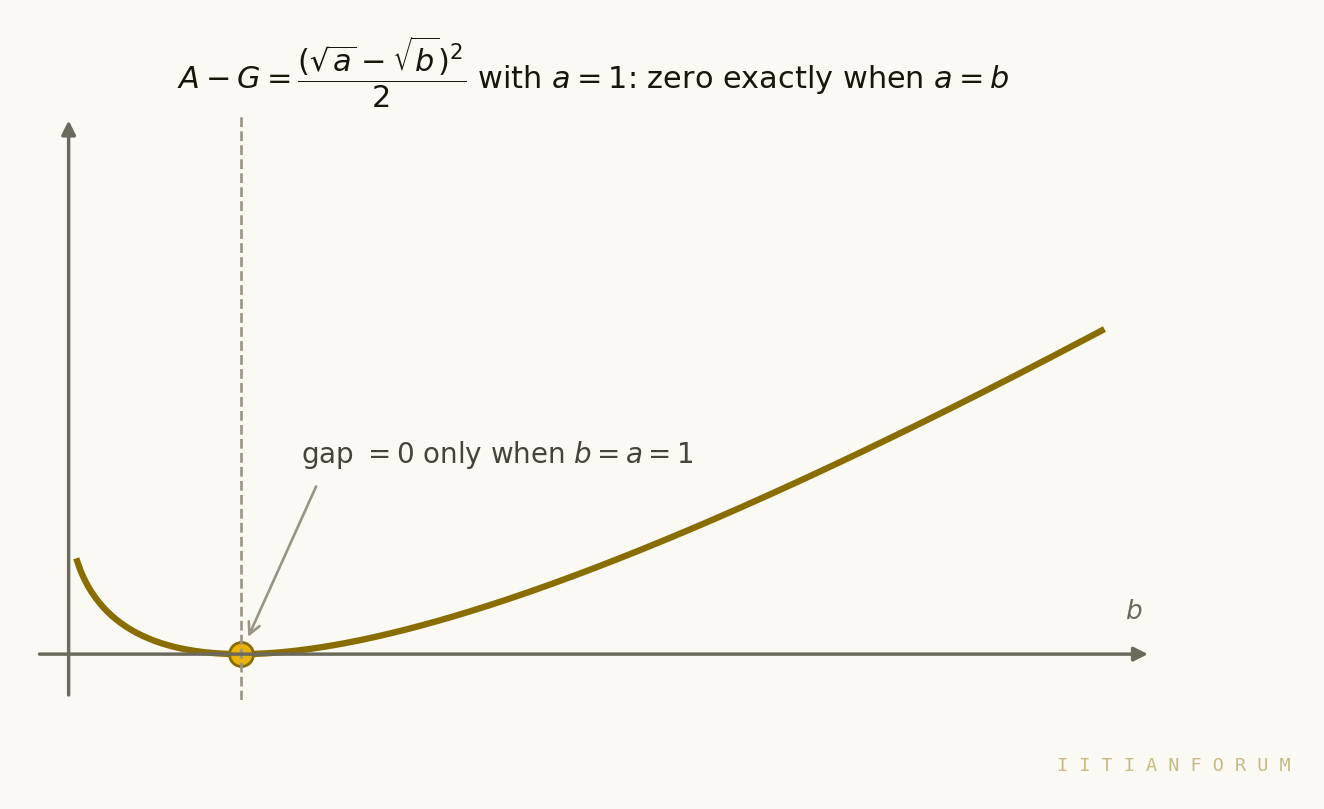
with equality throughout exactly when a=b, because (a−b)2=0 forces a=b.
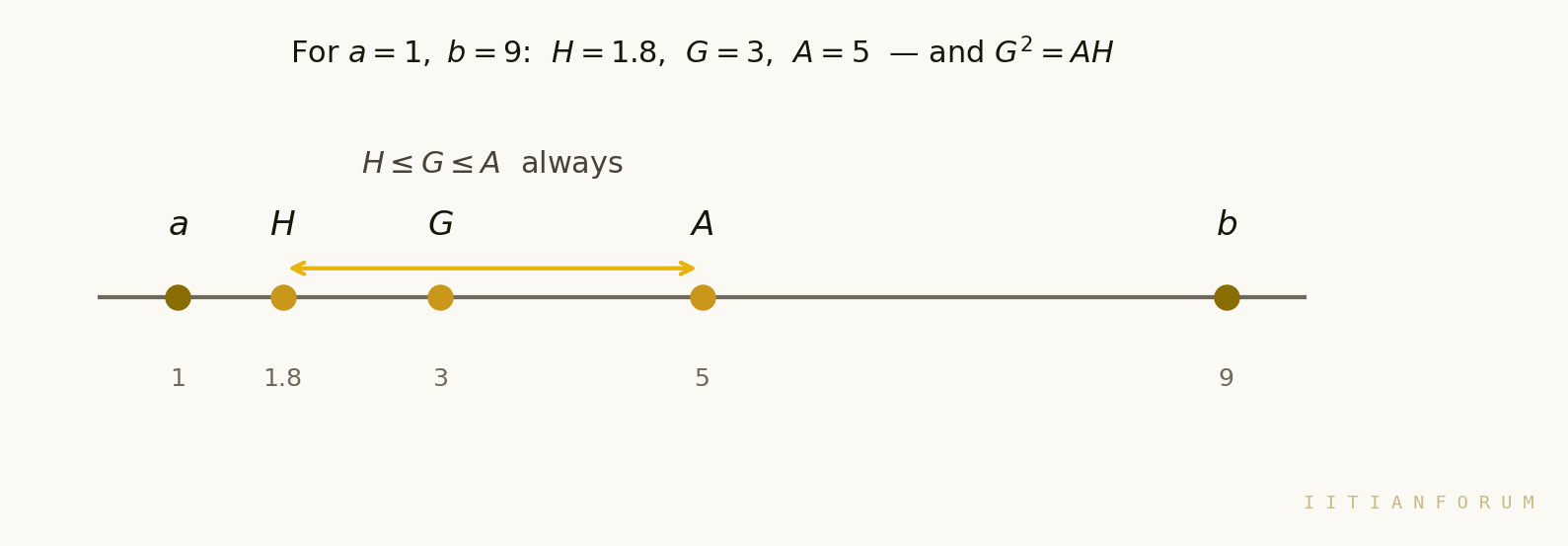
The three means for a = 1 and b = 9 on a number lineThe gap A minus G closes only when a equals b
The equality condition is half the marks
Every optimisation question using AM–GM has two parts: the bound, and the check that the bound is attained. A minimum of 2k is only the answer if the variables can actually be made equal within the given domain. State where equality holds, every time.
The geometric picture
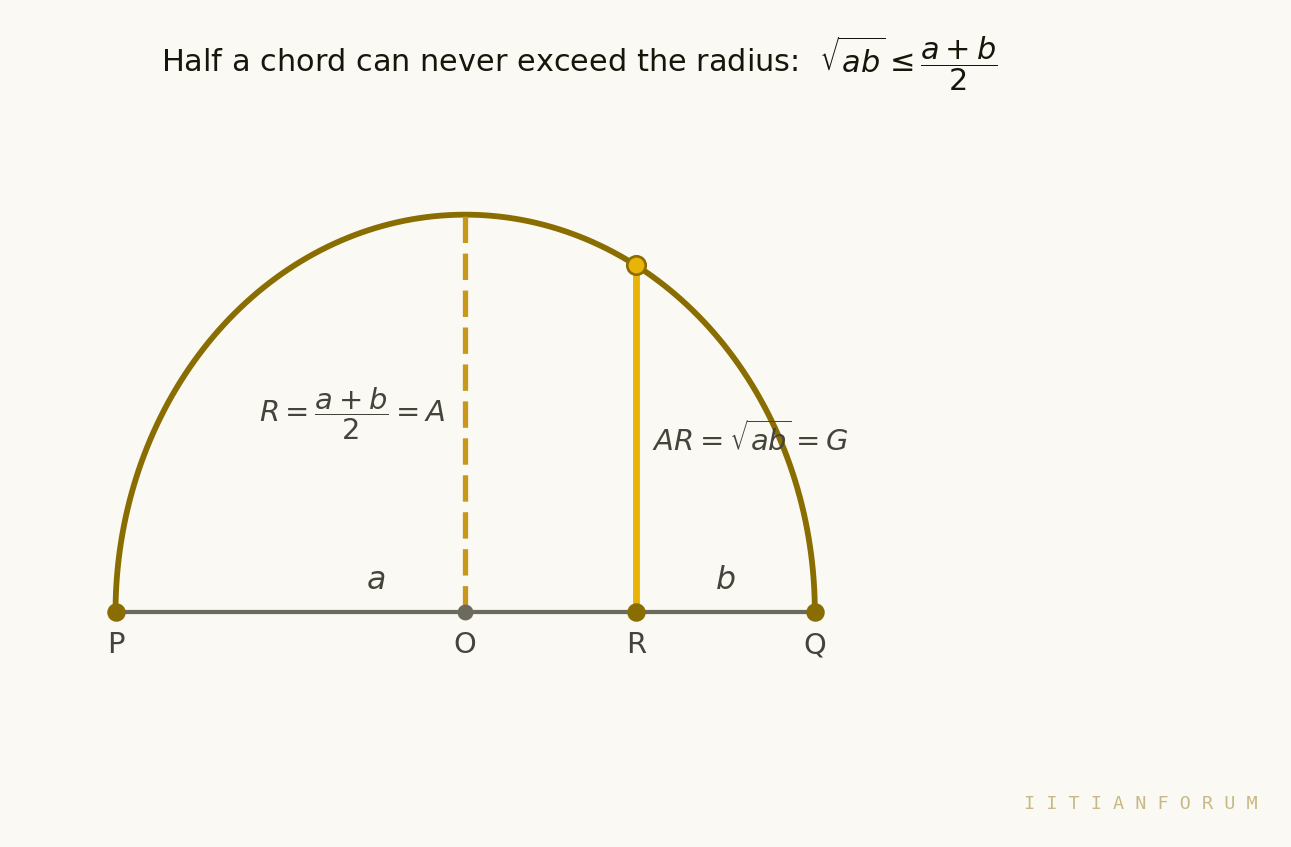
The inequality is a fact about a circle. Lay segments PR=a and RQ=b end to end, so PQ=a+b, and draw the circle on PQ as diameter. Its radius is 2a+b. The chord through R perpendicular to PQ meets the circle at A, and the intersecting-chords relation gives
AR2=PR⋅RQ=ab⟹AR=ab.
Half a chord can never exceed the radius, so ab≤2a+b — and the two are equal exactly when R is the centre, i.e. when a=b.
Semicircle proof that root ab is at most the average of a and b
The key results worth memorising
For two positive numbers a and b with means A, G, H:
A, G, H are themselves in GP:G2=AH. (Check: AH=2a+b⋅a+b2ab=ab=G2.)
a and b are the roots ofx2−2Ax+G2=0, since their sum is 2A and their product is G2.
Recovering the numbers from the means:a=A−A2−G2 and b=A+A2−G2.
For three numbers with means A, G, H, the cubic having them as roots is x3−3Ax2+H3G3x−G3=0.
Result 3 is why A≥Gmust hold: if A<G the square root would be imaginary, and two positive reals cannot have imaginary values.
Standard inequalities that follow
Each of these is AM–GM applied once, and each shows up in papers in its own right.
#
Result
Where it comes from
(i)
(a1+⋯+an)(a11+⋯+an1)≥n2
AM–GM on the ai, then on the ai1, multiplied
(ii)
(a+b+c)(a1+b1+c1)≥9
result (i) with n=3
(iii)
a1+b1+c1≥ab1+bc1+ca1
AM–GM on each pair of reciprocals
(iv)
na1m+⋯+anm≥(na1+⋯+an)m for m<0 or m>1; the inequality reverses for 0<m<1
Result (v) is the one that unlocks "unequal coefficients" problems: split 2an into an+an, or split 3a−3 into three copies of a−3, and plain AM–GM applies again.
Now the six question types.
Type 1 — Inserting means and summing them
Example 1(JEE Main 2026, 05 Apr Shift 2). Let A1,A2,…,A39 be 39 arithmetic means between 59 and 159. Find the mean of A25,A28,A31 and A36.
▸ SHOW SOLUTION
Step 1: Count the terms. The AP is 59,A1,…,A39,159 — that is 41 terms, so 40 gaps.
Faster route. The four subscripts 25,28,31,36 average to 30, and Ar is linear in r, so the mean of the four values is A30=59+30(2.5)=134 directly.
Example 2(JEE Main 2026, 28 Jan Shift 2). Let the arithmetic mean of a1 and b1 be 165 with a>2. If a,4,α,b are in AP, locate the roots of αx2−ax+2(α−2b)=0.
▸ SHOW SOLUTION
Step 1: Use the AP to name everything by one letter. With 4 as the second term and common difference d:
Step 3: Clear and solve. With (4−d)(4+2d)=16+4d−2d2,
8(8+d)=5(16+4d−2d2)⟹10d2−12d−16=0⟹5d2−6d−8=0,
so (5d+4)(d−2)=0 and d=−54 or d=2.
Step 4: Pick the branch.d=2 gives a=2, α=6, b=8. (The other branch d=−54 gives a=4.8, and both branches land the roots in the same two intervals, so the answer is unaffected.)
Answer: one root in (1,4) and the other in (−2,0).
Type 2 — Minimum of a sum when the product is fixed
This is the single most common use of AM–GM. If the product of the terms is a constant, their sum has a minimum, and the minimum is n times the nth root of that product.
Example 3(IIT-JEE 1991). The product of n positive numbers is unity. What can be said about their sum?
▸ SHOW SOLUTION
Step 1: Name the numbers. Let x1,x2,…,xn>0 with x1x2⋯xn=1.
Step 2: Apply AM–GM to all n of them.
nx1+x2+⋯+xn≥(x1x2⋯xn)1/n=11/n=1.
Step 3: Multiply out.
x1+x2+⋯+xn≥n.
Step 4: Equality. All xi equal, i.e. every xi=1, which does satisfy the product condition — so the bound is attained.
Answer: the sum is never less than n.
Example 4(IIT-JEE 2002). If a1,a2,…,an are positive reals with product a fixed number c, find the minimum value of a1+a2+⋯+an−1+2an.
▸ SHOW SOLUTION
Step 1: Make the product match the sum. The sum contains 2an, not an, so treat the n quantities as
a1,a2,…,an−1,2an,
whose product is 2(a1a2⋯an)=2c.
Step 2: Apply AM–GM to those n quantities.
na1+a2+⋯+an−1+2an≥(2c)1/n.
Step 3: Multiply out.
a1+a2+⋯+an−1+2an≥n(2c)1/n.
Step 4: Equality. All n quantities equal, i.e. a1=⋯=an−1=2an, which is achievable.
Answer:n(2c)1/n
The trick in Example 4 is the whole technique
AM–GM only bounds a sum by the nth root of the product of the very terms being added. So when a coefficient appears, absorb it: read 2an as one quantity, or split 3a−3 into a−3+a−3+a−3. Getting the grouping right is the entire difficulty in these questions.
Example 5(IIT-JEE 2011). Find the minimum value of a−5+a−4+3a−3+1+a8+a10 for a>0.
▸ SHOW SOLUTION
Step 1: Split the coefficient. Write 3a−3 as three separate terms. The expression becomes a sum of eight quantities:
a−5,a−4,a−3,a−3,a−3,1,a8,a10.
Step 2: Check their product. Add the exponents:
−5−4−3−3−3+0+8+10=0,
so the product is a0=1. This is why the question was built with these particular powers.
Step 3: Apply AM–GM to the eight quantities.
8a−5+a−4+3a−3+1+a8+a10≥(1)1/8=1.
Step 4: Multiply out.
a−5+a−4+3a−3+1+a8+a10≥8
Step 5: Equality. All eight equal forces a=1, and substituting a=1 gives 1+1+3+1+1+1=8. The bound is attained, so 8 really is the minimum.
Example 6(JEE Main 2026, 05 Apr Shift 2). Let (21−a+21+a), f(a), (3a+3−a) be in AP and let α be the minimum value of f(a). Evaluate
∫loge(α−1)logeαe2x−e−2xdx.▸ SHOW SOLUTION
Step 1: The middle term of an AP is the average of its neighbours.
f(a)=21[(21−a+21+a)+(3a+3−a)].
Step 2: Minimise each bracket by AM–GM. Each is a sum of two positives with constant product:
21−a+21+a≥221−a⋅21+a=222=4,3a+3−a≥23a⋅3−a=2.
Both equalities need a=0, the same value of a — so both minima are reached together.
Step 3: Minimum of f.
α=f(0)=21(4+2)=3.
Step 4: Set up the integral. The limits are loge2 and loge3. Substitute t=e2x, so dx=2tdt and e2x−e−2x=tt2−1; the limits become t=4 and t=9:
I=∫49t2−1t⋅2tdt=∫492(t2−1)dt.
Step 5: Partial fractions. Using t2−11=21(t−11−t+11),
I=41[loget+1t−1]49=41(loge108−loge53).
Step 6: Simplify.
I=41loge(108⋅35)=41loge(34)
Answer:41loge34
Type 3 — Maximum of a product when the sum is fixed
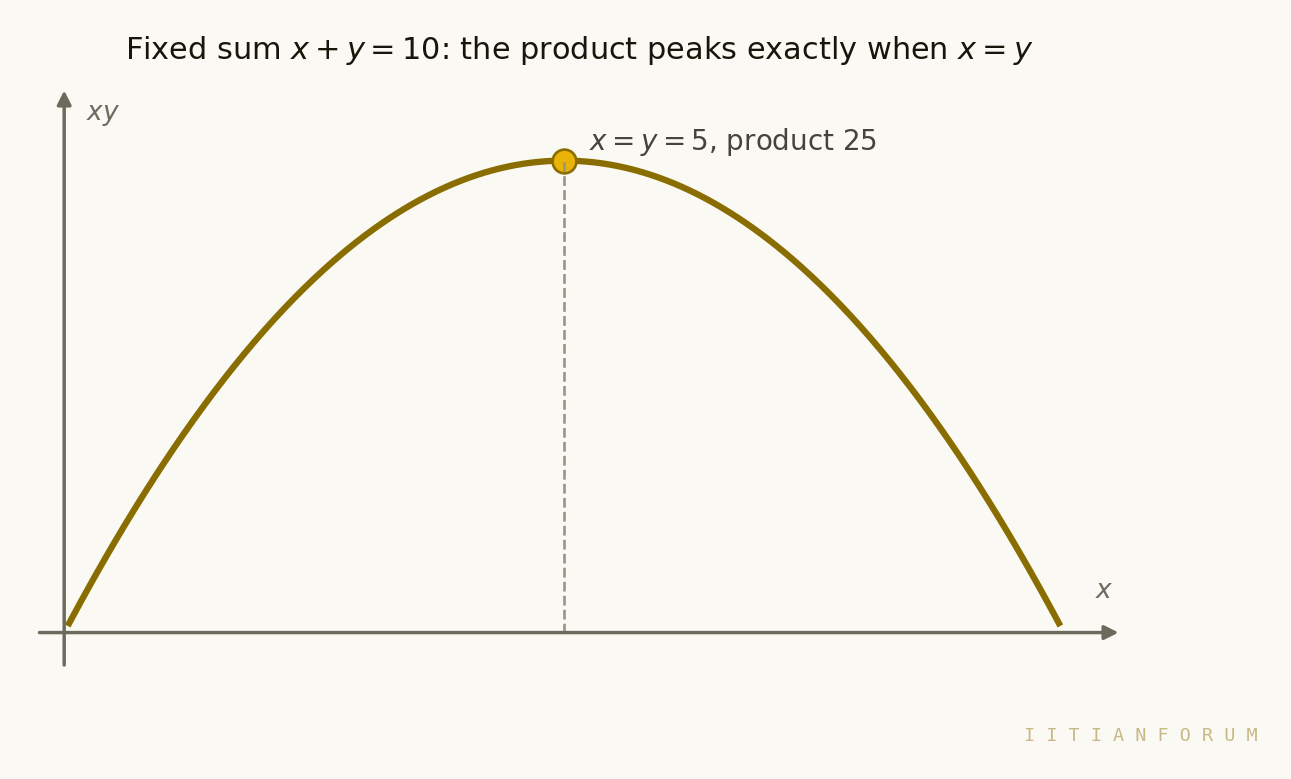
The mirror image. If the sum is fixed, the product has a maximum, reached again at equality.
Fixed sum: the product peaks when the two numbers are equal
Example 7(IIT-JEE 2000). If a,b,c,d are positive reals with a+b+c+d=2 and m=(a+b)(c+d), find the range of m.
▸ SHOW SOLUTION
Step 1: Group into two blocks. Treat (a+b) and (c+d) as two positive numbers. Their sum is 2.
Step 2: Apply AM–GM to the two blocks.
2(a+b)+(c+d)≥(a+b)(c+d)⟹22≥m⟹m≤1.
Step 3: Get the lower bound. All four numbers are positive, so a+b>0 and c+d>0, giving m>0. It cannot reach 0.
Step 4: Combine.
0<m≤1
Step 5: Equality.m=1 needs a+b=c+d=1, which is easily arranged, so the upper bound is attained.
Type 4 — Two terms whose product is constant
Whenever an expression has the shape u+uk with u>0 and k constant, AM–GM finishes it in one line: the minimum is 2k, at u=k.
y = x + 1/x has minimum 2 at x = 1
<!-- upload fig05-min-x-plus-1-over-x.png -->
Example 8(IIT-JEE 2003). If α∈(0,2π), show that
x2+x+x2+xtan2α
is always at least 2tanα.
▸ SHOW SOLUTION
Step 1: Check both terms are positive. Wherever the expression is defined we need x2+x>0, so x2+x>0. And α∈(0,2π) makes tanα>0, so tan2α>0.
Step 2: Name the pieces. Put u=x2+x and v=x2+xtan2α. Their product is constant:
uv=tan2α.
Step 3: Apply AM–GM to u and v.
2u+v≥uv=tan2α=tanα
(the positive square root, since tanα>0 on this interval).
Step 4: Multiply out.
x2+x+x2+xtan2α≥2tanα
Step 5: Equality.u=v means x2+x=tan2α, which has a solution for every α in the given range, so the bound is sharp. ■
Example 9(IIT-JEE 2004). For positive reals a,b,c, prove that
{(1+a)(1+b)(1+c)}7>77a4b4c4.▸ SHOW SOLUTION
Step 1: Expand the product.
(1+a)(1+b)(1+c)=1+a+b+c+ab+bc+ca+abc.
Step 2: Count the terms. The right-hand side is a sum of seven positive quantities after the leading 1:
Example 12(IIT-JEE 1992). The harmonic mean and geometric mean of two positive numbers are in the ratio 4:5. Find the ratio of the numbers.
▸ SHOW SOLUTION
Step 1: Name the numbers with one unknown. Let them be ka and a with a>0, so the required ratio is k:1.
Step 2: Write both means.
G=ka⋅a=ak,H=ka+a2(ka)(a)=k+12ka.
Step 3: Impose the ratio.
GH=(k+1)ak2ka=k+12k=54.
Step 4: Solve for k.
10k=4k+4⟹2k−5k+2=0⟹k=45±3=2or21,
so k=4 or k=41.
Step 5: Read the ratio. Both give the same pair of numbers in the two possible orders.
Answer: the numbers are in the ratio 4:1
Type 6 — Proving the standard inequalities
Example 13. Prove that (a+b+c)(a1+b1+c1)≥9 for positive a,b,c.
▸ SHOW SOLUTION
Step 1: AM–GM on the three numbers.
3a+b+c≥(abc)1/3.
Step 2: AM–GM on the three reciprocals.
3a1+b1+c1≥(abc1)1/3.
Step 3: Multiply the two. Both sides of both inequalities are positive, so multiplying is legal:
3(a+b+c)⋅3(a1+b1+c1)≥(abc)1/3⋅(abc1)1/3=1.
Step 4: Clear the nines.
(a+b+c)(a1+b1+c1)≥9
Step 5: Equality. Both AM–GM steps need all three equal, so equality holds exactly when a=b=c. ■
Check. At a=b=c=1 the left side is 3×3=9. At a=1,b=2,c=3 it is 6×611=11>9.
The same argument with n numbers instead of three gives result (i) from the table: (a1+⋯+an)(a11+⋯+an1)≥n2.
Quick recall
Situation
What to reach for
Product fixed, minimise a sum
AM–GM: minimum is n(product)1/n
Sum fixed, maximise a product
AM–GM the other way: maximum at all terms equal
Expression looks like u+uk
Minimum 2k at u=k
A coefficient spoils the grouping
Split it: 2an→an+an, or use weighted AM–GM
The word harmonic appears
Take reciprocals immediately; HP becomes AP
n means inserted between a and b
Sum of AMs =n2a+b; product of GMs =(ab)n; sum of reciprocals of HMs =2abn(a+b)
Given A and G, recover the numbers
Roots of x2−2Ax+G2=0
Asked to relate A, G, H
G2=AH, and A≥G≥H with equality only when all numbers are equal
A stray +1 or a leftover positive term
The inequality becomes strict — say so
swipe for more →
Before you move on
Two habits carry almost all the marks in this chapter. First, match the grouping to the product — AM–GM bounds a sum only by the terms actually being added, so absorb every coefficient before you apply it. Second, always state where equality holds; a bound that cannot be reached is not a minimum, and examiners build options around exactly that gap.
Practise these on doMath, and read the JEE Main 2026 shift-wise analyses to see how often Sequences & Series and inequality questions actually appeared this year.