Matrices for JEE: Types, Powers, Transpose and Inverse
A matrix is a rectangular arrangement of numbers that is handled as one object. You add matrices, multiply them, take powers of them and invert them, and the rules look like ordinary algebra with two important differences: the order of multiplication matters, and a product can be zero when neither factor is zero.
This note builds the chapter in the order JEE uses it: what a matrix is, the special types, the operations, transpose and the symmetric and skew-symmetric split, powers, the equation every matrix satisfies, the inverse, and elementary row operations. Every worked example is a JEE Main 2026 or JEE Advanced 2026 question unless it says otherwise, and every answer was re-derived from scratch.
What a matrix is
A matrix with rows and columns is said to have order . The entry in row and column is written , and the whole matrix is written .
A 3 by 4 matrix with row 2 and column 3 shaded and the entry a23 marked where they cross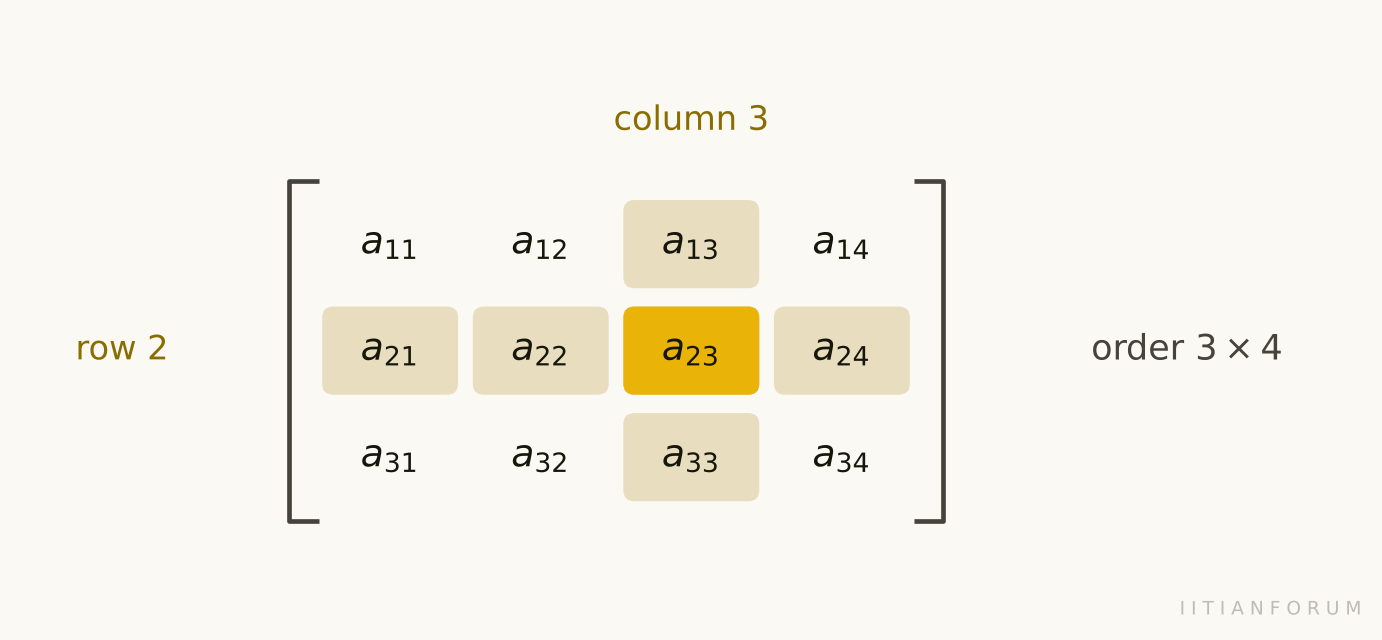
The first index is always the row and the second is always the column. A matrix of order has entries, so if each entry can be chosen from a set of numbers, the number of such matrices is
Two matrices are equal only when they have the same order and every corresponding entry is equal. So one matrix equation of order is really ordinary equations.
When a question counts matrices with a condition, write the condition entry by entry first. It almost always becomes a condition on a sum of squares, a product of two entries, or a fixed trace, and the count becomes ordinary permutations and combinations.
Types of matrices
| Type | Condition | Example of order 3 |
|---|---|---|
| Row matrix | one row, order | |
| Column matrix | one column, order | |
| Square matrix | order | |
| Zero matrix | every entry | |
| Diagonal | square, for | |
| Scalar | diagonal with equal diagonal entries | |
| Identity | scalar with | |
| Upper triangular | square, for | zeros below the diagonal |
| Lower triangular | square, for | zeros above the diagonal |
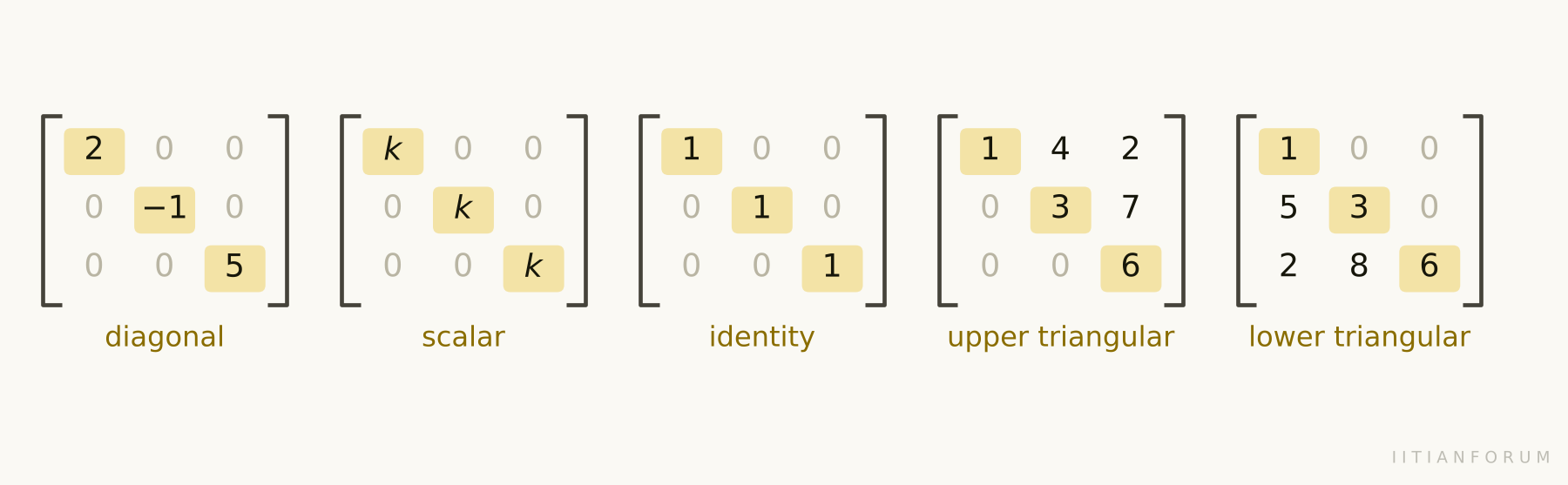
In a square matrix the entries form the principal diagonal, and their sum is the trace:
Trace is linear and does not care about the order of a product:
Addition, scalar multiple and product
Matrices of the same order are added entry by entry, and multiplies every entry by . Addition is commutative and associative, is the additive identity, and .
The product is defined only when the number of columns of equals the number of rows of . If is and is , then is and
That is, row of against column of , term by term, then add.
Row 2 of A shaded, column 1 of B shaded, and the single entry they produce in AB shaded at row 2 column 1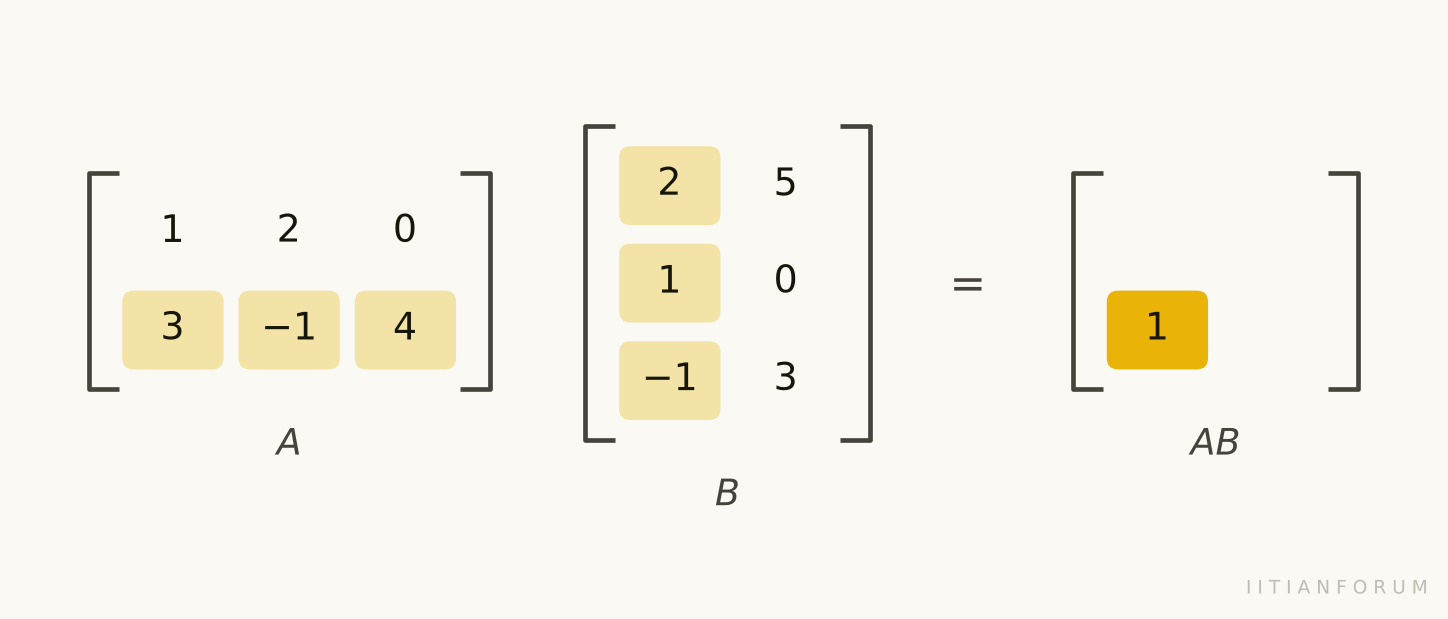
Multiplication is associative, , and distributes over addition, . Also for a square .
and are usually different, even when both exist.
does not force or . For example the matrix with rows and times the matrix with rows and is .
does not give unless is invertible.
So , and it equals only when .
The column picture
Multiplying a matrix by the standard column picks out its first column, its second, and its third:
So if a question tells you what does to , , , it has handed you column by column. Similarly is row of .
A 3 by 3 matrix M with its three columns in different shades, and arrows from Me1, Me2, Me3 to the matching columns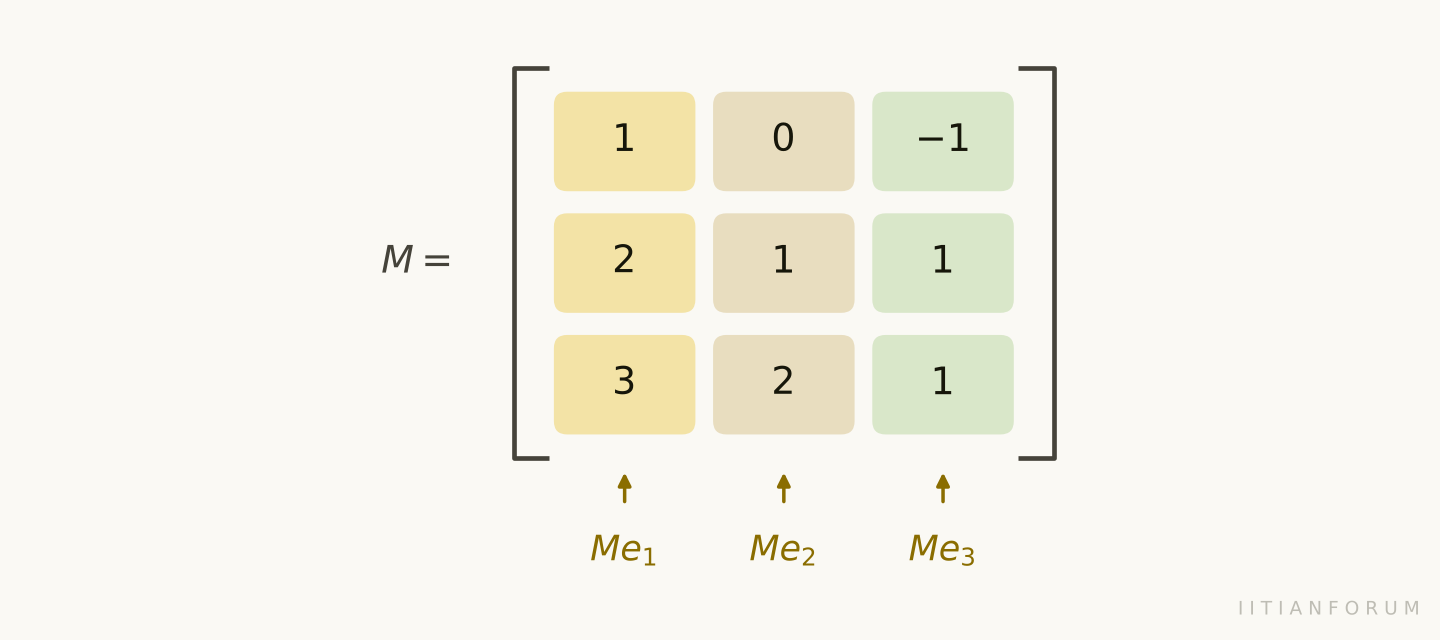
Example 1 (JEE Main 2026, 5 April Shift 2). Let be a matrix such that , and , where are the standard unit columns. If , then equals
▸ SHOW SOLUTION
Step 1. Write M column by column
Step 2. Three equations
Step 3. Solve
Third minus second:
First gives . Into the second:
So , , , .
Answer: (2)
Transpose
The transpose is obtained by turning the rows of into columns. If is , then is and .
A 2 by 3 matrix and its 3 by 2 transpose, with the first row of A and the first column of the transpose in the same shade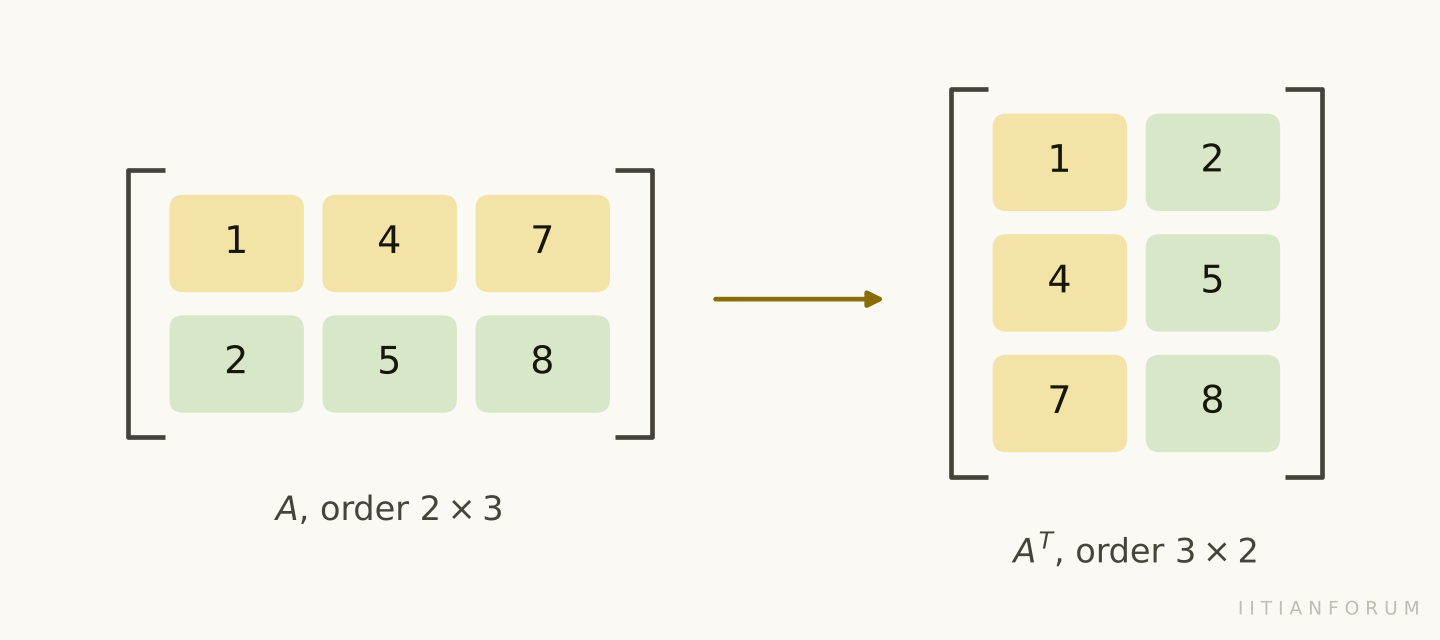
The order reverses in the last rule. For three factors, .
One identity is worth keeping ready. The entry of is column of against itself, which is the sum of the squares of that column. Adding over all :
So is the sum of the squares of every entry of , and it is only when .
Example 2 (JEE Main 2026, 24 January Shift 1). The number of matrices which can be formed using the elements of the set such that the sum of all the diagonal elements of is , is ______.
▸ SHOW SOLUTION
Step 1. Turn the condition into a sum of squares
has entries and
which is the sum of the squares of all entries.
Each square is , or .
Step 2. List the ways to make 5
Five squares equal to and one equal to , or one , one and four s.
Step 3. Count each case
Five entries and one : choose the place of in ways, signs in ways.
One entry , one entry , rest : places in ways, signs in ways.
Step 4. Add
Answer:
Symmetric and skew-symmetric matrices
A square matrix is symmetric if , that is , and skew-symmetric if , that is .
Putting in the skew condition gives , so every diagonal entry of a skew-symmetric matrix is .
A symmetric matrix with mirror-image entries across the diagonal, and a skew-symmetric matrix with zeros on the diagonal and opposite entries across it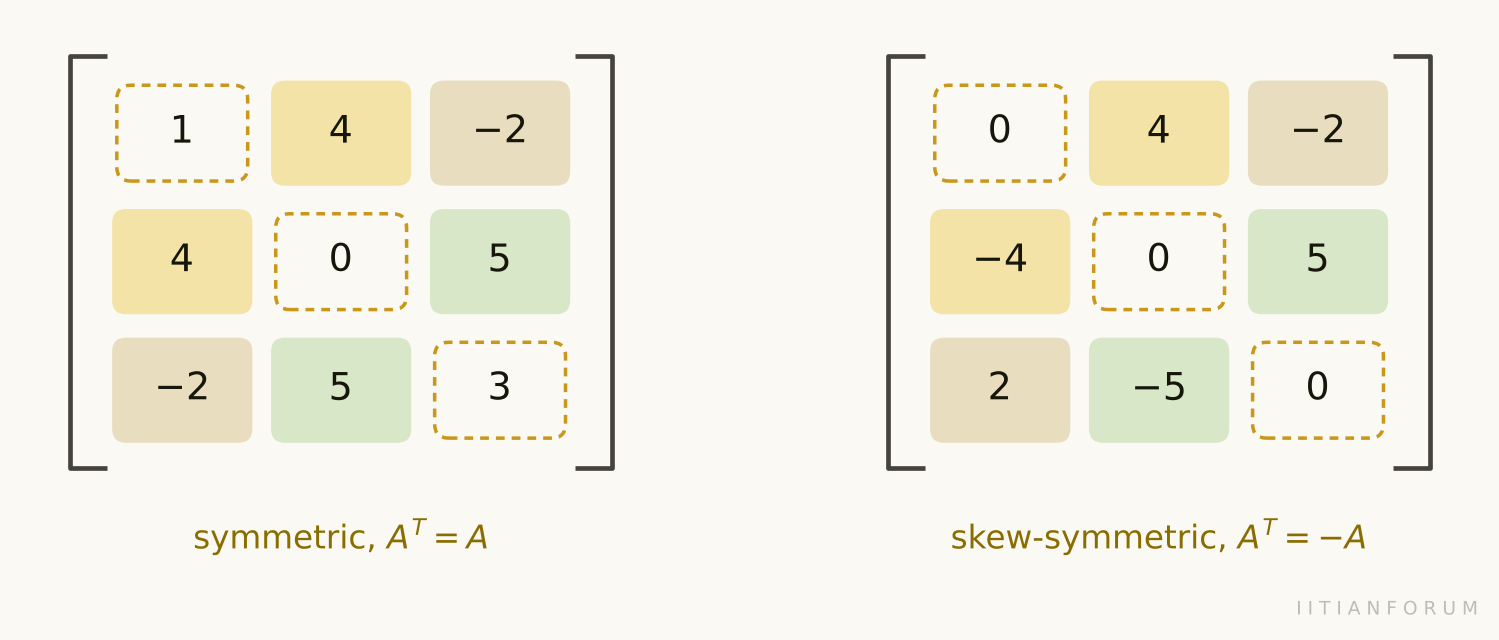
Every square matrix splits in exactly one way into a symmetric part and a skew-symmetric part:
Proof. Put and . Then and , and . If also with symmetric and skew, taking transposes gives , so and .
Facts that come up often:
- is symmetric and is skew-symmetric, for any square .
- and are symmetric for any , square or not.
- If and are symmetric, is symmetric exactly when .
- For any , is symmetric when is symmetric and skew-symmetric when is skew.
Example 3 (IITianForum). How many symmetric matrices of order have every entry from and trace ?
▸ SHOW SOLUTION
Step 1. Count the free entries
A symmetric matrix is fixed by its diagonal entries and the entries above the diagonal. The entries below are copies.
Step 2. Above the diagonal
Any values:
Step 3. The diagonal
Three entries from adding to : all three (one way), or one each of , , in some order ( ways).
Step 4. Multiply
Answer:
Example 4 (IITianForum). Let be a square matrix with , and let satisfy
Then is
▸ SHOW SOLUTION
Step 1. Collect A on one side
Step 2. Transpose
Step 3. Add (1) and (2)
So is skew-symmetric.
Step 4. Back into (1)
Step 5. Determinant
Answer: (3)
Transposing the given equation and adding is the standard first move whenever and appear together.
Orthogonal matrices
A square matrix is orthogonal if
Then is the inverse of , so as well. Read entry by entry, says each row has sum of squares and any two different rows have dot product . says the same for the columns.
Example 5 (JEE Advanced 2026, Paper 1). For real numbers , consider
with . Let , , be the vectors whose components are the first, second and third columns of . Match List-I with List-II.
| List-I | List-II |
|---|---|
| (P) | (1) |
| (Q) if , then | (2) |
| (R) | (3) |
| (S) | (4) |
| (5) |
▸ SHOW SOLUTION
Step 1. Rows of M
Row 1 has sum of squares :
Row 2 has sum of squares and is perpendicular to row 1:
Step 2. Columns of M, for (P)
too, so each column has sum of squares :
Step 3. (Q)
is times the column . So
That is the second row of read as a column, so .
Step 4. (R)
is the determinant with as rows, which is . From , .
Step 5. (S)
Different columns are perpendicular, so both dot products are and the value is .
Answer: (1) P→5, Q→4, R→2, S→1
Powers of a square matrix
, , and so on, with . Powers of the same matrix always commute, . Three named types appear constantly:
| Name | Condition | Consequence |
|---|---|---|
| Idempotent | for all | |
| Involutory | , | |
| Nilpotent of index | , | every higher power is |
The method for a high power: write A as I + N
If and commute, which they always do, the binomial theorem works for exactly as for numbers. When every term from on vanishes:
When but :
So for a high power, subtract and square what is left. If it dies quickly, the power is a short polynomial in .
The 2 by 2 matrix N with rows (2, minus 4) and (1, minus 2), its square shown as the zero matrix, and A to the n written as I plus n N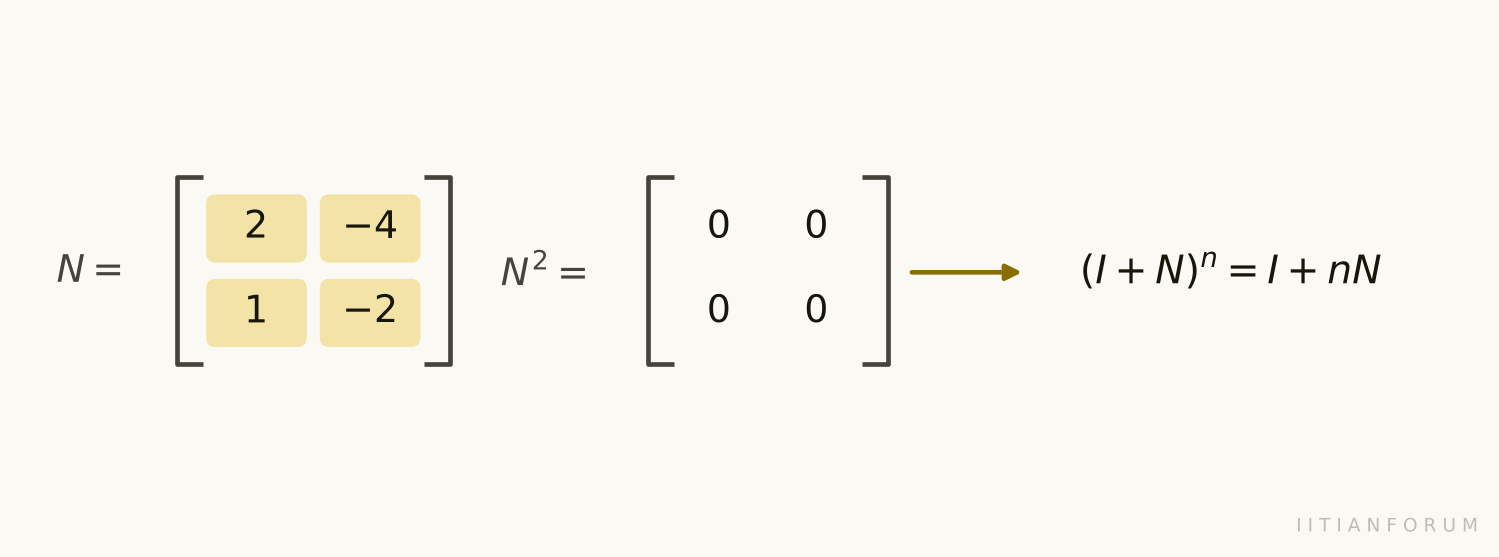
A triangular matrix with every diagonal entry is always with strictly triangular, and a strictly triangular matrix always has . That is why such matrices are the favourite source of and questions.
Example 6 (JEE Main 2026, 28 January Shift 2). Let
and be a matrix such that . Then the sum of all the elements of is ______.
▸ SHOW SOLUTION
Step 1. Subtract I
Step 2. The power
Comparing with gives .
Step 3. Power of B
, so and the sum of its elements is .
Answer:
Example 7 (JEE Main 2026, 21 January Shift 2). For
if where is the column with entries , , then which is true?
▸ SHOW SOLUTION
Step 1. Same A as Example 6
with , so
Step 2. Add B
Step 3. Solve
Both rows give , so is a multiple of . Only option (3) fits.
Answer: (3)
Example 8 (JEE Main 2026, 6 April Shift 2). Let
and . Then is
▸ SHOW SOLUTION
Step 1. Subtract I and find the powers of N
and .
Step 2. The power
Step 3. Read the three entries
Step 4. The ratio
Answer: (3)
Example 9 (JEE Advanced 2026, Paper 1). Let
and let be integers with
Which of the following is (are) TRUE?
(1) There is an invertible real matrix with , where
(2)
(3) For any integers there are unique integers with and
(4) For each the system , has a unique solution
▸ SHOW SOLUTION
Step 1. Write M as I + N
Step 2. M to the 26 and the sum
So and (2) is false.
Step 3. Option (3)
By Cramer's rule the unique solution is , , both integers. True.
Step 4. Option (4)
The coefficient determinant is never for , so the solution is unique. True.
Step 5. Option (1)
Put
and compare entries of and :
This needs and . Take , :
So is invertible. True.
Answer: (1), (3), (4)
The equation every 2×2 matrix satisfies
For
multiply out and check directly that
That is,
This one line does three jobs. It lowers any power: is a combination of and , so , , and every higher power is too. It gives the inverse when :
And it decodes a given equation. If is not a multiple of and , subtracting the identity above gives , which forces and .
If , then only says , and the trace and determinant are and , not and . Check this case separately whenever a question allows it.
Example 10 (IITianForum). A square matrix satisfies . If , then is
▸ SHOW SOLUTION
Step 1. One multiplication rule
Every power is . Multiplying by :
Step 2. Climb
| Power | ||
|---|---|---|
Answer: (3)
The coefficients are consecutive Fibonacci numbers, because each new row is (previous -coefficient, sum of the previous two).
Example 11 (JEE Main 2026, 4 April Shift 1). Let be the set of all matrices
with and . The number of matrices in whose diagonal sum is is
▸ SHOW SOLUTION
Step 1. Use the 2×2 identity with trace 4
Subtract the given equation:
Conversely, trace and determinant give the equation back. So count with .
Step 2. Go through the diagonal
| needed | pairs | ||
|---|---|---|---|
| , | |||
| , | each | ||
For with : pairs. For : only .
Step 3. Add
Answer: (4)
Example 12 (JEE Advanced 2026, Paper 2). Let
Let . Which of the following is (are) TRUE?
(1)
(2) If , then
(3) If is an integer with , then is a multiple of
(4) If , then
▸ SHOW SOLUTION
Step 1. The product
so , , , .
Step 2. Option (1)
False.
Step 3. Option (2)
, so
using . True.
Step 4. Option (3)
Let . Trace , determinant :
Multiply by :
and , so the powers of repeat with period exactly . needs to be a multiple of , so Since is not a multiple of , false.
Six points on a circle labelled P, P squared, up to P to the sixth equal to I, with arrows showing the cycle closing after six steps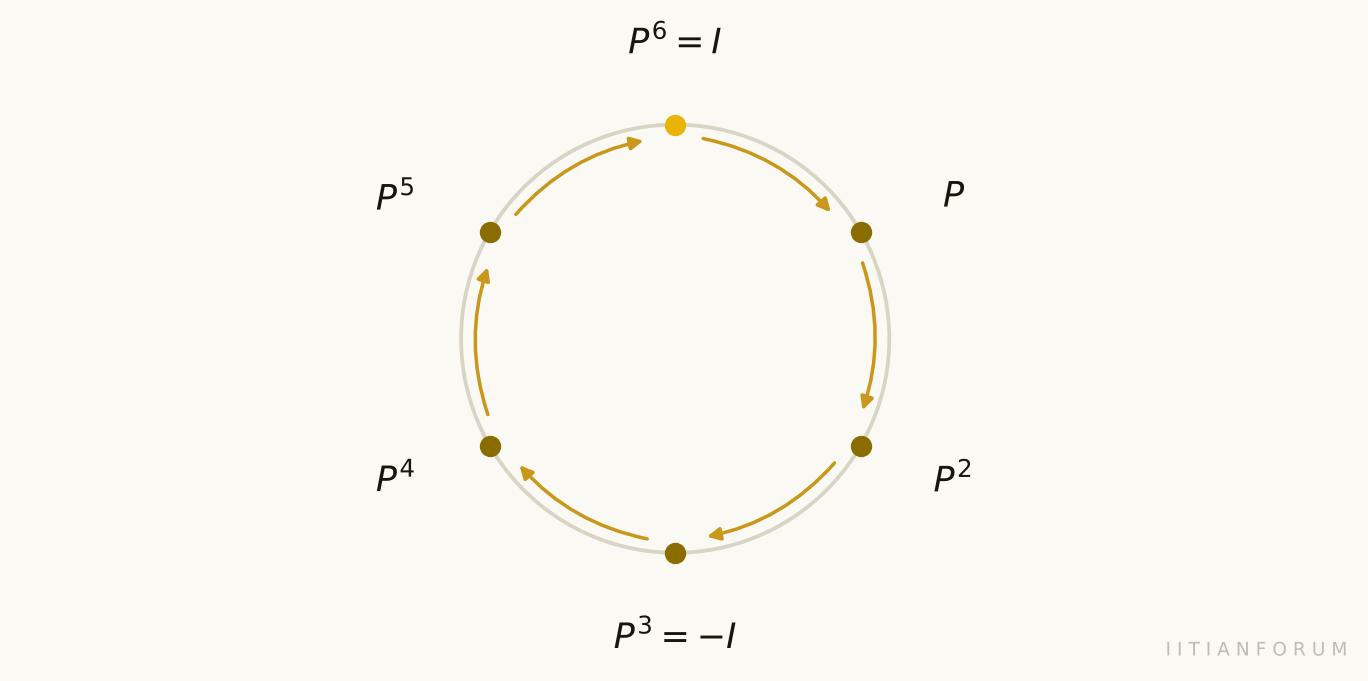
Step 5. Option (4)
With ,
Its imaginary part has the sign of , which is positive. True.
Answer: (2), (4)
Inverse of a matrix
A square matrix is invertible if there is a matrix with
Then is unique and is written . Not every square matrix has one: a matrix with determinant never does. How to compute through the adjoint belongs to the Determinants note; here are the rules that need no computation.
If for square matrices of the same order, then automatically, so one side is enough.
, , , are all polynomials in or inverses of them, and any two of them commute. That lets you move factors past each other freely in questions built from and .
Example 13 (JEE Main 2026, 28 January Shift 1). Let , , be real matrices with and . If
then is
▸ SHOW SOLUTION
Step 1. Show CB = BC
. The products and both equal . Multiply that equality by on the left and on the right:
That is .
Step 2. Solve
Adding, , so and .
Answer: (2)
Example 14 (JEE Main 2026, 23 January Shift 2). Let
and be a matrix such that . Then the sum of the diagonal elements of is ______.
▸ SHOW SOLUTION
Step 1. A is skew-symmetric
. Also and are invertible (each has determinant ), so
Step 2. Transpose B
using and .
Step 3. Multiply
Write and , so and :
and commute, so and everything cancels:
Step 4. Trace
Answer:
So is orthogonal. A skew-symmetric always gives an orthogonal , and the entries of never mattered.
Example 15 (IITianForum). Let and be invertible real matrices with
If , then is ______.
▸ SHOW SOLUTION
Step 1. Multiply out
Step 2. One matrix X
Put , so :
Multiply by :
Step 3. Multiply by X − I
Step 4. Determinants
since is real. And , so .
Answer:
The order of the matrices was never used: for any order, the condition forces .
Elementary row operations
Three operations on the rows of a matrix are called elementary:
- , swap two rows.
- with , multiply a row by a non-zero number.
- , add a multiple of another row.
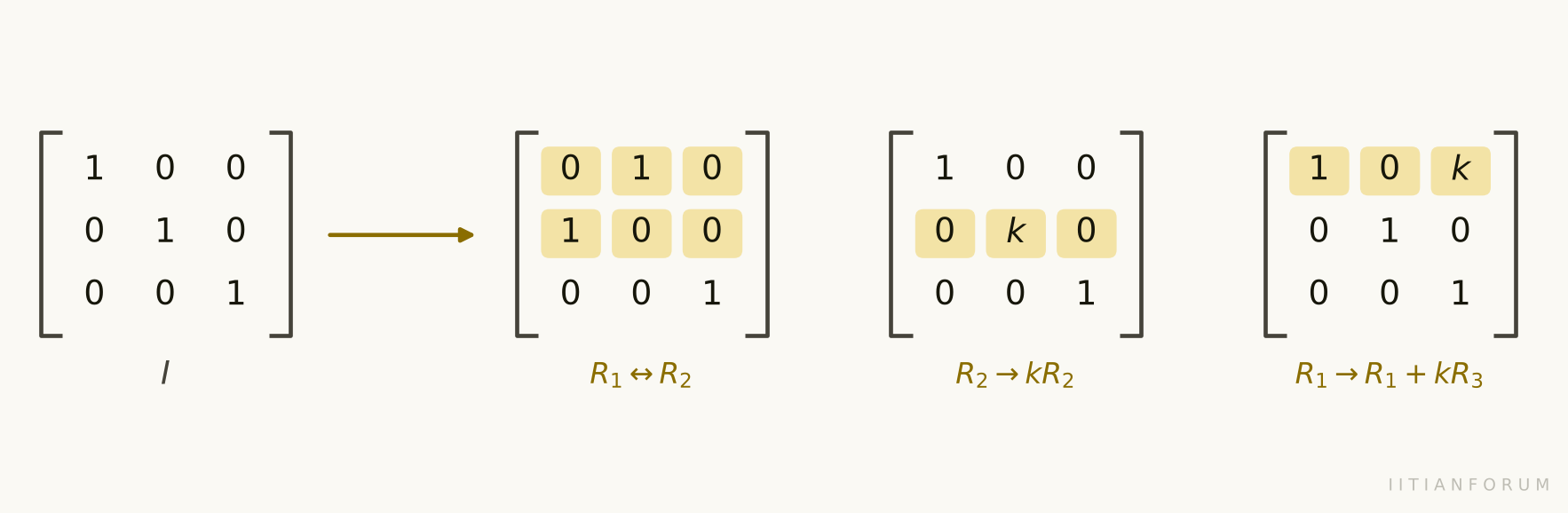
Each one can be undone by an operation of the same kind, and their effect on a determinant is fixed: a swap changes the sign, scaling by multiplies it by , and adding a multiple of another row changes nothing. Starting from , whose determinant is , the determinant can therefore never become .
Conversely, every matrix with non-zero determinant can be reduced to by row operations, and running those operations backwards builds it from . So:
The same row operations, applied to until the left half becomes , turn the right half into . That is the elementary-operations method for the inverse.
Example 16 (JEE Advanced 2026, Paper 1). Which one of the following matrices can be obtained by performing elementary row transformations on the identity matrix?
▸ SHOW SOLUTION
Step 1. Use the determinant test
Only a matrix with non-zero determinant can come from .
Step 2. Check each option
(1): all rows equal, determinant .
(3): , determinant .
(4): , determinant .
(2):
Answer: (2)
Which result to use
A decision chart: from what the question gives, arrows lead to the column picture, trace of A transpose A, writing A as I plus N, the 2 by 2 identity, commuting polynomials in A, or the determinant test| The question gives you | Reach for |
|---|---|
| acting on | the column picture, is column |
| or | sum of squares of all entries |
| for a large | subtract , square what is left |
| a triangular matrix with s on the diagonal | , with for order |
| for a matrix | trace , determinant |
| a product with period, such as | the identity, then multiply up to |
| , and inverses together | they commute, rearrange freely |
| skew-symmetric with | is orthogonal |
| rows and columns are perpendicular unit vectors | |
| row operations on | possible exactly when |
Quick recall
| Result | Statement |
|---|---|
| Number of matrices | for order with choices per entry |
| Product defined | columns of equal rows of |
| Transpose of product | |
| Trace of product | |
| sum of squares of all entries | |
| Skew-symmetric diagonal | all |
| Split | |
| Orthogonal | |
| identity | |
| Power with | |
| Power with | |
| Inverse of product | |
| Row operations on | reach exactly the matrices with |
Take any matrix, write down its trace and determinant, and use to find without multiplying five times. If you can do that in under two minutes, the powers section of JEE is under control.
Practise these methods on real exam questions in the doMath Matrices chapter, and continue with the Determinants note, which takes over from the inverse and builds the adjoint, Cramer's rule and systems of equations.