Continuity and Differentiability for JEE: Corners, Counts and Constants
Ritesh Raj · 3 Nov 2026
Aa
42 min read19 sectionsConcept
A function is continuous at a point when its graph can be drawn through that point without lifting the pen. It is differentiable at a point when, in addition, the graph has a single, non-vertical tangent there: no break, no sharp corner, no pointed tip. Both ideas rest on the left hand and right hand limits of the Limits chapter, so every test in this note is a comparison of a left side with a right side.
This note follows the order in which JEE uses the chapter: continuity at a point, the types of discontinuity, sums, products and composites, constants in piecewise functions, greatest integer and fractional part functions, continuity on an interval and the intermediate value theorem, differentiability and its geometric meaning, constants for differentiability, modulus, maximum and minimum by the graph method, the product rule for differentiability, functional equations, and functions defined by integrals. Every worked example is a JEE Main 2025 or 2026 or JEE Advanced 2026 question unless it says otherwise, and every answer was re-derived from scratch.
Continuity at a point
A function f is continuous atx=a when three things hold together:
f(a) is defined,
the limit of f(x) as x→a exists, that is, LHL = RHL and both are finite,
the limit equals the value.
In one line,
x→a−limf(x)=x→a+limf(x)=f(a)
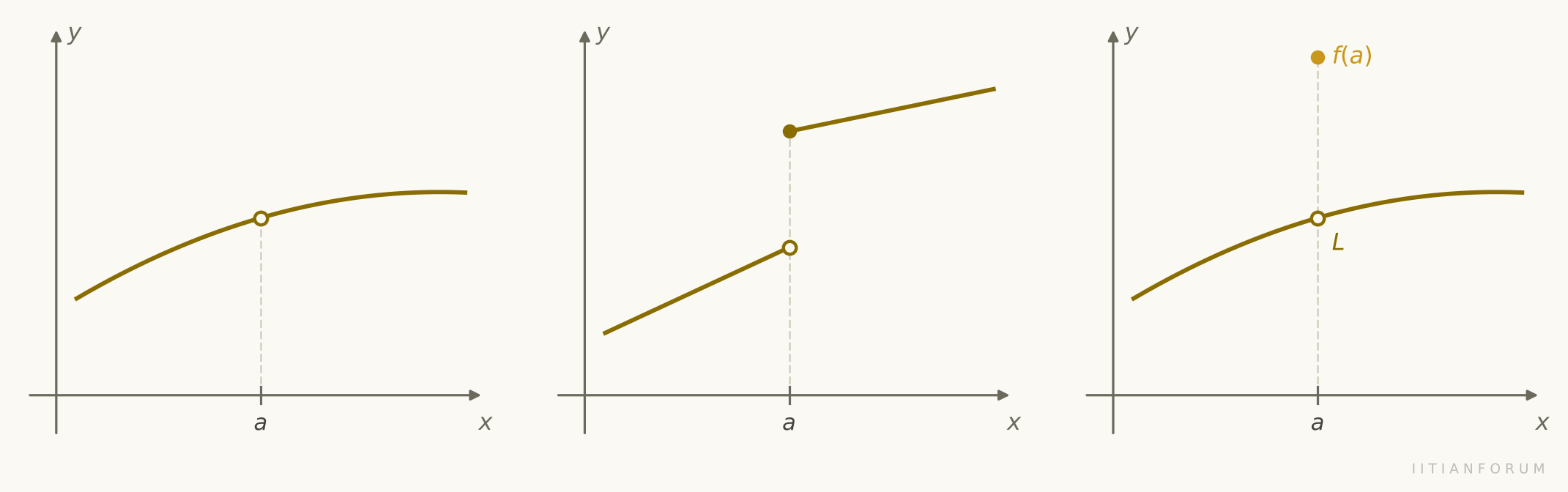
If any one of the three fails, f is discontinuous at a. The three pictures below show each failure in turn: the value is missing, the two sides do not meet, and the two sides meet at a height different from f(a).
Three graphs side by side, each with a dashed vertical guide at x equals a: the first is a smooth curve with a hollow dot at x equals a and no filled dot anywhere above it; the second has a lower line ending in a hollow dot and an upper line starting with a filled dot at x equals a; the third is a smooth curve with a hollow dot marked L and a separate filled dot higher up marked f of a
For a function given by one formula, continuity at a point inside its domain is usually automatic: polynomials, sinx, cosx, ex, ax, ∣x∣ are continuous everywhere, and lnx, x, tanx are continuous at every point of their domains. The real work is at points where the formula changes, where a denominator is zero, or where [⋅], {⋅} or sgn appear.
Order of work
Always find f(a) first, then LHL, then RHL. When the question has unknown constants, write one equation for each equality you need.
Example 1(IITianForum). Find k so that the function below is continuous at x=2.
f(x)=x−2x2−4(x=2),f(2)=k▸ SHOW SOLUTION
Step 1. Limit
For x=2, cancel the common factor:
x−2x2−4=x+2x→2limf(x)=4
Step 2. Match the value
Continuity needs f(2)=4.
Answer:k=4
Example 2(JEE Main 2026, 24 January Shift 1). If the function
The numerator tends to 0. If c=8 the denominator tends to c1/3−2=0 and RHL =0, but ea=0. So c=8, and the RHL is a 00 form.
Step 3. RHL with c = 8
Divide the top and the bottom by x and use x(a+x)n−an→nan−1:
x(4+x)1/2−2→41x(8+x)1/3−2→121RHL=1/121/4=3
Step 4. Constants
ea=3 and 1+b=3, so b=2.
eabc=3⋅2⋅8=48
Answer: (3) 48
Types of discontinuity
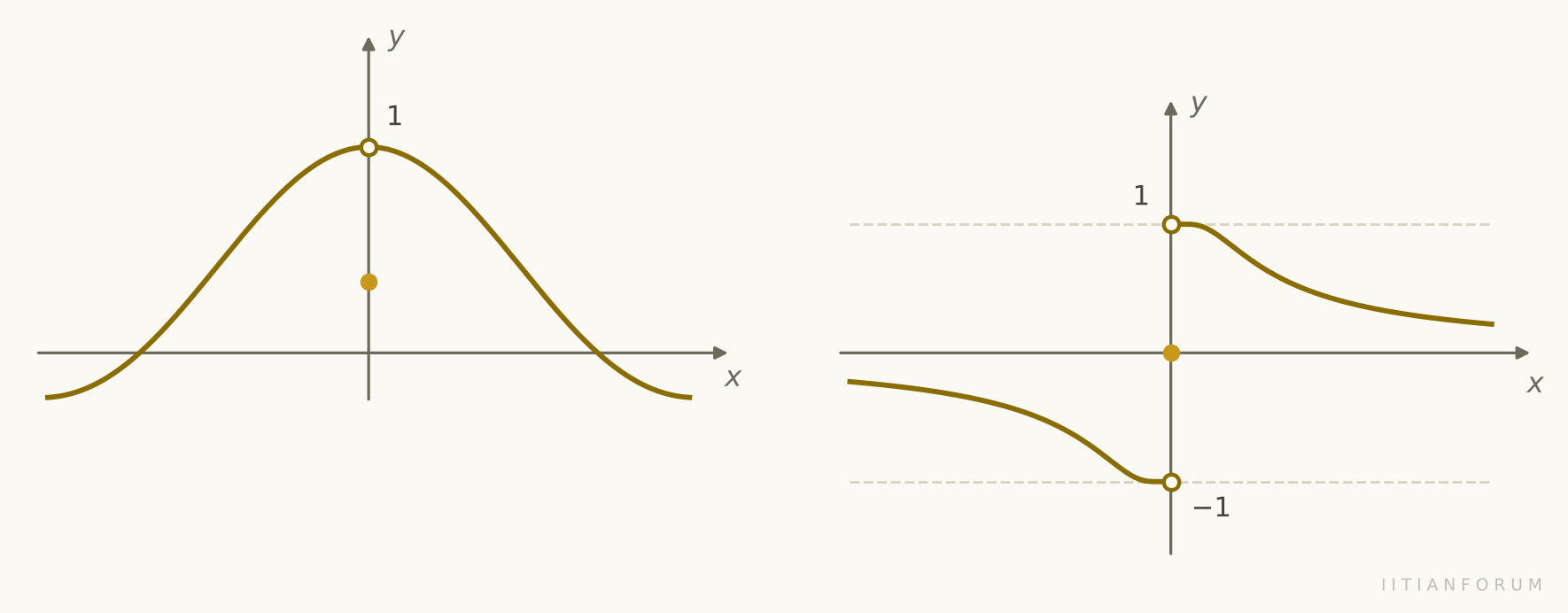
Once a function fails to be continuous at a, JEE asks what kind of failure it is.
Type
LHL and RHL
Picture
Removable
both finite and equal; f(a) missing or different
a hole, perhaps with a stray dot
Jump (finite)
both finite, unequal
a step; jump =∣RHL−LHL∣
Infinite
at least one is ±∞
the graph runs off along a vertical line
Oscillating
at least one side has no limit
the graph swings between two values
swipe for more →
A removable discontinuity can be cured by defining (or redefining) f(a) as the common limit. The other three cannot be cured by changing one value, so they are called non-removable.
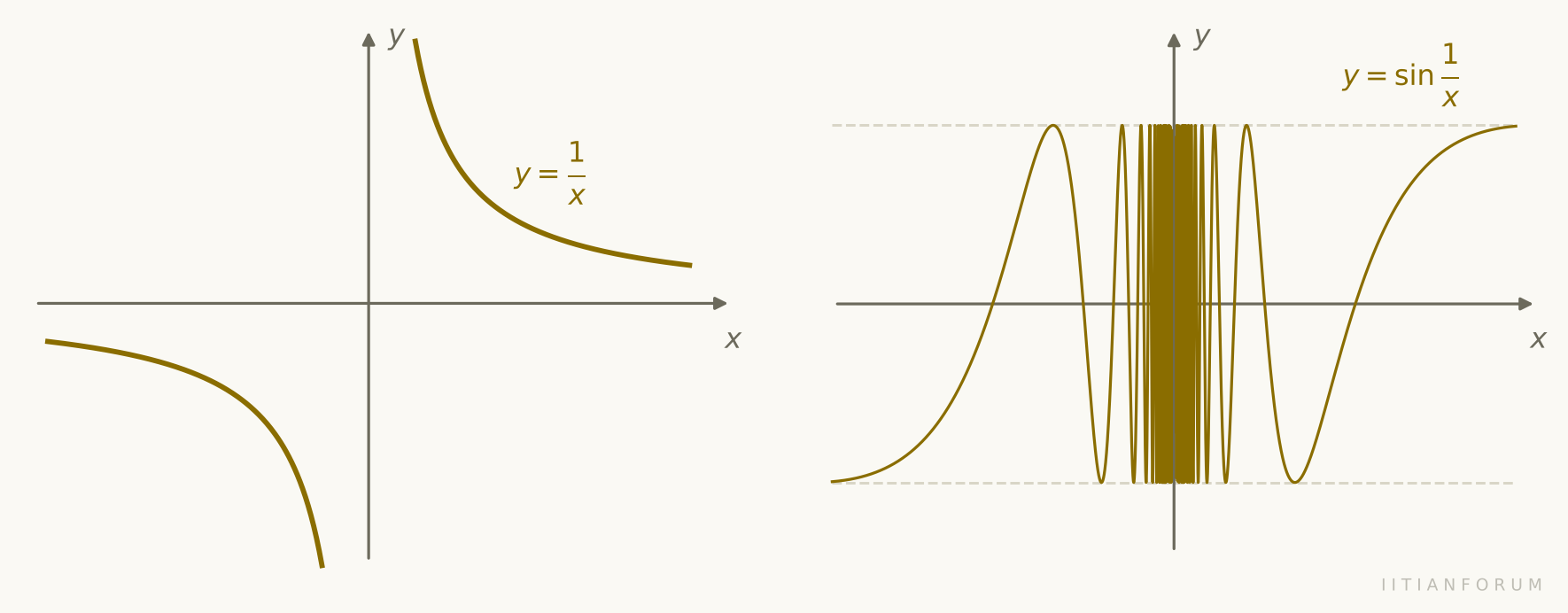
Two graphs side by side: the left is a bell shaped curve with a hollow dot at its top on the y axis at height 1 and a separate filled dot lower down on the y axis; the right has a left branch rising towards a hollow dot at minus 1 and a right branch falling from a hollow dot at 1, with a filled dot at the originTwo graphs side by side: the left is the hyperbola y equals 1 over x, with its two branches running up and down along the y axis; the right is y equals sin of 1 over x, whose waves crowd together between the dashed lines y equals 1 and y equals minus 1 as x approaches 0
Example 5(IITianForum). Classify the discontinuity at x=0 of each function, with f(0) as stated.
(i) f(x)=e1/x+1e1/x−1, f(0)=0
(ii) f(x)=e1/x, f(0)=1
(iii) f(x)=x21−cosx, f(0)=1
▸ SHOW SOLUTION
Step 1. Function (i)
As x→0+, e1/x→∞; divide by e1/x and RHL =1. As x→0−, e1/x→0 and LHL =−1. Both finite, unequal: a jump of 2.
Step 2. Function (ii)
LHL =0 and RHL =∞: an infinite discontinuity.
Step 3. Function (iii)
x→0limx21−cosx=21=f(0)
The limit exists, so this is removable. Redefining f(0)=21 makes f continuous.
Answer: (i) jump, (ii) infinite, (iii) removable
Example 6(IITianForum). The function
f(x)=2+x2(0≤x≤1)f(x)=−x(−2<x<0)
is one-one, and g is its inverse. Find the jump of g at x=2.
▸ SHOW SOLUTION
Step 1. Ranges of the two pieces
On [0,1], 2+x2 increases and takes the values [2,3]. On (−2,0), −x takes the values (0,2). The two ranges do not overlap, so g is defined on (0,3].
Step 2. Formula for g
For 0<y<2: y=−x, so g(y)=−y.
For 2≤y≤3: y=2+x2 with x≥0, so g(y)=y−2.
Step 3. One-sided limits at y = 2
y→2−limg(y)=−2y→2+limg(y)=0=g(2)
Answer: a jump of 2
Example 7(JEE Main 2026, 23 January Shift 1). Let
f(x)=4x2+4x−3ax2+2ax+3,x=−23,21
and f(x)=b at x=−23,21. If f is continuous at x=−23 and f∘f(x)=57, then x is
Tap an option to check your answer
(1)2
(2)1
(3)0
(4)1.4
▸ SHOW SOLUTION
Step 1. The numerator must vanish at x = -3/2
4x2+4x−3=(2x+3)(2x−1) is zero at −23. A finite limit there needs the numerator zero too:
49a−3a+3=0⇒a=4
Step 2. Cancel
4x2+8x+3=(2x+1)(2x+3), so for x=−23,21,
f(x)=2x−12x+1
The limit at −23 is −4−2=21, so b=21.
Step 3. Solve f(y) = 7/5
b=21=57, so y is not a special point:
2y−12y+1=57⇒y=3
Step 4. Solve f(x) = 3
2x−12x+1=3⇒x=1
Answer: (2) 1
Sums, products and composite functions
If f and g are continuous at a, then so are
f±gfgcfgf(g(a)=0)
For a composite: if f is continuous at a and g is continuous at f(a), then g∘f is continuous at a.
These results only go one way. Two discontinuous functions can combine into a continuous one: [x]+{x}=x everywhere. And a composite can be continuous even when the outer function breaks at the inner value, because the inner function may stay on one side of the break.
Common mistake
"f continuous and g discontinuous at a" decides the sum, not the product. f+g is surely discontinuous, since g=(f+g)−f would otherwise be continuous. But fg can be continuous, because f(a)=0 can cancel the break in g.
Example 8(IITianForum). Let f(x)=x and g(x)=sgnx. Check the continuity at x=0 of f+g and of fg.
▸ SHOW SOLUTION
Step 1. The sum
f+g has LHL =0−1=−1 and RHL =0+1=1. It is discontinuous at 0, as the result above says.
Step 2. The product
xsgnx=∣x∣
∣x∣ is continuous at 0.
Answer:f+g is discontinuous at 0, fg is continuous at 0
Example 9(IITianForum). Let f(x)=[x] and g(x)=x2. Check the continuity of f∘g and of g∘f at x=0.
▸ SHOW SOLUTION
Step 1. f∘g(x) = [x²]
For 0<∣x∣<1, 0<x2<1, so [x2]=0 on both sides, and [0]=0. Continuous at 0, even though [⋅] breaks at g(0)=0: the inner value x2 never goes below 0.
Then the number of points where g∘f is discontinuous is ______.
▸ SHOW SOLUTION
Step 1. Where f changes sign
For x<0, f(x)=x3+8 is negative when x<−2. For x≥0, f(x)=x2−4 is negative when 0≤x<2.
Step 2. Formula on each interval
Interval
f(x)
g(f(x))
x<−2
negative
(x3)1/3=x
−2≤x<0
≥0
x3+12
0≤x<2
negative
(x2−12)1/3
x≥2
≥0
x2=x
swipe for more →
Step 3. Check the joins
At x=−2: left −2, right 4=2. Break.
At x=0: left 12, right (−12)1/3. Break.
At x=2: left (−8)1/3=−2, right 2. Break.
Answer:3
Piecewise functions: constants for continuity
When a function changes formula at a, compute LHL from the left formula and RHL from the right formula. Each equality gives one equation in the unknowns.
Example 11(JEE Main 2026, 23 January Shift 2). If
f(x)=xa∣x∣+x2−2sin∣x∣cos∣x∣
for x=0, and f(0)=b, is continuous at x=0, then a+b is
Tap an option to check your answer
(1)1
(2)2
(3)0
(4)4
▸ SHOW SOLUTION
Step 1. Right side, |x| = x
2sinxcosx=sin2x:
RHL=x→0+limxax+x2−sin2x=a−2
Step 2. Left side, |x| = -x
2sin∣x∣cos∣x∣=sin(−2x)=−sin2x:
LHL=x→0−limx−ax+x2+sin2xLHL=−a+2
Step 3. Equate
a−2=2−a gives a=2, and then b=f(0)=0.
Answer: (2) 2
Example 12(JEE Main 2025, 23 January Shift 1). The function f with
f(x)=x2{sin(k1+1)x+sin(k2−1)x}
for x<0,
f(x)=x2ln(2+k2x2+k1x)(x>0)
and f(0)=4 is continuous at x=0. Then k12+k22 is
Tap an option to check your answer
(1)8
(2)20
(3)5
(4)10
▸ SHOW SOLUTION
Step 1. LHL
xsinmx→m:
LHL=2(k1+1+k2−1)=2(k1+k2)
Step 2. RHL
ln(2+kx)=ln2+ln(1+2kx) and tln(1+t)→1:
RHL=2(2k1−2k2)=k1−k2
Step 3. Solve
2(k1+k2)=4 and k1−k2=4 give k1=3, k2=−1.
k12+k22=9+1=10
Answer: (4) 10
Example 13(IITianForum). A function f:R→R is continuous and
Example 14(JEE Main 2026, 24 January Shift 2). Let [t] be the greatest integer ≤t. Let f(x)=b2sin(2πu) for x<0, where
u=[2π(cosx+sinx)cosx]
and let
f(x)=x3sinx−21sin2x(x>0)
with f(0)=a. If f is continuous at x=0, then a2+b2 is
Tap an option to check your answer
(1)85
(2)169
(3)43
(4)21
▸ SHOW SOLUTION
Step 1. RHL
sinx−sinxcosx=sinx(1−cosx):
x3sinx(1−cosx)→1⋅21=21
So a=21.
Step 2. The bracket for x slightly less than 0
(cosx+sinx)cosx≈1+x<1, so
2π(cosx+sinx)cosx→(2π)−≈1.57
Its greatest integer is 1, and the left formula tends to b2sin2π=b2.
Step 3. Equate
b2=21.
a2+b2=41+21=43
Answer: (3) 43
Example 15(JEE Main 2026, 8 April Shift 2). Let
f(x)=31(x≤2π)f(x)=(π−2x)2b(1−sinx)(x>2π)
If f is continuous at x=2π, then the value of
∫03b−6x2+2x−3dx
is
Tap an option to check your answer
(1)5
(2)2
(3)3
(4)4
▸ SHOW SOLUTION
Step 1. RHL
Put x=2π+h. Then 1−sinx=1−cosh and π−2x=−2h:
4h21−cosh→81
So RHL =8b.
Step 2. b
8b=31 gives b=38 and 3b−6=2.
Step 3. The integral
x2+2x−3=(x+3)(x−1) is negative on (0,1) and positive on (1,2):
∫01(3−2x−x2)dx=35∫12(x2+2x−3)dx=3735+37=4
Answer: (4) 4
Greatest integer, fractional part and sgn
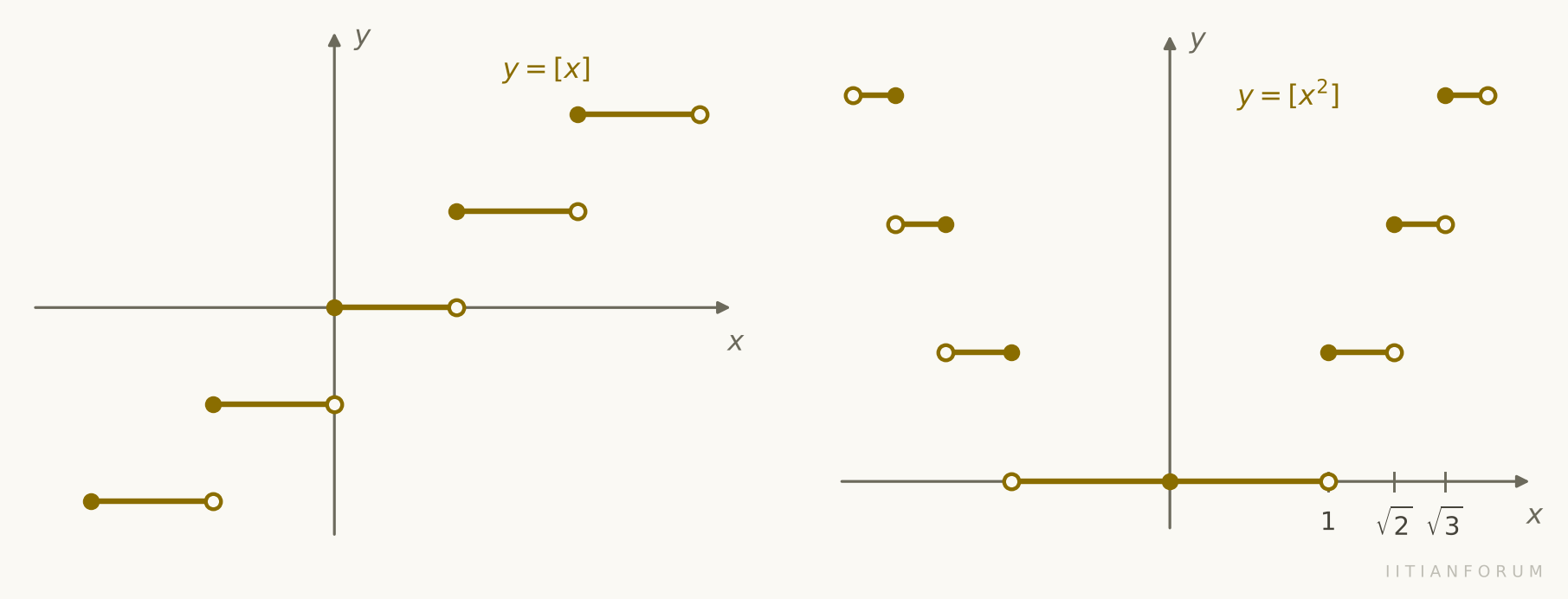
[x] and {x}=x−[x] break at every integer, and sgnx breaks at 0. At an integer n,
x→n−lim[x]=n−1,x→n+lim[x]=n=[n]Two step graphs side by side: on the left y equals the greatest integer of x, a staircase of unit steps, each step starting with a filled dot and ending with a hollow dot; on the right y equals the greatest integer of x squared on minus 2 to 2, symmetric about the y axis, with steps changing at plus or minus 1, root 2 and root 3
For [g(x)] with g continuous, use this rule.
A break is possible only where g(x) is an integer.
If gcrosses the integer there, [g] breaks.
If g only touches the integer from above (a local minimum equal to the integer), [g] does not break. If it touches from below (a local maximum equal to the integer), [g] breaks, since the value at the point is one more than the values beside it.
If [g(x)] is multiplied by a continuous factor that is 0 at the point, the product can still be continuous there. Check the one-sided limits.
Example 16(JEE Main 2026, 2 April Shift 2). The number of points in [2,4] at which f(x)=[x2−x−21] is discontinuous is ______.
▸ SHOW SOLUTION
Step 1. Range of the inside
g(x)=x2−x−21 increases on [2,4] (its vertex is at x=21), with
g(2)=1.5,g(4)=11.5
Step 2. Integers crossed
g crosses each of 2,3,…,11 exactly once inside (2,4). The end values 1.5 and 11.5 are not integers, so the end points are fine.
Answer:10
Example 17(JEE Main 2025, 7 April Shift 1). The number of points of discontinuity of
f(x)=[2x2]−[x],x∈[0,4]
is ______.
▸ SHOW SOLUTION
Step 1. Where each bracket changes
[2x2] changes where x2=2k:
x=2,2,6,22x=10,23,14,4
[x] changes where x is an integer: x=1 and x=4.
Step 2. The common point x = 4
Both brackets rise by 1 at x=4, so the difference does not change:
f(4−)=7−1=6f(4)=8−2=6
f is continuous at 4.
Step 3. Count
The seven points 2,2,6,22,10,23,14, and x=1. At x=0, both brackets are 0 just to the right, so f is continuous there.
Answer:8
Example 18(JEE Main 2026, 22 January Shift 2). Let f(x)=min{2x,x2} and
g(x)=∣x∣[x2]S={x∈(−2,2):g breaks at x}
Then the sum of f(x) over x∈S equals
Tap an option to check your answer
(1)2−2
(2)26−32
(3)1−2
(4)6−22
▸ SHOW SOLUTION
Step 1. Breaks of [x²]
On (−2,2), x2∈[0,4), and it crosses 1,2,3 at
x=±1,±2,±3
At x=0, x2 only touches 0 from above, so no break.
Step 2. The factor |x|
∣x∣=0 at all six points, so each break of [x2] is a break of g. S has six points.
Step 3. Values of f
x
2x
x2
f(x)
1
2
1
1
−1
−2
1
−2
2
2
2
2
−2
−2
2
−2
3
6
3
6
−3
−6
3
−6
swipe for more →
1−2+2−2+6−6=1−2
Answer: (3) 1−2
Example 19(IITianForum). Find the number of points in (−2,2) at which f(x)=[x]3−[x3] is discontinuous.
▸ SHOW SOLUTION
Step 1. At an integer n
f(n)=n3−n3=0. Just right of n: [x]=n and [x3]=n3, so the RHL is 0. Just left of n: [x]=n−1 and [x3]=n3−1, so
LHL=(n−1)3−(n3−1)=3n(1−n)
This is 0 only for n=0,1. In (−2,2) the integers are −1,0,1, so only x=−1 is a break.
Step 2. At a non-integer with x³ an integer
Here [x] does not change but [x3] jumps by 1, so f breaks. On (−2,2), x3∈(−8,8), which contains the 15 integers −7,…,7. Leave out −1,0,1, which come from integer x:
15−3=12
Step 3. Total
12+1=13
Answer:13
Example 20(JEE Advanced 2026, Paper 2). Consider f,g:(−3,3)→R,
Let A and B be the sets of points of (−3,3) where f and g are discontinuous. Then ∣A∣+2∣B∣−∣A∩B∣ is ______.
▸ SHOW SOLUTION
Step 1. The factor in f
L(x)=ln(1+sin2(π{x})) is continuous everywhere: at an integer, {x}→1− from the left and 0+ from the right, and sinπ=sin0=0. Also L(x)=0 only at integers.
Step 2. Breaks of [x³]
x3∈(−27,27) crosses the integers −26,…,26: 53 points x=n1/3.
Step 3. Which of these are breaks of f
If x=n1/3 is itself an integer, L=0 there and the product is 0 on both sides: no break. The cubes in (−27,27) are −8,−1,0,1,8, giving 5 such points. At the other 48, L=0, so f breaks.
∣A∣=48
Step 4. g
M(x)=sin2(πln(1+{x})) tends to sin2(πln2)=0 from the left of an integer n and to 0 from the right, with M(n)=0. So g breaks at n exactly when n3=0: n=±1,±2.
∣B∣=4
Step 5. Intersection
B contains only integers, where f is continuous, so A∩B is empty.
48+8−0=56
Answer:56
Continuity on an interval and the intermediate value theorem
f is continuous on an open interval (a,b) when it is continuous at every point of it. It is continuous on [a,b] when, in addition, it is right continuous at a and left continuous at b:
x→a+limf(x)=f(a),x→b−limf(x)=f(b)
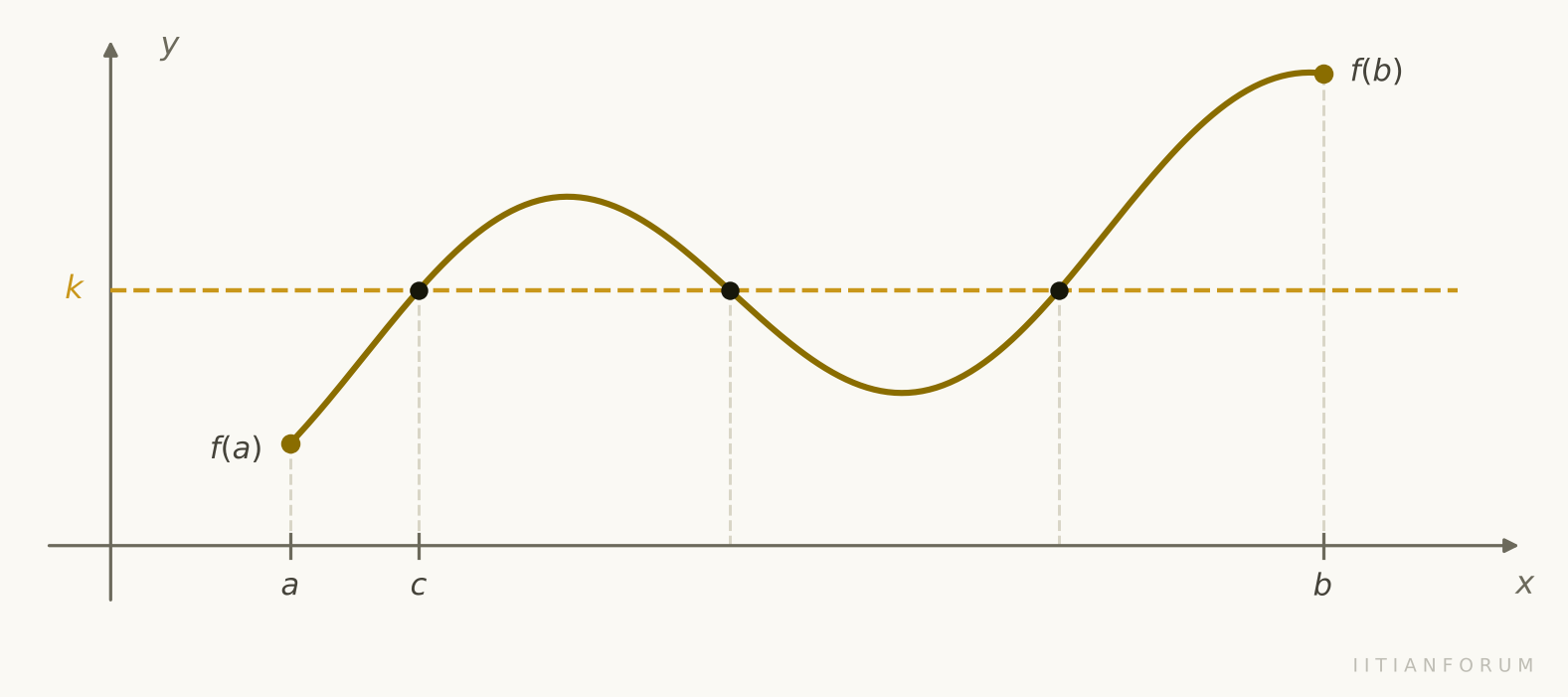
Intermediate value theorem (IVT). If f is continuous on [a,b] and k is any number between f(a) and f(b), then f(c)=k for at least one c in (a,b).
A continuous curve from a filled dot at height f of a over x equals a, rising and falling, to a filled dot at height f of b over x equals b; a dashed horizontal line at height k meets the curve at three points, the first of which is marked c on the x axis
The most used case: if f(a) and f(b) have opposite signs, f(x)=0 has a root in (a,b). The theorem promises at least one point; the picture shows that there may be more.
Continuity is essential
f(x)=x1 has f(−1)<0<f(1) but no root in (−1,1). The theorem does not apply because f is not continuous at 0.
Example 21(IITianForum). Show that x3−3x+1=0 has three real roots in (−2,2), and locate each between consecutive integers.
▸ SHOW SOLUTION
Step 1. Values at integers
Let p(x)=x3−3x+1, a polynomial, so continuous everywhere.
x
−2
−1
0
1
2
p(x)
−1
3
1
−1
3
swipe for more →
Step 2. Sign changes
The sign changes on (−2,−1), (0,1) and (1,2). By the IVT there is a root in each.
Step 3. No more roots
A cubic has at most three real roots.
Answer: one root in each of (−2,−1), (0,1), (1,2)
Example 22(IITianForum). f is continuous on [0,1] and f(0)=f(1). Prove that f(c)=f(c+21) for some c∈[0,21].
Either one end value is 0, or h(0) and h(21) have opposite signs and h has a zero between them. In both cases h(c)=0 for some c, which is the required equality.
Answer: proved
Differentiability at a point
The derivative of f at a is
f′(a)=h→0limhf(a+h)−f(a)
when this limit exists and is finite. Taking h→0− and h→0+ separately gives the left hand derivative and the right hand derivative:
f is differentiable at a exactly when LHD and RHD are finite and equal.
Geometric meaning
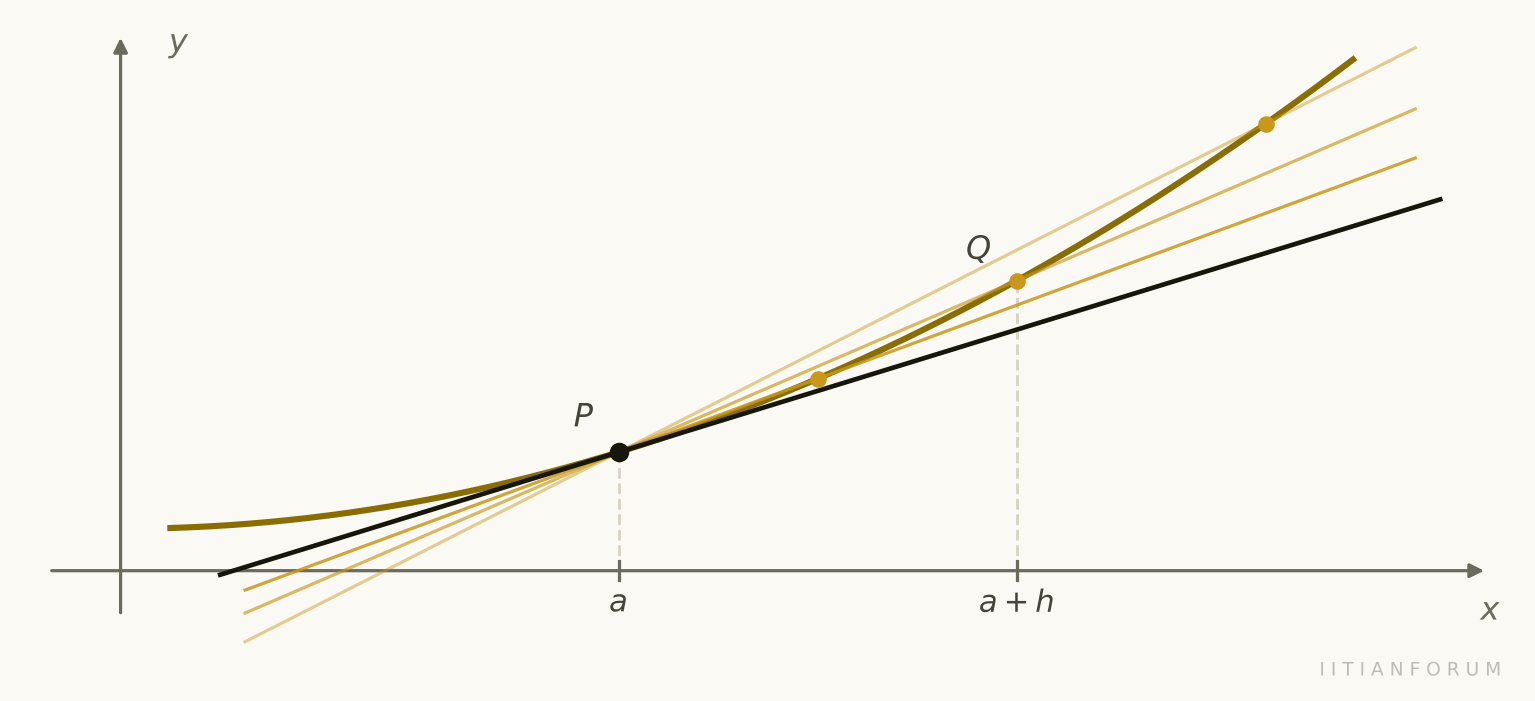
hf(a+h)−f(a) is the slope of the chord PQ. As h→0, Q slides along the curve to P, and the chord turns into the tangent at P. So f′(a) is the slope of the tangent at (a,f(a)).
A rising curve with a fixed point P over x equals a and three chords from P through points further along the curve, the chords drawn lighter as they get farther from P; one of the points is labelled Q over x equals a plus h, and a dark line through P touches the curve as the tangent
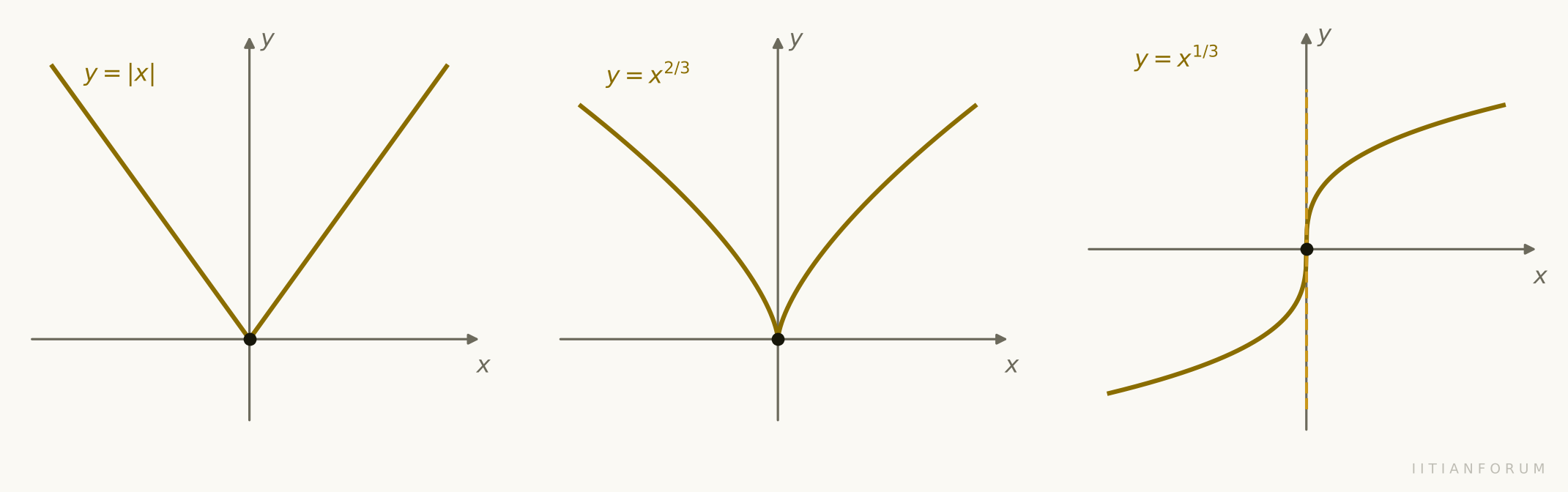
The derivative fails to exist in three typical ways.
Shape at a
LHD and RHD
Example at 0
Corner
finite, unequal
∣x∣: −1 and 1
Cusp
−∞ and +∞
x2/3
Vertical tangent
both +∞ (or both −∞)
x1/3
swipe for more →
Three graphs side by side, each through the origin: y equals mod x forming a V with a sharp corner; y equals x to the power 2 by 3 forming a pointed tip at the origin with both arms leaving vertically; y equals x to the power 1 by 3 passing through the origin with a dashed vertical tangent along the y axis
Example 23(IITianForum). Using the definition, test differentiability of (i) ∣x−3∣ at x=3, (ii) x2/3 at x=0, (iii) x1/3 at x=0.
▸ SHOW SOLUTION
Step 1. |x - 3| at 3
h∣h∣={−1,1,h<0h>0
LHD =−1, RHD =1: a corner, not differentiable.
Step 2. x^(2/3) at 0
hh2/3=h1/31
This tends to −∞ as h→0− and to +∞ as h→0+: a cusp, not differentiable.
Step 3. x^(1/3) at 0
hh1/3=h2/31→+∞
from both sides. The tangent is the vertical line x=0, but the derivative is not finite, so f is not differentiable.
Answer: none of the three is differentiable at the given point
Differentiable implies continuous
If f′(a) exists, then
f(a+h)−f(a)=hf(a+h)−f(a)⋅h→f′(a)⋅0=0
so f(a+h)→f(a) and f is continuous at a. The converse is false: ∣x∣ is continuous at 0 but not differentiable. Two consequences are used in almost every counting question:
At a point of discontinuity, f is not differentiable.
To prove continuity, it is enough to prove differentiability.
Example 24(JEE Advanced 2026, Paper 1). Let f:R→R be an arbitrary function and g(x)=xf(x). Which statements are TRUE?
(1) g is always continuous at x=0
(2) If f is continuous at x=0, then g is differentiable at x=0
(3) If g is differentiable at x=0, then f is continuous at x=0
(4) If g is differentiable at x=0, then the limit of f(x) as x→0 exists
▸ SHOW SOLUTION
Step 1. The difference quotient of g at 0
g(0)=0, so for h=0,
hg(h)−g(0)=hhf(h)=f(h)
So g′(0) exists exactly when the limit of f(h) as h→0 exists.
Step 2. Statements (2) and (4)
If f is continuous at 0, the limit of f(h) is f(0), so g′(0)=f(0) exists: (2) is true. If g′(0) exists, Step 1 says the limit of f exists: (4) is true.
Step 3. Statement (3)
Take f(x)=1 for x=0 and f(0)=5. Then g(x)=x everywhere, differentiable, but f is not continuous at 0. False.
Step 4. Statement (1)
Take f(x)=x1 for x=0 and f(0)=0. Then g=1 for x=0 and g(0)=0, not continuous. False.
Answer: (2) and (4)
Example 25(IITianForum). With f(0)=0 and g(0)=0, test continuity and differentiability at 0 of
f(x)=xsinx1g(x)=x2sinx1(x=0)▸ SHOW SOLUTION
Step 1. Continuity
sinx1≤1, so ∣f(x)∣≤∣x∣ and ∣g(x)∣≤x2. Both tend to 0, so both functions are continuous at 0.
Step 2. Derivative of f at 0
hf(h)−f(0)=sinh1
This keeps swinging between −1 and 1 and has no limit. f is not differentiable at 0.
Step 3. Derivative of g at 0
hg(h)−g(0)=hsinh1→0
g is differentiable at 0 with g′(0)=0.
Answer: both are continuous at 0; only x2sinx1 is differentiable there
Two graphs side by side: on the left y equals x sin of 1 over x, oscillating between the dashed lines y equals x and y equals minus x, the waves crowding at the origin; on the right y equals x squared sin of 1 over x, oscillating between the dashed parabolas y equals x squared and y equals minus x squared and flattening against the x axis at the origin
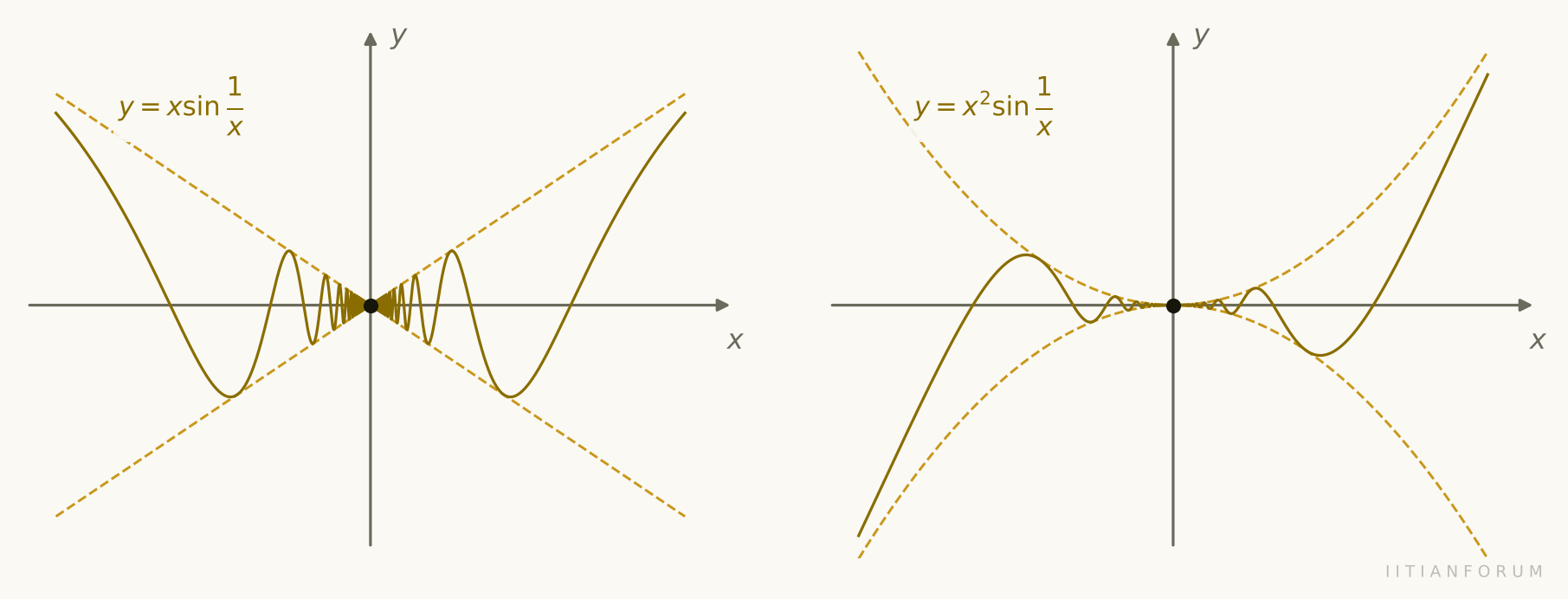
The picture explains the result. The chord from the origin to a point of xsinx1 keeps swinging between slopes 1 and −1. For x2sinx1 the curve is pressed flat between two parabolas that both touch the x axis, so the chord slope tends to 0. In general, xnsinx1 is continuous at 0 for n≥1 and differentiable at 0 for n≥2.
Example 26(JEE Main 2026, 8 April Shift 2). For f(x)=esin∣x∣−∣x∣, consider
Statement I: f is differentiable for all x∈R.
Statement II: f is increasing in (−π,−2π).
Tap an option to check your answer
(1)Both true
(2)Both false
(3)I true, II false
(4)I false, II true
▸ SHOW SOLUTION
Step 1. Only x = 0 needs checking
Away from 0, ∣x∣ is smooth and so is f.
Step 2. One-sided derivatives at 0
For x>0: f=esinx−x, f′=cosxesinx−1→1−1=0.
For x<0: f=e−sinx+x, f′=−cosxe−sinx+1→−1+1=0.
LHD = RHD =0. Statement I is true.
Step 3. Statement II
On (−π,−2π), cosx<0, so
f′(x)=1−cosxe−sinx>1>0
f is increasing. Statement II is true.
Answer: (1)
Example 27(JEE Main 2026, 24 January Shift 2). For f:(0,∞)→R, f(x)=∣lnx∣−∣x−1∣, consider
(I) f is differentiable at all x>0; (II) f is increasing in (0,1); (III) f is decreasing in (1,∞).
Tap an option to check your answer
(1)All three true
(2)Only (I)
(3)Only (II) and (III)
(4)Only (I) and (III)
▸ SHOW SOLUTION
Step 1. Both modulus signs change at x = 1
f(x)=−lnx−1+x(0<x<1)f(x)=lnx−x+1(x≥1)
Step 2. Derivatives
On (0,1): f′=1−x1<0. On (1,∞): f′=x1−1<0. At x=1 both formulas give slope 0, and both give f(1)=0.
Step 3. Read off
(I) true: LHD = RHD =0. (II) false: f decreases on (0,1). (III) true.
Answer: (4)
Piecewise functions: constants for differentiability
At a point a where the formula changes, differentiability needs two equations:
continuity: left formula at a= right formula at a,
equal slopes: LHD = RHD.
When each formula is differentiable near a and f is continuous at a, the LHD is the derivative of the left formula at a and the RHD that of the right formula. Never skip equation 1: a step function has equal slopes on both sides but is not differentiable.
Example 28(JEE Main 2026, 24 January Shift 1). Let
f(x)=2α(x2−2)+2βx(x<1)f(x)=(α+3)x+(α−β)(x≥1)
be differentiable for all x. Then 34(α+β) is
Tap an option to check your answer
(1)84
(2)48
(3)36
(4)24
▸ SHOW SOLUTION
Step 1. Continuity at 1
−2α+2β=2α+3−β⇒3β=4α+3
Step 2. Slopes at 1
Left: 4αx+2β at 1. Right: α+3.
4α+2β=α+3⇒3α+2β=3
Step 3. Solve
α=173,β=172134⋅1724=48
Answer: (2) 48
Example 29(JEE Main 2025, 22 January Shift 1). The function
f(x)=−3ax2−2(x<1)f(x)=a2+bx(x≥1)
is differentiable for all x, where a>1. If the area of the region enclosed by y=f(x) and the line y=−20 is α+β3 with α,β integers, then α+β is ______.
▸ SHOW SOLUTION
Step 1. Two equations
Continuity: −3a−2=a2+b. Slopes: −6a=b.
a2−3a+2=0⇒a=2(a>1)b=−12
Step 2. The function
f(x)=−6x2−2(x<1)f(x)=4−12x(x≥1)
It meets y=−20 at x=−3 (left piece) and x=2 (right piece).
Step 3. Area
∫−31(18−6x2)dx=16+123∫12(24−12x)dx=6
Area =22+123.
Answer:22+12=34
Example 30(IITianForum). Let
f(x)=∫0x(2+∣t−1∣)dt(x>2)
and f(x)=ax2+bx for x≤2. If f is differentiable at x=2, find 4(a+b).
▸ SHOW SOLUTION
Step 1. The integral for x > 2
∫0x∣t−1∣dt=21+2(x−1)2f(x)=2x+21+2(x−1)2
Step 2. Value and slope from the right at 2
f(2+)=4+21+21=5. By the fundamental theorem, the slope is 2+∣x−1∣, which is 3 at x=2.
Step 3. Two equations
4a+2b=5,4a+b=3b=2,a=41
Answer:4(41+2)=9
Modulus, maximum and minimum: the graph method
The sharp corner rule for the modulus
Let f be differentiable. ∣f∣ equals f or −f near every point where f=0, so trouble is possible only at a zero a of f. There:
LHD of ∣f∣=−∣f′(a)∣RHD=∣f′(a)∣
If fcrosses the axis at a with f′(a)=0, ∣f∣ has a sharp corner: not differentiable.
If f′(a)=0 (the graph touches the axis, or is flat as it crosses), both one-sided derivatives are 0 and ∣f∣ is differentiable.
The dashed curve y equals f of x crosses the x axis at 0 and touches it at 2; the solid curve y equals mod f of x is its reflection above the axis, with a sharp corner at 0 and a smooth touch at 2
For f(∣x∣): the graph for x≥0 is mirrored in the y axis. If f is differentiable, f(∣x∣) can fail only at x=0, and it is differentiable there exactly when f′(0)=0.
Maximum and minimum of two functions
max{f,g} and min{f,g} follow f or g, and can switch only where f=g. At such a point:
if f′=g′ there, the graph switches from one curve to the other and gets a corner;
if the curves only touch with equal slopes, there is no corner.
Draw both curves, darken the upper (for max) or lower (for min) one, and count corners.
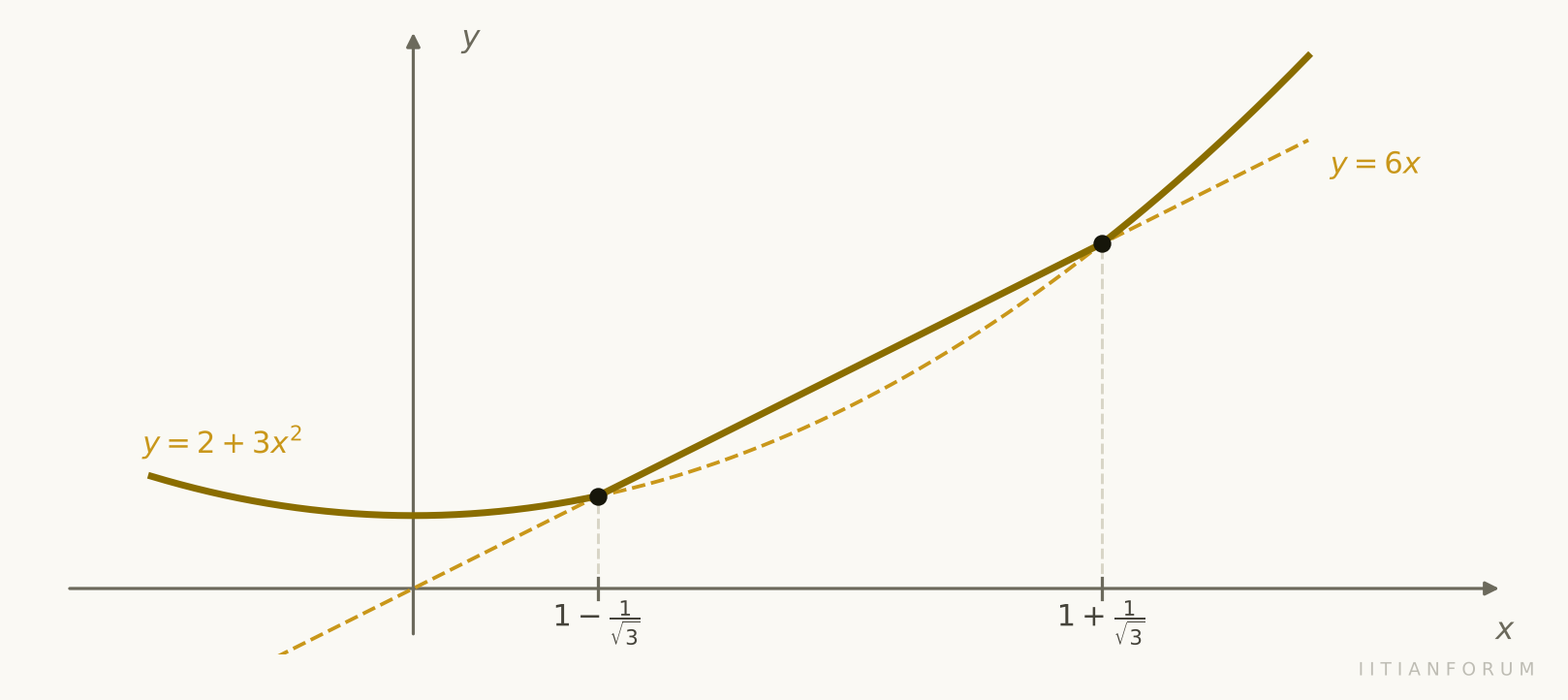
The dashed line y equals 6x and the dashed parabola y equals 2 plus 3x squared meet at x equals 1 minus 1 over root 3 and 1 plus 1 over root 3; the darker graph of their maximum follows the parabola, then the line between the two meeting points, then the parabola again, with corners at both meeting points
Counting non-differentiable points
List the candidates first: zeros of what is inside a modulus, points where two curves of a max or min meet, points where the formula changes, and every point of discontinuity. Then test only these.
Example 31(JEE Main 2026, 2 April Shift 1). The number of critical points of
f(x)=xsinx(x=0),f(0)=1
in (−2π,2π) is
Tap an option to check your answer
(1)1
(2)3
(3)5
(4)7
▸ SHOW SOLUTION
Step 1. Corners
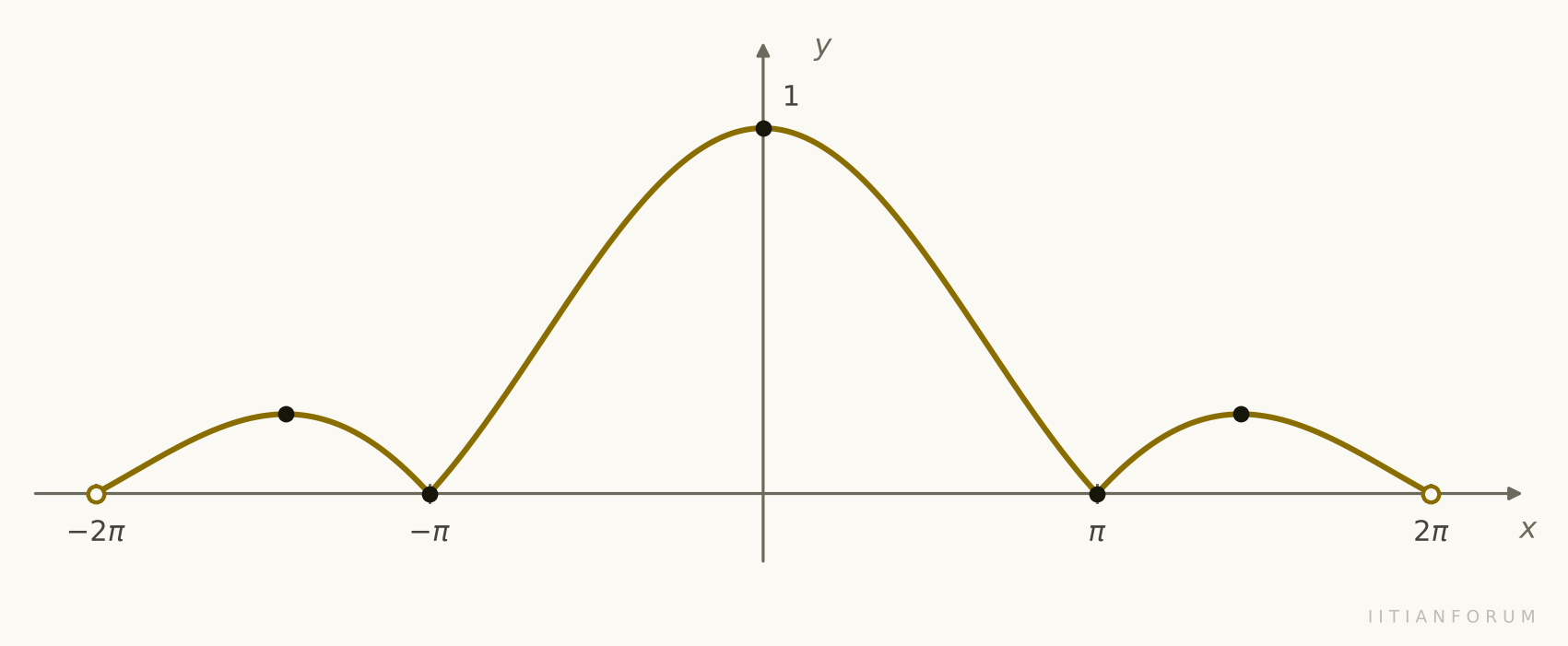
xsinx is zero at x=±π in this interval, and crosses the axis there (slope ∓π1=0). So ∣f∣ has corners at ±π: two critical points where f′ does not exist.
Step 2. f'(x) = 0
Away from ±π, f′=0 where the derivative of xsinx is zero:
x2xcosx−sinx=0⇒tanx=x(x=0)
On (0,2π), y=tanx meets y=x once, in (π,23π), at x≈4.49. By symmetry one more at x≈−4.49.
Step 3. x = 0
xsinx is even and has its maximum 1 at 0, so f′(0)=0.
Answer: (3) 5 critical points: 0, ±π, ±4.49
The curve y equals mod of sin x by x on minus 2 pi to 2 pi: a tall arch with top 1 at the origin, sharp corners touching the x axis at minus pi and pi, and two small arches whose tops lie near x equals minus 4.49 and 4.49; hollow dots at the excluded ends minus 2 pi and 2 pi
Example 32(JEE Main 2026, 4 April Shift 2). Let
f(x)=ex−1(x<0)f(x)=x2−5x+6(x≥0)
and g(x)=f(∣x∣)+∣f(x)∣. If g is not continuous at α points and not differentiable at β points, then α+β is ______.
▸ SHOW SOLUTION
Step 1. f(|x|)
∣x∣≥0, so f(∣x∣)=x2−5∣x∣+6 everywhere. Continuous, with a corner only at 0.
Step 2. |f(x)|
At 0: LHL =e−1, f(0)=6. So ∣f∣ breaks at 0. For x>0, ∣(x−2)(x−3)∣ has corners at 2 and 3, where f crosses with non-zero slope.
Step 3. Count
g breaks only at x=0: α=1. g is not differentiable at 0 (a break), 2 and 3: β=3.
Answer:4
Example 33(JEE Main 2026, 4 April Shift 1). The number of points in (−π,π) at which
f(x)=max{6x,2+3x2}+∣x−1∣cosx2−41
is not differentiable is ______.
▸ SHOW SOLUTION
Step 1. The max
2+3x2=6x when 3x2−6x+2=0:
x=1±31
Both lie in (−π,π). The slopes there are 6 and 6x=6, so both are corners (see the figure above).
Step 2. The modulus inside cos
cos∣u∣=cosu for every u, so the second term is ∣x−1∣cos(x2−41).
Step 3. The factor |x - 1|
At x=1, cos43=0, so the product has a corner. At the zeros of the cosine, ∣x−1∣ is smooth, so no new corner.
Answer:3
Example 34(JEE Main 2025, 24 January Shift 2). Let m and n be the numbers of points where f(x)=[x]+∣x−2∣, −2<x<3, is not continuous and not differentiable. Then m+n is
Tap an option to check your answer
(1)6
(2)9
(3)8
(4)7
▸ SHOW SOLUTION
Step 1. Breaks
[x] breaks at −1,0,1,2, and ∣x−2∣ is continuous. So m=4.
Step 2. Non-differentiable points
Every break: −1,0,1,2. The corner of ∣x−2∣ is at x=2, already counted. So n=4.
Answer: (3) 8
Example 35(JEE Main 2025, 28 January Shift 1). Let f(x)=3x for x<0, f(x)=5 for x>2, and for 0≤x≤2,
f(x)=min{1+x+[x],x+2[x]}
If f is not continuous at α points and not differentiable at β points, then α+β is ______.
▸ SHOW SOLUTION
Step 1. Simplify the middle piece
On [0,1), [x]=0: min{1+x,x}=x.
On [1,2), [x]=1: min{2+x,x+2}=x+2.
At x=2: min{5,6}=5.
Step 2. Joins
At 0: 3x→0 and f(0)=0, continuous, but slopes 3 and 1 differ.
At 1: LHL =1, f(1)=3. Break.
At 2: LHL =4, f(2)=5. Break.
Step 3. Count
α=2 (at 1,2). β=3 (at 0,1,2).
Answer:5
Example 36(JEE Main 2025, 4 April Shift 1). Let m and n be the numbers of points at which
f(x)=max{x,x3,x5,…,x21}
is not differentiable and not continuous, respectively. Then m+n is ______.
▸ SHOW SOLUTION
Step 1. Which power is largest
For odd powers, compare by size of ∣x∣ and sign.
Interval
largest
x≤−1
x
−1≤x≤0
x21
0≤x≤1
x
x≥1
x21
swipe for more →
Step 2. Joins
The pieces agree at −1,0,1, so f is continuous: n=0.
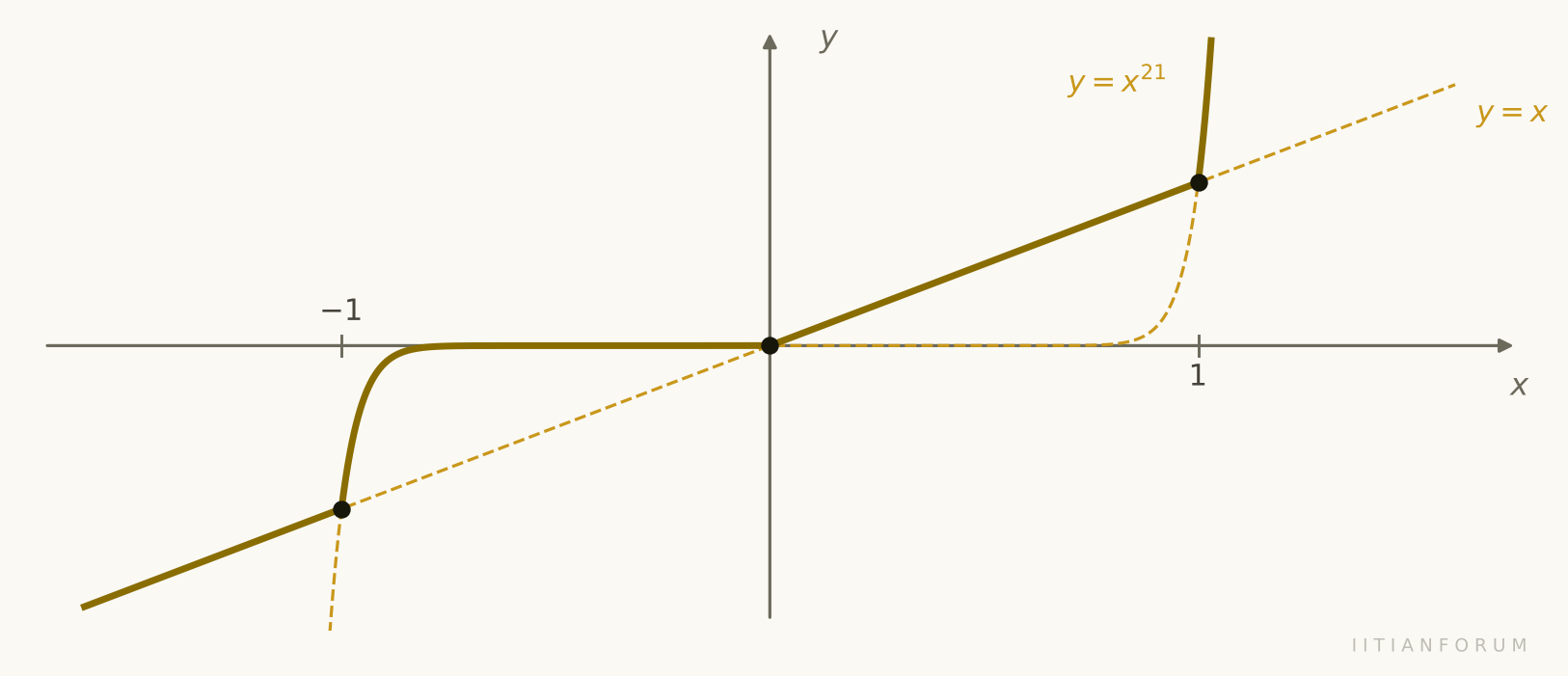
Slopes: at −1, 1 and 21; at 0, 0 and 1; at 1, 1 and 21. All three are corners: m=3.
Answer:3
The dashed line y equals x and the dashed curve y equals x to the 21 drawn together; the darker graph of their maximum follows the line for x up to minus 1, rises steeply along x to the 21 to lie almost flat on the x axis up to 0, follows the line from 0 to 1, then climbs steeply along x to the 21; corners at minus 1, 0 and 1
Example 37(IITianForum). Find the number of points at which each function is not differentiable.
h1(x)=max{∣x∣,x3}h2(x)=min{∣x∣,x3}(x≤1)h2(x)=max{∣x∣,x3}(x>1)▸ SHOW SOLUTION
Step 1. Compare |x| and x³
For x≤0: x3≤0≤∣x∣. For 0≤x≤1: x3≤x. For x≥1: x3≥x.
Step 2. h₁
h1=∣x∣ for x≤1 and x3 for x≥1. Corners at 0 (slopes −1, 1) and at 1 (slopes 1, 3).
Step 3. h₂
For x≤1 the minimum is x3; for x>1 the maximum is x3. So h2(x)=x3 for every x, differentiable everywhere.
Answer:h1: 2 points; h2: none
Example 38(IITianForum). Let f(x)=x2−4∣x∣. For −4≤x<0, let
g(x)=min{f(t):−4≤t≤x}
and for 0≤x≤6, let
g(x)=max{f(t):0≤t≤x}
Find (number of points of discontinuity) + (number of points of non-differentiability) of g in (−4,6).
▸ SHOW SOLUTION
Step 1. Left part
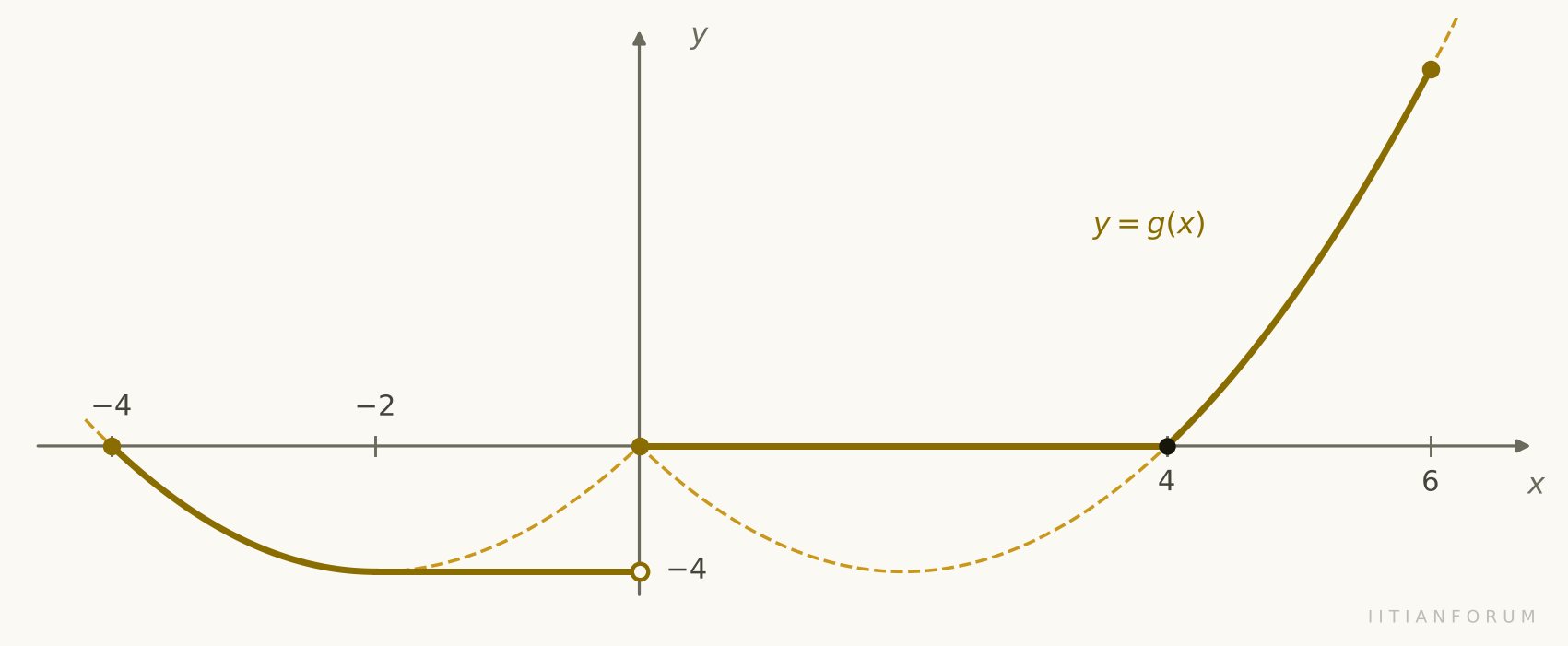
For t<0, f(t)=(t+2)2−4: it falls from 0 to −4 on [−4,−2], then rises. So
g(x)=x2+4x(−4≤x≤−2)g(x)=−4(−2≤x<0)
Step 2. Right part
For t≥0, f(t)=t2−4t≤0 on [0,4] with f(0)=0, then f grows. So
g(x)=0(0≤x≤4)g(x)=x2−4x(4≤x≤6)
Step 3. Test the joins
At −2: both pieces give −4, and slopes 2x+4=0 and 0 agree. Smooth.
At 0: LHL =−4, g(0)=0. A break, so also not differentiable.
At 4: both give 0; slopes 0 and 2x−4=4 differ. A corner.
Answer:1+2=3
The graph of g on minus 4 to 6 over the dashed curve y equals x squared minus 4 mod x: it follows the parabola down from minus 4 to its lowest point minus 4 at x equals minus 2, stays flat at minus 4 up to a hollow dot at x equals 0, restarts with a filled dot at the origin, stays on the x axis up to x equals 4, then rises along the parabola to x equals 6
Example 39(IITianForum). Let
f(x)=n→∞limx2n+1x2n−1g(x)=n→∞lim(1+∣x∣3n)1/n
Find (number of points where f is discontinuous) + (number of points where g is not differentiable).
▸ SHOW SOLUTION
Step 1. f
x2n→0 for ∣x∣<1, →∞ for ∣x∣>1, and equals 1 at ∣x∣=1. So f=−1 for ∣x∣<1, f=0 at x=±1, f=1 for ∣x∣>1. Breaks at ±1: two points.
Step 2. g
The n-th root of a sum of two n-th powers tends to the larger base:
g(x)=max{1,∣x∣3}
Step 3. Corners of g
The two pieces meet at x=±1. At x=1 the slopes are 0 and 3; at x=−1, −3 and 0. At x=0, ∣x∣3 is not in use. Two corners.
Answer:2+2=4
The product rule for differentiability
The syllabus states this result directly, and JEE uses it in almost every paper.
Result. Let f be differentiable at a with f(a)=0, and let g be continuous at a (it need not be differentiable). Then fg is differentiable at a and
(fg)′(a)=f′(a)g(a)
Why. Since f(a)g(a)=0,
hf(a+h)g(a+h)=hf(a+h)−f(a)⋅g(a+h)→f′(a)g(a)
So a zero factor cancels a corner: (x−1)∣x−1∣ and x∣x∣ are differentiable at the corner. If instead f(a)=0 and g has a corner at a, then fg has a corner too.
For twice differentiable, one zero is not enough. (x−a)∣x−a∣ has derivative 2∣x−a∣, which itself has a corner. You need f(a)=f′(a)=0, as in (x−a)2∣x−a∣.
Common mistake
Do not count every zero of the expression inside a modulus. First check whether the factor outside the modulus is 0 at that point. If it is, the corner is gone.
Example 40(JEE Advanced 2026, Paper 1). For f:(−2π,2π)→R,
f(x)=(∣x∣+∣x−1∣)sinx+[xsinx]
let α be the number of points where f is not continuous and β the number where it is not differentiable. Then α+β is ______.
▸ SHOW SOLUTION
Step 1. The modulus part
At x=0: ∣x∣sinx has the zero factor sinx, so it is differentiable at 0.
At x=1: ∣x−1∣sinx with sin1=0. LHD =−sin1, RHD =sin1. A corner.
Step 2. The bracket
g(x)=xsinx is even, g(0)=0, and g′=sinx+xcosx>0 on (0,2π), so g rises from 0 towards 2π≈1.57.
At x=0, g touches 0 from above: no break. g crosses 1 at exactly two points ±x0, where x0sinx0=1. Two breaks.
Step 3. Count
α=2. β=2+1=3 (the two breaks and the corner at 1).
Answer:5
Example 41(IITianForum). Find all points where
f(x)=(x2−1)∣x2−3x+2∣+cos∣x∣
is not differentiable.
▸ SHOW SOLUTION
Step 1. Candidates
cos∣x∣=cosx is smooth. The modulus vanishes at the zeros of (x−1)(x−2): x=1 and x=2.
Step 2. At x = 1
The outside factor x2−1 is 0 at x=1. By the product rule the corner is cancelled: differentiable.
Step 3. At x = 2
The outside factor is 3=0 and x2−3x+2 crosses 0 with slope 1. LHD and RHD of the product are −3 and 3, plus the same smooth part −sin2 on both sides. A corner.
Answer: only x=2
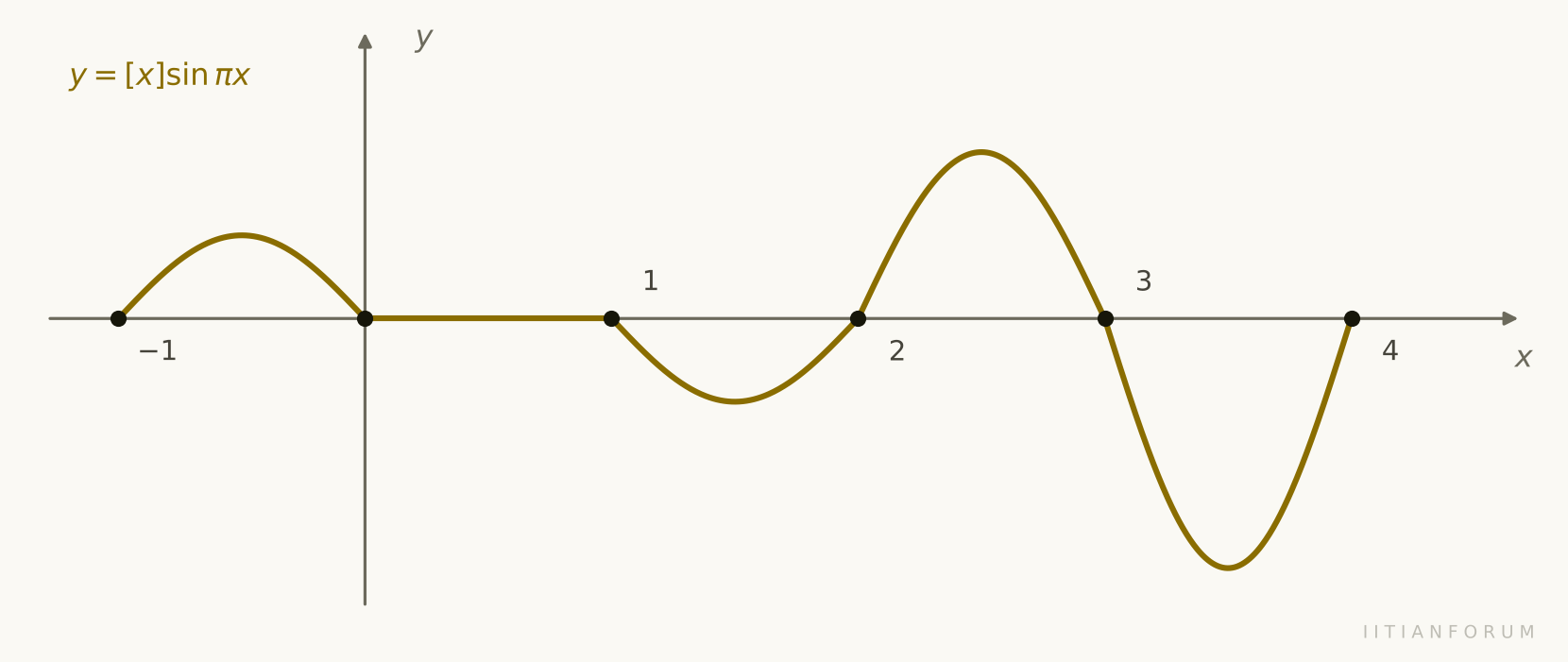
Example 42(IITianForum). Discuss continuity and differentiability of f(x)=[x]sinπx at every integer.
▸ SHOW SOLUTION
Step 1. Continuity at an integer n
Left of n: f=(n−1)sinπx→0. Right of n: f=nsinπx→0. And f(n)=0. The factor sinπx vanishes at n, so the jump of [x] is cancelled. Continuous.
Step 2. Slopes at n
dxdsinπx=πcosπx, which is π(−1)n at x=n.
LHD=(n−1)π(−1)nRHD=nπ(−1)n
They differ by π, so f is not differentiable at any integer.
Answer: continuous at every integer, differentiable at none
The graph of y equals the greatest integer of x times sin pi x from minus 1 to 4: a hump on minus 1 to 0, flat on the x axis from 0 to 1, then arches of growing height alternating below and above the axis, with every integer point a corner on the x axis
The difference between Example 41 and Example 42: in Example 41 the zero factor was differentiable and the other factor continuous, so the product rule applied. In Example 42 the other factor [x] is not even continuous, so only continuity is rescued.
Functional equations
A functional equation such as f(x+y)=f(x)+f(y) fixes f once we know it is differentiable. The method has three steps.
Put x=y=0 (or x=y=1 for products) to find f(0) (or f(1)).
Write f′(x) by the definition and use the equation to replace f(x+h).
Solve the resulting relation using the given value of f′(0) or f(1).
so f′ is the constant k=f′(0) and f(x)=kx, since f(0)=0.
Example 43(JEE Main 2026, 5 April Shift 1). Let f:R→R be differentiable with
f(3x+y)=3f(x)+f(y)
for all x,y, and f′(0)=3. Then the minimum value of g(x)=3+exf(x) is
Tap an option to check your answer
(1)3(ee+1)
(2)3(ee−1)
(3)e3−e
(4)3e
▸ SHOW SOLUTION
Step 1. f(0) and f(x/3)
x=y=0: f(0)=32f(0), so f(0)=0. Then y=0: f(3x)=3f(x).
Step 2. Additive form
So 3f(x)+f(y)=f(3x+y)=3f(x+y), that is
f(x+y)=f(x)+f(y)
With f′(0)=3, f(x)=3x.
Step 3. Minimum
g(x)=3+3xex, g′(x)=3ex(1+x)=0 at x=−1, where g′ changes from negative to positive.
g(−1)=3−e3=3(ee−1)
Answer: (2)
Example 44(JEE Main 2025, 22 January Shift 1). Let f be twice differentiable with f(x+y)=f(x)f(y) for all x,y. If f′(0)=4a and f′′(x)−3af′(x)−f(x)=0, a>0, then the area of
R={(x,y):0≤y≤f(ax),0≤x≤2}
is
Tap an option to check your answer
(1)e2−1
(2)e4+1
(3)e4−1
(4)e2+1
▸ SHOW SOLUTION
Step 1. Form of f
f′(0)=4a=0, so f≡0 and f(x)=ekx with k=f′(0)=4a.
Step 2. Find a
Substitute f=ekx:
k2−3ak−1=016a2−12a2=1⇒a=21
Step 3. Area
f(ax)=e4a⋅ax=e4a2x=ex.
∫02exdx=e2−1
Answer: (1)
Example 45(JEE Main 2025, 22 January Shift 1). Let f be differentiable with f(0)=1 and
f(x+y)=f(x)f′(y)+f′(x)f(y)
for all x,y. Then the sum of lnf(n) for n=1 to 100 is
Tap an option to check your answer
(1)2384
(2)2525
(3)5220
(4)2406
▸ SHOW SOLUTION
Step 1. f'(0)
x=y=0: 1=2f′(0), so f′(0)=21.
Step 2. Put y = 0
f(x)=21f(x)+f′(x)⇒f′(x)=21f(x)
So f(x)=ex/2, using f(0)=1.
Step 3. The sum
lnf(n)=2n:
n=1∑1002n=25050=2525
Answer: (2) 2525
Example 46(IITianForum). A differentiable function f with f(x)>0 for all x satisfies
f2(x)+f2(y)+2xy−3=f2(x+y)
for all x,y, and f(1)=2. Find f(13)+4f′(1).
▸ SHOW SOLUTION
Step 1. F = f²
Put F=f2: F(x)+F(y)+2xy−3=F(x+y). With y=0: F(0)=3.
Step 2. Remove the 2xy term
Let H(x)=F(x)−x2−3, a differentiable function. Then H(x+y)=H(x)+H(y), so H(x)=cx (first row of the table) and
F(x)=x2+cx+3
Step 3. Use f(1) = 2
F(1)=4: 1+c+3=4, so c=0 and f(x)=x2+3.
Step 4. Evaluate
f(13)=16=4. f′(x)=x2+3x, so f′(1)=21.
Answer:4+2=6
Example 47(JEE Main 2026, 24 January Shift 2). Let y=y(x) be differentiable on (0,∞), y(1)=2, and for each x>0
t→xlimx−tt2y(x)−x2y(t)=3
Then 2y(2) is
Tap an option to check your answer
(1)18
(2)23
(3)27
(4)12
▸ SHOW SOLUTION
Step 1. Add and subtract x²y(x)
t2y(x)−x2y(t)=(t2−x2)y(x)+x2(y(x)−y(t))
Step 2. Divide by x - t and let t → x
x−tt2−x2→−2xx−ty(x)−y(t)→y′(x)x2y′−2xy=3
Step 3. Solve
Divide by x4: the left side is the derivative of x2y.
x2y=−x31+C
y(1)=2 gives C=3, so y=3x2−x1.
2y(2)=2(12−21)=23
Answer: (2) 23
Functions defined by integrals
If f is continuous, then the function F below is differentiable:
F(x)=∫axf(t)dt
and
dxd∫axf(t)dt=f(x)
So an equation that contains an integral from a to x becomes an equation in f and f′ after one differentiation. Put x=a in the original equation to get the starting value, since the integral is then 0. A function defined by an integral is automatically continuous, and differentiable wherever the integrand is continuous.
Example 48(JEE Main 2026, 22 January Shift 1). f:[1,∞)→R is differentiable and
6∫1xf(t)dt=3xf(x)+x3−4
for all x≥1. Then f(2)−f(3) is
Tap an option to check your answer
(1)−4
(2)−3
(3)4
(4)3
▸ SHOW SOLUTION
Step 1. x = 1
0=3f(1)+1−4, so f(1)=1.
Step 2. Differentiate
6f=3f+3xf′+3x2⇒xf′−f=−x2
Divide by x2: the derivative of xf is −1.
Step 3. Solve
xf=−x+C; f(1)=1 gives C=2. So f(x)=2x−x2.
f(2)−f(3)=0−(−3)=3
Answer: (4) 3
Example 49(JEE Main 2026, 5 April Shift 2). f:[1,∞)→R is differentiable and
f(x)=∫1xf(t)dt+g(x)
where g(x)=(1−x)(lnx−1)+e.
Then f(f(1)) is
Tap an option to check your answer
(1)1+ee
(2)1+e
(3)1+e+ee
(4)1+2e
▸ SHOW SOLUTION
Step 1. x = 1
f(1)=0+0+e=e.
Step 2. Differentiate
f′=f−(lnx−1)+x1−xf′=f−lnx+x1
Step 3. Solve
Put f=lnx+u. Then x1+u′=lnx+u−lnx+x1, so u′=u and u=Cex.
f(1)=e gives C=1: f(x)=lnx+ex.
Step 4. Evaluate
f(f(1))=f(e)=1+ee
Answer: (1)
Example 50(JEE Main 2025, 2 April Shift 2). f:[1,∞)→[2,∞) is differentiable and
10∫1xf(t)dt=5xf(x)−x5−9
for all x≥1. Then f(3) is
Tap an option to check your answer
(1)18
(2)32
(3)22
(4)26
▸ SHOW SOLUTION
Step 1. x = 1
0=5f(1)−10, so f(1)=2.
Step 2. Differentiate
10f=5f+5xf′−5x4⇒xf′−f=x4
Divide by x2: the derivative of xf is x2.
Step 3. Solve
xf=3x3+C; f(1)=2 gives C=35.
f(x)=3x4+5xf(3)=381+15=32
Answer: (2) 32
Which method to use
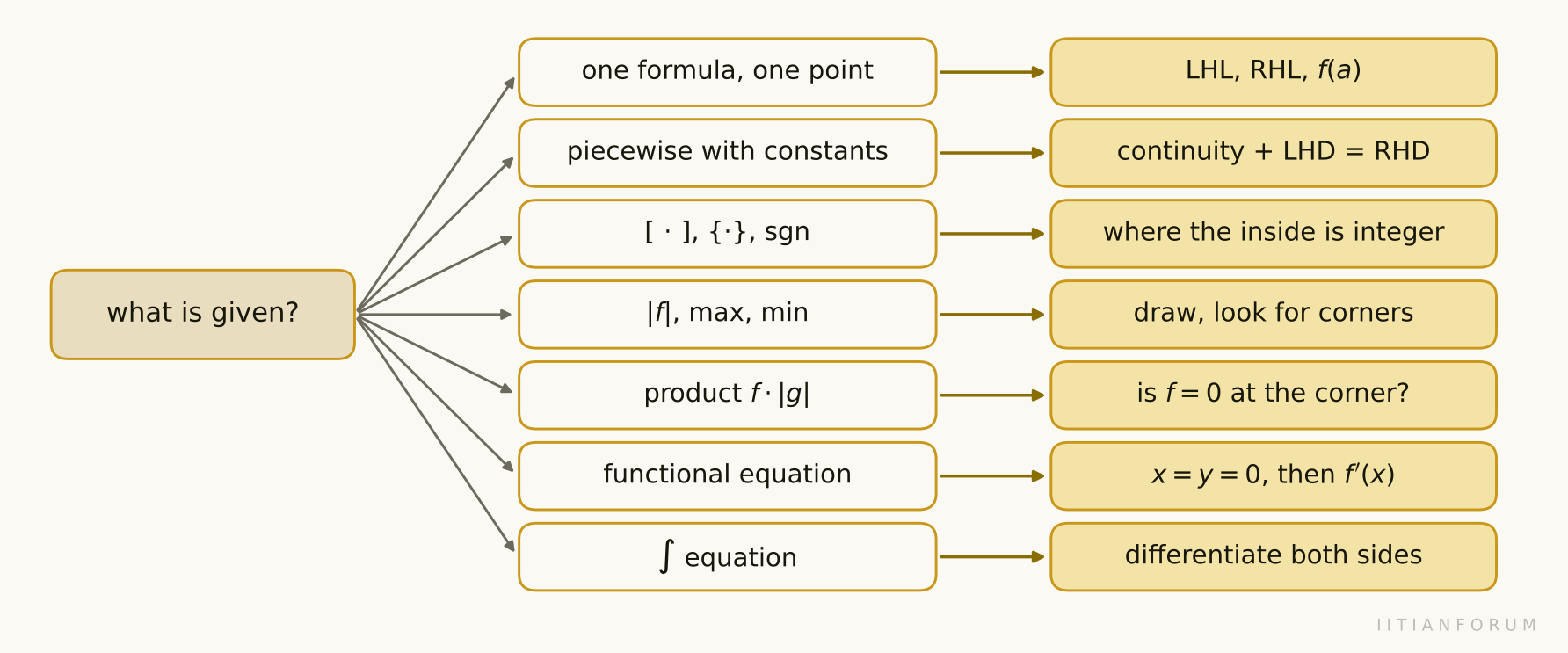
A decision chart: from what is given, arrows lead to seven situations, each paired with its method: one formula at one point, check LHL, RHL and f of a; piecewise with constants, use continuity and equal slopes; greatest integer, fractional part or sgn, look where the inside is an integer; modulus, max or min, draw and look for corners; a product with a modulus, check whether the outside factor is zero at the corner; a functional equation, put x equals y equals 0 and then find f dash; an integral equation, differentiate both sides
Given
Method
one formula, one point
LHL, RHL, f(a); standard limits or expansions
piecewise with constants
continuity equation, then LHD = RHD
[g(x)], {g(x)}, sgng(x)
points where g is an integer (or 0); crossing or touching
composite g∘f
where f changes formula and where f(x) hits a break of g
∣f∣, f(∣x∣)
zeros of f with f′=0; x=0 for f(∣x∣)
max{f,g}, min{f,g}
draw; corners where f=g with f′=g′
f(x)∣g(x)∣
is f=0 at the zero of g? then no corner
limit defined by n→∞
find f piece by piece first, then test the joins
root in an interval
sign change and IVT
functional equation
x=y=0, then f′(x) from the definition
integral from a to x in an equation
put x=a, then differentiate
swipe for more →
What JEE asks
Across the 2025 and 2026 papers the chapter appears in four forms, roughly in this order of frequency.
Counting the points where a function built from [⋅], ∣⋅∣, max or min is not continuous or not differentiable (Examples 16 to 20, 31 to 40). The answer is usually a small integer.
Finding constants from continuity or differentiability, followed by a short calculation (Examples 4, 11 to 15, 28 to 30).
Value of a continuous function at the point where its formula is 00 (Examples 2 and 3).
Functional and integral equations, where differentiability is the bridge to a solvable relation (Examples 43 to 50).
JEE Advanced adds statement-type questions that test the theory directly (Example 24) and counts with a zero factor that cancels a break (Examples 20 and 40).
Quick recall
Result
Statement
Continuity at a
LHL = RHL =f(a)
Removable
limit exists, =f(a) or f(a) missing
Jump
LHL, RHL finite and unequal
Composite
f continuous at a, g at f(a)⇒g∘f at a
[x] at integer n
LHL n−1, RHL n
[g(x)]
breaks where g crosses an integer
IVT
f continuous, f(a)f(b)<0⇒ root in (a,b)
Derivative
limit of hf(a+h)−f(a) as h→0
Differentiable
LHD = RHD, finite
Differentiable ⇒ continuous
converse false: ∣x∣
Corner, cusp, vertical tangent
not differentiable
∣f∣ at a zero
corner iff f′(a)=0
max, min
corners where curves cross with unequal slopes
Product rule
f(a)=0, g continuous ⇒fg differentiable
Twice differentiable
needs f(a)=f′(a)=0
xnsinx1 at 0
continuous for n≥1, differentiable for n≥2
f(x+y)=f(x)+f(y)
f=kx
f(x+y)=f(x)f(y)
f=ekx
Integral function
F= integral of f from a to x⇒F′=f
swipe for more →
Before you leave this chapter
Without a pen, say how many points of non-differentiability each of these has: ∣x2−1∣, (x−1)∣x2−1∣, max{x,x2}, and [x]∣sinπx∣ on (0,3). If all four answers come instantly (2, 1, 2, 2), the chapter is yours.
Practise these methods on real exam questions in the doMath Continuity and Differentiability chapter. If the left and right limits in this note felt slow, go back to the Limits note first: every test here is built on them.