Determinants for JEE: Properties, Adjoint, Inverse and Systems
Ritesh Raj · 3 Nov 2026
Aa
16 min read9 sectionsConcept
Every square matrix has a single number attached to it, its determinant. That number decides whether the matrix has an inverse, whether a system of equations has one solution, none or infinitely many, and what area three points enclose. JEE asks about it in two ways: compute it cleverly, or use its rules (product, adjoint, inverse) without computing anything at all.
This note follows straight on from the Matrices note. It builds the value of a determinant, its properties, the product rule, area and collinearity, the adjoint and its chain of rules, the inverse, and systems of linear equations. Every worked example is a JEE Main 2026 question unless it says otherwise, and every answer was re-derived from scratch.
Value of a determinant
For a 2×2 matrix,
acbd=ad−bc
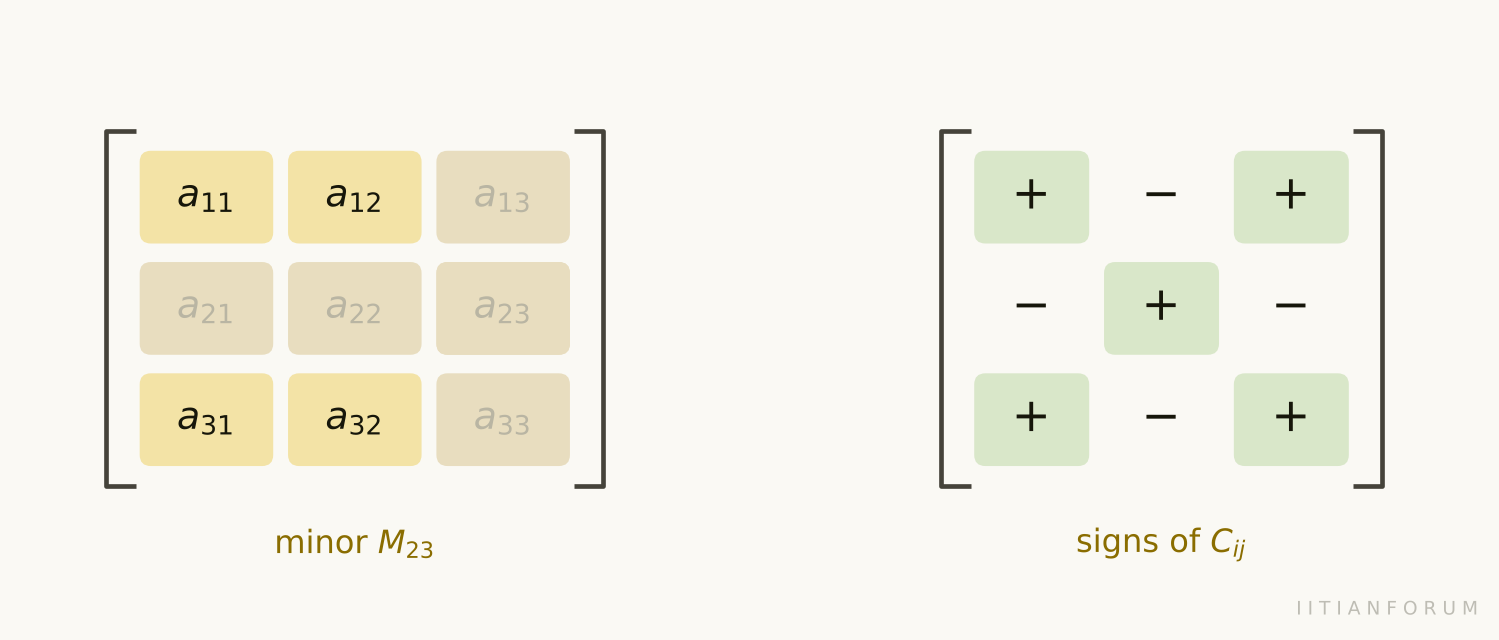
For a 3×3 matrix, the minorMij of the entry aij is the 2×2 determinant left after deleting row i and column j. The cofactor is the minor with a sign:
Cij=(−1)i+jMijLeft: a 3 by 3 matrix with row 2 and column 3 shaded and the four remaining entries boxed as the minor of a23. Right: the checkerboard of signs plus, minus, plus for the cofactors
The determinant is the sum of the entries of any one row or column, each times its own cofactor. Along row 1:
Expand along the row or column with the most zeros. One more fact is used in the adjoint section: entries of one row times the cofactors of a different row always add to 0.
a11C21+a12C22+a13C23=0
Example 1(JEE Main 2026, 4 April Shift 2). Let
A=1432−2878−7
and det(A−αI)=0 for a real number α. If the largest possible value of α is p, then the circle (x−p)2+(y−2p)2=320 meets the coordinate axes at
Tap an option to check your answer
(1)1 point
(2)2 points
(3)3 points
(4)4 points
▸ SHOW SOLUTION
Step 1. Expand the determinant
det(A−αI) is
1−α432−2−α878−7−α
Expanding along row 1 and collecting powers of α:
det(A−αI)=−α3−8α2+88α+320
Step 2. Find the roots
α=8 gives −512−512+704+320=0, so α−8 is a factor:
−(α−8)(α2+16α+40)=0α=8,α=−8±26
Both other roots are negative, so p=8.
Step 3. Meet the axes
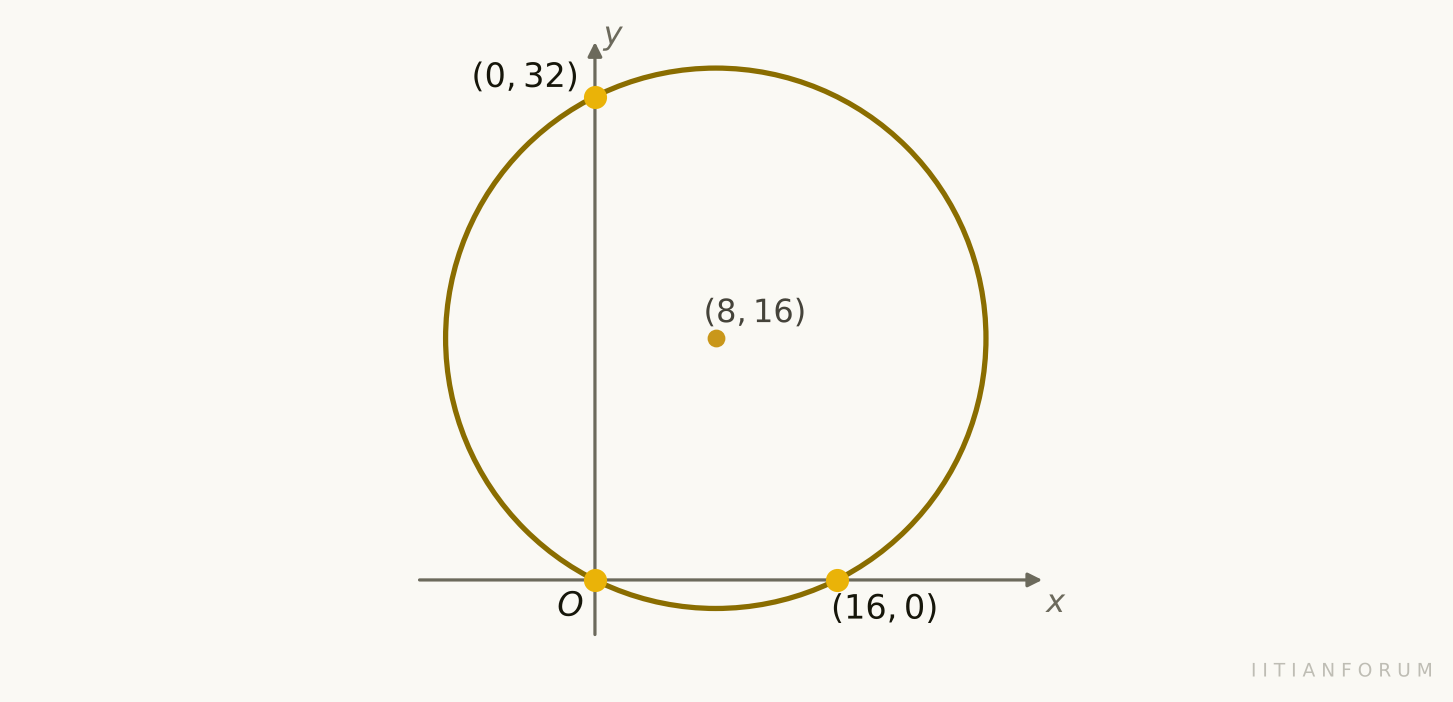
The circle is (x−8)2+(y−16)2=320.
On y=0:
(x−8)2=64⟹x=0,16
On x=0:
(y−16)2=256⟹y=0,32
The origin is counted in both lists, so the distinct points are (0,0), (16,0) and (0,32).
Circle with centre (8, 16) passing through the origin and meeting the x-axis again at (16, 0) and the y-axis again at (0, 32)
Answer: (3) 3 points
Properties of determinants
These are what make a determinant quick to evaluate. Each is stated for rows; every one holds for columns as well.
#
Property
Effect on Δ
1
Transpose
∣AT∣=∣A∣
2
Swap two rows
sign changes
3
Two rows equal or proportional
Δ=0
4
Multiply one row by k
Δ becomes kΔ
5
A row is a sum of two rows
Δ splits into two determinants
6
Ri→Ri+kRj
no change
7
A row of zeros
Δ=0
swipe for more →
Property 5 is the one that handles sums. If only one column of a determinant depends on n, then summing the determinant over n is the same as summing that column and keeping the others fixed:
Example 4(JEE Main 2026, 24 January Shift 2). Let P=[pij] and Q=[qij] be square matrices of order 3 with qij=2i+j−1pij and detQ=210. Then det(adj(adjP)) is
Tap an option to check your answer
(1)32
(2)16
(3)81
(4)124
▸ SHOW SOLUTION
Step 1. Take factors out of rows and columns
qij=2i−1⋅2j⋅pij
Row i carries 2i−1, so the rows give 20+1+2=23. Column j carries 2j, so the columns give 21+2+3=26.
detQ=29detP
Step 2. Find det P
29detP=210⟹detP=2
Step 3. Use the adjoint rule
For order 3, ∣adj(adjP)∣=∣P∣4 (see the adjoint section):
24=16
Answer: (2) 16
Example 5(IITianForum). If 0≤[x]<3, −2≤[y]<1 and 1≤[z]<4, where [⋅] is the greatest integer function, find the maximum value of
Δ=[x]+1[x][x][y][y]+1[y][z][z][z]+1▸ SHOW SOLUTION
Step 1. Short names
Write p=[x], q=[y], r=[z].
Step 2. Add all columns into the first
C1→C1+C2+C3 makes every entry of column 1 equal to 1+p+q+r. Take it out:
Δ=(1+p+q+r)111qq+1qrrr+1
Step 3. Clear column 1
R2→R2−R1 and R3→R3−R1:
100q10r01=1Δ=1+p+q+r
Step 4. Largest values
p≤2, q≤0, r≤3:
Δmax=1+2+0+3=6
Answer:6
Product rule
For square matrices of the same order,
∣AB∣=∣A∣∣B∣
and so
∣An∣=∣A∣n,∣A−1∣=∣A∣1
A matrix with ∣A∣=0 is singular; one with ∣A∣=0 is non-singular. Only non-singular matrices have inverses.
Call the columns of A1C1, C2, C3. The columns of A2 are
C1+3C2,C2+2C3,C3+5C1
Step 2. Write it as a product
Column j of a product PM is ∑k(column k of P)mkj, so
A2=A1⋅130012501
Step 3. The small determinant
1(1−0)−0+5(6−0)=31
Answer:31
Do not expand A1 or A2. Spotting that one is the other with columns mixed linearly turns the question into a 3×3 of small numbers.
Area of a triangle and collinearity
The area of the triangle with vertices (x1,y1), (x2,y2), (x3,y3) is
Area=21x1x2x3y1y2y3111
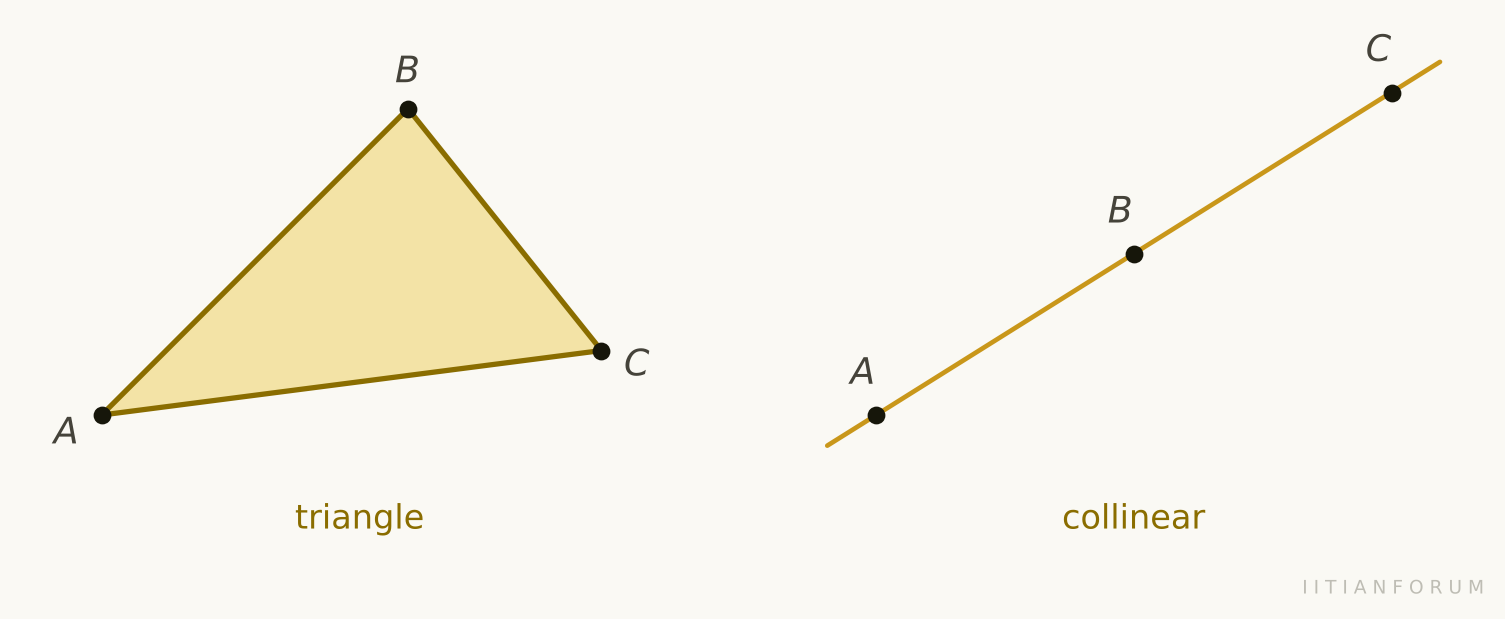
The determinant itself can be negative; the area is its absolute value. The three points are collinear exactly when the determinant is 0.
Two panels: a shaded triangle with vertices A, B and C, and three points A, B, C on one straight line where the triangle has collapsed
Example 8(IITianForum). The points A(1,1), B(3,4) and C(k,7) form a triangle of area 6. Find k. For which k are the three points collinear?
▸ SHOW SOLUTION
Step 1. The determinant
13k147111=(4−7)−(3−k)+(21−4k)=15−3k
Step 2. Area 6
21∣15−3k∣=6⟹∣15−3k∣=12k=1ork=9
Step 3. Collinear
15−3k=0⟹k=5
Check: (1,1), (3,4), (5,7) all have slope 23 between them.
Answer:k=1 or 9; collinear at k=5.
Both values of k are needed: the area condition fixes ∣Δ∣, not its sign, and the two answers sit symmetrically on either side of the collinear value 5.
Example 9(IITianForum). A triangle has vertices (x1,y1), (x2,y2), (x3,y3) and sides a, b, c. If
Δ=x1x2x3y1y2y3111
and Δ2=μ(a+b+c)(b+c−a)(c+a−b)(a+b−c), find μ.
▸ SHOW SOLUTION
Step 1. Area from the determinant
Area S=21∣Δ∣, so
Δ2=4S2
Step 2. Area from Heron's formula
With s=2a+b+c, S2=s(s−a)(s−b)(s−c), which is
16S2=(a+b+c)(b+c−a)×(c+a−b)(a+b−c)
Step 3. Compare
Δ2=4S2=41⋅16S2
Answer:μ=41
Adjoint of a matrix
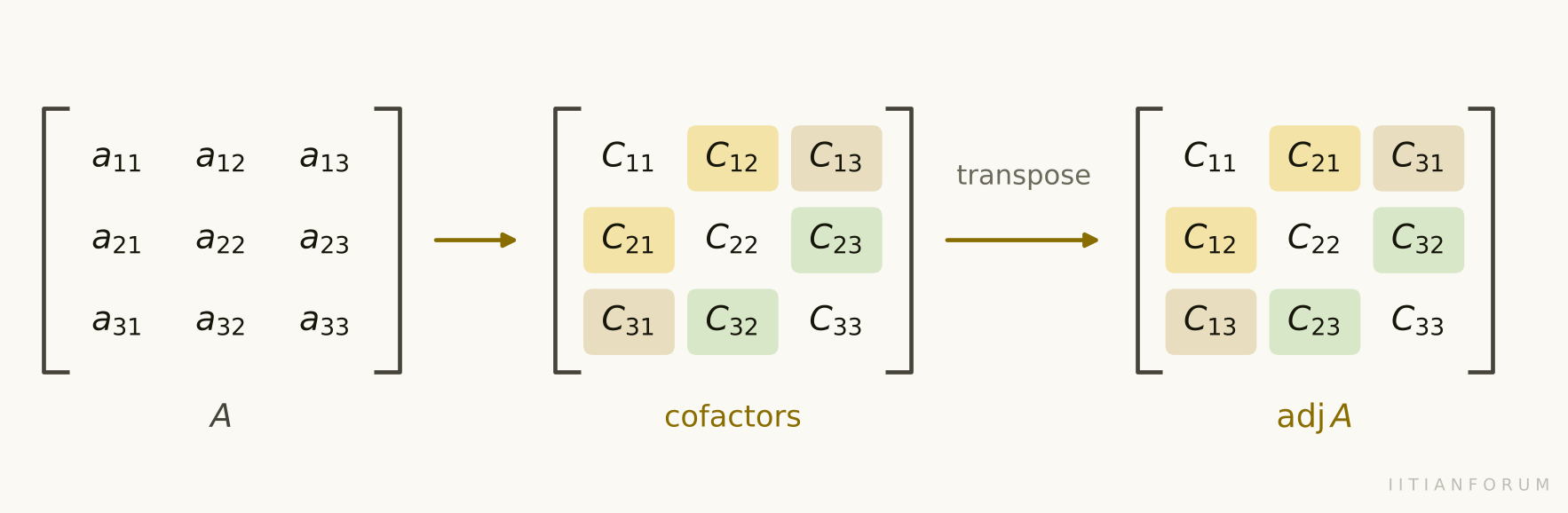
The adjoint of a square matrix is the transpose of its matrix of cofactors:
adjA=[Cij]TThree 3 by 3 grids: A, then the cofactor matrix with each Cij in place, then adj A with the cofactors reflected across the diagonal
For a 2×2 matrix this is quick: swap the diagonal entries and change the sign of the other two.
adj[acbd]=[d−c−ba]
The key identity comes from the two expansion facts in the first section. Row i of A times column j of adjA is row i against the cofactors of row j, which is ∣A∣ when i=j and 0 otherwise:
A(adjA)=(adjA)A=∣A∣I
Take determinants of both sides, for order n:
∣A∣∣adjA∣=∣A∣n
Everything in the table below follows from these two lines.
Rule, order n
Order 3
∣adjA∣=∣A∣n−1
∣A∣2
adj(adjA)=∣A∣n−2A
∣A∣A
∣adj(adjA)∣=∣A∣(n−1)2
∣A∣4
adj(kA)=kn−1adjA
k2adjA
adj(AB)=(adjB)(adjA)
same
adj(AT)=(adjA)T
same
swipe for more →
Peel from the outside in
For a nested expression such as ∣adj(3adj(…))∣, never build the matrix. Work out the determinant of the innermost piece, then apply one rule per layer moving outward: ∣kM∣=kn∣M∣ for a scalar, ∣adjM∣=∣M∣n−1 for an adjoint, ∣MN∣=∣M∣∣N∣ for a product.
Example 10(IITianForum). A square matrix A of order n has ∣A∣=4 and ∣adjA∣=214. The number of entries in A is
Tap an option to check your answer
(1)16
(2)49
(3)64
(4)81
▸ SHOW SOLUTION
Step 1. Use the adjoint rule
∣adjA∣=∣A∣n−1=4n−1=22n−2
Step 2. Solve
2n−2=14⟹n=8
An 8×8 matrix has 64 entries.
Answer: (3) 64
Example 11(JEE Main 2026, 23 January Shift 1). Let A be a 3×3 matrix with ∣A∣=6. If
adj(3adj(A2adj(2A)))=2m3n
for m,n∈N, then m+n is ______.
▸ SHOW SOLUTION
Step 1. Innermost
∣2A∣=8⋅6=48∣adj(2A)∣=482=28⋅32
Step 2. Next layer
∣A2adj(2A)∣=36⋅28⋅32=210⋅34
Call this matrix N.
Step 3. Adjoint, then the scalar 3
∣adjN∣=∣N∣2=220⋅38∣3adjN∣=27⋅220⋅38=220⋅311
Step 4. Outer adjoint
(220⋅311)2=240⋅322m+n=40+22=62
Answer:62
Example 12(JEE Main 2026, 22 January Shift 1). Let A be a 3×3 matrix with A+AT=O. If
A1−10=332,A21−10=−319−24
and det(adj(2adj(A+I)))=2α3β11γ with α,β,γ non-negative integers, then α+β+γ is ______.
▸ SHOW SOLUTION
Step 1. Write the skew-symmetric A
A=0−a−ba0−cbc0
Step 2. First condition
A1−10=−a−a−b+c=332
So a=−3 and c−b=2.
Step 3. Second condition
A2v=A(Av), so apply A to (3,3,2):
A332=3a+2b−3a+2c−3b−3c=−319−24
3a+2b=−3 gives b=3, and then c=5. (The other two rows check.)
Step 4. Determinant of A + I
∣A+I∣=13−3−31−5351
For a skew-symmetric 3×3 matrix this is always 1+a2+b2+c2:
Then the sum of all elements of adj(adj(2(adjA)−1)) is
Tap an option to check your answer
(1)3
(2)4
(3)−4
(4)−3
▸ SHOW SOLUTION
Step 1. Determinant of A
∣A∣=1(0−3)−1(−10−1)+2(−6)∣A∣=−3+11−12=−4
Step 2. Inverse of the adjoint
From (adjA)A=∣A∣I:
(adjA)−1=∣A∣A=−4A
So X=2(adjA)−1=−2A.
Step 3. Double adjoint
For order 3, adj(adjX)=∣X∣X.
∣X∣=(−21)3(−4)=21adj(adjX)=21⋅(−2A)=−4A
Step 4. Sum of elements
Elements of A add to 12, so the answer is −412=−3.
Answer: (4) −3
Example 14(JEE Main 2026, 6 April Shift 1). Let
A=−110100−111
satisfy
A2+αadj(adjA)+βadjA⋅adj(adjA)=C
where
C=2−20−2002−1−1
for some real α,β. Then (α−β)2 is ______.
▸ SHOW SOLUTION
Step 1. Determinant
Expand along row 3:
∣A∣=1⋅−1110=−1
Step 2. Simplify both adjoint terms
adj(adjA)=∣A∣A=−AadjA⋅(−A)=−∣A∣I=I
So the equation is A2−αA+βI=C.
Step 3. Compute A squared
A2=2−10−110101
Step 4. Compare two entries
Entry (1,2): −1−α=−2, so α=1.
Entry (3,3): 1−α+β=−1, so β=−1.
(α−β)2=4
Answer:4
Inverse of a matrix
Dividing A(adjA)=∣A∣I by ∣A∣ gives the inverse whenever ∣A∣=0:
A−1=∣A∣1adjA
For a 2×2 matrix:
[acbd]−1=ad−bc1[d−c−ba]
A matrix equation is solved by multiplying by the inverse on the correct side:
PA=B⟹P=BA−1AQ=B⟹Q=A−1B
These are different matrices in general. Their traces, though, are equal, because tr(XY)=tr(YX).
Example 15(JEE Main 2026, 2 April Shift 2). Consider
A=[24−2−2],B=[3193]
If PA=B and AQ=B, then the absolute value of the sum of the diagonal elements of 2(P+Q) is ______.
▸ SHOW SOLUTION
Step 1. Inverse of A
∣A∣=−4+8=4A−1=41[−2−422]
Step 2. P and Q have the same trace
P=BA−1 and Q=A−1B, so
trP=tr(BA−1)=tr(A−1B)=trQ
Step 3. Compute one of them
A−1B=41[−4−10−12−30]trQ=4−4−30=−217
Step 4. Trace of 2(P + Q)
2(trP+trQ)=2(−17)=−34
Answer:34
Example 16(JEE Main 2026, 22 January Shift 2). If X=[xyz]T is a solution of AX=B, where
adjA=4−5120−2253,B=402
then ∣x+y+z∣ is
Tap an option to check your answer
(1)3
(2)23
(3)1
(4)2
▸ SHOW SOLUTION
Step 1. Get |A| from the adjoint
∣adjA∣=4(10)−2(−20)+2(10)∣adjA∣=100
For order 3, ∣adjA∣=∣A∣2, so ∣A∣=±10.
Step 2. Solve
X=A−1B=∣A∣1(adjA)B(adjA)B=20−1010
Step 3. Add
x+y+z=±1020−10+10=±2
Answer: (4) 2
The sign of ∣A∣ is never fixed by the adjoint, which is exactly why the question asks for the absolute value.
Systems of linear equations
Three equations in x,y,z with coefficient matrix A and right side B are written AX=B. Let Δ=∣A∣, and let Δx, Δy, Δz be Δ with the x, y or z column replaced by B.
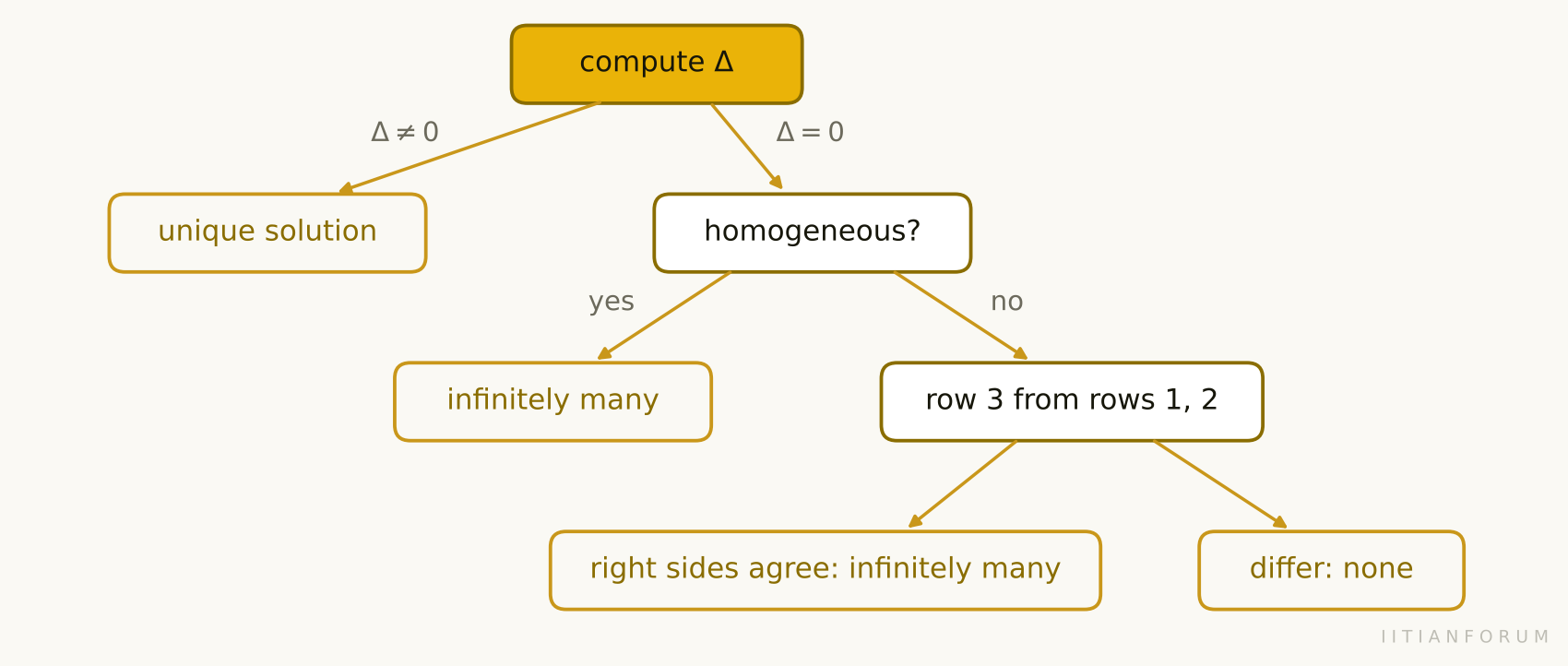
Cramer's rule. If Δ=0, the system has exactly one solution:
x=ΔΔx,y=ΔΔy,z=ΔΔzThree panels in two variables: lines crossing at one point, parallel lines that never meet, and two lines lying on top of each other
The picture shows the same three outcomes for two lines in the plane. In three variables each equation is a plane, and the outcomes are the same: one point, nothing, or a whole line or plane of solutions.
Situation
Conclusion
Δ=0
unique solution
Δ=0 and some Δx,Δy,Δz=0
no solution
Δ=0 and Δx=Δy=Δz=0
infinitely many or none, check further
swipe for more →
All four determinants zero does not guarantee infinitely many solutions
The system x+y+z=1, x+y+z=2, x+y+z=3 has Δ=Δx=Δy=Δz=0 and no solution at all. When Δ=0, the safe check is to write the third equation's left side as a combination of the first two, then see whether the right sides follow the same combination.
The homogeneous system AX=O always has x=y=z=0. It has a non-trivial solution, and then infinitely many, exactly when Δ=0.
A flowchart: compute Delta; if non-zero, unique solution; if zero, homogeneous systems have infinitely many, otherwise write row 3 as a combination of rows 1 and 2 and compare right sides to decide between infinitely many and none
Example 17(JEE Main 2026, 21 January Shift 2). If the system 3x+y+4z=3, 2x+αy−z=−3, x+2y+z=4 has no solution, then α is
Tap an option to check your answer
(1)19
(2)4
(3)13
(4)23
▸ SHOW SOLUTION
Step 1. Set Δ = 0
Δ=3(α+2)−3+4(4−α)Δ=19−α
No solution needs Δ=0, so α=19.
Step 2. Confirm it is "no solution"
Δx=3−3411924−11Δx=63−1−328=−266=0
Answer: (1) 19
Example 18(JEE Main 2026, 8 April Shift 2). If the system x+y+z=6, x+2y+5z=10, 2x+3y+λz=μ has infinitely many solutions, then λ+μ equals
Tap an option to check your answer
(1)12
(2)16
(3)22
(4)28
▸ SHOW SOLUTION
Step 1. Set Δ = 0
Δ=(2λ−15)−(λ−10)+(3−4)Δ=λ−6
So λ=6.
Step 2. Third row as a combination
The coefficients (2,3,6) are (1,1,1)+(1,2,5), so the third equation must be the sum of the first two:
μ=6+10=16λ+μ=22
Answer: (3) 22
Example 19(JEE Main 2026, 23 January Shift 2). The system x+y+z=6, 2x+5y+az=36, x+2y+3z=b has
Tap an option to check your answer
(1)unique solution for a=8, b=16
(2)infinitely many solutions for a=8, b=14
(3)infinitely many solutions for a=8, b=16
(4)unique solution for a=8, b=14
▸ SHOW SOLUTION
Step 1. Δ at a = 8
Δ=(15−2a)−(6−a)+(4−5)Δ=8−a
At a=8, Δ=0, so (1) and (4) are out.
Step 2. Third row as a combination
Find p,q with (1,2,3)=p(1,1,1)+q(2,5,8):
p+2q=1,p+5q=2q=31,p=31
Check the third coordinate: 31+38=3.
Step 3. Right sides
Infinitely many solutions need
b=31⋅6+31⋅36=14
At b=16 there is no solution.
Answer: (2)
Example 20(JEE Main 2026, 6 April Shift 2). The sum of all values of θ∈[0,2π] for which the system xcos3θ−8y−12z=0, xcos2θ+3y+3z=0, x+y+3z=0 has a non-trivial solution is
Example 21(JEE Main 2026, 5 April Shift 1). The system x+2y+tz=0, 6x+y+5tz=0, 3x+t2y+f(t)z=0, where f:R→R is differentiable, has infinitely many solutions for every real t. Then f
Tap an option to check your answer
(1)is a constant function
(2)is strictly increasing on R
(3)is strictly decreasing on R
(4)has two critical points
▸ SHOW SOLUTION
Step 1. Homogeneous, so Δ = 0 for every t
Δ=(f−5t3)−2(6f−15t)+t(6t2−3)Δ=−11f+t3+27t
Step 2. Solve for f
f(t)=11t3+27t
Step 3. Derivative
f′(t)=113(t2+9)>0
for every t.
Answer: (2) strictly increasing
Which result to use
The question gives you
Reach for
det(A−αI)=0
expand, find one root by trial, factor
a determinant equal to px+q
put x=0 for q, x=1 for p+q
a sum of determinants
sum the one column that changes
entries scaled like 2i+j
take factors out of rows and columns
∣kA∣
kn∣A∣, never k∣A∣
a high power inside a determinant
factor the power out, use the product rule
nested adj, scalars, products
peel from the inside, one rule per layer
adjA given, A not given
∣A∣=±∣adjA∣ for order 3
PA=B and AQ=B
inverse on the correct side, traces agree
a system with a parameter
Δ=0, then third row as a combination
homogeneous, non-trivial solution
Δ=0, nothing else
swipe for more →
Quick recall
Result
Statement
Expansion
Δ=∑jaijCij along any row
Alien cofactors
row i times cofactors of row j=i gives 0
Scalar multiple
∣kA∣=kn∣A∣
Product
∣AB∣=∣A∣∣B∣
Area
21∣Δ∣ with rows (xi,yi,1)
Collinear
Δ=0
Key identity
AadjA=∣A∣I
Adjoint determinant
∣adjA∣=∣A∣n−1
Double adjoint
adjadjA=∣A∣n−2A
Inverse
A−1=adjA/∣A∣
Skew 3×3
∣A+I∣=1+a2+b2+c2
Cramer
x=Δx/Δ when Δ=0
Homogeneous
non-trivial solution iff Δ=0
swipe for more →
Before you leave this chapter
Take any 3×3 matrix with determinant 2 and, without building a single matrix, write down ∣adj(2adj(3A))∣. If you get 210⋅312, the adjoint chain is under control.
Practise these methods on real exam questions in the doMath Determinants chapter, and go back to the Matrices note for powers, transpose and the 2×2 identity used in Example 6.