Limits for JEE: Standard Limits, Expansions and the 1^∞ Form
Ritesh Raj · 3 Nov 2026
Aa
21 min read16 sectionsConcept
A limit answers one question: as x gets closer and closer to a point, what value does f(x) settle near? The value at the point itself does not matter, and often does not even exist. That is why limits can handle 00, ∞∞ and 1∞, expressions that make no sense when you simply substitute.
This note builds the chapter in the order you use it in a paper: what a limit is and when it exists, the indeterminate forms, the standard limits, limits at infinity, the sandwich theorem, expansions, L'Hôpital's rule, the exponent forms 1∞, 00, ∞0, the greatest integer and fractional part, and finally finding unknown constants from a given limit. Every worked example is a JEE Main 2025 or 2026 question unless it says otherwise, and every answer was re-derived from scratch.
What a limit means
We write
x→alimf(x)=L
when f(x) can be made as close to L as we like by taking x close enough to a, with x=a.
Approaching from the left gives the left hand limit (LHL), from the right the right hand limit (RHL):
LHL=x→a−limf(x),RHL=x→a+limf(x)
The limit exists exactly when both exist, are finite, and are equal:
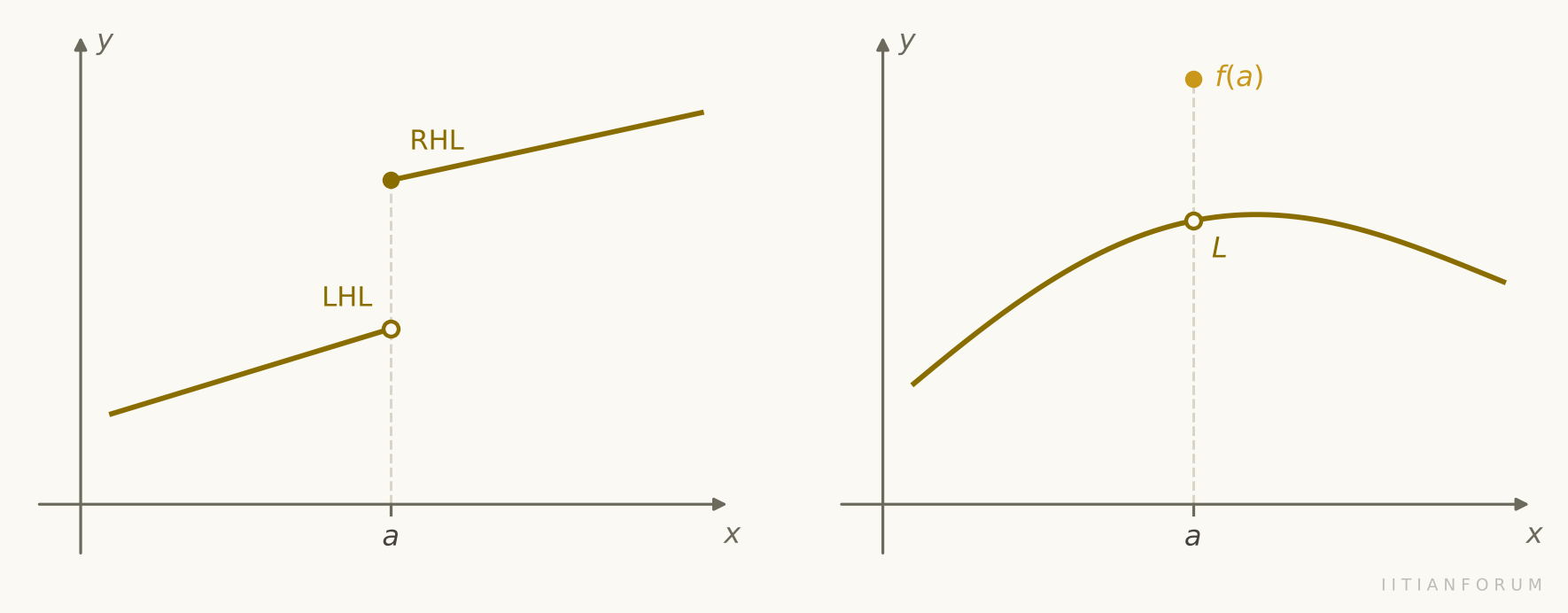
x→alimf(x) exists⟺LHL=RHLTwo graphs side by side: on the left a curve that jumps at x equals a, with an open dot at the end of the left piece and a filled dot at the start of the right piece; on the right a smooth curve with a hollow dot at x equals a and a separate filled dot above it
The left picture has LHL = RHL, so no limit. The right picture has a limit even though f(a) is somewhere else: the limit only looks at nearby points.
When to check both sides
Check LHL and RHL separately whenever the expression contains ∣x−a∣, [x], {x}, a piecewise definition, or a1/(x−k) with x→k. Everywhere else one calculation is enough.
Example 1(IITianForum). Find, if it exists,
x→0lim21/x+121/x−1▸ SHOW SOLUTION
Step 1. Right side
x→0+⇒x1→+∞⇒21/x→∞. Divide by 21/x:
RHL=x→0+lim1+2−1/x1−2−1/x=1+01−0=1
Step 2. Left side
x→0−⇒x1→−∞⇒21/x→0:
LHL=0+10−1=−1
Step 3. Compare
LHL = RHL.
Answer: the limit does not exist.
Indeterminate forms, factorisation and rationalisation
If limf=l and limg=m are finite, limits obey ordinary algebra:
lim(f±g)=l±m,lim(fg)=lmlimgf=ml(m=0)
The trouble starts when substitution gives one of the seven indeterminate forms:
00,∞∞,0⋅∞,∞−∞1∞,00,∞0
Each one can end up as any number, so the expression has to be rewritten until substitution works. The three oldest rewrites are: cancel a common factor (x−a), rationalise a root, and take out the highest power. The rest of this note supplies the others.
1 to the power infinity is not 1
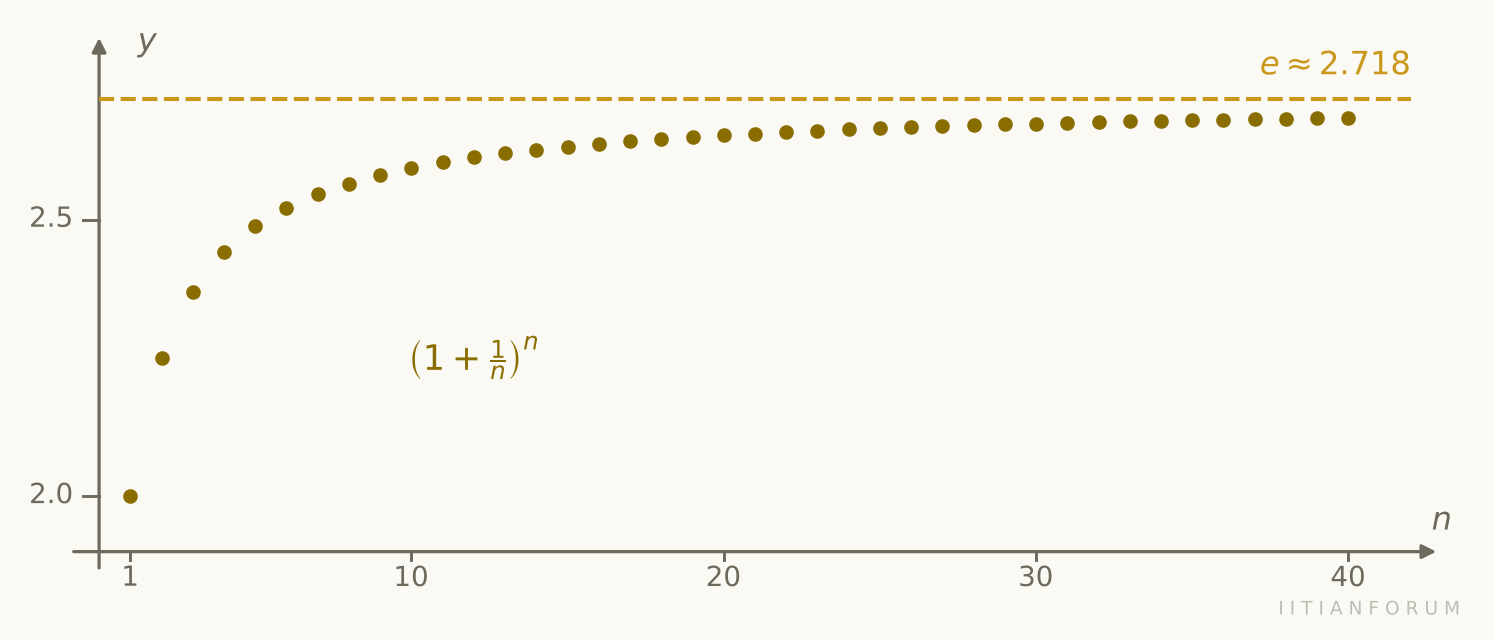
1∞ means "a base tending to 1 raised to a power tending to ∞". The base is never exactly 1, and the tiny gap gets multiplied by a huge power. (1+n1)n tends to e, not 1. Likewise ∞−∞ is not 0 and 00 is not 1.
Example 2(JEE Main 2025, 24 January Shift 1). Let p=2cos2x+3cosx and q=cos2x+sinx+4. The value of
x→0limcosecx(p−q)
is
Tap an option to check your answer
(1)0
(2)251
(3)151
(4)−251
▸ SHOW SOLUTION
Step 1. Rationalise
The difference of the two radicands is
cos2x+3cosx−4−sinx=(cosx−1)(cosx+4)−sinx
Step 2. Divide by sin x
sinx(cosx−1)(cosx+4)−1
sinxcosx−1→0, so this tends to −1.
Step 3. The two roots
Each root tends to 5, so their sum tends to 25.
Limit=25−1
Answer: (4) −251
The standard limits
Almost every limit question reduces to one of these. Learn them with the shape of the argument, not just the answer.
Limit
Value
x−axn−an, x→a
nan−1
xsinx, xtanx, x→0
1
xsin−1x, xtan−1x, x→0
1
x21−cosx, x→0
21
xex−1, x→0
1
xax−1, x→0
lna
xln(1+x), x→0
1
x(1+x)n−1, x→0
n
(1+x)1/x, x→0
e
swipe for more →
In every row x may be replaced by any expression that tends to 0. For instance
x→0lim5x2sin5x2=1
because 5x2→0. This replacement is how most exam limits are cracked.
Why sin x over x tends to 1
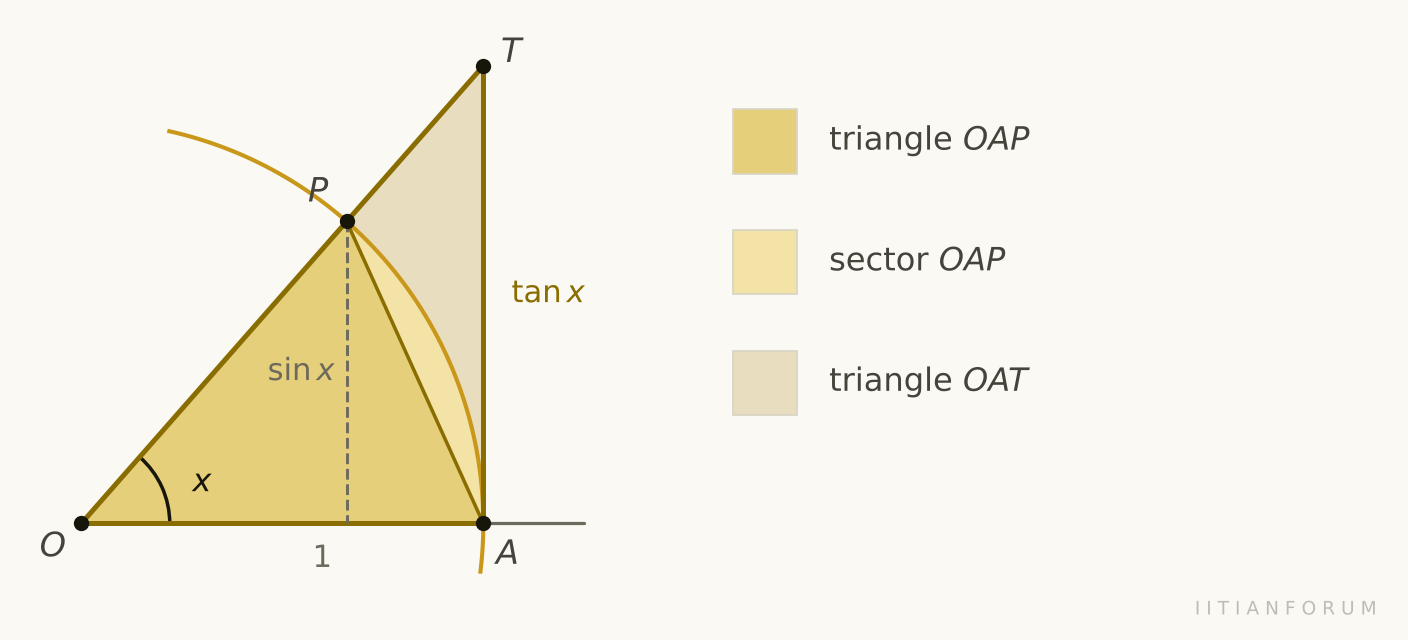
For 0<x<2π, compare three areas in the unit circle: the triangle OAP, the sector OAP, and the triangle OAT with AT tangent.
Unit circle sector from O with radius OA along the x-axis, point P on the circle at angle x, the vertical tangent at A meeting OP extended at T, and the triangle OAP, the sector OAP and the triangle OAT outlined21sinx<21x<21tanx
Divide by 21sinx and take reciprocals:
cosx<xsinx<1
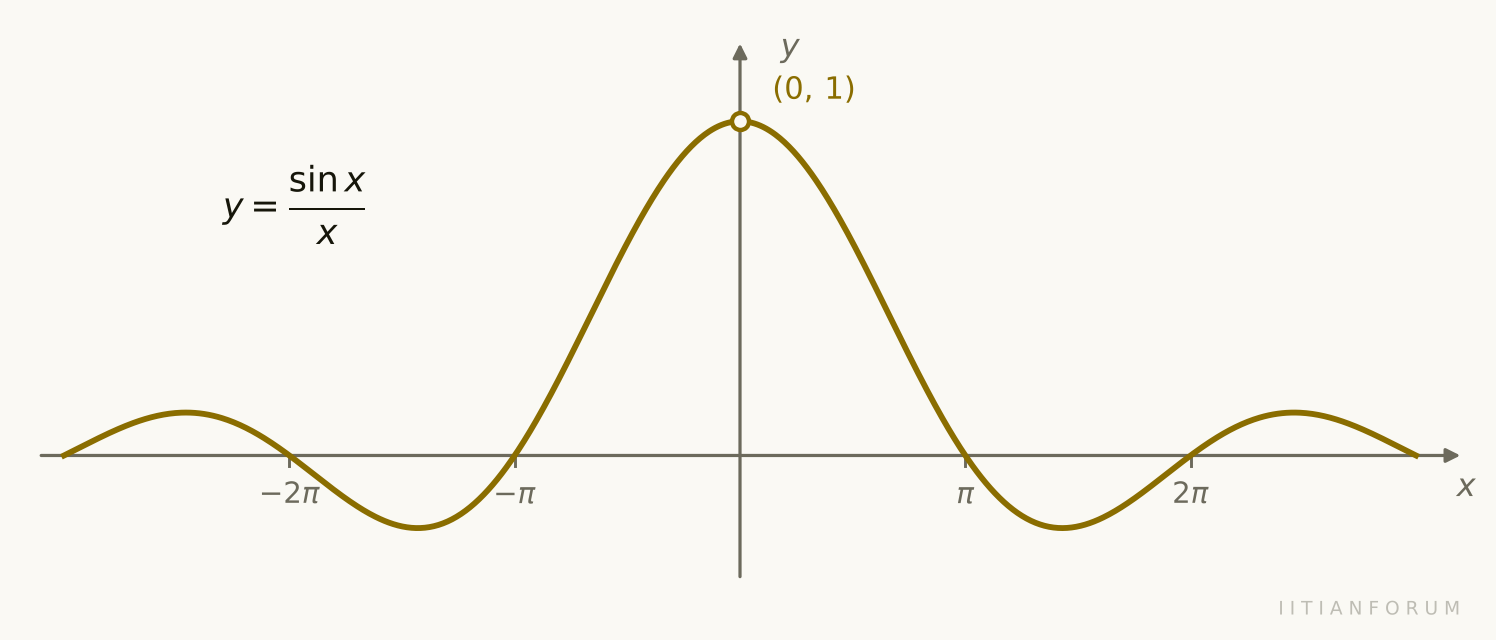
As x→0 both outer terms tend to 1, so xsinx→1. Both sides give the same value because xsinx is even.
Graph of sin x over x for x between minus 3 pi and 3 pi, a central hump rising to 1 near the origin with a hollow dot at (0, 1) and smaller decaying waves on both sides
The other entries follow from this one and from e:
Example 3(JEE Main 2025, 7 April Shift 2). For t>−1, let αt, βt be the roots of
atx2+btx+ct=0
where at=(t+2)1/7−1, bt=(t+2)1/6−1 and ct=(t+2)1/21−1.
If αt→a and βt→b as t→−1+, then 72(a+b)2 is ______.
▸ SHOW SOLUTION
Step 1. Put s = t + 2
s→1. Divide the whole equation by s−1 and use the first row of the table:
s−1sk−1→k
with k=71,61,211.
Step 2. Limiting equation
7x2+6x+211=06x2+7x+2=0
Step 3. Sum of roots
a+b=−6772⋅3649=98
Answer:98
Example 4(JEE Main 2026, 28 January Shift 1). The value of
x→0lime2−e2cosxln(sec(ex)sec(e2x)⋯sec(e10x))
is
Tap an option to check your answer
(1)2e2(e2−1)e10−1
(2)2e2(e2−1)e20−1
(3)2(e2−1)e20−1
(4)2(e2−1)e10−1
▸ SHOW SOLUTION
Step 1. Numerator
lnsecθ=−lncosθ, and cosθ=1−(1−cosθ), so
−lncosθ≈1−cosθ≈2θ2Numerator≈2x2(e2+e4+⋯+e20)
Step 2. Denominator
e2−e2cosx=−e2(e2cosx−2−1)
2cosx−2≈−x2→0, and ueu−1→1, so
Denominator≈e2x2
Step 3. Divide
2e2e2+e4+⋯+e20=21+e2+⋯+e18=2(e2−1)e20−1
Answer: (3)
Example 5(JEE Main 2026, 5 April Shift 2). Let
f(x)=y→0limy3(1−cosxy)tanxy
The number of solutions of f(x)=sinx, x∈R, is
Tap an option to check your answer
(1)0
(2)2
(3)3
(4)1
▸ SHOW SOLUTION
Step 1. Standard limits in y
1−cosxy≈2x2y2,tanxy≈xyf(x)=2x3
Step 2. Count roots of x³/2 = sin x
g(x)=2x3−sinx is odd and g(0)=0. For small x>0, g<0; for x≥2, 2x3>1≥sinx. Also g′′(x)=3x+sinx>0 for x>0, so g is convex there and crosses zero only once after 0. So one root in (0,2), its mirror root, and x=0.
Answer: (3) three solutions
Example 6(JEE Main 2026, 5 April Shift 1). Let C(x)=cosαxcos(α+1)xcos(α+2)x. The product of all values of α for which
x→0limsin2(α+1)x1−C(x)=2
is
Tap an option to check your answer
(1)−2
(2)1
(3)−1
(4)45
▸ SHOW SOLUTION
Step 1. Each cosine to second order
cospx≈1−2p2x2
so the product of the three cosines is
1−2α2+(α+1)2+(α+2)2x2
Step 2. The limit
2(α+1)2α2+(α+1)2+(α+2)2=2
Step 3. Solve with u = α + 1
(u−1)2+u2+(u+1)2=4u23u2+2=4u2⟹u2=2
α=−1±2, product 1−2=−1.
Answer: (3) −1
Example 7(JEE Main 2025, 7 April Shift 1). The value of
x→0+lim(tan−13x)2(e5x4/3−1)tan(5x1/3)ln(1+3x2)
is
Tap an option to check your answer
(1)151
(2)1
(3)31
(4)35
▸ SHOW SOLUTION
Step 1. Replace each factor by its standard approximation
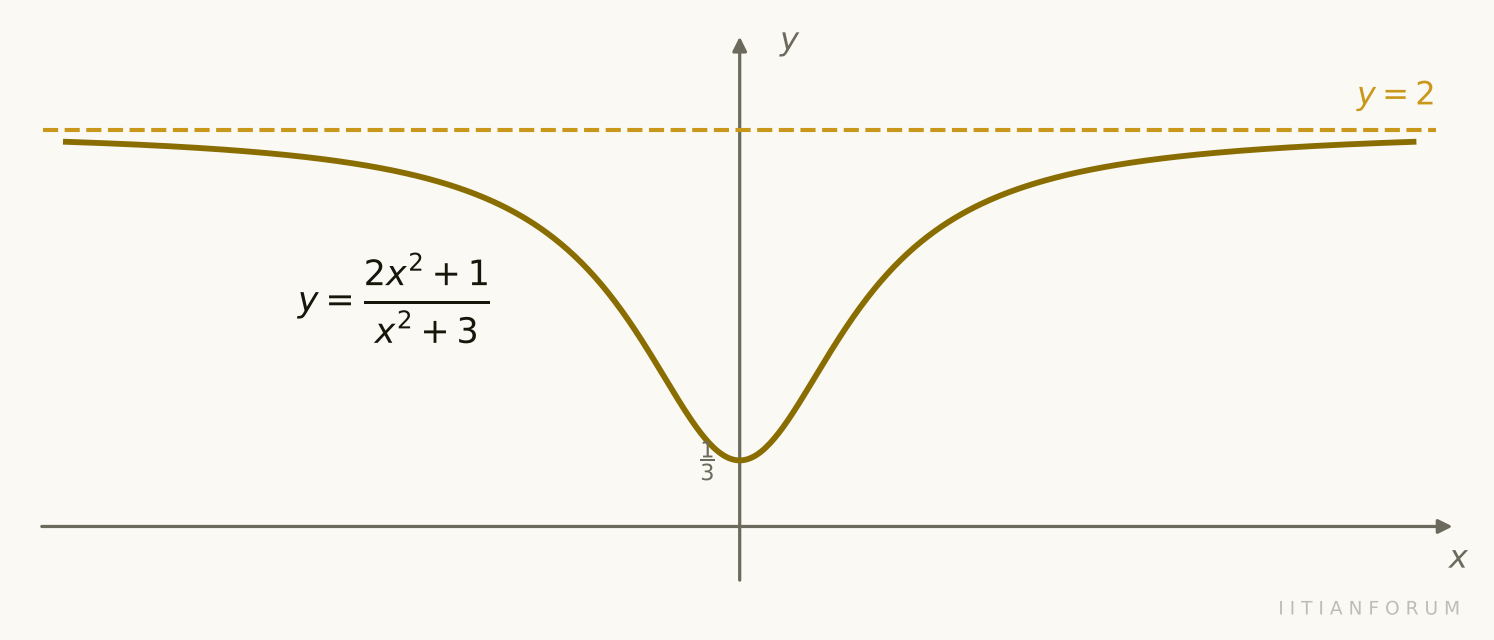
As x→∞, divide numerator and denominator by the highest power of x present. For a rational function this gives a rule by degree:
Degrees of p and q
q(x)p(x) as x→∞
degp<degq
0
degp=degq
ratio of leading coefficients
degp>degq
±∞
swipe for more →
Graph of the rational function 2x squared plus 1 over x squared plus 3, starting low near the origin and rising towards the dashed horizontal line y equals 2 on both sides
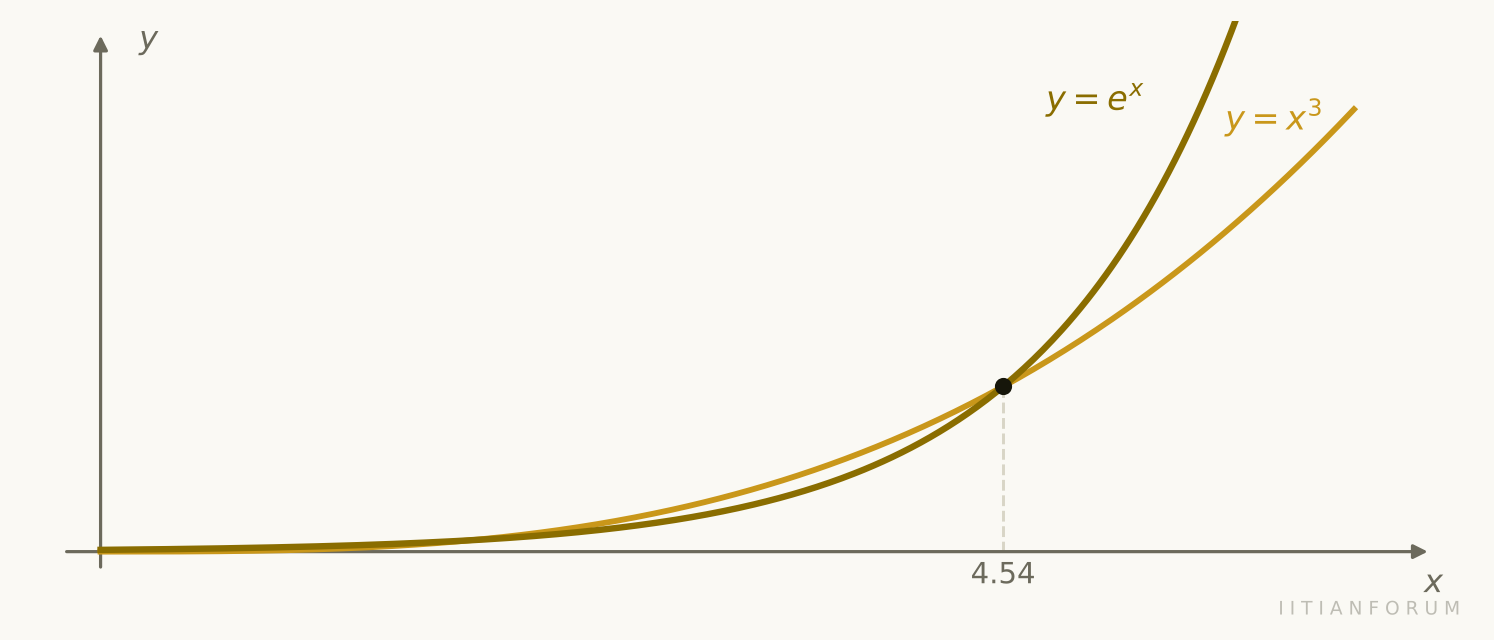
Two more facts are used constantly. Every positive power of x beats lnx, and ex beats every power of x:
xklnx→0,exxk→0(k>0)The curves y equals e to the x and y equals x cubed for x from 0 to 6, x cubed ahead for a while, then e to the x crossing it near x equals 4.5 and racing away
For a difference of roots, multiply by the conjugate. For cube roots use a−b=a2+ab+b2a3−b3.
Example 9(IITianForum). If
x→∞lim(3x3+3x2−3x3−2x2)=qp
with p,q coprime natural numbers, find p+q.
▸ SHOW SOLUTION
Step 1. Cube-root conjugate
Put a=3x3+3x2, b=3x3−2x2.
a3−b3=5x2
Step 2. Size of the denominator
a≈x, b≈x, so
a2+ab+b2≈3x2
Step 3. Limit
a−b=a2+ab+b25x2→35
Answer:p+q=8
Limits of the form xⁿ as n → ∞
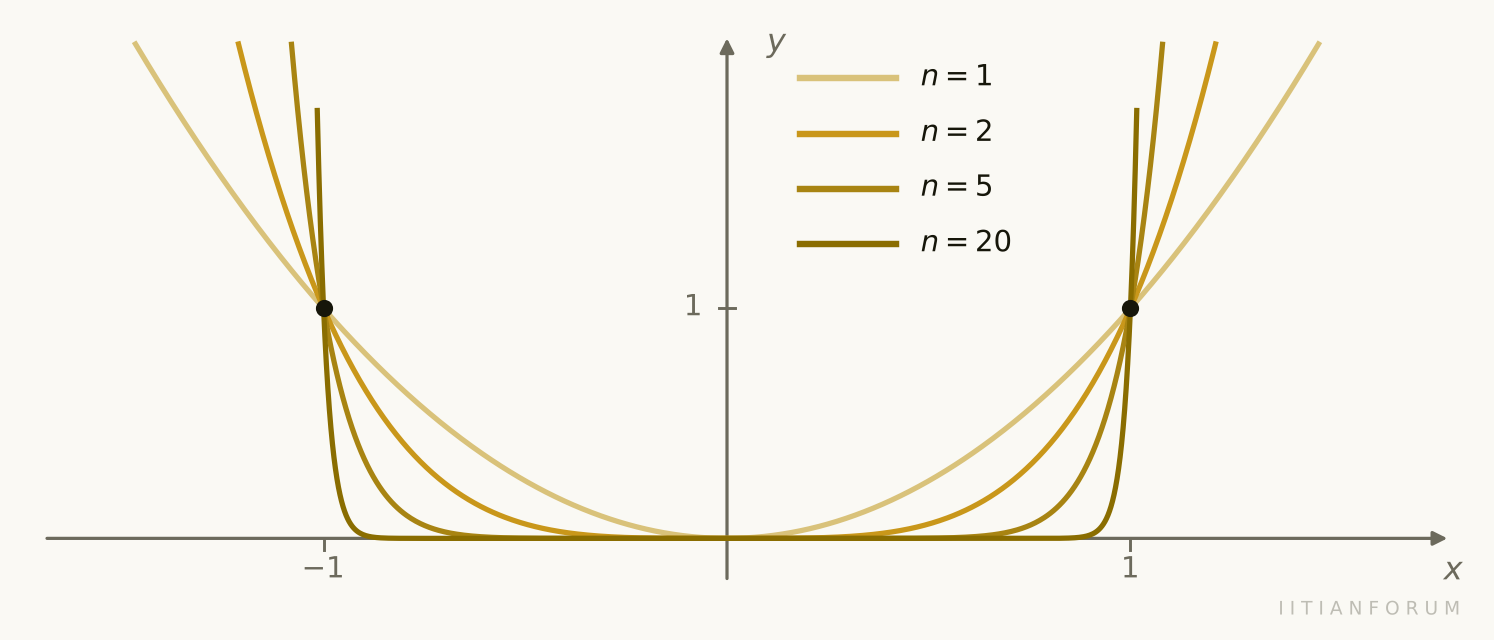
As n→∞, xn→0 when ∣x∣<1, xn→∞ when x>1, and x2n→∞ when ∣x∣>1. So a limit in n defines a function piece by piece, and the pieces meet at ∣x∣=1.
Curves of x to the power 2n for n equal to 1, 2, 5 and 20 on the interval from minus 1.5 to 1.5, flattening to 0 inside minus 1 to 1 and shooting up outside, all passing through (1, 1) and (minus 1, 1)
Example 10(IITianForum). Let
f(x)=n→∞limx2n+1x2n−1
Find f(x), and decide whether the limit of f(x) as x→1 exists.
▸ SHOW SOLUTION
Step 1. Three cases
∣x∣<1: x2n→0, so f(x)=−1.
∣x∣>1: divide by x2n, so f(x)=1.
∣x∣=1: x2n=1, so f(x)=0.
Step 2. Near x = 1
LHL =−1 (inside), RHL =1 (outside).
Answer:f is −1, 0, 1 as above, and the limit at x=1 does not exist.
Example 11(JEE Main 2025, 4 April Shift 1). Let f:R→R be continuous with f(0)=1 and f(2x)−f(x)=x for all x. If
G(x)=n→∞lim(f(x)−f(2nx))
then G(1)+G(4)+G(9)+⋯+G(100) is
Tap an option to check your answer
(1)540
(2)385
(3)420
(4)215
▸ SHOW SOLUTION
Step 1. Telescope with the given rule
Replacing x by 2kx in f(2x)−f(x)=x:
f(2k−1x)−f(2kx)=2kx
Adding for k=1 to n:
f(x)−f(2nx)=x(1−2n1)
Step 2. Let n → ∞
G(x)=x
Step 3. Sum
1+4+9+⋯+100=385
Answer: (2) 385
Continuity of f at 0 is what lets f(2nx)→f(0)=1, which also gives f(x)=1+x.
Sandwich theorem
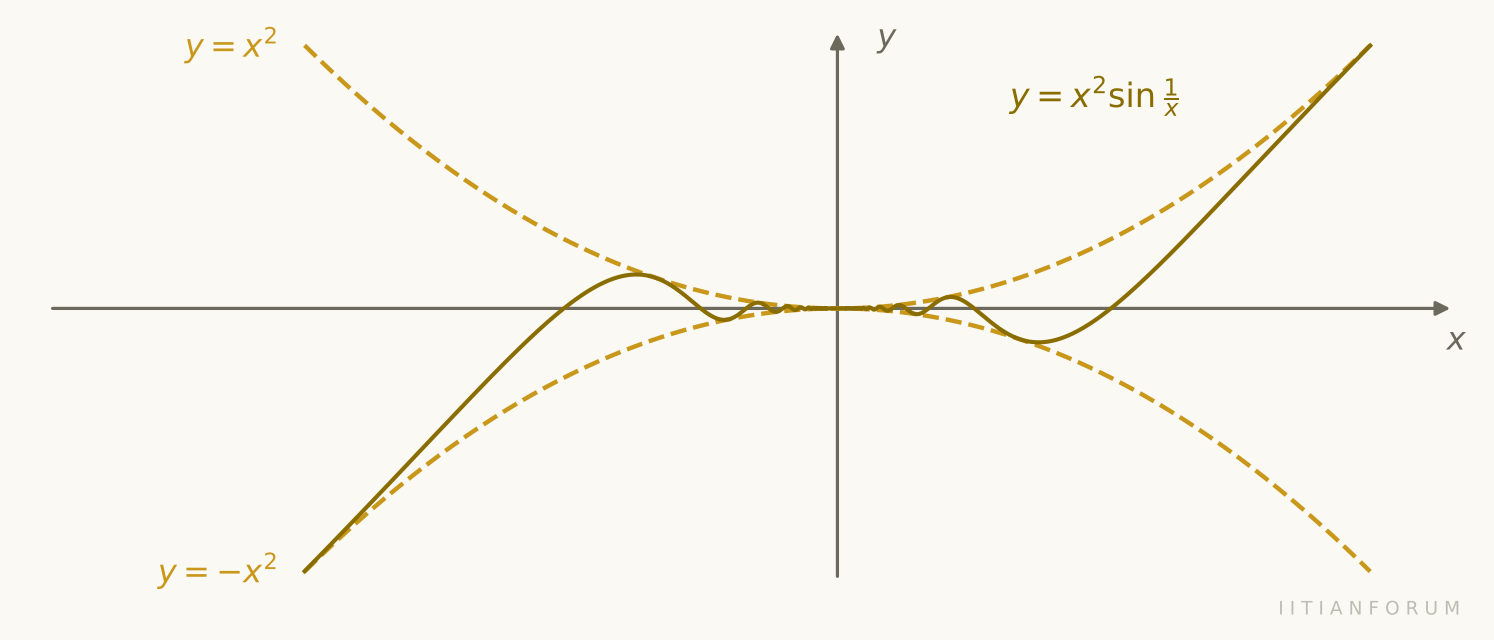
If g(x)≤f(x)≤h(x) near a, and g and h have the same limit L, then f has limit L too.
The curve x squared times sine of 1 over x oscillating faster and faster near the origin, trapped between the dashed parabolas y equals x squared and y equals minus x squared, all three meeting at the origin
The squeeze is the natural tool whenever a bounded quantity appears: −1≤sinθ≤1, or t−1<[t]≤t for the greatest integer function.
Example 12(IITianForum). For a real number x, find
n→∞limn2[x]+[2x]+[3x]+⋯+[nx]▸ SHOW SOLUTION
Step 1. Bound each term
kx−1<[kx]≤kx
Step 2. Add for k = 1 to n
2n(n+1)x−n<S≤2n(n+1)x
Step 3. Divide by n² and squeeze
Both bounds tend to 2x.
Answer:2x
Example 13(JEE Main 2026, 21 January Shift 2). Let
f(x)=n→∞limn31k=1∑n[3xk2]
Then 12(f(1)+f(2)+f(3)+⋯) is ______.
▸ SHOW SOLUTION
Step 1. Squeeze
3xk2−1<[3xk2]≤3xk2
Sum, divide by n3, and use ∑k2=6n(n+1)(2n+1):
6n3n(n+1)(2n+1)→31,n3n→0f(x)=3x+11
Step 2. The series
j=1∑∞3j+11=1−1/31/9=61
Answer:12⋅61=2
Expansions
When a limit needs more than the first term, use these known expansions near x=0. Each line is exact up to the last term shown.
Function
Expansion
sinx
x−6x3+120x5
cosx
1−2x2+24x4
tanx
x+3x3+152x5
tan−1x
x−3x3+5x5
ex
1+x+2x2+6x3
ln(1+x)
x−2x2+3x3
(1+x)n
1+nx+2n(n−1)x2
swipe for more →
The rule: expand top and bottom to the first power that survives in the denominator, then compare.
Do not replace sin x by x inside a difference
x3x−sinx is not x3x−x=0. Replacing a term by its first approximation is safe only for a whole factor. In a difference the first terms cancel and the next terms decide the answer, here x3x3/6=61.
Example 14(JEE Main 2026, 6 April Shift 1). The value of
x→0limx2−sin2xx2sin2x
is
Tap an option to check your answer
(1)2
(2)3
(3)4
(4)6
▸ SHOW SOLUTION
Step 1. Factor the denominator
x2−sin2x=(x−sinx)(x+sinx)
Step 2. Expand
x−sinx≈6x3,x+sinx≈2x
Denominator ≈3x4, numerator ≈x4.
Answer: (2) 3
Example 15(JEE Main 2025, 8 April Shift 2). Consider the two statements.
Statement I:
x→0limx5tan−1x+ln1−x1+x−2x=52
Statement II:
x→1limx1−x2=e21
Tap an option to check your answer
(1)I false, II true
(2)I true, II false
(3)both false
(4)both true
▸ SHOW SOLUTION
Step 1. Statement I
ln1−x1+x=21(ln(1+x)−ln(1−x))=x+3x3+5x5
Add tan−1x=x−3x3+5x5 and subtract 2x:
52x5
True.
Step 2. Statement II
1∞ form (see the 1∞ section):
elim1−x2(x−1)=e−2
True.
Answer: (4) both true
Example 16(IITianForum). Let a>0 and
L=x→0limx8x4+2(a2−a4+x4)
If L is finite, find a and L.
▸ SHOW SOLUTION
Step 1. Expand the root
a4+x4=a2(1+a4x4)1/2=a2+2a2x4−8a6x8
Step 2. Numerator
x4(1−a21)+4a6x8
Step 3. Finite only if the x⁴ term vanishes
a=1, and then L=41.
Answer:a=1, L=41
Example 17(IITianForum). Find
n→∞limn2(n2ln(1+n22)−2)▸ SHOW SOLUTION
Step 1. Put t = 1/n²
t→0, and the expression is
t1(tln(1+2t)−2)=t2ln(1+2t)−2t
Step 2. Expand
ln(1+2t)=2t−2t2+⋯
Answer:−2
Example 18(IITianForum). Find
x→0lim(ln(1+2x)2−tanx1)▸ SHOW SOLUTION
Step 1. First term
ln(1+2x)=2x(1−x+⋯)ln(1+2x)2=x1(1+x+⋯)=x1+1+⋯
Step 2. Second term
tanx1=x(1+3x2)1=x1−3x+⋯
Step 3. Subtract
The x1 terms cancel.
Answer:1
An ∞−∞ form is almost always settled this way: write each term as x1 plus a constant plus smaller terms.
L'Hôpital's rule
If g(x)f(x) is of the form 00 or ∞∞ at a, and f, g are differentiable near a with g′(x)=0 there, then
x→alimg(x)f(x)=x→alimg′(x)f′(x)
whenever the right side exists. Differentiate the top and the bottom separately, never the fraction as a whole, and check the form again before every repeat.
Example 19(IITianForum). Find
x→0limx3x−sinx▸ SHOW SOLUTION
Step 1. Three rounds, each 0/0
3x21−cosx→6xsinx→6cosx
Answer:61
The expansion x−sinx=6x3−⋯ gives the same answer in one line. Use L'Hôpital when no expansion is at hand, typically when the function is only known through f(a), f′(a), f′′(a).
Example 20(JEE Main 2026, 21 January Shift 1). Let f:R→(0,∞) be twice differentiable with f(3)=18, f′(3)=0, f′′(3)=4. Then the following is ______.
x→1limln(f(3)f(2+x))(x−1)218▸ SHOW SOLUTION
Step 1. Bring the power down
(x−1)218ln18f(x+2)
This is 00.
Step 2. L'Hôpital once
2(x−1)18⋅f(x+2)f′(x+2)
Still 00 because f′(3)=0.
Step 3. L'Hôpital again, at x = 1
218⋅f(3)2f′′(3)f(3)−f′(3)2=9⋅1824⋅18=2
Answer:2
The 1^∞ form
If f(x)→1 and g(x)→∞, then
limf(x)g(x)=elimg(x)(f(x)−1)
Why. Write f=1+h with h→0. Then fg=((1+h)1/h)hg, the inner part tends to e, and hg=g(f−1).
Dots showing (1 + 1/n) to the power n for n from 1 to 40, starting at 2 and rising quickly then slowly towards a dashed horizontal line at e, about 2.718, never crossing it
Example 21(JEE Main 2025, 3 April Shift 2). If
x→0lim(xtanx)1/x2=p
then 96lnp is ______.
▸ SHOW SOLUTION
Step 1. Formula
lnp=limx21(xtanx−1)=limx3tanx−x
Step 2. Expansion
tanx−x=3x3+⋯⟹lnp=31
Answer:96⋅31=32
Example 22(JEE Main 2025, 4 April Shift 2). Let f be differentiable on R with f(2)=1, f′(2)=4, and
x→0lim(f(2+x))3/x=eα
Then the number of times the curve y=4x3−4x2−4(α−7)x−α meets the x-axis is
Tap an option to check your answer
(1)2
(2)1
(3)0
(4)3
▸ SHOW SOLUTION
Step 1. 1^∞ form
α=x→0limx3(f(2+x)−1)=3f′(2)=12
Step 2. The cubic
4x3−4x2−20x−12=4(x+1)2(x−3)
A double root at −1 (touching) and a root at 3.
Answer: (1) 2 points
Example 23(JEE Main 2025, 22 January Shift 2). If
x→∞lim(1−ee(e1−1+xx))x=α
then 1+lnαlnα is
Tap an option to check your answer
(1)e
(2)e−2
(3)e2
(4)e−1
▸ SHOW SOLUTION
Step 1. Simplify the base
1−ee⋅e(1+x)1+x−ex=x+1x+1−e1→1
Step 2. Formula
lnα=limx⋅x+11−e1−1=1−ee
Step 3. Ratio
1+1−ee1−ee=1−e11−ee=e
Answer: (1) e
Example 24(JEE Main 2025, 23 January Shift 2). The value of
x→∞lim(3x2+5x+4)(3x+2)x(2x2−3x+5)(3x−1)x/2
is
Tap an option to check your answer
(1)3e2
(2)32e
(3)32e
(4)3e2
▸ SHOW SOLUTION
Step 1. Split
3x2+5x+42x2−3x+5→32(3x+23x−1)x/2(1∞)
Step 2. The power part
lim2x(3x+23x−1−1)=lim2x⋅3x+2−3=−21
Answer: (4) 32e−1/2=3e2
Example 25(JEE Main 2025, 29 January Shift 2). If
t→0lim(∫01(3x+5)tdx)1/t=5eα(58)2/3
then α is ______.
▸ SHOW SOLUTION
Step 1. The integral
I(t)=3(t+1)8t+1−5t+1,I(0)=1
Step 2. 1^∞, then the exponent as a derivative
t→0limtI(t)−1=I′(0)=38ln8−5ln5−1
Step 3. Exponentiate
eI′(0)=55/3e88/3=55/3e256
Step 4. Compare
5eα⋅52/34=55/3e4α
Answer:4α=256, so α=64
Example 26(IITianForum). Let f(x)=Ax4+Bx3+Cx2+Dx+E with A=0. If
x→0lim(3x3f(x))1/x=e2
find f(1)+f′(1).
▸ SHOW SOLUTION
Step 1. The base must tend to 1
3x3f(x)→1 forces C=D=E=0 and B=3.
3x3f(x)=1+3Ax
Step 2. 1^∞
limx1⋅3Ax=3A=2⟹A=6
Step 3. Evaluate
f(x)=6x4+3x3, f(1)=9, f′(1)=24+9=33.
Answer:42
The 0^0 and ∞^0 forms
Take logarithms. If y=f(x)g(x), then
lny=g(x)lnf(x)
which is a 0⋅∞ form, turned into 00 or ∞∞ and finished by the earlier methods. Two limits do most of the work:
t→0+limtlnt=0,x→∞limxlnx=0
The first gives xx→1 as x→0+; the second gives x1/x→1 as x→∞.
Example 27(IITianForum). Find
x→0+lim(sinx)tanx▸ SHOW SOLUTION
Step 1. Logarithm
lny=tanxlnsinx=sinxtanx⋅sinxlnsinx
Step 2. Each factor
sinxtanx=cosx1→1, and with t=sinx→0+, tlnt→0.
lny→0
Answer:1
Limits with [x] and {x}
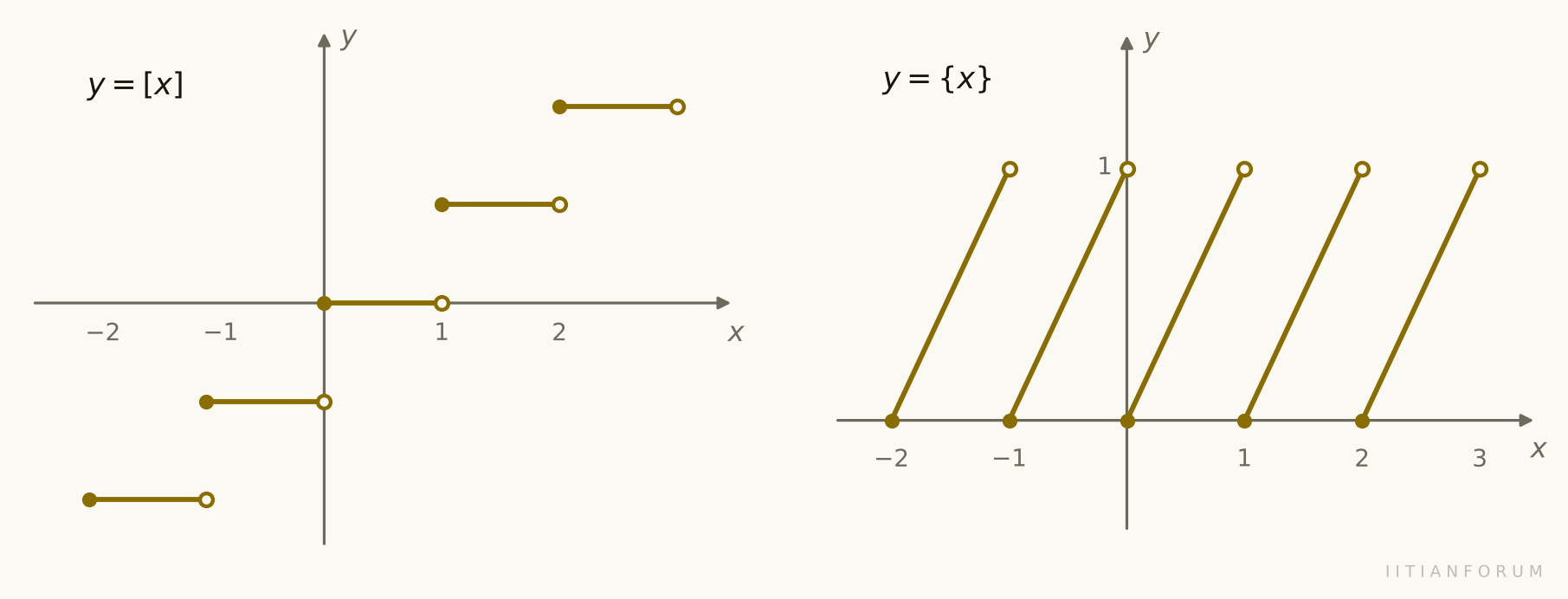
[x] is constant between integers and jumps by 1 at each integer; {x}=x−[x] rises from 0 towards 1 and drops back. So at an integer n:
x→n−lim[x]=n−1,x→n+lim[x]=nx→n−lim{x}=1,x→n+lim{x}=0Two graphs side by side: the step graph of the greatest integer of x from minus 2 to 3 with a filled dot at the left end and a hollow dot at the right end of each step, and the sawtooth graph of the fractional part of x rising from 0 to 1 on each unit interval with filled dots at the bottom and hollow dots at the top
Two facts save time. For non-integer x, [x]+[−x]=−1. And near 0+, x[xk]→k, because xk−1<[xk]≤xk.
Example 28(IITianForum). For an integer n, find
x→nlim((−1)[x]−(−1)[−x])▸ SHOW SOLUTION
Step 1. Left of n
[x]=n−1, and −x is just above −n, so [−x]=−n.
(−1)n−1−(−1)n=−2(−1)n
Step 2. Right of n
[x]=n, and −x is just below −n, so [−x]=−n−1.
(−1)n−(−1)n+1=2(−1)n
Step 3. Compare
The two sides differ in sign.
Answer: the limit does not exist.
With a plus sign instead of a minus, both sides would give 0 and the limit would exist. The sign of the combination decides everything here.
Example 29(JEE Main 2025, 29 January Shift 1). The least p∈N for which
x→0+lim(xk=1∑p[xk]−x2k=1∑9[x2k2])≥1
is ______.
▸ SHOW SOLUTION
Step 1. Each bracket
x[xk]→k,x2[x2k2]→k2
Step 2. The limit
2p(p+1)−(12+22+⋯+92)=2p(p+1)−285
Step 3. Inequality
p(p+1)≥572
23⋅24=552 fails, 24⋅25=600 works.
Answer:24
Finding constants from a given limit
This is the single most common JEE pattern. The logic is always the same.
If the denominator tends to 0 and the limit is finite, the numerator must also tend to 0. That gives the first equation.
Expand the numerator in powers of (x−a). Every power lower than the one in the denominator must have zero coefficient.
The first surviving coefficient, divided by the denominator's, equals the given limit.
Count conditions
Each unknown constant needs one equation. So a limit with two unknowns usually kills two lower powers, and a limit with three unknowns kills three. If you find you have fewer equations than unknowns, expand one term further.
Example 30(JEE Main 2026, 2 April Shift 1). If
x→2lim(x−1−1)ln(x−1)sin(x3−5x2+ax+b)=m
then a+b+m is
Tap an option to check your answer
(1)5
(2)6
(3)8
(4)10
▸ SHOW SOLUTION
Step 1. Denominator near x = 2
x−1−1≈2x−2ln(x−1)≈x−2
So the denominator ≈2(x−2)2.
Step 2. The cubic must have a double root at 2
Write p(x)=x3−5x2+ax+b. Then p(2)=0 and p′(2)=0:
2a+b=12,a=8
So b=−4 and p(x)=(x−2)2(x−1).
Step 3. m
m=lim(x−2)2/2(x−2)2(x−1)=2
Answer: (2) 8−4+2=6
Example 31(JEE Main 2026, 22 January Shift 2). If
x→0limxcosx−ln(1+x)e(a−1)x+2cosbx+(c−2)e−x=2
then a2+b2+c2 is
Tap an option to check your answer
(1)5
(2)3
(3)7
(4)9
▸ SHOW SOLUTION
Step 1. Denominator
xcosx−ln(1+x)=2x2+⋯
Step 2. Numerator coefficients
Constant: 1+2+(c−2)=c+1=0, so c=−1.
x: (a−1)−(c−2)=a+2=0, so a=−2.
x2: 2(a−1)2−b2+2c−2=3−b2.
Step 3. Ratio
1/23−b2=2⟹b2=2
Answer: (3) 4+2+1=7
Example 32(JEE Main 2025, 2 April Shift 2). If
x→0limx4cos2x+acos4x−b
is finite, then a+b is
Tap an option to check your answer
(1)21
(2)0
(3)43
(4)−1
▸ SHOW SOLUTION
Step 1. Expand
cos2x=1−2x2+⋯cos4x=1−8x2+⋯
Step 2. Kill the constant and the x² term
1+a−b=0,−2−8a=0
a=−41, b=43.
Answer: (1) 21
Example 33(JEE Main 2025, 2 April Shift 1). If
x→0limsin2x−βxx2sinαx+(γ−1)ex2=3
then β+γ−α is
Tap an option to check your answer
(1)7
(2)4
(3)6
(4)−1
▸ SHOW SOLUTION
Step 1. Numerator must vanish at 0
γ−1=0, so γ=1, and the numerator is x2sinαx≈αx3.
Step 2. Denominator must be of order x³
sin2x−βx=(2−β)x−34x3+⋯
If β=2 the limit is 0, so β=2.
Step 3. Ratio
−4/3α=3⟹α=−4
Answer: (1) 2+1+4=7
Example 34(JEE Main 2025, 4 April Shift 1). Let N(x)=(x−1)(6+λcos(x−1))+μsin(1−x). If
x→1+lim(x−1)3N(x)=−1
then λ+μ is
Tap an option to check your answer
(1)18
(2)20
(3)19
(4)17
▸ SHOW SOLUTION
Step 1. Put x = 1 + t
t(6+λcost)−μsint=(6+λ−μ)t+(6μ−2λ)t3+⋯
Step 2. Coefficients
6+λ−μ=0,6μ−2λ=−1
λ=6, μ=12.
Answer: (1) 18
Example 35(JEE Main 2026, 6 April Shift 2). Let g(x)=rx2+(p−2)x−2p and
x→2lim(x−2)2g(x)tan(x−2)=5
If the set of all q for which both roots of rx2−px+q=0 lie in (0,2) is (α,β], then 4(α+β) is
Tap an option to check your answer
(1)11
(2)13
(3)17
(4)21
▸ SHOW SOLUTION
Step 1. The quadratic must vanish at 2
4r+2(p−2)−2p=0⟹r=1
Then x2+(p−2)x−2p=(x−2)(x+p).
Step 2. The limit
x−2tan(x−2)⋅(x+p)→2+p
2+p=5, so p=3.
Step 3. Both roots of the quadratic in (0, 2)
The quadratic is x2−3x+q. Real roots: 9−4q≥0. Value at 0: q>0. Value at 2: q−2>0. Vertex 23 lies inside.
2<q≤49
Answer: (3) 4(2+49)=17
Example 36(JEE Main 2026, 2 April Shift 2). Let f(x) be a polynomial of degree 5 with extrema at x=1 and x=−1. If
x→0limx3f(x)=−5
then f(2)−f(−2) is
Tap an option to check your answer
(1)0
(2)50
(3)92
(4)112
▸ SHOW SOLUTION
Step 1. Shape from the limit
The limit is finite and non-zero, so f has no terms below x3 and the x3 coefficient is −5:
f(x)=ax5+bx4−5x3
Step 2. Extrema at ±1
f′(x)=5ax4+4bx3−15x25a+4b=15,5a−4b=15
b=0, a=3.
Step 3. Evaluate
f(x)=3x5−5x3 is odd, so f(2)−f(−2)=2f(2)=2(96−40).
Answer: (4) 112
Example 37(JEE Main 2025, 24 January Shift 1). Let f:R−{0}→R satisfy
f(x)−6f(x1)=3x35−25
If
x→0lim(αx1+f(x))=β
then α+2β is
Tap an option to check your answer
(1)3
(2)5
(3)4
(4)6
▸ SHOW SOLUTION
Step 1. Replace x by 1/x and solve
f(x1)−6f(x)=335x−25
Solving the two equations:
f(x)=−2x+21−3x1
Step 2. Finite limit
αx1−3x1+21−2x
The x1 terms must cancel: α=3, and then β=21.
Answer: (3) 3+1=4
Which method to use
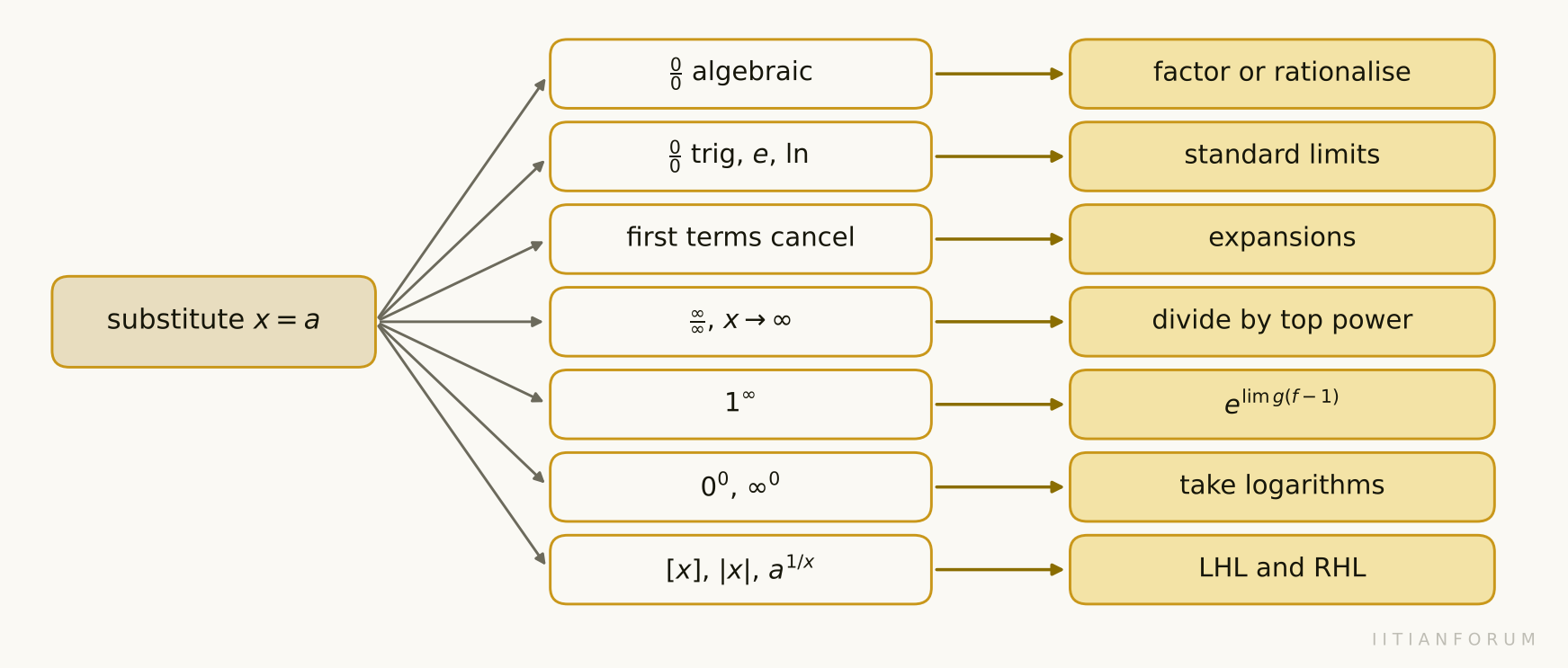
A decision chart: from what substitution gives, arrows lead to factor or rationalise, standard limits, divide by the highest power, expansions, the 1 to the infinity formula, logarithms, and checking left and right limits
Substitution gives
Reach for
a number
that number is the limit
00 with polynomials or roots
factor (x−a), or rationalise
00 with sin, tan, e, ln
standard limits, replacing x by what tends to 0
a difference whose first terms cancel
expansions to the first surviving power
∞∞ as x→∞
divide by the highest power
∞−∞
combine into one fraction, or expand each term
1∞
elimg(f−1)
00 or ∞0
take logarithms
f known only through f(a), f′(a)
L'Hôpital
a bounded part like sin or [⋅]
sandwich theorem
[x], {x}, ∣x∣, a1/x
LHL and RHL separately
unknown constants and a finite limit
cancel lower powers, match the first the equal power
swipe for more →
Quick recall
Result
Statement
Existence
LHL = RHL, both finite
x−axn−an
nan−1
xsinx, xtanx
1
x21−cosx
21
xax−1
lna
xln(1+x)
1
(1+x)1/x
e
Rational at infinity
compare degrees
Growth
lnx≪xk≪ex
Sandwich
g≤f≤h, g,h→L⇒f→L
1∞
elimg(f−1)
00, ∞0
logs, tlnt→0
[x] at integer n
LHL n−1, RHL n
[x]+[−x]
−1 for non-integer x
swipe for more →
Before you leave this chapter
Without a pen, say which method each of these needs: x3tanx−sinx, (cosx)1/x2, x2+x−x as x→∞, and x[x1] as x→0+. If all four answers come instantly (expansion, 1∞, rationalise, sandwich), the chapter is yours.
Practise these methods on real exam questions in the doMath Limits chapter, and then move on to Continuity and Differentiability, which is built on the LHL and RHL ideas of the first section.