Functions for JEE: Domain, Range, Inverse and Equations
Ritesh Raj · 3 Nov 2026
Aa
41 min read21 sectionsConcept
A function is a rule that gives every input exactly one output. That single sentence is the whole chapter: the domain asks which inputs are allowed, the range asks which outputs actually occur, one-one and onto ask how inputs and outputs are paired, and the inverse, the composite, even and odd, periodic and functional equations all describe that pairing in different ways. JEE uses functions in almost every calculus question, so speed here pays everywhere.
This note follows the order in which JEE asks the chapter: the meaning of a function, domain, range, the standard functions and their graphs, transformations, one-one and onto, counting functions, composition, the inverse, even and odd functions, periodic functions and functional equations. Every worked example is a JEE Main 2025 or 2026 or JEE Advanced 2026 question unless it says otherwise, and every answer was re-derived from scratch.
What is a function
For sets A and B, the cartesian productA×B is the set of all ordered pairs (a,b) with a∈A, b∈B. Any subset of A×B is a relation from A to B.
A relation f from A to B is a function, written f:A→B, when
every element of A has an image, and
no element of A has two images.
So in a function each input is used, and used once. Two inputs may share an output; that is allowed.
Word
Meaning for f:A→B
Domain
A, the set of allowed inputs
Co-domain
B, the set in which outputs lie
Range
f(A)={f(a):a∈A}, the outputs that actually occur
swipe for more →
Always f(A)⊆B. The range can be smaller than the co-domain.
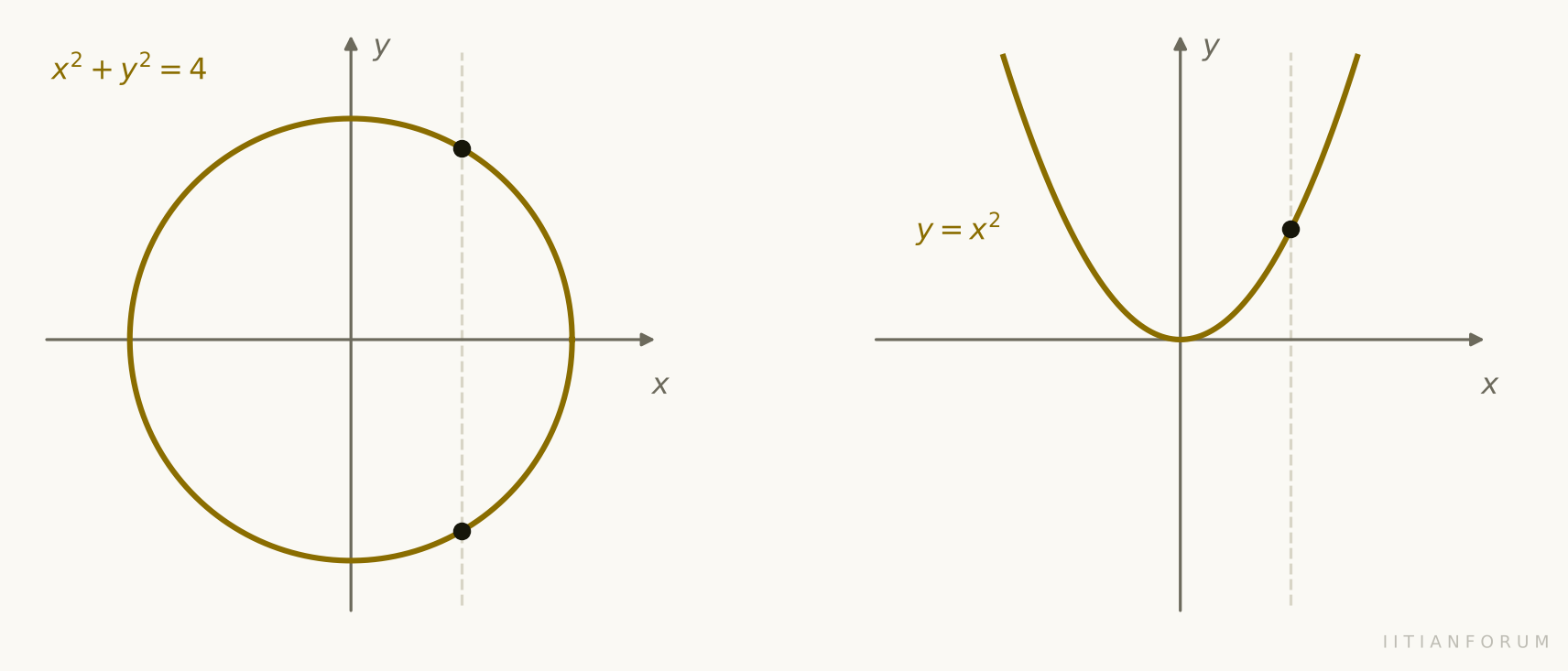
Vertical line test. A curve in the plane is the graph of a function of x exactly when every vertical line meets it at most once.
Two graphs side by side: on the left a circle centred at the origin cut by a dashed vertical line that meets it at two marked points; on the right an upward parabola cut by a dashed vertical line that meets it at one marked point
Real valued functions. When the range lies in R, the function is real valued. For two such functions on a common domain,
The domain of f±g and fg is Df∩Dg; for gf, remove also the zeros of g.
Equal functions
f and g are equal only when they have the same domain and f(x)=g(x) at every point of it. So xx2 and x are not equal (the first is not defined at 0), and lnx2 and 2lnx are not equal (the first is defined for all x=0, the second only for x>0).
Example 1(IITianForum). Let A={1,2,3} and B={4,5,6}. Which of these relations are functions from A to B? For each function, write its range.
R1={(1,4),(2,5),(3,4)}R2={(1,4),(2,6)}R3={(1,4),(1,5),(2,6),(3,6)}▸ SHOW SOLUTION
Step 1. Check each input
R1: 1,2,3 each appear once as a first entry. Function.
R2: 3 has no image. Not a function.
R3: 1 has two images, 4 and 5. Not a function.
Step 2. Range of R₁
Outputs that occur: 4 and 5.
Answer: only R1 is a function; its range is {4,5}, a proper subset of the co-domain B.
Domain
The domain of a formula is the set of all real x for which every part of the formula gives a real number. Write one condition for each part, solve each, and intersect.
Part
Condition
g(x)
g(x)≥0
g(x)1
g(x)=0
logag(x)
g(x)>0
logh(x)g(x)
g>0, h>0, h=1
sin−1g, cos−1g
−1≤g(x)≤1
sec−1g, cosec−1g
∣g(x)∣≥1
tanx, secx
x=(2n+1)2π
cotx, cosecx
x=nπ
swipe for more →
Two facts settle most log conditions:
a>1:logau>k⟺u>ak0<a<1:logau>k⟺0<u<ak
The second line reverses the inequality because loga is decreasing when the base is less than 1.
Nested logs
For logplogqlogr(u) with all bases greater than 1, work from outside in: the outer log needs its argument >0, so logqlogru>0, so logru>1, so u>r. One clean inequality replaces three.
Example 2(IITianForum). Find the domain of
f(x)=x−2+log10(5−x)1▸ SHOW SOLUTION
Step 1. Root
x−2≥0⇒x≥2
Step 2. Log in the denominator
5−x>0 gives x<5. The log must not be zero: 5−x=1, so x=4.
Step 3. Intersect
Answer:[2,4)∪(4,5)
Example 3(JEE Main 2026, 24 January Shift 1). If the domain of the function
f(x)=log(10x2−17x+7)(18x2−11x+1)
is (−∞,a)∪(b,c)∪(d,∞)−{e}, then 90(a+b+c+d+e) equals
Tap an option to check your answer
(1)170
(2)177
(3)307
(4)316
▸ SHOW SOLUTION
Step 1. Argument positive
18x2−11x+1=(2x−1)(9x−1)>0x<91orx>21
Step 2. Base positive
10x2−17x+7=(x−1)(10x−7)>0x<107orx>1
Step 3. Base not equal to 1
10x2−17x+6=(5x−6)(2x−1)=0
x=21 is already excluded by Step 1, so only x=56 is removed.
Step 4. Intersect
(−∞,91)∪(21,107)∪(1,∞)−{56}
So a=91, b=21, c=107, d=1, e=56.
90(a+b+c+d+e)=10+45+63+90+108
Answer:316, option (4)
Example 4(JEE Main 2026, 23 January Shift 1). Let the domain of the function f(x)=log3log5log7(9x−x2−13) be the interval (m,n). Let the hyperbola a2x2−b2y2=1 have eccentricity 3n and length of latus rectum 38m. Then b2−a2 is equal to
Tap an option to check your answer
(1)5
(2)11
(3)9
(4)7
▸ SHOW SOLUTION
Step 1. Outside in
log3(⋅) needs log5log7u>0, so log7u>1, so u>7:
9x−x2−13>7x2−9x+20<0⇒(x−4)(x−5)<0
So m=4, n=5.
Step 2. Hyperbola
e2=925=1+a2b2⇒a2b2=916a2b2=332⇒ab2=316
Divide: a=3, then b2=16.
Answer:b2−a2=7, option (4)
Example 5(JEE Main 2026, 22 January Shift 2). Let the domain of the function
f(x)=log3log5(7−log2λ)+sin−117−x3x−7,
where λ=x2−10x+85, be (α,β]. Then α+β is equal to
Tap an option to check your answer
(1)10
(2)12
(3)9
(4)8
▸ SHOW SOLUTION
Step 1. The log part
λ=(x−5)2+60>0 always. The outer log needs log5(7−log2λ)>0:
7−log2λ>1⇒λ<26=64x2−10x+21<0⇒x∈(3,7)
Step 2. The inverse sine part
(3x−7)2≤(17−x)28x2−8x−240≤0(x−6)(x+5)≤0
So x∈[−5,6].
Step 3. Intersect
(3,7)∩[−5,6]=(3,6], so α=3, β=6.
Answer:9, option (3)
Example 6(JEE Main 2026, 2 April Shift 1). If the domain of the function
f(x)=log0.6x2−42x−5
is (−∞,a]∪{b}∪[c,d)∪(e,∞), then the value of a+b+c+d+e is ______.
▸ SHOW SOLUTION
Step 1. Reduce to one inequality
The root needs the log ≥0. The base 0.6 is less than 1, so the inequality reverses:
[0,23] lies inside (−∞,516], so the domain is [0,23].
Answer:α+2β=0+3=3, option (2)
Example 8(JEE Main 2026, 22 January Shift 1). If the domain of
f(x)=sin−13+2x5−x+log(10−x)1
is (−∞,α]∪[β,γ)−{δ}, then 6(α+β+γ+δ) is
Tap an option to check your answer
(1)70
(2)66
(3)67
(4)68
▸ SHOW SOLUTION
Step 1. Inverse sine
∣5−x∣≤∣3+2x∣ with x=−23. Square:
25−10x+x2≤4x2+12x+93x2+22x−16≥0(3x−2)(x+8)≥0
So x≤−8 or x≥32.
Step 2. Log in the denominator
10−x>0 and 10−x=1: x<10, x=9.
Step 3. Intersect
(−∞,−8]∪[32,10)−{9}6(−8+32+10+9)=6⋅335
Answer:70, option (1)
Example 9(JEE Main 2026, 24 January Shift 2). If the domain of the function
f(x)=sin−1x2−2x−21
is (−∞,α]∪[β,γ]∪[δ,∞), then α+β+γ+δ is equal to
Tap an option to check your answer
(1)2
(2)4
(3)3
(4)5
▸ SHOW SOLUTION
Step 1. Use t
Let t=x2−2x−2=(x−1)2−3, t=0. The condition t1≤1 is simply
∣t∣≥1
Step 2. Two cases
t≥1: (x−1)2≥4, so x≤−1 or x≥3.
t≤−1: (x−1)2≤2, so 1−2≤x≤1+2.
Step 3. Domain
(−∞,−1]∪[1−2,1+2]∪[3,∞)
Answer:−1+(1−2)+(1+2)+3=4, option (2)
The reciprocal step in Example 9 is worth remembering: t1≤1⟺∣t∣≥1. It turns a rational inequality into two quadratic ones.
Domain with the greatest integer function
[x] is the greatest integer not exceeding x. On each interval n≤x<n+1 it is the constant n, so a condition containing [x] is solved one interval at a time.
Example 10(JEE Main 2026, 6 April Shift 1). Let [⋅] denote the greatest integer function. If the domain of the function f(x)=sin−1(3x+[x]) is [α,β), then α2+β2 is equal to
Tap an option to check your answer
(1)2
(2)5
(3)10
(4)13
▸ SHOW SOLUTION
Step 1. Condition
−3≤x+[x]≤3
Step 2. Interval by interval
On [n,n+1), x+[x]=x+n runs over [2n,2n+1).
n
x+[x]
inside [−3,3]?
−2
[−4,−3)
no
−1
[−2,−1)
yes
0
[0,1)
yes
1
[2,3)
yes
2
[4,5)
no
swipe for more →
Step 3. Domain
[−1,0)∪[0,1)∪[1,2)=[−1,2), so α=−1, β=2.
Answer:α2+β2=5, option (2)
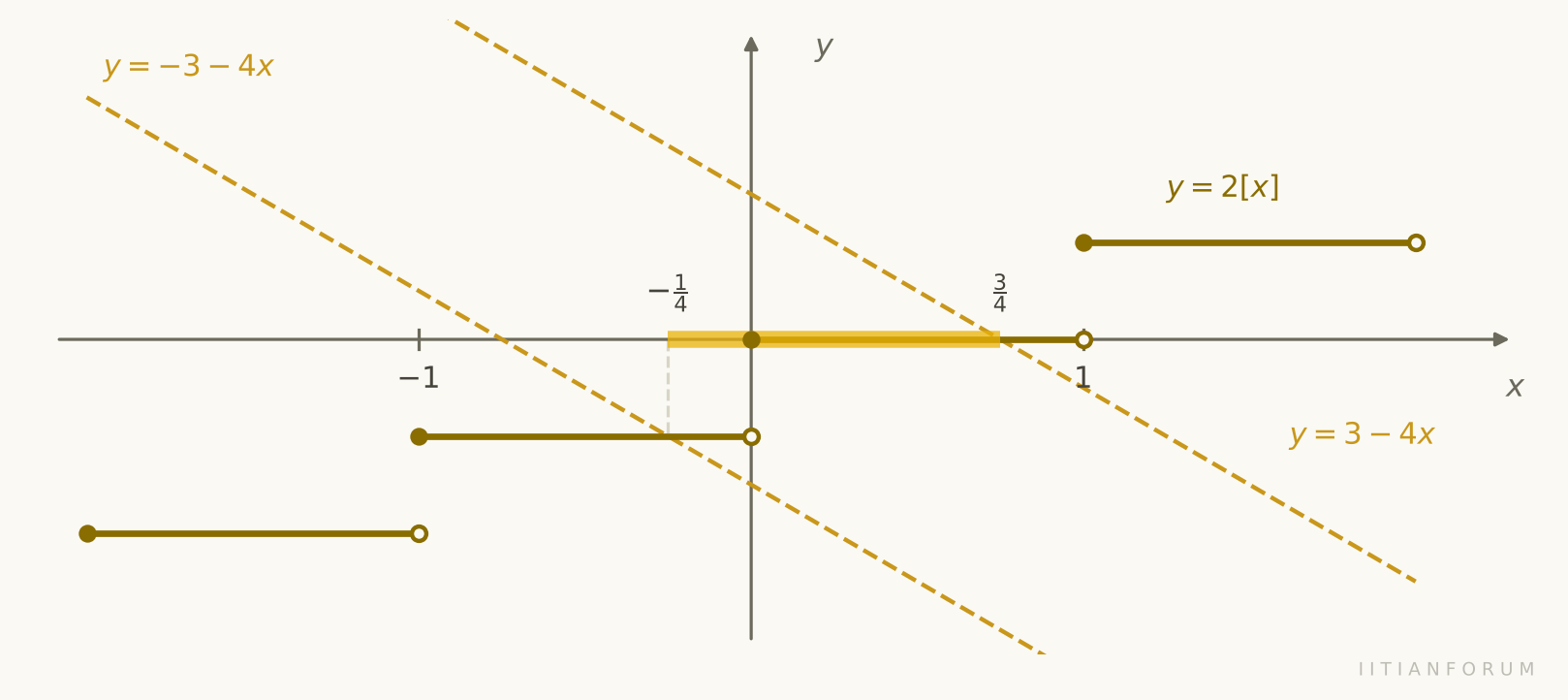
Example 11(JEE Main 2026, 4 April Shift 1). Let [⋅] denote the greatest integer function. If the domain of f(x)=cos−1(34x+2[x]) is [α,β], then 12(α+β) is equal to
Tap an option to check your answer
(1)6
(2)8
(3)9
(4)4
▸ SHOW SOLUTION
Step 1. Condition
−3≤4x+2[x]≤3−3−4x≤2[x]≤3−4x
Step 2. Interval [0, 1)
[x]=0: −3−4x≤0≤3−4x gives 0≤x≤43.
Step 3. Interval [−1, 0)
[x]=−1: −3−4x≤−2 gives x≥−41; the other side holds for all x<0. So −41≤x<0.
Step 4. Other intervals
For x≥1, 4x+2[x]≥6>3. For x<−1, 4x+2[x]<−8. Nothing more.
Step 5. Domain
[−41,0)∪[0,43]=[−41,43].
Answer:12(−41+43)=6, option (1)
The step graph y equals 2 times the greatest integer of x, drawn as horizontal segments with filled left ends and hollow right ends, together with two parallel falling lines y equals 3 minus 4x and y equals minus 3 minus 4x; the part of the x axis from minus one quarter to three quarters, where the steps lie between the two lines, is highlighted
The picture shows Example 11 at a glance: x is in the domain exactly when the step 2[x] lies between the two falling lines.
Range
The range is the set of values f(x) actually takes. JEE uses six methods.
Solve for x. Put y=f(x), make x the subject, and see which y give a valid x in the domain.
Discriminant. If y=f(x) becomes a quadratic in x, real x needs discriminant ≥0.
Substitution. Put t= a simpler piece (∣x∣, cosx, 2x), find the range of t, then the range of y in terms of t.
Monotonicity. A function increasing on [a,b] has range [f(a),f(b)].
Standard bounds.−a2+b2≤asinx+bcosx≤a2+b2, and t+t1≥2 for t>0.
Graph. Read the lowest and highest heights the curve reaches.
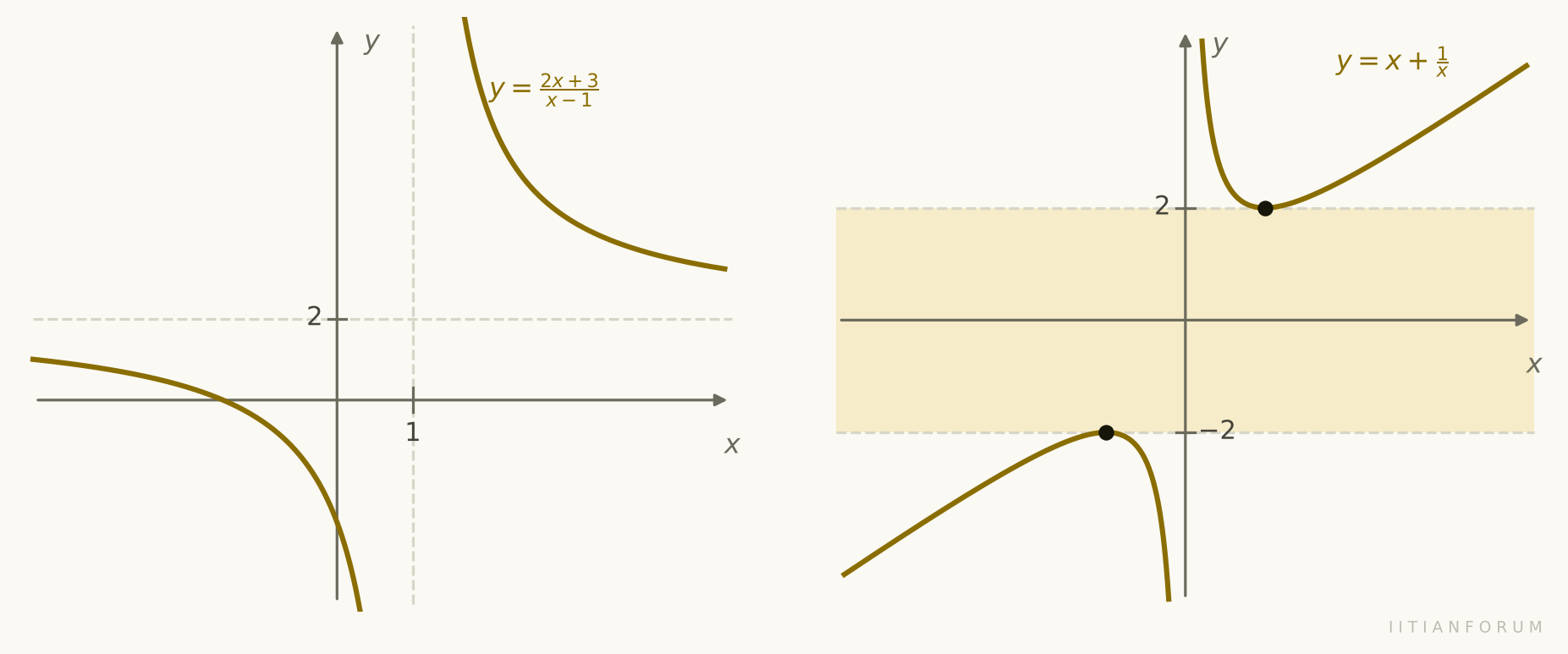
Two graphs side by side: on the left the hyperbola y equals 2x plus 3 over x minus 1 with dashed asymptotes x equals 1 and y equals 2, the curve never touching the horizontal asymptote; on the right the curve y equals x plus 1 over x with its two branches, the lower branch peaking at height minus 2 and the upper branch bottoming at height 2, and the horizontal band between minus 2 and 2 shaded as a gap the curve never enters
Example 12(IITianForum). Find the range of f(x)=x−12x+3.
▸ SHOW SOLUTION
Step 1. Solve for x
y(x−1)=2x+3⇒x(y−2)=y+3x=y−2y+3
Step 2. Which y work
y=2 gives no x. For y=2 the value of x is never 1 (that would need y+3=y−2).
Answer:R−{2}. The horizontal asymptote y=2 is the missing value (left panel of the figure).
Example 13(JEE Main 2025, 7 April Shift 2). If the range of the function f(x)=x2−3x+25−x, x=1,2, is (−∞,α]∪[β,∞), then α2+β2 is equal to
Tap an option to check your answer
(1)190
(2)192
(3)188
(4)194
▸ SHOW SOLUTION
Step 1. Quadratic in x
yx2+(1−3y)x+(2y−5)=0
y=0 gives x=5, allowed. For y=0, real x needs
(1−3y)2−4y(2y−5)≥0y2+14y+1≥0
Step 2. Excluded points
x=1 would need −4=0 and x=2 would need −3=0, so no root is lost.
Step 3. Range
Roots of y2+14y+1=0: y=−7±43. So α=−7−43, β=−7+43.
α2+β2=2(49+48)
Answer:194, option (4)
Common mistake with the discriminant method
After finding the y values from D≥0, check two things: the case where the x2 coefficient is zero, and whether the x you get is one of the points removed from the domain. Either can add or remove a value from the range.
Example 14(IITianForum). Find the range of
f(x)=2∣x∣+13∣x∣−2▸ SHOW SOLUTION
Step 1. Substitute t = |x|
t takes every value in [0,∞).
y=2t+13t−2=23−2(2t+1)7
Step 2. Monotone in t
As t grows, 2(2t+1)7 falls, so y rises. At t=0, y=−2. As t grows without bound, y gets as close to 23 as we like but never equals it.
Answer:[−2,23)
Example 15(JEE Main 2026, 5 April Shift 1). The sum of all the integral values of p such that the equation 3sin2x+12cosx−3=p, x∈R, has at least one solution, is
Tap an option to check your answer
(1)−54
(2)−60
(3)−75
(4)−84
▸ SHOW SOLUTION
Step 1. Equation has a solution iff p is in the range
Put c=cosx∈[−1,1]:
3(1−c2)+12c−3=12−3(c−2)2
Step 2. Range
c−2∈[−3,−1], so (c−2)2∈[1,9] and the range is [−15,9].
Step 3. Sum of integers from −15 to 9
The terms −9 to 9 cancel, leaving −(10+11+12+13+14+15).
Answer:−75, option (3)
Example 16(JEE Main 2026, 28 January Shift 1). In a G.P., if the product of the first three terms is 27 and the set of all possible values for the sum of its first three terms is R−(a,b), then a2+b2 is equal to ______.
▸ SHOW SOLUTION
Step 1. Terms
Take the terms rA,A,Ar. Product A3=27, so A=3.
S=3(1+r+r1)
Step 2. Range of r + 1/r
For r>0, r+r1≥2 (AM ≥ GM). For r<0, r+r1≤−2. So r+r1∈(−∞,−2]∪[2,∞) (right panel of the figure).
Step 3. Range of S
S≥3(1+2)=9 or S≤3(1−2)=−3. So S∈R−(−3,9).
Answer:a2+b2=9+81=90
Standard functions and their graphs
Function
Domain
Range
polynomial, odd degree
R
R
∣x∣
R
[0,∞)
sgnx
R
{−1,0,1}
[x]
R
Z
{x}=x−[x]
R
[0,1)
ax (a>0, a=1)
R
(0,∞)
logax
(0,∞)
R
sinx, cosx
R
[−1,1]
tanx
x=(2n+1)2π
R
cotx
x=nπ
R
secx
x=(2n+1)2π
(−∞,−1]∪[1,∞)
cosecx
x=nπ
(−∞,−1]∪[1,∞)
swipe for more →
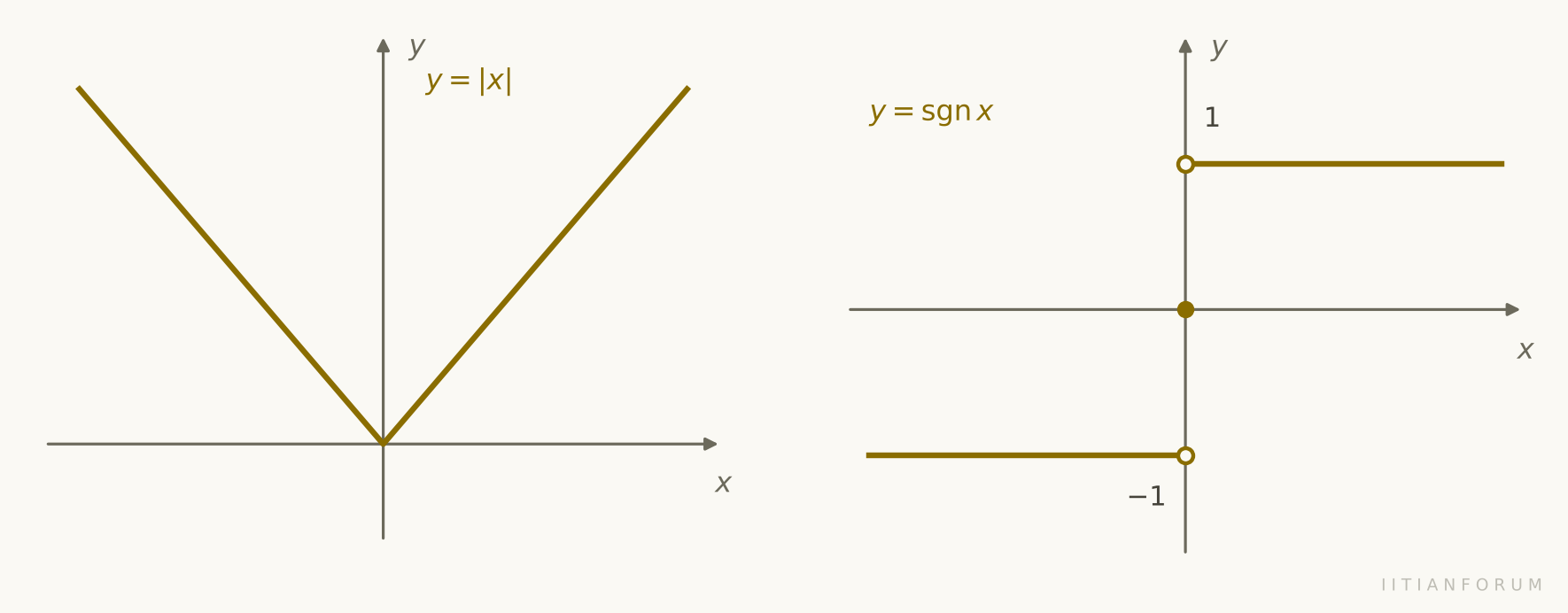
Modulus and signum
∣x∣=x(x≥0),∣x∣=−x(x<0)
sgnx is 1 for x>0, 0 at x=0 and −1 for x<0. For x=0, sgnx=x∣x∣.
Two graphs side by side: on the left the V shaped graph of y equals modulus of x with its corner at the origin; on the right the signum function, a horizontal ray at height 1 for positive x starting with a hollow dot, a filled dot at the origin, and a horizontal ray at height minus 1 for negative x ending with a hollow dot
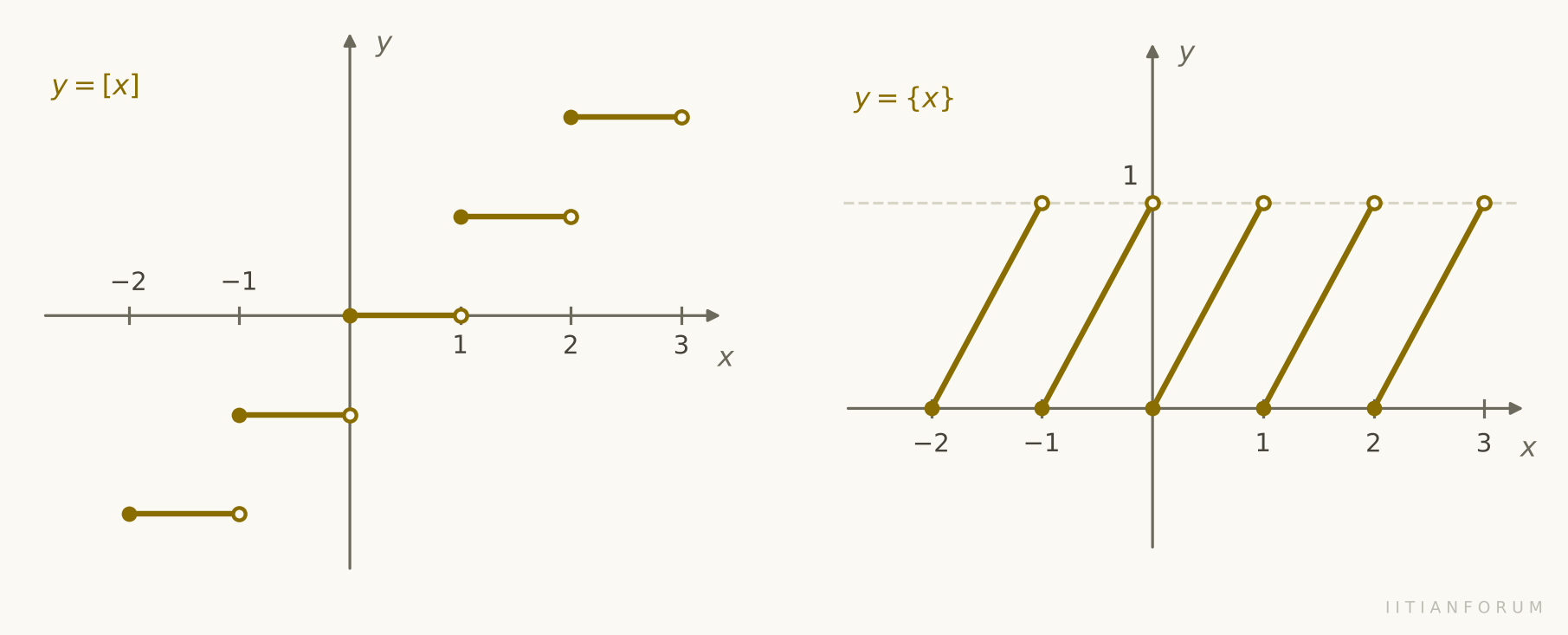
Greatest integer and fractional part
[x] is the greatest integer ≤x, and {x}=x−[x]. Examples: [2.7]=2, [−2.7]=−3, {−2.7}=0.3.
Two graphs side by side: on the left the staircase y equals greatest integer of x, each step a horizontal segment with a filled dot at its left end and a hollow dot at its right end; on the right the sawtooth y equals fractional part of x, rising lines of slope 1 from filled dots on the x axis to hollow dots at height 1, under a dashed line at height 1
Property
Holds for
x−1<[x]≤x
all x
[x+n]=[x]+n
integer n
[x]+[−x]=0
x∈Z
[x]+[−x]=−1
x∈/Z
{x}+{−x}=0 or 1
x∈Z or not
[x+y]=[x]+[y] or [x]+[y]+1
as {x}+{y}<1 or ≥1
swipe for more →
Exponential and logarithm
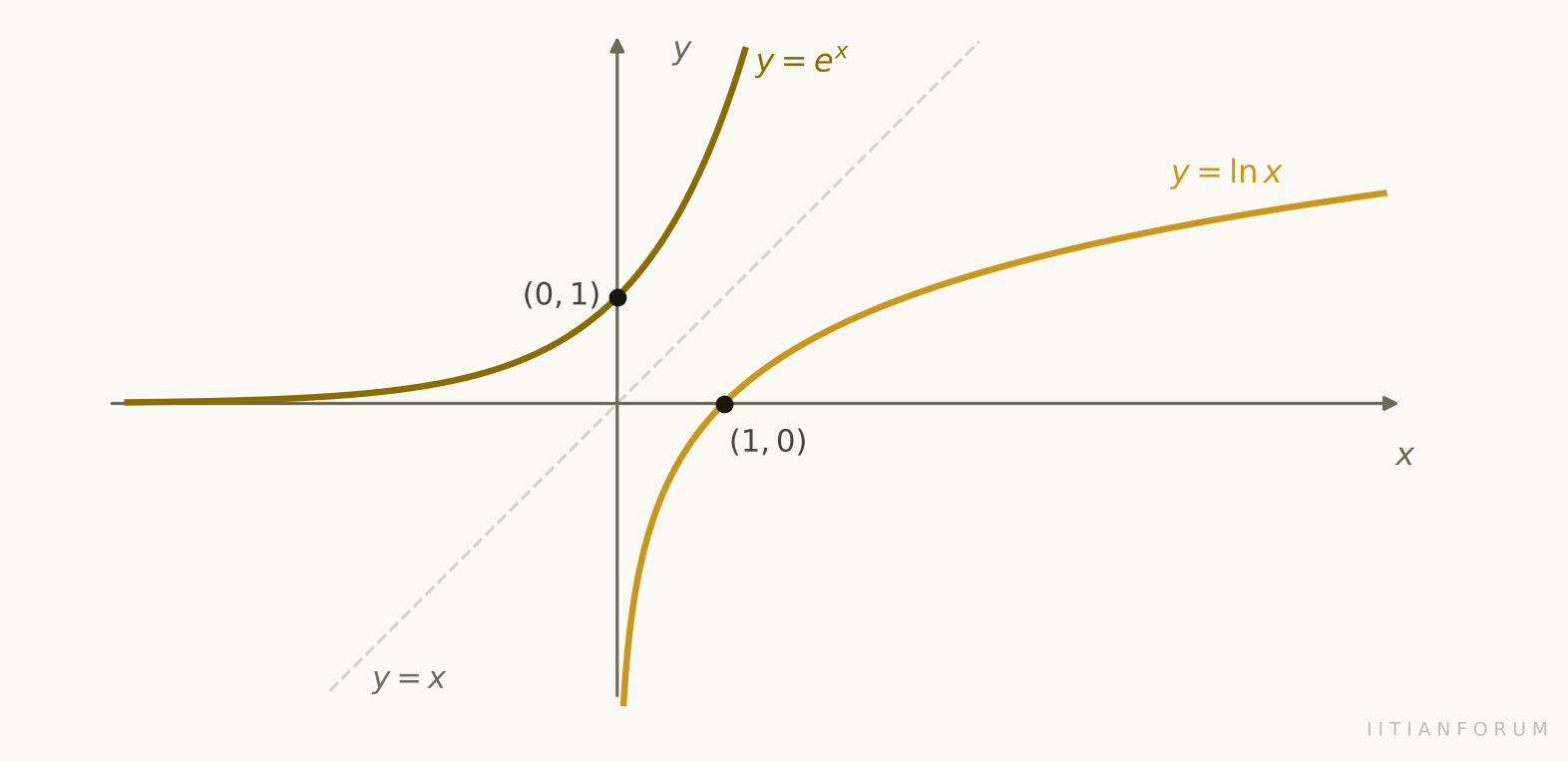
y=ax and y=logax are inverses of each other, so their graphs are mirror images in the line y=x. For a>1 both increase; for 0<a<1 both decrease.
The exponential curve y equals e to the x and the logarithm curve y equals log x drawn as mirror images in the dashed line y equals x; the exponential passes through the point 0 comma 1 and stays above the x axis, the logarithm passes through 1 comma 0 and stays to the right of the y axis
Example 17(IITianForum). Let [⋅] denote the greatest integer function. All values of x for which the product
[x−31][x+32]
is a prime number form the set [x1,x2)∪[x3,x4). Find x12+x22+x32+x42.
▸ SHOW SOLUTION
Step 1. Consecutive integers
x+32=(x−31)+1, so with n=[x−31] the product is n(n+1).
Step 2. When is n(n+1) prime
n(n+1) is a product of two consecutive integers, hence even. The only even prime is 2:
n(n+1)=2⇒n=1orn=−2
Step 3. Back to x
n=1: 1≤x−31<2, so x∈[34,37).
n=−2: −2≤x−31<−1, so x∈[−35,−32).
925+4+16+49=994
Answer:994
Example 18(JEE Main 2026, 28 January Shift 2). The sum of all the elements in the range of
f(x)=Sgn(sinx)+Sgn(cosx)+Sgn(tanx)+Sgn(cotx),
x=2nπ, where Sgn(t)=1 for t>0 and −1 for t<0, is
Tap an option to check your answer
(1)4
(2)2
(3)−2
(4)0
▸ SHOW SOLUTION
Step 1. Quadrant by quadrant
tanx and cotx always have the same sign, equal to the sign of sinxcosx.
Quadrant
sin
cos
tan,cot
f
I
+
+
+
4
II
+
−
−
−2
III
−
−
+
0
IV
−
+
−
−2
swipe for more →
Step 2. Range
{4,−2,0}, sum 2.
Answer: option (2)
Example 19(IITianForum). How many integers lie in the range of f(x)=sgn(ln(x2+x+1))?
▸ SHOW SOLUTION
Step 1. Range of the inside
x2+x+1=(x+21)2+43≥43
So the quadratic takes every value in [43,∞).
Step 2. Sign of the log
lnu<0 for 43≤u<1, lnu=0 at u=1, lnu>0 for u>1. All three occur.
Answer: the range is {−1,0,1}, so 3 integers.
Transformations of graphs
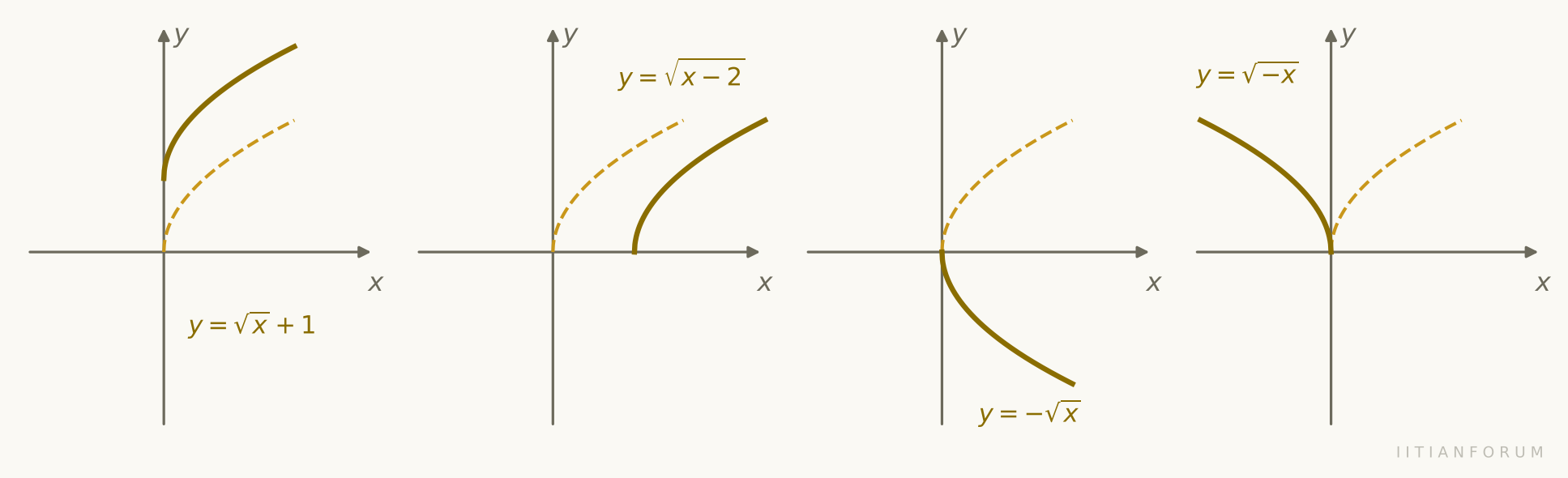
Start from the graph of y=f(x). Each change in the formula changes the graph in a fixed way (k>0, a>0).
New function
Effect on the graph
f(x)+k
up by k
f(x−a)
right by a
−f(x)
reflect in the x axis
f(−x)
reflect in the y axis
kf(x)
stretch vertically by k
f(kx)
compress horizontally by k
∣f(x)∣
parts below the x axis flip up
f(∣x∣)
keep x≥0, mirror it to x<0
swipe for more →
Four small graphs in a row, each showing the dashed curve y equals root x and one transformed copy drawn solid: the first raised by one unit, the second shifted two units right, the third reflected in the x axis so it lies below, the fourth reflected in the y axis so it lies to the left
Counting solutions with a graph
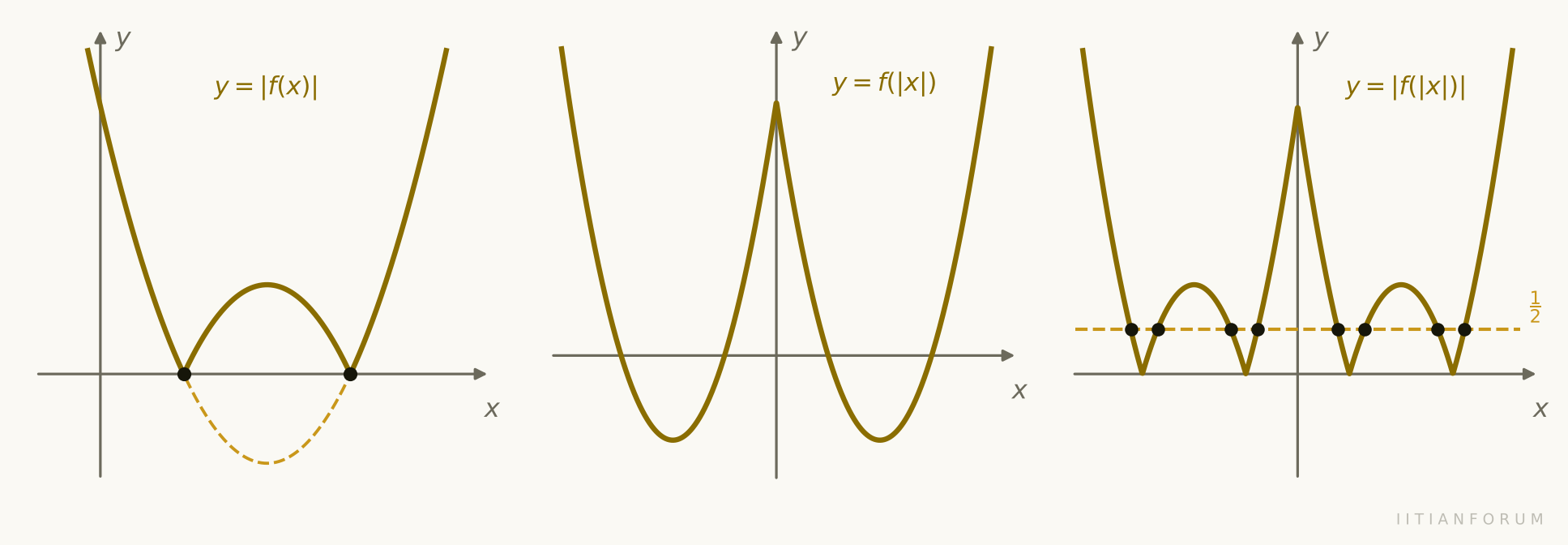
The number of real solutions of f(x)=k is the number of points where the horizontal line y=k meets the graph of f. Transform the graph first, then slide the line.
Example 20(IITianForum). Find the number of real solutions of
x2−4∣x∣+3=21▸ SHOW SOLUTION
Step 1. Use t = |x|
The left side is unchanged when x is replaced by −x, so each positive solution t gives two values x=±t. With t≥0,
t2−4t+3=21ort2−4t+3=−21
Step 2. First equation
t2−4t+25=0⇒t=2±23
Both are positive (1.5<2).
Step 3. Second equation
t2−4t+27=0⇒t=2±21
Both positive.
Step 4. Count
Four positive values of t, each giving two values of x.
Answer:8 solutions
Three graphs side by side built from the parabola y equals x squared minus 4x plus 3: the first is y equals the modulus of that parabola, with the dip between 1 and 3 flipped above the axis; the second is y equals f of modulus x, a W shape symmetric about the y axis; the third is the modulus of f of modulus x, an M and W shape crossed by the dashed horizontal line y equals one half at eight marked points
One-one, onto and bijective
For f:A→B:
Type
Meaning
one-one (injective)
f(a1)=f(a2)⇒a1=a2
many-one
two different inputs share an output
onto (surjective)
range = co-domain
into
range is a proper subset of the co-domain
bijective
one-one and onto
swipe for more →
Every function is exactly one of one-one or many-one, and exactly one of onto or into.
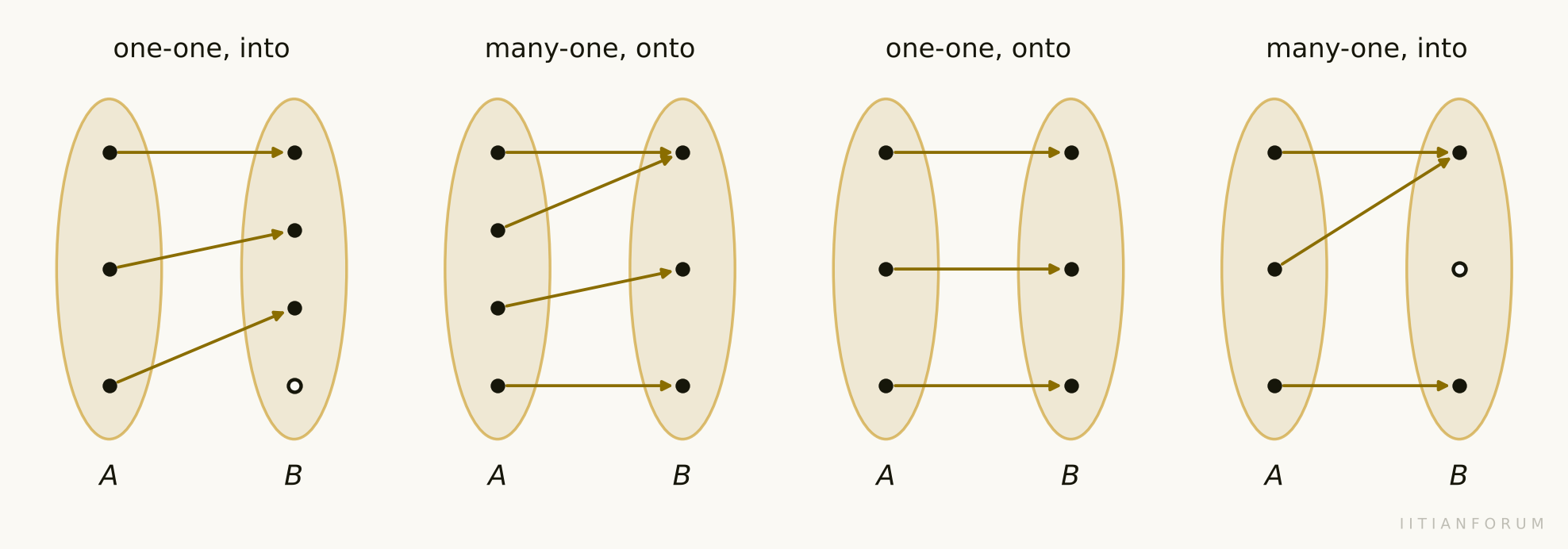
Four arrow diagrams side by side, each with a set A on the left and a set B on the right drawn as ovals with dots: the first shows three dots going to three different dots of a four dot set with one dot left unused, marked one-one into; the second shows two arrows meeting at the same dot and every dot of B used, marked many-one onto; the third shows a perfect pairing, marked one-one onto; the fourth shows two arrows meeting and a dot of B unused, marked many-one into
Tests for one-one
Definition. Assume f(a)=f(b) and show a=b; or find two inputs with the same output.
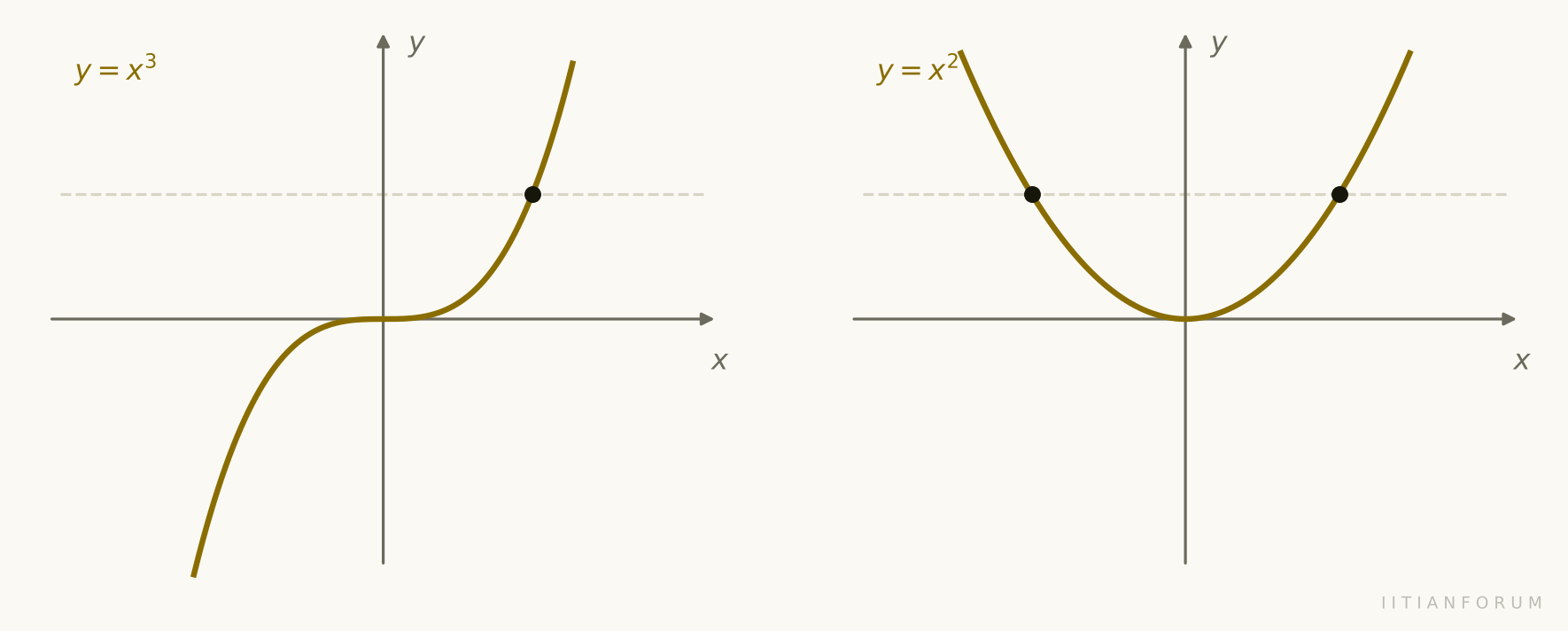
Horizontal line test.f is one-one exactly when no horizontal line meets the graph twice.
Monotonicity. If f is strictly increasing or strictly decreasing on its domain, it is one-one. For a differentiable f on an interval, f′(x)>0 throughout (or f′<0 throughout) is enough; f′≥0 with equality only at isolated points also works.
Quick rejections. An even function on a symmetric domain, a periodic function, and a continuous function with a turning point are all many-one.
Two graphs side by side: on the left the cubic y equals x cubed, cut by a dashed horizontal line that meets it once; on the right the parabola y equals x squared, cut by a dashed horizontal line that meets it at two marked points
Tests for onto
Find the range and compare it with the co-domain. A polynomial of odd degree from R to R is always onto; one of even degree never is.
Example 21(JEE Main 2026, 28 January Shift 2). Given below are two statements.
Statement I: f:R→R, f(x)=1+∣x∣x is one-one.
Statement II: f:R→R, f(x)=x2−8x+18x2+4x−30 is many-one.
Tap an option to check your answer
(1)Both false
(2)Both true
(3)I false, II true
(4)I true, II false
▸ SHOW SOLUTION
Step 1. Statement I
For x≥0, f(x)=1+xx=1−1+x1, increasing, with values in [0,1). For x<0, f(x)=1−xx, increasing, with values in (−1,0). The two pieces do not overlap, so f is strictly increasing on R: one-one. True.
Step 2. Statement II
f(0)=−1830=−35. Solve f(x)=−35 (the denominator is never zero):
3(x2+4x−30)=−5(x2−8x+18)8x2−28x=0⇒x=0,27
Two inputs, one output: many-one. True.
Answer: option (2)
Example 22(JEE Main 2026, 6 April Shift 2). Let f:R→R be defined as
f(x)=3x2+x+32x2−3x+2
Then f is
Tap an option to check your answer
(1)both one-one and onto
(2)one-one but not onto
(3)onto but not one-one
(4)neither one-one nor onto
▸ SHOW SOLUTION
Step 1. Not one-one
Both quadratics read the same from either end (2,−3,2 and 3,1,3). So multiplying the numerator and denominator of f(x1) by x2 gives f(x) back: f(x1)=f(x) for x=0. For example,
f(2)=f(21)=174
Step 2. Range
(3y−2)x2+(y+3)x+(3y−2)=0
Real x needs (y+3)2−4(3y−2)2≥0:
(7y−1)(5y−7)≤0⇒71≤y≤57
The range is bounded, not R: not onto.
Answer: option (4)
Example 23(JEE Main 2025, 24 January Shift 2). The function f:(−∞,∞)→(−∞,1), defined by f(x)=2x+2−x2x−2−x, is
Tap an option to check your answer
(1)one-one but not onto
(2)onto but not one-one
(3)both one-one and onto
(4)neither one-one nor onto
▸ SHOW SOLUTION
Step 1. Simplify
Multiply above and below by 2x:
f(x)=4x+14x−1=1−4x+12
Step 2. One-one
4x increases, so 4x+12 decreases and f increases strictly. One-one.
Step 3. Range
4x takes all values in (0,∞), so 4x+12 takes all values in (0,2) and f takes all values in (−1,1). The co-domain (−∞,1) is larger: not onto.
Answer: option (1)
Example 24(JEE Main 2025, 28 January Shift 2). Let f:[0,3]→A be defined by f(x)=2x3−15x2+36x+7 and g:[0,∞)→B be defined by g(x)=x2025+1x2025. If both the functions are onto and S={x∈Z:x∈Aorx∈B}, then n(S) is equal to
Tap an option to check your answer
(1)30
(2)36
(3)29
(4)31
▸ SHOW SOLUTION
Step 1. Onto means A is the range of f
f′(x)=6(x−2)(x−3)
f increases on [0,2] and decreases on [2,3].
f(0)=7,f(2)=35,f(3)=34
So A=[7,35].
Step 2. Range of g
g(x)=1−x2025+11 increases from 0 towards 1, so B=[0,1).
Step 3. Integers
From B: only 0. From A: 7,8,…,35, that is 29 integers.
Answer:n(S)=30, option (1)
Example 25(IITianForum). Let f:R→R satisfy x+2∣f(x)∣=3f(x) for every real x. Show that f is one-one and onto.
▸ SHOW SOLUTION
Step 1. Case f(x) ≥ 0
x+2f(x)=3f(x) gives f(x)=x. This needs x≥0.
Step 2. Case f(x) < 0
x−2f(x)=3f(x) gives f(x)=5x. This needs x<0.
Step 3. The function
f(x)=x(x≥0),f(x)=5x(x<0)
For each x exactly one case applies, so f is well defined.
Step 4. Bijective
Both pieces increase, and the left piece takes all negative values while the right piece takes all values ≥0. So f is strictly increasing with range R.
Answer:f is one-one and onto.
Example 26(IITianForum). If f:R→R,
f(x)=x3−(k−1)x2+(k+5)x−7
is a bijection, find the sum of all integral values of k.
▸ SHOW SOLUTION
Step 1. Onto is automatic
A cubic from R to R takes every real value. So bijective means one-one, which for a cubic means f′(x)≥0 for all x.
Step 2. Derivative
f′(x)=3x2−2(k−1)x+(k+5)
This is never negative when its discriminant is ≤0:
4(k−1)2−12(k+5)≤0k2−5k−14≤0⇒(k−7)(k+2)≤0
Step 3. Integers
k=−2,−1,…,7. Sum =25.
Answer:25. At k=−2 and k=7, f′ is zero at a single point only, so f is still strictly increasing.
Counting functions
Let n(A)=m and n(B)=n.
Type of f:A→B
Number
all functions
nm
one-one (m≤n)
n(n−1)⋯(n−m+1)
bijections (m=n)
n!
constant
n
onto, n=2
2m−2
onto, n=3
3m−3⋅2m+3
into
all minus onto
swipe for more →
For general n the onto count is inclusion-exclusion over the elements of B that are missed:
r=0∑n(−1)r(rn)(n−r)m
Distributions are functions
Putting m different objects into n different boxes is a function from objects to boxes. "No box empty" means onto. "At most one object per box" means one-one.
Example 27(IITianForum). For sets with n(A)=3 and n(B)=6, the number of functions from A to B is x, of which y are one-one. Find x+y.
▸ SHOW SOLUTION
Step 1. All functions
Each of the 3 elements has 6 choices: x=63=216.
Step 2. One-one
y=6⋅5⋅4=120.
Answer:x+y=336
Example 28(JEE Main 2026, 4 April Shift 1). The number of functions f:{1,2,3,4}→{a,b,c} which are not onto is
Tap an option to check your answer
(1)48
(2)45
(3)51
(4)35
▸ SHOW SOLUTION
Step 1. Total
34=81
Step 2. Onto
34−3⋅24+3⋅14=81−48+3=36
Answer:81−36=45, option (2)
Example 29(JEE Main 2026, 8 April Shift 2). A person has three different bags and four different books. The number of ways in which he can put these books in the bags so that no bag is empty, is
Tap an option to check your answer
(1)18
(2)36
(3)39
(4)72
▸ SHOW SOLUTION
Step 1. It is an onto count
Each book goes to one bag: a function from 4 books to 3 bags. No bag empty: onto.
34−3⋅24+3=36
Step 2. Check by grouping
Sizes must be 2,1,1: choose the pair, (24)=6 ways, then arrange three groups in three bags, 3!=6 ways.
Answer:36, option (2)
Example 30(JEE Main 2026, 23 January Shift 2). Consider two sets
So 5≤x≤7 or −1≤x≤1: A={−1,0,1,5,6,7}, six elements.
Step 2. B
The factor x−2 is not zero (x=2). So x=4 or ∣x−2∣=1, giving x=3 (and x=1, excluded). B={3,4}.
Step 3. Onto count
26−2=62
Answer: option (1)
Example 31(JEE Main 2026, 5 April Shift 1). Let A={1,2,3,4,5,6}. The number of one-one functions f:A→A such that f(1)≥3, f(3)≤4 and f(2)+f(3)=5, is ______.
▸ SHOW SOLUTION
Step 1. The pair (f(2), f(3))
Distinct values with sum 5 and f(3)≤4: (1,4),(4,1),(2,3),(3,2). Four pairs.
Step 2. f(1)
f(1)∈{3,4,5,6}, minus the values already used. Each pair above uses exactly one of 3,4 and none of 5,6, so f(1) has 3 choices every time.
Step 3. The rest
The remaining 3 values go to 4,5,6 in 3!=6 ways.
Answer:4×3×6=72
Example 32(JEE Advanced 2026, Paper 2). Consider the sets A={1,2,3,4,5} and B={1,2,3,4,5,6,7}. Let S be the set of all functions f:A→B such that f(2)=2 and f(4)=4. Consider the set
T={f∈S:g(f(x))=2xfor some g}
where g:B→N and the condition holds for all x∈A. Then the number of elements in T is ______.
▸ SHOW SOLUTION
Step 1. Such a g exists iff f is one-one
If f(x1)=f(x2) then 2x1=g(f(x1))=g(f(x2))=2x2, so x1=x2. Conversely, if f is one-one, set g(f(x))=2x on the range of f and give g any natural value elsewhere.
Step 2. One-one functions
7⋅6⋅5⋅4⋅3=2520
Step 3. Remove f(2) = 2 or f(4) = 4
f(2)=2: 6⋅5⋅4⋅3=360. Same for f(4)=4. Both: 5⋅4⋅3=60.
2520−360−360+60
Answer:1860
Composite functions
For f:A→B and g:B→C, the compositeg∘f:A→C is
(g∘f)(x)=g(f(x))
First apply f, then g. For formulas, the domain of g∘f is
{x∈Df:f(x)∈Dg}
Property
Statement
order matters
g∘f=f∘g in general
associative
h∘(g∘f)=(h∘g)∘f
one-one
f, g one-one ⇒g∘f one-one
onto
f, g onto ⇒g∘f onto
converse parts
g∘f one-one ⇒f one-one
g∘f onto ⇒g onto
swipe for more →
Piecewise composition
For f(f(x)) or g(f(x)) with piecewise formulas, split the x axis where f changes formula AND where f(x) crosses the break points of the outer function. Then use one formula on each piece.
Example 33(IITianForum). Let
f(x)=x+1for x<1f(x)=2xfor x≥1
Find f(f(x)).
▸ SHOW SOLUTION
Step 1. Where f(x) crosses 1
For x<1, f(x)=x+1, which is <1 when x<0 and ≥1 when 0≤x<1. For x≥1, f(x)=2x≥2.
Step 2. Piece x < 0
f(x)=x+1<1, so f(f(x))=(x+1)+1=x+2.
Step 3. Piece 0 ≤ x < 1
f(x)=x+1≥1, so f(f(x))=2(x+1).
Step 4. Piece x ≥ 1
f(x)=2x≥1, so f(f(x))=4x.
Answer:f(f(x))=x+2 for x<0, 2x+2 for 0≤x<1, 4x for x≥1.
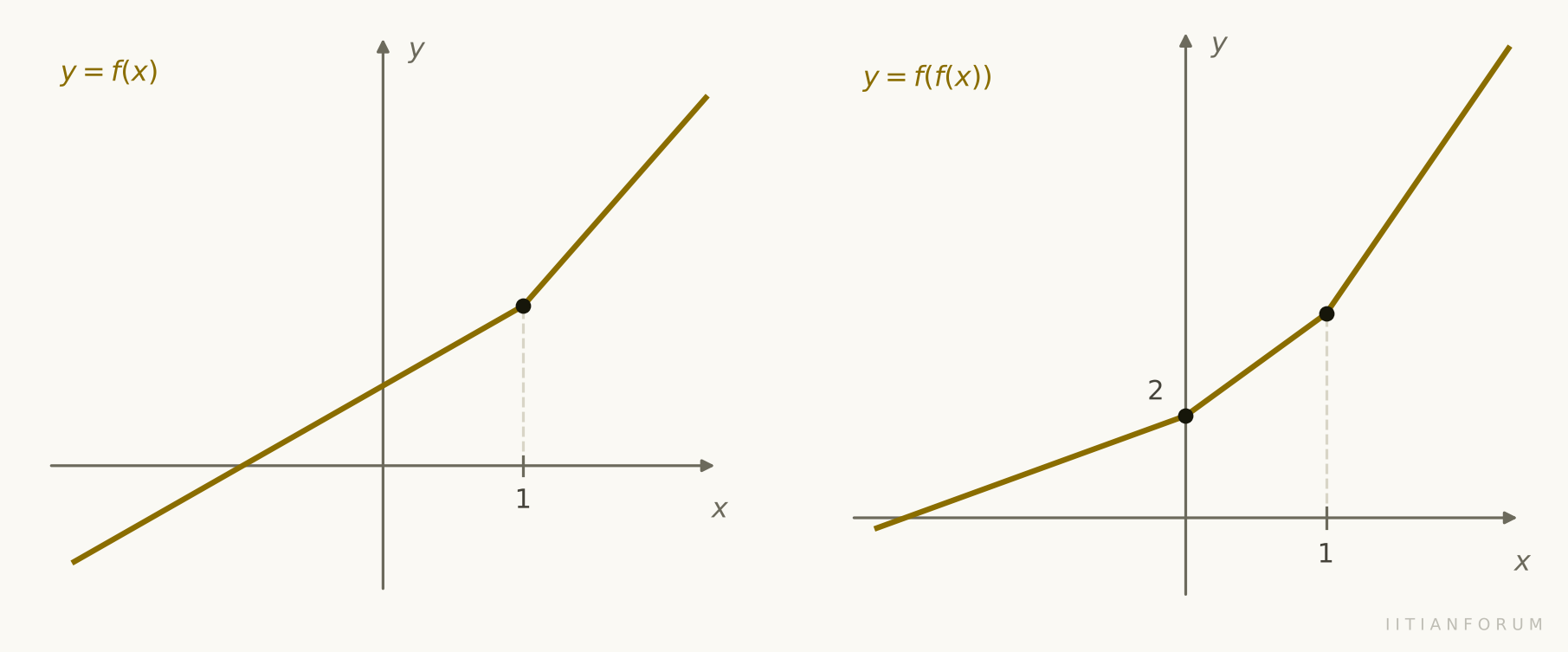
Two graphs side by side: on the left the piecewise function made of the line y equals x plus 1 for x less than 1 and the line y equals 2x for x at least 1, joining at the point 1 comma 2; on the right its composite with itself, made of three line pieces y equals x plus 2, y equals 2x plus 2 and y equals 4x, with a dashed guide at x equals 1; the formula also changes at x equals 0, on the y axis
Example 34(JEE Main 2026, 28 January Shift 1). If g(x)=3x2+2x−3, f(0)=−3 and 4g(f(x))=3x2−32x+72, then f(g(2)) is equal to
Tap an option to check your answer
(1)625
(2)−625
(3)27
(4)−27
▸ SHOW SOLUTION
Step 1. Quadratic in f
Write f for f(x):
12f2+8f−12=3x2−32x+7212f2+8f−(3x2−32x+84)=0
Step 2. Solve
The discriminant is a perfect square:
64+48(3x2−32x+84)=(12x−64)2f=24−8±(12x−64)
Step 3. Use f(0) = −3
The + sign gives f(0)=−3; the − sign gives 37. So
f(x)=2x−6
Step 4. Value
g(2)=12+4−3=13, and f(13)=27.
Answer: option (3)
Example 35(JEE Main 2025, 23 January Shift 1). Let f(x)=logex and
g(x)=2x2−2x+1x4−2x3+3x2−2x+2
Then the domain of f∘g is
Tap an option to check your answer
(1)R
(2)(0,∞)
(3)[0,∞)
(4)[1,∞)
▸ SHOW SOLUTION
Step 1. Condition
f∘g needs g(x) defined and g(x)>0.
Step 2. Denominator
2x2−2x+1 has discriminant −4, so it is always positive.
Step 3. Numerator
x4−2x3+3x2−2x+2=(x2−x+1)2+1>0
So g(x)>0 for every real x.
Answer:R, option (1)
Example 36(JEE Main 2025, 4 April Shift 1). Let f,g:(1,∞)→R be defined as f(x)=5x+22x+3 and g(x)=1−x2−3x. If the range of f∘g:[2,4]→R is [α,β], then β−α1 is equal to
Tap an option to check your answer
(1)68
(2)29
(3)2
(4)56
▸ SHOW SOLUTION
Step 1. Composite
g(x)=3+x−11>3 for x>1, so f(g(x)) is defined.
f(g(x))=5(2−3x)+2(1−x)2(2−3x)+3(1−x)=17x−129x−7
Step 2. Monotone
17x−129x−7=179−17(17x−12)11
For x∈[2,4], 17x−12>0 and grows, so f∘g increases.
If f:A→B is a bijection, the rule that sends each b∈B back to the unique a with f(a)=b is the inversef−1:B→A.
f−1(f(x))=xfor x∈Af(f−1(y))=yfor y∈B
A function that is not one-one has no inverse; one that is not onto has an inverse only on its range.
Finding f−1. Put y=f(x), solve for x in terms of y, then rename y as x.
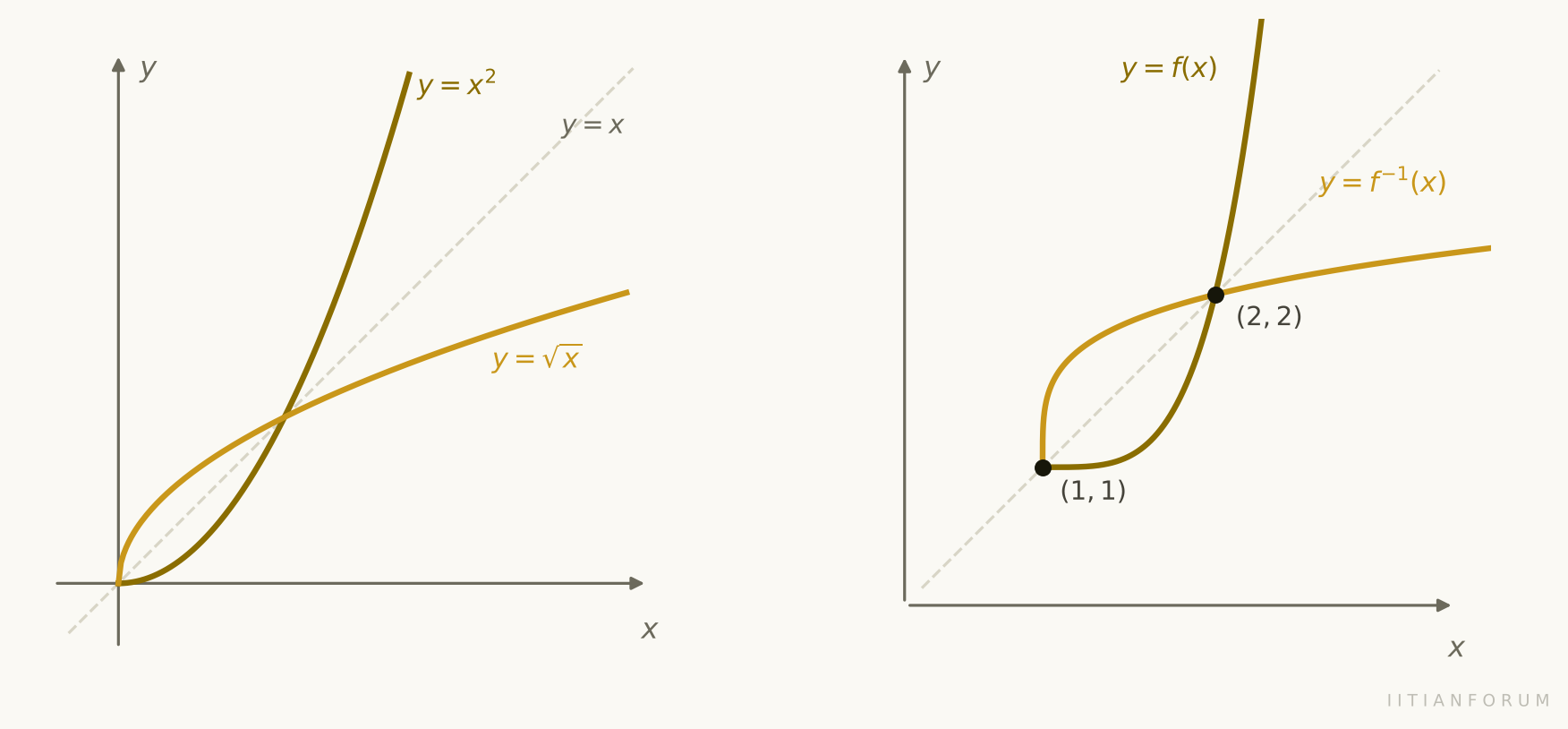
Graph.(a,b) lies on y=f(x) exactly when (b,a) lies on y=f−1(x), so the two graphs are mirror images in the line y=x.
Two graphs side by side: on the left the half parabola y equals x squared for x at least 0 and its mirror image y equals root x across the dashed line y equals x; on the right the curve y equals x minus 1 to the power 4 plus 1 for x at least 1 and its inverse curve, mirror images in the dashed line y equals x, meeting it at the two marked points 1 comma 1 and 2 comma 2
Property
Statement
unique
a bijection has exactly one inverse
inverse of inverse
(f−1)−1=f
composite
(g∘f)−1=f−1∘g−1
self-inverse
f=f−1⟺f(f(x))=x
increasing f
f(x)=f−1(x)⟺f(x)=x
swipe for more →
The last line holds because if f(a)=b and f−1(a)=b, then f(b)=a; with f increasing, a<b would give b=f(a)<f(b)=a, and a>b fails the same way. So a=b.
Only for increasing functions
For a decreasing function, f(x)=f−1(x) can have solutions off the line y=x. For f(x)=−x3, f−1(x)=−x1/3, and f=f−1 at x=−1,0,1, while f(x)=x only at x=0.
Example 37(IITianForum). Let f:[2,∞)→[1,∞), f(x)=x2−4x+5. Show that f is invertible and find f−1.
▸ SHOW SOLUTION
Step 1. Bijective
f(x)=(x−2)2+1. On [2,∞), x−2≥0 grows, so f increases from 1 without bound: one-one, and onto [1,∞).
Step 2. Solve for x
y=(x−2)2+1⇒x−2=y−1
The positive root is taken since x≥2.
Answer:f−1(x)=2+x−1, x≥1
Example 38(IITianForum). Find k so that f(x)=x+k2x+3, x=−k, is its own inverse.
for all x, so every coefficient is zero: k=−2 (and then k2−4=0 also holds).
Answer:k=−2. In general cx+dax+b is self-inverse when a+d=0; its graph is then symmetric about y=x.
Example 39(JEE Main 2026, 4 April Shift 2). For the function f:[1,∞)→[1,∞) defined by f(x)=(x−1)4+1, consider the two statements:
(I) The set S={x∈[1,∞):f(x)=f−1(x)} contains exactly two elements.
(II) The set S={x∈[1,∞):f(x)=f−1(x+1)} is empty.
Tap an option to check your answer
(1)only (I) is TRUE
(2)only (II) is TRUE
(3)both are TRUE
(4)neither is TRUE
▸ SHOW SOLUTION
Step 1. Statement I
f is increasing on [1,∞), so f(x)=f−1(x)⟺f(x)=x:
(x−1)4=x−1(x−1)[(x−1)3−1]=0⇒x=1,2
Exactly two elements. True.
Step 2. The inverse
y−1=(x−1)4 gives f−1(y)=1+(y−1)1/4, so
f−1(x+1)=1+x1/4
Step 3. Statement II
f(x)=f−1(x+1) becomes (x−1)4=x1/4, that is
x=(x−1)16
Let h(x)=(x−1)16−x. Then h(1)=−1<0 and h(3)=216−3>0. h is continuous, so it is zero somewhere in (1,3) (near x≈2.05). The set is not empty. False.
Answer: option (1)
Example 40(JEE Main 2026, 6 April Shift 1). Let f:{1,2,3,4}→{1,e,e2,e3} and g:{1,e,e2,e3}→{1,21,31,41} be two bijective functions such that f is strictly decreasing and g is strictly increasing. If
ϕ(x)=[f−1{g−1(21)}]x,
then the area of the region {(x,y):x2≤y≤ϕ(x),0≤x≤1} is
Tap an option to check your answer
(1)3loge23−loge2
(2)3loge21
(3)3+loge2
(4)2+loge33+loge2
▸ SHOW SOLUTION
Step 1. g increasing
The smallest input goes to the smallest output:
g(1)=41,g(e)=31g(e2)=21,g(e3)=1
So g−1(21)=e2.
Step 2. f decreasing
f(1)=e3,f(2)=e2f(3)=e,f(4)=1
So f−1(e2)=2 and ϕ(x)=2x.
Step 3. Area
On [0,1], 2x≥1≥x2.
∫01(2x−x2)dx=ln21−31=3ln23−ln2
Answer: option (1)
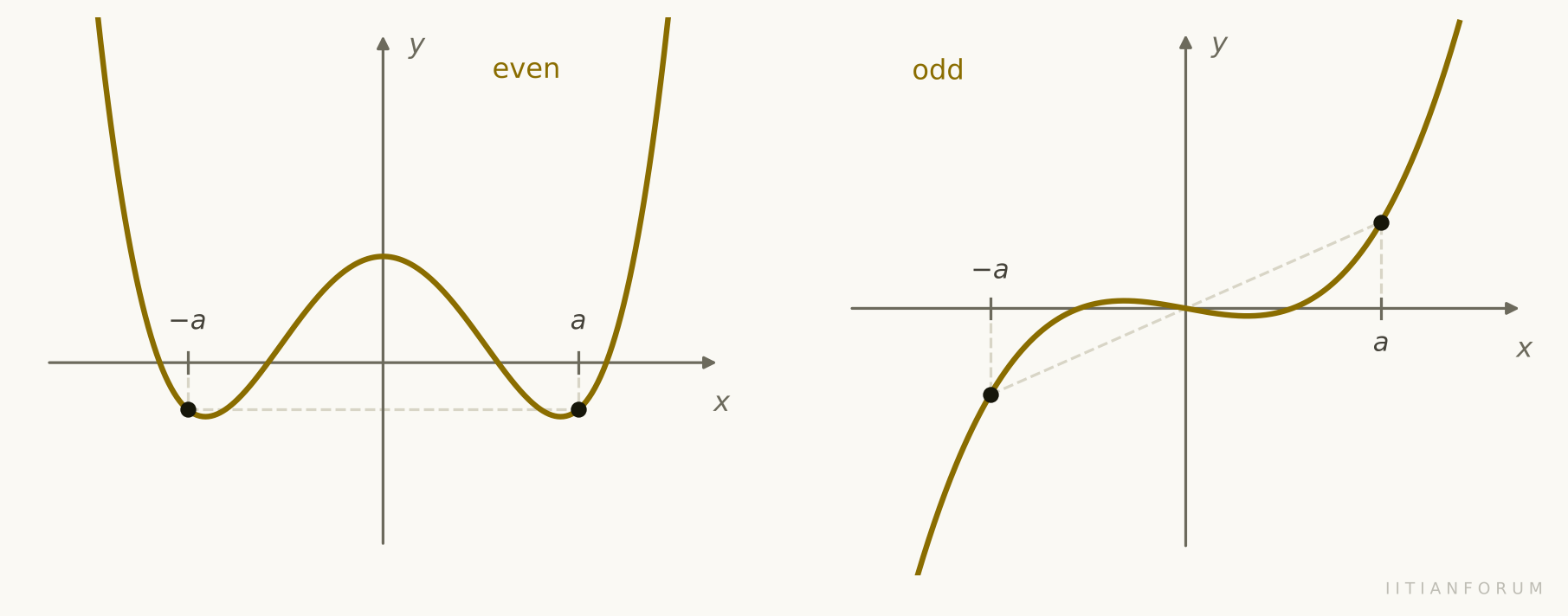
Even and odd functions
Let the domain be symmetric about 0 (with x, it contains −x).
even: f(−x)=f(x)odd: f(−x)=−f(x)
The graph of an even function is symmetric about the y axis; the graph of an odd function is symmetric about the origin.
Two graphs side by side: on the left an even function, a W shaped curve symmetric about the y axis, with two marked points at the same height at x equals minus a and x equals a; on the right an odd function, an S shaped curve through the origin, with two marked points at x equals minus a and x equals a whose heights are equal and opposite
Combination
Result
even ± even
even
odd ± odd
odd
even × even, odd × odd
even
even × odd
odd
f(g(x)) with g even
even
odd ∘ odd
odd
odd and defined at 0
f(0)=0
both even and odd
only f≡0
swipe for more →
Standard members: x2, cosx, ∣x∣, ex+e−x are even; x3, sinx, tanx, sgnx, ex−e−x are odd. Most functions are neither, but every function on a symmetric domain splits into an even part and an odd part:
f(x)=2f(x)+f(−x)+2f(x)−f(−x)
An even function on a symmetric domain is never one-one (f(−a)=f(a)), so it has no inverse there.
Example 41(IITianForum). Write ex as the sum of an even function and an odd function.
▸ SHOW SOLUTION
Step 1. Use the split
ex=2ex+e−x+2ex−e−x
Step 2. Check
The first part is unchanged when x→−x; the second changes sign.
Answer: even part 2ex+e−x, odd part 2ex−e−x
Example 42(IITianForum). Which of the following are odd functions?
(A) 3∣x∣+cosxx3
(B) x2ex2+1
(C) 2x+12x−1(h(x)+h(−x)), for any function h defined on R
(D) p(q(r(x))), where p, q, r are all odd
▸ SHOW SOLUTION
Step 1. (A)
x3 is odd, 3∣x∣+cosx is even (and positive). Odd over even: odd.
Step 2. (B)
Every factor is even. Even.
Step 3. (C)
2−x+12−x−1=1+2x1−2x
So the first factor is odd. h(x)+h(−x) is even. Odd times even: odd.
f is periodic if there is a T>0 with f(x+T)=f(x) for every x in the domain. The smallest such T is the fundamental period (usually just "the period").
Function
Period
sinx, cosx, secx, cosecx
2π
tanx, cotx
π
∣sinx∣, ∣cosx∣, sin2x, cos2x
π
{x}=x−[x]
1
constant function
every T>0; no smallest
swipe for more →
Rules.
If f has period T, then f(ax+b) has period ∣a∣T.
If f and g have periods T1 and T2, then f+g repeats after the LCM of T1 and T2. For fractions, LCM =HCF of denominatorsLCM of numerators.
The LCM is a period but not always the smallest one. Check smaller values when the two parts interact, as in ∣sinx∣+∣cosx∣ or sin4x+cos4x (period 2π for both).
Example 43(IITianForum). Find the period of sin32x+cos2x.
▸ SHOW SOLUTION
Step 1. Each part
sin32x:2/32π=3πcos2x:1/22π=4π
Step 2. LCM
LCM of 3π and 4π is 12π. The smaller candidates fail: f(0)=1, but f(6π)=sin4π+cos3π=−1 and f(4π)=sin38π+1=1.
Answer:12π
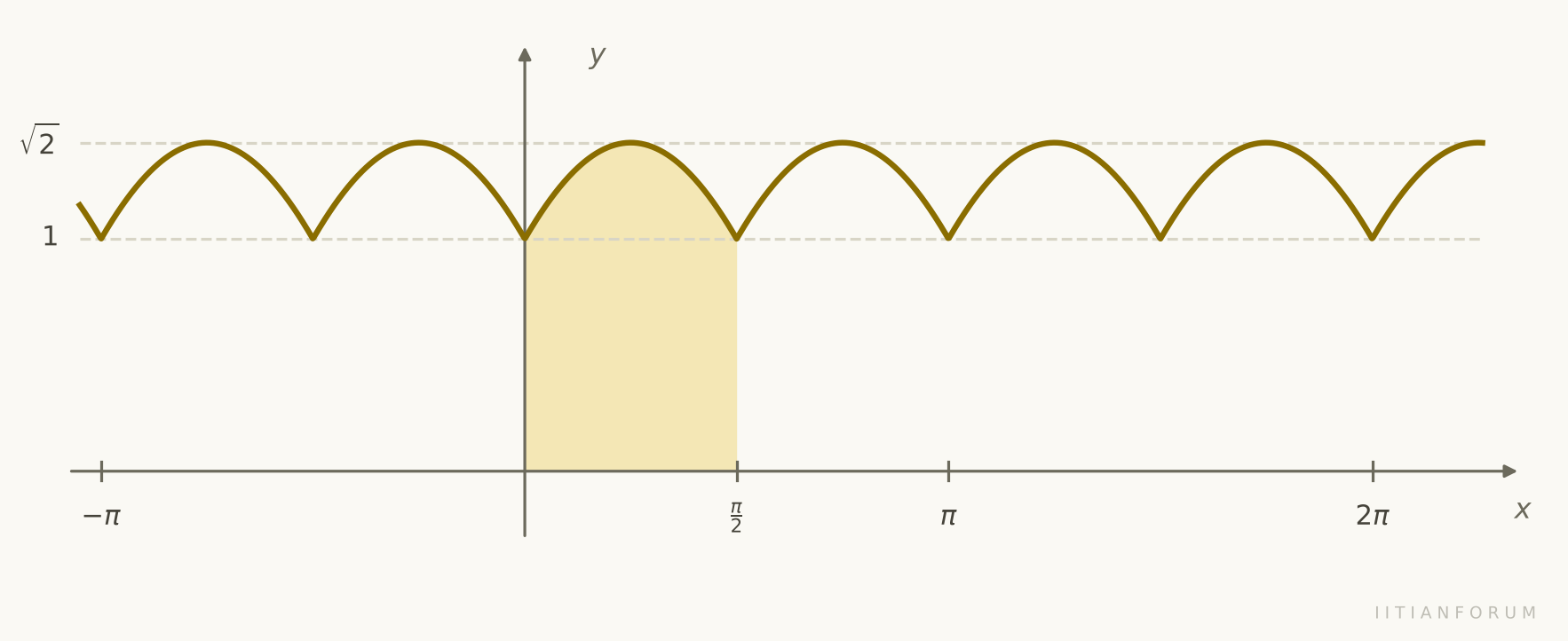
Example 44(IITianForum). Find the period and the range of f(x)=∣sinx∣+∣cosx∣.
▸ SHOW SOLUTION
Step 1. π/2 is a period
f(x+2π)=∣cosx∣+∣sinx∣=f(x)
Step 2. Nothing smaller
On [0,2π],
f(x)=sinx+cosx=2sin(x+4π)
For 0<T<2π this gives f(T)>1=f(0), so no such T is a period.
Step 3. Range
On one period 2sin(x+4π) runs from 1 up to 2 and back.
Answer: period 2π, range [1,2]
The graph of y equals modulus of sin x plus modulus of cos x over several periods, a row of identical arches between heights 1 and root 2, with one arch from 0 to pi over 2 shaded to mark a single period and dashed horizontal guides at heights 1 and root 2
Example 45(IITianForum). A function f:R→R satisfies
f(x+1)+f(x−1)=3f(x)
for all real x, and f(4)=2. Find r=1∑10f(4+12r).
▸ SHOW SOLUTION
Step 1. Write the values one step apart
Fix x and let an=f(x+n). The relation says an+1=3an−an−1. Start with a0=p, a1=q:
So f(x+6)=−f(x) for every x, and applying it twice,
f(x+12)=f(x)
Step 3. Sum
Each term f(4+12r)=f(4)=2.
Answer:10×2=20
Example 46(IITianForum). A real function f satisfies, for every real x,
f(x+1)=2+3u(x),whereu(x)=9−12f(x)+6f(x)2−f(x)3
and f(1)=3. Find f(2026)+f(2027).
▸ SHOW SOLUTION
Step 1. Shift by 2
Let g(x)=f(x)−2. Expanding shows u(x)=1−(f(x)−2)3, so
g(x+1)3=1−g(x)3
Step 2. Period 2
Replace x by x+1: g(x+2)3=1−g(x+1)3=g(x)3, so g(x+2)=g(x) and f has period 2.
Step 3. Values
g(1)=1, so g(2)3=1−1=0 and f(2)=2.
f(2026)=f(2)=2f(2027)=f(1)=3
Answer:5
Functional equations
A functional equation gives a relation that f satisfies for all x (and y). The usual plan:
Put special values: x=y=0, x=y=1, y=−x, y=x1, to find f(0), f(1) and symmetry.
When f(x) appears with f(x1) or f(a−x), replace x by x1 or a−x and solve the two linear equations.
When a form is given (polynomial of degree 2, say), substitute it and compare coefficients.
Recognise the standard forms below. In JEE the function is given to be continuous, differentiable or a polynomial, which is what makes these forms the only answers.
Equation
Solution
f(x+y)=f(x)+f(y)
f(x)=kx
f(x+y)=f(x)f(y), f≡0
f(x)=ax, a>0
f(xy)=f(x)+f(y)
f(x)=klnx
f(xy)=f(x)f(y)
f(x)=xn
f(x)f(x1)=f(x)+f(x1), polynomial
f(x)=1±xn
f(x+y)+f(x−y)=2f(x)f(y)
f(x)=coskx type, even
swipe for more →
Example 47(JEE Main 2026, 22 January Shift 2). Let f and g be functions satisfying f(x+y)=f(x)f(y) and g(x+y)=g(xy), with f(1)=7 and g(1)=1, for all x,y∈N. If
x=1∑ng(x)f(x)=19607,
then n is equal to
Tap an option to check your answer
(1)7
(2)5
(3)6
(4)4
▸ SHOW SOLUTION
Step 1. f
y=1: f(x+1)=7f(x), so f(x)=7x.
Step 2. g
y=1: g(x+1)=g(x), so g is constant, g(x)=1.
Step 3. Sum
7+72+⋯+7n=67(7n−1)=196077n=1+76⋅19607=16807=75
Answer:n=5, option (2)
Example 48(JEE Main 2026, 4 April Shift 2). Let for some α∈R, f:R→R satisfy
f(x+y)=f(x)+2y2+y+αxy
for all x,y∈R. If f(0)=−1 and f(1)=2, then the value of n=1∑5(α+f(n)) is
Tap an option to check your answer
(1)110
(2)140
(3)150
(4)170
▸ SHOW SOLUTION
Step 1. Put x = 0
f(y)=f(0)+2y2+y=2y2+y−1
Step 2. Find α
Substitute f(x)=2x2+x−1 back. The left side has 4xy, the right side has αxy; all other terms match. So α=4. (Check: f(1)=2.)
Step 3. Sum
α+f(n)=2n2+n+3n=1∑5(2n2+n+3)=2(55)+15+15
Answer:140, option (2)
Example 49(JEE Main 2026, 24 January Shift 2). Let f be a function such that
3f(x)+2f(19xm)=5x,x=0,
where m=i=1∑9i2. Then f(5)−f(2) is equal to
Tap an option to check your answer
(1)−9
(2)36
(3)18
(4)9
▸ SHOW SOLUTION
Step 1. The constant
m=69⋅10⋅19=285, so 19m=15:
3f(x)+2f(x15)=5x(1)
Step 2. Replace x by 15/x
3f(x15)+2f(x)=x75(2)
Step 3. Eliminate
3×(1)−2×(2):
5f(x)=15x−x150⇒f(x)=3x−x30
Step 4. Value
f(5)=9, f(2)=−9.
Answer:18, option (3)
Example 50(JEE Main 2026, 5 April Shift 2). Let f:R→R be a function such that f(x)+3f(2π−x)=sinx. Let the maximum value of f be α. If the area of the region bounded by the curves g(x)=x2 and h(x)=βx3, β>0, is α2, then 30β3 is equal to ______.
▸ SHOW SOLUTION
Step 1. Pair of equations
Replace x by 2π−x:
f(2π−x)+3f(x)=cosx
Eliminate f(2π−x):
8f(x)=3cosx−sinx
Step 2. Maximum
3cosx−sinx has maximum 10, so α=810 and α2=325.
Step 3. Area
The curves meet at x=0 and x=β1.
∫01/β(x2−βx3)dx=12β3112β31=325⇒β3=158
Answer:30β3=16
Example 51(JEE Main 2025, 28 January Shift 2). Let f:R−{0}→(−∞,1) be a polynomial of degree 2 satisfying
f(x)f(x1)=f(x)+f(x1)
If f(K)=−2K, then the sum of squares of all possible values of K is
Tap an option to check your answer
(1)1
(2)6
(3)7
(4)9
▸ SHOW SOLUTION
Step 1. Factor the equation
Bring every term to one side and add 1:
(f(x)−1)(f(x1)−1)=1
Step 2. The form of f
g(x)=f(x)−1 is a polynomial with g(x)g(x1)=1; the only such polynomials are ±xn. Degree 2 gives f(x)=1±x2.
Step 3. Use the co-domain
1+x2≥1 is outside (−∞,1), so f(x)=1−x2.
Step 4. Solve f(K) = −2K
K2−2K−1=0
Sum of squares =(K1+K2)2−2K1K2=4+2.
Answer:6, option (2)
Example 52(IITianForum). A function f:R→R with f(0)=0 satisfies
f(x+y)+f(x−y)=2f(x)f(y)
for all real x,y, and f(1)=2. Show that f is even and find f(2) and f(3).
▸ SHOW SOLUTION
Step 1. f(0)
x=y=0: 2f(0)=2f(0)2. Since f(0)=0, f(0)=1.
Step 2. Even
x=0: f(y)+f(−y)=2f(y), so f(−y)=f(y).
Step 3. f(2)
x=y=1: f(2)+f(0)=2f(1)2.
f(2)=2⋅4−1=7
Step 4. f(3)
x=2, y=1: f(3)+f(1)=2f(2)f(1).
f(3)=2⋅7⋅2−2=26
Answer:f is even, f(2)=7, f(3)=26. In general f(n+1)=2kf(n)−f(n−1) with k=f(1), which gives f(2)=2k2−1.
Example 53(IITianForum). Let f:(0,∞)→R with f(1)=1 satisfy, for all x,y>0,
f(x)f(y)+f(x5)f(y5)=2f(xy)
Find f(2026).
▸ SHOW SOLUTION
Step 1. x = y = 1
1+f(5)2=2, so f(5)2=1.
Step 2. y = 1
f(x)+f(x5)f(5)=2f(x)f(x)=f(5)f(x5)(1)
Step 3. y = 5/x
2f(x)f(x5)=2f(5)f(x)f(x5)=f(5)(2)
Step 4. Square of f
Multiply (1) by f(x) and use (2): f(x)2=f(5)⋅f(5)=1.
Step 5. Sign
Put x=y=t: f(t)2+f(t5)2=2f(t), and both squares are 1, so f(t)=1 for every t>0.
Answer:f(2026)=1
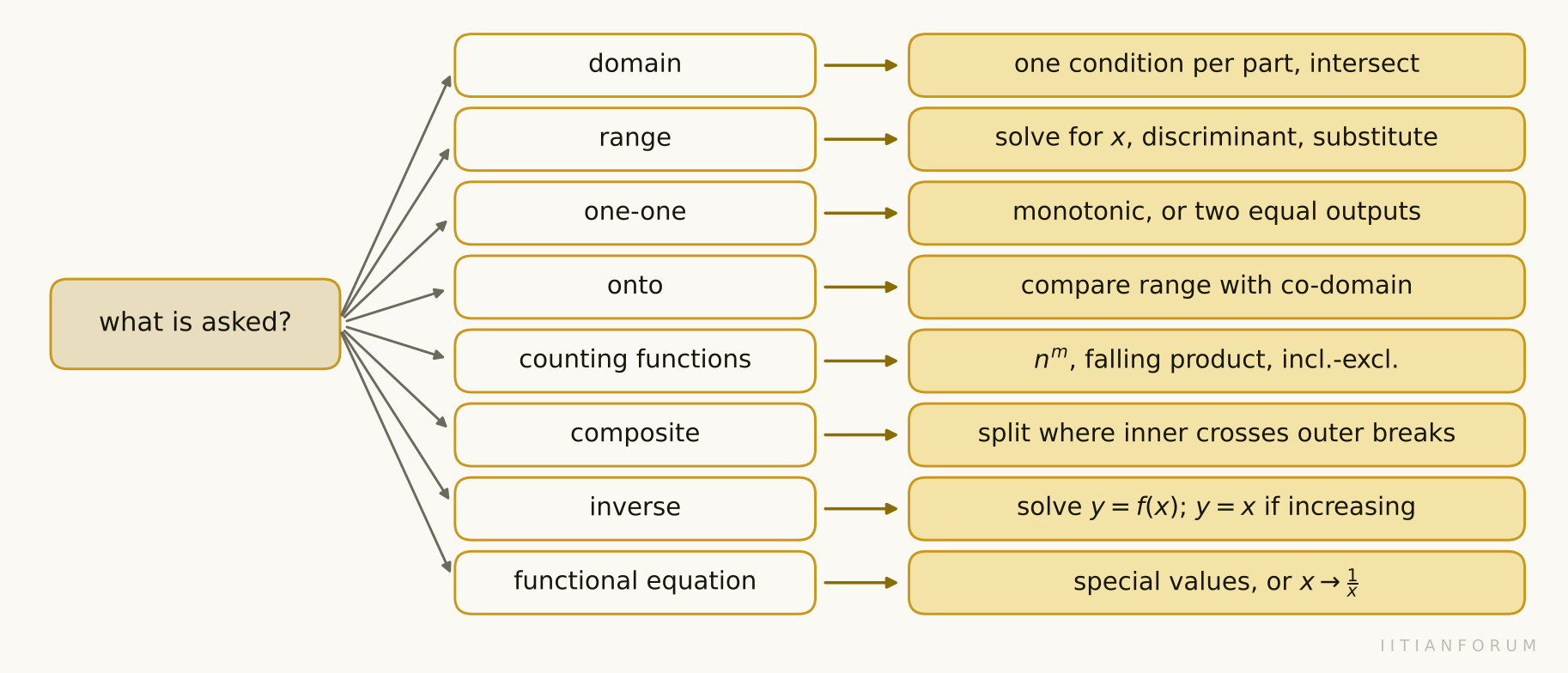
Which method to use
A decision chart: from the question asked, arrows lead to eight situations, each paired with its method: domain, one condition per part then intersect; range, solve for x or use the discriminant or a substitution; one-one, test monotonicity or find two equal outputs; onto, compare range with co-domain; counting functions, use n to the power m, the falling product or inclusion-exclusion; composite, split where the inner function crosses the outer break points; inverse, solve y equals f of x for x and use y equals x for increasing f; functional equation, put special values or replace x by 1 over x then solve
Given
Method
domain
one condition per part, intersect
nested logs
outside in, one inequality
[x] inside a condition
interval [n,n+1) at a time
range of a rational function
solve for x, or discriminant ≥0
range with ∣x∣, cosx, 2x
substitute t, use the range of t
one-one
monotonic, or two equal outputs
onto
range = co-domain?
counting
nm, falling product, inclusion-exclusion
distributions with no empty box
onto count
composite of piecewise functions
split where the inner value crosses outer breaks
inverse
solve y=f(x) for x
f(x)=f−1(x), f increasing
solve f(x)=x
even or odd
replace x by −x
period of a sum
LCM, then check smaller values
f(x) with f(x1) or f(a−x)
replace and solve two equations
f(x+y), f(xy)
x=y=0, x=y=1, standard forms
swipe for more →
What JEE asks
Across the 2025 and 2026 papers the chapter appears in five forms, roughly in this order of frequency.
Domain of a formula with logs, roots, inverse trigonometric parts or [x], answered as a sum of interval end points (Examples 3 to 11). This is the single most common functions question in JEE Main 2026.
Counting functions: all, one-one, onto, not onto, with conditions (Examples 28 to 32).
Functional equations of the substitution type, often followed by a sum or an area (Examples 47 to 51).
One-one and onto decided from monotonicity and range (Examples 21 to 24).
Range, composite and inverse, usually inside a larger question (Examples 13, 15, 34 to 40).
JEE Advanced 2026 tested the link between a composite and one-one functions (Example 32).
Quick recall
Result
Statement
Function
every input, exactly one output
Range
f(A)⊆ co-domain
logau>k, 0<a<1
0<u<ak
∣t1∣≤1
∣t∣≥1
x−1<[x]≤x
{x}∈[0,1)
[x]+[−x]
0 at integers, −1 otherwise
asinx+bcosx
between ±a2+b2
t+t1
≥2 for t>0, ≤−2 for t<0
f(x)=k solutions
meets of y=k with the graph
One-one
strictly monotonic suffices
Onto
range = co-domain
All functions
nm
One-one
n(n−1)⋯(n−m+1)
Onto to 3 elements
3m−3⋅2m+3
Domain of g∘f
x∈Df, f(x)∈Dg
Inverse exists
bijection
(g∘f)−1
f−1∘g−1
Self-inverse cx+dax+b
a+d=0
Even, odd
f(−x)=f(x), f(−x)=−f(x)
Period of f(ax+b)
∣a∣T
∣sinx∣+∣cosx∣
period 2π
f(x+y)=f(x)f(y)
ax
f(xy)=f(x)+f(y)
klnx
swipe for more →
Before you leave this chapter
Without a pen, answer these four: the domain of log2log3(x−1), the number of onto functions from a 4 element set to a 2 element set, the period of ∣sin2x∣, and f(x) if f(x)+2f(1−x)=x. If the answers (2,∞), 14, 2π and 32−3x come quickly, the chapter is yours.
Practise these methods on real exam questions in the doMath Functions chapter. Functions are the language of calculus: the Limits note and the Continuity and Differentiability note build directly on everything here.