and you are looking at three unknowns g, f and c. So three independent conditions pin down exactly one circle, and any two conditions leave a whole one-parameter collection of circles behind. That collection is what this chapter is about.
The wasteful way to handle two conditions is to set up g, f, c as unknowns, write two equations, and carry a leftover parameter through pages of algebra. The efficient way is to write down a single expression that already satisfies both conditions and carries one visible parameter λ. Then the third condition becomes one small equation in λ, and you are done in three lines instead of thirty.
That is the whole method. Build the family first, fit λ last.
What you should be able to do by the end
Given any two conditions on a circle, write the family in one line without hesitating about which form to use, and then read off λ from the third condition.
We start with lines, because the parameter trick is easier to see there and it is the same trick.
Family of lines: where the λ trick starts
Take two lines that actually meet:
L1≡a1x+b1y+c1=0,L2≡a2x+b2y+c2=0.
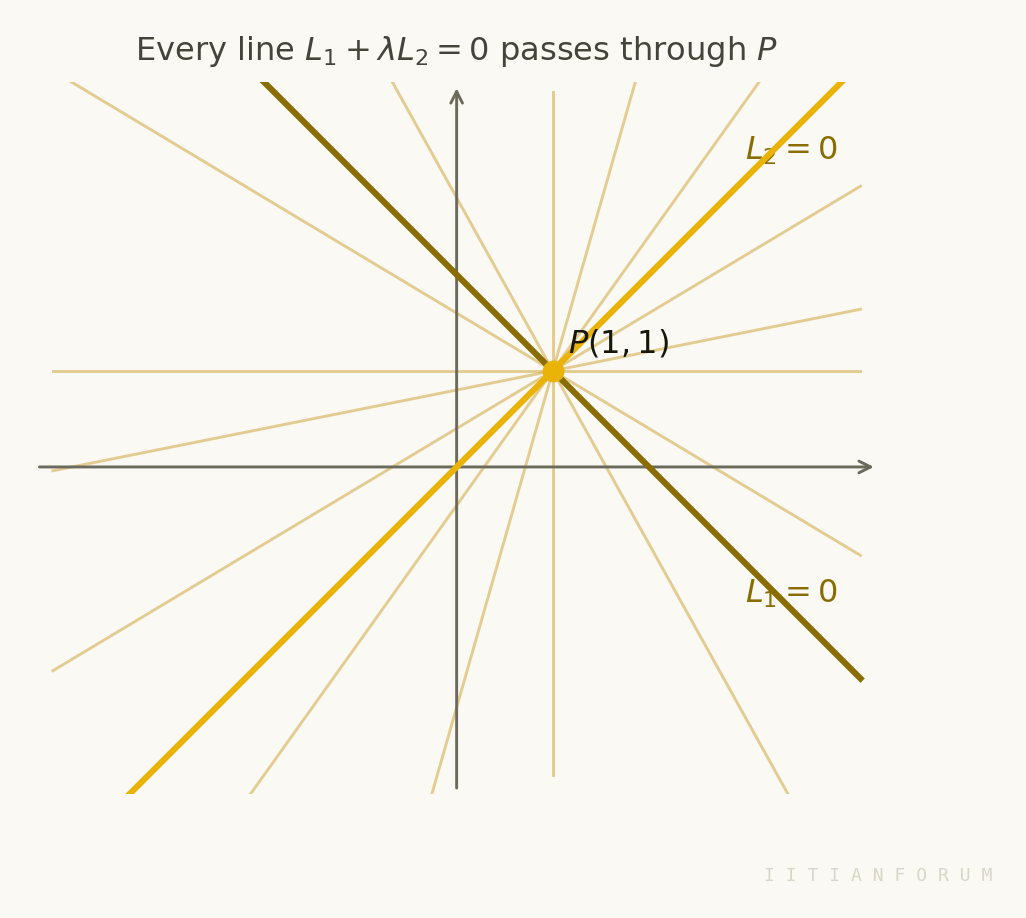
Let P be their point of intersection. Now look at
L1+λL2=0.
Two things are true at once, and both matter.
It is a line. Expanding gives (a1+λa2)x+(b1+λb2)y+(c1+λc2)=0, which is first degree in x and y.
It passes through P. At P both L1 and L2 are zero, so L1+λL2 is 0+λ⋅0=0 whatever λ is.
So L1+λL2=0 is the whole pencil of lines through P, with one exception: L2=0 itself is never produced, because no finite λ can kill L1 entirely.
Every line of the family L1 + lambda L2 = 0 passes through the fixed point P
Situation
What to write
Line through the intersection of L1=0 and L2=0
L1+λL2=0
A family with a parameter, asked for its fixed point
group the terms as A+λB=0, then solve A=0, B=0
swipe for more →
The second row is the same statement read backwards, and it is the version JEE prefers.
Example 1. Show that for every real λ the line (1+2λ)x+(1−λ)y=3+3λ passes through a fixed point, and find it.
▸ SHOW SOLUTION
Step 1: Collect the λ terms. Bring everything to one side and group:
(x+y−3)+λ(2x−y−3)=0.
Step 2: Read the condition. This holds for everyλ only if both brackets vanish, because a linear expression in λ is identically zero only when its constant term and its coefficient of λ are both zero.
x+y−3=0and2x−y−3=0.
Step 3: Solve the pair. Adding, 3x=6, so x=2, and then y=1.
Step 4: Verify. Put (2,1) into the original: (1+2λ)(2)+(1−λ)(1)=2+4λ+1−λ=3+3λ. It matches the right side for all λ.
Answer:(2,1)
Example 2. Find the equation of the line that passes through the intersection of 3x−4y+6=0 and x+y+2=0 and is perpendicular to 2x+3y=0.
▸ SHOW SOLUTION
Step 1: Write the family. Every line through the intersection is
(3x−4y+6)+λ(x+y+2)=0,
that is, (3+λ)x+(λ−4)y+(6+2λ)=0.
Step 2: Use the perpendicularity. The given line 2x+3y=0 has slope −32, so our line needs slope 23. The family has slope −λ−43+λ, so
−λ−43+λ=23⟹−2(3+λ)=3(λ−4)⟹−6−2λ=3λ−12.
Step 3: Solve.5λ=6, so λ=56.
Step 4: Substitute back. Multiplying the family by 5 first keeps the arithmetic clean:
5(3x−4y+6)+6(x+y+2)=0⟹21x−14y+42=0⟹3x−2y+6=0.
Step 5: Check. The two given lines meet where 3x−4y+6=0 and x+y+2=0, which gives x=−2, y=0. And 3(−2)−2(0)+6=0, so the point is on our line. Its slope is 23, perpendicular to −32.
Answer:3x−2y+6=0
Why we bother with the shortcut
Finding the intersection point first and then writing a line through it also works, and for Example 2 it is barely longer. The advantage of the family form shows up when the intersection point is ugly, or when the question never asks for it. Then you never compute it at all.
Type 1: circles through the intersection of a circle and a line
Let
S≡x2+y2+2gx+2fy+c=0,L≡ℓx+my+n=0,
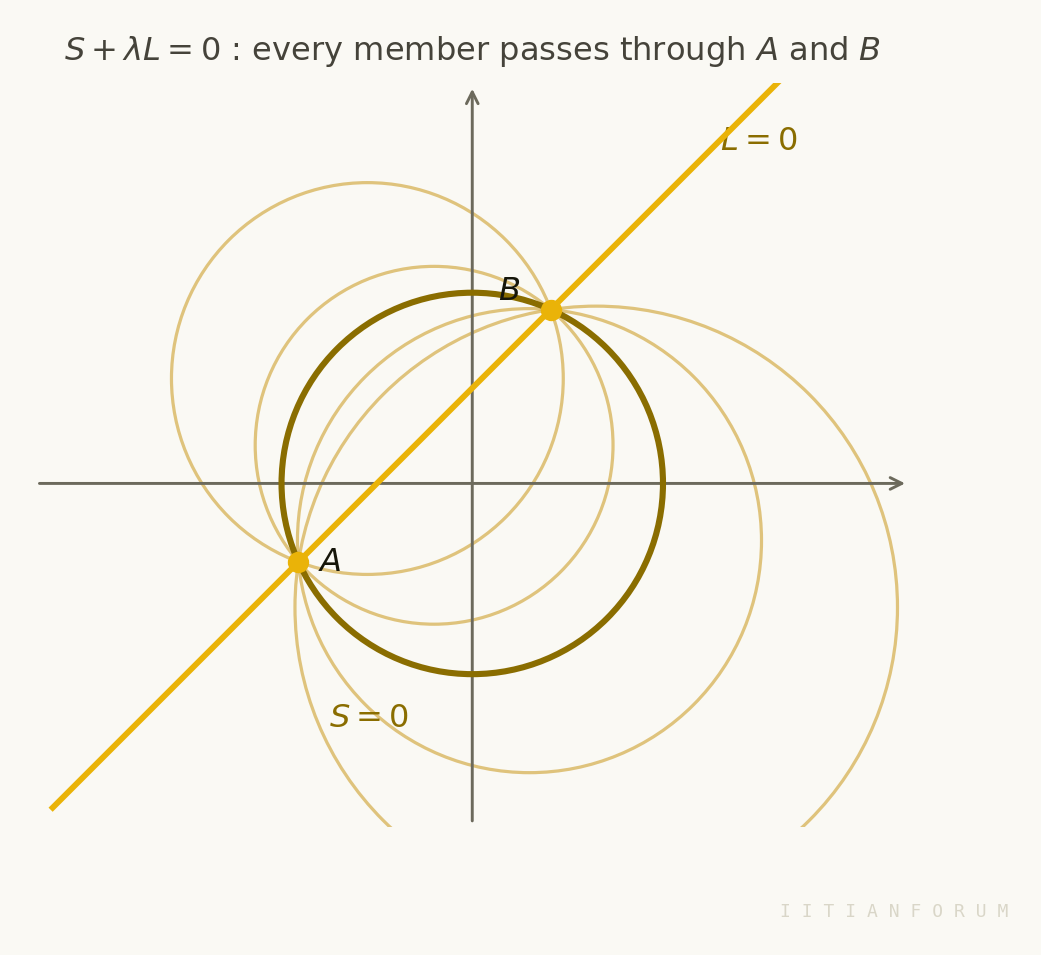
and suppose the line cuts the circle at A and B. Then
S+λL=0
is the family of all circles through A and B, with λ any real number.
The reasoning is the same two-part check as for lines.
It is a circle. Adding λL changes only the x, y and constant terms. The coefficients of x2 and y2 stay at 1 and no xy term appears, which are exactly the conditions for a circle.
It passes through A and B. At either point S=0 and L=0, so the whole expression is zero.
The family S+λL=0, with every member through the two intersection points A and B
Written out, the member with parameter λ is
x2+y2+(2g+λℓ)x+(2f+λm)y+(c+λn)=0,
so its centre is (−g−2λℓ,−f−2λm). As λ runs over the reals that centre travels along a straight line, and that line is the perpendicular bisector of AB. Every circle through A and B must have its centre there, so this is a free check on your algebra.
The mistake that costs the mark
S+λL=0 needs S written with the coefficient of x2 equal to 1. If the question hands you 3x2+3y2−12x+6y−9=0, divide by 3 first. Skip that step and every coefficient afterwards is off by a factor, and the λ you compute means nothing.
Example 3. Find the circle that passes through the points where x2+y2=25 meets 3x−4y−5=0, and also through (1,2).
▸ SHOW SOLUTION
Step 1: Write the family.
x2+y2−25+λ(3x−4y−5)=0.
Step 2: Impose the extra point. Put x=1, y=2:
1+4−25+λ(3−8−5)=0⟹−20−10λ=0.
Step 3: Solve for λ.λ=−2.
Step 4: Substitute back.
x2+y2−25−2(3x−4y−5)=0⟹x2+y2−6x+8y−15=0.
Step 5: Check. At (1,2): 1+4−6+16−15=0. Correct. The centre is (3,−4), which does lie on the line through the origin perpendicular to 3x−4y−5=0, as predicted.
Answer:x2+y2−6x+8y−15=0
Example 4. The line y=x cuts the circle x2+y2−2x=0 in the segment AB. Find the circle on AB as diameter.
▸ SHOW SOLUTION
Step 1: Write the family. Every circle through A and B is
x2+y2−2x+λ(y−x)=0,
that is x2+y2−(2+λ)x+λy=0.
Step 2: Turn "AB is a diameter" into a condition. A circle has AB as a diameter exactly when its centre is the midpoint of AB, and in particular when its centre lies on the line AB. Since both A and B are on the family circle, the centre being on AB forces AB to be a diameter.
Step 3: Locate the centre. From Step 1 the centre is
(22+λ,−2λ).
Step 4: Put the centre on y=x.
−2λ=22+λ⟹−λ=2+λ⟹λ=−1.
Step 5: Substitute.
x2+y2−(2−1)x−y=0⟹x2+y2−x−y=0.
Step 6: Check. Solving y=x with x2+y2−2x=0 gives 2x2−2x=0, so A=(0,0) and B=(1,1). Their midpoint is (21,21), which is exactly the centre of x2+y2−x−y=0, and the radius 21 equals half of AB=2.
Answer:x2+y2−x−y=0
Two conditions worth recognising instantly
For a member of the family S+λL=0: "AB is a diameter" means the centre lies on L, and "the circle is the smallest of the family" means the same thing, because the smallest circle through A and B is the one on AB as diameter. Both give you one linear equation in λ.
Type 2: circles through the intersection of two circles
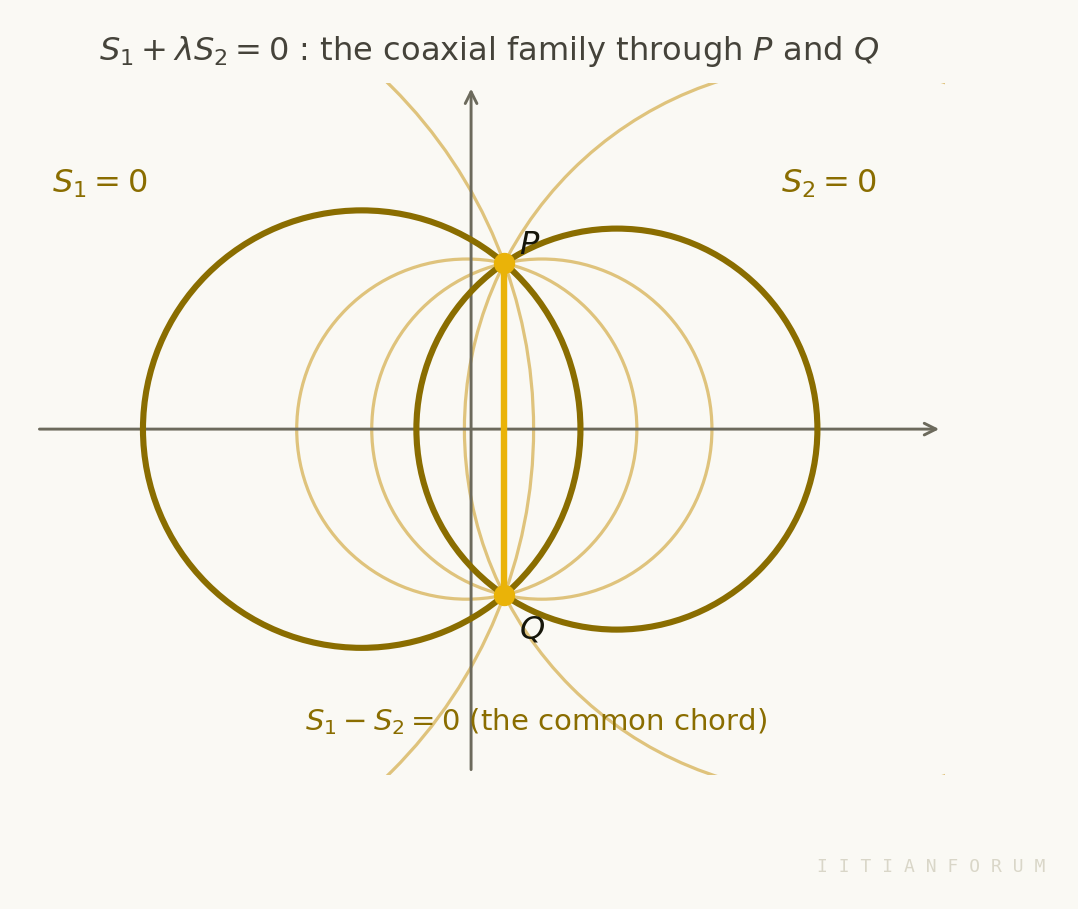
and dividing by 1+λ gives a genuine circle. At λ=−1 the quadratic terms cancel completely and what is left,
S1−S2=0,
is a straight line: the common chord PQ. That is not an accident, it is the degenerate member of the family, and it is useful in its own right.
Two traps in one line
First, S1 and S2 must both be normalised so that the coefficient of x2 is 1 before you combine them. Second, λ=−1 is excluded from the circle family. Write λ=−1 every time, because examiners set questions where the algebra pushes you towards exactly that value and the correct conclusion is "no such circle exists, the locus is a line".
Example 5. Find the circle through the points common to x2+y2−4x−2y−8=0 and x2+y2−2x−4y−8=0 that also passes through (−1,4).
▸ SHOW SOLUTION
Step 1: Write the family.
(x2+y2−4x−2y−8)+λ(x2+y2−2x−4y−8)=0.
Step 2: Impose the point (−1,4). For the first bracket:
1+16+4−8−8=5.
For the second:
1+16+2−16−8=−5.
Step 3: Solve. So 5+λ(−5)=0, giving λ=1.
Step 4: Substitute and divide by 1+λ=2.
2x2+2y2−6x−6y−16=0⟹x2+y2−3x−3y−8=0.
Step 5: Check. At (−1,4): 1+16+3−12−8=0. Correct.
Answer:x2+y2−3x−3y−8=0
The same idea works when the two curves are not circles, and that is where JEE has been going lately.
Example 6(JEE Main 2026, 23 Jan Shift 2). The points of intersection of the two conics
x2+2y2−6x−12y+23=0and4x2+2y2−20x−12y+35=0
lie on a circle of radius r with centre (a,b). Find ab+18r2.
▸ SHOW SOLUTION
Step 1: Use the family even though these are not circles. Any curve through all the common points is
S1+λS2=0.
Step 2: Force it to be a circle. A second degree curve is a circle when the coefficients of x2 and y2 are equal and there is no xy term. There is no xy term here, so we only need
1+4λ=2+2λ⟹2λ=1⟹λ=21.
Step 3: Build that member. With λ=21:
x2:1+2=3,y2:2+1=3,x:−6−10=−16,y:−12−6=−18,
and the constant is 23+235=281.
Step 4: Normalise by dividing by 3.
x2+y2−316x−6y+227=0.
Step 5: Read the centre and radius. Comparing with x2+y2+2gx+2fy+c=0 gives g=−38, f=−3, c=227, so
Whenever a question says "the intersection points of two curves lie on a circle", do not solve for the intersection points. Write S1+λS2=0 and choose λ to make it a circle. The four intersection points of two conics almost never have nice coordinates, but the circle through them nearly always does.
Type 3: circles through two given points
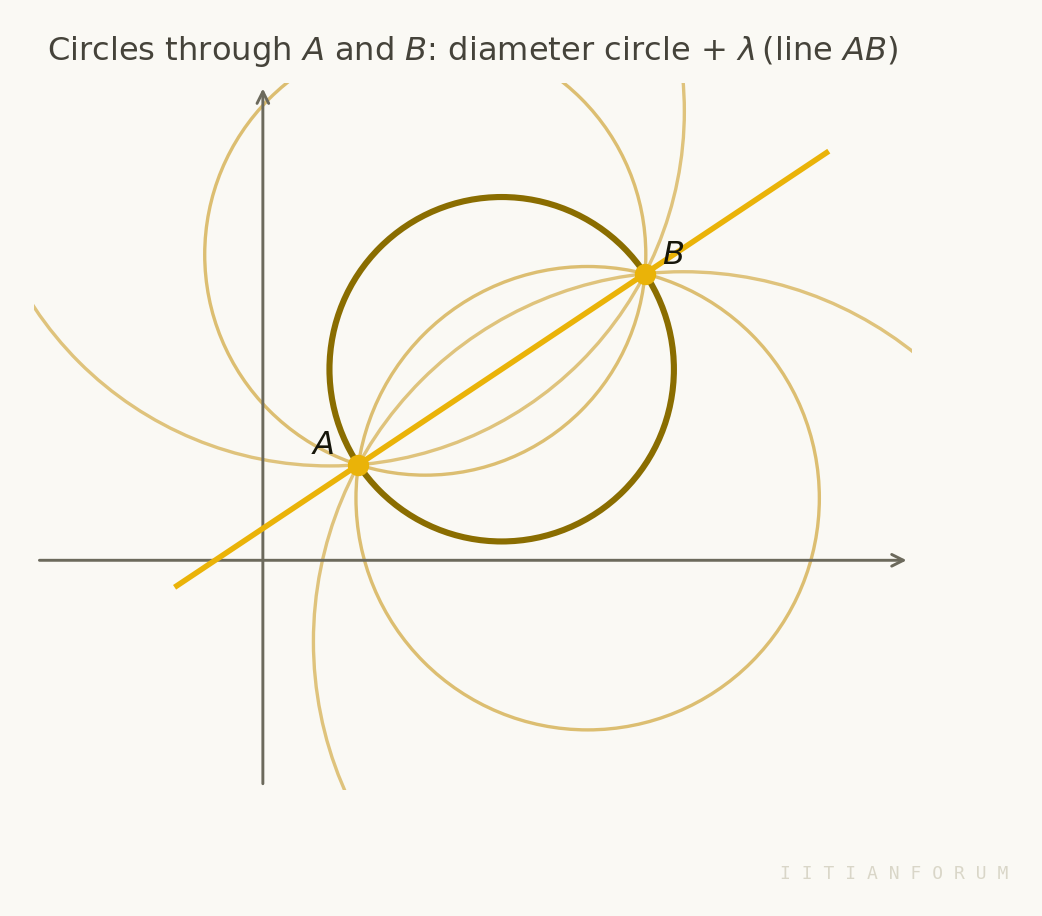
If the two points A(x1,y1) and B(x2,y2) are given directly, you do not need a circle to start from. The smallest circle through them is the one on AB as diameter,
(x−x1)(x−x2)+(y−y1)(y−y2)=0,
and the line AB can be written in determinant form as
xx1x2yy1y2111=0.
Adding λ times the second to the first gives every circle through A and B:
In practice you write the line AB in ordinary form and add λ times it. The determinant is just a way of remembering the line without a separate calculation.
Why the diameter circle works. If P(x,y) is any point of the circle on AB as diameter, other than A or B, then the angle in a semicircle gives ∠APB=90∘, so PA⊥PB. The vectors PA and PB have components (x1−x,y1−y) and (x2−x,y2−y), and perpendicular vectors have zero dot product:
(x1−x)(x2−x)+(y1−y)(y2−y)=0.
Multiplying each bracket pair by (−1)(−1)=1 gives the form quoted above. It also holds at P=A and P=B, so the whole circle is captured.
Example 7. Find the circle through A(1,−2) and B(5,4) whose centre lies on the line x−y=3.
▸ SHOW SOLUTION
Step 1: Write the diameter circle.
(x−1)(x−5)+(y+2)(y−4)=0⟹x2+y2−6x−2y−3=0.
Step 2: Write the line AB. Slope =5−14+2=23, so y+2=23(x−1), that is
3x−2y−7=0.
Step 3: Write the family.
x2+y2−6x−2y−3+λ(3x−2y−7)=0.
Step 4: Find the centre. Comparing coefficients, 2g=−6+3λ and 2f=−2−2λ, so the centre is
(3−23λ,1+λ).
Step 5: Put the centre on x−y=3.
(3−23λ)−(1+λ)=3⟹2−25λ=3⟹λ=−52.
Step 6: Substitute. Multiply the family by 5 to clear fractions:
5(x2+y2−6x−2y−3)−2(3x−2y−7)=0⟹5x2+5y2−36x−6y−1=0.
Step 7: Check. The centre is (518,53) and 518−53=515=3, so it is on the given line. At A(1,−2) the left side is 5+20−36+12−1=0, and at B(5,4) it is 125+80−180−24−1=0.
Answer:5x2+5y2−36x−6y−1=0
Example 8. A circle passes through A(2,0) and B(0,4) and touches the x-axis. Find it.
▸ SHOW SOLUTION
Step 1: The diameter circle.
(x−2)(x−0)+(y−0)(y−4)=0⟹x2+y2−2x−4y=0.
Step 2: The line AB. Intercept form 2x+4y=1 gives 2x+y−4=0.
Step 3: The family.
x2+y2−2x−4y+λ(2x+y−4)=0,
that is x2+y2+(2λ−2)x+(λ−4)y−4λ=0.
Step 4: Turn "touches the x-axis" into an equation. Put y=0 and demand a repeated root:
Step 7: Check. Setting y=0 gives x2−4x+4=(x−2)2=0, a repeated root at x=2, so the circle touches the x-axis at (2,0), which is A itself. At B(0,4): 0+16−0−20+4=0. Correct.
Answer:x2+y2−4x−5y+4=0
Why only one answer here
A repeated root in λ is the algebra telling you the two solutions have merged. Geometrically, A already sits on the x-axis, so any circle through A that touches the x-axis must touch it atA, and there is only one such circle through B as well. When A is not on the axis you get a genuine quadratic in λ and two circles.
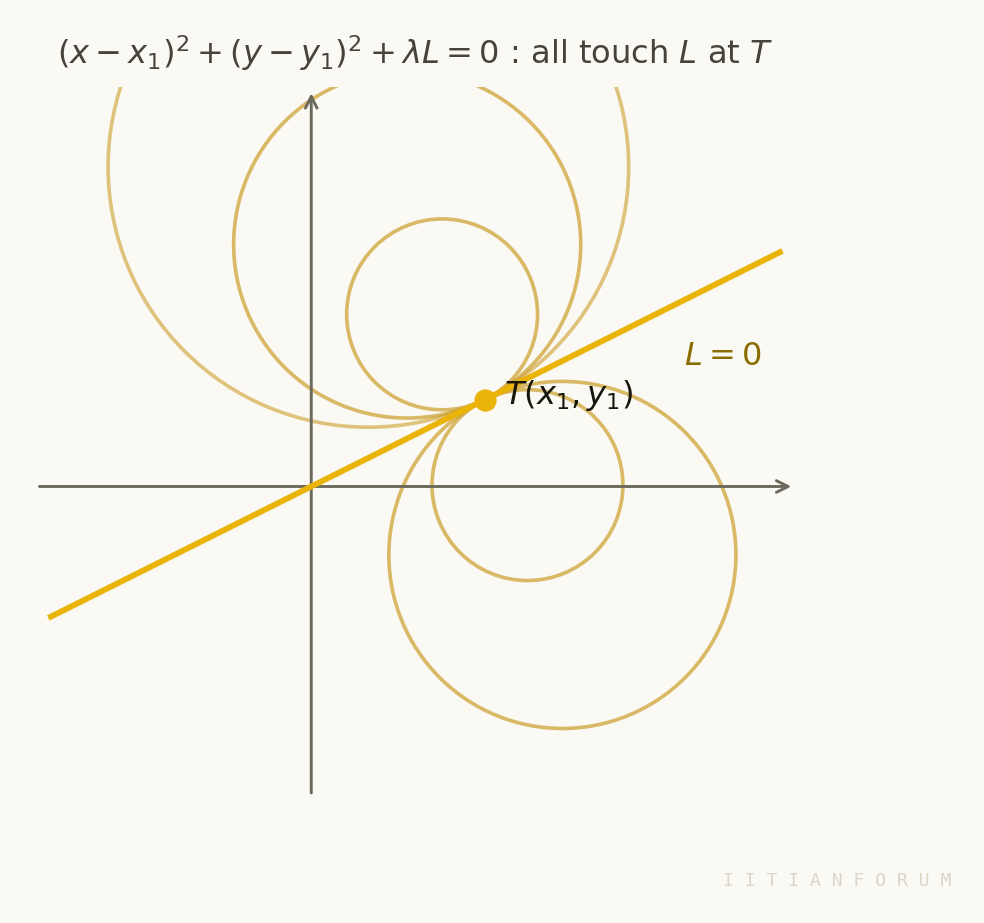
Type 4: circles touching a given line at a given point
Suppose every circle must touch the line L≡ℓx+my+n=0 at the fixed point T(x1,y1), which lies on L. Then
(x−x1)2+(y−y1)2+λL=0.
This is the previous idea taken to its limit. The point circle (x−x1)2+(y−y1)2=0 plays the role of "the two intersection points have merged into one", and adding λL swings a whole family through that single point, all tangent to L there.
Two special cases are worth keeping ready.
The line L is
The family becomes
the vertical line x=x1
(x−x1)2+(y−y1)2+λ(x−x1)=0
the horizontal line y=y1
(x−x1)2+(y−y1)2+λ(y−y1)=0
swipe for more →
Why it really is tangent. Substituting L=0 into the family leaves (x−x1)2+(y−y1)2=0, whose only real solution is the single point T. A line meeting a circle in exactly one point is a tangent, so every member touches L at T.
Example 9(IIT JEE 2011). A circle passes through (−1,0) and touches the y-axis at (0,2). Which of (−23,0), (−25,2), (−23,25), (−4,0) does it also pass through?
▸ SHOW SOLUTION
Step 1: Write the family. The tangency is at (0,2) on the line x=0, so
Notice that Step 6 gave r2 as a clean function of λ before either root was substituted. Doing the general computation once, then plugging in, is nearly always shorter than building both circles and measuring them separately.
Which form to reach for
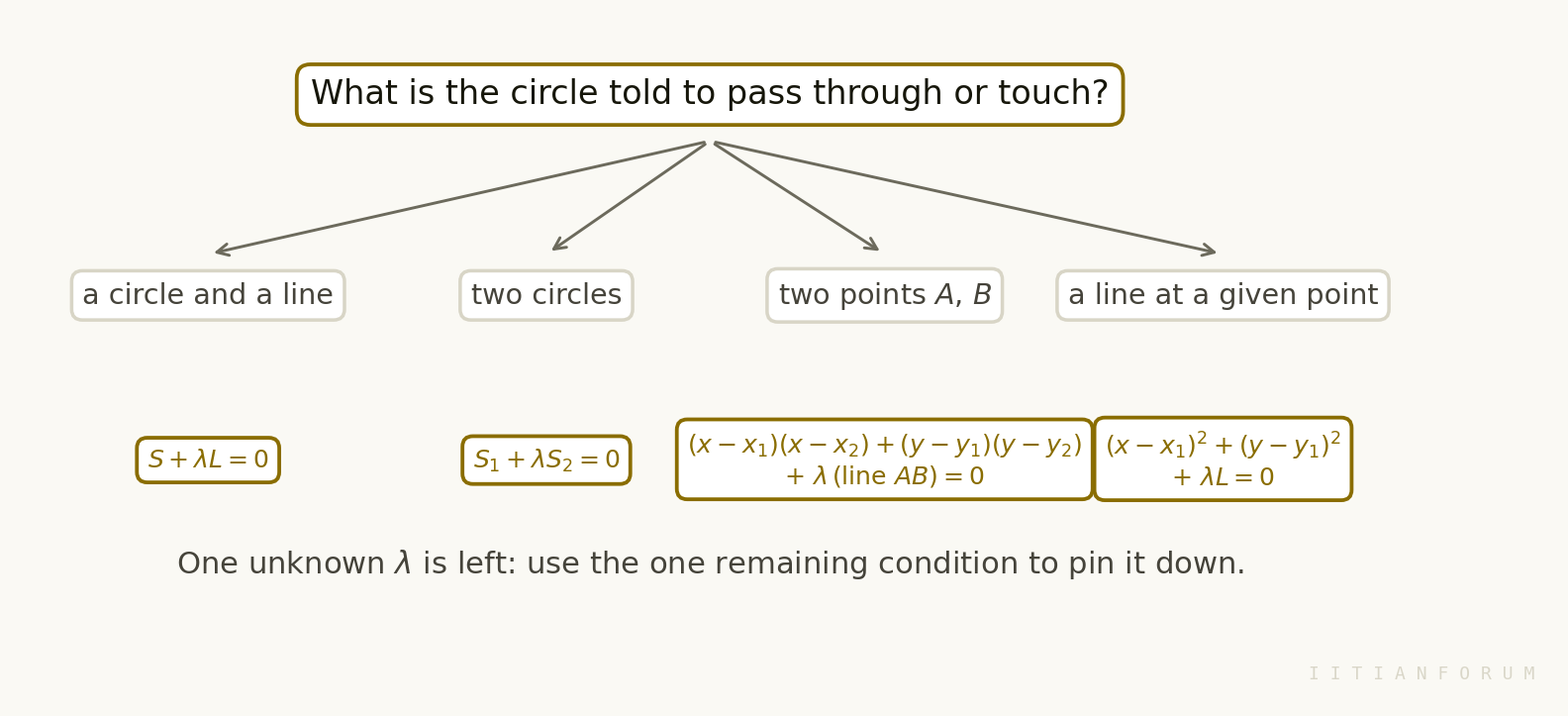
All four types are the same move. Write down something that already satisfies the conditions you were given, attach one λ, and let the last condition fix it.
The circle must pass through or touch
Write
the intersection of a circle S=0 and a line L=0
S+λL=0
the intersection of two circles S1=0, S2=0
S1+λS2=0, with λ=−1
two given points A(x1,y1), B(x2,y2)
(x−x1)(x−x2)+(y−y1)(y−y2)+λ(line AB)=0
a line L=0 at a given point T(x1,y1) on it
(x−x1)2+(y−y1)2+λL=0
swipe for more →
And then the last condition, whatever it is, becomes one equation in λ:
Last condition
Equation in λ
passes through a further point
substitute the point
centre on a given line
put the centre expression into that line
AB is a diameter, or the circle is the smallest of the family
centre lies on the chord
touches a given line
discriminant of the substituted quadratic is zero
given radius
g2+f2−c=r2
cuts a given circle orthogonally
2(g1g2+f1f2)=c1+c2
bisects the circumference of a given circle
common chord passes through that circle's centre
swipe for more →
One habit that saves time in the exam
Before substituting, always write the family in the normalised form x2+y2+2gx+2fy+c=0 and note g, f, c as expressions in λ. Every condition in the second table above is then a one-line substitution, and you never rebuild the circle twice.
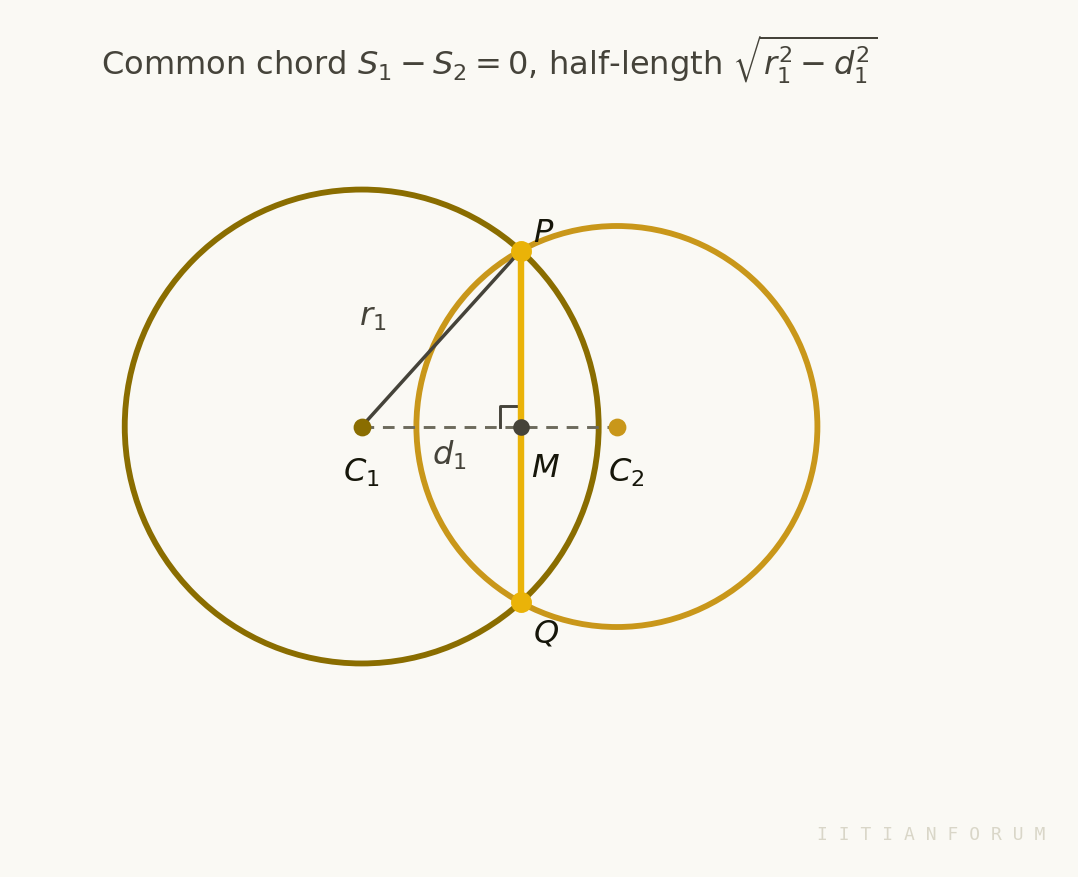
The common chord
We met it as the degenerate member of the family, and it deserves its own name. For two intersecting circles
Length. Drop a perpendicular from C1 to the chord. It bisects the chord, so with d1 the distance from C1 to the line S1−S2=0,
PQ=2r12−d12.
You may use either centre. The answer is the same, which is a good check.
The line exists even when the circles do not meet
S1−S2=0 is a perfectly good line whether or not the circles intersect. It is called the radical axis, and it is always perpendicular to the line of centres. When the circles meet it is the common chord, when they touch it is the common tangent at the point of contact, and when they are apart it is a line lying between them. Every member of the family S1+λS2=0 shares that same radical axis with both, which is why the family is called coaxial.
Example 11. Find the length of the common chord of x2+y2+8x+1=0 and x2+y2+2μy−1=0, given that it equals 26, and hence find μ.
▸ SHOW SOLUTION
Step 1: Write the common chord. Subtracting,
8x−2μy+2=0⟹4x−μy+1=0.
Step 2: Take the first circle. Here g=4, f=0, c=1, so its centre is (−4,0) and
r1=g2+f2−c=16+0−1=15.
Step 3: Use the half-chord relation. Half the chord is 6, so
d12=r12−6=15−6=9⟹d1=3.
Step 4: Compute d1 from the line. The distance from (−4,0) to 4x−μy+1=0 is
d1=16+μ2∣4(−4)−μ(0)+1∣=16+μ215.
Step 5: Solve.
16+μ215=3⟹16+μ2=5⟹μ2=9⟹μ=±3.
Step 6: Check with the other circle. For μ=3 the second circle has centre (0,−3) and radius 0+9+1=10. Its distance to 4x−3y+1=0 is 5∣0+9+1∣=2, and 210−4=26. It matches.
Answer:μ=±3
Example 12. If the circle x2+y2+4x+22y+c=0 bisects the circumference of x2+y2−2x+8y−d=0, find c+d.
▸ SHOW SOLUTION
Step 1: Turn "bisects the circumference" into geometry. One circle bisects the circumference of another exactly when their common chord is a diameter of the second circle, so the common chord passes through the centre of the second circle.
Step 2: Write the common chord. Subtracting the second from the first,
(4+2)x+(22−8)y+(c+d)=0⟹6x+14y+c+d=0.
Step 3: Locate the second centre. For x2+y2−2x+8y−d=0, the centre is (1,−4).
Step 4: Put the centre on the chord.
6(1)+14(−4)+c+d=0⟹6−56+c+d=0.
Step 5: Solve.
c+d=50.
Answer:50
Bisecting is not symmetric
"S1 bisects the circumference of S2" is a statement about S2's centre, not S1's. Substituting the wrong centre is the standard way to lose this mark. Read the sentence, then ask: whose circumference is being cut in half? That circle's centre is the one that goes into the chord.
Example 13(JEE Main 2026, 23 Jan Shift 2). Find the area of the region common to the circles x2+y2=4 and x2+(y−2)2=4.
▸ SHOW SOLUTION
Step 1: Find the common chord. Subtracting,
y2−(y−2)2=0⟹4y−4=0⟹y=1.
Step 2: Find where it meets the circles. Putting y=1 into x2+y2=4 gives x2=3, so the circles meet at (±3,1).
Step 3: Set up the area. Over −3≤x≤3 the region lies below the upper circle y=4−x2 and above the lower boundary y=2−4−x2. Using symmetry in x,
A=2∫03[4−x2−(2−4−x2)]dx=4∫03(4−x2−1)dx.
Step 4: Integrate. Using ∫a2−x2dx=2xa2−x2+2a2sin−1ax with a=2,
A=4[2x4−x2+2sin−12x−x]03.
Step 5: Evaluate. At x=3: 4−3=1 and sin−123=3π, so the bracket is 23+32π−3=32π−23.
Step 6: Multiply out.
A=4(32π−23)=38π−23=32(4π−33).
Step 7: Sanity check. Numerically A≈8.378−3.464≈4.91, which is a sensible fraction of a single circle's area 4π≈12.57.
Answer:32(4π−33)
Two circles in contact
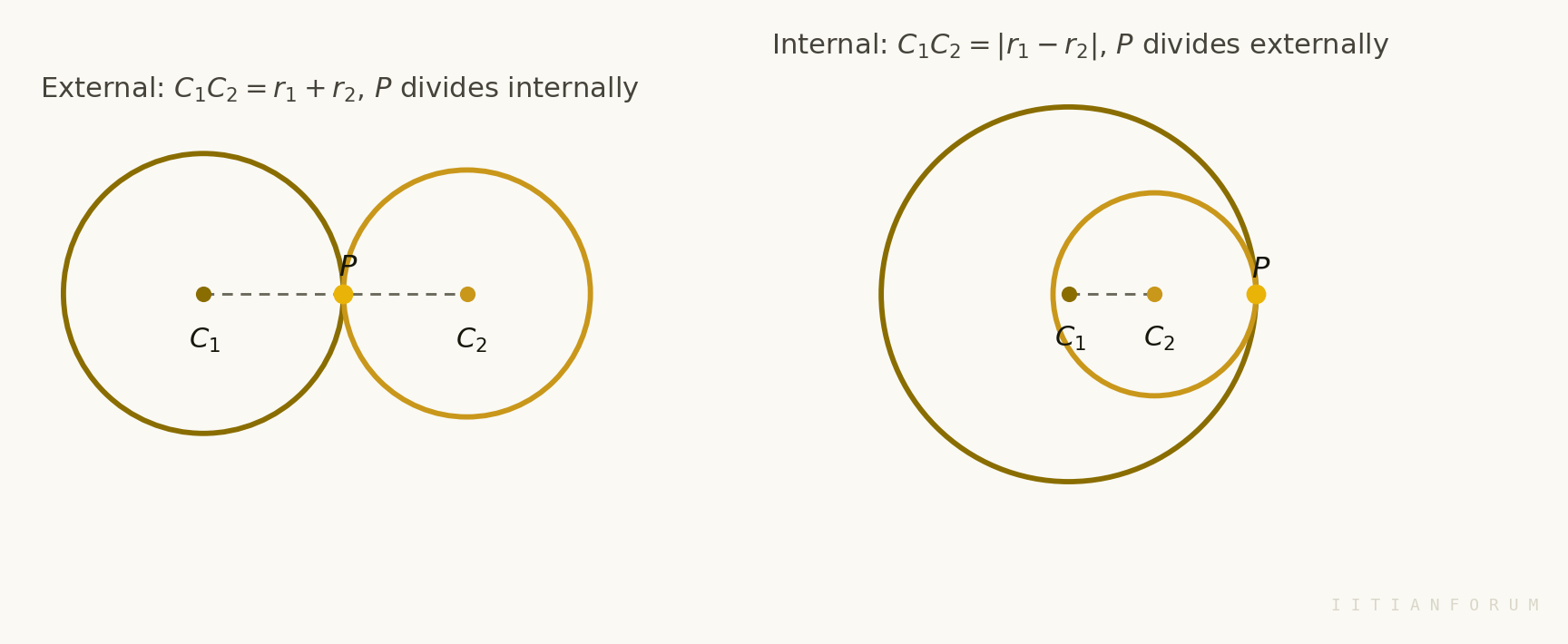
Two circles touch when they meet at exactly one point. Everything follows from one comparison: the distance between the centres against the two radii.
The point of contact P always lies on the line C1C2, and the section formula gives it at once.
Contact
P divides C1C2
Coordinates of P
external
internally in r1:r2
(r1+r2r1x2+r2x1,r1+r2r1y2+r2y1)
internal
externally in r1:r2
(r1−r2r1x2−r2x1,r1−r2r1y2−r2y1)
swipe for more →
Example 14(IIT JEE 2014). Let C be the circle with centre (1,1) and radius 1. If T is the circle centred at (0,y) passing through the origin and touching C externally, find the radius of T.
▸ SHOW SOLUTION
Step 1: Name the radius.T has centre (0,k) and passes through the origin, so its radius is ∣k∣. Take k>0.
Step 2: Write the contact condition. External contact means the distance between centres equals the sum of radii:
(1−0)2+(1−k)2=k+1.
Step 3: Square both sides.
1+(1−k)2=(k+1)2⟹1+1−2k+k2=k2+2k+1.
Step 4: Simplify.
2−2k=2k+1⟹1=4k⟹k=41.
Step 5: Check. Centres (1,1) and (0,41) are 1+169=1625=45 apart, and r1+r2=1+41=45. It matches.
Answer:41
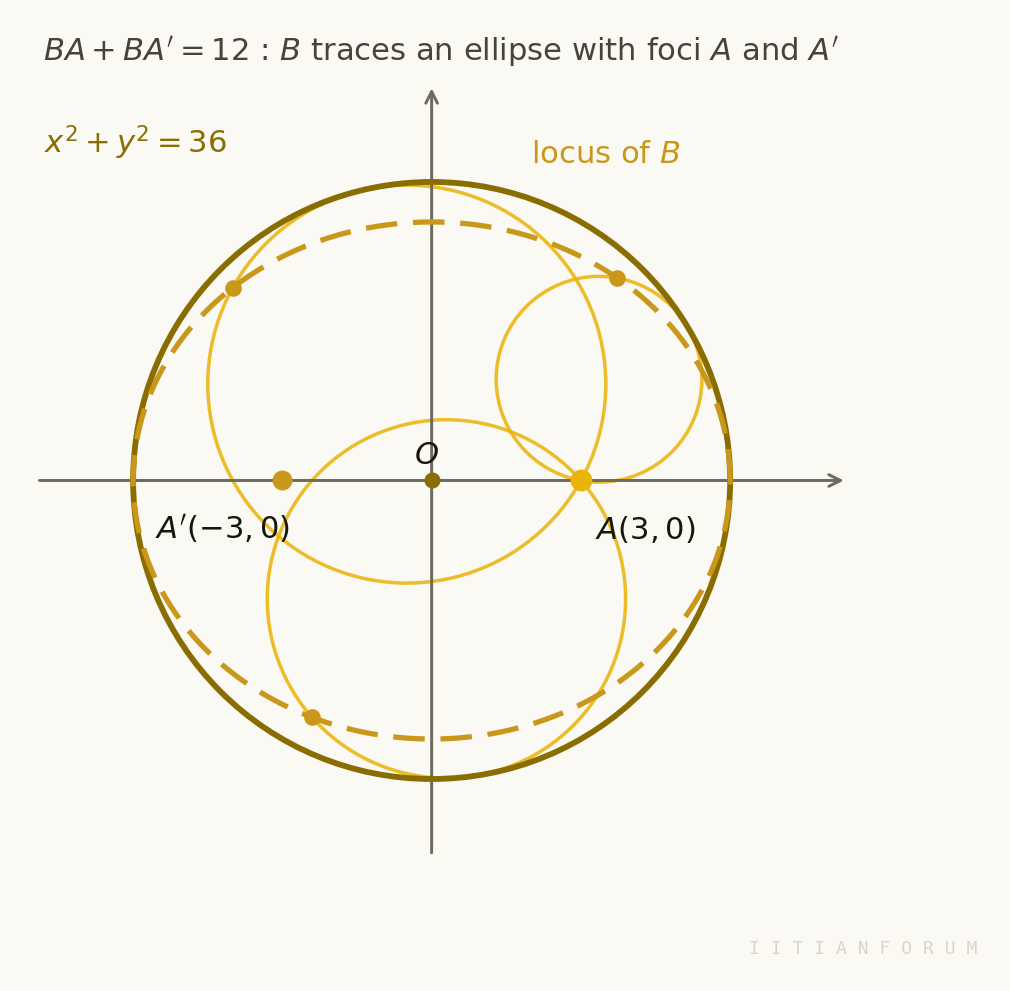
Example 15(JEE Main 2026, 2 Apr Shift 2). Let A=(3,0). Circles with variable diameter AB touch the circle x2+y2=36 internally. If the locus of B is a curve of eccentricity e, find 72e2.
▸ SHOW SOLUTION
Step 1: Set up. Write B=(h,k). The variable circle has AB as a diameter, so its centre is the midpoint
M=(2h+3,2k),
and its radius is
ρ=2AB=2(h−3)2+k2.
Step 2: Write the internal contact condition. The fixed circle has centre O(0,0) and radius 6. The small circle sits inside it, so
OM=6−ρ.
Step 3: Substitute.
(2h+3)2+(2k)2=6−2(h−3)2+k2.
Step 4: Multiply through by 2.
(h+3)2+k2=12−(h−3)2+k2.
Step 5: Rearrange and read the definition.
(h+3)2+k2+(h−3)2+k2=12.
The sum of the distances from B to the two fixed points (−3,0) and (3,0) is constant. That is precisely an ellipse with those two points as foci.
Step 6: Extract the constants.2a=12 gives a=6, and the foci are 6 apart so 2c=6, giving c=3.
Step 7: Compute the eccentricity.
e=ac=63=21,72e2=72⋅41=18.
Answer:18
Recognising a conic from a contact condition
Contact conditions turn into sums or differences of two distances, which is exactly how ellipses and hyperbolas are defined. Internal contact with a fixed circle gives a sum of distances, so an ellipse. External contact with two fixed circles gives a difference, so a hyperbola. Spot the sum or difference and you can name the curve before doing any algebra.
Common tangents: counting them first
A common tangent touches both circles. How many exist depends only on how the circles sit relative to each other, and the whole classification is one comparison of C1C2 with r1+r2 and ∣r1−r2∣.
Position
Condition
Common tangents
one outside the other
C1C2>r1+r2
4
touching externally
C1C2=r1+r2
3
cutting at two points
$
r_1-r_2
touching internally
$C_1C_2=
r_1-r_2
one inside the other
$C_1C_2<
r_1-r_2
swipe for more →
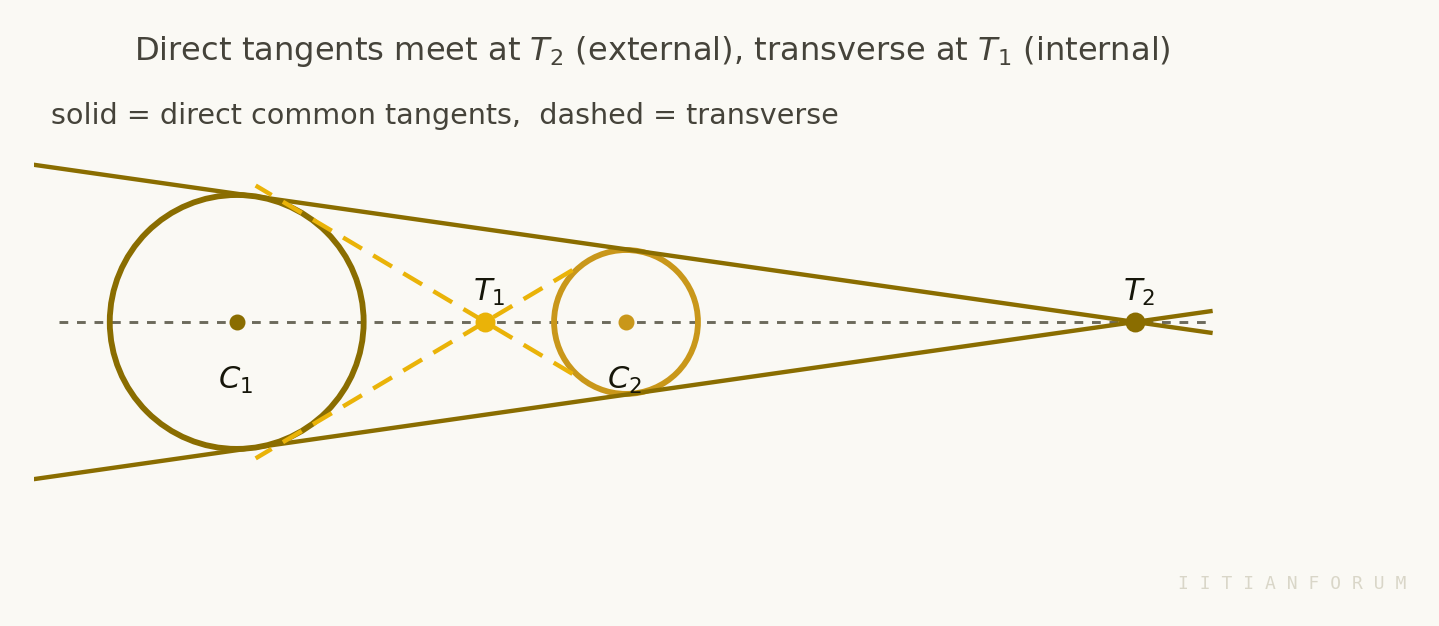
The two tangents that keep both circles on the same side are the direct common tangents, and they meet on the line of centres at the point dividing C1C2externally in the ratio r1:r2. The two that pass between the circles are the transverse common tangents, and they meet at the point dividing C1C2internally in the same ratio.
With d=C1C2, the tangent segments have lengths
direct=d2−(r1−r2)2,transverse=d2−(r1+r2)2.
The second formula makes the classification obvious: the transverse tangents are real only when d≥r1+r2, which is exactly the case where you counted 3 or 4.
Example 16(JEE Main 2015). How many common tangents can be drawn to x2+y2−4x−6y−12=0 and x2+y2+6x+18y+26=0?
▸ SHOW SOLUTION
Step 1: Read off centres and radii. For the first, g=−2, f=−3, c=−12, so C1=(2,3) and
r1=4+9+12=25=5.
For the second, g=3, f=9, c=26, so C2=(−3,−9) and
r2=9+81−26=64=8.
Step 2: Compute the distance between centres.
C1C2=(2+3)2+(3+9)2=25+144=169=13.
Step 3: Compare.r1+r2=5+8=13=C1C2, so the circles touch externally.
Step 4: Read the table. External contact gives 3 common tangents.
Answer:3
Example 17(JEE Main 2026, 22 Jan Shift 1). The set of values of r for which the circles (x+1)2+(y+4)2=r2 and x2+y2−4x−2y−4=0 intersect at two distinct points is an interval (α,β). Find αβ.
▸ SHOW SOLUTION
Step 1: Put the second circle in standard form. Completing squares,
(x−2)2+(y−1)2=4+4+1=9,
so C2=(2,1) and r2=3. The first has C1=(−1,−4) and radius r.
Step 2: Compute the distance between centres.
d=(2+1)2+(1+4)2=9+25=34.
Step 3: Write the intersecting condition. Two circles cut at two distinct points exactly when
∣r−3∣<d<r+3.
Step 4: Solve the right half.34<r+3 gives r>34−3.
Step 5: Solve the left half.∣r−3∣<34 gives −34<r−3<34, and since r>0 the binding part is r<34+3.
Step 6: Combine.r∈(34−3,34+3), so α=34−3 and β=34+3.
Step 7: Multiply.
αβ=(34)2−32=34−9=25.
Answer:25
Example 18. Find the length of the shortest segment PQ that touches C1:x2+y2−20x+64=0 at P and C2:x2+y2+30x+144=0 at Q.
▸ SHOW SOLUTION
Step 1: Read off the two circles. For C1: centre (10,0) and r1=100−64=6. For C2: centre (−15,0) and r2=225−144=9.
Step 2: Check their position.d=25 and r1+r2=15<25, so the circles lie completely outside each other and all four common tangents are real.
Step 3: Identify what "shortest" means. A segment touching both circles is a piece of a common tangent. The direct tangent segments have length d2−(r1−r2)2 and the transverse ones d2−(r1+r2)2. Since (r1+r2)2>(r1−r2)2, the transverse segment is the shorter one.
Step 4: Compute.
PQ=252−(6+9)2=625−225=400=20.
Step 5: Check the other one. The direct segment would be 625−9=616≈24.8, indeed longer.
Answer:20
Do not memorise which formula is which
Students routinely swap the two tangent lengths. Rebuild them instead: the transverse tangents pass between the circles, so they must clear the sum of the radii, hence r1+r2 appears. The direct tangents run alongside, so only the mismatch in radii matters, hence r1−r2. Reasoning takes two seconds and never fails.
Angle of intersection and orthogonal circles
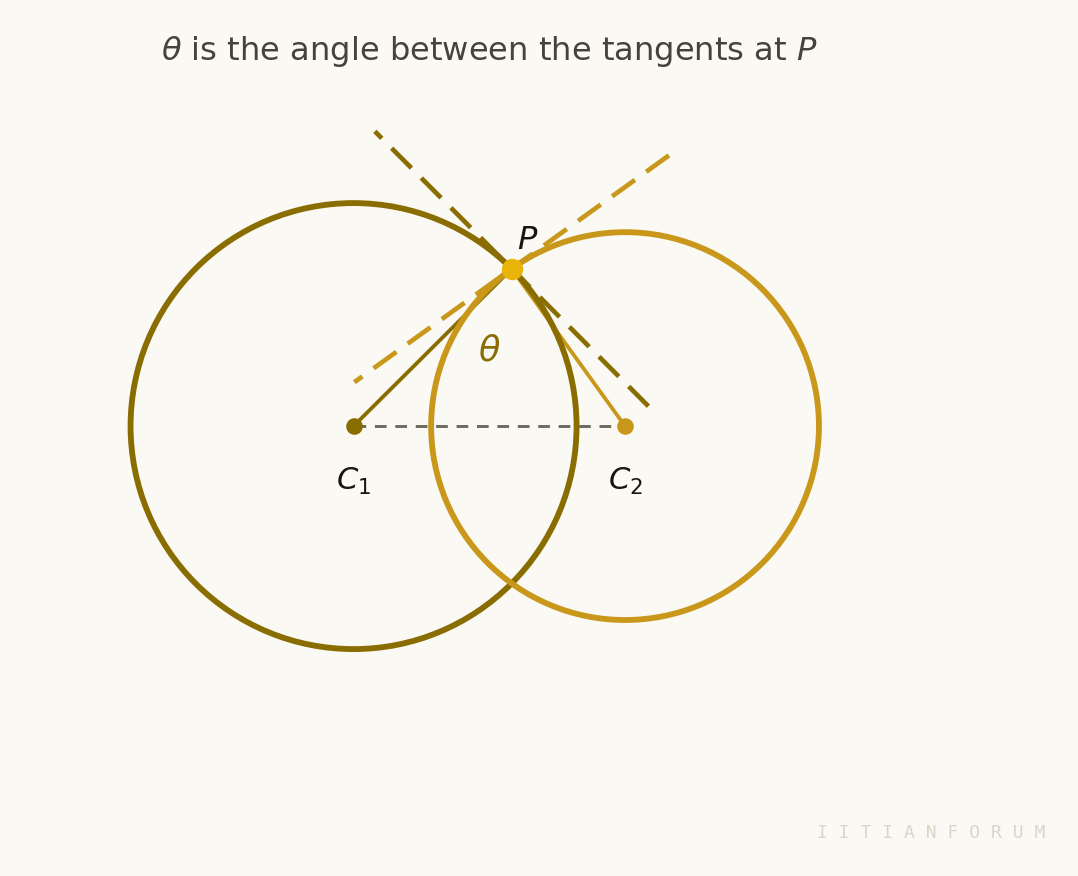
When two circles cut, the angle between them is defined as the angle between their tangents at a common point. Since each tangent is perpendicular to the corresponding radius, that is the same as the angle between C1P and C2P.
In triangle C1PC2 the sides are r1, r2 and d=C1C2, so the cosine rule gives
cosθ=2r1r2r12+r22−d2.
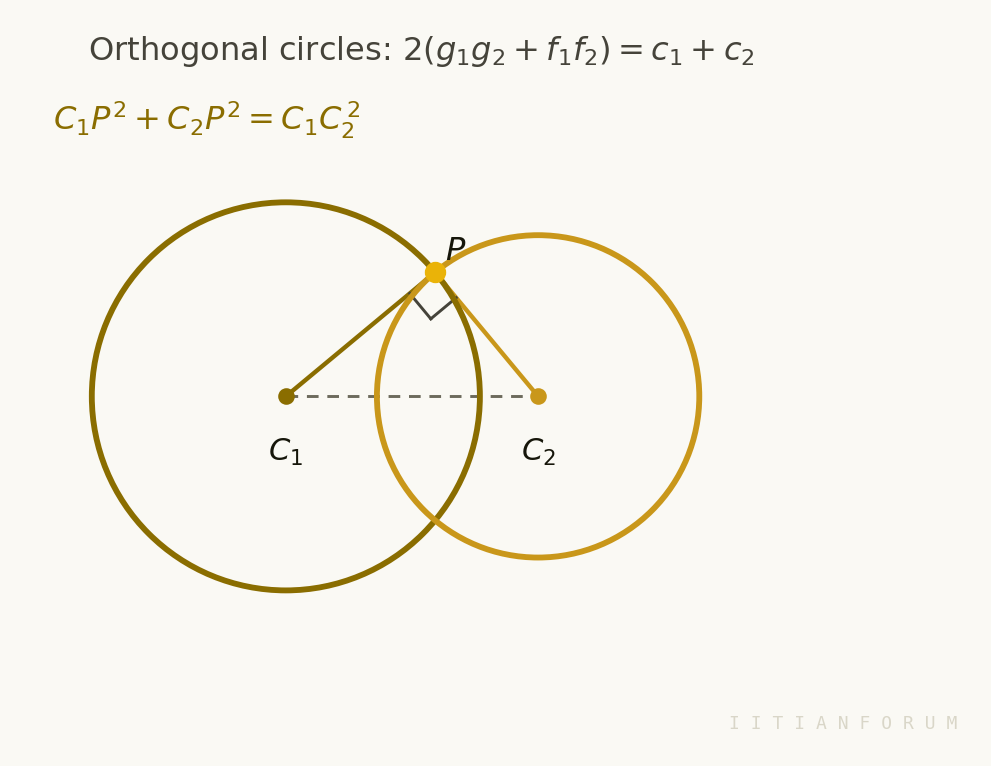
Orthogonal circles. Setting θ=90∘ makes the numerator vanish:
r12+r22=d2.
Written in general coefficients, with r12=g12+f12−c1, r22=g22+f22−c2 and d2=(g1−g2)2+(f1−f2)2, everything squared cancels and what survives is
2(g1g2+f1f2)=c1+c2
A picture worth carrying
Orthogonality says C1P⊥C2P, and since C2P is a radius of the second circle while C1P is perpendicular to it, C1P is tangent to the second circle at P. So two circles are orthogonal exactly when each radius drawn to a common point is a tangent to the other circle. That reading turns many orthogonality questions into tangent-length questions.
Example 19. Find the angle at which x2+y2−6x+4y+11=0 and x2+y2−4x+6y+9=0 intersect.
▸ SHOW SOLUTION
Step 1: Read off centres and radii. First: C1=(3,−2), r1=9+4−11=2. Second: C2=(2,−3), r2=4+9−9=2.
Step 5: Check they really do meet.∣r1−r2∣=2−2≈0.586 and r1+r2=2+2≈3.414, and d=2≈1.414 lies strictly between them, so the circles genuinely cut at two points.
Answer:45∘
Example 20. For what value of k do x2+y2−2kx+6y+1=0 and x2+y2+4x−2y+3=0 cut orthogonally?
▸ SHOW SOLUTION
Step 1: Read off the coefficients. First: g1=−k, f1=3, c1=1. Second: g2=2, f2=−1, c2=3.
Step 2: Apply the orthogonality condition.
2(g1g2+f1f2)=c1+c2⟹2((−k)(2)+(3)(−1))=1+3.
Step 3: Simplify.
2(−2k−3)=4⟹−4k−6=4⟹k=−25.
Step 4: Check both circles are real. With k=−25, the first has r12=425+9−1=457>0 and the second has r22=4+1−3=2>0. Both are genuine circles.
Step 5: Verify geometrically. The centres are (−25,−3) and (−2,1), so
d2=(21)2+42=41+16=465,r12+r22=457+2=465.
They are equal, which is exactly the orthogonality condition r12+r22=d2.
Answer:k=−25
Example 21(JEE Advanced 2014). A circle S passes through (0,1) and is orthogonal to (x−1)2+y2=16 and x2+y2=1. Find its centre and radius.
▸ SHOW SOLUTION
Step 1: Name the unknown circle. Let S:x2+y2+2gx+2fy+c=0.
Step 2: Write the two given circles in general form.(x−1)2+y2=16 becomes x2+y2−2x−15=0, so g2=−1, f2=0, c2=−15. And x2+y2=1 becomes x2+y2−1=0, so g3=0, f3=0, c3=−1.
Step 3: Orthogonality with the second circle.
2(g⋅0+f⋅0)=c+(−1)⟹0=c−1⟹c=1.
Step 4: Orthogonality with the first circle.
2(g⋅(−1)+f⋅0)=c+(−15)⟹−2g=1−15=−14⟹g=7.
Step 5: Use the point (0,1).
0+1+0+2f+c=0⟹1+2f+1=0⟹f=−1.
Step 6: Assemble. The centre is (−g,−f)=(−7,1) and
r=g2+f2−c=49+1−1=49=7.
Step 7: Check. Distance from (−7,1) to the centre (1,0) of the first given circle is 64+1=65, and r2+42=49+16=65. Orthogonal. Distance to (0,0) is 50, and 49+1=50. Orthogonal again.
Answer:centre (−7,1),radius 7
Chords and loci built on the same ideas
The three questions below are all from JEE Main 2026. None of them says "family of circles", and all three are solved by the habits this chapter builds: name the moving point, write the geometric condition, and let the algebra become a circle.
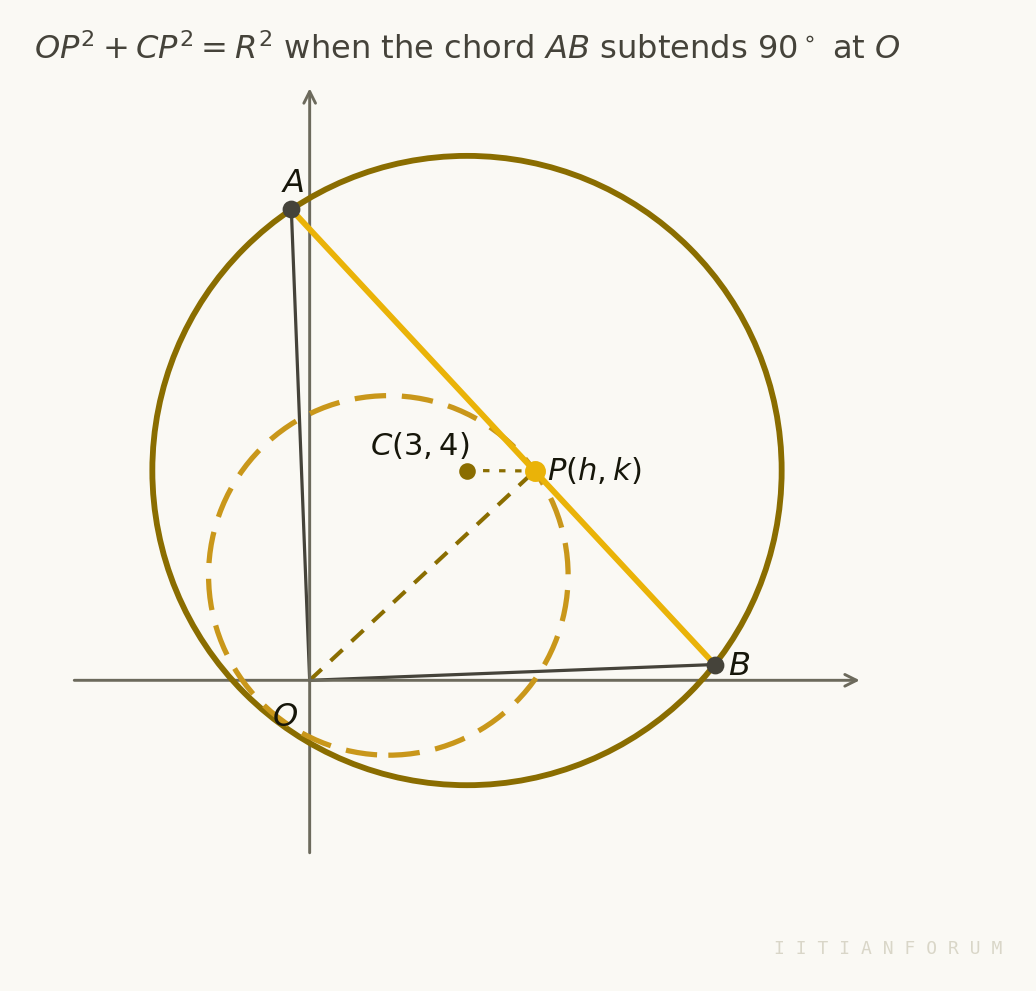
Example 22(JEE Main 2026, 8 Apr Shift 2). For the circle C:x2+y2−6x−8y−11=0, a variable chord AB subtends a right angle at the origin. The locus of the foot of the perpendicular from the origin to AB is the circle x2+y2−αx−βy−γ=0. Find α+β+2γ.
▸ SHOW SOLUTION
Step 1: Read the given circle. Its centre is C=(3,4) and
R=9+16+11=36=6.
Step 2: Name the moving point and the midpoint. Let P(h,k) be the foot of the perpendicular from O to AB, and let M be the midpoint of AB. Since CM⊥AB, the point M is the foot of the perpendicular from C.
Step 3: Use the right angle at O. In triangle AOB the angle at O is 90∘, so AB is the hypotenuse and the midpoint of the hypotenuse is equidistant from all three vertices:
OM=AM=2AB.
Step 4: Express AM from the circle. In the right triangle AMC,
AM2=R2−CM2.
Step 5: Express OM using P. Both M and P lie on the line AB, and OP⊥AB, so triangle OPM is right angled at P:
OM2=OP2+PM2.
Similarly triangle CPM is right angled at M, giving CP2=CM2+MP2, that is CM2=CP2−MP2.
Step 6: Put the three together. Substituting Steps 4 and 5 into OM2=AM2:
OP2+PM2=R2−(CP2−MP2).
The PM2 terms cancel and what is left is beautifully simple:
OP2+CP2=R2.
Step 7: Write that in coordinates. With P=(h,k), O=(0,0), C=(3,4) and R=6:
h2+k2+(h−3)2+(k−4)2=36.
Step 8: Expand and tidy.
2h2+2k2−6h−8k+25=36⟹2h2+2k2−6h−8k−11=0.
Dividing by 2,
h2+k2−3h−4k−211=0.
Step 9: Compare with the given form. So α=3, β=4 and γ=211, giving
α+β+2γ=3+4+11=18.
Answer:18
The one fact that did all the work
"The midpoint of the hypotenuse of a right triangle is equidistant from all three vertices" is a class 9 circle theorem, and it converted a right-angle condition into a length equation in a single line. Whenever a chord subtends 90∘ at a point, reach for it first.
Example 23(JEE Main 2026, 4 Apr Shift 1). Two chords are drawn from the point (1,2) on the circle x2+y2+x−3y=0 and each is bisected by the y-axis. If the far ends of these chords are R and S, and the midpoint of RS is (α,β), find 6(α+β).
▸ SHOW SOLUTION
Step 1: Check the given point is on the circle.1+4+1−6=0. Yes.
Step 2: Parametrise the midpoints. A chord bisected by the y-axis has its midpoint at M(0,λ) for some λ.
Step 3: Find the far end. If P(1,2) and E are the ends of a chord with midpoint M, then M=2P+E, so
E=2M−P=(−1,2λ−2).
Step 4: Force E onto the circle. Substituting x=−1, y=2λ−2 into x2+y2+x−3y=0:
1+(2λ−2)2−1−3(2λ−2)=0.
Step 5: Expand.
4λ2−8λ+4−6λ+6=0⟹4λ2−14λ+10=0.
Step 6: Solve. Dividing by 2, 2λ2−7λ+5=0, so (2λ−5)(λ−1)=0 and λ=1 or λ=25.
Step 7: Get the two far ends. For λ=1: E=(−1,0). For λ=25: E=(−1,3). So R=(−1,0) and S=(−1,3).
Step 8: Take the midpoint of RS.
(α,β)=(−1,23),6(α+β)=6(−1+23)=6⋅21=3.
Step 9: Check. Both (−1,0) and (−1,3) satisfy x2+y2+x−3y=0: 1+0−1−0=0 and 1+9−1−9=0.
Answer:3
Example 24(JEE Main 2026, 6 Apr Shift 2). The line x−y=4 meets the circle C:(x−4)2+(y+3)2=9 at Q and R. If P(α,β) lies on C with PQ=PR, find (6α+8β)2.
▸ SHOW SOLUTION
Step 1: Find Q and R. Substituting y=x−4:
(x−4)2+(x−1)2=9⟹2x2−10x+8=0⟹x2−5x+4=0,
so x=1 or x=4, giving Q=(4,0) and R=(1,−3).
Step 2: Turn PQ=PR into a line. Points equidistant from Q and R lie on the perpendicular bisector of QR. Writing it out,
(α−4)2+β2=(α−1)2+(β+3)2.
Step 3: Expand and cancel.
−8α+16=−2α+1+6β+9⟹−6α−6β+6=0⟹α+β=1.
Step 4: Use the relation directly. We need 6α+8β, and β=1−α, so
6α+8β=6α+8−8α=8−2α.
Step 5: Find α.P is on the circle, so substituting β=1−α into (α−4)2+(β+3)2=9:
(α−4)2+(4−α)2=9⟹2(α−4)2=9⟹α=4±23.
Step 6: Substitute.
6α+8β=8−2(4±23)=∓26,
so in either case
(6α+8β)2=236=18.
Step 7: Check. The perpendicular bisector of QR passes through the centre (4,−3), and indeed 4+(−3)=1. Both solutions are the two points where that bisector meets the circle, and the squaring makes the sign irrelevant.
Answer:18
Quick recall
Item
Result
Family of lines through the intersection of L1,L2
L1+λL2=0
Fixed point of a family A+λB=0
solve A=0 and B=0
Circles through a circle and a line
S+λL=0
Circles through two circles
S1+λS2=0, λ=−1
Circle on AB as diameter
(x−x1)(x−x2)+(y−y1)(y−y2)=0
Circles through two points A,B
diameter circle +λ(line AB)=0
Circles touching L at T(x1,y1)
(x−x1)2+(y−y1)2+λL=0
Common chord / radical axis
S1−S2=0
Length of the common chord
2r12−d12, d1 from C1 to the chord
S1 bisects the circumference of S2
common chord passes through the centre of S2
External contact
C1C2=r1+r2, P divides C1C2 internally in r1:r2
Internal contact
C1C2=∣r1−r2∣, P divides externally in r1:r2
Number of common tangents
4, 3, 2, 1, 0 as C1C2 falls through r1+r2 and ∣r1−r2∣
Count the conditions before you compute anything. Three conditions means a unique circle and you should be solving for g, f, c. Two conditions means a family, so write the family in one line and keep λ alive until the last condition arrives. Deciding this in the first ten seconds is worth more than any formula on this page.
The five slips that cost marks in this chapter
Not normalising the coefficient of x2 to 1 before combining. Forgetting λ=−1 in S1+λS2=0. Swapping the direct and transverse tangent lengths. Substituting the wrong centre in a "bisects the circumference" question. Confusing the longest chord through a point with the chord farthest from the centre.
Work every one of these on paper before you look at the solutions. Then come back to the doMath practice sets on Circles and time yourself: two minutes for a tangent-counting question, four for a family question, five for a locus.