Complex Numbers for JEE: Notes, Modulus, Argument, Roots of Unity and PYQs
Ritesh Raj · 12 Nov 2026
Aa
43 min read45 sectionsConcept
The equation x2+1=0 has no real root, because the square of a real number is never negative. Mathematicians added one new number i with i2=−1 and found that every polynomial equation then has a root. The resulting numbers a+ib add, multiply and divide like real numbers, carry a length and a direction, and turn rotation in the plane into a single multiplication. That is why complex numbers appear in quadratics, trigonometric sums, roots of unity and coordinate geometry.
This note covers the powers of i, the algebra of a+ib and equality, real and imaginary parts, the conjugate and its properties, the modulus with the triangle inequality and the parallelogram law, the argument and the principal argument, polar and Euler form, square roots, solving equations in z, De Moivre's theorem, the cube roots of unity, the nth roots of unity, and quadratic equations with complex roots or coefficients. Geometry in the Argand plane (rotation, lines, circles and loci) is summarised in one short section and developed fully in the Complex Numbers in Coordinate Geometry note. Each section ends with worked examples from JEE Main, JEE Advanced and IIT JEE papers, graded from easy to hard.
The number i and its powers
The imaginary uniti is defined by
i2=−1
so i=−1. For a positive real a, the square root of −a is
−a=ia
A number of the form ib with b real and b=0 is called purely imaginary.
Powers of i
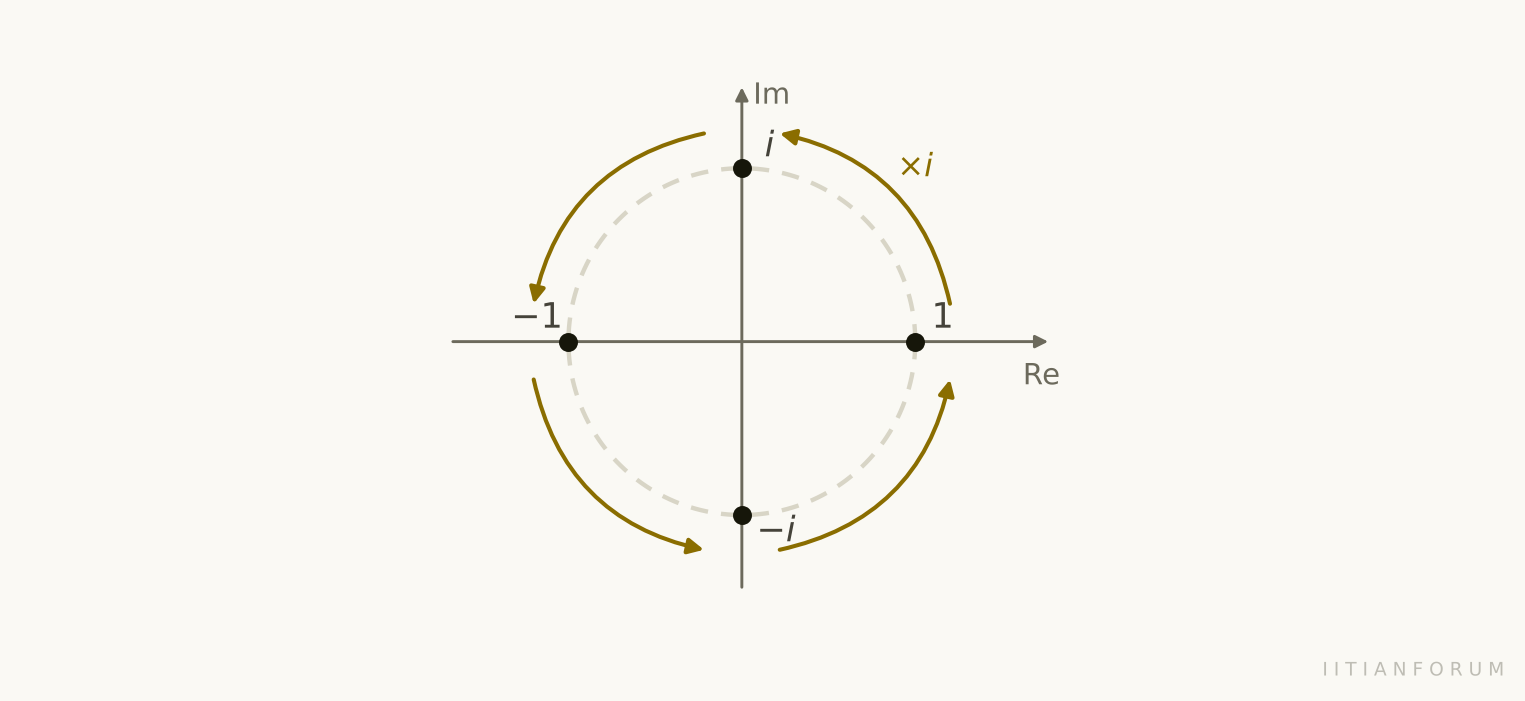
Multiplying by i again and again gives a cycle of length 4:
i1=i,i2=−1,i3=−i,i4=1
So for any integer n, write n=4q+r with r∈{0,1,2,3}. Then
in=i4q+r=(i4)qir=ir
The same rule works for negative n: i−1=i1=−i because i⋅(−i)=1.
The four powers of i on the unit circle, each a quarter turn from the previous one
Four consecutive powers always add to zero:
in+in+1+in+2+in+3=in(1+i−1−i)=0
nmod4
0
1
2
3
in
1
i
−1
−i
swipe for more →
The rule $\sqrt a\sqrt b=\sqrt{ab}$ needs $a,b\ge0$
For two negative numbers it is false. −4⋅−9=(2i)(3i)=6i2=−6, while (−4)(−9)=36=6. Always write −a=ia first, then multiply.
Examples
Example 1. The value of i57+i70+i−3+i−102 is
Tap an option to check your answer
(A)−2+2i
(B)2i
(C)−2
(D)0
▸ SHOW SOLUTION
Step 1. Reduce each power modulo 4
57=4⋅14+1, so i57=i. 70=4⋅17+2, so i70=−1.
i−3=i−4⋅i=ii−102=i−104⋅i2=−1
Step 2. Add
i−1+i−1=−2+2i
Answer: option (A)
Example 2. Which of the following is correct?
Tap an option to check your answer
(A)−4−9=6
(B)−4−9=−6
(C)(−4)(−9)=−6
(D)−4−9=36
▸ SHOW SOLUTION
Step 1. Write each root with i
−4=2i,−9=3i
Step 2. Multiply
−4−9=6i2=−6
(−4)(−9)=36=6, the positive root. So (A), (C) and (D) are false.
Answer: option (B)
Example 3(IITianForum). The value of k=1∑40ik! is
Tap an option to check your answer
(A)35+i
(B)36+i
(C)37
(D)35−i
▸ SHOW SOLUTION
Step 1. The first three terms
1!=1, 2!=2, 3!=6:
i1+i2+i6=i−1−1=i−2
Step 2. The remaining terms
For k≥4, k! contains the factor 4, so ik!=1. There are 40−3=37 such terms.
Step 3. Add
(i−2)+37=35+i
Answer: option (A)
Complex numbers: algebra and equality
A complex number is z=x+iy with x,y real. The real number x is the real part, Re(z), and the real number y is the imaginary part, Im(z). Note that Im(z) is y, not iy.
Formally, z is the ordered pair (x,y) of real numbers, and the set of all such pairs is C. The real numbers are the pairs (x,0), and i is the pair (0,1).
Equality
Two complex numbers are equal exactly when both parts are equal:
a+ib=c+id⟺a=candb=d
This is the most used fact of the chapter: one complex equation gives two real equations.
There is no order on $\mathbb C$
Statements like 3+2i>1+i or i>0 have no meaning. Only real numbers can be compared. In a question, z1>z2 means both are real. You may compare moduli, ∣z1∣>∣z2∣, because those are real.
Operations
For z1=a+ib and z2=c+id:
z1±z2=(a±c)+i(b±d)z1z2=(ac−bd)+i(ad+bc)
The product follows from expanding and using i2=−1. To divide, multiply the numerator and the denominator by c−id:
c+ida+ib=c2+d2(a+ib)(c−id)
The multiplicative inverse of z=a+ib=0 is
z1=a2+b2a−ia2+b2b
Addition and multiplication are commutative and associative, multiplication distributes over addition, 0 and 1 are the identities, and every non-zero z has an inverse.
Purely real and purely imaginary
z is purely real when Im(z)=0 and purely imaginary when Re(z)=0, z=0. For a quotient, first put it in the form a+ib and then set the required part to zero.
Examples
Example 4. If 1−i3+2i+(2−i)2=a+ib with a,b real, then 2(a−b) is equal to ______.
▸ SHOW SOLUTION
Step 1. The quotient
1−i3+2i=2(3+2i)(1+i)=21+5i
Step 2. The square
(2−i)2=4−4i+i2=3−4i
Step 3. Add and read off a, b
a+ib=27−23i2(a−b)=2(27+23)=10
Answer:10
Example 5(JEE Main 2026, 2 April Shift 1). Let x and y be real numbers such that 50(1+3i2x−1−2iy)=31+17i, i=−1. Then the value of 10(x−3y) is
Tap an option to check your answer
(1)20
(2)31
(3)35
(4)75
▸ SHOW SOLUTION
Step 1. Real denominators
(1+3i)(1−3i)=10 and (1−2i)(1+2i)=5:
1+3i2x=5x(1−3i)1−2iy=5y(1+2i)
Step 2. The equation
10x(1−3i)−10y(1+2i)=31+17i
Step 3. Equate parts
10x−10y=31,−30x−20y=17
So x−y=3.1. Putting x=3.1+y in the second: −93−50y=17, so y=−2.2 and x=0.9.
10(x−3y)=10(0.9+6.6)=75
Answer: option (4)
Example 6(JEE Main 2016). A value of θ for which 1−2isinθ2+3isinθ is purely imaginary, is
Tap an option to check your answer
(A)6π
(B)sin−1(43)
(C)sin−1(31)
(D)3π
▸ SHOW SOLUTION
Step 1. Real denominator
Multiply by 1+2isinθ. Write s=sinθ.
1+4s2(2+3is)(1+2is)=1+4s2(2−6s2)+7is
Step 2. Real part zero
2−6s2=0⇒s2=31
The imaginary part 1+4s27s is then non-zero, so the number is purely imaginary. sinθ=31 gives θ=sin−131.
Answer: option (C)
Example 7(JEE Main 2025, 4 April Shift 2). Let the product of ω1=(8+i)sinθ+(7+4i)cosθ and ω2=(1+8i)sinθ+(4+7i)cosθ be α+iβ, i=−1. Let p and q be the maximum and minimum values of α+β respectively. Then p+q is equal to
Tap an option to check your answer
(1)140
(2)130
(3)160
(4)150
▸ SHOW SOLUTION
Step 1. Separate real and imaginary parts
Let a=8sinθ+7cosθ and b=sinθ+4cosθ. Then
ω1=a+ib,ω2=b+ia
Step 2. The product
ω1ω2=ab+ia2+ib2+i2ab=i(a2+b2)
So α=0 and β=a2+b2.
Step 3. Simplify a2+b2
a2+b2=65sin2θ+65cos2θ+120sinθcosθα+β=65+60sin2θ
Step 4. Extremes
p=65+60=125 and q=65−60=5, so p+q=130.
Answer: option (2)
The conjugate
The conjugate of z=x+iy is
zˉ=x−iy
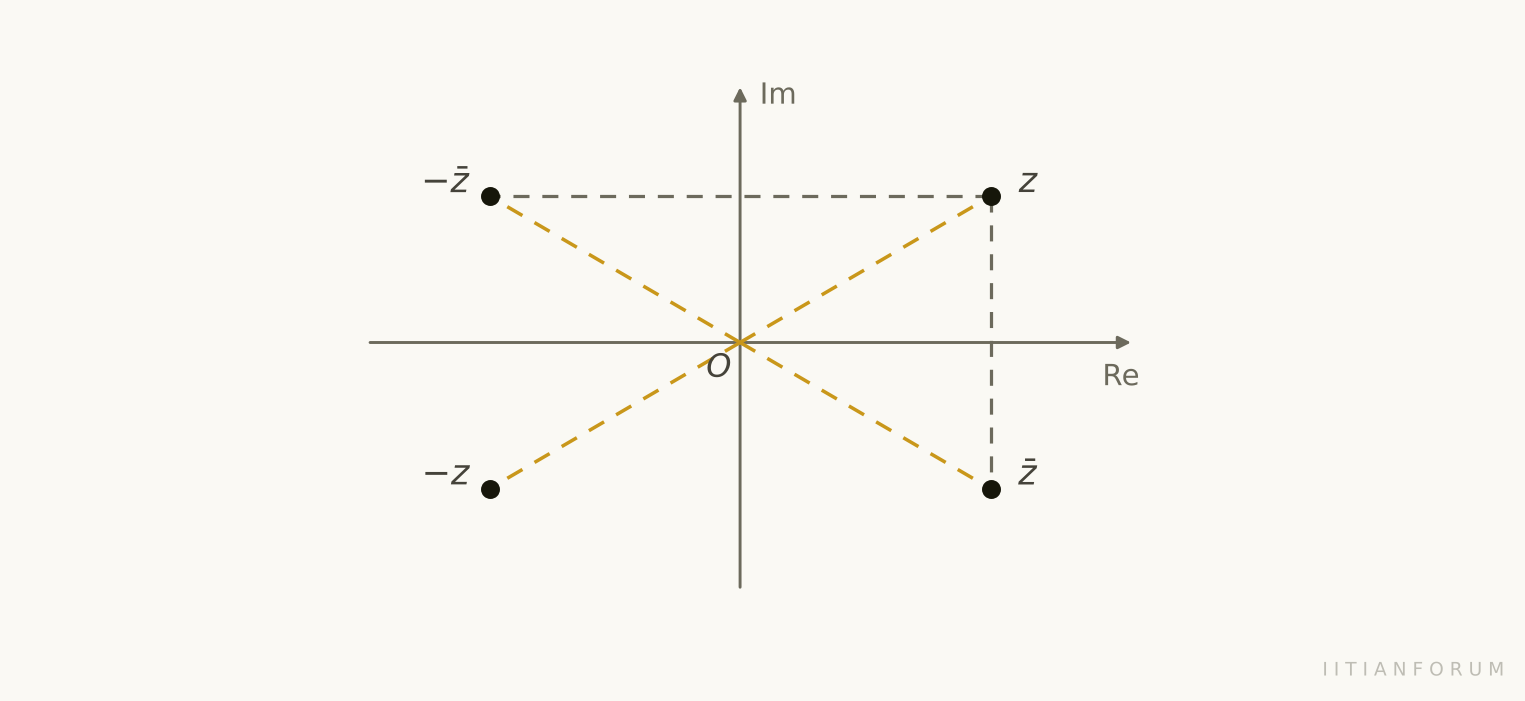
In the Argand plane (next section) zˉ is the mirror image of z in the real axis.
Point z with its conjugate, its negative and the negative of its conjugate in the four quadrants
Properties
Each follows by writing z=x+iy and expanding.
Property
Statement
Double conjugate
zˉ=z
Sum and difference
z+zˉ=2Re(z), z−zˉ=2iIm(z)
Real test
z real ⟺z=zˉ
Imaginary test
z purely imaginary ⟺z=−zˉ, z=0
Product with conjugate
zzˉ=x2+y2=∣z∣2
Conjugate of sum
z1±z2=zˉ1±zˉ2
Conjugate of product
z1z2=zˉ1zˉ2
Conjugate of quotient
(z1/z2)=zˉ1/zˉ2
Conjugate of power
zn=(zˉ)n
Reciprocal
z1=∣z∣2zˉ
swipe for more →
The product rule: if z1=a+ib and z2=c+id, both sides equal (ac−bd)−i(ad+bc). The quotient rule follows from the product rule applied to z1=z2z1⋅z2.
So the conjugate of any expression built from z's by +,−,×,÷ and real constants is the same expression in the zˉ's. For example, if p(x) has real coefficients then p(z)=p(zˉ). This is why the non-real roots of a real polynomial come in conjugate pairs.
Conjugate method for 'real' and 'imaginary'
To show that w is real, show w=wˉ. To find when w is purely imaginary, solve w+wˉ=0. This often avoids putting z=x+iy.
Examples
Example 8. Let z be a non-real complex number such that z+z1 is real. Then
Tap an option to check your answer
(A)∣z∣=1
(B)Re(z)=0
(C)∣z∣=2
(D)argz=4π
▸ SHOW SOLUTION
Step 1. Real means equal to its conjugate
z+z1=zˉ+zˉ1
Step 2. Factor
(z−zˉ)−zzˉz−zˉ=0(z−zˉ)(1−∣z∣21)=0
Step 3. Use the non-real condition
z is non-real, so z−zˉ=0. Hence ∣z∣2=1.
Answer: option (A)
Example 9(IITianForum). For non-zero complex numbers z1,z2, the minimum value of ∣z1z2∣z1zˉ2+zˉ1z2+z1z2+zˉ1zˉ2 is ______.
This lies in [−4,4] and equals −4 for θ1=0, θ2=π, for example z1=1, z2=−1.
Answer:−4
Example 10(JEE Main 2025, 7 April Shift 1). Among the statements
(S1): The set {z∈C−{−i}:∣z∣=1 and z+iz−i is purely real} contains exactly two elements, and
(S2): The set {z∈C−{−1}:∣z∣=1 and z+1z−1 is purely imaginary} contains infinitely many elements,
Tap an option to check your answer
(1)both are incorrect
(2)only (S1) is correct
(3)only (S2) is correct
(4)both are correct
▸ SHOW SOLUTION
Step 1. Statement S1
Let w=z+iz−i be real. Then w=1, and solving for z:
z=1−wi(1+w)
which is purely imaginary or zero. On ∣z∣=1 this leaves z=±i. z=−i is excluded, so only z=i remains. S1 is false.
Step 2. Statement S2
For ∣z∣=1, zˉ=z1. Let u=z+1z−1:
uˉ=z1+1z1−1=1+z1−z=−u
So u is purely imaginary (or 0 at z=1) for every z=−1 on the circle. There are infinitely many such z. S2 is true.
Answer: option (3)
Example 11(JEE Advanced 2016, Paper 2). Let a,b∈R and a2+b2=0. Suppose S={z∈C:z=a+ibt1,t∈R,t=0}, where i=−1. If z=x+iy and z∈S, then (x,y) lies on
More than one option is correct. Pick all of them, then Check
(A)the circle with radius 2a1 and centre (2a1,0) for a>0, b=0
(B)the circle with radius −2a1 and centre (−2a1,0) for a<0, b=0
(C)the x-axis for a=0, b=0
(D)the y-axis for a=0, b=0
▸ SHOW SOLUTION
Step 1. Real and imaginary parts
z=a2+b2t2a−ibtx=a2+b2t2a,y=a2+b2t2−bt
Step 2. Case a=0, b=0
x2+y2=a2+b2t21=ax
This is the circle with centre (2a1,0) and radius 2∣a∣1. For a>0 this is (A). For a<0 the centre is (2a1,0), not (−2a1,0), so (B) is false.
Step 3. The two special cases
b=0: y=0 and x=a1, a point of the x-axis, so (C) holds. a=0: x=0, so z is on the y-axis, and (D) holds.
Answer: (A), (C) and (D)
Example 12(JEE Advanced 2026, Paper 2). Let R denote the set of all real numbers and let i=−1. Consider the matrices S=[01−10] and T=[1011]. Let a,b,c,d be real numbers such that ST=[acbd]. Let H={x+iy:x,y∈R and y>0}. Then which of the following statements is (are) TRUE?
More than one option is correct. Pick all of them, then Check
(1)d+icb+ia=i
(2)If ω=2−1+i3, then cω+daω+b=ω
(3)If m is an integer greater than 2 such that (ST)2=(ST)m, then m is an integer multiple of 8
(4)If z∈H, then cz+daz+b∈H
▸ SHOW SOLUTION
Step 1. The matrix
ST=[01−11]
So a=0, b=−1, c=1, d=1.
Step 2. Statement (1)
d+icb+ia=1+i−1=2−1+i=i
False.
Step 3. Statement (2)
ω+1=−ω2, so
cω+daω+b=ω+1−1=ω21=ω
True.
Step 4. Statement (3)
Let A=ST. Then A2=[−11−10] and A3=−I, so A6=I. Am=A2 holds exactly when m−2 is a multiple of 6, for example m=14, which is not a multiple of 8. False.
Step 5. Statement (4)
cz+daz+b=z+1−1. Multiply by z+1:
z+1−1=∣z+1∣2−(zˉ+1)Im(z+1−1)=∣z+1∣2Im(z)>0
True.
Answer: (2) and (4)
Modulus
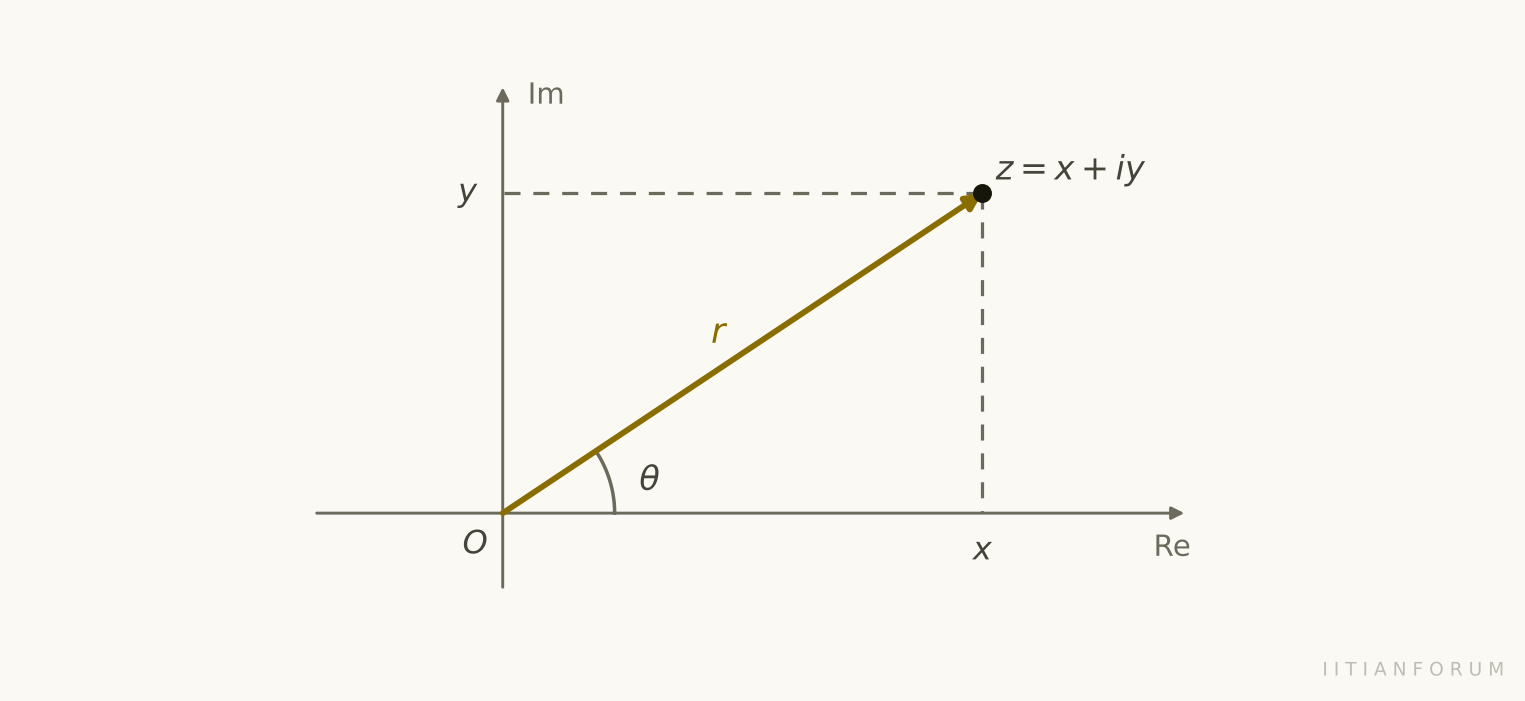
The Argand plane shows z=x+iy as the point (x,y). The modulus of z is its distance from the origin:
∣z∣=x2+y2
∣z1−z2∣ is the distance between the points z1 and z2.
The point z equals x plus iy at distance r from O, making angle theta with the real axis
Properties
Property
Statement
Basic
∣z∣≥0; ∣z∣=0⟺z=0
Symmetry
∣z∣=∣zˉ∣=∣−z∣
Parts
−∣z∣≤Re(z)≤∣z∣, −∣z∣≤Im(z)≤∣z∣
Conjugate
zzˉ=∣z∣2
Product
∣z1z2∣=∣z1∣∣z2∣
Quotient
z2z1=∣z2∣∣z1∣
Power
∣zn∣=∣z∣n
Sum squared
∣z1±z2∣2=∣z1∣2+∣z2∣2±2Re(z1zˉ2)
Parallelogram law
∣z1+z2∣2+∣z1−z2∣2=2(∣z1∣2+∣z2∣2)
Two variable identity
∣az1−bz2∣2+∣bz1+az2∣2=(a2+b2)(∣z1∣2+∣z2∣2), a,b real
swipe for more →
The product rule comes from ∣z1z2∣2=z1z2zˉ1zˉ2=∣z1∣2∣z2∣2. The sum rule comes from
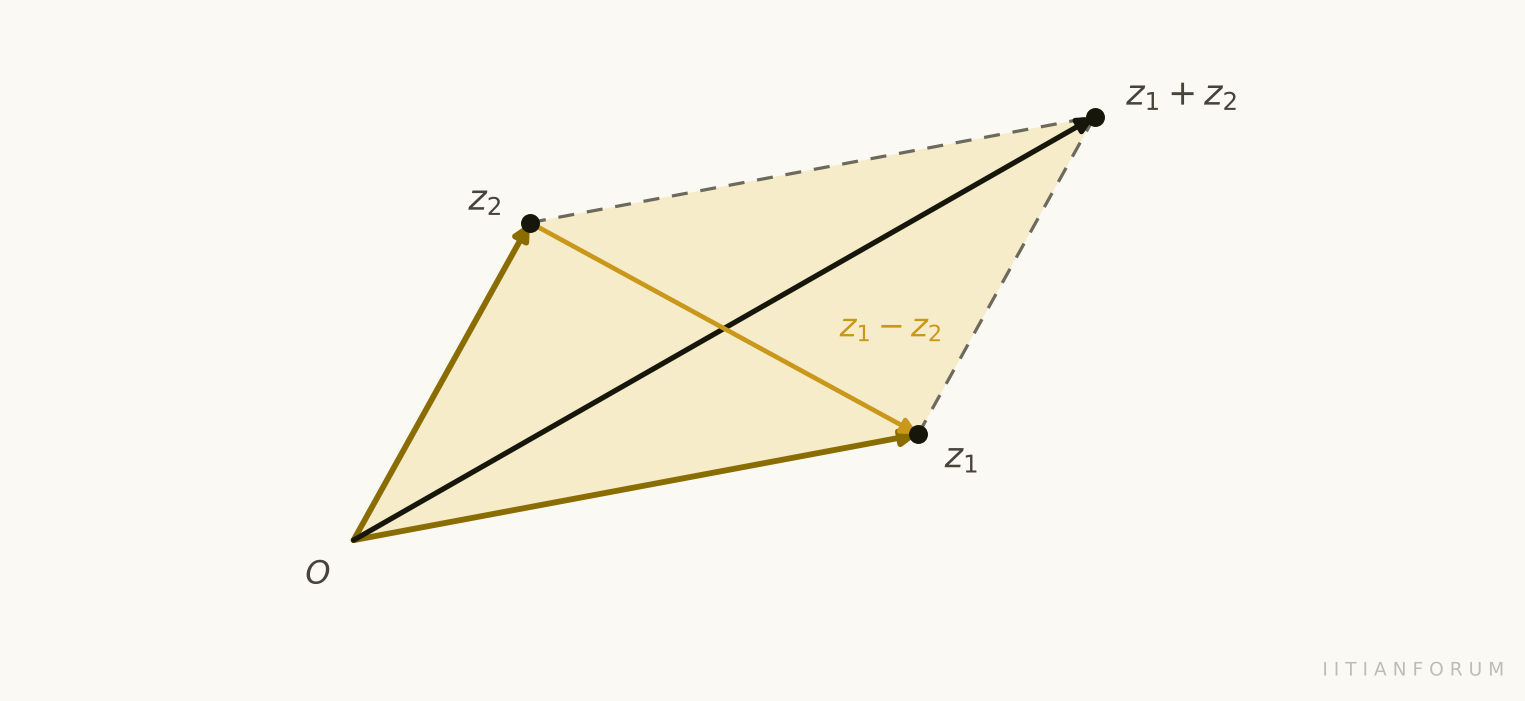
and z1zˉ2+zˉ1z2=2Re(z1zˉ2). Adding the + and − forms gives the parallelogram law: the sum of the squares of the diagonals equals the sum of the squares of the four sides.
Parallelogram with sides z1 and z2 and diagonals z1 plus z2 and z1 minus z2
Triangle inequality
∣z1+z2∣≤∣z1∣+∣z2∣∣z1∣−∣z2∣≤∣z1−z2∣
Reason: Re(z1zˉ2)≤∣z1zˉ2∣=∣z1∣∣z2∣, so
∣z1+z2∣2≤∣z1∣2+∣z2∣2+2∣z1∣∣z2∣
In the figure, the sides of triangle O,z1,z1+z2 have lengths ∣z1∣, ∣z2∣, ∣z1+z2∣. The general form is ∣z1+z2+⋯+zn∣≤∣z1∣+∣z2∣+⋯+∣zn∣.
Equality cases.∣z1+z2∣=∣z1∣+∣z2∣ holds exactly when z1 and z2 point the same way, that is z1zˉ2 is real and non-negative (argz1=argz2 for non-zero numbers). ∣z1−z2∣=∣z1∣−∣z2∣ holds under the same condition. ∣z1+z2∣=∣z1−z2∣ holds exactly when Re(z1zˉ2)=0, that is argz1−argz2=±2π.
Bounds for $|z|$ from an equation
From z−z4=2 you get ∣z∣−∣z∣4≤2, an upper bound. The other direction, ∣z∣4−∣z∣≤2, gives the lower bound. Check that the bound is reached: equality needs z and z4 to point in opposite or same directions.
Examples
Example 13(JEE Main 2026, 24 January Shift 2). Let z=(1+i)(1+2i)(1+3i)⋯(1+ni), where i=−1. If ∣z∣2=44200, then n is equal to ______.
▸ SHOW SOLUTION
Step 1. Modulus of a product
∣z∣2=r=1∏n∣1+ri∣2=r=1∏n(1+r2)
Step 2. Multiply until 44200
The factors are 2,5,10,17,26,…:
2⋅5⋅10⋅17⋅26=44200
So n=5.
Answer:5
Example 14(JEE Main 2019, 11 January Shift 2). Let z be a complex number such that ∣z∣+z=3+i, where i=−1. Then ∣z∣ is equal to
Tap an option to check your answer
(A)334
(B)45
(C)35
(D)441
▸ SHOW SOLUTION
Step 1. Equate parts
Let z=x+iy. ∣z∣ is real, so the imaginary part gives y=1, and the real part gives
x2+1+x=3
Step 2. Solve
x2+1=(3−x)2=9−6x+x2x=34∣z∣=3−x=35
Answer: option (C)
Example 15(IITianForum). Complex numbers z1,z2 satisfy ∣z1∣=∣z1+z2∣=2 and ∣z1−z2∣=23. Then
More than one option is correct. Pick all of them, then Check
Re(z1zˉ2)=∣z1∣∣z2∣cosϕ, where ϕ is the angle between them:
cosϕ=4−2=−21
So ϕ=32π and argz1z2=±32π.
Answer: (A), (C) and (D)
Example 16(AIEEE 2009). If z−z4=2, then the maximum value of ∣z∣ is equal to
Tap an option to check your answer
(A)5+1
(B)2
(C)2+2
(D)3+1
▸ SHOW SOLUTION
Step 1. Triangle inequality
∣z∣=(z−z4)+z4≤2+∣z∣4
Step 2. Solve for r=∣z∣
r2−2r−4≤0⇒r≤1+5
Step 3. The bound is reached
Equality needs z−z4 and z4 in the same direction. Take z=i(1+5): then z4=−i(5−1) and z−z4=2i, which has modulus 2.
Answer: option (A)
Example 17(IITianForum). If 7z8+6iz7+6iz−7=0, then
Tap an option to check your answer
(A)∣z∣=1
(B)∣z∣<1
(C)∣z∣>1
(D)∣z∣ cannot be decided
▸ SHOW SOLUTION
Step 1. Isolate z7
z7(7z+6i)=7−6iz⇒z7=7z+6i7−6iz
Step 2. Compare the two moduli
Let z=x+iy. Expanding both:
∣7−6iz∣2=49+36∣z∣2+84y∣7z+6i∣2=49∣z∣2+36+84y
The difference is 13(1−∣z∣2).
Step 3. Rule out the other cases
If ∣z∣>1: then ∣z7∣>1, but the difference is negative, so the quotient has modulus less than 1. Contradiction. If ∣z∣<1: then ∣z7∣<1, but the difference is positive, so the quotient has modulus greater than 1. Contradiction again. So ∣z∣=1.
Answer: option (A)
Example 18(JEE Advanced 2013, Paper 1). Let complex numbers α and αˉ1 lie on the circles (x−x0)2+(y−y0)2=r2 and (x−x0)2+(y−y0)2=4r2 respectively. If z0=x0+iy0 satisfies the equation 2∣z0∣2=r2+2, then ∣α∣=
Tap an option to check your answer
(A)21
(B)21
(C)71
(D)31
▸ SHOW SOLUTION
Step 1. Write both conditions with zzˉ
Let a=∣α∣2, p=Re(αzˉ0) and c=∣z0∣2. Since αˉ1=aα:
a−2p+c=r2a1−a2p+c=4r2
Step 2. Remove p
From the first, 2p=a+c−r2. Put it in the second (multiplied by a):
1−a−c+r2=4ar2−ac
Step 3. Use c=2r2+2
2r2−a=27ar2−a⇒a=71
So ∣α∣=71.
Answer: option (C)
Argument and principal argument
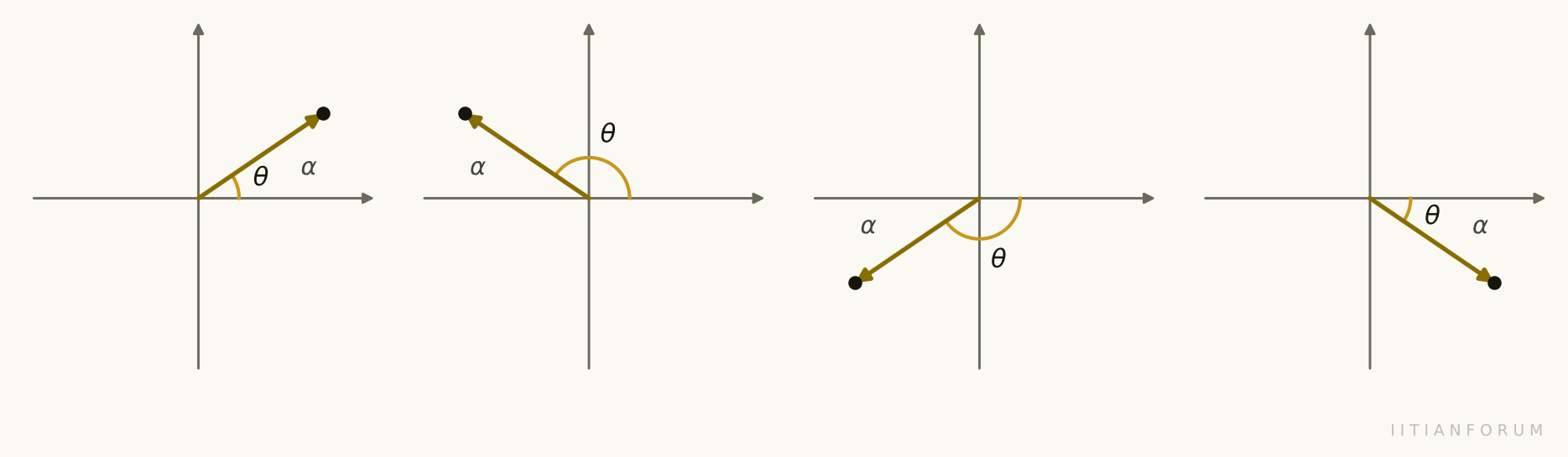
For z=0, an argument of z is an angle θ that the line from O to z makes with the positive real axis. In the figure of the last section,
cosθ=∣z∣x,sinθ=∣z∣y
If θ is an argument, so is θ+2kπ for every integer k. The one value in (−π,π] is the principal argument, written argz or Argz. The argument of 0 is not defined.
Finding the principal argument
First find the acute angle α=tan−1xy, then place it by quadrant.
Principal argument in the four quadrants built from the acute angle alpha
Position of z=x+iy
argz
x>0,y≥0 (first quadrant or positive real axis)
α
x<0,y≥0 (second quadrant or negative real axis)
π−α
x<0,y<0 (third quadrant)
−(π−α)
x>0,y<0 (fourth quadrant)
−α
x=0,y>0
2π
x=0,y<0
−2π
swipe for more →
Some books use the interval [0,2π). Then the third and fourth quadrant values become π+α and 2π−α. A JEE question always states its convention; the default is (−π,π].
The integer k is chosen to bring the answer back into (−π,π]. The first rule follows from polar form in the next section: moduli multiply and angles add. The rule for zˉ needs z not on the negative real axis (there argzˉ=argz=π).
Principal arguments do not simply add
arg(−1+i)=43π and arg(−1+i3)=32π, but arg of the product is not 1217π, which lies outside (−π,π]. It is 1217π−2π=−127π. Always reduce at the end.
Useful special cases
z real positive: argz=0. Real negative: π. argz=2π means z is on the positive imaginary axis. ∣z1+z2∣=∣z1∣+∣z2∣ means argz1=argz2.
Examples
Example 19. Let z1=−1+i and z2=−1+i3. Then the principal argument of z1z2 is
Tap an option to check your answer
(A)1217π
(B)−127π
(C)127π
(D)−125π
▸ SHOW SOLUTION
Step 1. Each argument
z1 is in the second quadrant with α=4π, so argz1=43π. z2 is in the second quadrant with α=3π, so argz2=32π.
Step 2. Add and reduce
43π+32π=1217π>πarg(z1z2)=1217π−2π=−127π
Check: z1z2=(1−3)−i(1+3) is in the third quadrant.
Answer: option (B)
Example 20(JEE Main 2013). If z is a complex number of unit modulus and argument θ, then arg(1+zˉ1+z) equals
Tap an option to check your answer
(A)−θ
(B)2π−θ
(C)θ
(D)π−θ
▸ SHOW SOLUTION
Step 1. Use ∣z∣=1
zzˉ=1, so zˉ=z1:
1+zˉ=1+z1=zz+1
Step 2. Simplify
1+zˉ1+z=1+z(1+z)z=z
So the argument is θ.
Answer: option (C)
Example 21(JEE Advanced 2018, Paper 1). For a non-zero complex number z, let arg(z) denote the principal argument with −π<arg(z)≤π. Then, which of the following statement(s) is (are) FALSE?
More than one option is correct. Pick all of them, then Check
(A)arg(−1−i)=4π, where i=−1
(B)The function f:R→(−π,π], defined by f(t)=arg(−1+it) for all t∈R, is continuous at all points of R
(C)For any two non-zero complex numbers z1 and z2, arg(z2z1)−arg(z1)+arg(z2) is an integer multiple of 2π
(D)For any three given distinct complex numbers z1,z2 and z3, the locus of the point z satisfying the condition arg((z−z3)(z2−z1)(z−z1)(z2−z3))=π, lies on a straight line
▸ SHOW SOLUTION
Step 1. Statement (A)
−1−i is in the third quadrant with α=4π, so arg(−1−i)=−43π. (A) is false.
Step 2. Statement (B)
−1+it moves along the line x=−1. For t>0 it is in the second quadrant and f(t)→π as t→0+. For t<0 it is in the third quadrant and f(t)→−π as t→0−. So f jumps at t=0. (B) is false.
Step 3. Statement (C)
argz2z1=argz1−argz2+2kπ, so the expression equals 2kπ. (C) is true.
Step 4. Statement (D)
The argument π means the expression is a negative real number. Then z−z3z−z1 and z2−z3z2−z1 have arguments differing by π, so z and z2 see the segment z1z3 under supplementary angles from opposite sides. The locus is an arc of the circle through z1,z2,z3, not a line. (D) is false.
Answer: (A), (B) and (D)
Polar and Euler form
With r=∣z∣ and θ an argument, x=rcosθ and y=rsinθ, so
z=r(cosθ+isinθ)
This is the polar form. Writing cosθ+isinθ=eiθ (Euler's formula) gives the Euler form
z=reiθ
From Euler's formula: eiπ=−1, eiπ/2=i, eiθ=1, and
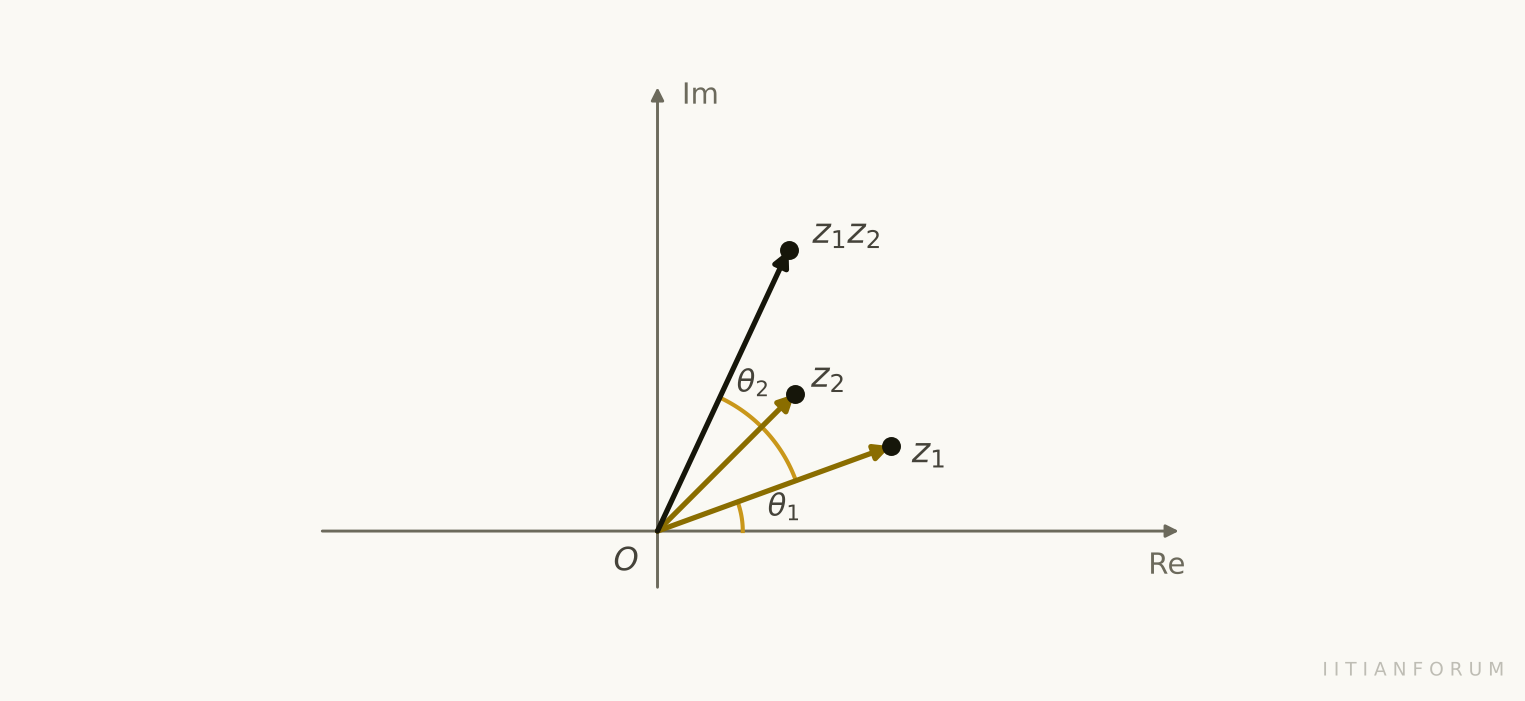
Reason: expand (cosθ1+isinθ1)(cosθ2+isinθ2) and use the addition formulas for cos and sin. So multiplying by z2 scales by r2 and rotates by θ2. In particular, multiplying by i=eiπ/2 is a quarter turn, and multiplying by eiα is a rotation through α.
Rays to z1, z2 and z1 z2; the angle of the product is the sum of the two angles
For a unit complex number, ∣z∣=1:
zˉ=z1=e−iθ,zˉz=e2iθ
Check the form before reading off the argument
sinθ+icosθ is not in polar form. Write it as cos(2π−θ)+isin(2π−θ) first. Also, in r(cosθ+isinθ) the number r must be positive; −2(cosθ+isinθ)=2(cos(θ+π)+isin(θ+π)).
Square roots of a complex number
Let z=a+ib with b=0. Its square roots are ±(x+iy) where
x=2∣z∣+a,y=2∣z∣−a
with x and y of the same sign when b>0 and of opposite signs when b<0.
Reason: (x+iy)2=a+ib gives x2−y2=a and 2xy=b. Also ∣x+iy∣2=∣z∣, so x2+y2=∣z∣. Adding and subtracting give x2 and y2, and 2xy=b fixes the signs. When b=0: a for a>0 is real, and for a<0 the roots are ±i∣a∣.
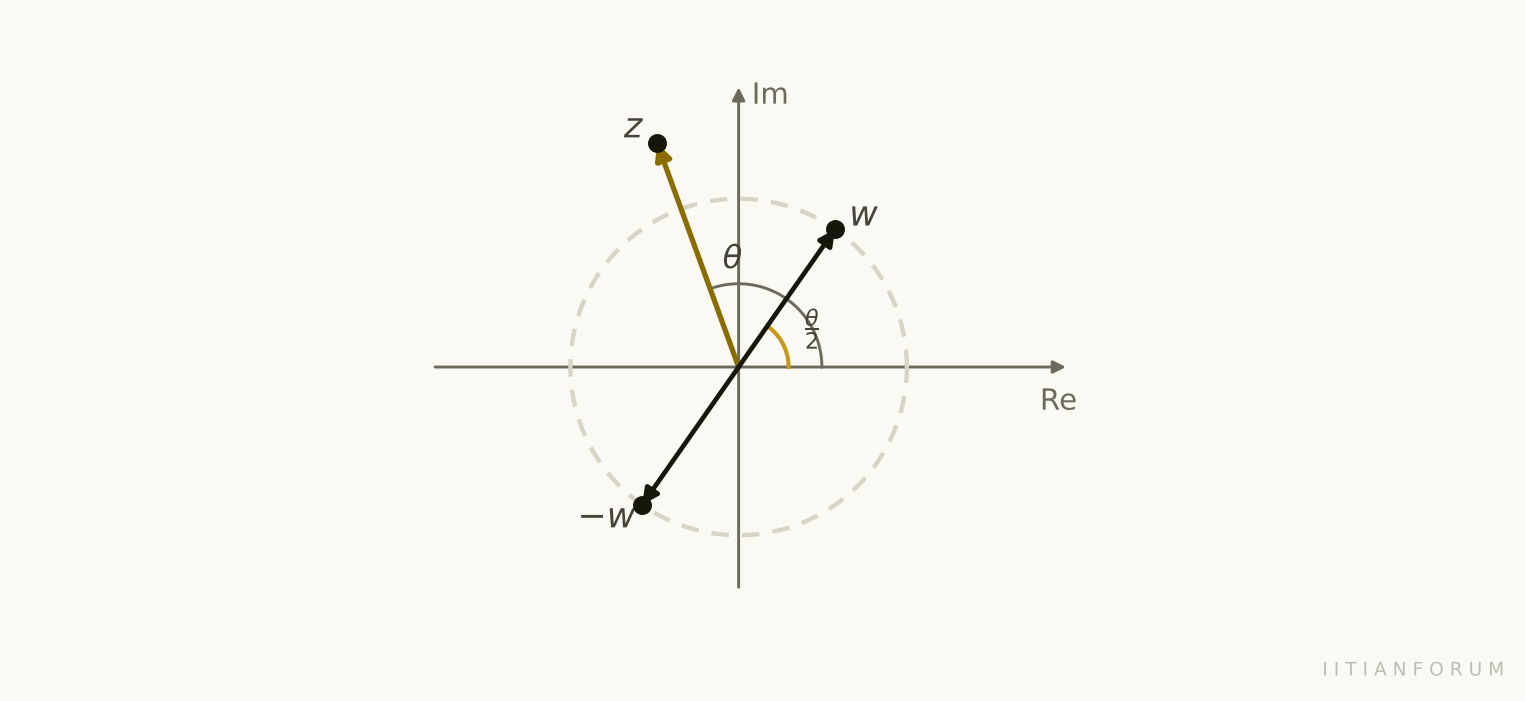
In polar form the two roots of reiθ are
±reiθ/2Complex number z and its two square roots w and minus w at half the angle
Examples
Example 22. For π<α<2π, the principal argument of 1+cosα+isinα is
b=−8<0, so x and y have opposite signs. The roots are ±(1−4i).
Check: (1−4i)2=1−8i−16=−15−8i.
Answer: option (A)
Example 24(IITianForum). Let E=(3+1+i(3−1))n, n∈N. For the least n for which E is a positive real number, log2E is equal to ______.
▸ SHOW SOLUTION
Step 1. Modulus
(3+1)2+(3−1)2=8r=22
Step 2. Argument
The number is in the first quadrant with
tanθ=3+13−1=2−3⇒θ=12π
Step 3. Positive real power
E=(22)neinπ/12
E is a positive real exactly when 12nπ is a multiple of 2π, that is 24∣n. Least n=24:
E=(23/2)24=236
Answer:36
Example 25(JEE Main 2025, 22 January Shift 1). Let z1,z2 and z3 be three complex numbers on the circle ∣z∣=1 with arg(z1)=−4π, arg(z2)=0 and arg(z3)=4π. If ∣z1zˉ2+z2zˉ3+z3zˉ1∣2=α+β2, α,β∈Z, then the value of α2+β2 is
Tap an option to check your answer
(1)24
(2)41
(3)31
(4)29
▸ SHOW SOLUTION
Step 1. Euler form
z1=e−iπ/4, z2=1, z3=eiπ/4, and zˉ=e−iθ on the unit circle.
z1zˉ2=e−iπ/4,z2zˉ3=e−iπ/4z3zˉ1=eiπ/2=i
Step 2. The sum
2e−iπ/4+i=2−i2+i=2+i(1−2)
Step 3. Modulus squared
2+(1−2)2=5−22
So α=5, β=−2, and α2+β2=29.
Answer: option (4)
Example 26(IITianForum). A complex number z satisfies ∣z∣2+∣z∣29−3(zˉz+zzˉ)−8=0. If the maximum value of ∣z∣ is a+b, where a,b∈N, then a+b is equal to ______.
▸ SHOW SOLUTION
Step 1. Euler form
Let z=reiθ. Then zˉz=e2iθ and
zˉz+zzˉ=2cos2θ
Step 2. The equation
r2+r29=8+6cos2θ≤14
Step 3. Largest r
r2+r29 increases for r>3, so r is largest when the right side is 14:
r4−14r2+9=0⇒r2=7+210r=5+2
because (5+2)2=7+210. So a+b=7.
Answer:7
Solving equations in z
Three standard methods:
Put z=x+iy and equate real and imaginary parts. This gives two real equations.
Take the modulus of both sides first. For example, 4z2=−zˉ gives 4∣z∣2=∣z∣.
Take the conjugate of the equation and solve the pair as two linear equations in z and zˉ.
For method 3, the equation sz+tzˉ+r=0 with its conjugate tˉz+sˉzˉ+rˉ=0 gives, after removing zˉ,
z(∣s∣2−∣t∣2)=trˉ−sˉr
So if ∣s∣=∣t∣ there is exactly one solution. If ∣s∣=∣t∣ there is either no solution or a whole line of solutions.
Real parameter, complex unknown
When a real number k is unknown, the complex equation still gives two real equations. Eliminate x and y geometrically if possible: one equation is often a line and the other a circle, and "at least one solution" means the line meets the circle.
Examples
Example 27(JEE Main 2026, 22 January Shift 2). Let S={z∈C:4z2+zˉ=0}. Then z∈S∑∣z∣2 is equal to
Tap an option to check your answer
(1)163
(2)647
(3)161
(4)645
▸ SHOW SOLUTION
Step 1. Take the modulus
4∣z∣2=∣z∣⇒∣z∣=0or∣z∣=41
Step 2. The non-zero solutions
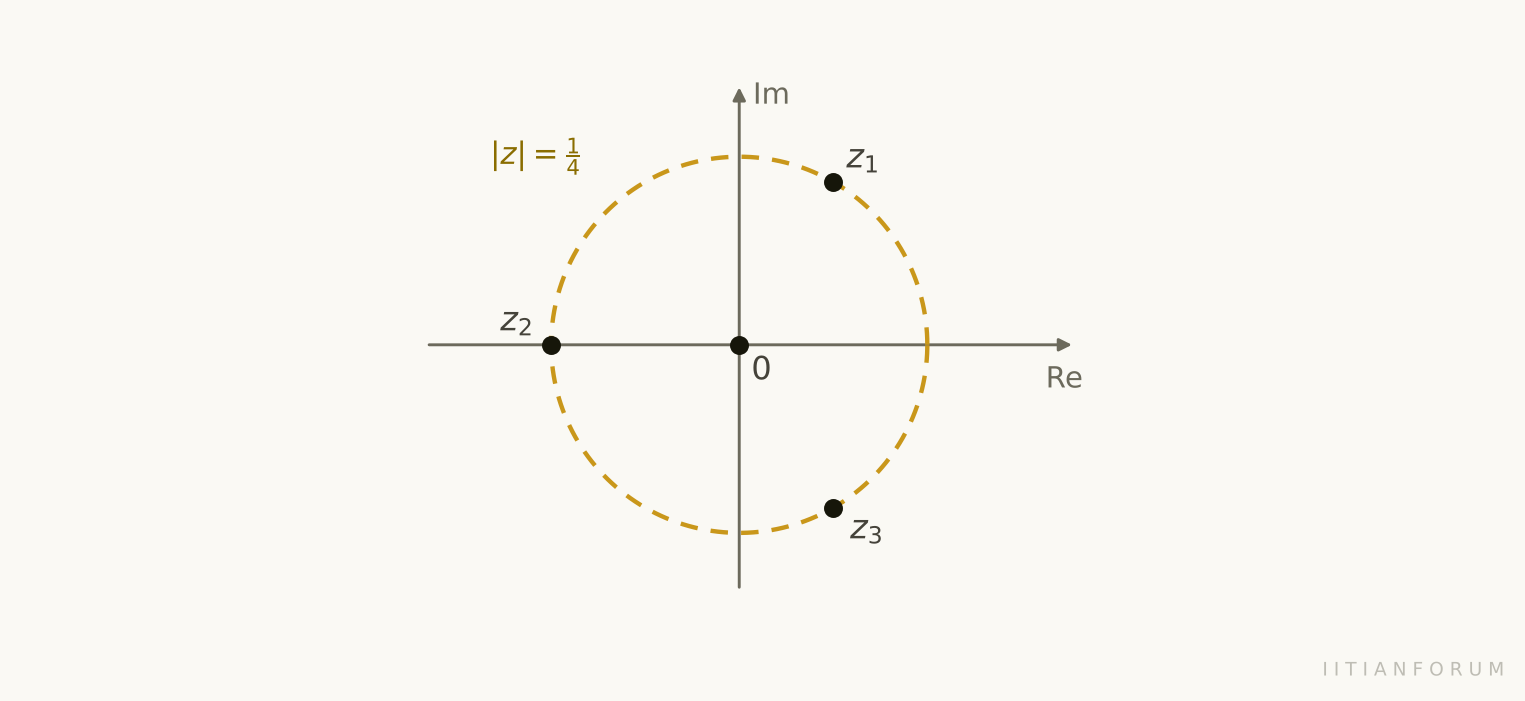
Let z=41eiθ. Then 4z2=41e2iθ and zˉ=41e−iθ:
e2iθ=−e−iθ⇒e3iθ=−1
So θ=3π,π,35π, three solutions, each with ∣z∣2=161.
The solution 0 and three solutions on the circle of radius one quarter
Step 3. Add
0+3⋅161=163
Answer: option (1)
Example 28(IIT JEE 2009, Paper 1). Let z=x+iy be a complex number where x and y are integers. Then the area of the rectangle whose vertices are the roots of the equation zzˉ3+zˉz3=350 is
Tap an option to check your answer
(A)48
(B)32
(C)40
(D)80
▸ SHOW SOLUTION
Step 1. Factor with zzˉ
zzˉ(zˉ2+z2)=350
zzˉ=x2+y2 and z2+zˉ2=2(x2−y2):
(x2+y2)(x2−y2)=175
Step 2. Integer factor pairs
x2+y2>x2−y2>0 and both have the same parity. From 175=175⋅1=35⋅5=25⋅7, only 25 and 7 give squares:
x2=16,y2=9
Step 3. The rectangle
The roots are ±4±3i, a rectangle with sides 8 and 6. Area =48.
Answer: option (A)
Example 29(JEE Main 2026, 6 April Shift 1). Let the set of all values of k∈R such that the equation z(zˉ+2+i)+k(2+3i)=0, z∈C, has at least one solution, be the interval [α,β]. Then 9(α+β) is equal to
Tap an option to check your answer
(1)−10
(2)−8
(3)1013
(4)813
▸ SHOW SOLUTION
Step 1. Put z=x+iy
zzˉ+z(2+i)=(x2+y2+2x−y)+i(x+2y)
Step 2. Equate parts
x2+y2+2x−y+2k=0x+2y+3k=0
A circle and a line.
Step 3. Line must meet the circle
Centre (−1,21), radius squared 45−2k. Distance from the centre to the line:
5∣−1+1+3k∣=53∣k∣59k2≤45−2k⇒36k2+40k−25≤0
Step 4. Sum of the end points
α,β are the roots of 36k2+40k−25=0, so α+β=−910 and 9(α+β)=−10.
Answer: option (1)
Example 30(JEE Main 2025, 3 April Shift 1). Let z∈C be such that z−2+iz2+3i=2+3i. Then the sum of all possible values of z2 is
Tap an option to check your answer
(1)19−2i
(2)−19−2i
(3)19+2i
(4)−19+2i
▸ SHOW SOLUTION
Step 1. Clear the denominator
z2+3i=(2+3i)(z−2+i)
(2+3i)(−2+i)=−7−4i, so
z2−(2+3i)z+7+7i=0
z=2−i is not a root, so both roots are allowed.
Step 2. Sum of squares of roots
z1+z2=2+3i and z1z2=7+7i:
z12+z22=(2+3i)2−2(7+7i)=−5+12i−14−14i=−19−2i
Answer: option (2)
Example 31(IITianForum). Let (x,y) be a pair of real numbers satisfying 5x−12y=x2+y2x and 12x+5y=−x2+y2y. Then 13(∣x∣+∣y∣) is equal to ______.
▸ SHOW SOLUTION
Step 1. Combine into one complex equation
Let z=x+iy. Take the first equation plus i times the second:
Example 32(JEE Advanced 2017, Paper 1). Let a,b,x and y be real numbers such that a−b=1 and y=0. If the complex number z=x+iy satisfies Im(z+1az+b)=y, then which of the following is(are) possible value(s) of x?
More than one option is correct. Pick all of them, then Check
Example 33(JEE Advanced 2018, Paper 2). Let s,t,r be non-zero complex numbers and L be the set of solutions z=x+iy (x,y∈R, i=−1) of the equation sz+tzˉ+r=0, where zˉ=x−iy. Then, which of the following statement(s) is (are) TRUE?
More than one option is correct. Pick all of them, then Check
(A)If L has exactly one element, then ∣s∣=∣t∣
(B)If ∣s∣=∣t∣, then L has infinitely many elements
(C)The number of elements in L∩{z:∣z−1+i∣=5} is at most 2
(D)If L has more than one element, then L has infinitely many elements
▸ SHOW SOLUTION
Step 1. Conjugate equation
sz+tzˉ+r=0,tˉz+sˉzˉ+rˉ=0
Multiply the first by sˉ, the second by t, and subtract:
z(∣s∣2−∣t∣2)=trˉ−sˉr
Step 2. The two cases
If ∣s∣=∣t∣, exactly one solution. If ∣s∣=∣t∣, then with z=x+iy the equation is one real linear equation (a line) or has no solution. For example, s=t=1, r=i gives 2x+i=0, no solution.
Step 3. Check each statement
(A)True: one element forces ∣s∣=∣t∣.
(B)False, by the example.
(C)True: L is a point, a line or empty, and a line meets a circle in at most 2 points.
(D)True: more than one element means the line case.
Answer: (A), (C) and (D)
De Moivre's theorem
For every integer n,
(cosθ+isinθ)n=cosnθ+isinnθ
In Euler form this is (eiθ)n=einθ. Reason: for n≥1 apply the product rule n times, adding the angle θ each time; for negative n use eiθ1=e−iθ. So
(reiθ)n=rneinθ
Uses
Powers. To find (a+ib)n, write a+ib in polar form first. Common values:
1+i=2eiπ/4,1+i3=2eiπ/33+i=2eiπ/6
Multiple angles. Expanding (cosθ+isinθ)n by the binomial theorem and comparing parts gives cosnθ and sinnθ as polynomials. For n=3:
cos3θ=4cos3θ−3cosθsin3θ=3sinθ−4sin3θ
Trigonometric sums.∑coskθ and ∑sinkθ are the real and imaginary parts of the geometric series ∑eikθ.
Binomial sums. Sums like ∑nCk3k/2 with alternating signs are the real or imaginary part of (1+i3)n.
De Moivre for fractional powers
For a fraction qp, (cosθ+isinθ)p/q has q different values, cosqp(θ+2kπ)+isinqp(θ+2kπ) for k=0,1,…,q−1. The single formula with qpθ gives only one of them. Roots of unity below are this case.
Examples
Example 34(JEE Main 2026, 23 January Shift 2). If z=23+2i, i=−1, then (z201−i)8 is equal to
Tap an option to check your answer
(1)−1
(2)0
(3)1
(4)256
▸ SHOW SOLUTION
Step 1. Polar form
z=cos6π+isin6π=eiπ/6
Step 2. The power
6201π=32π+23πz201=ei3π/2=−i
Step 3. Finish
(−i−i)8=(−2i)8=28i8=256
Answer: option (4)
Example 35(IIT JEE 2009, Paper 1). Let z=cosθ+isinθ. Then the value of m=1∑15Im(z2m−1) at θ=2∘ is
Tap an option to check your answer
(A)sin2∘1
(B)3sin2∘1
(C)2sin2∘1
(D)4sin2∘1
▸ SHOW SOLUTION
Step 1. Imaginary parts
By De Moivre, Im(z2m−1)=sin(2m−1)θ:
S=sinθ+sin3θ+⋯+sin29θ
Step 2. Telescope
2sinθsin(2m−1)θ=cos(2m−2)θ−cos2mθ. Adding for m=1 to 15:
2sinθ⋅S=1−cos30θ
Step 3. Put θ=2∘
S=2sin2∘1−cos60∘=4sin2∘1
Answer: option (D)
Example 36(JEE Main 2025, 28 January Shift 1). If α=1+r=1∑6(−3)r−112C2r−1, then the distance of the point (12,3) from the line αx−3y+1=0 is ______.
▸ SHOW SOLUTION
Step 1. Recognise the sum
In (1+i3)12=∑12Ck(i3)k, the odd terms k=2r−1 give
Example 37(IITianForum). If z is a non-real complex number, then the least value of (Imz)5Im(z5) is ______.
▸ SHOW SOLUTION
Step 1. Polar form
Let z=r(cosθ+isinθ) with sinθ=0. By De Moivre:
(Imz)5Im(z5)=r5sin5θr5sin5θ=sin5θsin5θ
Step 2. Expand sin5θ
The imaginary part of (c+is)5 is 5c4s−10c2s3+s5. With c2=1−s2:
sin5θ=16s5−20s3+5s
Step 3. Minimise
With t=s21≥1:
sin5θsin5θ=5t2−20t+16=5(t−2)2−4
Least value −4 at t=2, that is θ=4π.
Answer:−4
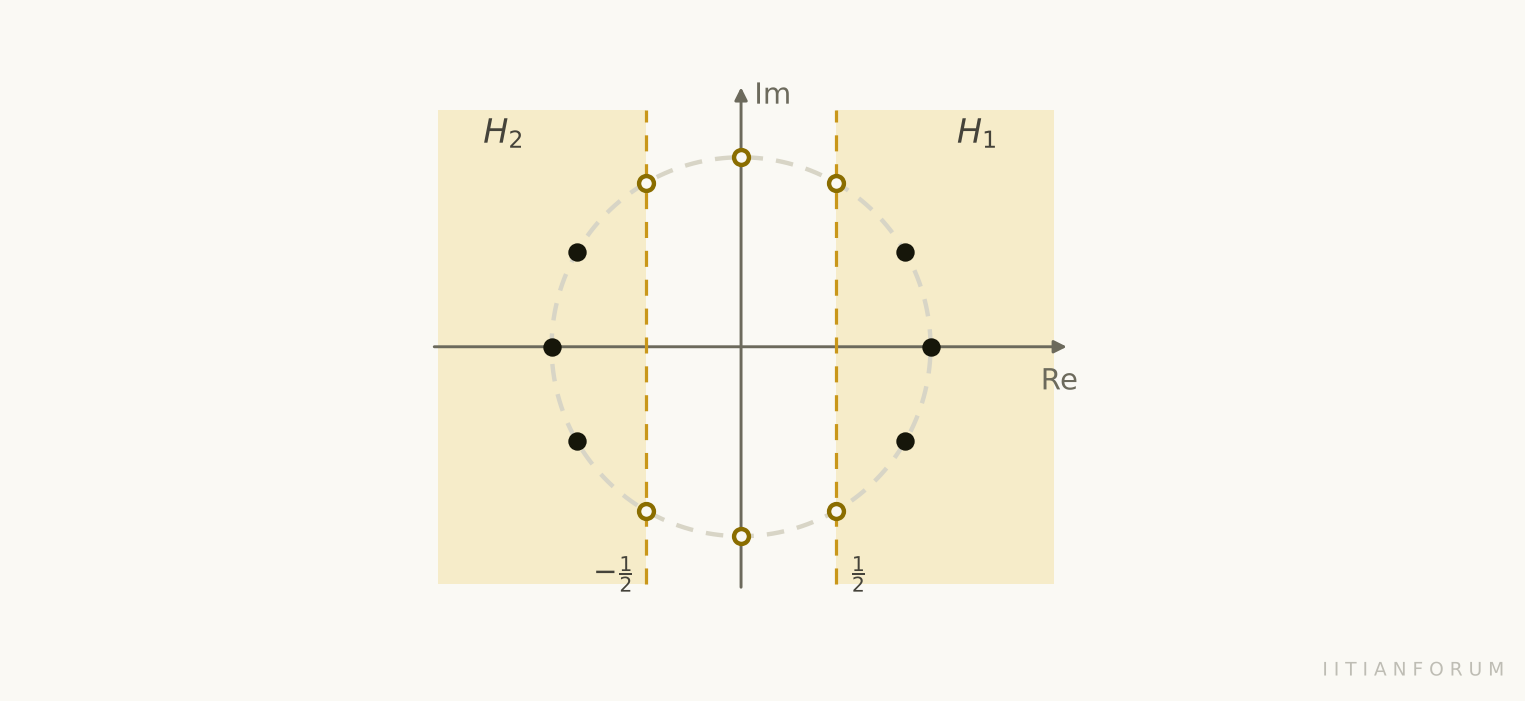
Example 38(JEE Advanced 2013, Paper 2). Let w=23+i and P={wn:n=1,2,3,…}. Further H1={z∈C:Rez>21} and H2={z∈C:Rez<−21}, where C is the set of all complex numbers. If z1∈P∩H1, z2∈P∩H2 and O represents the origin, then ∠z1Oz2=
More than one option is correct. Pick all of them, then Check
(A)2π
(B)6π
(C)32π
(D)65π
▸ SHOW SOLUTION
Step 1. The set P
w=eiπ/6, so P is the 12 points eikπ/6, k=0,1,…,11, on the unit circle.
Step 2. Points in each half-plane
Re=cos6kπ. cos>21 only for angles 0,±6π. cos<−21 only for π,±65π. The points at ±3π and ±32π lie on the boundary lines and are not included.
Twelve powers of w on the unit circle with the half-planes Re z greater than one half and less than minus one half
Step 3. Possible angles
The angle between a point at a∈{0,±6π} and a point at b∈{π,±65π} takes the values 32π, 65π and π. Among the options, 32π and 65π occur.
Answer: (C) and (D)
Cube roots of unity
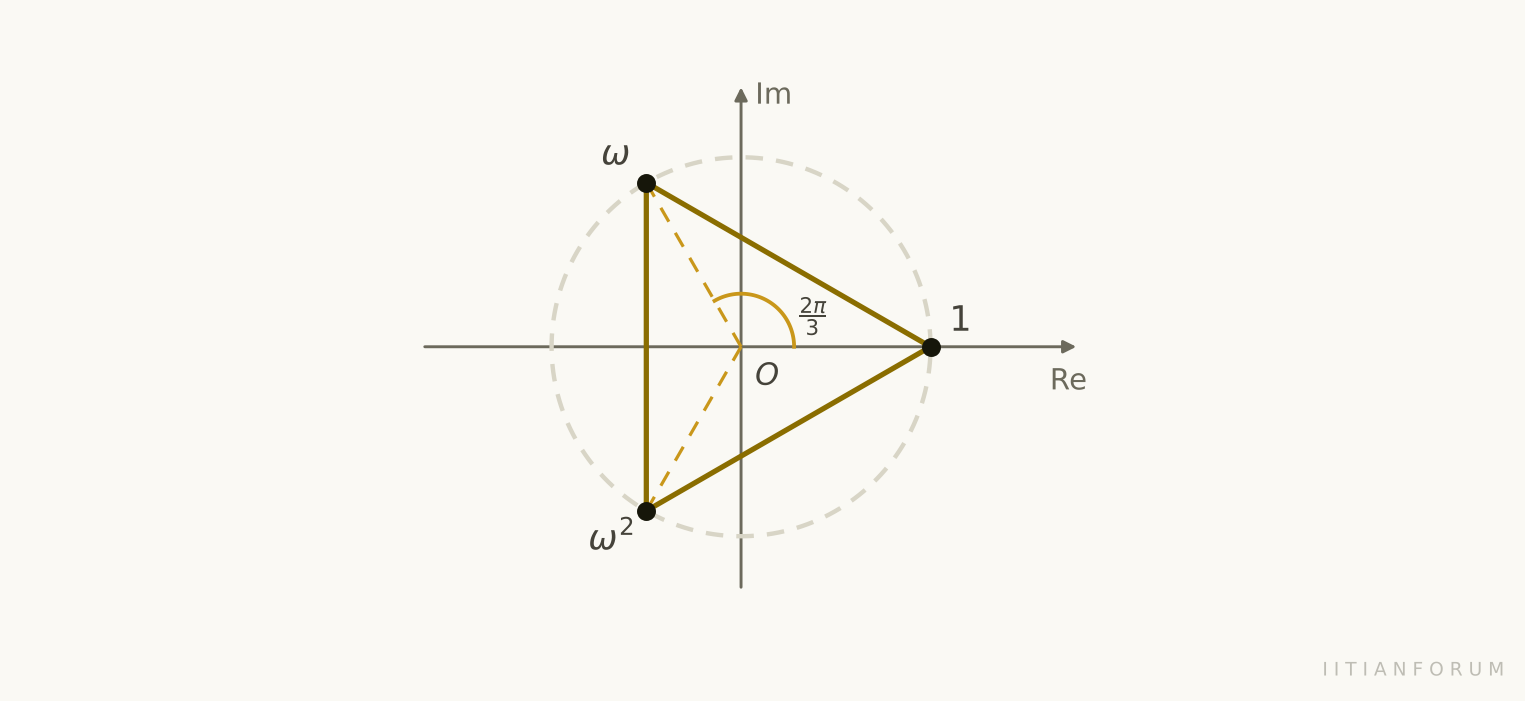
The equation z3=1 factors as (z−1)(z2+z+1)=0. Its roots are
1,ω=2−1+i3ω2=2−1−i3
In Euler form ω=e2πi/3 and ω2=e4πi/3=e−2πi/3. They form an equilateral triangle on the unit circle.
The cube roots of unity 1, omega and omega squared at the vertices of an equilateral triangle on the unit circle
Properties
Property
Statement
Cube
ω3=1
Sum
1+ω+ω2=0
Conjugate
ωˉ=ω2=ω1
Modulus
∣ω∣=1
Powers
ω3k=1, ω3k+1=ω, ω3k+2=ω2
Power sum
1+ωn+ω2n=3 if 3∣n, else 0
Quadratic
ω,ω2 are the roots of x2+x+1=0
Negatives
−ω,−ω2 are the roots of x2−x+1=0
swipe for more →
The sum property: ω is a root of z2+z+1=0. The power sum: if 3∤n, then ωn is ω or ω2 and the sum is again 1+ω+ω2.
argω=32π, but argω2=−32π in the principal range (−π,π]. The value 34π is correct only in the [0,2π) convention.
Spot $\omega$ in disguise
Numbers like 2−1±i3, roots of x2+x+1=0, and 1+ω=−ω2, 1+ω2=−ω appear in many questions without the letter ω. Rewrite them first. For roots of x2−x+1=0 use −ω and −ω2, which satisfy z3=−1 and z6=1.
Examples
Example 39(JEE Main 2026, 21 January Shift 1). If x2+x+1=0, then the value of (x+x1)4+(x2+x21)4+(x3+x31)4+⋯+(x25+x251)4 is
Tap an option to check your answer
(1)128
(2)162
(3)175
(4)145
▸ SHOW SOLUTION
Step 1. Each bracket
x=ω (or ω2; the answer is the same) and xn1=ω2n:
xn+xn1=ωn+ω2n={2,−1,3∣n3∤n
Step 2. Count
From 1 to 25 there are 8 multiples of 3 and 17 other numbers.
8⋅24+17⋅(−1)4=128+17=145
Answer: option (4)
Example 40(JEE Main 2026, 22 January Shift 1). Let α=2−1+i3 and β=2−1−i3. If (7−7α+9β)20+(9+7α−7β)20+(−7+9α+7β)20+(14+7α+7β)20=m10, then m is ______.
▸ SHOW SOLUTION
Step 1. Rename
α=ω, β=ω2. Let B=9+7ω−7ω2.
Step 2. First and third brackets are multiples of B
ω2B=9ω2+7−7ω=7−7ω+9ω2ωB=9ω+7ω2−7=−7+9ω+7ω2
Step 3. Last bracket
14+7(ω+ω2)=14−7=7
Step 4. Add
B20(ω40+1+ω20)+720=B20(ω+1+ω2)+720=720
720=4910, so m=49.
Answer:49
Example 41(IITianForum). Let ω be a non-real cube root of unity, p=2+3ω+5ω2, q=3+5ω+2ω2 and r=5+2ω+3ω2. Then
More than one option is correct. Pick all of them, then Check
Example 42(IIT JEE 2010, Paper 1). Let ω be the complex number cos32π+isin32π. Then the number of distinct complex numbers z satisfying z+1ωω2ωz+ω21ω21z+ω=0 is equal to ______.
▸ SHOW SOLUTION
Step 1. Add all rows to the first
Each column adds to z+1+ω+ω2=z:
Δ=z1ωω21z+ω2111z+ω
Step 2. Subtract columns
Use C2→C2−C1 and C3→C3−C1:
Δ=zz+ω2−ω1−ω21−ωz+ω−ω2
Step 3. Expand
Δ=z(z2−(ω2−ω)2−(1−ω)(1−ω2))
(ω2−ω)2=ω4−2ω3+ω2=−3 and (1−ω)(1−ω2)=3, so
Δ=z3
Δ=0 only for z=0: one value.
Answer:1
Example 43(JEE Advanced 2016, Paper 1). Let z=2−1+3i, where i=−1, and r,s∈{1,2,3}. Let P=[(−z)rz2sz2szr] and I be the identity matrix of order 2. Then the total number of ordered pairs (r,s) for which P2=−I is ______.
▸ SHOW SOLUTION
Step 1. Square the matrix
z=ω. The off-diagonal entries of P2 are
z2s((−z)r+zr)=ω2sωr((−1)r+1)
These are 0 only when r is odd: r=1 or 3.
Step 2. Diagonal entries
z2r+z4s=ω2r+ω4s=−1
r=1: ω2+ωs=−1 needs ωs=ω, so s=1. r=3: 1+ωs=−1 is impossible because ∣ωs∣=1.
So only (r,s)=(1,1).
Answer:1
Example 44(IITianForum). The sum of the squares of the moduli of the non-real roots of z5−2z4+z3−2z2+z−2=0 is ______.
▸ SHOW SOLUTION
Step 1. Group in pairs
z4(z−2)+z2(z−2)+(z−2)=(z−2)(z4+z2+1)
Step 2. Factor the quartic
z4+z2+1=(z2+1)2−z2=(z2+z+1)(z2−z+1)
The non-real roots are ω,ω2,−ω,−ω2.
Step 3. Add
Each has modulus 1, so the sum is 4.
Answer:4
Example 45(JEE Advanced 2026, Paper 1). Match each entry in List-I to the correct entry in List-II.
List-I
List-II
(P) If α,β are distinct roots of x2+x+1=0, then the quadratic with roots (α+1)20261,(β+1)20261 is
(1) x2+x+1=0
(Q) If α,β are distinct roots of x2+x+1=0, then the quadratic with roots (α+1)20271,(β+1)20271 is
(2) x2−x+1=0
(R) If γ,δ are distinct roots of x2−x+1=0, then (γ−1)20261+(δ−1)20261 is
(3) x2+x−1=0
(S) If p,r are distinct roots of x2+x−1=0, then (p+1)31+(r+1)31 is
(4) −1
(5) −4
swipe for more →
The correct option is
Tap an option to check your answer
(1)(P)→(1), (Q)→(2), (R)→(5), (S)→(4)
(2)(P)→(3), (Q)→(1), (R)→(4), (S)→(5)
(3)(P)→(1), (Q)→(2), (R)→(4), (S)→(5)
(4)(P)→(2), (Q)→(3), (R)→(5), (S)→(4)
▸ SHOW SOLUTION
Step 1. Item P
α=ω, β=ω2, so α+1=−ω2 and β+1=−ω. Even power: the signs go.
ω40521=ω21=ω,ω20261=ω1=ω2
Roots ω,ω2: x2+x+1=0. P→(1).
Step 2. Item Q
Odd power: each term changes sign, giving −ω2 and −ω. Sum 1, product 1: x2−x+1=0. Q→(2).
Step 3. Item R
γ=−ω, δ=−ω2. Then γ−1=−(1+ω)=ω2 and δ−1=ω:
ω40521+ω20261=ω+ω2=−1
R→(4).
Step 4. Item S
p2+p=1 gives p+11=p. So the sum is p3+r3 with p+r=−1, pr=−1:
p3+r3=(p+r)3−3pr(p+r)=−1−3=−4
S→(5).
Answer: option (3)
Example 46(JEE Advanced 2025, Paper 2). For a non-zero complex number z, let arg(z) denote the principal argument of z, with −π<arg(z)≤π. Let ω be the cube root of unity for which 0<arg(ω)<π. Let α=arg(n=1∑2025(−ω)n). Then the value of π3α is ______.
▸ SHOW SOLUTION
Step 1. The base
−ω=21−23i=e−iπ/3
Its powers repeat with period 6, and any six consecutive powers add to 0.
Step 2. Reduce the sum
2025=6⋅337+3, so only the last three terms remain:
−1−i3 is in the third quadrant with α=−(π−3π)=−32π. So π3α=−2.
Answer:−2
nth roots of unity
The equation zn=1 has exactly n roots. Writing 1=e2kπi:
zk=e2kπi/n,k=0,1,…,n−1
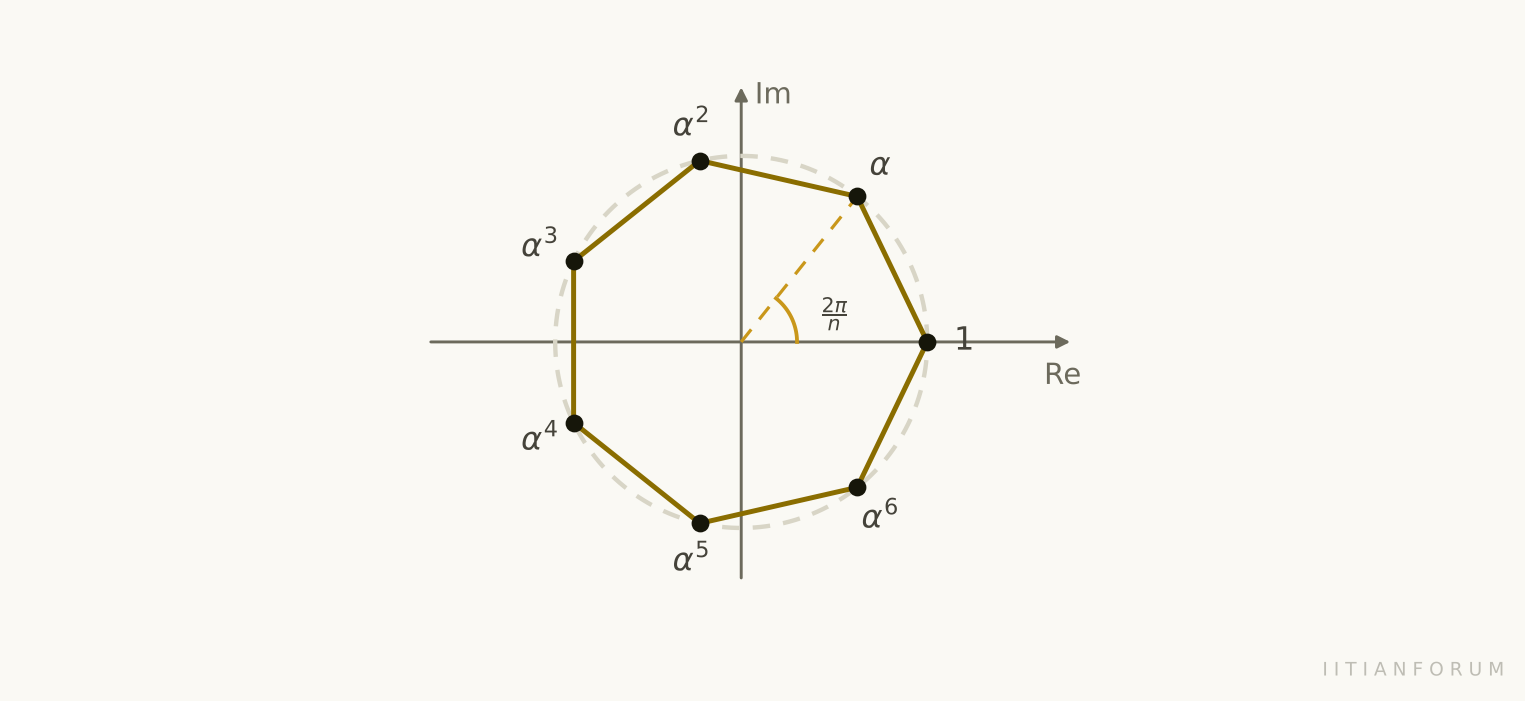
With α=e2πi/n they are 1,α,α2,…,αn−1, a geometric progression. They are the vertices of a regular n-gon inscribed in the unit circle, one vertex at 1, adjacent vertices n2π apart.
The seventh roots of unity at the vertices of a regular heptagon on the unit circle
Properties
For n≥2:
Property
Statement
Sum
1+α+α2+⋯+αn−1=0
Power sum
∑k=0n−1αkp=n if n∣p, else 0
Product
1⋅α⋯αn−1=(−1)n−1
Factorisation
zn−1=(z−1)(z−α)⋯(z−αn−1)
Product of differences
(1−α)(1−α2)⋯(1−αn−1)=n
Conjugate pairs
αk=αn−k
Common roots
zm=1 and zn=1 share exactly gcd(m,n) roots
swipe for more →
Reasons. The sum is a GP: 1−α1−αn=0. The product is (−1)n−1 times the constant term of zn−1, by Vieta. Dividing the factorisation by z−1:
1+z+⋯+zn−1=(z−α)⋯(z−αn−1)
and putting z=1 gives the product of differences.
nth roots of any complex number
The n roots of zn=reiθ are
nrei(θ+2kπ)/n,k=0,1,…,n−1
They also form a regular n-gon, of radius nr. Equivalently: one root times each nth root of unity.
Sum of roots needs $n\ge2$
For n=1 the only root is 1 and the sum is 1. Also, the power sum is 0 only when n does not divide p; for p=n every term is 1.
Examples
Example 47. Let α=e2πi/7. Then k=1∏6(2−αk) is equal to ______.
▸ SHOW SOLUTION
Step 1. Factorisation
z7−1=(z−1)k=1∏6(z−αk)k=1∏6(z−αk)=1+z+z2+⋯+z6
Step 2. Put z=2
1+2+4+⋯+64=27−1=127
Answer:127
Example 48(JEE Advanced 2014, Paper 2). Let zk=cos102kπ+isin102kπ, k=1,2,…,9. Match the lists.
List I
List II
P. For each zk there exists a zj such that zk⋅zj=1
1. True
Q. There exists a k∈{1,2,…,9} such that z1⋅z=zk has no solution z in the set of complex numbers
2. False
R. 10∣1−z1∣∣1−z2∣⋯∣1−z9∣ equals
3. 1
S. 1−∑k=19cos102kπ equals
4. 2
swipe for more →
Tap an option to check your answer
(A)P→1, Q→2, R→4, S→3
(B)P→2, Q→1, R→3, S→4
(C)P→1, Q→2, R→3, S→4
(D)P→2, Q→1, R→4, S→3
▸ SHOW SOLUTION
Step 1. P
zk are the 10th roots of unity other than 1. zkz10−k=1 and z10−k is also in the list. P is true.
Step 2. Q
z1=0, so z=z1zk always exists. Q is false.
Step 3. R
(1−z1)(1−z2)⋯(1−z9)=10, so the expression is 1.
Step 4. S
The real parts of all ten roots add to 0, so ∑k=19cos102kπ=−1 and S =2.
Answer: option (C)
Example 49(JEE Advanced 2015, Paper 2). For any integer k, let αk=cos(7kπ)+isin(7kπ), where i=−1. The value of the expression k=1∑3∣α4k−1−α4k−2∣k=1∑12∣αk+1−αk∣ is ______.
▸ SHOW SOLUTION
Step 1. Every term is the same
αk=eikπ/7, so
∣αk+1−αk∣=∣αk∣eiπ/7−1=eiπ/7−1
These are the equal sides of a regular 14-gon. Call the common length d.
Step 2. Count
The numerator has 12 terms and the denominator 3, all equal to d:
3d12d=4
Answer:4
Example 50(IITianForum). Let α1,α2,…,α12 be all the 12th roots of unity, and S=1≤i<j≤12∑(αiαj)P. Then
More than one option is correct. Pick all of them, then Check
(A)if P=1, S=0
(B)if P=4, S=−4
(C)if P=6, S=−6
(D)if P=12, S=66
▸ SHOW SOLUTION
Step 1. Write S with power sums
Let Tm=∑i=112αim. Then
S=2TP2−T2P
Tm=12 if 12∣m and 0 otherwise.
Step 2. Each value of P
P=1: T1=T2=0, S=0. P=4: T4=T8=0, S=0, so (B) is false. P=6: T6=0, T12=12, S=−6. P=12: T12=T24=12:
S=2144−12=66
Answer: (A), (C) and (D)
Example 51(IITianForum). The number of complex numbers z that satisfy both z60=1 and z84=1 is ______.
▸ SHOW SOLUTION
Step 1. A common root has order dividing both
z60=1 and z84=1. Since gcd(60,84)=12, there are integers a,b with 60a+84b=12, so
z12=(z60)a(z84)b=1
Step 2. Conversely
Every 12th root of unity satisfies both, because 12∣60 and 12∣84. So there are 12 such z.
Answer:12
Example 52(IITianForum). Let P=cos72π+isin72π, a=P+P2+P4 and b=P3+P5+P6. Then ∣a−b∣2 is equal to ______.
▸ SHOW SOLUTION
Step 1. Sum
a+b=P+P2+⋯+P6=−1.
Step 2. Product
ab=P4+P6+P7+P5+P7+P8+P7+P9+P10
P7=1, P8=P, P9=P2, P10=P3:
ab=3+(P+P2+⋯+P6)=3−1=2
Step 3. Difference
(a−b)2=(a+b)2−4ab=1−8=−7
So a−b=±i7 and ∣a−b∣2=7.
Answer:7
Quadratic equations with complex roots
For az2+bz+c=0 with a=0, the roots are
z=2a−b±b2−4ac
This formula holds for complexa,b,c too, with b2−4ac meaning either square root (found by the method of the polar form section). Vieta's relations also hold:
z1+z2=−ab,z1z2=ac
Real coefficients
If a,b,c are real and D=b2−4ac<0, the roots are the conjugate pair
2a−b±i−D
More generally, a polynomial with real coefficients has its non-real roots in conjugate pairs, because p(zˉ)=p(z)=0. Then
z1+z2=2Re(z1),z1z2=∣z1∣2
Complex coefficients
When the coefficients are not all real, conjugate pairing fails. Use the formula with the square root of a complex number, or Vieta's relations. The sign test D<0 has no meaning, because D is complex.
Real root of an equation with complex coefficients
To find when z2−(3+i)z+(m+2i)=0 has a real root x, put z=x and equate real and imaginary parts: x2−3x+m=0 and −x+2=0. Do not use the discriminant.
Sums of powers of roots
For z1n+z2n, either write the roots in polar form and use De Moivre, or use sn=−absn−1−acsn−2 with s0=2.
Examples
Example 53(JEE Main 2026, 4 April Shift 2). Let S={z∈C:z2+4z+16=0}. Then z∈S∑z+3i2 is equal to
Tap an option to check your answer
(1)42
(2)23
(3)27
(4)38
▸ SHOW SOLUTION
Step 1. Roots
(z+2)2=−12⇒z=−2±23i
Step 2. Shift by 3i
z+3i=−2+33ior−2−3i
Step 3. Moduli
(4+27)+(4+3)=38
Answer: option (4)
Example 54(JEE Main 2026, 5 April Shift 2). Let z1,z2∈C be the distinct solutions of z2+4z−(1+12i)=0. Then ∣z1∣2+∣z2∣2 is equal to
Tap an option to check your answer
(1)18
(2)22
(3)29
(4)34
▸ SHOW SOLUTION
Step 1. Discriminant
b2−4ac=16+4(1+12i)=20+48i
Step 2. Its square root
∣20+48i∣=52. Then x=252+20=6 and y=252−20=4, same sign:
20+48i=±(6+4i)
Step 3. Roots
z=2−4±(6+4i)=1+2ior−5−2i
Step 4. Moduli
∣z1∣2+∣z2∣2=5+29=34
Answer: option (4)
Example 55(JEE Main 2026, 5 April Shift 1). Let a,b∈C. Let α,β be the roots of x2+ax+b=0. If β−α=11 and β2−α2=3i11, then (β3−α3)2 is equal to
Example 56(JEE Main 2026, 4 April Shift 2). If α=1 and β=1+i2, where i=−1, are two roots of the equation x3+ax2+bx+c=0, a,b,c∈R, then ∫−11(x3+ax2+bx+c)dx is equal to
Tap an option to check your answer
(1)−2
(2)−4
(3)−8
(4)−10
▸ SHOW SOLUTION
Step 1. Third root
Real coefficients, so 1−i2 is also a root.
(x−1−i2)(x−1+i2)=x2−2x+3
Step 2. The cubic
(x−1)(x2−2x+3)=x3−3x2+5x−3
Step 3. Integrate
Odd powers give 0 on [−1,1]:
∫−11(−3x2−3)dx=−2−6=−8
Answer: option (3)
Example 57(JEE Main 2026, 6 April Shift 2). Let S={z∈C:z2+6iz−3=0}. Then z∈S∑z8 is equal to
Tap an option to check your answer
(1)162
(2)184
(3)262
(4)324
▸ SHOW SOLUTION
Step 1. Roots
z=2−6i±−6+12=26(±1−i)
Step 2. Eighth powers
(1−i)2=−2i and (−1−i)2=2i, so both eighth powers are 16:
(1−i)8=(−2i)4=16(−1−i)8=(2i)4=16
Step 3. Add
(26)8=2864=1681∑z8=1681(16+16)=162
Answer: option (1)
Example 58(AIEEE 2011). Let α,β be real and z be a complex number. If z2+αz+β=0 has two distinct roots on the line Rez=1, then it is necessary that
Tap an option to check your answer
(A)β∈(0,1)
(B)β∈(−1,0)
(C)∣β∣=1
(D)β∈(1,∞)
▸ SHOW SOLUTION
Step 1. The roots are a conjugate pair
Two distinct roots with real part 1 cannot both be real (they would both equal 1). Real coefficients, so the roots are 1±iy with y=0.
Step 2. Product
β=(1+iy)(1−iy)=1+y2>1
Answer: option (D)
Complex numbers in geometry: a short summary
Every result of this section is developed with figures and many more examples in the Complex Numbers in Coordinate Geometry note. The list below is for quick recall.
Idea
Result
Distance
∣z1−z2∣
Section point in ratio m:n
m+nmz2+nz1
Centroid
3z1+z2+z3
Rotation about z0 through θ
z−z0=(z1−z0)eiθ
Angle at z0 from z1 to z2
argz1−z0z2−z0
Collinear z1,z2,z3
z2−z1z3−z1 real
Line through z1,z2
zz1z2zˉzˉ1zˉ2111=0
General line
aˉz+azˉ+b=0, b real
Complex slope of that line
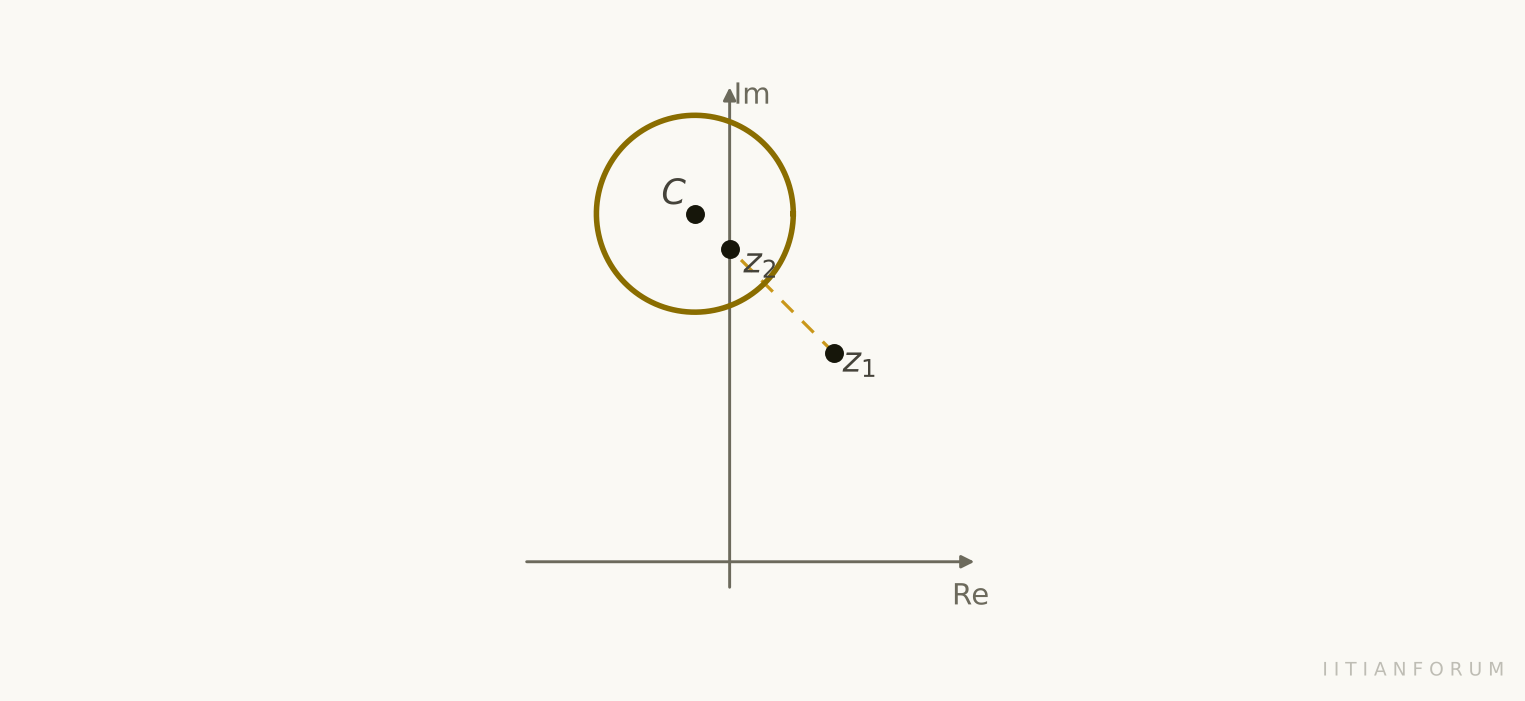
−aˉa
Distance of z0 from that line
2∣a∣∣aˉz0+azˉ0+b∣
Circle
∣z−z0∣=r, or zzˉ+aˉz+azˉ+b=0 with centre −a
Apollonius circle
z−z2z−z1=k, k=1
Perpendicular bisector
∣z−z1∣=∣z−z2∣
Ellipse
∣z−z1∣+∣z−z2∣=2a>∣z1−z2∣
Hyperbola branch
∣z−z1∣−∣z−z2∣=2a<∣z1−z2∣
Arc of a circle
argz−z2z−z1=θ
Equilateral triangle
z12+z22+z32=z1z2+z2z3+z3z1
swipe for more →
For ∣z∣ over a region: the least and greatest distance from a point P to a circle with centre C and radius r are ∣PC−r∣ and PC+r.
Examples
Example 59(JEE Main 2026, 21 January Shift 2). Let z be the complex number satisfying ∣z−5∣≤3 and having maximum positive principal argument. Then 345iz+165z−122 is equal to
Tap an option to check your answer
(1)16
(2)12
(3)26
(4)20
▸ SHOW SOLUTION
Step 1. The extreme point
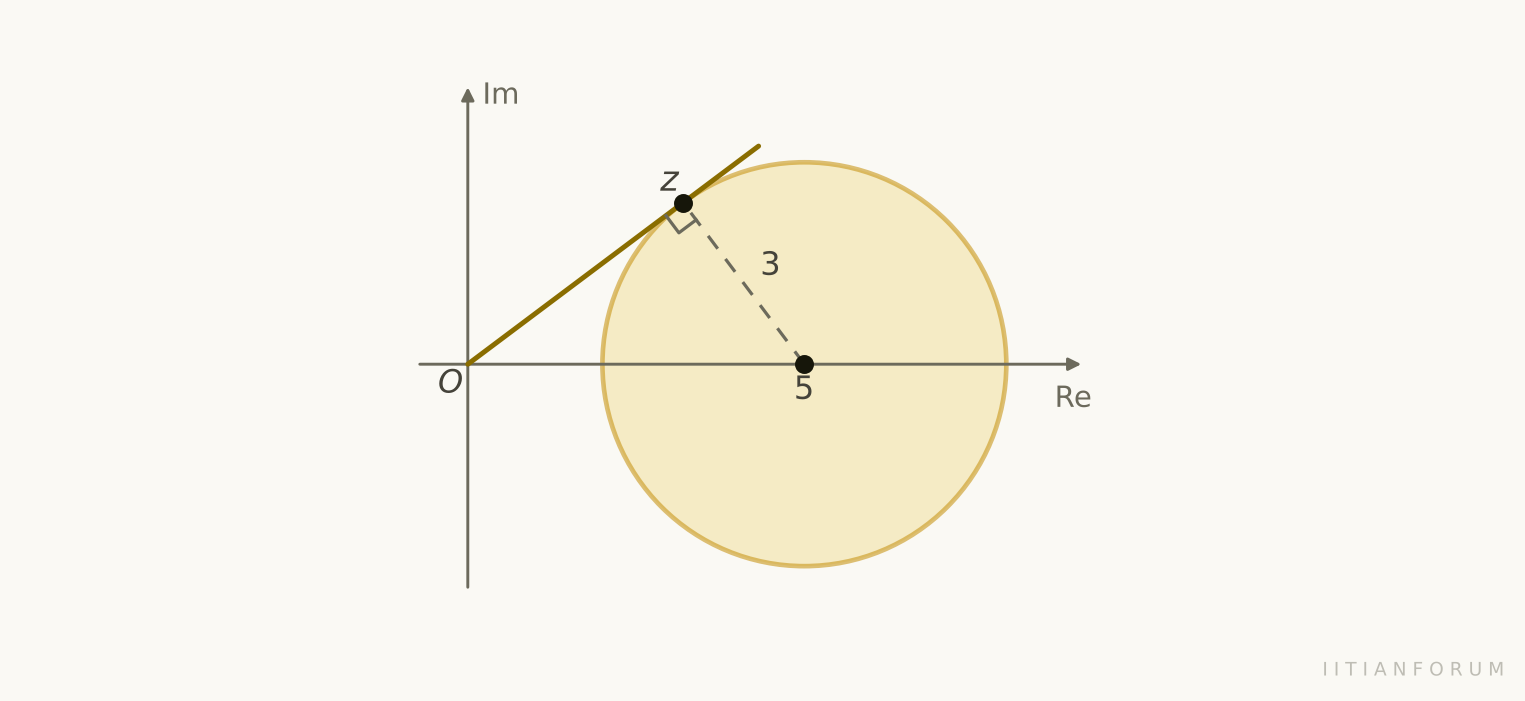
The disc has centre 5 and radius 3. The argument is greatest at the upper tangent point z from O.
Disc of radius 3 centred at 5 with the tangent from the origin touching it at z
Step 2. Locate it
∣z∣=25−9=4 and sin(argz)=53, so cos(argz)=54:
z=4(54+53i)=516+12i
Step 3. Evaluate
5z−12=4+12i and 5iz+16=4+16i:
34⋅16+25616+144=34⋅272160=20
Answer: option (4)
Example 60(JEE Advanced 2025, Paper 1). Let R denote the set of all real numbers. Let z1=1+2i and z2=3i be two complex numbers, where i=−1. Let S={(x,y)∈R×R:∣x+iy−z1∣=2∣x+iy−z2∣}. Then which of the following statements is (are) TRUE?
More than one option is correct. Pick all of them, then Check
(A)S is a circle with centre (−31,310)
(B)S is a circle with centre (31,38)
(C)S is a circle with radius 32
(D)S is a circle with radius 322
▸ SHOW SOLUTION
Step 1. Square both sides
(x−1)2+(y−2)2=4(x2+(y−3)2)3x2+3y2+2x−20y+31=0
Step 2. Centre and radius
Divide by 3: centre (−31,310) and
r2=91+9100−331=98⇒r=322Apollonius circle for the points z1 and z2 with ratio 2, and its centre C
Answer: (A) and (D)
Which method to use
Given
Method
Large power of i
Reduce the index modulo 4
Equation with real unknowns x,y
Equate real and imaginary parts
"Purely real" or "purely imaginary"
Make the denominator real, or use w=±wˉ
Equation in z and zˉ
Take the modulus first, or put z=x+iy, or pair with the conjugate equation
∣z∣=1
Replace zˉ by z1; write z=eiθ
Bound on ∣z∣
Triangle inequality, then check equality
∣z1±z2∣ given
Parallelogram law and Re(z1zˉ2)
High power of a+ib
Polar form and De Moivre
Trigonometric or binomial sum
Real or imaginary part of a power or a GP of eiθ
2−1±i3 or x2±x+1=0
Write as ω,ω2 or −ω,−ω2
Sum or product over roots of zn=1
GP sum, power sums, zn−1 factorisation
Quadratic with complex coefficients
Formula with the square root of a complex number, or Vieta
Max or min of ∣z−a∣ or argz over a region
Geometry: distance to the centre, tangent from the origin
swipe for more →
What JEE asks
Across the JEE Main papers from 2009 to 2026 and the JEE Advanced and IIT JEE papers, the chapter appears in these forms.
Algebra, equality and real or imaginary parts (Examples 4 to 7, 10, 12 and 32).
Modulus, conjugate and inequalities (Examples 8, 9, 11 and 13 to 18).
Argument and polar form (Examples 19 to 22, 24 to 26 and 46).
Equations in z and zˉ (Examples 27 to 31 and 33).
De Moivre, trigonometric and binomial sums (Examples 34 to 38).
Cube roots of unity (Examples 39 to 46). This is the most common form in JEE Advanced, often inside a matrix or a determinant.
nth roots of unity (Examples 47 to 52).
Quadratic equations with complex roots or coefficients (Examples 53 to 58). Five of the thirteen 2026 JEE Main questions in this note are of this type.
Geometry in the Argand plane (Examples 59 and 60, and the coordinate geometry note).
JEE Advanced 2026 asked for ω inside a list match of quadratics (Example 45) and for the map z↦cz+daz+b on the upper half-plane (Example 12). JEE Advanced 2025 asked for the argument of a sum of powers of −ω (Example 46) and an Apollonius circle (Example 60).
Quick recall
Result
Statement
Powers of i
i4q+r=ir
Inverse
z1=∣z∣2zˉ
Conjugate
zzˉ=∣z∣2; z1z2=zˉ1zˉ2
Real, imaginary tests
z=zˉ; z=−zˉ
Modulus of product
∣z1z2∣=∣z1∣∣z2∣
Sum squared
∣z1+z2∣2=∣z1∣2+∣z2∣2+2Re(z1zˉ2)
Parallelogram law
∣z1+z2∣2+∣z1−z2∣2=2(∣z1∣2+∣z2∣2)
Triangle inequality
∣z1∣−∣z2∣≤∣z1±z2∣≤∣z1∣+∣z2∣
Principal argument
(−π,π]; α, π−α, −(π−α), −α
Argument of product
argz1+argz2+2kπ
Euler form
z=reiθ
Square root of a+ib
±(2∣z∣+a±i2∣z∣−a), sign of b
De Moivre
(eiθ)n=einθ
Cube roots of unity
1+ω+ω2=0, ω3=1, ωˉ=ω2
nth roots of unity
e2kπi/n; sum 0; product (−1)n−1
Product of differences
∏k=1n−1(1−αk)=n
Real polynomial
non-real roots in conjugate pairs
swipe for more →
Before you leave this chapter
Without a pen, answer these four: the value of i2026; the principal argument of −1−i3; the value of (1+i)8; and the sum of the 5th powers of the 7th roots of unity. If −1, −32π, 16 and 0 came quickly, the chapter is in place.
Practise these methods on real exam questions in the doMath Complex Numbers chapter. Rotation, lines, circles and loci in the Argand plane are developed in the Complex Numbers in Coordinate Geometry note, and quadratic equations with real coefficients in the Quadratic Equations note.