Straight Lines for JEE: Forms, Distances, Bisectors and Centres
A straight line is the simplest curve in the plane, and coordinate geometry begins with it. Once a point is a pair of numbers and a line is an equation of the first degree, every question about lengths, angles, areas and positions turns into algebra that can be checked line by line. The same results return in every later chapter: the circle, the parabola, the ellipse and the hyperbola all use the distance of a point from a line, the slope of a line and the family of lines through a point.
This note covers the distance and section formulas with harmonic conjugates, the area of a triangle and of a polygon, the locus of a point, the slope of a line, every standard form of the equation of a line, the position of a point relative to a line, the angle between two lines, the distance of a point from a line and between parallel lines, the foot of the perpendicular and the image of a point, the bisectors of the angles between two lines, the centres of a triangle, families of lines and concurrency, lines that form a figure, and the change of origin and rotation of axes. Each section ends with worked examples from JEE Main, JEE Advanced and IIT JEE papers, graded from easy to hard.
Distance and the section formula
Take two perpendicular number lines meeting at the origin . A point is then the ordered pair of its signed distances from the -axis and the -axis.
Distance between two points
For and , the horizontal and vertical gaps are and , and Pythagoras gives
The distance of from the origin is .
If the points are given in polar form, and , the cosine rule in triangle gives
Section formula
Let divide the join of and in the ratio , so that .
For internal division ( between and ),
For external division ( on produced), replace by :
Internal division with P between A and B, and external division with P on AB produced beyond B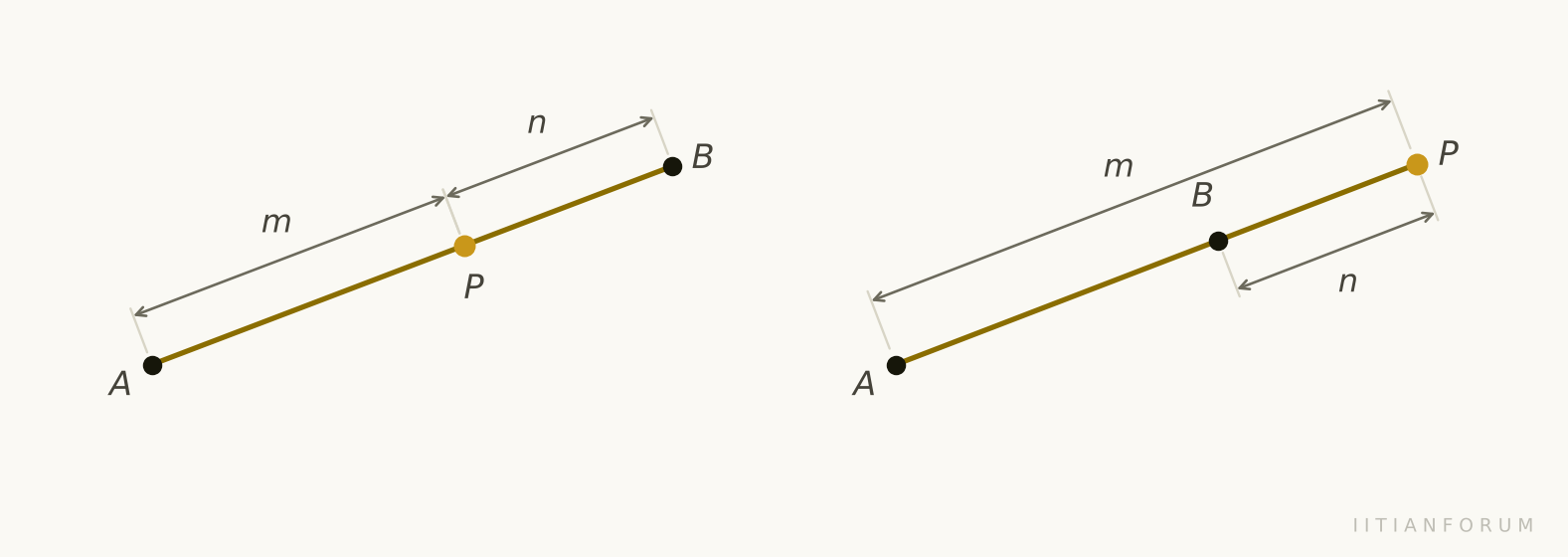
Reason. Drop perpendiculars from , , to the -axis. The horizontal gaps are in the same ratio as (similar triangles), so , which gives .
| Point | Coordinates |
|---|---|
| Mid-point of | |
| Points of trisection | ratios and |
| Centroid of | |
| Fourth vertex of parallelogram | (diagonals bisect each other) |
Ratio in which a line divides a segment
The line meets the join of and at the point dividing in the ratio
A positive ratio means internal division ( and on opposite sides of the line); a negative ratio means external division.
Harmonic conjugates
If divides internally and divides externally in the same ratio, then and are harmonic conjugates of each other with respect to and :
With directed segments the two ratios have opposite signs: and . If instead the ratio is written as (note ), then . Mixing the two ways of writing the ratio gives the wrong sign.
Examples
Example 1 (JEE Main 2014). Let be the median of the triangle with vertices , and . The equation of the line passing through and parallel to is
▸ SHOW SOLUTION
Step 1. The mid-point of
Step 2. Slope of
Step 3. The parallel line through
Answer: option (4)
Example 2. Find the point where the line meets the join of and , and the harmonic conjugate of that point with respect to and .
▸ SHOW SOLUTION
Step 1. The ratio
and , so
The ratio is positive, so the line cuts internally in the ratio .
Step 2. The point of division
Check: .
Step 3. The harmonic conjugate
The conjugate divides externally in the same ratio :
Answer: and
Example 3 (JEE Advanced 2025, Paper 1). Let , and be three distinct points in the -plane, and let be a point inside the triangle such that . Let and be the mid-points of the sides and respectively. Then the value of is ______.
▸ SHOW SOLUTION
Step 1. Coordinates of
Write , , and . The -components of the given relation give , so
and the same for . So is the point with weights at .
Step 2. The vector
and , so and
Step 3. The vector
So .
Step 4. The ratio
Answer:
Area of a triangle and of a polygon
Area of a triangle
For vertices , , ,
where .
In determinant form,
Reason. Drop perpendiculars from the three vertices to the -axis. The triangle is one trapezium minus the other two, and the area of a trapezium is half the sum of the parallel sides times the width.
When one vertex is the origin, for the other two vertices.
Collinearity
Three points are collinear exactly when the area is zero:
Equivalently, the slope of equals the slope of , or for the three distances.
Area of a polygon
For a polygon with vertices taken in order round the boundary,
with . Each term is twice the signed area of the triangle formed by the origin and one side.
A quadrilateral with vertices taken in order round the boundary, beside the same four points joined in a crossing order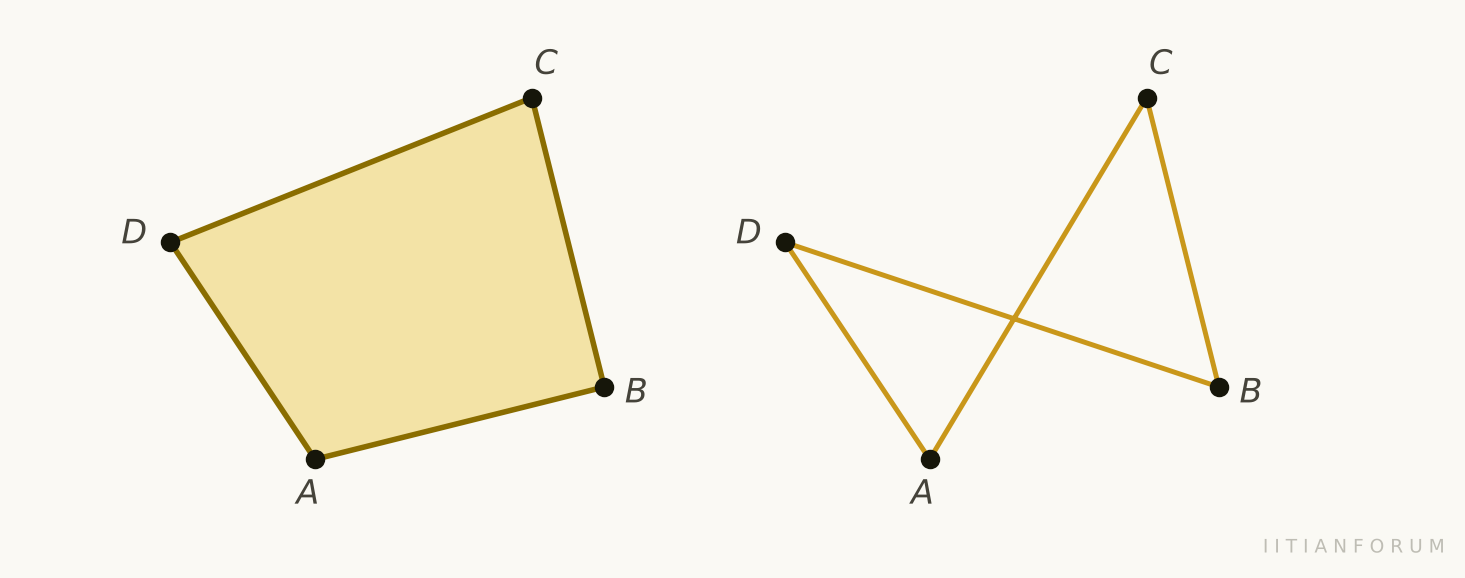
The polygon formula needs the vertices listed round the boundary, all clockwise or all anticlockwise. Listing them in any other order traces a crossing path and the formula returns a smaller, wrong number. For a triangle the order never matters, because three points can only be joined in one way.
| Result | Formula |
|---|---|
| Triangle | |
| Triangle with a vertex at | |
| Collinear points | determinant |
| Triangle with mid-points of sides given | area of the mid-point triangle |
| Polygon | , vertices in order |
Examples
Example 4 (IIT JEE 2008, Paper 2). Consider three points , and , where . Then
▸ SHOW SOLUTION
Step 1. Expand the coordinates of
Step 2. Read them as a combination of and
and , so
Step 3. Test for collinearity
A point lies on the line only when . Here
for . So is not on line , and the three points are not collinear.
Answer: option (D)
Example 5. Find the area of the quadrilateral with vertices , , and , taken in this order.
▸ SHOW SOLUTION
Step 1. The terms
| Side | Term |
|---|---|
Step 2. Add and halve
The vertices go round the boundary anticlockwise, so the order is right.
Answer: square units
Example 6 (JEE Main 2017). Let be an integer such that the triangle with vertices , and has area square units. Then the orthocentre of this triangle is at the point
▸ SHOW SOLUTION
Step 1. Area in terms of
Step 2. Find the integer
has no real root. From ,
The vertices are , , .
Step 3. Two altitudes
is horizontal (), so the altitude from is . The slope of is , so the altitude from has slope :
Step 4. Intersect
At : .
Answer: , option (4)
Example 7 (JEE Main 2015). The number of points, having both coordinates as integers, that lie in the interior of the triangle with vertices , and is
▸ SHOW SOLUTION
Step 1. Describe the interior
The triangle is , , . A point is strictly inside when
Step 2. Count by columns
For (), runs from to , which is values. So the count is
Answer: option (4)
Locus of a point
A locus is the path traced by a point that moves under a given condition. Its equation is the relation satisfied by the coordinates of every position of the point, and by no other point.
Method
- Call the moving point .
- Write the given condition as equations in , and any parameter (an angle, a slope, a second point).
- Eliminate the parameter to get one relation between and .
- Replace by and by .
The final equation must contain only and . If a slope or an angle is still present, the result describes one position of the point, not the locus. Also check for points the condition excludes, such as a parameter value that makes a triangle collapse.
Examples
Example 8 (JEE Main 2026, 8 April Shift 2). If a straight line drawn through the point of intersection of and meets the coordinate axes at and , then the locus of the mid-point of is
▸ SHOW SOLUTION
Step 1. The fixed point
Subtracting the equations gives , and then :
Step 2. The variable line
Let the mid-point be , so and , and the line is
Step 3. Make it pass through the fixed point
Step 4. Replace by
Answer: option (2)
Example 9 (JEE Main 2018). A straight line through the fixed point intersects the coordinate axes at distinct points and . If is the origin and the rectangle is completed, find the locus of .
▸ SHOW SOLUTION
Step 1. Coordinates
Let and . The fourth vertex of rectangle is .
Step 2. The line passes through
Step 3. Replace by
Answer:
Example 10 (JEE Main 2020, 7 Jan Shift 2). From any point on the line , a perpendicular is drawn to the line ; let be its foot. The locus of the mid-point of is
▸ SHOW SOLUTION
Step 1. Coordinates of and
Let . The foot on is the point of with the same value of :
Step 2. Mid-point of
Step 3. Eliminate
, that is .
Answer: option (2)
Example 11 (IIT JEE 2009, Paper 2). The locus of the orthocentre of the triangle formed by the lines , and , where , is
▸ SHOW SOLUTION
Step 1. The vertices
With the first two lines give and . Subtracting the first two equations, , so their intersection lies on
Putting this in the first line gives .
Step 2. Two altitudes
is the -axis, so the altitude from is . The side is the second line, with slope , so the altitude from is
Step 3. The orthocentre
At : . So and
Answer: option (D)
Example 12 (IITianForum). A point lies inside the triangle formed by the lines , and , and the sum of its distances from the three lines is . The locus of is a part of the line
▸ SHOW SOLUTION
Step 1. Signs inside the triangle
The vertices are , and . At the inside point : , and .
Step 2. Remove the modulus signs
Step 3. Simplify
Answer: option (A)
Slope of a line
The inclination of a line is the angle , , that it makes with the positive direction of the -axis, measured anticlockwise. Its slope is
A line making the inclination theta with the positive x-axis, with the rise and run between two of its points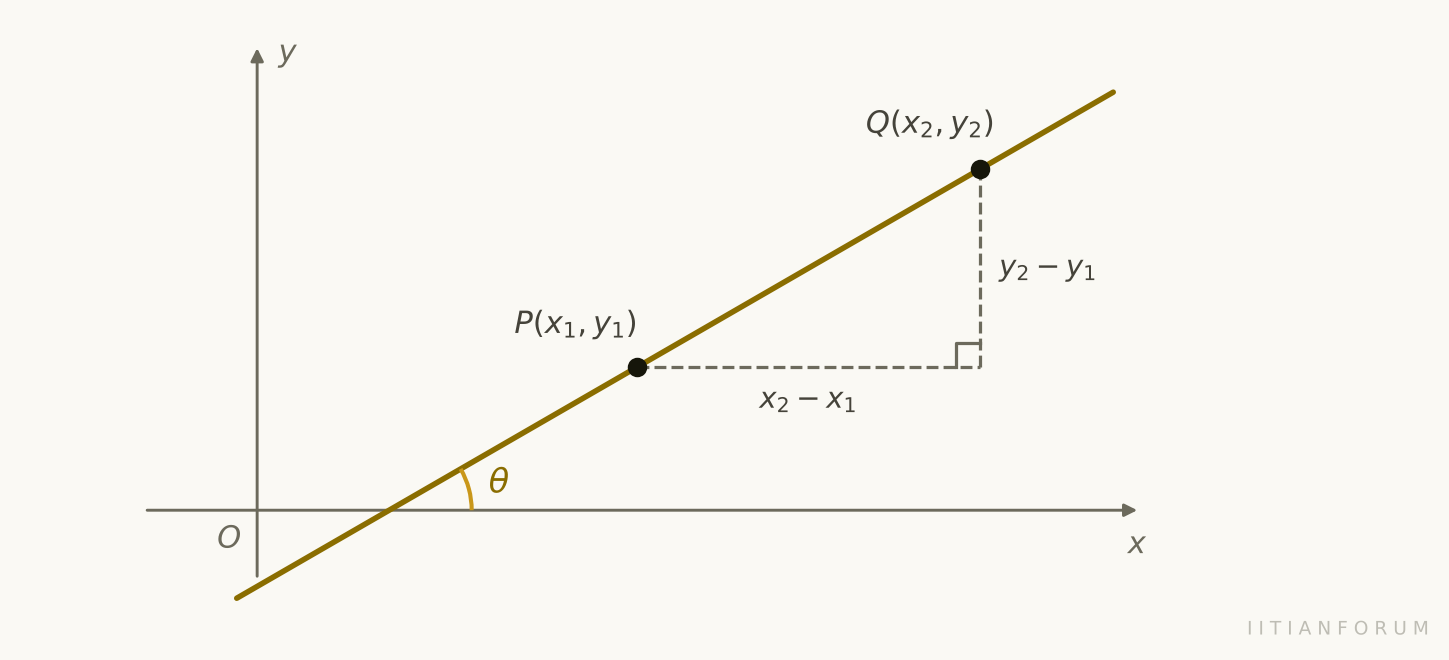
| Given | Slope |
|---|---|
| Two points , | |
| Line , | |
| Line parallel to the -axis | |
| Line parallel to the -axis | not defined |
| Line equally inclined to the axes |
Parallel and perpendicular lines
For non-vertical lines with slopes and :
Reason. Parallel lines have equal inclinations. If , then , so .
A line parallel to is , and a line perpendicular to it is .
The rule does not cover the pair and , which are perpendicular. Whenever a line may be parallel to the -axis, work with the form and the test , which covers every case.
Examples
Example 13 (JEE Main 2014). Let , , and be non-zero numbers. If the point of intersection of the lines and lies in the fourth quadrant and is equidistant from the two axes, then
▸ SHOW SOLUTION
Step 1. Write the point
In the fourth quadrant and equidistant from the axes, the point is with .
Step 2. Put it in both lines
Step 3. Equate
Answer: option (1)
Example 14 (JEE Main 2021, 26 Feb Shift 1). The intersection of the three lines , and is a
▸ SHOW SOLUTION
Step 1. The vertices
Step 2. The sides
The squared sides are , and . Two sides are equal, and , so there is no right angle.
Answer: option (3)
Forms of the equation of a line
Every straight line has an equation of the first degree in and , and every such equation is a straight line. A line is fixed by two conditions: two points, or a point and a direction, or two intercepts.
| Form | Data | Equation |
|---|---|---|
| Parallel to -axis | at distance | |
| Parallel to -axis | at distance | |
| Point and slope | , slope | |
| Slope and -intercept | slope , intercept | |
| Two points | , | |
| Intercept | intercepts , | |
| Normal | perpendicular from at angle | |
| Parametric | point , inclination |
The intercepts , and carry signs: a line cutting the negative -axis has .
Two-point form as a determinant
This is the collinearity test with as the third point.
Intercept form and normal form
The line cuts off the triangle with , , of area .
In the normal form, is the length of the perpendicular from the origin to the line, and is the angle makes with the positive -axis, .
Intercept form with intercepts a and b, beside the normal form with the perpendicular ON of length p at angle alpha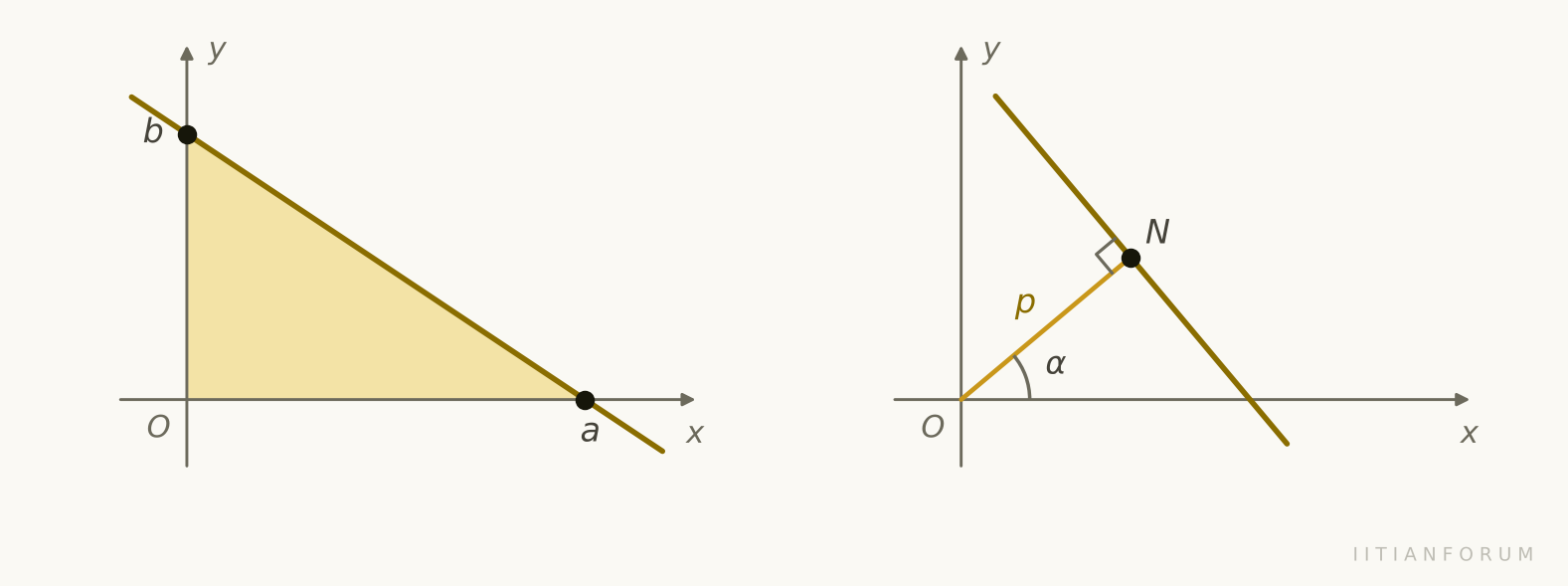
Reason. , and the line is perpendicular to , so its slope is . The point-slope form through simplifies to .
Parametric form
The point at signed distance from along the line of inclination is
on one side of and on the other. This form turns a question about a length along a line into a question about one number .
A line through A at inclination theta, with the point P at distance r along it and the horizontal and vertical steps r cos theta and r sin theta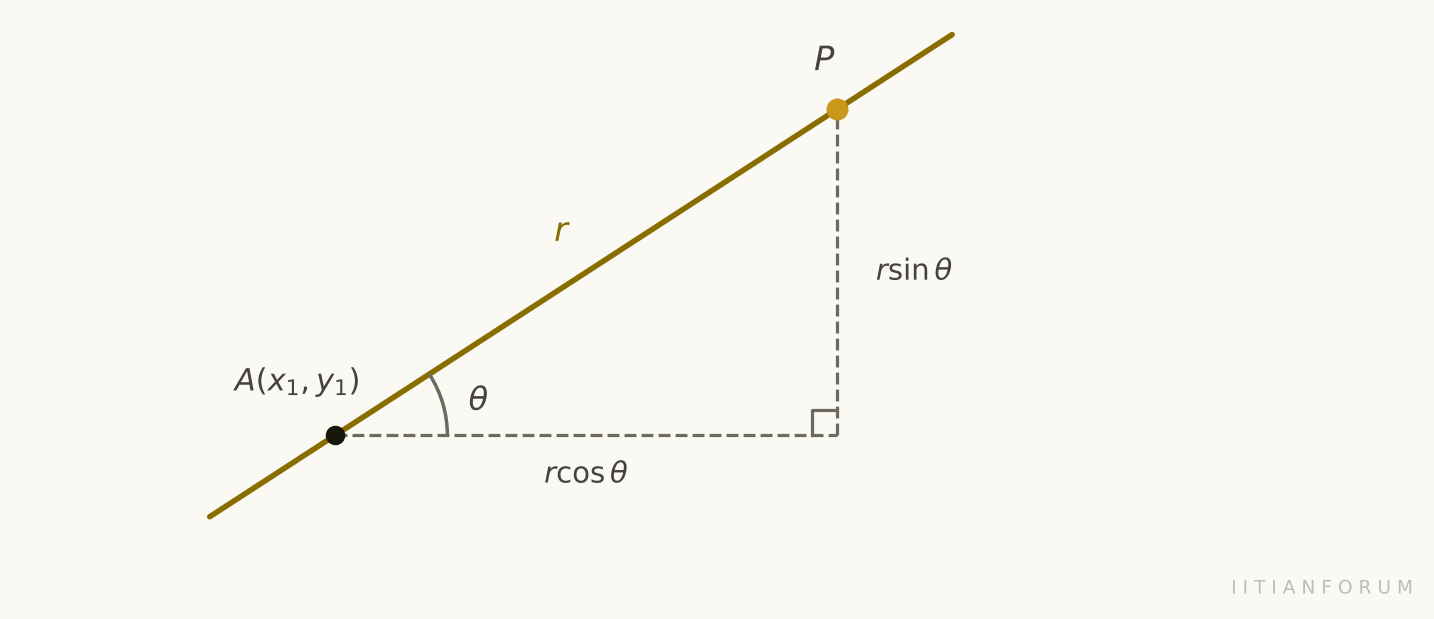
From the general form
| To | Result |
|---|---|
| Slope form | , |
| Intercept form | intercepts and , |
| Normal form | divide by , with the sign chosen so that the right side is positive |
For the normal form write when and when , then divide by . The right side is then .
A line through the origin has both intercepts zero, and a line parallel to an axis has no intercept on that axis. Neither can be written as . When a question says "a line through cuts the axes", check that such lines are excluded.
Examples
Example 15 (JEE Main 2025, 2 April Shift 2). Let the area of the triangle formed by a straight line with the coordinate axes be square units. If the perpendicular drawn from the origin to the line makes an angle of with the positive -axis, then the value of is
▸ SHOW SOLUTION
Step 1. Use the normal form
With the line is , that is . Comparing with gives .
Step 2. Use the area
The intercepts are both , so
Step 3. Answer
Answer: option (3)
Example 16 (JEE Main 2021, 31 Aug Shift 1). If and are the lengths of the perpendiculars from the origin on the lines and respectively, then is equal to
▸ SHOW SOLUTION
Step 1. Bring the first line to normal form
Multiply by :
The right side is , and , so
Step 2. The second line
It is already in normal form: .
Step 3. Eliminate
Answer: option (1)
Example 17 (JEE Main 2026, 24 Jan Shift 2). Let the angles made with the positive -axis by two straight lines drawn from the point and meeting the line at a distance from be and . Then the value of is
▸ SHOW SOLUTION
Step 1. The point at distance
With , the point is . It lies on :
Step 2. Square
Step 3. The two angles
or , so and . Both make positive, so neither is extra.
Answer: option (3)
Position of a point relative to a line
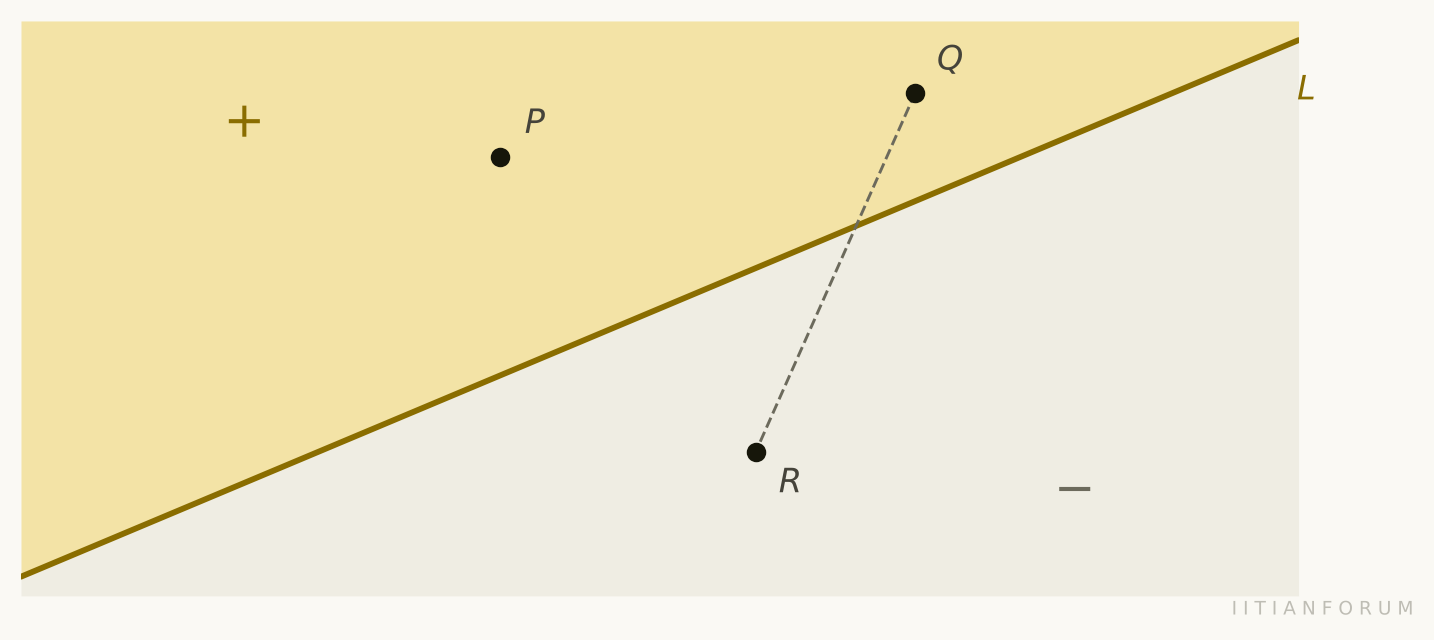
Write . The line divides the plane into two half-planes, and keeps one sign on each of them.
Reason. On a vertical line (when ), is a first-degree function of that vanishes only at the point of the line. So has one sign above the line and the opposite sign below it.
| Condition | Meaning |
|---|---|
| and of the same sign | the two points are on the same side |
| and of opposite signs | the two points are on opposite sides |
| of the same sign as | the point is on the origin side |
| the point is on the line |
Inside a triangle
A point is inside the triangle formed by three lines when, for each line, lies on the same side as the opposite vertex. In practice: find the three vertices, then for each line compare the sign of at and at the vertex not on that line.
Examples
Example 18 (JEE Main 2020, 2 Sep Shift 2). The set of all possible values of in the interval for which the points and lie on the same side of the line is
▸ SHOW SOLUTION
Step 1. Sign at
With , .
Step 2. The same sign at the other point
Step 3. Solve on
runs over , and the sine exceeds for , so .
Answer: option (1)
Example 19 (JEE Main 2025, 24 Jan Shift 2). Let the points lie on or inside the triangle with sides , and . Then the product of the smallest and the largest values of is equal to
▸ SHOW SOLUTION
Step 1. The vertices
Step 2. Which sides cross
The value lies between and and between and , so the vertical line meets the sides and :
Step 3. The range of
, and the product of the extremes is .
Answer: option (3)
Angle between two lines
If two lines have slopes and , the angle between them is or its supplement, and
Reason. . Taking the modulus gives the acute angle; the obtuse angle is .
Two intersecting lines with inclinations theta one and theta two and the angle theta between them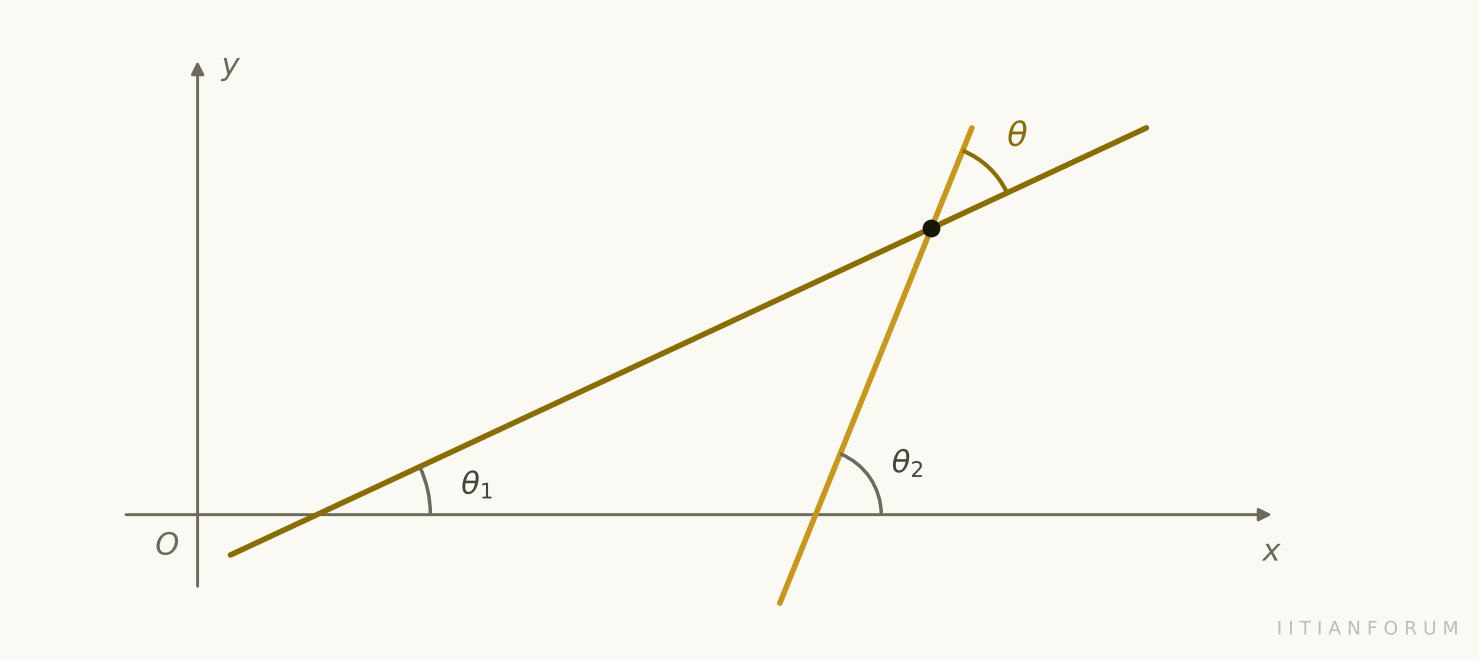
For and ,
| Lines , | Condition |
|---|---|
| Parallel | |
| Perpendicular | |
| Coincident | |
| Intersecting |
Lines making a given angle with a given line
Through there are two lines making an angle with the line of slope . Their slopes are
Equivalently, add and subtract to the inclination of the given line.
If , one of the two lines is vertical and the slope formula breaks down. For example, the lines through a point at to are and . Work with inclinations when this can happen.
Examples
Example 20 (IIT JEE 2011, Paper 1). A straight line through the point is inclined at an angle to the line . If also intersects the -axis, then the equation of is
▸ SHOW SOLUTION
Step 1. Inclination of the given line
The slope is , so its inclination is .
Step 2. The two lines at
Their inclinations are , that is or . The second is parallel to the -axis and never meets it, so has slope .
Step 3. Equation
Answer: option (B)
Example 21 (JEE Main 2021, 18 March Shift 1). The equation of one of the straight lines which passes through the point and makes an angle with the straight line is
▸ SHOW SOLUTION
Step 1. The two slopes
With and , :
Step 2. The line of slope
Answer: option (1)
Example 22 (JEE Main 2025, 3 April Shift 1). A line passes through the origin and makes equal angles with the positive coordinate axes. It intersects the lines and , , at the points and respectively. If and the foot of the perpendicular from the point on the line is , then is equal to
▸ SHOW SOLUTION
Step 1. The points and
The line is . With : , so . With : .
Step 2. Find
(the other root makes ). So .
Step 3. The right triangle
, so , where is the angle between (slope ) and (slope ):
Answer: option (4)
Distance of a point from a line
The length of the perpendicular from to the line is
The perpendicular PN from a point P to a line, beside two parallel lines with the distance d between them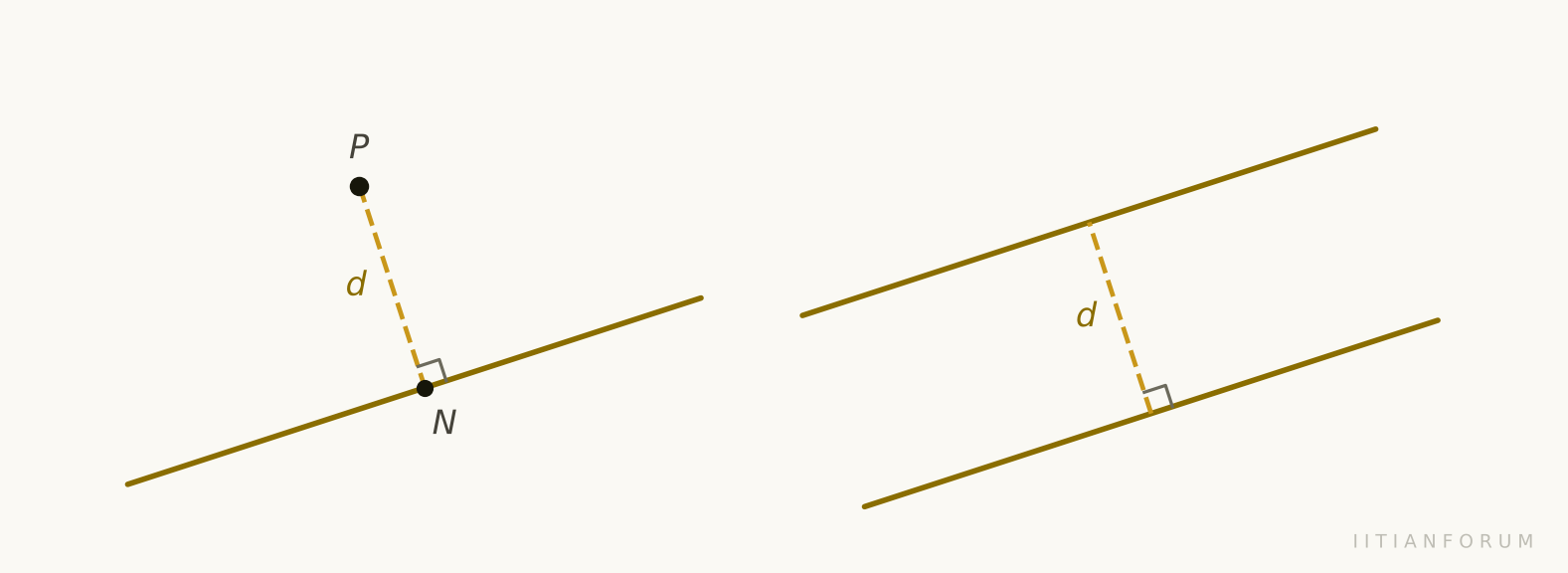
Reason. Let the perpendicular meet the line at , so for some , because is perpendicular to the line. Putting in the line gives , and .
| Distance | Formula |
|---|---|
| Point to | |
| Origin to | |
| Between and | |
| Point to |
For and the distance is not . First write the second line as ; then .
Examples
Example 23 (JEE Main 2026, 23 Jan Shift 1). A rectangle is formed by the lines , , and . Let the line be perpendicular to and divide the area of the rectangle into two equal parts. Then the distance of the point from the line is equal to
▸ SHOW SOLUTION
Step 1. The slope of
The given line has slope , so has slope .
Step 2. passes through the centre
A line halves the area of a rectangle when it passes through its centre :
Step 3. The distance
Answer: option (4)
Example 24 (JEE Main 2026, 21 Jan Shift 1). Let a point lie between the parallel lines and such that its distances from and are and units respectively. Then the area (in sq. units) of the equilateral triangle , where and lie on and , is
▸ SHOW SOLUTION
Step 1. Place the lines
Take as and as , so that is above and below . Let the side be .
Two parallel lines with the point A between them at distances 6 and 3, and the equilateral triangle ABC with B and C on the lines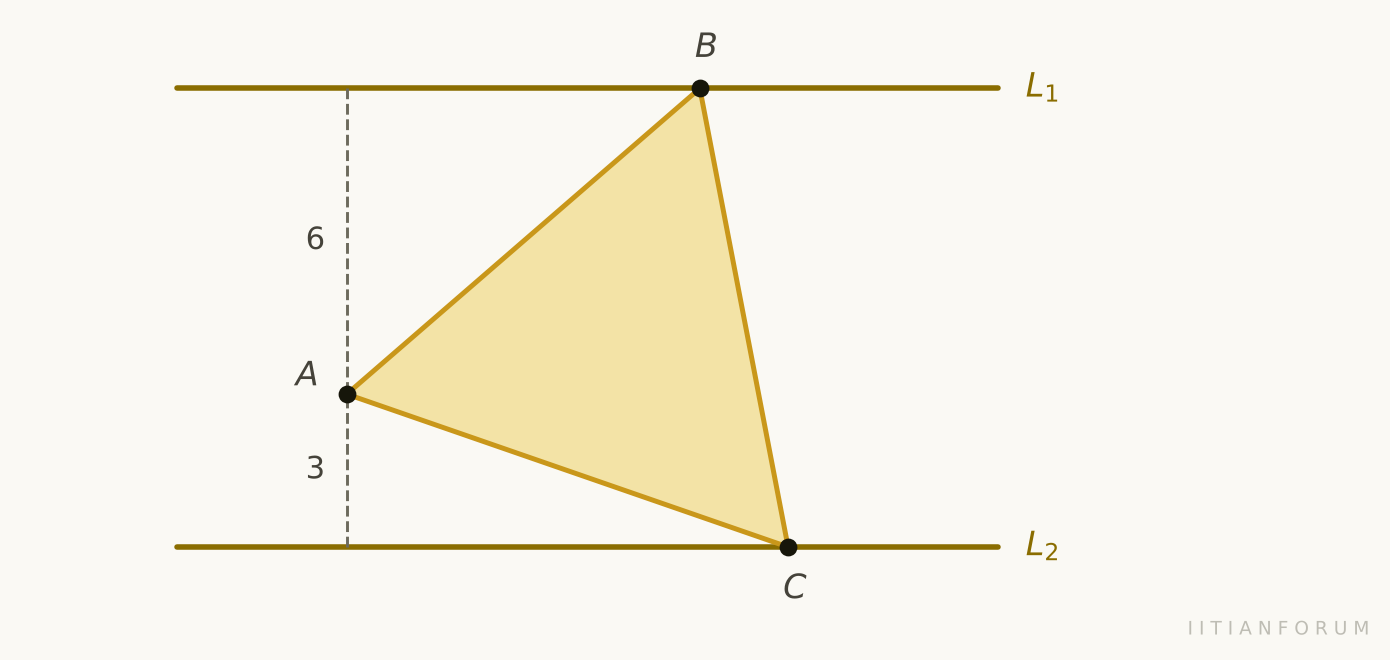
Step 2. Two heights
Let go down to at an angle below the horizontal. Turning through towards gives , which rises at :
Step 3. Expand the second
Step 4. Eliminate
Step 5. Area
Answer: option (3)
Example 25 (JEE Main 2020, 5 Sep Shift 1). If the line is at a distance and from the lines and respectively, then the sum of all possible values of and is ______.
▸ SHOW SOLUTION
Step 1. Match coefficients
Write the given line as and as .
Step 2. First distance
So or .
Step 3. Second distance
So or .
Step 4. Add
Answer:
Example 26 (JEE Advanced 2013, Paper 1). For , the distance between and the point of intersection of the lines and is less than . Then
▸ SHOW SOLUTION
Step 1. The point of intersection
Subtracting the equations gives , so , and then
Step 2. The distance
So .
Step 3. The other option
and give directly.
Answer: (A) and (C)
Example 27 (JEE Advanced 2014, Paper 1). For a point in the plane, let and be the distances of the point from the lines and respectively. The area of the region consisting of all points lying in the first quadrant of the plane and satisfying is ______.
▸ SHOW SOLUTION
Step 1. Remove the modulus signs
In the first quadrant . For , , so
Step 2. The region below
gives , with . This is the region between two vertical lines, cut by the axis and the line .
The region in the first quadrant between x equal to root 2 and 2 root 2 below y equal to x, and its mirror image above y equal to x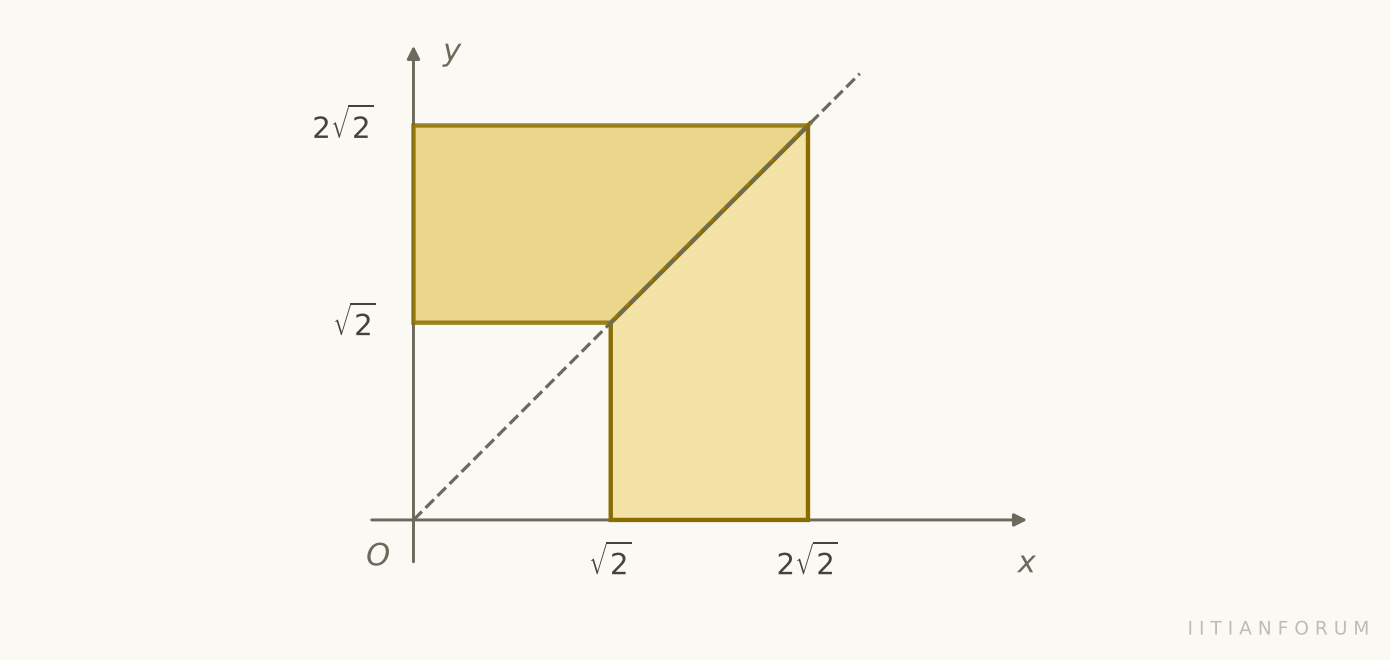
Step 3. Its area
It is a trapezium with parallel sides and and width :
Step 4. Use the symmetry
Above the roles of and swap, giving another .
Answer:
Foot of the perpendicular, image and reflection
For the point and the line , the foot of the perpendicular is given by
The image of in the line, the point with the line as the perpendicular bisector of , is given by
Reason. is along the normal , so , and on the line fixes as in the distance formula. The image is twice as far along the same normal.
The point P, the foot N of its perpendicular on a line, and the image Q with N the mid-point of PQ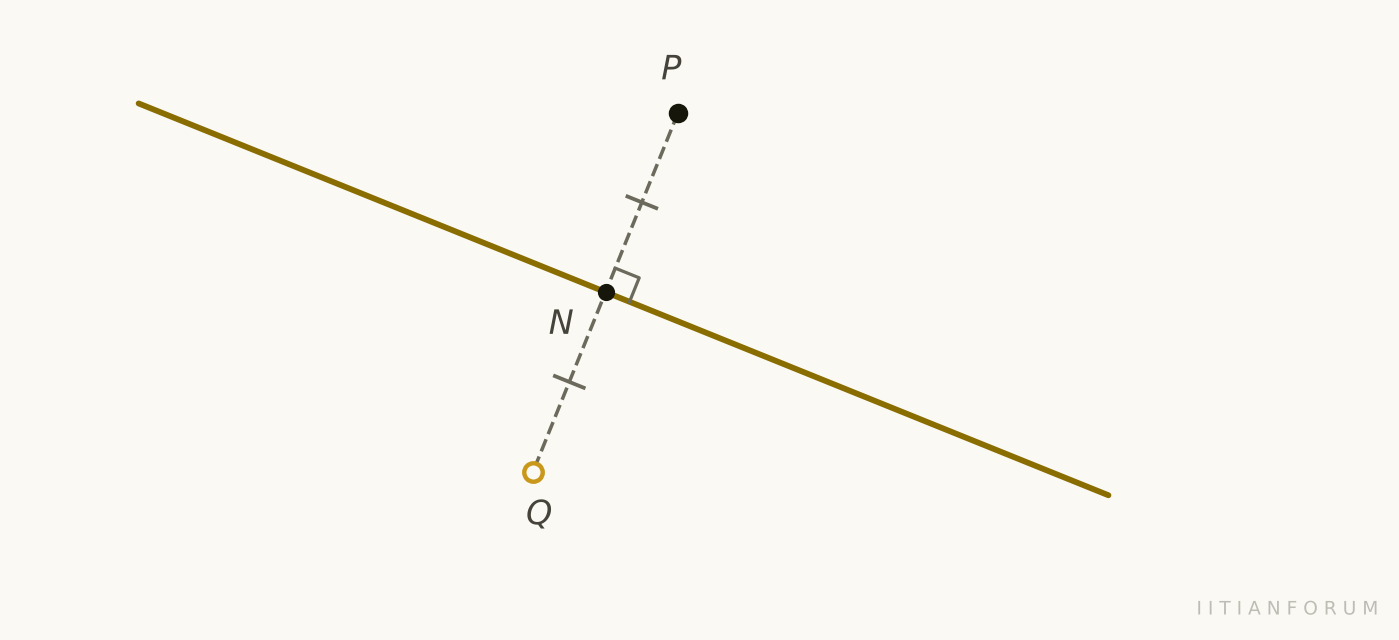
| Mirror | Image of |
|---|---|
| -axis | |
| -axis | |
| origin | |
Image of a line and reflection of a ray
To reflect a whole line in a mirror, reflect two of its points. If the line meets the mirror at , then is its own image, so one more point is enough.
A ray of light reflected by a line mirror obeys angle of incidence = angle of reflection. Equivalently, the reflected ray, extended backwards, passes through the image of the source. This turns a reflection question into an image question.
A ray from S striking a mirror at M, the reflected ray, and the image S prime of S lying on the reflected ray extended backwards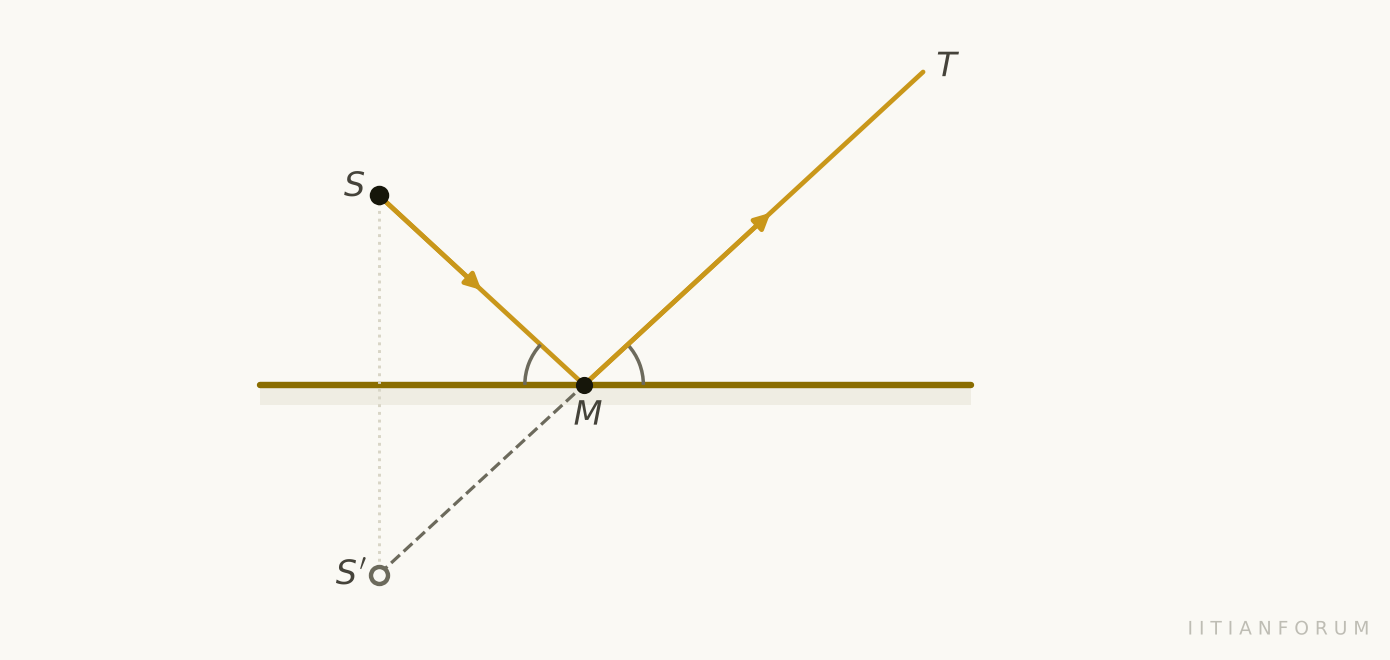
For the shortest path from to a line and on to , with and on the same side, reflect in the line. The straight segment from to the image of crosses the line at the best point, by the triangle inequality.
Examples
Example 28 (JEE Main 2021, 25 Feb Shift 1). The image of the point in the line lies on
▸ SHOW SOLUTION
Step 1. Use the formula
and , so
The image is .
Step 2. Test the options
, so it lies on the first circle.
Answer: option (1)
Example 29 (JEE Main 2025, 22 Jan Shift 1). Let the triangle be the image of the triangle with vertices , and in the line . If the centroid of is the point , then is equal to
▸ SHOW SOLUTION
Step 1. Reflect the centroid only
Reflection keeps mid-points and ratios, so the centroid of the image is the image of the centroid .
Step 2. Image of
and :
So and .
Step 3. Answer
Answer: option (4)
Example 30 (JEE Main 2026, 21 Jan Shift 2). is a point on the circle , is a point on the line , and is the perpendicular bisector of . Then times the sum of the abscissae of all such points is ______.
▸ SHOW SOLUTION
Step 1. is the image of
The perpendicular bisector of is the mirror, so is the image of in . The image of in this line is .
Step 2. Image of the whole line
If is on , then . Writing gives , , and
Step 3. Meet the circle
Put in :
The abscissae are and .
Step 4. Answer
Answer:
Example 31 (JEE Main 2026, 5 April Shift 2). From the point , two rays are sent making angles of with the line . These rays get reflected from the mirror . If the equations of the reflected rays are and , , then the value of is ______.
▸ SHOW SOLUTION
Step 1. The two incident rays
The line has inclination , so the rays have inclinations and : they are and .
Step 2. Points where they meet the mirror
meets at , and meets it at .
Step 3. Image of the source
The reflected rays pass through the image of in . With and ,
Step 4. The reflected rays
Through and the slope is , giving , that is .
Through and the slope is , giving .
Step 5. Answer
, , , , so
Answer:
Example 32 (IITianForum). is a fixed point. and are points on the lines and respectively. The least possible value of the perimeter is
▸ SHOW SOLUTION
Step 1. Reflect in both lines
The image of in is , and in it is . Then and .
The point P between the lines y equal to x and y equal to 0, its two images, and the straight path from one image to the other meeting the lines at Q and R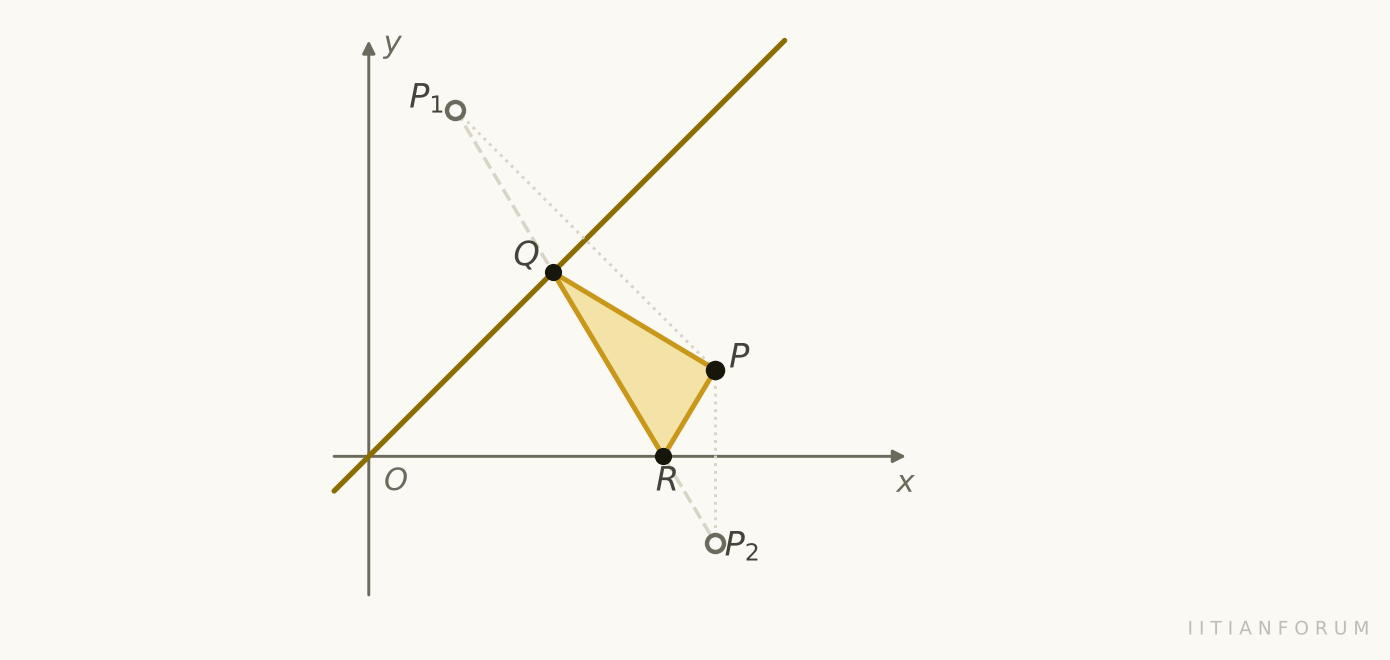
Step 2. A broken path between the images
Equality holds when and lie on the segment .
Step 3. The least value
The segment meets at and at , both on the correct rays.
Answer: option (A)
Bisectors of the angles between two lines
Two intersecting lines and form two pairs of vertically opposite angles, and so they have two angle bisectors, perpendicular to each other:
Reason. A point is on a bisector exactly when it is equidistant from the two lines. The two signs give the two bisectors.
Two intersecting lines with the bisector of the angle containing the origin and the other bisector, the origin marked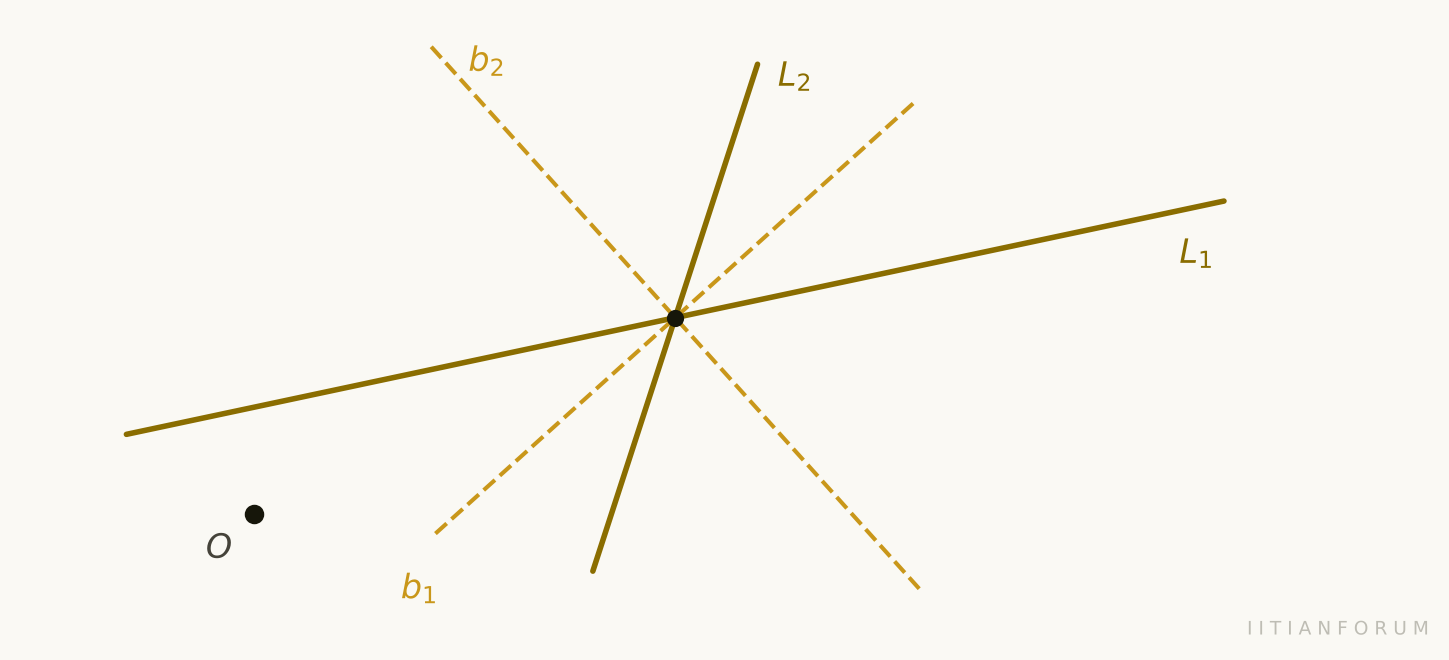
Which bisector is which
First make and positive (multiply an equation by if needed). Then:
| Test | Result |
|---|---|
| Sign | bisector of the angle containing the origin |
| Sign | bisector of the other angle |
| origin lies in the obtuse angle: gives the obtuse bisector | |
| origin lies in the acute angle: gives the acute bisector |
A quicker check: take any point on one bisector and find the angle the bisector makes with one of the lines. If it is less than , that bisector bisects the acute angle.
The internal bisector of an angle of a triangle
The internal bisector of angle in triangle meets at with
so comes from the section formula. A vertex and its reflection in an internal bisector lie on the opposite sides of that angle: the reflection of in the bisector of angle lies on line .
The rule "plus sign gives the bisector containing the origin" is valid only after and . If one constant is negative, the signs swap. If a line passes through the origin, use a different point in place of the origin.
Examples
Example 33 (IIT JEE 2007, Paper 2). Lines and intersect the line at and respectively. The bisector of the acute angle between and intersects at .
Statement 1: The ratio equals .
Statement 2: In any triangle, the bisector of an angle divides the triangle into two similar triangles.
▸ SHOW SOLUTION
Step 1. The points
and , and the lines meet at .
Step 2. Is acute?
, so is acute and its bisector is the acute-angle bisector.
Step 3. The ratio
So Statement 1 is true.
Step 4. Statement 2
A bisector gives two triangles with one equal angle and one common side, but they are not similar in general. Statement 2 is false.
Answer: option (C)
Example 34 (JEE Main 2026, 4 April Shift 1). Let the line intersect the lines and at the points and respectively. Let the bisector of the obtuse angle between the lines and intersect the line at the point . Then is equal to
▸ SHOW SOLUTION
Step 1. The points
and ; and meet at .
Step 2. Is obtuse?
, so is obtuse, and its bisector is the obtuse-angle bisector.
Step 3. Angle bisector theorem in
Answer: option (1)
Example 35 (JEE Main 2026, 24 Jan Shift 1). Let , and be three points. If the equation of the bisector of the angle is , then the value of is
▸ SHOW SOLUTION
Step 1. The two sides at
Step 2. The point on
, so
Step 3. The line
Slope , so , that is .
Answer: , option (4)
Example 36 (IITianForum). In a triangle the vertex is , and the internal bisectors of the angles and are and respectively. The equation of the side is
▸ SHOW SOLUTION
Step 1. Reflect in the bisector of
The image of in the bisector of angle lies on . With and ,
Step 2. Reflect in the bisector of
In the line the image is
Step 3. The line
Slope , so :
Check: it meets the bisectors at and , and the bisectors meet at the incentre .
Answer: option (A)
Centres of a triangle
Let the vertices be , , with opposite sides , , .
| Centre | Where the lines meet | Coordinates |
|---|---|---|
| Centroid | medians | |
| Incentre | internal angle bisectors | |
| Excentre (opposite ) | bisectors: internal at , external at , | |
| Circumcentre | perpendicular bisectors of the sides | solve |
| Orthocentre | altitudes | intersect two altitudes |
The excentres and come from changing the sign of or of instead of .
Reason for the incentre. The bisector from meets at with , and the bisector from then divides in the ratio . The section formula gives .
When the angles are known, the circumcentre and orthocentre also have weighted forms:
(with the same expressions for the -coordinates, and valid for a triangle with no right angle).
The Euler line
In every triangle the orthocentre , the centroid and the circumcentre are collinear, and
A scalene triangle with its orthocentre H, centroid G and circumcentre O on one straight line, G two thirds of the way from H to O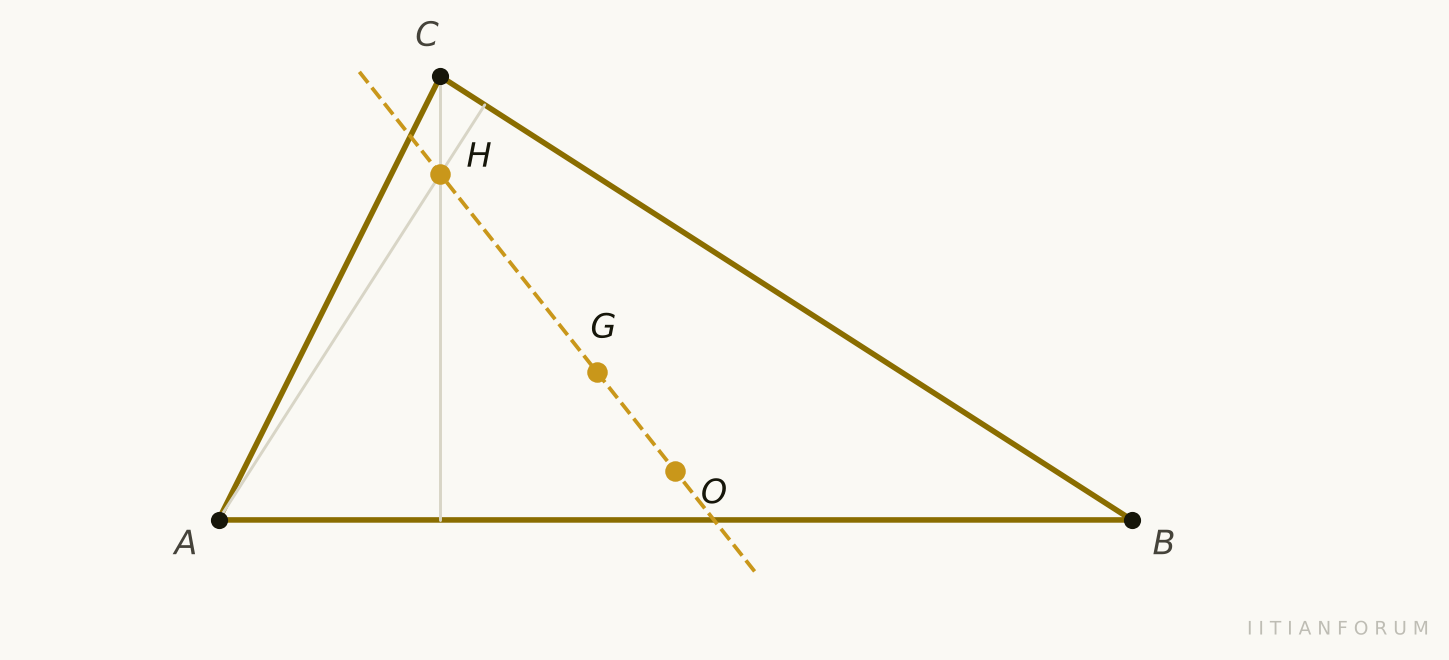
| Triangle | Fact |
|---|---|
| Right-angled at | , and is the mid-point of the hypotenuse |
| Equilateral | ; the centre is at distance of the height from each side |
| Isosceles with | , , , all lie on the median from |
| Mid-points of the sides given | , and so on |
In the incentre, the weight on vertex is , the side opposite , not a side through . Writing in place of is the most frequent error in this topic, and it gives a wrong point that still looks reasonable.
Examples
Example 37 (IIT JEE 2007, Paper 2). Let , , be the vertices of the triangle . The point inside the triangle is such that the triangles , , are of equal area. The coordinates of are
▸ SHOW SOLUTION
Step 1. Equal areas give the centroid
has one third of the area of on the same base , so is at one third of the height of above . The same holds for the other two sides, and the only such point is the centroid.
Step 2. Compute it
Answer: option (C)
Example 38 (JEE Main 2026, 2 April Shift 1). Let the mid-points of the sides of a triangle be , and . If its incentre is , then is equal to
▸ SHOW SOLUTION
Step 1. Recover the vertices
Each vertex is the sum of the two adjacent mid-points minus the opposite one:
Step 2. The sides
The side joining and is ; the other two are both . The weight goes on the vertex opposite the side of length .
Step 3. The incentre
Step 4. Answer
Answer: option (3)
Example 39 (JEE Main 2026, 4 April Shift 1). Let the vertex of a triangle be , and the mid-point of the side be . If the centroid of the triangle is and its circumcentre is , then is equal to
▸ SHOW SOLUTION
Step 1. The vertices and
, and :
Step 2. Two perpendicular bisectors
and for give
Step 3. Solve
Answer: option (3)
Example 40 (JEE Main 2026, 5 April Shift 1). In an equilateral triangle , let the vertex be at and the side be along the line . If the orthocentre of the triangle is , then is equal to
▸ SHOW SOLUTION
Step 1. Foot of the altitude from
and , so the foot is
Step 2. Orthocentre equals centroid
In an equilateral triangle , which divides in the ratio :
Step 3. Answer
Answer: option (4)
Example 41 (JEE Main 2026, 28 Jan Shift 1). Let be an equilateral triangle with orthocentre at the origin and side on the line . If the coordinates of the vertex are , then the greatest integer less than or equal to is
▸ SHOW SOLUTION
Step 1. is on the altitude through
The altitude is perpendicular to and passes through , so it is , and .
Step 2. Use
, so , and is on the opposite side of from . With along the unit vector ,
Step 3. Answer
and .
Answer: option (4)
Example 42 (JEE Main 2026, 4 April Shift 2). Let , be points on the two half-lines , , at a distance from their point of intersection . The line segment meets the angle bisector of the given half-lines at the point . If and is the radius of the circumcircle of , then is equal to ______.
▸ SHOW SOLUTION
Step 1. The two half-lines
They are and for , meeting at with inclinations . The angle between them is , and the bisector is the -axis.
Step 2. The triangle is equilateral
with the angle between them, so is equilateral with side , and is the mid-point of .
Step 3. Find and
Step 4. Answer
Answer:
Example 43 (JEE Main 2025, 7 April Shift 2). If the orthocentre of the triangle formed by the lines , and is at , then is
▸ SHOW SOLUTION
Step 1. The vertex on the first two lines
gives .
Step 2. The third side is horizontal
The altitude from passes through and , so it is the vertical line . The third side is perpendicular to it: , and the side is .
Step 3. Another altitude
The third side meets at . The altitude from is perpendicular to , so its slope is , and it passes through :
Answer: , option (1)
Example 44 (JEE Main 2019, 9 Jan Shift 2). Let the equations of two sides of a triangle be and . If the orthocentre of this triangle is at , then the equation of its third side is
▸ SHOW SOLUTION
Step 1. The common vertex
The slope of is , so the third side has slope .
Step 2. A second vertex
Let be on . The altitude from is perpendicular to , so it has slope through : . With this gives
Step 3. The third side
Through with slope :
Answer: option (1)
Example 45 (JEE Advanced 2021, Paper 1). Consider a triangle whose two sides lie on the -axis and the line . If the orthocentre of is , then the equation of the circle passing through the vertices of the triangle is
▸ SHOW SOLUTION
Step 1. The vertices
The two sides meet at . Let be on the -axis and on .
Step 2. Altitude from
It is perpendicular to the -axis and passes through , so and .
Step 3. Altitude from
It is perpendicular to and passes through , so it is , and .
Step 4. The circle
Through the origin, . Then gives and gives .
Answer: option (B)
Example 46 (JEE Advanced 2026, Paper 1). Let be the point on the parabola such that the slope of the tangent to the parabola at is . Let be the point in the first quadrant lying on the circle such that the slope of the tangent to the circle at is . Let be the point in the first quadrant lying on the ellipse such that the slope of the tangent to the ellipse at is . Then the radius of the circle passing through the points , and is
▸ SHOW SOLUTION
Step 1. The three points
On , gives . On the circle the tangent is perpendicular to the radius , so has slope and . On the ellipse gives , so and .
Step 2. A right angle
is vertical () and is horizontal (), so the angle at is .
Step 3. Circumradius
The circumcentre is the mid-point of the hypotenuse :
Answer: option (3)
Example 47 (IITianForum). The line is rotated clockwise through the angle about the point where it meets the -axis, and the new line is . If is the incentre of the triangle formed by , and the -axis, then is equal to ______.
▸ SHOW SOLUTION
Step 1. The new slope
meets the -axis at . Its slope is . Turning clockwise through with gives the slope
Step 2. The new line and the triangle
: , that is . With the -axis the vertices are , , .
Step 3. The incentre
The side opposite is ; the other two sides are each.
By symmetry about the -axis, .
Answer:
Family of lines and concurrency
If and intersect at , then for every real
is a line through . Reason. makes both and zero, so it makes zero, and the equation is still of the first degree.
Several lines of the family L1 plus lambda L2 passing through the common point P of L1 and L2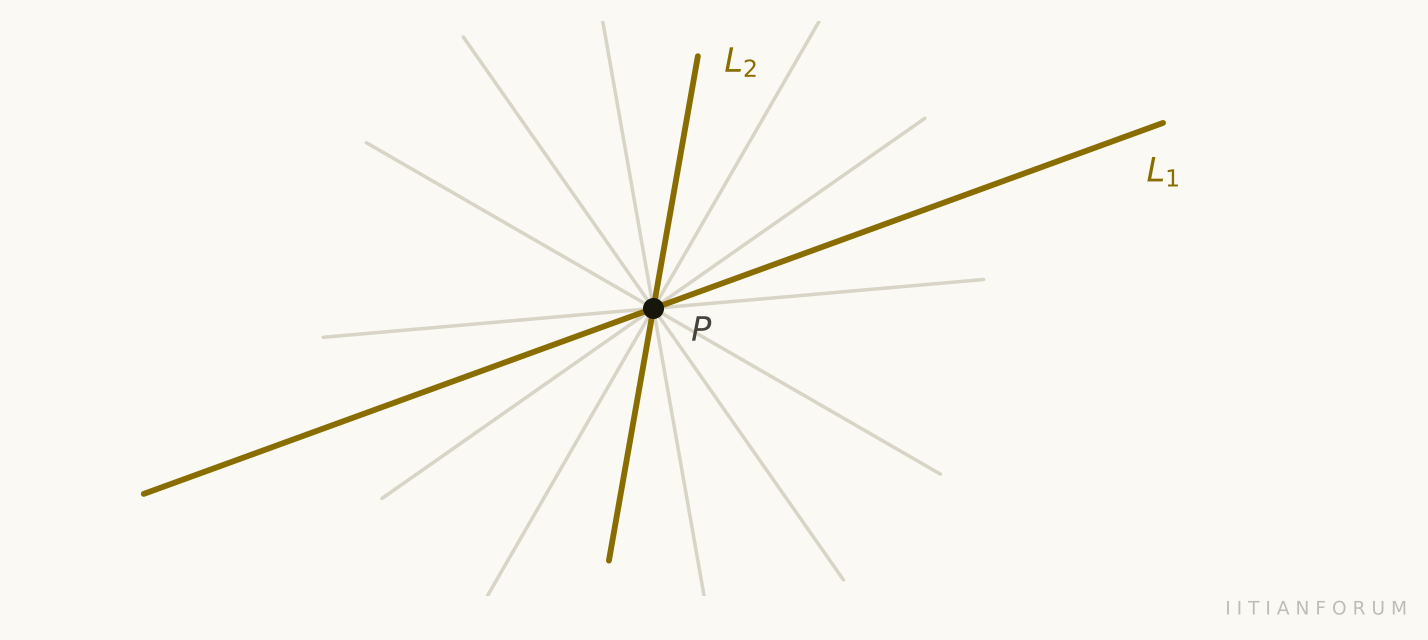
| Given | Fixed point |
|---|---|
| intersection of and | |
| with , | |
| , , in AP: | |
| intersection of , |
Concurrency of three lines
The lines () are concurrent when two of them meet and the third passes through that point. This happens when
and two of the lines are not parallel. Equivalently, there are constants , not all zero, with .
The determinant is also zero for three parallel lines, such as , , , which have no common point. Always check that two of the lines actually meet.
No value of in gives itself. If the required line could be , test it separately, or use .
Examples
Example 48 (JEE Main 2019, 9 Jan Shift 1). Consider the set of all lines such that . Which one of the following statements is true?
▸ SHOW SOLUTION
Step 1. Rewrite the condition
Divide by :
Step 2. Read off the point
This says that satisfies for every such line.
Answer: option (3)
Example 49 (JEE Main 2026, 22 Jan Shift 2). Among the statements (S1): If and are two vertices of a triangle whose orthocentre is , then its third vertex is ; and (S2): If positive numbers , , are three consecutive terms of an A.P., then the lines are concurrent at ,
▸ SHOW SOLUTION
Step 1. (S1): two altitudes through
Let . and :
Step 2. Solve
The equations are and , giving , . (S1) is correct.
Step 3. (S2): the AP condition
means , which is the line at the point . So every such line passes through , and (S2) is correct.
Answer: option (4)
Example 50 (IITianForum). For all values of , the lines pass through one fixed point. The image of that point in the line is
▸ SHOW SOLUTION
Step 1. Separate and
With and the lines are
Step 2. The fixed point
It is the intersection of and : put in the first to get , so the point is .
Step 3. The image in
The image of in is :
Answer: option (A)
Example 51 (IITianForum). If , then the family of straight lines may be concurrent at
▸ SHOW SOLUTION
Step 1. Factor the condition
The left side splits into two linear factors:
Expanding the right side confirms all six terms.
Step 2. Read each factor as a point
is at , and is the same line at .
So each line of the family passes through or through .
Answer: (A) and (B)
Example 52 (JEE Main 2025, 24 Jan Shift 1). Let the lines , and be concurrent. If the image of the point in the line is , then is equal to
▸ SHOW SOLUTION
Step 1. The mirror passes through the mid-point
The mid-point of and its image is , which lies on :
Step 2. Concurrency
The first two lines are not parallel, so the three lines do meet.
Answer: , option (2)
Example 53 (JEE Main 2025, 3 April Shift 2). Consider the lines , being a parameter, all passing through a point . One of these lines (say ) is farthest from the origin. If the distance of from the point is , then the value of is
▸ SHOW SOLUTION
Step 1. The fixed point
Solving and gives .
Step 2. The farthest line
For any line through , the distance from is at most , with equality when the line is perpendicular to . So , and is .
Step 3. Distance from
Answer: option (1)
Lines that form a figure
Many questions give some sides or diagonals of a parallelogram, rhombus or square and ask for the rest. The facts used are few.
| Figure | Property used |
|---|---|
| Parallelogram | diagonals bisect each other; opposite sides parallel |
| Rhombus | parallelogram with diagonals perpendicular |
| Rectangle | parallelogram with diagonals equal |
| Square | diagonals equal, perpendicular, bisecting each other, at to the sides |
| Triangle cut by a line | similar triangles, areas in the square of the ratio |
A line through the centre of a parallelogram (or rectangle) always divides its area into two equal parts.
Examples
Example 54 (JEE Main 2026, 23 Jan Shift 2). Let and be two diagonally opposite vertices of a rhombus, whose sides and are parallel to the line . If and are the other two vertices, then is equal to
▸ SHOW SOLUTION
Step 1. The diagonals bisect each other
The mid-point of is , so :
Step 2. Answer
Step 3. The vertices themselves
The rhombus ABCD with A at 1, 2 and C at minus 3, minus 6, its sides AD and BC parallel and its diagonals crossing at minus 1, minus 2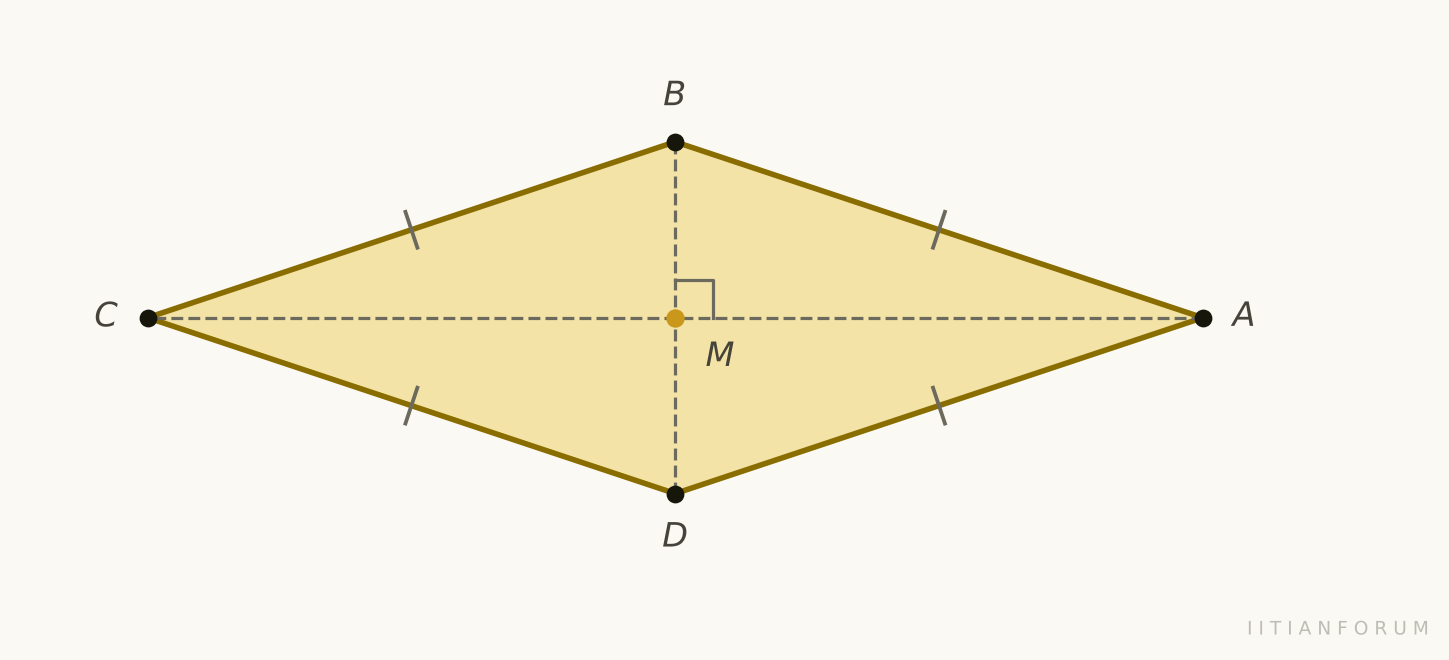
is perpendicular to (slope ) through . Meeting the line through of slope gives , and then . The sum is , as found.
Answer: option (3)
Example 55 (JEE Main 2016). Two sides of a rhombus are along the lines and . If its diagonals intersect at , then which one of the following is a vertex of this rhombus?
▸ SHOW SOLUTION
Step 1. The vertex on both sides
and give , so the opposite vertex is .
Step 2. Sides through
They are parallel to the given sides: and .
Step 3. The other two vertices
with gives , and with gives .
Answer: option (2)
Example 56 (JEE Main 2025, 8 April Shift 2). Let be the length of a side of a square with being the origin. Its side makes an acute angle with the positive -axis and the equations of its diagonals are and . Then is equal to
▸ SHOW SOLUTION
Step 1. Direction of the diagonal
The first diagonal passes through with slope .
Step 2. Direction of
makes with and is acute, so and .
Step 3. is on the other diagonal
Answer: , option (1)
Example 57 (JEE Main 2025, 2 April Shift 2). Let , and be the vertices of a triangle . Then the maximum area of the parallelogram , formed with vertices , and on the sides , and of the triangle respectively, is ______.
▸ SHOW SOLUTION
Step 1. Area of the triangle
Step 2. The two corner triangles
Let . Since and , the triangles and are similar to with ratios and :
Step 3. Maximise
, with equality at , so the maximum is .
Answer:
Example 58 (IITianForum). is the point of intersection of the lines and , and is the point . A variable line through meets the ray , , at and the positive -axis at . The least possible area of the triangle is ______.
▸ SHOW SOLUTION
Step 1. Coordinates in terms of
Let . The line is . It meets where
and needs .
Step 2. The area
Step 3. Minimise with
by , with equality at . Then , , and is the mid-point of .
Answer:
Change of origin and rotation of axes
Shift of origin
If the origin is moved to with the axes kept parallel, a point with old coordinates has new coordinates with
The new equation of a curve comes from writing for and for . Distances, slopes and angles do not change.
Rotation of axes
If the axes are turned anticlockwise through about the origin, the old and new coordinates are related by
and, solving back,
The old axes x and y and the new axes x prime and y prime turned through theta, with one point P and its two pairs of coordinates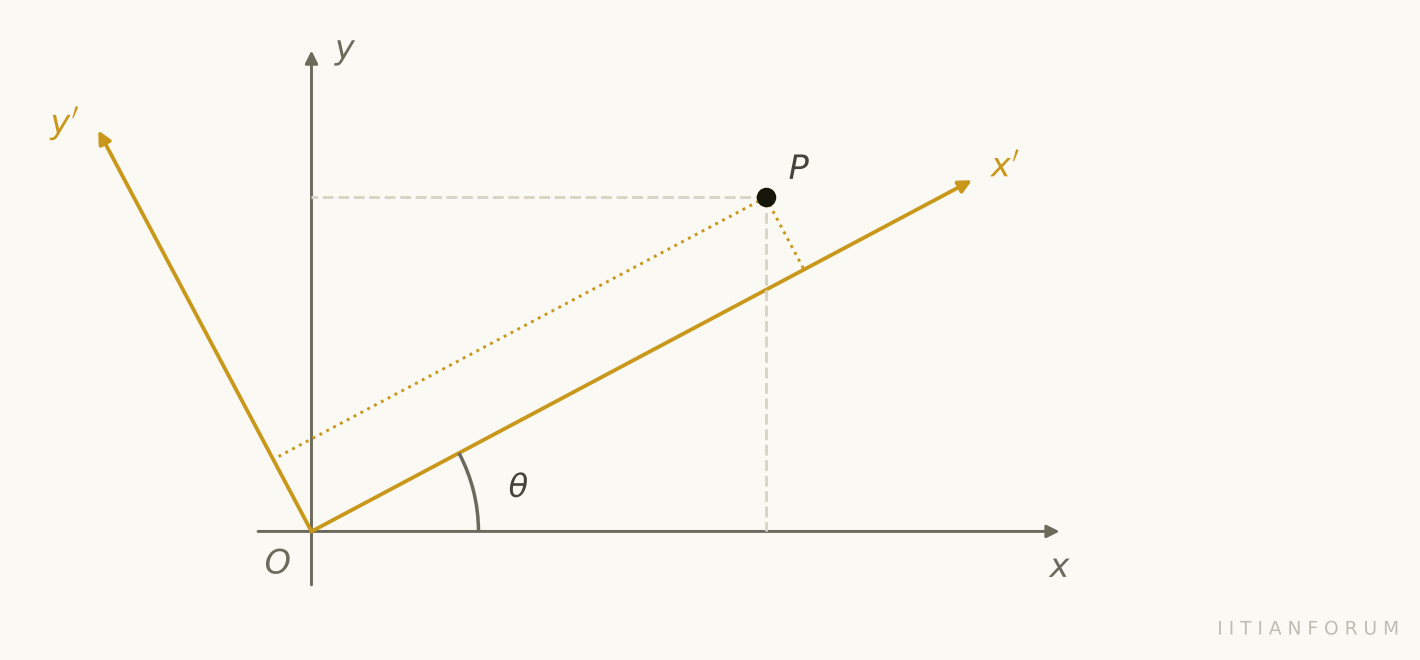
For a shift to followed by a rotation through , replace , in the last two lines by , .
Rotating a point instead of the axes
Turning a point anticlockwise through about the origin gives
Turning the axes through has the same effect on coordinates as turning the point through . So the new coordinates after rotating the axes use , while the coordinates of a rotated point use . Read the question for which one is turned.
Examples
Example 59 (JEE Main 2021, 27 July Shift 2). The point undergoes the following three transformations successively: reflection about the line ; translation through units along the positive direction of the -axis; rotation through angle about the origin in the anticlockwise direction. If the coordinates of the final position of the point are , then the value of is equal to
▸ SHOW SOLUTION
Step 1. Reflection, then translation
Reflection in gives ; the translation gives .
Step 2. Rotation through
Step 3. Solve
and , so , .
Answer: , option (2)
Example 60 (JEE Main 2025, 8 April Shift 2). A line passing through the point makes an acute angle with the positive -axis. Let this line be rotated about the point through an angle in the clockwise direction. If in the new position, the slope of the line is and its distance from the origin is , then the value of is
▸ SHOW SOLUTION
Step 1. The angle
After the clockwise turn the inclination is , and . So .
Step 2. Distance from the origin
The new line passes through at inclination , so its distance from is :
Step 3. Find
, so
Step 4. Answer
Answer: option (1)
Which method to use
| You are given | Start with |
|---|---|
| A point dividing a segment | section formula; a line cutting it: ratio |
| Three points, area or collinearity | the determinant |
| A moving point and a condition | call it , eliminate the parameter |
| A point at a given distance along a line | parametric form |
| Perpendicular from the origin, its length and angle | normal form |
| Intercepts or a triangle cut off by the axes | intercept form |
| Two points on the same or opposite sides | signs of |
| A line at a given angle to another | inclination angle, then point-slope form |
| Foot, image, reflected ray, shortest path | the image formula |
| Equidistant from two lines | bisectors, then the origin or dot-product test |
| Mid-points of sides, centres of a triangle | recover vertices, then the table of centres |
| Orthocentre given | two altitudes through it |
| Lines with a parameter | split as for the fixed point |
| Three lines through one point | determinant, and check that two lines meet |
| Sides or diagonals of a quadrilateral | diagonals bisect each other |
| Axes moved or a point turned | shift and rotation formulas |
What JEE asks
JEE Main asks about one straight-line question per shift, and many circle and conic questions use the same results. In 2026 the most frequent types were the centres of a triangle (Examples 38 to 42 and 49), angle bisectors and the angle bisector theorem (Examples 34 and 35), images and reflected rays (Examples 30 and 31), distances to parallel lines (Examples 23 and 24), the parametric form (Example 17), a locus through a family of lines (Example 8) and a rhombus from its diagonals (Example 54). The 2026 equilateral-triangle questions all used one fact: the orthocentre, centroid and circumcentre coincide and divide the altitude in the ratio .
JEE Advanced asks fewer but deeper questions: the orthocentre locus as a straight line (Example 11), regions defined by distances from two lines (Example 27), conditions from a distance inequality (Example 26), the orthocentre used to recover a triangle and its circumcircle (Example 45), and a weighted point written by the section formula (Example 3, 2025). Statement questions on the angle bisector theorem (Example 33) and collinearity hidden in trigonometric coordinates (Example 4) appeared in earlier years.
Quick recall
| Result | Statement |
|---|---|
| Distance | |
| Section, internal | |
| Line cuts in | |
| Area of triangle | |
| Slope | |
| Parallel, perpendicular | ; |
| Normal form | |
| Parametric point | |
| Angle | |
| Point to line | |
| Parallel lines | |
| Foot / image | |
| Bisectors | |
| Incentre | weights , , on , , |
| Euler line | |
| Family | |
| Concurrency | determinant , two lines meeting |
| Rotation of axes | , |
Without a pen, answer these four: the distance between and ; the image of in ; the fixed point of the lines with ; and the orthocentre of the triangle with vertices , , . If , , and came quickly, the chapter is in place.
Practise these methods on real exam questions in the doMath Straight Lines chapter. The same distance and image formulas run through the Family of Circles note, the vector form of these results is in the Complex Numbers in Coordinate Geometry note, and the trigonometric side of the centres of a triangle is in the Solution of Triangles note.