JEE Main 2026 (5 Apr, Shift 2) Maths Analysis Chapter Weightage, Difficulty & Answer-Key Error
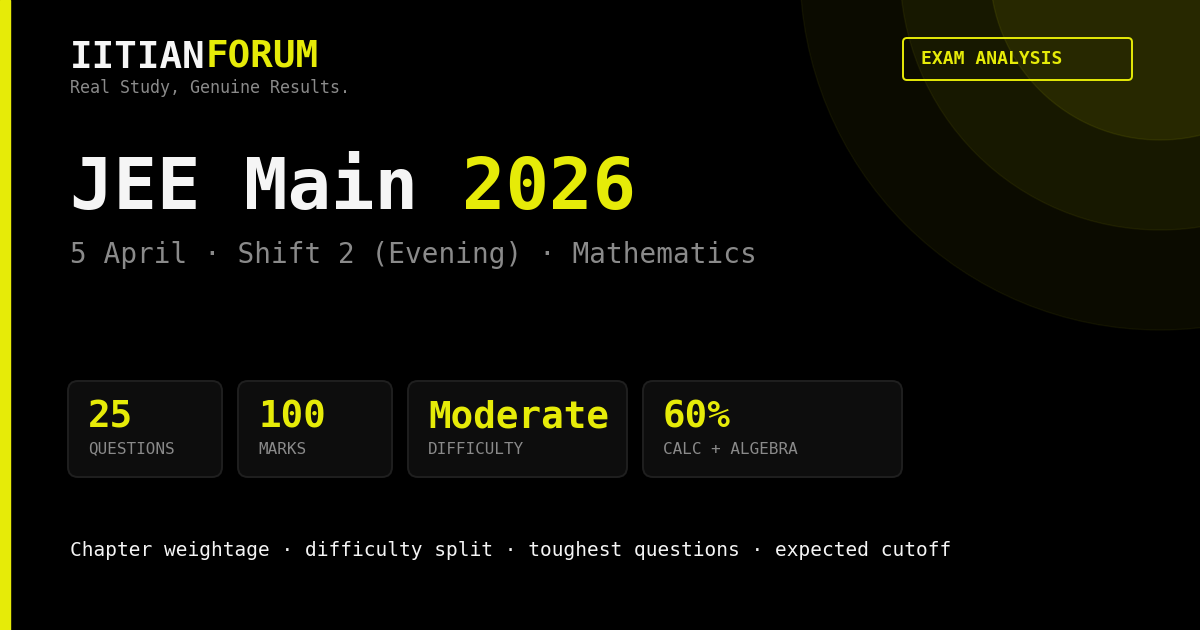
The 5 April 2026 evening shift was a moderate-to-tough Mathematics paper with nine hard questions and it carries a finding worth flagging loudly: the official answer key for Q7 is wrong. Our independent verification (and the booklet's own working) gives 3360, not the printed 3480.
Here is the full breakdown: what was asked, where the marks sat, how hard it really was, and roughly what a good attempt looked like.
The paper at a glance
| Field | Detail |
|---|---|
| Exam | JEE Main 2026 · 5 Apr · Shift 2 (Evening) |
| Questions | 25 (Q1–Q20 single-correct MCQ, Q21–Q25 numerical) |
| Marks | 100 (+4 correct, –1 wrong on MCQs; no negative on numericals) |
| Overall difficulty | Moderate, leaning tough |
| Biggest units | Algebra (36 marks) · Calculus (24 marks) |
| Toughest questions | Q1, Q10, Q22, Q24 |
| Answer key | Q7 key error found (3480 → 3360); Q9 ambiguous |
Overall verdict
A demanding but fair paper with an unusually generous three easy marks (Q6 arithmetic means, Q8 total probability, Q16 a vector ratio). The difficulty clustered in the back half the entire Section-B block bar one question was hard plus a tough Sequences pair early on. Algebra carried the most weight at 36 marks, with Sequences & Series alone contributing three questions.
Grab the 3 easy + 13 medium questions cleanly (that's a strong 64/100), then pick your battles among the 9 hard ones. Q1, Q10, Q22 and Q24 were the biggest time sinks — save them for last.
Unit-wise weightage
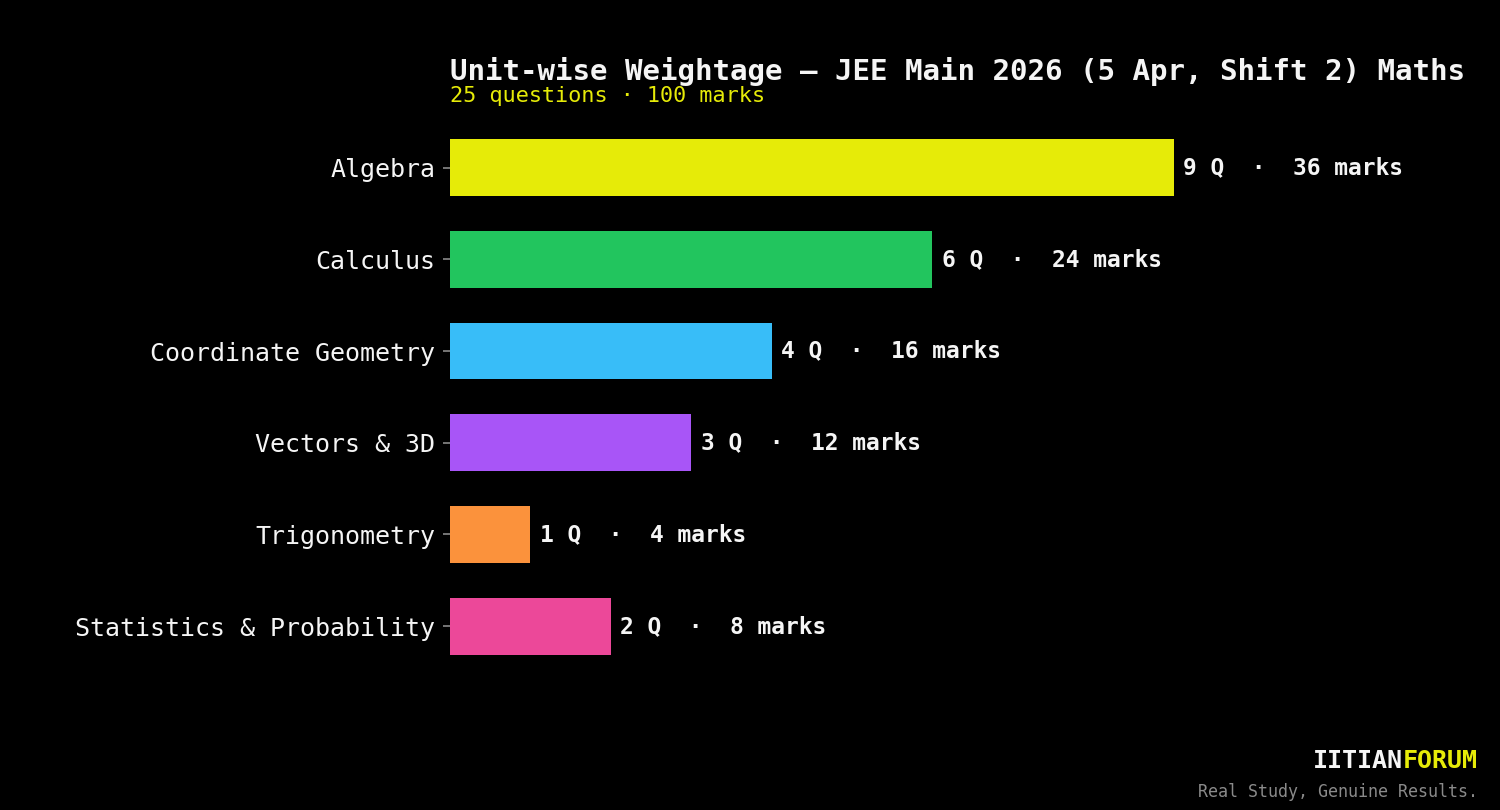
- Algebra — 9 questions · 36 marks. Three Sequences & Series, two Matrices, plus Complex Numbers, Binomial, Permutations & Combinations and Sets/Relations.
- Calculus — 6 questions · 24 marks. Two Differential Equations, Limits, Definite Integration, Application of Derivatives and Area.
- Coordinate Geometry — 4 questions · 16 marks. Circle, Parabola, Hyperbola (all medium) and a hard Straight Lines problem.
- Vectors & 3D — 3 questions · 12 marks.
- Trigonometry — 1 question · 4 marks.
- Statistics & Probability — 2 questions · 8 marks.
Algebra + Calculus = 60 of 100 marks — the usual backbone.
Chapter weightage
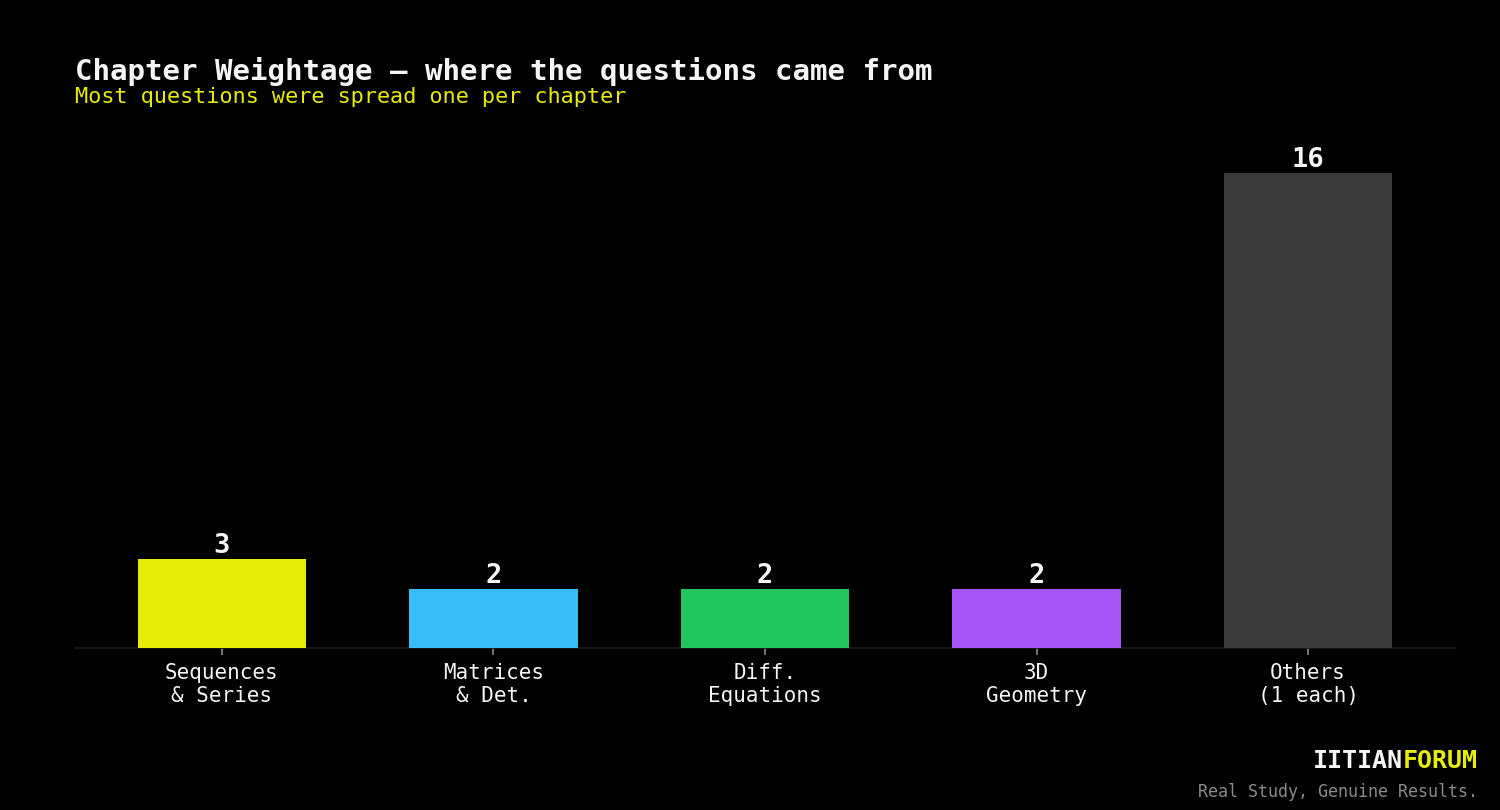
Sequences & Series led with three questions; Matrices & Determinants, Differential Equations and 3D Geometry gave two each; 16 other chapters gave one apiece.
| Chapter | Questions | Marks |
|---|---|---|
| Sequences & Series | 3 | 12 |
| Matrices & Determinants | 2 | 8 |
| Differential Equations | 2 | 8 |
| 3D Geometry | 2 | 8 |
| 16 other chapters | 1 each | 4 each |
Difficulty split
| Level | Questions | Share |
|---|---|---|
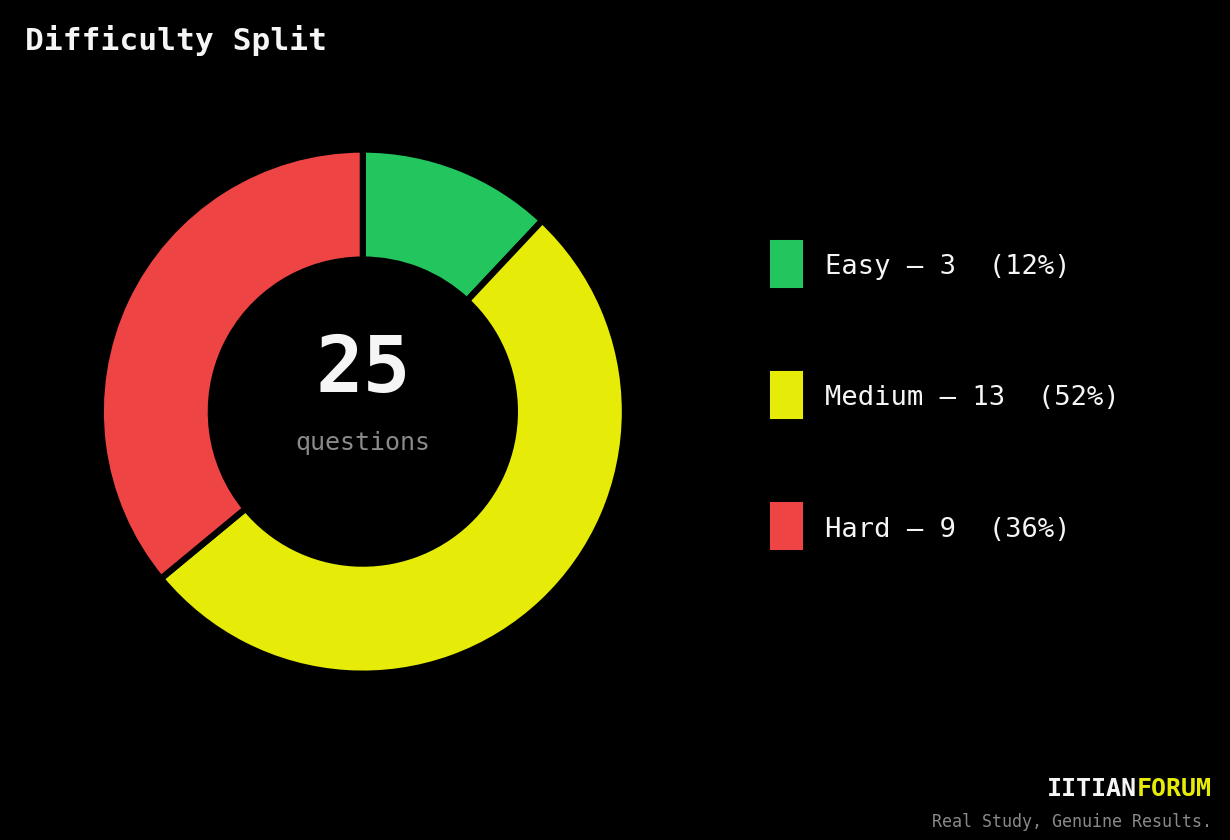
| Easy | 3 | 12% |
| Medium | 13 | 52% |
| Hard | 9 | 36% |
At 36% hard (DI 2.24) this was on the tougher side, but the three easy marks — more than most April shifts gave students a real foothold.
The four questions that decided the paper
Q1 — Four roots in G.P. across two quadratics (Hard).
▸ SHOW SOLUTION
Writing the roots as and using the two sums gives ; integrality forces , so and . Answer: (3).
Q10 — Median of a binomial-frequency distribution (Hard).
▸ SHOW SOLUTION
With , the mean is , so . The cumulative frequency places both middle observations in the block, so the median is 56. Answer: (1).
Q22 — Two rays reflected in a mirror (Hard).
▸ SHOW SOLUTION
The two 45° rays are and ; reflecting each in gives and , so . Answer: 7.
Q24 — Functional maximum feeding an area (Hard).
▸ SHOW SOLUTION
The functional equation gives with max , so . Matching the area gives , so . Answer: 16.
Q7 has a genuine key error. The coefficient of in is — option (2) — but the printed key marks (3) 3480. The booklet's own working also gives 3360. Separately, Q9 is ambiguous: it never states whether same-colour balls are distinct; the solution treats them as distinct (4100).
Expected good attempt & cutoff read
Directional only — actual percentiles depend on normalisation across shifts:
- Excellent (top percentile): 20+ correct with clean numericals.
- Strong: 16–19 correct.
- Safe: 13–16 correct bank the three easy and the medium block.
With nine hard questions but three genuinely easy ones, this shift rewarded students who triaged quickly and didn't over-invest in the back five.
What to take away for your prep
- Sequences & Series appeared three times. G.P. root problems and quartic telescoping sums both showed up this chapter repays deep practice.
- Always verify against your own working. Q7's printed key is wrong; a student confident in the binomial general term would have scored it correctly.
- Watch for ambiguous phrasing. Q9 doesn't specify distinct vs identical balls attempt cleanly on the standard convention and move on.
FAQ
How difficult was JEE Main 2026 Maths on 5 April Shift 2?
Moderate-to-tough nine of 25 questions hard (DI 2.24), though three genuinely easy marks softened it.
Which chapters had the highest weightage?
Sequences & Series (3 questions), followed by Matrices & Determinants, Differential Equations and 3D Geometry (2 each). Algebra was the biggest unit at 36 marks.
What were the toughest questions?
Q1 (four roots in G.P.), Q10 (binomial-frequency median), Q22 (reflected rays) and Q24 (functional maximum feeding an area).
Were there any errors in the answer key?
Yes Q7's printed key (3480) is incorrect; the correct coefficient is 3360, option (2). Q9 is also ambiguously worded.
Want the fully worked, step-by-step solution to all 25 questions of this shift? Practise these exact chapters on IITIANFORUM and download the complete verified solutions PDF below.
Enter your email to get the download.
Ritesh Raj
Founder and Lead Mentor at IITian Forum. M.Sc Mathematics, IIT Delhi. 500+ students mentored for JEE and Olympiad mathematics.