JEE Main 2026 (5 Apr, Shift 1) Maths Analysis Chapter Weightage, Difficulty & Expected Cutoff
The 5 April 2026 morning shift looks moderate on paper but that hides a sharp imbalance. Five of the six Calculus questions were hard, while almost everything else sat comfortably at medium. If your Calculus was strong, this was a very scorable shift; if not, it was punishing.
Here is the full breakdown: what was asked, where the marks sat, how hard it really was, and roughly what a good attempt looked like.
The paper at a glance
| Field | Detail |
|---|---|
| Exam | JEE Main 2026 · 5 Apr · Shift 1 (Morning) |
| Questions | 25 (Q1–Q20 single-correct MCQ, Q21–Q25 numerical) |
| Marks | 100 (+4 correct, –1 wrong on MCQs; no negative on numericals) |
| Overall difficulty | Moderate |
| Biggest units | Algebra (32 marks) · Calculus (24 marks) |
| Toughest questions | Q17, Q18, Q20, Q25 |
| Answer key | Independently verified — no errors found |
Overall verdict
The defining feature of this shift was the Calculus block: an improper logarithmic integral, a cosine-product limit, a clever antiderivative and a homogeneous differential equation were all genuinely hard. Outside Calculus, the paper was friendly Algebra, Coordinate Geometry, Trigonometry and Vectors were almost entirely medium, with two easy marks in Q8 (mean deviation) and Q13 (point-to-line distance). A student who banked the non-Calculus questions cleanly could post a strong score.
Sweep everything outside Calculus first that's roughly 18 gettable questions then spend what's left on the Calculus block. Q17, Q18, Q20 and Q25 were the biggest time sinks.
Unit-wise weightage
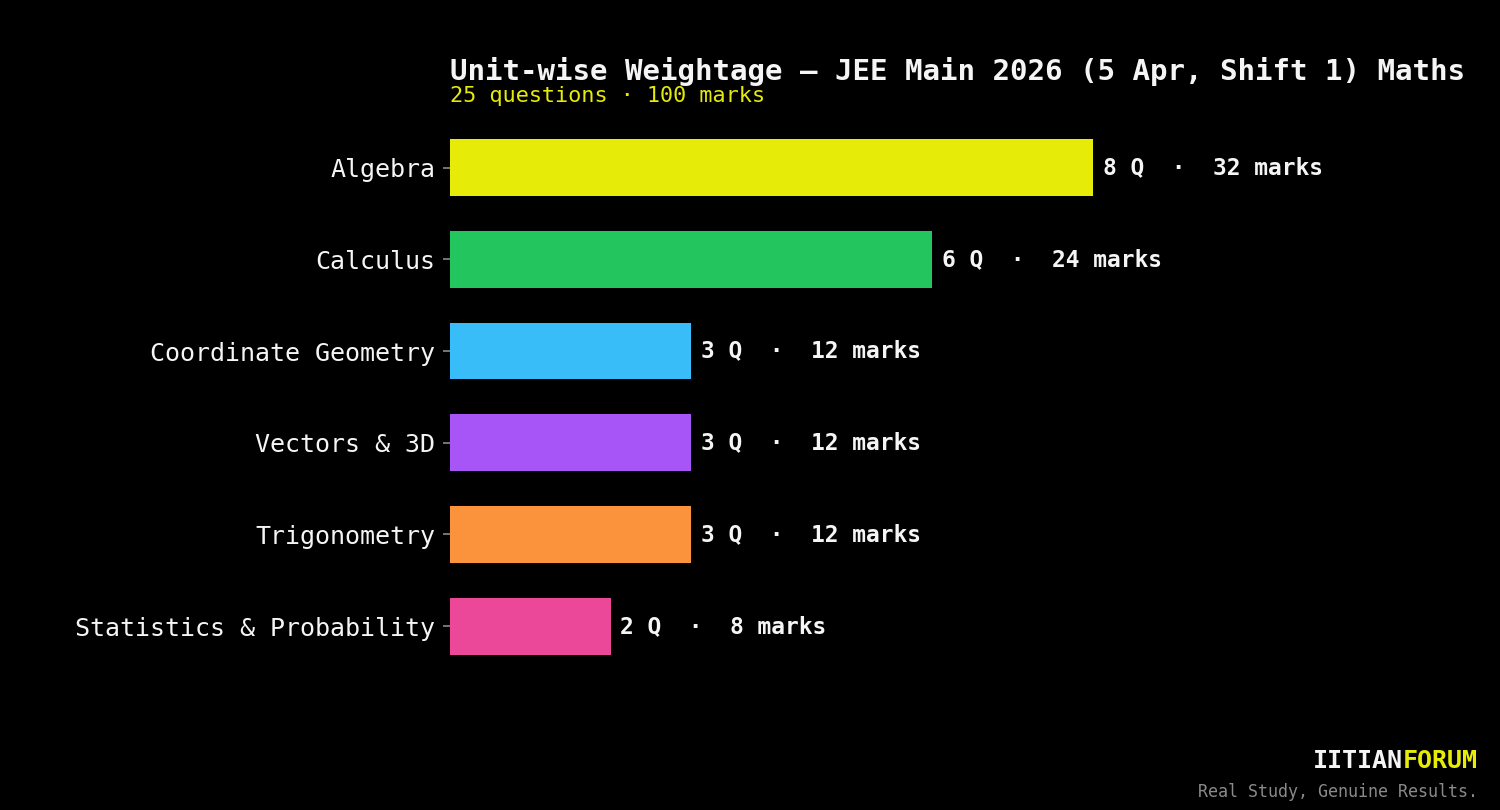
- Algebra — 8 questions · 32 marks. Two Matrices, two Sequences, two Permutations & Combinations, plus Complex Numbers and Binomial.
- Calculus — 6 questions · 24 marks. Two Definite Integration, Area, Limits, Application of Derivatives and a Differential Equation — five of six hard.
- Coordinate Geometry — 3 questions · 12 marks. Ellipse, Circle and Straight Lines (all medium).
- Vectors & 3D — 3 questions · 12 marks.
- Trigonometry — 3 questions · 12 marks.
- Statistics & Probability — 2 questions · 8 marks.
Algebra + Calculus = 56 of 100 marks but Algebra was where the reachable marks lived.
Chapter weightage
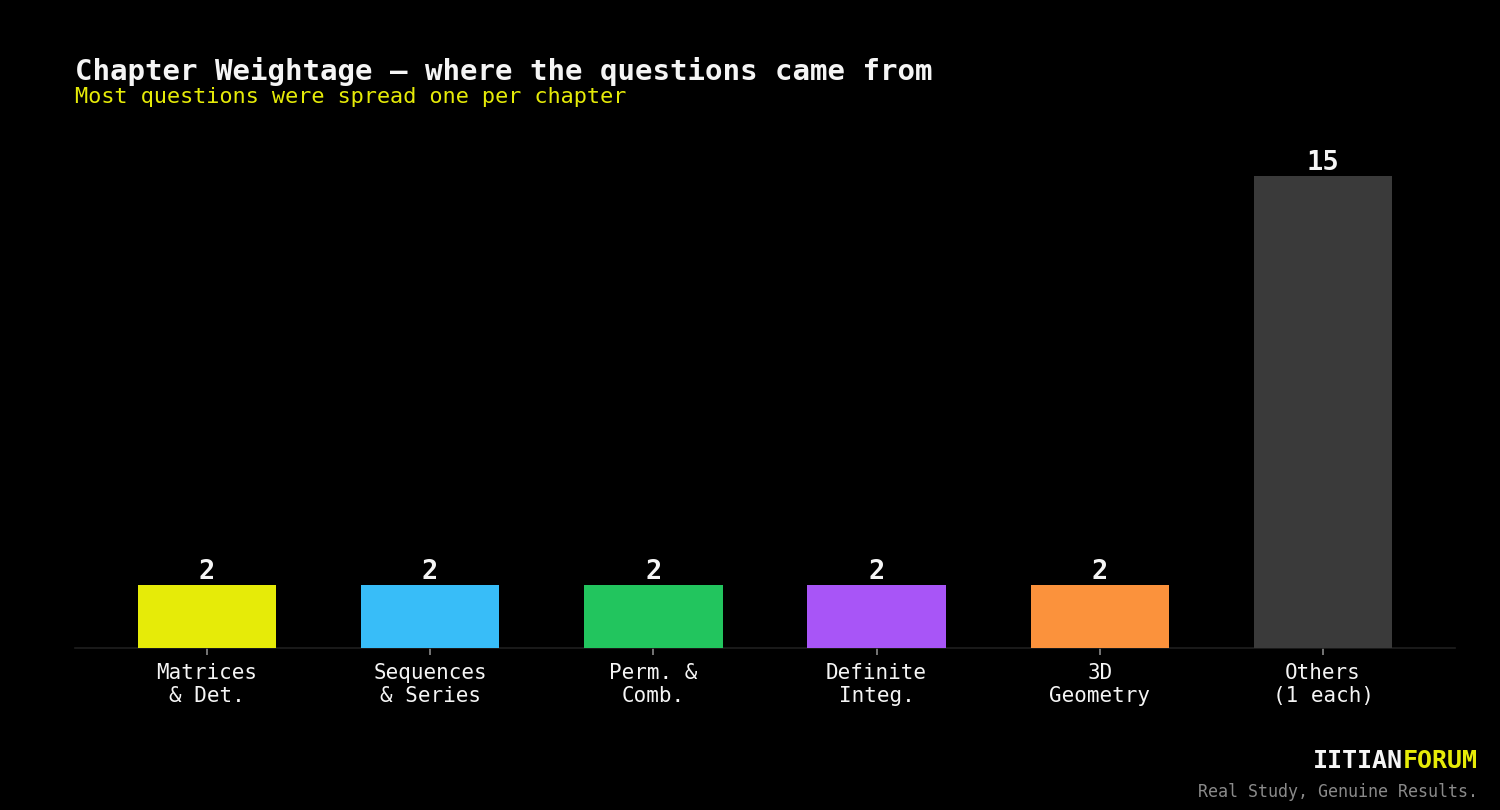
| Chapter | Questions | Marks |
|---|---|---|
| Matrices & Determinants | 2 | 8 |
| Sequences & Series | 2 | 8 |
| Permutations & Combinations | 2 | 8 |
| Definite Integration | 2 | 8 |
| 3D Geometry | 2 | 8 |
| 15 other chapters | 1 each | 4 each |
Difficulty split
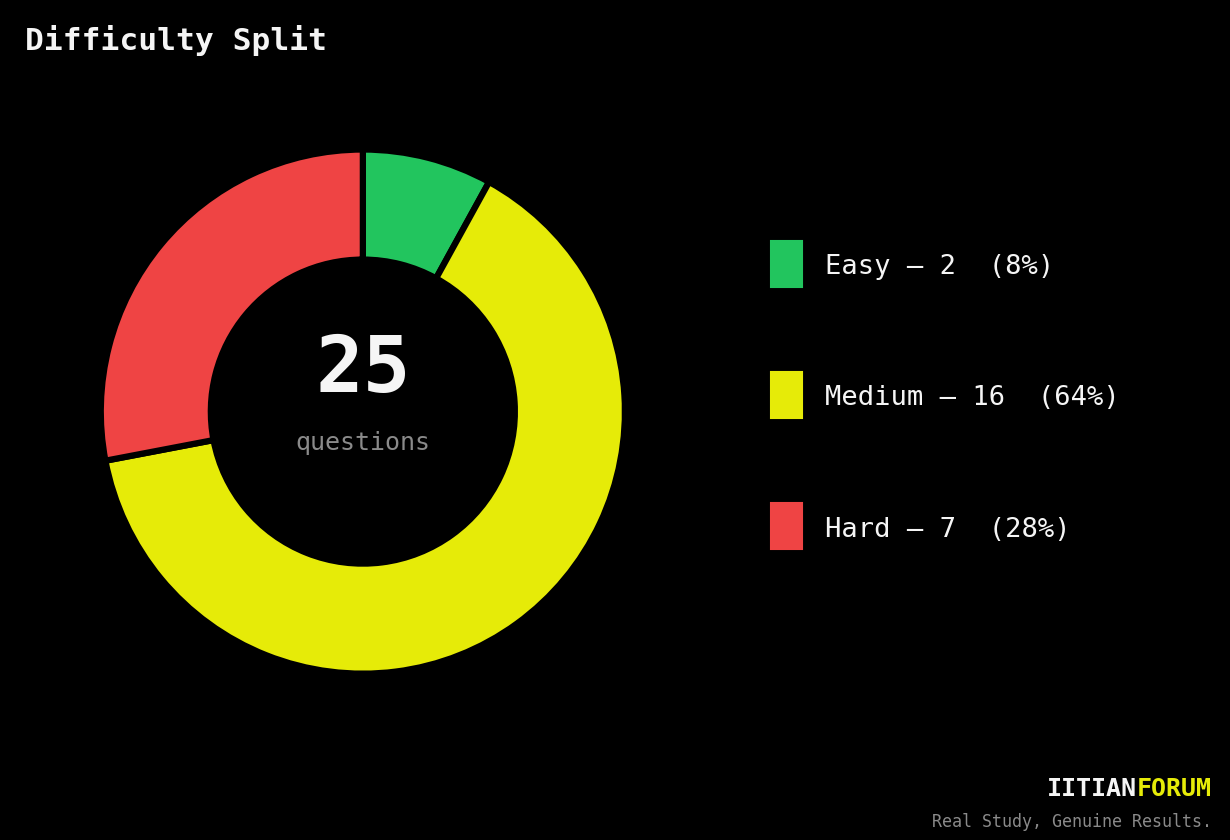
| Level | Questions | Share |
|---|---|---|
| Easy | 2 | 8% |
| Medium | 16 | 64% |
| Hard | 7 | 28% |
At 28% hard (DI 2.20) the headline number is moderate but with five of those seven hard questions inside a single unit, the experience depended almost entirely on your Calculus strength.
The four questions that decided the paper
Q17 — Limit of a cosine product (Hard).
▸ SHOW SOLUTION
Expanding each cosine to gives , i.e. . The product of the roots is . Answer: (3).
Q18 — Improper logarithmic integral (Hard).
▸ SHOW SOLUTION
Substituting splits the integral; the piece vanishes by , leaving . Answer: (2).
Q20 — Spotting the antiderivative (Hard).
▸ SHOW SOLUTION
differentiates exactly to the integrand, so the value is . Answer: (3).
Q25 — Homogeneous ODE feeding a circle (Hard).
▸ SHOW SOLUTION
Substituting gives , so . Then gives , i.e. 11 integer values. Answer: 11.
Every answer on this shift was independently re-derived and verified by IITIANFORUM no key errors. (Q8's booklet intermediate "84" should read 88; the printed final answer 44/13 is correct.)
Expected good attempt & cutoff read
Directional only actual percentiles depend on normalisation across shifts:
- Excellent (top percentile): 21+ correct with clean numericals.
- Strong: 17–20 correct.
- Safe: 14–17 correct — sweep the non-Calculus questions.
Because the hard questions clustered so tightly in Calculus, this shift produced unusually polarised scores.
What to take away for your prep
- Difficulty can concentrate in one unit. Five of six Calculus questions were hard here — depth in Integration and Limits is not optional.
- Algebra was the safety net. Matrices, Sequences and Permutations & Combinations each appeared twice, all gettable.
- Learn to spot antiderivatives. Q20 was instantly solvable if you recognised — pattern recognition saves minutes.
FAQ
How difficult was JEE Main 2026 Maths on 5 April Shift 1?
Moderate overall (DI 2.20) — but five of the six Calculus questions were hard, making it feel much tougher for Calculus-weak students.
Which chapters had the highest weightage?
Matrices & Determinants, Sequences & Series, Permutations & Combinations, Definite Integration and 3D Geometry two questions each. Algebra was the biggest unit at 32 marks.
What were the toughest questions?
Q17 (cosine-product limit), Q18 (improper logarithmic integral), Q20 (cot·sec⁴ antiderivative) and Q25 (homogeneous ODE feeding a circle).
Were there any errors in the answer key?
No — every answer was independently verified.
Want the fully worked, step-by-step solution to all 25 questions of this shift? Practise these exact chapters on IITIANFORUM and download the complete verified solutions PDF below.
Enter your email to get the download.
Ritesh Raj
Founder and Lead Mentor at IITian Forum. M.Sc Mathematics, IIT Delhi. 500+ students mentored for JEE and Olympiad mathematics.