JEE Main 2026 (6 Apr, Shift 1) Maths Analysis: Chapter Weightage, Difficulty & Expected Cutoff
The 6 April 2026 morning shift was a moderate Mathematics paper with an unusual shape. Instead of the usual Algebra-and-Calculus dominance, this paper spread its weight much more evenly Trigonometry and Coordinate Geometry both carried heavier loads than normal. Seven of the 25 questions were hard.
Here is the full breakdown: what was asked, where the marks sat, how hard it really was, and roughly what a good attempt looked like.
The paper at a glance
| Field | Detail |
|---|---|
| Exam | JEE Main 2026 · 6 Apr · Shift 1 (Morning) |
| Questions | 25 (Q1–Q20 single-correct MCQ, Q21–Q25 numerical) |
| Marks | 100 (+4 correct, –1 wrong on MCQs; no negative on numericals) |
| Overall difficulty | Moderate |
| Biggest units | Algebra (28 marks) · Calculus (20 marks) |
| Toughest questions | Q3, Q20, Q21, Q25 |
| Answer key | Independently verified — no errors found |
Overall verdict
This shift stood out for its balance. Algebra was still the largest single unit, but at 7 questions it was well short of its usual share and Trigonometry (4 questions) and Coordinate Geometry (4 questions) filled the gap. Two easy marks in Q5 (alternating cubes) and Q7 (letter arrangements) plus a big medium band kept a strong score reachable. The seven hard questions were spread across conics, calculus, matrices and trigonometry rather than clustered.
Bank the 2 easy plus 16 medium questions first that alone is a strong 72 of 100 then take on the 7 hard ones. Q3, Q20, Q21 and Q25 were the biggest time sinks.
Unit-wise weightage
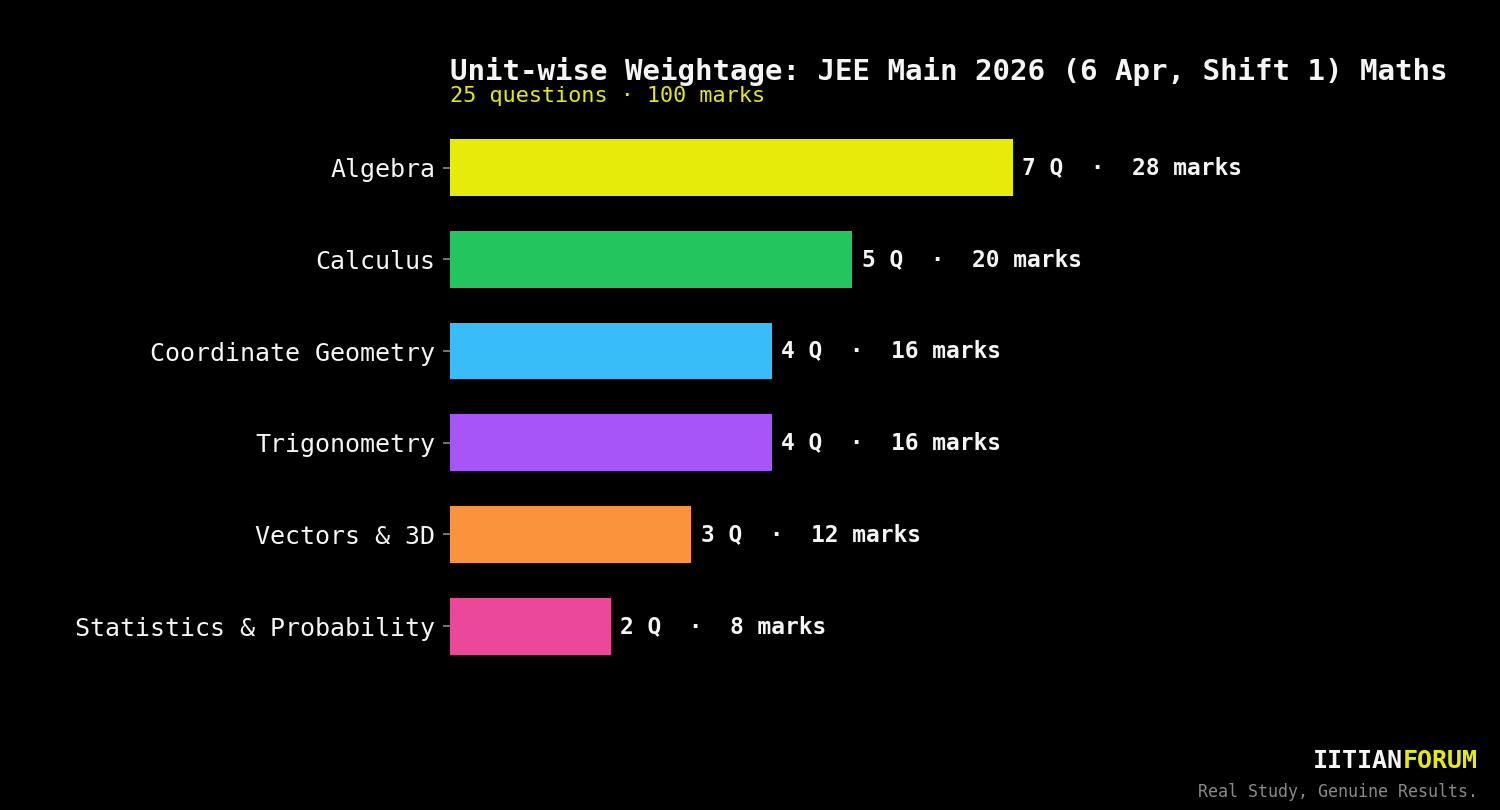
- Algebra — 7 questions · 28 marks. Quadratics, Complex Numbers, two Sequences, Permutations & Combinations, Binomial and Matrices.
- Calculus — 5 questions · 20 marks. Limits, Definite Integration, two Area problems and a Differential Equation.
- Coordinate Geometry — 4 questions · 16 marks. Two Hyperbola, Parabola and Circle.
- Trigonometry — 4 questions · 16 marks. Two inverse-trig and two identities.
- Vectors & 3D — 3 questions · 12 marks.
- Statistics & Probability — 2 questions · 8 marks.
Algebra + Calculus = only 48 of 100 marks here well below their usual 55 to 60 percent. This was a paper where broad preparation paid off.
Chapter weightage
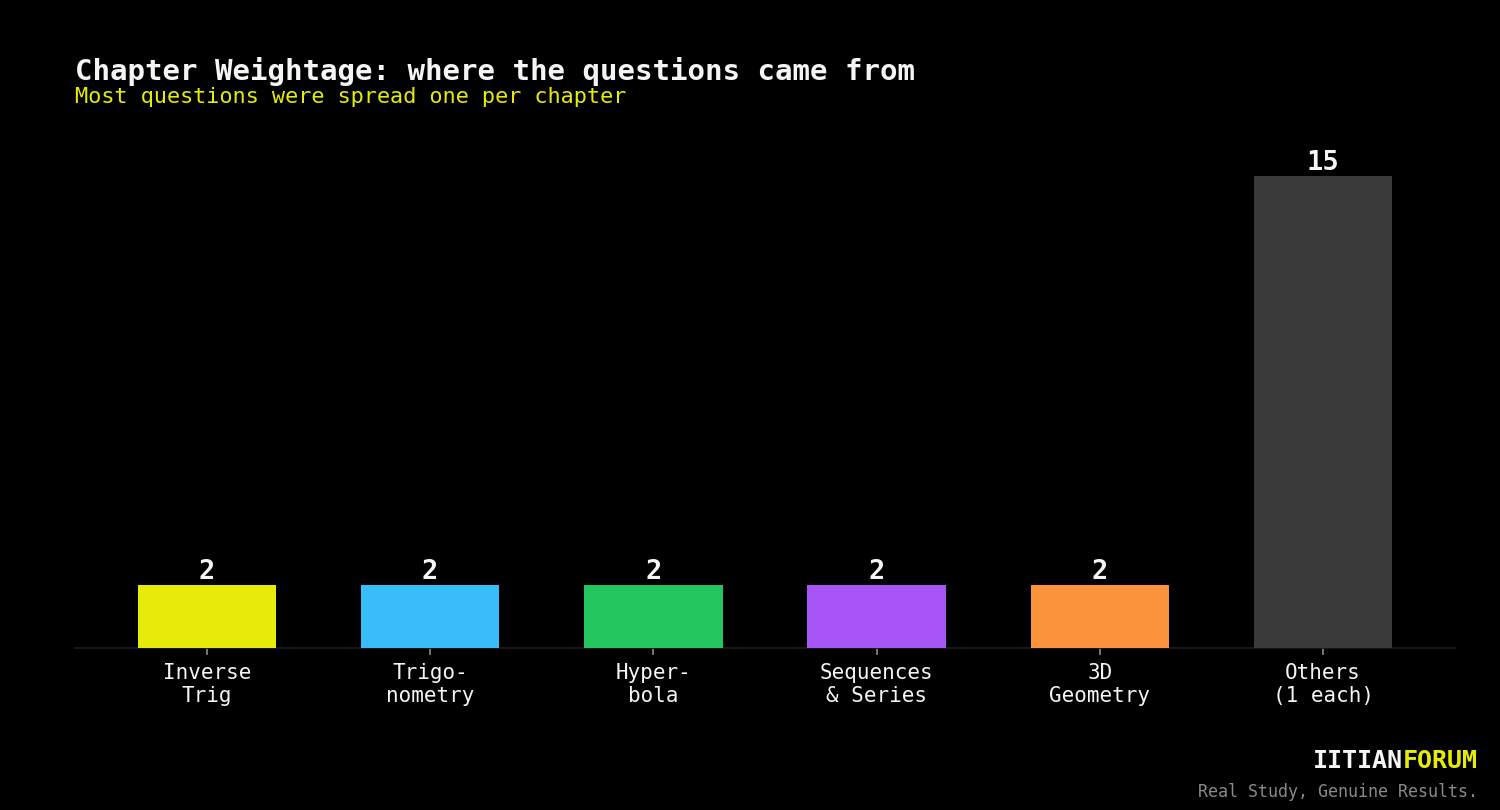
Six chapters gave two questions each — Inverse Trigonometry, Trigonometry, Hyperbola, Sequences & Series, 3D Geometry and Area under Curves — while 13 other chapters gave one apiece.
| Chapter | Questions | Marks |
|---|---|---|
| Inverse Trigonometry | 2 | 8 |
| Trigonometry | 2 | 8 |
| Hyperbola | 2 | 8 |
| Sequences & Series | 2 | 8 |
| 3D Geometry | 2 | 8 |
| Area under Curves | 2 | 8 |
| 13 other chapters | 1 each | 4 each |
Difficulty split
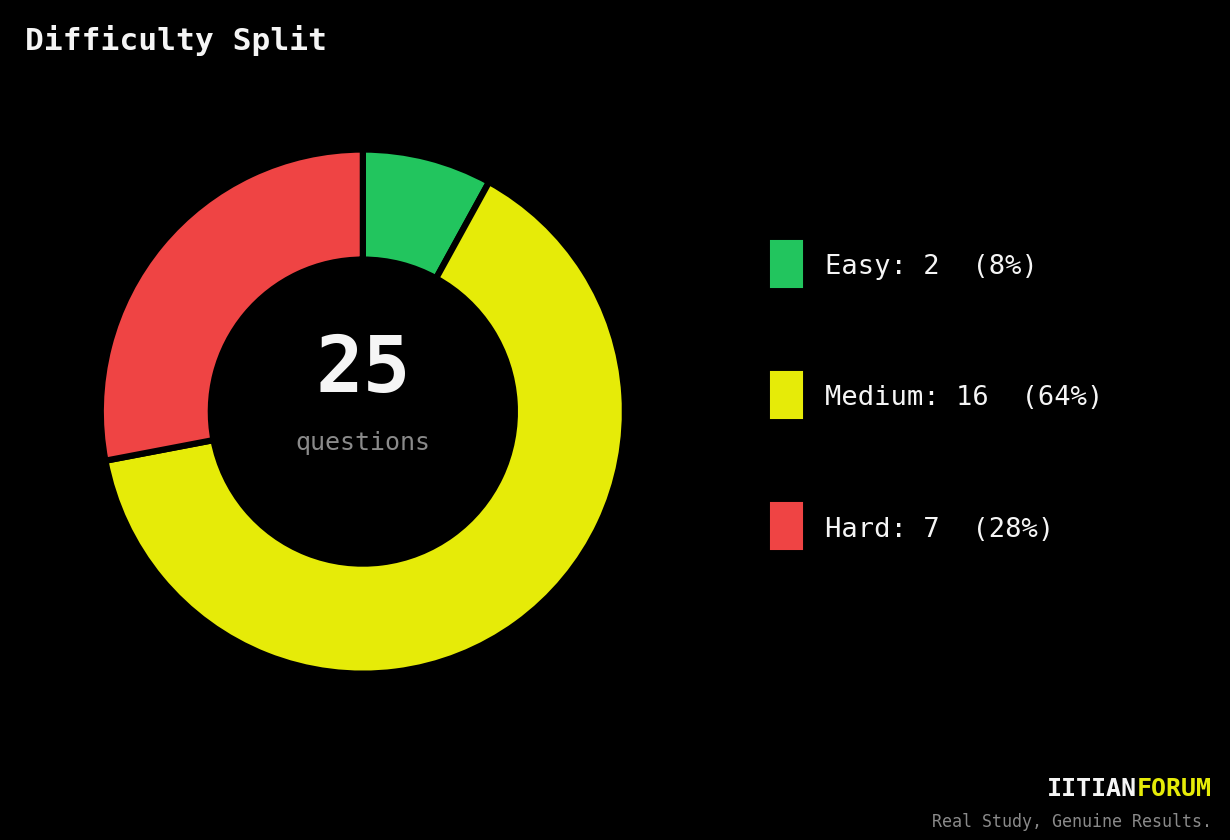
| Level | Questions | Share |
|---|---|---|
| Easy | 2 | 8% |
| Medium | 16 | 64% |
| Hard | 7 | 28% |
At 28% hard (DI 2.20) this was a genuinely moderate paper — with the difficulty spread thinly across many chapters rather than concentrated in one unit.
The four questions that decided the paper
Q3 — Conic eccentricities from a quadratic (Hard).
▸ SHOW SOLUTION
The roots of must both be valid eccentricities. Analysing the "both hyperbolas" and "ellipse and hyperbola" cases gives the intervals with endpoints , so . Answer: (3).
Q20 — Bijections feeding an area (Hard).
▸ SHOW SOLUTION
Two strictly monotonic bijections force ; the region between and on has area . Answer: (1).
Q21 — Nested adjugate identity (Hard).
▸ SHOW SOLUTION
Using and , the matrix equation reduces to , giving , so . Answer: 4.
Q25 — Linear ODE with a radical (Hard).
▸ SHOW SOLUTION
The equation rearranges to a linear ODE whose integrating factor is ; solving gives , so and the greatest integer below it is 3. Answer: 3.
Every answer on this shift was independently re-derived and verified by IITIANFORUM no key errors found.
Expected good attempt & cutoff read
Directional only — actual percentiles depend on normalisation across shifts:
- Excellent (top percentile): 21+ correct with clean numericals.
- Strong: 17–20 correct.
- Safe: 14–17 correct — banking every easy and medium question.
Because the difficulty was so evenly spread, this shift rewarded students with broad, balanced preparation rather than a single strong unit.
What to take away for your prep
- Do not neglect Trigonometry. It carried 4 questions here — matching Coordinate Geometry and beating Vectors and 3D.
- Conics reward practice. Hyperbola appeared twice, and the eccentricity problem was genuinely hard.
- Breadth beats narrow depth. With Algebra and Calculus at only 48 percent, weak spots anywhere cost marks.
FAQ
How difficult was JEE Main 2026 Maths on 6 April Shift 1?
Moderate (DI 2.20) — 16 medium questions and 7 hard, spread evenly across units.
Which chapters had the highest weightage?
Inverse Trigonometry, Trigonometry, Hyperbola, Sequences & Series, 3D Geometry and Area under Curves — two questions each.
What were the toughest questions?
Q3 (conic eccentricities), Q20 (bijections feeding an area), Q21 (nested adjugate identity) and Q25 (linear ODE with a radical).
Were there any errors in the answer key?
No — every answer was independently verified.
Want the fully worked, step-by-step solution to all 25 questions of this shift? Practise these exact chapters on IITIANFORUM and download the complete verified solutions PDF below.
Enter your email to get the download.
Ritesh Raj
Founder and Lead Mentor at IITian Forum. M.Sc Mathematics, IIT Delhi. 500+ students mentored for JEE and Olympiad mathematics.