JEE Main 2026 (4 Apr, Shift 2) Maths Analysis Chapter Weightage, Difficulty & Expected Cutoff
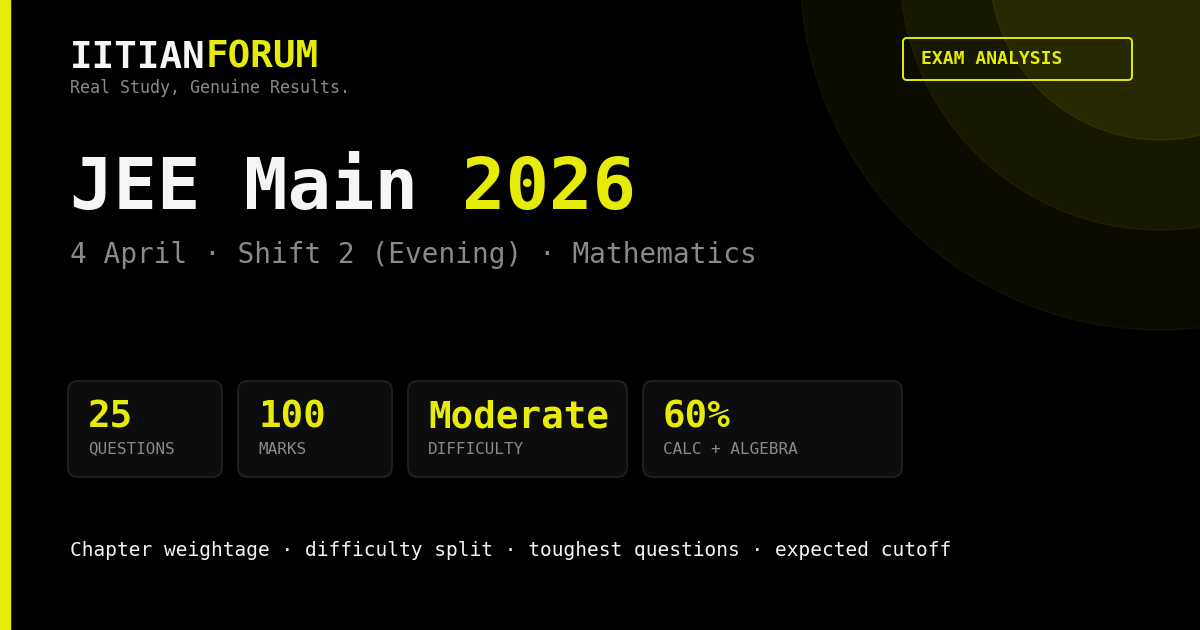
The 4 April 2026 evening shift was a moderate Mathematics paper with one striking feature: every Coordinate Geometry question was hard. Algebra led the weightage heavily, eight questions were hard overall, and the conics were where the paper bit hardest.
Here is the full breakdown: what was asked, where the marks sat, how hard it really was, and roughly what a good attempt looked like.
The paper at a glance
| Field | Detail |
|---|---|
| Exam | JEE Main 2026 · 4 Apr · Shift 2 (Evening) |
| Questions | 25 (Q1–Q20 single-correct MCQ, Q21–Q25 numerical) |
| Marks | 100 (+4 correct, –1 wrong on MCQs; no negative on numericals) |
| Overall difficulty | Moderate |
| Biggest units | Algebra (40 marks) · Calculus (20 marks) |
| Toughest questions | Q6, Q11, Q24, Q25 |
| Answer key | Independently verified — no errors found |
Overall verdict
A well-distributed paper with a clear pressure point: all four conic questions (Ellipse, Hyperbola, Straight Lines, Parabola) were hard. Algebra, at 40 marks, was both the biggest and the most gettable unit — mostly medium — so a student strong in Algebra and Vectors could build a solid score before wrestling with the coordinate-geometry problems. The two easy marks (Q8 standard deviation, Q18 area) were quick.
Bank the 2 easy + 15 medium questions first (that's a strong 68/100), then take on the hard conics and calculus. Q6, Q11, Q24 and Q25 were the biggest time sinks — save them for last.
Unit-wise weightage
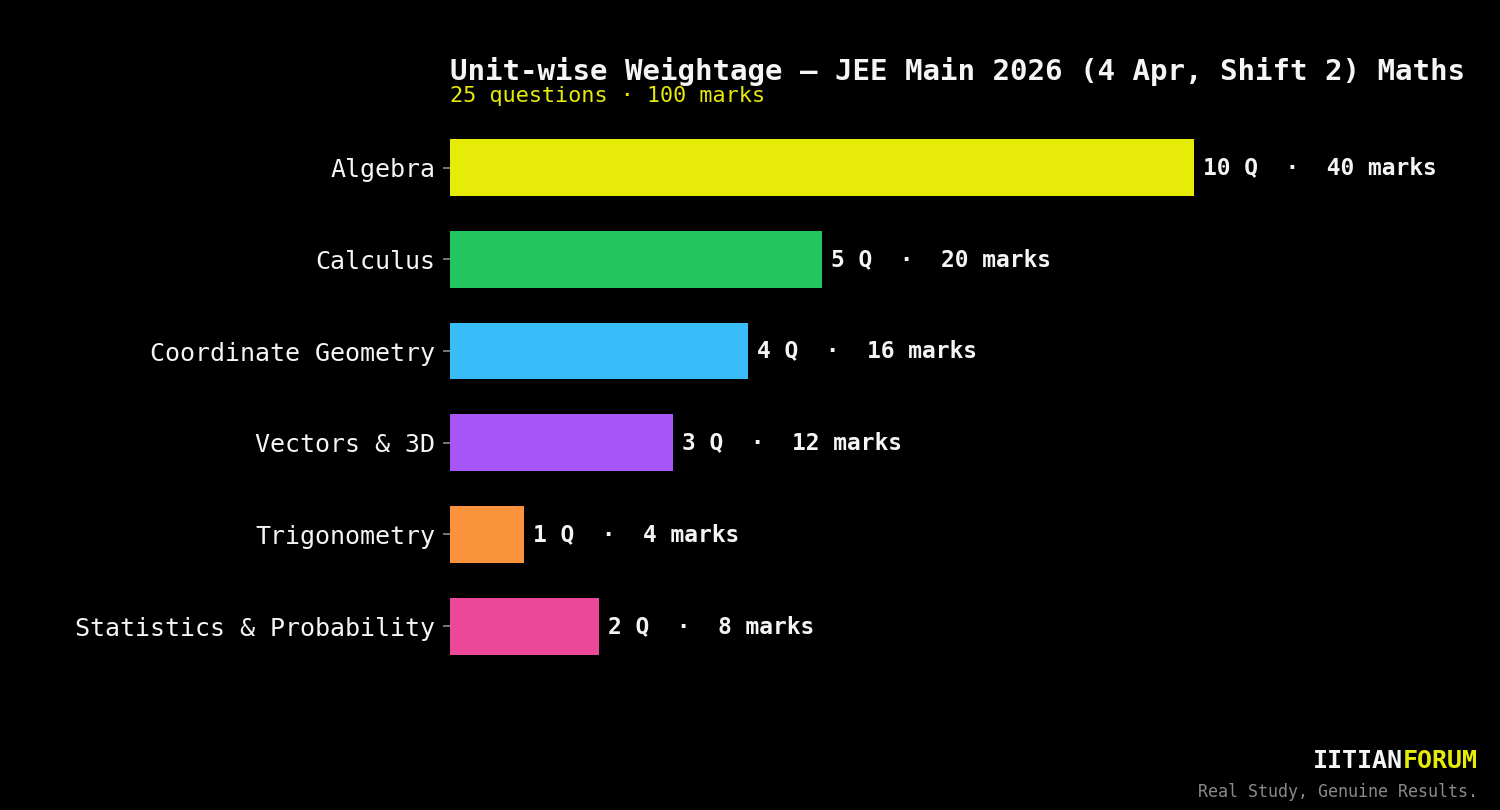
- Algebra — 10 questions · 40 marks. The dominant unit: two Complex Numbers, two Matrices, two Sets/Relations/Functions, plus Theory of Equations, Sequences, Binomial and Permutations & Combinations.
- Calculus — 5 questions · 20 marks. Area, Definite Integration, Continuity, a Differential Equation and Application of Derivatives.
- Coordinate Geometry — 4 questions · 16 marks. Ellipse, Hyperbola, Straight Lines and Parabola — all hard.
- Vectors & 3D — 3 questions · 12 marks (all medium).
- Trigonometry — 1 question · 4 marks.
- Statistics & Probability — 2 questions · 8 marks.
Algebra + Calculus = 60 of 100 marks but with Algebra carrying most of the reachable marks.
Chapter weightage
| Chapter | Questions | Marks |
|---|---|---|
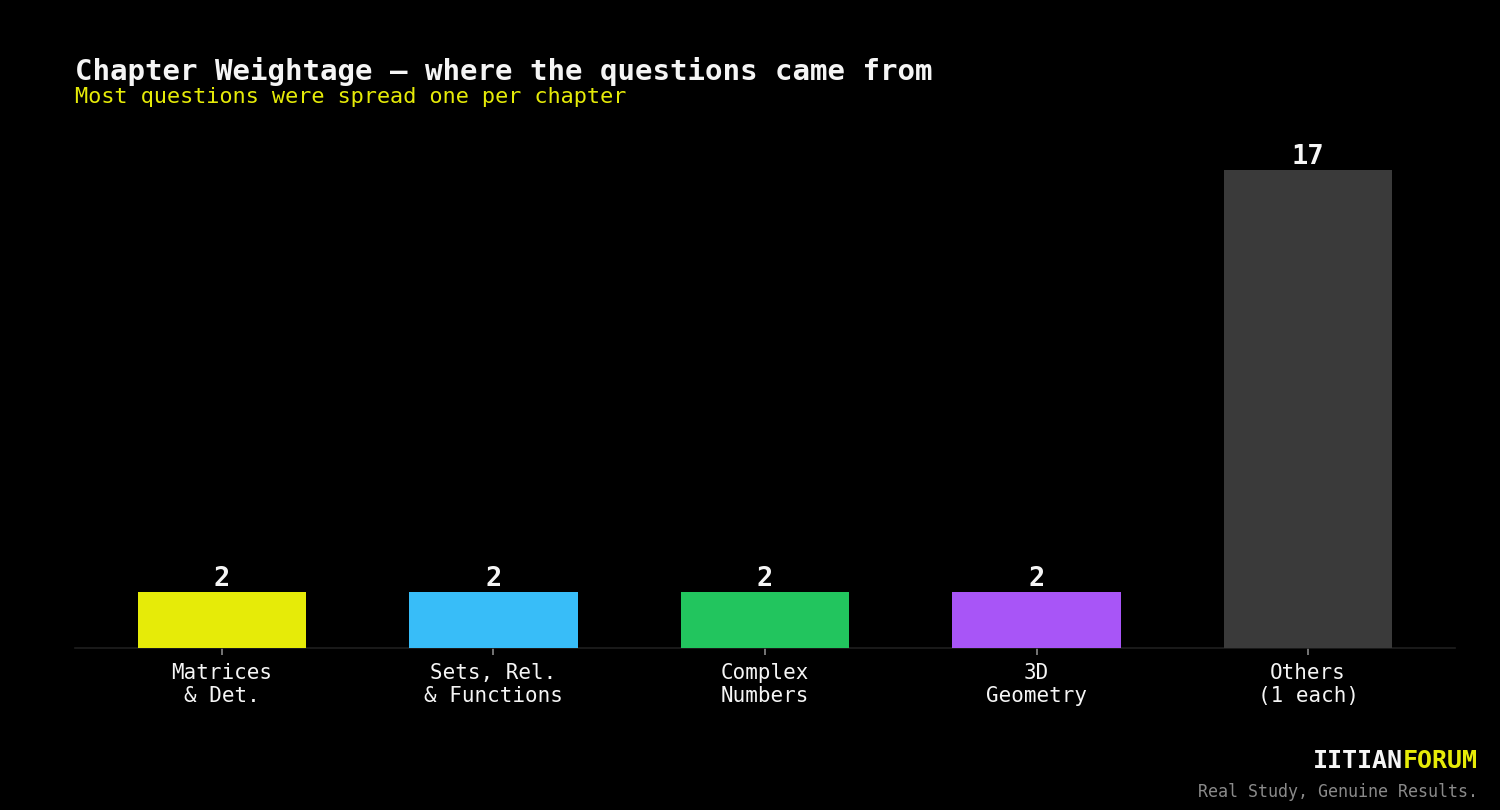
| Matrices & Determinants | 2 | 8 |
| Sets, Relations & Functions | 2 | 8 |
| Complex Numbers | 2 | 8 |
| 3D Geometry | 2 | 8 |
| 17 other chapters | 1 each | 4 each |
Difficulty split
| Level | Questions | Share |
|---|---|---|
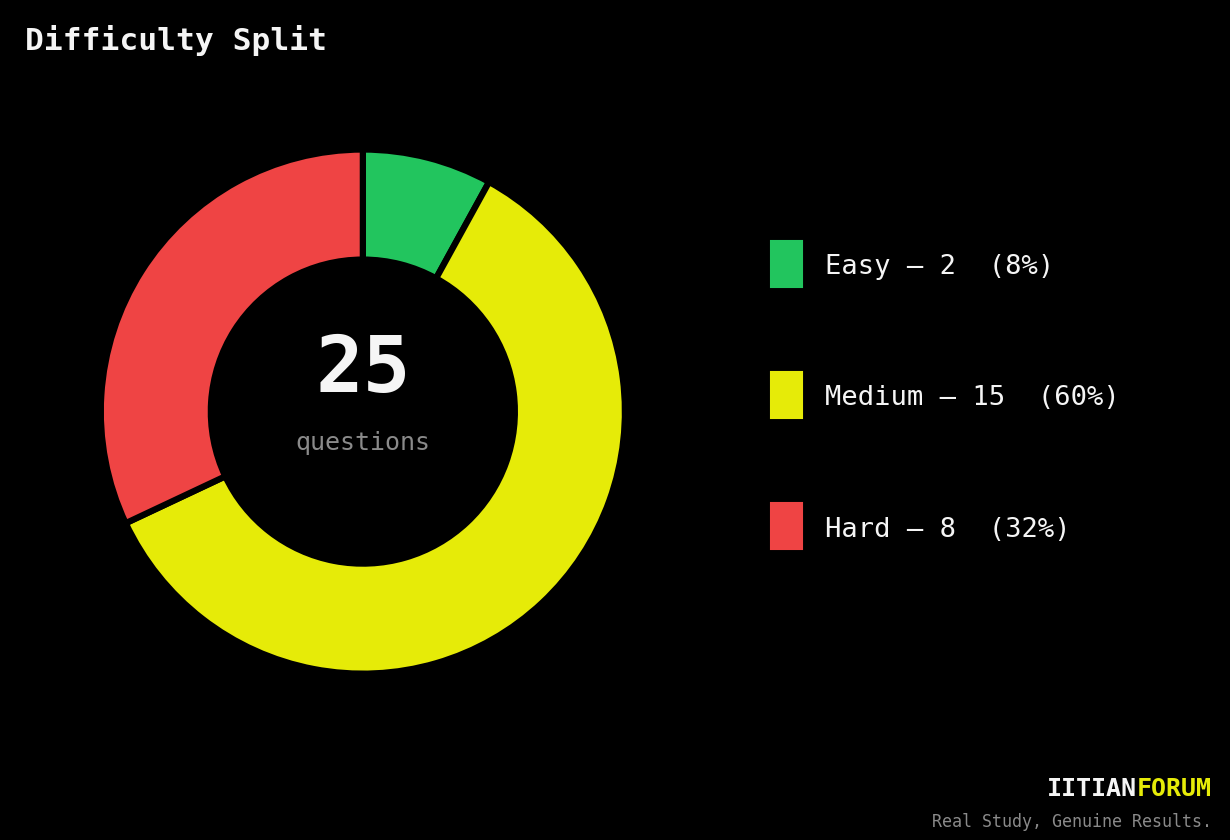
| Easy | 2 | 8% |
| Medium | 15 | 60% |
| Hard | 8 | 32% |
At 32% hard (DI 2.24), this sat in the tougher-moderate band. The distinctive feature wasn't the overall count but the concentration: the entire Coordinate Geometry unit was hard.
The four questions that decided the paper
Q6 — Eigenvalue feeding a circle (Hard).
▸ SHOW SOLUTION
The characteristic cubic gives the largest eigenvalue ; the circle meets the axes at three distinct points (the origin repeats). Answer: (3).
Q11 — Hyperbola triangle area (Hard).
▸ SHOW SOLUTION
Foci distance and directrix distance fix . The area condition gives . Answer: (2).
Q24 — Centroid locus of a right triangle in a parabola (Hard).
▸ SHOW SOLUTION
The right-angle condition at gives ; eliminating the parameters yields a parabola whose latus rectum is , so three times it is . Answer: 16.
Q25 — Integral-functional equation (Hard).
▸ SHOW SOLUTION
Differentiating gives , so . Then . Answer: 5.
Every answer on this shift was independently re-derived and verified by IITIANFORUM. In Q6 the booklet's printed "p = −8" is a typo — the correct largest eigenvalue is p = 8 (the very next step uses centre (8, 16)).
Expected good attempt & cutoff read
Directional only actual percentiles depend on normalisation across shifts:
- Excellent (top percentile): 21+ correct with clean numericals.
- Strong: 17–20 correct.
- Safe: 13–16 correct bank Algebra and Vectors, then pick off reachable conics.
With Coordinate Geometry entirely hard, a student weak in conics felt this paper far more than an Algebra-strong one.
What to take away for your prep
- A whole unit can go hard. Every conic question here was tough Coordinate Geometry needs deep practice, not just formula recall.
- Algebra was 40% of the paper. Complex Numbers, Matrices and Functions all recurred this is where the reachable marks lived.
- Vectors & 3D were reliable. All three questions were medium — a steady source of marks on a tough paper.
FAQ
How difficult was JEE Main 2026 Maths on 4 April Shift 2?
Moderate eight of 25 questions hard (DI 2.24), with all four Coordinate Geometry questions hard.
Which chapters had the highest weightage?
Matrices & Determinants, Sets/Relations/Functions, Complex Numbers and 3D Geometry — two questions each. Algebra was the biggest unit at 40 marks.
What were the toughest questions?
Q6 (eigenvalue feeding a circle), Q11 (hyperbola triangle area), Q24 (centroid locus of a right triangle in a parabola) and Q25 (integral-functional equation).
Were there any errors in the answer key?
No every answer was independently verified (the Q6 "p=−8" print is a typo; p=8).
Want the fully worked, step-by-step solution to all 25 questions of this shift? Practise these exact chapters on IITIANFORUM and download the complete verified solutions PDF below.
Enter your email to get the download.
Ritesh Raj
Founder and Lead Mentor at IITian Forum. M.Sc Mathematics, IIT Delhi. 500+ students mentored for JEE and Olympiad mathematics.