Continuity & DifferentiabilitymediumFree
Continuity & Differentiability: Satisfies Equation Maximum Value Minimum Value Match List
JEE Maths question with a full step-by-step solution.
satisfies the equation
. The maximum value of is and the
minimum value is . Match List-I with List-II.
List-I
I is a continuous function
II , is non-differentiable at only integral values of
III is discontinuous at
IV is discontinuous as well as an even function
List-II
P is non-differentiable at maximum two points
Q is non-differentiable at exactly three points
R may be discontinuous at infinitely many points
S is non-differentiable at five points
T is non-differentiable at points
AI (Q); II (R); III (S); IV (P)
BI (Q); II (P); III (S); IV (R)correct
CI (S); II (P); III (T); IV (P)
DI (S); II (P); III (T); IV (R)
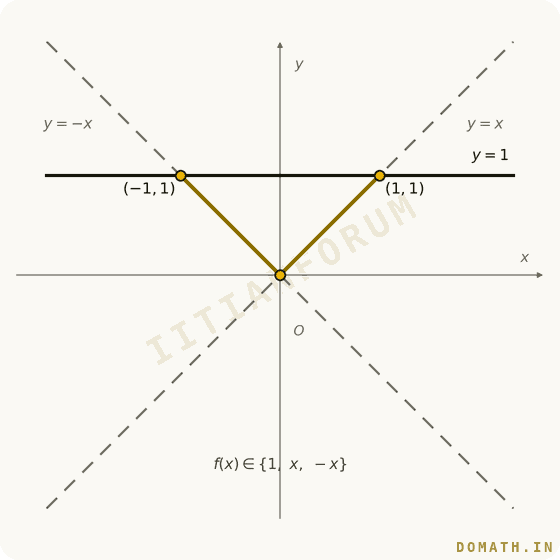 Step 1:
So for each , : the graph of lies inside the union of the
three lines , , .
Step 2: for every . For neither nor lies in
, so there; for the admissible values are and
. Also can only happen at , and the minimum is attained, so
Step 3 - (I): the branch and the branch meet only at , so a
continuous can switch between them only there. Starting from ,
This has corners at , , and is smooth elsewhere, exactly three points, so
(I) (Q). That eliminates options (3) and (4).
Step 4 - (IV): an even may switch branches at any symmetric set of points, for instance at
for every . So it may be discontinuous at infinitely many
points, and nothing bounds its non-differentiability by two. (IV) (R), not (P). That
eliminates option (1).
Step 5 - (III):
. For
the only admissible value is , and at the two admissible values and
are equal, with both branches tending to as , so is continuous at
these points. So a discontinuity is possible only for : five points of
discontinuity, hence at least five points of non-differentiability, which is what (S) records.
Answer: (2)
Continuity & Differentiability · medium
The number of points in the interval , at which the function , where denotes the greatest integer function, is discontinuous, is
Continuity & Differentiability · hard
The number of points, at which the function , , is not differentiable, is
Continuity & Differentiability · hard
Let and . If the number of points where is not continuous and is not differentiable are and respectively, then is equal to
Continuity & Differentiability · hard
Consider a function defined as (where represents the fractional part function)
Solve more, learn faster
Sign up free to solve more JEE Maths questions and explore doMath — timed drills, mastery sprints, bookmarks, and chapter-wise progress tracking.