Continuity & DifferentiabilityhardFree

Continuity & Differentiability: Consider Function Defined Cases 2mm 16x Cases Represents

JEE Maths question with a full step-by-step solution.

Question
Consider a function defined as
f(x)={sin(π2(x{x})),1x<1,{x}8(x2)2+2+24x216x+15,1x3,f\left(x\right) = \begin{cases} \sin\left(\dfrac{\pi}2\left(\left|x\right|-\left\{x\right\}\right)\right), & -1 \le x<1,\\[2mm] \left\{x\right\}\sqrt{8\left(x-2\right)^2+2+2\left|4x^2-16x+15\right|}, & 1 \le x \le 3, \end{cases}
(where {x}\left\{x\right\} represents the fractional part function)
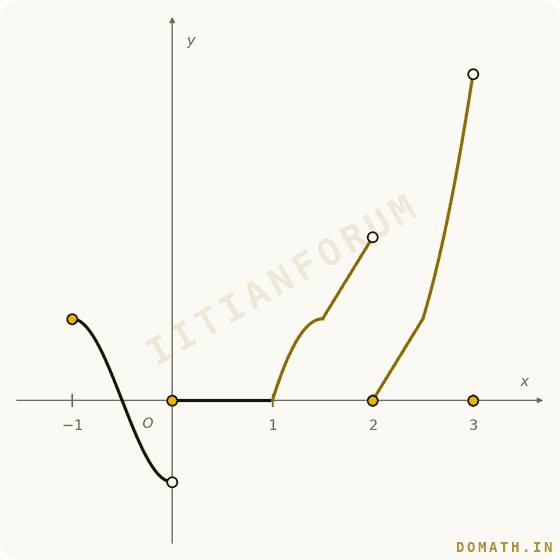
Anumber of points where f(x)f\left(x\right) is either discontinuous or non differentiable in (1,3)\left(-1,3\right) are 55correct
Brange of f(x)f\left(x\right) is (1,4)\left(-1,4\right)correct
C3/25/2f(x)dx=1\displaystyle\int_{3/2}^{5/2}f\left(x\right)dx = 1correct
Df(x)f\left(x\right) has no local extremum in (1,3)\left(-1,3\right)
Solution
Question attachment Step 1: For 1x<0-1 \le x<0: x=x\left|x\right| = -x and {x}=x(1)=x+1\left\{x\right\} = x-\left(-1\right) = x+1, so
x{x}=xx1=2x1  f(x)=sin(π2(2x1))\left|x\right|-\left\{x\right\} = -x-x-1 = -2x-1 \ \Longrightarrow\ f\left(x\right) = \sin\left(\frac{\pi}2\left(-2x-1\right)\right)
As xx runs from 1-1 to 00^- the argument runs from π2\tfrac{\pi}2 down to π2-\tfrac{\pi}2, so ff decreases from 11 to 1-1 (the value 1-1 is approached, not attained). For 0x<10 \le x<1: x=x\left|x\right| = x and {x}=x\left\{x\right\} = x, so
f(x)=sin0=0f\left(x\right) = \sin0 = 0
Step 2:
4x216x+15=(2x3)(2x5),8(x2)2+2=8x232x+344x^2-16x+15 = \left(2x-3\right)\left(2x-5\right),\qquad 8\left(x-2\right)^2+2 = 8x^2-32x+34
- If 4x216x+1504x^2-16x+15 \ge 0 (i.e. x32x \le \tfrac32 or x52x \ge \tfrac52), the radicand is
8x232x+34+2(4x216x+15)=16x264x+64=16(x2)28x^2-32x+34+2\left(4x^2-16x+15\right) = 16x^2-64x+64 = 16\left(x-2\right)^2
so the surd is 4x24\left|x-2\right|. - If 32<x<52\tfrac32<x<\tfrac52, the radicand is
8x232x+342(4x216x+15)=48x^2-32x+34-2\left(4x^2-16x+15\right) = 4
so the surd is 22. Step 3: Unfolding {x}\left\{x\right\} at x=2x = 2,
f(x)={4(x1)(2x),1x32,2(x1),32<x<2,2(x2),2x<52,4(x2)2,52x<3,0,x=3.f\left(x\right) = \begin{cases} 4\left(x-1\right)\left(2-x\right), & 1 \le x \le \tfrac32,\\ 2\left(x-1\right), & \tfrac32<x<2,\\ 2\left(x-2\right), & 2 \le x<\tfrac52,\\ 4\left(x-2\right)^2, & \tfrac52 \le x<3,\\ 0, & x = 3 . \end{cases}
Step 4 - option (1): on each open piece ff is a sine or a polynomial, hence differentiable there, so only the joins can fail. - x=0x = 0: left limit 1-1, value 00. Discontinuous. - x=1x = 1: value 00 from both sides, so continuous; left derivative 00, right derivative 4(32x)x=1=4\left.4\left(3-2x\right)\right|_{x=1} = 4. Non-differentiable. - x=32x = \tfrac32: value 11 from both sides; left derivative 4(32x)=04\left(3-2x\right) = 0, right derivative 22. Non-differentiable. x=2x = 2: left limit 22, value 00. Discontinuous. x=52x = \tfrac52: value 11 from both sides; left derivative 22, right derivative 8(x2)x=5/2=4\left.8\left(x-2\right)\right|_{x=5/2} = 4. Non-differentiable. That is exactly 55 points. (1) is correct. Step 5 - option (3): - On [1,0)\left[-1,0\right): ff decreases from 11 to 1-1, giving (1,1]\left(-1,1\right]. - On [0,1]\left[0,1\right]: f=0f = 0. - On [1,32]\left[1,\tfrac32\right]: 4(x1)(2x)4\left(x-1\right)\left(2-x\right) rises from 00 to 11. On (32,2)\left(\tfrac32,2\right): 2(x1)2\left(x-1\right) covers (1,2)\left(1,2\right). On [2,52)\left[2,\tfrac52\right): 2(x2)2\left(x-2\right) covers [0,1)\left[0,1\right). On [52,3)\left[\tfrac52,3\right): 4(x2)24\left(x-2\right)^2 covers [1,4)\left[1,4\right). The union is (1,1][1,4)=(1,4)\left(-1,1\right] \cup \left[1,4\right) = \left(-1,4\right): 1-1 is approached at x0x \to 0^- but never attained, and 44 is approached at x3x \to 3^- but f(3)=0f\left(3\right) = 0. (2) is correct. Step 6 - option (3):
3/222(x1)dx=[(x1)2]3/22=114=34\int_{3/2}^{2}2\left(x-1\right)dx = \left[\left(x-1\right)^2\right]_{3/2}^{2} = 1-\frac14 = \frac34
25/22(x2)dx=[(x2)2]25/2=140=14\int_{2}^{5/2}2\left(x-2\right)dx = \left[\left(x-2\right)^2\right]_{2}^{5/2} = \frac14-0 = \frac14
Total =34+14=1= \tfrac34+\tfrac14 = 1. (3) is correct. Step 7 - option (4): f(2)=0f\left(2\right) = 0 while ff is close to 22 just to the left and close to 0+0^+ just to the right, so f(2)f\left(2\right) is smaller than every nearby value, a local minimum. (Every point of the flat stretch [0,1]\left[0,1\right] is a weak local extremum as well.) (4) is not correct. Answer: (1),(2),(3)\left(1\right),\left(2\right),\left(3\right)
Still stuck on this question?Ask your doubt on WhatsApp
Similar questions

Solve more, learn faster

Sign up free to solve more JEE Maths questions and explore doMath — timed drills, mastery sprints, bookmarks, and chapter-wise progress tracking.