Continuity & DifferentiabilitymediumFree

Continuity & Differentiability: Let Real Valued Function Defined Cases 1mm Cases

JEE Maths question with a full step-by-step solution.

Question
Let f(x)f\left(x\right) be a real valued function defined by f(x)=x22xf\left(x\right) = x^2-2\left|x\right| and
g(x)={min{f(t):2tx},x[2,0),max{f(t):0tx},x[0,3].g\left(x\right) = \begin{cases} \min\left\{f\left(t\right) : -2 \le t \le x\right\}, & x \in \left[-2,0\right),\\[1mm] \max\left\{f\left(t\right) : 0 \le t \le x\right\}, & x \in \left[0,3\right]. \end{cases}
List-I
Ig(x)g\left(x\right) is not continuous at xx equal to
IIg(x)g\left(x\right) is not differentiable at xx equal to
IIINumber of points of local extremum of g(x)g\left(x\right) is equal to
IVAbsolute maximum value of g(x)g\left(x\right) is equal to
List-II
P2-2
Q 00
R 11
S22
T33
AI \to (P); II \to (Q, R); III \to (P); IV \to (T)
BI \to (T); II \to (P, T); III \to (P); IV \to (T)
CI \to (Q); II \to (Q, T); III \to (Q); IV \to (T)
DI \to (Q); II \to (Q, S); III \to (Q); IV \to (T)correct
Solution
Question attachment Step 1:
f(x)={x2+2x=(x+1)21,x<0,x22x=(x1)21,x0.f\left(x\right) = \begin{cases}x^2+2x = \left(x+1\right)^2-1, & x<0,\\ x^2-2x = \left(x-1\right)^2-1, & x \ge 0.\end{cases}
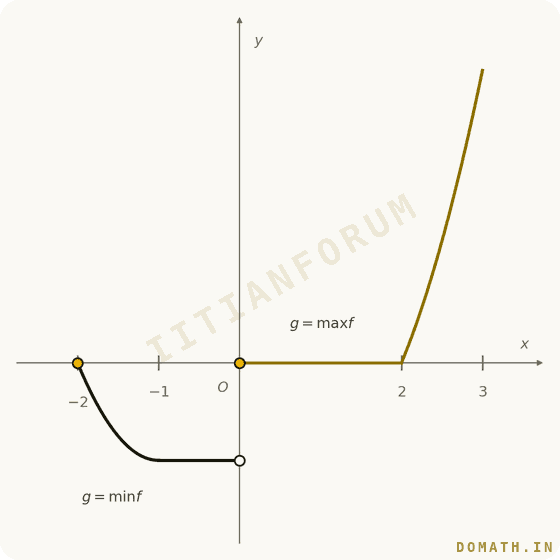
ff is continuous everywhere, with minima 1-1 at x=1x = -1 and at x=1x = 1, and f(2)=f(0)=f(2)=0f\left(-2\right) = f\left(0\right) = f\left(2\right) = 0, f(3)=3f\left(3\right) = 3. Step 2: On [2,1]\left[-2,-1\right], f(x)=2x+2<0f'\left(x\right) = 2x+2<0, so the running minimum is ff itself; after x=1x = -1 it stays at f(1)=1f\left(-1\right) = -1:
g(x)=x2+2x  (2x1),g(x)=1  (1<x<0)g\left(x\right) = x^2+2x \ \ \left(-2 \le x \le -1\right),\qquad g\left(x\right) = -1 \ \ \left(-1<x<0\right)
Step 3: On [0,2]\left[0,2\right], f(t)0f\left(t\right) \le 0 with f(0)=0f\left(0\right) = 0, so the running maximum is 00; for x>2x>2, f(x)=2x2>0f'\left(x\right) = 2x-2>0 and f(x)>0f\left(x\right)>0, so ff is itself the maximum:
g(x)=0  (0x<2),g(x)=x22x  (2x3)g\left(x\right) = 0 \ \ \left(0 \le x<2\right),\qquad g\left(x\right) = x^2-2x \ \ \left(2 \le x \le 3\right)
Step 4 - (I): at x=0x = 0, limx0g=1\lim_{x\to0^-}g = -1 but g(0)=0g\left(0\right) = 0; at x=1x = -1 both pieces give 1-1, and at x=2x = 2 both give 00. So the only discontinuity is
x=0(Q)x = 0 \quad\to\quad \text{(Q)}
Step 5 - (II): - x=0x = 0: discontinuous, so certainly not differentiable. - x=2x = 2: left derivative 00, right derivative 2x2x=2=2\left.2x-2\right|_{x=2} = 2. Corner. - x=1x = -1: left derivative 2x+2x=1=0\left.2x+2\right|_{x=-1} = 0, right derivative 00, so differentiable. So the points are x=0x = 0 and x=2x = 2:
(Q), (S)\to\quad \text{(Q), (S)}
Step 6 - (III): gg is constant 1-1 on (1,0)\left(-1,0\right) and constant 00 on (0,2)\left(0,2\right), so no point of either stretch is a **strict** local maximum or minimum; on [2,1]\left[-2,-1\right] gg is strictly decreasing and on [2,3]\left[2,3\right] strictly increasing, so no turning point occurs there either; x=0x = 0 is a jump, not an extremum, since g(0)=0g\left(0\right) = 0 equals the values just to its right; and the two endpoints x=2x = -2, x=3x = 3 are not counted. Hence the number of points of local extremum is
0(Q)0 \quad\to\quad \text{(Q)}
Step 7 - (IV): 1g0-1 \le g \le 0 on [2,0)\left[-2,0\right), g=0g = 0 on [0,2)\left[0,2\right) and gg is increasing on [2,3]\left[2,3\right], so the largest value is at the right end:
g(3)=96=3(T)g\left(3\right) = 9-6 = 3 \quad\to\quad \text{(T)}
Step 8: (I) \to (Q), (II) \to (Q, S), (III) \to (Q), (IV) \to (T), which is option (4). Answer: (4)\left(4\right)
Still stuck on this question?Ask your doubt on WhatsApp
Similar questions
Continuity & Differentiability · medium
The number of points in the interval [2,4][2,4], at which the function f(x)=[x2x12]f(x)=\left[x^2-x-\dfrac12\right], where [][\cdot] denotes the greatest integer function, is discontinuous, is
Continuity & Differentiability · hard
The number of points, at which the function f(x)=max{6x, 2+3x2}+x1cosx214f(x)=\max\{6x,\ 2+3x^2\}+|x-1|\cos\left|x^2-\dfrac14\right|, x(π,π)x\in(-\pi,\pi), is not differentiable, is
Continuity & Differentiability · hard
Let f(x)={ex1,x<0x25x+6,x0f(x)=\begin{cases}e^{x-1}, & x<0\\ x^2-5x+6, & x\ge0\end{cases} and g(x)=f(x)+f(x)g(x)=f(|x|)+|f(x)|. If the number of points where gg is not continuous and is not differentiable are α\alpha and β\beta respectively, then α+β\alpha+\beta is equal to
Continuity & Differentiability · hard
Consider a function defined as f(x)={sin(π2(x{x})),1x<1,{x}8(x2)2+2+24x216x+15,1x3,f\left(x\right) = \begin{cases} \sin\left(\dfrac{\pi}2\left(\left|x\right|-\left\{x\right\}\right)\right), & -1 \le x<1,\\[2mm] \left\{x\right\}\sqrt{8\left(x-2\right)^2+2+2\left|4x^2-16x+15\right|}, & 1 \le x \le 3, \end{cases} (where {x}\left\{x\right\} represents the fractional part function)

Solve more, learn faster

Sign up free to solve more JEE Maths questions and explore doMath — timed drills, mastery sprints, bookmarks, and chapter-wise progress tracking.