Complex NumbersmediumFree
Vertices of a Regular Hexagon Circumscribing |z - 1 - i| = root3 | JEE
JEE Maths question with a full step-by-step solution.
If one of the vertices of the regular hexagon circumscribing the circle is
, then the complex number which is NOT representing any vertex of the hexagon is
A
B
Ccorrect
D
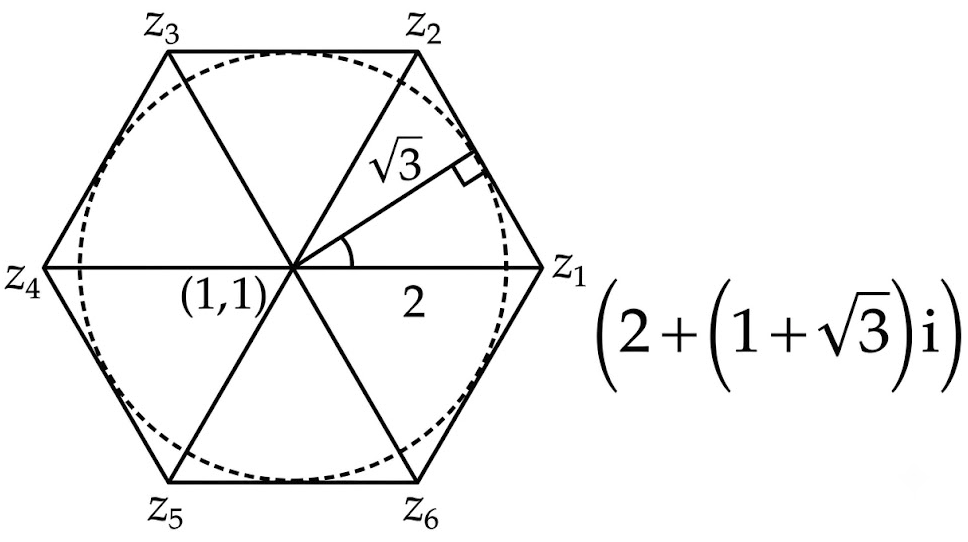 Step 1: Read off the circle. has centre and radius .
Because the hexagon circumscribes this circle, the circle is the hexagon's incircle.
Step 2: Find the distance from the centre to a vertex (the circumradius). Check it directly on the
given vertex :
Step 1: Read off the circle. has centre and radius .
Because the hexagon circumscribes this circle, the circle is the hexagon's incircle.
Step 2: Find the distance from the centre to a vertex (the circumradius). Check it directly on the
given vertex :
Step 3: Use rotation to get the other vertices. Consecutive vertices of a regular hexagon subtend
at the centre, so
Step 4: Apply it once. With ,
so . That is option (B).
Step 5: Keep rotating. Each further multiplication by gives
Step 6: Add back to list all six vertices.
Step 7: Compare with the options. is , is , and
is . The only one missing from the list is .
Answer: (3).
Complex Numbers · medium
Let be the distinct solutions of . Then is equal to:
Complex Numbers · medium
Let and be real numbers such that , . Then the value of is
Complex Numbers · medium
The number of values of satisfying and simultaneously is
Complex Numbers · hard
Let ; . Match each entry in List-I with the correct entry in List-II.
Solve more, learn faster
Sign up free to solve more JEE Maths questions and explore doMath — timed drills, mastery sprints, bookmarks, and chapter-wise progress tracking.