Application of DerivativesmediumFree

Solve the Integral Equation f(x) = 3x^2 + integral of e^-t f(x-t) dt | JEE

JEE Maths question with a full step-by-step solution.

Question
If
f(x)=3x2+0xetf(xt)dt,f(x) = 3x^{2} + \int_{0}^{x} e^{-t} f(x-t)\,dt ,
then
Af(x)=0f(x) = 0 has 33 solutions
Bf(x)f(x) is monotonic increasing
Cf(x)=4f(x) = 4 has 22 solutionscorrect
D11f(x)dx=2\displaystyle\int_{-1}^{1} f(x)\,dx = 2correct
Solution
Step 1: Tidy the integral by substitution. Put u=xtu = x-t, so t=xut = x-u and dt=dudt = -du; the limits t=0,xt = 0, x become u=x,0u = x, 0:
0xetf(xt)dt=0xe(xu)f(u)du=ex0xeuf(u)du.\int_{0}^{x} e^{-t}f(x-t)\,dt = \int_{0}^{x} e^{-(x-u)}f(u)\,du = e^{-x}\int_{0}^{x}e^{u}f(u)\,du .
Step 2: Rewrite the given equation.
f(x)=3x2+ex0xetf(t)dt....(i)f(x) = 3x^{2} + e^{-x}\int_{0}^{x}e^{t}f(t)\,dt . \qquad \text{...(i)}
Step 3: Differentiate, using the product rule on the second term and the fundamental theorem of calculus on the integral.
f(x)=6xex0xetf(t)dt+exexf(x).f'(x) = 6x - e^{-x}\int_{0}^{x}e^{t}f(t)\,dt + e^{-x}\cdot e^{x}f(x) .
Step 4: Replace the integral term using (i), which says ex0xetf(t)dt=f(x)3x2e^{-x}\int_{0}^{x}e^{t}f(t)\,dt = f(x) - 3x^{2}.
f(x)=6x[f(x)3x2]+f(x)=3x2+6x.f'(x) = 6x - \left[f(x) - 3x^{2}\right] + f(x) = 3x^{2} + 6x .
Step 5: Integrate.
f(x)=x3+3x2+C.f(x) = x^{3} + 3x^{2} + C .
Step 6: Fix the constant. Putting x=0x = 0 in (i) makes the integral vanish, so f(0)=0f(0) = 0, giving C=0C = 0:
f(x)=x3+3x2.f(x) = x^{3} + 3x^{2} .
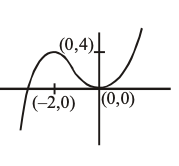
Question attachment Step 7: Test (1).
x3+3x2=0    x2(x+3)=0    x=0 or x=3,x^{3}+3x^{2} = 0 \implies x^{2}(x+3) = 0 \implies x = 0 \ \text{or}\ x = -3 ,
which is 22 distinct solutions, not 33. False. Step 8: Test (2).
f(x)=3x2+6x=3x(x+2)<0  for x(2,0),f'(x) = 3x^{2}+6x = 3x(x+2) < 0 \ \text{ for } x \in (-2, 0) ,
so ff decreases there and is not monotonic increasing. False. Step 9: Test (3).
x3+3x2=4    x3+3x24=0.x^{3}+3x^{2} = 4 \implies x^{3}+3x^{2}-4 = 0 .
Since x=1x = 1 works, (x1)(x-1) is a factor:
(x1)(x2+4x+4)=(x1)(x+2)2=0    x=1 or x=2,(x-1)\left(x^{2}+4x+4\right) = (x-1)(x+2)^{2} = 0 \implies x = 1 \ \text{or}\ x = -2 ,
which is 22 distinct solutions. True. Step 10: Test (4). The odd term integrates to zero over a symmetric interval:
11(x3+3x2)dx=0+3[x33]11=[x3]11=1(1)=2.\int_{-1}^{1}\left(x^{3}+3x^{2}\right)dx = 0 + 3\left[\frac{x^{3}}{3}\right]_{-1}^{1} = \left[x^{3}\right]_{-1}^{1} = 1-(-1) = 2 .
True. Answer: (3) and (4).
Still stuck on this question?Ask your doubt on WhatsApp
Similar questions
Application of Derivatives · medium
Let a function f:RRf : \mathbb{R} \to \mathbb{R} satisfy the functional equation f(x+y)=f(x)f(y),f(x+y) = f(x)\cdot f(y), where f(0)0f(0) \ne 0 and f(0)=1f'(0) = 1. Given g(x)=3xf(x),g(x) = \frac{3x}{f(x)}, then
Application of Derivatives · hard
Consider the function, for x[2,3]x \in [-2, 3], f(x)={x32x25x+6x1if x16if x=1f(x) = \begin{cases} \dfrac{x^{3}-2x^{2}-5x+6}{x-1} & \text{if } x \ne 1 \\[2mm] -6 & \text{if } x = 1 \end{cases} then
Application of Derivatives · medium
For the functions f(θ)=αtan2θ+βcot2θf(\theta)=\alpha\tan^2\theta+\beta\cot^2\theta and g(θ)=αsin2θ+βcos2θg(\theta)=\alpha\sin^2\theta+\beta\cos^2\theta, α>β>0\alpha>\beta>0, let min0<θ<π/2f(θ)=max0<θ<πg(θ)\displaystyle\min_{0<\theta<\pi/2}f(\theta)=\max_{0<\theta<\pi}g(\theta). If the first term of a G.P. is (α2β)\left(\dfrac{\alpha}{2\beta}\right), its common ratio is (2βα)\left(\dfrac{2\beta}{\alpha}\right), and the sum of its first 1010 terms is mn\dfrac{m}{n} with gcd(m,n)=1\gcd(m,n)=1, then m+nm+n is equal to
Application of Derivatives · hard
If xx and yy are real numbers such that x2+y2=27x^{2}+y^{2} = 27, then the maximum possible value of xyx-y is

Solve more, learn faster

Sign up free to solve more JEE Maths questions and explore doMath — timed drills, mastery sprints, bookmarks, and chapter-wise progress tracking.