Application of DerivativesmediumFree

Application of Derivatives: Number Distinct Real Roots Equation Value

JEE Maths question with a full step-by-step solution.

Question
The number of distinct real roots of the equation
2x48x3+8x21=02x^{4}-8x^{3}+8x^{2}-1 = 0
is nn, then the value of 1n\dfrac1n is _
Solution
Answer: 0.25 (± 0.01)
Step 1: Put f(x)=2x48x3+8x21f(x) = 2x^{4}-8x^{3}+8x^{2}-1 and differentiate.
f(x)=8x324x2+16x.f'(x) = 8x^{3}-24x^{2}+16x .
Step 2: Factorise.
f(x)=8x(x23x+2)=8x(x1)(x2).f'(x) = 8x\left(x^{2}-3x+2\right) = 8x(x-1)(x-2) .
Step 3: List the critical points.
x=0, 1, 2.x = 0,\ 1,\ 2 .
Step 4: Evaluate ff at each.
f(0)=1,f(1)=28+81=1,f(2)=3264+321=1.f(0) = -1, \qquad f(1) = 2-8+8-1 = 1, \qquad f(2) = 32-64+32-1 = -1 .
Step 5: Note the behaviour at the ends. The leading term 2x42x^{4} dominates, so
f(x)+  as x±.f(x) \to +\infty \ \text{ as } x \to \pm\infty .
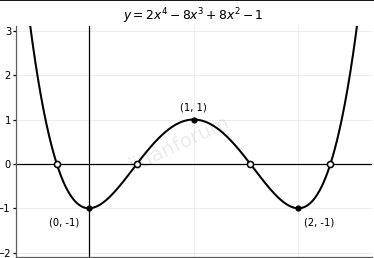
Step 6: Read off the shape: coming down from ++\infty to a minimum 1-1 at x=0x = 0, up to a maximum +1+1 at x=1x = 1, down to a minimum 1-1 at x=2x = 2, then up to ++\infty. Step 7: Count the sign changes, each of which gives one root by the intermediate value theorem.
(, 0): +  1 root,(0, 1): +  1 root,(-\infty,\ 0): \ + \to - \ \Rightarrow \ 1 \ \text{root}, \qquad (0,\ 1): \ - \to + \ \Rightarrow \ 1 \ \text{root},
(1, 2): +  1 root,(2, ): +  1 root.(1,\ 2): \ + \to - \ \Rightarrow \ 1 \ \text{root}, \qquad (2,\ \infty): \ - \to + \ \Rightarrow \ 1 \ \text{root} .
Step 8: A quartic has at most 44 roots, so these are all of them.
n=4.n = 4 .
Question attachment Step 9: Take the reciprocal.
1n=14=0.25.\frac1n = \frac14 = 0.25 .
Answer: 0.250.25.
Still stuck on this question?Ask your doubt on WhatsApp
Similar questions
Application of Derivatives · medium
Let a function f:RRf : \mathbb{R} \to \mathbb{R} satisfy the functional equation f(x+y)=f(x)f(y),f(x+y) = f(x)\cdot f(y), where f(0)0f(0) \ne 0 and f(0)=1f'(0) = 1. Given g(x)=3xf(x),g(x) = \frac{3x}{f(x)}, then
Application of Derivatives · hard
Consider the function, for x[2,3]x \in [-2, 3], f(x)={x32x25x+6x1if x16if x=1f(x) = \begin{cases} \dfrac{x^{3}-2x^{2}-5x+6}{x-1} & \text{if } x \ne 1 \\[2mm] -6 & \text{if } x = 1 \end{cases} then
Application of Derivatives · medium
For the functions f(θ)=αtan2θ+βcot2θf(\theta)=\alpha\tan^2\theta+\beta\cot^2\theta and g(θ)=αsin2θ+βcos2θg(\theta)=\alpha\sin^2\theta+\beta\cos^2\theta, α>β>0\alpha>\beta>0, let min0<θ<π/2f(θ)=max0<θ<πg(θ)\displaystyle\min_{0<\theta<\pi/2}f(\theta)=\max_{0<\theta<\pi}g(\theta). If the first term of a G.P. is (α2β)\left(\dfrac{\alpha}{2\beta}\right), its common ratio is (2βα)\left(\dfrac{2\beta}{\alpha}\right), and the sum of its first 1010 terms is mn\dfrac{m}{n} with gcd(m,n)=1\gcd(m,n)=1, then m+nm+n is equal to
Application of Derivatives · hard
If xx and yy are real numbers such that x2+y2=27x^{2}+y^{2} = 27, then the maximum possible value of xyx-y is

Solve more, learn faster

Sign up free to solve more JEE Maths questions and explore doMath — timed drills, mastery sprints, bookmarks, and chapter-wise progress tracking.