Application of DerivativeshardFree
Critical Points and Higher Derivatives of an Integral with Limit x^2 | JEE
JEE Maths question with a full step-by-step solution.
Let
then
A has distinct positive solutions
B has distinct positive solutionscorrect
C has distinct positive solutions
D has critical points
Step 1: Differentiate, using the chain rule because the upper limit is rather than .
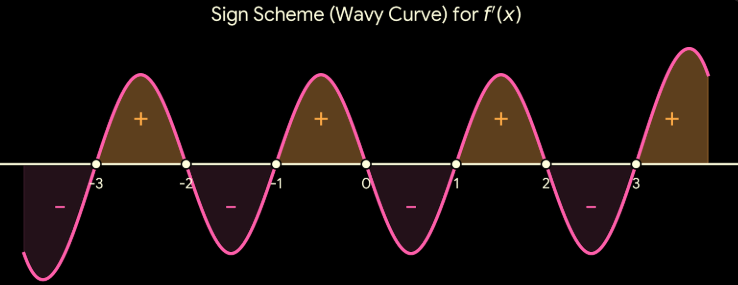 which is distinct points. Every one is a genuine critical point, so (4) - which claims - is
false.
Step 3: Count the zeros of . Between consecutive zeros of , Rolle's theorem gives a zero of
; with zeros there are gaps, so has at least zeros. Since is a polynomial
of degree , has degree and therefore exactly zeros.
Step 4: Split those by sign. is an odd function (every factor pairs up as
), so its zeros are symmetric about and so are the zeros of :
which is distinct points. Every one is a genuine critical point, so (4) - which claims - is
false.
Step 3: Count the zeros of . Between consecutive zeros of , Rolle's theorem gives a zero of
; with zeros there are gaps, so has at least zeros. Since is a polynomial
of degree , has degree and therefore exactly zeros.
Step 4: Split those by sign. is an odd function (every factor pairs up as
), so its zeros are symmetric about and so are the zeros of :
Step 2: Factorise completely and list the zeros.
so
which is distinct points. Every one is a genuine critical point, so (4) - which claims - is
false.
Step 3: Count the zeros of . Between consecutive zeros of , Rolle's theorem gives a zero of
; with zeros there are gaps, so has at least zeros. Since is a polynomial
of degree , has degree and therefore exactly zeros.
Step 4: Split those by sign. is an odd function (every factor pairs up as
), so its zeros are symmetric about and so are the zeros of :
So (1), which claims positive, is false.
Step 5: Count the zeros of . It has degree , and Rolle's theorem between the zeros of
gives zeros - so exactly .
Step 6: Split those by sign. odd makes even, which makes odd, so and
the remaining four zeros pair off:
Step 7: So has exactly distinct positive solutions - option (2) - and (3), claiming
, is false.
Answer: (2).
Application of Derivatives · medium
Let a function satisfy the functional equation where and . Given then
Application of Derivatives · hard
Consider the function, for , then
Application of Derivatives · hard
Let , then which of the following is/are CORRECT?
Application of Derivatives · medium
For the functions and , , let . If the first term of a G.P. is , its common ratio is , and the sum of its first terms is with , then is equal to
Solve more, learn faster
Sign up free to solve more JEE Maths questions and explore doMath — timed drills, mastery sprints, bookmarks, and chapter-wise progress tracking.