3D Geometry for JEE: Lines and Planes, Fully Solved
Ritesh Raj · 1 Nov 2026
Aa
29 min read18 sectionsConcept
Three dimensional geometry is coordinate geometry with one more axis, and almost every question in it comes down to one picture: a point, a line through it with a known direction, and a perpendicular dropped from somewhere. Learn to write the general point of a line with one parameter, and most questions become a single equation in that parameter.
This note covers the whole chapter: coordinates, direction cosines, the line in every form JEE uses, the foot, the image, distance along a direction, skew lines, and then the plane, a line meeting a plane, images in a plane, families of planes and three planes together. Every worked example is a JEE Main 2026 or JEE Advanced 2026 question unless it says otherwise, and every answer was re-derived from scratch.
Coordinates in space
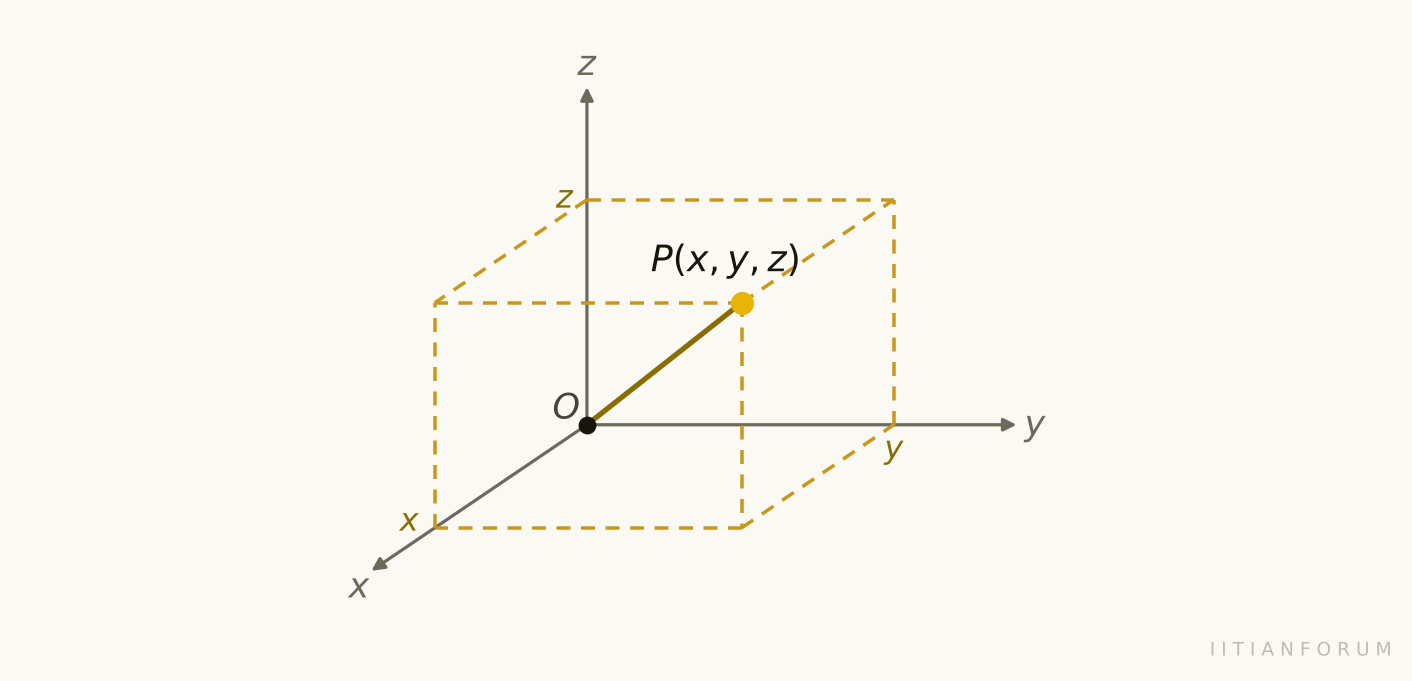
Three mutually perpendicular axes through the origin O divide space into eight octants. A point P(x,y,z) is reached by moving x along the x-axis, y parallel to the y-axis and z parallel to the z-axis.
Octant
I
II
III
IV
V
VI
VII
VIII
x
+
−
−
+
+
−
−
+
y
+
+
−
−
+
+
−
−
z
+
+
+
+
−
−
−
−
swipe for more →
On the xy-plane z=0, on the yz-plane x=0, on the zx-plane y=0. On the x-axis y=z=0.
The distance between A(x1,y1,z1) and B(x2,y2,z2) is
AB2=(x2−x1)2+(y2−y1)2+(z2−z1)2
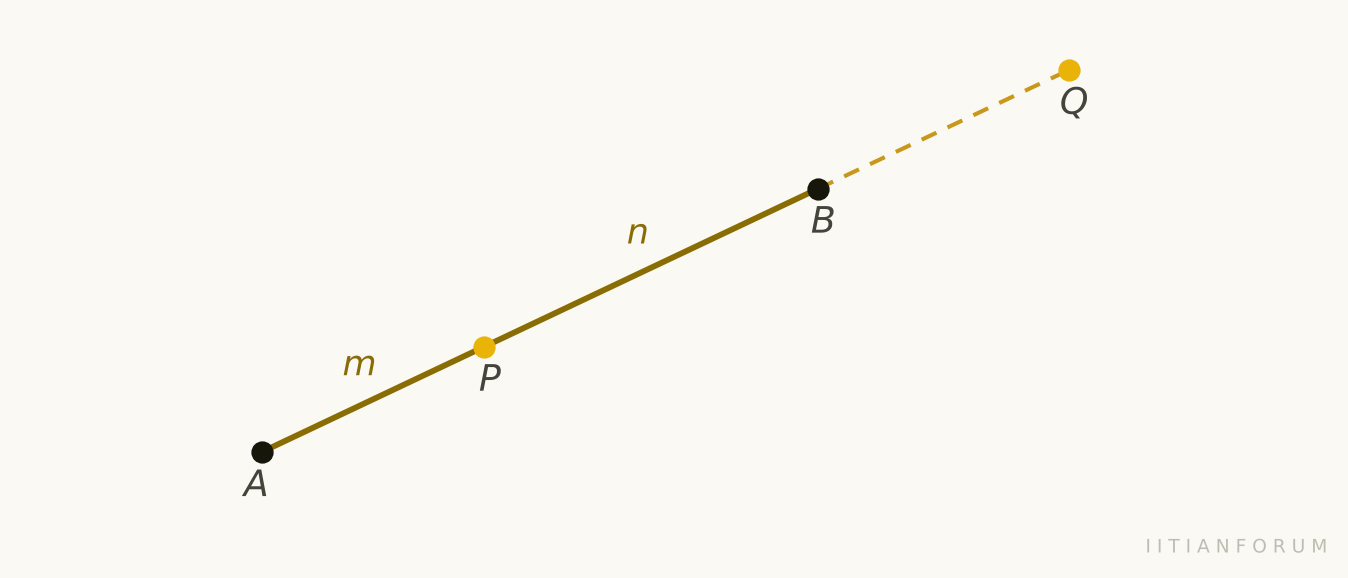
The point dividing AB internally in the ratio m:n is
(m+nmx2+nx1,m+nmy2+ny1,m+nmz2+nz1)
and externally, replace n by −n. The centroid of a triangle is the average of its three vertices; the centroid of a tetrahedron is the average of its four.
Segment AB with an inner point P dividing it in the ratio m to n and an outer point Q beyond B dividing it externally
Ratio in which a coordinate plane cuts a segment
The yz-plane cuts AB where x=0. Put x=k+1kx2+x1=0 to get k=−x2x1. A positive k means the cut is between A and B.
Example 1(IITianForum). Let A(1,5,3), B(1,1,3) and C(4,1,0). Which of the following is (are) correct?
(1) The orthocentre of △ABC is at distance 11 from the origin
(2) The circumcentre of △ABC is (25,3,23)
(3) If A, B, C, D in some order form a parallelogram, D can be (4,5,0)
(4) If A, B, C, D in some order form a parallelogram, D can be (4,−3,0)
▸ SHOW SOLUTION
Step 1. Find the right angle
BA=(0,4,0)BC=(3,0,−3)BA⋅BC=0
So ∠B=90∘.
Step 2. Orthocentre and circumcentre
In a right triangle the orthocentre is the right-angle vertex B(1,1,3):
OB=1+1+9=11
The circumcentre is the midpoint of the hypotenuse AC:
(21+4,25+1,23+0)=(25,3,23)
Step 3. Fourth vertex
The three choices are A+C−B, A+B−C, B+C−A:
(4,5,0),(−2,5,6),(4,−3,0)
Answer: (1), (2), (3), (4)
Direction cosines and direction ratios
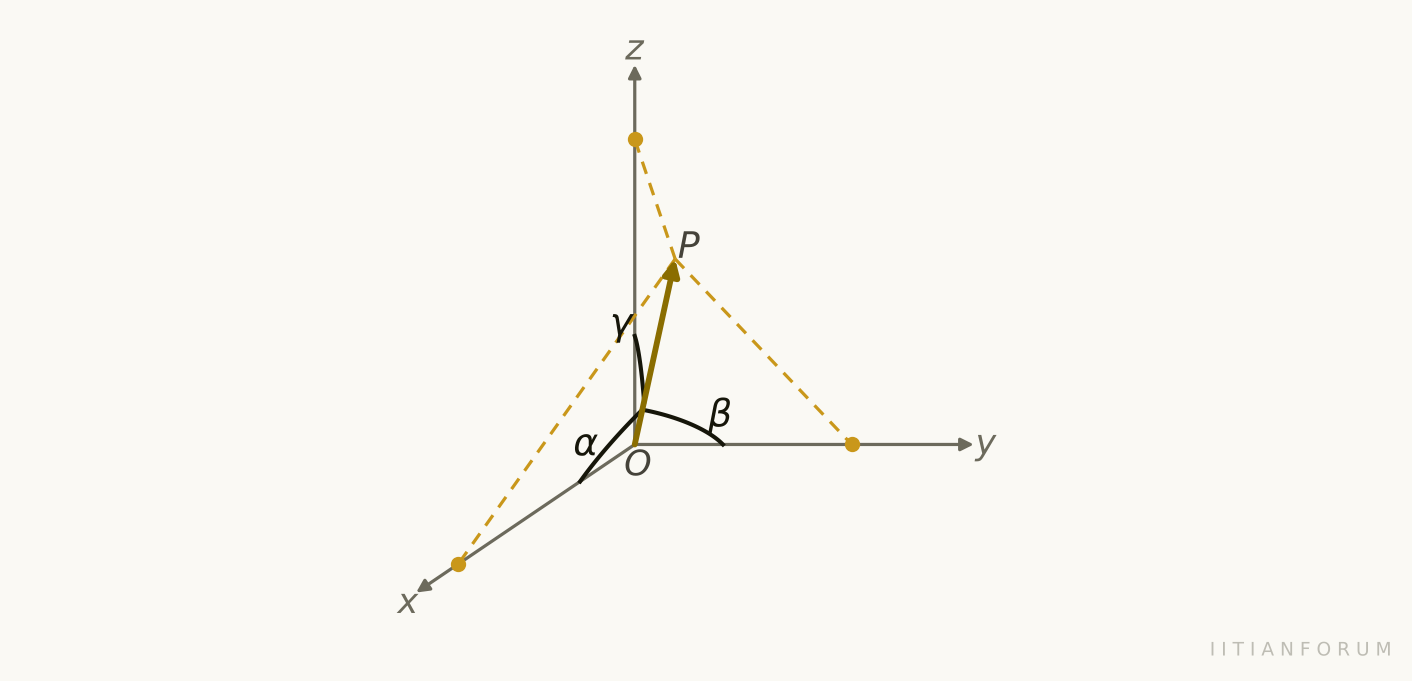
If a line makes angles α, β, γ with the positive x, y, z axes, its direction cosines are
l=cosα,m=cosβ,n=cosγA vector OP from the origin making angles alpha, beta and gamma with the x, y and z axes
They always satisfy
l2+m2+n2=1
Any three numbers a,b,c proportional to l,m,n are direction ratios. To go back, divide by the length:
l=a2+b2+c2am=a2+b2+c2bn=a2+b2+c2c
The direction ratios of the line through A(x1,y1,z1) and B(x2,y2,z2) are x2−x1, y2−y1, z2−z1.
A line has two sets of direction cosines
Reversing the direction changes (l,m,n) to (−l,−m,−n). Both describe the same line. When a question says "acute angle", take the absolute value of the cosine.
Example 2(JEE Main 2026, 23 January Shift 1). The direction cosines of two lines satisfy 4l+m−n=0 and 2mn+10nl+3lm=0. The cosine of the acute angle between the lines is
(1) 3810 (2) 33820 (3) 73810 (4) 33810
▸ SHOW SOLUTION
Step 1. Eliminate n
n=4l+m. Substitute:
2m(4l+m)+10l(4l+m)+3lm=040l2+21lm+2m2=0
Step 2. Factor
(8l+m)(5l+2m)=0
Step 3. The two directions
m=−8l gives n=−4l, direction (1,−8,−4).
m=−25l gives n=23l, direction (2,−5,3).
Step 4. Angle
cosθ=8138∣2+40−12∣=93830cosθ=33810
Answer: (4)
Equation of a line
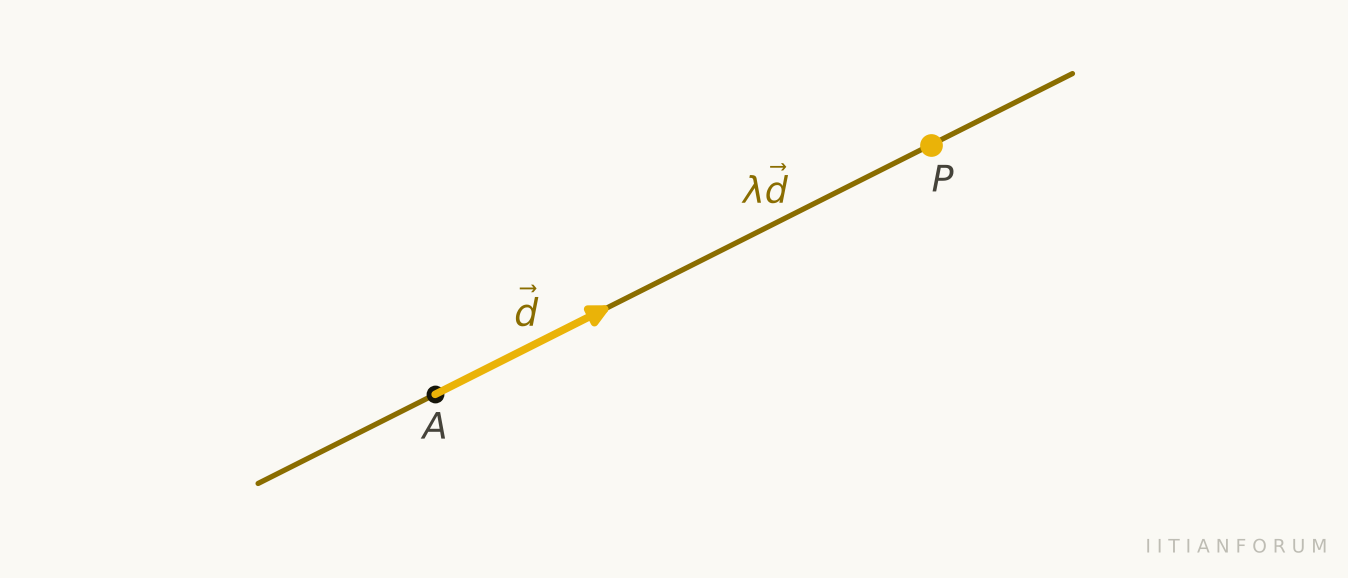
A line is fixed by a point A on it and a direction d=(a,b,c).
A line through the point A with direction vector d, and a general point P on it reached as A plus lambda d
Vector form.r=a+λd, where a is the position vector of A.
Cartesian form. Through (x1,y1,z1) with direction ratios a,b,c:
ax−x1=by−y1=cz−z1
Two-point form. Through (x1,y1,z1) and (x2,y2,z2):
x2−x1x−x1=y2−y1y−y1=z2−z1z−z1
The general point. Put each fraction equal to λ:
P=(x1+aλ,y1+bλ,z1+cλ)
This one line is the start of nearly every solution in the chapter. If the direction ratios are the direction cosines, ∣λ∣ is the actual distance AP.
The zero denominator
2x−1=0y+3=5z is not division by zero. It means the direction is (2,0,5), so the y-coordinate never changes: every point has y=−3. In the general point, write y=−3+0⋅λ.
Rewrite the line before reading its direction
In 3x−6=2y−7=27−z the third fraction is −2z−7, so the direction is (3,2,−2), not (3,2,2). Every variable must appear as x, y, z with coefficient 1 on top before you read off the point and the direction.
Example 3(JEE Main 2026, 5 April Shift 2). Points P and Q lie on the line
8x+3=2y−4=2z+1
and are at distance 6 from R(1,2,3). If (α,β,γ) is the centroid of △PQR, then α+β+γ is
(1) 4 (2) 5 (3) 6 (4) 8
▸ SHOW SOLUTION
Step 1. General point
(8λ−3,2λ+4,2λ−1)
Step 2. Distance 6 from R
(8λ−4)2+(2λ+2)2+(2λ−4)2=36
Divide by 4:
(4λ−2)2+(λ+1)2+(λ−2)2=918λ2−18λ=0⟹λ=0,1
Step 3. The points and the centroid
P(−3,4,−1), Q(5,6,1), R(1,2,3):
G=(33,312,33)=(1,4,1)α+β+γ=6
Answer: (3)
Angle between two lines
The angle between two lines is the angle between their directions d1=(a1,b1,c1) and d2=(a2,b2,c2):
A line perpendicular to two lines has direction d1×d2:
d1×d2=i^a1a2j^b1b2k^c1c2
Example 4(JEE Main 2026, 6 April Shift 1). A line L is perpendicular to both
L1:3x+1=5y+3=7z+5L2:1x−2=4y−4=7z−6
If θ is the acute angle between L and a line L3 with direction ratios 2,1,2, then tanθ is
(1) 232 (2) 252 (3) 352 (4) 342
▸ SHOW SOLUTION
Step 1. Direction of L
(3,5,7)×(1,4,7)=(7,−14,7)
So L has direction (1,−2,1).
Step 2. Cosine with L₃
cosθ=6⋅3∣2−2+2∣=362
Step 3. Tangent
cos2θ=544sin2θ=5450tan2θ=450⟹tanθ=252
Answer: (2)
Example 5(JEE Main 2026, 24 January Shift 1). A line L through P(1,1,1) is perpendicular to
4x−4=1y−1=1z−1
and
1x−17=1y−71=0z
L meets the yz-plane at Q. A line parallel to L through S(1,0,−1) meets the yz-plane at R. The square of the area of the parallelogram PQRS is ______.
▸ SHOW SOLUTION
Step 1. Direction of L
(4,1,1)×(1,1,0)=(−1,1,3)
Step 2. Points Q and R
L: (1−t,1+t,1+3t). On x=0, t=1: Q=(0,2,4).
Through S: (1−u,u,−1+3u). On x=0, u=1: R=(0,1,2).
Step 3. Area
PQ=(−1,1,3)PS=(0,−1,−2)PQ×PS=(1,−2,1)
Area =6, so its square is 6.
Answer:6
Foot of the perpendicular and distance from a line
To drop a perpendicular from P to a line with direction d:
Write the general point F(λ) of the line.
Impose PF⋅d=0. It is linear in λ.
Solve, then PF is the distance of P from the line.
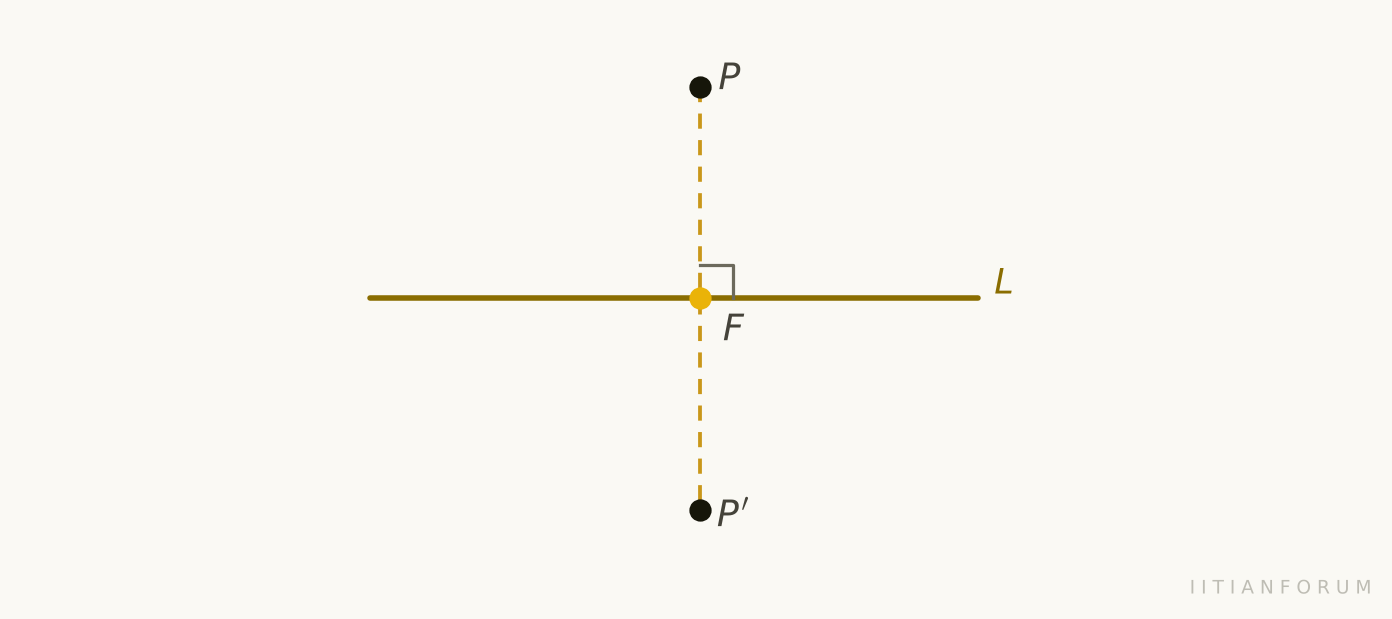
A point P off a line, the foot F on the line with PF perpendicular to the line, and the image P-prime on the other side with F the midpoint of P P-prime
There is a shortcut for the distance alone. If A is any point of the line,
PF2=AP2−(∣d∣AP⋅d)2
because AF is the projection of AP on the line.
Example 6(JEE Main 2026, 5 April Shift 1). The square of the distance of P(5,6,7) from the line
2x−2=3y−5=4z−2
is
(1) 3 (2) 5 (3) 6 (4) 8
▸ SHOW SOLUTION
Step 1. General point and the perpendicular condition
Example 8(JEE Main 2026, 23 January Shift 1). Vertices B and C of △ABC lie on
1x=−21−y=3z−2
A=(1,6,3), B=(4,9,α) and BC=10. The area of △ABC is
(1) 513 (2) 1513 (3) 2013 (4) 1013
▸ SHOW SOLUTION
Step 1. Rewrite the line
−21−y=2y−1, so the line is (λ,2λ+1,3λ+2) with direction (1,2,3).
Step 2. Height from A
Foot D: (λ−1,2λ−5,3λ−1)⋅(1,2,3)=0:
14λ−14=0⟹D=(1,3,5)AD=0+9+4=13
Step 3. Area
21⋅BC⋅AD=21⋅10⋅13=513
Answer: (1)
α never mattered. The height from A is the same for every base on that line.
Example 9(JEE Advanced 2026, Paper 2). L is the line through P(1,2,−1) and Q(2,3,1). S is the foot of the perpendicular from R(4,−1,5) to L. Another line through R meets L at T such that S divides PT internally with PS:ST=1:2. Which is (are) TRUE?
The image P′ of P in a line is the point with the foot F as the midpoint of PP′:
P′=2F−P
Find the foot first, then double. When the image is given with unknowns, use the two conditions directly: the midpoint of PP′ lies on the line, and PP′ is perpendicular to the line.
Example 10(JEE Main 2026, 22 January Shift 1). If the image of P(1,2,a) in the line
3x−6=2y−7=27−z
is Q(5,b,c), then a2+b2+c2 is
(1) 293 (2) 264 (3) 298 (4) 283
▸ SHOW SOLUTION
Step 1. Read the line correctly
Point (6,7,7), direction (3,2,−2).
Step 2. Midpoint on the line
M=(3,2b+2,2a+c). The x-coordinate gives parameter 33−6=−1:
2b+2=7−2=5⟹b=82a+c=7+2=9⟹a+c=18
Step 3. Perpendicular
(4,6,c−a)⋅(3,2,−2)=024−2(c−a)=0⟹c−a=12
So c=15, a=3.
a2+b2+c2=9+64+225=298
Answer: (3)
Example 11(JEE Main 2026, 4 April Shift 2). If (2α+1,α2−3α,2α−1) is the image of (α,2α,1) in the line
3x−2=2y−1=1z
then the possible value(s) of α is (are)
(1) only 3 (2) only 3 and −1 (3) only 3, 41 and −1 (4) only 3 and 41
▸ SHOW SOLUTION
Step 1. Midpoint
M=(23α+1,2α2−α,4α+1)
Step 2. M on the line
2α−1=4α2−α−2=4α+1
First equals third: 2α−2=α+1, so α=3. The middle one then gives 44=1, consistent.
Step 3. Check the perpendicular
α=3: from (3,6,1) to (7,0,1) is (4,−6,0), and (4,−6,0)⋅(3,2,1)=0.
Answer: (1)
The middle equation alone also allows α=−1, but that value fails the other two. Every coordinate condition must hold, not just one.
Example 12(JEE Main 2026, 28 January Shift 2). Q(a,b,c) is the image of P(3,2,1) in the line 1x−1=2y=1z−1. The distance of Q from the line
Example 13(JEE Main 2026, 6 April Shift 2). R is the image of P(0,−5,0) in the line 2x−1=1y=−2z+1, and S is the image of Q(0,−21,0) in the line −1x−1=4y+9=1z+1. The square of the area of the parallelogram PQRS is ______.
▸ SHOW SOLUTION
Step 1. Image of P
Foot (1+2k,k,−1−2k) with (1+2k,k+5,−1−2k)⋅(2,1,−2)=0:
9k+9=0⟹k=−1
Foot F=(−1,−1,1), so R=(−2,3,2).
Step 2. Image of Q
Foot (1−λ,−9+4λ,−1+λ) with the perpendicular condition:
18λ−36=0⟹λ=2
The foot is again F=(−1,−1,1), so S=(−2,−23,2).
Step 3. Area from the diagonals
PR and QS have the same midpoint F, so they are the diagonals.
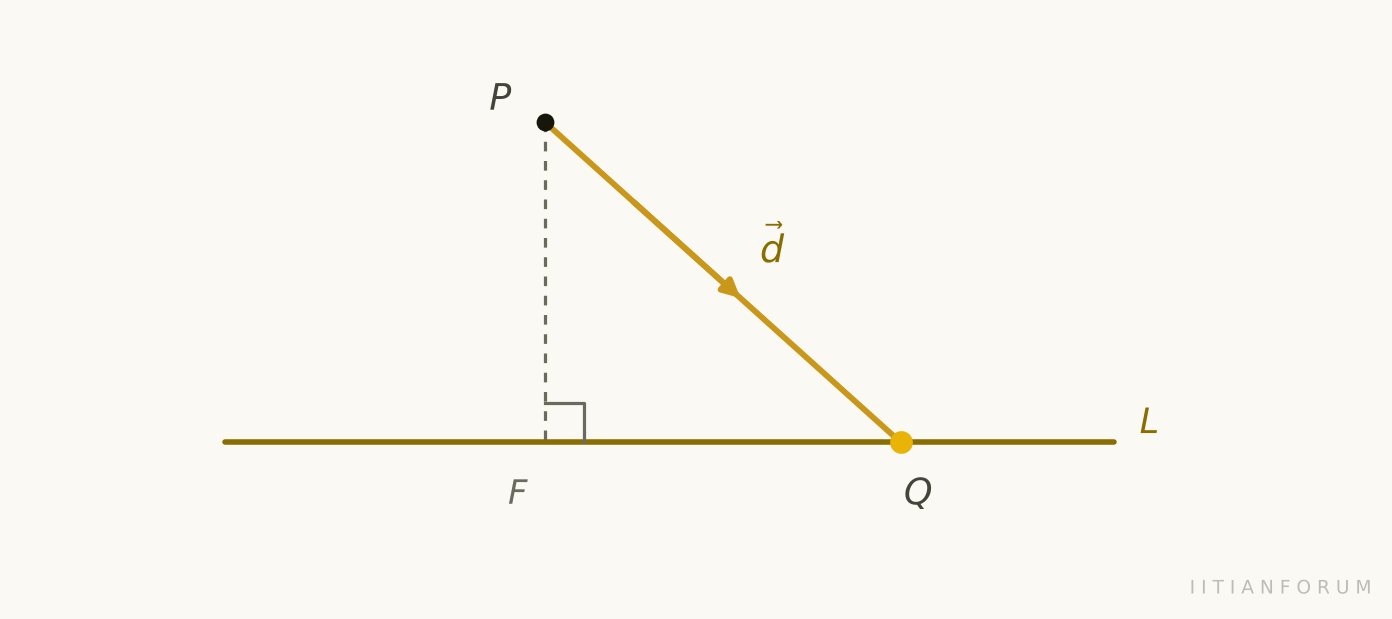
"The distance of P from the line Lalong the line M" is not the perpendicular distance. It is the length PQ, where Q is the point at which the line through P parallel to M meets L.
A point P, a line L, the perpendicular from P to L shown faint, and a slanting segment from P in a given direction meeting L at Q
Write the line through P with the given direction: P+td.
Make that point satisfy L.
The answer is ∣t∣∣d∣.
The perpendicular distance is the wrong answer here
The perpendicular distance is the shortest of all such lengths, so it is always too small. The word along changes the question completely.
Example 14(JEE Main 2026, 4 April Shift 1). The square of the distance of (−2,−8,6) from the line
1x−1=2y−1=−1z
along the line 1x+5=−1y+5=2z is
(1) 3 (2) 6 (3) 8 (4) 12
▸ SHOW SOLUTION
Step 1. Line through the point along (1, −1, 2)
B=(−2+t,−8−t,6+2t)
Step 2. B on the first line
1t−3=2−9−t=−16+2t
First equals third: t−3=−6−2t, so t=−1. The middle gives −4, consistent.
Step 3. Distance
PB2=t2(1+1+4)=6
Answer: (2)
Example 15(JEE Main 2026, 28 January Shift 1). The distances of (1,2,a) from the line 1x−1=2y=1z−1 along the lines
L1:3x−1=4y−2=bz−aL2:1x−1=4y−2=cz−a
are equal. Then a+b+c is
(1) 7 (2) 5 (3) 6 (4) 4
▸ SHOW SOLUTION
Step 1. Along L₁
A=(3λ+1,4λ+2,bλ+a) must satisfy the line:
3λ=24λ+2⟹λ=1
Then 3=b+a−1, so a+b=4, and A=(4,6,4).
Step 2. Along L₂
B=(μ+1,4μ+2,cμ+a):
μ=24μ+2⟹μ=−1
Then −1=a−c−1, so c=a, and B=(0,−2,0).
Step 3. Equal distances
9+16+(a−4)2=1+16+a241−8a=17⟹a=3
b=1, c=3, so a+b+c=7.
Answer: (1)
Example 16(JEE Main 2026, 28 January Shift 2). The distance of P(43,α,β), β<0, from the line r=4i^−k^+μ(2i^+3k^) along a line with direction ratios 3,−1,0 is 1310. Then α2+β2 is ______.
▸ SHOW SOLUTION
Step 1. Meet the given line
P+t(3,−1,0)=(43+3t,α−t,β) must equal (4+2μ,0,−1+3μ):
The sign of α is fixed by β<0: α=−13, not 13. The final answer 170 is the same either way, which is why the slip is easy to miss.
Example 17(JEE Main 2026, 22 January Shift 2). L is the line 2x+1=3y+1=6z+3, and S is the set of points on L whose distance from the line 2x+1=3y+1=0z−9 along L is 7. The sum of a+b+c over all (a,b,c)∈S is
(1) 34 (2) 28 (3) 40 (4) 6
▸ SHOW SOLUTION
Step 1. Where L meets the second line
The zero denominator says the second line lies in z=9. On L, (2t−1,3t−1,6t−3), so 6t−3=9 gives t=2:
M=(3,5,9)
Step 2. Points at distance 7 along L
∣d∣=4+9+36=7, so a step of 1 in t is a distance of 7: t=1 or t=3.
(1,2,3)(5,8,15)
Step 3. Add
6+28=34
Answer: (1)
As printed the second line read 0z+9, which gives no option; the intended line is z=9, used above.
Skew lines and the shortest distance
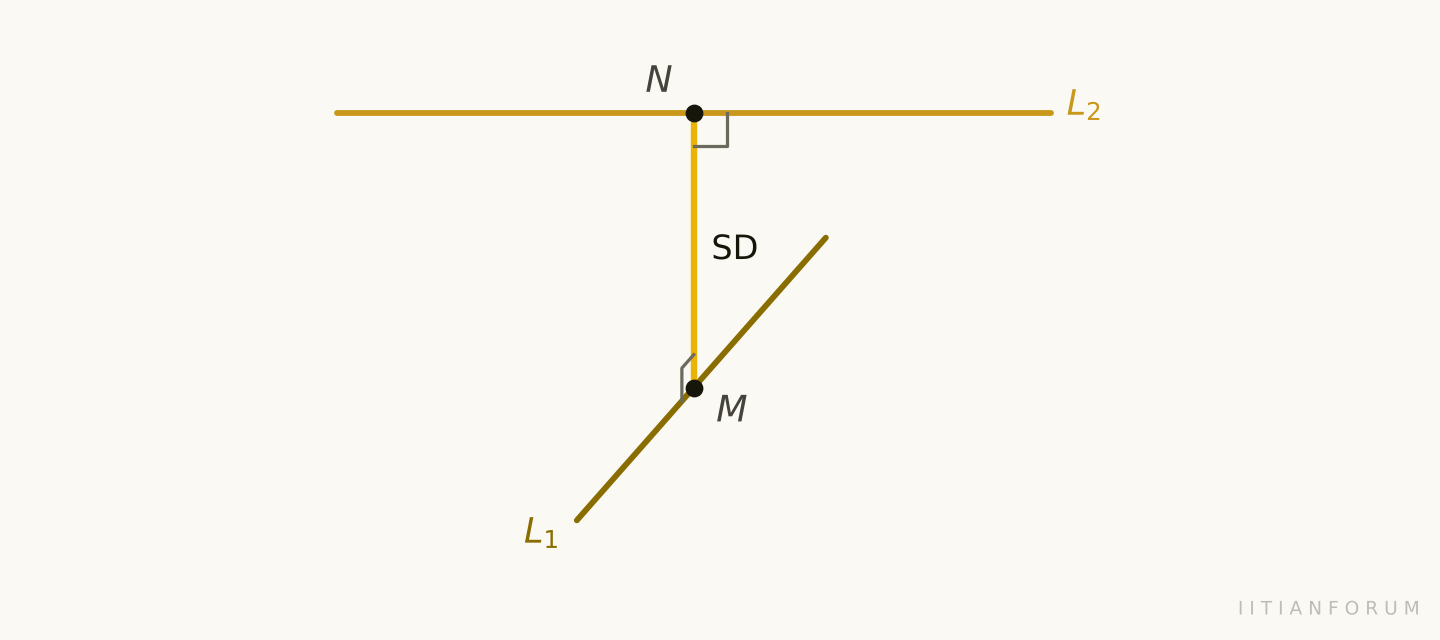
Two lines in space can intersect, be parallel, or be skew: neither parallel nor meeting. Between skew lines there is exactly one segment perpendicular to both, and its length is the shortest distance.
Two skew lines, the rear one broken where the front one passes over it, with the common perpendicular segment joining them
For r=a1+λb1 and r=a2+μb2:
SD=∣b1×b2∣(a2−a1)⋅(b1×b2)
The numerator is the volume of the box on a2−a1, b1, b2, the denominator is its base, so SD is its height.
For parallel lines with common direction b:
d=∣b∣(a2−a1)×b
SD = 0 means the lines meet
If (a2−a1)⋅(b1×b2)=0 and the lines are not parallel, they intersect. In determinant form:
x2−x1a1a2y2−y1b1b2z2−z1c1c2=0
Example 18(JEE Main 2026, 4 April Shift 2). The shortest distance between
Example 19(JEE Main 2026, 24 January Shift 2). The sum of all values of α for which the shortest distance between
αx+1=−1y−2=−αz−4
and
αx=2y−1=2αz−1
is 2, is
(1) 8 (2) −6 (3) 6 (4) −8
▸ SHOW SOLUTION
Step 1. Cross product
With d1=(α,−1,−α) and d2=(α,2,2α):
d1×d2=(0,−3α2,3α)
with length 3∣α∣α2+1.
Step 2. SD
Joining vector (1,−1,−3):
SD=3∣α∣α2+1∣3α2−9α∣=α2+1∣α−3∣
Step 3. Solve
(α−3)2=2(α2+1)α2+6α−7=0
Sum of roots =−6.
Answer: (2)
Example 20(JEE Main 2026, 22 January Shift 1). P(α,β,γ) is the point on 2x−1=−3y+1=z at distance 414 from (1,−1,0), nearer to the origin. The shortest distance between
1x−α=2y−β=3z−γ
and
2x+5=1y−10=1z−3
is
(1) 745 (2) 457 (3) 475 (4) 247
▸ SHOW SOLUTION
Step 1. The point P
P=(2λ+1,−3λ−1,λ) with 14λ2=224, so λ=±4.
(9,−13,4):OP2=266(−7,11,−4):OP2=186
So P=(−7,11,−4).
Step 2. Cross product
(1,2,3)×(2,1,1)=(−1,5,−3)
with length 35.
Step 3. SD
Joining vector (2,−1,7):
SD=35∣−2−5−21∣=3528=457
Answer: (2)
Example 21(JEE Main 2026, 8 April Shift 2). The foot of the perpendicular from (λ,2,3) to 1x−4=2y−9=1z−5 is (1,μ,2). The distance between the lines
2x−1=3y−2=6z+4
and
2x−λ=3y−μ=6z+5
is
(1) 712 (2) 7145 (3) 7146 (4) 7143
▸ SHOW SOLUTION
Step 1. Find μ and λ
(1,μ,2) is on the line at parameter −3, so μ=9−6=3.
Perpendicular: (1−λ)+2(1)+(−1)=0, so λ=2.
Step 2. Parallel lines
Both have direction (2,3,6). Joining vector (1,1,−1):
(1,1,−1)×(2,3,6)=(9,−8,1)d=781+64+1=7146
Answer: (3)
Lines that meet, and transversals
Two lines meet when one parameter on each makes the general points equal. That gives three equations in two unknowns: solve two, and the third must check. If it fails, the lines are skew.
A transversal is a line meeting two given lines. If its direction is given, take a general point P on the first line and Q on the second, and make PQ parallel to the given direction.
Example 22(JEE Main 2026, 2 April Shift 1). The point of intersection of
3x+1=5y+a=7z+b+1
and
1x−2=4y−b=7z−2a
lies on the xy-plane. Then a+b is
(1) 2 (2) 5 (3) 7 (4) 9
▸ SHOW SOLUTION
Step 1. General points
(3r−1,5r−a,7r−b−1)(s+2,4s+b,7s+2a)
Step 2. Four equations
z=0 on both: b=7r−1, a=−27s. Equal x: s=3r−3.
Step 3. Equal y
5r−a=4s+b5r+221r−221=12r−12+7r−17r=5⟹r=75
Step 4. Values
b=4, s=−76, a=3:
a+b=7
Answer: (3)
Example 23(JEE Main 2026, 4 April Shift 1). A line with direction ratios 1,−1,2 meets
2x=3y=3z+1
and
−1x+1=1y−2=4z
at P and Q. If PQ=α, then 225α2 is
(1) 1024 (2) 1014 (3) 1104 (4) 1204
▸ SHOW SOLUTION
Step 1. General points
P=(2λ,3λ,3λ−1)Q=(−μ−1,μ+2,4μ)
The components of QP are
2λ+μ+13λ−μ−23λ−4μ−1
Step 2. Parallel to (1, −1, 2)
First and second components are opposite:
5λ=1⟹λ=51
Third is twice the first:
λ+6μ=−3⟹μ=−158
Step 3. Length
QP=1513(1,−1,2)225α2=169⋅6=1014
Answer: (2)
Example 24(JEE Main 2026, 21 January Shift 2). L1 is parallel to −3i^+2j^+4k^ through (2,6,7), and L2 is parallel to 2i^+j^+3k^ through (4,3,5). A line L3 parallel to −3i^+5j^+16k^ meets L1 at C and L2 at D. Then CD2 is
Here CD came out exactly equal to the given direction, a quick check that the arithmetic is right.
The plane
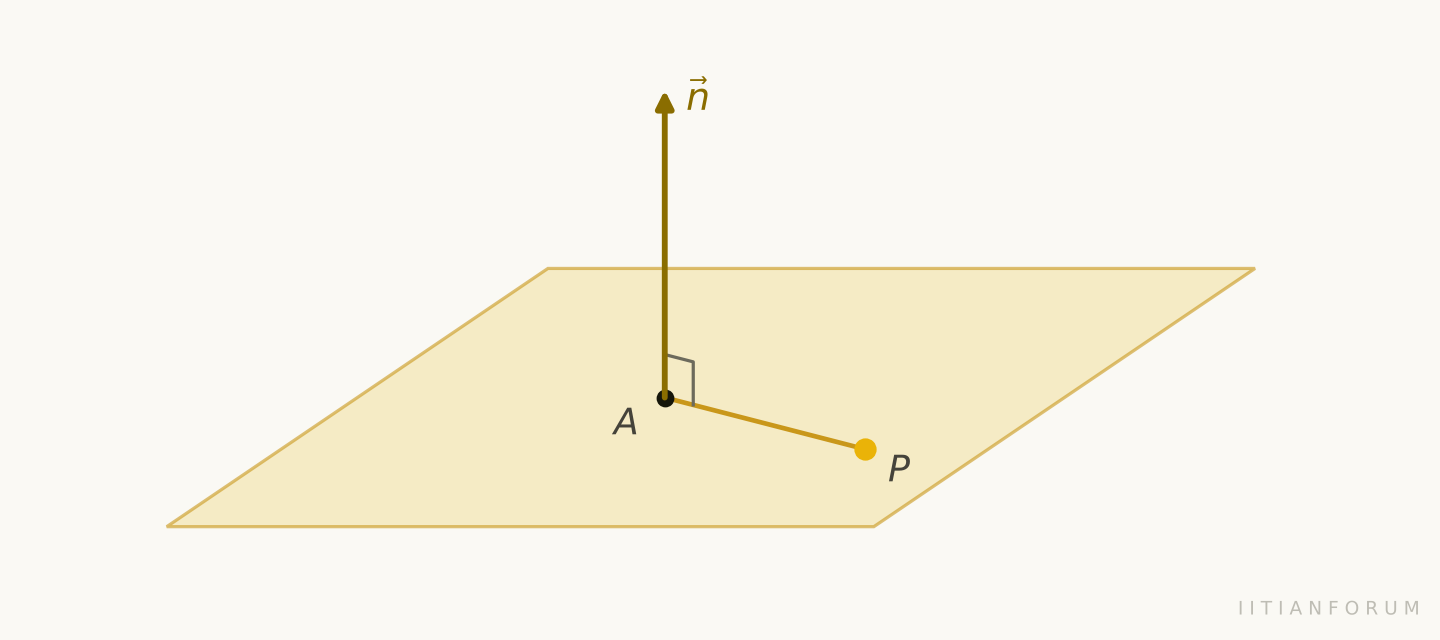
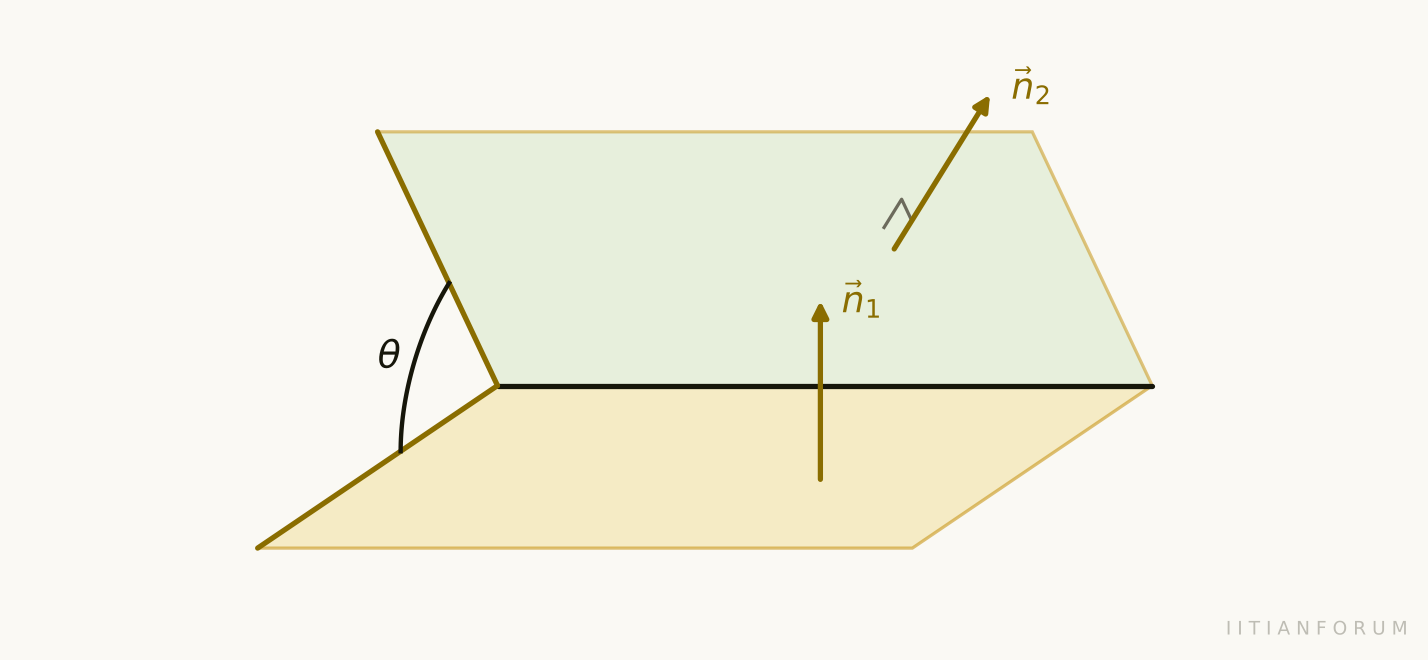
A plane is fixed by a point A on it and a normaln=(a,b,c) perpendicular to every line in it.
A plane drawn as a parallelogram, a point A on it, the normal vector n standing perpendicular at A, and a general point P on the plane
JEE Advanced from here
In the IITianForum syllabus, planes belong to the JEE Advanced unit; the JEE Main questions of 2025 and 2026 were all on lines. Advanced 2026 Paper 1 asked a plane question, and the board exam uses planes too.
Example 26(JEE Advanced 2026, Paper 1). P is the plane containing the line 2x−1=3y−3=1z+2 and perpendicular to the plane x+2y+3z=4. P1 is the plane through (4,2,2) parallel to P. Which is (are) TRUE?
(1) P is 7x−5y+z=−10
(2) The distance between P and P1 is 30
(3) The distance of P from the origin is 23
(4) The acute angle between P and 2x+2y+z=3 is cos−1(331)
▸ SHOW SOLUTION
Step 1. Normal of P
It is perpendicular to the line direction (2,3,1) and to the normal (1,2,3):
(2,3,1)×(1,2,3)=(7,−5,1)
Step 2. Equation of P
Through (1,3,−2):
7x−5y+z=7−15−2=−10
So (1) is true.
Step 3. P₁ and the distances
P1: 7x−5y+z=28−10+2=20. ∣n∣=75=53.
between P,P1:5330=23from O:5310=32
So (2) and (3) are false.
Step 4. Angle
cosθ=53⋅3∣14−10+1∣=331
Answer: (1), (4)
A line and a plane
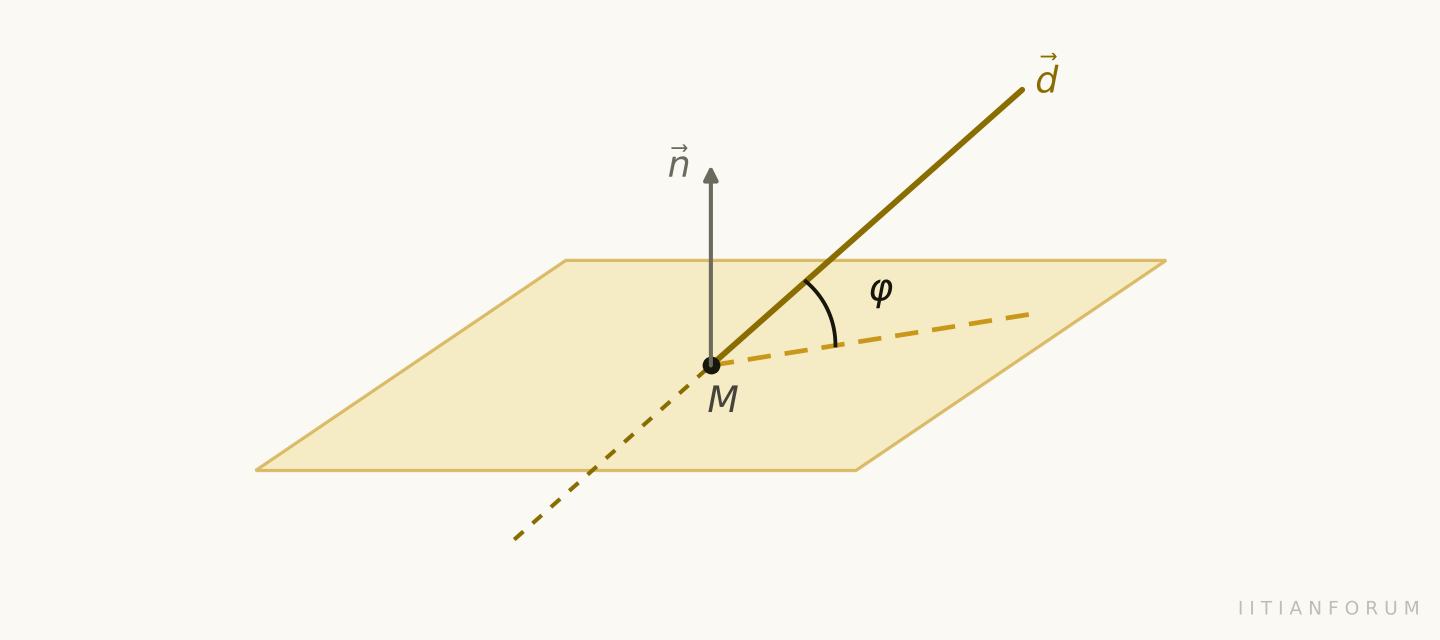
For a line with direction d and a plane with normal n:
Angle. The line makes angle φ with the plane, and 90∘−φ with the normal:
sinφ=∣d∣∣n∣∣d⋅n∣A line meeting a plane at M, the normal at M, the projection of the line on the plane, and the angle phi between the line and its projection
Condition
Meaning
d⋅n=0
the line meets the plane in one point
d⋅n=0, a point of the line not on the plane
parallel to the plane
d⋅n=0, a point of the line on the plane
the line lies in the plane
swipe for more →
Intersection. Put the general point of the line into the plane. It is one linear equation in the parameter.
Projection of a line on a plane. It passes through the meeting point M, and its direction is d with the normal part removed:
d′=d−∣n∣2d⋅nn
Example 27(IITianForum). Find where the line 2x−1=−1y−2=2z−3 meets the plane 2x+y−2z+9=0, and the sine of the angle between them.
▸ SHOW SOLUTION
Step 1. Substitute the general point
(1+2t,2−t,3+2t):
2+4t+2−t−6−4t+9=07−t=0⟹t=7
The point is (15,−5,17).
Step 2. Angle
sinφ=3⋅3∣4−1−4∣=91
Answer:(15,−5,17) and sinφ=91.
Example 28(IITianForum). The planes x+y+z=2 and x−y+z=0 meet in a line L. The distance of L from the plane 2x+y+2z=9 is
(1) 1 (2) 2 (3) 3 (4) 3
▸ SHOW SOLUTION
Step 1. Direction of L
It is perpendicular to both normals:
(1,1,1)×(1,−1,1)=(2,0,−2)
Step 2. L is parallel to the third plane
(2,0,−2)⋅(2,1,2)=0
So every point of L is at the same distance.
Step 3. One point of L
y=1 from subtracting the planes; take x=1, z=0: (1,1,0).
3∣2+1+0−9∣=2
Answer: (2)
Example 29(IITianForum). Find the projection of the line 1x−2=2y=0z−1 on the plane x+y+z=6.
▸ SHOW SOLUTION
Step 1. Meeting point
(2+t,2t,1) in the plane: 3+3t=6, so t=1.
M=(3,2,1)
Step 2. Remove the normal part
d=(1,2,0), n=(1,1,1), d⋅n=3, ∣n∣2=3:
d′=(1,2,0)−(1,1,1)=(0,1,−1)
Step 3. The projection
0x−3=1y−2=−1z−1
Answer: the line through (3,2,1) with direction (0,1,−1).
Check: (0,1,−1)⋅(1,1,1)=0, so the projection lies in the plane.
Foot and image of a point in a plane
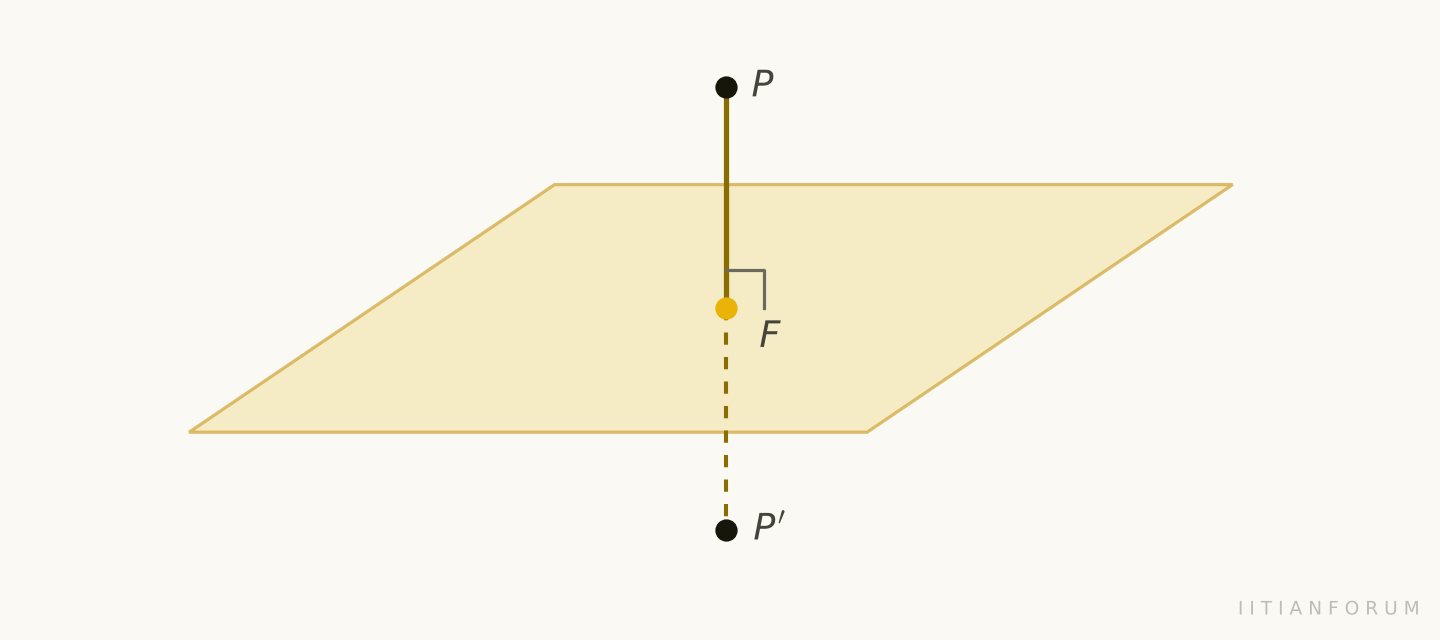
From P(x1,y1,z1) to ax+by+cz+d=0, move along the normal:
image: k=−2a2+b2+c2ax1+by1+cz1+dA point P above a plane, its foot F on the plane and its image P-prime the same distance below, all on one normal line
Image of a line in a plane. If the line meets the plane at M, its image passes through M and through the image of any other point of the line.
Reflection of a ray. A ray with direction d reflected by a plane mirror with normal n leaves along
d′=d−2∣n∣2d⋅nn
Example 30(IITianForum). A plane cuts the axes at 2, 4 and 4. If (α,β,γ) is the image of the origin in it, find 3(α+β+γ).
Example 31(IITianForum). A ray from P(2,1,3) travelling parallel to (1,2,−6) strikes the mirror x+y+z=0 at Q and reflects along QR. Find Q, the direction of QR, and the plane PQR.
▸ SHOW SOLUTION
Step 1. Point Q
(2+t,1+2t,3−6t) in the plane:
6−3t=0⟹t=2Q=(4,5,−9)
Step 2. Reflected direction
d⋅n=1+2−6=−3, ∣n∣2=3:
d′=(1,2,−6)+2(1,1,1)=(3,4,−4)
Step 3. Plane PQR
It contains both directions:
(1,2,−6)×(3,4,−4)=(16,−14,−2)
Normal (8,−7,−1) through P:
8x−7y−z=6
Check Q: 32−35+9=6.
Answer:Q(4,5,−9), QR along (3,4,−4), plane 8x−7y−z=6.
The plane of incidence always contains the normal too: (8,−7,−1)⋅(1,1,1)=0.
Example 32(IITianForum). Find the image of the line 2x−1=1y−2=1z−3 in the plane x+y+z=2, and the plane containing the image that is perpendicular to the mirror.
▸ SHOW SOLUTION
Step 1. Where the line meets the mirror
(1+2t,2+t,3+t): 6+4t=2, so t=−1.
M=(−1,1,2)
Step 2. Image of A(1, 2, 3)
k=−2⋅36−2=−38A′=(−35,−32,31)
Step 3. Image line
MA′=−31(2,5,5)2x+1=5y−1=5z−2
Step 4. The perpendicular plane
Normal (2,5,5)×(1,1,1)=(0,3,−3), through M:
y−z+1=0
Answer: image 2x+1=5y−1=5z−2; plane y−z+1=0.
The original line lies in the same plane: A(1,2,3) gives 2−3+1=0. A line and its image always share the plane perpendicular to the mirror.
Planes through a line, and coplanar lines
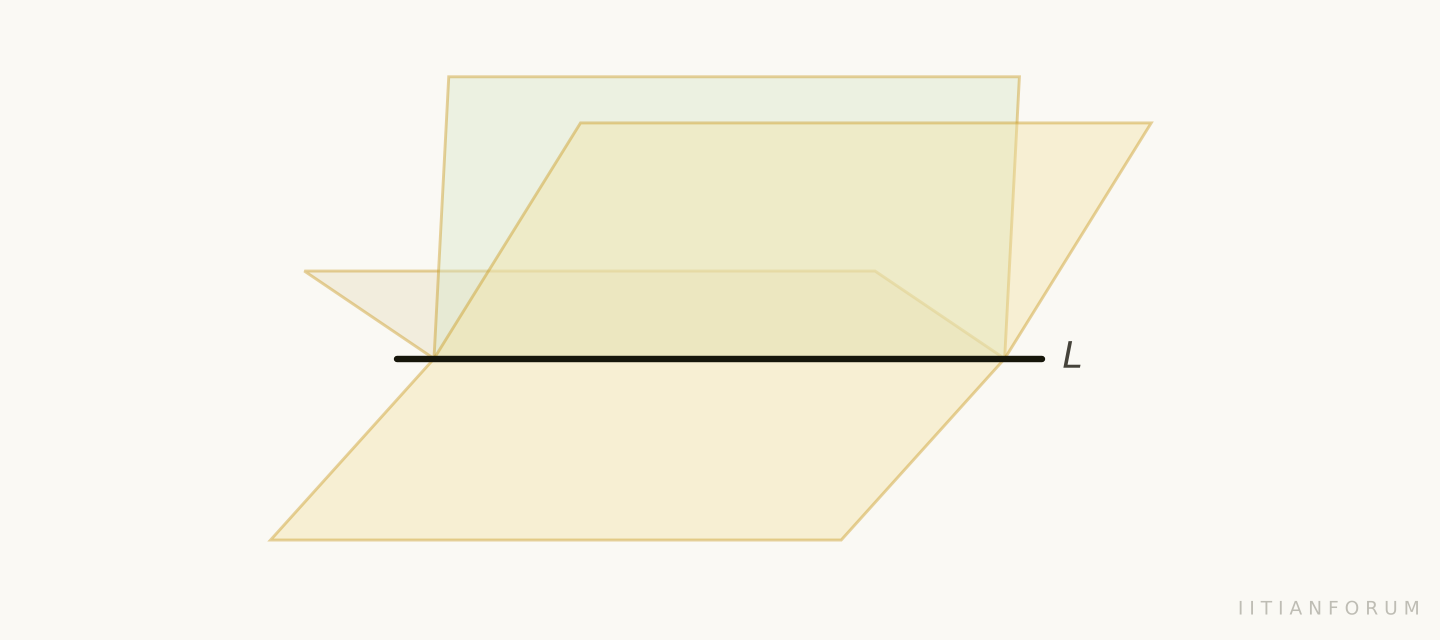
Every plane through the line of intersection of P1=0 and P2=0 is
P1+kP2=0
for some k (and P2=0 itself). One extra condition fixes k.
Several planes fanning out around a common line like the pages of an open book
A plane containing a line through A with direction d has a normal perpendicular to d. With a second line, or a point B, the normal is d1×d2 or d×AB.
Bisector planes. The planes bisecting the angles between a1x+b1y+c1z+d1=0 and a2x+b2y+c2z+d2=0 are
Write P1=a1x+b1y+c1z+d1 and P2=a2x+b2y+c2z+d2. The bisectors are
a12+b12+c12P1=±a22+b22+c22P2
With d1, d2 of the same sign, the + sign gives the bisector of the angle containing the origin. That angle is acute when n1⋅n2<0 and obtuse when n1⋅n2>0.
Coplanar lines. Two lines lie in one plane exactly when
(a2−a1)⋅(d1×d2)=0
and that plane has normal d1×d2 (for non-parallel lines).
Example 33(IITianForum). L is the line through A(1,2,1) with direction (1,0,−1). P1 contains L and has normal parallel to (1,2,1). P2 contains L and the point B(0,1,0). Find P1, P2 and the cosine of the acute angle between them.
▸ SHOW SOLUTION
Step 1. P₁
(1,2,1)⋅(1,0,−1)=0, so such a plane exists. Through A:
x+2y+z=6
Step 2. P₂
AB=(−1,−1,−1)d×AB=(−1,2,−1)
Through A:
x−2y+z+2=0
Check B: 0−2+0+2=0.
Step 3. Angle
cosθ=6⋅6∣1−4+1∣=31
Answer:x+2y+z=6, x−2y+z+2=0, cosθ=31.
Example 34(IITianForum). Among the planes containing the line x+2y=5,z=2, find the one farthest from the origin.
▸ SHOW SOLUTION
Step 1. Foot of O on the line
The line is (5−2t,t,2) with direction (−2,1,0):
(5−2t)(−2)+t=0⟹t=2F=(1,2,2)OF=3
Step 2. Why OF is the answer
Every plane through the line contains F, so its distance from O is at most OF. The distance equals OF exactly when OF is the normal.
Step 3. The plane
Normal (1,2,2) through F:
x+2y+2z=9
Answer:x+2y+2z=9, at distance 3.
As a member of the family (x+2y−5)+k(z−2)=0 this is k=2, and the distance 5+k2∣5+2k∣ peaks there.
Example 35(IITianForum). Find the plane bisecting the acute angle between 2x−y+2z=3 and x+2y+2z=6.
▸ SHOW SOLUTION
Step 1. Both normals have length 3
32x−y+2z−3=±3x+2y+2z−6
Step 2. The two bisectors
+:x−3y+3=0−:3x+y+4z−9=0
Step 3. Which is acute
d1=−3 and d2=−6 have the same sign, and n1⋅n2=2−2+4=4>0, so the + sign bisects the obtuse angle. The acute bisector is
3x+y+4z=9
Check: its angle with the first plane has cosine 3266−1+8=626, which is cos2θ for cosθ=94.
Answer:3x+y+4z=9
Example 36(IITianForum). Find k so that
2x−1=3y−2=4z−3
and
1x−2=2y−k=3z−6
are coplanar, and find the plane containing them.
▸ SHOW SOLUTION
Step 1. Cross product of directions
(2,3,4)×(1,2,3)=(1,−2,1)
Step 2. Coplanarity
(1,k−2,3)⋅(1,−2,1)=08−2k=0⟹k=4
Step 3. The plane
Normal (1,−2,1) through (1,2,3):
x−2y+z=0
Check (2,4,6): 2−8+6=0.
Answer:k=4; plane x−2y+z=0.
Example 37(IITianForum). Find the shortest distance between the z-axis and the line x+y+z=1,x+2y+3z=6.
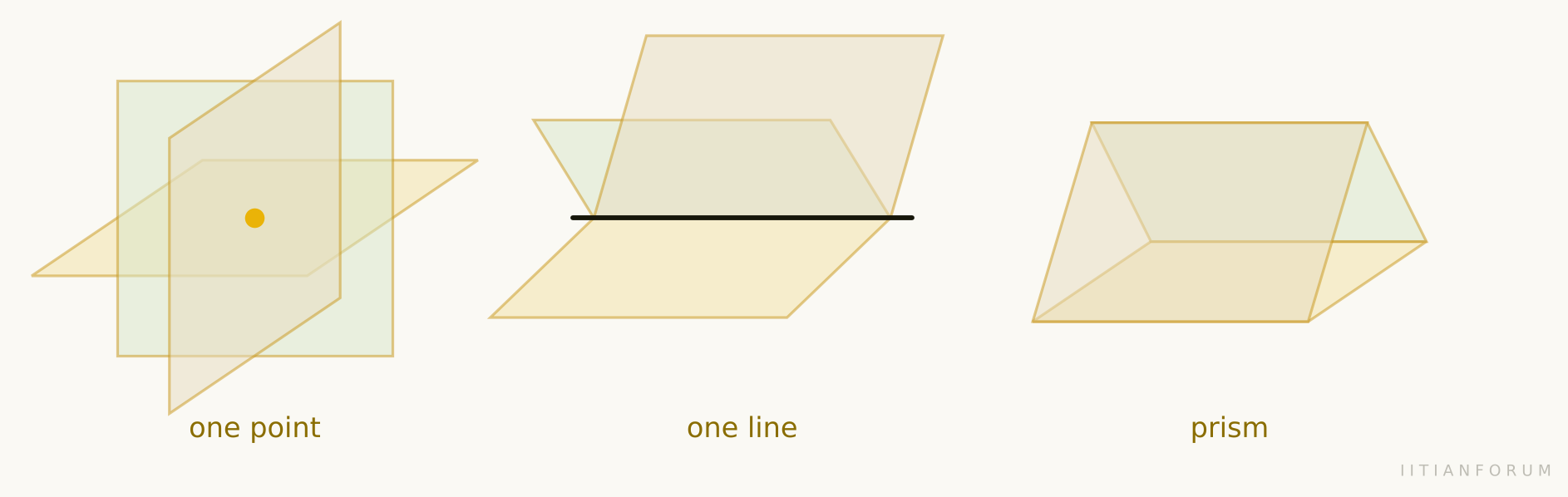
Three planes with normals n1, n2, n3 can meet in one point, in a common line, or not at all.
Three panels: three planes meeting at a single point, three planes sharing one common line, and three planes forming a triangular prism
Situation
Picture
n1n2n3=0
one common point
normals coplanar, third plane =pP1+qP2
one common line
normals coplanar, not a combination, no two parallel
triangular prism
two or more parallel
no common point
swipe for more →
The determinant test is the Determinants chapter again: the three equations have a unique solution exactly when the coefficient determinant is non-zero.
Example 38(IITianForum). Consider x+y+z=3, x−y+2z=1 and 3x+y+4z=k. Which is (are) correct?
(1) For k=7 the three planes have a common line
(2) For k=9 they form a triangular prism
(3) For some k they meet in exactly one point
(4) For k=7 the common line is parallel to (3,−1,−2)
▸ SHOW SOLUTION
Step 1. Determinant of the normals
1131−11124=0
So (3) is false for every k.
Step 2. The combination
(3,1,4)=2(1,1,1)+(1,−1,2)
The third plane is 2P1+P2 exactly when k=2⋅3+1=7. Then all three share a line; for k=7 no point lies on all three, and since no two normals are parallel, they form a prism.
Step 3. Direction of the common line
(1,1,1)×(1,−1,2)=(3,−1,−2)
Answer: (1), (2), (4)
Which result to use
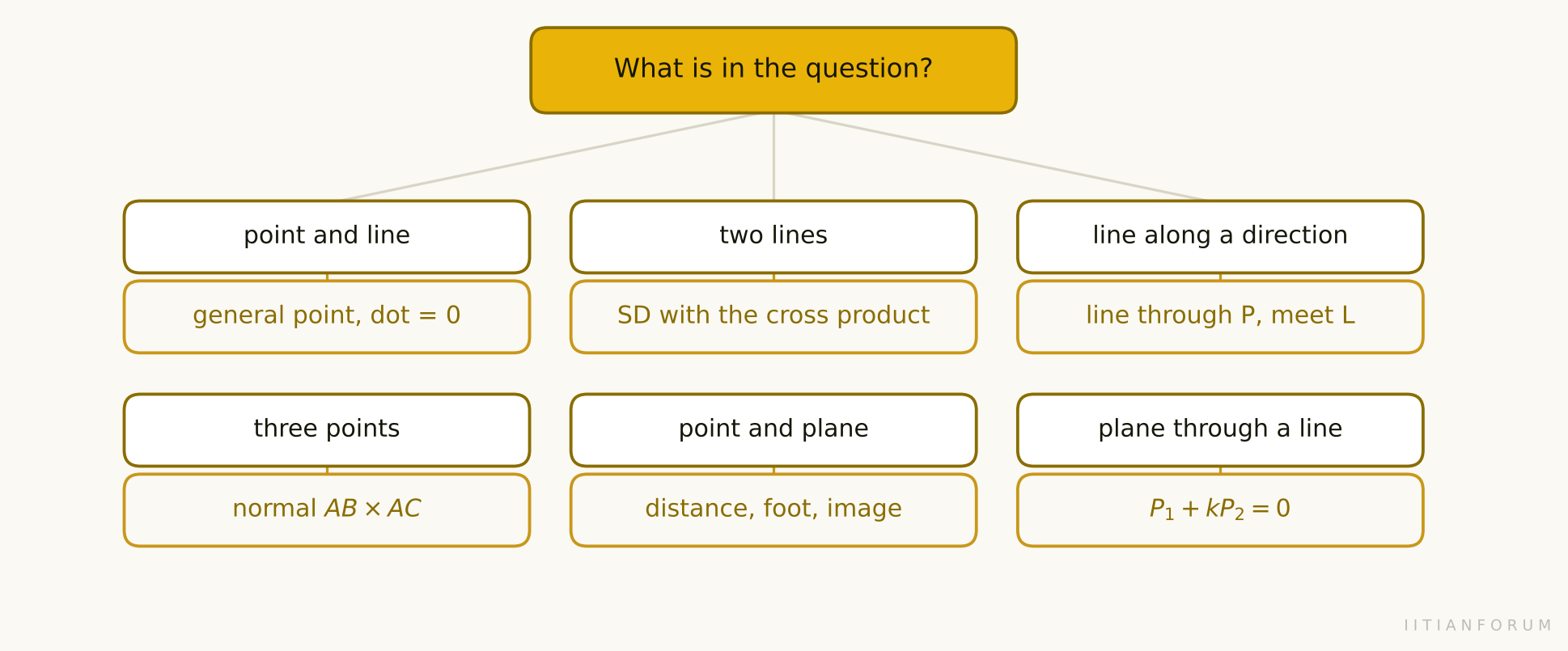
A decision chart: from the object in the question, arrows lead to the general point of a line, the foot condition, the cross product, the SD formula, the plane through three points, the point to plane distance, or the family of planes
The question gives you
Reach for
a point on a line at a given distance
general point, ∣λ∣∣d∣
perpendicular from a point to a line
PF⋅d=0, linear in λ
image in a line
foot, then P′=2F−P
distance along a direction
line through P in that direction, meet L
a line perpendicular to two lines
d1×d2
two lines, shortest distance
∣(a2−a1)⋅(b1×b2)∣/∣b1×b2∣
a transversal with known direction
general points on both, PQ∥d
three points of a plane
normal AB×AC
point and plane
distance formula, or foot and image with k
line and plane
d⋅n decides meet, parallel or inside
a plane through a given line
P1+kP2=0, or normal ⊥d
three planes
determinant of the normals
swipe for more →
What JEE asks now
Paper
Lines
Planes
JEE Main 2026, 19 shifts
about 30 questions
none
JEE Main 2025, 19 shifts
regular
none
JEE Advanced 2026
Paper 2: foot and orthocentre
Paper 1: plane through a line
swipe for more →
In the IITianForum syllabus the JEE Main unit covers everything up to and including lines that meet (with the coplanarity determinant) and the reflection of a line in a plane as a basic idea. The plane sections belong to the JEE Advanced unit.
In JEE Main 2026 the line questions fell into five types, in this order of frequency: foot and image in a line, shortest distance between lines, distance along a direction, lines that meet, and the line perpendicular to two lines. Every one of these types has a worked example above.
Quick recall
Result
Statement
Direction cosines
l2+m2+n2=1
General point
(x1+aλ,y1+bλ,z1+cλ)
Angle between lines
cosθ=∣d1∣∣d2∣∣d1⋅d2∣
Foot on a line
PF⋅d=0
Image in a line
P′=2F−P
Skew lines SD
∣b1×b2∣∣(a2−a1)⋅(b1×b2)∣
Parallel lines
∣b∣∣(a2−a1)×b∣
Plane
ax+by+cz+d=0, normal (a,b,c)
Point to plane
a2+b2+c2∣ax1+by1+cz1+d∣
Image in a plane
k=−2a2+b2+c2ax1+by1+cz1+d
Line and plane
sinφ=∣d∣∣n∣∣d⋅n∣
Family
P1+kP2=0
Coplanar lines
(a2−a1)⋅(d1×d2)=0
swipe for more →
Before you leave this chapter
Take the point (1,2,3) and the line 1x=1y=1z. Find the foot, the image and the distance without looking at anything above. Then do the same with the plane x+y+z=0. If both take under five minutes, the core of the chapter is yours.
Practise these methods on real exam questions in the doMath Three Dimensional Geometry chapter, and read the Vectors note alongside this one: the dot product, the cross product and the scalar triple product do all the work here.