JEE Main 2026 (28 Jan, Shift 1) Maths Analysis Chapter Weightage, Difficulty & Expected Cutoff
The 28 January 2026 morning shift was the toughest paper of the entire January session. The Mathematics section leaned firmly toward hard — ten of the 25 questions were difficult, spread across every unit, and only two were genuinely easy. Algebra and Calculus still carried the weightage, but this paper demanded stamina as much as skill.
Here is the full breakdown: what was asked, where the marks sat, how hard it really was, and roughly what a good attempt looked like.
The paper at a glance
| Field | Detail |
|---|---|
| Exam | JEE Main 2026 · 28 Jan · Shift 1 (Morning) |
| Questions | 25 (Q1–Q20 single-correct MCQ, Q21–Q25 numerical) |
| Marks | 100 (+4 correct, –1 wrong on MCQs; no negative on numericals) |
| Overall difficulty | Moderate, leaning tough |
| Biggest units | Algebra (36 marks) · Calculus (24 marks) |
| Toughest questions | Q6, Q9, Q14, Q24 |
| Answer key | Independently verified — no errors found |
Overall verdict
This shift gave students no cushion. With a 40% hard share and difficulty scattered through every unit — both Trigonometry questions were hard, four of five numericals were hard, and even Section A carried six hard problems — time-management and composure decided the outcome. The two easy marks (Q8 cubics, Q17 linked APs) and a solid medium band were the base to build on, but a strong score required cracking a few hard questions cleanly.
Secure the 2 easy + 13 medium questions first (that alone is a strong 60/100), then pick your battles among the 10 hard ones. Don't get anchored — Q6, Q9, Q14 and Q24 could each swallow ten minutes.
Unit-wise weightage
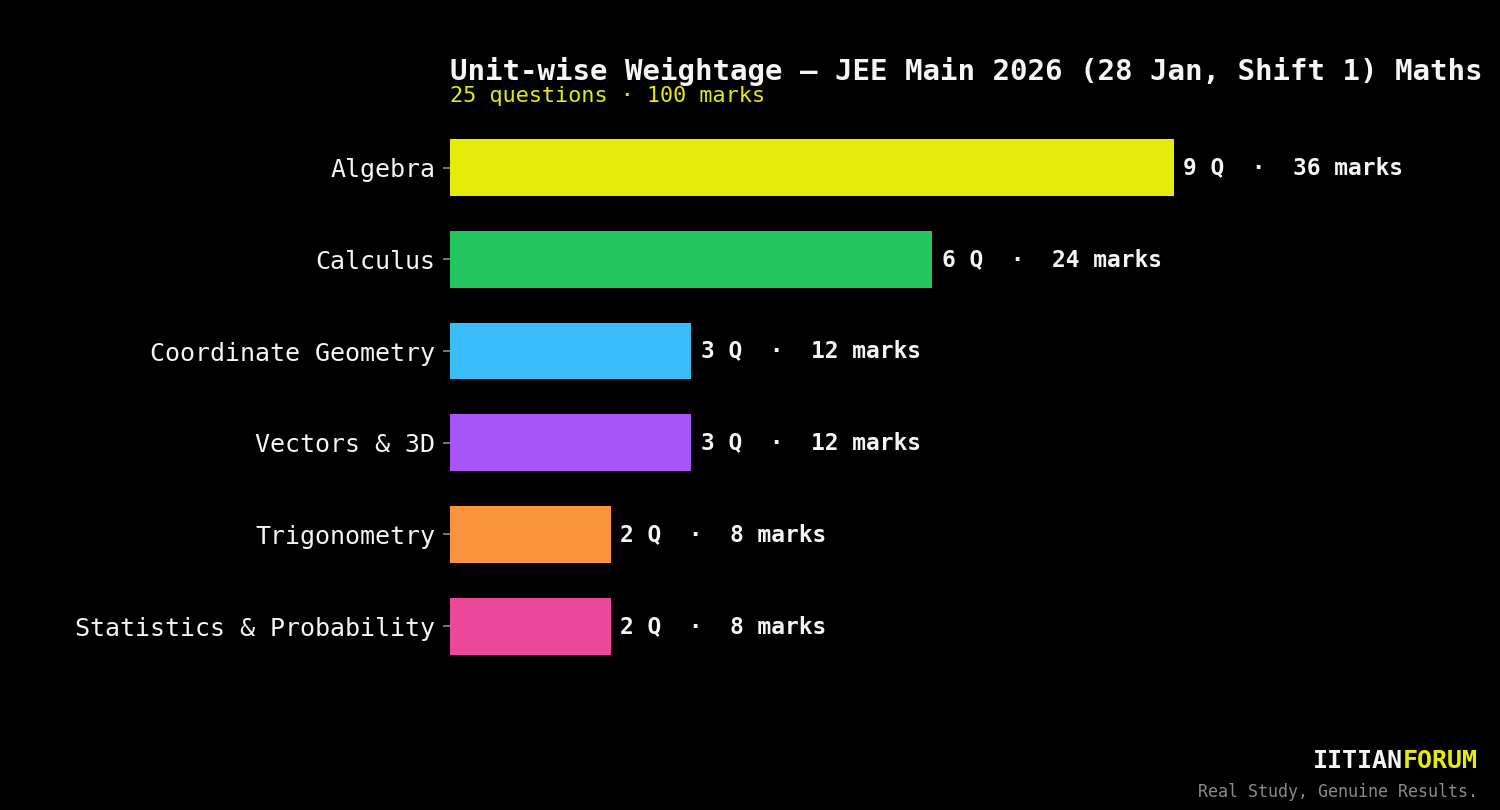
- Algebra — 9 questions · 36 marks. Three Sequences, two Theory of Equations, plus Functions, Complex Numbers, Permutations & Combinations and Matrices.
- Calculus — 6 questions · 24 marks. Two Definite Integration, Indefinite Integration, Area, a Limit and a Differential Equation.
- Coordinate Geometry — 3 questions · 12 marks. Circle, Straight Lines and Hyperbola — two of them hard.
- Vectors & 3D — 3 questions · 12 marks. Two vectors and one 3D problem.
- Trigonometry — 2 questions · 8 marks (both hard).
- Statistics & Probability — 2 questions · 8 marks.
Algebra + Calculus = 60 of 100 marks — the usual backbone, but harder than usual.
Chapter weightage
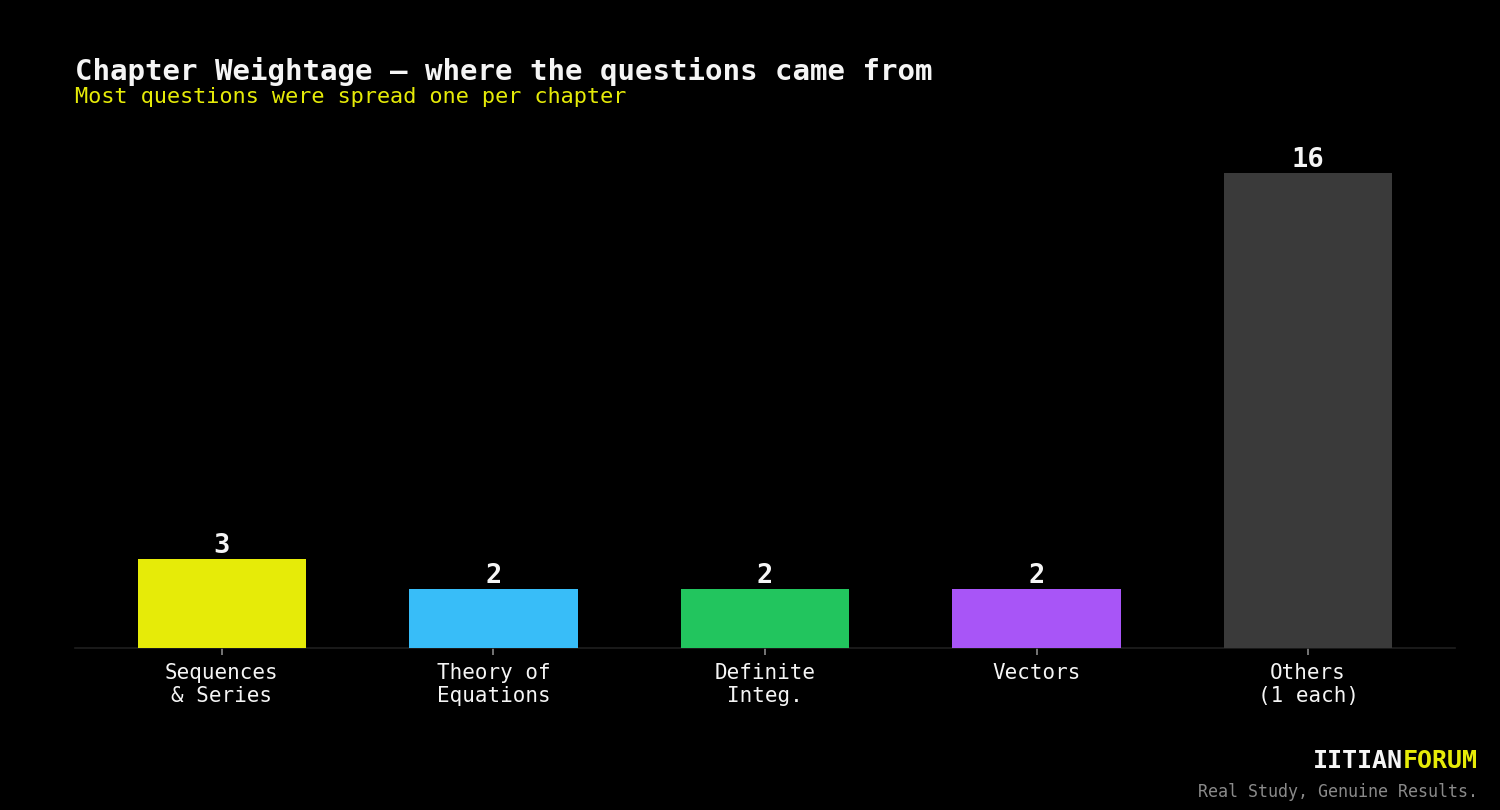
Sequences & Series led with three questions; Theory of Equations, Definite Integration and Vectors gave two each; 16 other chapters gave one apiece.
| Chapter | Questions | Marks |
|---|---|---|
| Sequences & Series | 3 | 12 |
| Theory of Equations | 2 | 8 |
| Definite Integration | 2 | 8 |
| Vectors | 2 | 8 |
| 16 other chapters | 1 each | 4 each |
Difficulty split
| Level | Questions | Share |
|---|---|---|
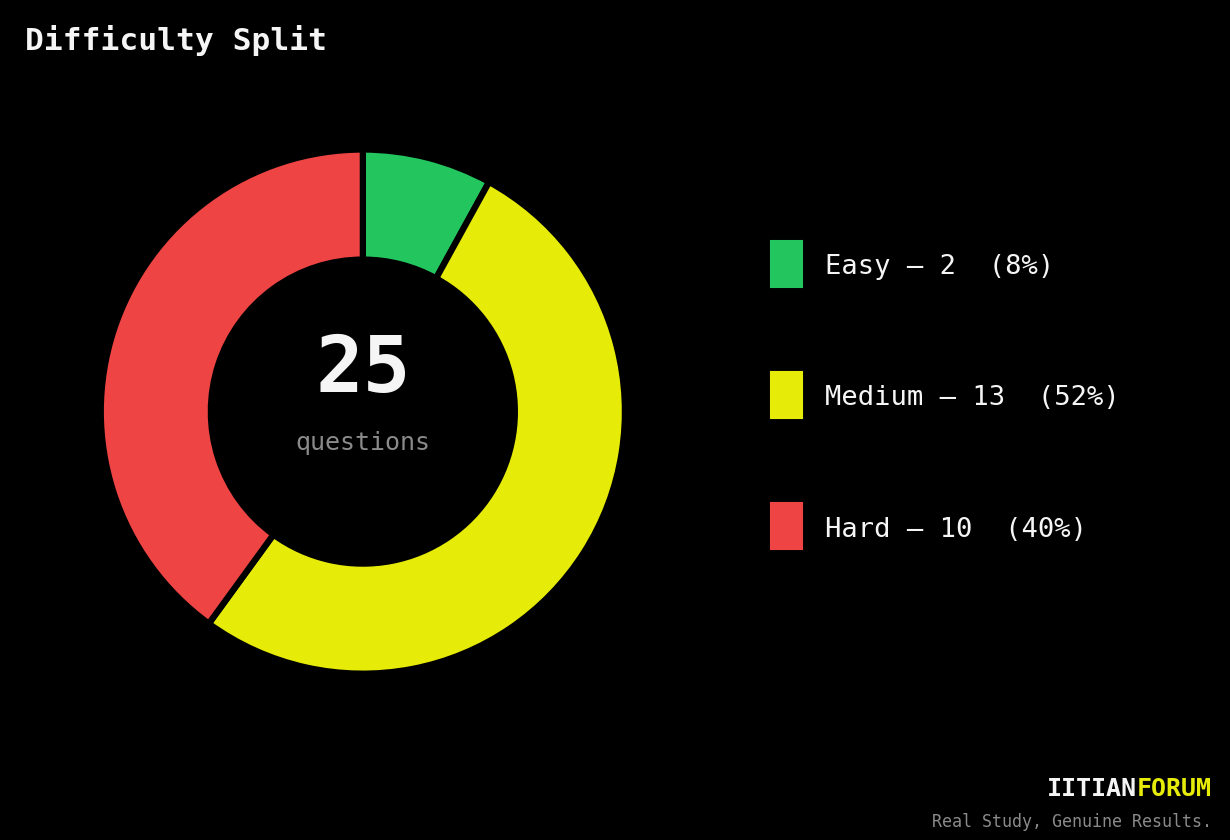
| Easy | 2 | 8% |
| Medium | 13 | 52% |
| Hard | 10 | 40% |
At 40% hard (DI 2.32), this was the steepest January shift. The difficulty wasn't confined to the numerical section — Section A alone carried six hard questions.
The four questions that decided the paper
Q6 — Equilateral triangle with orthocentre at the origin (Hard).
▸ SHOW SOLUTION
The altitude through is , and with . Solving with the correct side gives , , so and . Answer: (4).
Q9 — Bayes with a hockey-stick sum (Hard).
▸ SHOW SOLUTION
, using . Answer: (4).
Q14 — Limit with a product of secants (Hard).
▸ SHOW SOLUTION
The log-sum over a denominator ; the geometric sum gives . Answer: (3).
Q24 — King property + floor sum (Hard).
▸ SHOW SOLUTION
, so and . Summing gives . Answer: 210.
Every answer on this shift was independently re-derived and verified by IITIANFORUM — no key errors found. (Q20's printed initial condition was garbled; the worked solution uses y(2) = 0.)
Expected good attempt & cutoff read
Directional only — actual percentiles depend on normalisation across shifts:
- Excellent (top percentile): 20+ correct with clean numericals.
- Strong: 16–19 correct.
- Safe: 12–15 correct bank every easy and medium question, then attempt the reachable hard ones.
Because this was the hardest January shift, expected cutoffs would sit a little lower than the gentler shifts but normalisation smooths this across the session.
What to take away for your prep
- A whole session can end tough. The last January shift was the hardest — never assume papers get easier.
- Sequences & Series was the top chapter (3 questions). AP/GP/series manipulation must be automatic.
- Trigonometry gave no easy marks here. Identities and inverse-trig both went hard — don't treat trig as a soft unit.
FAQ
How difficult was JEE Main 2026 Maths on 28 January Shift 1?
It was the toughest January shift - 10 of 25 questions hard (DI 2.32), with difficulty spread across every unit.
Which chapters had the highest weightage?
Sequences & Series (3 questions), followed by Theory of Equations, Definite Integration and Vectors (2 each). Algebra was the biggest unit at 36 marks.
What were the toughest questions?
Q6 (equilateral triangle, orthocentre), Q9 (Bayes with a hockey-stick sum), Q14 (product-of-secants limit) and Q24 (King-property floor sum).
Were there any errors in the answer key?
No — every answer was independently verified.
Want the fully worked, step-by-step solution to all 25 questions of this shift? Practise these exact chapters on IITIANFORUM and download the complete verified solutions PDF below.
Enter your email to get the download.
Ritesh Raj
Founder and Lead Mentor at IITian Forum. M.Sc Mathematics, IIT Delhi. 500+ students mentored for JEE and Olympiad mathematics.