ParabolamediumFree
Parabola: Parabola Given 2xy
JEE Maths question with a full step-by-step solution.
A parabola is given by . Then
AIts focus is correct
BIts focus is
CIts directrix is correct
DIts directrix is
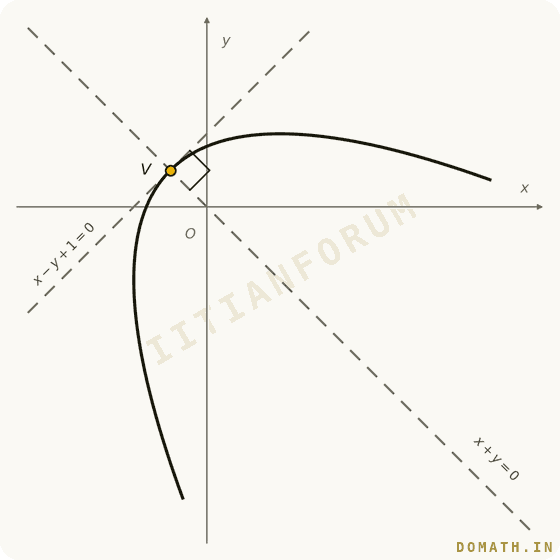 Step 1: Grouping the terms,
The lines and are perpendicular, so this is a parabola with a tilted axis.
Step 2: Divide each linear form by , so that it measures a distance.
With and
,
Step 3: This is in the rotated frame
Step 4: The vertex is , i.e. the intersection of and :
Step 5: The focus is at a distance from the vertex along the axis, in the direction of
increasing , which is the unit normal of the line :
So (A) is true, and (2) names the vertex, not the focus, so it is false.
Step 6: The directrix is , i.e.
So (3) is true and (4) is false.
Step 7: Check with the focus-directrix definition at the vertex: the distance from
to is , and its distance from
is . Equal, as required.
Answer: (1) and (3).
Parabola · easy
The Cartesian equation of the curve whose parametric equations are and is:
Parabola · easy
If is the directrix of the parabola , then the value of is:
Parabola · easy
The locus of the centroid of the triangle formed by a tangent to the parabola with the coordinate axes is:
Parabola · easy
If and the line passes through the points of intersection of the parabolas and , then:
Solve more, learn faster
Sign up free to solve more JEE Maths questions and explore doMath — timed drills, mastery sprints, bookmarks, and chapter-wise progress tracking.