Definite IntegrationhardFree

Definite Integration: Let Continuous Function Maximum

JEE Maths question with a full step-by-step solution.

Question
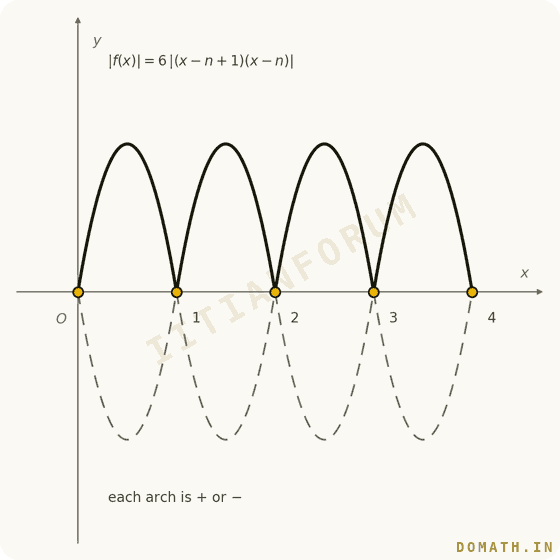
Let f:[0,4]Rf:\left[0,4\right]\to\mathbb R be a continuous function such thatf(x)=6(xn+1)(xn)\left|f(x)\right| = 6\left|\left(x-n+1\right)\left(x-n\right)\right|, where nNn \in \mathbb N x[n1,n]\forall\,x \in \left[n-1,n\right], and g(x)=0xf(t)dtx4f(t)dtg(x) = \displaystyle\int_0^xf(t)\,dt-\int_x^4f(t)\,dt has its maximum at x=2x = 2. Then 1/24f(t)dt\displaystyle\int_{1/2}^{4}f(t)\,dt is/are
A12-\dfrac12correct
B00
C12\dfrac12
D11
Solution
Question attachment Step 1:
g(x)=f(x)(f(x))=2f(x)g'(x) = f(x)-\left(-f(x)\right) = 2f(x)
So gg increases where f>0f>0 and decreases where f<0f<0. Step 2: On each [n1,n]\left[n-1,n\right] the product (xn+1)(xn)\left(x-n+1\right)\left(x-n\right) is 0\le0, and f>0\left|f\right|>0 on the open interval, so the continuous ff cannot change sign inside it:
f(x)=εn(6(xn+1)(xn)),εn=±1f(x) = \varepsilon_n\cdot\left(-6\left(x-n+1\right)\left(x-n\right)\right),\qquad \varepsilon_n = \pm1
which is εn\varepsilon_n times a non-negative arch vanishing at both endpoints. Continuity at the integers is automatic, because every arch vanishes there. Step 3: Putting u=xn+1[0,1]u = x-n+1 \in \left[0,1\right],
n1n(6(xn+1)(xn))dx=601u(u1)du=6(1312)=1\int_{n-1}^{n}\left(-6\left(x-n+1\right)\left(x-n\right)\right)dx = -6\int_0^1u\left(u-1\right)du = -6\left(\frac13-\frac12\right) = 1
So n1nf=εn\displaystyle\int_{n-1}^{n}f = \varepsilon_n and g(n)g(n1)=2εng(n)-g(n-1) = 2\varepsilon_n. Step 4: If ε2=1\varepsilon_2 = -1 then g(1)=g(2)+2>g(2)g(1) = g(2)+2>g(2), and if ε3=+1\varepsilon_3 = +1 then g(3)=g(2)+2>g(2)g(3) = g(2)+2>g(2); both are impossible, so ε2=+1\varepsilon_2 = +1 and ε3=1\varepsilon_3 = -1. With those fixed, ε1=1\varepsilon_1 = -1 would give g(0)=g(1)+2=g(2)g(0) = g(1)+2 = g(2) and ε4=+1\varepsilon_4 = +1 would give g(4)=g(3)+2=g(2)g(4) = g(3)+2 = g(2), ties at which x=2x = 2 is no longer the maximum. Hence
ε1=ε2=+1,ε3=ε4=1\varepsilon_1 = \varepsilon_2 = +1 ,\qquad \varepsilon_3 = \varepsilon_4 = -1
That is, f0f \ge 0 on [0,2]\left[0,2\right] and f0f \le 0 on [2,4]\left[2,4\right]. Step 5:
1/21f=1/21(6x(x1))dx=6[x33x22]1/21=12\int_{1/2}^{1}f = \int_{1/2}^{1}\left(-6x\left(x-1\right)\right)dx = -6\left[\frac{x^3}3-\frac{x^2}2\right]_{1/2}^{1} = \frac12
Step 6:
1/24f=12+ε2+ε3+ε4=12+111=12\int_{1/2}^{4}f = \frac12+\varepsilon_2+\varepsilon_3+\varepsilon_4 = \frac12+1-1-1 = -\frac12
Answer: (1)
Still stuck on this question?Ask your doubt on WhatsApp
Similar questions

Solve more, learn faster

Sign up free to solve more JEE Maths questions and explore doMath — timed drills, mastery sprints, bookmarks, and chapter-wise progress tracking.